
PART ONE

NORMANS AND ANGEVINS
CHAPTER 1
‘The friend of piety and the soother of distress’
Matilda of Flanders never expected to be Queen of England. Initially, she was not much attracted to the idea of becoming Duchess of Normandy. A story in the Chronicle of Tours claims that when she learned Duke William of Normandy had proposed for her, she angrily declared she would never marry a bastard, upon which William forced himself into her bedroom in Bruges and soundly beat her. Another version has the illegitimate Duke dragging her from her horse and pursuing his rough courtship in the roadside mud. Matilda was apparently so overcome by this display of macho passion that she took to her bed and announced she would never marry anyone else. The tale ‘may be regarded of more interest to the student of psychology than the student of history’,1 but as with many interpretations of medieval history, what contemporaries could believe had happened is sometimes as revealing as what actually did.
Matilda was descended from Charlemagne and the Saxon king Alfred the Great and her mother, Adela, was a daughter of the King of France. Her prospective husband may have been a duke, but his title gentrified a family that was only a few generations’ distance from Viking marauders, whereas her own paternal line, the counts of Flanders, had ruled since the ninth century. But if Matilda objected to the match, her father, Count Baldwin IV, saw a Norman alliance as a contribution to Flanders’ growing status as a political power. In the end, that alliance was to become more profitable than the Count could ever have imagined.
Yet when William and Matilda were betrothed in 1049, the status of both Duke and duchy might have made any bride apprehensive. The rights of the dukes of Normandy had been recognised in the early tenth century and William was a direct descendant of the duchy’s first ruler, Rolf the Viking. After a splendid career of raiding and pillaging in France, Scotland and Ireland, Rolf (or Rollo) was baptised by the Archbishop of Rouen some time before 918 and settled down to a new life as a Christian ruler. Five generations later, in 1034, Duke Robert, William’s father, felt sufficiently detached from his pagan ancestors to set off on a pilgrimage to Jerusalem. He died on his return journey in 1035, leaving a seven-year-old boy as his heir.
The first years of William’s minority rule saw a catalogue of anarchic and brutal violence. The Archbishop of Rouen, Count Alan of Brittany and the lords Osbern and Turold had been appointed guardians to the boy, but the Archbishop died in 1037, followed by Count Alan in 1040. The Count’s replacement, Gilbert of Brionne, was murdered a few months later by assassins in the pay of the Archbishop’s son. Turold was killed at the same time. Then Osbern, who acted as William’s steward, ‘unexpectedly had his throat cut one night . . . while he and the Duke were sound asleep in the Duke’s chamber at Vaudreuil’.2 The homicidal avarice of competing factions of the Norman nobility keen to take advantage of William’s weakness to seize lands and power for themselves instilled such fear in the boy duke of the treachery within his own household that he was often reduced to sheltering in peasants’ cottages.
William’s personal survival was dependent mainly on the historical relationship between Normandy and the kings of France. The Norman dukes had been vassals of the kings since 968, and in 1031 King Henry I, Matilda’s maternal uncle, had taken refuge at Rouen during a period of civil war. With the help of William’s grandfather, Duke Richard II, he had managed to recover his kingdom. When, after a decade of bloody skirmishes, war broke out in Normandy in 1046, William appealed to Henry. Together they fought the first significant battle of William’s distinguished military career, at Val-es-Dunes near Caen in 1047, against a rebel army led by William’s cousin Guy of Burgundy. William won, but for the next thirteen years he was to find himself almost constantly at war.
The marriage between William and Matilda took place towards the end of 1051. In the beginning it was surrounded by controversy. Although it had been planned in 1049, the match was banned in the autumn of that year by Pope Leo IX at the Council of Reims on the grounds of consanguinity. Christian marriage as it was to be understood by future generations was a relatively new invention in the eleventh century, and as part of increasing reforms the Church was anxious to turn a custom into a regulated institution. Canon law forbade the union of individuals who were related in certain ‘prohibited degrees’, and William and Matilda were fifth cousins. Family connections were further complicated by a marriage contract between Matilda’s mother, Adela, and Duke Richard III of Normandy, William’s uncle, before her marriage to Count Baldwin (pre-contract was another invalidating factor), and by the fact that after the death of Matilda’s grandmother, Ogiva, her grandfather, Baldwin IV, had taken as his second wife Eleanor, a daughter of Duke Richard II of Normandy. Another theory relating to the papal objection is that Matilda herself was already married, to a man named Gerbod, by whom she had a daughter, Gundrada, who eventually became the wife of William of Warenne, first Earl of Surrey. This story has, however, been dismissed as ‘in the highest degree impossible’.3 Nevertheless, the union did not receive a retrospective papal sanction, from Nicholas II, until the second Lateran Council of 1059.
According to the chronicler William of Jumièges, Matilda’s parents, Adela and Baldwin, did not consummate their marriage until 1031, which suggests that Matilda could have been no older than about nineteen when she married William. Since there is no evidence that she was the eldest of their four children, she might well have been considerably younger. Whatever her personal opinion of the match, both her father and her bridegroom were sufficiently keen on it to defy papal sanction, and Count Baldwin brought his daughter to Eu, where the wedding was celebrated. Afterwards the ducal couple travelled together to Rouen.
What were the motivations behind William and Count Baldwin’s arrangement? Matilda’s father was in the process of reorienting his small but strategically important country with the aim of distancing it from the German-controlled Holy Roman empire and forging stronger links with France, as evinced by his own marriage to the French princess Adela. Having become one of the principal vassals of the King of France, he saw his ambitions further consolidated by the marriage of Matilda’s brother Baldwin to Richildis, the widow of the Count of Hainault, in 1049. Having fought unsuccessfully against Flanders in the settlement of Richildis’s inheritance, and concerned by constant skirmishing along the Flemish-German border, the German Emperor, Henry III, was apprehensive about a Norman-Flemish alliance which would diminish his influence still further. (Since the current pope, Leo IX, owed his throne to the Emperor, it is unsurprising that he agreed to return the favour by opposing the marriage between William and Matilda.) Normandy could also prove a powerful ally against the English crown, which was at the time hostile to Flanders: King Edward had summoned a fleet to serve against Count Baldwin on the Emperor’s side if necessary. In his turn, Duke William was conscious of his own hitherto vulnerable position, dependent as he was on the continued cultivation of the goodwill of the French King and a small group of loyal aristocrats. He was frequently in conflict with the lords of Arques, Ponthieu and the Vexin, who periodically aligned themselves with Count Eustace of Boulogne, one of Count Baldwin’s most rebellious vassals. The marriage with Matilda would thus provide both William and Baldwin with a mutual reinforcement of power to subdue the rebels whose territories lay between their lands. Further, it has been suggested that Matilda’s impeccable bloodline went some way to enhancing William’s own prestige and eradicating the stain of his illegitimacy.
That William was known to his contemporaries as ‘the Bastard’ and not ‘the Conqueror’ is not in doubt, but the implications of this status in terms of the eleventh century need to be examined carefully. The chronicler Orderic Vitalis’s claim that William ‘as a bastard was despised by the native nobility’ may be dismissed as an anachronistic judgement from a later age. Contemporary perceptions did not necessarily stigmatise or even fully recognise illegitimacy. The regularisation of ecclesiastical marriage was still very much an ongoing process, and William’s grandfather, Duke Richard II, had been the first of the line to make a Christian marriage, at the turn of the previous century. His sons continued to take concubines, as was still the prevailing custom, and William’s father, Duke Robert, did not make a dynastic marriage. His concubine Herleva of Falaise, William’s mother, was the daughter of Fulbert, ‘the chamberlain’, which was not necessarily a high office at the time. That William was sensitive on the subject of his birth was clearly known, as the soldiers of Alencon were to find to their cost, but this may have been more to do with his maternal grandfather’s profession than his mother’s unmarried status. Fulbert was a skinner, though he appears in some accounts as a ‘pollinctor’, which in Roman usage meant undertaker. When William besieged the castle of Alenccon, the troops ‘had beaten pelts and furs in order to insult the duke’4with his grandfather’s dirty, menial origins. William had the hands and feet cut off thirty-two of them.
(The ancestry of the English kings was, incidentally, still good for a giggle a century later. Henry II, having quarrelled with the bishop of Lincoln, refused to greet him at a picnic one day. The King was mending a leather bandage on his finger with a needle and thread and the bishop, daringly trying to amuse him, remarked: ‘How like your cousins of Falaise you do look.’ Luckily for the bishop, Henry fell about laughing.5)
Norman chroniclers do display discomfort with William’s birth, as well as with his defiance of the papal ban on his marriage. Flouting the authority of the Pope was a highly risky form of disobedience, since it could provide rebels in the duchy with a religious sanction for political disloyalty. William, however, had been dodging traitors for most of his life, he was a brilliant military strategist and he was possessed of an extremely powerful will. William of Malmesbury recounts how, in the aftermath of his mother’s life-threatening labour, the newborn William was left on the floor of Herleva’s room while she was cared for. The tiny baby grabbed at the rushes covering the floor with such strength that his attendants predicted he would ‘become a mighty man, ready to acquire everything within his reach, and that which he acquired he would with a strong hand steadfastly maintain against all challengers’.6 So William wanted Matilda of Flanders badly enough to defy the Pope, and he got her.
The prestige of Matilda’s ancestry was obviously considered a sufficient compensation for someone of William’s relatively uncertain status, as she brought no dowry of land or titles to the union. The desirability of an elite bride was based on the power of her male relations, her wealth and her lineage, and the first two attributes did not necessarily outweigh the third. Ancestry -specifically maternal ancestry - was also to be the principal factor in the choice of the next English queen, the bride of Matilda’s son Henry.
At the time of their marriage, William was in his early twenties and Matilda, as has been noted, probably in her late teens. He was a tall man by the standards of the day, about five feet ten, clean shaven and short-haired in the Norman style. Matilda, by contrast, was tiny, just four feet two inches tall. William of Jumièges describes ‘a very beautiful and noble girl of royal stock’ while Orderic Vitalis declared that she was ‘even more distinguished for the purity of her mind and manners than for her illustrious lineage . . . She united beauty with gentle breeding and all the graces of Christian holiness.’ Conventional tributes such as these appear so frequently that it is difficult to attach much real meaning to them, but William and Matilda were sufficiently attracted to one another for their first child, Robert, to be born within three years of the wedding. They would go on to have three more sons and at least five daughters. Accounts concur that the marriage was happy, and that very happiness was crucially to affect the structure of political power in Normandy and, eventually, in England.
Aristocratic marriages were not made in the expectation of affection. Matrimony was the primary means of advancing family and dynastic interests. A woman of Matilda’s status was required to marry as the concerns of her family directed, but this did not mean she would be merely handed about Europe like a diplomatic doll. All eleventh-century politics were family politics, and political legitimacy was dependent not only on military power but on claims of blood, and therefore on women. A particular emphasis was placed in dynastic marriages on the role of the wife as a ‘peace-weaver’, a mediator or intercessor. In the Anglo-Saxon poem ‘Beowulf a match is arranged between the children of two enemies, Hrothgar and Froda, ‘to settle with the woman a part of his deadly feuds and struggles’. Even if women were no longer carried off as booty from the battlefield as they had been a few centuries previously, in an extremely violent society the grace and good manners of an aristocratic wife were vital to the domestic interactions of powerful men:
The woman must excel as one cherished among her people and be buoyant of mood, keep confidences, be open-heartedly generous with horses and with treasures, in deliberation over the mead, in the presence of the troop of companions, she must always and everywhere greet first the chief of those princes and instantly offer the chalice to her lord’s hand, and she must know what is prudent for them both as rulers of the hall.7
The country where Matilda had grown up was considered an extraordinarily violent region even by the standards of the time. In comparison with France and England it was a primitive, backward area - Dudo of St Quentin claimed that when the Scandinavians were offered the province by Charles the Simple, they rejected it in favour of Normandy. A twelfth-century account, The Life of St Arnulf, describes the state of Flanders in the eleventh century: ‘Daily homicides and spilling of human blood had troubled the peace and quiet of the entire area. Thus a great number of nobles, through the force of their prayers, convinced the bishop of the lord to visit the places where this atrocious cruelty especially raged and to instruct the docile and bloody spirit of the Flemings in the interest of peace and concord.’8 These turbulent conditions hampered development. No town had a population more than 5,000 and there were few stone buildings. Nevertheless, the mid-eleventh century saw the beginning of an increasing prosperity which would make Flanders one of the most important European centres of commerce and culture in the centuries to come. By the fifteenth century, it was ‘completely founded on the fact and course of merchandise’9 and the centre of mercantile activity was Bruges, already in Matilda’s time a key port. In 1037, her parents had been in the city to greet a famous visitor, the exiled Queen Emma of England.
A dynastic connection between Flanders and England had been established in the ninth century. Judith, the daughter of Charles the Bald, became England’s first consecrated queen in 856 on her marriage to Aethelwulf, King of the West Saxons. After Aethelwulf’s death, Judith was briefly married to her own stepson before eloping with Baldwin ‘Iron Arm’, the first Count of Flanders. Their son, Baldwin II, married Aelfthryth of England, a daughter of Alfred the Great, the first monarch to be recognised as ruler of all England. Matilda was descended from both England’s first anointed queen and one of its greatest kings.
When Emma, daughter of Duke Richard I of Normandy, married Aethelred of England nearly 150 years later, she was able to take advantage of the growing customary power attached to the role of queen. In 973, Aelfthryth, her mother-in-law, had been consecrated, and after her death the new queen became ‘the axis around which English politics turned’.10 Extraordinarily, Emma was crowned queen twice, as after Aethelred’s death she married Cnut of Denmark, who reigned from 1016 to 1035. The conflicts between the children of these two marriages led to Emma’s exile in Flanders and formed the background to Matilda’s own coronation as queen of England.
Emma’s marriage to Aethelred was influenced by the Viking descent of the Norman dynasty. Within a century of the 911 grant of Normandy to Rolf the Viking, Scandinavian language and customs had largely died out, and the duchy was Christian, but the Normans retained some loyalty to their seafaring, pillaging cousins. In 996, Richer of Reims was still referring to the Norman duke as ‘pyratum dux’ and in the year 1000 a Viking fleet was permitted to shelter over the winter in Normandy before crossing the Channel to raid England in the spring. As late as 1014, a pagan horde led by Olaf and Lacman was received in Rouen to recover from its exertions in laying waste to a large area of north-western Gaul. The alliance created by Emma’s marriage put a stop to such attacks on England, at least temporarily. By 1013, England was again under threat from a Danish force, and Aethelred, Emma and their sons, Edward and Alfred, took refuge in Normandy as the invaders swiftly overcame the north and east. Aethelred returned in 1014, but died two years later, in April 1016. As well as his two children with Emma, he left an elder son, Edmund, by his first wife. Edmund, who became known as ‘Ironside’ for his fierce resistance to the Danes, succeeded in driving the invaders north of the Thames, whereupon it was agreed that the kingdom would be thus partitioned. But Edmund himself died in November 1016 leaving Cnut, the newly elected Danish ruler, as king of England. The following summer, Cnut married Emma. He also had two children with an Englishwoman, Aelfgifu, Swain and Harold ‘Harefoot’. It was decided that the rights of the couple’s previous children should be waived in favour of a son from the new marriage, and a boy, Harthacnut, obligingly appeared.
Emma is the first and only pre-Conquest English queen of whom an image survives. In the Liber Vitae of the New Minster, Winchester, Cnut and Emma present a gold cross to the abbey. Emma wears a diadem and is styled ‘Regina’. Her biographer sees the illustration as especially important in the development of queenship, noting the ‘special status of the king’s wife, as queen, that is as a consecrated person and as an office holder’.11 Until she became queen dowager, Emma was the richest woman in England, and established herself as a leading patron, commissioning illuminated manuscripts from Peterborough and her own (highly flattering) life story, the Encomium Emmae Reginae. In the frontispiece to this work, Emma is shown crowned and seated on a throne beside her sons Edward and Harthacnut, but her figure is larger than theirs. Enthronement is quite uncommon in eleventh-century representations, usually reserved for Christ or other heavenly figures and only just beginning to be used for kings. Emma proved herself adept at managing the new status that the illustrations accord her, succeeding in placing both Harthacnut and Edward on the English throne.
When Cnut died in 1035, Emma suffered a blow to her ambitions when Harold Harefoot was chosen as regent while Harthacnut was absent in Denmark. Emma was able to maintain control for a time in the old capital of Winchester, where she retained Cnut’s treasure and was supported by Godwin, Earl of Wessex, who had become Cnut’s most trusted adviser. Her sons by Aethelred, Edward and Alfred, chose this moment to sail from Normandy, where they had remained in exile following their father’s death. Harold Harefoot did not even pretend to believe their claim that this was an innocent visit to their mother. Edward was prevented from landing at Southampton, but Alfred managed to get to Dover. At this point Earl Godwin switched his allegiance from Emma to Harold Harefoot and Alfred, ‘the blameless Aetheling’*, was murdered at Ely.12 The Anglo-Saxon Chronicle reports what happened next: ‘Here Harold was everywhere chosen as king and Harthacnut forsaken because he was too long in Denmark, and his mother . . . was driven out without any mercy to face the raging winter; and she then came beyond the sea to Bruges, and there Earl Baldwin received her well.’13
The Encomium Emmae gives a fuller description of Emma’s presence at Bruges, which suggests something of the city Matilda knew as a child: ‘The latter town is inhabited by Flemish settlers and enjoys very great fame for the number of its merchants and for its affluence in all things upon which mankind places the greatest value. Here indeed [Emma] was . . . honourably received by Baldwin, the marquis [sic] of that same province and by his wife.’
Emma was active in Bruges, working to establish Harthacnut’s right to the throne. In 1039 he finally arrived, with a large fleet, to join her and they spent the winter as Count Baldwin’s guests. When Harold Harefoot conveniently died in the spring of 1040, Emma and Harthacnut returned triumphantly to England. For two years, she once again enjoyed power as Mater Regis (queen mother), until Harthacnut died after a drinking session at a wedding celebration in Lambeth in 1042. Emma had always championed him above her other sons, but now she was obliged to negotiate a relationship with Edward, who had joined his younger brother in dual kingship a year earlier, and now became sole ruler of England. According to The Anglo-Saxon Chronicle, Edward had a low opinion of his mother’s wavering loyalties, and deprived her of most of her wealth. Emma died at Winchester in 1052, just after Matilda of Flanders became Duchess of Normandy.
Matilda was perhaps no more than a tiny child when Emma visited Bruges, and there is no evidence that the Queen of England saw her, though, given the length of Emma’s stay and the ‘honourable’ reception she received from Count Baldwin and Countess Adela, it is perfectly plausible that she was presented to their children. The triangular political relationships between Normandy, Flanders and England continued in the next decades, and Emma set a powerful example of what a politically astute and determined woman could achieve. She had effectively governed as regent in Wessex during Harthacnut’s absence in Denmark, she had obtained wealth and position as a patron, and though her life ended rather flatly, she did live to see two of her sons crowned king.
Very little is known of Matilda’s childhood in Flanders, but Queen Emma was not the only influential woman from whom she might have drawn an example. The last centuries of the first millennium witnessed an extraordinary concentration of women’s poweras part of the emerging dominance of the Christian church. Royal abbesses were at the forefront of the new monastic movement, both as a trans-European phenomenon and in the country of which Matilda would eventually be queen, where it is estimated that fifty religious houses appointed their first abbess from a royal family. Royal blood was an ‘essential prerequisite’ for sanctity.14 Bede’s eighth-century Ecclesiastical History observes the vital role played by Saxon women in the conversion of their male kin to Christianity, enumerating royal missionaries such as Bertha, wife of the Kentish King Aethelred; her daughter Aethelburh, who married and converted King Edwin of Northumbria; Eanflaed, Edwin’s daughter, and Hilda, his great-niece. The foundation and patronage of abbeys was a potent symbol of royal authority, and far from being a retreat from the world, the religious life offered women an active role in dignifying the lineage of their houses. ‘The holiness of such women redounded to the honour of their male kin and the lineage they shared . . . a daughter or a sister in a convent was not a woman “disposed of”, but a woman put to work to add sanctity and legitimacy to newly, often nefariously acquired lordships.’15
A strong connection between the religious life and female scholarship was also current at the time. It was suggested to Matilda’s daughter, Adela of Blois, that learning was one way in which daughters could surpass their fathers, devoting their leisure to cultivating knowledge and a love of books. Early education was very much a domestic, maternal responsibility, and one that was taken seriously. Throughout the medieval period, an extensive clerical literature advises mothers on proper childcare and education and as early as Asser’s ninth-century Life of King Alfred, this was emphasised in Saxon England. The writer notes that ‘with shame be it spoken, by the unworthy neglect of his parents . . . [Alfred] remained illiterate even till he was twelve years old or more’. But Alfred’s mother, Osburgh, ‘a religious woman, noble by birth and by nature’, gave Alfred and his brother a book of Saxon poetry, saying, ‘Whichever of you shall the soonest learn this volume shall have it for his own.’ When Alfred succeeds, his mother ‘smiles with satisfaction’.
The cult of the Virgin, which was to play such a resonant part in contemporary conceptions of medieval queenship, also connected royalty, sanctity and learning. An engraving from ninth-century Mercia shows the Queen of Heaven holding a book, connecting three dynamics which were to be central to Matilda’s own conduct and the manner in which she raised her children. The northern, pagan concept of the queen as wise and judicious counsellor to her husband was absorbed, in Christian education, into St Paul’s edict in I Corinthians on the duty of wives to influence their ‘unbelieving husbands’ - an obligation adopted by Matilda’s Saxon predecessors with evident success. There was a new tension between the dynamic, evangelising role of the queen as a source and symbol of sacred power and the injunction, also found in St Paul, that Christian wives should be meek, passive and silent. Later stipulations on the education of women suggest that Matilda would also have been exposed to this new conception of her wifely role. In the influential manual The Book of the Knight of the Tower, Geoffrey de la Tour-Landry suggested that women’s learning should be limited ‘to the virtuous things of scripture, wherefore they may better see and know their salvation’. The fifteenth-century commentator Bartholomew Granville16 stressed the importance of deportment to the well-bred woman’s character. Her carriage should be erect, but her eyes modestly cast down; she should be ‘mannerly in clothing, sober in moving, wary in speaking, chaste in looking, honest in bearing, sad in going, shamefast among the people’. Writers from the end of the period such as Giles of Rome and Christine de Pisan concurred that spinning, sewing and embroidery were ideal activities to keep girls from idle and potentially sinful imaginings.
Extrapolating from these two slightly variant traditions, it is not possible to do more than give a sense of the intellectual atmosphere in which Matilda of Flanders was raised, though evidence of her character and activities can be stretched to support the theory that she was successful in creating a role combining both active pious queenship and suitably modest personal conduct. Literacy in Latin had been a notable feature of the Flemish court, and since Matilda’s daughters could certainly read the language, it seems likely that she too had some knowledge of it, which in turn suggests that her own mother had favoured a ‘royal’ education. Writing, however, was extremely uncommon among laywomen, and it is probable that Matilda, like her daughter-in-law, used a clerk for her letters. What other practical skills she acquired is not known, though the thirteenth-century French romance Silence suggests that appropriate accomplishments for girls of her class were music, particularly the harp and viol, and embroidery. Matilda’s daughter-in-law, Matilda of Scotland, was to be a patron and promoter of the skills of English needlewomen, and while the nineteenth-century writer Agnes Strickland’s assertion that the Bayeux Tapestry was made by Matilda of Flanders and her ladies has been proved false, Matilda did leave some fine work in her will, and her husband certainly patronised one Leofgeat of Wiltshire, who is recorded as making gold embroidery for the King’s use. Saxon needlework is one example of the cultural validation that was as essential to the Norman project of conquest as military might, in that the Anglo-Saxon past was reclaimed and absorbed into a new tradition.
However profound were the wider implications of such activities, there was much more to Matilda’s life than sitting around sewing. Aristocratic women were the principal managers of their family’s households and estates, particularly in a time when their men were often absent for long periods on campaign. Their effectiveness in applying themselves to a role that might be seen as the equivalent of running ‘a major business enterprise’17 is borne out by the frequency with which they were named as executrixes in widowhood. Whatever the precise details of Matilda of Flanders’ early training, it seems to have equipped her well for life as a ruling duchess and a successful, fully engaged consort.
Matilda appears as William’s consort in a charter to Holy Trinity in Rouen in 1053. By then, the marriage had directed an important change in William’s policy and family attitudes. As a minor, he had relied on the older generation for support, particularly his uncles, Mauger, archbishop of Rouen, and William of Arques. As William grew more confident and emotionally involved with Matilda, he began to redefine his family more intimately, in terms of his own growing children. In a pattern that would become a familiar problem to English princes, he also began to favour his own contemporaries over his senior relations. By 1052, both uncles were in open opposition to William and in 1053, William of Arques staged a revolt. Matilda was now faced with an experience common among aristocratic brides: a conflict between her husband and her natal family. William’s relationship with Matilda’s uncle, King Henry of France, had been an important motivation for their marriage, but this aspect of the alliance had turned sour when Henry reconciled with William’s arch-enemy Geoffrey, Count of Anjou. Normandy was now isolated between hostile Angevin and French territory, and Henry was keen to profit from dissent within the duchy. In response to his uncle’s opposition, William besieged the fortress of Arques, and Henry led a relief force to the rebels. William succeeded in forcing Henry to retreat, and William of Arques went into exile in Boulogne, where he died. Archbishop Mauger was obliged to retire after a Church council at Lisieux in 1054, and withdrew to Guernsey, but William’s difficulties with Henry continued.
The French King made another attempt on Normandy in 1054, sending a divided army to the north and south of the River Seine. William faced Henry in the south, sending his cousin Robert of Eu to confront the northern column. Robert achieved a spectacular victory at Mortemer and once again Henry was repelled, but he continued plotting with Geoffrey of Anjou and in 1057 Normandy was attacked yet again. The French and Angevin forces invaded from the south and pressed towards the Channel, laying waste to the countryside en route. William met them at the estuary of the River Dives at Varaville, where a high tide split the enemy forces. Their battalions cut in half, Henry and Geoffrey could only stand helplessly on the bank and watch as William massacred their army. Both Henry and Geoffrey died in 1060, by which point William had already begun a long campaign to secure Maine as a border province.
Such a compression of military events might give the impression that William and his peers spent most of their time hacking at one another on the battlefield, but this would be to misunderstand the nature of medieval warfare and to neglect the significant cultural and economic development of Normandy in the 1050s. Despite the near-permanent military commitments of the duke, he was not engaging in pitched battles on a regular basis. Europeans were notoriously cautious in war, as a twelfth-century Arab commentator noted,18 and it was prudence as much as bravery that won campaigns. So when diplomacy failed, siege warfare - taming the enemy by hunger and isolation, or strategies such as taking important hostages - was tried. Outright armed combat was avoided as far as possible: it was only as a last resort that a commander would risk his men’s lives in large numbers or, worse, that of his prince.
So while the Normandy Matilda knew was certainly dominated by her husband’s armed struggles to control his aristocracy and expand and secure his borders, it was able concurrently to develop peacefully and profitably. A distinct ‘Norman’, as opposed to Scandinavian or French, identity was becoming clearly established. The towns of Rouen, Bayeux and Caen were expanding - a Jewish community of artisans and merchants was founded in Caen around 1060 - and the duchy was profiting from the wine-growing regions to the south as tuns were shipped down the Seine to supply Britain and the north. There was also something of a religious revival. Normandy had been Christian as far back as the fifth century, but owing to the Viking incursions, by the first decades of the tenth, there were no monasteries remaining. William’s grandfather, Duke Richard, restored the monastery of St Michel in 965, and by the eleventh century, Benedictine abbeys were flourishing at Préaux, Lyre, Corneilles, Conches and St Georges-de-Boscherville, in addition to William and Matilda’s own foundations at Caen. St Stephen and Holy Trinity were created in response to the papal recognition of William and Matilda’s marriage in 1059. The papal edict was revoked on condition that William and Matilda each performed a penance of building and endowing a monastic house ‘where monks and nuns should zealously pray for their salvation’.19 Matilda’s foundation, Holy Trinity, was functioning under its first abbess (appropriately named Matilda), by the end of the year, with a choir of nuns to sing the daily offices. The abbey was finally consecrated in 1066.
That year is, of course, the one that everyone knows: 1066, the year of Hastings, the year that English history really ‘began’. Throughout the first fifteen years of Matilda’s marriage, the man-oeuvrings and manipulations that led to the battle of Hastings were fitting gradually into place. Edward the Confessor, the English King, had married Edith, the daughter of the powerful Earl Godwin, in 1045,but by 1051 the marriage was still childless. Having spent much of his life in Normandy, the King’s loyalties to the duchy were strong, and he began to build up a faction of Norman retainers at the English court, possibly as a check on Godwin’s influence. Nevertheless, in September 1051, Godwin was confident enough to openly defy Edward and events came to a head. The Godwin family was outlawed, Godwin himself fled to Flanders, continuing the tradition of the province as a refuge for disaffected English ambition, and Edward repudiated his wife, leaving the English throne without even the possibility of a successor.
Some historians accept that William of Normandy visited England at this juncture, and while there is very little reason to believe that such a visit took place, it is agreed that Edward offered William the English crown. Robert, the former abbot of Jurmèges in Normandy and subsequently, as part of Edward’s pro-Norman policy, archbishop of Canterbury, passed through Normandy on his way to Rome, bringing the promise of the succession and hostages to confirm it. (These hostages were Wulfnoth, Earl Godwin’s son, and Haakon, his grandson, and they were to remain in Normandy for thirteen years.) Later stories included the presentation of a ring and ceremonial sword. There were, however, other strong contenders for the throne. The children of Edward’s sister Godgifu, Countess of the Vexin, had an interest, as did the descendants of Edmund Ironside, whose son Edward ‘The Exile’ returned to the English court in 1057 but died shortly afterwards, leaving a son, Edgar Aetheling, as the claimant for the house of Wessex. And it was still possible that Edward might have children of his own.
In 1052, everything changed again. Godwin was begrudgingly restored to favour and Queen Edith was fetched out of the convent. Godwin died the following year, and his son Harold became Earl of Wessex, assuming his father’s role as the second man in the realm. It was too early for William to risk a confrontation, and for him the decade was one of consolidation. He waited patiently for his chance and, in 1064, the winds of opportunity finally blew.
They blew Earl Harold and his party to the coast of Ponthieu, a neighbouring county of Normandy, where they were immediately imprisoned by the local lord, Count Guy. The purpose of Harold’s journey is unknown, despite the claim of later Norman sources that he had been sent as an envoy to reaffirm Edward’s promise to William and retrieve the hostages. When storms deposited Harold at Ponthieu, William was conveniently able to deliver him from captivity, and the two men spent the summer together. Though Harold was effectively a prisoner, everyone politely maintained that this was a friendly visit. Whatever might have been in the two men’s hearts, there was no outward manifestation of rivalry, indeed ‘there is every likelihood that a good time was had by all’.20William was anxious to impress his guest with his status as a great prince and his jewels, silks, furs and plate were much on display. He also took the opportunity to introduce Harold to Norman military tactics in a short campaign against Brittany, in which Harold acquitted himself admirably. But beneath the displays of amity, William was intent on furthering the purpose he had been harbouring for over a decade. At some point before his return to England, Harold swore an oath to uphold William’s claim to the English crown, an oath which also included the promise of marriage to one of William and Matilda’s daughters. The scene is depicted in the Bayeux Tapestry, with Harold placed between two altars holding sacred relics, which he touches with his hand as William, seated on a throne and holding a sword (the sword supposedly sent by King Edward?) looks on.
Harold’s estimation of the value of his oath was demonstrated when King Edward died on 5 January 1066. The next day, the newly consecrated royal abbey at Westminster saw the funeral of one king and the coronation of another: Harold. He took Ealdgyth, sister of Morcar, the Earl of Northumbria, as his wife. It was a smooth succession, suggesting it had been arranged in advance, but Harold was immediately beset by challenges. At stake was not only the future of the English crown, but the orientation of the country towards either Scandinavia or Latin Europe, and the consequent balance of both ecclesiastical and political power in western Europe as a whole. The crucial figures involved were Harold himself, his brother Tostig, Harald Hardrada, King of Norway, and Duke William of Normandy.
By the summer of 1066, William was preparing for war. The English expedition brought new and important responsibilities for Matilda, who was to act as his regent in the duchy in his absence, in the name of their son Robert, who was now fourteen. Something of William’s long-term plans for the attempt on the English throne may be discerned in the fact that he had officially designated Robert as his heir in 1063, suggesting that he knew he was to risk his life and hoped to ensure a trouble-free succession. Three years later, as the troopships were under construction in the shipyards and the massive organisation of men, horses and supplies was underway, William called a great assembly where he proclaimed his son as his heir before his chief magnates and extracted an oath of fidelity. Three counsellors were appointed to guide Matilda in William’s absence, Roger of Beaumont, Roger of Montgomery and Hugh d’Auranchin. Matilda was to demonstrate her political capabilities more fully in the future, but it is significant that during the critical period of the expedition, Normandy, ‘a province notoriously susceptible to anarchy’,21 suffered no major disturbances, despite being left in the nominal charge of a young woman and a boy. Matilda also contributed directly to the venture with the gift of the Mora, the large and brightly decorated ship in which William himself set sail for the English coast.
Harold was aware of the challenge to his crown being mobilised across the Channel, but he was faced with more immediate problems. Tostig had been made Earl of Northumbria in 1055 after his father’s reconciliation with King Edward. He was deeply unpopular, and ten years later the Northumbrians rebelled against him. Tostig was exiled to Flanders and replaced by Morcar, soon to become Harold’s father-in-law. Shortly after Harold’s succession, Tostig attempted to revenge himself by mounting a series of raids along the English coast, but was driven up to Scotland, where he made a treacherous alliance with one of Harold’s far more powerful rivals, the King of Norway. Harold Hardrada now proclaimed himself the rightful heir of King Cnut and set out with a huge fleet to make a bid for the throne. Tostig swore allegiance to him and their combined forces managed to take possession of York in September 1066. Harold moved his army northwards with spectacular speed and attacked the invaders at Stamford Bridge, to the north-east of the city. It was a magnificent victory. Tostig and Harold Hardrada were killed and only twenty-odd Viking ships were left to limp back to Norway.
Yet once more, Harold had to move fast. The Norman forces had landed at Pevensey on 28 September and were now encamped at Hastings. There was no option but to swing his exhausted men round and make for the south coast. The two armies met on 14 October.
The only contemporary account of the battle to have survived in English is the ‘D’ version of The Anglo-Saxon Chronicle. It is a brief and poignant description of the passing of a world:
Then Earl William came from Normandy into Pevensey, on the eve of the Feast of St Michael, and as soon as they were fit, made a castle at Hastings market town. This became known to King Harold and he gathered a great army and came against him at the grey apple tree. And William came upon him by surprise before his people were marshalled. Nevertheless the King fought very hard against him with those men who wanted to support him, and there was great slaughter on either side. There was killed King Harold and Earl Leofwine his brother, and Earl Gyrth his brother and many good men. And the French had possession of the place of slaughter.
King William I was crowned at Westminster on Christmas Day 1066. The ceremony was a crucial reinforcement of the legitimacy of his right to the throne. William needed to show that he held the crown not only by right of conquest, but as the true heir to an unbroken line of succession. The choice of the Confessor’s church at Westminster was a part of this declaration of legitimacy, and Westminster became the coronation church for almost every subsequent English monarch. The tenth-century Saxon rite was employed, with two notable modifications. The congregation was asked, by the archbishop of York in English and the bishop of Coutances in French, for its formal assent to William’s rule, a question that was incorporated into following coronations. And the Laudes Regiae, a part of the liturgy that had been used at the coronation of Charlemagne and on the highest Church holidays ever since, were sung. Pre-Conquest, William had been named in the Laudes as ‘Duke of the Normans’, after the French king. Post-Conquest, he is referred to as ‘the most serene William, the great and peacegiving King, crowned by God, life and victory’. Life and victory, vita et Victoria, is a Roman formulation, while serenissimus is the antique imperial title: William was evoking the most ancient authorities to support his new status. No mention was made in the post-1066 Laudes of the king of France, implying that he and William were now equals. As William’s consort, Matilda of Flanders was associated in this declaration of majesty, and thus the queen’s role was publicly formalised as never before.
William sailed back to Normandy in 1067. At Fécamp in April, he displayed the English royal regalia and had the Laudes performed at the most splendid Easter court the duchy had ever seen. He returned to his new kingdom the following year and sent for Matilda, who arrived with the bishop of Lisieux as her escort and was crowned by archbishop Aldred at Westminster on the feast of Pentecost, 11 May 1068. Once again the Laudes were sung, and Matilda was anointed as well as crowned. The use of holy oil on the monarch’s person marked a moment of apotheosis, of spiritual consecration. Unction symbolised the unique relationship between the anointed and God. The coronation ordo used for Matilda incorporated three important new phrases: ‘constituit reginam in popolo’ - the Queen is placed by God among the people; ‘regalis imperii . . . esse participem - the Queen shares royal power; and ‘laetatur gens Anglica domini imperio regenda et reginae virtutis providential gubernanda’-the English people are blessed to be ruled by the power and virtue of the Queen.22 The power of English queens consort was always customary rather than constitutional, but Matilda’s coronation reinforced the rite undergone by her ancestor Judith, which transformed queenship into an office.
A counterpoint to Matilda’s arrival in England was the departure of the mother figures of the two most important Anglo-Saxon dynasties. Gytha, the mother of King Harold, and the Confessor’s queen, Edith, sailed to St Omer in Flanders with ‘the wives of many good men’,23 while Agatha, the widow of Edward Aetheling, and her daughters Margaret and Christina left for Scotland after Matilda’s coronation. The ‘D’ version of The Anglo-Saxon Chronicle juxtaposes the departure of the Englishwomen and the arrival of the new Norman queen in a manner which highlights the significance of blood ties and marriage to political legitimacy. For the Saxons, 1066 represented ‘an almost total dispossession and replacement of the elite’,24 and that dispossession was marked not only by the redistribution of lands to William’s supporters but by the dislocation of the carriers of Saxon blood, the women themselves. Chronicle ‘D’ anticipates the role of women in disseminating the bloodline of the conquerors through marriage, Orderic confirms that Matilda travelled with an entourage of Norman noblewomen and a study of post-Conquest nomenclature shows that the process of melding Saxons and Normans into a new race was well advanced by the end of the twelfth century, by which time nearly all English people bore ‘Continental’ names. (The major chroniclers of the period, William of Malmesbury, Henry of Huntingdon and Orderic Vitalis himself were all products of ‘mixed’ marriages.) Thus the picture painted by Chronicle ‘D’, of the sorrowing Saxon womenfolk making way for the wives and mothers of the next Norman generation, becomes a symbol of victory and defeat which emphasises the centrality of women in dynastic power structures.
As the stark description of ‘D’ makes clear, the Conquest was a domestic as well as a military triumph. Marriage to Saxon heiresses was a significant means of obtaining greater control of Saxon lands. The Domesday Book records that 350 women held lands in England under the Confessor, their combined estates amounting to 5 per cent of the total area documented. Two per cent of this was held by Queen Edith, the Confessor’s wife, and his sister Godgifu, and the majority of the rest was divided between thirty-six noblewomen. For women who chose not to go into exile, the convent offered a refuge from marriage to an invader. The archbishop of Canterbury, Lanfranc, was concerned about the number of Englishwomen who had gone into hiding in religious houses. Matilda of Scotland, the granddaughter of Edward Aetheling, spent much of her childhood in two convents, perhaps as a means of protecting her from Norman fortune-hunters, though the possibility of her having betrayed an implied vocation was to cause controversy in her marriage to Henry I. The eventual ruling of the archbishop of Canterbury on the matter was based on Lanfranc’s judgement that women who had taken the veil to protect themselves ‘in times of lawlessness’ were free to leave the cloister.
At the time of her coronation Matilda was pregnant with her fourth son, Henry, the only one of her children to be born in England. She and William went back to Normandy for Christmas 1068, but the Norman victory in his kingdom was still insecure. A huge uprising, headed by Edgar Aetheling, broke out in North-umbria, and William had to return to deal with it. That Matilda, now heavily pregnant, joined him on the expedition is proved by the birth of Henry at Selby in Yorkshire. The ‘harrying of the north’, as the campaign became known, appalled contemporaries with its ruthlessness. The Anglo-Saxon Chronicle reports variously that William’s troops ‘ravaged and humiliated’ the county, ‘wholly ravaged and laid waste to the shire’, or just ‘completely did for it’. Matilda showed great fortitude and loyalty in accompanying her husband at this dangerous time, and the journey she made shortly after her son’s birth all the way back to Normandy, where she took office as William’s regent, attests to her physical bravery and determination. Normandy would prove to be the main focus of Matilda’s activities for the rest of her life, but she did take an interest in her newly acquired English lands. With the aid of her vice-regal council she managed her estates effectively, granted charters and manors - including two, Felsted in Essex and Tarrant Launceston in Dorset, in 1082, to provide the nuns at Holy Trinity, her monastic house at Caen, with wardrobes and firewood - and founded a market at Tewkesbury.
The manor of Tewkesbury provided the setting for another legend. Before the Conquest, Tewkesbury was held by the Saxon lord Brictric, who was said to have caught Matilda’s eye at her father’s court in Flanders while on an embassy from Edward the Confessor. Apparently Brictric did not return her interest, but Matilda neither forgave nor forgot and, after Hastings, supposedly demanded the manor from her husband and proceeded to throw Brictric into prison at Winchester, where he died in mysterious circumstances two years later. That Brictric owned the property, and that it passed to Matilda, who granted it to Roger de Busci before her death, may be ascertained from the Domesday Book, but this also confirms that Brictric (who, since he inherited the manor in 1020, might be assumed to have been rather old on his presumed ‘embassy’ in the 1050s) had died before the lands were granted to the Queen. Another story that portrays Matilda as sexually jealous and vengeful tells of William dallying with a woman, and Matilda having ‘the lady in question hamstrung and put to death’.25 Again, it is hard to imagine that Matilda might forget herself so far as to murder a mere mistress, and indeed William was reputedly faithful to her. All the same, these tales, like that of Matilda’s feisty refusal of William’s suit, suggest the perception of a certain force of character, and it is deliciously tempting to imagine the mighty Conqueror quailing before the temper of his tiny queen.
There is no doubting the strength of character revealed by Matilda’s determination to use her position as regent of Normandy to fight for justice in her homeland. In 1067, her father had died and was succeeded by his son, Baldwin VI, who successfully annexed the Hainault inheritance of his wife, Richildis. Matilda’s younger brother Robert had married Gertrude, the widowed Countess of Frisia, several years before, and on Baldwin VI’s death in 1070 he invaded Flanders, which was being held by Richildis, as regent, for her son Arnulf. Since Normandy and Flanders were both French vassal states, Matilda united with the King of France to go to her nephew’s aid, sending Anglo-Norman troops under the command of William FitzOsbern, Earl of Hereford. This was very much a Norman initiative: William did not intervene in his capacity of king of England. On 22 February 1071, Robert defeated his nephew and sister-in-law, and little Arnulf was killed on the battlefield at Cassel. Matilda was outraged by what she saw as Robert’s cruelty, and she blamed him for the loss of her commander, FitzOsbern. However, though Hainault was granted to Arnulf’s younger brother Baldwin, since Philip of France now accepted Robert as Count of Flanders, she was obliged to concede defeat. Robert the Frisian remained a thorn in William of Normandy’s side. Along with Geoffrey Martel, Count of Anjou, and Conan, Duke of Brittany, Robert ‘hatched many plots against me, but though they hoped for great gain and laid cunning traps they never secured what they desired, for God was my help’.26 William might have tried to claim Flanders for his wife, as her inheritance, but given the continued struggle to hold Normandy and England, and the grudging support of the French for Robert the Frisian, he judged that a campaign in Flanders would overstretch his resources.
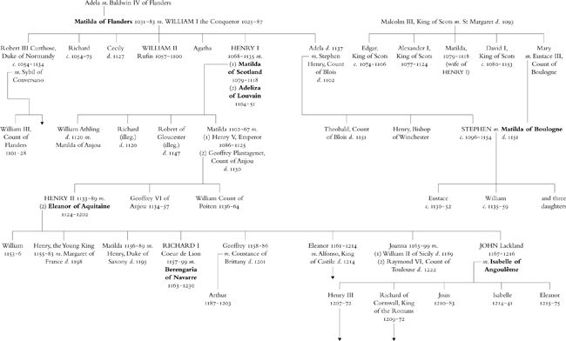
Like all contemporary rulers, Matilda lived a peripatetic life, moving constantly through her lands with her own household, hearing petitions, overseeing her accounts and convening courts. Her progresses may be followed through her charters, the number and frequency of which are evidence of her personal power. Matilda’s special place in confirming and adding her approval to William’s grants confirm her unique superiority over even the most powerful male magnate. However, business activities did not prevent her from taking considerable interest in her children’s education. Matilda and William had four sons: Robert, Richard (who died in 1075), William, known as William Rufus for his red hair, and Henry; and five daughters: Agatha, Cecily, Adela, Constance and Matilda. All were remarkable for their level of education - Matilda clearly did not believe that learning should be confined to men. Adela, who married Stephen of Blois in 1083, became a noted literary patron, displaying her skills at the transportation of the relics of the Empress Helen, the mother of the first Christian Roman Emperor, Constantine, in 1095, when she read aloud the inscription on the new reliquary for the company. William Rufus and possibly Henry were tutored by Archbishop Lanfranc, and Henry ensured that his own daughter, the Empress Matilda, was educated enough to understand government documents written in Latin.
Matilda’s daughters were educated at her Holy Trinity foundation at Caen and received instruction from a monk who was a well-known orator. Cecily entered Holy Trinity as a novice in 1075, eventually becoming abbess in 1113. Holy Trinity’s brother house, William’s foundation of St Stephen’s of Caen, provided a link with the reforming tendencies in Church practices championed by Lanfranc, first as abbot of St Stephen’s and then as archbishop of Canterbury. Lanfranc’s ardent faith was spiritually inspiring to William and his queen. Matilda’s household, like her husband’s, was strict in its observances, and Matilda heard Mass every day. She and William were enthusiastic supporters of Lanfranc’s mission to revitalise the Church, which William recognised as a potentially significant means of uniting his new realm. Between 1072 and 1076, Lanfranc organised a series of reforming councils to regulate the English Church according to Norman practices, forbidding simony (the sale of church offices), ruling against clerical marriage and determining episcopal sees. William’s martial persona is so overwhelming that his spiritual side is often neglected, but it was relevant in his marriage to Matilda in that ‘this ever devout and eager worshipper’27 believed in the Church teachings on marriage propagated by Lanfranc, and broke with four generations of family tradition by never producing a bastard.
Sharing her husband’s piety, assisting in his government and managing his Norman lands, Matilda was in many ways an exemplary queen and the sense of her marriage is of a strong and successful partnership. However, she was also prepared to defy her husband and set her own political judgements against his. In 1077, Matilda’s eldest son, Robert ‘Curthose’, rebelled against his father, and Matilda secretly supported him. Robert’s discontent stemmed from what he saw as unfair treatment following the Conquest. In 1063, Matilda and William had witnessed the charter for ‘Robert, their son, whom they had chosen to govern the regnum after their deaths’,28 a strategy for affirming the loyalty of William’s magnates to his heir of which his own father had made use in 1034.In 1067, Robert effectively became ‘acting’ duke of Normandy, but when, in 1071, William began to make annual visits to the duchy after a four-year absence, Robert resented his father’s resumption of his ducal powers. Orderic described Robert as a ‘proud and foolish fellow’, but his mother loved him enough to involve herself in the quarrel. In 1077, Robert took his grievance to the King of France, who granted him the castle of Gerberoy as a base to fight a campaign against his father. William besieged him there for three weeks in 1079, but returned unsuccessfully to Rouen, the two were reconciled and Normandy was regranted to Robert. Matilda sent money from her own revenues to help Robert, and a Breton monk, Samson, later told Orderic Vitalis that he had been dispatched to William by Matilda to try to persuade him of Robert’s case. The family were reunited at Breteuil in 1080 for the betrothal of Matilda’s daughter Adela to Stephen of Blois, an event which marked not only the alliance between Blois and Normandy against the threat of the Angevins, but the end of the rebellion, the castellan of Breteuil having been one of Robert’s backers.
William does not appear to have held Matilda’s support for Robert against her; indeed, such maternal loyalty was laudable, if unwise. Orderic Vitalis recounts her speech to her husband in words that, though unlikely to have been recorded verbatim, convey a sense of the devotion expected of royal mothers: ‘O my lord, do not wonder that I love my first-born with such tender affection. By the power of the most high, if my son Robert were dead and buried seven feet in the earth and I could bring him back to life with my own blood, I would shed my lifeblood for him!’
In 1082, Matilda accompanied her husband to meet his half-brother, Odo of Bayeux, at Grestain, where their mother Herleva was buried, to make arrangements for an abbey there. Odo had been a longstanding ally since his appointment to the bishopric in 1052 and had played an essential role in the Conquest. He was a swashbuckling churchman of the pre-reform era, enormously rich, a father and a mace-wielding warrior. William relied on him greatly, and had given him the earldom of Kent and the vice-regency of England in the 1060s and 1070s, but by 1082, Odo was becoming a threat. Having built up a strong personal faction in England, he came up with a plan to get himself elected pope and began spending huge amounts of money to achieve his ambition. After the meeting at Grestain, Odo left for England to embark for Rome, a journey William had expressly forbidden. The King himself arrested his brother as he was about to sail from the Isle of Wight, and Odo spent the rest of his life in the Tower of Rouen. William was quite prepared to be ruthless with members of his own family, and Odo had been a far more loyal servant to him than his son Robert. So was his reconciliation with Robert, who had gone as far as to take up arms against him, perhaps an indication of Matilda’s pacifying influence?
The King and Queen were back in Normandy early in 1083 for Adela’s wedding. Matilda did not live to see the marriage of another daughter, Constance, to Alan of Brittany in 1086. By the summer of 1083 she was ill, and that November she died. William was with her as she dictated her will and made her confession. Matilda left the contents of her chamber, including her crown and sceptre, to Holy Trinity, where she wished to be buried. She also gave generously to the poor from her deathbed, an example William followed in 1087. He had not married Matilda with the expectation of making her a queen, and it has been suggested that had he not taken a wife until after 1066 he might have sought a more illustrious match, yet their marriage had in some ways been instrumental to the Conquest. Without Matilda’s alliances and, more importantly, her blood, William may not have been able to retain Normandy so effectively, or to prosecute so vigorously his claim, and that of his legitimate sons, to England. And without her capable regency, he might not have been able to hold both his realms post-Conquest.
William was reportedly wretched at her death. Despite the bride’s early objections, the marriage of William the Bastard and Matilda of Flanders was undoubtedly a success, both emotionally and practically. It also permitted Matilda to establish a model of active queenship so influential on her immediate successors that the consorts of the Anglo-Norman kings are seen to this day as representing the zenith of English queenly power.