
CHAPTER TWENTY-ONE

Generals Banks, Shields, and just about everyone else in command in the Union army in Winchester awoke on the overcast early morning of Sunday, March 23, with the same thought: that Turner Ashby, whatever odd mischief he had been up to the day before, was long gone. Two full Union divisions were going to march east across the mighty Blue Ridge Mountains to join McClellan in his grand enterprise and there was nothing to stop them. The war was going to be won, and soon, and they were going to be part of the army that would march triumphantly into Richmond before the summer’s heats. And so it caused considerable surprise and consternation when a Federal reconnaissance patrol, sometime around 9:00 a.m., ran smack into Ashby’s cavalry and horse artillery. He hadn’t gone anywhere. Not only that, he had somehow been reinforced with four infantry regiments, and apparently intended not merely to harass but also to move aggressively forward up the eastern side of the valley turnpike. Ashby, believing his own faulty intelligence, and as always recklessly brave, was determined to sweep straight into Winchester and retake the town before Jackson arrived.
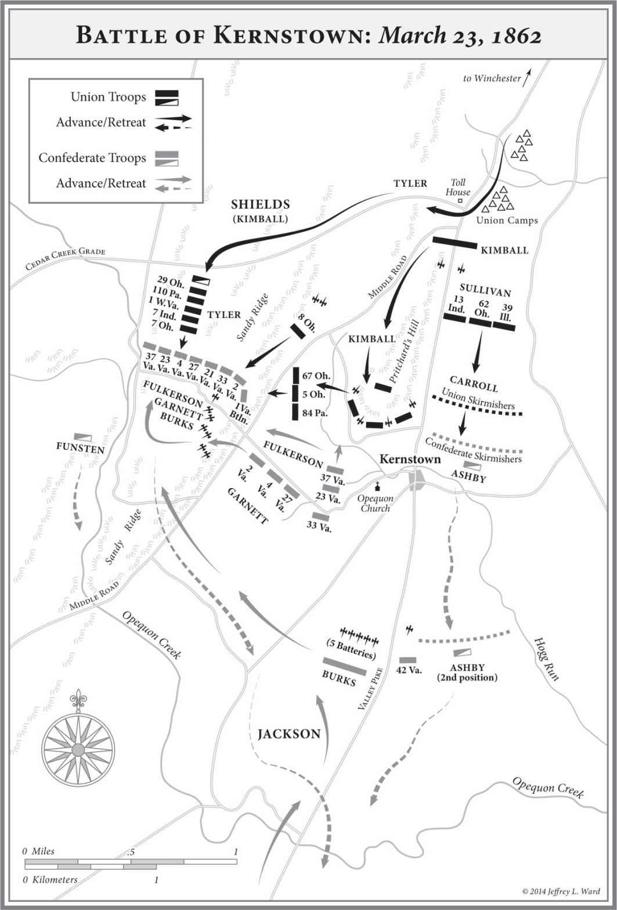
It was unfortunate for him that, while Banks and Shields, stationed in a house three miles north, in Winchester, persisted in believing that this small rebel force posed no threat, the wounded Shields’s battlefield replacement, Colonel Nathan Kimball, very definitely did not. Kimball, a smart, sensible Indiana doctor and Mexican-American War veteran who would go on to a distinguished war career as a Union general, wasted no time in countering Ashby’s attack. He threw troops forward and brought reinforcements up. Soon he had 3,000 men on the field facing Ashby’s 450 north of the small village of Kernstown and east of the valley pike. (Kimball was not aware that Ashby’s force was so small.) Ashby was repulsed just after 9:00 a.m., and then again at about 10:00 a.m. By 10:30 he had a pretty clear idea of what he was up against, and it was emphatically not the skeleton force he had told Jackson about, though he would compound his earlier mistake by mysteriously failing to tell Jackson of this potentially shattering development. Minié balls from Federal sharpshooters zipped through his ranks with their peculiar sibilant hiss, while the weirdly accurate, rifled Parrott guns of the Federal artillery began to find their range. One of Ashby’s artillerists recalled what it was like to watch, for the first time, incoming artillery:
I saw it flying in its graceful curve through the air, coming directly toward the spot where I was standing. I watched it until it struck the ground about fifteen feet in front of me. I was so interested in the skyball, in its harmless appearance, and surprised that a shell could be so plainly seen during its flight, that I forgot for a moment that danger lurked in the black speck that was descending to earth before me like a schoolboy’s innocent plaything. It proved to have been a percussion shell, and when it struck the ground it exploded and scattered itself in every direction around me.1
Nathan Kimball, meanwhile, believing that he was still not seeing the rebels’ full strength, and ignoring orders from his convalescent commander to attack, had made a wonderful discovery. Just north of Kernstown and west of the valley pike was an elevated promontory known as Pritchard’s Hill, the sort of defensive position army commanders dream about. “The position commanded the plain or valley, and village in front,” he later wrote. “No better position could be found to cover the approaches to Winchester with the forces I had.” He proceeded to load the top of the hill with men and cannons until the place fairly bristled with firepower. By early afternoon Pritchard’s Hill held 16 guns, 300 artillerists, and 6 full regiments—the better part of 3,500 men.
Banks and Shields continued to be certain, in spite of Ashby’s peculiar behavior, that Jackson could not possibly be crazy or brave enough to, as Shields later put it, “hazard himself so far away from his main support.”2 To march on Winchester with such a small force would be suicidal, and it did not take a genius to see that. So secure was the Union command in this conviction that Banks left that afternoon by train for Harpers Ferry, en route to his new assignment in Manassas. He was quite pleased with it; he was trading an obscure sideshow for the main event. Shields, supremely confident and full of his usual bravado, told his subordinate Colonel Sullivan, in Sullivan’s words, “that there was no danger of Jackson’s fighting again; that he knew him, and Jackson was afraid of him.”3
If that was true, Jackson had an odd way of showing it. At 7:00 a.m. he had put his men on the road again: 3 brigades, and 5 batteries of 24 cannons. All told, he had 3,500 infantry and artillerymen. “With the blessing of an ever-kind Providence,” he wrote General Johnston before leaving, “I hope to be in the vicinity of Winchester this evening.”4 Out on the arrow-straight, macadamized valley pike, he drove his men brutally hard: fifty minutes of march; ten minutes of rest, sometimes less. After the grueling march of the day before, many fell out of the ranks. The phenomenon was known as straggling. It was the bane of Civil War armies, and it could embrace everything from nearly outright desertion to the inability of a soldier with a toe infection to keep up with the rest of his company. A man with severe diarrhea, for example—and there were many—would be forced to leave his marching column repeatedly. He would fall behind. Over many miles he would fall very far behind and would be literally hours behind his regiment, unattached and uncommanded. Some men straggled to pick blueberries or to drink from streams. Some were drunk, or suffering from hangovers. Many straggled because they did not want to fight. The practice was often so widespread that it was virtually impossible for commanders to court-martial all offenders even if they wanted to. Thus the disciplining of stragglers—arrest, court-martial, fines, confinement, and sometimes even the threat of the firing squad—was inconsistent at best, and depended on the mood of the commanding general. It was an enormous problem for both sides throughout the Civil War, and no commander ever solved it. Jackson, who drove his men harder and faster than any other commander in the war, inevitably faced the problem. On this march, which covered some thirty-seven miles in less than thirty hours, he lost several hundred that way.5
At noon on March 23, the vanguard of Jackson’s army arrived five miles south of Winchester, and the rest of the men soon caught up. In the military terms of that era, this was blazing, unprecedented speed; seen from Washington, DC, it was a virtual blink of the eye. With Ashby’s fleet and highly contentious cavalry in front as a screen, moreover, the army’s march north had been completely undetected. Jackson immediately moved all of his troops off the exposed valley pike and into the woods just to the west. The day had brightened; the clouds had burned off, and the deep chill had gone out of the air. With two of his aides, Sandie Pendleton and George Junkin, Jackson rode out to reconnoiter. What they saw was a surprise: Kimball’s artillery on Pritchard’s Hill looked to be several times stronger than what Ashby had led them to expect. Though this seemed odd to them, they still had no reason to challenge their fundamental assumptions. Jackson now had a choice. He could rest his hungry, aching, foot-weary men and attack the next morning. That was the sensible thing to do. Staring up at the heights of Pritchard’s Hill, however, Jackson realized how visible he was. If the Federals saw his full force, they might have time to bring up reinforcements, and Jackson would lose what he believed, incorrectly, was his advantage.
His reconnaissance had discovered something else, too. Roughly a mile to the west of Pritchard’s Hill was a four-mile-long-by-three-quarter-mile-wide, elevated, intermittently wooded table of land the locals called Sandy Ridge. It was not only high ground; it was also higher than Pritchard’s Hill and therefore ideal for artillery placement. In spite of the weariness of his men, Jackson decided he would attack immediately. He was worried only about doing so on the Sabbath, which he rigorously kept free of all secular activity. There could be nothing more secular than killing human beings with shells and bullets. “I was greatly concerned, too,” he wrote Anna later, after she had told him she worried about fighting on Sunday. He had found it “very distasteful to my feelings . . . but I felt it my duty to do it, in consideration of the ruinous effects that might result from postponing the battle. . . . Necessity and mercy both called for battle.”6 He would move west through the small valley, scale Sandy Ridge, turn the Federal flank, then strike the valley pike in the Federal rear. There was nothing exceptional about the plan: it was standard West Point flanking tactics. But Jackson had seen in an instant something that Kimball had not: the critical tactical importance of Sandy Ridge. His assumptions of enemy troop strength, of course, were still those provided by Ashby the day before. He still believed he had more men and guns than the enemy had.
Back in Winchester, Shields, in pain from his shrapnel wounds, still refused to believe that he had anything to fear. At one thirty he ordered Kimball to “concentrate forces and fight the enemy on the plain.” Kimball ignored him. Whatever happened at Kernstown was his problem now. He knew how well situated his troops were, suspected that the enemy was more numerous than he looked, and believed that Ashby’s purpose was “to draw me from the strong position I held.”7 Determined to stay on the defensive, he could see Jackson’s lead regiments under Colonel Samuel Fulkerson moving west through the woods below him. He opened fire, raining down shell (hollow iron spheres with timed fuses that exploded into fragments) and canister on the men below. Alarmed by the intensity of the fire, Jackson ordered Fulkerson to turn and try to flank the artillery on Pritchard’s Hill. Fulkerson took one thousand men to within five hundred yards of the guns and was cut to pieces. Of the eighty-four men killed that day in his regiments, almost all died under Kimball’s artillery fire.
Fulkerson’s men fell back from the approaches to Pritchard’s Hill—it was about two o’clock now—and with the main body of Jackson’s troops continued hauling themselves west toward Sandy Ridge under the constant pounding of Kimball’s guns. Fulkerson’s ill-fated lunge had had the effect of a feint, and it was effective in screening the movement of the Confederate cannons. Jackson also had Ashby demonstrate beyond the valley pike, a true feint that also worked, convincing Kimball that there was still danger on the Union left, and causing him to draw off two regiments to deal with it.
While all this was happening, Jackson was pursuing his true purpose: a flank march up Sandy Ridge that would extend his line against a weaker force. In the words of John Lyle of the 4th Virginia, Jackson moved about on horseback with a pale countenance and a set jaw, furiously “stripping his front almost bare of troops to hurl the bulk of his small force on the right flank of the enemy.”8 What he really wanted to do, and what all his training as an artillerist told him to do, was to get his batteries up on top of Sandy Ridge as quickly as possible. They rolled on, unseen, while Jackson’s infantry pushed forward over the marshy low ground, crossing that same no-man’s-land of shot and shell, toward the heights of the ridge. “Their bravery was heroic and commanded the admiration and respect of all who witnessed it,” wrote an Ohio infantryman who was looking down on the action from Pritchard’s Hill.9
At 3:00 p.m.—ironically, almost the exact moment the dapper and placidly confident Nathaniel Banks was boarding a train for Harpers Ferry—Jackson’s batteries thundered to life atop Sandy Ridge. It was also the moment Nathan Kimball realized the severity of his mistake in failing to secure his right flank. Jackson’s guns were now 100 feet or more higher than his own, which were almost exactly a mile to the east. And now they began to find the range of Union infantry and batteries, while Kimball’s guns were forced into an artillerist’s nightmare: shooting uphill at the enemy. Kimball’s infantry were for the moment useless, motionless, flat on their bellies, and praying that the next shell fragment was not going to embed itself in their skulls. Though ranges of Civil War artillery varied, the most common gun of the war, the 12-pounder Napoleon smoothbore, could shoot 1,619 yards or just under 1 mile; rifled guns were accurate over larger distances: the 10-pounder Parrott had a range of 1,900 yards (1.08 miles), and the 3-inch rifles were fairly accurate at 2,000 yards (1.14 miles). Cannon shooting spherical case, or shrapnel, tended to operate at 500 to 1,500 yards, while the effectiveness of anything loaded with canister was limited to about 350 yards.10
Jackson, in his first real fight with an independent command, was quickly learning his trade. The last time any Americans had fought a war was fifteen years earlier, in a different country, with different weapons, and most of the men who were running this war had little or no experience of traditional battlefield command. (Indians had generally refused to fight pitched battles; fighting mounted Cheyennes or Comanches on the open plains or Seminoles in Florida swamps required an entirely different set of skills.) Civil War tactics were invented on the fly by men trying desperately to see through the sulfurous smoke and fog of battle, to understand terrain, troop movement, supply trains, the effects of artillery bombardment on infantry, and a hundred other things that were not covered in West Point’s dry texts or in Napoléon’s maxims. Jackson had made some very good moves—some calculated, some purely reactive. He had surprised the enemy with a fast and unexpected march so successfully cloaked that, to the dumbfounded Shields, who did not learn that Jackson himself was present on the battlefield until 3:30 p.m., he had appeared as if from nowhere. Such materializations from the ether would become a Jackson hallmark. He had grasped the tactical significance of Sandy Ridge before his opponent had. He had screened the movement of his artillery, had gotten it to the high ground first, and had used his advantage in elevation to devastating effect. He had, moreover, already understood and put into practice something that both Confederate and Union armies would be relatively slow to learn. Though it was common practice in military theory to attach batteries to brigades and have them support those brigades on the battlefield, Jackson had detached and massed his artillery on the hilltop, creating far more concentrated firepower.11 He had, moreover, by the strength and surprise of his attack, forced Kimball—who had been led by Jackson’s audacity to believe that the two sides had equal numbers of men—to play his tactical game.12 With his numerical advantage, all Kimball had to do to win the battle was bring a large force against Jackson’s right flank. He would have turned it quickly, and would just as quickly have captured the supply trains in the Confederate rear. If he had done so, he would have won a stunning victory. He would have been a hero. Instead, befuddled by the speed of Jackson’s movement and the telling effect of his big guns, he swung heavily to his right, trading finesse for brute force.
But Jackson had made mistakes, too, and would make more this day. As in the Romney campaign, he had told none of his subordinates anything of his battle plan—not even Brigadier General Richard Garnett, a veteran soldier and the commander of the Stonewall Brigade as well as his second in command. This was shocking on its face—illogic from a supremely logical man. It had already resulted in confusion over whether one of Garnett’s regiments was supposed to support Fulkerson’s attempt to turn Kimball’s artillery. That attempt itself had been a mistake; Jackson had allowed himself to be distracted by Kimball’s guns from his main goal of gaining the ridge. The effect was to slow the movement westward of his regiments, which would now be fed into the battle in fragmentary fashion. Piecemeal attack—which ceded the advantage of massed firepower—was one of the cardinal sins committed by generals in the Civil War, even the best ones. Jackson was learning about that, too. But he would never learn to share information freely with subordinates; it was a glaring weakness, and it would haunt him here and throughout the war.
Sometime after 3:00 p.m., while Jackson was winning his artillery duel with Colonel Kimball, his young aide Sandie Pendleton climbed to one of the highest points on Sandy Ridge for a better view of Pritchard’s Hill and the countryside around it. He was astonished by what he saw: at least ten thousand Union troops, with artillery to match, positioned squarely in front of Winchester. This was not the skeleton force of four regiments Ashby had reported. This was a full division. Not only that, Pendleton counted fully five regimental flags floating down one of the roads that led to Sandy Ridge, coming directly toward him. One of Kimball’s brigade commanders, Colonel Erastus B. Tyler, a fur merchant from Ohio, was moving in force against the batteries that had been antagonizing him, and therefore toward the bulk of Jackson’s army, which was still shifting leftward through the wooded low ground. Pendleton galloped back to Jackson to report the news. We have no record of Jackson’s expression when he heard it, but we know what he told Pendleton. “Say nothing about it,” he said. “We are in for it!” So Garnett and other commanders, who knew nothing about the battle plan, would know nothing about enemy troop strength, either. It is safe to say that no other general, on either side, would have chosen to proceed this way. Jackson, who had been planning a general assault, abandoned that plan. He would have to shift from offense to defense. Outnumbered again, he was suddenly in a desperate battle for survival.
The Battle of Kernstown, as this fight would be known, entered its second phase when Colonel Nathan Kimball, weary of the dominance of Jackson’s cannons, sent Tyler’s 2,300-man brigade to silence them. That was what Pendleton had seen coming at him. Tyler, deploying west along the Cedar Creek Grade Road, and then south along Sandy Ridge, ran headlong into the lead regiment of the Stonewall Brigade—the 27th Virginia—which itself was swinging west and north to defend the artillery. Badly outnumbered, these 200 men, under their intrepid commander, six-foot-four-inch, 260-pound Colonel John Echols, fell back behind a half-mile-long, shoulder-high stone wall that ran east to west and rose and fell with the broken landscape. At about four o’clock on Sunday afternoon, March 23, with only a few hours of daylight remaining, the battle, which had up to that point really been an artillery duel, became a desperate fight for control of that stone wall on Sandy Ridge.
Erastus Tyler’s opening gambit, in this improvised war where commanding officers had to learn by trial and error, was a grievous mistake. To take his men more efficiently through the wood, he had formed them in what was known in military jargon as a close or massed “column by divisions.” That meant that instead of long, linear, two-man-deep battle lines—the typical Civil War battlefield deployment—his men were configured in a large rectangular box that measured some seventy-five yards across its front and four hundred yards deep. Two companies made up the front line; behind them stretched the other forty-eight companies in twenty-four lines, set up front to back like dominoes. In that configuration they indeed moved easily through the woods on the northern part of Sandy Ridge. The weather had dramatically improved. On the second day of the Shenandoah spring, the sun was finally shining. “It was a beautiful day,” wrote an infantryman in the 7th Ohio. “Birds sang in the trees and the warm sun brought out all the aromatic odors of the forest.”13
Minutes later, the exhilaration of spring was gone. Tyler’s lead companies found themselves at the edge of the leafless wood, looking 150 yards across open ground to the stone wall, from which poured volley after volley of musket fire, red jets of yellow flame piercing the billowing rolls of smoke, while their rebel opponents shouted “Bull Run!” as loudly as they could. Jackson’s artillery opened up with canister on the Federal left, and Union soldiers, who were not trained to fight in a box formation, immediately found themselves in serious trouble. Once the firing started, it was almost impossible, because of the noise, smoke, and confusion, to shake themselves out into conventional battle lines by companies and regiments. The domino analogy is apt: the bluecoats offered a dense and easy target for Echols’s riflemen at the wall. At the same time, they had temporarily lost the ability to use their huge numerical advantage to extend their lines. The fire was so hot that the 110th Pennsylvania fled backward through the ranks of the 29th Ohio, just behind them. Or, as an officer from the disgusted 29th saw it, “they broke and scampered like sheep at the first fire.”
Thus did 200 Confederates, outnumbered 10 to 1, and aided by Tyler’s tactical blunder, hold their own smartly against the oncoming brigade. Tyler’s force had been virtually stopped in its tracks. But the battle was only five minutes old. From his position with the artillery on high ground, a quarter mile in the rear, Jackson saw that he needed more soldiers, and began to feed the fight. Under his orders, Lieutenant Colonel John Patton and the 21st Virginia, 270 men strong, advanced to the stone wall, where they poured a hot fire into the Union ranks. Still, the entire fight at this point was only two regiments against five. Tyler’s first, unsuccessful assault had been on the eastern end of the stone wall. Now he noticed that the western end was undefended, and ordered an attack there. Colonel Sam Fulkerson, bringing his 23rd and 37th Virginia Regiments forward after being cannonaded for the better part of two hours, saw the same weakness, the same opening. What happened next was a deadly footrace. The 1st West Virginia rushed forward from the north, while the Virginia boys lunged from the south. The Confederates won, by seconds. They set up quickly behind the wall, 500 of them, opening up with their smoothbores loaded with “buck and ball” (a bullet attached to three pieces of buckshot that combined the characteristics of a musket and a shotgun) on the West Virginians, who were only fifty yards away. At point-blank range, the effect on the bluecoats was deadly.
Only ten minutes had elapsed since Tyler’s first charge. He had been repulsed twice. Now the Confederates, realizing the size of the Federal force, began to bring additional regiments to the wall. Brigadier General Richard Garnett finally arrived, after his long march across the low ground with the rest of his Stonewall Brigade, and inserted the 33rd Virginia just to the right of the 21st Virginia. It is noteworthy that he not only had no knowledge of any battle plan; also, neither he nor his commander knew where the other was. By Jackson’s orders, the 2nd Virginia came up, too, as did the Irish Battalion, to fill another gap in the wall. The Federals, meanwhile, had managed to untangle themselves into disorganized clots of men at the edge of the woods, 150 to 200 yards from the stone wall. They paid the price for their confusion, as many of their men in the front lines were dropped by their own friendly fire. At one point, the 1st West Virginia had unloaded several volleys into the backs of the 7th Indiana and the 7th Ohio. The Federals were nonetheless able, from behind trees and rocks and declivities, to deliver a constant stream of fire. Along the wall, the Confederate soldiers who fell almost invariably did so with horrible head wounds, many of them lethal, caused by huge .59-caliber minié balls that hummed like tuning forks in the sulfurous air and entered through the throat, mouth, eyes, forehead, and nose, blowing the men’s brains out the sides and backs of their heads. Many soldiers later commented on the enormous sound of war: it was more of a giant, rolling roar than a succession of shots.
By 4:30 p.m., a little more than half an hour into the fight, Jackson’s 1,200 men behind the wall had created a stalemate with the larger force, which was disorganized and strung out along a four-hundred-yard front that was fifty to five hundred yards from the stone wall. The fight went furiously on. There was little or no finesse here. It was a brutal, bloody, hard-nosed affair, rarely equaled in closeness of range and intensity of firing in the larger war that was to come, and no one, except the 110th Pennsylvania, was running away from it. Jackson himself told a friend five days later, “I do not recall ever having heard such a roar of musketry.”14 Wrote a soldier in the 7th Indiana, “The battle was on in all of its fury. The woods were soon enveloped in smoke. . . . The crashing of shells and shot and canister through the trees has left an impression on my mind that can never be effaced. . . . The regiments [were] mixed up through and through each other, but [we] never ceased to get rid of our sixty rounds of cartridges as fast as we could load and shoot.”15
Jackson had thus far done remarkably well in spite of enormous disadvantages. He had less than half the troops his enemy had on the battlefield. His men were armed with smoothbores, while all but three Federal regiments had far more accurate rifled muskets.16He had only three rifled cannons against the Union’s fourteen.17 And his men had held the wall. He knew he could not hope to win. But he still had three regiments in reserve and less than two hours of daylight, and the odds had gone up considerably for a drawn battle—one that would accomplish everything he had been ordered by Johnston to do, and more. “I became satisfied that we could not expect to defeat the enemy,” he later wrote, “and that our safety consisted in holding our position until night and drawing off under the cover of darkness.”18
At almost the very same moment—around 4:30 p.m.—it occurred to Colonel Nathan Kimball, on his own high ridge a mile to the east, that he could lose. He had fully 3,600 men he had not used. Just as Jackson had earlier stripped his right of troops to seize Sandy Ridge, Kimball gathered up regiments on his unthreatened left and sent them double-quicking across the little meadowed valley between the two heights and into the fight at the eastern end of his battle line. Now came the final slugfest at the wall, the last hour of the fight. Most of the action had shifted east, where Kimball’s fresh troops were shouldering into Jackson’s bone-tired, battle-weary force. For Jackson it was a race to darkness. The fighting at the wall, brutal and constant for a full hour, now turned desperate. A measure of its intensity was the astounding tale of the regimental flag of the 2nd Virginia Regiment. The bearers of regimental colors were often targets of the enemy, both because they stood out as easy targets and because the flags were important in telling soldiers where the rest of their regiment was, and in which direction it was heading. The carnage began when the first standard-bearer, Sergeant Ephraim Crist, was shot in the head and killed instantly. Lieutenant J. B. Davis, who picked it up, was knocked out of action by a spent ball. Lieutenant Richard Lee then took up the flag and, with reckless bravery, jumped over the wall and brandished it at members of the 67th Ohio, who refused out of respect to shoot him, saying, “Don’t shoot that man, he is too brave to die.” They ordered him back over his wall, where he was soon wounded severely in the leg. A fourth, unknown man who grabbed the flag fell mortally wounded. Finally a full colonel, James W. Allen, leaned down from his horse, picked up the colors, and rode them to the wall, where his 250 surviving troops rallied around him. By the time the colors got there, they bore the marks of fourteen bullet holes, and the banner’s flagstaff had been shot in two. The 5th Ohio had a similar experience. Five different standard-bearers were killed or wounded within a few minutes.19
Then something happened that no one, including Jackson, had counted on. At about five thirty, as the sun was setting over the battlements of the Alleghenies, and Jackson’s goal of a drawn battle was in sight, the Confederate soldiers at the wall began to run out of ammunition. It began, predictably, with the courageous 27th Virginia, the men who had started the fight at the stone wall. They had carried only forty to sixty rounds in their cartridge boxes to begin with, and whatever ammunition the valley army had was sitting several miles away, back on the valley pike. Amazingly, in spite of this the Confederates, exhorted by Brigadier General Garnett, who stormed up and down the ranks, had managed to repulse three Ohio regiments that had assaulted the eastern wall. But the Federal numbers were beginning to tell. Fresh, well-armed Federal regiments were coming up to replace regiments that were themselves running out of bullets. And Kimball was beginning, at last, to use his numerical advantage to extend his line. Now, in the smoky blue twilight, came the hammer blow: two fresh Indiana regiments, the 13th and 14th, hit the eastern part of the wall, whose defenders had virtually no ammunition left. Fearing envelopment, Garnett, at about 6:00 p.m., called retreat. A few minutes later, Jackson, who had ordered up reserves from the valley pike, was astonished to see his men streaming to the rear. He found Garnett and furiously dressed him down for ordering the withdrawal. “He did not manifest any concern,” Jackson later wrote of Garnett, “and was not using any efforts to rally his men. I rode up to him and asked him why he did not rally his men, or try to do so. He told me he had done so, till he was hoarse.” Jackson, incredulous, then rode back and forth, as bullets whickered about him, loudly exhorting the men back into battle. He could not believe what was happening. He grabbed a young drummer next to him, and with his hand on the boy’s shoulder, yelled, “Beat the rally! Beat the rally.”
But he was too late, as were the reserve 5th and 42nd Virginia Regiments he had summoned, who arrived at about six thirty but could do no more than help cover the retreat. The rest was messy. Men fell back in disorder; regiments fell apart in the oncoming darkness; the army became formless. The Union cavalry for once showed some aggressiveness, riding around the disintegrating Confederate left flank and rounding up several hundred prisoners, who were later paraded through the streets of Winchester. “We all scattered, every fellow for himself, building fires out of fence rails and making ourselves as comfortable as possible after the fatigues of the day,” wrote John Casler of the 5th Virginia.20 Jackson ordered the bloodied army into bivouac about five miles south of the battlefield. He rode silently with them, and at one point stopped by a campfire. “General,” said one of the men, “it looks like you cut off more tobacco today than you could chew.” Jackson replied simply, “Oh, I think we did very well.”21 He had a small dinner of bread and meat—his first food of the day, gave thanks to God, and went to sleep on a bed of fence rails, without a blanket, next to his chief commissary, Wells Hawks. The next day Jackson’s army headed south once again, pursued by the same army that had chased them less than a week before.
• • •
Jackson’s men, battered, parched, and exhausted, agreed with his assessment of the battle. They knew that they had been badly outnumbered. They were equally aware that they had faced a Union foe that was just as brave and tough and resourceful as they were. (This was news to many of them.) They had marched twelve to fifteen miles in the morning, had been subjected to galling artillery fire, then had stood with astounding bravery at a stone wall for two hours under a barrage of Union lead. They had fought to their last bullet and were deeply proud of what they had done. “It was a terrific fight and all our men behaved like heroes,” wrote Alexander Boteler Jr. of the Rockbridge Artillery, son of the congressman. “No one left his post unless ordered off the ground. . . . Our canister scattered them like scared sheep, and made them all run.”22 The almost universal feeling was that with ammunition they would have held. “The . . . little army had been heavily engaged, and although confronted by large odds, held its own, and only retired after shooting all its ammunition away,” wrote John Worsham of the 21st Virginia Regiment. “It seems to me that the 21st Virginia would have held its line indefinitely if it had been supplied with ammunition. It was a regular stand-up fight with us, and as stated the men . . . fought as I never saw any fighting during the war.”23 Even Loring’s old regiments seemed to find a new respect for their commander. And Confederate prisoners, to a man, expressed pride at what they had done.
Southern newspapers echoed the same sentiment. If their facts were slightly skewed, they fully understood that a very small force had stood toe to toe with a much larger one. “No battle has been fought during the war against such odds,” said the Richmond Dispatch. “With a force not exceeding 3,500 men—men who had been on forced marches for weeks—we attack 20,000 fresh troops, repulse them again and again, until overpowered by numbers.” The paper gave Jackson full credit: “A braver man God never made.”24 Amid all the recent bad news from the scattered Confederate armies, here, at least, was an example of pluck and courage. Here was hope. Jackson himself did not believe he had lost the fight. According to his mapmaker, Jed Hotchkiss, he “never considered that he was beaten at Kerns-town.”25 To Anna he wrote, five days after the battle, “My little army is in excellent spirits. It feels that it inflicted a severe blow upon the enemy.”26
The gruesome scene they left behind was witness to it—a pocked and devastated landscape full of pooled blood and bodies and pieces of limbs, clothing, hats, weapons, and a bewildering variety of personal items. Across the top of the wall, running its entire length, was a jagged line of blood, the residue of hundreds of Union minié balls hitting Confederate skulls.27 A bloody, severed foot hung from a tree, testimony to the brute violence that had put it there. “The small bushes were cut to pieces, and every tree was filled with balls,” wrote John C. Marsh of the 29th Ohio. “The dead lay thickly in those woods and behind the stone wall, some all torn to pieces with shell, some badly mangled with canister, but by far the larger portion were killed with rifle balls. It was curious to note the different expressions on the faces of the dead. Some seem to have died in the greatest agony; others wore a smile even in death.”28 Sandie Pendleton thought that, though smaller in scale, the Battle of Kernstown was “a harder fight than Manassas.” In the end Union casualties exceeded Confederate casualties, perhaps predictably, considering that much of the battle amounted to an assault on a fortified position. The totals were: 118 Federals killed, 450 wounded, and 22 captured or missing; 80 Confederates killed, 375 wounded, and 263 captured.
Though he had expressed satisfaction with his performance, Jackson was frustrated that he had come, as he saw it, so agonizingly close to a draw against a superior foe. His unhappiness quickly manifested itself in his anger toward the unfortunate Garnett. Jackson believed that if Garnett had held on only a few minutes more, reserve troops would have arrived, there would have been no retreat, and darkness would have ended the fighting. Garnett, of course, had never been informed of that battle plan. Acting alone at the wall, he had behaved bravely and had ordered retreat only when, outnumbered and out of ammunition, and facing a possible envelopment by a much larger force, he had no other choice, a decision that all of Jackson’s regimental commanders later supported.
Jackson himself bore at least some of the responsibility for his defeat. This was his first fight as commanding general. He was learning. He was expanding his understanding of battle, which he had seen before only in pieces. He had done certain things very well. But seen from the front lines, the Battle of Kernstown was lost because Confederate soldiers ran out of ammunition, and that was Jackson’s direct responsibility.29 (Kimball made a similar though less costly mistake: he had failed to bring forward enough ordnance for his cannons.) Jackson had not anticipated an extended firefight and had not brought up reserve cartridges from his supply wagons. (Urging his men, as he did at the end, to charge with bayonets against rifles, was patently absurd, albeit a pure expression of Jackson’s own combativeness.) He had also—somewhat mysteriously, considering his intimate control of his brigade’s fight at Manassas—remained a quarter mile or so from the stone wall. Though there were good reasons for this—he could see the entire battlefield and the Union position more clearly from there—he was not available to redeploy his regiments where they were needed. (Kimball suffered from the same problem; he was even farther away from the action.) As twilight descended, Fulkerson’s six hundred men at the western part of the wall were relatively unengaged. They could have been ordered to the eastern wall to great effect. They were fresher; they had ammunition to spare. Finally, Jackson had hampered Garnett’s effectiveness by not telling him his battle plan; Garnett did not even know where Jackson was.
Perhaps the biggest lesson to be learned from Kernstown, however, involved not fighting but politics. Jackson’s tactical defeat turned out to be one of the great strategic victories of the early war. It began with the sheer fierceness of his troops’ resistance, suggesting to the Union command that he was stronger than he actually was. This impression was enhanced by Union-held prisoners, who crowed loudly that Jackson would soon be reinforced by thirty thousand troops. Banks, correctly suspicious of such tales, still could not quite bring himself to fully disbelieve them. This revised, more potent version of Jackson was further enhanced by James Shields. Puffing up his own accomplishment, Shields described for the Union War Department the desperate eight-hour battle he had fought against eleven thousand Confederate troops, five times what Jackson put on the field.30 He told of how—far from being surprised by Jackson’s attack—he had feigned weakness to deliberately lure and trap Jackson. Piling lies on top of lies, he claimed that he had closely managed the battle and even ordered Tyler’s brigade to attack. “The havoc which has been made in the rank of the Rebels has struck a blow such as they have nowhere else endured since the commencement of the war,” Shields told the War Department. “Jackson and his Stonewall Brigade and all the other brigades accompanying him will never meet this division again in battle.”
But McClellan and the War Department in Washington drew the opposite conclusion. To them the battle meant that Jackson was far more dangerous than they had thought. The valley was not a sideshow; it was a full-blown theater of war. Thus McClellan, still in command of the valley and alerted to this new danger, made an uncharacteristically decisive move. The sensible thing might have been to leave Shields in the valley to fight Jackson. Instead, he canceled orders for both of Banks’s divisions to leave the valley. He ordered the brigades that had already departed back to Winchester. And then he ordered a full-out pursuit of the small rebel army. “As soon as you are strong enough, push Jackson hard and drive him well beyond Strasburg,” he wrote Banks. He still wanted Banks in Manassas, but now the terms were “the very moment the thorough defeat of Jackson will permit it.” Thus were 19,000 sent out to destroy 3,500, and thus did two full divisions become useless to the Union army east of the Blue Ridge.31
Jackson’s attack reverberated in other ways through the Union command. As McClellan began his epic move southward, Lincoln and Secretary of War Stanton discovered to their horror that he had not left the twenty-five-thousand-strong force he had promised to protect Washington. This role was to have been assumed by Nathaniel Banks’s 5th Corps, which, of course, had been on its way to Manassas. Jackson’s attack at Kernstown was the reason they never got there. McClellan, reluctant to give up any men from his expeditionary force, then proceeded to fudge the troop numbers. He included Banks’s valley divisions in a “covering force” that was supposedly “in and about Washington.”32 It was actually eighty miles from Washington. Lincoln, furious and feeling betrayed, moved swiftly to correct the problem. He ordered troops back to Washington from the Rappahannock, thus killing any immediate idea of a pincer movement on Richmond. Next, he created two new independent commands, the Department of the Shenandoah under Banks, and the Department of the Rappahannock under Irvin McDowell. Both generals would report directly to Lincoln and Stanton. With Banks in supposedly headlong pursuit of Jackson in the valley, McClellan, stripped of a good deal of his power, was told sternly to focus on his single objective: Richmond.