
CHAPTER TWENTY-SIX

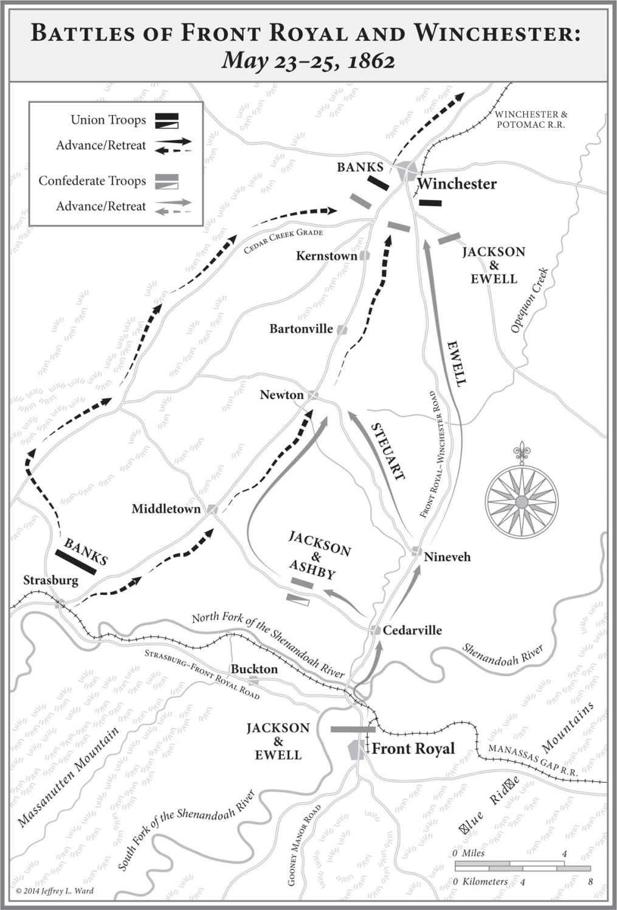
In the lazy, late afternoon of May 23, 1862, in the Strasburg camps of General Nathaniel Prentiss Banks, it seemed as though the world had gone to sleep. The air was still and hot; the canvas tents were stifling. There was little movement anywhere, and whatever moved did so very slowly. For many of these Union soldiers there was a feeling that the war was about to end without them, that they had missed out on whatever glory they might have secured for themselves with McClellan at Richmond. Now they seemed destined to finish their service in this lovely, irrelevant place.1 Though some were disappointed, most had gotten more than their fill of soldiering, with its rotten salt pork, weevily hardtack, and muddy bivouacs. They were relaxed, and ready for the fighting to stop. “A general languor was manifested in the drowsy way in which the sentinels dawdled along their posts,” recalled Banks’s subordinate Colonel George H. Gordon, “or in the aimless sleepy air in which the troops addressed themselves to such amusements as were suggested by time and place.” Colonel Gordon himself was doing nothing in particular.2
Just after 4:00 p.m., the stillness was broken by the sound of galloping hooves followed by the appearance of Corporal Charles H. Greenleaf of Company D, 5th New York Cavalry, at Banks’s headquarters. He was exhausted. He had just ridden seventeen miles in less than an hour from Front Royal to Strasburg in the simmering heat, taking a detour to dodge rebel horsemen. He had come to report that a Confederate force of indeterminate size had attacked the Union troops there under Colonel John R. Kenly. Greenleaf had been sent on an urgent mission to request reinforcements for the Union regiment stationed in Front Royal. General Banks listened. He was not terribly upset by what he heard. After all, cavalry and horse-artillery attacks by Ashby’s ubiquitous troopers had become commonplace.
But as afternoon faded into evening, other reports began to pile up at Banks’s headquarters, each one adding more—and more alarming—detail about these inexplicable events in Front Royal. Shortly after dark, an escaped slave reported that Colonel Kenly was in full retreat. Later came a note from a captain of the 1st Maryland Cavalry, saying that Kenly’s regiment had been destroyed, that he had been killed and all his field officers and surgeons captured, and that Stonewall Jackson was marching on Winchester with twenty thousand men.3 Another cavalry officer reported that he had been “attacked by three or four hundred cavalry and some infantry.”
Even these accounts did not upset General Banks terribly. They all seemed a bit hysterical, delivered by scared men who had likely fled whatever fighting was taking place. “Owing to what was deemed an extravagant statement of the enemy’s strength,” Banks wrote, as though yawning while he wrote the words, “these reports were received with some distrust.”4 His aide David Hunter Strother put it more bluntly. After hearing the apparently tall tale of Jackson and twenty thousand men, he remarked to Banks “that this fellow was some coward who had ingloriously fled the field and covered his ignominy by monstrous lying.”5 In spite of his skepticism, Banks dispatched a regiment of infantry along with some cavalry to Front Royal.
But the news kept rolling in. Throughout the evening telegrams arrived from Winchester, relaying information from various refugees—soldiers, teamsters, sutlers, and cavalrymen—that Front Royal had fallen to a force of Confederates, variously estimated at 15,000 to 20,000.6 At about midnight, yet another officer reported that his unit had been destroyed and that he had seen a rebel force of 5,000 or 6,000 “fall back on Front Royal.” By this point it was clear that something had happened out on the foggy perimeters, and that it had involved more than just a few companies of men.
Amazingly, it was not until 10:00 p.m. that Banks took any of this seriously, and it was midnight—ten hours after the initial attack—before he fully acknowledged that something disastrous had occurred on his flank, a mere twelve miles away. By the time he went to bed, sometime after 1:00 a.m., he had come to accept, finally, that his worst fears had been realized, and much faster than he had ever dreamed possible. He and his staff now agreed—conceded might be a better word—that Ewell was at Front Royal and that the shadowy Jackson was very likely moving northward toward them along the turnpike. “The extraordinary force of the enemy could no longer be doubted,” wrote Banks later. “It was apparent also that they had a more extended purpose than the capture of the brave little band at Front Royal. This purpose could be nothing less than the defeat of my own command.”7 He was used to being the hunter. He now understood that he was being hunted. He did not yet understand—and would have been far more upset had he realized—that the principal hunter, Jackson, in person and accompanied by the veteran army that had defeated Schenck and Milroy at McDowell, was also on his doorstep at Front Royal. Anticipating the worst, Banks got his wagon trains rolling late that night toward Winchester, which also happened to be in the direction of Maryland, safety, and home.
At seven o’clock in the morning that very same day—May 23—under the same hot sun and fair skies, some seventy-five miles to the east, President Abraham Lincoln and Secretary of War Edwin Stanton stepped from a steamboat onto a dock on the Potomac River. The place was Aquia Landing, a Federal logistical and supply depot less than ten miles by rail from the town of Fredericksburg. The two men had traveled all night from Washington to get there. It was a happy occasion. They had come to meet personally with General Irvin McDowell and to review his Army of the Rappahannock, all in anticipation of the big assault on Richmond.
In spite of McClellan’s dithering, Union prospects had never been sunnier, and Lincoln knew it. The Union victory at Shiloh and the seizure of New Orleans were fresh memories, as were the even more recent victories by McClellan at Yorktown (May 3) and Williamsburg (May 6). In the last two months McClellan had managed to haul his sprawling army up the soggy, brush-choked peninsula to the gates of Richmond. Confederates had evacuated Norfolk and its shipyards on May 9, and were forced to scuttle their prize ironclad warship Virginia (formerly the Merrimack) on May 11. Admiral David Farragut’s warships were steaming north toward Vicksburg, Mississippi, after capturing New Orleans, in a strategic thrust that would likely secure Northern control over the entire Mississippi River. And Union forces under John Pope and Andrew H. Foote had cleared the upper Mississippi nearly to Memphis with the capture of Island No. 10.
With the arrival of General James Shields’s division from the valley, McDowell’s army, which he paraded grandly that day before Lincoln and Stanton, was now 40,000 men and 86 cannons strong. It was almost as big as the entire Confederate force that had opposed McClellan on the peninsula. Three days hence, under Lincoln’s orders, McDowell was to advance toward Richmond.8 There was no one in the Union camp that day, or in the War Department in Washington, who believed that, with 150,000 to 160,000 men attacking the Confederate capital from two directions, they could fail to take the city. All the big logistical questions had been settled. What could possibly go wrong?
• • •
While Lincoln and Stanton were making plans with McDowell at Fredericksburg, and Banks’s men were idling in the languid sunshine at Strasburg, Jackson and Ewell were pushing their soldiers as fast as they could down the Luray Valley toward Front Royal and the small Union garrison there. Their column stretched for twelve miles. They had started at dawn, marching four abreast down the river road, following the course of the South Fork of the Shenandoah in the shadow of the long, humped ridges of Massanutten Mountain on the west and the soaring Blue Ridge on the east. The Luray Valley was a miniature of the Shenandoah, and just as lovely. Jackson and Ewell rode with the vanguard. Jackson’s division was the old valley army: all Virginians, most of them local. It held three brigades under Brigadier Generals Charles S. Winder and William B. Taliaferro, and Colonel John A. Campbell. Ewell’s division was a much more representative unit of the Confederacy, containing regiments from Maryland, Georgia, North Carolina, Virginia, Mississippi, Louisiana, and Alabama. They were organized into four brigades under Brigadier Generals Arnold Elzey, Isaac Trimble, and Richard Taylor, and Colonel William C. Scott. The army’s cavalries were commanded by Virginians: Brigadier General Turner Ashby and Lieutenant Colonel Thomas Flournoy. Colonel Stapleton Crutchfield, a former Jackson student at VMI, was in charge of artillery.
Just how many men Jackson actually had in his command as he marched on Front Royal is harder to say. Civil War troop strength is a notoriously muddy statistic, and the paper “returns” of an army often bore no resemblance to the size of the force a commander could deploy on a battlefield. Jackson, in the valley, offers a classic example. On May 3, he claimed 8,597 infantry. This number reflected huge growth since the Battle of Kernstown six weeks before, mostly in the form of new recruits who were anticipating being drafted. This probably seemed to the Confederate high command to be very good news. It wasn’t, really. In the next three weeks the valley army suffered from what amounted to mass desertion and mass straggling—often it was hard to tell the difference between the two—much of it the direct result of the extreme hardship of Jackson’s marches. Though the new recruits were most susceptible to this, forced marches with scant rations and minimal equipment in brutal weather conditions affected the veterans, too. On May 3 Jackson listed the Stonewall Brigade as containing 3,681 soldiers. Less than three weeks later, a mere 1,600 remained, a loss of 57 percent of the force. Such reductions were not limited to Jackson’s favorite brigade. “We are all broken down with fatigue, loss of sleep, and irregularity in eating,” wrote brigade commander Samuel V. Fulkerson to his sister on May 16. “Jackson is killing up all my men.”9 He estimated that his brigade had been reduced by half. As Jackson approached Front Royal, his division had less than 5,000 of the original 8,600 available for duty.10 The result was that Jackson had far fewer troops than the Confederate command thought he did. So his actual strength was “closer to 12,000 effectives.”11 That was at least 4,000 fewer than anybody thought.
Whatever the true number, it served as no deterrent to Jackson’s plans, which were now focused on cutting Banks off from his lines of supply and communication and destroying him. Jackson had made a good start. Once again, he had made an army disappear, only to reappear where the Union command did not expect to see it, and far sooner than Banks or anyone in the War Department in Washington would have believed physically possible. Though the existence of the single pass through the Massanutten connecting the Shenandoah and Luray Valleys was a mystery to no one—Shields had just passed through it on his march to Fredericksburg—Jackson had used it just as effectively, in combination with Ashby’s lethal cavalry screens, as he had used the Virginia Central Railroad in his advance on McDowell.
It was as though Jackson had warped time itself: neither Banks nor Frémont nor any other Union commanders had ever moved with such sustained, deliberate, and determined speed over such large distances. They did not yet understand a general who virtually jettisoned his regimental supply trains, ordered his men to march without knapsacks or tents and with only light haversacks and a few days’ cooked rations, who was happy to have his men sleep on the ground in the rain or snow and get up before dawn and march all day. Day after day. Though Milroy and Schenck had certainly learned how fast their army could move when fleeing, in mortal peril, from Jackson, no commander in the war had yet done anything like what Jackson had done on a sustained basis. Union commanders did not think to look for Jackson in the Luray Valley, because they did not think he could possibly have marched his men that quickly from Franklin, a distance of ninety miles in bad weather over mostly substandard roads that included mountainous terrain. They were looking for him, once again, where he wasn’t.
At about 2:00 p.m. on May 23, while Ashby sliced west to cut telegraph lines, Jackson’s Maryland and Louisiana regiments, emerging from the shadows of the Luray Valley, drove in the Union pickets and swept away the provost guard in the small village of Front Royal. Then they smashed into Colonel Kenly and his roughly one thousand men in camp just north of town. Like Banks, Kenly was taken completely by surprise. Like Banks, he had no idea that Confederate infantry was even in the general area. And because Banks for some reason had allotted him no cavalry, he had possessed no way to see what was coming at him. What followed was a surprisingly spirited fight, considering the lopsided Confederate advantage. Kenly, who had no idea how big a force he was facing, gamely withdrew to a promontory called Richardson’s Hill and there, with a couple of rifled, ten-pounder Parrott guns, he held off the Confederates for two hours.
He was actually quite lucky that he wasn’t simply blasted off the hillside, as he should have been. His luck came in the form of a critical mistake by Jackson’s artillery chief, Stapleton Crutchfield, who had graduated first in the VMI Class of 1855 but had not yet fully learned his craft. He had ordered shorter-range smoothbores to locations appropriate only for longer-range rifled guns. This meant that they did not have the range even to suppress Kenly’s own tiny battery, which, in the absence of counterbattery fire, was devastatingly effective.12
But Kenly did not have the numbers to last. At four thirty, as his Union regiment was slowly being surrounded, he fell back across the two forks of the Shenandoah that met just north of Front Royal, and found another piece of high ground, where he made another valiant stand, using his cannons to maximum advantage. Jackson, impatiently watching the action, and lamenting the unforgivable absence of cannon fire—“Oh, what an opportunity for artillery!” he complained later in the battle—ordered Flournoy’s cavalry to seize the Parrott guns.
At 6:00 p.m., finding himself again in the closing jaws of a trap, Kenly, who still did not comprehend that he faced a twenty-to-one disadvantage, fell back northward again to the hamlet of Cedarville, to make a final stand. As Flournoy’s four companies of cavalry closed in on what was left of his force, Union riflemen delivered one last devastating volley. Then, as they tried to reload, the Confederate horsemen were upon them. What followed was a rare, rollicking, often hand-to-hand fight between cavalry and infantry, featuring flashing sabers cleaving skulls, arms, and hands, clubbed muskets thudding against wheeling horsemen, the crack of pistol fire, and the screams of men and horses.13 Colonel Kenly’s head was split open by a saber. He would survive, but the battle was soon over. The Union soldiers who fled were quickly rounded up and captured.
Though Kenly and his men had fought bravely, the battle was a thorough defeat for the Union. Once again, Jackson’s brilliance in strategic maneuver had made the fight itself almost an afterthought. At a cost of only 36 killed or wounded, Jackson had killed or wounded 83 and captured 691 Union soldiers. He had secured large quantities of commissary, quartermaster, and sutlers’ supplies and had captured two splendid rifled cannons. After the battle Jackson remained on the field for several hours, overseeing the roundup of the prisoners and making sure his precious captured supplies were properly collected and inventoried. The day had been a rousing success. Not the least of it was General Ewell’s personal epiphany. His courage in standing by Jackson had paid off, and his opinion of the man had changed. “The decided results at Front Royal,” wrote Ewell, taking no credit for himself, “were the fruits of General Jackson’s personal superintendence and planning.”14 It seemed that the “crazy” general actually knew what he was doing.