
CHAPTER THIRTY

By early June, it could be fairly said that Jackson had done everything Jefferson Davis and Robert E. Lee had asked him to do, and more. For two and a half months he and his small, highly mobile force had occupied the attention of ever-larger Union armies. He had managed, by the sheer weight of his daring and audacity—and a growing reputation for both—to create a diversion that had temporarily stalled the Union campaign in front of Richmond. He had even thrown the Northern capital into a brief fit of panic. Now, having narrowly slipped through Lincoln’s pincers, the last thing anyone expected him to do was to turn and fight. He did not need to. His escape over the Blue Ridge to the safety of Robert E. Lee’s army was guaranteed. But escape had never figured in his plans. On June 5 Jackson, having sent his trains of captured supplies and sick and wounded men south to Staunton, turned off the valley pike at Harrisonburg, marched a few miles south and east on a narrow, rutted clay road, and under the looming 2,900-foot southern tip of the Massanutten Mountain bivouacked his army in rolling farmland near an obscure river-junction hamlet called Port Republic, and spun around to face his pursuers.
This time they were coming at him from two different directions. To understand the nature of the threat, we have to back up several days to a time when Jackson was still retreating southward. After Shields had failed to intercept Jackson at Strasburg, the pugnacious Irishman had conceived what seemed to him a brilliant idea. While Frémont pursued Jackson in the now familiar way—straight down the valley pike—Shields would reverse Jackson’s stunning juke-step march against Front Royal. The Union general would start from his camps in that town, then slide southward along the South Fork of the Shenandoah, cross the Massanutten at New Market, and block Jackson’s southward retreat. Though he began his march down the boggy roads on the east side of the massive mountain in yet another of the seemingly eternal rainstorms that swept Virginia that spring, he was more confident than ever that this time he would “bag” the rebel Jackson. If the previous engagements with Jackson were about speed and maneuver, this one, featuring three armies instead of two, would be more like an intricate game of martial chess, played out among the roaring rivers, ravines, spurs, and ridges of the Luray and Shenandoah Valleys.
The game this time was mostly about bridges—four of them—strung out over roughly forty miles in the Luray Valley between the towns of Luray and Port Republic. They were important because the South Fork of the Shenandoah—a navigable river in normal times that carried flatboats downstream to Harpers Ferry—was in flood stage, swift, swollen, and unfordable. Shields realized that he desperately needed the northernmost of those bridges, named White House and Columbia, to cross the river, cut through New Market Gap, and intercept Jackson in the Shenandoah Valley. On June 1, while Jackson was still passing through the jaws of Lincoln’s trap, Shields had dispatched one of his best officers, Colonel Samuel S. Carroll, to travel ahead of the army to seize and hold those bridges. He had other work for Carroll, too. Ten miles south was another bridge at the hamlet of Conrad’s Store, over which Jackson and his army had passed when retreating from Banks in April. It was the most direct escape route from the midvalley to the Blue Ridge Mountains. Shields, convinced that Jackson was indeed trying to escape, ordered Carroll to burn the Conrad’s Store bridge. “Everything depends on speed,” Shields told him. “Jackson must be overtaken.” And then, underscoring how vastly important this assignment was, he promised the young officer a brigadier generalship if he succeeded. “You will earn your star,” he said, “if you do all this.”1
It was a good idea. Unfortunately for Shields, Jackson had beaten him to it. Jackson had noticed that Shields had not joined Frémont in pursuit of him, and had guessed correctly that the Union general was taking the back way through the Luray Valley to cut him off. Jackson had immediately dispatched Samuel Coyner of Ashby’s cavalry, who rode down the valley pike, crossed the mountain at New Market, and at dawn on June 2, after struggling through deep mud, a driving thunderstorm, and “the roughest road,” managed to burn both the Columbia and White House bridges. Carroll’s men, on foot and saddled with four pieces of artillery Shields had ordered them to carry, were two days behind them.2
Curiously, Coyner and his Confederates had exactly the same orders Carroll did for the bridge at Conrad’s Store: destroy it. Coyner of course beat Carroll again, and burned it the next day. But how could it be in both generals’ interests to burn the same bridge? Because, once again, Shields had grossly misread his opponent. Instead of fleeing to Stanardsville on the eastern side of the Blue Ridge, Jackson was doing the thing Shields least expected him to do, which was to stand and fight. And because he had chosen to stay put, the very last thing he wanted was for the two Union armies to be able to easily unite against him. Burning the Conrad’s Store bridge and the two bridges near New Market Gap meant that would never happen. Jackson had decisively won the opening gambit. As the badly bogged-down Shields would soon discover, he could neither cut off Jackson’s retreat, nor unite easily with Frémont.
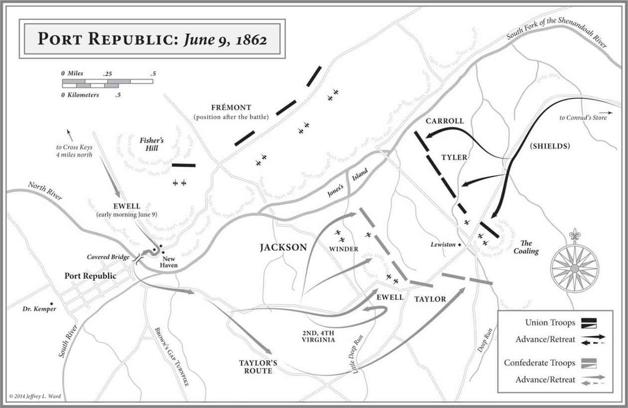
Thus, three of the bridges. The fourth, and most critical to Jackson’s strategy, was in the town of Port Republic, a small cluster of buildings in the delta formed by the North River and the South River just before they flowed together to form the South Fork of the Shenandoah. Shields, increasingly lost in his own private fog of war, would misunderstand its importance, too. Jackson had chosen Port Republic over every other place he could have gone—and by now he and his brilliant cartographer, Jed Hotchkiss, knew all of them—because of its peculiar location at the junction of the three rivers. His army, on the morning of Sunday, June 8, was camped in the rolling wheatfields north of the town, facing attack from Frémont’s army from the direction of Harrisonburg and from Shields coming down the Luray Valley. The Union armies were so close that they posed a classic problem of military strategy: Jackson could not afford to throw his entire army at one or the other; he could not take them in succession, or “in detail.” He would somehow have to deal with both at once. It was yet another reason for him to march for Brown’s Gap as fast as he could, depart the valley, and join the Confederate forces at Richmond. It is hard to think of another general, on either side, who at this point in the war would not have done so.
But Port Republic, like so many of Jackson’s choices of positions in the war, then and later, was actually a terrific tactical play.3 Its beauty lay in the fact that it offered both the protection of a roaring river and an escape hatch if things went wrong. Its best feature, tactically speaking, was a sturdy covered bridge over the rampaging North River. This was the fourth bridge. In the absence of the others, it was the only way for either army to cross the river. If Frémont beat him on the battlefield, he could easily retreat over the North River and burn the bridge. East of town there was the South River, breast-high and moving like a millrace but still fordable or bridgeable with pontoons or wagons. It separated him from Shields’s oncoming army. If he lost that fight, he could recross the lesser stream and head to Brown’s Gap a few miles away on a good road that ran south out of town.
On the morning of June 8 Jackson’s army looked like this: Its headquarters was in the small village of Port Republic. Seven thousand men under his direct command were camped outside of town just north of the North River, while Ewell’s five-thousand-man force was camped about four miles north at a hamlet known as Cross Keys. Jackson’s numbers were down because his brutal marches had once again taken a fearsome toll on his army, which now had at least three thousand absentees.4 It was the price paid for his extraordinary maneuvers. “We have been on a retreat for five days and an awful time it has been,” wrote one artillerist. “I never saw so many men with their feet all swollen and bleeding.”5 Facing Ewell across gently swelling farmland covered by wheat, clover, patches of timber, and the occasional picturesque farmhouse were twelve thousand bluecoats under Frémont in full battle lines and ready for a fight. To the east, bogged down in muck and mire downstream near Conrad’s Store, lurked Shields’s brigades.
For all of his cleverness in isolating his enemies and in devising a place where he might fight both of them, Jackson now made several critical errors in judgment. Having chosen this river straddle as his main tactical play, he proceeded to neglect the key to it all: the North River bridge. Though that bridge needed no protection from north of Port Republic, where most of Jackson’s army was bivouacked, it was deeply vulnerable from the south and east. But Jackson had placed only a very light guard on the two river fords across the South River, over which the threat from the east would come. There were no guards on the bridge itself. He made an even more serious mistake by ordering Quartermaster John Harman’s enormous wagon train with most of the army’s supplies to park in the fields behind headquarters, both highly visible and highly vulnerable to any attack from the east. (An advance unit from Shields had only to cross the fordable South River to get at them.) Worse still, loss of the North Bridge would mean that Jackson’s army and its supplies were on opposite sides of the unfordable river. Indeed, Jackson himself might have been separated from his own army.
What had happened to cloud Jackson’s mind? His staff was convinced that he was a victim of complete physical exhaustion. He was at least as tired as his men, many of whom had simply dropped by the roadside. He was often up at what he euphemistically called “early dawn”—what we would call the middle of the night—working on the endless details of command, many of which he insisted on keeping track of himself. Colonel Samuel Fulkerson wrote that his commander “is remarkable for his energy and industry . . . and sleeps very little. Often while near the enemy, and while everybody except the guards are asleep, he is on his horse and gone, nobody knows where.”6
He thus took the fate of the entire army on his shoulders, its life and death, its hard marches and whatever food and clothing he could secure to keep it going. All of this cost him rest. There is little evidence that he had had a single full night’s sleep since the valley campaign began. On many nights the wet weather precluded sleep at all. On June 4, Jackson’s tent was the victim of a small flash flood in the middle of the night that carried away his hat and boots. He tried to sleep anyway, even though the tent was still full of water. The next morning, according to Douglas, it was still full of “various small articles of apparel and furniture . . . floating about like little boats.”7 Such was life on the march that spring. Jackson was so weary that he sometimes fell asleep fully clothed, even wearing his sword and boots. Sandie Pendleton, who was probably closer to his commander than any of his aides, thought that in the first week of June “General Jackson was completely broken down.”8
The consequences of Jackson’s strange lassitude were not long in coming. At about 8:30 a.m. on the dry, mild morning of June 8, approximately 150 cavalry with four guns under the command of Colonel Samuel Carroll forded the South River, galloped into Port Republic, and created an astounding amount of havoc in a short time, capturing three staff officers and nearly taking Jackson himself, who escaped only by a mad gallop the length of the main street and over the North River bridge.9 The immediate result of the assault was that Carroll’s raiders suddenly found themselves in possession of that bridge. It was Jackson’s worst nightmare. Carroll had only to burn the bridge and Jackson and his army would be cut off from his supply trains and his escape routes. Frémont would have him cornered against the rampaging North River.
And then something miraculous happened. Carroll, who might have changed the war and made himself a hero by burning the bridge, was actually determined to hold it. That was because his superior, Major General James Shields, had explicitly ordered him, in writing, to do so.10 It was one of the campaign’s greatest tactical mistakes, and it still is not clear how Shields could have been so foolish. In keeping with his character—he was a chronic liar—Shields later blamed it all on Carroll, who by “some unaccountable misapprehension” had failed to burn the bridge. Shields, in reality, had not been able to make up his mind and had given at least one set of conflicting orders, though his final order was clear enough: “Hold it at all hazards.”11 Carroll did, until he and the rest of his little group—plus some infantry that had remained in the rear—were chased off by a determined Jackson backed by two regiments and artillery.
Still, why would Shields have ordered Carroll to, as Union general Nathan Kimball later put it, “hold the only bridge over which Jackson could possibly escape from Frémont”?12 The real reason may have been petty jealousy, which would also have been in keeping with Shields’s deeply deficient character. According to an Ohio soldier, on the previous day Shields had said in a voice “loud and rather sarcastic, ‘Frémont thinks he is going to raise hell up there, and I’ll show him.’ ” The idea was that Frémont wanted the bridge burned to trap Jackson; Shields wanted to deny Frémont that glory. Kimball, generally a reliable source, later made the same accusation.13
As for Jackson’s own tactical lapses, there was another reason for his sudden blindness that morning: Turner Ashby, his brilliant, erratic cavalry chief, was dead, killed in a skirmish with Union cavalry on June 6. (His death underscored how dangerous life was for Civil War officers, who had a 50 percent greater chance of being killed than privates.14) Though he had failed to execute Jackson’s orders at half a dozen key moments—most egregiously at Winchester—Ashby had closed out his life with a rush of redemptive glory.15 During Jackson’s retreat south in June, he had been his old brilliant self, launching daring attacks that slowed Frémont’s army, at one point even rallying straggling infantry to make a successful counterattack. For all his flaws, he was supremely brave, capable of feats of endurance in the saddle that amazed his contemporaries, and uncannily aware of where the enemy was. Such devotion to duty had taken its toll on him, as it had on Jackson. At the time of his death he was, in the description of a contemporary, so thin he looked emaciated. With his dark skin; long, dark beard; and long hair he presented a wild sight. “He told me that he had been under fire for sixty consecutive days, but he found no inconvenience from it,” wrote the soldier. In place of meals, Ashby said, “I eat a few apples, drink some spring water, and draw up my swordbelt a hole or two tighter, and I’m all right. It’s just as good as eating.’ ”16 He had the blind loyalty of his men, but in his absence the cavalry quickly lost whatever meager discipline it had, and bore at least some of the blame for Carroll’s freakish success that morning at Port Republic. Still, in his official report, Jackson praised Ashby as he had never praised anyone else:
The close relation which General Ashby bore to my command for most of the previous twelve months will justify me in saying that as a partisan officer I never knew his superior; his daring was proverbial; his powers of endurance almost incredible; his tone of character heroic, and his sagacity almost intuitive in divining the purposes and movements of the enemy.17
But on the morning of Sunday, June 8, there was no time to mourn the fallen hero. From the north came the distant roll of artillery: Frémont’s big guns were opening up on Ewell. The Battle of Cross Keys had begun.
• • •
Frémont should have won the battle quickly. He had a two-to-one numerical advantage, and better than that in artillery. If he had thrown his entire force directly at Ewell’s line, which was set up on a long ridge, he would very likely have broken it. But with Frémont nothing was ever that simple. He was facing not just Stonewall Jackson now but also the myth of Stonewall Jackson, and the myth told him and his officers that they were facing twenty thousand battle-hardened Confederate troops instead of the five-thousand-plus effectives in front of them. At Frémont’s council of war he and his brigade commanders worried about this terrible numerical disadvantage and bemoaned the poor condition of their ragged, starved-out, exhausted army. A hundred and fifty years later, you can almost hear the defeatism. One thinks of the astonishing moral distance between their outlook and that of the dead Ashby, a man who slept little, often went hungry, and fought bravely and almost continuously without complaint.
After some inconclusive skirmishing, the main battle began, as most of these battles seemed to, with long-range artillery. And while cannons were very satisfying to shoot, watch, and listen to, they often did little significant tactical damage. For a cautious warrior such as Frémont, this probably seemed like a good way to fight without getting his hands dirty. (George McClellan, another hesitant fighter, loved nothing better than the idea of bringing up his big guns in front of Richmond and pounding the city into submission from afar.) The cannonade began at Cross Keys at 10:30 a.m., roared for six full hours, and consisted mostly of shooting at other batteries. An enormous amount of ordnance was used up in the process. A single Union battery shot six hundred rounds that day, meaning one round per cannon every three minutes. In spite of this, there is little evidence that much damage was done. Another Union battery stood on the front lines for four hours of this shelling and lost only one man killed, one wounded.18
The battle on the ground, on the other hand, clearly belonged to the Confederates. It was conducted entirely by Richard Ewell, barking his profane orders in his squawky voice from his headquarters, which, unlike that of Frémont, was up on the field of battle near his artillery. Jackson, wary of the arrival of the rest of Shields’s army, remained four miles south, in Port Republic. Rebel soldiers under Brigadier General Isaac Trimble tore into the Union left, driving three brigades back a full mile. In the center, Brigadier General Robert Milroy, who had fought Jackson so well at McDowell and who was impatient with Frémont’s passive battle management, launched a two-thousand-man assault in midafternoon on his own initiative, only to see his men cut to pieces by Virginians in the woods. There was plenty of hardnosed fighting on both sides, too, men standing in the open and loading and firing and stepping or inching forward or backward depending on the flow of the battle.
Why a particular regiment of soldiers advanced or retreated at this and other battles in the Civil War is still something of a mystery. At bottom, fighting was about the ability to hurl enough lead at a concentrated group of soldiers so that, seeing enough of their friends go down, they became convinced that they had to withdraw. Often it was just that simple. At other times the effects of musket fire were almost imperceptible, as much the result of a soldier’s belief in his chances of survival as of the actual danger he faced. Belief counted for a lot—in one’s general, in the captain in front of you brandishing his gleaming sword, in the bravery of one’s fellow soldiers, in the idea of winning itself. A rout might start with men taking small steps backward while reloading, then taking slightly larger steps backward while their enemy, two hundred or three hundred yards away, began to move very slightly forward. Soon the retreating line would begin to lose individual soldiers, then groups of them, and finally the entire line would turn and run—all without ever experiencing a single definitive moment when the battle turned.19 Sometimes regimental and brigade commanders simply became lost in the thick clouds of gunpowder smoke. Blinded and feeling isolated, and with the whoops and shouts of the enemy newly magnified in their ears, they might also be inclined to retreat. Though it is impossible to measure the effect of Jackson’s growing reputation as a winner on his men, it was undoubtedly strong.
By early evening, when Frémont ordered his troops to withdraw from their advance positions under cover of his artillery, it was clear that Ewell had gotten the better of him. He now occupied the ground from which Frémont had launched his first attack. The final tally of casualties—288 for the Confederates and 684 for the Federals—suggests the level of Confederate dominance. Still, Frémont’s force was bloodied but not beaten; he would be able to fight the next day.
Jackson, meanwhile, spent most of the day in Port Republic, fully expecting Shields to follow up on Carroll’s attack. Jackson spent time placing artillery on the bluffs that overlooked the village—enough to be sure that he could stop Shields if he tried another attack across the South River. When one of his officers pointed out this possibility to him, he replied, waving his hand toward his commanding artillery positions, “No, sir! No! He cannot do it! I should tear him to pieces!”20
The news of Ewell’s victory at Cross Keys thrilled Jackson’s men. They had been attacked by Frémont’s full army, had struck a hard blow in return, and had driven him back. More important, as far as Jackson’s staff was concerned, was the meaning of the victory. With Frémont checked and Shields not yet in evidence, they all believed that Jackson would now do the supremely logical thing: slip out under cover of darkness, take his exhausted army on the road for Brown’s Gap, and call an end to the long campaign. They had underestimated their commander once again. That evening he amazed them all by ordering his quartermaster, John Harman, to bring up the supply wagons, roll them across the North River bridge, and give the troops rations to cook. They were going to stay and fight. Among his staff members there was a good deal of eye-rolling and looks exchanged. “The General seemed to like traps,” wrote Henry Kyd Douglas, “and, at any rate, was not yet satisfied with the risks he had run and the blows he had inflicted. . . . We were getting used to this kind of aberration, but this did seem rather an extra piece of temerity.”21 And so the huge supply train rumbled forward; campfires were lit; and, likely to the astonishment of Shields and Frémont, no Confederates showed any signs of leaving Port Republic.