
CHAPTER THIRTY-FOUR

The news of Stonewall Jackson’s arrival in front of Richmond ran through the Army of Northern Virginia like an electric current, and it spread from mouth to mouth until suddenly, according to one soldier, “a deafening shout burst from our men; thousands of throats took it up and rent the very air; it died away only to be repeated with greater emphasis and volume. . . . Stonewall Jackson here! The genius of our Southern cause—its very soul. What could he know of failure? Every soldier in the ranks felt safe; the magic of that name, the prestige of his corps, was such that the most doubting Thomas had no longer any fears.”1
They had prayed that Jackson would come, and now, in their hour of greatest peril, he and his army had marched in, fresh from their brilliant valley campaign, ready to save the day, the city, the Confederacy. The moment was purely theatrical: one of the South’s few authentic heroes had arrived at the very time and place where he was needed most—the gloom-ridden, despondent city of Richmond, in whose eastern approaches stood McClellan’s restless Army of the Potomac—to redeem the Southern cause. Until his arrival, there had been little to hope for. The bloody stalemate at the Battle of Seven Pines on May 31–June 1 had accomplished nothing more than to fill the city’s hospitals with wounded men. And now came the very real prospect that the city might fall. Plenty of Northerners believed that it would; newspapers in New York and Boston were boasting of the inevitable victory. Expecting the worst, many Richmond residents had already fled. President Davis and other politicians had dispatched their families southward. Trains loaded with Confederate gold and government documents were ready to roll out of the city at a moment’s notice. Major General Joseph E. Johnston, recuperating from his recent wounds, was so certain that McClellan would capture Richmond that he arranged for a special train to take him out of the city.2 While Union soldiers drilled in their camps, gnawed on hard biscuits, and complained about the heat, Richmond prepared for battle, siege, and more death.
How could one dusty, disheveled major general and 18,500 ragged troops possibly live up to such outlandish expectations? That is one of the most intriguing questions of the war. Because Jackson, against all odds, did. He fulfilled all of his countrymen’s most wildly optimistic and absurdly unrealistic expectations of him, and he did it before summer’s end. It is a matter of record that, mainly on the strength of Lee’s daring and Jackson’s astounding maneuvers, within two months the capital being threatened was no longer Richmond but Washington, DC, a city into which the defeated Union army beat a humiliating retreat—the greatest military disaster of the war to date.
Just how that happened is one of the great stories of the war. It did not happen right away. First the rebel generals had to deal with the immense army in front of them.
• • •
The counteroffensive began as an idea in the mind of Robert E. Lee. In late June 1862 the problem he faced was obvious enough: how to force a very large Union army away from Richmond. Even though with Jackson’s troops and other reinforcements he would soon have eighty-five thousand to ninety thousand men at his disposal, he did not believe he could succeed in a frontal assault against the entrenched Federals. He was absolutely certain that he could not win a purely defensive battle.
What he could do, however, was use the enormous size of the Union army against itself.3
That army, camped deep inside enemy territory, was dependent on its lines of supply to deliver the six hundred tons of food, clothing, weaponry, ammunition, fodder, tents, and multitudinous other sundries it needed every day to survive. It was far too big to live off the land. Without those supplies it would turn very quickly from a fighting force into an assemblage of starving men and horses. The lines that fed it were long and sinuous: they had their origins in New York, Philadelphia, Baltimore, and other Northern cities. The matériel came by wagon, train, and eventually by boat down the Chesapeake Bay and then up the York and Pamunkey Rivers to a place called White House Landing, about twenty airline miles due east of Richmond. Lee knew it well. The White House plantation had been the home of his wife, Mary’s, great-grandmother Martha Custis at the time she married George Washington. It had later been inherited by Lee’s son Rooney. When Federal troops took possession of the mansion and converted it to Little Mac’s headquarters, it was Mary’s principal residence. McClellan, always attentive to proper protocol, saw to it that Mrs. R. E. Lee was escorted through the lines.4
In the late spring of 1862, this pier on the Pamunkey had become the lifeline of McClellan’s epic move against Richmond. In the river were boats of every sort, steam-powered and sail-powered and man-powered, stacked and gammed in rows that spread out into the lazy current and that were tethered ultimately to a succession of floating wharves where goods were unloaded. There were floating hospitals, too, sutlers’ stores selling everything from toothbrushes to potted lobster, roads jammed with wagons, quartermaster officers, sailors, African-American laborers, and other contrabands, mules, and horses.5 Here, too, was the terminus of the telegraph wire from Washington, strung along a circuitous, two-hundred-mile path from the War Department to Wilmington, down the Eastern Shore of Maryland, and up the York-James Peninsula. With its electrical current, electromagnets, and pulses of Morse code, it was one of the technological wonders of the age. Through it ran all of Lincoln’s chiding and coaxing, as well as McClellan’s dilatory, self-protective replies. From White House Landing the supplies were loaded onto train cars on the Richmond and York River Railroad and hauled westward to the Union camps in front of the Confederate capital.
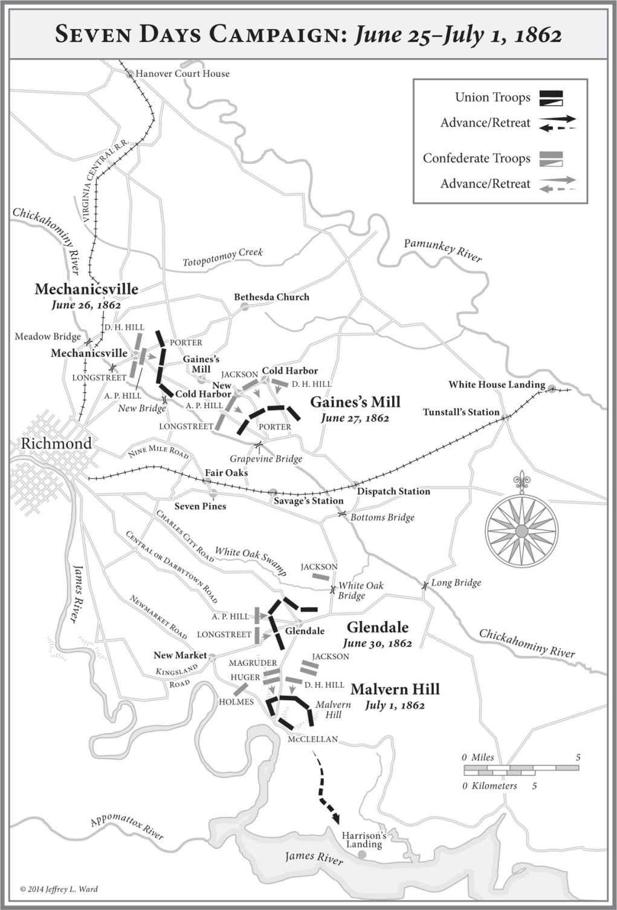
Thus everything the Union army needed to survive—all that tonnage produced by McClellan’s vast logistical machine and transported from points hundreds of miles away—ultimately ran down a single, vulnerable railroad track. To threaten it was to threaten the army itself. Lee understood this. As he considered the scene in front of Richmond, he saw something else, too. The Chickahominy River, which ran parallel to the James and roughly bisected the peninsula, was swollen and unfordable: the bogs and marshes of its timbered bottomlands were up to a mile wide in places, making it impossible for cavalry or artillery to cross. At high water—which there was plenty of that spring—it was too swampy even for light infantry.6 Crossing was possible only by bridge, and there were only half a dozen of them spread along fifteen river miles in front of Richmond; some of them were washed out.
To protect the railroad line on both sides of the Chickahominy, McClellan had been forced to split his army. Jeb Stuart’s swashbuckling ride had shown Lee precisely how he had done it. McClellan had deployed eighty thousand men in front of the city, south of the river. But north of the river, on his right flank, he had placed only a single army corps of thirty thousand men under General Fitz John Porter, an army lifer and McClellan crony who had graduated a year ahead of Jackson at West Point and had later been a cavalry and artillery instructor there.7 (The rest of the Union right was camped on the south side of the river.) Because of the difficulty of moving an army across the Chickahominy, Porter could not be easily or quickly reinforced. In this Lee saw a compounding of Union weaknesses. He saw opportunity. A successful attack north of the Chickahominy against the numerically inferior Porter would in turn threaten the Union’s railroad and supply depot, which would then compel McClellan’s main force to fall back from its advanced positions in front of the city.
There were two problems with Lee’s idea. The first was that Porter occupied one of the war’s best defensive positions, one that Confederate engineers themselves had scouted earlier and determined would be almost impregnable.8 Lee’s answer to this, in the plan he outlined at the generals’ meeting on Nine Mile Road, was to avoid attacking Porter directly. Instead, he would send Jackson and his army to march around Porter’s flank and head straight for the railroad in his rear. With Jackson behind him—specifically Jackson, his name ablaze with its new celebrity—Porter would have no choice but to pull out of his breastworks and rifle pits and move rearward. He would then be out in the open, where Lee could unleash his wheeling attack. Of course, all this required precision in both timing and movement. The maneuvers were to be executed by an inexperienced staff under a novice commanding officer and subordinate officers who were unused to cooperating with each other.
The second, and far more serious, problem was that by placing sixty-five thousand Confederate troops—six of his ten divisions—north of the Chickahominy, Lee had at most twenty-five thousand troops under Generals John Magruder and Benjamin Huger to defend the city. He was not only leaving a token force to defend the Confederate capital—an almost crazy risk all by itself—he was also planning to deploy the bulk of his army on the far side of a swollen river, from which point it would be difficult or impossible to come to Richmond’s aid. It was the inverse of the tactical dilemma Lee intended to inflict on McClellan. To say that Lee’s plan was fraught with danger is to understate the point: he was risking everything—his army, his capital city, perhaps the survival of the Confederacy itself. If McClellan and his generals understood for a moment what Lee was doing, and acted on it, they would have little trouble smashing Richmond’s defenses. As Lee saw it, he did not have much choice. Waiting in Richmond for McClellan to haul up his big siege guns and blow the rebels out of their trenches did not seem to him a reasonable option.
It was thus to Lee’s considerable dismay that, at about 8:30 a.m. on June 25, the day before his planned offensive, and after most of his troops had been moved into place for the next day’s advances, brigades of McClellan’s army attacked the Confederate army in front of Richmond. Several miles north, Lee listened to the sounds of the battle, and worried. Had McClellan learned of his plans? Was this the beginning of the final assault that had been so long in the making? It must have taken an enormous effort of will not to modify his plans. But he did not. He believed he knew McClellan, and he did not think McClellan was going to hazard his infantry against Richmond’s trenches. Lee would soon be proven right. In reality what he was hearing was a halfhearted advance by a general who had been prodded into it and still wasn’t certain he wanted to do it. McClellan wrote to Stanton that same day with his now familiar complaint that he was badly outnumbered: “The rebel force is stated at two hundred thousand, including Jackson and Beauregard,” he wrote.9 If he truly believed this, his actions defied logic. Why would he willingly attack a force twice his size? Why did he, at the same moment, seem so confident that he himself was not going to be attacked? These questions have never been answered, though divining Confederate numbers and deployments was not exactly a dark art. One of McClellan’s brigade commanders, Brigadier General George G. Meade, figured out that the Confederate front at Richmond was thin and vulnerable; even the correspondent for the Philadelphia Inquirer got Lee’s troop strength roughly right.10 But something inside McClellan wanted it that way. In the same letter there was an undertone of tragic vainglory, almost martyr-like, that hinted at his state of mind: “I regret my great inferiority in numbers but feel I am in no way responsible for it,” he went on. “I will do all that a General can with the splendid Army I have the honor to command & if it is destroyed by overwhelming numbers can at least die with it & share its fate.”11 It was a kind of miracle, in fact, that McClellan was finally sending the men forward at all.
He would not send them very far. Though the initial Union attacks gained ground, the Union commanders soon began to worry that they were facing some version of the 180,000-to-200,000-man Confederate army of Pinkerton’s fictions and McClellan’s nightmares. General Joseph Hooker, commanding a division, somehow concluded that he was outnumbered three to one, a bit of utterly unjustified paranoia that made its way quickly back to its most receptive audience, George McClellan. The fear was enough to send the Union brigades, under Little Mac’s orders, scurrying back to their entrenchments. McClellan, who had been managing the battle from three miles in the rear by the technological innovation of the battlefield telegraph, then rode to the front. Climbing a tree as bullets zipped by him—he never seemed personally afraid of gunfire—and seeing no overwhelming enemy presence, he sent his troops forward again. They proceeded to retake the six hundred yards of ground they had lost in the morning. Then night fell. The fight that day pitted approximately seventeen thousand Federals against roughly seven thousand rebels.12 If the attack seemed tepid, it was because McClellan had never had any intention of sending his army in a full assault on the city. He was clinging to his old idea: the way to take Richmond was to get close enough to move one hundred big siege guns up and pound the place into rubble. His plan that day was to take just enough real estate to allow that to happen. For whatever reason, he could not shake a genuine distaste for sending his brave, adoring soldiers into a bloody fight. “Every poor fellow that is killed or wounded almost haunts me!” he had written his wife, Nell, on June 23 from White House. “My only consolation is that I have done my best to save as many lives as possible.”13 Lee would turn out to have no such scruples.
• • •
While the 1,067-casualty Battle of Oak Grove, as it came to be known, was being fought in front of Richmond, Jackson and his army were moving toward their appointed destination above the Union right, from which they would launch their flanking movement the following morning. Their march was a small disaster, the first of many disasters, small and large, that would occur in the week of battles that came to be known as the Seven Days. Jackson’s columns started late, in the rain, and proceeded in airless, suffocating heat. The streams were all running high. Commissary wagons were bogged down in deep mud. Bridges were out—having been washed away or destroyed by Union cavalry. Maps were abysmal and often completely wrong. Lee’s directions were impossibly complicated. (“If a second column continued on the Ash Cake Road to J. Overton, & thence on the road to Pole Green Church, it would strike the road from Shady Grove Church to Old Raleigh, a mile & three quarters east of the Shady Grove Church,” and so on.14) This was not the open, gently rolling, mountain-bracketed land of the Shenandoah Valley. Here you could not see anything. Here an army division could be half a mile from you and you would not know it. Making everything worse was the fumbling presence of Robert L. Dabney, a leading Presbyterian theologian and friend of Jackson’s but a desperately poor choice for chief of staff. In this new wilderness he was completely overmatched; a severe case of diarrhea combined with Jackson’s reluctance to share information with him made him almost useless. Equally distressing in this soggy labyrinth was the absence of mapmaker Jedediah Hotchkiss, whom Jackson to his regret had dispatched on other business back to Staunton. Then, too, whatever secrecy Lee had hoped for had been blown sky high, as evidenced by the persistent Federal cavalry attacks: the Union high command was well aware of Jackson’s approach. At the end of the day the exhausted army was forced to stop six miles short of its destination. They had covered twenty-five miles. Still, considering that Jackson was to launch an offensive in the morning, six miles was a long way. The single bright note was the arrival of Jeb Stuart with two thousand cavalry, whom Lee had sent to cover Jackson’s left during the following day’s march.
That night offered a rare window into Jackson’s preparations for war. At about midnight, Generals Chase Whiting and Richard Ewell called on him at his farmhouse headquarters to suggest a route of march for the next day. Jackson listened, and told them he would consider it. As the two generals left, Ewell remarked to Whiting, “Don’t you know why Old Jack would not decide at once? He is going to pray over it first!”15 When Ewell discovered he had left his sword in Jackson’s room and returned for it, he indeed found Jackson on his knees, deep in prayer. According to Robert Dabney, the general had spent the evening pacing his chamber, receiving visits from officers, and “wrestling with God.” After Ewell and Whiting left, he spent the rest of that night in prayer and preparation for the great operation that was now before him.16
He would have done better to sleep. Jackson, in fact, was once again in an advanced state of exhaustion. He was likely also in the early phases of some sort of severe cold or sickness—“fever and debility,” as he described it to his wife later in the week.17Including that night, he had spent three sleepless nights in a row. He had had no more than seven hours’ sleep in the preceding four days. During that time he had ridden more than ninety miles without rest to and from Lee’s meeting, then added another twenty-five miles on June 25 with his army. The day ahead was to be momentous. Jackson must have been a physical wreck. It was amazing that he could even stay awake in his saddle. Somehow he went on.
The march the next day—June 26—was as bad as the last. Jackson’s men were in a new world now. Nothing went right. Directions were almost impossible to follow. Jackson had ordered his troops to move at 2:30 a.m. but because of balky supply trains and lack of fresh water, they did not move until 8:00 a.m. Jackson’s refusal to share information with his officers hurt even more here in tangled thickets where delegation of authority was a necessity. When his column did move, it was struck repeatedly by Union cavalry, which fought small, sharp engagements, burned bridges, and felled trees that acted as barricades. Jackson’s troops, swelled now to nearly twenty-four thousand, were forced to march at a dead-slow pace, feeling their way through the wooded thickets “with skirmishers deployed.” By 9:00 a.m., as Confederate divisions under D. H. Hill, A. P. Hill, and James Longstreet waited near the Chickahominy, and troops under General John Magruder marched and countermarched and shouted orders to nonexistent regiments and generally carried on an elaborate charade in front of Richmond to deceive the enemy, Jackson’s army was already six hours behind schedule. If nerves were beginning to fray, there was good reason. Richmond itself was at stake. Everyone knew that. Everyone knew that McClellan could move forward again at any time, and they wondered: Where is Jackson?
McClellan, meanwhile, was behaving exactly as Lee had believed he would. As the morning of the twenty-sixth passed, he issued no orders to follow up his attack of the previous day. That was because, at least in part, he had concluded that he himself was about to be attacked. He had waited too long, and his procrastination and delays had finally caught up with him. It was a consequence he had not really counted on, because he had wildly underestimated Robert E. Lee. Now, with one of the most remarkable opportunities of the war before him, his fears got the better of him. There was his usual willingness to believe the exaggerated Confederate troop numbers. But added to that was a new variable: fear of Jackson’s reputation. McClellan knew for certain now that Jackson was bearing down on his right; in a letter to Stanton on June 25 he predicted that “Jackson will soon attack our right & rear” and pleaded again for more troops, but this time saying, “If I had another good Division I could laugh at Jackson.”18 But he did not, and the effect was paralyzing. He neither attacked Magruder nor sent troops to reinforce Porter. He waited for whatever fate God had in store for him—an odd attitude for the nation’s commanding general in a war where he held enormous inherent advantages.
But Lee could not know this. Nor could he know why his grand plan to evict Fitz John Porter from his works, which relied on Jackson to make the first move, was failing, and failing miserably. Jackson was nowhere to be found. At 3:00 p.m. Jackson’s West Point classmate A. P. Hill, the sensitive, slender young aristocrat who wrote poetic letters to his sister and lady friends but who in wartime was a hard-bitten, unsentimental killer, decided that enough was enough: on his own initiative, he ordered his division to cross the Chickahominy. Soon Little Powell and his men were advancing through the shell-swept village of Mechanicsville toward Porter’s thirty thousand, who were dug in along a mile-long line in the sixty-to-seventy-foot-high banks behind a small tributary of the Chickahominy called Beaver Dam Creek. Lee, who had come to the same conclusion that Hill had—in Lee’s words he was “obliged to do something” to distract the larger Union force in front of the city—declined to call off the attack. Hill believed in any case that Jackson was on his way and that his critical flanking movement was still in progress. They were saving Richmond, after all, even if they were doing exactly what Lee’s plan had tried to avoid: a frontal attack on Union defenses.19
The result was what Lee himself might have predicted: more of a slaughter than a fight. The Battle of Mechanicsville (also known as the Battle of Beaver Dam Creek) offered yet more evidence of what was becoming increasingly apparent to most of the war’s participants: men with rifled muskets shooting from good cover had enormous advantages over their attackers. The cover in this case was splendid. Wrote Porter Alexander, “They had fortified it with infantry breastworks & pits for guns & by cutting down all timber in range to give unobstructed fire.”20 They had also constructed an extended abatis—an obstacle made of sharpened logs and branches. The open fields west of the creek also offered clear fields of fire for the Union artillery, expertly positioned on the high ground behind the infantry, which laid down a devastating barrage from the moment the rebel soldiers appeared, with horrific effects. One soldier in A. P. Hill’s division said that everyone would duck when a shell passed, then look behind to see where it had landed. “The body of a stalwart young fellow suddenly disappeared, and on the ground where he had stood was a confused mass of quivering limbs which presently lay still,” he wrote. “The same shell, as I learned afterward, carried away the top of a man’s head in our own regiment.”21 It was this brutal, raking artillery fire that led Hill to advance toward the Union position, where he thought there would be better cover.
But the fire was just as lethal near the swamp. As the rebel soldiers approached, they could see from a thousand feet away what lay ahead of them: first the cannons ranged on the top of the creekbank, then the rifle pits, and below those the wide swamp, abatis, and other felled trees. Most who made it to the water were cut down. In a five-hour firefight the Confederates lost 1,500 of the 10,000 men who were engaged, many of them on a final, suicidal assault at a place called Ellerson’s Mill. “A more hopeless charge was never entered upon,” later wrote Porter Alexander. The 44th Georgia Regiment, which made it to the creek where its men were lacerated by musket fire and ran out of ammunition, suffered 361 casualties of 514 men who entered the fight. In one soldier’s description, the dead in the swamp looked like “flies in a bowl of sugar.”22 The 1st North Carolina Regiment lost 133 killed and wounded, including its colonel, lieutenant colonel, major, 6 captains, and 10 lieutenants. Of the 14,000 Union soldiers engaged in the fighting, only 361 were lost.23 It was a lopsided victory for the defense. The Confederate assaults against the Union 5th Corps’ fortress-like positions never had any hope of success. McClellan, meanwhile, wired Stanton triumphantly that evening, “Victory today complete and against great odds. I almost begin to think we are invincible.”24
But where was Jackson? The question has haunted histories of the war ever since. And what, by extension, had become of Lee’s elaborate plan? The answer lies partly in a document known as “General Orders No. 75,” dated June 24, 1862, in which Lee gave detailed instructions to his generals. The document is as confusing today as it was then, an attempt to both arrange and predict a sequence of movements involving more than sixty thousand men in a swamp-ridden, densely wooded country they did not know and did not even have accurate maps for, and generals who had no experience working together under a commander who had never wielded an army. Jackson’s difficulties were all rooted in some way in General Orders No. 75. Its vague language and wishful thinking constituted Lee’s first big mistake of the war.
Jackson’s location, as the first of A. P. Hill’s troops advanced on Beaver Dam Creek, was roughly an hour short of the place he was supposed to reach in the early morning. His problem that day, as it was the day before, was that he could not make his army march fast enough to meet the timetable established by those orders. Though he was frustrated and impatient, he could do nothing about it; the obstacles were too great. At 9:00 a.m., fully aware of how far behind he was, Jackson sent a courier to General Lawrence Branch, who was to be the second chess piece to move in Lee’s plan, telling him that he was already six hours behind Lee’s schedule. For reasons unknown to history, Branch decided not to pass that message on. A. P. Hill had based his attack at least in part on the idea that Jackson would soon arrive. No one had told him otherwise. Nor, for that matter, had Hill tried to contact either Jackson or Branch.
But the worst confusion came from the orders themselves. Lee had instructed Jackson to advance to an old Revolutionary War–era meetinghouse called Polegreen Church, let the other generals know that, then lead a movement down the north bank of the Chickahominy toward Cold Harbor. The assumption was that Jackson’s arrival at Polegreen Church would take him so close to Porter’s force that the Federals would have no choice but to pull out. But Lee’s maps were wrong. Though they showed the church virtually on top of the position Porter’s men occupied on Beaver Dam Creek, in fact it was more than three miles away. When Jackson and his army pulled up just past Polegreen Church at a place called Hundley’s Corner at about 5:00 p.m., where they reunited with Ewell’s division, they thus found themselves in the middle of nowhere. Strangely, they could hear the sound of distant gunfire from the south.
It was a confusing moment. Jackson’s orders said nothing about making an attack, or riding to the sound of battle. Indeed, attacking Porter was exactly what Lee did not want to do. He wanted to maneuver the Union general out of his position. The orders stated explicitly that Jackson was to bear to the east of the creek, toward the Union supply line. What, then, were these guns? Was the plan already under way? Were Confederate troops crossing the Chickahominy? Had he somehow turned the Federal flank? Jackson, whose face, according to an aide, was “anxious and perplexed,” had no way of knowing. He would have assumed that Lee knew how late he was. He might also have assumed that if Lee had different plans for him, Lee would have contacted him. But Lee did no such thing. He did not even try. So Jackson, attempting to follow his orders, which told him to advance to the church and to avoid Beaver Dam Creek, stayed put. There may have been a further misunderstanding: in Lee’s battle report he says he expected Jackson to flank Porter; Jackson’s report indicates that he thought his goal was a crossroads at Cold Harbor much farther in the Union rear.
Jackson has been criticized through the years by generals on both sides and by historians for failing to arrive on time at Mechanicsville and then, when he got there, for failing to attack, even to the point of blaming him for the Confederate defeat. Most of this is unfair; he was in a subordinate position, doing what he believed Lee wanted him to do, and that did not include attacking any Union position. He was indeed late, but he assumed Lee knew that, and in any case his lateness had more to do with Lee’s timetable than with his own failure to move his army as quickly as possible. (Jackson himself had suggested at the generals’ meeting on June 23 that the advance should take place on June 25; but the ultimate responsibility for the decision lies with Lee.) Though he failed to reach his appointed destination on June 25, Jackson still had managed a twenty-five-mile march under horrendous conditions in terrain that no one, Lee included, understood. “The Confederate commanders knew no more about the topography of the country than they did about Central Africa,” wrote General Richard Taylor. “Here was a limited district, the whole of it within a day’s march of the city of Richmond . . . and yet we were profoundly ignorant of the country, were without maps, sketches, or proper guides.”25
Though Jackson cannot be held responsible for the shortcomings of General Orders No. 75, and certainly not for the loss at Mechanicsville, his actions that afternoon still seem both strange and out of character for one of the most aggressive military commanders America has ever produced. Like his fellow generals A. P. Hill and Lawrence Branch, he seems to have assumed that the job of communication belonged to someone else, perhaps to Lee’s staff. Thus he arrived at Hundley’s Corner, just down the road from the church, and did not dispatch a courier to Lee or to anyone else—an odd and uncharacteristic passivity that could be explained by lack of sleep and sickness. Then, too, he was unused to playing the role of subordinate. We will never know. Jackson does not offer any reasons in his official report and indeed seems to find it scarcely worth mentioning. During that day the only message he sent to anyone was the brief note to Branch saying he was late. Nor did he avail himself of the services of Jeb Stuart, the only Confederate officer who actually knew something about the local terrain. Lee scrupulously avoided placing blame on any of his generals, including Jackson, for the bloody disaster of June 26.26
Behind all of the blunders and miscommunications, staff failures and misunderstandings that swirled around the Confederate defeat at Mechanicsville, however, lay a single, very large truth: Lee’s plan actually worked. It did not work precisely when it was supposed to, and it did not work exactly as he had imagined, with his legions executing a perfectly sequenced rightward turn behind Jackson’s army, driving McClellan’s army south along the Chickahominy. But Lee’s calculation—that the presence of Jackson’s twenty-four thousand men along with his outsized reputation on the Union right flank would scare the Federals out of their entrenchments on both sides of the river—was correct. While McClellan’s wires to Washington after his army’s victory at Mechanicsville were jaunty and optimistic, claiming his near invincibility, as the evening progressed he began to feel weak and vulnerable. Any doubts in his mind that Jackson was there in force were now gone. He knew, moreover, that Jackson’s veteran army had not engaged at Beaver Dam Creek and was therefore the equivalent of a very large gun pointed at the rear of the 5th Corps and, beyond, at the railroad and Union supply base.
McClellan was not wrong. Jackson’s presence there made Porter’s position behind the creek instantly indefensible, precisely as Lee had envisioned it would. Perhaps a more courageous or resourceful general would have brought up reinforcements and fought the massed Confederate divisions north of the river while launching the main attack to the south. This was Porter’s suggestion. Other generals suggested variants of this plan. They all believed Richmond was vulnerable. They all thought the solution was to attack. McClellan disagreed. More convinced than ever that he was facing a two-hundred-thousand-man force, he began, in the wake of his victory, to think only of how he was going to save his army. Lee, after his defeat, was thinking only of how he was going to corner and destroy his adversary.
At about 1:00 a.m. on June 27, after the Battle of Mechanicsville, George McClellan made the breathtaking decision that he would abandon both his supply line and his grand plan to capture Richmond. He decided to retreat. He did not think of it this way, and did not describe it this way to his superiors. His own choice of words to describe the course he set for the Army of the Potomac was “change of base.” By this he meant that he was forsaking White House Landing and the railroad as conduits for his daily ration of supplies, and shifting those operations to a new supply base, at Harrison’s Landing on the James River, eighteen airline miles due south across the peninsula. Cutting the supply line meant that his army could no longer stay where it was. All of those men would march to the banks of the deeper James, where they could shelter under the massive guns of the US Navy’s ships.
McClellan ordered Fitz John Porter to fall back during the night, though he would not have enough time to move his entire corps across the Chickahominy. He would instead move a few miles south and set up along another swamp to protect the bridges, which were his only avenue of escape. As Porter remembered later, McClellan impressed upon him “the absolute necessity of holding the ground, until arrangements over the river can be completed.”27 Porter saw this as a sort of code. He believed McClellan was telling him that the 5th Corps was going to be sacrificed so the rest of the army could assault and take Richmond. Porter, always the good soldier, replied, “I shall hold it to the last extremity.”28 What he was really doing, though he did not yet know it, was covering a retreat. The rest of the army would have to move soon, and quickly. For the moment it was frozen in front of Richmond in contemplation of another Confederate attack.