
CHAPTER FORTY-TWO

Had the war changed Thomas J. Jackson? After eighteen months of brutal dislocation that had changed so many others, the question is worth asking. There was no simple answer. He could, and did, often seem completely opaque, even to his own staff. Between his administrative duties—managing equipment, supplies, munitions, medical matters, and food, dealing with Richmond, overseeing promotions and other personnel matters—and his basic responsibilities for marching and fighting, Jackson presents such a seamless blur of activity that it is easy to lose sight of the man behind the rank.1 A rare exception was the two-month period that followed the Battle of Antietam. The Union army had offered no immediate pursuit. There was no fighting. There were no forced marches. Jackson spent almost all of that time in various camps near Bunker Hill, just north of his beloved—and dramatically changed—Winchester. And though he was still quite busy, in this period of extended rest the man himself became more visible.
He comes most sharply into focus through the eyes of a British army colonel named Garnet Wolseley, who visited Jackson’s camp in the second week of October along with two English reporters. Wolseley was one of the brightest stars in his country’s army. He would later become commander in chief of the British army and thus the most powerful military figure in the world. He had gone out of his way to meet the famous Confederate general, even though he had been told that the taciturn Jackson would be a difficult interview. But Jackson was not at all what he expected. With a newly shaven upper lip and chin and “only a very small allowance of whisker,” Jackson cordially welcomed his visitors into his tent.2 He began the conversation by speaking of his trip to England and the Continent in 1856, particularly of his fondness for English cathedrals, then asked his guests questions about various English subjects. In contrast to so many observers who found Jackson disappointing in person, Wolseley, an outsider who saw him unfiltered by the lens of the wartime army, was enormously impressed. (A later British visitor, a member of the House of Commons, said Jackson was the best-informed military man he met in America.3) This was not because Jackson’s manner had changed—one of the reporters present recalled him as courteous but somewhat distant and reserved—but his presence clearly had.4 Jackson was still Jackson, and dressed like Jackson. But Wolseley, the soldier’s soldier, believed himself to be in the company of a brilliant and fully formed leader of men.
“Dressed in his gray uniform, he looks the hero that he is,” Colonel Wolseley wrote in a British magazine a few months later,
and his thin compressed lips and calm glance, which meets you so unflinchingly, give evidence of that firmness and decision of character for which he is so famous. . . . Though his conversation is perfectly free from all religious cant, it is evident that he is a person who never loses sight of the fact that there is an omnipresent Deity ever presiding over the minutest occurrences of life. . . .
With such a leader men would go anywhere, and face any amount of difficulties; and for myself, I believe that, inspired by the presence of such a man, I should be perfectly insensible to fatigue, and reckon upon success as a moral certainty. . . . Jackson, like Napoleon, is idolized with the intense fervor which, consisting of mingled personal attachment and devoted loyalty, causes them to meet death for his sake and bless him while dying.5
Many of Jackson’s men would have agreed with Wolseley. Whether his wild popularity was somehow rooted in his unusual personality, or, as his cynical brother-in-law D. H. Hill believed, solely in his ability to win on the battlefield—or some combination of the two—there was clearly more to him than the old science teacher with a few glorious victories under his belt. Almost everyone who had known him before noted this change. His old friend Mrs. Fanny Graham from Winchester saw the transformation in physical terms. “He is looking in such perfect health—far handsomer than I ever saw him,” she wrote Anna after the general had stopped by for tea at her home in Winchester.6 A few months later Anna, too, would remark on this improvement in his looks that is apparent today in his few portraits.7 Gone is the almost petulant expression of the prewar photographs, replaced with the face—apparent in his famous “Winchester” portrait that his wife and friends all said was a true record of his appearance—of a man who indeed looked much more handsome, older, wiser, and more complete. It was perhaps no accident that someone whose many physical ills had virtually vanished—except for his unidentified sickness during the Seven Days—would seem physically transformed.8Though he was considerably thinner than he had been before the war, he was otherwise, for the first time in his adult life, completely healthy.
Part of his change, too, was the fame itself, which attached itself to him and would not let him alone. He was adored and idolized all over the South. One Alabama private wrote, “If Jesus Christ were to ride along the ranks on the foal of an ass, there would not be half the cheering and huzzahing” the general received.9 When he walked to regimental church services, men would drop what they were doing, including their card games, follow him, and stand in rapt silence while he knelt and often prayed aloud for them. (They were just as likely to return to their cards when he had departed.10) His mere presence in camp often sparked the feral crescendos of the rebel yell. Henry Kyd Douglas described a night in camp when “there broke forth that wild and joyous yell for which the Stonewall Brigade was famous. Other brigades and divisions took it up and it sprang from camp to camp with increasing vigor, until the bright arch of Heaven seemed to resound with the thundering acclaim. . . . When it was at its height I saw the General come out, bareheaded, from his tent, walk to the fence and lean his elbow on the topmost rail. . . . When it was all over, he returned slowly to his tent, and said in soliloquy as he entered: ‘That was the sweetest music I ever heard.’ ”11
One of the most telling signs of his renown—and his inability to escape it—was the song, written on the eve of Antietam, that was sweeping through Confederate ranks and that would become one of the more popular Confederate songs of the war. Set to a spirited, upbeat tune, “Stonewall Jackson’s Way” was a faithful reflection of the way he was seen in the ranks in the fall of 1862. In its third verse, the song dares anyone to “scoff ” at Jackson’s habits of worship.
Come, stack arms, men! Pile on the rails,
Stir up the camp-fire bright;
No matter if the canteen fails,
We’ll make a roaring night.
Here Shenandoah brawls along,
There burly Blue Ridge echoes strong,
To swell the brigade’s rousing song
Of “Stonewall Jackson’s way.”
We see him now, the old slouched hat
Cocked o’er his eye askew;
The shrewd, dry smile, the speech so pat,
So calm, so blunt, so true.
The “Blue-Light Elder” knows ’em well;
Says he, “That’s Banks, he’s fond of shell;
Lord save his soul! We’ll give him hell,”
That’s “Stonewall Jackson’s way.”
Silence! Ground arms! Kneel all! Caps off !
Old “Blue Light’s” going to pray.
Strangle the fool that dares to scoff !
Attention! It’s his way.
Appealing from his native sod,
“Hear us, hear us Almighty God,
Lay bare Thine arm; stretch forth Thy rod!”
That’s “Stonewall Jackson’s way.”
He’s in the saddle now. Fall in!
Steady! The whole brigade!
Hill’s at the ford cut off. We’ll win
His way out, ball and blade!
What matter if our shoes are worn?
What matter if our feet are torn?
“Quick-step! We’re with him before morn!”
That’s “Stonewall Jackson’s way.”
The sun’s bright lances rout the mists
Of morning, and, by George!
Here’s Longstreet struggling in the lists,
Hemmed in an ugly gorge.
Pope and his Yankees, whipped before,
“Bayonets and grape!” hear Stonewall roar;
“Charge, Stuart! Pay off Ashby’s score!”
In “Stonewall Jackson’s way.”
Ah! Maiden, wait and watch and yearn
For news of Stonewall’s band!
Ah! Widow, read, with eyes that burn,
That ring upon thy hand.
Ah! Wife, sew on, pray on, hope on;
Thy life shall not be all forlorn;
The foe had better ne’er been born
That gets in “Stonewall’s way.”
Jackson had a contentious relationship with his fame, which he battled with a combination of flight and prayer. Cheers from his men would usually prompt him to spur and gallop away. It was said that Little Sorrel understood his master’s wishes and would speed up as soon as he heard shouting. Though Jackson had vowed not to read newspapers, he was aware that the press was full of his exploits, and he wrote Anna to caution her, in words that might have been drawn from his own prayers, to ignore them. “Don’t trouble yourself about representations that are made of your husband,” he wrote. “These things are earthly and transitory. There are real and glorious blessings, I trust, in reserve for us beyond this life. It is best for us to keep our eyes fixed upon the throne of God and the realities of a more glorious existence beyond the verge of time. It is gratifying to be beloved and to have our conduct approved by our fellow-men, but this is not worthy to be compared with the glory that is in reservation for us in the presence of our glorified Redeemer.”12 (Italics added.)
He often included the same sorts of caveats in his thank-you notes for the many gifts he received, which included everything from gilded spurs, gold braid, and dress swords to socks, scarves, and apple pies. “My Dear Mrs. Osburn,” he wrote in one letter, “Your very kind note and beautiful and useful presents from your daughter have been received. Please give my thanks to her, and accept them for yourself. I know of none who rejoices more than myself at your release from that thralldom to which you refer [Federal occupation], but you must not overestimate me in the work. I have been but the unworthy instrument whom it has pleased God to use in accomplishing his purpose.”13
But he did more than just redirect credit for his victories to the divinity. During this interlude, Jackson, who believed that godliness among his troops would help win the war—and by contrast blasphemies such as carrying mail on Sunday might doom the cause—began to play a more active role in his army’s religious life. He had always done this, to some extent. But now, and for the next seven months, he went at it more systematically. Though he would consent, in the absence of a pastor, to lead prayers, he himself never proselytized, never preached, never criticized any soldier for failure to attend religious services. His work was entirely behind the scenes, ensuring that Christian pamphlets were distributed in camp, recruiting regimental chaplains, lobbying Richmond for more money to pay them, sometimes donating his own money, and arranging for popular preachers to give sermons. His efforts coincided with the wave of Christian revival meetings that pulsed through Jackson’s camps that fall. They were partly the product of the eighteen months the soldiers had spent in close proximity to death and their concerns about their own spiritual salvation. They were partly due to the work of preachers who saw a ripe opportunity to save souls. Jackson loved all of it, and attended as many camp meetings and services as possible, especially those featuring the Reverend Joseph Stiles, whom he particularly liked. He was delighted when more than one hundred men from the Stonewall Brigade showed up for a meeting. “It appears that we may look for growing piety and many conversions in the army,” Jackson wrote Reverend Dabney happily.14
Though a deacon’s bench was the closest Jackson ever came to the ministry, people sometimes treated him as though he had pastoral, if not saintly, powers. On one occasion, in October at Bunker Hill, a young woman approached Jackson while he was on his horse, lifted up her eighteen-month-old son, and asked the general to bless him. “He turned to her with great earnestness,” wrote an observer, “and with a pleasant expression on his stern face took the child in his arms, held it to his breast, closed his eyes and seemed to be, and I doubt not was, occupied for a minute or two with prayer, during which we took off our hats and the young mother leaned her head over the horse’s shoulder as if uniting in prayer. . . . When he finished he handed the child back to its mother without a word, who thanked him with streaming eyes while he rode off back down the road.”15
There were signs, too, that Jackson, though separated from Anna and thus from that more animated and emotional side of his personality, had not entirely lost his ability to relax. His unique relationship with Jeb Stuart deepened during this time. During the fall camp the two visited each other frequently, and soldiers marveled not only at how Stuart was allowed to kid Jackson, but also how Jackson seemed to save his few stillborn attempts at humor for his swashbuckling friend. One night Stuart arrived at a late hour at Jackson’s headquarters to find the general asleep. Instead of returning to his own camp, he took off his saber and lay down next to Jackson to sleep, which touched off a nightlong struggle for the single blanket. The next morning Stuart awoke to find Jackson and some of his staff warming themselves by a campfire.
“Good morning!” said Stuart. “How are you?”
“General Stuart, I am always glad to see you here,” Jackson replied. “You might select better hours sometime, but I am always glad to have you. But General,” he said, rubbing his legs, “you must not get into my bed with your boots and spurs on and ride me around like a cavalry horse all night!”16
At about that time the dapper Stuart, tired of seeing Jackson in the same tattered coat, had commissioned a tailor in Richmond to make Jackson a new one of fine wool, with gilt buttons and lace. He sent his aide Heros Von Borcke to Jackson with the carefully wrapped gift. Jackson opened it, gazed at it for a moment in “modest confusion,” then said, “Give General Stuart my best thanks, Major. The coat is much too handsome for me, but I shall take the best care of it, and shall prize it highly as a souvenir.”17 He folded it carefully and placed it in his portmanteau.
But Von Borcke was under orders from Stuart to press the issue, and insisted that Jackson try it on. He did, it fit perfectly, and he liked it so much that he wore it to dinner that night, to the slack-jawed amazement of Jim and his staff. Word of the general’s new coat spread quickly through the camp, and soon soldiers were running to see it for themselves. Jackson was very pleased with his friend’s gift, which he would eventually wear into battle—thus shocking the rest of the army, too. He wrote Stuart, “I am much obliged for the beautiful coat you have presented me. . . . When you come near don’t forget to call & see me. Your much attached friend.”18
Jackson proved that he could be unpredictable in other ways, too. Shortly after the Battle of Antietam, a Virginia man had invited Jackson and his staff to dinner. Before the meal, the host appeared with a decanter of whiskey and asked if anyone would like an “appetizer.” To the amazement of the group, Jackson, instead of politely declining, asked, “Have you got any white sugar?” The answer was yes. Jackson strode to the table, and, with “a skill and ease which seemed shocking in contrast to his reputation,” mixed himself a toddy, drank it off, complimented the host on the flavor, then offered some to General D. H. Hill and Henry Kyd Douglas.19
“Mr. Douglas,” Jackson said, “you will find it very nice.”
Douglas demurred, saying he had a headache and that he did not like the taste of “spirituous liquors” anyway.
Jackson’s reply surprised his listeners. “In that I differ with you and most men,” he said. “I like the taste of all spirituous liquors. I can sip whiskey or brandy with a spoon with the same pleasure the most delicious coffee or cordial will give you. I am the fondest man of liquor in this army and if I had indulged my appetite I would have been a drunkard. But liquors are not good for me. I question whether they are much good to anyone. At any rate I rarely touch them.”20 Douglas recalled seeing Jackson take a glass of wine only a few times during the war. Liquor, like his own soaring ambition, was so seductive that it needed to be forcibly suppressed.
• • •
While Stonewall Jackson was resting and reorganizing his troops that fall—he and James Longstreet had both been promoted to lieutenant general on October 10, each commanding half of Lee’s army—George Brinton McClellan, the erstwhile young Napoléon, was losing his moorings. Though he crowed about his “victory” over Lee, he had done nothing to follow it up, nothing to make it stick. In spite of warm, dry weather, custom-made for fighting a war—and with flooding rains and cold weather looming ahead—he refused to move. He cited the by now familiar litany of reasons why he could not: exhausted troops and horses, lack of clothing and shoes, lack of wagons, a river too deep to cross or not deep enough to protect Washington, Lee’s superior numbers, etc. And this drove Lincoln, Halleck, the War Department, the Republican press, and much of Congress to distraction. Halleck noted that after urging McClellan to move during the first week of October, to no avail, he had “peremptorily ordered” him on October 6 “to cross the Potomac and give battle to the enemy.”21 This, too, produced no results. Lincoln followed with more gentle prodding. “You remember my speaking to you of your over-cautiousness,” he wrote his general on October 13, as though lecturing a troublesome child. “Are you not over-cautious when you assume that you can not do what the enemy is constantly doing? Should you not claim to be at least his equal in prowess, and act upon that claim? . . . It is easy if our troops march as well as the enemy; and it is unmanly to say they can not do it.”22
But McClellan was feeling powerful again. He had rejuvenated a discouraged army. He had saved the North from a Confederate invasion. He had the love of his men and plenty of political support from Democrats in a country whose fall elections were about to tilt in their direction. At the same time, he could see quite clearly that his tormentor, Lincoln, was facing bitter attacks from a wide spectrum of political interests. The president was denounced as a moral coward by Democrats who called the Emancipation Proclamation “another advance on the Robespierrian highway of tyranny and anarchy.” His conservative supporters hated him for selling out to the radicals, and the radicals assailed him with “vehement and injurious demands for a more vigorous prosecution of the war.”23 McClellan’s habitual criticism of his bosses in Washington now deteriorated into withering scorn. “The good of the country requires me to submit to all this from men whom I know to be greatly my inferiors socially, intellectually & morally!” he wrote his wife, Ellen. He called Lincoln a “gorilla,” Stanton a “great villain,” Halleck “a fool . . . with no brains whatever!”24 Flushed with victory, he wanted nothing less than Stanton’s head and Halleck’s job.
On October 26, six weeks after Lee’s withdrawal from Sharpsburg, and under considerable pressure from Washington, McClellan finally put his army on the road. And though this southward movement was accompanied by great fanfare in the Northern press and renewed cries of “On to Richmond!” the great march of the Army of the Potomac proved nothing but a slow, spiritless trudge. It took McClellan eight days to cross the Potomac and penetrate a mere twenty miles into Virginia, a task Jackson could have accomplished in a day with a barefoot army on half rations. In the meantime he had allowed Longstreet to slip between him and the Richmond defenses. He inched his way into the area around Warrenton, where on November 7 he encountered a howling snowstorm, proof positive that he had already waited too long to mount a major campaign.
But McClellan’s brief, bright hour was over. That same day, while long lines formed in front of Mathew Brady’s gallery in New York City to see gruesome photographs of dead soldiers at Antietam, his Civil War career ended. Lincoln, long-suffering and almost preternaturally patient with his problem child, had finally had enough. During the snowstorm, Lincoln’s emissary, the picturesquely named Brigadier General Catharinus P. Buckingham, arrived to tell McClellan that he was relieved, effective immediately, and replaced by Major General Ambrose Burnside. And that was that. There would be no reinstatement this time, no glorious return with bugles blowing and soldiers hurrahing. Though McClellan took the news with surprising calm and dignity, he was bitterly disappointed. “I feel as if the Army of the Potomac belonged to me,” he wrote two days later. “It is mine. I feel that its officers are my brothers, its soldiers my children. This separation is like a forcible divorce of husband and wife.” Of Burnside he said accurately, “He is as sorry to assume command as I am to give it up.”25
Burnside was a curious figure in the war. He truly did not believe he was up to the job of commanding the Army of the Potomac. He had been offered it twice before by Lincoln, once in July 1862, after the Seven Days fiasco, and once after Lee had embarked on his invasion of Maryland. Each time he had turned it down. He had tried to duck it this time, too, and had relented only when Buckingham informed him that refusing the job meant that his detested rival Joe Hooker would get it instead. That was Burnside in a nutshell: a decent, unambitious man who mistrusted his own abilities. Though he had not had much financial success in life prior to the war, he was not without intelligence and initiative. In 1853 he had left the military to attempt to manufacture and sell a single-shot, .54-caliber carbine of his own design. Though he went bankrupt, and the factory he had started passed from his ownership, the Union ended up purchasing fifty thousand of them. Known as the “Burnside carbine,” it became the third most popular such weapon in the war after the Sharps and Spencer. Its success contributed to Burnside’s wartime rise in the army. At the time the war started, Burnside was working as a cashier for the Illinois Central Railroad, run by George B. McClellan, who had graduated a class ahead of him at West Point. A strapping six-footer with luxuriant facial hair, Burnside was honestly humble and had a simple, frank, hearty manner that endeared him to his friends. He could also be stubborn to a fault. He had trouble sleeping.
He was certainly smart enough to understand that his job now was to move, and move very quickly, in a southerly direction. He did just that. His grand plan, approved by Lincoln, was to feint toward Longstreet’s camps at Culpeper, then slide south and east toward Fredericksburg, cross the Rappahannock, and move directly on Richmond. The first part of the plan went well enough. Two advance corps arrived in the town of Falmouth, a mile upriver from Fredericksburg on the northern bank, on November 17, before Lee could shift his troops to block a crossing. But there they stopped: the pontoons Burnside needed to ferry his 110,000-man army across the river had not arrived. They would not arrive for a week, by which time Lee was dug in on the heights across the river.
Lee had never intended to fight at Fredericksburg, and, unaware of Burnside’s pontoon problem, was wary of his enemy’s intentions. Thus he summoned Jackson, whose newly created 2nd Corps marched out of Winchester on November 22. The weather was cold and getting colder. Sleet, snow, and icy winds whipped the marching columns. The men awoke in the morning with frost in their hair and their food frozen in their haversacks. Many were barefoot, and some of their frozen feet bled as they marched, leaving traces of blood on the ground.26 Many were without blankets or tents.27 They came at a steady pace, marching 175 miles in twelve days, cresting the magnificent heights of the Blue Ridge—as some of them had done on Jackson’s dramatic backdoor march to Front Royal in his valley campaign—descending through the rolling, river-crossed Piedmont, and landing in full force in Fredericksburg on December 4.
While Jackson marched eastward, his thoughts were of his wife, Anna, who was nine months pregnant and due to give birth any day. He had reason to be concerned. He had lost his first wife, Ellie, and a son in childbirth in 1854. His daughter Mary Graham, to whom Anna had given birth in 1858, had lived only a month. Two days before his departure for Fredericksburg he had written Anna, saying, “Don’t you wish you were here in Winchester? Our headquarters are about one hundred yards from Mr. Graham’s, in a large white house back of his, and in full view of our last winter’s quarters, where my esposa used to come up and talk with me. Wouldn’t it be nice for you to be here again?”28 In fact she would have been horrified to see the town, which had lately become a repository for the human debris of war. Makeshift hospitals overflowed with wounded from the Maryland campaign; a fire started by an exploding Union powder magazine had destroyed many of the town’s buildings, and others had simply been pulled apart for other uses. There was not a single item for sale in any Winchester store.29
On November 28, while he was still camped near Gordonsville, Jackson received a note from his wife’s sister saying that Anna had given birth to a healthy, eight-and-a-half-pound girl at the family home near Charlotte, North Carolina. The letter was written in the voice of the new baby, saying, “My aunts both say I am a little beauty. My hair is dark and long, my eyes are blue, my nose straight just like papa’s. . . . My mother is very comfortable this morning, and hopes you will write and give me a name.”30 Jackson was joyous, and wrote to Anna, “Oh! How thankful I am to our kind Heavenly Father for having spared my precious wife and given us a little daughter!”31 He went on,
I cannot tell you . . . how much I wish I could be with you and see my two darlings. But while this pleasure is denied me, I am thankful it is accorded to you to have the little pet, and I hope it may be a great deal of company and comfort to its mother. Now don’t exert yourself to write to me, for to know that you were taxing yourself to write would give me more pain than the letter would pleasure, so you must not do it. But you must love your esposo in the meantime.32
Jackson told no one about the birth of his daughter, and even forbade Anna to put the news on the telegraph. He was experiencing “a joy with which a stranger could not intermeddle.” Later, more in control of his emotions, he implored his wife not to “set your affections upon her, except as a gift from God. If she absorbs too much of our hearts, God may remove her from us.”33 He named the child for his cherished mother and his beloved but estranged sister: Julia Laura Jackson.
Jackson had no time to share these feelings with anyone anyway. Battle loomed. For reasons that would soon be painfully clear to the Union army, Lee had decided to stand and fight behind the Rappahannock. He actually could not believe that Burnside wanted to fight there. As one Confederate officer put it, “If the world had been searched by Burnside for a location in which his army could be best defeated and where an attack should not have been made he should have selected this very spot.”34 Fredericksburg was a charming, prosperous river town of five thousand souls where George Washington spent his boyhood and later bought a home for his mother. James Monroe once practiced law there.
More important militarily were its immediate surroundings. West of the Rappahannock was a broad plain that climbed in a gentle upward sweep to a long, slightly elevated range of wooded hills that ran behind the town, roughly parallel to the river. Though the slopes were not steep, the natural defensive positions on the ridge were superb. Union troops would have to advance across half a mile to a mile of open ground, where they would be at the mercy of Confederate artillery. As they closed on the ridgeline, they would then be faced with some seventy thousand Confederates and their artillery firing downhill at them from behind sturdy entrenchments that included a stone wall, a sunken road, and considerable wooded cover. The one Federal advantage beyond sheer numbers was a high ridge that rose on the left bank of the river known as Stafford Heights. Artillery posted there had complete command of the town and plains below. This meant that the Confederates could not stop the Union army from crossing the river, nor could they mount an effective counterattack. But those big guns would offer little or no help to the blue-clad men as they assaulted the heights west of the river.35
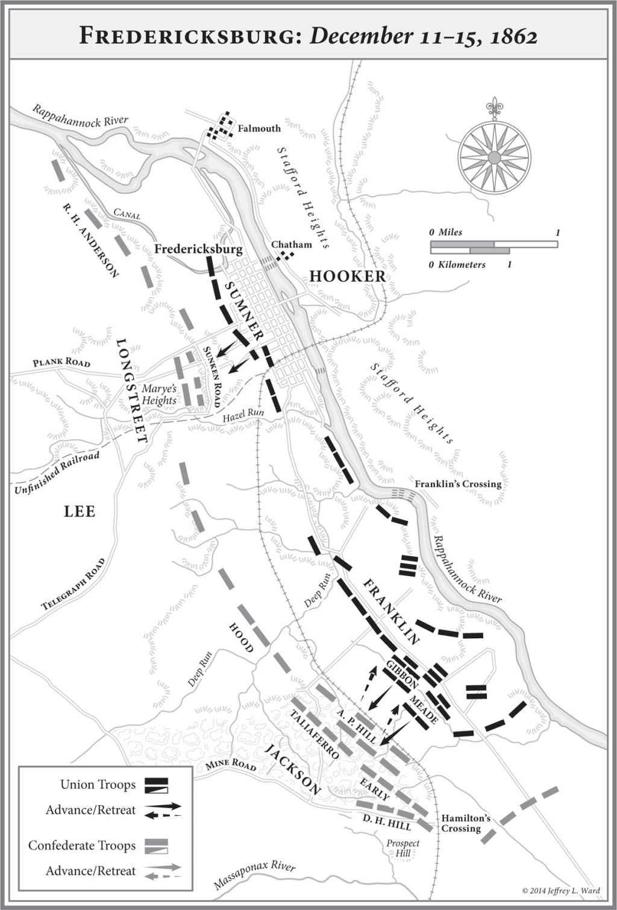
Lee took full advantage of the local geography, installing his army along the crest of the ridge, which offered both elevation and, in some places, superb natural fortifications. The most striking characteristic of his line was its unusual length: seven miles. He had neither attacked, nor defended, anything close to that scale thus far in the war. On the left was James Longstreet’s 1st Corps, dug in mainly along Marye’s Heights, which were fronted by a six-hundred-yard-long stone wall and sunken road. On the right, occupying a front of more than two miles, was Jackson’s 2nd Corps, tucked into the woods in a deep formation reminiscent of Second Manassas. The main difference was that he and his guns now commanded the high ground.
The Battle of Fredericksburg began on December 11, when Burnside ordered his men to build pontoon bridges across the Rappahannock in preparation for crossing. As the engineers attempted to anchor the wooden pontoon boats in place across from the town and lay four-inch-wide planks across them, Brigadier General William Barksdale’s brigade of 1,800 Mississippians opened fire on them from the buildings across the river, driving them back each time they emerged onto the boats. Frustrated and impatient with the delay, Burnside ordered his artillery chief to “bring all your guns to bear on the city and batter it down.”36 Soon soldiers on both sides were watching what Colonel Edward Porter Alexander, recently appointed Longstreet’s chief of artillery, called “perhaps the most impressive exhibition of military force . . . I have ever witnessed.”37 For two hours the guns boomed; cannonballs whizzed, hummed, whistled, screeched, or whirred, depending on who was hearing them; buildings collapsed; trees were uprooted; fires raged all over town; and entire blocks lay in smoldering ruins. The barrage damaged almost every structure in the town.
Witnesses on both sides were stunned by the barbarity of this attack on a civilian target, even though it had been evacuated. Later in the war men would get used to seeing cities and towns destroyed. But not yet. One New York gunner wrote later that he felt guilty about what he had done to the helpless town. Lee, watching from the heights, was disgusted by the spectacle, made worse by the frenetic Federal looting that followed. “These people delight to destroy the weak and those who can make no defense,” he said. “It just suits them.”38 In spite of all this apocalyptic thunder, the Federals still did not manage to dislodge Barksdale’s Mississippians, who began firing again as soon as the engineers emerged on the pontoons. Burnside, now furious, ordered volunteers topaddle the pontoon boats across the river and establish a bridgehead. This was soon done, though Barksdale’s men would put up a spirited street-to-street fight—the war’s first urban combat—for the next twelve hours. Behind it all, above the left bank lay the enormous Federal war machine, fully packed, provisioned, and waiting to cross. As Confederate artillerist Porter Alexander described the scene,
Over 100,000 infantry were visible, standing apparently in great solid squares upon the hilltops, for a space of three miles. Scattered all over the slopes were endless parks of ambulances, ordnance, commissary, quartermaster & regimental white-topped wagons. . . . Still more impressive to military eyes . . . were the dark-colored parks of batteries of artillery scattered here and there among them. . . . Over the whole scene there hung, high in the air, above the rear of the Federal lines, two immense black, captive [observation] balloons, like two great spirits of the air attendant on the coming struggle.39
By December 12, Burnside had managed to get his army across the Rappahannock. The next morning he launched his attack. His plan to assault Lee’s long line had two components. The main attack was to be made by William B. Franklin’s “Left Grand Division” against the Confederate right, roughly sixty-five thousand Federals against Jackson’s thirty-seven thousand. The secondary strike was to be made by the “Right Grand Division” under Edwin Sumner against the entrenched Confederates on Marye’s Heights. Sumner’s assault would fix Longstreet in place while Franklin rolled up Jackson’s line on the Federal right. Then the two grand divisions, together, would crush what was left of Lee’s army. In effect two battles would be fought that day, separated by three miles. Though Burnside’s plan was somewhat simple and crude, relying on brute force for its effects, there was no reason—on paper, anyway—why it could not work. As Burnside would soon discover, the reality on the ground was quite different.
Jackson, waiting on Prospect Hill, was visibly happy that morning. In the words of an aide, he was “in his most serene and cheerful mood.”40 He was pleased with fatherhood, pleased with the high spirits of the men and guns he had carefully deployed. That morning he wore the new coat Stuart had given him along with a new blue-gray lieutenant general’s hat with a band of gold lace that Anna had sent him, to the general bewilderment of his men, many of whom did not recognize him. He was unusually talkative, too. When Longstreet asked him if he was not “scared by that file of Yankees you have before you down there,” he fired back, “Wait until they come a little nearer, and they shall either scare me or I’ll scare them!” When Von Borcke asked him a version of the same question—Could he hold against such numbers?—he replied, “Major, my men sometimes fail to take a position, but to defend one, never! I am glad the Yankees are coming.”41
Most of all, he knew that he had built a prodigiously strong defensive position, stronger even than at Second Manassas. His lines were stacked a mile deep, with so many reserves—three-fourths of his entire 2nd Corps—that he had roughly eleven men per yardof defensive ground. His first and second lines consisted of A. P. Hill’s battle-tested veterans of the “Light Division,” heroes at Cedar Mountain, Second Manassas, and Antietam. The two generals were still feuding but did not allow personal issues to interfere on the battlefield. Behind them were Taliaferro’s division on the left and Early’s division on the right. These were some of the best and most seasoned fighters in the Confederate army. Stuart’s brigades with horse artillery were posted on the far southern end of his line.
The morning of December 13 broke cold, still, and foggy. From the top of Prospect Hill, the core of the Confederate defense, soldiers could see nothing but the dense mist that lay wet and heavy in the river valley. At about ten o’clock, in one of the war’s most spectacular and theatrical moments, the fog suddenly lifted to reveal an open plain that was alive with moving dark lines of men, horses, and artillery. “On they came, in beautiful order,” wrote an eyewitness,
as if on parade, their bayonets glistening in the bright sunlight; on they came, waving their hundreds of regimental flags, which relieved with warm bits of colouring the dull blue of the columns and the russet tinge of the wintry landscape, while their artillery beyond the river continued with unabated fury over their heads, and gave a background of white, fleecy smoke, like midsummer clouds, to the animated picture.42
The entire battle, in fact, unfolded in what one observer termed “a giant panorama,” in which much of the fighting was visible to everyone on both sides.
In the battle’s opening moments a young major named John Pelham, the commander of Jeb Stuart’s horse artillery, did something absolutely extraordinary: he hauled two pieces of artillery to a forward position on the Union left. One was quickly disabled, leaving him with a single twelve-pounder Napoléon. For nearly an hour, while he somehow dodged the heavy barrage aimed directly at him, he managed to hold up the advance of Franklin’s entire Grand Division. Only when he grudgingly withdrew under orders were the Federal batteries finally free to focus on Jackson’s position. For a solid hour, from 11:00 a.m. to noon, from both sides of the Rappahannock, Franklin’s guns pounded the Confederate lines. At noon the guns went silent, and then two infantry divisions, under Brigadier Generals John Gibbon on the right and the irascible, ambitious Major General George Gordon Meade on the left, marched forward up the gentle slope, dark antic lines moving against the frost-covered ground.
Jackson had, in fact, not been softened up at all. He had deliberately held his fire, saving his precious ammunition for use against the oncoming infantry. When Meade and Gibbon closed to about half a mile—amazed at the rebels’ odd silence—Jackson’s fifty-plus guns exploded in the wintry air, throwing out clouds of smoke pierced by long sheets of red flame, raking the advancing lines with shell, spherical case, and double-shotted canister. His guns tore great bloody holes in Federal regiments. Beaten back, the Union men regrouped and came on again, and were again rocked by this storm of lead and iron, which included a deadly crossfire from Pelham’s guns. Still the Federals came forward, now into musket range, where they continued to be cut down by Confederate fire. Federal batteries in front of the river, meanwhile, began to find the range of those Confederate guns, knocking many of them out. In the noon hour the battle raged on.
At about 1:00 p.m. Meade, undeterred, renewed his attack and again came under the same galling fire. As the division advanced, soldiers in the brigade of twenty-four-year-old Colonel William Sinclair, desperate for cover of any kind, found their way into a wide tongue of tangled, thickly wooded terrain that jutted forward from the same woods that held the rebel infantry. They expected to find rebels there, but they found no one at all. Earlier that day A. P. Hill, commanding that section of Jackson’s line, had apparently decided that the area was impenetrable and thus had left it unoccupied. He was wrong, almost disastrously so.43 Though the grove was tangled and swampy, it was navigable and far safer than standing in the open and at the mercy of Jackson’s canister, and the deeper the Federals penetrated, the more they understood that they had found a spectacular gap in their enemy’s defenses. They struggled upward through the thickets and then suddenly the lead group of Meade’s men—4,500 in total—were busting through a six-hundred-yard-wide gap in the Confederate line, rolling back the flanks of the two Confederate brigades under Brigadier Generals James H. Lane and James J. Archer that Hill had positioned on either side of this swampy gap. As the rebels fell back, the gap grew even wider. Meade’s soldiers drove straight on to the crest of Prospect Hill, where they caught Brigadier General Maxcy Gregg’s South Carolinians completely by surprise and routed them, too, mortally wounding Gregg in the process. By now they had penetrated so deeply that they were actually shooting at the rebels’ backs, causing even more panic and pandemonium in the collapsing center of the Confederate line. Suddenly—only a few minutes since Sinclair’s men first plunged into the woods—Meade’s division seemed on the verge of slicing Jackson’s carefully laid defenses in two.44 Gibbon’s division had moved forward and was engaged in a sharp firefight on the right side of the gap’s tangled thickets, while another Union brigade, under Brigadier General Conrad Feger Jackson, was fighting on the left.
There were just two problems with this apparently stunning breakthrough. First, General Franklin, whose decision to send only two divisions forward was met with bitter protest by Meade, had no plans to follow up with additional troops. This was due both to his own innate timidity and to the bizarre and tentative orders he had received from Burnside that morning. If Burnside had wanted Prospect Hill carried at all costs, he had never said so. Second, and far more serious, what Meade had broken was merely the front ranks of the Confederate defense. The larger formation remained intact and dauntingly deep. Jackson, who learned of the breach from one of Gregg’s panicked men, showed no particular concern. He knew exactly how deep his lines were, and he knew that an entire division waited just behind Gregg’s broken brigade. His response was to tell a staffer, in a calm voice, to order Jubal Early forward.
As they had at Antietam, Early’s men came on in a rush. With the sound of the rebel yell reverberating through the trees, his men scrambled forward and crashed into the wobbly Union lines, which had already suffered massive casualties. After more than an hour of fighting, the men were exhausted. No reinforcements were on the way. As Early came on, so did the Confederate brigades that had been surprised by Meade’s attack. They now regrouped and moved forward, too, both against Meade and against Gibbon on his right. Not only was the gap sealed, but the Confederates now closed on the Union forces along their entire front. What remained of the contest was violent, bloody, and brief. Meade’s men discovered, as they reeled in disorder from the woods, that when they emerged onto the open plain, momentarily safe from musket fire, they were now at the mercy of Jackson’s artillery. Adding to the horror, the tall broom sage across which they were retreating caught on fire. As the battle turned and the retreat became a rout, Jackson came forward to the edge of the woods, gazed out at the disorder and confusion before him, and raised his hand in prayer. Some of Early’s men, caught up in the sudden thrill of their success, chased the Union troops out onto the plain, only to be repulsed by stiff artillery fire and the fresh reserves Franklin should have sent up in support of Meade. The battle on the Confederate right was, for all intents and purposes, over. Meade’s breakthrough had offered the brief illusion that Jackson could be broken on Prospect Hill when, in fact, the Federals never had much of a chance—not attacking with single divisions, anyway.
Franklin wired Burnside at two fifteen, via battlefield telegraph, to say that his men had been driven back. When Burnside later ordered him to advance his right, Franklin said it was impossible. Jackson spent the next hour shifting his lines, partly to bait Franklin into another attack. But to no avail. Jackson wanted to attack, and even had D. H. Hill’s division make preparations, but the orders miscarried. And he soon realized anyway that he did not stand a chance against the massed Union artillery on Stafford Heights.45He had suffered more than 3,400 casualties, most of those in A. P. Hill’s division. The Union had sustained nearly 5,000.
The fight on the Confederate right paled in comparison to the bloody human destruction on the left. At about 11:00 a.m., with artillery from Jackson’s fight booming in the distance, Union forces advanced against Longstreet. William H. “Blinky” French was ordered to advance his division and take Marye’s Heights, a task that turned out to be impossible.46 Emerging from the town’s ravaged streets, French’s men had to advance across an open plain with almost no cover against a stacked and virtually impregnable defensive line. In front of them lay three thousand Confederates arrayed three deep in the Sunken Road behind the stone wall. Forty to fifty feet above them on the heights were more infantry. These two positions created, in effect, two front lines, which together brought six thousand rifles to bear simultaneously across a six-hundred-yard front. The Confederate artillery was stacked, too. Edward Porter Alexander, Longstreet’s chief of artillery and a man not prone to exaggeration, told his commander that “we cover that ground now so well that we will comb it as with a fine-tooth comb. A chicken could not live on that field when we open on it.”
What happened over the next six hours was something close to butchery, one of the war’s worst and bloodiest examples. French’s men were cut to pieces. Two of his brigades suffered 50 percent casualties within minutes. Whole regiments melted away before the unceasing rolling crash of guns and muskets and the flashes of white fire inside a wall of smoke. The Union boys never got to the wall. Most never got within a hundred yards of it. After French’s division came Hancock’s, attacking brigade by brigade just as French had, and then Howard’s, Wilcox’s, Sturgis’s, and Griffin’s, and so on, all fed by the stubborn Burnside into the killing machine at the top of the hill. The pattern of the attack would change hardly at all. There was no art to what was happening on either side: the men went up the hill, were cut down where they stood, and the survivors fell back while their comrades advanced over all that human wreckage—almost eight thousand casualties against less than a thousand for Longstreet’s men. There was no glory on Marye’s Heights either, just men killing men in a terrible and systematic way. Seven full Union divisions were sent in, one brigade at a time in fourteen different assaults against six thousand rebels. Porter Alexander, who spent the afternoon amusing himself with his spyglass by spotting men who had sought the almost nonexistent shelter, then blasting them from their cover, wrote later that “Fredericksburg was the easiest battle we ever fought.”47 Lee commented that “the attack on the 13th had been so easily repulsed, and by so small a part of our army, that it was not supposed that the enemy would limit his efforts to an attempt which . . . seemed so comparatively insignificant.”48
Yet that is what happened. The last of the Federal assaults on the heights ended the Battle of Fredericksburg. The Union had suffered 12,653 killed and wounded, the Confederacy 5,309. Ambrose Burnside, stubborn till the end, wanted to personally lead an attack of his 9th Corps the next day, but was talked out of it by his generals. Though he has gone down in history as an incompetent field commander for his tactics at Fredericksburg, in fact there was often a fine line in the Civil War between tenacity and foolishness. At Gaines’s Mill, Lee spent more than five hours assaulting uphill against a phenomenally strong Federal position, and lost nearly 8,000 men in the process. Yet because his final charges, by Hood in particular, won the day, the battle is remembered as a glorious victory. Because Burnside sacrificed all those men in a losing cause, he is often seen as inept and mindlessly obstinate.49 Though Lee, Jackson, and Longstreet expected the attacks to resume, they never did. The Union troops stayed in place on December 14, and on December 15 they retreated across the river. Soon Burnside’s pontoon bridges were gone, too, and the Federals were back in their camps along the high riverbank, nursing their wounded.
• • •
Both armies ended the battle in the same place they started it, but this time there were no debates about who had won. Burnside wired the president the next morning with the disingenuously hopeful news that his men held “the first ridge outside of town” and that they intended “to carry the crest today.” But news of heavy casualties soon cast the outcome in a different light. That evening a reporter for the New York Tribune who had covered the battle met with Lincoln and gave him the unvarnished version: Fredericksburg was a disaster, the worst defeat ever suffered by the Army of the Potomac.50 By December 15 much of the Northern press, so recently proclaiming the glory of the impending victory, fully understood that it would be impossible to spin the results into anything but a crushing defeat. The New York Times called it “a black day in the calendar of the Republic.” The Cincinnati Commercial wrote, “It can hardly be in human nature for men to show more valor or generals to manifest less judgment, than were perceptible on our side that day.” Senator Zachariah Chandler, a radical Republican, wrote, “The President is a weak man, too weak for the occasion, and those fool or traitor generals are wasting time and yet more precious blood in indecisive battles and delays.” Lincoln soon faced a full-scale mutiny from the Senate Republican caucus, which in effect demanded Secretary of State William Seward’s head in compensation for the loss. Though the president famously outmaneuvered the senators—and Seward kept his job—the shocking loss on the battlefield once again suggested a rudderless, divided country fighting a war with no clear end in sight.
The South, meanwhile, was giddy. Jefferson Davis, who had been feeling political heat for everything from the plunging value of Confederate currency to the impressment of supplies, the ragged condition of his army, and its failures in the western theater, rode the wave of victory. He claimed that the Federal defeat demonstrated yet again “the impossibility of subjugating a people determined to be free” and spoke of his “profound contempt” for the “impotent rage” of the Emancipation Proclamation.51
Jackson, meanwhile, expressed only regret that he had not hit his adversaries harder. Looking out over the corpse-strewn battlefield, he said, in a tone of resignation, “I did not think that a little red earth would have frightened them. I am sorry that they are gone. I am sorry I fortified.”
As always, such hard-heartedness was leavened with occasional kindness. During Meade’s attack Brigadier General Maxcy Gregg had been severely wounded. Gregg, a bookish and slightly deaf South Carolina aristocrat with a strong sense of right and wrong, had once called Jackson “tyrannical and unjust.” The two men had clashed on a number of occasions, once when Jackson had arrested Gregg’s regimental colonels for allowing men to break ranks, and once when he arrested them for allowing the men to remove fences for firewood. Jackson and Gregg had exchanged heated words, and Gregg at one point had preferred charges against Jackson, prompting Lee to intervene, saying that “he desired the matter to go no further.”52
At about 4:00 a.m. Jackson, who had been awake in his tent reading the Bible, sent a messenger to inquire about Gregg’s condition. The answer: he was dying. There was no hope. The messenger said that General Gregg “wishes to tell you that he regrets having sent you the note he did the day before yesterday, as he has since discovered that you were right and he mistaken.”53 The note has been lost, and in any case Jackson did not remember it. But he rode through the early-morning darkness with his aide James Power Smith to visit Gregg. When he arrived he found him fully conscious and in great pain. Jackson took Gregg’s hand, and in a voice filled with emotion said, “The doctor tells me that you have not long to live. Let me ask you to dismiss this matter from your mind and turn your thoughts to God and to the world to which you go.” Gregg, with tears in his eyes, mumbled thanks. He died a day later of his wounds.
On the way back to headquarters Jackson, riding now with McGuire and Smith, said nothing until they neared their camp, when he suddenly said, “How horrible is war.”
“Horrible, yes,” McGuire replied. “But we have been invaded. What can we do?”
“Kill them, sir,” Jackson said. “Kill every man.”54
• • •
Burnside would make one last attempt at Lee, more than a month later, on January 20. By this time many of his own generals, led by ringleaders William F. “Baldy” Smith and William B. Franklin, were in open revolt against him, undercutting him both in Washington and with his own troops. Smith, in fact, was demoted for doing so. Hooker was running down Burnside in press interviews. They were upset by what they saw as the needless butchery at Fredericksburg and by the appalling demoralization in the ranks. There were even cries for McClellan’s restoration.
In part to prove his critics wrong, Burnside now launched a campaign “to strike a mortal blow to the rebellion.” The plan was to cross the Rappahannock upstream of Fredericksburg and try to get behind Lee’s position on Marye’s Heights. Once again, the plan looked reasonable on paper. But then a cold, wind-driven rain started falling, which turned into a howling nor’easter. Soon the army, trudging upstream along the Rappahannock, found itself in what one soldier called “a complete sea of mud.” Wagons sank to their hubs, horses to their fetlocks. Mules sank completely out of sight in the middle of the road. There was obviously no way to continue, so Burnside called it off, ending once and for all his abortive winter campaign against Robert E. Lee.
But he was just beginning his campaign to punish his own generals for their insubordination and conspiracy against him. He drew up formal dismissals of the offending officers, including Hooker, Smith, and Franklin. Since he had to get presidential approval for such an action, he traveled to Washington, where he told Lincoln, in effect, fire them or accept Burnside’s resignation. Lincoln chose the latter. He relieved Burnside and gave the command to Hooker, about whom he had reservations. “Hooker does talk badly,” he said, “but the trouble is, he is stronger with the country to-day than any other man.”55