
CHAPTER FORTY-FOUR

Sometime deep in the afternoon of April 30, 1863, Robert E. Lee and his staff rode to the top of a high promontory near Fredericksburg known as Telegraph Hill.1 From its ramparts—cleared of trees by his orders—Lee had directed the Battle of Fredericksburg four and a half months earlier. From here he had watched the seemingly endless waves of blue-uniformed men crash on the killing grounds below the Sunken Road. He had watched Jackson’s bloody rout of Meade and Gibbon, which had prompted him to comment, “It is well that war is so terrible, or we would grow too fond of it.”2 Today he had come not to see men fight but to try to understand his enemy’s mind. Though he had grown accustomed to thwarting the well-laid plans of his Union counterparts, he had been caught off guard by large Federal troop movements in the preceding two days. Now it was his turn to be puzzled. From the hilltop he watched the Federals intently for some time. Then he closed his glass, turned to a staff officer, and said, “The main attack will come from above.” By “above” he meant to the west, upstream on the Rappahannock, where a large chunk of the Union army had suddenly materialized a dozen miles due west of his main force in Fredericksburg—behind him. Lee was right, and he knew it, even though most of his officers did not agree with him.3 But this was not exactly good news. It meant that his adversary Major General Joseph Hooker, known fondly to his men as Fighting Joe and referred to contemptuously by Lee as Mr. F. J. Hooker, had stolen a march on him.
It was that very contempt that had gotten Lee into this trouble. Hooker, as it turned out, was not at all like the man he replaced. Though the forty-eight-year-old general was seen in the army as a pushy, self-promoting opportunist who happily disparaged others to advance himself and was fonder of strong drink than he ought to be, he was also an aggressive fighter and, to everyone’s surprise, a talented administrator.4 He had inherited a demoralized army from Ambrose Burnside and in three and a half months given it back its snap. He replaced incompetent officers and reduced absenteeism. He streamlined operations and improved food, sanitation, campsites, and even clothing. Hospitals were cleaned up. Pay arrived on time.5 There was order and clarity and purpose in the camps, and the men could feel it. There was a sense, too, reminiscent of the old McClellan days, that the high command cared once again about the fate of the ordinary soldier. One of Hooker’s most important moves was to revamp his intelligence service, now known as the Bureau of Military Information. Unlike the bizarrely incompetent Allan Pinkerton, the BMI delivered consistently accurate estimates of rebel troop strength. Hooker, who had 159,329 men in his army (of whom roughly 135,000 were infantry, cavalry, and artillery), knew for a fact that Robert E. Lee had roughly 55,000 infantry available to fight.6 For the first time in the war, a Union commander had a clear picture, literally brigade by brigade and general by general, of his enemy’s strength.
Hooker, moreover, had a plan, and it was a good one, and it did not depend on reckless and sacrificial assaults on entrenched Confederate positions. He had put it in motion on Sunday, April 27, with elaborate secrecy, while Anna and Thomas Jackson were listening to Reverend Lacy preach at the open-air church at Hamilton’s Crossing. That day Hooker launched his “flying column”—three full army corps, stripped to the bare essentials of fighting, carrying eight days’ rations—on a march that covered more than thirty miles for some units around the rebel army’s extended left flank. Brilliantly executed and completely unknown to Lee—who had been fooled by a simple ruse of the Union signal corps into deploying his intelligence-gathering cavalry too far upstream—forty thousand men, nine batteries, and their assorted trains had tramped off to the west and south, crossed both the Rappahannock and the Rapidan, then swung east toward Lee’s flank and rear. By April 30, the Union flanking column—the 5th Corps under George G. Meade, the 12th Corps under Henry W. Slocum, and the 11th under Oliver O. Howard—were all camped in the vicinity of a little crossroads called Chancellorsville. They were soon joined by Darius Couch’s 2nd Corps.
What Lee had finally understood, squinting through his telescope that afternoon, was that the threat to his army’s existence came not from the 1st and 6th Corps sitting in front of Jackson—though they were forty thousand strong—but from this massive turning movement to his west. The 1st and the 6th were merely there to hold the Confederate army in place while Hooker’s main column rolled up its flank. Lee was still unaware of the third and equally menacing component of Hooker’s plan: a cavalry strike at his supply line between Richmond and Fredericksburg. The previous day Jackson’s quiet West Point roommate George Stoneman and ten thousand Union horsemen had taken off on a long, looping ride far above the Confederate left. Their mission was to destroy Lee’s railroad link to Richmond and thus the line by which all of his supplies moved. By these movements Hooker planned to force Lee out of his entrenchments and into the open, where he would either have to fight or retreat on Richmond. By April 30, everything was going exactly as planned.
Robert E. Lee, meanwhile, the great strategic and tactical genius, had failed to anticipate any of this.7 The best evidence of this failure was that, as Hooker’s men were marching, fully a quarter of Lee’s army was running an errand some eighty miles away in southeastern Virginia. Two crack divisions under James Longstreet—John Bell Hood’s and George Pickett’s—had been dispatched in February to blunt a suspected movement toward Richmond by the Union 9th Corps. When that threat failed to materialize, the Confederate force stayed to gather much-needed food and forage for the army—shipping it up on rail lines through Richmond—and to try to capture the Union garrison at Suffolk. Longstreet was busy laying siege to that town when he received Lee’s call for help, sent on April 29 and received on April 30. But Lee had already waited too long. Longstreet would not be able to even start north until May 3. Lee would have to fight Hooker’s army with what he had.
But before he did anything else, Lee had to throw something in the way of Hooker’s oncoming legions. He had already ordered Major General Richard H. Anderson to fall back from the river with his nine thousand men and establish a defensive line east of Chancellorsville. Now he summoned Jackson. Jackson, predictably, had wanted to attack the Federal troops who had crossed the Rappahannock on the foggy morning of April 29 and were now in his front. (It was the sound of the guns covering their crossing that had awakened him and led to Anna’s hasty departure.) Lee, who did not agree with Jackson, had nevertheless indulged this idea. But having studied the enemy’s dispositions, Jackson now told Lee he concurred that “It would be inexpedient to attack there.” By that he meant that massed Federal artillery on Stafford Heights would blast him out of existence if he tried.
Instead, Lee now ordered a massive shift to his left, sending most of Lafayette McLaws’s division plus three of Jackson’s divisions (under Robert Rodes, Raleigh Colston, and A. P. Hill) to join Anderson east of Chancellorsville. He left only a single division, plus one attached brigade, of twelve thousand men under Jubal Early, to defend the heights west and south of Fredericksburg. Lee thus committed four-fifths of his available army, under Jackson’s command, to stopping Hooker’s flanking column.8 Jackson was thrilled with the prospect. He was always in high mood before battle, but today—whether it was due to Anna’s visit or the long lapse in fighting—he was as animated as his staff had ever seen him. “I well remember the elation of Jackson,” wrote his ordnance officer William Allan. “He seemed full of life & joy. His whole demeanor was cheerful & lively compared with his usual quiet manner.”9
Back in Chancellorsville the Union command was indulging in a small orgy of self-congratulation. They had been outmaneuvered, outflanked, outmarched, and outgamed so many times by Lee and Jackson that they could scarcely believe this new scheme was working so well. Hooker had earlier boasted to a group of officers, “My plans are perfect, and when I start to carry them out, may God have mercy on General Lee, for I will have none.” Which might have seemed more of that standard-issue, high-command Union bloviation, familiar from the days of Pope and McClellan, except that the plan had worked perfectly so far. They had outfoxed the master. Three army corps had executed a difficult and nearly flawless sequence of maneuvers that had surprised Lee and placed them squarely on his flank. Now they were being reinforced. Full of confidence and pride, Hooker issued a general order to his army that read,
It is with heartfelt satisfaction that the commanding general announces to the army that the operations of the last three days have determined that our enemy must either ingloriously fly, or come out from behind his defenses and give us battle on our own ground, where certain destruction awaits him.
The order was greeted with cheers. Except for the bit about “certain destruction,” everything Hooker said was accurate.10
• • •
Chancellorsville was not really a town at all. It was not even a hamlet. It was barely a crossroads. The place consisted of a single large two-and-a-half-story brick house with a columned porch and a couple of outbuildings. The house was the residence of the widow Fanny Chancellor, her young son, and seven good-looking daughters, plus a handful of local refugees. Partly on the strength of the comely daughters, it had become a sort of social center during that extended, languorous Confederate winter. Dinner guests included Generals Dick Anderson and Jeb Stuart and the dashing Mississippi brigadier Carnot Posey.11 The girls loved Stuart above all, with his perfect manners, his plumed hat, and his perpetual good humor. The fun and ringing laughter had ended with the arrival of the Yankees, who took over the house for use as Hooker’s headquarters, including all of its most comfortable rooms, consigning the unhappy residents to one crowded wing.
More important for the two hundred thousand men who were about to fight here was the peculiar terrain surrounding the Chancellor house. People called it the Wilderness of Spotsylvania or just the Wilderness. The name was well chosen. It was a dense tangle of forest that spread twelve miles long and six miles deep on the flanks of the Rappahannock. There had been an iron industry here since colonial times, and the trees had all been cut down to make charcoal for furnaces and foundries. The vegetation that had grown back was a stunted, thorny snarl of dwarf pine, cedar, hickory, scrub oak, and assorted brambles. Though the woodland was pierced here and there by a few roads, much of it was indeed dark, impenetrable, trackless, labyrinthine, and often swampy wilderness. In all of its more than seventy square miles there were only a few cleared areas, most of which lay athwart the two main east-to-west roads that ran through it: the Orange Turnpike, and the looping and intermittent Orange Plank Road. The largest of these was a seventy-acre open area around the Chancellor house. There was nothing pretty or pleasant about the Wilderness. It would soon become apparent to many soldiers that, as a place to fight a battle, these dark woods were something out of a nightmare.
Jackson’s men marched from their camps below Fredericksburg in the light of a brilliant moon that yielded in the early dawn to a thick, watery mist. They left quietly, all twenty-four thousand of them, and headed west.12 By 11:00 a.m. on May 1 most of them had reached General Anderson’s division, which was busily digging in along a ridge about three and a half miles east of Chancellorsville that crossed both the Orange Turnpike and the Orange Plank Road. There they confronted Hooker’s army and braced themselves for the inevitable attack. Lee’s trust in Jackson was such, by this point in the war, that he had given him only the broadest guidelines for action: “Make arrangements to repulse the enemy,” he had said, which allowed Jackson to handle the problem as he saw fit. Jackson knew, at the same time, that it was Lee’s ultimate desire to drive Hooker back across the Rapidan. That suited him just fine. And so, upon assuming command near the Zoan Church, he told the troops under Anderson and McLaws to put down their picks and spades, climb out of their trenches, and prepare to attack.
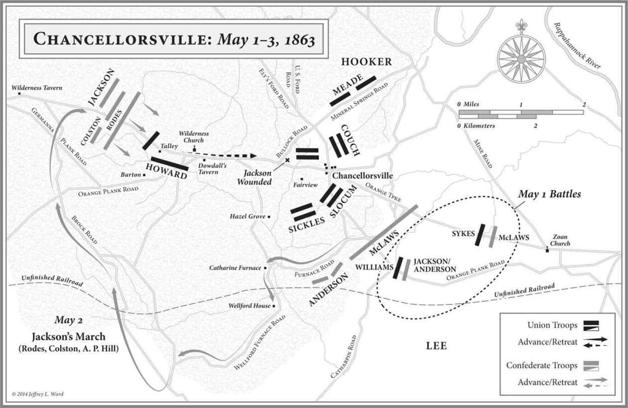
There is no way to know Jackson’s thought process as he prepared to engage the Union army in front of him. He knew very little about it and certainly he had no idea that, at the moment he ordered his men to advance, he was actually outnumbered five to one. But it was characteristic of the man that his means of determining the enemy’s strength was to hit the enemy in the face and then see what happened. Typical, too, was his impatience to fight. As at Port Republic, he chose to attack before his full force had arrived.
Hooker, meanwhile, a few miles to the west, was unaware that Jackson himself had taken the field against him. Jackson’s movements, under cover of night and fog, had gone completely undetected, and Hooker’s latest intelligence still placed the entire 2nd Corps on the heights below Fredericksburg. The Union commander thus believed he was facing only the divisions of Lafayette McLaws and Richard Anderson. They would be dug in, he believed, and he expected them to fight a defensive battle. With his superior numbers, he would spread their flanks and make short work of them. At roughly 10:30 a.m. Hooker signaled the start of a three-pronged advance, stacked north to south: George Meade with two divisions on the River Road, George Sykes with one division on the Orange Turnpike, and Henry Slocum on the Plank Road with another two divisions. They would move forward, link up, and, if all went well, carry the heights of Fredericksburg by 2:00 p.m.
At almost exactly the same moment, Jackson signaled his own advance. To the amazement of the Union command, which had not expected to be attacked, his rapidly advancing columns slammed into the two lower prongs of Hooker’s attacking force. Jackson not only had the element of pure surprise, but also, by hitting the Federal columns head-on and hitting them early, he deprived them of their ability to communicate with one another and, as they had planned, to join forces. Meade’s two 5th Corps divisions in the north were isolated from their comrades and out of the fight, while McLaws hit Sykes in the center with superior numbers and Jackson stopped Slocum cold almost before he got started. By 1:00 p.m. Hooker knew that his plan had gone badly awry. So had his strategy at Fredericksburg. He had ordered John Sedgwick to “threaten an attack in full force” below the town, but Sedgwick had done nothing at all. That was because, due to faulty telegraphs, Sedgwick would not even receive those orders until almost 5:00 p.m.13
By now Hooker was beginning to understand what was happening to him. He received more bad news: a large Confederate force had detached from Fredericksburg and marched west. Thus his opponent on the field was almost certainly not Richard Anderson but Stonewall Jackson himself. And so when Union general George Sykes, fighting astride the Orange Turnpike, reported that he was heavily outnumbered and that his flanks were being turned, this information took on new meaning. Sykes not only could not be rescued easily, but also, with Jackson on the field, the divisions under Meade and Slocum might be threatened, too. At about 2:00 p.m. Hooker issued orders to all three columns to withdraw. Jackson, as always, pursued. But the Federals managed disciplined countermarches under fire, and Jackson’s last-ditch attempt at a flank attack was repulsed by Hooker’s heavy artillery. In spite of his natural predatory instincts, Jackson knew that a frontal assault on Hooker’s entrenched, U-shaped defensive position at Chancellorsville would have been suicidal. The day ended with Hooker’s troops in exactly the same position they had been in at dawn. Jackson’s men were two miles in advance of Anderson’s entrenchments. Jackson had won the day: Hooker’s huge army was suddenly penned up in dense thickets, where its numbers meant far less than they would have on open ground.
In spite of his repulse, and his failure to take the high ground at Zoan Church, which should have been readily his, Hooker was undaunted. He believed he had accomplished his main purpose—flushing Lee from his defensive position and out into the open—and that he was now in a position to fight a defensive battle “on my own ground.”14 That was how he saw it, anyway. He was, moreover, expecting word from George Stoneman any minute that the rebels’ railroad supply line had been cut.15 What he did not comprehend was that, while his individual decisions may have been perfectly rational, and while he held, technically speaking, one of the stoutest defensive positions of the war, he had also surrendered the initiative to Robert E. Lee and Stonewall Jackson. And that was a very dangerous thing to do.
Just how important Jackson’s presence was in Hooker’s decision to withdraw is impossible to know. But it likely loomed large. Hooker later explained his retreat by saying that he believed he “was hazarding too much to continue the movement” and that because of the difficulty of deploying his troops in the wooded terrain he “was apprehensive about being whipped in detail.” Both statements might have referred to Jackson.16 Jackson’s name alone may not have been worth two divisions, as an observer once suggested, but it was still enough to inspire prudence and caution in even a hard-fighting man like Joe Hooker, whom Jackson had fought to a bloody standstill in the cornfield at Antietam and who had been fully present for Jackson’s tactical masterstroke at Second Manassas.
Whatever Hooker’s thoughts, Jackson by this point in his meteoric and still ascendant career cast a large shadow, far larger than the sum of his flesh-and-blood parts. There was something fateful about him, something foreordained, as though he had been born to occupy precisely this moment in time and space, as though his strange and mystical communion with God had granted him special power over both his own men and his enemies. His personal oddities now fueled the legend. Though James Longstreet was a good general and a resolute fighter, he was a prosaic and somewhat colorless human being. Jackson, by contrast—remote, silent, eccentric, and reserved, his hand raised in prayer in the heat of battle—suggested darkness and mystery and magic. Longstreet inspired respect; Jackson, fear and awe. There are several remarkable accounts of him by his own men as he rode to battle on that day, men trying to put into words what it was like to see the living myth as he passed by. North Carolina colonel R. T. Bennett described seeing Jackson on his way to Tabernacle Church that morning, surrounded by the booming cheers of the men. “Suddenly the sound of a great multitude who had raised their voices in accord came over the tips of the bayonets,” he wrote. “The very air of heaven seemed agitated. . . . The horse and his rider cross our vision. The simple Presbyterian Elder, anointed of God, with clenched teeth, a very statue, passes to his transfiguration.”17 Other descriptions of him have this same oddly mystical cast. (“The people of the Confederate states had begun to regard this immortal leader as above the reach of fate,” wrote John Esten Cooke in his 1863 biography.18) Later that day Edward Porter Alexander watched Jackson and Lee ride by together at the head of a column of men, to more wild cheering. His brief description of Jackson in that moment was one of the most memorable of the war. “As a fighter and a leader,” Alexander wrote of the once scorned college professor, “he was all that can ever be given to a man to be.”19
• • •
While Joe Hooker attended to his troop dispositions in the comfort of the Chancellor house that evening, and put the final touches on his prodigious defensive lines, Robert E. Lee and Stonewall Jackson were sitting on a log near the intersection of the Orange Plank and Catharine Furnace Roads, talking. They had met at about 7:00 p.m., after Jackson had called off his attack, and had made their way to a sheltered clearing on the northwest quadrant of the intersection to avoid Federal sharpshooters. Their conference lasted several hours. Staff officers and various generals came and went. Gunshots from the front lines sputtered and finally died out. Darkness fell. Later on, when those observers understood the full historic significance of this conversation, they would strain to remember something—anything—about what they had seen or heard.
The meeting began with a discussion of the day’s battle. Jackson told Lee in detail what he had seen, and expressed his surprise at “the ease with which [the enemy] had been driven back to Chancellorsville,” as Fitzhugh Lee remembered the conversation.20Jackson believed that Hooker would withdraw by morning. Lee had a different idea. As he saw it, Hooker’s quick retreat simply meant that he wanted to fight a defensive battle. Instead of withdrawing, he was digging in, and daring Lee to attack. Lee was right, as it turned out, and he fully intended to oblige his adversary.
The question was how. As the two generals conversed, Confederate reconnaissance parties were scouting the margins of the Union position, probing for weakness. Hooker’s center was almost absurdly strong, unassailable. There were five army corps on the Chancellorsville front, arrayed in a convex, six-mile-long line manned by nearly two-thirds of the Army of the Potomac and supported by 184 pieces of artillery. Thanks to the abundance of wood, and plenty of leisure time to cut and haul it, Union lines bristled with field fortifications, abatis, and obstructions of various designs, a defender’s dream. The army’s left, in the form of George Meade’s tough 5th Corps, was anchored stoutly on the Rappahannock, which meant that it could not be turned.
Thus Lee looked to the Union right, where he soon found exactly what he was looking for. Jeb Stuart’s subordinate, Brigadier General Fitzhugh Lee, whose cavalry had been doing the main reconnaissance, had discovered something extraordinary out there: rebel horsemen controlled virtually all the roads on the Confederate left, right up to the Federal picket lines, and thus the “eyes and ears” on Hooker’s right flank belonged entirely to the Confederacy. This was partly—though not entirely—because much of the Union cavalry corps was off with its commander George Stoneman trying to disrupt Confederate supply lines. Stoneman’s expedition would turn out to be an epic failure and one of the worst tactical mistakes of the war. But no one knew that yet; no one in the Union high command, in fact, had heard anything from Stoneman. Lee knew only that he was abroad with his troopers making mischief somewhere in central Virginia. But Lee now knew for certain that Hooker had left himself virtually blind in the west. Seeking advice on the terrain, Lee and Jackson summoned Reverend Tucker Lacy, whose family owned land in the area. Lacy explained that a marching column looping to the south and west could trace a long arc from Catharine Furnace that would reach the Orange Turnpike at Wilderness Tavern, about five miles west of Chancellorsville.21 This confirmed what Lee and Jackson had heard from Stuart and Fitzhugh Lee, and would put the Confederate troops well beyond Hooker’s right wing. Robert E. Lee soon made his decision: he would send Jackson on a march around the Union right. Though he did not know exactly where that was, he had a clear enough idea from what Fitzhugh Lee had told him. He would leave the details of the flanking movement, and subsequent attack, up to Jackson.22 Jeb Stuart and his cavalry would screen his movements. Lee issued marching orders for the next day. Then the two generals made a simple camp in the pine woods. They spread saddle blankets on the ground, covered themselves with their overcoats, and used their saddles as pillows.
Sometime after midnight, Tucker Lacy, who had camped near Jackson and Lee, awoke to find a small fire burning, and Jackson sitting alone in front of it on a Union hardtack box. “Sit down,” Jackson said. “I want to talk to you.” He explained that he needed more information about the roads west of Catharine Furnace. Jackson was worried that the route Lacy had suggested might bring his column too near the Federal pickets. Wasn’t there a way farther to the south that would make them less visible?23 Lacy said he did not know but he did know someone who could plot such a route: Charles C. Wellford, the proprietor of Catharine Furnace, the only operating ironworks in the area. Jackson roused his mapmaker Hotchkiss and dispatched him and Lacy to the Wellford house, two miles away. There Wellford indeed suggested a better way—a road through the thickets that he had recently reopened to haul wood and iron ore—that would be invisible to just about anyone in the area. Wellford volunteered his son as a guide. Hotchkiss and Lacy galloped back to camp with the news, where they found Lee and Jackson both awake and sitting on hardtack boxes by the fire. Hotchkiss pulled up a third box and spread his map out on it, showing the generals this secret passage to the enemy’s rear.
As Hotchkiss recalled, when he had finished his presentation, Lee turned to Jackson.
“General Jackson, what do you propose to do?” Lee asked.
“Go around here,” Jackson replied, pointing to Wellford’s suggested route on the map.
“What do you propose to make the movement with?”
“With my whole command.”
“What will you leave me?”
“The divisions of Anderson and McLaws.”
There was a pause as Lee reflected on the high-risk plan they were so calmly discussing. He had divided his army once in February, sending Longstreet south. He had divided it again the previous day, leaving Jubal Early with his single division on the heights of Fredericksburg. Now he had decided not only to divide his army a third time, but also to march the largest part of it directly across his enemy’s front, roughly similar to what Edwin Sumner and John Sedgwick had done with the Union 2nd Corps at Antietam, where Jackson had slaughtered them like animals. Lee was betting—it was one of the most daring and perilous bets of the war—that Hooker would wait to be attacked.
“Well, go ahead,” Lee said.
And that was all there was to it. Lee made some final notes for the orders he would have to issue. Then Jackson saluted and said, “My troops will move at once, sir.”24
Moving at once was actually impossible, considering how much work it was going to take to get three divisions all marching and pointed in the same direction. At about seven o’clock on the chilly morning of May 2 the lead elements of the 2nd Corps crossed the narrow Plank Road on their way to Catharine Furnace and beyond. General Lee sat on his horse by the side of the road, watching. When Jackson rode up, the two men conversed briefly—whatever they said is lost to history—then Jackson pointed toward the enemy’s lines and rode on. With him went 29,400 men along with 27 batteries with 108 guns. Riding on his flank were three and a half regiments of Jeb Stuart’s cavalry. In all Jackson had 33,000 men. By agreement, he had left Lee with a meager 15,000 to face the bulk of Hooker’s army. Jackson’s corps was stripped down for combat. It carried only ammunition wagons and ambulances, no baggage or commissary wagons. The men marched at a rate that would cover a mile in twenty-five minutes, resting ten minutes each hour. As a North Carolina private recalled,
We went swiftly forward through the Wilderness, striking now and then a dim path or road. Strict silence was enforced, the men only being allowed to speak in whispers. Occasionally a courier would spur his tired horse past us as we twisted through the bush. For hours at a time we neither saw nor heard anything.25
The column wound forward along narrow paths that had been cut through the dense woods, an enormous, silent body of men making its way west. Jackson, riding at the head of the column, stopped to pick up his guide, Charles Wellford. When he galloped past his men he did so with his cap held high, while his men all raised theirs in silent tribute. It was not an easy march. Temperatures rose, and the length and narrowness of the column meant that every piece of uneven terrain and every mudhole would cause it to string out, leading to endless halting and starting, halting and starting.26 The last of Jackson’s troops, under A. P. Hill, did not leave until eleven o’clock. Still, they pressed forward with minimal straggling: Jackson had made sure of that by placing his regimental commanders in the rear.
As the hours passed, Jackson was mostly silent. But he would occasionally join the conversation of the officers who rode with him. One of them noted how many former VMI faculty and students were with the 2nd Corps on its march. Division commanders Robert Rodes and Raleigh Colston had both been professors there. Rodes, a VMI graduate, had left his teaching job there when the full professorship he wanted was given to newcomer Thomas J. Jackson in 1851. Colston had accompanied Jackson and his cadets when they traveled to Richmond in April 1861. Artillery chief Stapleton Crutchfield had been a student of Jackson’s. Cavalry colonel Tom Munford had been the ranking cadet at VMI when Jackson had first arrived, had treated the odd new professor kindly, and the two had become friends. Brigadier General James H. Lane had been a student of Jackson’s and later taught mathematics at VMI. There were, in fact, twenty brigadiers and colonels of line and staff that day who were VMI graduates. Jackson, pleased with this notion, turned to Munford and said, “Colonel, the Institute will be heard from today.” At about 2:30 p.m. the head of Jackson’s column came to a halt at the Orange Plank Road, three miles west of Chancellorsville.
• • •
May 2 was an odd day for Joseph Hooker, as much for what did not happen as for what did. He remained supremely confident in his position, had passed this confidence on to his general officers, and they all agreed that their success was virtually guaranteed. For once they had reliable estimates of rebel troop strength and knew they held better than a two-to-one advantage over Lee. They knew that Longstreet was too far away to make any difference. They held immensely strong defensive positions that extended all the way to the Rappahannock and shielded their own supply lines. Hooker’s main concern was Stoneman, riding with ten thousand men somewhere in the rebel rear but unheard from for four days. Hooker expected he would hear very soon that his cavalry commander had succeeded and that the rebel communications had been cut, which meant that Fighting Joe once again held both the initiative and the upper hand.
For the moment he could only do his best to shore up his position. That meant strengthening his right, which consisted of O. O. “Otis” Howard’s 11th Corps, a weak fighting force full of German-speaking Germans. He was known as the “Christian General,” a man who, like Jackson, prayed before and during battle, and spoke of war in religious terms. Unlike Jackson, he was an ineffectual commander. It was no accident that Hooker had stationed him well west of Chancellorsville in what must have seemed to him the middle of nowhere and certainly far from whatever fighting was likely to take place. Still, he had taken pains to strengthen this wing of his army. At about 1:00 a.m. he had sent an order to General John Reynolds, in command of the 1st Corps and still deployed on the Fredericksburg front. Reynolds was to move before daylight and march his entire 16,900-man force upriver, past Chancellorsville, and take a new position on the right rear of the 11th Corps. They would arrive by midafternoon on May 2. This meant that the questionable Howard would be well backed up. It also meant that the Union right, instead of being in the air, where it now was, would be strongly anchored on the Rapidan River three miles west of its confluence with the Rappahannock.27
This was a very good idea, especially since Hooker’s troops in Fredericksburg had clearly failed to hold the Confederate forces there in place. But Hooker was once again the victim of the inept and inconsistent Union Signal Corps. Reynolds did not receive his telegraph until daylight, which meant that his men would not be in place in Chancellorsville until very late afternoon or evening. Hooker’s chief of staff, Dan Butterfield, called this lapse “one of the most unfortunate that has occurred.”
Another, even more damaging mistake would be made that morning. Starting at about 8:00 a.m., Union observers sitting in tall trees began reporting an unusual and unanticipated event taking place behind rebel lines: the apparent movement south and west of a large Confederate column, complete with artillery and trains. Though most of Jackson’s route of march was cloaked even from these treeborne scouts, there was one section of road that ran along high, open ground just east of Catharine Furnace where the column became briefly visible. The reports were passed quickly up the line. An hour and a half later, 3rd Corps commander Major General Daniel Sickles personally observed the column through field glasses and secured permission from Hooker to open fire on it with his artillery. Taking no chances, Hooker sent a message to Otis Howard, saying, “we have good reason to suppose that the enemy is moving to our right” and observing that “the disposition you have made of your corps has been with a view to a front attack by the enemy. If he should throw himself on your flank . . . determine upon the position you will take in that event.” He reminded Howard to keep reserves “well in hand to meet this contingency.” Howard read the order, discussed it briefly with one of his generals, then more or less disregarded it. He sent an officer from the Signal Corps a mile to the west but did not reposition any of his troops. His feeling, shared by others, was that the density of the Wilderness around him would be defense enough.
Sickles, meanwhile, wanted to know more about this odd troop movement. At midday he asked for and received permission from Hooker to attack the Confederate column with infantry. Actually this was the tail of Jackson’s column, which had been swinging past Catharine Furnace for more than five hours. Jackson had had the foresight to leave the 23rd Georgia Regiment behind to secure this vulnerable, open area, and now the Georgians collided with Sickles’s attacking force. There was a sharp, extended fight near the Catharine Furnace in which 296 of the Georgians were taken prisoner. But they did the job Jackson had intended them to do, which was to keep the Union forces away from the marching column. Except for one broken-down caisson, every piece of Jackson’s force passed unscathed.
Even better for the success of Lee’s plan was the conclusion that Sickles drew from his engagement with the 23rd Georgia. At about 1:30 p.m. he reported that what he was witnessing was actually a rebel retreat. The enemy’s troops, after all, were seen moving in a southerly direction, and had their trains with them. It only made sense. Sickles’s message got to Hooker’s headquarters at about 2:00 p.m., at which point the Union high command, too, became convinced that Lee was retreating toward Gordonsville. (Maybe this was because Lee’s supply lines had been cut, Hooker fantasized, and his enemy was marching to the Orange and Alexandria line to restore them.) Further evidence to support this interpretation were reports of Jubal Early’s sudden disengagement from the Fredericksburg front. They happened to be true, though the movement was entirely unintentional. As it turned out, Lee’s chief of staff, Robert Chilton, had misinterpreted Lee’s wishes. Lee had wanted Early to watch the Federals closely, and if they seemed to be departing for Chancellorsville, he was to leave a small holding force in place and join Lee. The orders were discretionary. But what Early got from Chilton was a peremptory directive to immediately fall back, even though the 6th Corps was still in front of him. By 4:45 p.m. the Union command knew for certain that Early was leaving, which seemed to be final, conclusive proof of the rebel withdrawal. Orders had already gone out alerting Union commanders to replenish food and ammunition and to be ready to pursue the retreating rebel army the next morning. Now there was no doubt at all.
Lee also benefited from the eventual escalation of the fight Sickles had started at Catharine Furnace. It soon drew in not only elements from Richard Anderson’s Confederate divisions but also, more important, involved some twenty-five thousand Federal troops, many of whom had been stripped from the Union left, leaving a mile-wide gap in the line just east of Howard’s 11th Corps. Though the fighting involved advances and retreats, much pounding of artillery, and expenditure of powder and bullets, nothing much came of it. But it had the effect of leaving Otis Howard, late that afternoon, quite isolated and alone on the Union right.
• • •
Jackson’s column had moved resolutely forward, in secret and in silence, cutting an elliptical arc around the Union right. The 2nd Corps had taken the Catharine Furnace Road, then the Wellfords’ road, then a series of narrow byways that had finally rejoined the Brock Road, which had put their lead at the Orange Plank Road in midafternoon. Except for the open area near the furnace, they had remained unseen and undetected. Every path and byway that went off to the right had been sealed off by Stuart’s horsemen. According to the plan Lee and Jackson had developed, the column would turn right at the intersection of the Brock and Plank Roads. From there the Union right was supposed to be about two miles to the east. To see if this was true, the 2nd Virginia Cavalry, under Tom Munford, conducted a reconnaissance up the Plank Road. They soon found a piece of high ground from which a Confederate captain saw a view rarely afforded to any scout. He galloped back to find Fitzhugh Lee, who saw it, too, then himself galloped back to find Jackson, who was riding at the head of Robert Rodes’s column.
Lee drew rein, and said, “General, if you will ride with me, halting your column here . . . I will show you the enemy’s right.” Minutes later Jackson was gazing down upon a major piece of the Union army, not seven hundred yards away. This was Howard’s 11th Corps, though Jackson had no way of knowing that. But it was clearly the terminus of the Union right. From the spot where the Orange Plank Road intersected the Orange Turnpike, Jackson could see roughly half a mile of open space on either side. As Fitzhugh Lee recalled,
Below and but a few hundred yards distant ran their line of battle, with abatis in front and long lines of stacked arms in the rear. Cannon in position were visible, and the soldiers were in groups, chatting, smoking, and playing cards, while the ones in the rear were driving up and butchering beeves.28
Jackson could also see that the Union line was facing south. He thus understood, when it was pointed out to him, that an attack up the Plank Road would amount to a frontal assault. An advance eastward on the Orange Turnpike, on the other hand, which intersected Brock Road a mile and a half to the north, would mean that his own battle line would be almost perfectly perpendicular to the Union line. He turned to Fitzhugh Lee and said, “Tell General Rodes to move across the Plank Road and halt when he gets to the old turnpike. I will join him there.”29 Rodes did just that. He turned to the east on the turnpike, continued for a mile to a four-hundred-yard-wide clearing at the farm of John Luckett, and then stopped, unnoticed and unmolested by anyone in a blue coat.
At about 3:00 p.m. Jackson wrote out a brief dispatch in his clumsy scrawl for General Lee: “The enemy has made a stand at Chancellor’s which is about 2 miles from Chancellorsville. I hope as soon as practicable to attack. I trust that an ever kind Providence will bless us with great success. Respectfully, T. J. Jackson.” He then added a postscript that read, with more of his usual deadpan understatement, “The leading division is up & the next two appear to be well closed.”30
Though the marching had indeed been disciplined, it still took a long time to convert the elongated column to a battle line. It was even harder because most of that line had to assemble in the supposedly impenetrable woods. Over the next two hours Jackson labored to place 21,800 infantry and 8 pieces of artillery into position. This would be his attacking force. The rest would follow behind, in reserve. He had plenty of daylight to work with and was able to pay attention to the smallest details. He had never had this luxury before. Roughly half a mile ahead of him, his foes went about their business, suspecting nothing. When Jackson had finished, his battle line was two miles long, aimed directly at a Union army corps that was in most places only a few men deep, facing south.
At 5:30 p.m. Jackson was sitting on his horse on the Orange Turnpike next to General Robert Rodes. His lines were formed and waiting. Though the men had marched some twelve miles and they were in high, fighting spirits, they were as yet unaware of exactly what was going to happen. Jackson’s veterans knew by now that long marches preceded spectacular events. After surveying his battle lines he turned to his fellow rider and said, “Are you ready, General Rodes?” “Yes, sir!” came the enthusiastic response. Jackson then said quietly, “You may go forward, then.”
A bugle call rang through the woods, followed by responses from bugles on the left and right, and suddenly the woods were alive with fast-moving Confederates.31 As they quick-stepped forward through the tangled undergrowth, which didn’t seem to dampen their enthusiasm, the wild, eerie, corkscrewing sound of the rebel yell swept down the ranks. In minutes they were in range of the Union lines. Though the rough terrain broke up Jackson’s neat battle lines, the men did not stop to re-form but pushed forward, singly and in groups. Jackson rode close behind his men, shouting, “Press forward! Press forward!”
The speed and direction of the Confederate attack took the 11th Corps completely by surprise. Because of an acoustical anomaly in the forest, they had heard none of the bugle calls. They had been enjoying a moment of drowsy calm and seemingly perfect security. Men were fixing dinner and taking naps or relaxing, listening to the distant music of a regimental band, or perhaps discussing the Confederate retreat, when suddenly all nature seemed to rise up in revolt around them. Through their camps rushed frantic rabbits, deer, quail, and wild turkeys, then there was an odd silence, and then Jackson’s massive, screaming, onrushing wall of gray was upon them. It was so sudden and so overwhelming that men who were there later used storm or avalanche metaphors to describe it. There was very little they could do about it, except to drop what they had and run for their lives. There was an effort made here and there by Union infantry to form and make some sort of fight, but the shock of the assault was too much for most of them. “The surprise was complete,” wrote Confederate artillery officer David Gregg McIntosh:
A bolt from the sky would not have startled [brigade commander Leopold] Von Gilsa’s men half so much as the musket shots in the thicket, and the sight of their flying comrades, followed by a straggling line of skirmishers, and then by a solid wall of gray. . . . The resistance offered was speedily beaten down. There was nothing left to do but lay down their arms and surrender, or flee. . . . Arms, knapsacks, clothing, equipage, everything, was thrown aside and left behind. The camp was in wild confusion. Men lost their heads in terror, the road and the woods on both sides were filled with men, horses and cattle, in one mad flight. The rebel yells added terror to the situation.32
The victory was fast and complete. In an hour and a half Jackson had shattered the 11th Corps and driven forward a full mile and a quarter to a point less than two miles from Hooker’s headquarters. The 11th Corps had suffered 2,400 casualties out of 11,000 men, including 1,000 captured. Jackson lost only 800 men.33 Former VMI professors Rodes and Colston had led the attack. The dashing Rodes in particular was a brilliant presence on the field, exhorting his men with his long mustaches flying. Jackson personally congratulated him on his gallant performance. Indeed, Jackson’s men had never seen their leader quite so thrilled with a victory. “He was in unusually fine spirits,” wrote one Confederate captain, “and every time he heard the cheering of ourselves which was the signal of victory he raised his right hand a few seconds as if in acknowledgment of the blessing and to return thanks to God for the victory.”34 One Georgian remembered that even after the fighting had died down the ground seemed “to tremble as if shaken by an earthquake, the cheering is so tremendous, caused by Gen. Jackson riding along the line.”35
Like the hapless Otis Howard, Hooker had also been taken completely by surprise. He had been busy planning a full-scale pursuit of Lee’s supposedly retreating army for the following morning. He had certainly been curious about various Confederate advances on the turnpike and the Plank Road east of Chancellorsville at about five thirty—which was actually Lee demonstrating loudly to cover Jackson’s attack. He had had trouble getting Sedgwick to advance, as ordered, on Fredericksburg. And he still had not heard from George Stoneman. But he was not terribly worried. He would work these things out. At about 6:30 p.m., as he was conversing with two captains on his staff on the porch of the Chancellor house, he heard a sudden noise from the road. One of the captains stepped off the porch, looked through his glass, and shouted, “My God, here they come!” Hooker and his staff rode westward on the road to see what was happening, and immediately encountered the men, horses, and wagons of the 11th Corps in wild panic and full flight. Many had no weapons, hats, haversacks, or coats. They demanded, wild-eyed, to know how to get to the bridges, so they could cross the river to safety.36 Because almost half of them were German, and shouting in their native language, it was hard to tell at first what was going on. (Hooker’s staffers may have learned at that moment that “Alles ist verloren!” meant “All is lost!”) But soon enough they understood that the 11th had been routed, and the Union flank shattered beyond repair. Hooker himself did not panic. He acted quickly. He brought up artillery and pointed it west instead of south, pulled other troops back from the furnace to the turnpike and faced them the same way, and shifted Meade’s 5th Corps to protect his lines to the river. He went to work constructing a new west-facing line three-quarters of a mile east of his headquarters. Orders went out that the high ground near the Chancellor house—the center of the army’s position—was to be held at all costs. In minutes, Hooker’s attitude had changed from serene self-confidence to fear for the safety of his army. He was right to be alarmed. To the west, through the descending darkness, Stonewall Jackson was planning to cut off his retreat and smash him yet again that very night.