
Chapter Twelve
‘Evil disposed persons (both in our City of London and elsewhere within this our realm) enforce themselves daily to sow seed of noise and dislander against our person … to our great heaviness and pity.’
Richard III, letter of March 1485
‘Nor willing or glad of the death of his Queen, but as sorry and in heart as heavy as man might be.’
Richard III, speech on 30 March 1485
The final months of Richard III’s reign were the unhappiest of all. He was very much aware of his unpopularity, of the sinister tales about him circulating among his unloving subjects. They spread across the Channel, too. Molinet often exaggerates yet his account of Richard’s unsavoury reputation in Europe sounds genuine enough. ‘He reigned with great cruelty’ says Molinet, ‘the most feared of all the Kings of the West.’1
It is hard to imagine a lonelier figure. He had lost his family, he would not be able to find a new wife and beget an heir, and he does not seem to have taken a mistress. Lord Lovell is said to have been ‘his best friend’ but this is mere surmise, while if Norfolk – thirty years his senior – was a trusted ally, he was usually far away. There were of course ‘Mr Ratcliff and Mr Catesby’ (as the Great Chronicle calls them) yet they scarcely sound people to inspire affection. In any case the King was not a man to have a male favourite. Nor, for all his vaunted piety, was a confessor or priest particularly close to him.
Moreover, ‘trusting few of such as were about him’, he would surely have sensed the uneasiness of his courtiers, the latent treachery everywhere. Sir Francis Bacon, who could conceivably have met people who had known survivors from Richard’s court, writes, ‘Suspicions amongst thoughts are like bats among birds, they ever fly by twilight … They dispose Kings to tyranny.’ In addition, contemporaries tell us that Richard suffered from a terrifying sense of guilt and was a haunted man, sometimes on the edge of hysteria. Perhaps he awaited Henry Tudor’s invasion as a trial by battle before God. As Gairdner surmises, the King was leading ‘a life of great agony and doubt’. Bosworth may have come as a welcome relief.
There seems to have been something like a standard official portrait of King Richard. The best-known version is that in the Royal Collection at Windsor, of which there are several copies. Itself a mid-sixteenth-century copy, it depicts a most unusual face which has made a curious impression on many people. It put Dr Parr, the famous eighteenth-century scholar, in mind of Lorenzo de’ Medici. Josephine Tey, the novelist, sees
Someone used to great responsibility, and responsible in his authority. Someone too conscientious. A worrier; perhaps a perfectionist … Someone, too, who had suffered ill-health as a child. He had that incommunicable, that indescribable look that childhood suffering leaves behind it; less positive than the look on a cripple’s face, but as inescapable.
G. K. Chesterton discerns ‘a remarkable intellectual beauty’. Paul Murray Kendall, who clearly idolized his subject, finds
a rather thin face of strongly marked but harmonious features; eyes direct and earnest, shadowed by care; a forthright nose; a chin remarkable for the contrast of its bold structure with its delicate moulding. The face suggests the whole man, a frail body compelled to the service of a powerful will.
The Croyland chronicler casts an interesting light on the clothes the King is wearing. He says that at Christmas 1482 Edward IV had appeared in ‘garments of a completely different fashion to those which had been seen hitherto in our land. The sleeves of the robes were very full and hanging, much resembling a monk’s cowl [over tunic] and were … lined with costly furs and rolled over the shoulders.’ This suggests that the only other contemporary portrait of Richard, in which his brocade doublet resembles those in his brother’s pictures, may date from before 1483 and would therefore have been painted when he was still Duke of Gloucester. (The inscription, Richards. Rex Tertius, could be a later addition.)
This other portrait of Richard is in the possession of the Society of Antiquaries. It is an early-sixteenth-century copy of a lost original and undoubtedly the earliest surviving likeness. He looks in the opposite direction to that of the better-known portrait, though here too he fiddles nervously with a ring – obviously a characteristic gesture. There is no sign of deformity in the shoulders, though this may be due to a good tailor. It is the hard-favoured, warlike visage of which More heard, an alarmingly forceful and indeed a merciless face. In the present writer’s view, here is the most convincing likeness of him.2
There is no question that the King had every intention of marrying his niece. Elizabeth was more than nubile – she was twenty in February 1485 – a tall, intelligent beauty with the same fair complexion and golden hair as her mother. (The Croyland writer describes all Edward IV’s daughters as ‘beauteous maidens’.) Richard’s sensuality may well have been aroused and heightened by the gloomy atmosphere of Lent; in the next century Grafton imagined him as having ‘fancied apace Lady Elizabeth’. But, above all, the Croyland chronicler stresses, such a marriage made both political and dynastic sense, even though the girl had been legally bastardized. Like his great-nephew Henry VIII, Richard III was in a dynastic impasse – the Earl of Lincoln was no substitute for a Prince of Wales. The King ‘saw no other way of confirming himself as King, nor of crushing the ambitions of his rival [Henry]’. Shakespeare is at his most intriguing, and entirely convincing, when he makes an anxious Richard say:
I must be married to my brother’s daughter
Or else my Kingdom stands on brittle glass.
Significantly Henry Tudor is known to have been very alarmed when rumours of the projected marriage reached him in France; in the vivid phrase of Vergil’s sixteenth-century translator, ‘it pinched him to the very stomach’. Furthermore, the King was also rumoured to be trying to marry off Elizabeth’s only other sister of marriageable age, Cecily, to someone of obscure rank, to end the Earl of Richmond’s last hope of a bride from the House of York. In desperation Henry considered marrying a Welsh lady, a Herbert – scarcely an adequate substitute, even if she was Northumberland’s sister-in-law.
Predictably ‘The Most Pleasant Song of the Lady Bessy’ claims that the girl was revolted by the thought of becoming Richard’s wife. No less predictably Polydore Vergil declares that she would have preferred ‘martyrdom to marrying a man who is the enemy of my family’. Nevertheless, it is not impossible that she accepted the situation. There was nothing against such a marriage in Canon Law; before and since then, the Church has given dispensations for uncle-niece marriages. A gentle soul, Elizabeth of York may very likely have been under pressure from her mother to take the King. The former Queen had lost faith in Henry Tudor and, with her combination of opportunism and political ineptitude, had decided to make the best of a bad job and compromise with Richard.
In early 1485 Elizabeth Woodville was writing to her son Dorset in Paris, telling him to come home and make his peace. After all his perils – hunted with hounds like an animal when escaping from Westminster, then having to flee again for his life after Buckingham’s débâcle – Thomas Grey, Marquess of Dorset, must have been badly shaken. In any case he was a weak and unstable character. The third senior peer of England, he was living in penurious exile; his vast wealth had been confiscated, and he had had to leave many children behind him. He knew Henry Tudor’s plans; plainly he saw little hope for them – without Elizabeth of York, Henry’s chances were very slim indeed. It looked as though the present regime was going to last. The Marquess accepted Richard’s offer of a pardon. One night in February or March 1485, Dorset left Paris suddenly and secretly. This defection by someone so important and so well informed about them horrified the exiles. A warrant for his arrest was obtained from the French government and a hard-riding Humphrey Cheyney caught up with the Marquess at Compiègne and persuaded him to return to Paris, although perhaps unwillingly. We know that Henry would not trust Dorset for a long time. His distrust reflects deep pessimism about his prospects. Richard III was still very much King of England.
Sir George Buck, one of Richard’s earliest would-be rehabilitators, compiled a strange book in the 1620s, made even stranger by being rewritten by an erratic and over-imaginative kinsman. However, Buck saw documents now lost. He claims to have seen a letter, long since vanished, at Arundel House, which throws an extraordinary light on Elizabeth of York’s response to her uncle’s amorous intentions. Addressed to the Duke of Norfolk, the letter – according to Buck – asks him to intercede with the King about her marriage to him, swearing that Richard is ‘her only joy and maker in this world, and that she was in his heart and thought’. She adds that she fears the Queen will never die. What gives Buck’s story some conviction is that he is using the letter to try to show that the King did not want the marriage.
Undoubtedly Richard consulted theologians. (Again, there is an uncanny parallel with Henry VIII.) But, whatever they and the canon lawyers might say, there was no English precedent for such a match. The Croyland writer informs us that ‘the King’s determination to marry his niece Elizabeth reached the ears of his people, who wanted no such thing’. (If Malory is representative, fifteenth-century Englishmen were revolted by incest; when Mordred wishes to marry Queen Guinevere ‘and said plainly that he would wed her, which was his uncle’s wife and his father’s wife’, the Archbishop of Canterbury curses him with bell, book and candle for making ‘a foul work in this land’.) What finally decided Richard against the marriage was Catesby and Ratcliff telling him ‘to his face’ that if he did not abandon the idea and deny it publicly, even the Northerners would rise against him. They would accuse him of killing the Queen – daughter and heiress to the Earl of Warwick through whom he had first won their loyalty – in order to be able to indulge his incestuous lust for his brother’s daughter, something abominable before God. The Croyland chronicler goes on to explain that though Catesby and Ratcliff then produced theologians and canon lawyers of their own way of thinking, their real motive was fear that if she became Queen, she might try to avenge her Woodville kindred – after all everyone knew that Ratcliff had personally superintended the murders at Pontefract. This may well be true, though unquestionably Richard would have earned even more damaging unpopularity if he had made the girl his consort, merely because of such a marriage.
The Croyland writer says that ‘even the King himself seldom dared oppose’ the views of these two. ‘And so, a little before Easter, in the great hall of St John’s and before the Mayor and citizens of London, the King totally repudiated the whole idea, in a loud, clear voice. Though people thought it was more because of his advisers’ wishes than his own.’ On the other hand, Polydore Vergil says that the marriage was the brain-child of Catesby and Ratcliff – we will never know whether the chronicler or Vergil was better informed. What we do know however, from the records of the London Mercers’ Company (first printed and published in 1936) corroborates the chronicler as to the public denial. On 30 March 1485 the Mayor and Corporation were summoned to the Priory of the Knights of Rhodes at Clerkenwell, together with many lords and citizens, to listen to an extraordinary announcement by Richard. He told them that ‘It never came in his thought or mind to marry in such manner-wise [i.e. his niece], nor willing or glad of the death of his Queen, but as sorry and in heart as heavy as man might be.’ He complained furiously of rumours – presumably about his poisoning Anne. It says volumes for the King’s sinister reputation among his subjects that he had to descend to such a humiliation.3
During the Clerkenwell address Richard also threatened anyone caught repeating such calumnies with imprisonment until they told the authorities where they had heard them. The Mercers’ records are confirmed in their turn by a letter which the King wrote to the citizens of York very shortly afterwards. He informs them that he is aware that
divers seditious and evil disposed persons (both in our City of London and elsewhere within this our realm) enforce themselves daily to sow seed of noise and dislander against our person, and against many of the lords and estates of this our land, to abuse the multitude of our subjects and avert their minds from us.
He grumbled that the slanders were being spread by means of posting bills or by ‘bold and presumptuous open speech’, ordering the arrest of those who were spreading the rumours.
Elizabeth was packed off to Sheriff Hutton, which Richard clearly regarded as the safest place for her. He kept little Warwick there, as he had Lord Rivers during the usurpation. He was not going to risk any attempts at abduction by the Tudor’s supporters. The future mother of Henry VIII stayed in Yorkshire all spring and summer, until after the King had fought and lost Bosworth. However, at Sheriff Hutton, even if probably under surveillance, Elizabeth of York would have found herself among reassuringly distinguished company. Besides Warwick and his eleven-year-old sister Margaret (who, as the very last Plantagenet, would be executed in 1541), there were John de la Pole, Earl of Lincoln – heir presumptive and President of the Council of the North – and his brother-in-law, Lord Morley. Some of Elizabeth’s sisters may have been staying there as well. A special scale of allowances of food and drink was laid down for this resident house-party, the largest measures of ale and wine being reserved ‘to My Lord [of Lincoln] and the children’. Sir Clements Markham argues speciously that these ‘children’ of high rank were in fact the former Edward V and his brother, a claim which does not merit serious consideration.
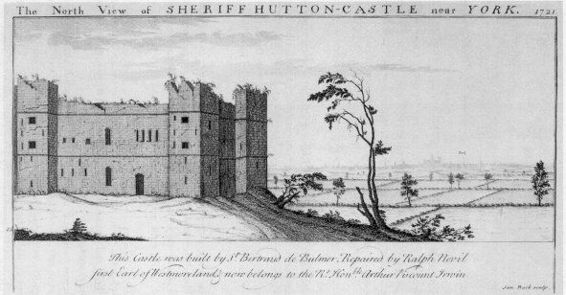
16. Sheriff Hutton Castle in the North Riding of Yorkshire, one of Richard’s favourite residences. His niece Elizabeth of York was confined here in 1484–5. From S. and N. Buck, A Collection of Engravings of Castles, Abbeys, etc.
Dynastically Richard was in a complete impasse. He had not dared marry Elizabeth Plantagenet himself; nor did he dare to marry her or her sisters to anyone else, for fear their sons might eventually claim the throne. It had quickly become clear that Lincoln was unacceptable as heir presumptive. Little Warwick, the only other surviving male of the House of York, was the King’s obvious successor, but the Attainder of 1478 would have to be reversed; if that were done, in theory at least, he would then possess a better title to the throne than his uncle. And without an assured succession Richard’s regime could not appear secure, as he must have known all too well. Everything and everyone was conspiring against the King.
At the same time there were other, more material, and new reasons for Richard’s unpopularity. Although when he had usurped the throne he found ‘ample resources’, he was soon overspent, despite the bonus of so many forfeited estates after Buckingham’s rebellion. It has long been a cliché that the Yorkist monarch evolved many of the financial methods employed by the Tudors, though at the same time it is recognized that Henry VII used them much more efficiently. Edward IV gave generous rewards to his followers in order to establish himself on the throne and only managed to balance his books towards the end of his reign. In his desperate need to buy friends Richard III handed out confiscated lands on a truly prodigal scale. The expenses of his ostentatious court, of the Breton and Scots wars and, above all, of costly precautions against invasion or revolt, quickly exhausted his funds. There is also some slight indication that Richard had always lacked financial expertise; in 1482 the Council of the Duchy of Lancaster had stated bluntly that his neglect and inefficiency over a period of years had seriously reduced the Duchy’s revenues – selling timber to raise ready cash and not replanting was one example.4
According to the Croyland writer, the King was now forced to go back to Edward IV’s compulsory loans ‘which he had openly condemned in Parliament, though he was very careful to avoid using the word “benevolence”. He sent out officials to scrape up huge sums out of all records relating to almost any sort of property holding in the realm.’ In reality Richard was probably only trying to raise a comparatively small sum, perhaps as low as £10,000; it has been calculated that in the event he obtained less than half that sum. Moreover, while Edward IV’s benevolences were extorted with no guarantee of repayment, Richard gave ‘good and sufficient pledges’ the money would be reimbursed. Between February and April 1485 a number of men of substance – prelates, landowners, merchants – seem to have been approached because of ‘such great and excessive costs and charges as we hastily must bear and sustain, as well for the keeping of the sea as otherwise for the defence of this our realm’. It is reasonable to suspect that all too many of those approached were sceptical about his ability to repay. Politically it would surely have been much wiser for the King to borrow from other sources rather than lose face in this way – as Gairdner emphasizes, ‘Commercial credit is a thing without which even tyrants cannot succeed.’
He was growing unpopular in York, of all places. It is true that when the news of Bosworth came, the Mayor and Corporation would record how ‘King Richard late mercifully reigning over us … was piteously slain and murdered, to the great heaviness of this city.’ Yet even before his reign some citizens of York were sceptical about the value of his friendship – one asked publicly in 1482, ‘What may My Lord of Gloucester do for us of the city? Nothing but grin of us!’ The Great Chronicle of London speaks of otherwise unrecorded troubles in the North during the summer of 1483 which the King had to repress in the course of his progress. In autumn 1484 there was a nasty riot at York when Richard consented to the enclosure of certain common lands; despite a stern warning from the King, who sent no less a personage than the Comptroller of his Household (Sir Robert Percy) to deliver it, armed rioting broke out again in January 1485 and there were several casualties. Nor, whatever a Mayor might say, did the city remember him with universal affection. During a drunken brawl at Christmas 1490 a local schoolmaster accused Richard of having been ‘an hypocrite, a crouchback and buried in a dike like a dog’. The Croyland writer tells us that there were many Northerners among the deserters at Bosworth.
Considerable sums were spent on building up a large arsenal of field artillery and hand-guns at the Tower. Much of it consisted of ‘serpentines’. These were long, light cannon, which were mounted on pivots and fired a four-pound ball, and were the latest thing in the period’s weaponry. The King imported Flemish gunsmiths to manufacture them, presumably at great expense.
All the indications are that Richard was obsessed by the Pretender threatening his throne. Henry’s anonymity may have made him seem more formidable than he really was. During the 1939–45 War, Field Marshal Montgomery had photographs of the German army commanders confronting him hung in his battle caravan to help him guess what was in their minds. The King can have had no idea of what the Tudor even looked like. At Barnet he had known Warwick, Montagu and Exeter very well, and it is likely that at Tewkesbury he could say he had at least met the Beauforts. But if Richard had even heard the name Henry Tudor before 1483, it was merely as that of an obscure by-blow of the Beauforts; indeed, he was not even a Beaufort, let alone a Plantagenet of the ‘Old Royal Blood of England’. The name is misspelt ‘Tydder’ in all proclamations against him. The proclamations also describe his parentage and descent, pointing to some sort of official investigation. Although the ‘spies across the seas’ were almost certainly at Henry’s little court – not so little now – to judge from his secrecy and reserve after he had become King, they would scarcely have been able to tell Richard much about the man himself or about what he was thinking. The sixteenth-century chronicler may have been using his imagination when he makes Richard tell his captains, before Bosworth, that the Tudor was a ‘Welsh milksop’, but he is certainly near the truth in making the King say additionally that ‘the Devil, the disturber of concord and sower of sedition, hath entered into the heart of an unknown Welshman whose father I never knew, nor him personally saw’. One is tempted to wonder whether Richard thought it was a vengeful God rather than the Devil. Devoured by guilt and superstition as he was, the King may sometimes have suspected, like Commynes, that ‘God had raised up an enemy against him.’
Throughout his reign Richard III seems to have taken refuge in the undeniable fact that although a usurper he was none the less the legal, anointed and crowned – and therefore divinely appointed – King of England. Hence his excessive wearing of the royal diadem, like some sort of talisman. Hence too his constant, and emphatic, references to treason – plainly a word which obsessed him. ‘Treason’ was embodied by one man, Henry. The Welshman’s use of the royal style, ‘Henricus Rex’, must have infuriated him.
Both the Croyland writer and Polydore Vergil tell us that on the night before Bosworth Richard had nightmares. Vergil says that this was a frequent occurrence. As has been already said, More claims to have heard from the King’s attendants that almost every night of his reign he was troubled by ‘fearsome dreams’. This is the origin of the lines which Shakespeare gives Queen Anne:
For never yet one hour in his bed
Did I enjoy the golden dew of sleep,
But with his timorous dreams was still awak’d.
That Richard suffered from remorse, or at least from an uneasy conscience, seems to be indicated by his quite remarkably intense care for the repose of the souls of dead kindred. It is of course true that, before and after his usurpation, his foundations for chantry priests were to celebrate Masses for all members of his family and not just his victims. He could scarcely single out Edward V and little York (which may lend substance to Sir Thomas’s stories about a secret reburial, or perhaps a secret Requiem).
In the fifteenth century Requiems and prayers for the dead were considered a duty to an exaggerated degree. All over Western Europe countless chantries – or endowments to say Masses for them – were being founded. But Richard set up chantries on a truly extraordinary scale. Even Rous praises him for it. It is likely that only a handful, such as the collegiate chapels at Middleham, Barnard Castle and Barking or the thousand Masses for Edward IV by the friars of Richmond have been identified. He must have presented York Minster with many vestments, a common practice by the great at that time because of the high cost of silk and velvet, yet it is curiously fitting that the only one of which the Minster archives give us any detail was black.
Most peculiar of all was the huge chantry Richard planned for York Minster, where he clearly meant to be buried. Presumably he intended to build a chapel – anticipating Henry VII’s chapel at Westminster. What made this one so unusual was that there would be six altars served by a hundred priests saying Mass for the Dead without a break, with a staff of two or three hundred clerks, choristers and servants, for whom an enormous endowment was needed. Probably no one in Christendom has ever contemplated praying for the dead on such an exaggerated scale. Richard’s motive here must have been the same as that stated in his foundation charter for Middleham – the Masses were to be ‘in part satisfaction for such things as at the dreadful day of judgement I shall answer for.’ He also wanted to make quite sure that the souls of the dead should rest in peace.
An urge for atonement and propitiation is also evident in Richard’s treatment of his enemies’ wives and children. His partisans ascribe it to unusual magnanimity, but he was no more merciful than Edward IV in providing such casualties with pensions. Both Kings seem to have set store by an ostentatious show of mercy. In the case of Hastings’s family, Richard was undeniably lavish in allowing the son to inherit his father’s estate, as though there had been no charge of treason, and the widow to have the wardship. Yet again, one discerns an uncomfortable conscience.
The King’s personal spiritual life, in so far as we know anything about it, conveys an even stronger sense of desolation. His Book of Hours – his principal prayer book – has fortunately survived. Illuminated between 1430 and 1450, it had at least one previous owner – probably a member of the Warwick family. What makes it so interesting is the addition in a different hand of a long prayer for the King’s use. It is in Latin, headed ‘De beato Juliano’. ‘As you wish to relieve those burdened with sore affliction,’ it opens, ‘release me from the affliction, temptation, grief, infirmity, poverty and peril in which I am trapped and give me aid.’ Appeals for protection are repeated over and over again. It begs, ‘Make peace between me and my enemies … lessen, turn aside, extinguish, bring to nothing, the hatred they bear me.’ After citing the mercies of the Old Testament and the Passion of Christ, it pleads, ‘Son of the living God, deign to free me, thy servant King Richard, from all the tribulation, sorrow and anguish in which I am and from all my enemies’ snares, and deign to send Blessed Michael the Archangel to aid me against them and the evil they are planning.’ Undeniably the prayer is deeply moving. Yet it is not over-fanciful to detect a note of almost hysterical fear, of paranoia. It gives a unique glimpse of the King’s innermost feelings.
Professor Lander stresses that one simply cannot write off as propaganda a highly personal and specially composed prayer which reads ‘like the incantation of a litany, fraught with notes of the deepest gloom, oppression and danger, in which the highly charged reference to Susannah, de falso criminere et testimonio, so prominently stands out’. Lander continues,
Considering the accusations against him, the knowledge that he slandered his brother’s memory, the probability that he impugned his mother’s chastity, that he authorized judicial murder, that he was prepared to contemplate incest, that he cheated his nephews out of their inheritance if not far worse, the prayer must indicate that either Richard thought he was innocent of the charges or that towards the end of his life he had become in the highest degree schizophrenic, a criminal self-righteously invoking the protection of the Almighty.
The words ‘De beato Juliano’, overlooked even by Lander, are the key to the prayer. They indicate that it was intended to invoke the intercession of this obscure saint, who enjoyed a widespread popular cult during the later Middle Ages. Little is known of Julian the Hospitaller save that according to medieval hagiographers he killed his own father and mother, and that after doing penance for many years it was revealed to him that God had pardoned him. It is almost certain that Richard was familiar with the tale since it appears in the version of The Golden Legend which Caxton printed at Westminster towards the end of 1483. A parricide was a fitting intercessor for an infanticide, let alone a man who had murdered a saint.5
Richard would have become still more uneasy about his enemies if a certain letter from Henry Tudor had fallen into his hands. Dating from the first months of 1485, it probably circulated widely. Addressed to Henry’s ‘Right trusty, worshipful and honourable good friends’, it reads:
Being given to understand your good devoir and entreaty to advance me to the furtherance of my rightful claim, due and lineal inheritance of that Crown, and for the just depriving of that homicide and unnatural tyrant which now unjustly bears dominion over you, I give you to understand that no Christian heart can be more full of joy and gladness than the heart of me, your poor exiled friend, who will, upon the instant of your sure advertising what power you will make ready and what captains and leaders you get to conduct, be prepared to pass over the sea with such force as my friends here are preparing for me. And if I have such good speed and success as I wish, according to your desire, I shall ever be most forward to remember and wholly to requite this your great and most loving kindness in my just quarrel. Given under our signet.
H.R.
It is likely that Northumberland and the Stanleys, among others, received such letters.6
By the spring Henry was at Rouen, looking for ships. No doubt Richard’s spies reported his activities to their master, who may not have been unduly alarmed. For the French seem to have been in two minds about the Earl of Richmond. They must have remembered the English King’s opposition to the treaty of Picquigny – Commynes certainly did – and may also have seen copies of his proclamations against Henry, in which the Tudor was accused of promising the French King to ‘dissever the arms of France from the arms of England for ever’, and to abandon all claims to Normandy, Anjou, Maine, Gascony and Guyenne. Obviously if ever Richard felt strong enough, he would invade France and try to reconquer the territories once governed by his father. There was therefore a good case for sending Henry to topple him while he was still weak. There was also a case for keeping Henry in reserve, as a threat. Both options would cost money, but especially the first. It is likely that the King understood this and felt that there was a reasonable chance of his enemy being unable to raise sufficient funds for a proper invasion fleet.
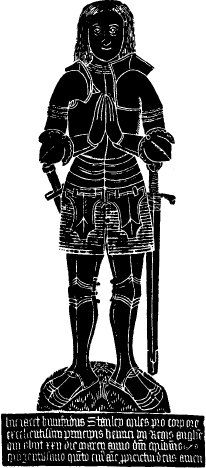
17. Sir Humphrey Stanley (1455–1505) of Pipe, Staffordshire, who fought so gallantly for Henry Tudor at Bosworth that he was knighted on the battlefield. One of Henry VII’s Knights of the Body, he later took a prominent part in defeating the Yorkists at Stoke and the Cornish at Blackheath. In 1495 Henry apparently saved him from the consequences of a murder. From a brass at Westminster Abbey.
He had an informer among the exiled rebels, Sir Robert Clifford from Aspenden in Hertfordshire (where there is a stained glass portrait of him in the parish church). A former Lancastrian, whose father had been killed at first St Alban’s and whose brother – the murderer of Richard’s brother Rutland – had fallen on the Towton campaign – and who had then joined Brandon’s abortive rising, his credentials seemed impeccable to the Tudor. Yet he was back in England by spring 1485 with a pardon after informing the council of anything he could learn. (Clifford was a talented spy - later Henry VII used him as a double agent, to penetrate the circle around Perkin Warbeck.
Nevertheless, Richard was not taking any chances. In April 1485 Sir George Nevill was given a flotilla to patrol the Kentish coast and in May Lovell was ordered to keep a fleet in readiness at Southampton. The King expected Henry would try to land in southern England, the most disaffected part of the country. His agents had learnt that the Tudor intended to make for ‘Milford’, and there was a tiny port of that name in Hampshire which would be excellent for a secret landing, and apparently a soothsayer confirmed that this was the danger spot. No one realized that Richmond’s ‘Milford’ was Milford Haven in Wales. Sir Ralph Assheton and Lord Scrope of Bolton, now Constable of Exeter Castle, were guarding the West Country. Assheton was reappointed Vice-Constable of England and given a deputy. In June Richard returned to his command centre at Nottingham.
Meanwhile, the Earl of Richmond had not been idle. Fortunately for him, he was not a procrastinator. The French government were still alarmed that the English King might support Breton separatists should Duke Francis die; indeed, by his encouragement of them, he had given the impression that he intended to invade France as soon as possible – by a more placatory attitude he could easily have won French friendship. As it was, French policy suddenly altered in the autumn and Henry would then have received no help. In any case what he did receive was very inadequate. Commynes says it consisted only of a ‘little money from the King [Charles VIII] and some 3,000 of the most unruly men that could be found and enlisted in Normandy’.7 In reality Charles gave nothing and it was a courtier, Philippe Lullier (Captain of the Bastille), who from his own private resources lent Henry just enough to hire a thousand mercenaries and half a dozen small ships, which was very different from the 4,000 troops that had been promised by the French government. It was Lullier, not Charles, who provided a few cannon.8
Nevertheless, we can safely guess that Henry Tudor made the most of what was available. Lullier’s loan was undoubtedly supplemented by contributions from supporters in England, while Henry also borrowed from Parisian goldsmiths – he was not without humour – leaving the untrustworthy Dorset behind him as security. Moreover, historians have accepted Commynes too uncritically and tend to underestimate the fighting potential of Henry’s expedition. While the xenophobic Hall may dismiss them as ‘beggarly Bretons and faint-hearted Frenchmen,’ Henry’s mercenaries were crack troops equipped with the latest weaponry, mostly pikemen trained to fight in formation like the Swiss, using the eighteen foot long Swiss pike which at that time was unknown in England. They also included arquebusiers, whose new guns, lighter than the earlier hand cannon but with a larger bore and a matchlock, fired armour piercing bullets that were devastatingly effective against mounted men-arms. Led by several hundred exiled English gentry, what might be termed the officer/man ratio was unusually high. And when it landed the little army would be reinforced by formidable recruits.
Furthermore, while Richmond had never even seen a full-scale battle – he himself called Bosworth ‘our first field’ – he possessed superlative commanders. The Earl of Oxford had smashed the Yorkist left at Barnet in 1471 (just as he would destroy the last Yorkist army at Stoke in 1487), while the Savoyard Philibert de Chandée, who commanded the French troops, clearly knew how to handle them, however ‘meschantz’ (worthless). Jasper Tudor’s experience of campaigning in Wales would be very useful in the early stages – he understood the management of that valiant but touchy race. And the expedition included an even greater warrior than Oxford. This was Bernard Stewart, Seigneur d’Aubigny, one of the French King’s Scots Archers. Although he was nearly forty, his real triumphs lay ahead; he was to be Captain of the Archers, a Marshal of France and a hero of the French invasions of Italy; in 1508 James IV would proudly refer to him as ‘the Father of War’. Aubigny had been French Ambassador to Scotland in 1484 and may well have helped persuade the French to aid Henry, perhaps to avenge that humiliating occupation of Edinburgh. Undoubtedly he brought a small Scots contingent; it is improbable that many came from the French King’s indispensable bodyguard, though one or two may have been spared – a laird present, possibly an archer, whose name we do know was Sir Alexander Bruce of Earlshall.9
Henry assembled his men and his few ships, perhaps at Rouen, and sailed up the Seine. No doubt with unhappy memories of his stormy journey of two years before, he seems to have waited for fine weather at Harfleur on the Norman coast before putting out to sea. His little fleet had a longer voyage ahead than the vast majority of those on board realized. On Monday 1 August a soft wind was blowing from the south, which was what the shipmasters wanted. The Earl of Richmond set sail.
As soon as Richard had reached Nottingham in June, his spies brought him reliable information that the long-awaited invasion was about to begin. On 22 June he reissued his proclamation of the previous December against ‘Henry Tydder’ and his band of rebels and traitors ‘of whom many be known for open-murderers, adulterers and extortioners’, who had been chased out of Brittany for making proposals ‘too greatly unnatural and abominable’; they intended to commit ‘the most cruel murders, slaughters and robberies and disherisons that ever were seen in any Christian realm’ and to steal everyone’s estates and offices, even the bishoprics. Either Richard dictated this proclamation himself or it was someone who knew the workings of his mind. The following day he sent out Commissions of Array, ordering the commissioners, ‘upon peril of losing their lives, lands and goods’, to ensure that their men were properly ‘horsed and harnessed’ and ready to march at an hour’s notice.
Lord Stanley came to the King and asked permission to return to his estates in the North West to raise his tenantry. Richard plainly distrusted the man but dared not antagonize a subject whom he had made one of the three principal props of his regime. He compromised, insisting that Stanley leave his son, the 25-year-old Lord Strange, in his place. Stanley, according to Vergil, did not leave Nottingham until Strange had come, to be in fact if not name an unofficial hostage for his wily father’s good behaviour.
In July the King received confirmation that Henry’s fleet was about to sail. On the 24th of the month he sent for the Great Seal. Five days after sending for the seal, in yet another outburst of suspicion, Richard dismissed Bishop Russell from his post as its Keeper. Without the Seal it was impossible to issue Commissions of Array and raise an army. Predictably Russell was replaced by a Northerner – or at least a man whom the King had known in the North – Dr Thomas Barowe, Master of the Rolls. A product of Cambridge, he had been the King’s Chancellor when Richard was Duke of Gloucester and was obviously a reassuringly familiar figure. (On Barowe’s appointment to the Rolls two years before, Richard had sent him two pipes of wine.)
Meanwhile a spy – Clifford? - had learned that the enemy’s ships would make for ‘Milford’, which was a tiny, port in Hampshire, and Lord Lovell assembled a flotilla at Southampton to intercept them.
The Great Seal was delivered to the King at Nottingham on 11 August. That very same day he received news that the Earl of Richmond had already landed, in a place where he had been least expected, and was marching towards him with his army.