
Chapter One
‘For I have often heard my mother say
I came into the world with my legs forward.’
Shakespeare, King Henry VI, Part III
‘He left such a reputation behind him that even his birth was said to have proclaimed him a monster.’
James Gairdner, History of the Life
and Reign of Richard the Third
Richard III was born on 2 October 1452 at Fotheringay in Northamptonshire, sixth and youngest son of the Duke and Duchess of York. The castle, one day to see the imprisonment and execution of Mary, Queen of Scots, was where he would spend his earliest years. It was a principal house, though only an occasional residence, of his parents.
It is likely that he had a difficult birth. John Rous was plainly anxious to vilify the dead King when he wrote his Historia Regum Angliae – dedicated to Henry VII – between 1485 and 1491. Yet there may be a grain of truth in his fanciful account of Richard being ‘retained within his mother’s womb for two years and emerging with teeth and hair to his shoulders’. If clearly nonsense, it could none the less recall a long and worrying pregnancy. By medieval standards his mother at thirty-seven was old for childbearing. (She had only one more baby after him, a girl three years later who does not appear to have survived infancy.) More tells us he had heard similar tales about the King’s birth, which he is inclined to attribute to popular hatred, but he adds significant details. ‘It is … reported that the Duchess his mother had so much ado in her travail that she could not be delivered of him uncut, and that he came into the world with the feet forward.’ It sounds like a breech birth – children are not infrequently born upside-down. There was no such instrument as forceps in the Middle Ages, so the baby may have been damaged by the midwife’s efforts to pull him out. The scoliosis that curved his spine and made one shoulder higher than the other, probably set in when he was about ten but never hampered his movements - we know that it did not prevent him from wearing heavy plate armour or handling weapons. On the other hand, it was very severe and, as he grew older, he may well have been in constant pain since he was always noticeably pale. In a superstitious age deformity of this sort was seen as a mark of the Devil and no doubt he did his best to conceal it with padding.
His father Richard, Duke of York, was a small, hard-featured man. It was later said that King Richard bore a remarkable facial likeness to him. Very haughty and arrogant in manner, the Duke was always conscious that since 1447 he had been the only living Prince of the Blood Royal, apart from his own sons, and was therefore heir presumptive to the throne. In the male line he was the grandson of Edmund of Langley, first Duke of York and Edward III’s youngest son, while in the female line, through his mother, Anne Mortimer, he was also great-great-grandson and ultimate heir of Lionel, Duke of Clarence who had been Edward III’s third son. The reigning sovereign Henry VI was only the great-grandson of Edward’s fifth son. As befitted such a descent, he was the richest man in England. Although his father, the Earl of Cambridge, had been beheaded for treason in 1415 (the year he was born), Richard inherited not only the patrimony of the Dukes of York – after his uncle was killed at Agincourt – but that of his mother’s family, the Earls of March. He possessed estates and palaces throughout England and Wales, and also Ireland where he had wide lands in the Pale. The headquarters of his vast territories in Wales and on the Welsh Borders was in Shropshire at his great castle of Ludlow, on the River Teme, where his elder sons Edward and Edmund were brought up.
York had seen some fierce campaigning in the Hundred Years War, having been Lieutenant-General (Viceroy) of ‘France’ – the English-occupied areas of the Ile-de-France and Normandy. A mixture of pugnacity and indecision, he was not a good soldier, but he had with him that legendary warrior ‘Old Talbot’, so that, despite the French revival, he was surprisingly successful. His wife accompanied him, their eldest surviving son Edward being born at Rouen. A contemporary chronicler, Thomas Basin, describes what claustrophobic and altogether terrifying lives were led by the English in France at this time – ‘shut up for years behind town walls or in castles as though condemned to life imprisonment, living in fear and danger’. Duke Richard and his Duchess must have experienced such an existence. However, at home the court party were alarmed by York’s growing popularity and replaced him by the incompetent Duke of Somerset. Since 1448 York had been Lord-Lieutenant of Ireland, where, notwithstanding his haughtiness and though he spent barely a year there, he won the lasting friendship of the Anglo-Irish lords by his lavish generosity. Even the Celtic chieftains – including the greatest, O’Neill himself – paid him homage and swore to be his liegemen.
In 1424, when he was nine, Richard of York had married Cecily Nevill, daughter of Ralph Nevill, Earl of Westmorland, in whose household he was spending his boyhood. She was the twenty-second of the Earl’s twenty-three children, the thirteenth by his second wife, Joan Beaufort. Cicely was herself descended from Edward III since her mother’s father had been John of Gaunt. Ralph was the head of the Nevills, an ambitious and already powerful northern family which, largely by carefully calculated marriages, was fast becoming one of the richest and most influential clans in England. Ralph’s second son was the Earl of Salisbury, whose own son acquired in addition the magnificent Earldom of Warwick – which made him the wealthiest man in the realm after York – while three other of Ralph’s younger sons also obtained peerages for themselves, Lords Fauconberg, Latimer and Abergavenny.2 Yet another was Prince Bishop of Durham, who ranked among the foremost prelates in England and ruled his great palatinate as though it were an independent state.
Born in 1415, like her husband, Cecily had spent her childhood at her father’s bleak stronghold of Raby in Co. Durham where she became famed for her beauty, acquiring the name of ‘The Rose of Raby’ – later she was given another name, ‘Proud Cis’. She appears to have begun to live with York as his wife about 1438, bearing him at least ten children though several of these died in infancy. So many brothers and sisters together with such a vast kindred were to mean that few English Kings have ever been so widely and so closely related to their aristocracy as was Richard III.
His early life is unknown, but was no doubt uneventful. Yet these years saw the outbreak of the longest period of civil war in English history. To understand Richard and why the Wars of the Roses began, one has to know something of the 1450s. England was in a thoroughly unhappy condition. The government was almost bankrupt under a weak King, Henry VI, whose personal reign has been described as the most calamitous of any of our monarchs and who went mad within a year of the birth of the cousin who would one day murder him. The Lancastrian monarchy – so called because of its descent from John of Gaunt, Duke of Lancaster – was collapsing. Already unpopular, ostensibly because of venal and mediocre ministers, it was discredited even more by the loss of English France. Normandy went in 1450 and Guyenne, English for three centuries, in 1451 – Talbot managed to re-occupy Bordeaux the same October that Richard was born, only to perish with his entire army the following year. At home Kent had risen under Jack Cade in 1450 in an especially vicious revolt.
Oddly enough, it was an age of prosperity for most people. Ninety per cent of a diminishing population of perhaps as low as three million earned their living on the land – even if they were always pitifully vulnerable to a bad harvest – and for the majority wages had never been higher nor food cheaper, despite the agricultural depression of 1430–60. The mortality caused by the Black Death and recurring visitations of plague had ruined the traditional manorial economy dependent on serf labour; lords of manors switched over to tenant farming, leasing out their land on competitive rents, or, where they still farmed themselves, tried to attract labourers by good wages. At the same time, however, arable land was being turned into sheep runs or going back to forest; there were vast tracts of uncultivated land and huge woods, while many hamlets simply disappeared, their inhabitants moving into the towns. All this made country folk uneasy. In addition, the roads were full of refugees from France, who had become either beggars or brigands. Life in the towns was noticeably affected by the troubles of the cloth and wool trade, which was seriously interrupted by hostilities with France and Burgundy and with the Hanseatic League. Nevertheless, though there was considerable urban unemployment, the larger English cities remained wealthy enough. Besides cloth and wool, they exported hides, tin, lead and carved alabaster; in return the French brought wine, the Genoese and the Venetians silk, velvets, spices, sugar, gems, precious metals, armour and drugs, and the Germans timber, corn, amber and furs. For all their narrow streets and wooden houses, English merchants were busily building glorious guildhalls and soaring churches in the new Perpendicular style. The clergy too were prospering. Abbeys were richer than ever – ‘more like baronial palaces than religious houses’ wrote a Venetian at the end of the century – even if there were fewer monks. Secular priests made an excellent living while the Bishops were mighty lords. Indeed, there was much envy of the clergy, often expressed in a sometimes ferocious anticlericalism.
The class who suffered most was that of landowners, especially the great. Although by continental standards the English aristocracy were not really a nobility but simply rich gentlemen, they none the less constituted a warlike élite who dominated the country. The combination of declining revenues among them and of exceptionally inept central government produced anarchy. The sixty or so English peers degenerated into something halfway between war lords and gang bosses, in the phenomenon known as bastard feudalism; they built up personal armies, ‘retaining’ local gentry with annuities. Any country gentleman who wished to save his estate and his goods – occasionally his life – had to be retained and have a protector. Finding themselves increasingly short of money, most magnates saw good reason to quarrel with each other over lands and local influence, even fighting private wars – sometimes there were full-scale pitched battles. More usually, in the struggle to preserve their wealth and authority, they simply terrorized the country round about; they beat up or murdered their weaker neighbours, or else forced them to submit by law cases during which juries were bullied into finding against them. Law and order broke down and there was widespread banditry. In consequence, there was no security for property, whether houses, movables, farmland or livestock. In the Act of 1461 which deposed King Henry, Parliament stated that under his rule
not plenty, peace, justice, good governance, policy and virtuous conversation, but unrest, inward war and trouble, unrightwiseness, shedding and effusion of innocent blood, abusion of the laws, partiality, riot, extortion, murder, rape and vicious living, have been the guiders and leaders of the noble realm of England.
It was only too easy, as lesser lords allied with greater, for private gang battles to escalate into civil war on a national scale. For the greatest lords, the ‘overmighty subjects’ – as a contemporary, Chief Justice Fortescue, termed them – had the military strength to pursue their political aims by other means. An unusually strong King like Henry V might have held them in check, but not his son.
The traditional view of Henry VI is that he was too holy and too simple to rule, and that his Council of greedy favourites was responsible for the country’s miserable condition. Recently, however, it has been argued that the King himself must take much of the blame and was as perversely wilful as he was incompetent.3 Yet his subjects were reluctant to blame him even if, in 1450, the men of Kent could complain that his ‘false Council has lost his law, his merchandise is lost, his common people is lost, the sea is lost, France is lost, the King himself is so beset that he may not pay for his meat and drink’. Not until the end of the 1450s could the English conceive of replacing Henry by another King. Most magnates supported the court party in any case, if only because it was the King’s party. As leader of the anti-court faction, the Duke of York would at first find little support among the lords, save from his Nevill kinsmen. None the less, Henry and his Council were very conscious of their unpopularity and extremely nervous about an heir presumptive to the throne who was quite so rich, so powerful and so popular as York.
Duke Richard returned from Ireland in 1450 to begin his long campaign to obtain power. He was alarmed by his exclusion from the King’s Council. Despite his enormous wealth, he was heavily in debt as a result of his expenses in France, and there was every sign he would never be repaid the £10,000 he was owed while Somerset controlled affairs.
Edmund Beaufort, Duke of Somerset, the leader of the court party, was John of Gaunt’s only surviving grandson and therefore York’s second cousin. Even had he wished, Somerset dared not relinquish power – it would have meant his ruin. In any case he was greedy, determined to be the first prince in the land. He had an alternative candidate to block Duke Richard’s succession to the throne: his elder brother’s daughter, Margaret Beaufort, whose son Henry would one day prove indeed to be the ruin of the House of York.
Moreover, Somerset was supported by the Queen, Margaret of Anjou. A scion of a younger branch of the French royal house, she had dominated her husband from the very moment of her arrival in England at the age of fifteen, besides allying herself with the third-rate ministers who had given her a crown and wanted peace with her fellow countrymen. Beautiful, in a dark-haired foreign way, she was proud, hard and meddlesome, excessively ambitious but with poor political judgement, and strong-willed to the point of ferocity. She was incapable of compromise. A correspondent of the Pastons – that rising East Anglian family who so diligently preserved their letters – comments, ‘The queen is a great and strong laboured woman, for she spareth no pain to an intent and conclusion to her power.’
Just what York had to fear may be seen from the destruction of the Duke of Gloucester during the previous decade. In 1441 the court party had ruthlessly exploited the scandal when his silly Duchess, Eleanor Cobham, was found guilty of dabbling in sorcery – to find out if she would ever be Queen – and was made to walk barefoot through London for three days carrying a lighted taper before being imprisoned for life. Her husband was totally discredited. When the government finally arrested him in 1447, he quickly expired from a stroke, probably brought on by rage – at fifty-seven, a ripe old age for the time, he had already suffered attacks of ‘palsy’. Nevertheless, public opinion believed that ‘the good Duke Humphrey’ had been murdered.
When Duke Richard came to London, he demanded that the King should put on trial the ministers responsible for the disasters afflicting the realm. Henry made vague promises, summoning a Parliament. When it met in October 1450, the Commons was strong in support of York, but very few of the Lords were. None of his wishes was met. By the end of 1451 he was gathering an army and preparing to march on London. In the event, he was arrested the following year and by 1453, although set at liberty, had been humiliated and isolated – he lost his Lord-Lieutenancy of Ireland and his allies deserted him.
Then, in August 1453, Henry VI went mad from a ‘sudden fright’, unable to speak or move. (Catatonic schizophrenia has been suggested.)4 But two months later Margaret of Anjou bore a son, Edward of Lancaster, and demanded the regency. However, a number of peers had begun to support Duke Richard, notably his Nevill in-laws – Salisbury and his son Warwick – largely because they were waging a private war on the Percy family in the North. In March 1454 York was made Protector. He ruled with surprising moderation. Most unfortunately King Henry recovered his wits at the end of 1454, and with the Queen’s assistance Somerset and the court party had regained control of the government by the following spring. Given their refusal to compromise and the availability of private armies and of veteran commanders from the Hundred Years War, bloodshed was inevitable. Admittedly there can have been no more than 5,000 front-line troops in England who had served in the French campaigns; yet even so, most leaders in the first battles of the Wars of the Roses had fought in France and all of them must have possessed a nucleus of experienced men-at-arms.
Somerset and the Queen soon overplayed their hand. York, Salisbury and Warwick were summoned to appear at a council at Leicester on 21 May 1455. Plainly they were to be destroyed. They gathered an army and marched south. Somerset also assembled troops and, taking the King with him, went to meet them at St Albans on 22 May. In what was scarcely more than an armed affray Henry was wounded in the neck by an arrow; there were only a few hundred casualties – but among these was Somerset. However, there would be no more fighting for another four years. The court party had lost its leader and was not yet ready to accept Margaret in his place.
It is unlikely that little Richard ever saw much of his father. We may guess that his childhood was as painful as his birth; towards the end of the 1450s a doggerel poem about the Duke of York’s family comments, with apparent surprise, ‘Richard liveth yit’ – he must have had difficulty even to survive. We know that he spent a good part of his early years at Fotheringay with his sister Margaret, who had been born in 1446, and his brother George, who had been born in 1449 (in Dublin). It had been fancifully suggested that Margaret ‘played mother to him’, but it is more likely that nurses performed this role.
The Tudor antiquary John Leland, who visited it about 1538, informs us that the town of Fotheringay was ‘but one street, all of stone building’. The castle was demolished long ago and only a grassy mound now remains, on a pleasant site amid lush meadows and rich cornfields by the banks of the beautiful River Nene. To the east it is not far from fenland, to the west from the Forest of Rockingham. We know that it was then very splendid and imposing, a double-moated castle with an unusually tall gatehouse. It had been largely rebuilt in the late fourteenth century in the shape of a fetterlock (a closed semi-oblong), an instrument for tethering horses which formed part of one of the badges of the House of York – the ‘Falcon and Fetterlock’. Leland, who saw it when it was still standing, says that it was ‘strong with double dykes and hath a keep very ancient and strong’ and that ‘there be very fair lodgings’.5
However, Leland also tells us that ‘the glory’ of Fotheringay ‘standeth by the parish church’. This was the mighty Perpendicular church of St Mary the Virgin and All Saints, built by the Dukes of York and only completed just before Richard’s birth. In those days it was a college of priests and choristers and as big as a cathedral – half pulled down at the Reformation – its walls a mass of eighty-eight stained-glass windows and its soaring, fan-vaulted tower crowned by a striking octagon lantern. To the north of the church were the conventual buildings, which housed a community of some thirty clerks – a cloister with a library and carrels, dormitories, a dining hall and a kitchen, a chapter house and the Master’s lodging.6 No doubt the children attended many imposing and gloriously sung services in St Mary’s. (Alas, today the tower is in a condition which makes it impossible to ring the bells.)
By 1456 the Queen and the court party had again regained control – causing Duke Richard ‘to stink in the King’s nostrils even unto death, as they insisted that he was trying to take the Kingdom into his own hands,’ says the Croyland Chronicle. There was an attempt at reconciliation, the ‘Loveday’ of 24 March 1458 when the Yorkish lords and the sons of those killed at St Albans walked arm-in-arm to St Paul’s. But despite efforts by prelates, the political climate grew steadily more poisoned and more menacing. Margaret of Anjou took the court to the Midlands and began to build a power base on the estates of the Duchy of Lancaster, centred on such strongholds as Kenilworth. She was preparing for civil war.
By 1459 she was ready. A council of the realm was formally summoned to Coventry in June – York and his supporters were ostentatiously uninvited. Anxiously they assembled at Ludlow, collecting an army with which they hoped to force their way through to King Henry to justify themselves. Duchess Cicely joined her husband, bringing Margaret, George and Richard with her. Everything went wrong for the Yorkists. On the way to Ludlow, Salisbury fought an indecisive battle at Bloreheath and had two of his sons taken prisoner. Then most of Warwick’s troops deserted when the royal army finally marched on Ludlow in October. York lost his nerve and fled to Ireland. Salisbury and Warwick took refuge in Calais, where the latter was captain, taking with them the Duke’s eldest son Edward, Earl of March. The younger children stayed behind at Ludlow with their mother, where they were captured in the town on 13 October.
Cicely and her children were escorted to Coventry, where Parliament was in session. It attainted York and confiscated all his lands, the Duchess being left with a pittance for her support. She and her children were confined at a manor house belonging to her brother-in-law, the Duke of Buckingham, which has not been identified. This may well have been when Richard first began to know his mother.
Meanwhile, York and his kinsmen were not idle. The Duke was welcomed ecstatically in Ireland by both Anglo-Irish lords and ‘wild Irish’ chieftains. An emissary from Somerset’s son and successor who tried to serve a writ on him was hanged, drawn and quartered. The Duke was visited early in 1460 by Warwick, who planned a joint invasion with him before sailing back to Calais, which he had made a centre of Yorkist intrigue. From there the exiled Earls waged a pirate war on royal ships, besides sending a stream of propaganda into England where they were already regarded with considerable sympathy. The court party’s administration was as venal and unsatisfactory as ever. At last in June, Salisbury, Warwick and March landed in Kent and advanced on London, gathering support all the way. The following month they defeated the royal army near Northampton – one of the few casualties was little Richard’s gaoler, Buckingham – and captured Henry VI. Parliament was summoned to meet at Westminster in October, to reverse the attainders against York and the Earls. But even the latter had no intention of deposing King Henry.
John Paston’s man in London wrote that on the Monday after Lady Day (15 September) ‘my master Bowser, Sir Harry Ratford, John Clay and the harbinger of my Lord of March’ had come ‘desiring that my Lady of York might lie here until the coming of my Lord of York, and her two sons, my Lord George and my Lord Richard and my Lady Margaret her daughter, which I granted them in your name’. This was at Fastolf Place, Sir John Fastolf’s mansion inherited by Paston; it was in Southwark, near Tooley Street, on the south bank of the Thames opposite the Tower, a great moated and walled house with a large tree-filled garden and its own wharf.7 However, the Duchess
had not lain here two days but she had tidings of the landing of my Lord at Chester. The Tuesday next after, my Lord sent for her, that she would come to him to Hereford and thither she is gone. And she hath left here both the sons and the daughter, and my Lord of March cometh here every day to see them.
Cicely travelled in a wagon roofed with blue velvet and drawn by eight horses – one wonders if Richard saw her set off. Soon the Duke and Duchess were marching to London with 500 troops, who bore banners with the Royal Arms of England.
When they reached London, Duke Richard went to Westminster Hall. He walked arrogantly through the assembled House of Lords, with a sword of state borne before him as though he were King, and, going up to the throne, clapped his hand on it. There was a long, embarrassed silence. Then his kinsman Thomas Bourchier, Archbishop of Canterbury (and his wife’s brother-in-law) asked York if he wished to have an audience of King Henry. The Duke replied, ‘I know of no person in this realm which oweth not to wait on me, rather than I on him.’ Even Salisbury and Warwick were taken aback. York moved into the royal apartments, sword in hand, ordering his men to break open the doors. A week later he formally claimed the throne as senior descendant of Edward III. (For the first time he took the surname Plantagenet – there is no evidence that it was ever used by his son Richard.) Asked why he had not made his claim before, he replied proudly, ‘Though right for a time rest and be put to silence, yet it rotteth not nor shall it perish.’ The Lords insisted on a compromise. Henry VI would keep the crown so long as he lived, but Duke Richard was to be Protector, receiving the Principality of Wales and Earldom of Chester and the Duchy of Cornwall; on Henry’s death he would become King and the succession would pass to his children. The helpless Henry gave his assent, disinheriting his own son.
Unfortunately for York the Lancastrians quickly recovered their strength, mustering troops in the North. They began to lay waste his own estates in Yorkshire, so in December he went up to deal with them. He did not realize that he would face a great army, and when he and Salisbury decided to spend Christmas at Sandal Castle near Wakefield, they found themselves cut off. Duke Richard sent a message to Edward of March to come and relieve him – strongly fortified, the castle could have held out for months. But York was too impatient. Commanded by the young Duke of Somerset – his old enemy’s son – the Earl of Northumberland and Lord Clifford, the Lancastrians challenged him to give battle. Although his force was hopelessly inferior, on 30 December 1460 Duke Richard galloped out to charge his enemies. He was taken in flank by a shattering countercharge and killed, while his army was routed. (A quarter of a century later his youngest boy would behave in a very similar way at Bosworth.) His seventeen-year-old son, Edmund of Rutland, was caught on Wakefield bridge by Lord Clifford, who shouted, ‘By God’s blood thy father slew mine and so will I do thee’, and stabbed him to death despite his begging for mercy. Salisbury was captured and speedily beheaded. His head, together with those of Rutland and York, was stuck over the main gate into York, the Duke’s being crowned in derision with a paper coronet.
Margaret of Anjou and her army now marched south, while the Tudor family raised Wales for her. Warwick waited for her in London, Edward of March setting off to stop the Welsh, whom he soon broke at Mortimer’s Cross near Wigmore – heartened by the uncanny spectacle of three suns in the sky which became one (a parhelion). The Queen’s northern troops advanced, plundering, burning and raping, like ‘pagans or Saracens,’ says the Croyland Chronicle. Although they won a considerable victory at the bloody second battle of St Albans, London refused to admit the Queen, instead letting in Warwick and Edward of March, who had joined forces. When the latter proclaimed himself King Edward IV in March 1461, Londoners cheered him rapturously.
After the fresh disaster at St Albans, the mourning Duchess of York – still presumably lodged at Fastolf Place – hastily sent George and Richard across the sea to the Low Countries with a few trusted servants, to find refuge with the Duke of Burgundy. The Burgundian lands – modern Holland and Belgium together with a large block of eastern France – were almost an independent kingdom under Duke Philip the Good, who was England’s natural if faithless ally against the French (just as the King of Scots was the latter’s traditional ally against the English). At first he took ostentatiously small notice of these embarrassing refugees, who were sent to obscure lodgings at Utrecht. But on 12 April news reached the Duke that Edward had won a decisive victory and must henceforward be regarded as undoubted King of England. Philip at once gave orders for the two boys to be treated as royal princes and brought to his glittering court at Bruges. When they arrived, he was flatteringly attentive – the Milanese envoy reported that, ‘The Duke, who is kind in every way, has visited them at their lodgings where he showed the utmost respect.’
On the bitterly cold Palm Sunday (29 March) of 1461 Edward had engaged the Lancastrian army at Towton, about eight miles from York. He had taken a fortnight to march up from the capital, gathering recruits as he came. Twenty-eight lords (nearly half the peerage) and possibly as many as 50,000 troops took part in the battle. It snowed all day, the flakes blowing uphill with Yorkist arrows into the Lancastrians’ faces. The latter’s arrows fell short, but they charged downhill blindly and, after several hours of hacking and stabbing, their superior numbers had nearly broken Edward’s army. Then his ally the Duke of Norfolk arrived with fresh troops and the Lancastrians ran. Terrible slaughter ensued. The River Wharfe ran with blood while the snow on the ground was crimson over an area six miles long and half a mile wide. Later the heralds claimed to have counted 28,000 corpses. Among them was that of Rutland’s butcher, Lord Clifford. Every captured nobleman and gentleman was beheaded, including forty-two knights. Margaret escaped to Scotland, taking Henry VI and their son with her.
Not only had the Lancastrian North perished, but, for the time being, so had the Lancastrian cause. Its surviving magnates hastened to transfer their allegiance to the triumphant House of York, if they were not dispossessed. Richard’s brother-in-law, the Duke of Exeter, one of the richest and haughtiest noblemen in England, was reduced to begging his bread in Flanders – barefoot, and from door to door. (Eventually he was recognized and given a small pension by the Duke of Burgundy.)
On 28 June Edward IV was finally crowned King of England at Westminster Abbey, with the utmost splendour. That night his nine-year-old brother, together with twenty-seven other young men and boys including George, was created a Knight of the Bath. Having been ritually bathed, they made a vigil in the chapel of St John at the Tower of London which lasted until Matins and Mass at dawn, after which they received the accolade from the King.
On All Saints Day (1 November) Richard was created Duke of Gloucester, Edward IV girding him with a sword of state and placing a cap of maintenance on his head. It was an ill-omened title – of the only two previous Dukes of Gloucester, the first had been murdered and the second had died in suspicious circumstances. Nevertheless, he had become a mighty prince, brother of an anointed King and second in succession to the throne – George, now Duke of Clarence, being heir presumptive. Was this the beginning of Richard’s ‘execrable desire of sovereignty’?
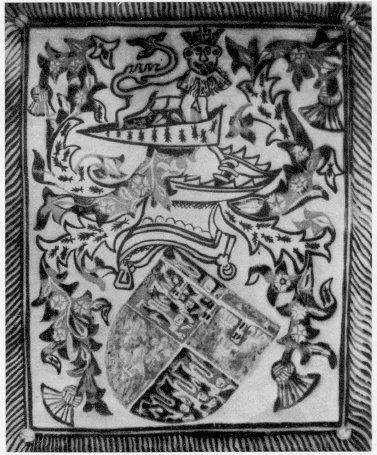
1. The stall plate of Richard, Duke of Gloucester, as a Knight of the Garter, c. 1465. It shows his arms, which are France modern and England quarterly with a silver label of three points, each ermine in a canton gules – the crest is a crowned leopard gold on a cap of estate and with a label as in the arms around his neck. St George’s Chapel, Windsor.