
Chapter Three
‘But when the Earl of Warwick understood of this marriage, he took it so highly that … thereof ensued much trouble and great bloodshed.’
Sir Thomas More, The History of King Richard the Third
‘Confess who set thee up and pluck’d thee down?
Call Warwick patron, and be penitent.’
Shakespeare, King Henry VI, Part III
By the end of 1468 Warwick was able to inform the King of France that he had ‘drawn over’ Clarence. Indeed, he had achieved an extraordinary influence over the Duke, having all but bewitched him, so seductive were his arguments.1 For the Earl was maturing a plan to depose Edward and replace him by his more amenable brother, whom he intended to secure by making him his son-in-law. However, he was not yet quite ready, still uneasy about taking such a desperate step. Nor did the King suspect him. That summer a Lancastrian agent had been captured and, after being ‘burnt in the feet’, had accused several people of corresponding with Margaret of Anjou. Among them was Lord Wenlock, well known to be a firm friend of Warwick. Still confident of the Earl, Edward commissioned him to investigate the matter.
The business dwindled into insignificance in the light of the latest piece of scandalous Woodville greed. A distinguished City merchant and former Lord Mayor of London, Sir Thomas Cook, had been implicated with Wenlock. The Queen’s father persuaded Edward to arrest Sir Thomas and then plundered his house, stealing all his plate and movables – including some gold-thread tapestries which the Queen’s mother was well known to have tried to buy in vain. When the Lord Chief Justice acquitted Cook, old Rivers still contrived to have him fined in such a way that his daughter got £800 of ‘Queen’s Gold’ out of it. Soon afterwards the Lord Chief Justice was dismissed.
The Woodvilles were almost certainly responsible for an even more vicious crime in Ireland. In 1465 the Lord Deputy, Thomas FitzGerald, seventh Earl of Desmond, had visited England and during his stay had told the King that he would have done better to marry a princess of some great foreign house. Two years later, on being replaced as Deputy by the Earl of Worcester, Lord Desmond was promptly arrested, arraigned on frivolous charges and beheaded, while two of his young children were murdered in prison. Nearly two decades after, when he was King, Richard wrote to the then Earl of Desmond to say that his father and brothers had been killed by the same people who had destroyed his own brother Clarence – the Woodvilles.2
What with Woodville crimes and Warwick’s intrigues, ‘many murmerous tales ran in the City [of London]’ and indeed throughout the country. The atmosphere was explosive. The crisis burst early the following year, 1469, in the North. A certain ‘Robin of Redesdale’ – in reality Sir John Conyers, a kinsman of Warwick – rose in revolt, together with ‘Robin of Holderness’ and ‘John Amend-all’. In their manifestos they complained of pointed grievances, and in particular of Lord Rivers and all the Queen’s kindred. Still more suspiciously a rumour began to circulate, and to circulate very widely, that Edward IV was a bastard and that the rightful King was the Duke of Clarence. One rising was promptly and apparently zealously repressed by Warwick’s brother, the Nevill Earl of Northumberland, yet almost immediately another broke out in Lancashire.
King Edward did not appreciate the seriousness of the situation, nor did he detect the sophisticated organization behind the risings. Above all, he did not understand that he had failed to give England the peace and prosperity which it had expected from him when he replaced Henry VI. Nevertheless, he was sufficiently worried to go north himself with a small army. Richard accompanied him. Not realizing how grave was his danger, Edward moved slowly enough. En route he passed through Norwich, where the Paston family presented themselves to the royal brothers and complained of the depredations of the Duke of Suffolk, their brother-in-law.
While Richard was in Norfolk, he found himself so short of money that he wrote – or rather dictated – an anxious letter to one of his retainers to borrow ‘an hundred pound of money until Easter next coming’ because ‘I am so suddenly called’. The letter, from Castle Rising, is dated 24 June. He and his brother spent the night of 26 June at Croyland Abbey, for whose monks Bishop Russell would write a damning account of Richard’s reign nearly twenty years later. They continued by boat up the River Nene to his childhood home of Fotheringay to stay with their mother, who was in residence.
Duchess Cecily no doubt gave them disturbing news of their brother George. She had recently seen him at Warwick’s castle of Sandwich in Kent, where a threateningly large contingent of Nevills were gathering, including the Archbishop of York. Clarence had gone there on 7 June. He must have been painfully embarrassed by the unexpected arrival of his mother a week later – clearly she had learnt of a plot and hoped to dissuade him from taking part in it. Probably she guessed that she had been unsuccessful and hastened to the Midlands to warn Edward.
In the event Clarence and Warwick crossed to Calais shortly after her departure. On 11 July George married the Earl’s sixteen-year-old daughter Isabel, the service being performed by the bride’s uncle, the Archbishop. Within another week Clarence and Warwick were on their way back to England with fresh troops from the Calais garrison. They landed on 20 July and marched north.
Meanwhile, Edward had suddenly realized that he was in grave danger. Not only was he outnumbered by ‘Robin of Redesdale’, but he now knew that Warwick was behind the rising. The King and Richard took refuge in Nottingham Castle, waiting to be relieved by the Earl of Pembroke and his Welshmen. Then Robin and Warwick joined forces and routed Pembroke at Edgecote near Banbury, capturing and beheading him, together with other leading supporters of the King.
Edward IV, as strong-nerved as he was cunning, now adopted a policy of totally passive resistance. He disbanded his outnumbered troops and then waited for Warwick to take him prisoner. It was a calculated gamble – everyone remembered how Richard II had been dethroned and murdered in similar circumstances. Certainly the rebels were in no very merciful mood. Old Rivers and his son John – the aged Duchess of Norfolk’s youthful husband – were quickly caught and executed. There was a general massacre of Woodville supporters. The Queen’s mother was accused of trying to bewitch Edward by means of ‘an image of lead made like a man-at-arms, being the length of a man’s finger and broken in the middle and made fast with wire’. However, Warwick was not quite brave enough to take the only step which might have ensured victory – to kill the King, as had been done with Richard II. Edward was placed in honourable confinement, first at Warwick Castle, then at Middleham, then at Pontefract. He showed the utmost amiability, graciously co-operating with his captors and signing documents drafted by them without demur. Warwick appointed a new Lord Treasurer and appeared to be in complete control of the realm. In reality all he had achieved was to plunge it into anarchy without eliminating the captive King’s supporters.
It seems that the young Duke of Gloucester had not been arrested with his brother. We know that Edward’s chamberlain, his cousin and friend Lord Hastings, was busy raising troops in Lancashire while the King was being held, and it is likely that Richard was doing the same somewhere else in the North Country. It is also known that when Edward suddenly summoned his lords to come to him at Pontefract at the end of September, Gloucester and Hastings rode there together at the head of a very strong force. The King’s unofficial gaoler, the Archbishop of York, could do nothing when in October Edward announced he was going to London. In the capital he was welcomed with unfeigned relief. Warwick watched helplessly from the North as the King reasserted his authority. The Earl and Clarence finally dared to go down to London in December, where they were received with apparent forgiveness.
The Duke of Clarence had gained less than nothing from his treachery. By contrast, Richard was magnificently rewarded, being made Constable of England and receiving many other great honours and estates, among them the beautiful castle of Sudeley in Gloucestershire. He was also appointed Chief Steward and Surveyor of the Principality of Wales and Earldom of March, Chief Justice of North Wales and – until the majority of the boy Earl of Pembroke – Chief Justice and Chamberlain of South Wales. The Welsh were inveterate Lancastrians. Shortly after Edward’s return to London, Henry ap Thomas ap Griffith and Morgan ap Thomas ap Griffith seized the castles of Cardigan and Carmarthen as bases for a full-scale rebellion. The seventeen-year-old Chief Justice dealt with them with impressive speed, recapturing both castles before Christmas.
But Warwick and Clarence remained an insoluble problem. They knew that their very existence threatened the King, while they could not forget a most unforgiving Queen. Even had they wished, they were unable to hold back their supporters – a strange mixture of personal followers, secret and not so secret Lancastrians, and energetic opportunists. By March 1470 risings were again breaking out in the North. On 10 March Sir John Conyers, Lord Fitzwalter and Lord Scrope of Bolton were up in arms. The outbreak was recognized as very serious. After an apparently puny affray by Lord Welles and Sir Thomas Dymmock in Lincolnshire the previous month, on 4 March Welles’s son Sir Robert had had a proclamation read in all the churches of that county – every man must rally against the King in the names of the Duke of Clarence and the Earl of Warwick.
This time Edward moved much more quickly, smashing the risings and summarily beheading their leaders. Before he died Sir Robert confessed that Clarence and Warwick had been behind him. These two ‘great rebels’ refused to obey the King’s summons without a safe conduct. Having got as far north as Manchester, they then fled down to Devon and embarked for Calais with their wives. At Calais, although the Lieutenant Lord Wenlock was secretly Warwick’s friend, they were met with gunfire. The poor young Duchess of Clarence was in labour and miscarried as a result, her stillborn son being buried at sea. The miserable party finally landed at Honfleur, where King Louis was only too pleased to give them refuge.
Edward was prepared to use any means to prevent their return. At the suggestion of the sinister John Tiptoft, Earl of Worcester, twenty of Warwick’s men were publicly impaled at Southampton for an example (though the victims seem to have been hanged beforehand). Yet Warwick was far from beaten.
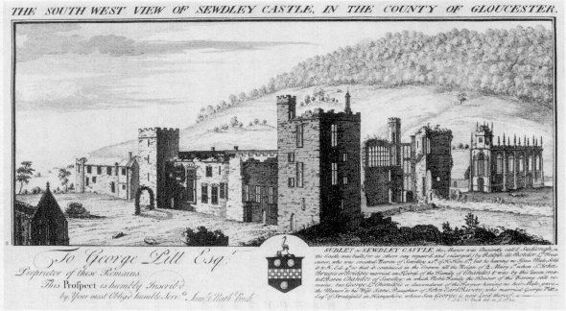
2. Sudeley Castle in Gloucestershire where Richard rebuilt the great hall between 1469 and 1478. However, because it was in the South he can only have visited it once or twice. From S. and N. Buck, A Collection of Engravings of Castles, Abbeys, etc.
By now he had decided that Clarence would make an impossible King. But there was still a Lancastrian Pretender available – together, Lancastrian faithful and Yorkist disaffected might well restore Henry VI. Louis was enchanted by the prospect and forced Margaret of Anjou to forgive the Earl and ally with him. On 22 July 1470 in Angers Cathedral, Warwick knelt on the stone floor before her for a good quarter of an hour, first begging her forgiveness and then swearing loyalty to King Henry. She even consented to her only son, Prince Edward, marrying his younger daughter Anne. The boy was already all too like his ferocious mother, alarmingly haughty and talking of nothing but war and beheading his enemies. However, the Earl must subdue England before she and the boy returned – an ultimately fatal miscalculation. Clarence was left with nothing but the right to inherit the throne, should Edward of Lancaster fail to beget children.
Meanwhile, in northern England still more small risings were breaking out once again. They were not especially dangerous, but important enough to keep Edward IV there. Richard was with him, a precociously mature eighteen-year-old who in August 1470 was appointed Warden of the West Marches against Scotland. But the real danger lay in the South.
The King was at York when he was suddenly informed that on the evening of 13 September the Earl of Warwick, together with the Duke of Clarence and such Lancastrian exiles as the Earls of Oxford and Shrewsbury, had landed in Devon and were making for London. Edward started out for the South. But he had only reached Doncaster when in the middle of the night his minstrels burst into his bedchamber to warn him that the Marquess Montagu – Warwick’s brother, formerly Earl of Northumberland – was advancing with a large body of troops to capture him.
The King reacted with his usual decisiveness. Together with Richard, Hastings, his brother-in-law the new Earl Rivers, and a few hundred devoted followers, he galloped to King’s Lynn in Norfolk. There he commandeered two flat-bottomed merchantmen from Holland to supplement the single small royal ship which he found in the port. Then, still in his armour, he set sail for the Low Countries. Commynes observes, ‘They did not have a penny between them and scarcely knew where they were going.’