
CHAPTER 9
*
KATHRYN REED ALTMAN: When we got married Bob was in the middle of Hawaiian Eye. He was doing a lot of TV. After we were married, it was Bonanza and Combat! and all kinds of things. We were getting out of debt. We were terribly in debt when we got married. We were living off my child support, practically. Then we got a really good business manager; his name was Charlie Goldring and he got Bob straight. He had us on a regular budget. It worked out very well because he got us out of debt and on our feet. I just kind of thought that was going to be our life. We bought a house with a swimming pool in Mandeville Canyon. We lived there for nine years. We bought a house and we had a baby and we had the other kids coming over. It was a great house and we had lots and lots and lots and lots and lots of parties.
Television Directing
Hawaiian Eye—1959; The Millionaire—1958–59 (five episodes); Westinghouse Desilu Playhouse—1960; Sugarfoot—1959–60 (two episodes); Gale Storm Show—1960; Maverick—1960; Lawman—1961; Surfside 6—1961; The Roaring Twenties—1960–61 (nine episodes); Bonanza—1960–61 (eight episodes).
DAVID DORTORT (producer): I produced Bonanza, and George W. George was someone I respected. I knew his father’s reputation. I had hired George to write an episode of Bonanza, and he did an excellent job. I mentioned how struck I was by the use of the camera on the James Dean movie, and George said, “How about giving Bob a chance to direct?” We were number one in the world and I didn’t know anything about this guy. I met him and he was so overweight, heavy, and drinking. I said, “If I hire him, he must promise that he would stop drinking.” That was no easy thing.

Directing Ray Danton (left) and Roger Moore in an episode of The Roaring Twenties
He was fantastic on Bonanza. He was the best director I had. The series became sharper, more focused. He was born with a camera in his brain. The guys on the show immediately recognized his talent compared to the other directors. But he told me that as much as he liked working for me, now he wanted to be able to direct a feature.
Television Directing
Route 66—1961 (one episode);
Bus Stop—1961–62 (eight episodes).
ROBERT BLEES (producer): I did the television adaptation of Bus Stop from both the William Inge play and the Fox movie, which starred Marilyn Monroe. When I realized that I had to make thirty-nine hours the first year—thirty-nine new shows—I fought to get some assistance.
We were going along and I couldn’t get the talent that I wanted for behind the camera, and I knew there was a show at Warner Brothers, The Roaring Twenties, that had gotten a little bit of talk. I looked at some reels of that show, from three different episodes, and all were good. The director on all three was Bob Altman.
We learned we were both from Kansas City originally and we hit it off. When I called up the producers of the Warner Brothers show, I said, “Tell me about Altman.” They said, “He’s trouble. He’s good, but trouble. Fights over everything. There were almost blows exchanged.” Nevertheless, we hired Altman, because he was good.
He was doing overlapping dialogue, even in those days. He was very good about casting—he wouldn’t go the obvious ways. On Bus Stop, he cast Robert Redford, the all-American boy, as a member of a criminal plan. And Barbara Baxley, everybody’s sensible grandmother, as part of a criminal enterprise.
SUSAN DAVIS: I was commercial looking, so I could pay the rent, but it was a constant struggle. He hired me on a show called Bus Stop and Robert Redford and Barbara Baxley were on there. I was hired, and we were going to shoot my part in one day. It was very simple. He rehearsed it, but we didn’t shoot it, and I’m sitting there for the rest of the day. It was a Friday, and about five thirty he said, “Okay, the scene with Susan Davis and so-and-so, we can’t get to that. We’ll have to bump that over to Monday. Can you make it, Susan?” And I’m thinking, “Whoa, that’s two rent checks, two days.” He knew exactly what he was doing, taking care of me. He never mentioned it, but I thought, “Wow.”
ROBERT BLEES: Bob responded to provocative ideas and sometimes wanted to do things that were too provocative. Not from a censorship point of view, but for the sake of being provocative. He was always pushing it. Sometimes, to my mind, erroneously.
FABIAN FORTE (singer and actor): The Bus Stop episode I was in that Bob directed was about evil. It walks among us. That was the title, “A Lion Walks Among Us.” Evil. It’s out there. And you never know where it’s coming from. It was perfectly written. I played a drifter, a psychopath. He was very, very charming. Wandered into this little town and took advantage of anything he possibly could take advantage of. He repaid anyone who was nice to him by killing them, and he almost got away with it.
I met with the producers, Roy Huggins and Bob Blees. They said the only way you could possibly get this, me being Fabian, is you have to meet with Bob Altman. So I drove up to his house in Mandeville Canyon. I don’t think anybody knew anything about Altman at that time. I knew I was going to have to read for this guy and convince him I could do this. I was nervous as hell. I walked in, and he reminded me of a hippy-dippy kind of guy, which I loved. He was cool, he was warm, he asked me a lot about my personal life, I guess to put me at ease.
KATHRYN REED ALTMAN: When Fabian came over to the house, Konni and Christine just couldn’t believe it. They served him a sandwich, and the potato chips he didn’t eat, they put them under their pillows or something. They were just gaga over him.
FABIAN FORTE: At first he wanted to improvise a few things about the character. I read with him. We read from the script, and I think it was because of his input I totally transformed myself into this really fucked-up guy. He opened windows into the guy—“How would you feel if you had this in your past?” He really wanted you to have that power to see if you could do it. We did it eight or nine different ways. He didn’t say much, just a word here or a word there. He had the power to make you go to another dimension. He was that way on the set, too. He never bludgeoned you or was harsh with you. He was very astute—very few words but right to the point emotionally. Then he’d walk away. He did that with all the actors. To me it was, “Wow, if this is the way acting is, this is what I want to be part of.”

Teen heartthrob Fabian, star of Robert Altman’s “A Lion Walks Among Us” episode of Bus Stop
ROBERT BLEES: Bob, of course, saw this as an opportunity to make a shockingly violent picture. We had to reshoot two different scenes because of the gore and the violence. One was the opening scene, in which Fabian murders the little store owner. That was enough to make anybody gag except Bob. Still, it was a powerful piece.
Jack Gould, story headlined “TV: An Hour of Ugliness,” The New York Times, December 4, 1961: An hour of dark and sordid ugliness—cheaper than anything yet seen on television and its crude reliance on primitive violence and such—was presented on “Bus Stop” last night. … The vehicle was entitled “A Lion Walks Among Us,” and starred Fabian, one of the wiggling vocalists created for the TV market. … A play often can be extremely unpleasant but still command interest and respect because of the depth of its insight into characters. But last night’s presentation had no such justification or excuse; it was unrelieved exploitation of the base instincts of an animal run amuck.
Censorship on TV is certainly odious, but restraint does have its place. Given tact and delicacy, almost any scene can be handled, but last night’s onslaught of mayhem and suggestiveness surely was misplaced in an hour known to appeal to a substantial young audience.
ROBERT BLEES: You know who wrote the book that episode was based on? Tom Wicker of The New York Times. I was amazed he never stepped forward to defend it.
FABIAN FORTE: The reviews were the best I ever got as an actor. I give Altman a lot of credit for that. But then the advertisers got scared about the content of the show, and then it got brought up in the congressional hearings they had going on.
Marjorie Hunter, story headlined “A.B.C. Head Backs ‘Bus Stop’ Episode,” The New York Times, January 25, 1962: A network president testified today that he did not cancel a controversial episode in a television show because he feared his action might discourage creative talent. Oliver Treyz, head of the American Broadcasting Company, appeared before a Senate subcommittee investigating juvenile delinquency and the impact of television crime and sex shows on teen-agers.
Senator Thomas J. Dodd, Democrat of Connecticut, who is subcommittee chairman, reminded Mr. Treyz that he testified last summer that networks could police themselves. “How do you square that statement with your refusal to let the code authority preview your show?” the Senator inquired. Mr. Treyz replied that he felt a preview would have opened the door to possible prior censorship of program content.
ROBERT BLEES: In the aftermath I thought it was ridiculous. I think it was Senator Dodd who said on the floor that he had never seen it, but had heard enough to know it was evil. I thought that was bullshit. It has a very moral point. Roy Huggins was a very devout Catholic—it was sometimes almost impossible to keep his Catholicism out of the show. All the people who criticized it for being evil or approving of crime are absolutely wrong.
FABIAN FORTE: Dodd had a bug up his ass about what was on television, and they used this show as Exhibit A. A lot of people loved it. It was only the tight-asses that were saying it was going to bankrupt our young people. You know, like the “devil music.” Now here it comes on TV. Bob Blees and Roy Huggins wanted to make a feature out of the episode, it was that good. I was praying they would make the motion picture. But because of the heat, the advertisers, and the hearings with Senator Dodd, they buried it. That would have changed my whole life. Well, it might have.
ROBERT BLEES: The show wasn’t picked up after that first season. It was the controversy, but it was also the ratings. We were against Bonanza on Sunday nights. No show survived against Bonanza.
We got some very good notices from good critics and we ended up like number three in some poll. We took our shots and failed. The uproar? It might have helped Bob. He got print. And in this business that helps.
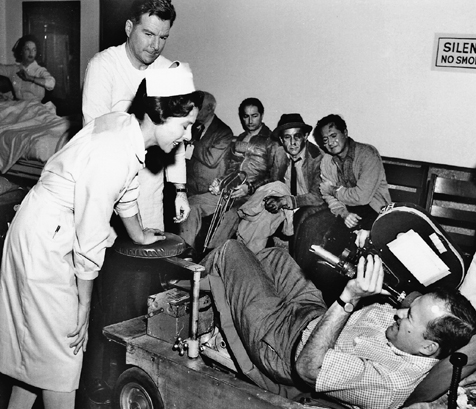
Filming a pilot for Fox in 1962. The actor at left is Bert Remsen, who became a close friend of Altman’s and acted in eight of his films.
* * *
Kraft Mystery Theater—1962 (TV, one episode)
JOHN WILLIAMS (composer): At Universal studios, I’d been working in the music department since 1958 as a composer. I was assigned to Kraft Mystery Theater for two years. Bob was very different from other directors. I didn’t meet them; there wasn’t contact. But once I was assigned to Bob he practically lived over in the music department with me—inviting me to his house, wanting to have drinks after work. I was fascinated with him because he showed so much unaccustomed interest in what I was doing. He became a collaborator in a way that wasn’t usual in those days in TV.
Television Directing
The Gallant Men—1962; Combat!—1962 (ten episodes).
ROBERT BLEES: After Bus Stop came Combat! I saw what they wanted to do was take a World War II squad from almost D-day to Berlin’s fall. I was hired and the first thing I said was, “I’d love to do it. I can improve it, but I want Bob Altman under contract.” It was a unique contract for Bob—he would be under contract for the entire year, and he would shoot one episode and would be preparing the next one when he finished shooting. He’d be doing every other episode. That was unique, to commit to that many, but he was the best director. I had used fifteen or twenty directors, including some of the best. Arthur Hiller worked for me. Don Siegel. Other top, top guys. Bob was the best fifty-five-minute television director I had ever encountered. No one had his instincts.
TOM SKERRITT (actor): I was right at the end of film school at UCLA, and I met this director guy who lived in the neighborhood near UCLA—he had seen me in this little antiwar film I had done. He said, “Come on over and be in this show, Combat!” It was Robert Altman.
The day before I’m supposed to start shooting, I went over to the set to see him to thank him for the job. I walk up and see him from behind. He was sitting in this tall director’s chair, and I knew it was him. He had this wonderful Australian hat on. A Jeep drives up and the guys in the scene jump out. Bob’s head is leaning over. Generally a director will say, “Cut.” He says nothing. The A.D., the assistant director, comes over and shakes him. “Bob, the shot’s over.” And he woke up. “Oh, how was it?” he says. “It was fine, Bob.” “Okay, print it. Let’s move on.” That was the first time I saw him in action. And I said, “He’s my kind of director” [laughs]. But imagine falling into a mentorship with a guy like Altman. You work with other guys and you realize they’re not half of what Altman is. Put them all together and they weren’t half of what Altman was.
So then it’s my first day on the set, my first Combat!, and I’m sitting next to Bob. There was a tense scene being lit. And I’m watching an electrician walking around with an empty five-gallon bucket, walking from one light to another on a catwalk. I’m thrilled, taking it all in. I’ve never been on a Hollywood soundstage before. I’m brand-new to all this, and I think this is really something. I’m watching the guy with the bucket and Bob is watching me, reading the whole situation as only he could. I’ve got this look on my face, “Gee-golly-whiz.” I’m still looking up, and just then, the guy throws up in his bucket.
Bob points up there and says, “Hollywood.”
JOHN CONSIDINE (actor and screenwriter): I was a young actor and I got this audition to read for this new show, Combat!, as guest lead on an episode. I was supposed to dive into this moat to swim across where we could get to this German machine-gun nest. He shot it and I thought we were done—there are such time constraints, everybody in television is pressured to get things done. But Bob realized he could shoot the whole scene in the reflection of the water. It was certainly more interesting that way. So he did the whole thing over. It was the only time I ever heard a director in television say, “Hey, I’ve got a better idea.” Right there I saw a little of what Bob was going to be like later.
ROBERT REED ALTMAN (son): There’s a story from the Combat! days, when Vic Morrow would walk down a crowded street with a hundred and fifty extras and no one could talk except that one actor and the guy that was with him, because they were being paid to do that. And my dad would go to the extras every morning and say, “Who wants a line today?” And the assistant directors were like, “No, no, you can’t do that!” My dad would pick five people to shout things out as Vic walked down the street. The next day, the A.D. said, “Here come the producers. They’re going to fire you for doing that.” They came up and said, “Whose idea was it to have these guys do that, call out things as Vic walked by? That was great—we loved that. It made it real.” He never had fear. If something creatively grabbed him, he would do it.
BARBARA TURNER (screenwriter/actress/producer, ex-wife of Vic Morrow): Vic adored Bob. Every actor in the world adored Bob. It was the sense of freedom that Bob gave actors. When I worked with Bob as an actress it was stunning.
MICHAEL MURPHY (actor): He was doing Combat!, and Joan Bennett, who is a longtime friend of Bob and Kathryn, said, “You should go out to MGM and meet Bob Altman. He’s doing this Army thing and they’re using a lot of young guys.” So I went out and met him and he couldn’t have been nicer. I knew from the minute I walked in that he was just this very unusual guy. Something about him, I was completely enamored. He knocked me out. Here was a guy, he was in his thirties, he was probably thirty-seven or thirty-eight, and he’d flown fifty missions over the South Pacific. So he was a fully formed adult male. He was a guy who you looked up to. He had older sensibilities. He had stories to tell and he knew how he wanted to tell them and it wasn’t like some twit from film school. There weren’t any film schools. He learned what he had to say by practical experience and he’d been through things that most people never go through.
So he said, “Are you sure you want to do this?”
I said, “Yeah.”
He said, “Well, okay.”
I opened my door one morning the next week, and there was a script from Combat! and I almost fell down. There was an offer in the envelope and I was to play Tank Driver Number Two. Tank Driver Number One was Matty Jordan—you know, the guy who owned Matteo’s and ensured Bob a good seat on Friday nights.
So I went out to the lot when the day came, and you’d have thought I was the star of the show. He was so nice and I was included in everything. Remember, this was Hollywood. There was no reason for him to be hanging around with me [laughs]. But he was just this very, very nice guy and he seemed genuinely interested and he seemed to care that I was there. I remember saying, “Should I rehearse this with Vic Morrow?” He said, “Oh, we’re not going to shoot that stuff.” And we didn’t. We sat out there in the weeds—they used to give you those box lunches in the old days out there. I remember sitting under a tree and he says, “Well, what do you want to say in this scene?” And I said, “What do I want to say?” I remember going home that night and thinking, “This isn’t like acting. There’s no anxiety. It’s just so easy. It’s just people talking to each other.” Of course that was his whole point. That’s how you operated.
Well, it turns out the bosses had told him not to shoot this episode. They told him that it was too dark and nobody was speaking English. The only people that spoke in the episode were the Germans and me. And Vic was wandering around hurt. He’s burned and he’s wandering. The bosses went to New York for some kind of business meeting, and he shot it anyway [laughs]. So of course he was busted, fired, for insubordination. And of course the episode, it’s called “Survival,” turns out to be the best one they ever shot.

Vic Morrow in the best-known episode of Combat!, “Survival,” directed by Robert Altman
* * *
Kraft Suspense Theater—1963—64 (TV, three episodes)
KATHRYN REED ALTMAN: Bob was doing the Kraft Suspense Theater shows. After he did the third one, he did an interview. He had to leave for Chicago the very next day on something job related. I didn’t go. I had a small baby. And he gave this interview—I don’t know what prompted the interview, he wasn’t that well-known. But the headline in Variety the next day says, “Robert Altman says the Kraft Theater plots are as bland as their cheese.” And he’s gone, of course, and it hit the front page and I get all the phone calls. And I didn’t know at first what anybody was talking about. Really funny. For Bob’s next birthday, John Williams, the composer, and his wife, Barbara, brought Bob a whole case of Velveeta. I loved that.
GEORGE LITTO (agent): The show is as bland as its cheese. He said that. He didn’t tell Kraft, he told Variety, which is worse. I was an agent in town, but I didn’t know him at all. I knew of him, but I did not personally know him nor had I ever met him. I knew him as a filmmaker in the community—he was known for having directed many Combat! episodes, and good ones. He was known as a very skillful director.
Once I saw a show he did on television, just turned it on and saw the show, and there was a nice story. The story was good but not extraordinary, but what was extraordinary was the way the film was shot. And what was new and exciting was that it was the first time in a commercial program by a major studio where high-speed Ektachrome film was used, with which you could shoot night for night, with minimum light. And the way the film looked with this high-speed film, and the style he used to photograph and direct the movie, was extraordinary.
Nightmare in Chicago
(aka, Once Upon a Savage Night; 1964)
Albuquerque Journal television previews, April 2, 1964: This chase tale is a sleeper, with a particularly terrifying moment out on a tollway. It involves a murderer, “a butcher,” who throttles blondes. It was filmed around Chicago at night, and it’s most effective in color. Black and white footage is not quite as suspenseful, because the star of the film is variations in light.
DONALD FACTOR (producer): He was hired to do this pilot, which was a cops-and-robbers thing. Some of his old Army Air Force friends told him that Eastman Kodak had developed some kind of new film stock, for photographing missiles. It was very high speed. He said, “With this, we can go out in the streets and shoot outdoors at night and have a really good, realistic film.” He went to Universal and they talked to Kodak and they refused to give him any. They said it wasn’t tested for that kind of use. Bob simply went behind their backs and bootlegged a bunch of it and shot his pilot. Kodak found out and raised all kinds of hell. Of course it was a big success and everyone was impressed with the look of it. So after that the people at Kodak called Bob and wanted him to become the spokesman for that film stock. He did things like that and he usually came out on top.
BARBARA TURNER: After the Hitchcock show, the next time I worked with Bob was Once Upon a Savage Night. Bob called me one day and said, “We’ve got this script, but we’re not going to be doing it. We’re just going to rewrite the whole thing. Let me take you away from all this, and we’ll have a good time.” That was ’63, because I got on the plane about two days after Kennedy was shot. And we had to change a large piece of the script because it was originally about a presidential convoy coming through, and somebody who was out to kill the president. He changed it to a missile being driven on the thruway. So the whole cast stayed up until three or four in the morning covering a gasoline truck to make it look like a missile.
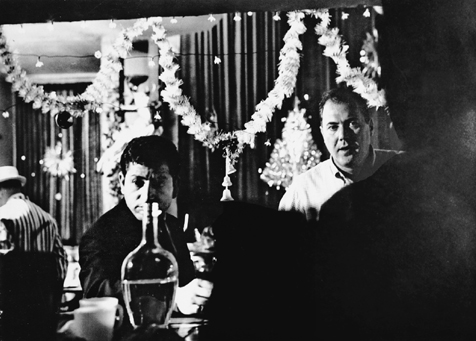
Filming Once Upon a Savage Night in Chicago with Reza Badiyi
It was like camp. You know, everybody had to be together all the time. We ate together, we slept together, we did everything together. Everybody had to be around all the time. He would take from everybody and it was just fun. And it’s not like it all went smoothly. The weather didn’t go smoothly. It was so cold the cameras froze. We stopped for two weeks because he couldn’t finish the movie. And we all came back to finish it without pay because everybody loved him so much and loved doing it.
We’re all sitting around one night and he said, “You know, when I was a little boy, it was so cold in the morning that my mother used to make hard-boiled eggs and put them in my mittens in the morning to walk to school. Then when I got to school, when they’d cooled off, I would eat them.”
I said, “Oh my God, can I have that? Can we put that in the script?”
He did, and it wasn’t until the show was over that he said, “I made that up.” But it was great, and it was in the movie. After, he had a little statue made of an egg. It was an “Eggie,” and he gave it to me for “the best performance in twenty-below-zero weather.”
GEORGE LITTO: So Bob had a reputation as being very individualistic or a maverick or difficult or worse. But I was accused of being the same way, so none of that ever bothered me. As a matter of fact, I was attracted to people who had strong personal views and I liked people with a new and individual take on their work. I was always looking for it.
ROBERT ALTMAN: Pretty much all the stuff I did in television, the style of it, the color of it, or the feel of it came from movies I liked. On Combat! I copied everything. I remember once on Combat! saying, “This is gonna be my Four Feathers,” or I’d name some other movie. I’d have a movie in mind that I could apply to the script we were shooting. I was really stealing someone else’s style and applying it to my work.
But that’s no different than someone telling you, “Do a painting of the ocean,” or “Do a painting of mountains.” Well, you’ve got all these paintings of mountains and oceans, and that doesn’t mean your painting of either of those things is diminished just because you’re doing something similar to what somebody else does. We all do similar things.
* * *
REZA BADIYI (director): Bob loved actors, but he had an enormous disagreement—I wouldn’t say hatred, but almost like the neighbor who puts up the fence—toward the management. So he always becomes a champion of the crew, to go and yell at the producers and the upper-up, the money. He would fight for their causes.
BARBARA TURNER: He taught me a lot. He got a letter or notes from Universal, because the show was from Universal. Something about being too dark or too light or something, and he sent them back a letter saying, “Fuck you. Rude letter follows.” And I thought, “This is the greatest man in the universe.” Bob was the most extraordinary man that ever walked the face of the earth. I mean, he didn’t bend for anybody.
Bob was I think the closest reincarnation—except they lived at the same time—to Hemingway. They were the same guy. The same demons, the same passions, and the same ego and the same vulnerabilities. Larger than life. Incredibly gifted. And Hemingway could turn on people on a dime, for no reason, just attack, you know? But then would get over it. Bob, too.
Bob had a shit list of sorts, so you could get on that. It took a while to get off of it—when he decided to take you off of it—but I don’t think he could hold a grudge. It was the same with Hemingway. He would get in raging fights with people, I mean fistfights, and then start to laugh. That was Bob, you know? And Hemingway loved women, like Bob.
I never thought of Bob as an alcoholic. I don’t think Bob thought of himself as an alcoholic. I don’t think anybody thought Bob was an alcoholic, but he drank a lot. And he was a big guy so he could pretty much carry a lot.
GEORGE LITTO: He used to mix these fucking crazy drinks—the Green Death. It was all part of the fun. He’d have all this shit he’d order, and he’d mix all the things up and [say], “Everybody, try this, try that.” It was a whole ceremonial thing. He used to captivate everybody’s attention while he made all these drinks. He could have been a great entertainer. We’d all get shit-faced and roll over, fall asleep on the floor, wake up at six in the morning—we didn’t know where we were. Well, when you’re young and strong. Green Death. I’ll never forget that.
* * *
RICHARD SARAFIAN (director/actor/former brother-in-law): I had written a script called Andy. It was a very sensitive story about someone I knew when I was a bartender in New York. He was retarded and he ultimately froze to death in a doorway. This film was a tribute to him. After I got my first job at Warner Brothers, I met Bob at Nickodell’s and he had been drinking. He wanted to direct the script I had written. I wanted to direct it myself. I said no. He was furious. He said, “I’ll tell you what, Sarafian, I’ll become your worst enemy in Hollywood.” There was a competitive side of Bob, and for whatever reason—marrying his sister, being a director—he saw me as competition in those days.
JOAN ALTMAN SARAFIAN: That’s not true. Dick would love to have been Bob’s friend. He would have loved it more than having me. He would much rather have had Bob.
JOHN WILLIAMS: Bob was uneven when he drank. He could always be very sweet, but more typically he would be cutting and sarcastic and apply that soul-destroying gaze of his. His eyes were fantastic instruments of reprimand and reproach.
When he drank, he seemed to find an excuse to go penetrating and in-depth at people’s foibles. He could go right for the jugular with people in a way that could be devastating. He was so perceptive in his analysis of people at various levels that he was very well equipped to do it. A lot of that came out when he was lubricated, or liberated, by alcohol. I don’t remember him aiming it at me. But my kids—he was hard on my kids.
I don’t think it’s very unusual. But Bob was also so attractive and elicited so much loyalty from his friends that I don’t think there were too many relationships in his inner circle that were broken by this cruel behavior.
KONNI CORRIERE: He gave parties every weekend, loud and late and drunk, and he always got drunk and always got cruel and evil and terrifying. He was so perceptive; he’d go for a person’s weakness and then crucify them. It was loud. It was frightening. It was the main attraction and no one ever stood up to him.
Once at the house in Mandeville Canyon, he was so drunk and so angry, he took the television and threw it through the plate-glass window into the swimming pool.
KATHRYN REED ALTMAN: He was a big drinker and a party boy. His good traits outshone his bad ones, but he had some pretty bad results with all the drinking. Telling people off at the wrong time. Really the problem was not that person. I would have to tell them, “You are not the target, don’t take it personally.” I won most everybody back. There were times when I would just walk on eggs and sit in fear before the evening was over that there was going to be an explosion. When he was good he was very, very good, but when he was bad, oh man.
REZA BADIYI: He wasn’t scared to just say his mind. But sometimes he was just saying it for effect at that moment. But it has a resonance, an echo that bothered him dearly in life, to a point that he was truly not working and he needed some money.
KATHRYN REED ALTMAN: Some people are motivated by security. And then there’s the gambler. He takes chances, risks. That’s Bob Altman, the rebel and the renegade and all those names they called him. It was a given. His dad was a big hustler, player, gambler, so Bob grew up in it, knew all the tricks.
It was our fifth anniversary and he was at the track. I heard about this later. He had this last three hundred dollars or something, and he was saying, “If this horse doesn’t win I can’t go back home because Kathryn is waiting and I don’t know what I’m going to do. I’m just going to put it all on one horse.” And Martha Raye was there, and she said, “Put it all on this one.”
Robert Altman, from an essay called “Risk” in Esquire, October 1993: Martha Raye came by and said, “Here’s a tip. I don’t know if it’s any good but there’s a horse called Pal Fast.” I looked up and saw that Pal Fast was going off at thirty to one. “Thanks a lot,” I said…. I’m thinking, “What the fuck am I going to do? I can’t cover a check for Las Vegas and I can’t lose face.” Finally I said, “Oh what the hell.”
KATHRYN REED ALTMAN: He bet it all and he won. He came up with a few grand and we had the greatest weekend—we laughed the whole time. It could have been a horrendous story, and I might not be sitting here very easily had it gone down the other way. That was our last ten cents. Make that our last nickel.
Robert Altman, from an essay called “Risk” in Esquire, October 1993:I’ve gambled all my life, but I’ve managed to gamble within my loss range. I’ve been lucky, because I haven’t always been careful. My attitude is, “Why not?” Professional gamblers are the most uninteresting gamblers of all because they’re like the banks. They play the odds and cut it right out of the middle. They don’t even think about the long shot. Absolutely boring. I put them alongside the studios…. We don’t rely enough on instinct in this culture. Sometimes you just feel the heat and you know the fucking number is going to come out and finally it does. Waiting for it is part of the joy.
* * *
GEORGE LITTO: So the Variety piece comes out, where he says the thing about the cheese, and when I read about it in the paper I said, “Jesus, what a stupid son of a bitch [laughs]. Didn’t he have enough trouble? Can’t he keep his mouth shut?” And he gets dropped by his agency, Ashley-Steiner. And before I knew it, Ray Wagner, who was an executive at MCA/Universal, called me on the phone. I had many clients working under his auspices. And he said, “George, I’m calling you because I’m planning to leave Universal.”
I said, “Why, Ray? I know they like you there.”
He said, “Well, I’m going to go into production. I want to produce pictures and I’m going to go into a partnership with Bob Altman to produce pictures and some television, too.”
I said, “Are you out of your fucking mind?” My thought was, Bob Altman couldn’t get a commitment to be a dogcatcher at this point in time.
He said, “George, you don’t know Bob. You got to meet him and you got to come to breakfast with him.”
RAYMOND WAGNER (producer): I liked Bob because he was a rebel. Bob was always Bob. He was not a man that enjoyed the big commercial process so much or the corporate structures, but liked doing whatever it was he liked doing.
GEORGE LITTO: So we had a breakfast meeting at the Beverly Hills Hotel. My first impression? He was angry. He was a little surly. I’m a first-generation Sicilian Italian, okay? I’m not intimidated by anybody. So he said to me, “If you’re interested in working with us, I’m not going to do any more television.”
I said, “You don’t have to worry about that. I don’t think anybody will let you.”
It was true. It was a long time before he did television.