
1. Robert Bruce and Elizabeth de Burgh from the Seton Armorial, 1591
2. Three armonial devices associated with the Bruces
3. The interior of the Bannatyne Mazer
4. Lochmaben Castle, Annandale
5. Edward I makes his son Edward the Prince of Wales
6. Sixteenth-century reconstruction of an Edwardian
7. King John of Scotland and his wife Isabella de Warenne
8. Edward I’s army slaughters the inhabitants of Berwick, 1296
9. Stone of Destiny, Jacob’s Pillow or the Tanist Stone
10. The Coronation of Edward II
11. Dunstaffnage Castle, the chief stronghold of the MacDougalls
12. Coin showing the head of Robert I
13. Equestrian statue of Robert Bruce at Bannockburn
14. The Monymusk Reliquary
15. The Declaration of Arbroath, April 1320
16. Brass marking the tomb of Robert Bruce
17. The lead container that holds Robert Bruce’s heart
18. The carved deviced at Melrose Abbey over the place where his heart is buried
19. Statue of Robert Bruce at Stirling Castle
20. Cast of the skull of Robert Bruce
21. Reconstruction of Robert Bruce’s head, based on the cast of the skull
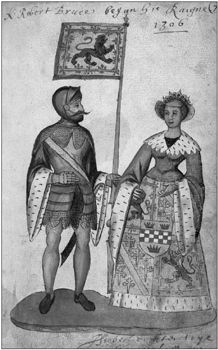
1. Robert Bruce and Elisabeth de Burgh from the Seton Armorial, 1591.
In April 2006, a poll of 1,000 respondents was taken by Stirling University to discover who is considered to be the greatest Scot of all time. William Wallace came first with 36% of the vote, Robert Burns next with 16% and Robert the Bruce third with 12%. Seven hundred years after his seizure of the throne of Scotland, Robert retains an attraction and relevance for most Scots. (From the Seton Armorial © Trustees of the National Library of Scotland)
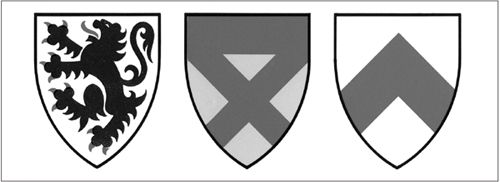
2. These three armorial devices were associated with the Bruces. The first, the blue lion (argent a lion rampant azure), were the original arms of the Bruces in the twelfth century; the second shows the arms of the Lordship of Annandale (or, a saltire and chief gules). The third shield shows the arms of the earldom of Carrick (argent a chevron gules).(Courtesy of Jean Munro and Don Pottinger)
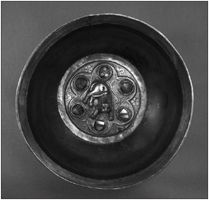
3. The interior of the Bannatyne Mazer. This wooden drinking bowl was meant to be passed around the company at a feast, and may have belonged to Walter the Steward. It illustrates the close relationship between the lord and his ‘menie’, his affinity or retinue. The boss inside the cup shows a crouching lion encircled by the six heraldic shields of his vassals. (© Trustees of the National Museums of Scotland)
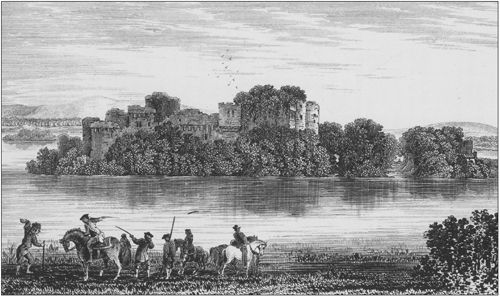
4. Lochmaben Castle, Annandale. The Bruces moved the caput or head of their lordship from Annan to Lochmaben some time around 1200. The stone castle was built by Robert Bruce V, Robert the Noble. However on capturing the Bruce Castle in 1298 Edward I decided to dismantle it and, using the stones from the original building, built the castle illustrated nearby. (© Trustees of the National Library of Scotland)
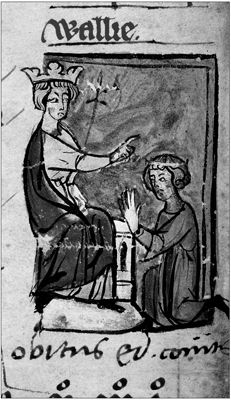
5. Edward I makes his son Edward the Prince of Wales. Edward I’s high expectations of his son were disappointed. An important factor in Robert’s success was the difference, much remarked upon by contemporaries, in the personalities and capabilities of these successive English monarchs. (BL Cotton Nero DII, f. 191v, © British Library)
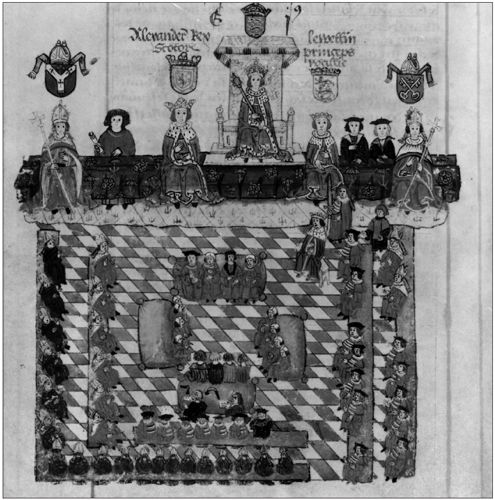
6. Sixteenth century reconstruction of an Edwardian parliament by Sir Thomas Wriothesley. The illustration shows the English king flanked by Alexander King of Scotland and Llywelyn Prince of Wales. It is fantasy, since there was no such meeting; yet as an expression of Edward’s ambitions, it may not be too wide of the mark. (Wriothesly MS, quire B The Royal Collection © HM Queen Elizabeth II)
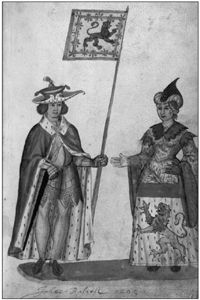
7. King John of Scotland and his wife Isabella de Warenne. John abdicated as king of Scotland by a deed of 10 July 1296, and was ceremonially unkinged by Edward I. The arms of Scotland were ripped from his surcoat. Henceforth he bore the nickname ‘Toom Tabard’, ‘the empty surcoat’. (From the Seton Armorial, 1591 © Trustees of the National Library of Scotland)
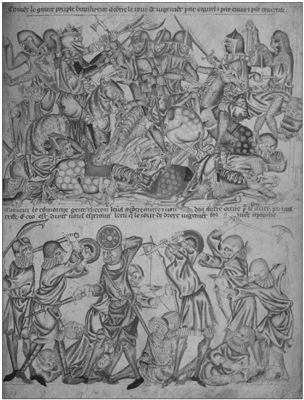
8. Edward I’s army slaughters the inhabitants of Berwick, 1296. The Lanercost Chronicle records the slaughter of the townsfolk. Corpses were thrown into the sea or buried in mass graves. (MSS No. ADD.47682 Folio 40 © British Library)
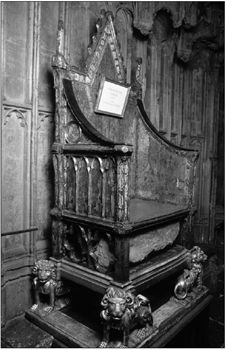
9. Stone of Destiny, Jacob’s Pillow or the Tanist Stone. There is no doubt that Edward I removed the genuine Stone of Destiny from Scone Abbey. He paid Walter of Durham, his painter, to make a wooden throne to contain it, and this was completed by 1300. Robert was enthroned in the absence of the Stone, but as soon as he had an heir in 1324 he asked for its return, and renewed his request in 1328. On that occasion however the Abbot of Westminster or the London mob prevented its removal. In 1950 it was removed by nationalist students to Arbroath Abbey, but returned to Westminster by the authorities. On St Andrew’s Day 30 November 1996, it was officially restored to Scotland, where it is kept with the Scottish crown jewels in Edinburgh Castle. (© Marianne Majerus)
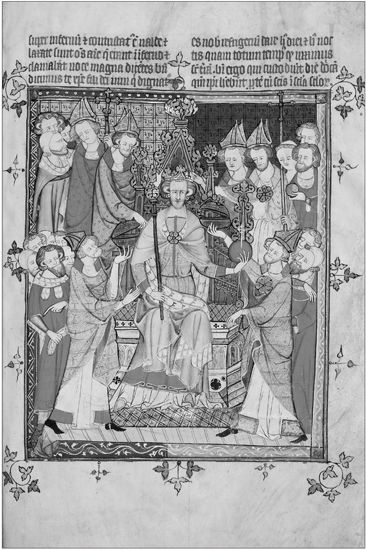
10. The Coronation of Edward II. English and French kings were crowned, anointed and enthroned, with sceptre and orb as this manuscript illumination shows. Prior to 1329, however, Scottish and Irish kings were enthroned but lacked the rite of coronation. The winning of rites of coronation and unction for Scottish kings was a major diplomatic triumph for Robert. (© Corpus Christi College, Cambridge)
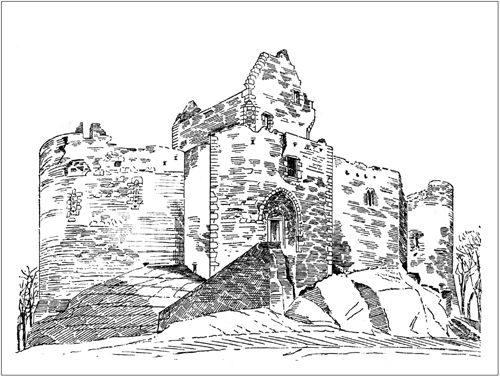
11. Dunstaffnage Castle, the chief stronghold of the MacDougalls. Alexander MacDougall and his son John of Argyll were Robert Bruce’s bitterest opponents. Their stronghold was eventually reduced by the Bruces in 1309, but the MacDougalls continued their opposition from Ireland and Man.
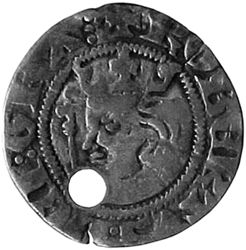
12. Coin showing the head of Robert I. For any medieval monarch coinage was crucial as a public demonstration of royal power. Robert however was unable to mint his own coins until his capture of the Berwick mint in 1318. Consequently coins bearing his image are rare. Pennies, halfpennies and farthings were minted in Robert’s name. (Courtesy of www.londoncoins.com)
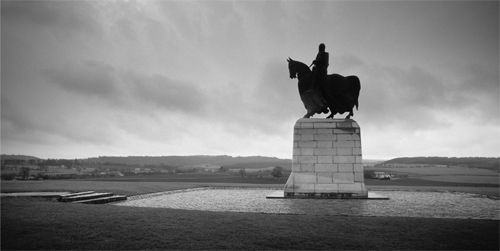
13. Equestrian statue of Robert at Bannockburn. Pilkington Jackson’s striking and impressive statue of the hero king stands on the site of a battle which was a pivotal event in the War of Independence. At a stroke, Robert gained three important castles and a variety of English prisoners, valuable for ransoms and exchange for family members held captive. (© Marianne Majerus)
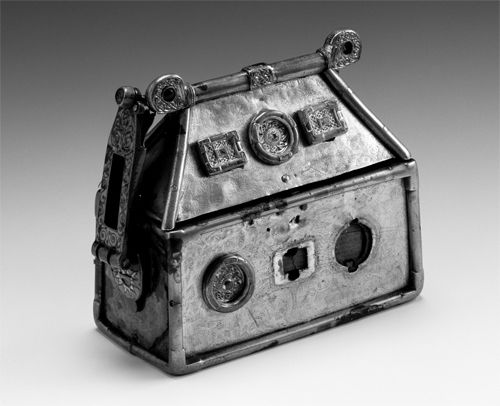
14. The Monymusk Reliquary. Edward I’s looting of the sacred talismans of Scotland overlooked the Breccbennach, a little silver reliquary, which contained a bone relic of St Colmcille and was believed to transmit potency in battle. The name translates as ‘the speckled and peaked one’, an apt description of the punched decoration in its silver panels. It was present at Bannockburn. (© Trustees of the National Museums of Scotland)
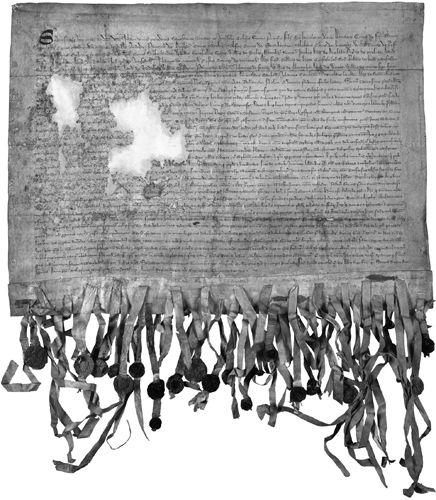
15. The Declaration of Arbroath April 1320. Written in the papal cursus (or approved metre) and employing phrases borrowed from classical authors as well as many quotations from the Vulgate, the famous letter of the Scottish lords to Pope John XXII was carefully crafted to push all the right buttons at the papal chancery. (The Nation of Scots and the Declaration of Arbroath, © National Archives of Scotland)
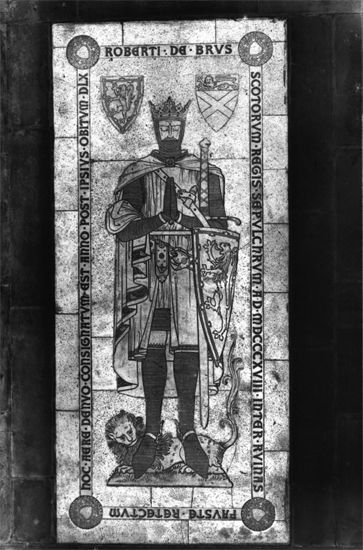
16. Brass marking the tomb of Robert Bruce. The discovery and exhumation of Robert’s body in Dunfermline in 1819 may have been somewhat challenging to the authorities. After all, Scotland was a province of the United Kingdom that had been subdued only within the past century. However that might be, the discovery of the tomb thrilled contemporaries, as it appealed to fashionable interest in romantic aspects of chivalry. (© University of St Andrews)
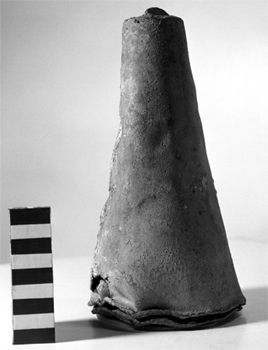
17. Lead container that holds Robert’s heart and the carved device at Melrose Abbey over the place where Robert’s heart is buried.
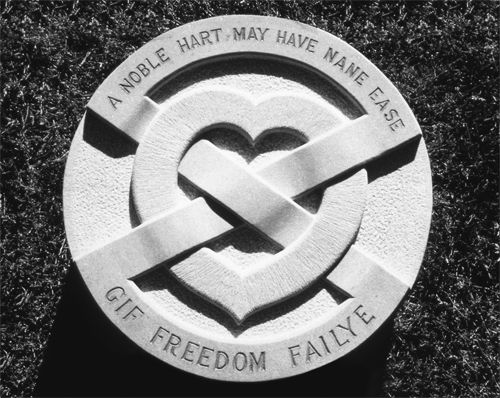
18. The heart of Robert Bruce, famously borne into battle by Sir James Douglas, was twice exhumed from its resting place in Melrose Abbey. In 1921 it was discovered by archaeologists, who found an embalmed heart in a leaden cone-shaped casket. They sealed it in a lead container and reburied it. It 1996 it was discovered again and reburied on 24 June 1998. (© Historic Scotland)
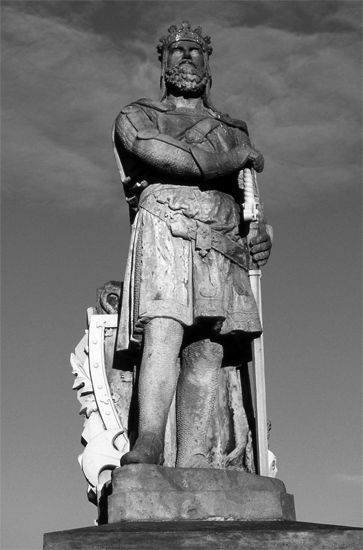
19. Statue of Robert at Stirling Castle. This statue of Robert Bruce stares across the valley of the River Forth at the National Wallace Monument. However, at a time of peaceful Union with England at home and rapid expansion of the British Empire abroad, William Wallace’s uncomplicated martial virtue fitted the national mood more easily than Robert’s achievement of Scottish national independence. (© Historic Scotland)
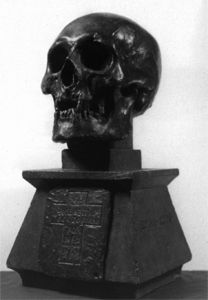
20. Cast of the skull of Robert Bruce. A plaster of paris cast was taken of Robert’s skull during the exhumation of 1819, and many copies of this exist. The cast is the principal evidence in the debate over whether the king died of leprosy or some other condition. (Courtesy of the Scottish National Portrait Gallery)
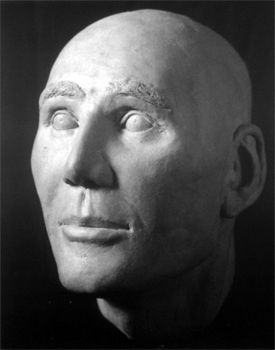
21. Reconstruction of Robert’s head, based on the cast of the skull.This reconstruction was made in 1996 by Brian Hill of Newcastle Dental Hospital applying standard soft tissue depth measurements to the cast of the skull. At his death however Robert is likely to have been badly scarred from his war wounds, which included: a fracture of the left cheekbone, a severe injury on the top of the skull and fracture of zygomatic arch, on the left side of the head. (Courtesy of the Scottish National Portrait Gallery)