
11
We have seen the enormous difficulty that Robert I experienced in trying to convert his string of impressive military victories into diplomatic and political triumph. In 1323, with the thirteen-year truce of Bishopsthorpe, it seems that Robert gave up for the present the idea of forcing the English king to concede defeat and yield recognition of his sovereign right in Scotland. Yet after twenty-seven years of war, the truce could hardly usher in a new era of geniality in Anglo-Scottish relations. Contacts between the kingdoms continued to be frosty at best, and occasionally violent. At sea, English mariners continued to harass and attack the Scots en route to Flanders, and Scots and Flemings who put in at English ports were ill treated and might be killed. An appalling massacre occurred when a Flemish vessel, the Pelarym was seized by English sailors, bearing a cargo worth £2,000. Scots on board, including pilgrims, women and children were killed. In 1324 Edward II wrote to Edward Balliol, who was to many Scots the legitimate heir to the Scottish throne, inviting him to come to England with the obvious intention of undermining the Bruce regime. Balliol did not take up the invitation until 1331; however, this move was clearly inspired by the birth of an heir to Robert that same year. Both sides continued to lobby the papal court, and in 1323 a mission led by Moray succeeded in having the Pope address Robert for the first time as King of Scots. Contrary to the truce, Edward II wrote to the pope on 24 September 1325 urging him not to revoke the excommunication of Robert Bruce, and wrote again to thank him when the pope had done his bidding. In retaliation, the Scots made border forays in violation of the truce and mounted a nocturnal attack on Carlisle Castle in the spring of 1325.
Though humiliated by Scotland and increasingly threatened by France, Edward II of England was, in domestic terms, at the height of his power in the 1320s. He had cowed opposition from the barons of the Welsh March; he had used Harclay to see off the Lancastrian threat in 1322; and the following year he had dispatched Harclay himself, for treasonable negotiations with the Scots. Wealth flooded into the English royal coffers from confiscated lands, and, opposition vanquished, unpopular exchequer reforms were forced upon the country to further increase the tax yield. A narrow coterie of favourites controlled all access to the king and to royal patronage. The two Hugh Despensers, father and son, Robert Baldock and Edmund fitz Alan, Earl of Arundel, between them monopolised royal patronage and terrorised all opposition. The regime was deeply unpopular and oppressive, and its failure to defeat Scotland added to the opprobrium in which it was held.
Edward II was no more adept at managing relations with France than he was with Scottish affairs. Relations between England and France deteriorated markedly in 1324 as a result of the accession to the French throne of aggressive Charles IV in 1322, a dispute over the judicial rights to the town of Saint-Sardos, and the demand that the English king perform homage for his French fief of Gascony. Seeing his chance, Robert began pressing more aggressively for a final peace, and issued a stern warning. A chronicler paraphrases Robert’s words: ‘Many of my men have agreed to these truces with difficulty. Whence I fear that if peace is refused I may be unable to keep my word, for I cannot alone restrain the fury of a raging throng.’ Negotiations took place at York in November 1324, but according to this account Robert’s demands by this time included a claim to perambulation of the marches, return of the former Bruce barony of Writtle in Essex and return of the Stone of Destiny. He also proposed a royal marriage between a daughter of his and Edward II’s young son Edward – later Edward III – to seal a perpetual peace. Edward II, however, refused to countenance these proposals:
For how, without prejudice to our Crown, can we surrender the right we have in Scotland, which from the coming of the Britons to the coming of the Saxons and down to our own time is known always to have been subject to our ancestors? … They cannot claim any right in the March, of which they never had possession … Robert Bruce claims the inheritance which my father once took from him for manifest crime … We should make little difficulty about returning the stone, if their other demands were not beyond all reason … The marriage which Robert offers we do not agree to at present, since we think that, as offered, it is unsuitable for us … Their demands are too damaging to us, they shall return home unsatisfied.
On rejection of his draft treaty Robert nevertheless agreed, showing immense forbearance, that the truce should continue to be observed. But when the War of Saint-Sardos broke out between England and France in 1324, Robert seized the opportunity to ratchet up pressure on the English and he negotiated a treaty of mutual assistance with France, threatening England with war on two fronts. The pact is known as the Treaty of Corbeil, sealed on 26 April 1326 and ratified by the Stirling parliament of July. By it each kingdom undertook to give military aid to the other in the event of either going to war with England. It included clauses forbidding either kingdom to make a separate peace with England.
Relations with England had become strained to a point where a renewal of the war had become almost inevitable. But a revolution in England intervened before war materialised. The leader of the English marcher barons, Roger Mortimer of Wigmore, had been imprisoned by Edward II in the Tower of London, but in August 1323, his gaolers having been drugged with a sleeping potion, he escaped to France. Queen Isabella, who had brokered peace with France following the War of Saint-Sardos, used the opportunity of a diplomatic mission to France to escape the English court for that of her brother, Charles IV. Before her disaffection became overt Edward sent his heir to France – the future Edward III – to perform homage for his French fiefs in his stead. He feared, with every justification, that if he himself left England his favourites would be over-thrown. At the French court, Isabella and Mortimer commenced an open liaison and refused to return the young Edward to England. In France, and later in Hainhault, a county in modern Belgium, a growing band of English émigrés coalesced and plotted the downfall of Edward II. Isabella adopted widow’s weeds as though her husband had died, refusing to return until traitors to the king and realm had been removed from Edward’s company and punished. Henry Beaumont, whose claim to Scottish estates had been swept aside by the truce of Bishopsthorpe, joined her; so too did Edmund of Woodstock, the king’s half-brother and earl of Kent. In September 1326 Mortimer and Isabella invaded England with a small force spearheaded by 700 men-at-arms led by Jehan de Hainault. Among those in England who flocked to Isabella’s side were others of the Disinherited, Thomas Wake and Henry Percy who, like Beaumont, felt that Edward’s peace with Scotland had cheated them of estates and titles. The tyrannous regime of Edward II collapsed almost without a whimper. The London mob rioted and murdered several prominent courtiers including Baldock, and in November Edward II himself was pursued by Mortimer and others, as a chronicle relates, into Wales:
lest they should embark there and sail across to Ireland, there to collect an army and oppress the English as they had done before. Also the aforesaid lords feared that if the king could reach Ireland he might collect an army there and cross over into Scotland, and by the help of the Scots and the Irish together he might attack England. For already, alarmed at the coming to England of the French and some English with the Queen, the king had been so ill-advised as to write to the Scots, freely giving up to them the land and realm of Scotland, to be held independently of any King of England, and (which was far worse) bestowed upon them with Scotland and a great part of the northern lands of England lying next to them, on condition that they should assist him against the queen, her son and their confederates.
There is no evidence that Edward II made any such offer to Robert, yet Edward clearly sought safety in the west, and through Donald, heir to the earldom of Mar, who resided at the English court and was a close confident of the English king, he had a possible contact with Robert. Edward II was soon captured and imprisoned by the queen’s supporters, and in January 1327 there occurred in England a strange and, for the Middle Ages, rare event, the deposition of a living monarch. A deputation of churchmen and nobles renounced homage on behalf of the kingdom, and in a brief ceremony Edward II was tried and deposed, with the loss of Scotland cited as one of many reasons for his inadequacy. His heir was crowned Edward III on 1 February 1327.
As might be expected, the former king became a focus for restoration plots and escape attempts. The King of Scots may have preferred the ancien regime of his old adversary, with whom he had a treaty, to the unpredictable and illegal regime of Isabella and Mortimer and its Disinherited supporters. On the very night of Edward III’s coronation, the Scots attempted to capture by surprise the critically important border castle of Norham. Robert’s nephew, Donald of Mar, who had been taken prisoner and reared at the English court, was deeply attached to Edward II. Captured in 1306 when only four years of age, he had in 1315 refused to be repatriated in accordance with the exchange of prisoners that followed upon the Battle of Bannockburn. Donald was then associated with the elder Despenser in futile efforts to resist the queen’s invasion of England, and, following the triumph of Isabella and Mortimer, he fled to Scotland. Robert received him back with cordiality, and Donald was invested with his earldom. However, he did not abandon the cause of Edward II. One chronicle describes Mar as ‘hoping to rescue [Edward II] from captivity and restore him to his kingdom, as formerly, with the help of the Scots and of certain adherents the deposed king still had in England’. Mar sent agents to the Welsh Marches to stir up trouble for the new English regime, and he may have made headway in persuading Robert to support his plans to restore Edward II. Isabella and Mortimer had every intention of making war on Scotland when they were ready. But in March 1327, to ward off further Scottish attacks, they appointed envoys to treat for a final peace in York and confirmed the truce of Bishopsthorpe. At the same time however ‘precautionary’ measures were put in place. A muster was planned for Newcastle on 18 May, to restrain possible Scottish aggression, and fleets were prepared on both North and Irish Seas. Isabella appealed for help to Jehan de Hainault, who had provided mercenaries for their invasion of England the previous autumn, and towards the end of May the Hainaulters returned to England. Among them was Jehan le Bel of Liège, who kept a record of his experiences in his narrative, Les Vrayes Chroniques. Just as Scottish envoys arrived in York to treat of the peace, further writs of array were issued to muster an English army. The negotiations, intended only to buy time for the English to prepare for war, soon broke down. On their departure the Scottish envoys nailed to the door of St Peter’s church in Stangate the following curious satirical comment on English dress and customs:
Long beard heartless
Painted hoods witless
Gay coats graceless
Make England thriftless.
Patience at an end, Moray, Douglas and Mar struck deep into England in the middle of June. Moving unpredictably and with great speed the Scottish veteran raiders burnt and plundered various locations in the bishopric of Durham.
On 15 July the English host arrived at Durham. Le Bel gives a graphic account of the Weardale campaign of 1327, a madcap chase after the raiders through bogs and forests, barren hillsides and swollen rivers that lasted three weeks. In these reminiscences he recounts his disorientation as a foreigner, the fighting between the English infantry and his compatriots the Hainhaulters, the discomforts of life in the field and disappointments at the failure, time and again, to bring the Scots to battle. When le Bel and his comrades finally encountered the Scots on 30 July, the raiders were ensconced in a position of extraordinary natural strength in Stanhope Park, from which they could not be tempted to move or give battle. They had droves of stolen cattle to live off and could not be starved into surrender, while le Bel and his comrades starved and shivered in the rain. Before finally giving the English the slip on the night of 6/7 August, Douglas mounted a daring foray into the English camp, during which he cut the guy ropes of the royal tent. It is tempting to see in this incident a further attempt by the Scots to capture a royal prisoner and force the English to concede Robert’s sovereignty. Moray and Douglas turned back, driving a great booty of cattle into Scotland, and on their way home met the earls of March and Angus43 leading a fresh force of raiders into England to ensure that the enemy was given no respite.
Well before Douglas and Moray had crossed into England, Robert, now aged 53, himself took another force across to Ulster, where he landed at Larne around Easter – 12 April. Richard de Burgh, the Red Earl, had died on 29 July 1326. As a result of Edward Bruce’s invasion – and, one suspects, of continued Scottish intervention – the earl’s lordship in Ulster had deteriorated greatly, and it is not surprising that, on his death, Robert, his son-in-law, should take possession of a lordship of such strategic importance to his kingdom. A report to the mother of the heir to Ulster – this was Elisabeth de Clare de Burgh, widow of Sir John de Burgh, the Red Earl’s eldest son, and mother of heir, William de Burgh – stated that unless the heir arrived soon to claim the earldom, the men of Ulster might ‘choose another lord in order that they might have maintenance’. This is probably an oblique reference to the King of Scots, the only other lord-able to fill the vacuum left by the Red Earl. Furthermore, there had as yet been no revolution in Ireland corresponding to that which had occurred in England. John Darcy, Edward II’s justiciar of Ireland, was still in office and he had in February sent a Franciscan friar as a special messenger to Scotland ‘to further certain confidential business touching the lord king’. We can speculate as to what may have been on the table: an offer of assistance in restoring the old king to the English throne; detachment of the Irish government in Dublin from the regime of Isabella and Mortimer; with, possibly, an offer to Robert of the earldom of Ulster, or wardship of the heir, in return for a Scottish initiative. These at any rate were the sorts of rumours noised abroad. It is not only the English chronicles that express the fear that Scots, Irish and Welsh were combining to effect a restoration of the ancien regime in England. The report to the heir’s mother stated that Robert had arrived to secure Irish co-operation for the landing of an army in Wales which was to attack England. The Irish administration was keen to ascertain which way the chief men of the earldom would jump. At a date unspecified it dispatched the senior chancery clerk, Roger Outlaw, prior of Kilmainham, to Ulster ‘to treat with the men of Ulster and to scrutinise their hearts on resistance to the Scots, enemies and rebels of the said lord king, and on curbing their malice if it should happen that they land there’. This at any rate was the pretext given for Outlaw’s mission a year later so that expenses could be recovered; we will never know the true nature of the mission, or whether Outlaw actually met the King of Scots to discuss co-operation against the regime in England.
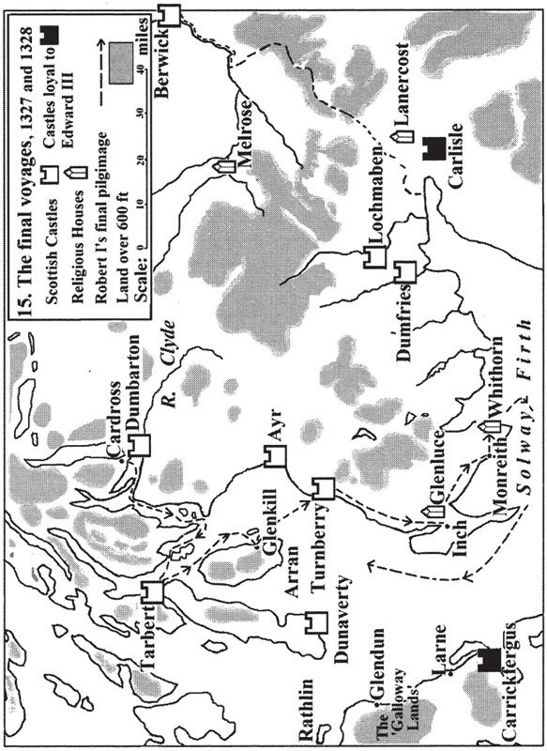
How typical of Robert to fish in the troubled waters of Ulster even while gravely ill. There has been much speculation as to the nature of this illness. Elisabeth de Clare’s informant seems confident that Robert was dying: ‘Robert Bruce is so feeble and so failed that he will not last that long with God’s help, because he cannot move anything except his tongue.’ Robert was paralysed, possibly by a stroke. Yet his condition still left him able to speak, and thus pursue his aims by diplomacy, and war if necessary. Robert stayed in Ulster for four whole months. Perhaps he was too ill to be moved, or perhaps there was a purpose behind his continued presence in Ulster. Probably he had too much respect for property rights to consider intruding himself as earl. Nevertheless he seems to have effectively taken the earldom into his own hands during the period of the heir’s minority, 1326–28, as though he – and not the king of England – were overlord, awaiting payment of a relief from the heir. The knights and minor lords of Ulster decided not to resist him and it is even possible that he stayed initially with the connivance of the justiciar of Ireland, John Darcy. However, John Darcy was forced to flee Ireland in May, when the government of Isabella and Mortimer imposed Thomas fitz John, Earl of Kildare, as the new justiciar on 12 May 1327. The next day the reign of Edward III was proclaimed belatedly and for the first time in Ireland. Robert had then to sound out a second set of Irish officials.
In the meantime, on 12 July at Glendun on the Antrim coast, Robert made an agreement with the steward of Ulster, Henry de Mandeville. The location may be significant: Robert’s presence in lands which were granted in the twelfth century to his great-grandfather, Duncan of Carrick, may indicate that he was striving to revive that claim. Robert may not then have coveted the earldom of Ulster itself, but was rather pursuing the old claim to the Galloway lands, long since absorbed by that earldom. That would be in character. We have seen him attempt to revive Bruce family claims to Writtle in Essex and to Hartness in Durham. By the agreement he granted a truce to the people of the earldom of Ulster for one year in return for 100 measures of wheat and 100 of barley, half at Martinmas – 11 November – and half at Whitsun – 22 May 1328. Robert’s allies among the Gaelic Irish of Ulster were also to be included in the truce, which may have been particularly galling for Mandeville to accept, for Robert had bound him to do so, on pain of forfeiture. During the summer of 1327 there was all over Ireland a marked rise in the level of violence between the Gaelic lords and the Anglo-Irish colony. We surmise that Robert’s intervention in Ulster was intended to menace the new Irish government, and perhaps his very presence was enough to cause Gaelic Irish revolts.
A chronicle entry, apparently misdated to 1328, relates that Robert ‘sent to the jusiciar of Ireland and to the council that they should come to Greencastle [the earldom’s southernmost castle] to draw up a peace between Scotland and Ireland, and because the said Justiciar and Council did not come as he wished he returned to his native land after the feast of the Assumption of the Blessed Virgin Mary [15 August]’. This is borne out by an inquisition into the episode taken in 1331 by the Irish government, and by payments of 100 shillings to Robert Cruys and John Jordan ‘for going to Ulster to expedite certain matters touching the business of the king and his land of Ireland’. Furthermore John Jordan was paid a small reward for ‘good and praiseworthy action’. This praiseworthy action was probably breaking the news to the King of Scots that the new Irish government would stand by the regime of Isabella and Mortimer, and not be bullied into alliance with Scotland. On receiving this response Robert gave up trying to detach the Irish government from the English, and with it probably all thought of restoring Edward II to the English throne. He returned to Scotland just a day or two earlier than stated in the Irish chronicle, for he was at Melrose on 14 August. Moray and Douglas had just returned from giving the English host the runaround in Weardale, and March and Angus were keeping the English occupied.
Elisabeth de Clare’s informant may have exaggerated the extent of the king’s infirmity, for soon after his return to Scotland he mounted horse and rode on a last campaign into England. It was a critical time. His heir was but a three-year-old child, so he must have been extremely anxious to wrest final and lasting recognition of his sovereignty from the English before his own death. He had tested and given up on the possibility of effecting a restoration of Edward II to the English throne: the only course left to him was to bring such military pressure to bear on the north of England that Isabella and Mortimer would have no choice but to concede his right. Any air of desperation that accompanied Robert’s last great campaign has been written out of history by Robert’s propagandists, and there is, if anything, a light-hearted feel to the Scottish narratives, full of admiration at Robert’s magnificence and daring. It takes an effort to remember that neither in Weardale nor in Northumberland were the Scots toying with the English: both campaigns were in deadly earnest, for Robert probably knew his days were numbered. He set his sights on the great border castles of Northumberland, the loss of any one of which might bring the English government to the negotiating table. Accordingly he raised a great army and divided it into three: one part to besiege Norham, one Alnwick, and one to range freely across Northumberland, devastating, taking hostages and money, and weakening the Eastern March in every conceivable manner. Barbour recounts that the king left the detailed prosecution of the sieges to others, and took his leisure hunting in the parks of border lords and granting away their lands to his own followers:
The king left his men before those castles
As I explained
And held his way with the third host
From park to park for his recreation
Hunting as though it were all his own.
To those who were with him there
He gave the lands of Northumberland
That lay there nearest to Scotland
In fee and in heritage
And they paid the fee for sealing.
If fees were paid for the sealing of these deeds, Robert’s granting away of Northumberland estates was regarded as no empty gesture. In the past he had made speculative grants of land in the English borders to encourage grantees to take possession, but, in the context of sieges and tribute taking, this looks like a determined effort to annex Northumberland permanently, and was intended to be understood as such.
Moray and Douglas besieged Alnwick castle, held by Henry Percy, for a fortnight, hostilities being interspersed with occasional jousts with the enemy. Then they gave up that siege and attacked Warkworth instead, allowing Percy to sally out on a raid into Teviotdale. They prevented Percy from returning to Alnwick however, and forced him to retire to the safety of Newcastle. Finally they retired to assist with the siege of Norham, where the Flemish engineer and privateer chief John Crabbe had built siege engines to hasten its collapse. Witnessing the devastation of Northumberland, other county communities of northern England hastened to purchase immunity from attack. The bishopric of Durham, Carlisle, Westmorland and even Cleveland and Richmond in Yorkshire, all paid up readily. In the accounts of Durham Cathedral Priory there is evidence of a levy on each manor and another on each church living to meet the ransom demand for a truce until 22 May 1328.
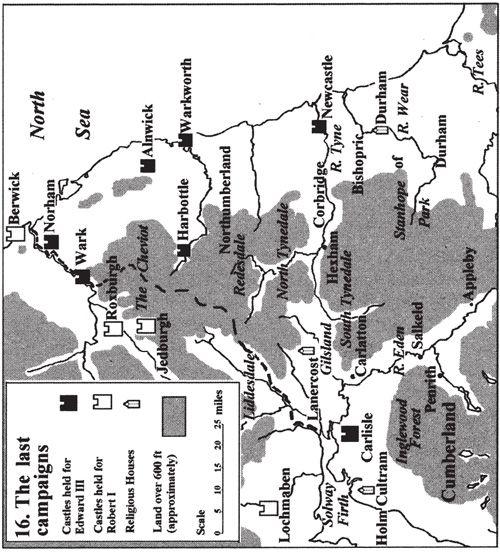
The English government had the impression that Robert was reviving the Scottish king’s ancient claim to Northumberland, and feared a general collapse of resistance and ultimately the area’s annexation. They summoned a parliament to Lincoln for 15 September, and subsequently stated that Bruce had threatened to subjugate the people of England and to destroy them; that he had built and garrisoned peels and fortalices in Northumberland; and that he had granted away English lands by charter. In the mid 1310s Robert had also built peels in English territory and granted lands in Northumberland to his followers by charter, but it appears to have been the combination of these with the threats to England’s crucial frontier castles that was so deeply disturbing. The unstable rule of Isabella and Mortimer could not afford further military catastrophe, and their government was panicked into fresh peace negotiations. Plots and attempts to release Edward II had continued to plague their regime of dubious legality. On the night of 21/22 September 1327 Mortimer’s henchmen are thought to have disposed of the former king. To this day it is not certain how the old king died; and theories of his survival are still advanced by scholars. Such rumours do not concern us, for Robert appears to have given up all hope of resuscitating Edward II’s regime.
For the first time both English and Scottish governments were both truly desperate to achieve a peace. On 9 October the English appointed Henry Percy and William Denholme to treat of a final peace, and on 18 October Robert set out six terms which to us seem extraordinarily reasonable: he insisted, of course, upon recognition of his kingship and upon holding the kingdom of Scotland free of any obligation; he offered his infant son David in marriage to Edward III’s sister, Joan ‘of the Tower’, as a means of making the settlement last; there was to be no restoration of the Disinherited, those English and Anglo-Scottish lords who had lost estates and titles in Scotland; each kingdom was to assist the other against its enemies – though this was not to apply to Robert’s recently negotiated Treaty of Corbeil with France; the English were to assist in the removal of papal sanctions against Scotland; and finally, and most striking of all, Robert offered £20,000 to be paid within three years of confirmation of the peace. We have seen from the Bruce–Harclay treaty of 1323 that Robert had for some years been prepared to pay handsomely to secure a peace, a strange position for the victor of a long and bitter struggle. It was not specified exactly what the payment was for; it was neither compensation for Robert’s tribute taking in England, nor was it compensation for loss of the king of England’s rights in Scotland. It is not described as reparation for the exaction of ransoms or the immense damage which Scottish raids had inflicted: Durham alone claimed to have paid £20,000 to the Scots over the years. It is simply described as ‘contribution for peace’. Robert may have seen payment as a device to give the English a greater stake in the peace; perhaps he knew that paying off of the Hainhaulters and the costs of campaigning had left the English government flat broke – the Weardale campaign had cost £70,000.
Isabella and Mortimer rapidly responded that these terms could serve as a basis for negotiation. The English parliament of February 1328 at York considered the terms, and sent two bishops to discuss certain articles with the Scots. On 1 March Edward III formally agreed that the ‘magnificent prince, Lord Robert by the grace of God the illustrious King of Scots’ should hold Scotland free from any subjection or demand, ‘separate in all things from the kingdom of England, assured forever of its territorial integrity, to remain forever quit and free of any subjection, servitude, claim or demand’. It is significant too that the English had to travel to Edinburgh to sue to conclude the treaty. Two bishops and three nobles were nominated to journey to Edinburgh, any two of whom were empowered to swear on the king’s soul that he would abide by the articles. They arrived around 10 March, and Robert summoned a parliament for the occasion. On 17 March 1328 the agreement was formally concluded in the king’s chamber at Holyrood, where Robert again lay ill. It was indeed ‘the substance of everything for which Bruce had fought’. Final negotiations added refinements to the terms. Robert conceded only one of his six points: a general prohibition of the claims of the Disinherited was not written into the treaty, and he first permitted Henry Percy the right to sue in Scottish courts for lands granted his father by Edward I, and then made him an outright grant of those lands. In exchange for this recognition of the rights of the most important Disinherited lord, it may have been intended that Scotland should receive back the relics looted by Edward I in 1296. The Stone of Destiny was ordered to be removed to Scotland, but the Londoners and the Abbot of Westminster prevented its removal. It is possible, however, that at this time the Scots regained the Cross of St Margaret, the Black Rood; at any rate they had possession of it in 1346 – when they lost it again to the English at the Battle of Neville’s Cross. All documents implying the subjugation of Scotland were to be surrendered and a record made of their delivery. Great importance was attached by Robert to the marriage between David and Joan, as though he considered this to be a means of ensuring that the settlement would last. As dower, Joan would receive lands worth £2,000 in annual rent in Scotland. The King of Scots was not to aid the enemies of the king of England in Ireland; nor was the king of England to aid the enemies of the King of Scots in Man or other Scottish isles. The rights of the Church in both realms were to be safeguarded, which seems to have implied that lands forfeited from religious houses were to be restored. The ancient Laws of the Marches between the kingdoms were to be kept, and any disputes referred to the councils of the two kings. Finally, the English parliament was to ratify the peace before Ascension Day – 12 May 1328; it was actually ratified by the parliament of Northampton on 4 May. It is a sign of Isabella and Mortimer’s great weakness at this point that the Treaty of Edinburgh was one of very few foreign treaties made by an English medieval government to be submitted to parliament for ratification.
Robert conveyed to David the earldom of Carrick, in order that his four and a half-year-old son should be dignified with a comital title for the occasion of his marriage. But, clearly as a mark of his personal disapproval, Edward III gave no dowry with the seven-year-old Joan. On 17 July 1328 the royal marriage between David, aged 4, and Joan, aged 7, took place at Berwick, but, although Isabella, now queen mother, was present, Edward III conspicuously absented himself from the ceremony. Explaining Robert’s absence from the nuptials of David and Joan, Barbour states:
For an illness afflicted him so badly
That in no way could he be there.
His disease arose from catching a chill
Through his cold lying
When he was in his great tribulations
That serious illness came upon him.
His ‘cold lying’ seems to refer to Robert’s sleeping rough in the heather while a fugitive and guerrilla chief. But the absence of the English king, intended as a snub, may have required Robert’s reciprocal absence.
However, the question of what Robert was suffering from in Antrim in 1327 and possibly again at Berwick in 1328 remains unsettled. It may have been a symptom of a final, lingering illness. English chronicles, including the generally reliable Lanercost, assert that he had contracted leprosy. Considered a vile and loathsome disease, leprosy was regarded as a ‘disease of the soul’, and often interpreted as divine punishment for lechery. These reports in English chronicles may be false, but cannot altogether be discounted. Scottish chronicles, by the same token, cannot be expected to own up to their king’s contracting leprosy, as it would detract from the vision of regality that they sought to portray. The medieval diagnosis of leprosy might in any case have extended to virtually any serious skin disorder. Recently an authority on the osteological appearance of leprosy claimed to have detected features associated with facies leprosa, the facial characteristics of leprosy, in the plaster of Paris cast that survives of Robert’s skull made in 1820, though he added that, without examination of the skull itself, he could not be certain. The fact that there is no record of Robert’s segregation from human contact does not necessarily have a bearing on the question. Baldwin IV, the twelfth-century leper king of Jerusalem, was not segregated in any way during his reign. More significant, perhaps, are the facts that no contemporary source, not even those most hostile to Robert’s regime, levels at him the accusation that he had contracted leprosy. Other medical authorities assert that the cast bears evidence of sporadic syphilis. Professor Kaufman, the most recent authority to examine the problem, considers that the cast bears characteristics consistent with either leprosy or syphilis. A third suggestion is that Bruce had contracted Raynaud’s disease – which can be contracted from lying in the damp – and that its symptoms might, in the Middle Ages, have been confused with those of leprosy. There survives a finger bone, looted from the exhumation of 1819, analysis of which may yield further evidence of maladies from which Robert suffered.
The illnesses of 1327 – the first real enough, the second probably a ‘diplomatic’ illness – did not prevent Robert from attending to matters he considered important. William de Burgh, the young and recently knighted heir to the earldom of Ulster, had attended the Berwick nuptials and sought assistance from both Isabella and Robert in gaining control of his patrimony. The English government begrudgingly issued the necessary warrant for transferring custody of Carrickfergus Castle into William’s custody in November 1328, and assented to Robert’s taking personal charge of the young earl’s installation. This is an indication both of Robert’s residual power in Ulster and of his anxiety to ensure that the strategically important castle should remain in the care of a client earl. Together with Murdoch, Earl of Menteith, Robert set sail for Ulster, escorting William to Carrickfergus and making him a present of stockfish to help him provision the castle. Here again, as quid pro quo, Robert may have been seeking restoration from the new earl of Ulster of the ‘Galloway lands’ in Antrim, to which he might have laid claim. He dated a letter at Larne Lough on 13 August 1328, and probably returned to Scotland soon afterwards.
During his last years, 1327 to 1329, Robert’s favourite residence was his manor house at Cardross, a retreat which he had planned and built for himself. His queen, Elisabeth de Burgh, predeceased him in November 1327. She had died at Cullen, where she may have been on pilgrimage, and her entrails were buried there in the Lady Chapel. One surmises that, given the antagonism between Robert and his father-in-law, Elizabeth’s reported remarks at Robert’s inauguration, and the existence of illegitimate children, their marriage had never been a close union. Robert arranged that a chaplain at Cullen was paid £4 annually for celebrating masses for her soul. This was modest provision for the soul of a queen; Robert had set aside £20 per annum for the souls of Alexander III and John, Earl of Atholl. Nevertheless Robert shows attachment to Elisabeth in that her body was borne to Dunfermline Abbey for burial: he clearly wanted his spouse at his side in death.
Having endured the loss of his four brothers, Robert seems always to have valued male companionship more dearly than female. The closest of all his companions was Moray, often with him in these last months and sharing his activities. The king had a new chamber built at Cardross – with glasswork in the windows and a painted interior – a garden, and a shed for his falcons, and he maintained a considerable hunting establishment. He lived well, threw feasts and dispensed gifts and charity. He kept a pet lion, as the young and riotous Edward of Caernarfon had done twenty years before. He and Moray took special interest in the king’s ‘great ship’, making repairs, and ordering sails, pitch, iron and other materials. On one occasion Robert had it hauled from the seashore into the river beside the house for maintenance.
Robert’s last journey appears to have been a pilgrimage; this was possibly in search of a miraculous cure, though equally, as pilgrimages often provided excuse for wandering, it may have been merely a pretext for an outing on his great ship. With Moray he set off from Cardross for Tarbert, thence to Arran where he celebrated Christmas 1328 at the hall of Glenkill near Lamlash, and thence he sailed to the mainland to visit his son and his bride, mere children, now installed at Turnberry, the head of the earldom of Carrick and once his own main residence. He journeyed overland to Inch, south of Stranraer: houses were built there and supplies brought to that place, as though the king’s condition had deteriorated while he was being carried across the isthmus. At the end of March he was staying at Glenluce Abbey and at Monreith, from which St Ninian’s cave was visited. Early in April he arrived at the shrine of St Ninian at Whithorn. He returned by sea to Cardross, where he was placed upon his deathbed, Moray no doubt by his side. Barbour relates – and he is borne out by other sources – that Robert summoned the lords of the kingdom to his bedside for a final council, at which he made copious gifts to religious houses and repented of his failure to fulfil a vow to undertake a crusade. He dispensed silver to religious foundations of various orders, so that they might pray for his soul. Into the mouth of the dying king Barbour puts a speech which includes an almost modern repentance for ‘war crimes’:
I thank God for giving me
Time in this life to repent,
For because of me and my war-making
There has been much spilling of blood
In which many innocent men were slain;
Therefore I accept this sickness and pain
As reward for my transgressions.
Whether these sentiments were actually expressed by the dying king is uncertain; it is unconventional for a medieval king to express guilt about ‘collateral damage’ inflicted on innocents in pursuit of his right, and for this reason it might indeed represent an actual deathbed utterance. Robert’s final wish, however, reflects conventional piety expressed in a novel fashion, quite possibly intended to perpetuate his memory: after his death his heart was to be removed from his body and borne by a noble knight, one honest, wise and brave, against God’s enemies – probably intended from the first to be James Douglas.44 Robert died on 7 June 1329 having lived a life extraordinarily rich and varied. He died utterly fulfilled, in that the goal of his lifetime’s struggle – untrammelled recognition of the Bruce right to the crown – had been realised, and confident that he was leaving the kingdom of Scotland safely in the hands of his most trusted lieutenant, Moray, until such times as his infant son could hold the reins of state. However great his final agony, he could not have asked for greater comforts. Six days after his death, to complete his triumph still further, papal bulls were issued granting the privileges of coronation and unction at the enthronement of future Kings of Scots.
The obsequies of Robert I were as befitted a great king. The body was embalmed. Separate burial of heart and body had been forbidden by a papal bull of 1299, but the custom was attractive in that more than one religious community could be involved in intercession for the soul. It had been carried out at the funerals of Louis IX of France, Richard I and Henry III of England, Eleanor of Castile – Edward I’s queen – and, as we have seen, in the case of Robert’s own queen. Accordingly the breastbone of Robert’s corpse was sawn to allow extraction of the heart, which Douglas placed in a silver casket to be worn around his neck. The body was taken from Cardross, through Dunipace and Cambuskenneth to Dunfermline, the mausoleum of the Scottish kings. Barbour claims that:
when his people knew that he had died
Sorrow spread from home to home.
You could see men tear their hair,
And frequently knights weeping copiously,
Striking their fists together and tearing their clothes like madmen,
Mourning his seemly generosity,
His wisdom, strength and his honesty
But above all the warm companionship
Which, in his courtesy, he often shared with them.
We cannot tell whether the gilded hearse was followed by crowds of mourners; nor does there survive any more reliable indication of genuine widespread grief. There will have been some relief and anticipation from the anti-Bruce elements that Robert had suppressed, yet we can scarcely doubt that the funeral was an occasion for an outpouring of affection such as Barbour describes, for a king who had ended foreign occupation, led successful and lucrative foreign war, distributed largesse abundantly and triumphed magnificently and repeatedly.
An enormous weight of wax – 478 stone, or just over 3,000 kg – was purchased, presumably for the making of funerary candles; copious lengths of fine linen and black cloth were procured for mourning clothes: black ‘budge’ for knights, other varieties for officers of the household and their followers. Robes were bought, and furs for knights. A marble tomb, which Robert had commissioned years previously to be made in Paris, was brought by way of Bruges to Dunfermline. Gold leaf was acquired in England for its decoration, and an iron railing placed around the grave. A chapel of timber was erected over the grave on the day of the funeral, and Robert was interred in what was then the very centre of Dunfermline Abbey, beneath the high altar, and beside his queen. Though the church around it is greatly altered, the place is now marked by a magnificent Victorian brass.
The faithful Douglas had been selected – probably pre-selected – to fulfil Robert’s crusading vow. In a coda to his epic poem Barbour relates how Douglas set off from Berwick for Spain to do battle with the Moors. It was an act of piety, but for both Bruce and Douglas it was also self-promotion, a ‘farewell European tour’. No one had ever gone on crusade in quite this fashion, and the excursion was intended to cultivate the legends of Robert Bruce and the Black Douglas. No expense was spared to deck out Douglas with a splendid entourage. He passed through England, and in September 1329 Edward III’s chancery equipped him with letters of protection and commendation to King Alfonso XI of Castille. His ship anchored in the busy port of Sluis in the southern Netherlands for twelve days, but Douglas did not disembark. Rather, guests were invited on board to bid farewell to a legend, and Douglas entertained them ‘as though he were king of Scotland’. Douglas’s fame went before him and he was received in Spain with honour, above all from the English knights. In broad terms Barbour’s version of events in Spain is borne out by le Bel and by a Spanish source. Douglas was clearly preparing to exit this life, and had no intention of returning safely from Spain. He was killed in a skirmish on 25 August 1330 at Tebas de Ardales, the day before the main engagement there, along with Sir William Sinclair, and Robert and Walter Logan. Tradition has it, from lines interpolated into the Barbour text, that, seeing his position to be hopeless, Douglas tossed the casket bearing the king’s heart into the thick of the fight, and charged the enemy with the words:
Now pass thou forth before,
As thou was wont in field to be,
And I shall follow or else die.
Recovered from the field, Douglas’s body was boiled in order to remove flesh from bones – another not uncommon funerary practice – and then his bones, together with the heart of Robert Bruce, were borne back to Scotland by Sir William Keith of Galston. Douglas was buried in his parish church, St Bride’s Kirk at Douglas, where in 1307 he had ambushed the enemy garrison, and, in accordance with the king’s earlier wish, the heart of Robert Bruce was interred at Melrose Abbey.