
In the late 1980s to early 1990s, I traveled to Eritrea in the fraught Horn of Africa, took on a visiting professorship at delightful NYU, headed the movement to make Australia a republic, and was offered and accepted a post at the University of California at Irvine, and still the film had not been made.
In the Irvine writers’ program, I was not the only one who had an unproduced book with a film studio, and indeed a number of films based on the books of writers who had been graduate students when I was last at UCI were in the process of production. Kathy Kennedy, Spielberg’s executive producer, took me to lunch in 1991 to tell me the young man named Steve Zaillian was now working on the Schindler screenplay, and also introduced me to the Australian director Jocelyn Moor-house, who was slated to make the film of Whitney Otto’s How to Make an American Quilt, a book written during Otto’s participation in the UCI program. Marti Leimbach’s novel Dying Young was in production by Joel Schumacher and starred Julia Roberts. The film rights were in the market for Michael Chabon’s Wonder Boys.
Talking writing was a compulsive exercise with the graduate students. There was not one of them who was not a splendid writer. The only question was: Who would be hungry enough, desperate enough, to write their book, and then write another? It is not an easy business. Enough of them who could write were in for years of heartbreak until their books were at last published, or else they would become teachers in universities and junior colleges. To tell a young writer he had talent when it was not true was my version of the sin against the Holy Spirit, for it condemned them to a severe regime embarked upon without the tools to give it meaning. Indeed, to find out that you did not have literary talent was in some senses the equivalent of being told you did not have hepatitis. It meant your life would not be driven by the characteristic pattern of obsession, exaltation, depression, recurrent disappointment at not being the writer you hoped to be, and all the grief that this would impose on your family.
Poldek and I still met up for occasional meals. He came down, sometimes with Misia, sometimes without, to readings at the university or to brunch at the Laguna Hotel. I would go up occasionally to attend his 1939 Club events. Sometimes we would be invited somewhere—UCLA, UC Santa Barbara, or the Claremont Colleges, say—to do our act, to tell our joint story. And in more modest gatherings, at readings at Barnes & Noble in LA or Orange County or San Diego, I would read from my new books, from Woman of the Inner Sea, for example, over which no Amblin aura hung.
We were a good team, and an act in contrasts. I always signed the Schindler book with Shalom, Peace—a much dishonored word in any language. He signed his ornately. A man who saves a single life saves the world entire. Then, A story of humanity man to man. Sometimes he would add, Always remember not to forget! Then, Professor Magister Leopold Pfefferberg. In a world in which most professional writers are stingy with their signatures, Poldek wrote an essay, and the phenomenon ensured that there were some late nights in bookstores for us. On top of that, since the American edition had halftone prints, he would say, “Look at page forty-nine, darlings, and see what a good-looking Polish officer I was!”
Back to the beach we came each year as summer struck Southern California and fires raged down out of the shrub-lands behind the ocean. In the kindly Sydney winter of 1991, I was as engaged as ever in writing a novel when the news came, first of all and appropriately from Poldek.
“Thomas, have you been told? At last our friend Steven is going to make the film. We are there, my brother!”
“Are you sure, Poldek?”
“Do you think I’d want to lie to a friend?”
“It’s just been a long wait, Poldek.”
“Ai, ai, ai!” he said, in a lament for the lost time. “But he got the flu, and he read the book again and said, ‘It’s time. I must make this film.’ This guy Steve Zaillian, a nice man, he’s the screenwriter. He’s doing the final polishings. My friend, I see it all happening now, and the Novell Prize is close, and I have my ticket booked to Stockholm.”
“Yes. I know, Poldek. You’ll be there on your own.”
“It will happen, it will happen! Didn’t I tell you the film would be made?”
“You told me. And that finance policeman back in Kraków.”
“That guy. I should look him up, the poor guy. But I lost his address.”
I got a confirmatory call from the admirable Kathy Kennedy. When I returned to UCI, Steven would want to see me, she said. Zaillian’s screenplay was on its way to me, and comment would be welcomed. From Spielberg’s secretary came the suggestion that I was entitled, along with all the other writers, to claim a screen title and have the matter adjudicated by the Writers Guild of America. The screenplay, when it arrived, read well, and I was delighted to see some of what I thought of in writer’s vanity as the book’s more significant phrases and images intact within it. It showed that Steve Zaillian was not too proud to use his chief source. I did not have the bewildering experience of seeing a transformed, skewed and misused tale. There were sections of the Schindler story missing, of course—Schindler’s career with the Abwehr, for example, and his childhood. His postwar career was covered in a few lines. That was the inevitability of film. Zaillian had done a splendid job.
Over the next few weeks, the first panel of three experienced members of the Writers Guild of America had convened to compare the two screenplays, Zaillian’s and the equally hefty document I had written in Australia in the early 1980s. Their judgment was that Steve Zaillian deserved a sole writer’s credit. I was mildly surprised, since my earlier screenplay had been as documentary in feel as Zaillian’s now was, but I was satisfied, and did not undertake an appeal, even though Amblin made it obvious that it was no skin off their nose if I did.
Poldek called and asked me what I thought of Zaillian’s script. We both liked it, although he confessed that early on he had called Spielberg and said, “Steven, I’m just up to page fifty-five and—already thirty mistakes!”
Judy and I returned to UCI for the Southern Californian winter, and moved into one of the houses up in University Hills behind the university, built across the old prairie and orchard hills of the Irvine ranch. I resumed the workshops and had begun a new novel, a sort of homage to my immigrant grandparents, named A River Town.
I had also, with the help of the chairman of the English Department, acquired a reader’s ticket at the wonderful Huntington Museum up in Pasadena, beneath the San Gabriel Range and its attractive snowcaps. The Huntington was meant to complement research I had already been pursuing in the New South Wales archives and elsewhere on Irish convicts transported to Australia—the world they had been ejected from, the world they encountered in the convict planet of Australia, and the world of America to which in some cases they escaped.
It was in the midst of research, teaching and writing that I got a call from the charming Bonnie Curtis, Steven’s new assistant at Amblin, asking me to come and see Steven, and apologizing that it would require a schlep up 405 and the aging I-5 freeway to get there.
Turning up in one’s car at a studio and being admitted at the gate, the real gate, the gate of business, is itself an archetypal scene in movies, a scene of savage rejection or unlikely triumph. Despite every resistance, every effort to seem normal, casual and a non-stranger, the myth works on you, even though studios generally look like some physically nonpolluting warehouse and manufacturing business. The headquarters of Amblin, however, had never been like that. Near the edge of the Universal set, it was nonetheless the sharp little tail which wagged the big dog of Universal and sent nutriment its way.
In the foyer of Amblin in early 1992 there were exciting artifacts on display in the entryway—the fantastical flying bike from E.T., native American costumes and art, and relics of Back to the Future. The place had a marked New Mexican pueblo architectural style, and far more individual grace than the standard offices of other production companies I had visited.
It was now some six years since I had seen Steven in the flesh. I had seen his mother, however, for Poldek had recently taken me back again to Leah Adler’s eclectic kosher restaurant; she now had a hefty man in a yarmulke at her side to protect her from molestation by overeager screenwriters and producers.
We met in Steven’s relatively modest office and later went on to a lunch of Southwestern cuisine in a dining room. Steven still seemed young, but given his facial hair, one could almost imagine him as a shtetl scholar, telling parables to elucidate the moral and ritual conundra of Torah to a rapt Polish or Russian audience.
He spoke now as if there had never been any doubt he would make this film. “I’m going to make the film someday” had become “I’m now making this film…” He said he was ready for it, it was the right time in his life. He had reached an age at which his ancestry and heritage meant more to him than it did when the book first appeared. He had already received Steve Zaillian’s script when he caught flu and reread the book, and he said he had then remembered something (he claimed) I had once said to him: “You told me once, ‘Just film the bloody book, Steven.’”
I have to say I had no memory of that, or of presuming such familiarity with or influence on him, but maybe I did say it once—bluntness sometimes flows unbidden from Australian lips.
Without detracting from Steve Zaillian’s work in any way, since he had written the script in the spirit of the novel, Steven thought following the book was the way to go, even if there would be great lumps of it which he would not be able to find room for. First off, though, he told me he hoped to have Liam Neeson, the Irishman, play the Schindler role. He had considered my genial countryman Jack Thompson (who had acted in The Chant of Jimmie Blacksmith as well as many other films), but had decided against him. I had not known this and never got a chance to put in my tuppence-worth on Jack.
In any case, what did I think of Neeson, he asked—purely out of politeness, obviously, since the matter had clearly been decided. I didn’t need to pretend. I was fascinated by Neeson’s skills as an actor, by the strength of his features. It was a splendid choice, I thought, and it seemed to have been settled. As the “biographer” of the film, Franciszek Palowski, tells us in his book on the ultimate production (The Making of Schindler’s List), Spielberg had not wanted someone stricken with stardom to do the role. There was a rumor that Kevin Costner had offered to play the part for free. But Neeson had done a screen test, and so had some Polish actors—Piotr Franczewski and Andrzej Seweryn. The latter would end up playing the sinister SS man Scherner in the film.
A little earlier in 1992, said Spielberg, he, his wife Kate, and Kate’s mother went to the theater in New York to see Liam Neeson in Eugene O’Neill’s Anna Christie at the Criterion Center Stage Right, a production in which Neeson played Mat Burke and Natasha Richardson, ultimately to be Neeson’s wife, acted Anna. Liam Neeson is said to have been so delighted to see them in the dressing room that he embraced Kate’s mother and kissed her on both cheeks with a spontaneity and exuberance which convinced Spielberg that the tall Irishman could do the job. Liam had a growl in his voice, as did Schindler, and he had been practicing off a tape of a filmed speech given by Oskar at Temple Beth Am in Beverly Hills.
And what of Ben Kingsley as Stern? Kingsley brought subtlety to playing decent men, I thought. Superb. Indeed, since Gandhi I had felt affronted whenever producers decided to use him as a villain. There was something in his performances as villains which lacked dimension, and in such a fine actor this could only be the fault of writers, directors and casting agents.
Then Steven began to tell me how he meant to film it. In a more documentary style, and with a feel of authenticity, and so in black and white, he said, like the old newsreels from the war, with just a few points of color a few times in the film. Perhaps it was only the candle flame at the start of the film which would be colored, and all else grainy white and black and shades of dun.
I nodded. Secretly, I thought it was a crazy idea. For one thing, to the people in the newsreel, what was happening involved far too vivid and brutal color. Later I heard the rumor that highly placed people in Universal were uneasy too, except that Steven had the authority, on the basis of how often he had made them look good, to film it the way he chose.
Steven said he intended to send his producer Branko Lustig, who himself was a childhood Auschwitz survivor, looking for an appropriate city. From what I’d seen of Kraków, asked Spielberg, could it be filmed there?
I told him that as far as I knew, all the sites were still intact—he could film some of Schindler’s factory scenes in Schindler’s factory, if he could get permission. Kraków’s old churches, and the old Jewish sector of Kazimierz and the Nazi ghetto, were intact. So was the site of Plaszów, retained as a national monument and left largely bare because of the evil that was done to Poles—Jews and Gentiles—there. I made the point, too, that the acid rain from the Soviet-built steelworks at Nowa Huta produced a sinister grime upon the gargoyles and the cornices of Kraków, giving an impression of tainted elegance and lost innocence.
We started to talk about Schindler’s motivation then, his mixed motives for employing Jews, his desire to be seriously rich, and all the rest of it. But then he achieved in Brinnlitz something that the good, respectable executives of many leading German companies, including Krupps, IG Farben and Mercedes-Benz, could not manage. He kept his people alive. I mentioned and attempted to reprise Schindler’s statement of expenditure, the one to do with the running of the two camps as benign institutions. That was the document, mentioned earlier, which Schindler submitted to the Joint Distribution Committee when impoverished in the late 1950s. I spoke of the way Schindler kept Brinnlitz going as an armaments camp when in fact it ran purely as a black-market base, Oskar having expressed to a number of his Jewish intimates that he did not intend to make anything which would take “some poor bastard’s life.”
In lunchtime conversation we revisited the issue of where in Oskar altruism ended and opportunism began. I made the claim that it was actually important that the question could not be answered, that the abiding attraction of Schindler’s character was wrapped up in the very conundrum.
Last of all, I asked Steven if he could possibly reverse my mistake of years before and name the film Schindler’s Ark. He said he would do it except that he wanted to use lists throughout. Lists were visible, metaphors weren’t. From start to finish it would be a matter of lists. I thought his reasons much better than Dan Green’s all those years before. All at once it was midafternoon, and Steven made an arrangement for one further meeting.
In the event, Steven himself would make an initial thirty-six-hour raid on Kraków in late winter–early spring of 1992. Spielberg, his assistant Bonnie Curtis, and his trusted, experienced and eternally calm coproducer Jerry Molen, along with the writer Steve Zaillian, met with the Polish film authorities in Kraków, especially with Lew Rywin, the head of Heritage Films, who would work with Steven as a coproducer. They visited all the places associated with the tale, including an excursion into the Nazi-established ghetto from the hill beyond it. Spielberg made a record of everything with an eight-millimeter video camera.
Then they raced out to Auschwitz. Concerned by the way the modern city was impinging upon camera angles at Plaszów, Spielberg decided to film the camp in the nearby Liban chalk quarry, a moonscape hole, notably atmospheric and stark on the black-and-white film Spielberg ultimately shot. The visit seems to have greatly stimulated Steven. Poldek’s friend Franciszek Palowski, who was part of the Polish group working with the production team, called up Poldek and related how Spielberg had told a Polish television crew that in Kraków he would make his “truest” film.
Branko Lustig, a bearish, efficient fellow, spent longer periods in Poland, and although there was some delay over demands that Polish extras be heavily insured, it was ultimately decided the film would go ahead there early the next year. That had pretty much become the plan by the time Judy and I went home to Australia in the North American spring, our autumn. I was kept informed of further developments by Amblin and by an exhilarated and hopeful Poldek.
But not everyone would be as tickled as Poldek to see Oskar’s name become a byword of “humanity man to man.” Poldek intimated to me he had lost some friends when the book was published—chiefly because people were afraid Oskar’s story would give the Nazis absolution for their crimes. And Emilie’s Argentinian minders had no affection for wife-abandoning Oskar either.
It was about June 1992 that Spielberg went again to Poland and spent a little longer in Kraków. The Hotel Cracovia, one of Oskar’s joy spots, was looked over, and a jazz café named Michael’s Cave in the Rynek. And places less associated with pleasure—the Pomorska and Montelupich prisons. On this June trip Spielberg stayed at the Hotel Forum near an old tannery building which he wanted to check out as a possible location for Schindler’s factory in Brinnlitz. It was a mere two minutes’ walk from the Hotel Forum, where Spielberg intended to house his cast and crew. As for the Plaszów camp, Spielberg told Lew Rywin to build a replica of it in the Liban quarry he had just revisited. The production designer who would ultimately do the job was Allan Starski, an expert in designing concentration camps, since he had been the designer for Europa Europa and Escape from Sobibor.
I still did not quite believe it would all happen. Poldek, however, was exultant. Though there was a rumor that others at Universal considered Steven’s intention to make the film a folly, Poldek saw it as plain sense.
Photo Insert Two
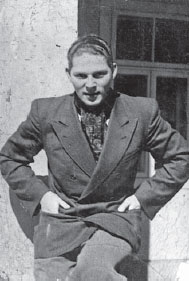
Leopold (Poldek) Pfefferberg in Kraków in March 1939, age twenty-six.
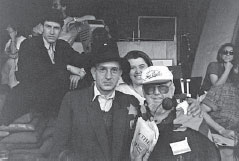
Tom with Ben Kingsley. In the back left of the picture is Jonathan Sagall, who played the young Poldek, showing an uncanny likeness to the original subject.
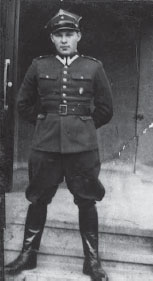
Poldek in his uniform as First Lieutenant in the Polish Army, November 1938.
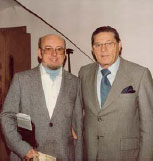
A much older Poldek pictured with Tom during their research trip to Poland in 1981, a year after their first fateful meeting in Poldek’s store in Beverly Hills, California.
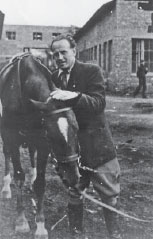
Oskar Schindler in equestrian garb, ready to take a ride through the parklands of Kraków in June 1942. It was on one such excursion with his mistress that he was said to have witnessed one of the first and fiercest ghetto raids to round up those Jews seen to be unproductive, for the purpose of systematic extermination.
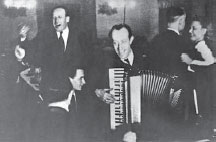
Schindler (top left) enjoying a German party in Kraków, circa 1940–41.
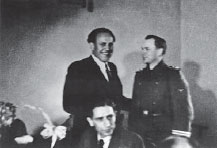
Schindler (left) with an Abwehr officer, said to be Lieutenant Martin Plathe, with whom Oskar collaborated against the rival SS officers.
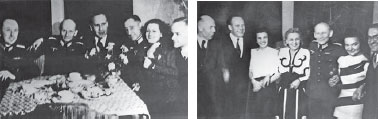
Schindler charming friends and clients at a party in Kraków.
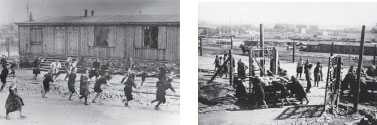
Historic photos of women hauling trolleys containing quarried stone at Plaszów concentration camp. These photos, with a number of others, were taken by the Austrian Raimund Titsch, a brave factory supervisor.
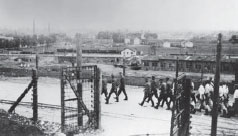
A Titsch picture of German and Ukranian soldiers marching through Plaszów concentration camp.
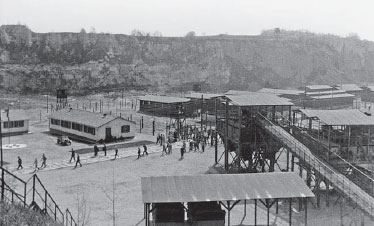
The camp was rather chillingly re-created for the film Schindler’s List on the site of the nearby quarry, where, during the Holocaust, Jewish prisoners from Plaszów were put to work.
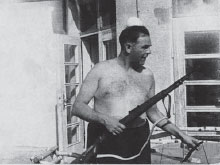
The all-too-real Plaszów camp commandant, Amon Goeth, on the balcony of his residence overlooking the camp. From here he would fire random shots at prisoners with his sniper rifle.
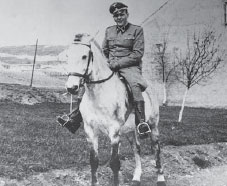
Amon Goeth, a nightmare figure to prisoners, fully uniformed and mounted.
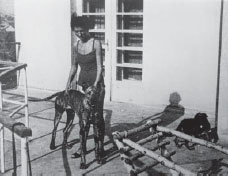
Majola, Goeth’s mistress, on the balcony of his residence at Plaszów.
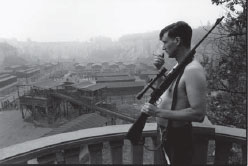
Historic photos like those on the facing page allowed Spielberg and actor Ralph Fiennes to re-create with some authenticity the brutal character of Goeth. Spielberg spoke to Tom of how Fiennes, in his uniform as Goeth, was embarrassed when one of the Jewish women survivors visiting the set had backed away from him on trembling legs.
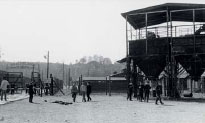
The film reenactment of the scene in which Goeth’s house-and-stable boy, Lisiek, is shot dead by his master’s sniper rifle for supposedly mishandling a saddle.

Ralph Fiennes as Amon Goeth.
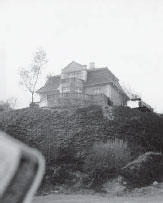
Goeth’s residence as re-created for the film Schindler’s List.
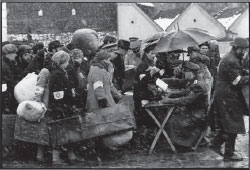
A still from the film of Jews at a checkpoint during an Aktion in the ghetto in Kraków. Those with work permits were allowed to work at Oskar’s and other factories, while many others—children, the aged and those without labor documents—were gassed in carbon monoxide chambers at the Belzec camp.
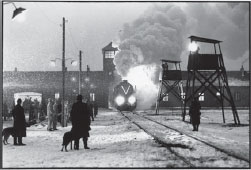
The scene in the film in which the Schindler women are mistakenly taken to Auschwitz. They are later rescued as a result of Schindler’s intervention and taken to Brinnlitz to work at his factory.
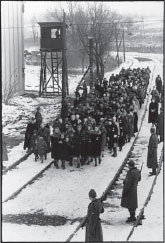
From the film, the women arriving at Schindler’s factory after their Auschwitz ordeal.
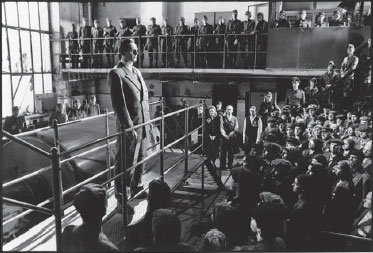
The famous speech made by Schindler (Liam Neeson) in front of his Jewish factory workers and the SS garrison on the eve of Allied liberation, appealing to the German soldiers to ignore orders to exterminate all prisoners.
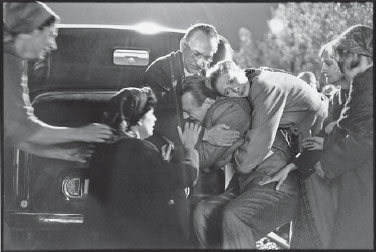
Schindler (Neeson) breaks down as he bids farewell to his factory workers, distraught that he was not able to save more Jews. In reality his camp was already crowded beyond its authorized limits.
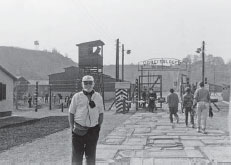
Tom in front of Spielberg’s specially built set of the Plaszów concentration camp. Tom is standing on a re-creation of the path made from the gravestone fragments taken in the war from the nearby Jerozolimska Synagogue, and used by the Germans to pave the entrance to the camp.
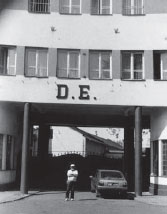
Tom in 1993 at 4 Lipowa Street, where Schindler had his office, works and, ultimately, the barracks of DEF, Deutsche Email Fabrik (German Enamel Company), in Kraków.
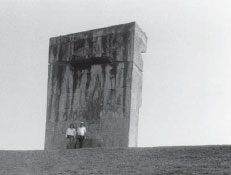
Tom and his daughter Jane at the monument of Chujowa Górka (Prick Hill), originally the site of an ancient Austro-Hungarian hill fort used by the SS as a screened enclosure in which to slaughter and bury Jews, partisans and people living on forged documents. As the Russians approached Kraków, the bodies were dug up by the SS and burned in a horrifying attempt to destroy the evidence of their atrocities.
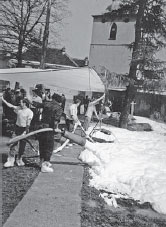
Officers of the Kraków fire department making “snow” outside a local parish church. It was for a scene (not used in the film) in which Schindler asks a priest to sell him church ground for the Goleszów cattle-truck people to be buried as Jews.