
In October 1980 when I met Leopold, I had been a writer for some seventeen years or so. I had been a late entrant in life’s hectic traffic, having spent six years in a Sydney seminary studying to be a priest. Having left after what I now realize was a crack-up, I was a lost soul teaching high school in Sydney’s eastern suburbs, living with my parents in Homebush, and writing during breaks from school. I was studying law too, and would always be something of a lawyer manqué, and as if to compensate for my ineptitude and shyness with women, I coached rugby.
In a room I shared with my brother, a medical student, I had written my first book during the summer school holidays of 1962–63. It was a time when Australians still felt a certain post-colonial sense of cultural unworthiness and yearning. The arts didn’t seem to belong much to us. I knew no writers. If there were any, why would they hang around Homebush? Unknown to me, a number of heroic writers, including Dal Stivens and Morris West, were at the time establishing the Australian Society of Authors, but that was a poorly reported event.
We Australians didn’t think of ourselves as viable practitioners of writing, for the arts were something which happened elsewhere, in western Europe. Nearly all the literature I had read came from elsewhere, from landscapes foreign to me, from seasons which were the reverse of seasons in Australia. The term “Australian literature” would—if uttered in London by a comedian like Barry Humphries/Dame Edna—draw fits of hilarity from a British audience, and would be considered amusing even in Australia, like the idea of a dog riding a bicycle. However, I finished my summer novel in April 1963. These things can be done while holding down a job if a person is desperate enough, and I was desperate to find a place in the world I had once renounced to enter the seminary and was now anxious to re-find.
I got the name of a publisher’s office in London from the copyright page of a book, bundled up the manuscript as typed for me by a young woman who lived on the corner of our block in Loftus Crescent, Homebush, and posted it off. Ten weeks later I was called out of teaching a class to take a message from my mother. A telegram had arrived in Homebush from London with the startling news that the publisher wanted to publish me. He (in those days publishers were always he), Sir Cedric Flower of Cassell’s, was willing to give me £150 sterling.
In my post-colonial naivety, this was like the finger of the deity emerging from clouds and yelling, “You!” My more urbane British contemporaries would not have seen their own experience of getting published by a trade publisher quite in the same terms—they came from cultivated backgrounds where people did them the favor of telling them that it was impossible to make a living as a writer. But beneath the great dome of the Commonwealth of Australia’s then apathy toward writing, I had no one to save me from myself, and I clung to the idea that I would write and survive. This novel was to be my deck chair from the Titanic, and I never doubted that, clinging to it, I would be washed to unimaginable places.
So the “profession” of the novel (£150 and all) was my deliverance from a clumsy start in life. That first contract would give me the confidence to reenter the normal, squalling, striving, aspiring world. Among other manifestations of liberation, I would take out and ultimately propose marriage to a splendid and exceptionally beautiful nurse from the Sydney suburb of Leichhardt, who generously considered that my intention to become a full-time novelist made perfect sense. Her name was Judith Martin, and I met her when she was nursing my mother in Lewisham Hospital after surgery. It astonished me that she harbored a preference for me over the doctors and bookmakers who generally took her out. She later said my patter was superior.
We were married in 1965, and in our small house in West Ryde, between Sydney and Parramatta, I began to keep writer’s hours, eight to one, two to five, and struggled with the reality that in a suburban house at eight on a weekday morning, writing could seem stupendously difficult, like making a model of Buckingham Palace out of playing cards. I was fortunate that, because of my parents’ influence, I was—in the term smart people would ultimately adopt—“task-driven.” Now that I was a novelist, I could not face the ignominy of failing to produce novels.
There were a number of factors which enforced discipline on me. One was that the Australian federal government gave me four thousand dollars, then a living wage, as a literary grant for 1966. Coming from a background where men and women viewed industriousness as a prime marker of their existence, I saw that money as coming from taxpayers in hard-pressed homes, and believed a sacred trust had been imposed upon me. It demanded that I consider my new experiment in life as a profession, a daily commitment from me. I must confess I have always tended to have an industrial approach to writing. I knew that if I was to survive I would need to be published as widely as I could manage—a pittance from England, a pittance from America, a pittance from Australia, all adding up to a living.
By 1980, when I met Poldek, I was in mid-career. Some of the early bloom had gone off my repute, at least in the eyes of Australian commentators. By the time I went into Poldek’s store, I had two adolescent daughters, Margaret and Jane, and I lived with them and my wife in a house above a beach north of Sydney. I had had the ill grace to forget I had still been fortunate beyond belief—fortunate in the early generosity and openness of readers and, as any writer will tell you, fortunate in survival. I suffered the self-absorbed and symptomatic discontent and restlessness of the writer, which were no doubt more wearing on my family than on me. But we were happy and we had come through. And to have a tale before you which you believed, with whatever degree of self-delusion, that the world needed to hear, was a splendid, euphoric, ever-renewing experience.
By the time I walked into Poldek’s store I had, through being published in the United Kingdom and the United States, something of what was called “a cult following,” and of course, ambition still burned and I selfishly yearned for more. Only as an older writer would I ask, “Who, what god, what destiny, ever guaranteed that someone who came from Homebush on the earth’s left buttock would grow up to write something people tolerated reading?” I considered the arrival of Schindler’s tale to be part of the sequence of that good fortune. And since I tried to write more or less a book a year, I was now gripped by the yearly euphoria that people who did more useful, routine, albeit more profitable, jobs never had the chance to feel. However, by the light of a gritty, glaring dawn the morning after I bought my briefcase from Poldek, doubt struck me. How could I consider myself qualified for this subject matter?
I had read a certain amount about Jewish culture, but I had only once attended Shabbat in a Jewish house. I knew that Australia’s first Passover had been celebrated with a special ration of flour and wine in 1788 by Cockney Jewish convicts, as a result of a Scottish officer in the marines being in love with one of the young criminals, one Esther Abrahams. That was a historical curiosity. But Poldek and Misia were the first Holocaust survivors I had knowingly met.
About ten in the morning, Poldek called from downstairs. He had come to take me to brunch. Over the eggs I told him I was a colonial naïf living in a country where one might have expected to find Indonesian settlement if not for its exquisite aridity. It was a place which had been the platform for convicts, minor British officials, gold-seeking British and Irish refugees and postwar displaced persons trying to get as far from pernicious Europe as they could. I knew about Jews chiefly from books—Roth, Malamud, Bellow. Though European by heritage, how could I interpret that full-throated and disordered side of the European soul, full-throated anti-Semitism?
After every objection, Poldek said, “That’s good, Thomas, that’s good. It means you don’t have an ax to grind.” And then he’d repeat (constantly), “This is not a book for Jews, this is a book for Gentiles. This is a great story of humanity man to man. An Australian is perfect to write it. What should you know? You know about humans. I’ll travel with you, Thomas!”
But the research task suddenly seemed more forbidding than it had the day before.
By Sunday lunchtime, Glovin, Poldek and I were discussing this golden and redemptive tale and the more banal question of who had legal rights, and in what sense, to the Schindler material. Things were getting complex, but were not yet set in concrete. It was agreed that I should go home that night with whatever photocopied documents Leopold had given me, and the addresses of various Australian Schindler survivors and others who knew Schindler. It excited me to think that, through the tragedies of history, there were such people in my own remote country.
I would make contact with the Australian survivors, add what they told me into the mix, and produce—this was my own suggestion—two documents: a fifteen-to twenty-page treatment of the material for my friend the Simon & Schuster editor Nan Talese, and a shorter, two-page abstract in case others didn’t have the patience for a full document. After all, Paramount Studios had acquired Simon & Schuster, and I was aware there were executives involved who, ironically, preferred a short précis to a full manuscript. An independent director named Robert Solo, who wanted to make a film of my book Confederates, had taken me out to see a Paramount executive just a month or so before I met Poldek. The executive had picked the book up from his desk, weighed it in his hand and said, “Kinda thick, isn’t it?” Then he’d commissioned a team of two screenwriters to turn out a screenplay for him—just, it seemed, to deal with his own reading incapacities. The screenplay was written—a good one—but joined the great majority of scripts that are never made into films.
Poldek, of course, insisted on taking me to the airport that night, and also insisted we go to a kosher restaurant on the way, where, engorged already with overrich Californian food, I choked back some latkes on the grounds, stated by Poldek, that “airline food is poison!” I did not yet realize that if you did not agree to something Leopold said, the only way out was to exclaim as fast and hard and loudly as him. I should have said, “You want I should have indigestion all the way to Australia?” Modest resistance, however, and what Anglo-Celts thought of as politeness, never had a chance against him.
“I doubt Irving Glovin is comfortable with me,” I said over the kosher food. “He already finds my approach too irreverent.”
“Irreverent? What does he know from irreverent? Listen, I saw Schindler screwing SS girls in the water reservoirs at Brinnlitz’s factory. That’s irreverent.”
The flight to Australia leaves Los Angeles late in the evening, and a small technical problem will, and often has, nudge the departure back to after midnight. But that night we took off more or less on time. Poldek’s last words to me at the gate were: “Thomas, who will do it if not you? You think I have them queued up?”
The plane taxied past the sign on the runway that says NO TURN BEFORE THE OCEAN—a sign which always rather disturbed me, since I thought that any pilot worth his salt might already know that. Then we travelers were shot straight out over the Pacific, encountering at various times of the night the customary Pacific Ocean turbulence, the great cones of air and cloud which could rise higher than the track of a 747. Tiredness, light-headedness and the prospect of meeting my girls, Judy and my daughters, in some thirteen hours permitted me to achieve some optimism.
It occurred to me on that flight through darkness and quirky columns of air that there was a novelistic neatness to the tale. During the war, Poldek and others had been utterly dependent on Oskar. By the late 1950s, when he abandoned his wife in Argentina, he became dependent upon them, on men like Zuckermann, Number 585, and Pantirer, Number 205, New Jersey real estate developers who peppered the New Jersey suburbs they would develop with Schindler Streets and Schindler Plazas. They had once been the children and he the father, but then, postwar, he became the promising but perpetually erratic child who could never seem to make a go of anything, and who must have found some of the people he had saved a little tiresomely bourgeois. And so, as I had discovered, after times with them in Israel or California, back he went for a season in Frankfurt, in his poor apartment near the Hauptbahnhof, a zone of garish bars, prostitutes and lost souls. “Ah,” his survivors would say in documents I now possessed, “the Herr Direktor hasn’t changed.”
I was in fact so excited by what I had heard from Poldek and Misia and by the documentation I carried with me—even though it constituted a fraction of the material which would be needed to make the book—that when we came in over the coast and the familiar red roofs of Sydney, and I survived the baggage hall and customs and was met by my wife and two teenage daughters, I told them, “Look, before we go home, can we have a cup of coffee? I’ve got a wonderful story to tell you. See this briefcase—I’m sorry, I had to leave the one you girls gave me behind, but I left it in a flash suite at the Beverly Wilshire.”
My daughters had taken to describing me condescendingly as “a funny old thing,” but accepted, and in some cases shared, their parents’ enthusiasms. And Sydney is an excellent city for coffee—a boon from considerable immigration from southern Europe. After we gave our order I told them, having caught the bug of hyperbole from Poldek, that I had encountered the most wonderful story imaginable, I didn’t know if I could write it, but I was thinking of having a try.
As that black coffee injected me with false wakefulness, I narrated everything. I opened my new briefcase—that was part of the story too—and showed them some of the Schindler documents. It was only later in life that I came to appreciate my wife’s acceptance of my projects. Judy was not a cat’s paw. She had robust Irish convicts in her background, and her elder brother had flown eighty-four missions before the age of twenty-three over Europe in the Second World War, and been multiply decorated. But it’s worth reiterating that she had never seen my profession, as economically perilous as it was, as an odd one. I showed them the list. Judy and the girls were captivated by it, its bureaucratic form, the fact that there were names on it belonging to people I had now met and spoken to at length.
The coffee finished, we drove home. Our house lay above a Sydney beach, unspoiled by promenades, cement or hotels, and the garden was connected to the sand by a little track of about forty or fifty meters. My office was located above this track on the ground floor—it had a desk, bookshelves and a pub snooker table which I had purchased from a group of jovial surfies who had mass-rented the place next door. This would prove to be a perfect surface for the spreading of research documents. I often wrote standing up there, clearing off my pages only for an occasional game of pool. Meanwhile, on the beach below, board riders innocent of old-world malice performed their calm stunts amid crashing waves.
From here I began to make Schindler contacts in Sydney. First was a meeting with a general practitioner, Dr. Roman Rosleigh, who practiced medicine from a surgery at the front of a bungalow in the eastern Sydney suburb of Rose Bay. Rosleigh was a stately, handsome man, a contemporary of Poldek, a survivor of Plaszów and of its evil commandant Amon Goeth. He had been a doctor in the camp hospital and now he was generous with his information. When he first arrived in Australia as what the locals called “a reffo,” he had worked in a tire factory until he passed the certification exams the authorities imposed on immigrant doctors. He had founded an Australian family—I would often run into his son at the Sydney Football Stadium, wearing an Easts football sweater, no shadow of evil Plaszów or of Amon Goeth hanging over him. As for Dr. Rosleigh’s daughter, Monica, she is now the director of a nuclear medicine department in one of Sydney’s hospitals.
Dr. Rosleigh had not been on Oskar’s list for Brinnlitz, but he had often observed Schindler as he moved about Plaszów on business and had great respect for him, he said. And he knew intimately many of the Schindlerjuden. He’d known Stern, Schindler’s chief accountant and reputedly a great influence upon Oskar. He had seen, from his post in the clinic, Amon Goeth striding along or riding his white horse around the interior roads of the Plaszów camp, with each prisoner his eye lit upon feeling doomed to a bullet, if not today then tomorrow. Dead Goeth rampaged through Dr. Rosleigh’s dreams as he did through the dreams of all survivors of Plaszów.
As we drank tea in the house after surgery hours, he showed me a treasure from his bookshelf. It was the Polish transcript of Amon Goeth’s postwar trial, the full account by witnesses of Goeth’s behavior, beginning with the time he rolled into Kraków from Tarnów with the job of liquidating the Kraków ghetto. It covered the random shooting of prisoners from his balcony; the numbers of Polish Gentiles and Jews who were slaughtered at Chujowa Górka, a former Austrian hill fort at the southwestern end of the camp; his ambiguous relationship of hate and desire with his maid Helen Hirsch; his teasing of the boy prisoner Lysiek with the prospect of death, followed by his ultimate delivery of it with a bullet—all this freshly remembered in the evidence of those witnesses who in 1946 brought down a guilty verdict upon Amon’s head and sent him to the gallows.
Dr. Rosleigh, short of time, nonetheless patiently took me through the transcript, translating sections into English.
The transcript of the trial was also richly interspersed with photographs, including a photograph of the sensualist Goeth, in a fairly ordinary suit, being hanged from a low scaffold at Plaszów, scene of his crimes.
Dr. Rosleigh had a professional gravitas Poldek lacked, and to hear the same stories emerging from both kinds of men, so far apart geographically, impressed me greatly. There had been a fallible, heavy-drinking man named Schindler who had provided rescue, but he did it by drinking with another fallible yet utterly warped man of the same age, Obersturmführer (First Lieutenant) Amon Goeth.
Poldek had also given me the Sydney address of a family named the Korns, Leosia and Edmund, or Edek. In Brinnlitz, Oskar’s second camp in Czechoslovakia, Edek had been a welder with Poldek, and he too had the build I came to associate with male Holocaust survivors—below six feet, a compact trunk with considerable upper body strength or wiriness. Leosia was different—a delicately built woman, like Misia. Also like Misia, she had been on Schindler’s list for Brinnlitz, but had found herself by accident, and with the other Schindler women, right in the midst of that very conurbation of slaughter, Auschwitz. How astounding to see her in a pleasant home in the eastern suburbs, where she lived on the incline rising to the sandstone cliffs of Bondi.
When, apparently miraculously after three weeks, Leosia was shipped out of Auschwitz again with the others for Brinnlitz, she weighed less than forty-four kilos, was suffering from scarlet fever and did not have the resistance to combat it. She was put to bed among the boilers in the basement of the Brinnlitz factory, where Mrs. Emilie Schindler hand-fed her semolina she had acquired on the black market. Leosia was able to get out of her cot, in that warm cellar at the end of one of Europe’s saddest winters, on the day before the German surrender. Yet there she is on the list, marked down like frail Misia as a Metallarbeiterin. There were few other spaces than that boiler room where she could have survived. These grandparents, Edek and Leosia, now took their children and grandchildren to Bondi and were Sydney and eastern suburbs patriots in the same way Poldek was a Beverly Hills patriot.
The Korns’ immigration story was a little like Leopold and Misia’s. When they arrived in Sydney postwar, they had been amazed to discover that the chief sectarian fight was not between Gentile and Jew but, at that stage, between Catholic and Protestant. “I said to a friend,” Leosia told me, “here the Catholics are the Jews!” Australians, who with unabashed xenophobia labeled all foreigners wogs, did not discriminate between Polish Catholics and Polish Jews, and abused them both with equal ferocity. Equality at last, thought the Korns.
At first Edek had worked at a rubber factory. In the period immediately after the war, housing was so short in Australia that if you wanted to rent the humblest flat, you were forced to offer the agent and/or owner a special tax named “key money”—that is, a bribe. His fellow workers in the rubber factory, who knew him by now, took up a collection and raised the key money he needed. It was given to him by one of his Australian coworkers with the words, “Listen, you wog bastard. Make sure you pay it all back!” That was the thing about Australians, said Edek Korn, quite admiringly. When you first arrived and they didn’t know you or like you they called you a wog bastard, and when they got to know and like you they called you a wog bastard. It was characteristic of a society largely made up of the hard-handed descendants of economic and political refugees that men expressed their deepest prejudice and their truest affection in the same words and with barely altered emphasis.
As soon as they could, Edek and Leosia had acquired some sewing machines, rented an upstairs room in an inner suburb, and started turning out trousers. One thing the Holocaust did for its survivors—and the experience of being a Schindlerjude did it too—was to give them vocational flexibility. They would turn their hand to anything that might earn them a space to breathe on earth.
By the time I met them, the Korns were well-to-do manufacturers, but Leosia confessed to me that she could never leave home to go shopping, even to the plush emporium of David Jones in the Central Business District, without taking with her a crust of bread. It was a quirk I would run up against in many of the Schindlerfrauen. Reason told them that between Dover Heights and Sydney, between New Jersey and Manhattan, they were unlikely to be loaded unexpectedly into a truck and shipped away, but the experience of hunger was so seared into their brains that they could not travel without the irrational fear that the bus or the taxi in which they rode would be stopped, that the trucks of the tyrant would lie in their paths, that they would be taken off their conveyances and packed tight in something in which there was no guarantee of survival, let alone the next meal. I told this story at a table of survivors in a New York restaurant, and almost shamefully a number of women began to confess they were the same, and took crusts from their handbags to prove it.
The Korns had two daughters, one a mother of young children, and another about to become an eminent criminologist. One took from the Korns a sense of precisely what talent had been redeemed from the furnace, though a mere modicum of the whole tapestry, of course.
I had to go to Melbourne too, and set up a meeting with a family named the Rosners, who lived there. The Rosner brothers had enjoyed the curious privilege of being Amon Goeth’s musicians in Plaszów. Before the war, Leo Rosner, an accordionist, had performed in the best hotels in Kraków with his brother Henry, a violinist. Even in the ghetto they were sometimes summoned to Nazi parties, and they played together in cafés inside the ghetto itself. Then, in the Plaszów camp, it was under orders that they put on their dinner suits in the appalling barracks to go up to Goeth’s villa and perform at lunches and cocktail parties. They got used to playing on, sustaining the required flow of music no matter what happened in Goeth’s living room and on the balcony. Now Leo and Henry did not live on the same continent—Henry lived in Queens, and I hoped to see him eventually.
Since the first discovery of gold near Melbourne, Sydneysiders and Melburnians have been locked in rivalry for a century and a half, and I was amused to find that Leo Rosner, Schindler survivor and accordion player, was a full-throated participant in the dialogue. “You should live in Melbourne,” he told me in the Rosner house in the Melbourne suburb of Elsternwick. “We have better roads. Sydney people are so ruthless. Thank God I came to Melbourne!” His intense civic pride was characteristic of Melburnians, who possessed a municipal self-esteem which puts the more relaxed Sydneysiders to shame. In the most congenial way possible, Leo Rosner had survived to become a typical Melburnian. A patriot of that golden city, as Edek Korn was of Sydney and Poldek of his “California, Beverly Hills.”
Like Edek Korn, Rosner proved to be a sturdy little man, and was still a professional musician, in demand for weddings and parties all over the state of Victoria, being equally able to play a rousing Australian folk song and a plangent prewar Hungarian song of doomed love. His brother, he told me, regularly played the violin at the Sign of the Dove in New York. “Poldek will take you there,” he promised. It was an appropriate idea, because Rosner possessed much of Poldek’s own indomitability. But it became apparent, too, that many who possessed these qualities had once, for a second, taken the wrong direction, been stopped with a bullet, or forced to ingest the lethal gas. It was in the women, in his wife, Helena, who had survived the Holocaust without being a Schindler Jew, that one encountered the fragility, the wariness, the gentleness, and the more subtle invincibility.
It was during these visits to the Rosners that I met another Schindler survivor, this time from Argentina, a man named Edward Heuberger, a blithe, sun-tanned, open-browed sort of man who contributed his tale of Plaszów, Schindler’s DEF (Emalia) and Brinnlitz. He had been one of the young prisoners who at the war’s end had accompanied Oskar to the West, to testify on his behalf should he be captured. They had finally run into an American patrol just beyond the Austrian border. Heuberger, not having seen any cinema for many years, was astonished by the fact that the Americans all chewed either tobacco or gum in a uniform display of mastication as they took Europe away from the Wehrmacht.
Heuberger gave me a very detailed account of that journey to the West, including the confiscation of Schindler’s diamond-loaded Mercedes by the Czech underground, and the ultimate arrest of Schindler by the Allies in Konstanz, near the Swiss border. He was soon freed on the strength of a plea signed by all his prisoners.
Back in Sydney’s northern beaches, from the desk in my office, I began composing an account of Schindler’s activities, on the basis of a possible contract from Nan Talese. I could see the husky, nonverbal surfers riding their boards on the beach below. The beach we lived on seemed frequently to guarantee good wave formations—sets, as the board riders called them.
By December 1980, I took off for Los Angeles again to formalize arrangements and plans for a research journey with Poldek and Glovin, leaving a family who had become enthused with the story by way of our table talk. Nan Talese had offered an advance of U.S.$60,000, not a bad advance by the standards of 1980. It would enable me to deal with Glovin and to take Poldek with me on a research journey, but also to have a living wage while I wrote the book. My British agent, a splendid woman and by birth an Austrian baroness, Tessa Sayle (formerly von Stockert), took the treatment and the abstract and showed them to a British publisher called Hodder & Stoughton, particularly to a jolly, bearded editor named Ion Trewin. So Hodder & Stoughton, too, became interested in the book for English and Australian publication, and at some stage gave me an advance for it.
I was suddenly in deep. It was where, to be honest, I wanted to be. There was a hunger for more tales of simultaneous horror and deliverance. I did not pause to ask what that said of my nature. Writers don’t.
Photo Insert One
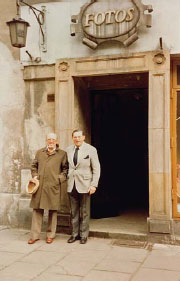
With Poldek in 1981 at 48 Grodzka Street, his old home in Kraków, where his mother ran her interior decorating business.
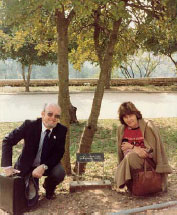
With Judy at Schindler’s plaque on the “Avenue of the Righteous,” Jerusalem, 1981. (Note the briefcase purchased from Poldek.)
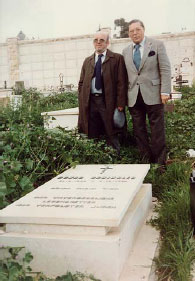
At Schindler’s grave in Jerusalem, 1981.
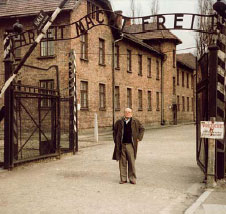
Tom at the entrance of Auschwitz 1 in 1981. (The top of the gate reads, “Work makes you free.”)
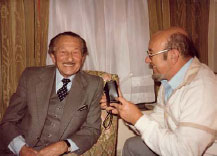
Tom with Henry Rosner, the New York—based violinist, 1981.
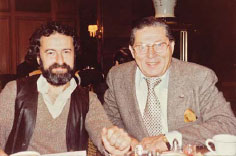
Poldek with child survivor Ryszard Horowitz, who went on to become a brilliant photographer.
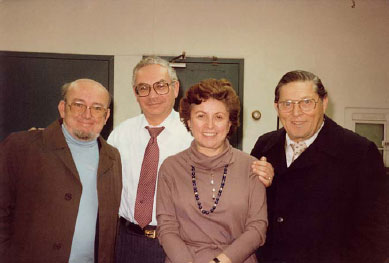
Lewis (Lutek) Fagen and his wife, who ran a wholesale business in New York’s diamond district. In Brinnlitz, Lutek was charged by the head of the SS garrison with sabotaging a calibrated metal press. Schindler laughed the charge off.
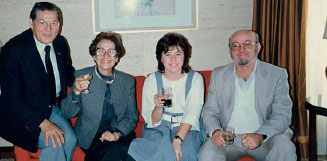
Poldek and Misia with Tom and Jane Keneally at the Keneally family home in Sydney, 1987.
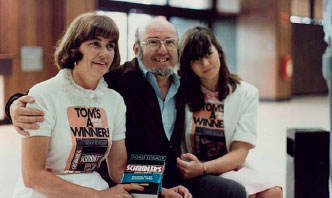
Judy and Margaret Keneally gave Tom a special homecoming at Sydney Airport after Schindler’s Ark was announced as the winner of the 1982 Booker Prize. The T-shirts were made by family friend Iain Finlay.
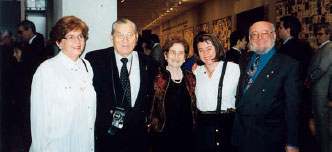
(Left to right) Judy, Poldek, Misia, Jane and Tom at a Labor Party lunch at the Regent Hotel in Sydney, where they were to meet up with Bob Hawke. This was Poldek’s first and last visit to Australia, in 1987.
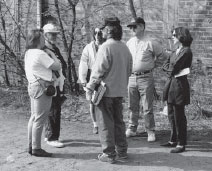
An informal meeting on the set of Schindler’s List. (Left to right) Jane Keneally, Tom, Bonnie Curtis (Spielberg’s assistant), Steven Spielberg, Jerry Molen (producer), Kathleen Kennedy (producer).
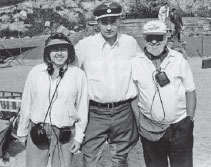
Jane and Tom Keneally on set with the intense Ralph Fiennes.
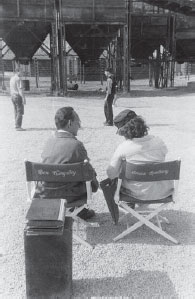
Ben Kingsley and Steven Spielberg on the set of the re-created Plaszów camp.
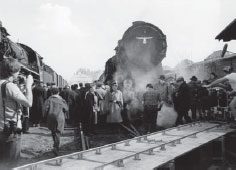
Vintage trains used to re-create scenes of the shipment of Jews to the labor camps. These scenes were particularly difficult for survivors to watch.
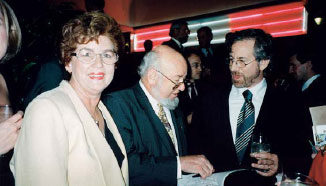
Judy, Tom and Steven Spielberg after the New York premiere of Schindler’s List.
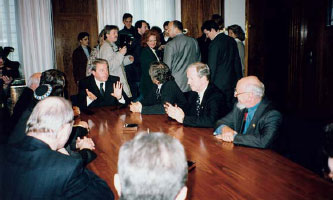
Meeting the Austrian chancellor, Frank Vranitzky (head of table): Steven Spielberg, Jerry Molen and Tom, February 1994.
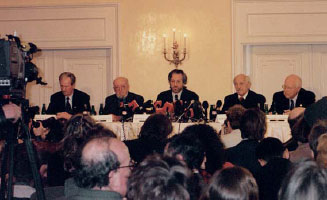
Press conference prior to the film premiere of Schindler’s List in Vienna, February 1994. (Left to right) Jerry Molen, Tom, Steven Spielberg, Simon Wiesenthal (war-criminal hunter) and Branko Lustig (producer and child survivor of Auschwitz).
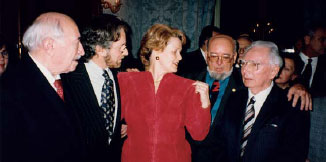
Simon Wiesenthal, Spielberg, Tom and Poldek with the U.S. ambassador to Vienna, Swanee Grace Hunt, at a party she hosted at the U.S. embassy before the premiere of the film in Vienna, February 1994.
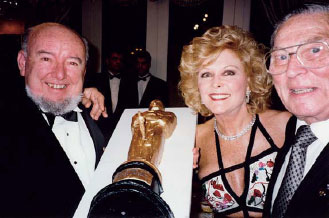
Tom and Poldek were awarded a chocolate Oscar at a pre–Academy Awards party hosted by Century City magnate Joe Segal. They are pictured here with Segal’s Australian-born wife, Kaye Kimberly-Clark.
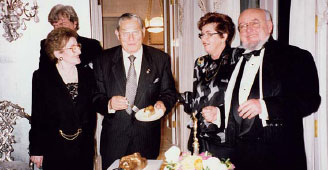
Misia, Poldek, Judy and Tom at the Segal party.
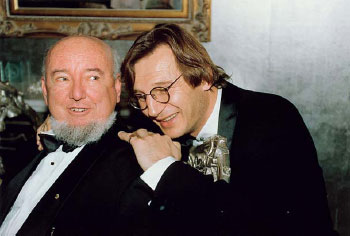
Liam Neeson with Tom at Segal’s opulent home. Neeson returned from the bathroom and said to Tom, “The fookin’ Cézannes, man! Have you seen the fookin’ Cézannes?”
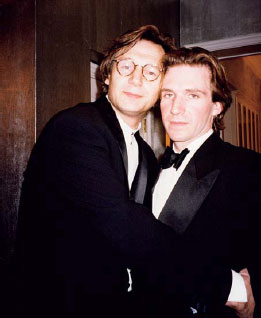
Liam Neeson and Ralph Fiennes ham it up at the Segal party.
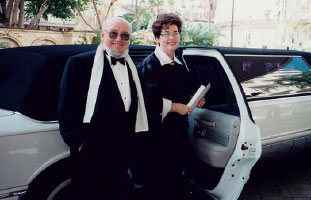
Tom and Judy Keneally on their way to the Academy Awards on March 22, 1994, in a stretch limousine arranged for by Universal Studios.
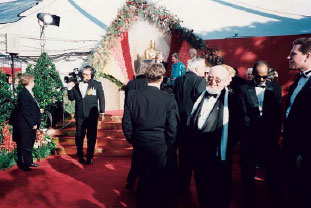
Outside the Academy Awards before the announcement that Schindler’s List had won Best Film and Spielberg Best Director.
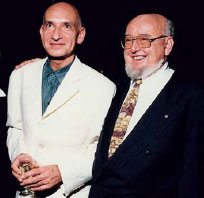
Tom with Ben Kingsley (now Sir Ben Kingsley), who played Itzhak Stern, at the premiere of Schindler’s List in Sydney.