
3
The plague of 1593/4 brought turmoil to the theatre industry. It closed off many venues for playing, and not only in London. All the major companies either went out of business or were reduced to shadows of their former selves, clearly not fit to perform at court. We have already marked the fates of the Queen’s Men and Strange’s/Derby’s Men (pp. 49–50; 65). The fates of others seem to be traced in Titus Andronicus’s 1594 claim that “it was played by the Right Honourable the Earl of Derby, Earl of Pembroke and Earl of Sussex their servants.” There has been debate over whether this means that the survivors of these three companies collaborated to present it or whether the play was passed from one to the next as they successively failed. But either scenario speaks of some desperation.
The Privy Council and the London authorities were generally in agreement about the danger of the plague and the need to close playhouses there when deaths rose above a certain number. In the 1590s the agreed figure seems to have been thirty deaths a week reported from the combined parishes of London. The draft of a licence for Queen Anne’s Men, from around 1604, speaks of them being allowed to play only “when the infection of the plague shall decrease to the number of thirty weekly within our city of London and the liberties thereof” (ES, 2: 230). In later documents, such as the King’s Men’s patent of 1619, the figure is raised to forty. In years like 1593/4 (1603, 1610, and 1625 were similar) the numbers far exceeded that: in a single week in August 1625 3,659 deaths of the plague were registered (Bentley, 1984, 182).
The first hint of final remission of the plague in 1594 is to be found in Henslowe’s Diary, in a section which begins “In the name of God, Amen. Beginning at Newington my Lord Admiral’s Men & my Lord Chamberlain’s Men. As followeth” (see Figure 3.1) He then records ten performances between June 3 and 13 (Henslowe, 21–2). It is uncertain whether the two companies combined for these performances, or whether they played alternately. But they certainly put on plays which would later be identified with the separate companies – Marlowe’s Jew of Malta with the Admiral’s Men and Titus Andronicus with the Chamberlain’s. Two other titles – Hamlet and The Taming of A Shrew – are also intriguing, in view of plays subsequently associated with Shakespeare.
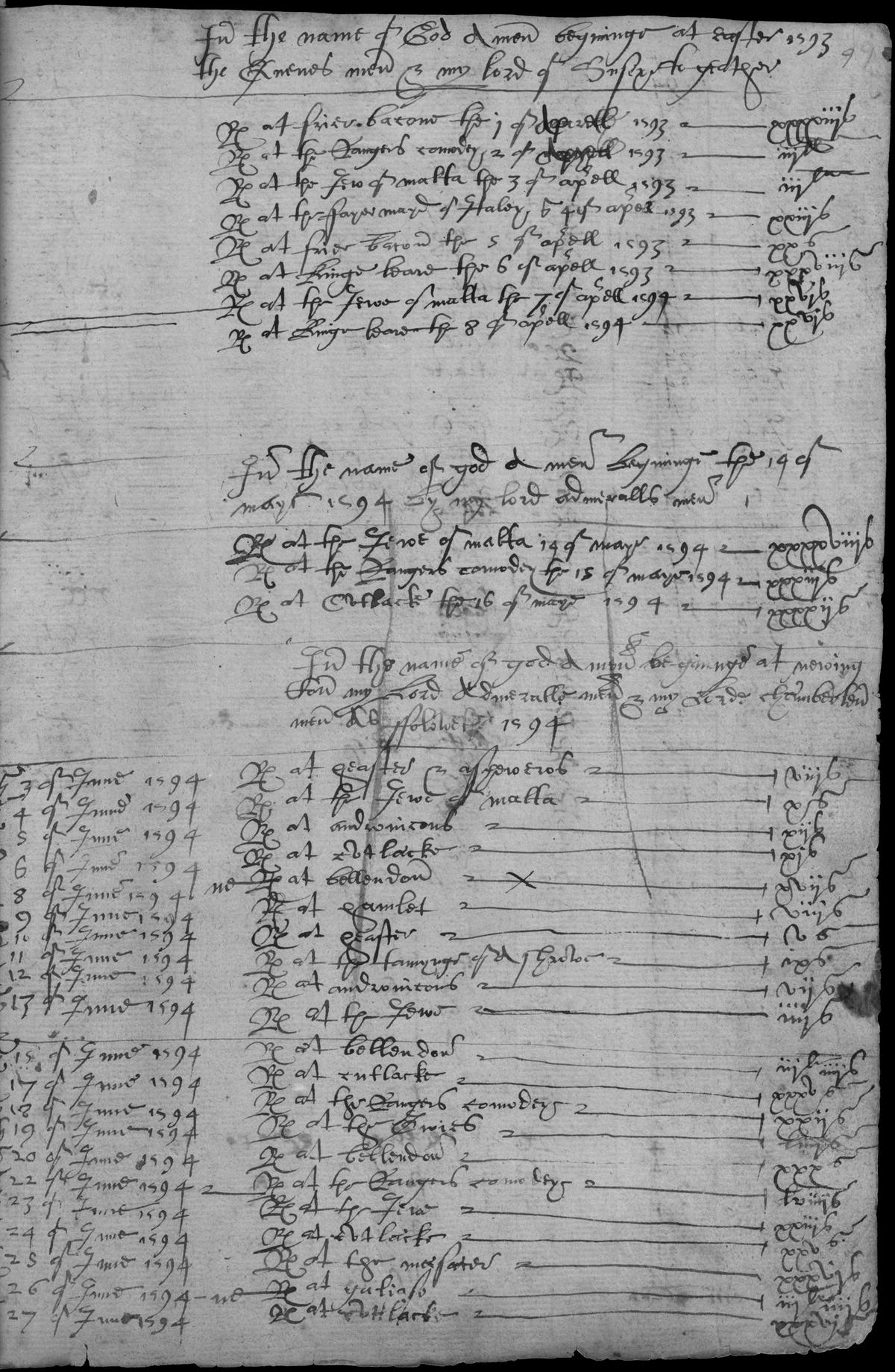
Figure 3.1 Digital reproduction of a page in Philip Henslowe’s Diary.
Source: Dulwich College, MS VII f9r, © David Cooper.
Newington Butts is one of the more obscure playhouses of the era. It was first built by Jerome Savage, a leading player with the Earl of Warwick’s Men, about the same time that James Burbage was building the Theatre (Ingram, 1992, 163–81). As Burbage was, at least in part, providing a London base to Leicester’s Men, Savage was presumably aiming to do the same for Warwick’s. But they failed to flourish after the defection of the Dutton brothers (see p. 34); and the playhouse similarly did poor trade “by reason of the tediousness of the way,” it was said in 1591/2, “and that of long time plays have not there been used on working days” (ES, 2: 405).
The village of Newington was indeed one mile south of London Bridge, which was itself a similar distance from the main residential areas of the city. And it could hardly have been very profitable if it normally only opened on holidays. The work‐week was six days, but playing was (after 1579) at least notionally forbidden on Sundays – the one day when most working people would otherwise have been free to go.1 Festival holidays included the Twelve Days of Christmas, Plough Monday, Candlemas, Shrove Tuesday, the four quarter days, May Day, and Halloween –about three a month in the Anglican Church calendar, averaged over the year. Henslowe’s records make it quite plain that the Rose (and doubtless all the other successful theatres) operated on most days of the working week, doubtless attracting those who did not have to work, such as students at the Inns of Court, but also some workers and apprentices on afternoons when they really should have been at their trade.2 The likeliest reason for the choice of Newington Butts as the first venue for what were in fact two new companies is that it was the furthest playhouse from the city – a prudent first step as the plague at long last receded.