
In all of this Shakespeare must have been adjusting to the novel experience of writing for the same theatre and the same group of players over a period of time.16 We know distressingly little about the specific skills of Shakespeare’s fellow sharers, or for the most part which roles they played. But we can say something about Shakespeare’s two fellow payees for the company’s first court performances, Richard Burbage and Will Kemp. We shall have occasion to revisit both of them again in due course, but it is appropriate to spell out the basics here (see pp. 257ff; 224ff). Burbage was thirty‐five in 1594 and had been playing for about ten years, according to testimony by his brother, Cuthbert (Gurr, 2004a, 222). The earliest Shakespearean role with which he was identified in his own day was that of Richard III, though we cannot be sure whether he created the role or only took it up when the play became part of the Chamberlain’s Men’s repertoire at the Theatre.17 He would later almost certainly perform the roles of Hamlet, Othello and Lear (see p. 164 and Van Es, 2013, 232–48). It would be surprising on that basis if he did not create the roles of Macbeth, Antony, and Coriolanus as well. We know that he played Malevole (a variation on the melancholic revenger) in Marston’s The Malcontent (1604) and Ferdinand, the Duchess’s melancholic twin brother, in Webster’s The Duchess of Malfi (see p. 281; 183, 187).
Such a track record, however, does not always help us to locate him in other plays, especially comedies. It must be likely that he created the role of Richard II and that Shakespeare invested that play with such a rich poetic texture in part because he already appreciated his colleague’s capacity with blank verse. In A Midsummer Night’s Dream he must surely have played Theseus. Did he also originate the common practice of doubling that role with Oberon? Doubling of roles was a common feature of Elizabethan theatre, an economic way of handling more speaking roles than the company could otherwise carry – and perhaps at times (like this) a way of drawing attention to parallels between two characters. But it was more common with lesser characters than with the leads. In Romeo and Juliet the obvious question is whether a man in his mid‐thirties was ideal for a teenager (or at most early twenties) like Romeo; but when we consider that he must have been nearly forty when he probably first handled Shakespeare’s “young Hamlet,” and again consider the richly ornate poetry which this role is asked to deliver, the odds must be in his favor. What, however, of The Merchant of Venice? Bassanio? Antonio? Or Shylock? None of the roles seems an automatic fit. And when we come to 1 Henry IV would he have taken the ageing dignity of the king’s role or the vitality of the prince’s? A possible deciding factor might be swordplay. The man who played Hamlet had to be more than proficient (though so too did the man who played Laertes). That also weighs in the role of Romeo – and the climax of 1 Henry IV is the contest between Prince Hal and Hotspur at Shrewsbury. Indeed, it seems that many of Burbage’s roles in histories and tragedies ended in swordplay – which must have asked a lot of him, on top of the already daunting speaking parts beforehand. Consider also the sheer number of those he had to keep at almost instant readiness at any one time, perhaps thirty over a two‐month period, if what Henslowe shows to have been the Admiral’s Men’s practice also applied to the Chamberlain’s Men (see p. 63, 106). It called for supreme fitness.
Kemp
The role of the leading comedian was no less demanding. Will Kemp (see Figure 3.3) had a reputation well before he came to the Chamberlain’s Men, having worked with Leicester’s and Strange’s Men; he had toured on the continent, including the Low Countries and Denmark (Wiles, 1987; Van Es, 2013, 40–1, 85–90). In the dedication to An Almond for a Parrot (1590, probably by Thomas Nashe) he is hailed as “that most comical and conceited cavalieri [knight], Monsieur du Kemp, jester‐monger and vice‐gerent general to the ghost of Dick Tarlton.” There is an example of his “merriment” in Scene 12 of A Knack to Know a Knave (a Strange’s Men’s play). We know specifically that at the Theatre Kemp played Peter, the Nurse’s “man” in Romeo and Juliet and (just possibly within the company’s time there) Dogberry in Much Ado About Nothing. This is because early texts sometimes call for him by name, rather than by his role. In the 1599 second quarto of Romeo, a stage‐direction for Peter reads “Enter Will Kemp” (4.5); and in 4.2. of the 1600 Much Ado the directions for Dogberry read at one point “Andrew” (= “Merry‐Andrew,” one who publicly plays the clown) and for the most part “Kemp.” These show us very clearly – since both texts seem to derive from manuscripts either in Shakespeare’s own hand, or very close to it – that he was writing with the specific performer in mind. Indeed, they suggest that Kemp’s overall stage persona, “the clown,” was primary, and the specific roles to which he was allocated somewhat secondary. In the 1597 first quarto of Romeo his role is designated “clown” before he is identified as Peter, and even earlier than that it is likely that he played the undistinguished, illiterate “serving‐man” who has to ask Romeo to read the names of the guests to the feast on the list old Capulet has given him.
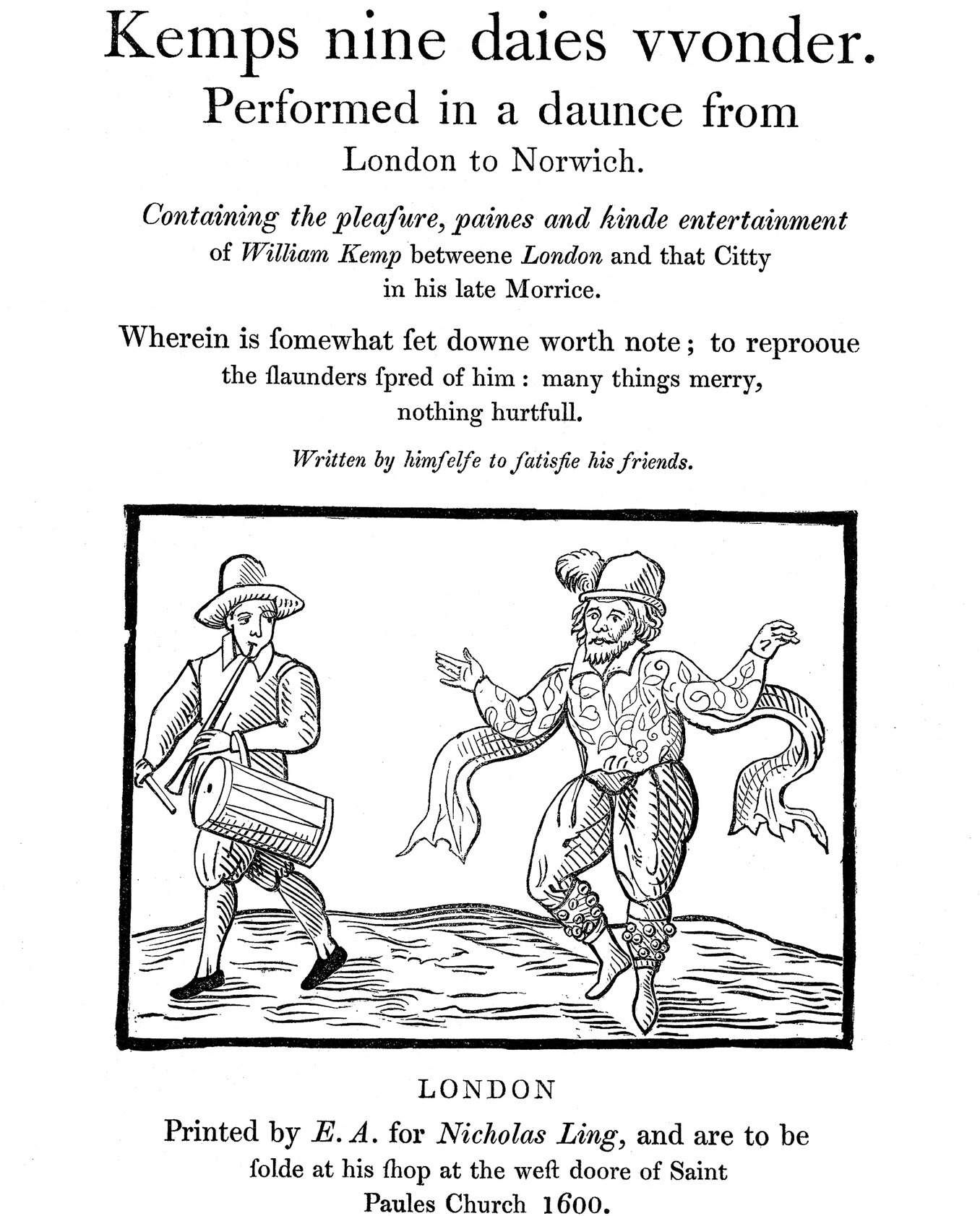
Figure 3.3 Image of Will Kemp and companion on the title‐page of Kemp’s nine daies wonder.
Source: PN2598.k6, 1839, Folger Shakespeare Library.
Inadequacies with language are part of his stock‐in‐trade, whether it be an inability to read at all, or a constant predisposition to malapropisms in the case of Dogberry. Like Dogberry himself, he is determined it be known “that I am an ass” (5.1.251). The mode of his clowning is very much that of the country fellow, out of his depth in the sophisticated society of the city or the court, despite a high opinion of himself.18 He must surely have created the roles of Bottom and Lancelot Gobbo in The Merchant of Venice. Kemp’s role in Romeo is particularly revealing, since his designation as the Nurse’s “man” is anomalous; the Nurse is a servant herself and is unlikely, therefore, to have her own “man” – only possibly a fellow servant who was directed by their masters to help in some particular task. But this designation is an excuse to put two comic roles side‐by‐side and in the end allows Kemp to introduce his distinctive comedy into many corners of the play, including a set‐piece with the musicians at the end of 4.5, a counterpoint to the rising tide of tragedy in the narrative.
Kemp was also noted for bawdy, irreverent, and energetic entertainments called jigs, which were often staged after the performance of a play. We shall have occasion to examine them elsewhere (see p. 218).