

The boy in the bed lay at peace, his breathing stilled, his struggle finished at last. But the men who looked down at the disfigured body knew that theirs had just begun. Now, they faced the battle to control the accession of England’s first reigning queen.
Their initial task was to stop the news of what had happened from spreading beyond the walls of the bedchamber until the levers of power had been comprehensively secured. The same tactic had been adopted six years earlier when Edward VI’s father had died; then, deliveries of royal meals had continued for three days to the heavily guarded door behind which lay Henry VIII’s monumental corpse, until the person of the new king could be united with his principal councillors and the governmental machine at their disposal to proclaim the start of the new reign as a seamless fait accompli.
In 1553, just as in 1547, the councillors were the strategic architects of the change of regime. The difference now was that the new monarch was their puppet not because he was a child, but because she was a woman: Jane Grey, the chosen vessel through whom Edward’s plan for a legitimate, Protestant and male succession would ultimately be achieved, and through whom the duke of Northumberland’s control of government would meanwhile be upheld. On Sunday 9 July, with the cordon of secrecy still in place around the dead king’s darkened chamber at Greenwich, Jane received an enigmatic summons to Syon House, Northumberland’s lavish home ten miles west of the capital, ‘to receive that which had been ordered by the king’. On her arrival the bewildered girl was met by the duke and other members of the Privy Council who knelt before her, offering their allegiance and their service to the new queen of England.
The next day, brightly dressed heralds at last appeared on London’s streets to inform Edward’s subjects that their king was dead and to proclaim the accession of Queen Jane. As they did so, a flotilla of barges carried the young queen and her hastily assembled royal entourage downriver to the Tower, where she made a ceremonial entry into the monarch’s apartments. England’s new ruler was a short and slender fifteen-year-old, with auburn hair and freckles powdering her pale complexion, but on this summer afternoon her slight frame was overwhelmed by the trappings of her royal destiny – a heavy gown of green velvet embroidered with gold, a white headdress weighted with jewels, and cumbersome wooden platforms strapped onto her small feet to make her more easily visible to her new subjects.
So began the reign of Queen Jane. Already, however, there were signs that this female repository of royal power might be less passively accommodating than Northumberland had hoped. Jane’s discomfort with her new role was more than superficial. She was sharply intelligent and stubbornly principled, and if the duke had assumed that she would be a malleable tool of her cousin’s design for the succession, he had begun to be disabused of that presumption from the moment the plan was put into action. At Syon the previous day, her first reaction to the news of Edward’s death and her own elevation to his throne had been a storm of grief for her cousin; her second was horror. ‘The crown is not my right and pleases me not,’ one of the councillors reported her saying. ‘The Lady Mary’ – the elder of Edward’s two sisters – ‘is the rightful heir.’ It took all the pressure that Northumberland, her parents and her new husband, the duke’s son Guildford, could muster before she was induced to accept her accession as the will of her Protestant God.
But acquiescence in this did not mean acquiescence in everything. The royal treasures held in the Tower included the crown itself, which the Lord Treasurer attempted to persuade her to try on, saying as he did so, Jane later recounted, that ‘another also should be made, to crown my husband’. The status of a reigning queen’s husband was an issue without precedent in England, but special envoys sent by the Holy Roman Emperor Charles V, for example, took it for granted that the accession of Queen Jane Grey meant the simultaneous elevation of King Guildford Dudley. (‘The new king and queen are to be proclaimed this very day,’ they reported on 10 July, before seeking advice from their imperial master about what they should do if they were offered an audience by the council and ‘the new king’.) Jane, however, had other ideas. She had been prevailed upon to accept, reluctantly, that the crown might be hers, but she was certain that it was not her husband’s. She would make him a duke, she told her councillors, but not king – a stand which precipitated a furious row with the duke and duchess of Northumberland and with eighteen-year-old Guildford himself, who persisted in conducting himself with elaborate ceremonial of a kind that suggested he too was England’s monarch.
Northumberland had expected a puppet, and was finding instead that Jane was prepared to flex her royal muscles. Jane herself, meanwhile, was wrestling (she later wrote) with ‘a troubled mind … infinite grief and displeasure of heart’, as she struggled to cope with the shock of a situation in which her father-in-law, her parents and her husband were foisting royal power upon her, and simultaneously seeking to prevent her from exercising it. Clearly, there were battles ahead. For the moment, however, they would have to wait, overtaken as they rapidly were by battles at hand, since the implementation of Edward’s ‘device for the succession’ was not proceeding as smoothly as it might have seemed from within the Tower’s royal apartments.
The first indication that all was not well was the silence on London’s streets when Jane’s queenship was declared. No bells were rung, no bonfires lit, no caps flung into the air. Instead, the news was met with a mixture of puzzlement and resentment under a muffling blanket of fear. The proclamation read out by the heralds that day had detained its listeners for an unusually long time, in part because of the need to explain exactly who the new queen was. If the idea that she might inherit the throne had come as a shock to Jane herself, it was a bolt from the blue for the people who were now required to accept her as their monarch. The Emperor Charles V had to ask his envoys to compile a family tree to explain the merits or otherwise of Jane’s claim; how much more at sea were her new subjects as they watched their young queen enter the Tower, her long train carried, confusingly, by the mother through whom her right to the crown was said to have come.
Puzzlement, then, at who Jane was, and resentment at who she was not – this being the second issue on which the heralds found themselves expounding at length. The circumstances which had persuaded Edward of her virtues as a candidate for his throne had much less purchase on the hearts and minds of his subjects. Jane’s commitment to the evangelical faith which Edward was so desperate to see nurtured and protected in his realm could not be doubted, but few of England’s people were as deeply convinced as their king of the doctrinal reformation over which he had presided, and in England’s parishes there remained much support still for the old ways of prayer and worship that had been so suddenly prohibited. Not many were prepared to emulate the rebels who had taken up arms for their beliefs in the west country in 1549, but few would see the reformed religion as reason enough to overturn the legitimate line of the royal succession.
What, though, was that legitimate line? The births of Edward’s half-sisters Mary and Elizabeth had been a matter of public controversy for two decades. There could be no doubt, however, that they were the only surviving children of Henry VIII, and they had been named as his heirs, along with Edward himself, both by parliamentary statute and in the old king’s will. Jane’s claim, by comparison, seemed a work of invention. No grounds, after all, had been advanced to justify the decision that her right should precede that of her mother. And if the terms of the Act of Succession and Henry’s will were to be abandoned in order to disinherit Mary and Elizabeth, then – as the imperial envoys noted in some alarm – there were good grounds for arguing that the next heir was not Jane Grey but Mary Stuart, queen of Scots and dauphine of France, the granddaughter of Henry’s elder sister rather than his younger.
Nevertheless, it was Mary Tudor, daughter of Henry VIII and his first, rejected wife Katherine of Aragon, who was popularly understood to stand next in line to her brother’s throne. Mary had been publicly accepted as heir presumptive to her father during the happy years of her childhood and adolescence, before the catastrophic collapse of her parents’ marriage; and, once her brother had become king, she was recognised by politicians and people alike as his heir unless or until he had offspring of his own. Just five months before his death she had been received at court with deferential magnificence, and as recently as April the duke of Northumberland had offered heraldic recognition of her status as ‘the second person in the realm’ when he ‘sent her her full arms as Princess of England’, the imperial ambassador Jehan Scheyfve reported, ‘as she used to bear them in the lifetime of her father the late king’.
It had been Mary’s sex, of course, that had compromised her standing as his heir in her father’s eyes, but, given the nature of the improvisation to which Edward had had to commit himself in order to establish his line of Protestant kings, the fact that she was female could hardly be used against her by supporters of Queen Jane. Great play was, however, made of the possibility that Mary might marry ‘any stranger born out of this realm’, as the proclamation of Jane’s accession declared, who might then seek
… to have the laws and customs of his or their own native country or countries to be practised and put in use within this realm, rather than the laws, statutes and customs here of long time used, whereupon the title of inheritance of all and singular the subjects of this realm do depend, to the peril of conscience and the utter subversion of the common weal of this realm.
(Or, as the imperial envoys more laconically put it, ‘it was stated that the Lady Mary might marry a foreigner and thus stir up trouble in the kingdom and introduce a foreign government’.) But it was an argument that seemed unlikely to deal a fatal blow to Mary’s claims in the eyes of her prospective subjects. Which, after all, was worse: this hypothetical apocalypse, or the alarming fact that Jane was already married to Guildford Dudley? Dudley was an Englishman, but one through whom the rule of his father Northumberland – a man much feared and not at all loved by the English people – would, disturbingly, become dynastic rather than merely ministerial.
Neither religion, nor birth, nor the probable direction of government policy therefore provided conclusive reason for the subjects of the English crown to repudiate Mary’s right to wear it as her brother’s heir. And, as a result, the process of putting his ‘device’ into effect was fraught with tension and danger. That much was clear from the fact that, despite Northumberland’s frantic efforts, it proved impossible to contain the seeping of information from inside the royal household about Edward’s intentions and his state of health. Jane herself was not aware of her cousin’s plans for her future until 9 July, three days after his death – although she later said that she had been forewarned by her mother-in-law and dismissed the information as fantastical nonsense – but Ambassador Scheyfve, a watchful presence on the margins of the court, had already learned the details of Edward’s ‘device’ five days earlier. When three more imperial envoys arrived to join Scheyfve in London on 6 July, they immediately heard the embargoed news that Edward had died that day, despite the council’s attempts to persuade them otherwise. (‘Sire, the king of England’s death is certain’, they wrote urgently to the emperor the following morning, adding that, ‘in answer to our demand for audience, the council have sent to tell us that they will speak to the king about it, fix a time according to his majesty’s condition, and let us know some time tomorrow’.)
And by then, most damagingly of all for Northumberland and his colleagues, too much information had already reached Mary, the heir they were trying to displace. A tense game of brinkmanship between council and princess had been in play in the last weeks of Edward’s illness. Mary had moved to Hunsdon, the Hertfordshire manor that was her closest home to London, in the effort to keep abreast of the rumours emanating from her brother’s bedside. She needed to be poised to assert herself as England’s queen the moment confirmation came that the king was dead – but not an instant sooner, for fear that she might be denounced as a traitor should she claim the throne before it was vacant. Meanwhile, timing was of the essence, too, for Northumberland: he needed Mary securely under lock and key, but that had to be achieved quietly and calmly, without protest or incident that might precipitate any general convulsion in his current control or his future plans. Much depended on exactly how long the dying boy in the Greenwich bed might cling to life, but the prognostications of his doctors were more art than science, and this calculation – like all the others Northumberland was making – was a finely calibrated risk.
At last, in the first week of July, the duke summoned the princess to her brother’s deathbed, a message laced with duplicitous reassurance, it seems, that her presence in London was required because she was his heir. By then, however, the sinister whispers escaping from Greenwich’s walls had alerted Mary to the danger in which she stood. ‘She was warned by a friend yesterday that she had better go further away into the country’, ran Scheyfve’s encrypted report on 4 July; and three days later, on the morning after the king’s death, when Northumberland finally sent his son Robert Dudley with three hundred armed men to seize Mary at Hunsdon, it was to find the great house empty and his quarry long gone on the dusty road into Norfolk.
At the first hurdle, then, Northumberland’s coup had faltered. But the duke saw no reason yet for serious alarm. Mary, after all, was a woman alone. Certainly, she had servants and counsellors within her household and tenants on her estates, but the formidable mechanisms of the Tudor state – the great bureaucracy of government directed by the powerful men of the Privy Council, and the consequent capacity to mobilise strong arms holding stronger weapons – lay under the duke’s command. Even Mary’s retreat in the direction of the East Anglian coast seemed, in the light of her recent history, to offer Northumberland encouragement as much as disquiet. The princess had lived her entire adult life under intense pressure, both political and emotional, and just three years earlier, as her brother’s attempt to force her to give up the Catholic mass began to intensify, she had shown signs of buckling under the strain. In the spring of 1550, exhausted by the confrontation in which she was currently embroiled and frightened by the uncertainty of her future as the Catholic heir to a Protestant king, she had sent secretly to her cousin, the emperor, asking for rescue. Imperial warships appeared off the coast of Essex, waiting to spirit her away; but Mary havered in frantic indecision – according to the imperial secretary, repeatedly asking the agonised question ‘What will become of me?’ – before baulking at the last minute at the tantalising but irreversible prospect of escape.
For Northumberland, it was a heartening precedent: either vacillation or flight on Mary’s part would serve his purposes well. And he was not alone in his assessment of the weakness of the princess’s position. The French ambassador, Antoine de Noailles, had no hesitation in passing on to his royal master the duke’s private assurance ‘that they had provided so well against the Lady Mary’s ever attaining the succession, and that all the lords of the Council were so well united, that there is no need for you, Sire, to enter into any doubt on this score’. That was, of course, exactly what Henri II wanted to hear, given how little he wished to see the English throne taken by the cousin of his enemy Charles V, and given, too, the enticing prospect that he might press the rival claim of his daughter-in-law Mary Stuart once Mary Tudor was out of the way.
More disturbing for Mary herself was the fact that her own allies were equally unconvinced of her chances of upholding her rights as her brother’s heir. ‘We see small likelihood of being able to withstand the duke’s designs,’ reported the imperial envoys on the morning after Edward’s death;
… it now seems that the Lady Mary’s person will be in danger, and her promotion to the crown so difficult as to be well-nigh impossible in the absence of a force large enough to counterbalance that of her enemies … All the forces of the country are in the duke’s hands, and my lady has no hope of raising enough men to face him, nor means of assisting those who may espouse her cause.
Mary, then, was being written off. As a woman, she could not fight for her rights at the head of her own troops. She was also – in a pattern of political interaction that her forebear Matilda would have recognised only too well – declining to follow advice that was offered to her, and finding that her judgement was questioned as a result. Mary had come to the conclusion, Scheyfve and his colleagues told the emperor, that she should proclaim herself queen as soon as Edward’s death was confirmed. This was necessary, she believed, partly to stake her claim in so immediate and public a manner that it could not be suppressed without challenge, and partly to raise a standard around which all those who supported her or opposed Northumberland could rally. ‘My lady has firmly made up her mind that she must act in this manner, and that otherwise she will fall into still greater danger and lose all hope of coming to the throne,’ the envoys wrote with regretful disapproval, and more than a hint of condescension. ‘We consider this resolution strange, full of difficulties and danger …’ Not only were the military cards stacked high against her, but her plan was hopelessly misconceived because the English would not offer spontaneous support for the claim of a Catholic; ‘and to proclaim herself without hope of immediate success would only jeopardise those chances that remain to her …’
On this if on nothing else, had they but known it, the governments of England, France and the Empire were agreed. Mary could not hope to prevail without the backing of imperial troops. Foreign intervention of that kind would compromise her support within England, and in any case (as imperial politicians, but not French or English, were aware) it would not come, because Charles V’s military machine was already over-committed in his continental campaigns against Henri II. (‘Our hands are full with France,’ he wrote wearily.) His envoys in England were therefore told to do what they could to safeguard the princess’s person rather than to press her claim at all costs. The consensus of heavyweight opinion was overwhelming: the first woman to test the bounds of female sovereignty in England would be the reluctant fifteen-year-old in a gilded cage at the Tower, not the thirty-seven-year-old princess contemplating her limited options from the midst of the East Anglian countryside.
That this was a misjudgement on an extravagant scale began to become apparent on the very day Jane was proclaimed queen. That afternoon, an elderly servant of Mary’s was ushered into the council chamber, grey with tiredness after the long ride from Norfolk, to present a letter from his lady declaring that the crown was hers and demanding that the council acknowledge her as queen. Northumberland, it was suddenly clear, had failed to remember that the frightened princess who had almost abandoned her country in 1550 was also the resolute woman who had ridden into London eight months later with a train of 130 velvet-clad gentlemen and ladies, every one of them holding a set of rosary beads in ostentatious defiance of her brother’s religious laws. And the imperial ambassadors – so confident in the superiority of their diplomatic insight – had utterly misread the dynamics of English politics, of which Mary now showed her mastery. She was the daughter of Henry VIII, the father she idolised despite the abuse and humiliation he had heaped upon her, and she was the rightful heir to her brother’s throne. She was not seeking, as the council had assumed she would, ‘either to flee the realm or to abide there some foreign power’. Instead, with the able support of her household officers, she sent letters and messengers flying along the roads of Norfolk and Suffolk and westward into the midlands and the Thames valley to summon her subjects to their queen’s defence.
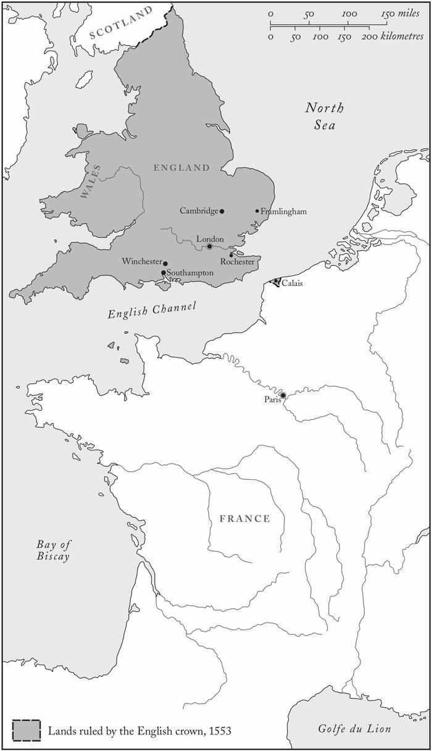
They answered her call in their thousands. Support for her cause was by no means unanimous, but in eastern England there were many landowners whose sympathies lay with the old religion, who were convinced of her claim to the throne, and who had looked to Mary as the greatest magnate of their region ever since she had been granted estates forfeited by the disgraced duke of Norfolk six years earlier. As these gentlemen gathered their armed tenants in the deer park of Mary’s great moated castle at Framlingham in Suffolk – to which she moved for her muster because its defences were still as formidable as when it was built four hundred years earlier – their confidence in the justice of their mission was palpable.
The same could not be said of their opponents. The duke of Northumberland was an able man, a shrewd politician and an experienced soldier, but he was hated by many, and loved by no one other than his wife. Meanwhile, Queen Jane had had no chance to inspire any personal loyalty in the handful of days since she had been so dramatically plucked from aristocratic obscurity. Supporters of the reformed religion, who might have backed the new regime, were torn between fear of Mary’s allegiance to Rome and their own loyalty to the lineage of Henry VIII. And in these circumstances – where one side was sustained by deep convictions, both political and religious, and propelled by spontaneous momentum, while the other relied on the conduct of business as usual in the service of radical change imposed entirely from above – the structures of governmental control on which Northumberland’s power depended began to disintegrate.
The duke’s son, Robert Dudley, was already in the field with three hundred men, pursuing Mary into East Anglia; magistrates and county lieutenants had been warned by Privy Council letters to resist her attempts to ‘stir and provoke the common people of this realm to rebellion’; and six warships had moved out of the Thames to lie off the Suffolk coast, to preempt any attempt at escape by the princess or invasion by the Empire. But Mary’s unexpected resistance meant that more concerted action was needed. Men, horses and artillery were hastily mustered into an army that marched out of London on Friday 12 July under the command of the duke of Northumberland himself, England’s finest general, confident still that his soldiers and cannon, backed by the unanimous will of the council, would see off a challenge for which not a single one of the kingdom’s most powerful men had declared his support.
Six days later, as Northumberland approached at last within twenty-five miles of Framlingham, he learned with incredulous horror what lay ahead of him. Mary’s forces now counted ten thousand men and rising, more than three times the number of the duke’s troops. Still worse was the news of his warships. Contrary winds had forced them into the coast, where Mary’s agents had made contact and the crews had defected, putting ashore great guns that were now ranged in defence of her fortress at Framlingham. And when Northumberland retreated to Cambridge in shock at the overwhelming strength of his enemy’s position, it was to discover that in his absence his fellow councillors in London had collapsed into panic and recrimination.
Faced with news of the princess’s growing power in East Anglia, and increasing resistance too in the shires to the west of the capital, the great lords of the council had faced an unpalatable choice: risk everything by following Northumberland onto the battlefield, or attempt to save their skins by declaring for Mary. In the early morning of Wednesday 19 July their allegiance to Jane was still holding, overwrought and desperately brittle though it now clearly was. By midday, it had broken. A deputation was despatched to tell the emperor’s envoys that, although it had been reported that the whole council had endorsed King Edward’s plans for the succession, in fact ‘only three or four of them had given their willing assent and the rest had been compelled and treated almost as if they were prisoners …’ These mistreated unfortunates, now liberated from Northumberland’s baleful influence – a good story if they could make it stick – then gathered with the mayor and aldermen at Cheapside in the heart of the capital to proclaim Mary queen.
Jane’s proclamation had been greeted with silence. A lone voice daring to speak ‘certain words of Queen Mary, that she had the right title’, had been quickly suppressed, its wretched owner set in the pillory the next morning with his ears sliced off. But now the streets were packed with people brought running by the rumours that were racing through the city. The new proclamation began; and when they heard the name ‘Mary’, the crowd erupted, drowning out everything that followed in a wild explosion of joy and overwhelming relief. ‘And there was Te Deum Laudamus’ – the great hymn of thanks for deliverance from danger – ‘with song and the organs playing and all the bells ringing …’ a Londoner named Henry Machyn noted in his diary, ‘and bonfires and tables in every street, and wine and beer and all, and every street full of bonfires.’ ‘Men ran hither and thither,’ an Italian eyewitness reported in amazement, ‘bonnets flew into the air, shouts rose higher than the stars, fires were lit on all sides, and all the bells were set to pealing, and from a distance the earth must have looked like Mount Etna.’ And while the celebrations raged, nervous messengers from the council rode through the night to Framlingham to offer their allegiance and their contrition to Queen Mary.
Just as Edward II and Hugh Despenser had discovered more than two centuries earlier, the imposing edifice of royal government could prove utterly, shockingly insubstantial if the authority it embodied lost its claim to legitimacy. And the issue of legitimacy on this delirious summer night was summed up in Henry Machyn’s description of its royal protagonists. Jane, he explained, was ‘daughter of the duke of Suffolk’, but Mary was ‘sister of the late king Edward VI and daughter unto the noble king Henry VIII’. The duke of Suffolk himself – as desperate now for his own salvation as he had once been for his daughter’s advancement – tore down the cloth of estate that signalled Jane’s regal status from above her chair where she sat at dinner in the Tower, saying (the imperial ambassadors were told) ‘that it was not for her to use it, for her position permitted her not to do so’. It was with gratitude that the girl who had reigned for just thirteen days – or nine since her public proclamation – relinquished a crown that she had always believed was Mary’s by right. When the news reached Cambridge, the duke of Northumberland stood in the market square and proclaimed Mary’s accession, throwing his hat in the air and, one of his companions later recalled, ‘so laughed that the tears ran down his cheeks for grief’.
Mary’s triumph was complete. On 3 August, at the head of an imposingly magnificent cavalcade, she rode at last into her cheering capital, a small figure regally dressed in purple velvet and satin ‘all thick set with goldsmith’s work and great pearls’. Three weeks later great crowds again thronged the streets of the city, this time to watch Northumberland lose his head on Tower Hill. On the eve of his execution, the duke had renounced the Protestantism for which he had fought, apparently in a vain bid to prove his loyalty and save his life. (‘I pray God I, nor no friend of mine, die so,’ was Jane Grey’s shocked response.) Jane herself – ‘cette pauvre reine’, as the French ambassador called her, ‘that poor queen’ – had returned with relief to her books and the muted clothes recommended by her own unbending faith. She remained in the Tower, condemned as a traitor for accepting the crown, but Mary saw her as a wronged innocent and, as the new imperial ambassador, Simon Renard, reported in frustration, ‘could not be induced to consent that she should die’.
Her enemies thus defeated, it was Mary Tudor who faced the reality – rather than simply, as Northumberland had planned for Jane, the rhetoric – of governing England as its queen. Jane had reigned, fleetingly and powerlessly, her crown acquired only by reluctant submission to the will of others. Mary, meanwhile, had stood alone to resist the plans of the greatest men in the realm. Now, she would rule. Her right to wear the crown as her father’s daughter and heir had been acclaimed with deep and genuine conviction after the trauma of that July fortnight. But in the exercise of her royal power, the challenges she faced had barely begun.