
An Incomparable Woman
1124–1204
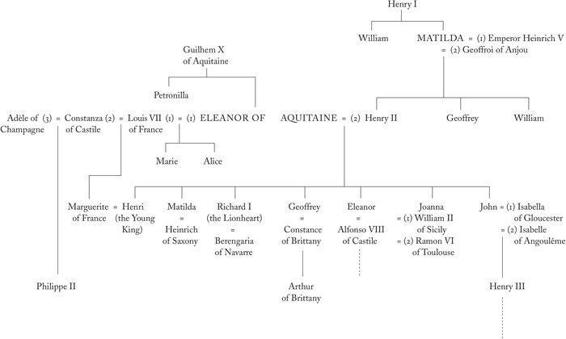
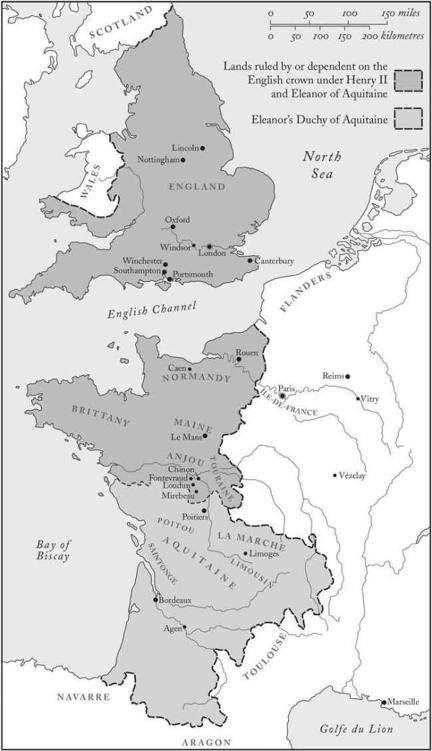

A casual observer at Henry II’s court in September 1166 might have been forgiven for thinking that Eleanor of Aquitaine was the most conventional of queens. A great heiress, famed for her beauty and her agile mind, she had brought her royal husband a rich inheritance that stretched from the green valleys of the Vienne river, where soft light danced on stately water as it flowed toward the Loire, to the foothills of the Pyrenees, where a stronger sun struck towering crags of granite and limestone.
And, along with the landscape and liegemen of her vast duchy of Aquitaine, Eleanor had given her husband a large brood of heirs to inherit his growing empire. Seven months pregnant now with the king’s eighth child, she had played to perfection the role of dutiful consort, spending enough time with her husband to ensure a succession of pregnancies – she gave birth five times in the first six years of their marriage alone – while also, so far as her repeated confinements allowed, providing a figurehead for his government in England during his long and frequent travels through his lands in France.
If her role as royal wife and mother was utterly conventional, so too is the fact that the chroniclers recorded no pen-portrait of Eleanor to match their detailed descriptions of her husband and king. Henry exerted a particular fascination on the men who recorded the events of his reign. In part at least, this is because a significant number of the contemporary writers whose works have survived – Walter Map, Gerald of Wales, Herbert of Bosham, Roger of Howden and Peter of Blois – served in one capacity or another as clerks at his court, and therefore observed his charisma, his idiosyncrasies and his extraordinary capabilities at close range. It remains clear, however, that the sheer magnetic force of his personality reached far beyond the confines of his household.
He had inherited the sturdy physicality of his royal grandfather and namesake, Henry I: he was neither tall nor unusually short, but broad and stockily muscular, thick-necked and square-chested. The solidity of his powerful frame blurred easily into fat, which he held at bay not only by the frugality with which he ate and drank, but also by virtue of the relentless energy that had been so marked in his grandfather, a quality which, in the younger man, became an almost pathological restlessness. He was a ‘human chariot dragging all after him’, wrote Herbert of Bosham, a cultured dandy whose personal style had little in common with that of his strenuous king. On his frequent military campaigns Henry scarcely paused to eat or sleep, his bowed legs and hoarse voice testifying to the hours he spent in the saddle. But times of truce did not bring peace to his household. Instead, he rose before dawn to satisfy his compulsive obsession with hunting, returning dusty and blood-smeared from the kill to spend his evenings still on his feet, reducing his courtiers – who were not permitted to sit while their king remained standing – to a state of exasperated exhaustion.
His leonine colouring – red-gold hair and ruddy, freckled face, offset by expressive blue-grey eyes – was a legacy from his Angevin father, although he did not share the physical beauty for which Geoffroi had been celebrated in his youth. Henry’s bulk, his closely shorn hair and his plain, practical clothes gave him a physical appeal that derived from his commanding vitality rather than any more obvious glamour. He was driven and ambitious, like his father, but his quick, scholarly mind seems more likely to have come from his remarkable mother, Matilda. Like her, this man of tireless action was entirely at home among intellectuals and academics: ‘… with the king of England’, wrote Peter of Blois, ‘it is school every day, constant conversation with the best scholars and discussion of intellectual problems’. He read voraciously, his memory was prodigious, and, though he expressed himself only in French and Latin, he knew something, Walter Map reported, of ‘all tongues spoken from the coast of France to the river Jordan’.
However, where Matilda’s public life was shaped by her self-control and carefully considered pragmatism, Henry was passionately emotional, a character of extremes and contradictions. He was unpretentious, patient and approachable, and possessed of unearthly calm in the face of crisis, yet capable of the most violent fits of rage. Court gossip (reported in 1166 to Archbishop Thomas Becket, once the king’s closest friend, now estranged and in exile) described one outburst of ferocious temper that left Henry screaming on the floor, thrashing wildly and tearing at the straw stuffing of his mattress with his teeth. He loathed betrayal in others, but was notorious for his willingness to break his own word without a second thought. He could be fierce or gentle, harsh or generous, and he contrived (without apparent contrivance) to be simultaneously an immovable object and an irresistible force.
The first hint that our observer of Henry’s court might get that Eleanor of Aquitaine was no conventional queen was the fact that she was a match, in personal as well as political terms, for this overwhelming, brilliant, bloody-minded king. Before she ever took her place at Henry’s side, she had had another life full of incident and experience. And the eventful pre-history of England’s queen was more than enough to show that the serene, swollen-bellied madonna of the autumn of 1166 was only one persona among many in the repertoire of an exceptional, unpredictable woman.
Eleanor was born probably in 1124, the first daughter of Guilhem, heir to the great duchy of Aquitaine. The court over which her family presided was dramatically different in style from the sober piety of the Anglo-Norman and German royal households in which Matilda had spent her childhood. At its head was Eleanor’s grandfather, Duke Guilhem IX, crusader, womaniser and poet of love and lust – the first of the troubadours, writing in Aquitaine’s native langue d’oc, whose verses have survived. William of Malmesbury, hundreds of miles away in England, recounted scandalous rumours of the duke’s provocative exploits and his sardonic wit: he ordered that his mistress’s portrait should be painted on his shield, William reported with some relish, declaring that ‘it was his will to bear her in battle as she had borne him in bed’.
Such tales probably had their roots in garbled elaborations of Duke Guilhem’s songs, fiction turning into breathlessly reported fact as it travelled northward. But the truth needed little such embellishment. The duke’s long-suffering duchess, Philippa of Toulouse, eventually left him for a religious life at Fontevraud Abbey – a new double monastery founded in 1101 by the ascetic preacher Robert d’Arbrissel, where both monks and nuns lived under the direction, unusually, of an abbess – fifty miles north of the duke’s city of Poitiers. In Philippa’s place at his side, Guilhem installed the woman whose notoriety had reached as far as the cloisters at Malmesbury – she of the supposed shield-portrait, the wife of the lord of nearby Châtellerault, though her name is not known – and arranged a marriage between his lover’s daughter and his own eldest son.
That son and heir, who became Duke Guilhem X when his father died in 1127, was a less flamboyantly talented character, famous for his insatiable love of food rather than his poetry. He spent ten turbulent years at the helm of Aquitaine’s affairs before deciding, in 1137, to invoke the spiritual support of St James the Apostle by making a pilgrimage to his Galician shrine. (The saint’s hand, thanks to Matilda, was now an object of veneration at Reading Abbey, but his body was believed to lie beneath the great granite cathedral newly built in his honour at Compostela in north-western Spain.) If the saint responded to the duke’s prayers, however, it was to secure the welfare of his soul rather than his duchy. Guilhem was already seriously ill when he arrived at Compostela, and he died there on Good Friday 1137. His body was buried before the cathedral’s high altar, his pilgrimage transmuted into a permanent resting-place.
His death left his children orphans. His wife, Anor of Châtellerault, had died several years earlier, along with their only son, another Guilhem. Two daughters remained: Petronilla, the younger, and her elder sister, Eleanor, who had been named after their mother – hence Aliénor, ‘another’ (in Latin, alia) Anor. The girls had been left at Aquitaine’s port city of Bordeaux under the distant guardianship of the French king, Louis the Fat, who was the duke’s nominal overlord. When reports arrived from Spain of Duke Guilhem’s death, Louis lay sick at his hunting lodge at Béthisy, north-east of Paris, exhausted by encroaching age and the physical strain of his obesity. But ill-health had not compromised his instincts as a king, and he responded with alacrity to the news that the fate of Aquitaine now rested on the slender shoulders of a thirteen-year-old girl. Eleanor should marry his son, the king declared, and he immediately despatched the prospective bridegroom, seventeen-year-old Louis, to Bordeaux with an imposing retinue which included the greatest noblemen in France as well as the king’s chief minister, Abbot Suger of Saint-Denis, and hundreds of well-armed knights.
It was an abrupt and forceful courtship, but the political imperatives that lay behind it were too compelling to be ignored. For 150 years, it had been the ambition of the Capetian kings to turn their theoretical sovereignty over the great feudal lords of France – the dukes of Aquitaine prominent among them – into the reality of power. But old freedoms could not be so easily curtailed, and, despite three decades of King Louis’s shrewd and commanding rule, the area under the crown’s direct control remained limited to the Île-de-France, the ‘island’ around Paris bounded by the rivers Seine, Marne, Oise and Beuvronne. Now, however, marriage vows rather than military force promised to deliver Aquitaine into royal hands. And, for Eleanor and those who advised her, the prospect of a husband who would be king of France as well as duke of Aquitaine offered protection for her rights as the duchy’s heir, rights which would otherwise be rendered acutely vulnerable by her youth and her sex.
And so, just three months after her father’s death, Eleanor married Louis, the heir to the French throne, in Bordeaux’s magnificent cathedral. In accordance with Capetian custom, her young husband had already been crowned king at Reims six years earlier (by Pope Innocent II, no less, for whom the French court was temporarily providing refuge from the challenge of a schismatic rival in Rome). This consecration in childhood was designed to safeguard the prince’s right to succeed his father, and it was therefore for the second time that Louis was crowned alongside his bride in Bordeaux, in the course of a specially devised coronation ceremony which emphasised that the people of Aquitaine were now numbered among the subjects of the French king. Only days later, Eleanor became queen in fact as well as in name. Louis the Fat died on 1 August 1137 – killed by an attack of dysentery in the intense heat of an oppressive summer – and on 8 August the young Louis VII and his new wife were crowned yet again, definitively this time, amid cheering crowds in Eleanor’s city of Poitiers.
The repeated coronations were intended, in part, to counteract the fact that the young man Eleanor had married had not been born to be king. Louis the Fat’s namesake and successor was his second son, who had been destined from an early age for a life in the Church. But in 1131 the boy’s elder brother, Philippe – a fifteen-year-old whose response to his own coronation-in-advance had been to defy his father with adolescent arrogance – tripped over a stray pig while riding through a Parisian street. The sudden, catastrophic fall of horse and rider left the young man bloodied and broken, in a coma from which he did not recover. He was buried in the abbey church of Saint-Denis, the Parisian necropolis of the French monarchy; and it was from the cloisters of Saint-Denis that eleven-year-old Louis emerged, wide-eyed, to find his future transformed.
His gaze was scarcely less innocent at seventeen, when he acquired his queen and his kingdom at almost exactly the same time. According to later gossip, Eleanor would one day remark that her husband was more monk than king – a judgement that captures Louis’s assiduous piety, and a certain unworldliness that remained from his years in the cloisters, but conveys little of his enthusiasm for either his bride or the business of ruling. Possession of Eleanor’s vast domains gave Louis more hope than any of his predecessors of extending his authority across the length and breadth of France, and soon he set about pressing her claim, inherited from her grandmother Philippa, to the comté of Toulouse beyond Aquitaine’s south-eastern borders. He was also, by all accounts, besotted with his wife, offering her an infatuated, puppyish devotion.
Eleanor herself was much less impressed. From the start, this union between a boy raised by monks (even monks under the acute eye of Abbot Suger) and the granddaughter of a licentious troubadour was not a meeting of minds. We have only scraps of information with which to piece together the royal couple’s relationship, but the overwhelming impression is that the young queen had worldly, sophisticated tastes, a sharp wit and an appreciation of the subtle ambiguities of politics, while her gauche husband conducted himself with an awkward combination of self-denying religiosity and judgemental inflexibility. Certainly, too, Eleanor in Paris was a stranger in a strange land: not as obviously and manifestly far from home as eight-year-old Matilda had been in Germany, but nevertheless an orphaned teenager housed within a forbidding fortress in a crowded, jostling city whose inhabitants spoke with the unfamiliarly rounded tones of the langue d oïl, the language of the French north, rather than in the hybrid frontier dialect of Poitou or with the lively musicality of Occitan itself.
Of course, this cultural isolation was the eternal condition of a royal bride, transported miles from her homeland as the incarnation of an alliance or treaty, a weaver of peace or a conduit of power. But the knowledge that Eleanor was not alone in her fate offered little in the way of comfort. The contrast in style between north and south in France was all too apparent forty years later to the troubadour Bertran de Born, lord of Hautefort in the Limousin, who professed himself unimpressed by his stay at the English king’s court in Normandy: ‘a court where no one laughs or jokes is never complete; a court without gifts is just a paddock-full of barons. And the boredom and vulgarity of Argentan nearly killed me …’ Paris was not Argentan, but neither was it Poitiers or Bordeaux. And if Eleanor felt any of the alienation expressed in her countryman’s song, it can only have been compounded by the effects of her failure to perform the eternal function of a royal bride: the provision of a male heir to safeguard the succession of the dynasty into which she had married.
However much the fault lay at Louis’s door – and the suspicion was that the monkish king was not a frequent visitor to his wife’s bed – the blame, in contemporary eyes, rested only with the queen. By 1144, after seven years of marriage, it is possible that Eleanor had had one miscarriage, but it is certain that she had produced no living heir. She was not a woman to be cowed by unhappy circumstance, and her position was protected from serious threat by Louis’s devotion, by her youth and by the power of the lands she brought to the French crown. But something of her frustration, as well as her fiery temperament, may be apparent in her fraught relationship with some of her husband’s closest advisers. One in particular, a eunuch named Thierry Galeran, she hated so much (according to John of Salisbury, the future bishop of Chartres who was then a student in Paris) that she subjected him to relentless mockery and ridicule.
At least Eleanor had the support of her sister, Petronilla, a companion who shared her language, her culture and her memories of their former life in Aquitaine. But Petronilla’s presence at her side precipitated the most horrifying incident of Louis’s kingship, one that cast a long shadow and set in motion a chain of events that would ultimately lead Eleanor away from Paris for ever. It began in 1142, when a husband was found for Petronilla from among the great noblemen of France. The king’s cousin Raoul, count of Vermandois, forty and one-eyed, was a champion of the French crown, his battle-damaged sight a badge of the devoted service he had given Louis’s father. He was the perfect political match for the queen’s sister in every way but one: he was already married. That, it seemed, was a minor inconvenience, and his wife of twenty years, Eléonore of Champagne, was rapidly put aside.
But the repudiated countess had two brothers, who might not be content to see her so publicly humiliated. One, Stephen, was otherwise engaged across the Channel in the battle to keep hold of the English crown; but the other, Thibaud of Blois and Champagne, was one of the most powerful magnates in France, who had ridden alongside Raoul of Vermandois in the young king’s retinue on the road to Bordeaux to meet his queen five years earlier. Raoul’s matrimonial rearrangements now set him on a collision course with his former brother-in-law, and massing ominously in support of the insulted Thibaud was the collective might of the Church. Despite his ostentatious piety, King Louis, like many another monarch, had already clashed with the pope over the vexed question of the right to elect and invest bishops. Now – in spite of the fact that three tame French bishops had been found to annul Raoul’s first wedding and sanction his second – Pope Innocent II decided to act to defend the sacrament of marriage from the vagaries of royal whim and political convenience. By the end of 1142, both Louis and his cousin Raoul had been excommunicated and their lands placed under interdict, and Innocent had witheringly denounced the young king as ‘a boy in need of instruction’.
For Louis, the need to demonstrate that he was no longer the child whom Innocent had crowned at Reims won out over religious obedience or political judgement. He blamed Count Thibaud for the reverses he had suffered, and in January 1143 he marched into Champagne at the head of an army, determined to bring his vassal to heel. At Vitry, a poorly defended town a hundred miles east of Paris, the king watched with grim satisfaction as the inhabitants fled in terror before the onslaught of his troops. Thirteen hundred men, women and children barricaded themselves into their church while their homes were torched around them. And then, as they prayed desperately for salvation, the flames spread to the roof-timbers of their sanctuary. Before Louis’s gaze, the building was engulfed. Amid unbearable heat and the deafening uproar of fire and falling masonry, the air filled with acrid smoke and the nauseating, cloying stench of burning flesh. From the holocaust of Vitry, no one emerged alive.
It was a massacre of innocents, and visceral in its horror. Even this, however, could not immediately check Louis’s obstinacy, and his army continued its advance across Thibaud’s lands. But the conflagration did plant seeds of doubt in the king’s mind about the justice of his cause, uncertainty that was rapidly compounded by the strictures of Bernard of Clairvaux, the most venerated and uncompromising of Europe’s spiritual leaders. At fifty-two, Bernard’s influence was felt far beyond the walls of the abbey he had founded in a densely wooded valley only fifty miles from Vitry. His example was the driving force behind the rapid spread of the new Cistercian order, an austere re-imagining of the Benedictine rule, which Bernard embraced with such single-minded asceticism from his tiny cell in the angle of the roof at Clairvaux that he pushed himself to the brink of his physical endurance, existing on the barest minimum of food and sleep. But from his gaunt frame issued a voice that thundered across Europe.
His spiritual standing was such that in 1130, when Innocent II was driven into French exile after the contested election of a rival pope, Louis the Fat had given the arbitration of Innocent’s claims to the Holy See into Bernard’s hands. The stern judgement of the abbot of Clairvaux not only decided French support for Innocent but, as he travelled indefatigably on a scrawny donkey at the pope’s side, secured the backing of Germany, Spain and England for Innocent’s eventual restoration to Rome. Now neither rank nor birth, wealth nor power, offered a shield against Abbot Bernard’s critical gaze. Kings and bishops, noblewomen and nuns – all could be judged and found wanting, the cure for their errors contained in excoriating letters despatched from a pen that scarcely seemed to rest.
Abbot Suger, the king’s greatest confidant and counsellor, had felt compelled to lay aside the luxurious trappings of power, adopting a simple woollen habit and taking up residence in a single small room in Saint-Denis’s cloister, after a rebuke from Abbot Bernard some years earlier. After Vitry, it was Louis’s turn to feel the stinging lash of Bernard’s tongue: ‘… from whom but the devil can I say that this counsel comes which adds fire to fire and slaughter to slaughter; which lifts the cry of the poor, the groaning of captives, the blood of the slain to the ears of the Father of the fatherless and the Judge of widows?’ The abbot, as always, spoke with the assurance of absolute spiritual certainty, and he left the king in no doubt of the reckoning he faced:
… provoked by the constant excesses you commit almost daily, I am beginning to regret having stupidly favoured your youth more than I should have done, and I am determined that in future, to the best of my limited ability, I will expose the whole truth about you … I speak harshly, because I fear harsher things for you.
Louis had no matching certainty of his own, and he crumbled before the abbot’s assault. By 1144, the king had collapsed into a state of wretched penitence, and was ready to make terms with both the pope and Count Thibaud. The royal army withdrew from Champagne, and the interdict was lifted. Meanwhile, Abbot Suger saw an opportunity to cement this fragile peace in the ceremony to consecrate the extraordinary new choir he had built for the basilica at Saint-Denis, a breathtaking confection of soaring arches and gorgeously coloured light. Abbot Bernard, for his part, deplored lavish ornament in church architecture, as in everything else: a misuse of earthly riches, he said, that could better be used to succour the poor, and a worldly distraction from the contemplative inwardness of the soul’s quest for God. But, in that at least, he had not persuaded Abbot Suger to follow him. For Suger, the overwhelming beauty of his building was a path to grace, a radiant, transcendent space that gave earth-mired sinners a glimpse of heaven.
On 11 June 1144, therefore, a uniquely powerful congregation of sinners passed through the gilded bronze doors of Suger’s church to see the bones of St Denis, France’s patron saint, placed in a golden shrine at the centre of the choir. King Louis was there, contrite and remorseful. Abbot Bernard had swallowed his revulsion at the opulence of his surroundings to be present in the cause of peace. And there too, weighed down by heavily embroidered robes amid the press of the crowd, was Louis’s wife, Eleanor.
It seems unlikely that Bernard was much impressed by this encounter with France’s queen. He had known her father – who had been a supporter of the schismatic anti-pope in the days when Abbot Bernard was Pope Innocent’s chief hope of regaining the throne of St Peter – and had brought the duke to his knees, literally, it was said, in a confrontation at Parthenay, just west of Poitiers. It was for the sake of Eleanor’s sister that Louis had watched more than a thousand souls burn at Vitry. And now here she stood, a woman – her sex in itself a source of anxiety and repugnance from the perspective of the ascetic Cistercian ideal – decked out in the kind of superficial magnificence that the abbot deplored.
But neither was Eleanor overawed by the emaciated figure dressed in the coarse white wool of the Cistercian habit. Throughout her life she would display a judicious piety, conventional in form and expression, but she was not about to bow her head to a spiritual philosophy by which she herself would be written off as an embodiment of worldly vanity. Instead, this unlikely pair recognised, each in the other, a formidable will and an imposing personality. The result was a bargain. Eleanor would do what she could to steer her husband in the ways of peace; in return, Abbot Bernard would petition the queen of heaven on behalf of the queen of France, in the hope that Eleanor might conceive an heir to her husband’s throne.
Heaven, it seemed, was listening to the saintly abbot, if not quite as carefully as were the crowned heads of Europe. In 1145, the year after the great and the good had gathered at Saint-Denis, Eleanor at long last gave birth for the first time. The baby was strong and healthy, and perfect in every way except for its sex: it was not the longed-for boy, but a girl, named Marie in thanks to the Virgin for this blessing bestowed and in hope of better to come.
Meanwhile, Abbot Bernard could have no cause for complaint about Eleanor’s side of their deal. By the end of 1145 Louis was not only penitent, and reconciled with the Church in France and in Rome, but committed to a greater goal even than peace itself: he planned to wage a holy war, to defend Christendom against the infidel. That summer, news had reached France that the city of Edessa had fallen to Muslim forces commanded by the emir of Aleppo, Imad ad-Din Zengi. For the Latin states of the Levant, founded half a century earlier in the wake of the victorious First Crusade, the loss of Edessa represented both a spiritual affront – the city housed the graves of the apostles Thomas and Thaddeus as well as thousands of Christian inhabitants – and a profound strategic threat.
Louis did not hesitate. At Christmas 1145, with his court gathered around him at Bourges for the annual royal ceremony of crown-wearing, he declared his intention to embark on a crusade. In the same month, the new pope, Eugenius III – the first Cistercian to be elected to the Holy See, and himself a disciple of Bernard of Clairvaux – published a bull urging the faithful to come to the aid of Edessa and confirming the remission of sins for all who joined the campaign. Three months later, the crusade was formally launched amid extraordinary scenes at Vézelay in northern Burgundy.
Many roads led to Vézelay: lying between Paris and the great mother-houses of the Cluniac and Cistercian orders, it was one of the chief staging-posts for pilgrims travelling south to Santiago de Compostela. And it was itself a place of pilgrimage, its newly rebuilt hill-top abbey dedicated to St Mary Magdalene, the patron of penitents, whose bones, contemporaries believed, rested there in a gilded shrine. Little wonder that it seemed the perfect place for a king to begin a journey that was, in part at least, one of pilgrimage and expiation.
But even Vézelay, its church freshly extended to cope with the thronging crowds it regularly had to accommodate, had never seen anything like the gathering of Easter Sunday 1146. So many people had packed into the town that the church had to be abandoned altogether, and a makeshift stage hastily constructed on the hillside beyond. There Louis sat in state, wearing stitched to the shoulder of his mantle a crusader’s cross sent especially by Pope Eugenius, who had been unable to leave Italy because of the dangerous uncertainty of Roman politics. In his place, however, the pope had despatched the frail but luminously charismatic figure of Abbot Bernard. Amid a reverent hush, the great man spoke fervently, with indomitable energy and urgent rhetoric, exhorting the Christians of the west to help their fellows in the east.
Then it was Louis’s turn to address his subjects, telling them of his ‘great devotion to this war’, before kneeling in tears at the abbot’s feet to take the cross for all to see. Behind him pressed the magnates of France, including Henri, heir to the king’s old enemy Thibaud of Champagne, along with so many others that the heap of fabric crosses Bernard had brought with him to confer upon would-be crusaders was quickly exhausted, and the abbot was forced to improvise replenishments by tearing strips from his own white robe as the crowd clamoured to reach him.
It was a profoundly stirring spectacle, unprecedented in substance as well as style. The First Crusade had been a speculative, self-consciously pioneering expedition, its lordly leaders venturing into the unknown to seek new spheres of influence as well as eternal salvation. But its triumph in the face of towering odds – capturing the holy city of Jerusalem, and establishing Christian states there and further north at Tripoli, Antioch and Edessa – meant that expectations, and the stakes that went with them, were now far higher. Never before had a crowned king undertaken to lead a crusade in person – a military campaign that would take him thousands of miles away from the lands it was his sacred duty to rule, and would keep him away for a matter of years rather than months, even supposing that he returned at all. He would spend untold sums, prised from the pockets of his subjects left behind. He would face the manifold dangers of landscape, climate, disease and a terrifying enemy. And he would do it all, it emerged, with his wife by his side.
Eleanor too had sat, dressed in a crusader’s robe, on the platform at Vézelay, had knelt before Abbot Bernard to receive the cross and had pledged her vassals of Aquitaine to join the campaign. She too received the blessing of Pope Eugenius himself at Saint-Denis on 11 June 1147, during an elaborately staged send-off for the crusaders where the queen, almost fainting on a suffocatingly hot day, watched her husband take possession of the oriflamme, a banner of fire-red silk on a golden lance that hung above the abbey’s altar until the king should have need of it to lead his troops in battle. And she too joined the French army when it assembled at Metz in the far east of France to embark on the long journey across Europe to rendezvous with the crusading forces of the German king, Conrad III, in Asia Minor.
The presence of the French queen and her attendants alongside the soldiers and the wagons full of arms was itself an indication of the confidence with which the expedition set out. Eleanor travelled in style, despite Eugenius’s instruction to his crusaders to deport themselves with sober simplicity. (His papal bull forbade them to bring hawks and hounds, to employ minstrels, or to wear ‘multi-coloured clothes or minivers or gilded and silver arms’.) But no silken pillow or upholstered saddle could disguise the fact that this was a journey beside which Matilda’s wintry crossing of the Alps thirty years earlier paled into insignificance.
From Metz the French army, with the queen’s elegant entourage in its midst, travelled a hundred miles north-east to Worms, where ships were waiting to ferry them all – nobles, ladies, bishops, troops, horses, arms and baggage – across the Rhine. They moved at speed, covering between ten and twenty miles a day as they pressed on another two hundred miles eastward to the Bavarian city of Regensburg, at the northernmost bend in the Danube, where a German fleet had assembled to carry them downriver through the lands of the king of Hungary. When they reached Bulgaria they left their boats, instead turning southwards by road – and, despite being sporadically held up by the frustrating unwieldiness of their four-horse baggage-carts, they were still making good time as they entered the territories of the Byzantine emperor, Manuel Komnenos. By 4 October, they had reached Constantinople, capital of the eastern Empire and the greatest Christian city in the world.
Relations between the Christians of west and east were far from easy, and the arrival of the French king at the head of his army, less than a month after the German king had passed by at the head of his, was hardly welcome to the emperor. Indeed, having expressed diplomatic joy at news of the crusaders’ plans a year earlier, Manuel had now concluded that the security of his empire was better served by agreeing a twelve-year truce with the Turks. But he was eager to see the French leave his capital as peacefully as they had come, and the royal couple were received with grace and extraordinary magnificence into this most brilliant of cities. Eleanor was entertained by the Empress Eirene, formerly Bertha of Sulzbach, a Bavarian noblewoman turned Byzantine consort whose pious disdain for the elaborate clothes and painted faces of court fashion contrasted sharply with the gilded intricacy of the imperial palaces and churches in which the two women met. We have no way of knowing whether queen and empress found common ground; there was, at least, a suggestion that one of Eleanor’s ladies should consider taking a Greek husband. Either way, her stay was brief. Manuel made rapid arrangements for the French to cross the Bosphorus in Byzantine ships, and soon they were once again on the move, this time tracing a path around the coast of Asia Minor.
But they were about to learn that grand plans and a sense of entitlement could not guarantee the success of a military expedition on this wildly ambitious scale so far from home. The first unwelcome surprise had been the sheer expense of keeping such a vast contingent in the field, and Louis had been writing home to Abbot Suger in Paris with instructions to send more money (instructions that were far easier, of course, to despatch than to fulfil) ever since they had reached Hungary.
Now, it began to be clear that much worse was to come. Any illusion that divine sanction would guarantee the crusaders’ victory, irrespective of unfamiliar terrain and hostile climate, evaporated in an instant when news arrived of the humiliating retreat of the German king’s forces, who had taken a more direct but much more dangerous route across the Anatolian plateau. In that empty, arid landscape, the German crusaders had run desperately short of food and water. Starving and incapacitated by thirst, they found themselves harried on all sides by Turkish raids. The Seljuk archers moved fast, their horses fresh and strong, and let fly dense volleys of arrows with deadly accuracy before melting back into the barren hills. Under this remorseless assault, the wretched remains of Conrad’s once proud army turned tail and struggled back to the Byzantine city of Nicaea in the far north-west of Anatolia, carrying their shaken and wounded king with them.
In the circumstances, their rendezvous with the French in November 1147 was a far cry from the moment of triumph that either Louis or Conrad had anticipated. The combined forces of the crusade – the Germans nursing their wounds and the French discomfited by their allies’ plight – made their way down the coastal road, struggling through fords and over mountains, to spend an unhappy Christmas at Ephesus. Conrad and his men then limped back to Constantinople, where Manuel had offered the services of his imperial doctors to nurse the injured king back to health, while Louis and his cavalcade headed onward, despite heavy falls of rain and snow.
But on the steep slopes of Mount Cadmus, the French army became dangerously overstretched. The vanguard – which included Eleanor and her ladies, and was commanded by Geoffroi de Rancon, a nobleman from the queen’s county of Poitou – made the ascent with unexpected ease, and decided, without consultation, to press on to pitch camp on the plain below. In doing so, they left the forces behind them stranded on the mountainside. The footsoldiers and baggage train, who were expecting to meet them at the summit, found no one there, while the king and his bodyguard, bringing up the rear, had not yet even begun the climb. And while the baggage train hesitated, strung out on narrow rocky paths edged by fearful drops, the Turks seized their moment.
The whine of an arrow in flight was the first sign of the slaughter to come. As the Seljuks closed in, firing from all sides, terror and panic spread among the French ranks. There was nowhere to turn: death rained from the sky in a hail of Turkish steel, while men and horses stumbled and fell, their bodies breaking on the rocks below. Messengers fled to tell the king of the unfolding massacre, and Louis and his knights rode as hard as they could to the rescue. But they could not strike a decisive blow against an enemy that was hidden on the hillside all around them. All they could do – at the cost of many more lives – was to shepherd what remained of the baggage train to the safety of camp.
Recriminations began at once. Eleanor’s vassal Geoffroi de Rancon was blamed for his impulsive leadership of the van, and was dismissed, to return home to Poitou. But Louis’s command of his army had been exposed, in this first major military encounter, as complacent at best, and at worst deeply flawed. It was a bruised, reduced and dispirited company that struggled onward to the port of Adalia to take ship for the Christian principality of Antioch.
We know nothing of Eleanor’s experience of these alarming events. But the very fact that there is so little mention of the queen in the principal sources for this part of the crusade (which include an eyewitness account by the king’s chaplain, Odo of Deuil) nevertheless suggests some plausible, if limited, conclusions. Eleanor, it seems, was physically strong. It was an arduous journey, and, whatever the privileged conditions in which the queen travelled, they could not have been enough to shield her completely from the privations of life with an army that had lost much of its equipment in raids and skirmishes, and was running disastrously short of provisions. Yet there is no suggestion of urgent concern about the wellbeing of the queen and her ladies, nor any proposal that they – like the wounded king of Germany – should turn back to take refuge under the protection of the Byzantine emperor at Constantinople. By the same token, it also seems reasonable to conclude that she was undaunted by the dangers she faced. And, certainly, her behaviour once she reached the haven of Antioch was anything but fearful.
It rapidly became clear, once the exhausted French contingent had landed at Antioch’s port of St Simeon on the eastern Mediterranean shore, that the crusade had wrought no greater transformation on the royal couple’s marriage than it had on the king’s abilities as a general. Eleanor and Louis, it appears, had spent little time together since leaving France. The queen seems to have been kept away from the king’s pavilion by considerations of propriety and safety, and, in all likelihood, by Louis’s determination to undertake the holy work of a crusader in the chaste condition of a pilgrim. But, after months as a camp follower, in Antioch Eleanor found herself once again a queen at the centre of a court – and one that offered attractions of beguiling familiarity.
The ruler of Antioch was Eleanor’s uncle, Ramon of Poitiers, her father’s younger brother, who had acquired his principality along with the hand in marriage of its ten-year-old heiress in 1136. Ramon was ‘the handsomest of the princes of the earth’, according to the later chronicler William of Tyre – urbane and charming, and the most attentive and generous of hosts. That generosity could not, however, be mistaken for disinterested kindness. Antioch was caught between the twin threats of Muslim and Byzantine expansionism, and the crusaders’ arrival seemed to offer Ramon the chance to strengthen his own hand in relation to those two looming predators. His plan was to persuade Louis to help him capture the great Muslim-held trading city of Aleppo in northern Syria, just beyond the eastern border of his principality – and he enlisted his niece, Eleanor, as an ally in his diplomatic offensive.
Louis, however, had other priorities. The crusade had originally been intended to liberate Edessa, which lay north-east of both Antioch and Aleppo. But now – almost a year and two thousand miles after he had first set out on his mission – Louis heard the devastating news that Edessa was no longer there to be saved. An Armenian-led revolt had been crushed with such vehemence by its Muslim captors that the city lay deserted, its walls in ruins. As a result, an alternative target would have to be found for a crusade that had been intended as a triumph, but threatened now to descend into farce. For Ramon of Antioch, who confidently presented his plans to the French king at a council convened for the purpose in May 1148, Aleppo was the obvious answer; but Louis declared his intention instead to ride three hundred miles south to rendezvous once more with the German king, Conrad, who was now healed of his wounds and had just arrived in the holy city of Jerusalem.
Ramon was appalled and incredulous. Having come so far, how could Louis now turn his back on the enemy he had set out to confront? And as the political relationship between Antioch and its French visitors collapsed into recrimination, so too did Louis and Eleanor’s marriage. The young queen had revelled not only in the comforts of her handsome uncle’s court, but in the charms of his company. She sympathised with his plans, and had undertaken to press his case with her husband. But the long, laughing conversations between uncle and niece – their intimacy compounded by the fact that the French struggled to understand the Poitevin or Occitan dialect in which Ramon and Eleanor could choose to speak privately – sparked scandalised whispers that the relationship had gone further than could be explained away by the politics of queenly intercession or the joy of a family reunion.
It was a dangerous moment for Eleanor. The wife of a king was the means by which his bloodline would be propagated, and, if the legitimacy of his heirs were to go unquestioned, she herself needed to be beyond reproach. But strikingly, and remarkably, Eleanor was unabashed by the currents of gossip and rumour that swirled around Antioch and soon raced across Europe. She knew her own strength, as heiress to the vast duchy that had transformed her husband’s power within his own kingdom, and she showed no fear for either her position or her reputation. There is no way of knowing, now, whether her affection for her glamorous uncle had grown into a full-blown affair – a relationship which, in the minds of shocked contemporaries, would constitute not only adultery but incest. Almost nine centuries later and with limited and partial evidence, we cannot with any confidence sift fact from speculation and innuendo. But speculation and innuendo there certainly were. And not only did Eleanor do nothing to distance herself from Ramon and his court, but when Louis declared his plans to leave Antioch for Jerusalem, she – astonishingly – refused to go with him.
It was an extraordinary public breach between France’s royal couple, and an unexpected and damaging crisis for a military campaign that already seemed destined for humiliation rather than victory. There could be no possible doubt, now, of how independent-minded Eleanor was; how brave – or perhaps reckless – in the face of convention; and how unhappy she had become with her husband. And when Louis tried to insist that she remember her duty, she showed just how far she was prepared to go to escape him. ‘When the king made haste to tear her away’, wrote John of Salisbury, a well-informed source who was then a clerk at the papal curia, ‘she mentioned their kinship, saying it was not lawful for them to remain together as man and wife, since they were related in the fourth and fifth degrees.’
It was true that Louis and Eleanor were related within the degrees of consanguinity prohibited by the Church – that is, they shared an ancestor within their families’ last seven generations. But then, so did almost everyone else within the royal and noble houses of Europe. The Church – faced with the need to choose between the extinction of the ruling classes for want of suitable marriage partners, and the prospect of turning a blind eye to the enforcement of ecclesiastical rules – had opted for the latter, and consanguinity had therefore become a prohibition to be invoked at the convenience, rather than for the discipline, of the aristocracy. Usually, it was an instrument wielded by powerful men to rid themselves of wives who were no longer politically convenient, and Eleanor had seen how useful it could be when Raoul of Vermandois had discarded Eléonore of Blois in order to marry her sister. But Eleanor also, it now appeared, saw no reason why this escape route should not be open to a troubled queen just as well as to an inconvenienced nobleman.
What Louis thought of his wife’s disaffection is much less clear. ‘The king was deeply moved’, John of Salisbury later remarked, ‘and although he loved the queen almost beyond reason he consented to divorce her if his counsellors and the French nobility would allow it.’ There are profoundly mixed messages here: Louis, by this account, was all but immobilised by the conflicting impulses of piety, passion and politics. And further confusion is added by the only strictly contemporaneous evidence we have. ‘Concerning the queen your wife,’ Abbot Suger wrote to Louis from Paris in 1149, ‘we venture to congratulate you, if we may, upon the extent to which you suppress your anger, if there be anger, until with God’s will you return to your own kingdom and see to these matters and others.’
If Louis was angry – and it seems, at the very least, a plausible reaction to such a dramatic affront – he did not express it publicly. What we can be sure of is that Eleanor wanted a way out of her marriage, and that her behaviour was the talk of Europe, while her husband – susceptible though he might be to suggestions that their union was sinful – did not want to let her go, whether because he loved her, because he needed her lands, or because he could ill afford the embarrassment of being deserted by his wife in the course of a crusade that was already shaping up to be a humiliating failure. And, despite her uncle’s support, Eleanor was unable to hold out in the face of her husband’s insistence that she stay by his side. When the French army left Antioch by night, at speed and with none of the fanfare that had greeted their arrival, the queen, however reluctantly, was with them.
The rumours that sprang from Eleanor’s self-assertion in Antioch pursued her for the rest of her life. Later, sympathetic chroniclers would find themselves unable to resist alluding to the scandal with an unmistakable frisson of excitement, even as they ostentatiously drew a veil over the episode. ‘Many know what I would that none of us knew…’ wrote Richard of Devizes forty years later. ‘Let no one say any more about it; I too know it well. Keep silent …’
But, while the whispers about Eleanor and her uncle persisted, silence descended instead over the queen’s experiences for a year after her enforced removal from his court. The French marched south to Tripoli and then south again to Jerusalem, where Louis andhis army were welcomed with cheers and the singing of hymns. A few weeks later, at the end of June 1148, a magnificent gathering of the kings and nobles of France, Germany and Jerusalem took the decision that their thwarted crusade should now besiege Damascus, the great Muslim city almost 150 miles to the north-east; but only a month later, after a promising attack through the walled orchards that made up the city’s outer defences, their combined forces were driven off by impassable blockades and the imminent prospect of starvation. Riven by argument about who was to blame for the fiasco, they trailed disconsolately home. And of the French queen’s whereabouts during this damp squib of a campaign, the chroniclers recorded nothing at all.
We do know that, when Louis decided to remain in Jerusalem while his nobles made the long journey home in the autumn of 1148, Eleanor stayed with him. If he had fallen short as a crusader, he was determined that he would not fail as a pilgrim, and the king and queen made an elaborate tour of the Holy Land’s most sacred sites, culminating in the celebration of the Christian calendar’s holiest feast at Easter 1149. Shortly afterwards, the royal couple at last set sail from the port of Acre on the kingdom of Jerusalem’s Mediterranean shore.
Eleanor, it had to be said, did not make as likely a pilgrim as the monkish Louis, and she had already made it clear that she no longer welcomed his company. Whatever her mood after their long sojourn in the east, it was unlikely to have been improved by their voyage home. They took ship in two Sicilian vessels, one carrying the king and his household, the other the queen and hers. But, by taking passage as guests of one ally, Roger II, the Norman king of Sicily, they fell foul of another. Roger was engaged in protracted hostilities with the forces of Byzantium, since the Emperor Manuel Komnenos saw him as the usurper of lands in southern Italy that should by rights be in Byzantine hands. And, as Eleanor gazed out from the deck of her Sicilian ship across the brilliant blue waters of the Mediterranean, a Byzantine fleet hove menacingly into view.
She had wished for a separation from her husband, but not in this frightening form. As the little Sicilian convoy scattered under the Byzantine attack, enemy ships closed round the queen’s vessel to corner and capture it. Eleanor’s time as a prisoner of the Greeks was brief, since rescue was close at hand in the form of Sicilian reinforcements; but by then the king’s galley was far out of sight, while storms drove Eleanor’s ship south towards north Africa. It was two long months before either made landfall again, Louis on the shore of Calabria in southern Italy, and Eleanor at Palermo in Sicily. There, finally, her health gave way under the strain of an already gruelling voyage compounded by the debilitating effects of isolation and uncertainty. It took three weeks before she was well enough to leave her bed and join her husband on the Italian mainland. And her convalescence can hardly have been helped by the arrival of the horrifying news that Ramon of Antioch, to whom she had said goodbye so unwillingly, had lost his life a few weeks earlier in battle with Nur ad-Din, the new ruler of Aleppo. Ramon’s head was hacked from his body, his good looks finally obliterated by this butchery, and sent in a silver box as a trophy for the caliph of Baghdad.
Weary, grieving and despondent, Eleanor made her way north at her husband’s side to Tusculum, a hill-town fifteen miles south-east of Rome, to accept the hospitality of the pope en route home to Paris. Eugenius III had last seen the couple in the glorious setting of Saint-Denis, at the ceremony to launch the crusade towards inevitable and triumphant victory. Now it seemed as though their marriage, just like the crusaders’ hopes, was fractured beyond repair. But the pope was determined to save this, if nothing else, from the ruins of the campaign. He issued a stern prohibition on any mention of the issue of consanguinity as a threat to the legitimacy of their marriage, confirming the validity of their union ‘by word and writing’, and threatening anathema against anyone who sought to dissolve it. And he sweetened compulsion with encouragement, ordering that the bed prepared for Eleanor and Louis to share should be protected from the autumnal air by some of his own priceless hangings.
Louis was delighted by this papal blessing, since (John of Salisbury reported) ‘he loved the queen exceedingly, in an almost boyish fashion’. The reaction of Eleanor – about whom there was no longer anything girlish, and whose affection for her husband had long since been exhausted – is not recorded. There could be no doubt, however, that the pope’s pronouncement had closed the door on any hope that she might imminently escape her marriage. And Eleanor did not waste her energy by struggling further. It seems clear that she had resigned herself for the time being to her future in France: she became pregnant soon after their return to Paris, and gave birth in 1150 to a second daughter, Alice.
For two years thereafter, the chroniclers paid little attention to France’s newly domesticated queen. While Louis threw himself into war against Duke Henry of Normandy, the seventeen-year-old son of the Empress Matilda, Eleanor remained in the background, and she stayed there when this fiery young man arrived at the French court at the end of August 1151 to confirm a peace brokered by the doughty Bernard of Clairvaux.
But only seven months after Henry’s visit, Eleanor found herself again the talk of Europe when – despite the pope’s prohibition – her marriage was once again dragged into the glare of public scrutiny. On 21 March 1152, having given the matter their formal consideration, an august assembly of French bishops declared that the impediment of consanguinity rendered the marriage of their king and queen null and void. This was the same blood relationship that Eleanor had first raised in Antioch as a reason for separating from her husband, and which the pope had so sweepingly dismissed in confirming the legitimacy of their relationship. Something, clearly, had changed.
Most contemporaries, and historians since, have looked for the answer to Louis, who until now had refused to accept that he might part from his wife, whom he loved, and who had brought him such powerful territories as her dowry. The king, it is usually assumed, must have tired of Eleanor’s coldness towards him, or suddenly become overwhelmed by doubt about her ability to bear him a male heir. But that conclusion perhaps underestimates the strength of the cards Eleanor held in her hand, or the way she chose to play them. She had been forced to acquiesce in the rapprochement brokered by Pope Eugenius in 1149, but there is no mistaking that her disenchantment with her marriage endured nonetheless. Certainly, the bishops’ pronouncement came as no surprise to her: she uttered no word of protest at the annulment, instead riding immediately towards her own city of Poitiers, and leaving forever her two daughters, the younger of whom was not yet two.
In fact, Alice’s birth in 1150 had, in retrospect, been a lucky break for Eleanor. Her status as the mother of girls has usually been seen as a position of weakness; it was mothers of boys, so the assumption goes, who could hope to assert their own power in their sons’ names. But, for Eleanor in 1152, the exact reverse was true. If she still wanted to escape her husband – and there is no reason to suppose that papal blandishments had done anything to change her mind – it was essential that she should not give birth to a son. If she bore Louis a boy, then the uncontested legitimacy of the heir to the kingdom of France would depend on the validity of his parents’ marriage. Escape, at that point, would be near-impossible (unless perhaps to a convent, which Eleanor had so far shown no sign of finding an attractive prospect). And, even if she could find some acceptable way of extricating herself without casting any hint of a shadow over her offspring, any son she had with Louis would be the heir not only to France but to Aquitaine as well – a fact that would undermine her chances of regaining control of her own duchy, as well as radically reducing her appeal to potential new suitors once she was free.
Without a son, however, Eleanor had an ace to play. Louis needed a legitimate male heir to inherit his kingdom (a necessity demonstrated only too convincingly by the bitter conflict still festering between Stephen and Matilda on the other side of the Channel). And if his wife refused him access to her bed, he stood no chance of fathering one. The odds must be that this is what Eleanor did, once their enforced reunion between papal sheets was over. The king and queen were still young – thirty-two and twenty-eight respectively – and baby Alice provided very recent proof of their fertility. But less than two years after Alice’s birth, Louis was prepared to let Eleanor go, and Aquitaine with her – a huge political and territorial sacrifice that was worth making only if he saw no other way of securing the future of his dynasty.
Louis made a last-ditch attempt to cling on to what he had lost, politically if not personally, by continuing to style himself ‘duke of the Aquitainians’ for two years after Eleanor had left. But by then, the success of Eleanor’s strategy was clear for all to see, since, whatever he might call himself, her former husband no longer held any semblance of power in her lands. And it also transpired that the timing of her departure from the French court – seven months after the visit of the young duke of Normandy – had not been entirely coincidental. No one, in March 1152, could mistake the fact that the newly divorced duchess of Aquitaine was once again a great catch for the unmarried magnates of Europe; she had plenty of childbearing years still ahead of her, and whoever fathered her sons would add Aquitaine to his family’s lands in perpetuity. A chronicler from Tours reports that Eleanor narrowly evaded two ambushes on her journey to Poitiers as a free woman, both laid by ambitious young noblemen intent on winning her hand by kidnap rather than diplomacy: one was Thibaud, the new count of Blois after the death of his father and namesake; the other, Geoffrey of Anjou, teenage son of the Empress Matilda. But once Eleanor eluded their grasp, it emerged that her hand had already, secretly, been taken – and that the man who would become her second husband was Geoffrey’s older brother, Duke Henry of Normandy, whom she had met in Paris the previous summer.
That, at least, is the most plausible conclusion to be drawn from the speed with which Eleanor and Henry married. Only eight weeks and two days after the bishops had proclaimed her divorce, Eleanor, at twenty-eight, made new vows to a nineteen-year-old whose boundless energy and charisma as a soldier and a leader marked him out, in personal terms, as the polar opposite of her first husband. Politically, though, the two men had more in common: each had stood to gain immeasurably from the addition of her lands to his own; and Henry, no less than Louis, could offer her a crown. The diadem was not yet quite in his hands in the spring of 1152, since, across the Channel in England, King Stephen still clung to the hope that his own son Eustace might succeed him. And Henry’s chance to press his claim to the throne on English soil was further delayed by the need to defend his French possessions against Louis’s furious reaction to the news of this provocative wedding. A French army swarmed across the Norman frontier; but Henry set in motion a counter-attack that was swift, violent and irresistible. In little more than two months, Normandy was secure. A year later, with Eustace dead and Stephen’s resistance finally extinguished, Henry was formally recognised as the heir to the English throne. One more year after that, on 19 December 1154, Eleanor sat by Henry’s side in Westminster Abbey as they were crowned king and queen of England.
Eleanor had effected an extraordinary transformation. For fifteen years she had been queen of France – a focus of personal loyalty for her Aquitainian vassals, but afforded no place in the formation of royal policy, dominated as her husband’s government was by the monastic influence of Abbot Suger. Nor, on the other hand, had she fulfilled the expected role of a royal consort. In fifteen years perhaps three pregnancies had produced only two daughters, not the male heir France needed, and when she had accompanied her husband on crusade her incautious behaviour had scandalised Europe.
Now she had a second chance to be a queen, beside a very different man, in a very different realm. And one of the most striking aspects of this transfiguration was how much it owed to Eleanor’s own agency. Admittedly, Louis was following in the footsteps of his father and grandfather, who had both separated from their first wives. (His father’s short-lived first marriage was annulled on the predictable grounds of consanguinity, for political reasons, it seems; his grandfather, on the other hand, repudiated the mother of his eldest son to pursue an outrageously irregular union with the wife of the then count of Anjou, and was excommunicated for his pains.) But neither had risked losing territory on the immense scale of the duchy of Aquitaine as a result of divorce. And, crucially, it was Eleanor who had first raised questions about the validity of her marriage; Eleanor, in all likelihood, who had brought the issue to a head in 1152; and Eleanor who, before she had even left the French king’s side, had found herself a new husband whose power could rival Louis’s own.
She had done so with determination, fearlessness and an utter lack of concern for the world’s verdict on her conduct. After the reverses she had suffered at Antioch, she had played her hand with acuity and skill. In leaving her first husband, and marrying her second, she had decisively shifted the balance of power in France. Together, Eleanor of Aquitaine and Henry of Normandy and Anjou now ruled lands that stretched from Barfleur in the north to the Pyrenees in the south – a territorial realignment that relegated Louis in Paris to the sidelines, and helped to overwhelm Stephen’s resistance to Henry’s claims in England. Henry could offer his bride the prospect of a crown, but there is no doubt that she helped him to secure it for her.
While he was doing so, Eleanor immersed herself in those elements of a royal wife’s role that she had so signally failed to fulfil at her first attempt. Within six months of marrying Henry she was pregnant, and in August 1153 – adding insult to injury for her ex-husband – she gave birth to a son, William, a name that conveniently celebrated the dukes of Aquitaine and the Norman conqueror of England simultaneously. Within a year she had conceived again, and was heavily pregnant when she was anointed and crowned at Westminster in December 1154, two weeks after enduring a stormy Channel crossing to set foot in her new kingdom for the first time. Her second son, named Henri after his father, was born in London in February 1155. Three more babies followed in the next three years: Matilda in 1156, Richard in 1157 and Geoffrey in 1158. Thereafter the rate at which she produced more children slowed, but it did not stop altogether. Eleanor, her own namesake, was born in 1161, and Joanna in 1165, and by the autumn of 1166 she was pregnant again for what was to prove the last time.
For the first fifteen years of her second marriage, then, she was almost constantly occupied with the physically demanding business of childbearing. The royal household was well equipped with wet-nurses, attendants and tutors to wait on the royal children’s every practical need; it was hardly that Eleanor’s days were consumed by the minutiae of motherhood. But repeated pregnancies, combined with her formal responsibilities as the consort of a king who never stopped moving around his vast territories, meant that she had little scope for political initiative at the highest level. She appeared at Henry’s side at ceremonial gatherings of the court throughout his empire, and she embodied one facet of his authority, at the head of a government managed with increasing administrative sophistication, when he was absent on campaign with his army. But the main female influence in Henry’s counsels during these years was that of his mother, the Empress Matilda, an experienced and astute presence at her home in Rouen. Eleanor, meanwhile, was absorbed in the vitally important but altogether less cerebral task of stocking the royal nursery.
All that was to change in 1167. In September of that year, Henry’s mother Matilda died. Nine months earlier, Eleanor had given birth to her last child, a boy named John. Her years as a silent madonna were over. She was ready to step into her mother-in-law’s place as a political force to be reckoned with. And Henry, like Louis before him, was about to discover that loyalty to her spouse was not the foremost of his wife’s many qualities.