
CHAPTER 24
Ihad been acting in Hollywood since 1944,” said William Self.
Soon after I got out here, I entered the Motion Picture Tennis Tournament, which was an annual event in those days, and I won it. All of a sudden, people knew in a vague way that there was a fellow named Bill Self who was an actor—or said he was—and a tennis player. Tim Durant called me up one day and said, “Would you like to play tennis with Charlie Chaplin?” I said, “Of course I would.” So we started doing that. And then one day Tim called and said, “We’re going to play across the street from Charlie’s at Irene Selznick’s tennis court with some mystery guests.” I said, “Okay.” I didn’t have a car in those days, so Tim had to pick me up. We went to Irene Selznick’s, and on the court hitting some balls were Spencer Tracy and Katharine Hepburn, Alfred De Liagre, Jr., the Broadway producer, and Oscar Hammerstein II. Not bad company.
I was introduced and we played some mixed doubles. Tim was a pretty good player. I was by far the best player and, therefore, everyone wanted me as a partner. Tracy was the worst player; he was not too bad at hitting the ball, but he was the worst at moving. So Tracy and I became partners. Later in the day, when we all sat around after we played, Hepburn was very aggressive: “So you’re an actor. What have you done?” And then: “How can we help you?” Spencer was more laid back—I suppose he couldn’t have cared less about meeting another actor—but Hepburn kind of went to bat for me, and almost immediately at M-G-M she got me something.1 That group continued, I would say, for at least three or four months. I’d see all these people two or three times a week, and got to know them very well. At some point, Spence got very interested in me as someone who could play tennis with John. John, with all of his handicaps, was a pretty good player. Even with his bad leg, he moved remarkably well. So I started going to the ranch they had on White Oak Avenue to play tennis with John. And I played with Susie, and I played with Mrs. Tracy, who wasn’t a bad player.
When Malaya started in February 1949, Bill Self had a bit as one of Sydney Greenstreet’s henchmen. Later that spring, Self was cast as Klausner, the jury foreman, in Adam’s Rib, giving him a box seat for the filming of the courtroom scenes. “The affection between Tracy and Hepburn was rather obvious,” he said.
He would touch her, or they’d laugh about an inside joke of some kind. Stuff like that. It was all great for me, because they would reminisce a little bit about their early careers. I think that if you were around them, as I was day after day after day, it was evident that they cared for each other a great deal. And then people began to tell me things. Tim Durant would tell me what he knew about them, and so forth. I didn’t know, when I was twenty-something years old, whether they were lovers or not, but I knew they cared a great deal about each other.
Then one day Hepburn talked to me about Spence—this was fairly early—and she said, “You know, Bill, Spence and I can’t live together. We are together, but we can’t live together.” She was concerned about what I would think about Louise and the children, I guess. I think Spence was a little concerned about my seeing him one day, and then on the next day I was seeing Louise and John and Susie, and he wanted to be sure our stories were straight. We cooked up something so that if I did say that I had seen him, it was always that we had played some tennis at the Beverly Hills Hotel. Actually, I played tennis at the Beverly Hills Hotel with Kate. I never played there with Spence that I remember, but that was the cover story … Spence absolutely felt that Louise didn’t know.
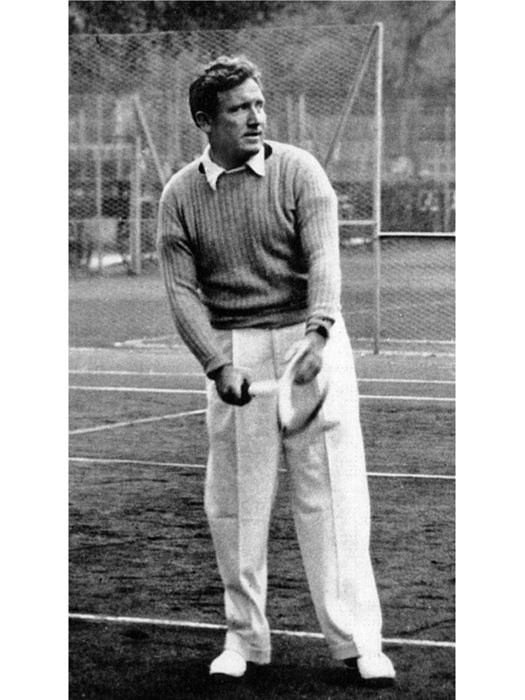
On the tennis court, circa 1944. (PATRICIA MAHON COLLECTION)
Kate played along, aware that Spence had a real need to believe that Louise didn’t know, but she realized, of course, that Louise couldn’t possibly have been so clueless. “She’d have had to have been so dense, which she wasn’t. Smart woman. Unsensitive. What shall I say? I think she had no sense of magic, she had no sense of the enormous complication of an Irish drunk.”
Chuck Sligh could remember a brief exchange with Louise while visiting Los Angeles in the early fifties. The kids were out on their own, and she was alone at the ranch in Encino.
Louise would round the three up so that we could all be together. This one time she called each of the children and Spence. Then she took me down to Chasen’s and each of the others came in their own car, so we had five people and four cars. We had a nice dinner, friendly. Spence was, of course, always fun to listen to. Finally, somebody said, “Well, I guess we’ve got to be going.” And each of them went out and got in their own car and went. Louise and I drove back to the house, and on the way out I said, “Louise, how come you and Spence are still married? I’m surprised you haven’t divorced him. I know he’s a Catholic, but—”
She said, “Well, he is a Catholic … and I thought at first this would all just … blow over … but it didn’t … Now … I think it would be sort of silly after all this time to divorce him.” And that was the end of that conversation.
In April 1949 Kate was finally ready to do As You Like It for the Theatre Guild, and it became a source of some tension between her and Tracy. For most of the time she had known him, she had made it her business to be where he was, to do what he wanted. “He couldn’t have left me,” she said. “I was too adorable—and sensible. I loved him and made a life for him that was irresistible to him. Otherwise, I think he would have wandered off.”
Eight years into the relationship, with her Metro contract having lapsed and her only work being pictures in which she was costarred with Tracy, she needed to get away, to go back to the stage, to stretch herself and try something different. Over the summer of 1949 she worked with actressConstance Collier, whose roles had included Juliet and Portia and Lady Macbeth and who had excited her interest in Shakespeare after years of prodding on the part of Lawrence Langner.
Retakes for Adam’s Rib finished the last week of August 1949. Hepburn staged the company wrap party and then headed east to Connecticut. Tracy followed shortly thereafter, installing himself at New York’s Pierre Hotel. He was back in New York in October, beset by stomach troubles and headed for Boston, where he checked into Peter Bent Brigham Hospital for “the works.”
As Kate could never be a part of the Tracy family, neither could Spence ever fit in with the Hepburns. “I think,” said Kate, “he was embarrassed with Mother and Dad because he was married and because it had gone on so long. I didn’t blame him, in a way.” Still, she never really left home, went back most weekends when she was in New York. “And when I went back there, I didn’t go to my atmosphere; I went to their atmosphere—of which I was a part.”
Tracy always portrayed Kate’s family as if they were Old Man Vanderhof’s clan from You Can’t Take It With You—strident, self-righteous, a little nuts around the edges. He loved twitting her about her “sacrosanct goddamn family” (as Katharine Houghton so aptly put it), throwing asides into master takes with the hope of sending her up. Shooting State of the Union on the set of a Detroit hotel room, his character was attempting to get a haircut when actor Frank Austin burst in through a side door, a pamphlet-wielding crackpot claiming to represent the eight hundred members of the League for the Abolition of Taxation. “The government should earn its own money like the rest of us!” he declared as Van Johnson hustled him from the room, “Abolish taxation!” Tracy, with an impish grin on his face, said to Hepburn. “Looks a little like your brother Dick,” to which she laughed and then, almost as an afterthought, kicked him sharply in the leg.2
In five days of tests and x-rays at Brigham, nothing proved conclusive. On Saturday, October 22, Tracy made the two-hour drive to Old Saybrook, where the Hepburn family’s summer estate, Fenwick, stood on three acres fronting Long Island Sound at the mouth of the Connecticut River. Katharine Houghton (née Grant, daughter of Kate’s younger sister, Marion), age four, was there with her parents and older brother.
“I remember him standing in the large tile foyer,” she said.
All of my family were assembled: grandparents, aunts, uncles, cousins. And, of course, Kate. I still have a vision of him standing there turning his hat in his hands and being quite nervous. I guess he must have come a little before lunch, and an autumn storm was brewing. At the dining table my older brother asked him to recite “Casey at the Bat” because we’d been told by my Aunt Katy that Spencer could do that very well. My grandfather, who was generally very suspicious of any of Kate’s beaux, wasn’t particularly enthusiastic about the performance. Spencer, after all, was a married man. My grandfather didn’t know what he was about, what he was up to. The storm got worse and worse during lunch, and the little sailboats moored near the big breakwater south of the house were beginning to pull their moorings. Kate was watching them, as was everyone else in the family, but I don’t think Spencer was. All of a sudden, Kate got up and said in a loud voice, “Everybody drop your pants and follow me!” So everyone, except the young kids, leapt up and took off their shoes and pants and tore out to the beach. The little boats were about to crash into our jetty. Spencer didn’t move. He just sat there and said, “This whole family is nuts.”
I don’t remember his ever visiting the house again. I do, however, remember my Aunt Kate mentioning something about other visits on various occasions in the late seventies or early eighties. Driving back to New York City on I-95 she’d say, “You see that Howard Johnson’s?” I’d say, “Yes.” She’d say, “Spencer used to stay there when I would come east to see Mother and Dad at Fenwick.”

A dual portrait, apparently penned during the making of State of the Union. The inscription, in Tracy’s barely legible hand, reads: “To the old one with love from THE PRESIDENT.” (ACADEMY OF MOTION PICTURE ARTS AND SCIENCES)
Tracy returned that same evening to Boston, where his test results pointed to an ulcer and not the malignancy he had feared. He met with Seymour Gray, a gastroenterologist and associate professor at the Harvard School of Medicine, who saw before him a “tortured soul” who had “an enormous guilt complex about his mute [sic] son, which he interpreted as a punishment from God for his sins.”
Tracy went back to New York, where rehearsals for As You Like It were under way, and after a couple of days with little to do, flew home to Los Angeles, where Dr. Dennis affirmed all of Dr. Gray’s findings. Nausea overtook him, and he spent nearly two weeks without an appetite. He met with Benny Thau at the studio, confirming a tentative start date for his next picture, but it wasn’t until he went out to the ranch for dinner on November 9 that he began to feel better.
As You Like It opened in New Haven on December 8 before a capacity audience that included Dr. and Mrs. Hepburn and the playwright and novelist Thornton Wilder. Any doubts about Kate’s fitness for the role of Rosalind were dispelled by a spirited, if not particularly commanding performance, and she was accorded seven curtain calls. Moving on to Boston, the show settled in at the Colonial Theatre, where Spence came to see her at Christmas, another sell-out engagement just prior to a limited Broadway run. Adam’s Rib had already been put into release, its New York opening set for the twenty-fifth at the Capitol. Rain and threatening weather brought huge crowds. Bolstered by strong notices and all the advance press accorded As You Like It, the picture stayed a total of twenty-four days before pushing out into the boroughs, where it faded quickly—more quickly than anyone expected.
“All the Katharine Hepburn–Spencer Tracy pictures I made were just mediocre successes,” Larry Weingarten lamented toward the end of his life. “When they got out of the big cities the fellows just didn’t understand them and the women—they didn’t go, it was too sophisticated for them.” There was also the scattered picketing of theaters from Kate’s presumed support of Henry Wallace and the Progressives.
Ironically, word-of-mouth benefited Adam’s Rib more than any of the previous Tracy-Hepburn pairings, and it ended up being the most profitable of all their pictures after Keeper of the Flame. Spence’s aunt Jenny, now living near her daughter in Renton, Washington, caught the buzz firsthand when she saw a doctor for stomach complaints—the family nerves that afflicted them all. “Mrs. Feely,” the doctor told her, “you should get out and do things. Go to a movie, get your mind off your worries. I saw the most wonderful movie last night—you should see it. I’ve laughed all day long. The name of it is Adam’s Rib.”
Jenny, a steely tone suddenly entering her voice: “No … I haven’t seen it yet, but I suppose that I’ll go.”
“It’s Spencer Tracy and Katharine Hepburn,” the man continued, not knowing when to let up. “It’s a riot—you really should see it.”
“I don’t think you’d laugh so much,” she snapped back, “if it was your nephew making a fool of himself!”
“That was hard for her to take,” her daughter Jane commented. “Oh, dear God. Katharine. Katharine Hepburn. ‘The hussy.’ It was always the woman [never the man]. Oh, heavens no. You know that he was dragged by his neck into that unholy alliance by this woman of no principles whatsoever. And my mother was not that kind—she was a very bright woman, an intellectual Catholic, very well informed. But on certain subjects like that, [the instinct of] the mother and her cub took over. It was never on your family’s side; there was no fault there. That double standard—the lace curtains. Appearances must be kept up.”
Andrew Tracy was the only member of the family to have actually met Kate Hepburn during one of his infrequent visits to California. “I don’t think this Katharine Hepburn is such a big deal,” he said, clearly and instantly taken with her. “She stuck her paw out and said, ‘Hello, Uncle Andrew.’ That was enough for me.”
The situation with Louise was worrisome, the tension thick between Spence and his brother Carroll. Andrew’s son Frank could remember his father describing his nephew’s dressing room on the M-G-M lot, a living room and a bedroom alongside Gable’s on the second floor of the building. “Sometimes Spence came in and went in his bedroom, laid down and took a nap. I remember Dorothy would be complaining about his treatment of Carroll, that Carroll would come home all shaky and white and pale, practically in tears and ready for a rubber room. And, meanwhile, Spence was back up there in his dressing room sound asleep, oblivious to the hellacious behavior that had caused this poor man to come apart.”
Malaya went into distribution six weeks after Adam’s Rib. A pulpy melodrama that held little sway with city audiences, it played off well in the sticks, its modest cost a considerable factor in its commercial success. Tracy returned to L.A. on January 6, 1950, and was present on the sixteenth when Louise’s father, Allienne Treadwell, died in San Diego at the age of eighty-one. Spence had met the old man, a practicing lawyer who came up to Encino once in a while for dinner and to borrow money. Louise was bitter when she was young, but she had long since made her peace with him. “You have to forgive,” she said. “Everybody does. You have to believe everybody does the best they can under the circumstances.”
The father was, in the opinion of Alathena Smith, at the root of Louise’s coolness. She was, as Dr. Smith put it, a “blood-red bleeding heart locked into a blue block of ice,” for she had been hurt by a man before Spence. “Don’t blame this on deafness,” she warned Jane Ardmore, who was planning a book on Louise and the clinic. “She adored her father and her father left her mother.” The memory of loss, the aversion to pain, held Louise at an emotional distance from even those closest to her. She got around it by giving herself to the work of the clinic and to young parents who reminded her of Spence and herself when they were confused and scared and unsure of what to do. “She shows it in the kindness in her letters,” said Dr. Smith in 1972. “She’ll spend 45 minutes on a paragraph to help some mother … She puts no limits on the help that I give to parents.”
Louise was still invisible to much of the film colony, a solitary figure at her husband’s previews, sometimes with John but just as often completely alone. “Occasionally we sat near her at some of the Tracy-Hepburn previews,” said screenwriter Lenore Coffee, “and she had the air of an interested member of the audience; of course, no one knew her by sight.” In the November 1949 issue of Modern Screen, Louise was featured in an article by Hedda Hopper, who made no secret of her dislike for Katharine Hepburn. Its title: “Hollywood’s Forgotten Wives.”
Hepburn, meanwhile, was slowly tightening her grip on Tracy, moving him away from Leo Morrison and into the hands of Bert Allenberg, who was now managing her own affairs at the William Morris Agency. Morrison was stunned when the process began, first by the appointment of Ross Evans as Tracy’s interim representative in August 1949, then by the formal request for a letter of termination at the end of the calendar year. Once payment in full had been acknowledged for all outstanding claims, Tracy gave his agent of twenty years a bonus “in appreciation of past services” even as he continued to duck his calls.
Kate also disliked Spence’s ongoing residency at the Beverly Hills Hotel, where managing partner Hernando Courtright allowed him to live rent-free in exchange for being seen regularly in the Polo Lounge, where he sat quietly sipping tea in the late afternoon and signing autographs for the guests. He hated being put on display and had to be goaded by his secretary into doing it, but the simplicity of hotel life suited him. (“I’ve always liked to live in small places,” he once said, “because I live a small life.”) The arrangement horrified Hepburn, who began looking around for quarters where he could be content and cared for, and yet shielded from the public.
If, as Tracy sometimes said, acting was reacting, then no role could possibly have afforded him a better showcase than that of Stanley T. Banks, the hapless hero of Father of the Bride. The book was by Edward Streeter, a New York banking executive who, in a former life, had been a war correspondent and travel writer. Streeter’s infrequent works, starting with 1919’s Dere Mabel, distinguished him as a chronicler of the put-upon everyman, a wryly observant Boswell of human nature. When Father made the rounds in manuscript form, it was snapped up by the Book-of-the-Month Club, then by Metro-Goldwyn-Mayer, which paid $100,000 for the film rights. As soon as word of the purchase got out, comedian Jack Benny cornered Dore Schary at a party and said that he wanted to play Banks. According to Pan Berman, who had responsibility for the project, Schary said, “Great, marvelous, we’d love to have you, you’ve got it.” And then he dropped his fait accompli in Berman’s lap.
“ ‘Dore,’ I said, ‘Jack Benny is a wonderful personality, but he simply won’t do. I know we don’t even have to ask [Vincente] Minnelli, but if you want to …’ ” Minnelli had directed Madame Bovary under Berman’s supervision and liked the idea of following it with a comedy.
We did test Jack Benny and he made a valiant effort, but it was terrible because it wasn’t for him. I went in and told Dore, “It’s hopeless.” Dore said, “I don’t agree with you. I think it’s great.” I remained steadfast. “Well, who are you going to get?” he asked. I said Spencer. “You’ll never get Spencer to do it.” “I’ll get him.” “Well, then, you’ll have to call Jack and tell him we’re not going to use him.” “I’ve got to call Jack? He’s been a dear friend for years. We dine in each other’s homes once a month. We’re all part of a gang together. Why should I have to call? If I had talked to him to begin with, I would have told him no in the first place.” So I did. Jack didn’t talk to me for ten years after that.
Tracy, said Berman, took about a week to make up his mind. Schary recalled a more complicated and angst-ridden process, which played itself out over a period of months and followed a pattern he came to regard as typical: “First there would be reservations about the original material, followed by a crashing refusal; then a quiet talk with suggestions of how it could be fashioned to suit Spence. This heart-to-heart would be followed by a wave of enthusiasm, later dispelled when the first script was born. With doubts returned, another conference had to be called, suggestions of how to change and improve the script would be on the agenda, and finally we would have Tracy’s approval.”
Assigned the screenplay was the husband-wife team of Frances Goodrich and Albert Hackett, both of whom thought the book “darling.” Goodrich, moreover, had been courted by Ed Streeter as a young actress. “It’s nice to think of my brainchild sitting in your lap like Charlie McCarthy while you put ideas in his head,” Streeter commented in a letter to Goodrich.
Tracy’s vacillations brought other potential candidates to the fore, and Streeter claimed to have heard unfounded reports “ranging from Harpo Marx to Paul Robeson.” Fredric March and Walter Pidgeon were candidates, and even Charles Laughton got mentioned at one particularly grim point. “Spencer Tracy is the one I wanted,” Streeter insisted, “but I heard that he was having contract trouble. March is obviously out, Laughton is my idea of nobody, and as for Benny I would nominate Abbott and Costello. Better than that, I would nominate myself.”
Tracy was confirmed for Father of the Bride just as Adam’s Rib went before the cameras. Kate arranged a dinner at which Minnelli made his pitch. “With you,” the director told him, “this picture could be a little classic of comedy. Without you, it’s nothing.” Tracy, recalled Minnelli, was delighted. “He’d heard other people were being tested for the part, and he thought we weren’t interested in him. All he’d wanted was to be wanted. Once Spencer accepted, the rest of the cast fell into place. It took no great imagination to cast beautiful young Elizabeth Taylor as the bride. Joan Bennett, with the same coloring as Elizabeth, seemed a logical choice to play the mother.”
By then, the script had gone through two complete iterations and was headed for a third. After an initial bout of anxieties, the Hacketts did a sterling job with Streeter’s simple yet universal tale, the withering of Mr. Banks translating neatly into three acts of progressive poverty and befuddlement. His plans go awry, and his desperation is evident when he offers his daughter $1,500 in cash to elope. (She thinks he is kidding.) He eventually falls completely from his family’s notice, underfoot as the wedding planner, the caterer, and the florist take over. In the end he slogs wearily upstairs, the forgotten man who has to pay for it all, an image eventually adapted for the film’s opening sequence in which Banks, his house strewn with the detritus of a chaotic reception, massages an aching foot as he empties confetti and rice from his shoe. “I would like to say a few words about weddings…,” he begins.
Tracy’s immersion in the role permitted him to inhabit a character as cartoonish as Banks and deliver a fully dimensional human being. In a scene around the family dinner table, Stanley first learns that his daughter is “in love” with somebody named Buckley and that she intends to get married. Alternately skeptical, peevish, combative, and shell-shocked, Tracy managed the beats with a musical precision, never leaning into the role but simply allowing it to happen. “Who is this Buckley anyway? And what’s his last name? I hope it’s better than his first one. Where the devil does he come from? And who does he think is going to support him? If he thinks I am he’s got another thing coming …”
He was, said Minnelli, an inspiration: “His instincts were infallible. He knew how to throw the unimportant things away, and he knew how to create the illusion of throwing the important things away too, so that they were inscribed on your mind. His way of speaking made you feel you’d stumbled on a great truth. You saw real life reflected in his face … and also strength.”
In choosing to let Tracy set the pace of the film, Minnelli took advantage of his inner stillness, a steadiness about his eyes and head that suggested simplicity while masking a furious turning of wheels. “There wasn’t a better man at comedy. He wasn’t a mugger, at least not in scenes with other actors. The facial contortions came when he was alone and unobserved.” Minnelli liked to point out a scene in which Banks mediates a reconciliation between his daughter and her fiancé and then finds himself stranded as they rush into each other’s arms. “The father is left standing there, the unwanted third man, trying to figure out a way to gracefully exit … Spencer’s reading was the essence of comedy, because it was achingly true. And he knew how well he’d done it, for no one had greater reason to feel secure about his ability than Spencer.”
Actor Don Taylor, playing the unexceptional Buckley Dunstan, hadn’t yet met Tracy when called upon to play his first important scene, the business of Kay Banks (Elizabeth Taylor) having slammed a car door on his hand. “We talked; we did the scene,” said Taylor.

“Who is this Buckley anyway?” Tracy, Joan Bennett, and Elizabeth Taylor in Father of the Bride (1950). (SUSIE TRACY)
And Minnelli said, “Well, I think I’ll have to print that.” (Meaning, “Very good!”) But ol’ Spence said [growling], “No-o-o-o-o, Vincente, no, that’s no good!” And he turned to me and he said, “I’m Spencer Tracy.” I said, “I’m Don Taylor.” Nobody had introduced us. Of course, I was mesmerized by him in every facet—as an actor, as a human being, and, you know, as a fellow man. He said, “C’mon!” and the two of us walked around the stage. We walked around twice, and we rehearsed the scene, ad-libbed a little bit, put it together, and came back, and Tracy said, “NOW we’ll shoot it.” And we shot it, and Minnelli said, “Cut! Print!”
Tracy hadn’t seen much of Joan Bennett since the completion of Me and My Gal, and her presence on the set clearly delighted him. They were like old lovers, sharing confidences and irreverent memories and occasionally even finishing each other’s sentences. “He was not quite as jovial as he used to be,” Bennett later remarked, “but he was still the good natured, wonderful actor that he’d always been.”
Each morning, Tracy would breeze past his secretary’s office (“Top o’ the mornin’ Miss G.!”) and mount the stairs to his permanent dressing room, where Larry Keethe would be awaiting him. Even a modern-dress picture required close attention to wardrobe, and it was Keethe’s job to know what tie, what suit, what shirt was necessary for any given scene, down to the smallest detail. Interiors of the Banks home had been assembled on M-G-M’s Stage 26, where Tracy was always punctual for his nine o’clock call.

With Elizabeth Taylor on the set of Father of the Bride. (SUSIE TRACY)
Bennett noticed how accommodating Tracy could be to his fellow performers, a trait that had not always distinguished him in the past. “If they wanted to rehearse, much as he disliked doing it, he would go ahead and rehearse with these people, these other actors, so that they could be secure in what they were doing.” Elizabeth Taylor, who had been at M-G-M since 1943, regarded the opportunity to work with him as a master’s class in the art of film acting: “Even at eighteen I learned so much by just watching Spence … it was his sense of stillness, his ability to use economy of movement, vocal economy. It seemed almost effortless. It seemed as if he wasn’t doing anything, and yet he was doing everything. It came so subtly out of his eyes. Every muscle in his face.”
Tracy, in turn, seemed to regard the boisterous Taylor as he might a second daughter, addressing her as Kitten (as he did in the film) and allowing her to call him Pops. “In between takes, he would be Spence … I mean we would really horse around. He’d chase me, rough me up. I’d tease him. But the minute the camera started, except once—I’d been naughty. I’d really been horsing around on the set, chasing him on a bicycle. And it was my closeup, and it was not a very intense moment, but a serious moment between father and daughter. The camera was on his back, and he played the whole scene with his eyes crossed, seeing how great my powers of concentration were. I could have killed him, but I didn’t bust up.” To his aunt Jenny he wrote: “We have been going along pretty smoothly on Father of the Bride—think it will be a nice, harmless movie.”
Tracy’s case of nerves persisted throughout the making of Father of the Bride, and though he merely seemed “more subdued” to Joan Bennett, he was convinced by the end of production that he had stomach cancer. Hepburn was in New York, where she was playing As You Like It, and he made plans to join her there, traveling to Boston for more tests at Brigham Hospital and another consultation with Dr. Gray. One day he surprised Bill Self by asking him to come along.
“Initially we were going to drive,” Self recalled,
and he wanted me to help him drive to New York, which was kind of a legitimate reason. The plan was that I would pack and meet him at Chasen’s for dinner. He had all the maps and was prepared for it. We were going to have dinner at Chasen’s and then we were going to drive to Palm Springs and spend the first night in Palm Springs, then take off for New York. So I arrived at Chasen’s with my bag. (He even made me go out and buy a hat, because I didn’t have a hat. He said, “You can’t be in New York without a hat.” So he gave me some money and I went out and bought a hat.) I arrived at Chasen’s and told the valet to put my bag in Mr. Tracy’s car. I went in and Spence was sitting there. I don’t remember if anyone was with him or not; there might have been Carroll.
He said, “Where you going?” I said, “I’m going to New York.” He said, “Oh, that’s interesting. I’m going to New York, but not tonight.” I said, “Oh? You’re not going tonight?” He said, “Well, I was going to drive to New York, but I’m not going to drive. I’m going to take the train.” I said, “Well, fine. What’s that mean to me?” He said, “You’re going with me. I have your ticket.”
Everybody says it would have been a disaster [to drive], and I have no doubt they were right. So we had dinner. I came home, caught [my wife] Peggy by surprise, and the next day we left on the train. The trip eastward was uneventful; we got along okay. The only eventful thing was that Fred Astaire and his wife were on the train, and that was the first time I ever met Fred and his wife. I didn’t remind Fred of that meeting until many, many years later. Nothing came of it, but Spence was not anxious to team up with them … While on the train, I said to him, “Why am I with you?” He said, “Because if somebody isn’t with me, people come up to me and talk to me. If I’m talking to somebody that I know, people don’t usually come up.” He said, “That’s particularly true at dinner.”
I never felt as close to Tracy as I felt to Hepburn. With me, Hepburn was very open. She’d say anything. She was just terrific. Tracy was much more reserved. I was careful not to talk about little things. He hated little conversations. “Small talk.” I would have to choose my subjects carefully. He’d rather sit there silently. He once said to me about the New York trip, “You know the real reason I asked you to go to New York? You don’t talk to me. I hate casual conversation. You and I don’t talk about those kinds of things.” I loved to talk about his career, because I didn’t know that much about his career and I was a young actor. I wanted to know more about: How do you do it? And he did talk to me about his career, told me lots of stories about when he got going…
We got to New York. Spence went to his hotel, and I went to mine. Hepburn had borrowed a Rolls-Royce from somebody. The Rolls-Royce would drop her at the theater and then it would drop Spence and me at a different theater. I remember going to see Sir Cedric Hardwicke in Caesar and Cleopatra. Spence always sat in the back row; he would enter the theater late, and he would leave the theater the moment the curtain came down. We dashed backstage to say hello to Sir Cedric Hardwicke, which was kind of interesting to me.
Often, Tracy and Self would walk the theater district after a performance, Kate’s show running later than most. “He told me all these stories about his drinking buddies and what he did and what he shouldn’t have done. We were walking in the Broadway area, and we passed a theater where he said, ‘This is where John Barrymore played Hamlet.’ ” It was the old Harris Theatre, now a Forty-second Street grind house, where Tracy himself had played Killer Mears in The Last Mile.

“Three Guys from Milwaukee” was the original caption for this M-G-M publicity photo. From left: Bill Self, Wisconsin state tennis champion; Tracy; and Frank Parker, U.S. national tennis champion. (WILLIAM SELF)
I said, “Did you ever work with Barrymore?” He said, “No.” And I, being facetious, said, “You would have made a great pair—a couple of drinkers like you.” How stupid can you be? He stopped and said, “What do you mean by that?” I said, “Well, Spence, you know you’re always kidding about the amount of drinking you did …” He said, “I don’t kid about my drinking.”
One evening we went back to Hepburn’s theater and picked her up—or she picked us up if she had the car—and we went to the Pierre. We talked for hours. It was a terrific evening, because I was hearing two giants tell their stories. They talked about George M. Cohan … We talked until two or three in the morning. Earlier, Spence had said, “Call me at eight o’clock and we’ll do something. Sightsee or something.” I said, “Great.” Then we talked much later than I expected. Spence said, “You take Katie back to her home.” So I went with her, and I did that, and then the car dropped me off. The next morning at eight o’clock I thought, Well I can’t call Spence at eight o’clock; we were up till four. I’ll wait a little while. Nine o’clock I called, and he said, “Where the hell have you been??”
I said, “Well, Spence, I thought we were all up so late that I would hesitate to call you at eight o’clock.” And he said, “Well, Bill, people who get along with me do what they say they’re going to do.” And he hangs up.
I had no money; he had been paying the bills. A few minutes later, Katie called and said, “What happened?” And I said, “Well, Kate, I was reluctant to call—you know how late we were up and I was concerned about calling him.” She said, “Well, he’s upset. Let him alone. I’ll fix it up. Don’t call him, don’t bother him. Just stay put.”
So I would say two or three days go by and I don’t hear a word from him. She called me and said, “I’m working on it.” I’m wandering around New York. I have no business there, no money, no nothing. I knew they were going to pay the bills. I wasn’t worried about that. I just didn’t know what to do. And then she called and said, “You’re going home tomorrow, and you leave at such-and-such a time from Penn Station (or whatever it was) and don’t be late.” I said, “I’m not going to be late. Not after this.”
So I met him at the station, and he was cool. Very awkward. My sole purpose for being there was to please him, and here I was and he wouldn’t even talk to me. So we got on the train and we had to change in Chicago, and he warmed up. That was when he told me that he thought he had stomach cancer, told me about his doctor in Boston. And he excused himself for being so touchy, I guess by virtue of having this on his mind. So we got friendly enough. We got to Chicago, and we were met by the M-G-M representative, limousine and all that, and he had booked a suite for us at the Blackstone Hotel. When we got to the suite there was liquor in the room. He said, “I could get this guy fired for that.”
They cleared the room of liquor, and Spence said that he was going to take a nap. He said, “You want the car?” I said, “Well, I went to the University of Chicago, and if I had the car I would go out there to my fraternity house and say hello to some of the guys. I would enjoy doing that.” He said, “Go ahead, take the car. We’ll leave here at such-and-such a time.” I said, “Great.” So I took the car, and I went out there and I bummed around. I was back well ahead of when I was supposed to be back, and I opened the door, and there was Spence sitting in a chair facing the door saying, “Where in the hell have you been??”
I said, “You know where I’ve been. I went out to the University of Chicago.” He said, “Bill, I couldn’t sleep. I can’t go out for a walk. You know that. I’m stuck in this room. You’ve got the car.” And he bawls hell out of me. Much to my surprise, I took him off. I said, “Mr. Tracy, you are too tough for me. When we get back, I never want to see you again. I don’t want anything to do with you.” I was amazed with myself for saying that because I thought, “I’m ruining my career. I’ll never work at M-G-M again.” He was shocked. He was shocked, and I was trembling, I was so angry. I don’t mind being accused of something if I’m wrong, but I was so right. And on top of the other thing, which I was trying to do the best I could. This was totally uncalled for, and so we just gathered our belongings and went to the station and got on the train.
And then he came around and literally apologized to me. He said, “Bill, this whole cancer thing scared me and I’ve been very tight and I’m sorry.” I said, “Well, that’s fine. I just hope I haven’t done anything wrong,” and he said, “No, you haven’t done anything wrong.” In fact, when we got back to Los Angeles, the first thing he did was to take me to Palm Springs with his family, down to the Racket Club to play some tennis and make amends, I guess. It’s the only time in my life I’ve ever been to the Racket Club. So everything seemed to be smoothed over. I never totally trusted him again, though. I just realized that I was dealing with a guy who could be pretty tricky.
Tracy observed his fiftieth birthday on April 5, 1950. Already assembled and previewed, Father of the Bride garnered 149 cards rating it outstanding or excellent and another 47 judging it to be “very good.” The audience at the Bay Theatre in Pacific Palisades was split evenly between males and females in the eighteen-to-forty-five age group, and both Berman and Schary were instantly convinced they had a big hit on their hands. Schary, in fact, already had the Hacketts sketching out notes for a sequel.
“I know you will realize with what horror we went into such a venture,” Frances Goodrich apologetically said in a letter to Ed Streeter. “But the studio felt so encouraged, after the very first days of shooting, that they wanted to be prepared … We feel like orphans on this one, sailing on uncharted seas … it is really terrifying. But we go on with our fingers crossed. We are doing, as you probably know, Kay’s first baby. Are you puking already? Don’t sue us.”
As You Like It closed on June 3, the colorful production having received better overall notices than Hepburn herself, even as her infrequently seen legs were widely—and favorably—remarked upon. (“She has the greatest set of legs I ever saw on a woman,” Tim Durant once said.) “They thought I was O.K.,” Hepburn said in her autobiography. “Sort of half carps and half praise. Looking back on my notices which I did not read at the time, I have the impression that I was irritating to the critics. They liked me in The Philadelphia Story, but in Shakespeare—well—it was sort of ‘she has a nerve to be doing this.’ Well I don’t know … At least I enjoyed it.”
She was back in California when Father of the Bride was released nationally on the sixteenth. Already in the midst of a six-week engagement at the Radio City Music Hall, the film surpassed any of Tracy’s previous features, bringing in more than $6 million in worldwide rentals and showing a profit of nearly $3 million on a cost of $1.2 million. From New York, where he had witnessed an advance screening on May 2, Edward Streeter wrote Tracy: “No one who ever sees the picture will be a more severe critic than I was last night in view of the fact that you were portraying ME. All I can say is that you have given me much to live up to, although it is more or less wasted in one sense of the word as I have no more daughters to marry off.”
Tracy replied:
It is utterly impossible for me to express to you the pleasure your letter has given me. The fact that I admired your book so much has a great deal to do with this, plus, I suppose, the fact that this is the first time an author of a book in which I was part of the so-called movie version has ever written me except to warn me that it might be in my best interests to avoid him. Sinclair Lewis, whom I knew well enough to call “Red,” has not spoken to me since the “version” of Cass Timberlane, and Kenneth Roberts, whose Northwest Passage I thought we did a pretty fair job [on], I understand has gone so far as to threaten bodily harm if I so much as entered the state of Maine. Since I had heard that you did not particularly like the script, I was doubly pleased to get your favorable reaction. Had I known this, I should certainly have called upon you last week when I was in New York, and now that I know you are not armed, I shall do so on my next visit.
The picture’s notices were wildly favorable, coming as they did just six months after a similar embrace for Adam’s Rib. (As Variety noted, “It’s the second strong comedy in a row for Spencer Tracy, doing the title role, and he socks it.”) Terms like “glamour-packed,” “rich in comic invention,” and “charming and refreshing” littered the reviews. Bosley Crowther used the first paragraph of his notice in the Times to heap praise on the book and then went on to say the movie was “equally wonderful … Mr. Tracy conducts himself with precisely the air of self-importance that a bride’s father likes to think he has, coupled with the mingled indignation and frustration that he is sure to acquire. Further, he has a capacity to show that warmth and tenderness toward his own which flavors with universal poignance the irony of the joke on him. As a father, torn by jealousy, devotion, pride, and righteous wrath, Mr. Tracy is tops.”
The pressure to do a sequel only increased with the film’s commercial success, but given that Tracy’s only experience with sequels had been the execrable Men of Boys Town, he resisted the idea. “Tracy didn’t want to do the second picture,” Pan Berman remembered. “What actor wants to do it again? I hated the sequel. I didn’t want to do it, but knew money. You know the sequel isn’t going to do as well.” According to Minnelli, it was Hepburn who stepped in once again, perhaps as a favor, as Berman believed, for either Benny Thau or L. B. Mayer. “In her practical way, she convinced Spencer that he owed it to the studio to do the film. Movies were a business, after all, and the first picture had been such a huge success that this one couldn’t fail either.”
A draft screenplay was completed in April, but Tracy held out until plans for Father’s Little Dividend collided with Minnelli’s next project, an elaborate musical based on the works of George and Ira Gershwin titled An American in Paris. Tracy went east on September 2, joining Kate as she began rehearsals for the national touring company of As You Like It, declaring he would take the rest of the month off before starting the new picture. On the thirteenth he received a telegram from Pan Berman confirming an official start date of October 9. “Am very happy,” Berman wrote, “because neither you nor I are getting any younger so we’d better get it made.” When Hepburn opened in Hershey, Pennsylvania, on September 22, Tracy was back in Los Angeles. He wired:
YOU MAY FORGET ALL THEM THINGS I LEARNED YOU ABOUT UNDERPLAYING BUT PLEASE REMEMBER THE REST. THE NEXT VOICE YOU HEAR I HOPE WILL BE MINE.
He signed the communiqué “Ever – Old Pot,” a likely reference to all the coffee he guzzled.3
According to Buck Herzog of the Sentinel, Tracy turned up in Milwaukee about a week later, completely unnoticed and making the rounds with Gene Sullivan. It was at the height of widespread rumors that Tracy and Hepburn were “more than just good friends,” and both were fuming over a splashy article by Richard Gehman in the high-end arts and fashion journal Flair that helped fuel such talk. Profiling Hepburn, Gehman essentially outed the relationship, suggesting their devotion to each other was an established fact: “They are together whenever professional commitments permit: Tracy turned up in Boston when As You Like It was there, and in 1945 when he was playing in Robert E. Sherwood’s The Rugged Path, Hepburn followed him about and, on one occasion, reportedly scrubbed the floor of his dressing room. They have often been seen riding in Hepburn’s black Lincoln convertible (Connecticut license KH-6), but they have never furnished column material by appearing in a public place.”
Since, in support of As You Like It, Hepburn had cooperated with Gehman, albeit minimally, Tracy may well have blamed her for the humiliation Louise no doubt suffered. Said Herzog: “We started the evening at the Club Madrid and wound up in the wee hours of the morning. He left the following day for Hollywood, followed by gossip column reports that his whirlwind courtship with Miss Hepburn, whom he had followed on tour, ended in a spat.”
Joan Bennett remembered a phrase Tracy had picked up from Kate: “Bore, bore, bore …” She heard it at the start of Father’s Little Dividend, but once he got into it, he actually seemed to be enjoying himself, racing through the picture in twenty-one days, seven days under schedule. “I went out to George [Cukor]’s for my first party to say goodbye to Viv[ien Leigh] and Larry [Olivier]—and Spence was there,” Constance Collier wrote in a letter to Hepburn, hoping, perhaps, to mend the rift. “In all the time I have known him—I have never seen him look so well—really wonderful—very brown and thinner and he was so funny and charming.”
At one point, Tracy became concerned that one of the twin babies playing his grandson in the picture was either hard of hearing or completely deaf. “I don’t think anything was wrong,” said Don Taylor, “but he was VERY concerned about it—I know that—and he called his wife.” Louise came to the set, and Spence, in light of the Flair article, was uncommonly solicitous, posing for pictures with her and talking up her work with the clinic. “They were very sweet to each other,” Taylor said. “She came on and he said, ‘Hello! Hi! How are you?’ They were dear. He introduced the mother, and his wife talked to the children.”
With sets recycled from the first film, Minnelli was able to wrap the picture $150,000 under budget. “These last three comedies have entirely changed my viewpoint,” Tracy told a visitor. “Where before I doted on doing dramatic roles, I have never been as happy as I am now. In these uncertain times I think the public wants escapist pictures and I hope I’ll get my share of them.”
There was never, however, an overabundance of comedies during Dore Schary’s reign at M-G-M. Tracy was bolstered in his quest for escapist fare only by the knowledge that the Kanins were at work for him on another original. Carrying the title Pat and Mike,the story concerned a woman whose controlling husband has little time for their marriage. When Pat Ford tells off the wife of an important client, Joe blows up and tells her that she couldn’t earn a penny on her own. Pat impulsively decides to turn athlete under the guidance of a local golf pro and quickly becomes the sensation of the Hot Springs Open. She attracts the attention of one Mike Cavanaugh, a destitute promoter, and goes on to phenomenal success in tennis and baseball under his shrewd management. It is Mike who tries injecting sex into sports by matching women against men, an idea that culminates in a big charity game between Pat’s girls and the Giants. The girls, of course, win, and Pat comes to realize that it is Mike she truly loves.
Where Adam’s Rib had come together quickly, all the pieces falling smoothly into place, Pat and Mike proved a much tougher job. Though conceived expressly for Tracy and Hepburn, the initial reader’s report was not encouraging: “A not too successful attempt to pound a clever but slight and difficult idea into comedy form. It has lots of laughs, but despite the unquestioned ability and experience of the writers, it doesn’t have quite the flair to put this sort of thing across. Many of the gags are pointless and familiar, as are the trick camera effects. And the galaxy of famous sports and political figures involved certainly deserve a better showcase.”
Pat and Mike was still under development when Tracy finished with Father’s Little Dividend, and the Hacketts said he proposed a plot for yet another sequel, this one taking him and Elizabeth Taylor on a European cruise. Joan Bennett, however, didn’t remember it that way: “When they asked him to make another [sequel] to Father of the Bride, he said no, he didn’t want to be playing Judge Hardy.”
All this left him free for something a little closer to Schary’s heart, a gritty courtroom drama called The People Against O’Hara. Anything but escapist fare, it began as an outline called Johnny O’Hara’s Life by Eleazar Lipsky, a novelist and assistant district attorney who was attached for four years to the homicide bureau of New York County. The author of Kiss of Death, Lipsky proposed a robbery-murder scenario, detailing in documentary fashion the events flowing from an ordinary criminal act. “We will see not only the machinery of justice turning, but also the steps taken by the defense to anticipate the prosecution. The cat-and-mouse play between the two should develop simultaneously.” Offered initially on an option basis, Lipsky subsequently submitted a 366-page manuscript, which became the novel on which the picture was officially based. Molding Lipsky’s story into a star turn for someone of Tracy’s magnitude took nearly a year.
The “contract trouble” Edward Streeter alluded to was typically over vacation and rest periods and the number of pictures Tracy could be required to make in a given year. In August 1949 a new interim agreement was signed that limited him to just two pictures a year and allowed thirteen consecutive weeks of vacation. Late in 1950 the William Morris Agency undertook a further modification of the deal, extending his rest periods to a minimum of six weeks between films and boosting his compensation to $150,000 a picture, or $5,769.23 a week on a fifty-two-week guarantee.
By doubling production, Schary had cut overhead costs per picture in half. He shortened production schedules—Woman of the Year took fifty-nine days to shoot while Father of the Bride took just twenty-eight days—and cut the average number of writers on a project from 7.3 (under the old Thalberg model) to 1.2—a dramatic reduction. He also began to root out the deadwood, bringing in younger directors who weren’t mired in the old Metro ways and were used to working at a faster clip.
One of those men was John Sturges, a former editor who, at the age of thirty-nine, was younger than many directors on the lot by at least a decade. In little more than a year, Sturges had completed four films for M-G-M, including The Magnificent Yankee—which had so impressed Tracy that he recorded a voice-over for the film’s trailer. Sturges, however, still needed Tracy’s approval to direct him in The People Against O’Hara. “It was traditional,” he said, “if you met anybody, you, your agent, and that person, if he was a star, had to meet at Romanoff’s. And we did. And talked about the picture we were going to do. Very brief conversation. ‘Look forward to it,’ he said. ‘Look forward to it,’ I said. Both left. That’s all there was to it.”
Sturges later recalled that he and Bert Allenberg, Tracy’s new agent at William Morris, were sipping martinis that day, while Allenberg’s client was calmly drinking a cup of coffee. “Five years later we were talking about alcoholism, and I asked [Spence] how long it had taken him to get over the urge to drink. He reminded me of that moment at Romanoff’s and said, ‘You know, at that time I hadn’t had a drink for five years, but I wanted that martini and I looked at it with as much longing as the day I quit.’ So that’s what the man lived with.”
Tracy began his sixteenth year at M-G-M with a new agent, a new contract, and a new picture in Father’s Little Dividend that was previewing even better than the original. “Audience chortled and howled throughout,” Schary was advised by Larry Weingarten in a wire. “Ending played very well. Looks like this one will pay the rent.”
Tracy was preparing to go east for a Red Cross broadcast and location work on The People Against O’Hara when it was announced that he had received an Academy Award nomination for his work in Father of the Bride—his first Oscar nomination since Boys Town a dozen years earlier.
1 This was likely Homecoming (1948).
2 Richard Houghton Hepburn (1911–2000) was a free spirit, the self-styled playwright of the family, sporadically produced. “Dick was no more eccentric than the rest of them,” Katharine Houghton said, “but he was closest to Kate in age and had been to Hollywood several times, unlike the rest of them. She had complex issues with Dick.”
3 Another frequent signature he used was T.O.T., which probably stood for “Tired Old Tracy.” He rarely, if ever, signed his correct name with close friends. To the Kanins he was “Old Tom.” To George Cukor he was always “Corse Payton,” the flamboyant Brooklyn matinee idol known for billing himself as “America’s Best Bad Actor.”