
CHAPTER 5
Under the pressure of a war for survival, Stalin realigned the cultural front. Paradoxically, the greater the centralization and restrictions he imposed on the cultural front, the less effective the results he sought; the greater the autonomy he extended to the practitioners of cultural production, the greater success in mobilizing the population for the war effort. As a typically Bolshevik military metaphor, the cultural front had taken on a meaning in the early years of Soviet power of a struggle between the party, aiming for control over the institutions and expression of cultural values, and various groups of the pre-revolutionary intelligentsia ranging from proponents of a radically new proletarian culture to defenders of the old values of autonomy and freedom for creative individuals.1 There was no clear-cut outcome, either in the early years or later down to the end of the Soviet regime. The struggle extended along a broad spectrum. On occasion, it took the form of a general offensive, other times, it cut back to local actions as in a real war. This was an ongoing campaign with retreats in some sectors and advances in others. But the firing rarely ceased altogether. To extend the metaphor, the intensity of the fighting depended to a large measure on the combatants involved and the degree to which they were unified in their own ranks as well as the changing conditions in the outer world. From time to time there was a relative pause, when the action subsided to a state of what Sheila Fitzpatrick has labelled ‘cultural orthodoxies’.2 But these pauses were temporary, generated by the imperatives of domestic and foreign policy as perceived by Stalin.
The prewar attempts to impose control on the activities and thoughts of the creative intelligentsia by centrally organizing them into unions and imposing on them a unified aesthetic was part of Stalin’s practice of mobilization. According to one account, Stalin first defined the term ‘socialist realism’ in 1932 during preparations for the first congress of Soviet writers. He rejected the use of the term ‘proletarian’ to define the creative method, proposing instead a term which would express the continuity in the development of literature of critical realism of the nineteenth century changing over into a method (partiinost’) that would define the position of the party on questions of literature and the arts.3 The first congress of the Union of Soviet Writers took place two years later. Although Gorky and Bukharin both spoke, Zhdanov’s keynote address became the classic formulation of the doctrine. The principal components of his definition were partiinost’, ideinost’ (Bolshevik ideology), tipichnost’ (typicality) and narodnost’ (national character). These were interpreted as a commitment to the depiction of reality in its revolutionary development by emphasizing the positive values of socialist society, expressed in clear, uncomplicated and inspirational prose. These elements were subsequently applied, with appropriate emendations, to musical composition, painting and architecture as unions for these professions were formed over the following years.
From the outset, however, both the organization of unions and the practical application of the doctrine ran into problems. First of all, a number of leading writers were extremely unhappy with the decisions of the congress.4 Second, the unions proved difficult to manage. They were designed like other institutions of Soviet life to combine democracy, that is elections by their constituents, with the concentration of real power in the hands of a few.5 Third, Socialist realism had proven to be an elusive doctrine, difficult to interpret and apply to works of art.6
The nature of the war created a whole new situation between the party and the cultural groups. The threat of an external enemy, so frequently invoked in Soviet propaganda, had become terrifyingly real. The enemy defined it as a ‘war of annihilation’. The top officials in the German political, military and economic hierarchy envisaged this as a different kind of war involving mass slaughter of prisoners and civilians, followed by mass starvation and deportation to the east to reduce further the population. These sentiments were shared, as events soon confirmed, by the German troops, who conceived of the civilian population as barbaric or inhuman, justifying terrible brutalities and atrocities.7 This kind of war required new weapons from the Soviet cultural armoury to mobilize the entire population in defending the country.
It would be a mistake, however, to assume that the organizations of the cultural front were merely waiting for instructions or inspiration from above. Even before the party and the government issued orders and appeals, the Union of Soviet Writers, the Union of Soviet Composers, the Academy of Sciences and the Orthodox Church all spontaneously and immediately volunteered their talents and issued calls to rally the people. These were just the institutional reactions. Scattered evidence drawn from memoirs and literary accounts attributed the spontaneous upsurge of patriotic feeling to a paradox in the prewar popular mood cultivated by the state. The building of a society on the basis of strict discipline, strong hierarchy and subordination to command had been diluted by a spirit of romantic idealism, especially among the youth. The Soviet historian Mikhail Gefter characterized it as a ‘strong blend of plenary power and accountability [which] conferred a kind of shock-brigade mentality’.8 Other, more sceptical commentators rejected the idea of an immediate coming together of the people as a myth of unity.9 The two positions were not necessarily contradictory. Rather they illustrate the difficulty of characterizing the psychological state of 100 million people in the face of a massive attack from abroad.
Directives from above were not long in coming. Two days after the German invasion, a directive of the Sovnarkom and Central Committee of the Communist Party established the Soviet Information Bureau to centralize the wartime propaganda within the country and abroad. It faced two major problems. The first was the shortage of paper. The second was self-imposed. The increasingly obsessive involvement in detail by Stalin and his subordinates contributed to the stifling of initiative. The attempt to impose rigid censorship and restrictions on distribution imposed by shortages in transportation and communication facilities meant that the goal of achieving complete control over the flow of information was paradoxically undercut by the means devoted to achieving it. The number of publications at the centre was cut in half, only eighteen out of thirty-nine newspapers survived; a similar winnowing out took place in the provinces. Even Pravda was reduced from six to four pages. However, the shrinkage of the press also reduced the percentage of non-Russian newspapers to a level hovering from slightly less than a quarter to a third of prewar levels.10 In the first few years, up to Stalingrad, under the pressure of censorship the main organs of the media, press, radio and documentary film displayed a reluctance to describe the full scale of the military disasters. It was important then to find other means to bolster public morale. Radio was particularly effective in developing new approaches to programming. Two daily series, ‘Letters from the Front’ and ‘Letters from the Rear’, read out by leading actors and actresses, reached the homes of millions. Classical culture, not socialist realism, dominated the airways with readings from Leo Tolstoy, and symphonic performances including the works of the great German composers were among the most popular broadcasts.11 An extensive campaign to encourage letter writing between Uzbek villagers and front-line soldiers was vigorously promoted in order to enhance the patriotic image of the war of peoples.12
The Sovinformburo (the leading Soviet news and propaganda agency) supervised a number of subsidiary groups including the All-Slav Committee, the Anti-Fascist Committee of Soviet Scientists and the Jewish Anti-Fascist Committee. In the press, the most active and influential group of journalists was recruited from the leading lights in the Union of Soviet Writers, many of whom became war correspondents. Aleksei Tolstoy, Ilia Ehrenburg, Mikhail Sholokhov, Konstantin Simonov, Leonid Leonov, Marietta Shaginian and Evgeny Surkov were the most familiar names in a long roster. Their writings were disseminated by radio to foreign audiences as well.13
It was these groups who were largely responsible for introducing a new, eloquent and militant spirit into what had become before the war a dull and sterile field of propaganda. To be sure, Stalin was still the last court of judgement, but much initiative had passed to organized groups and informal associations of individuals outside the party and commissariats. A new cultural orthodoxy was emerging in which Marxism-Leninism was muted though never absent, always standing in the shadows.
In addition to permitting a greater range of expression, Stalin’s main contribution to strengthening the cultural front was to broaden the range of mobilization themes, thereby further stimulating the new relationships between ruling institutions and ideology on the one hand, and diverse cultural groups and the mass of the population on the other. He had already employed three of these before the war: partiinost’, russo-centrism and Soviet patriotism.14 During the war he added the theme of Slavic solidarity. He spread the deadly strain of ‘demonology’, which had already infected his mental outlook in the purges, to infect the external enemy – the fascists. But as a counterpoint, he allowed a minor, humanitarian theme to characterize Soviet civilization as distinct from the inhumanity of fascism. He reconfigured the role of religion in general, and the Orthodox Church in particular, into a moral force in the service of the state. Finally, he introduced changes in the ideology and structure of international communism by abolishing the Comintern and reviving the prewar theme of different roads to socialism. A leitmotif in all of them evoked distant echoes from different periods of imperial Russian history, suitably revised to fit new circumstances.
Soviet propaganda had begun the process of making the war ‘the great event’ of the Soviet experience. The Bolshevik revolution, despite having been enshrined in official propaganda, was ill suited for the purpose of a founding myth. It had been the achievement of a minority of the population, leading to civil war. The defeats of the Whites and interventionists did not reconcile or eliminate the disaffected elements within the country or dispel the hostility of the capitalist world outside. Within two decades, most of its prominent leaders except for Lenin had been tarred by Stalin with the brush of treason. By 1938 large numbers of the rank-and-file Old Bolsheviks had also been condemned. The revolution was lavishly celebrated on 7 November, and Lenin’s mausoleum and the burial niches in the Kremlin Wall were venerated; the red star was prominently displayed. But there were very few other rituals and visible symbols of the revolution.
In this scenario, Stalin played the dominant role of leader (vozhd), matching Lenin’s achievement. He did not seek so much to replace the myth of revolution as to overshadow its significance.15 The war, with all its terrible immediacy, provided him with a unifying context, in which he could anchor the society; for all its paradoxical character Stalin’s war offered the country an eerie spiritual stability.16
PARTIINOST’
The public place of Marxist-Leninist theory and the role of the Communist Party as the hegemonic cultural as well as political force in the country were already in a state of crisis before the war broke out. Despite Stalin’s savage and contemptuous treatment of the party in the prewar years, it remained the most reliable and compelling instrument of his power for reconciling the contradictions that sprang up when Stalin allowed or emphasized different themes in his efforts to mobilize the population. While the country could be governed during the emergency by an ad hoc committee run by a dozen powerful men under Stalin’s command, the hard local organizational work demanded the revitalization of the party. No other state organ could be entrusted with running the daily life of the country; certainly not the police, not even the soviets, which lacked experience, esprit de corps and discipline. Restoring the old enthusiasm and initiative of the party members was no easy task in the wake of the purges. Where the provincial party organizations remained intact under strong leaders, like Ponomarenko in Belarus, the ideological work went smoothly. After the initial panic, at critical moments like the siege of Leningrad and the battle of Stalingrad, party morale held firm under the most extreme pressure. But there was always the danger that moving too far ahead on one or another sector of the cultural front would undermine the pre-eminence and coherence of the party’s organizational and ideological work. For example, the traditional relationship between party and army was in danger of being reversed.
In 1941, the government had, in a moment of panic, re-established the dual command in the army by the appointment of political commissars. Once the Red Army commanders had proven their reliability, the system was changed back to the principle of a unified single military leadership with a deputy political officer. Just as important was the relaxation of party membership requirements for Red Army men, especially those in combat. As a result, a flood of raw peasant recruits entered the ranks of the party. In 1941, the military accounted for 20 per cent of party effectives; by 1943, they numbered 50 per cent, and by the end of the war slightly more than that. Another problem arose as the party lost many of its seasoned activists in the initial fighting when they were hastily thrown into combat; overall, the party lost 3 million members during the war. There was no time for the more than 3.5 million new recruits to study the Marxist-Leninist classics, and the party leadership complained of their appalling ignorance.17 The main organ of the party to guide ideological work, Propagandist, interrupted publication briefly in March 1942 in order to revise and revitalize its message in light of the new challenge.18
An equal cause for concern was the erosion of the party’s authority in the autonomous republics. In the peripheral republics under German occupation, the drop in party membership caused by battle losses, Nazi executions and flight was often catastrophic. By the end of the war, despite wartime recruitment, the Ukrainian party had lost 43 per cent of its prewar membership and the Belarus party 34 per cent. In both parties, the substantial majority was composed of young communists, inexperienced and untested. Overall, very few of the nationalities in the USSR had more Communist Party members than they did on the eve of the war – only the Mari, Buriat Mongols, Estonians and Iakut, all numbering below 10,000 members. The party organizations of the territories annexed by the Soviet Union on the eve of the war were so weak and small that the party took the extraordinary measure in the autumn of 1944 of creating a party bureau for the Moldavian, Estonian, Latvian and Lithuanian Soviet republics. For a historical precedent, it was necessary to go back to the dark days of the civil war when similar bureaus had been set up for Central Asia and the Caucasus.19
To meet the challenge, the party leadership overhauled the entire propaganda structure of the army. It shook up the stodgy Main Administration of Political Propaganda, replacing Lev Mekhlis with the vigorous Aleksandr Shcherbakov, a member of the Politiburo, and creating a high-powered advisory Council of Military-Political Propaganda. An ‘Institute of Agitators’ was created to raise the level of political workers in the armed forces and the number of agitators throughout the country was increased by two to three times.20
While the inner circle around Stalin maintained their firm adherence to his version of Marxism-Leninism, there were signs that not all the party organs were toeing the same line, although overt deviation was, of course, not possible. As the implication of the Stalingrad victory became clearer, the party organs re-affirmed the legacy of Leninist theory on the nature of war. They followed the familiar reinterpretation of Clausewitz by Lenin and Stalin, stressing the need to go beyond the simplistic reaction of ‘the enemy is invading my country’ to find out ‘where war comes from, from which classes, [and] owing to which political goals’.21 In the wake of the Yalta agreements, the implications for Soviet foreign policy were being driven home. In a clear foreshadowing of Stalin’s well-known election speech of February 1946 on the inevitability of war, the party’s leading theoretical organ declared that ‘War arises from the phenomenon of antagonistic class contradictions: wars have accompanied the entire history of class struggle. The possibility of war will exist as long as the antagonistic contradictions exist.’22 The full implications of the return to the theme of class struggle and the party revival did not emerge clearly until after the war.
RUSSO-CENTRISM
In Soviet wartime propaganda, russo-centrism and Soviet patriotism were closely linked, but subtle differences distinguished one from the other. Stalin played on both themes, alternating from one to the other, in mobilizing support for the war effort. But a latent tension remained between them. In his first public address to the Soviet people after the German invasion he employed a very specific term to define the war as a ‘Velikaia Otechestvennaia voina’. This is conventionally translated as the ‘Great Patriotic War’, but this misses the symbolic meaning of the word; ‘Great Fatherland War’ better captures the historical reference of the term. The war of 1812 against the aggressor from the West, Napoleon, had a long and honoured pedigree as an Otechestvennaia voina.23 Stalin first employed the term ‘Otechestvennaia voina’ in February 1918, when the Austro-German forces threatened to occupy Ukraine. He was indicating that it would be a defensive, territorial war as opposed to an international revolutionary war at a time when the term ‘patriotic’ (patrioticheskaia) was still associated with the old regime and the provisional government.
Stalin never used the term Velikaia Patrioticheskaia voina, which has a foreign ring. Its use in Soviet propaganda for foreign consumption in its anglicized form might have been a conscious choice to resonate in the ears of foreign allies. Another indigenous alternative used by Stalin was captured in the cry ‘Za Rodinu!’, which could only be translated ‘For the Motherland!’, evoking another highly emotive gendered term.24 The employment of such phrases as ‘brotherhood of peoples’, ‘Fatherland War’ and ‘defence of the motherland’ could hardly be accidental. The implication was clear: the Soviet people were a great family of nations.
In seeking new ways to redefine the national purpose, Stalin wove together Russian, multi-national and international themes. For many years afterwards Russians who heard his radio broadcast remembered his startling salutation: ‘Comrades, citizens, brothers and sisters . . .’25 The man who had subjected his people to a succession of social traumas – collectivization, industrialization, the terror – all in the name of building socialism and glorifying himself in the process as the peerless leader, was now humbling himself, asking for their help to defend the motherland by employing the vernacular of the Russian peasantry: ‘brothers and sisters’. It was with that broadcast that Stalin began the long and painful process of mobilizing the population, legitimating the war and justifying the terrible human losses in the battle for survival. He began with the only means at his disposal in those grim June days: an exhortation, but cast in a new spirit and foreshadowing the emergence of a new ideological synthesis.
Before Stalin’s June 1941 speech, his revival of russo-centrism was well under way.26 It was part of his domestication of Marxism-Leninism that had commenced with his doctrine of ‘socialism in one country’. He was already moving away from the high point of his ‘affirmative action’ policy. His attention had been drawn to signs that this was exacerbating ethnic tensions rather than resolving them. He moderated the Soviet nationality policy by introducing the idea of the ‘friendship of peoples’, guided by Russia as the first among equals.27 From 1936 to the outbreak of war the russo-centric theme shifted in emphasis from proletarian internationalism to national Bolshevism as the leading, if not exclusive, theme in party propaganda.28
In his first wartime speech, Stalin took the additional bold step of combining universal with national themes in defining the war. In his new formulation, he appealed not only to ‘brothers and sisters’ but to all ‘freedom-loving peoples’. The war was no longer for him an imperialist war between competing forms of capitalism, but ‘a war of national liberation’ with international implications. As in the war against Napoleon, the aim of continuing the fight into 1813 was, in his words, ‘not only to repel the threat to Russia but also to help free all European people struggling under the yoke of the tyrant’. Even his rhetoric echoed the proclamation of Tsar Alexander I, with ‘fascism’ replacing Bonaparte’s imperialism as the enemy.29
The propaganda campaign followed and embellished his lead.30 The Soviet historian Evgeny Tarle struggled to find the right combination of patriotic elements in his 1938 book, Napoleon’s Invasion of Russia, 1812, which was praised and then attacked after the Second World War. Sergei Prokofiev grasped the symbolic significance of the parallel with 1812. He had already embarked on an ambitious plan to write an opera on the theme of Leo Tolstoy’s great epic of the Napoleonic invasion, War and Peace. Backed by the Committee on Arts Affairs, he worked with renewed energy. Evacuated first to the Caucasus and then to Western Siberia, he struggled to find the right balance in his music between the heroic and comedic elements. After completing parts of the piano score, he responded to criticism by shifting to the more heroic element, building up the character of General Kutuzov. In the seventh scene he employed a folk song, ‘The Expulsion of Napoleon from Moscow’, from a well-known Russian collection. But the enormity of the undertaking and the difficulty of reconciling the ideological with the musical defeated him.31
As Stalin began his rhetorical appeal in 1941, so he ended it in 1945 with an even more flamboyant flourish. When he raised his glass in a victory toast, he singled out ‘the Russian people because it is the most outstanding of the nations that reside in the Soviet Union . . . the leading force in the Soviet Union . . . because it has a clear mind, firm character and endurance’.32 In between the two incantations Stalin multiplied his symbolic gestures of russo-centrism and offered up to the Russian people a series of concrete concessions. On the first wartime anniversary of the October Revolution, of all days, Stalin unveiled his cult of heroes. These were six pre-revolutionary military leaders, all Russians, who had defended the homeland against foreign invaders. ‘Let the images of our great ancestors,’ he said, ‘Alexander Nevsky, Dmitry Donskoi, Minin and Pozharsky, Suvorov and Kutuzov, inspire us in this war.’ It made no difference that Nevsky and Donskoi were canonized saints of the Orthodox Church or that Suvorov had repressed the Poles in their struggle to save their national homeland. Right on cue the Propaganda and Agitation Department of the party turned out a million copies of popularly written pamphlets on each one of these heroes. A stream of novels and plays drew upon traditional accounts of their exploits in order to extract moral principles and guides to right action. Three new military orders bearing the names of Nevsky, Suvorov and Kutuzov were introduced with great fanfare to reward emulation of their achievements: the Order of Suvorov, for example, to commemorate the ‘battle of annihilation’. Nine newly established military academies were named after Suvorov, ‘the great captain’. The glorification of lesser military leaders like Admiral Pavel Nakhimov and Prince Petr Bagration followed later, but Stalin’s six maintained their special distinction.33
Behind the scenes Stalin encouraged an even more startling rehabilitation of the two tsars with whom he felt a close affinity, Ivan the Terrible and Peter the Great.34 The film producer Sergei Eisenstein had already created Alexander Nevsky as an early warning to the Germans before the war. Now he undertook to direct part one of Ivan the Terrible expressly on Stalin’s orders: ‘The main idea of the film is the might of Russia and the great struggle which took place in order to consolidate this might’, wrote Eisenstein. During the war four major historical novels, several of them trilogies, appeared on Ivan. Aleksei Tolstoy’s two plays about Ivan set the tone, portraying him as a defender of national unity against both internal enemies, the boyars, and in the Livonian War against external attack. Tolstoy’s earlier plays on Ivan enjoyed a revival. Pavel Sokolov-Skalia contributed several historical paintings on Ivan. The more serious but highly flattering historical work on Ivan by Robert Vipper was republished in two separate editions with several quotations from Stalin embellishing the text.35 Formerly, Stalin was eager to appear as the heir to Lenin’s mantle, but now he extended his lineage by 400 years and tapped into a familiar historical tradition.36
Yet even here there was an inconsistency rising to the level of a paradox in Stalin’s manipulation of history. In August 1941, Vipper had written an essay entitled ‘The Historical Roots of German Fascism’, which he began by declaring that ‘the war was not a struggle with the German people, but with German fascism’. Drawing on his expertise as a medievalist, he sought the reasons why a people ‘who had given so much to universal culture had fallen back into a state of barbarism’. His answer was to trace the roots of fascism in Germany to the feudal-militarist traditions in the German states dating back to the tenth century. The essay was not published until 1997. The reasons may be surmised from his response to his critics written in 1942 as an addendum to the essay. By implication, Vipper had challenged the party line on the origins of fascism as an outgrowth of Lenin’s stage of imperialism. Yet in the addendum, when Vipper applied his long-term historical analysis to the Russian state from Ivan the Terrible to Stalin, his views were not only accepted but widely praised.37
The creation of a Soviet Russian pantheon of heroes was a culmination of the process of reintroducing the individual in history that had been under way in school textbooks and popular literature since the mid-thirties.38 Running parallel to this trend was the construction of the cult of Stalin which peaked just before the war. It was briefly suspended and then revived when the tide of battle shifted to the Soviet side.39 To be sure, Stalin, the Georgian, did not fit in any real way the image of a Russian bogatyr, or frontier knight. But then again, Hitler was hardly a specimen of the Nordic superman. As in every aspect of the revival of ideology cum propaganda, it is difficult to arrive at any scholarly consensus on the role of the cult in shaping the moods and attitudes of the population towards the vozhd.40
The words ‘Russia’ and ‘Russian’ were given more and more prominence in official propaganda. A new national anthem was unveiled on 1 January 1944, replacing ‘The International’, which was relegated to the position of party hymn.41 The new anthem contained a verse that was offensive to many Old Bolsheviks and representatives of the nationalities: ‘Great Russia (Velikaia Rus’) had built an eternal and indestructible Union of Free Republics.’ Those who could remember Lenin’s extreme distaste for the reactionary term Velikaia Rus’ with its chauvinistic and anti-Semitic overtones could only shake their heads in wonder. The British correspondent Alexander Werth declared that a ‘virtual orgy of nationalism’ flared with renewed vigour after the great victory of Kursk. But as the verse of the new anthem announced, the Soviet theme was not ignored but rather subordinated to the russo-centric theme. In the same way, the famous poem by Aleksei Surkov placed the dynamic Russian people at the head of their passive brethren: ‘Avenging Russia is advancing / Ukraine and Belarus, wait and hope.’42
Stalin completed the process, already under way in the thirties, of expanding the timescale of the brief Soviet tradition. He moved back the ‘great time’, in Mircea Eliade’s sense of the word, from 1917 to the sixteenth century. But he broke the timeline, consciously or not, in the early nineteenth century, thus leaving a gap of 100 years from 1812 to 1917. What he had created then was a mythic past linked by six ‘great ancestors’ and separated by a century without heroes, a century of decline, until the real events of the revolution.43 From his point of view novelists and playwrights were better suited than historians to portray the mythic past and infuse it with lessons – national and patriotic – for the present. The writers of fiction carried the main burden of firmly anchoring the Soviet experience, which lacked any event of truly national significance that transcended proletarian revolution, with the long and glorious episodes of unity against the external enemy.
Under Stalin’s tutelage, another rich current in the Russian national tradition, folklore, was diverted into the mainstream of wartime propaganda. Beginning with Gorky’s speeches at the first congress of the Union of Soviet Composers, folklore was rehabilitated as an ‘oral poetic expression of the folk masses’ after a decade of having been dismissed by left-wing critics who derided it as a feudal survival. On the eve of the war, Russian folklorists had enjoyed a renaissance. Efforts were made to revive the tradition of the village tale-tellers. Their performances of byliny (traditional epic poems) were recorded, taught in schools and broadcast on the radio. The theme of repelling the foreign invaders was embellished with epic tales of the frontier knights (bogatyry) like Ilia Muromets, Aleksei Popovich and Dobrynia. An anthology of folk songs composed by Red Army soldiers in the 1920s was published in 1938.44
The popularity of folk tales reached a climax during the war with the famous recitals by Marfa Kriukova, who had mastered the technique of transposing the language and imagery of the byliny into contemporary life. She had a repertoire of about two hundred such poems, three quarters of which were original and the rest her own compositions. During the war, she gave 13,000 performances to Red Army units. Shortly after the war ended, a two-volume collection of her tales, About Heroes Past and Present, was published, in which traditional heroes appeared to help fight the Germans.45 The tradition of the lamentation (plach) was also revived in the villages of the north on the occasion of a soldier’s departure for the front or death in battle.46 It was only a matter of time before a flood of pseudo-folk tales about Soviet leaders, with Stalin in first place followed by Voroshilov, began to appear.47
Drawing on a related genre, musicians responded by composing thousands of war songs, another powerful vehicle for transmitting patriotic emotions.48 The term ‘war song’ covered a wide range of genres, evoking emotions from the lyrical to the militant. Like the folk tales, the simplicity of the music and verbal structures made them easily accessible even to the illiterate. Their origins were firmly rooted in pre-revolutionary military traditions, when every battalion in the imperial Russian army had its group of ‘soldier-singers’. During the war, the propaganda apparatus lost control of the genre and many of the songs continued to enjoy popular acclaim, and do so to this day.49 Among the most notable composers writing war songs, Prokofiev immediately responded to the appeal by the leadership of the Union of Soviet Composers to ‘mobilize all composers for the creation of anti-fascist songs’. He refocused his activities to compose ‘The Song of the Brave’ on a text by the poet Aleksei Surkov and another to a text by Vladimir Mayakovsky, one of Stalin’s favourite poets. The exaltation of national and patriotic themes in wartime songs and literature, particularly in poetry and short stories, invoked the plain folk as heroes and heroines. Perhaps the most famous war poem was ‘Vasily Terkin’ by Aleksandr Tvardovsky, which celebrated the courage and optimism of the simple soldier. Awarded a Stalin Prize, it was published chapter by chapter in newspapers sent to the front and read over Radio Moscow.50 Other poems celebrated the exploits of the working class, the partisans, and the sacrifices of old people in the villages, all embodying the unity of the whole country.51
SOVIET PATRIOTISM
The distinction between nationalism and patriotism has been widely recognized in the scholarly literature.52 It is critical in analyzing Soviet wartime propaganda. Russo-centrism was an ethnic principle based on a strong sense of belonging to a Russian nation and the role of the Russian people as the leading element in the multi-national Soviet Union. The words ‘Russian nationalism’ were never used by Stalin or the party to define the basis for sovereign rule or to justify the right to self-determination or separatism. For many years, Stalin opposed the creation of a Communist Party of the Russian Republic. Soviet patriotism was a political not an ethnic principle. It defined loyalty to a homeland composed of a union of national republics of which the Russian was only one, albeit the pre-eminent one. Both principles served as a rallying cry for mass mobilization in a multicultural state where one nationality, the Russians, occupied a special role, having built the state into a great power under the tsars and constituting the leading element in rebuilding the state into a socialist great power. The term ‘national Bolshevism’ sought to incorporate the two principles, as did the concept of the friendship of peoples and russo-centrism on different occasions. Soviet patriotism, as it evolved in the twenties, particularly after the official acceptance of Stalin’s ‘socialism in one country’, aimed at overcoming the persistent and disturbing absence in the state’s previous history of a justification – morally superior to brute force or historical accident – for assembling under one authority the many people who constituted the old tsarist empire and the USSR. Its guiding idea was a fusion of class and ethno-linguistic identities in a new form of citizenship.53 Its institutional bulwarks were the parties of the federal republics and the All-Union Communist Party, which had – significantly – changed its name to the Communist Party of the Soviet Union.
In the first year of the war, when the fronts in the Baltic, Belarusian and Ukrainian republics collapsed, the leadership sponsored meetings of representatives of the union republics and appealed to their patriotism.54 In a seldom recognized effort to include the nationalities in the cultural front, the music of the nationalities was promoted by the Union of Soviet Composers. Created in 1938–39, the union took as its motif the co-ordination, production and interpretation of new music; a sub-theme was to unleash the creative potential of the whole Soviet population. Toward this end, it set up chapters in the Central Asian republics. Soon after the outbreak of hostilities, most of the Soviet composers were evacuated to Sverdlovsk and Central Asia.55
Just before the war, Prokofiev had composed a panegyric to Stalin on the occasion of his sixtieth birthday, the Zdravitsa cantata, which consisted of seven folk poems from Russian, Ukrainian, Belarusian, Mari, Mordvinian and Komi sources in hopes of repairing the damage to his reputation as a loyal Soviet citizen.56 When he was evacuated in the autumn of 1941 to the Kabardino-Balkarian Autonomous Republic in the Caucasus, he became interested in the ‘oriental’ style of Tatar music. While working on War and Peace, he also composed his Second String Quartet on Kabardino-Balkarian themes drawn from dances and songs of the region in a transcription made by the nineteenth-century Russian composer Sergei Taneev. It was these combinations and their lyrical quality that Prokofiev invoked when attacked after the war for formalism.57
At the height of the war, with victory in sight, Stalin gave the idea of the multi-national state its fullest expression in a speech to the Moscow Soviet and party organizations: ‘The strength of Soviet patriotism consists in that its base does not rest on racial or nationalistic prejudices but on the profound devotion and faith of the people in their Soviet motherland [rodina] and the fraternal friendship of the toilers of all nations of our country . . . Soviet patriotism does not divide but on the contrary unites all nations and nationalities of our country into a unified fraternal family.’58
Soviet patriotism served Stalin as an instrument for stiffening the resolve of the nationalities, especially those exposed to the pressures and temptations of living outside Soviet power under German occupation. In order to reconcile national and multi-national loyalties, the leadership appealed to ‘the unbreakable friendship of peoples’, with the Russians occupying the position of the first among equals.59 It was not difficult for propagandists to embellish this theme with examples from the Soviet period. But the party pressed for glorifications of the military tradition among the non-Russian nationalities and these, for the most part, could only be found in the history of their resistance to Russian conquest. In order to resolve the embarrassing paradox, the historians tasked with this glorification had recourse to the ‘lesser evil’ formula. They explained that the nationalities fared better under the Russians than they would have under the alternative rule of the Turks, or the Chinese, or the Poles, and that, ultimately, they benefited from the greatest bounty of all – participation in the Bolshevik revolution.60 There were other problems in interpreting Stalin’s dual formula of russo-centrism and Soviet patriotism. In attempting to bridge the gap, propagandists in the Political Administration of the Red Army strained to distinguish between love of the Russian people and the Russian land from national chauvinism. While acknowledging the equality of nationalities, the emotional ties that held the USSR together were linked to the same love for the Russian people expressed in the work of non-Russian national poets.61
Not surprisingly, Andrei Vyshinsky emerged as the foremost propagator of Soviet patriotism as the foundation for a state of the new type. An ex-Menshevik, he had been Stalin’s blunt instrument in humiliating and liquidating the Old Bolshevik leaders in the purge trials (see above, p. 67). Repeating his denunciations of them, particularly Bukharin, he gave pride of place to the state as the ‘decisive factor’ in building socialism, relegating the party to a subsidiary role. His exaltation of the state, particularly its federal character as ‘a voluntary and equal union of peoples’, did not fit easily into a picture dominated by russo-centrism nor does it jibe with the theme of partiinost’.62 No one chose to take notice of the contradiction.
One of the most popular propagandists for Soviet patriotism was the president of the USSR, Mikhail Kalinin, a deft touch considering that he was, to many, the embodiment of the ‘pure Russian peasant type’ among the governing elite. In his frequent appearances before Komsomol leaders and front-line agitators, he insisted that the Soviet Union was ‘a single harmonious family of nations, forging a unity such as the world has never seen’.63 Kalinin boasted that the state was not afraid, as the tsarist monarchy had been, of recruiting from all the national groups.
The State Defence Committee decided to give more visible and dramatic expression to the vitality of the Stalinist nationality policy. Stalin had already recognized in 1937 the need to introduce obligatory Russian into the teaching curricula of the schools in the union republics. He pointed out that in recruiting for the army in Uzbekistan, Kazakhstan, Armenia, Georgia and Azerbaijan the lack of knowledge of Russian was a severe handicap. ‘With such a situation, one is forced to leave them in their local regions and then our divisions and brigades are transformed into territorial ones. This is not an army’.64 In November 1941, the Red Army recreated the national units that had been abolished in 1937. The task was placed in the hands of republic and oblast party commissions which, it was specified, had to contain at least a minimal representation of the local nationality. Russians were permitted to join the units only if the necessary technical personnel were lacking. Units of divisional strength were formed in the Central Asian, Transcaucasian and North Caucasian nationality areas.65
But the Commissariat of Defence quickly realized that the ‘“non-Russians” in the ranks of the Red Army [had] poorly mastered or entirely [did] not know the Russian language’, with devastating effects on their fighting capabilities. As a result, Shcherbakov, the vigorous head of the Political Administration of the Red Army, called for an intensification of a propaganda campaign to better integrate the non-Russian soldiers into an understanding of the nature of the war. By recognizing the specific cultural needs and celebrating the exploits of heroes of the non-Russian fighting men, the programme was also designed to overcome the prejudice directed against the non-Russians and to instil in them a sense of pride. As if to balance the equation, the teaching of Russian was to be vigorously promoted. These moves resembled a restoration of the indigenization policy of the early Soviet years, embodied in Stalin’s formula of ‘national in form and socialist in content’.66
When the Nazi advance broke through to the Caucasus, the Soviet press sought to repair the damage done by the purges in the region on the eve of the war. In the effort to mobilize support among the indigenous people, the theme of defending their national traditions under Russian leadership was given prominence. Once again Ehrenburg led the charge. But Pravda also went all out in celebrating the heroic warrior tradition of the mountaineers without, to be sure, mentioning that these had been developed in the wars against the Russians of the nineteenth century. The propaganda agencies also publicized the awarding of medals of patriotism to non-Russian nationalities in the region, including 313 Heroes of the Soviet Union during the battles for the Caucasus alone. Almost 13,000 Dagestanis were awarded state decorations for heroic labour in the rear areas.67 Occasionally, there was a pathetic and cruel irony – not to say paradox – in all this. At the very time that the Chechen and Ingush people were being deported, the press noted that 36 awards of Hero of the Soviet Union had gone to young Chechen and Ingush soldiers.68 In fact, the restoration of the warrior tradition of the mountaineers was only partial and temporary.
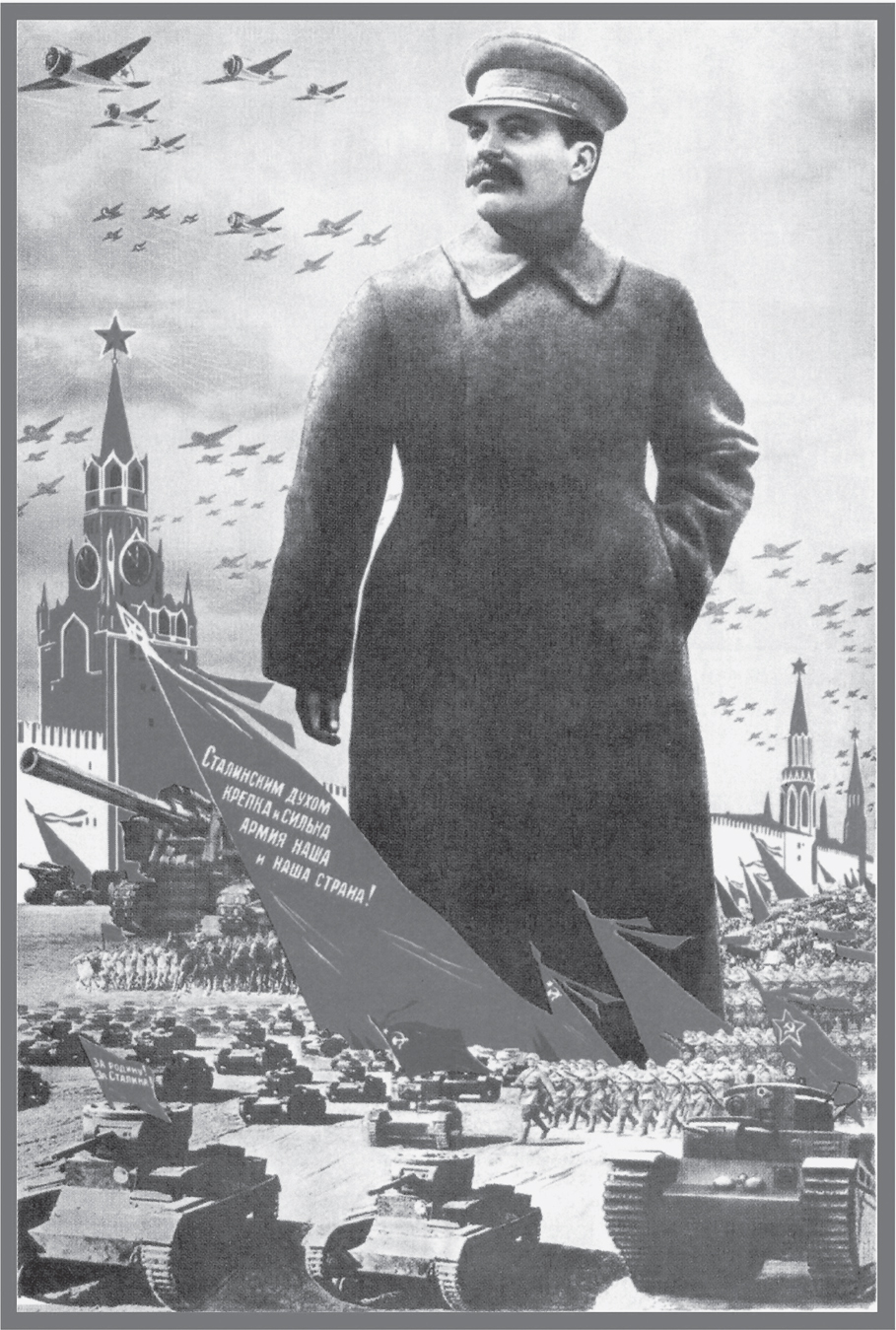
1. Anticipating Stalin as Warlord: propaganda poster by Arkady Arkady, 1939.
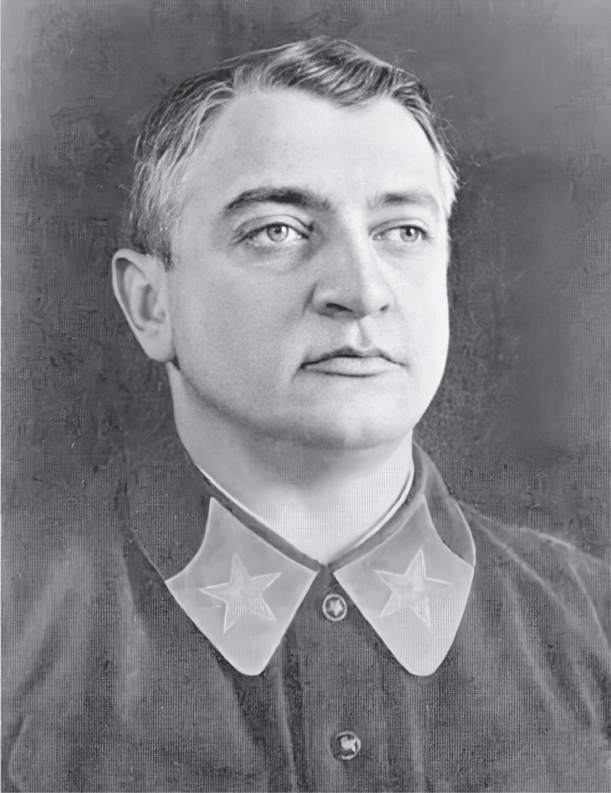
2. The great strategist Marshal Mikhail Tukhachevsky on the eve of his arrest in 1937.
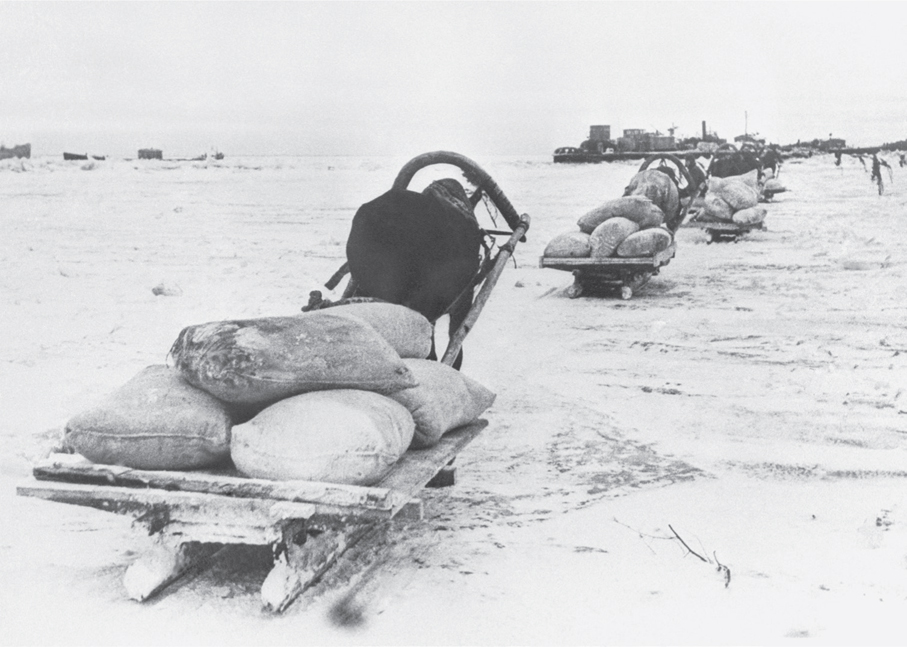
3. Struggling on the ice road across the frozen Lake Ladoga to feed the people of Leningrad during the siege of the beleaguered city, winter 1941–42.
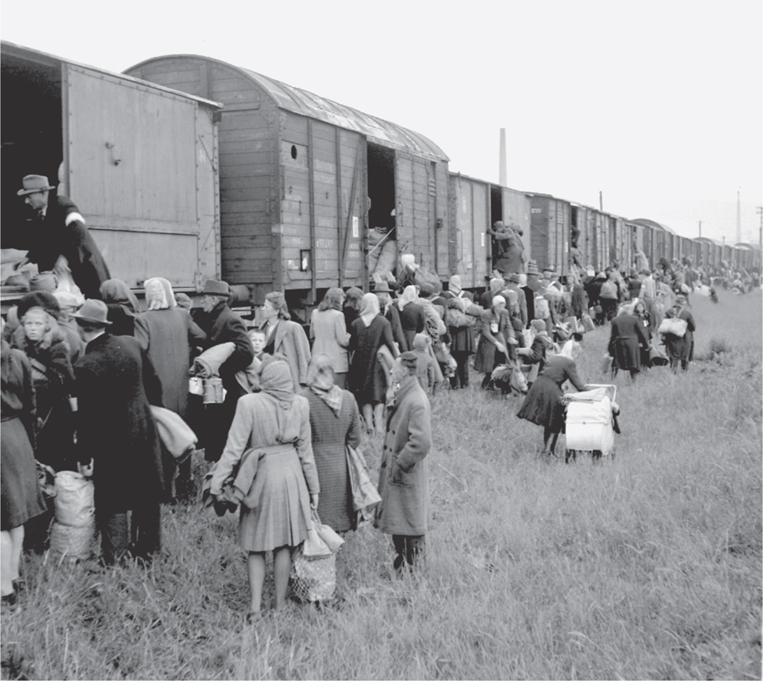
4. The deportation of Volga Germans, who were forced to leave their ancestral homes for exile in Siberia, 1941.
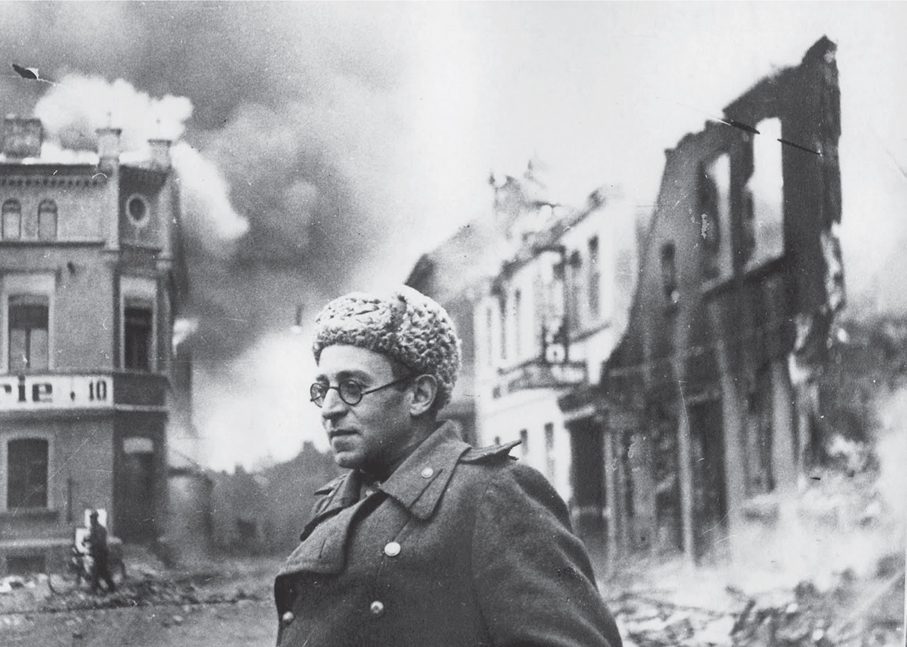
5. The renowned Soviet journalist Vasily Grossman reporting from the ruins of Germany, 1945.
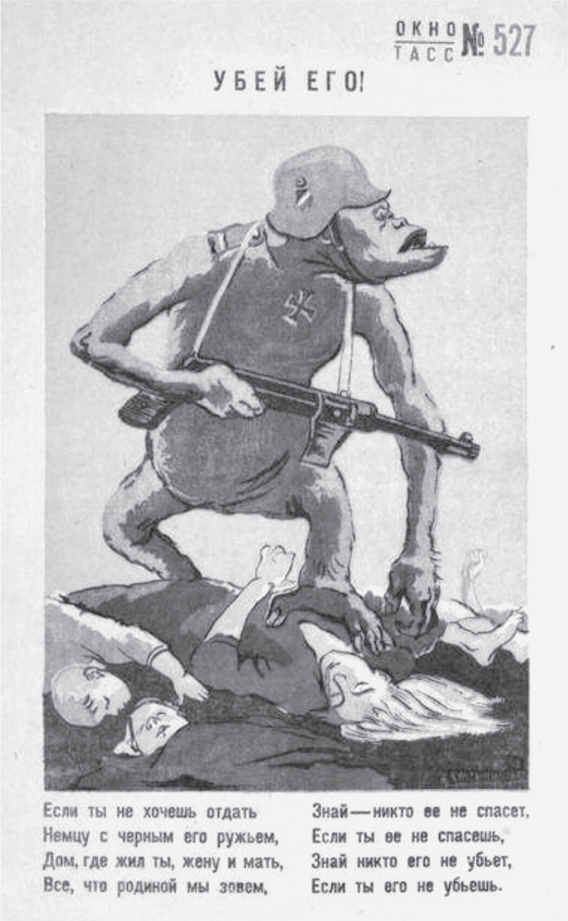
6. ‘Kill Him!’ Kukryniksy’s portrayal of the Nazi beast, with excerpt from a poem by Konstantin Simonov, 1942. The climactic line of the poem is, ‘No one will kill him, if you do not!’
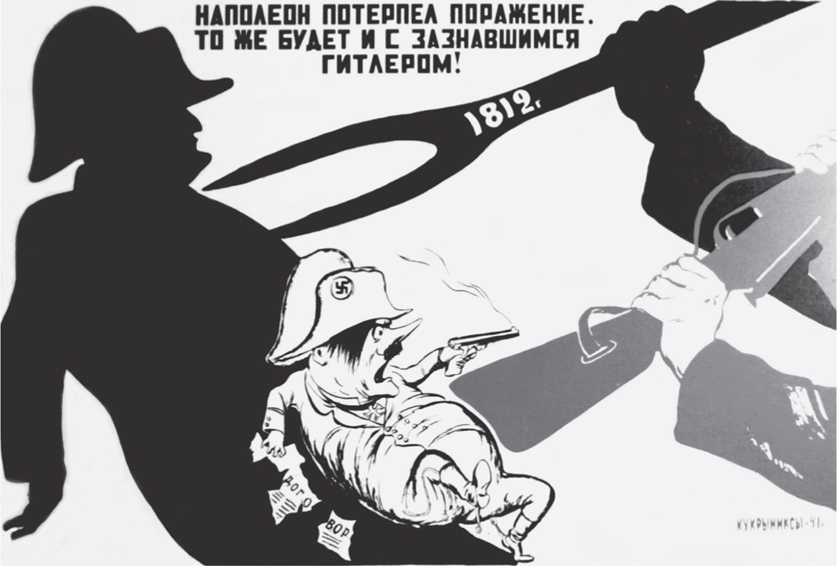
7. ‘1812–1943’, propaganda poster by Kukryniksy. Echoing Stalin’s invocation of history, the poster reduces Hitler to a puny figure who will share the defeat of Napoleon.
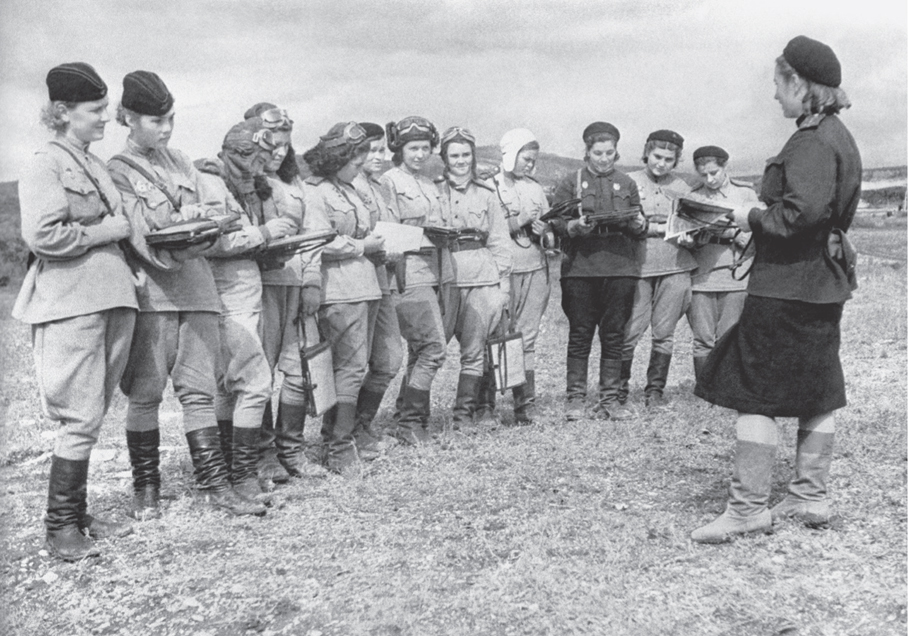
8. Pilots of the all-female ‘Taman’ aviation regiment. Known to the Germans as ‘Witches of the Night’, they were the only female combat flyers in any belligerent country of the Second World War.
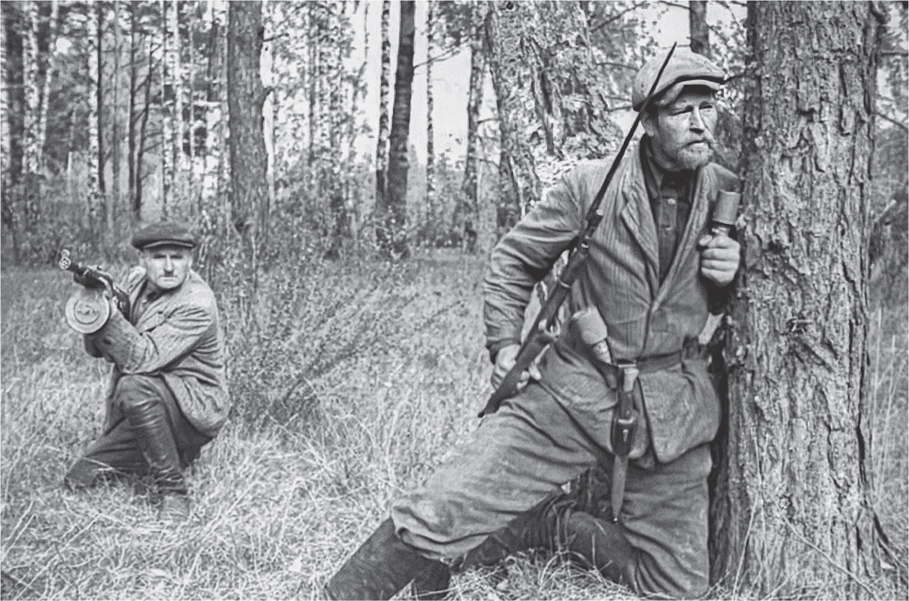
9. A staged photograph illustrating typical Soviet partisans active in the forests of Belarus in November 1943.
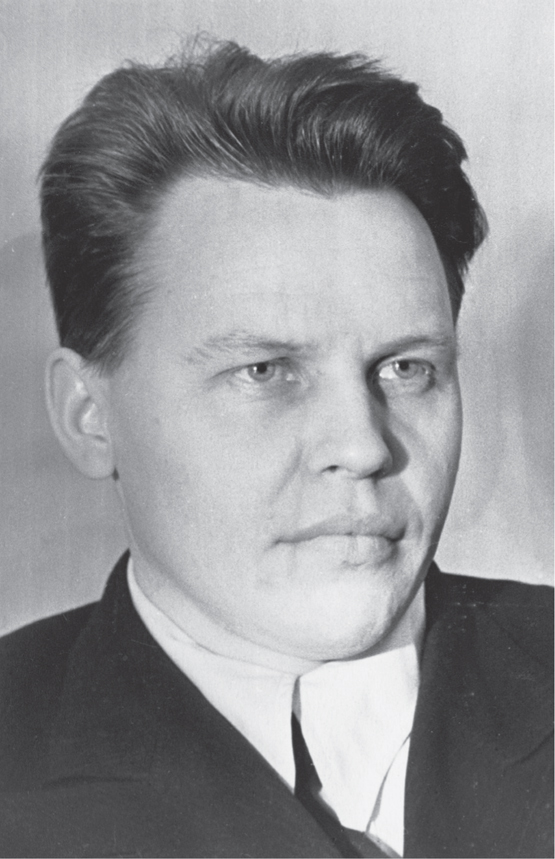
10. The Soviet economic planner Nikolai Voznesensky before his arrest in 1948.
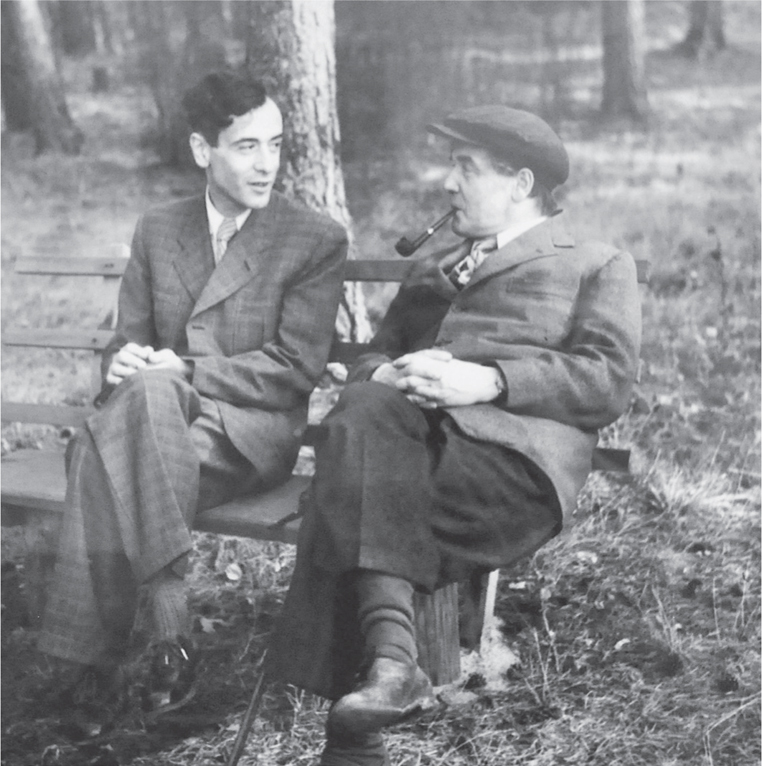
11. Lev Landau and Petr Kapitsa at Nikolina Gora. The two Nobel Prize winners relax at the well-known resort northwest of Moscow.
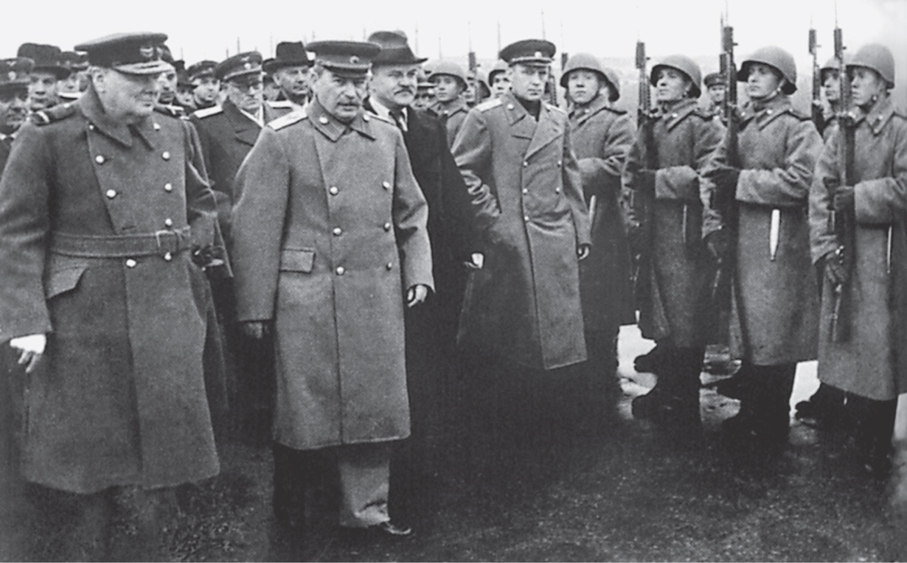
12. Stalin and Churchill reviewing Stalin’s favourite regiment in 1944. Molotov is at Stalin’s left and Vyshinsky at his right behind Churchill.
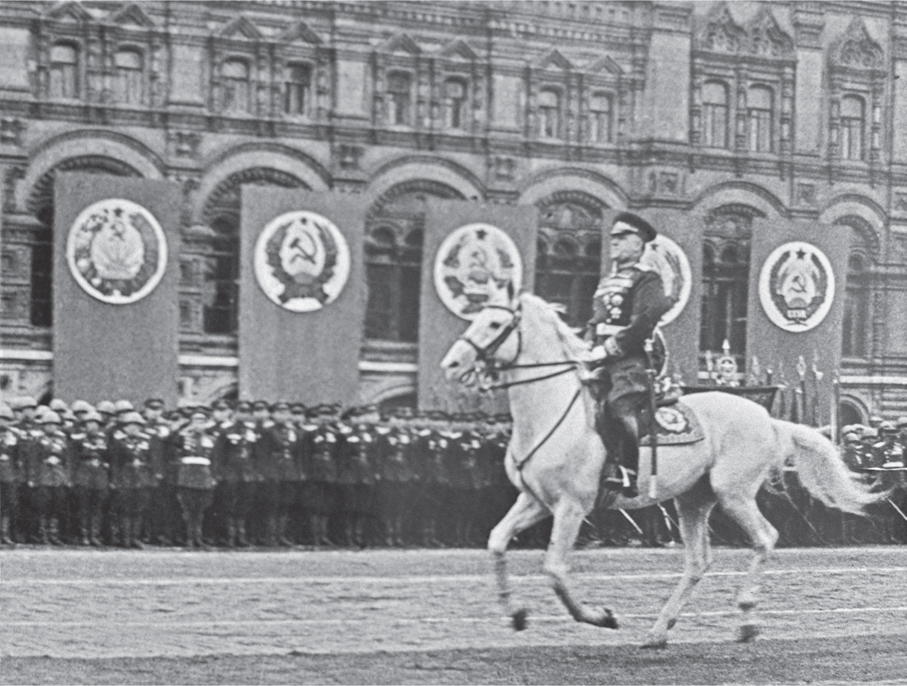
13. Marshal Zhukov leading the victory parade, May 1945. ‘The man on the white horse’ held clear implications for Stalin as he watched from the platform of the Lenin mausoleum.
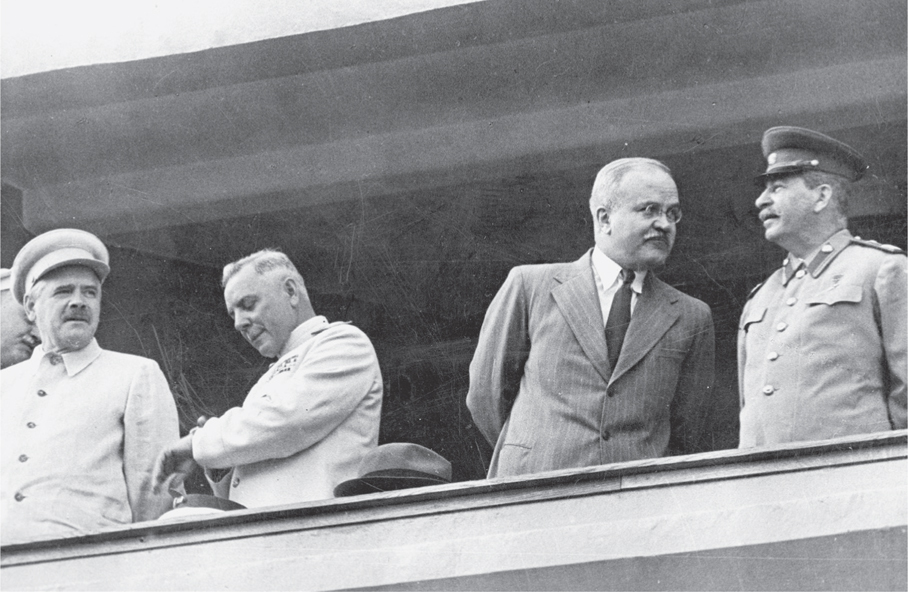
14. Vyacheslav Molotov talks to Stalin while watching a Physical Culture Day parade at the Moscow Dynamo Stadium in 1943. Molotov seems deferential, as always, while Stalin appears to be looking into the future.
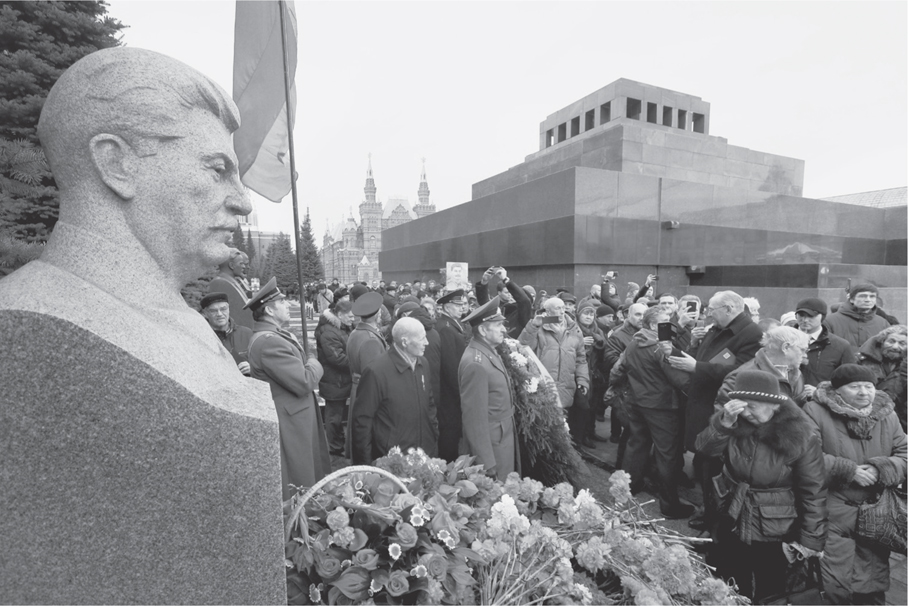
15. Homage to Stalin on the 66th anniversary of his death, Red Square, Moscow, 2019. An official celebration that inspired spontaneous reactions: note the woman crossing herself.
At the tenth session of the Supreme Soviet in February 1944, Molotov was still complaining that only ‘partial induction’ into the Red Army had been carried out in recent years in those regions of the Soviet Union ‘where in the old days military inductions did not occur’ (presumably meaning Central Asia). The Central Committee then drafted a law for the creation of military formations in the union republics and for the reorganization of the People’s Commissariat of Defence from the All-Union to the Union-Republic Commissariat of Defence. The law also granted each union republic plenipotentiary rights to maintain diplomatic relations with foreign powers and changed the name of the All-Union Commissariat for Foreign Affairs to the Union-Republic Commissariat for Foreign Affairs.69 The establishment of republic academies of sciences outside the Slavic republics was a more substantive effort to strengthen the loyalties of the non-Russian nationalities and exploit the intellectual resources of the entire country. The first step had been taken on the eve of the war with the creation of the Georgian Academy of Sciences. The relocation of scientists from the western war zones was instrumental in the organization of Uzbek, Armenian, Azerbaijani and Kazakh academies from 1943 to 1945. Shortly after the war, republic academies were founded in the reincorporated Latvian and Estonian republics.70 The Central Asian academies also provided a haven for scientists evacuated from Russia and the western republics, thus bolstering the notion of unity in diversity. By building the institutional infrastructure of a multicultural society, the state gave credence to the Soviet ideal and rebuffed the Nazi racist myth of the inferiority of the Slavic peoples.
By 1944, however, contradictions began to show up between aspects of russo-centrism (emphasizing the supremacy of the Russian language and the Russian historical experience) and Soviet patriotism (extolling the supra-national character of the struggle). Russo-centrism exhibited its negative side when it was employed to denounce aspects of local nationalism as excessive. Front-line newspapers in national languages were reproached for not giving sufficient credit to the Russian contribution to the war. The campaign to create a pantheon of epic Tatar heroes ran up against the nature of their exploits in resisting imperial Russian expansion and occupation. Among other faults, the Tatar ASSR party organization was rebuked for ‘serious mistakes in evaluation, the military-political and international position of our country, denigrating the role of the Red Army in the destruction of the German-Fascist predators and bowing before the military power, technical achievements and culture of the bourgeois’, as well as ‘serious shortcomings and errors of a nationalist character in illuminating the history of Tataria [glorifying the Golden Horde and popularizing the khanate-feudal epic of Idegei]’. The party organization of the Western Ukraine was taken to task for a series of nationalist errors including the failure to combat the ‘Ukrainian-German nationalists’ and overcoming the attitudes of the older generation of intelligentsia, ‘who were educated in German, Austro-Hungarian, Polish and Romanian schools in the spirit of bourgeois ideology’. A similar decree of the Central Committee criticized the Bashkir ASSR for failing to distinguish between the Bashkir national liberation movement and bandit raids, and for having ‘distorted the history of the participation of the Bashkirs in the Patriotic War of 1812, setting against one another the Russians and the Bashkirs’.71
Even historians whose party credentials seemed irreproachable could find their work sidetracked if it did not conform to the image of Russia as the progressive force in creating a multi-national state. Perhaps the most egregious example was the fate of The History of the Kazakh People, written in 1943 by a collective headed by the highly regarded historian Anna Pankratova. Nominated for a Stalin Prize, it was attacked by other professional historians for its negative portrayal of tsarist colonialism. This led to a fierce exchange, a virtual stand-off between Pankratova and her critics, and an uncharacteristic unwillingness of the party leadership to resolve the debate.72 The latent conflict between Ukrainian and Russian national mythologies had already broken to the surface in 1943 and 1944. Stalin had contributed to the confusion over the historic relationship between the two Slavic peoples. He had approved Nikita Khrushchev’s proposal to create the military Order of Bogdan Khmelnitsky (the medal bore his name in Ukrainian) and appeared to encourage the mounting nationalist excitement of the Ukrainian Communist Party as the Red Army liberated one city after another. As party secretary, Khrushchev attempted to square the circle of permitting two nationalisms to claim equal status. Then Stalin came down hard on the novel and film script Ukraine in Flames by Oleksandr Dovzhenko, accusing the film producer of ‘revising Leninism’ by emphasizing national pride over the class struggle. The rehabilitation of classic Russian historians of the nineteenth century ran counter to the rehabilitation of Ukrainian historians writing on the incorporation of Ukraine into the Russian Empire.73 But the campaign to denounce Ukrainian nationalist excesses had to wait until the war was over and the rift in the ‘great friendship’ could not be exploited by the nationalist opposition to re-Sovietization of Ukraine. Finally, even artists were condemned for slighting the creative role of the Russian literary classics. Meanwhile, the slogan of the ‘great friendship of peoples’ continued to be invoked.74
A major effort was made to mobilize the Jewish population under the banner of the ‘friendship of peoples’. The loyalty of the Jews during the war was unquestionable. During the war, no Jews collaborated with the enemy, the only nationality (including the Russians) of whom that can be said. To be sure, they had little choice given the Nazi aim of exterminating them. But many Jews had benefited greatly under the Soviet regime in ways that were unthinkable in tsarist Russia. They had risen to occupy positions of influence in the sciences, arts, diplomatic corps and police.
In the prewar decades, many Jews had taken the earliest opportunity to gain from the social mobility facilitated by the spread of literacy and education. By 1926, 70 per cent of the Jews in Ukraine and Belarus were literate; in Moscow this figure reached 85 per cent. This enabled them during the first two five-year plans to escape from the shtetls by joining the industrial labour force as skilled workers and then moving up the ladder as they acquired experience. In 1930 they were the largest group, except for the Russians, in the technikums of the Higher Soviet of the National Economy of the Russian Republic, the faculties preparing engineers and a number of postgraduate candidates in the sciences. On the eve of the war, Jewish men held the directorships of the six major military academies. They were particularly prominent in the management of industrial enterprises, and the design and improvement of aircraft, artillery and tanks. More than fifty Jews in various branches of industry and scientific organizations achieved the rank of general. During the war years they constituted 22 per cent of the directors of scientific institutes of the Academy of Sciences, 23.5 per cent of directors of the machine construction enterprises and 14 per cent of directors of metallurgical enterprises. During the same period, they won 21 per cent of the Stalin Prizes. This in a period during which they constituted just over 2 per cent of the population.75
To be sure, prominent Jewish party stalwarts like Trotsky, Zinoviev, Lev Kamenev and Genrikh Iagoda had been expelled, arrested and often shot. Writers like Isaac Babel and Osip Mandelstam had perished in the camps. But these were individual cases; there had not been a systematic anti-Semitic campaign. The purges fell indiscriminately on all the nationalities. This is not to suggest that anti-Semitism did not exist among Soviet civil and military officials. A case in point was the treatment of Polish Jews in the formation of the so-called Anders Army, composed of Polish prisoners of war and deportees sent to remote camps after the Soviet occupation of Belarus and Western Ukraine in 1939. The Jews suffered discrimination at the hands of the representatives of both the Soviet and Polish officers and officials involved in organizing the recruitment and dispatch of the troops under General Anders, himself a notorious anti-Semite, to Iran and on to the western fronts.76
The formation of the Jewish Anti-Fascist Committee (JAFC) appeared to promise more salutary results on the cultural front. But its fate revealed another dimension of the paradoxical face of Soviet patriotism. The idea for forming an Anti-Fascist Committee had a bizarre origin with tragic overtones. Jews constituted about a third of the population of the territories annexed from Poland in 1939. Many were deported to remote camps and a number were arrested, included two leading members of the Jewish Bund, Henryk Ehrlich and Wiktor Alter. Two years later, in September 1941, they were released from prison and approached by an officer of the NKVD who advised them to forget the past and contribute to the common struggle against the Nazis.77 He suggested creating a worldwide organization called the Jewish Anti-Fascist Committee and requested a plan for the organization. Their draft proposed activities in three areas, Poland, the Soviet Union and the West, to disseminate information and raise material support for the Jews in the Soviet Union. They even suggested the creation of a Jewish Legion composed of volunteers from the US and Great Britain to fight side by side with the Red Army. It was clear from their draft that they envisaged that the leadership of the committee would include a number of socialists who like themselves had been members of the Second International with previous ties to the Bund. Within two months, however, both men were arrested again; Ehrlich committed suicide in prison and Alter was shot in 1942. Meanwhile, Shcherbakov, the head of the Moscow party committee and member of the Central Committee, and Solomon Lozovsky, the deputy foreign minister and head of Sovinformburo, were developing plans for what became the Jewish Anti-Fascist Committee, following a mass rally of Jews in Moscow supporting the war effort. Stalin’s decision to proceed with the creation of the Jewish Anti-Fascist Committee illustrates once again his determination to employ every means of mobilizing the population, to the point of extending an unprecedented degree of autonomy to a group which in a different form had aroused his opposition in the past. Stalin had vigorously supported Lenin’s sharp criticism of the Jewish Bund before the revolution on the grounds that its claim to be the sole representative of the Jewish workers placed national identity over proletarian internationalism.
After a brief period of silence, in April 1942, the formation of the JAFC was announced with the renowned actor Solomon Mikhoels, people’s artist of the USSR, as chairman; Alter and Ehrlich had envisaged him as vice-chairman of their organization. Mikhoels had been evacuated to Tashkent where he served as the director of the Moscow Yiddish Art Theatre and became one of the most active and internationally connected advocates of Soviet Jewish interests. In 1946 he was awarded a Stalin Prize.
Lozovsky took the JAFC under his wing and helped to promote its activities at home and abroad. In 1943 it was considered safe enough to send Mikhoels and the poet Itsik Fefer, the Yiddish poet with ties to the police, on an official mission to the United States (where Mikhoels met Albert Einstein), Canada, Mexico and Great Britain to raise funds and promote the Soviet war effort. Yet the pair were forbidden to accept an invitation by the Yishuv to visit Palestine. The official journal of the JAFC, Eynigkayt, published in Yiddish, carried news on unofficial contacts with Jews abroad and the heroic exploits of Jewish soldiers. Large numbers of books in Yiddish were published in the Soviet Union. Mikhoels became a kind of universal adviser to Soviet Jews from all walks of life.78 Among all the officially designated nationalities, the Jews had risen to a position of prominence that exposed them to the suspicion that they sought, with Western support, to occupy a position in Soviet society that placed them side by side with the Russians. This soon proved to be a dangerous location.
THE CULT OF HATRED
Measured by its sheer visceral impact, a cult of hatred, with its folkloristic images of the ‘fascist beast’, was designed to arouse the most powerful emotional response to the German attack on the Soviet Union. Stalin had already tested what Moshe Lewin calls a ‘demonological theory of history’ in his internal war against the opposition.79 In orchestrating the purge trials, his instructions inspired Andrei Vyshinsky’s vicious denunciations of the opposition. Vyshinsky turned himself into an inquisitor whose mission it was to destroy every vestige of genuine political motivation or even of human behaviour in the actions of the accused. The opposition, he raged, was ‘not a political party’, but ‘a gang of criminals’. They were hardly if at all to be distinguished from highwaymen who waylaid unsuspecting travellers. They wove their conspiracies like invisible demons. ‘The roots of this group,’ Vyshinsky went on in a passage remarkable for its popular imagery, ‘are not in the masses of people of this country, whom this gang fears, from which it runs away like the devil from holy water. This gang hides its face from the mass of the people: it conceals its brutal claws and ferocious fangs. The roots of this gang must be sought in the secret recesses of the foreign espionage services.’ The oppositionists were often accused of resorting to poison, the symbol of witchcraft, as a favourite method of wrecking and subversion; the most vivid image of their victims was the mutilated child.80 Their conduct was inhuman, bestial. Yet once the war broke out nothing more was heard of internal enemies. But a similar rhetoric and imagery, intensified many times over, was turned with full force against the Nazi invader. In this case, unlike the purge trials, the crimes fit the accusations. But Soviet wartime propaganda was more successful than any other in transforming the terrible facts of Nazi atrocities into a systematic campaign of hating the enemy.
The Agitation and Propaganda (Agitprop) Department of the Central Committee threw all its weight behind the campaign to hate the enemy, but the real power came from the writers and artists who converted the dross of slogans into familiar visual devices drawn from popular traditions and early Bolshevik poster art.81 The most powerful visual images emerged from the pens of the three most talented and popular satirist-cartoonists in the Soviet Union, Mikhail Kypriianov, Porfiry Krylov and Nikolai Sokolov, whose collaborative work, perhaps unique to the genre, appeared under the collective pseudonym ‘Kukryniksy’. Their drawings were carried by Pravda and Krasnaia zvezda, but they also produced dozens of posters that were reproduced by the tens of thousands and pasted on the walls of Soviet cities. They designed special cartoons printed in German for massive distribution by air drops over enemy lines. Their work for Soviet audiences was particularly graphic in portraying the Nazi leaders and their fascist ‘lackeys’ in other Axis countries as animals with long fangs and claws dripping with blood. There were Nazi hyenas, wolves and monkeys (this role was reserved for Goebbels), snakes and spiders. Occasionally, these savage images would even be directed against German soldiers and their families at home. The trio of artists, like writers and Agitprop men, would pore over the captured diaries and letters of enemy troops seeking the appalling detail that would illustrate the bestial character of their conduct. This detail would become the focal point of the cartoon or story. Here too the folkloristic image burned most deeply, as in the case of the episode of the child’s clothes: a German soldier sent home a Russian child’s clothes (presumably stripped from her dead body), and apologized to his wife for the bloodstains. But she replied there was no need to worry, they washed out easily. From this exchange Kukryniksy drew a powerful cartoon portraying the well-dressed German Bürgerin as a witch-like creature scrawling her bloody reply while a ghostly image of her husband stripping the child hovers above her head.82
The three artists recruited the famous children’s poet Samuil Marshak to write brief pungent verses to accompany their work. They insisted on brevity to enhance the impact: a few stanzas, but a single quatrain was best. The result was a twentieth-century wartime version of the Russian fabulist Ivan Krylov, who did some of his best work during the Patriotic War of 1812. Like Krylov, too, Kukryniksy’s verses and drawings were imbued with a grim humour. Whenever Stalin used a folk image in his speeches, he could be certain that it would be picked up by them and embellished in different forms. For example, in his speech of 6 November 1944, he cited a proverb: ‘We shoot the wolf not because he is grey but because he eats sheep.’ Shortly thereafter Kukryniksy transformed it into a two-panel cartoon: in the first the Nazi sheep in wolf’s clothing – a Wehrmacht uniform – impales a baby on his bayonet; in the second, the Nazi sheep, disguise abandoned, flees the bayonet of a Red Army man.83
Some of the most talented pens in the literary world refined the cult of hatred; Mikhail Sholokhov, Ilia Ehrenburg and Konstantin Simonov were the foremost among them. On the second anniversary of the war, Sholokhov’s famous short story ‘The Science of Hatred’ appeared in Pravda.84 It was immediately reprinted in the army newspaper, Krasnaia zvezda. The Agitprop Department snapped it up and churned out a million copies in pamphlet form. Soon after Sholokhov met Stalin, who told him that his story was as timely and necessary for ‘the current phase’ of the war as Gorky’s Mother had been for the revolutionary movement. He urged Sholokhov to write a novel on ‘the holy national war of liberation’.85 Sholokhov found it difficult to write the short vivid pieces demanded of a war correspondent. Ehrenburg and Simonov took up the theme and developed it brilliantly in their feature articles for Krasnaia zvezda. Ehrenburg rapidly became the most popular and widely read of the war correspondents.86 ‘The Science of Hatred’ shows why this was so. A powerfully evocative piece, it nevertheless made distinctions between the hatred of fascism and respect for the civilized values of old German culture. He and Simonov were masters at juxtaposing the brutality of German troops with the self-sacrifice of Red Army men. Few could equal them at giving the lie to Nazi propaganda about the Aryan myth. Their message was a simple one: the Nazis were inferior, not because of race, but because they were inhuman.87 Aleksei Surkov turned out so many poems on the theme that they were compiled into a book on hatred.88
What endowed wartime films with a doubly powerful theme in the message of hating the enemy was the treatment of women as both the victims and avengers of Nazi brutality. Two films illustrate the extremes of violence inflicted on women and carried out by them. The first was Fridrikh Ermler’s She Defends the Motherland, first screened in 1943. It portrayed a woman whose conversion to a murderous axe-wielding partisan is incited by the slaughter of her baby, shown on the screen, and by her rape, which is not. Another was Lev Arnshtam’s Zoia, a film fable based on the arrest and execution of the famous teenaged partisan, Zoia Kosmodemianskaia. Shostakovich wrote the music; much of the story was taken from a Stalin Prize-winning poem in 1942 by the young, soon to be famous, Margarita Aliger. Exhibited for only a month in 1944, it signalled both the culmination and the end of the cult of hatred, in the film and in general.89 Few films were more effective in capturing the themes of hatred of the enemy and Soviet patriotism in its Ukrainian avatar than Oleksandr Dovzhenko’s fiercely anti-German The Battle for Our Soviet Ukraine which, came out in 1943. Dovzhenko had produced several celebrated films in the 1930s on industrialization and collectivization in Ukraine. But like other creative artists who sought to show how these generally positive transformations of life also produced negative effects, he fell out of favour and his wartime masterpiece was attributed to his wife.90
In the battleground of emotions, the cult of hatred, designed to demonize the enemy, was counterbalanced by a celebration of basic humanitarian values as a fundamental characteristic of the Soviet people. The image of Mother Russia, carrying with it the sanctification of home and family, emerges from letters sent by soldiers to Komsomolskaia Pravda, selected and published by the editors. Developed further by official propaganda the theme acquired growing momentum after Stalingrad.91 In wartime, creative artists also invoked the themes of humanism and lyricism. The inspiration for these themes was more complex, reflecting both the nature of their work and their patriotic feelings. In literature, the themes had appeared already in the first years of the fighting.92 But they had their origins in prewar debates over the nature of socialist realism in literature and music.93 By the thirties a shift was taking place in the direction of socialist realism in literature towards admitting the emotional responses of the individual as a legitimate component of a work of art linked to the intimate and lyrical elements. One of the most eloquent statements of this point of view was expressed by Konstantin Simonov in his essay ‘Notes on Poetry: on the Rights of the Lyrical’, published in Literaturnaia Gazeta at the very end of 1939. It was not surprising, then, that during the war he could evoke all the sentimental tenderness of a Red Army man writing to his wife that most famous of war poems, ‘Wait for Me’, and then spew out his fury in the story ‘Kill Him!’
Some years earlier, Dmitry Shostakovich had already taken up the lyrical theme during the ‘Discussion about Symphonies’ of February 1935, when he spoke of symphonies as ‘works of a lyrical character’. In his view, however, the First Quartet best expressed the inner life and intimate emotions of the composer. He sought to refute criticism that his work was ‘formalist’, meaning modern or too difficult for the average listener, by writing such works as the famous Seventh Symphony. The propaganda apparatus seized upon the work, which they dubbed the ‘Leningrad Symphony’, as a proudly patriotic expression of the heroic defence of the city, although Shostakovich had begun to compose it before the war broke out. The process of composition, however, continued during the war when Shostakovich remained in Leningrad for part of the siege and even served as a volunteer fireman before being evacuated to Kuibyshev. Once he had completed the symphony there, the party organized a performance in Leningrad which they recorded and broadcast over loudspeakers toward the German lines, as if to demonstrate that the city was the centre of a great culture holding out against the barbarian hordes: lyricism enrolled as the counterpoint of hating the enemy. Shostakovich continued, however, to write quartets, his second in 1944, with his third coming out a year after the war ended. The party exploited, praised and criticized him in the early postwar years. He defended himself by accepting the need for patriotic involvement – he actually called for ‘ideological correctness’ in music – while at the same time insisting that priority must be given to the musical values (echoing Kapitsa’s views on physics) over any verbal or textual interpretation. His only concession on that score was to refer to his quartets as conveying sensations of spring-like moods and childhood, pointedly avoiding the use of the word lyrical.94
The cult of hatred, like some rare chemical element, possessed a short life. It had been launched by Stalin after a brief period when he vainly hoped for a strong anti-fascist movement to emerge in Germany after the outbreak of war. He encouraged individual artists and writers to pursue the theme; it then took on a life of its own in the hands of artists and writers.95 By the end of the war, the cult of hatred became a political liability and Ehrenburg was singled out as the scapegoat. In April 1945 an article in Pravda by the rising star of the Agitprop Department, Georgy Aleksandrov, ‘Comrade Ehrenburg Oversimplifies’, signalled the end to the campaign. In the closing days of the war, it was important for Stalin to avoid driving a defeated Germany into the hands of Russia’s Western allies. After an orgy of violence, inspired by revenge, the Red Army was issued instructions to maintain strict discipline in its relations with the German civilian population.96
What Stalin, in praising Sholokhov’s ‘The Science of Hatred’, had called ‘the current phase’ of the war was over. It was characteristic of Stalin’s political manipulation to make a scapegoat out of the most successful interpreter of his own ideas. Ehrenburg had become a symbol of the cult of hatred. Goebbels had singled him out in counter-propaganda as the embodiment of the Communist-Jewish conspiracy to exterminate all Germans. Stalin responded when it became politically expedient by disavowing him.97 Others took the hint without having to be warned. The cartoons of Kukryniksy continued to portray Hitler and his entourage as shabby, pathetic and evil men, but the animal imagery faded away. At the Nuremberg Trials the trio of cartoonists sketched the accused as degenerates, but the fangs, the claws and the blood were gone. Across the Atlantic other demons were gathering.
THE PATRIARCHAL ORTHODOX CHURCH
Stalin’s decision to add the Patriarchal Orthodox Church to his armoury of cultural weapons against the fascists strikes one even at this distance as extraordinary. The officially atheistic regime had subjected church and clergy to three waves of anti-religious campaigns from the moment of its inception. In addition to persecution, Stalin had welcomed and encouraged the split in the historical Patriarchal Church after the revolution, when a group of churchmen formed the Renovationist Church. They rejected Patriarch Tikhon’s decree anathematizing the regime and accepted the secular authority of the state and its socio-economic policies. In 1927 a group of schismatics calling themselves the Josephite Church left the Patriarchal Church after Sergius (born Stragorodsky), the Moscow and Kolomensky district metropolitan acting as patriarch locum tenens, recognized the regime but not its policies.98 The differences among them did not spare them from persecution. Two years later the Law on Religious Associations set strict conditions on the right to worship for all believers.99 Much worse was to come.
Caught up in what became known as the Great Terror, between 1936 and 1938, the third and most extensive wave of church closings probably reflected the suppressed results of the 1937 census, which revealed that 56 per cent of the population identified themselves as believers. At the same time, about 150,000 clerical and lay officials of all the Christian faiths were arrested, half of them confined to the Gulag. The rest died or were executed, including most of the higher ranks of the clergy. Party and police officials co-ordinated their attacks right up to the outbreak of war, closing about 8,000 Orthodox places of worship and confiscating their properties. On the eve of the war, there were only 6,376 clergy in the Patriarchal Church and only four men in the hierarchy.100 Stalin stopped short of implementing repressive policies in the western borderlands acquired under the terms of the Nazi-Soviet Pact, presumably to avoid encouraging support for German propaganda.
Under these dire conditions, Metropolitan Sergius took the bold step only twelve hours after the German invasion of calling upon the faithful to rally around the motherland. Like the head of the Academy of Sciences, he timed his appeal in advance of any public statement by a member of the ruling party or government; in his case, to be sure, he blended together nationalist and religious themes with implications for the celebration of russo-centrism. The same day, the Metropolitan of Leningrad issued a similar appeal, followed by the head of the Renovationist Church. Letters came into the Soviet authorities requesting information on the status of the church, the implication being that willingness to serve depended on an acceptable answer. Over the centuries at times of crisis – and particularly in wartime – the church had always assumed a prominent role in rallying support for government, a fact that Stalin, an old seminarian, knew only too well. Whatever the motives of the churchmen may have been, their reaction to the German invasion probably saved the Patriarchal Orthodox Church from extinction as an institution in Russian life.101
Later, in an epistle to the faithful in the occupied territories, Metropolitan Sergius instructed them to do nothing that would directly or indirectly give comfort to the enemy. However, the contribution of the church to the war effort went far beyond exhortations of spiritual support. It was active in raising funds to help meet a number of needs − military, charitable and medical − all connected to the war effort. The metropolitan organized collections for the Defence Fund and subscribed to the war loans. Church funds were donated to the army to purchase forty tanks to form the Dmitry Donskoi tank battalion and to the air force to finance the creation of the Alexander Nevsky squadron. Monasteries opened their doors to provide shelter and infirmaries for the wounded. The church raised funds for a variety of medical and charitable activities, ranging from providing food to assisting the families of soldiers. The total contribution in money and kind donated by the Patriarchal Orthodox Church to the war effort is estimated at 300 million rubles.102
Stalin responded by calling off the anti-religious campaign. After some hesitation he arranged an informal concordat with the church which led to the permanent re-establishment of the patriarchate in September 1943. Stalin appointed an NKVD general, Georgy Karpov, to head a Council on the Affairs of the Russian Orthodox Church, reporting directly to Molotov.103 The installation of Sergius as patriarch in Moscow was a modest affair but the election of his successor, Aleksei, was attended by over 200 ecclesiastical dignitaries including the patriarchs of Antioch and Alexandria, the archbishop of Canterbury and metropolitan of North America. In his recommendations for the approval of Stalin and Molotov, Karpov included a mass of detail for the gathering of the church conference (sobor), ranging from the protocol at the airport to precious objects taken from museums as gifts to the patriarchs and the performers and programme of a music recital.104
In mapping his course for regulating church affairs, Stalin relied heavily on the advice and oversight of the NKVD. As early as 1942, Beria had suggested to Stalin that Metropolitan Sergius write a book, The Truth about Religion in Russia, to refute the Nazis’ claim that they were liberating Christians from Bolshevik atheism. Under the scrutiny of the council, churches which had opened illegally were recognized and petitions for new churches were received. But the council, backed up by Molotov, was chary in its responses, allowing approval of only 6 per cent of the petitions. On the other hand, Stalin, characteristically, was not always willing to let the NKVD have its way. For reasons that are not clear, Stalin allowed the Renovationist Church to wither away, rather than following Karpov’s advice to abolish it outright and incorporate its clergy into the Patriarchal Orthodox Church.105
In negotiations with Metropolitan Sergius, Stalin also departed from the views of his advisers by offering to open seminaries which would enable the church to train priests for future generations. In another unexpected concession, he gave permission for priests inducted into the army to return to their parishes.106 From Stalin’s perspective, however, the greatest service of the church was as an ally in the struggle over the loyalty of parishioners in the occupied territories of the western borderlands. The government relied primarily on the partisans and party organizers to maintain a Soviet presence in the occupied territories, but the church was useful in combating the defection of the clergy, especially in the Ukraine, and in resisting the proliferation of schismatics who opposed both the Nazis and the communists.107 In the struggle for influence over the population of the western borderlands the church faced a new and challenging dilemma.
In 1940 after the incorporation of Lithuania, Latvia and Estonia as national republics into the USSR, Bishop Sergius (born Voskresensky) had been appointed metropolitan of Lithuania and exarch of Latvia and Estonia to heal the schism in the church. Their annexation increased dramatically the number of churches in the USSR to 3,021, of which about 3,000 were located in the newly acquired territories. Before 1940 there were no monasteries in the Soviet Union; the annexations brought in sixty-four.108 Thus, when the Germans swept through the Baltic republics, Western Belarus, Western Ukraine and Bessarabia, they took possession of the overwhelming majority of the existing Russian Orthodox churches. The metropolitan remained in Riga, presumably with the sanction of Metropolitan Sergius of Moscow. He obtained permission from the German authorities to organize the administration of the church in the territories of the Russian Republic occupied by Army Group Centre. His official mission was to restore the Patriarchal Orthodox Church to its previous position, bringing the faith to a generation raised under the atheistic propaganda of the Soviet state. He sent out the first group of Riga ‘missionaries’ in August 1941; over the next three years, they succeeded in increasing the number of churches in the occupied territories tenfold, serviced by 175 priests. Their guiding idea of restricting their activities solely to religious life was, to be sure, compromised by the pressure of the Nazi officials to give religious propaganda an anti-Bolshevik direction and to recruit individuals for labour service in Germany or as members of the Russian Liberation Army composed of Red Army POWs organized and led by General Andrei Vlasov, a hero of the defence of Moscow who had gone over to the Germans. The extent to which the church resisted is a matter of some dispute.109
In the liberated territories of Ukraine, Stalin was personally involved in recruiting the church as part of the campaign to restore Soviet authority. Following the Yalta agreements which recognized the incorporation of Western Ukraine into the Ukrainian SSR, the oblast Agitprop Committee in newly occupied Galicia issued a ‘short thesis’. In comparing the historical significance of the Patriarchal Orthodox Church and the Ukrainian Greek Catholic Church, it praised the progressive role of the Orthodox Church in unifying the eastern Slavs and, in the Second World War, of preserving Ukraine from Polonization and Romanization. It condemned the Ukrainian Greek Catholic Church for striving to separate Ukraine from the Orthodox East and the Soviet Union which ‘would have meant handing it over to the capitalist West’.110 In April, Stalin informed Khrushchev of the need to mobilize the Patriarchal Orthodox Church in the struggle against the Roman Catholic and Uniate churches, which had gained ground under the German occupation.111 In a major step towards fulfilling these orders, an Orthodox eparchy divided into four parishes was re-established in Lvov (L’viv). A bishop was to be appointed from among Ukrainians and to be given the right to organize missionary activities. An initiative group in the Uniate Church was to announce a break with the Vatican. The Polish Autocephalous Church was to be disbanded and united with the Moscow Patriarch. The Mukhachevo Eparchy in the Zakarpatsky region, Mukhachersko-Pushevskoi (Zakarpatsky), was to be placed under Moscow’s jurisdiction with the approval of the Serbian Church, which previously had jurisdiction over it.112
The implementation of these instructions was accompanied by extensive repression. A massive propaganda attack aimed to portray the metropolitan of the Ukrainian Greek Catholic Church, Andrei Sheptyts’kyi, as an ally of fascism and an instrument of Anglo-Saxon imperialism. Arrests of Metropolitan Yosef Slipyy and other leaders of the Ukrainian Greek Catholic hierarchy were carried out as the Initiative Group joined the campaign of the NKVD to bring pressure on its clergy to convert. By October 1945, 800 priests had joined the Initiative Group. Winning over the laity was complicated by the nationalist underground resistance and the massive Soviet counter-insurgency. From 1944 to 1951, the number of Ukrainians who were deported as the result of co-operating with the anti-Soviet resistance ranges from a Soviet account of 203,662 to an émigré estimate of about 500,000.113 In any case, the Ukrainian Greek Catholic Church was broken at the end.
Stalin also recognized the value of playing the religious card in foreign policy. With his blessing, a delegation of the Orthodox Church visited Bulgaria. Karpov duly reported the favourable results to Stalin in great detail. The military and civil authorities of the newly established government coalition of parties, the Fatherland Front, expressed their gratitude to the Russian people for their liberation from the Turks in 1878 and the fascists in 1944. Some sceptical local priests were reassured by the April proclamation of the Sobor in Moscow. The re-establishment of ecclesiastical relations between the two countries was described as giving the lie to the provocative distortions of the position of the church in the Soviet Union. Karpov indicated that the delegation benefited from the great authority of the head of the delegation, Metropolitan Stefan of Pskov, who during the visit advanced the idea of slavianstvo, the unification of the Slavic peoples under the patronage of Russia. The remark was significant, Karpov noted, because the archbishop had been known earlier as an anglophile. On the basis of information received by the delegation, the head of the council recommended a secret subsidy be advanced to the patriarch of Constantinople, who was in financial straits. This would ‘forestall a step by England which once it learned of the Patriarch’s need would exploit the opportunity to strengthen its position’.114 With Stalin’s approval, the patriarch restored old ties to the Anglican Church. In another response to the patriarch’s request, Stalin approved his proposal to send a delegation led by him to Palestine, Egypt, Syria and Lebanon as a prelude to organizing an international church conference in Moscow of all Christian faiths except the Roman Catholics. But Stalin made it an ‘absolute condition’ that the delegation be accompanied by ‘a personal guard in civilian dress’.115
In Stalin’s most ambitious attempt to employ the church as an instrument of Soviet foreign policy, he endorsed Karpov’s plan in co-operation with Patriarch Aleksei to summon an Eighth Ecumenical Council of all Orthodox churches and to make the Moscow patriarch the equivalent of the Roman pontiff. But canonical problems raised by the Patriarch of Constantinople doomed the project. The fall-back position was to summon a pan-Orthodox conference in Moscow in June 1948. By accepting the dictates of conference, the Orthodox churches of the ‘people’s democracies’ became subordinate to the patriarch in Moscow.116 The Patriarchal Orthodox Church reaped no rewards. Stalin kept a strict control on the church’s activities, wielding the instruments of surveillance to patrol the limits of church autonomy, similar to those he employed in dealing with the other cultural groups that had supported him in the war.117
SLAVIC SOLIDARITY
The idea of Slavic solidarity began to surface in party ideology just before the outbreak of the Great Fatherland War. It was part of a shift in Soviet ideology on two levels; first, toward reviving the historic and ethnic links among the three Slavic nations of the Soviet Union; and second, toward accommodating national differences within the international communist movement. In appealing to Slavic solidarity within the Soviet Union, Stalin was once again reaching back into Russian history for a long-standing if ambivalent idea and then reinterpreting it for his own purposes. In responding to Hitler’s offer to divide Poland in the negotiations leading to the Nazi-Soviet Pact in 1939, Stalin grasped the idea that Soviet intervention could be justified and legitimized by the claim that it was necessary in order to protect the Belarusian and Ukrainian populations oppressed under Polish rule and exposed in the war with Germany.118 Initially, his idea was to organize elections of deputies representing the Polish, Belarusian and Ukrainian populations to assemblies which would petition for the creation of a Polish Soviet Socialist Republic and incorporation into the Soviet Belarusian and Ukrainian republics.119 He quickly reversed himself, redrawing the lines of partition between German-occupied Poland and the Soviet territories so that only the Belarusian and Ukrainian populations would be incorporated into the Soviet Union. There would not be a Polish Soviet Republic.120 This meant, in effect, accepting the Curzon Line proposed in 1919 by the British foreign minister and subsequently restated by Stalin at Yalta to justify the postwar boundaries of Poland. In the negotiations that followed, the two powers arranged for an exchange of populations that would cement the ethnic boundaries of the Soviet Union and bury the Piedmont principle (see above, p. 60) represented by a Western Ukraine under Polish control.121
The first step to link Slavic solidarity to the Comintern was taken in February 1941, when members of the Central Committee secretariat, including Zhdanov, Andreev, Malenkov and Dimitrov, agreed that the principal aim of the newly organized Comintern schools should be ‘to train for the most part cadres from the Slavic countries (Bulgaria, Yugoslavia, Poland and Czechoslovakia). In the curriculum: the emphasis is to be on the study of one’s own country, one’s own party, their problems, how to fight the enemy on one’s home territory.’ Zhdanov acknowledged that ‘We got off the track on the national question. [We] failed to pay sufficient attention to national aspects.’ In sum: ‘our “internationalists” have to be trained.’122
Once the war broke out, Stalin adopted the pose of a champion of the Slavs.123 By publicly invoking Slavic solidarity against the Germans, Stalin simply added another emotional dimension to his eclectic wartime propaganda. The premise of Slavic solidarity ran directly counter to notions of both international proletarian unity and Soviet patriotism. But even the Comintern organs came out rather shamelessly in favour of a special racial affinity of the Slavs against German expansionism, ‘one of the most constant phenomena in the history of Europe’.124 In appealing to the shared cultural values of Slavic people against the Germans, Stalin sought to avoid the obvious danger of reviving Pan-Slavism in its pre-revolutionary imperialist form. His recourse to Slavic solidarity as a theme in Soviet wartime ideology had two aims. It was, first of all, a counterfoil to Nazi racist propaganda which identified the Slavic peoples as second only to the Jews as the race enemies of the Aryan type, and promised their destruction. Second, it was a political weapon in combating 1,000 years of German expansion and cultural influences in Eastern Europe, and reversing it in favour of a Slavic advance to the west and – more importantly – Russian-Soviet cultural hegemony.
To propagate the idea of Slavic solidarity, the Soviet government sponsored the formation of an All-Slav Committee in September 1941. It supervised national radio broadcasts, held two congresses in Moscow during the war and a third in Belgrade in 1946. At the second congress in April 1942, the monthly periodical Slaviane was founded with a programme to rally all the Slavic people against fascism and recall the historic struggle against German imperialism.125 The leadership of the congress was mediocre and the organization lacked any political muscle, as the Yugoslav communist, Milovan Djilas, was quick to notice. But there was a scattering of luminous intellectuals in its executive, including, among the Russians, Dmitry Shostakovich, Aleksandr Fadeev and Aleksei Tolstoy; among the Poles, Wanda Wasilewska, who later became a key figure in the restoration of the Polish Communist Party; and several Czech scholars.126 In its many activities the committee emphasized Slavic humanism as contrasted with the predatory and militaristic character of its enemies both Eastern and Western. In his opening address, Aleksei Tolstoy ‘rejected the old ideology of Pan-Slavism’ as reactionary and contrary to the spirit of equality among the Slavic nations. The passionate appeal for Slavic solidarity stressed the need to avoid crossing over to racism in reverse. This point was driven home by Aleksandrov in his remarks to the first congress of the Academy of Sciences held during the war. He too rejected Pan-Slavism but stressed the need to unmask the German aggression of the nineteenth as well as the twentieth centuries and to illuminate the struggles of the Ukrainian, Belarusian and Great Russian peoples against the efforts of Germany to destroy the Slavic peoples and establish German hegemony in Slavic lands.127 It was important to mobilize the historians in particular. From the rostrum of the academy, Evgeny Tarle set the tone by reviewing and denouncing the distortions by Nazi historians of Germany’s expansion in Eastern Europe from the Middle Ages to the present.128 That these sentiments expressed Stalin’s own views on the need for a Russian-Polish alliance emerged clearly from the record of his extraordinary two-hour conversation with the Polish-American Catholic priest Father Stanislaus Orlemanski in late April 1944.129 In lecturing Orlemanski, Stalin appealed to the lessons of history, as he frequently did. He stressed the need for Slavic − in this case Russian-Polish − solidarity against a revival of German power in the future. This led him to argue for a reconstruction of the Polish government, one friendly to the Soviet Union. He concluded that the Polish people would surely not wish to welcome back those who had led them to disaster in 1939.
In practical terms, Stalin sought to use Slavic solidarity both in order to bolster political relations with the borderlands that had been for so long the contested zone between the Russians and the Germans and to weaken the influence of alternative sources of cultural dependency, in particular the French. The first step in this campaign was to encourage the leaders of Slavic states to expel the Germans bodily from Eastern Europe and to advance the Slavic frontiers and the movement of populations from east to west. In his dealings with the Poles over the postwar frontiers, Stalin revived the idea, first advanced by the Russians during the Seven Years’ War and restated by the tsarist government in 1915, of expelling the Germans from East Prussia and annexing all or part of the province. As compensation, the Poles would be moved to the west. Stalin spoke of restoring the old Polish lands up to the Oder, thus reconstructing Poland as it had existed under the medieval Piast kings; this, in his mind, would be an anti-German Poland to replace the multi-national Poland of the Jagiellonian dynasty built by incorporating the Belarusians and Ukrainians and repeatedly aspiring to a Dnieper frontier at the expense of the Russians.130
In an unusually frank and emotional speech in December 1943, honouring the Czech statesman Edvard Beneš, Stalin toasted the ‘neo-Slavs’, referring to the pre-revolutionary intellectuals who had favoured the complete independence of small Slavic countries, unlike the Pan-Slavs. He then turned his wrath on the Germans. ‘I hate Germans,’ he declared. ‘Slavs footed the bill for the First World War and also the Second World War is being solved at their expense . . . But this time we will break the Germans so that never again will their attacks against the Slavs be repeated. We are attempting to make them harmless.’131
Early in the war, Stalin even toyed with the idea of a series of Slavic federations in Eastern Europe, one including the Czechs and Poles and the other the South Slavs. When the Poles resisted Stalin’s offers to reconstruct their country, he torpedoed the west Slavic federation. During the war he expressed to the Yugoslavs his approval of their plans to create a federation with Bulgaria, but urged them to proceed slowly and, incredibly, to adopt the Austro-Hungarian model of a dualist state! He showed an interest in closer relations between the Yugoslavs and Albanians, making the extraordinary claim that ‘the Albanians were also Slavs in origin’.132 Stalin also pursued the expulsion of the Germans from the south Slavic states, particularly from Yugoslavia, and he sustained his interest in a south Slavic federation until after the war, when Tito’s independent attitude led him to turn against that as well. These several abortive attempts to construct transnational Slavic associations in Eastern Europe suggest that Stalin sought to tap the genuine emotional force of fraternal relations among Slavic countries in order to raise a bulwark against a German revival and forge a powerful bond between these nations and the Soviet Union. Stalin was successful in exploiting feelings of Slavic solidarity in the peace negotiations after the war against the Germans, Hungarians, Italians and Greeks.133
Although the break with Tito doomed the All-Slav Committee, the Soviet policy of promoting Russian language and culture and the historic ties among Slavs persisted. Its legacy was mixed, because a certain result of the Russian cultural penetration of Eastern Europe was the sharp decline and almost complete disappearance of the strong prewar German orientation among the intelligentsia and the commercial-professional elements in the area. This cultural roll-back had nothing to do with Marxism-Leninism – quite the contrary in fact. But it did have a great deal to do with the consolidation of Soviet power in the western borderlands against the threat of a German political revival.
INTERNATIONAL COMMUNISM
The great traumas of the thirties had left the original Bolshevik ideology in tatters. Stalin’s crude dialectics of intensifying state power and class struggle as the prelude to their disappearance made a mockery of Leninism. His assault on the Old Bolshevik leadership as spies and saboteurs shattered the myth of 1917. His sudden turnabout to embrace Nazi Germany as an ally disillusioned thousands of foreign communists. The German invasion was for Stalin an ideological windfall. Here was a cause around which he could construct a revised belief system.
The announcement of the Nazi-Soviet Pact passed like a tremor through the body of the international communist movement. Tactical flexibility was one thing, but to many communists a deal with Hitler was a betrayal. There had been almost no political preparation and only the most astute and cynical could have detected the faint signals in Soviet diplomacy that Stalin was ready to strike a bargain with the Nazis. Trotsky and his supporters had a field day at Stalin’s expense. Trotsky’s analysis did not, however, deny Stalin the right to make deals in the name of expediency. What he objected to was Stalin’s proclaiming ideological solidarity with fascism. Moreover, he exposed the paradoxical character of Stalin’s counter-revolutionary policy at home and his progressive policy in partitioned Poland, where he pushed the expropriation of the landlords and the nationalization of industry.134 Widespread resignations in the local parties poured in, including of many prominent intellectuals. The revival of a flagging international communist movement after the German invasion was preceded by two years of uncertainty and confusion after the signing of the Nazi-Soviet Pact.
The communist parties of Europe were thrown off balance by the sudden reversal of Soviet policy toward Nazi Germany. They had not been forewarned, to say nothing of being consulted. Without clear-cut instructions defining a new line, they groped their way toward solutions reflecting local conditions. Their reactions took one of two basic directions, a trend that continued to develop sub rosa during the war and broke out into the open in the postwar years. The French and Italian parties, personified by Maurice Thorez and Palmiro Togliatti, re-affirmed the anti-fascist line in their own countries while at the same time supporting the pact as a political necessity for the Soviet Union. Initially, the French communists greeted the pact as a giant step toward peace which enhanced rather than excluded an Anglo-French-Soviet pact. They urged the British and French military delegations, which had been negotiating in Moscow with their Soviet counterparts, to reach an immediate agreement. They were uncompromising in their denunciation of fascism in general and Nazism in particular. This did not sit well with Moscow. On 1 September the Comintern Executive took the French and Thorez personally to task for having recommended incorrectly an unqualified support for the government of Édouard Daladier and Georges Bonnet.135 Taking a more radical position articulated by Tito, the Yugoslav communists equally condemned both the fascists and democratic countries for unleashing a new imperialist war. They foresaw the outcome as a replay of the First World War and eagerly prepared for a revolutionary transformation of Yugoslav society.
The Comintern Executive was baffled by the ‘exceptional difficulty’ of adopting the right tactical position and appealed for Stalin’s ‘immediate assistance’ (italics in the original). Stalin obliged: the new line stated unequivocally that ‘the present war was an imperialist and unjust war in which the bourgeois of all the belligerent countries were equally guilty . . . the division of the capitalist countries into fascist and democratic has now lost its previous meaning’. The directive of the Comintern Executive singled out the parties of France, England, the USA and Belgium as those needing to correct their political line. Many of the other local parties, including those of Scandinavia and Canada, were also slow by Comintern standards in falling into line: the Comintern was still complaining in late October about their tardiness or reluctance to accept the new conditions.136
The Comintern instructions to the communist parties in Europe were to avoid engaging in either resistance to or open collaboration with the Nazi occupation forces. They could not be allowed to enter the fight against Stalin’s ally, Hitler. That would, after all, risk antagonizing the Nazis at a time when Stalin was counting on their endorsement of his expansion in Eastern Europe. But neither could the local communist parties be encouraged to form any kind of political alliance with an ideological enemy that was bent on destroying their influence in Europe. In this short period of the pact, the delicate balancing act was difficult to maintain; the dangers were most striking in the case of Yugoslavia. Dimitrov urged Tito to be cautious in his revolutionary ambitions, a refrain he was destined to repeat many times over the following few years. Yet at the same time, the Comintern also gave clear signals that the Yugoslav party was in high favour due to the success of its clandestine organization in surviving the initial shock of the Nazi occupation. The contradictions continued to exist until the German invasion of the Soviet Union and were then replaced by another set.137
The condemnation of both sides in the imperialist war was an uncertain guide to action in the extremely dangerous circumstances created by the Nazi invasion and occupation policies. Among the communists, there were individual acts of resistance to the Germans. For example, in 1939, Władysław Gomułka and a few comrades escaped from a Polish prison and remained in the underground. In France Auguste Lecœur helped lead a strike in the spring of 1941 against the German occupation forces. But these were isolated incidents that only assumed importance in postwar polemics when both men, accused of national deviation, defended themselves as communist-patriots.138 More serious was the plight of communist parties in small neutral nations. In Comintern and party literature, there were vague discussions about the rights of small nations to defend themselves against imperialist aggression. But, as we have seen, this form of resistance was really designed to justify the territorial expansion of the Soviet Union along its vulnerable western frontiers. The model was the Baltic states (see above, p. 38). It had nothing to do with mobilizing mass action and still less with revolution. The Comintern’s anti-nationalist line, which was not even redeemed in the eyes of many communist militants by an active defeatism as the prelude to a revolutionary upsurge like that in Russia in 1917, had no appeal outside the ranks of hardcore Stalinists.
When it appeared that communist defeatism was contributing to the rapid victory of the Wehrmacht, especially in France, Stalin began to reconsider the usefulness of maintaining a homogenous international line reflecting ‘the parochial interests’ of the Comintern. In conversations with Thorez and Togliatti, Dimitrov raised the question of discontinuing the activities of the Comintern Executive ‘as a leadership body for Com[munist] parties for the immediate future, granting full independence to the individual parties of Communists in their respective countries, guided by a communist programme but resolving their own concrete problems in their own manner, in accordance with the conditions in their countries and themselves bearing responsibility for the decisions and actions’. He even foreshadowed the creation of a Cominform by proposing ‘an organ of informational and ideological and political assistance for communist parties’.139 The whole idea of encouraging national communism was not only bold, but, as postwar developments would show, dangerous as well.
The shock of the German invasion, coming at a low point in the morale and organizational work of the Comintern, had an electrifying effect on the communist parties. Stalin’s appeal for international help was not issued in the name of proletarian solidarity but of ‘all freedom-loving people against fascism’. With those words he appeared to eliminate any and all barriers to co-operation among anti-fascists, whatever their class loyalty or party affiliations. For a year after the invasion, the Comintern Executive was still fumbling in search of a more precise formula to instruct the local parties; the Soviet leadership gave no clear doctrinal guidance. The local parties, in a repetition of events leading up to the popular front in 1934, began to take their own initiatives. Not surprisingly, the old tendencies re-emerged in accentuated form. What emerged from Stalin’s general pronouncements was a new policy, the national or united front that proved more innovative in its open-ended appeal and organizational flexibility than the popular front. Its components were: first, partisan warfare in occupied Europe to pin down the enemy’s armed forces; second, the broadest possible mobilization of society in support of the armed resistance and diversionary actions in the enemy’s rear; third, the organization of all anti-fascist forces into a patriotic movement having auxiliary units for intellectuals, youth and women with the active participation and if possible direct guidance by Communist Party members; and fourth, the maintenance of the separate clandestine organization of the party. Almost all traces of the rhetoric of class struggle and social revolution disappeared from the communists’ public discourse. The existence of the tightly knit clandestine party organization did not prevent all class co-operation on an unprecedented scale. The Comintern Executive hesitated to spell out all the political implications of the new strategy. But following the rapid German advance in the summer of 1942, Stalin’s appeal for a second front and Churchill’s first trip to Moscow, the contours of the Grand Alliance became clearer. The Comintern publicized the long-term implications of the wartime alliance for the emergence of a new international system to guarantee the peace in the postwar world.140
The immediate goal was to weaken the Nazi war effort, to relieve pressure on the eastern front and to prevent the population from sinking into apathy or collaborating with the enemy. The Soviet leaders and the Comintern discouraged planning for the long term as a distraction from the overriding tasks of military victory. But they could not stop local communists from thinking about it. In fact, by extolling national resistance both in the Soviet Union and throughout the rest of Europe, the Soviet leadership encouraged local parties to fashion a programme best suited to local circumstances. The Soviet Union itself took steps to further the process of individualizing or domesticating the local parties in symbol if not yet in fact. It created special military units of volunteers from East European countries that were named after national heroes who had ironically won their glory in fighting the Russians. The example was taken up by the Communists throughout Europe. In France, the partisan units were called Francs-Tireurs et Partisans Français, echoing the name of guerrilla forces in the Franco-Prussian War. In Greece, they were called Andartes, in Italy the Garibaldi Brigades. It was a far cry from the International Brigades in Spain, who were named after communist heroes. Although the separate identity and discipline of the party was presumably adequate to protect against the infection of nationalism, emotional identification with the nation as a whole and the glories of its history proved stronger in many cases than the party leadership anticipated.
The policy of the national front opened the way for the growth of mass communist parties in Europe. In size and political activities, they surpassed the achievements of the popular front. To meet their equal, it was necessary to go back to the era of the splits in the old social democratic parties of Europe after the Russian Revolution and the end of the First World War. The most spectacular gains were registered in France, Italy, Yugoslavia, Greece and Czechoslovakia; in the Far East the Chinese communists had been practising a form of national front since 1937, and their numbers too had expanded greatly. But the success of the new tactics could not obscure another set of contradictions that they inspired, no less profound than that of the period of the pact. To put it bluntly, the idea of all-out resistance of an insurrectionary type was incompatible in most countries with the idea of a broad-based political alliance with elements of the peasantry and bourgeoisie that feared the destructive impact of insurrection on life and property. Where insurrection was muted, for one reason or another, as in France and Czechoslovakia, political co-operation along a very broad spectrum was generally successful. Where insurrection was the watchword, as in Greece and Yugoslavia, it was not.
The French and Yugoslav parties represented the opposite ends of the spectrum of variations within the national front. The French communists recognized the authority of the government-in-exile led by General Charles de Gaulle, a nationalist, and accepted two minor posts in his cabinet. By sharing ministerial responsibility, they traded freedom of action for political respectability. This did not prevent them from supporting active resistance movements. They helped found and sought to control the administration organ of the internal resistance, the Conseil National de la Résistance (CNR). But power-sharing meant that they had opted for what might be called the Spanish or parliamentary path to a new form of social republic, or, as it was to be called, a popular democracy.141 This approach resurrected an idea first articulated by Stalin during the Spanish Civil War.
The Yugoslav interpretation of the national front was by contrast insurrectionist. The Yugoslav communists refused to accept the authority of the royal government in exile. They went so far as to form their own de facto provisional government at Jajce in 1942. The communist-dominated National Liberation Committee in Yugoslavia included a number of prominent non-communists, but unlike the French CNR it recruited them as individuals and not as representatives of other resistance organizations. In contrast to a united resistance in France, there was civil war between the leading resistance movements in Yugoslavia. Almost from the very outset of the fighting in Yugoslavia, Tito and his associates committed themselves to a revolutionary course. That is, the national partisan war against the Germans and Italians was at the same time a social struggle aimed at taking power at the liberation. Given the peculiar historical circumstances in Yugoslavia, it was difficult to separate the two. This was not the case in France. Stalin may have reproached Tito and the Yugoslav communists for their overly zealous ideological pronouncements and political assertiveness. Yet, at the same time, he strongly encouraged partisan war à outrance. In Yugoslavia this position was paradoxical and Stalin was never able to resolve the contradiction.142
Within the Comintern, both the French and Yugoslav models had their advocates. But the Yugoslav partisans were, throughout 1942 and 1943 up to the dissolution of the Comintern, the darlings of the international communist movement. In the absence of a second front, their style of guerrilla warfare offered the only hope of drawing off German divisions from the eastern front. During the spring and summer of 1942, the Soviet position was desperate. The Red Army was in headlong retreat that only ended at the Volga. Soviet diplomats urged the governments-in-exile to follow the Yugoslav example and unleash a general European insurrection that would force the Western allies to land on the continent.143 The Yugoslavs were the only active guerrilla movement with any potential for large-scale operations, and the Soviet and Comintern press held them up as an example for all other European resistance movements. At times the Comintern placed them almost on a par with the Red Army. Their achievements were exaggerated, giving the impression that it was only a matter of emulating the will power exercised by the Yugoslav communists to mobilize the masses in their own countries and rise up against the occupiers. Even geography was unimportant. The Yugoslavs had demonstrated that partisan warfare ‘was entirely possible and had a chance for success’. Success presumably meant the expulsion of the occupation forces, a dangerous fantasy which Stalin would later regret having encouraged.144
As part of its insurrectionist strategy, the Soviet government was determined to destroy illusions of stability within occupied Europe. It put heavy pressure on the Czech government-in-exile to demonstrate its worth as an ally through a blood sacrifice that would galvanize the passive Czech population into armed resistance. In May 1942, President Edvard Beneš responded reluctantly by ordering a specially trained team from London to carry out the assassination of Reinhard Heydrich, head of the Gestapo and the protector of Bohemia and Moravia. The killing touched off massive German reprisals, as Beneš had feared. The Comintern was exultant that the easy-going life in Prague had ended. The Germans felt themselves to be in an armed camp, while the Czech nation was united as never before. The world finally knew of the ‘touching self-sacrifice hidden in the Czech people’. The Comintern interpreted the flight of many young Czechs from Prague as a move to join the resistance: ‘One form of resistance leads to another.’ Everywhere in Europe, passivity was the enemy.145
After the victory at Stalingrad and the dissolution of the Comintern, two events that may be more closely connected than we suspect, the insurrectionary theme faded from the communist press. But it continued to burn white hot in Yugoslavia and flared up from time to time elsewhere – as in Slovakia in 1944 – to embarrass the Soviet Union. It was one thing to launch an insurrection in order to relieve the pressure on a retreating Red Army. It was another thing to launch it as the Red Army was advancing in order to claim a share in the liberation. But having once let the genie of insurrection out of the bottle, it was difficult for Stalin to recapture it.
Although the insurrectionary spirit got dampened down, the long-range political aims of the resistance remained constant in Moscow’s eyes. The Comintern pressed hard to prevent the consolidation of a mass base for fascism in the occupied countries. The smallest sign of resistance was given prominence, even magnified, in order to demonstrate that the ‘new order’ of Hitler lacked any social foundations. At all costs, it was necessary for the Soviet Union to dispel the illusion so sedulously cultivated by Goebbels that this was a war of civilized Europe against Bolshevism. In the early years of the war, the Comintern and Soviet press made a special effort to discredit Vidkun Quisling’s puppet regime in Norway. It had no military or strategic significance for the Soviet Union. But ‘Quisling’ had become synonymous with a collaborator. The Norwegian Church’s opposition to him was a valued proof that ‘civilization’ was not on the side of the Nazis.146
The size of the partisan movements outside the Soviet Union remains a subject of dispute. Estimates of the active participants in the fighting vary greatly. It was difficult to arrive at a generally accepted definition of a partisan. Was he or she an armed fighter involved full time in combat against the occupier? What about the auxiliary services that were called upon only occasionally, such as medical, communications, intelligence? In most areas, the number of partisans in the field at any one time fluctuated over time and in reaction to policies of the occupation forces. There was a dramatic jump in the number of those living en clandestinité – which is still different from being a partisan – after the introduction of the Nazi labour drafts in 1942. In order to escape forced service in German factories, tens of thousands of European youths went into hiding. Some joined the partisans. While the Soviet Union pressed vigorously for an expansion of partisan warfare, the Western powers were sceptical of the military effectiveness of large, badly armed bands of irregulars. They much preferred the work of trained intelligence operators, clandestine radio contacts, networks for retrieving downed airmen. But as liberation approached there was a rush to join the partisans as the fence-sitters jumped to the winning side. These last-minute resisters ran many fewer risks after the opening of a second front and the approach of the Red Army to the 1939 borders of the Soviet Union.
The military contribution of the partisans is a controversial issue, but their political significance was undeniable. In Eastern Europe partisan warfare was the principal means of conducting the struggle for control of the postwar governments. The communist parties were particularly well suited to expand their size and influence under wartime conditions. By virtue of their tightly knit, semi-clandestine organization and their militant spirit nourished by strikes and demonstrations, the communists readily adopted an underground resistance mentality and engaged in diversionist activities. These qualities appealed in particular to youths who were driven into the resistance by the Nazi labour drafts and the reprisals inflicted on the civilian population by the occupation forces in response to partisan attacks and individual acts of terrorism.
The strategy of the national front gave the communists enormous tactical flexibility and enabled them to break out of the isolation imposed by the Nazi-Soviet Pact. They succeeded in bringing together under their direct or indirect control substantial elements of the military and civil resistance in Yugoslavia, Greece, Slovakia, northern Italy, France, Belgium, Albania, northern China and Korea. Although they failed in Poland it was not for lack of effort. Tens of thousands of non-communists served under their command in these countries. This is not to deny the existence of large nationalist resistance movements in these countries, particularly in Poland, Yugoslavia, Greece and China. But the communists were able to build a reputation – based in part on real achievement and in part on myth – that they were the first and best resisters. This gave them an enormous psychological advantage at liberation.
In addition to the parliamentary and insurrectionist tendencies, there was a third variation of the national front that the Comintern sketched out during the early years of the war. This applied to the fascist dictatorships themselves, to Germany and Italy and their satellites, especially Hungary and Romania where in the early years of the war there were no resistance movements. The object here was to overthrow the leadership by a combination of forces involving the masses but also including elements of the ruling circles, especially within the army. In the case of Germany, this approach elicited virtually no response at all from within the country. In his early wartime speeches, Stalin had sought to distinguish the German people from the regime and the Comintern picked up this theme. But hopes that the small remnants of the German Communist Party could re-establish some contacts with the working class and conduct acts of sabotage and diversion that might swell into an anti-war movement were never fulfilled. And the Comintern tacitly admitted it.147 The prospect was only slightly more promising in the Soviet Union where small parties of communists and exiles made contact with German officers and soldiers in the POW camps. The process of organizing a national front in exile was painfully slow and its history belongs more properly in an analysis of Stalin’s planning for postwar Germany.
In Italy and Hungary, the Comintern appealed to traditional elements in the ruling classes to abandon the fascist leadership and break with Nazi Germany as the only way to preserve national independence against German imperialism. The object was to encourage a separate peace that would break up the Axis front. In Italy the Comintern took heart from the news that there were three groups of opposition to Mussolini within his own camp: the monarchists, the Catholic conservatives and even ‘part of the fascist party’. There was evidence that representatives of ‘the fascist opposition’ had met clandestinely in Milan with representatives of the liberals, Catholic republicans, socialists and communists. They had hammered out a programme to pull Italy out of the war, break with Germany, restore constitutional guarantees, establish civil liberties, revoke racist legislation and purge the fascists. Broadcasting from Radio Moscow, Togliatti called for overthrowing the fascists to save Italy from the catastrophe that was sure to come with Hitler’s defeat. At the same time, he admitted that the partisan movement, largely confined to Venezia Giulia where it could co-operate with the Yugoslavs, ‘still bears [in 1943] a sporadic and insufficiently broad character’.148 The implication of Togliatti’s message was that while the Italian Communists were doing their best to organize a mass movement against fascism they would accept a palace coup backed by the army and popular support in order to take Italy out of the war.
The Hungarian communists pinned their hopes on the army and the more traditional anti-German elements in the aristocracy who favoured a more independent Hungarian foreign policy. They too detected signs of a growing discontent among the liberals, the small peasants and the Christian and social democratic parties who resisted anti-Semitic legislation. In urging a separate peace, the communists appealed to the national pride of Hungary and its thousand-year history of struggles for independence. But their hopes that Hungary would become the first government to break with the Axis faded rapidly. They were forced to admit in 1943 that even ‘in the working class the tendency to passivity and attentisme still prevails’.149
As spokeswoman for the Romanian communists, Ana Pauker found nothing to celebrate in the domestic politics of her country. This was ironic because within eighteen months, in August 1944, Romania would actually follow the third variation sketched by the Comintern for destroying a fascist regime: a palace coup with the support of all the major non-fascist parties, including the communists. But Pauker was a dyed-in-the-wool sectarian for whom this solution had no appeal up to that point in the summer of 1944.150
War had dramatically increased the range of political action available to the communists. But paradoxically, the variety of possible courses of action condemned the Comintern to irrelevance. By early 1943, its existence as an organizing centre appeared increasingly problematic. In May Molotov, Dimitrov and Dmitry Manuilsky discussed the future of the organization. Presumably, the initiative on taking such a major decision as its dissolution came from Stalin. Once Dimitrov and Manuilsky had prepared a draft resolution to that effect, Stalin explained the rationale. In two sentences, he dismissed the international ethos of decades and the authority of Marx and Lenin: ‘Experience has shown that one cannot have [an international] centre for all countries. This became evident in Marx’s lifetime, in Lenin’s and today.’151 He proposed instead wide consultation with European and Asian leaders like Mao in China. He carefully monitored the editing process. At a meeting of the Politburo, he expanded his earlier statement, adding that different national parties had different tasks: the German and Italian to overthrow their governments, the Soviet, American and British (sic) to support their governments. He admitted to an error in thinking that Moscow had the resources to direct the movement in all countries. Dimitrov noted that another reason for dissolution not mentioned in the resolution was to deprive the enemy of the ‘false accusation’ that the Comintern was the agent of a foreign state.152 For Stalin the emerging ‘pluralism’ must have appeared as one more reason to confirm his long-standing doubts about the usefulness of the organization as a co-ordinating body.
On 23 May 1943, Moscow announced the dissolution of the Comintern. Stalin explained that this would demolish the lies of Goebbels’s propaganda about communist subversion and facilitate the co-operation of all anti-fascist forces. No doubt the move was calculated in part to reassure the Western allies. In fact, the news was received with relief among some circles in Britain and the USA, though many remained sceptical that anything had really changed. In fact, the move enabled Stalin to score a propaganda victory while ridding himself of an organization that had caused him little but trouble. He had already transferred many of its functions to the Foreign Department of the Central Committee, the so-called ‘ghost Comintern’. Henceforth, his relations with the communist parties were placed on a bilateral basis. This gave him greater flexibility and, he must have expected, greater control over them.153 In this latter expectation he was to be sorely disappointed.
The Comintern organ, playing to a different audience, emphasized the ‘demands of greater flexibility and self-sufficiency of its sections in the matter of deciding the problems facing them’. The workers’ movement could take its cues from the peculiarities of each country. And those peculiarities were already quite evident. As might have been expected, the various parties greeted the announcement differently. It took several months for the Comintern Executive to round up a sample of opinions, and then it was only a sample.154 Unanimity there may have been in principle, mais c’est le tone qui fait la musique. The Yugoslavs embraced the dissolution defiantly: ‘Under the banner of Marxism-Leninism, the party will as in the past continue to fulfil its duty toward the people . . . [and] remain true to the principles of internationalism.’ These sentiments were echoed by the Belgian, Spanish and Bulgarian parties. But the Italians, who were drawing ever closer to the French model, made no mention of Marxism-Leninism or internationalism.155
Despite Stalin’s efforts first to eliminate factionalism and then to terrorize the various communist parties into subservience, there always remained stubborn pockets of resistance to complete homogenization. Under wartime conditions, these pockets grew in size and resilience. The international communist movement, like other instruments of Soviet foreign policy (the army, defence industry and diplomatic corps), was spared the ravages of purges on the prewar scale. Most important of all, Stalin had allowed the idea of a new form of transition from a bourgeois democratic to a socialist revolution in order to accommodate the changed international environment and the socio-economic peculiarities of the East European societies. ‘Popular democracy’ or ‘democracy of a new type’ not only represented a deviation from the Soviet experience by denying the necessity of a dictatorship of the proletariat, but also implied a variety of historical experiences leading to the establishment of a socialist state.156
The communist parties worldwide responded differently all along the spectrum from the parliamentary to the insurrectionary way, both cultivated by Stalin. Towards the end of the war, Stalin gave explicit instructions to the leaders of the French and Italian communist parties, Thorez and Togliatti, to cultivate allies among the republican and democratic parties, enter coalition governments without conditions and not to insist on preserving the irregular armed forces of the resistance period.157 It was not until the formation of the Cominform in 1947 that Stalin made a concerted effort to impose conformity on all the European parties. Even then, the fierce criticism of the French and Italian party leadership was not accompanied by purges. Only after the show trials of ‘national communists’ in 1949 was the old prewar pattern of control re-imposed. By that time the tender shoots of national deviation had struck root and could not be easily extirpated.
By the end of the war, the activism and patriotism of the communist parties, combined with the prestige of the victorious Red Army, lifted their popular appeal to new heights in Europe, the Middle East and East Asia. The growth of party membership was one strong indicator of the ‘great recovery’. Another was participation in postwar governments. In Asia, the Chinese party underwent the most spectacular increase in members, from 40,000 in 1937 to 1.2 million in 1945, and then doubling again during the first years of the civil war to 2.7 million in 1947. In Europe, the Italian party jumped from 5,000 in 1943 to 2 million in 1946. Yet these two parties stood at polar opposites in their interpretation of the national front. The Chinese were insurrectionists, and the Italians were well on their way down the parliamentary path that would lead to Eurocommunism. In France, the increase was more modest, from 300,000 on the eve of the war, a figure that was severely eroded during the Nazi-Soviet Pact, to approximately 1 million in 1946. The Yugoslav communists also made dramatic gains, going from an illegal underground sect to a mass party. Contrasting the two extremes of the parliamentary and the insurrectionist tendencies demonstrates the advantages of the pluralist outlook that settled over the international movement.
Other parties in Eastern Europe made large gains mainly after the liberation and under Red Army occupation. But the Greek party grew from 17,500 to 72,500, and the Finnish party from a minuscule 1,200 in 1944 to 150,000 in 1946, without the benefit of direct Soviet intervention.158 In the early postwar elections, which were genuinely free, the communists won 20–25 per cent of the vote in Belgium, the Netherlands, France and Italy. Even in Finland, which had just fought two wars against the Soviet Union and lost important territories, over 23 per cent voted communist, while in Czechoslovakia, the communist share of the vote topped 38 per cent. In Yugoslavia there was no election, but the communists had proven their widespread support by winning their civil war unaided by outside forces. In Greece, the communist-dominated resistance controlled about two thirds of the country at the liberation and, judging by the first postwar plebiscite on the king, they could muster at least a quarter to a third of the electorate. In Iran, the newly created pro-Soviet Tudeh Party won only six per cent of the vote in the first really free election in the country held in 1944. Yet, within three years it had become the only mass party in Iran. In northern and eastern China, the communists commanded the overwhelming allegiance of the population. In Korea, by all accounts, the communists and their allies would have won a national election if it had been held in the second half of 1945. These achievements represented another ‘great recovery’ from the confusion and embarrassment of the Nazi-Soviet Pact.
As a result of the national front policies and the elections, the communists entered most of the governments of Europe during or immediately after liberation, accepting portfolios in France, Italy, Austria, Finland, Belgium, Denmark and Norway as well as all the governments of Eastern Europe liberated by the Red Army. In 1946 Tudeh members entered the Iranian government. A coalition government in China never materialized for internal political reasons, though it was accepted in principle by both the communists and the Kuomintang. The North Korean government was dominated by the communists from the moment of liberation. All these achievements reflected a greater degree of ideological openness, flexibility and pluralism within the international movement as well as a strong if often unfocused desire of the mass of the population in war-torn areas to bring about some kind of radical socio-economic change. But there was no longer an effective central representative organ that could determine a general line. Polycentrism was born of war.
From the outset, Stalin called it the Great Fatherland War rather than the Second World War. The implication was clear. The Soviet Union was fighting a different war than all the other belligerents. He also called it a ‘war of all freedom-loving peoples against fascism’. But none of his allies adopted that definition either. Its dual meaning derived from Russian history and Marxist theory, not easy to synthesize, but Stalin was the master at combining them. He was determined that the war would be fought by means of mobilizing the population and its resources by methods that had been tried and tested in the prewar building of socialism, but with a difference. Because the enemy was external rather than internal, it required a more flexible employment of means to build the broadest base of support among the groups that held the keys to survival and then victory. Coercion remained; so too did hortatory propaganda. But they were supplemented by concessions of greater autonomy to the army command, the technical, scientific and cultural intelligentsia, the nationalities, the foreign communist parties and even to the Patriarchal Orthodox Church, extending beyond the last constraints of ideology. The General Staff was given greater freedom of operational planning, especially after Stalingrad, though always under Stalin’s watchful gaze. Arrested officers, like Rokossovsky and Kirill Meretskov, were released and put in command of armies. Promotions, medals and commendations were showered on the new cadre of commanders, Stalin permitting their achievements to attain a public celebration close to his own. The intelligentsia responded to the outbreak of war with spontaneous declarations of loyalty and self-mobilizing activities. The technical and scientific cadres developed new weapons, explored and exploited material resources, and invented new chemical, biological and medical techniques for a variety of uses in warfare. The creative intelligentsia – writers, artists, musicians – introduced new themes with a powerful emotional impact to inspire the population to believe their cause was right. Except for the recently annexed western borderlands, the nationalities rallied behind the regime. There were far more Ukrainians who fought in the Red Army than in the OUN. There were no defections among the national units of the Central Asian republics. Even among those nationalities that suffered deportation in the latter stages of the war, there were numerous loyal, decorated soldiers. The Jewish Anti-Fascist Committee spread pro-Soviet propaganda and raised funds abroad. The church raised funds for the welfare of soldiers’ families and military hardware and assisted in the re-Sovietization of Ukraine. The foreign communist parties in occupied Europe threw themselves into the resistance, early on in Yugoslavia, Albania and Greece, and less actively in France. When allied armies drew closer, they took up arms in Slovakia, northern Italy and southern France. With the decline and then abolition of the Comintern, the local parties adopted more nationalist slogans.
While Stalin grasped the value of these initiatives, many coming from individuals and groups who had suffered from his attacks before the war, he did not diminish the role of the security services, but instead even expanded its range of activities. Beria exploited his unique sources obtained through surveillance and informants to furnish Stalin with information that he knew the vozhd would value. At the same time, he was building his own empire based on infiltration of state and party agencies. He secured authority to organize and deploy blocking units behind the regular Red Army units on the front line to prevent flight or desertion. He persuaded Stalin to grant military titles to all personnel under his authority in order to equalize their prestige with the military officers. His repressive operations led to the dismissal, disgrace or executions of hundreds of military officers, including Zhukov. As the following section will demonstrate, he intervened increasingly on the cultural front, denouncing those who were outside his control and promoting his own minions. On another level the Sovinform Bureau attempted to direct and control the lines of propaganda, and party stalwarts like Zhdanov and Malenkov already busied themselves denouncing writers and musicians who strayed too far over the fuzzy frontiers of Socialist Realism. Under the pressure of total war, the paradox of Stalin’s rule took on a new dimension. The heavy reliance on coercion in preparing for war yielded to a greater reliance on compliance and a greater degree of latitude in what was permitted. But the agencies of repression also increased their authority. At the end of the war, the stage was already set for the pendulum to swing back in the direction of coercion as Stalin’s preferred style of governing. But though many of the wartime gains of more autonomy in the society were wiped out, there were survivors among the wreckage, whose fate is not easy to explain.