
‘The Well-Beloved’
_____________
‘If I were Lieutenant of Police, I would prohibit those Paris cabriolets’

Louis XV is the Hamlet of the Bourbons. Few Kings have baffled historians as he has done; to most he is a classic example of the man who is not up to his job, though a surprising number think he may have been seriously under-estimated. He was no less of a mystery to his contemporaries. The shyest and most reserved of all his dynasty, his interest lies in his strange yet curiously attractive character and in its tragic inadequacy. For Louis XV, the eighteenth century was always the age of the Rococo, not of the Enlightenment.
He was born on 15 February 1710, the third and youngest son of the Duc de Bourgogne and Marie Adelaide of Savoy, and was soon after created Duc d’Anjou. One brother had already predeceased him; his remaining brother died in the same epidemic which carried off their parents. It has already been related how he was saved by the good sense of his governess, the Duchesse de Ventadour. She continued to be his governess for the first two years of his reign, taking the place of his mother; on his deathbed Louis XIV told the little boy to obey her, and he remained devoted to her for the rest of his life, calling her Maman.
The young King, a frail but beautiful child, was the idol of his people. Michelet recaptures their veneration: ‘He, the only remains of so great a family, saved like the infant Joash, is preserved apparently that he himself may save others.’ At his accession the crowd joined with wild and tearful emotion in crying ‘Vive le Roi!’ Once again France was afflicted with a minority, but unlike his predecessors Louis XV had no mother to act as Regent. Nor did the nobility make any attempt at rebellion; it has been said that while during Louis XIII’s minority they waged civil war and during Louis XIV’s joined in the Fronde, in the minority of Louis XV they were only capable of writing memoirs.
The new ruler of France was the King’s ‘wicked uncle’, his cousin Philippe d’Orléans, a plump, short-sighted little man with a cynical grin. He quickly set aside Louis XIV’s will—which had given considerable powers to the Duc du Maine—telling the Parlement firmly, ‘I have been proclaimed Regent and during the minority I must have a King’s authority.’ Indeed, Orléans became King in everything but name, as heir presumptive to a sickly boy, whom everyone expected would soon make way for ‘Philippe VII’; the eight years of his regency amounted to a reign on which he stamped his own scandalous, pleasure-loving character. Amiable, humane, tolerant, sceptical but open-minded, the Regent seems surprisingly modern. Yet he looked backward rather than forward, consciously modelling himself on his great-grandfather, Henri IV, whom he really believed he resembled. Alas, he took after him only in being amusing, loose-living and wearing spectacles. He was an insatiable womanizer, with more than a hundred mistresses (famous for their ugliness), and a drunkard with a weak head, who consumed bottle upon bottle of the new sparkling champagne.
Despite his hopes of the throne, the Regent was obviously very fond of his little cousin. He treated him exactly as he had treated Louis XIV—with deep respect. There is a charming portrait of them together; the Regent is seated at his work table, gesturing amiably and deferentially towards the little King who stands in the foreground, dressed in the height of grown-up fashion, wearing the star and sash of the Saint-Esprit. He adored the Regent, insisting that he sat down to dinner with him, contrary to all etiquette. At the end of 1715 Louis and his governess were sent to the old château of Vincennes, where long country walks improved his health. After a year the Regent had him brought to Paris to take up residence in the refurbished Tuileries. Soon he began to attend Council meetings, holding his favourite cat, but remaining tongue-tied; the ministers called the King’s cat his‘cher collègue’.
In 1717 Peter the Great of Russia visited Paris. Observers were fascinated to see the gigantic Tsar—six foot eight inches tall—take the tiny King under both arms, hoist him up and kiss him again and again; Louis showed no fear, while Peter was charmed with him; Saint-Simon says that the Tsar’s gentleness was very moving. Despite his barbaric manners Peter was fêted enthusiastically by the French; the Regent took him to the opera (which he does not seem to have enjoyed, leaving early). He even visited the Sorbonne where he saw a statue of Richelieu; seizing it with both hands the Tsar cried, ‘Great man, I would give half my kingdom to learn from you how to govern the rest!’ None the less, during his stay Peter also foretold that the French lords would ruin themselves by their luxury.
Louis’s childhood was not always happy. The same year that he met Peter, he had to part tearfully from his governess and was handed over to a Governor, Marshal de Villeroy, an old soldier courtier in his seventies; the King, who was only seven, refused to eat or even speak for several days. Villeroy was not altogether satisfactory. He told Louis that in dealing with ministers he must ‘hold a chamber pot over their heads when they’re in office, and pour it over them when they are out. He made him attend endless parades and receptions, which caused him to dislike appearing in public for the rest of his life; having to dance in ballets—‘a pleasure for which he was far too young’—increased this dislike. When the King was eleven, a Turkish envoy reported that during an audience the senile Marshal had made Louis walk up and down: ‘Come, walk about a little and show us how you move—walk a little faster to show the ambassador how light you are on your feet.’ As a result he became abnormally reserved. The Regent’s mother thought the King an ill-natured child: ‘He loves no one but his old Governess, dislikes people for no reason at all and enjoys making cutting remarks.’ Certainly he showed a cruel streak; when his cat Charlotte had kittens, he teased three of them to death, although devoted to cats (throughout his life, Versailles was full of them); he also shot a pet white deer.
Even so, Louis was deeply attached to his tutor, kindly old Bishop Fleury of Fréjus, who did more than merely see that the child received a good education. He encouraged him to make use of a toy printing press and played cards with him when he was bored. Fleury’s shrewd understanding of small boys is vividly preserved in the beautiful model warships (now in the Musée Marine) which he had made for the young King; Louis always retained a keen interest in the French navy.
To begin with the Regent seemed breathtakingly liberal. Prison doors opened, galley slaves were unmanacled, Huguenots and Jansenists were set free. He even thought of re-enacting the Edict of Nantes. He had Fénēlon’s Télémaque—an allegory criticizing Absolutism—reprinted. For a short time he replaced Louis XIV’s bourgeois bureaucracy with a system of councils staffed by noblemen. He gave back to the Parlement of Paris its ancient right of refusing to register any royal edict of which they disapproved. (Louis behaved with precocious dignity during the wearisome lit de justice which followed his accession.) Orléans delighted the Parisians by bringing the court back to Paris, he himself governing from his town house, the Palais Royal. He allied with England, a country which he much admired; the alliance was joined by the Habsburgs and all three fought together against Spain in the war of 1719; the French army marched on its King’s uncle, Philip V, storming Fuentarrabia. Yet if the Regent’s policies were a complete reversal of those of Louis XIV, he was still not prepared to summon the States General and use it as an English Parliament, as his friend Saint-Simon suggested.
It was a time of great elegance. The Regent—whose paintings included works by Raphael, Titian, del Sarto, Veronese and Poussin—made Watteau painter to the King, an ethereal genius whose idealized, fantastic scenes of court life imply that there was more than debauchery to the Regency. Even the furniture—for example, that by Charles Cressent—seemed gayer and freer than that of the old King’s reign.
In 1716, always open to new ideas, the Regent introduced a system of national credit finance invented by a Scots gambler, John Law; it was based on the principle that the country’s economy would benefit if more money were in circulation, and that this could be achieved by issuing paper currency guaranteed by a state bank. Law, who was made Controller-General, also formed the Compagnie du Mississippi which quickly took over all the other state trading companies. There was a wave of frenzied speculation, during which great fortunes were made. Then dissatisfied investors began to sell shares; to save the company Law incorporated it into the bank which was flourishing, but there were not sufficient assets. The public lost confidence in the new bank notes. In the summer of 1720 both bank and company collapsed, ruining large numbers of investors; many committed suicide. The Regent incurred considerable unpopularity for his part in this French South Sea Bubble; which unpopularity, most unfairly, was increased by a dreadful plague at Marseilles.
He was now on bad terms with the Parlement which had begun to compare itself with the British Parliament, in what Saint-Simon calls ‘a mad career of infinite presumption, pride and arrogance’. Seeking better relations with Rome, the Regent forced the Parlement to register the Papal Bull against the Jansenists; the latter’s supporters retaliated with a flood of scurrilous pamphlets accusing him of tyranny and even alleging that he was trying to murder the King. When the boy fell ill, the fishwives of Paris gathered under the Tuileries’ windows, screaming ‘to hell with the Regent’. In 1722 Louis was taken back to Versailles and moved into his great-grandfather’s old rooms.
Orléans’s approaches to Rome were partly dictated by a wish to secure a Red Hat for the Abbé Dubois, his old tutor who was now his secretary and éminence grise. Popular rumour credited this unsavoury cleric with being responsible for the Regent’s debauched tastes. Saint-Simon described him as ‘a little, wizened, herring-gutted man in a flaxen wig, with a weasel’s face brightened by some small intellect. Within, every vice fought for precedence. Avarice, debauchery, ambition were his gods; perfidy, flattery and bootlicking his methods.’ He had some strange hold over his former pupil, who on occasion addressed him as ‘you shark’. Unwillingly, Philippe gave way to the man’s shameless pleading and made him Archbishop of Cambrai. According to Saint-Simon, ‘an appalling scandal’ resulted which embarrassed even M le Duc d’Orléans. In fact, although indisputably vicious and greedy, Dubois was not without ability; he was the architect of the English alliance, receiving a fat English pension, and also worked for arapprochement with Spain. In 1722 the Regent made him First Minister.
However, Dubois died in August 1723. The King had come of age the previous February (thirteen was still the legal age of royal majority), so to retain his power Orléans—who had ceased automatically to be regent—had himself appointed First Minister in Dubois’s place.
The King had been crowned at Rheims on 25 October 1722. A painting by Jean Baptiste Martin shows an awkward, boyish figure, crowned and holding the sceptre and main de justice. M d’Argenson wrote in his journal, ‘How like Cupid he seemed in his long robes … our eyes filled with tears at the sight of this poor young prince.’ The sacrament made a profound impression upon Louis; throughout his life he never doubted the divine origin of his authority. Oddly enough, however, it seems to have done little to increase his self-confidence.
For all that Fleury could do, Louis was growing up to be shy and unsure of himself. His chief indulgence was over-eating—especially game and cakes. Ironically in view of his later life, at this age he was frightened of women and rather prudish; he actually ordered a loose lady to leave Versailles. Reassuringly, he had the family passion for hunting and enjoyed shooting: his other amusements were cards and gambling, which helped to distract him from his chronic boredom and melancholia. There were surprising affinities between the young Louis XV and his great-great-grandfather, Louis XIII.
He was even involved in a mild homosexual scandal in 1722 when a group of young courtiers near him, including Villeroy’s grandson were found indulging in sodomy. They were hastily banished; the King was told that they were being punished ‘for pulling up the pallisades in the gardens’. Shortly afterwards the aged Marshal followed, protesting shrilly. Louis wept from fear rather than regret; the old man, anxious to keep his place, had told the poor child that he would undoubtedly be murdered if Villeroy left court. The King’s too-enthusiastic friendship for the young Duc de La Trémouille, the first nobleman of the bedchamber, who was famed for his embroidery, also gave cause for alarm. Such fears were natural in the case of so beautiful a boy as Louis, but proved groundless.
In 1721 the Regent announced the King’s engagement to his first cousin, the Infanta Maria of Spain. On learning of his betrothal Louis burst into tears. Recovering, he told an unmarried courtier, ‘I am more experienced than you—I have a wife and child.’ For the Infanta was only four years old, and arrived in Paris sitting on Mme de Ventadour’s lap and playing with her doll. The monarch (who had just passed his twelfth birthday) greeted her gravely, ‘I am very glad, Madame, that you have reached France in such excellent health.’ Overcome with embarrassment, he then refused to address another word to her, although she persisted in following him everywhere. Sighing, the little girl told Mme de Ventadour, ‘He will never love me.’ There is a most attractive painting of the engaged couple in the Pitti in Florence.
The scandal of Orléans’s seraglio and of the ‘daily filthiness and impiety’ of the wild supper parties in the Palais Royal was noised abroad everywhere. It was even rumoured that the Duke slept with his favourite daughter, the widowed Duchesse de Berry, an utterly depraved creature who drank so much that she vomited over the company and rolled on the carpet. Her death at only twenty-four—worn out by a combination of drink and giving birth to an illegitimate child—was a severe blow to Orléans. He was also saddened by the death in 1722 of his grim old mother, Liselotte, to whom, more edifyingly, he had been devoted—he wept bitterly. He himself was growing iller every day, ‘a man with a hanging head, a purple complexion and a heavy stupid look’, although he was not yet fifty. He and everyone else knew that he was a dead man if he continued his debauchery, but he had lost all control. On 22 December 1723, discussing the ludicrous concept of final damnation with a mistress, Mme de Falaris, he suddenly fell against her, unconscious; it was an apoplexy. When a lackey tried to bleed him, another lady screamed, ‘No! You’ll kill him—he has just lain with a whore.’ He was dead within two hours.
Philippe d’Orléans is generally regarded as a failure. None the less, Voltaire could write that the Regent’s only faults were too much love of pleasure and too much love of novelty, and that of all the descendants of Henri IV, he most resembled him ‘in his courage, kindliness, frankness, gaiety, lack of pomposity and deep culture’. Even that ferocious republican, Michelet, calls him ‘the good’ Duc d’Orléans, and claims that he used to say, ‘If I were a subject I would certainly revolt.’ Louis mourned him deeply, and spoke of him affectionately as long as he lived.
The Duc de Bourbon, who was the grandson of the great Condé and a senior Prince of the Blood, demanded and obtained the post of First Minister. Monsieur le Duc, as he was known at court, was scarcely less debauched than Orléans, and far less able. In his early thirties, ‘tall, bowed, thin as a rake, legs like a stork and a body like a spider, with two eyes so red that the bad one is difficult to distinguish from the good’ (old Liselotte’s description), Bourbon was hardly a charmer. He was already heartily disliked for having made a fortune out of Law’s Système. Soon he had made his administration thoroughly unpopular by harrying the Jansenists. His most maladroit piece of work was the King’s marriage.
The English were nervous at the prospect of a French rapprochement with Spain. Bourbon’s mistress, the beautiful, nymph-like Mme de Prie—whom an exiled Jacobite called ‘the most corrupt and ambitious jade alive’—was in receipt of an English pension and came out strongly against the Spanish match. Then in 1725 Louis fell dangerously ill, after which Bourbon lived in constant dread of the throne being inherited by the heir presumptive, the new Duc d’Orléans. ‘What will become of me?’ muttered Bourbon. He wanted a tractable, biddable Queen who would bear a Dauphin as soon as possible. The little Infanta was therefore sent back to Madrid. The Spanish ambassador cried out, ‘All the blood of Spain would not suffice to wipe away the shame which France has caused my master!’ (However, the Infanta was obviously delighted to go home—she said that she was very glad that she was not going to be married after all. In the end she married King Joao of Portugal.)
Europe was still more amazed by Bourbon’s choice of a Queen, Marie Leszczynska. She was the daughter of King Stanislas Leszczynski, a once dashing and glamorous figure now living in seedy retirement in Alsace as a pensioner of France; he had even been forced to pawn his wife’s jewels. Count of Lesno, he had been elected to the throne of the Polish Republic in 1704 when only in his twenties, and since losing it in 1709 had led a strange, adventurous life, pursued by assassins and living on charity; by now he had lost all hope of recouping his fortunes. When he heard the news of the French marriage, he shouted to his wife and daughter, ‘Down on our knees to give thanks to God!’ Unfortunately Marie was singularly lacking in Polish allure, though not the web-footed monster of French popular gossip; she was nearly seven years older than her future husband and, while pleasant-looking, had hardly the beauty which one may expect of a Cinderella; she was good, pious, unaffected, sweet-natured and boring, her favourite occupation being the embroidering of altar cloths. Lack of any other suitable bride was the real reason for Bourbon’s choice of ‘the Princess of Poland’, whom he no doubt hoped would be suitably grateful.
A marriage by proxy took place at Strasbourg Cathedral in August 1725, the Duc d’Orléans representing Louis; the bride wore a dress of silver brocade ornamented with roses and trimmed with silver lace. The King, for once amiable and at ease, married her for a second time in the chapel at Fontainebleau, after which there was a magnificent wedding banquet, presentations, a play, and supper amid dazzling fireworks. That first night Louis made love to his wife no less than seven times.
The King was fifteen when he consummated his marriage and was the father of five children by the time he was twenty. He was to have ten in all; in 1727 Marie presented him with twin daughters, Mmes Elisabeth and Henriette (known as Mme Première and Mme Seconde); another daughter in 1728 who died very young; the Dauphin Louis in 1729; the Duc d’Anjou in 1730 who died three years later; Mme Adelaide in 1732; Mme Victoire in 1733; Mme Sophie in 1734; Mme Félicité in 1736; and Mme Louise in 1737 (popularly known as Mme Dernière). It is said that all were begotten on the poor Queen without a single word from her husband.
To begin with, the marriage seemed happy enough, although Marie is credited with complaining that her life was nothing but, ‘toujours coucher, toujours grossesse, toujours accoucher’. At first she was overcome by the unaccustomed luxury and plenty; shortly after her wedding she fell so ill that she was given the last sacraments; according to her father, Marie’s illness was due to eating nine dozen oysters, washed down with four flagons of beer, at a single sitting. Although many Frenchmen blamed Bourbon for such amésalliance, her friendliness and lack of conceit won most hearts.
Ironically, Marie ruined her benefactors, Bourbon and Mme de Prie. At their bidding she tried to persuade the King to dismiss Fleury, who had been telling him of the appalling state of the country, that inflation and famine were widespread; that there were food riots in the provinces and even in Paris starving men were breaking into bakeries. The Duke persuaded Marie to invite Louis to her apartments where he might see him alone, without fear of interruption. He presented the King with a letter from Cardinal de Polignac which contained a savage attack on Fleury. ‘What do you think of this letter?’ asked Bourbon. ‘Nothing,’ replied Louis. ‘Your Majesty wishes to give a command?’ ‘Things will remain just as they are.’ ‘I have displeased Your Majesty?’ asked Bourbon nervously. ‘Yes.’ Cunningly, Fleury had already left Versailles, leaving an affectionate letter of farewell. At the news Louis burst into tears and ordered Bourbon to bring him back. Shortly afterwards the Duke was banished to his estates. Mme de Prie was also banished; within a year, driven crazy by boredom, she had poisoned herself. Fleury took control of the government in June 1726 and was created a Cardinal before the year was out.
If Cardinal Fleury was hardly another Richelieu, he could at least claim to be a French Walpole. His programme was a simple one—peace and prosperity. War must be avoided at all costs and the economy came before everything else. In 1728 he and an excellent Controller-General, Philibert d’Orry—a true heir of Colbert—having fixed the ratio of gold to silver and of bank notes to coin, established the livre at twenty-four to the gold louis d’or (or six livres to the silver crown), a rate which remained until the Revolution. Stricter controls were imposed on tax farmers and government expenditure was cut; some taxes were even reduced. An excellent system of state roads was begun and bureaux de commerce were founded to encourage trade. Abroad, Orry reorganized the Compagnie des Indes—the French East India Company—and encouraged trade with the Spanish and Portuguese Americas. In 1739 Fleury’s administration succeeded in balancing the budget for the first time since 1672 (and also for the last until the budget of the restored Bourbon government in 1815).
The King was perfectly happy to leave all power in the hands of an aged cleric. Pink-faced, beaming like an old cherub, the Cardinal was so powerful that all France was ready to attend the little ceremony when he went to bed. M d’Argenson writes scornfully how ridiculous it was to see the old man folding his breeches, putting on a threadbare nightshirt and combing his four white hairs. But elsewhere the diarist also writes how Fleury ‘loves the King and the realm and is honest and sincere’.
The Cardinal’s greatest cross were the Jansenists. He tried to enforce the Papal condemnation, imprisoning a number of priests and even a bishop and dismissing Jansenist professors from the Sorbonne (including the great historian Rollin). By now the sect had almost hysterical popular support in Paris; miracles were reported to have taken place at Jansenist graves, notably at the church of Saint-Médard. Predictably the Parlements took up so popular a cause, refusing to register a royal decree against Jansenists in March 1730. Louis summoned the lawyers to Versailles, where they were told that the law and its interpretation came from the King, not from Parlement; ‘Do not force me to show you that I am your master,’ he threatened, clutching his whip. At one point during the struggle over a hundred magistrates were exiled. In the end Fleury gave way and recalled them. The alliance of Parlementaires and Jansenists would cause trouble later in the reign.
Even the Queen was anxious to keep on good terms with Fleury. He made Louis send her a letter which said, ‘I beg you, Madame, and if need be, order you to do everything that the Bishop of Fréjus asks you, just as though it came from me.’ Marie addressed the Cardinal almost obsequiously, while he treated her with cold respect.
However, even Fleury could not resist public pressure to go to war on behalf of Marie’s father in 1733. Augustus II, Elector of Saxony and King of Poland, died in February. Stanislas Leszczynski hurried home to be elected King by his enthusiastic countrymen. Unfortunately Augustus III of Saxony was supported by the Habsburgs and by the Russians. The latter, a new factor in European politics, sent an army into Poland; Augustus was crowned at Cracow while Stanislas took refuge in Danzig, besieged by the Russians. Despite his frantic appeals, the French only sent 1,500 men under the Breton Comte de Plélo. Plélo made a heroic sortie but he was mortally wounded and his little force was wiped out. Just before Danzig fell, King Stanislas managed to escape, disguised as a sailor.
French prestige had to be redeemed, though Fleury grumbled that he did not want to ruin the King for the sake of his father-in-law. One French army attacked Augustus’s Austrian allies in the Rhineland, while another attacked them in Italy. In Germany, after advancing triumphantly, the Marshal Duke of Berwick (James II’s son by Arabella Churchill) had his head taken off by a cannonball; in Italy, after capturing Milan, gallant old Marshal Villars died, aged eighty-one. Having restored her reputation, France made peace in 1735. She recognized Augustus III as King of Poland, but in return Duke Charles of Lorraine—who had married the Emperor’s heiress, Maria Theresa—gave up his duchy to Stanislas with remainder to France. The old adventurer reigned happily at Luneville as ‘King of Lorraine’ for the rest of his life, holding elegant court and patronizing Montesquieu and Voltaire; the latter wrote that it was impossible to be a better King or a better man. By 1740, due to Fleury’s excellent diplomacy, France dominated Europe.
In 1740, when the Cardinal was ill, M d’Argenson confided to his diary that Louis was ‘a King of thirty, very well informed’, and had shown that he knew how to rule for himself. Later, d’Argenson—when his ambitions had been frustrated—claimed to despise Louis, but at this time even he succumbed to his charm. The young King was tall and magnificently built, and wonderfully handsome—huge, sad eyes, and a delicate Roman nose over a generous mouth redeemed from any femininity by a strong blue chin. Extremely shy, his reserve added to his fascination; he spoke little, but always in a pleasing, oddly husky voice. His haughty manner, which came from lack of self-confidence, intrigued rather than repelled. In addition, Nancy Mitford discerns ‘a sexy moodiness of manner irresistible to women’.
So limited a personality as Queen Marie could not hope to hold him. She refused to let him into her bed on certain saints’ days, and when she did she smothered him with blankets. Even her own father described Marie and her mother as ‘the two most boring queens I ever met’. Marie once gave it as her opinion that the best way of dispelling ennui was eating—she herself sometimes ate a twenty-nine course dinner. In any case she had lost her figure and was ageing fast. Louis was a man of violent appetites, a mighty trencherman and gros buveur, and by the late 1730s discreet valets were regularly procuring whores for him. Every ambitious young woman at court watched the King with greedy, fascinated eyes.
At Easter 1739, Louis refused to take Communion. During one of his little dinner parties at La Muette he had already toasted ‘that unknown she’. The previous autumn d’Argenson had noted that the King had taken one of the Queen’s ladies-in-waiting for his mistress, the Comtesse de Mailly; the diarist describes her as ‘well built but ugly, a big mouth with good teeth which gives her rather a stupid look. She is of small intelligence and has no ideas about anything’; later he says that ‘her ugliness scandalizes foreigners who expect a King’s mistress to at least have a pretty face’. (Perhaps surprisingly, Mme de Mailly once boasted that sixteen artists had painted her portrait!) None the less, as an experienced married woman of twenty-seven—she was nicknamed ‘the widow’—Louise-Julie de Mailly knew just how to put the shy King at his ease, flattering him with little attentions, such as making him a dressing-gown with her own hands and leaving it on his dressing-table. She was invited to the supper parties at La Muette and installed in a flat at Versailles. The Queen accepted the situation with surprising common sense and even humour—she may have been glad of the rest. When Mme de Mailly asked for leave to go to Compiègne where Louis was, the Queen replied, ‘Do what you like—you’re the mistress.’ La Mailly did not have a particularly enjoyable reign—the King was constantly betraying her with other ladies. However, she no doubt felt safe in introducing him to her sister, Félicité de Vintimille (whom an enemy described as having ‘the face of a grenadier, the neck of a stork and the smell of a monkey’.) As early as June 1739 the sisters were dining together with the King; he took them hunting and boating.
By 1740 Mme de Vintimille had supplanted her sister—the King even offered her Fleury’s flat. Félicité was a big, bold woman with a rough tongue which somehow amused Louis. But even he was irritated by her outbursts of bad temper; on one occasion he told her, ‘I know just how to cure you of your ill nature, Mme la Comtesse—to cut off your head; it wouldn’t altogether be a bad idea as you have such a long neck.’ In the autumn of 1740 she gave birth to a son (the Comte du Luc—who grew up so like the King that he was called the Demi-Louis all his life). But La Vintimille developed puerperal fever and died of it. Louis was so miserable that he took to his bed, had a death mask made of her face, and then retired to Rambouillet almost by himself. When he returned to the court, it was to the forgiving arms of Mme de Mailly.
Unfortunately she was so unwise as to introduce him to her fat and even uglier sister, Adelaide, who took her turn as mistress, although she did not last very long. It is even possible that he slept with a fourth sister, Hortense. By this time lewd songs were being sung in Paris about the King’s weakness for the family.
Mme de Mailly never learnt. In 1742 she presented her youngest sister, Marie-Anne de la Tournelle, who was beautiful, intelligent and thoroughly nasty. At her insistence Mme de Mailly was banished four leagues from court, ‘with a harshness inexplicable in a Most Christian King’, as d’Argenson comments. ‘You bore me,’ Louis told the poor woman. He created Marie-Anne Duchesse de Châteauroux, gave her the official title of maîtresse en titre, a flat at Versailles over his own, a house in Paris and a country estate; he also agreed to legitimize any children born to her. Success went to Marie-Anne’s head and she was viciously rude to the poor Queen.
More responsible courtiers were alarmed by the King’s immaturity and irresponsibility. D’Argenson observes that the monarch, ‘rises at eleven and leads a useless life. He allows only one hour for work amid all his frivolous amusements; his Councils can scarcely be called work, as he lets his ministers do everything, merely listening or repeating what they say parrot fashion. He is still a child.’ The new Duchesse de Châteauroux tried to make Louis devote more time to affairs of state and advised him to join his army, but he only moaned, ‘Madame, you will kill me.’
France had been at war since 1741. It was a war which Louis had wanted to leave to other countries, but Marshal de Belle-Isle convinced him that he would be unworthy of his war-like forebears if he did not seize this chance of overawing Europe. He had allied with Prussia to deprive Maria Theresa of her succession to the Habsburg domains, but Frederick the Great had quickly made peace after conquering Silesia. Fleury’s foreign policy was in ruins; not only was France at war, but England emerged from the diplomatic isolation which the Cardinal had so carefully encouraged over the last decade, and joined in on the side of the Austrians. A French army had to surrender in Bohemia. Yet old Fleury—he had been born in 1653—clung to office though he was quite past it; news of reverses in Italy ‘made him dizzy’.
In 1740 d’Argenson had seen the Cardinal coming out of the King’s room; ‘More like a ghost than a man, the merest shadow of a dried up old monkey. He grows thinner before your very eyes, his legs and feet drag, he is only half alive and fast failing … indeed at this afternoon’s session the King’s Council needed Extreme Unction rather than refreshments.’ During the same year a bad harvest and rising prices had caused hunger riots all over the country, even in Paris; old hags seized the bridle of Fleury’s coach and screamed through the windows, ‘We’re dying of hunger!’
None the less, totally deaf and growing blind, the Cardinal toiled on, working at his papers from six in the morning until six at night. He rouged his cheeks and joked that old age was a disability which he did not want to cure just yet. When at last he died, at the end of January 1743, his pupil wrote to his uncle, Philip V of Spain, ‘I owe everything to him and always felt that he took the place of my parents.’
Louis presided over the first Council after the Cardinal’s death. ‘Messieurs, me voilà Premier Ministre!’ There is something faintly frivolous about the announcement; within two months d’Argenson was commenting bitterly that the King was simply not interested in how the realm was governed. It was now however that Mme de Châteauroux persuaded her royal lover to join his troops.
France’s military situation had seriously deteriorated. Marshal de Noailles had received a bloody repulse at Dettingen in 1743, the French army falling back down the Rhine. The troops’ morale had to be restored; it was felt that the appearance of the King at their head would have the desired effect. Louis marched into the Low Countries in April 1744 with a large force which included Mme de Châteauroux and one of her sisters (not Mme de Mailly). He was present when Ypres and several other towns were taken. Then news came that an Austrian army was advancing on Alsace and, together with Noailles and 50,000 men, Louis went to meet it.
On the way he fell ill at Metz. It was a fever which failed to respond to the normal purges and bleedings. Within a few days everyone, including the King himself, believed he was dying. The news alarmed the entire country. Michelet quotes a contemporary account: ‘The people leapt from their beds, rushed out in a tumult without knowing whither. The churches were thrown open in the middle of the night. Men assembled in the cross-roads, accosted, and asked questions without knowing each other. In several churches the priest who announced the prayer for the recovery of the King interrupted the chanting with his sobs, and the people responded by their cries and tears.’
The Bishop of Soissons, the Royal Almoner, refused to give Louis the last sacraments unless Mme de Châteauroux was sent away. Terrified, the King dismissed his mistress, made a tearful confession and summoned the Queen. Marie came at once—he embraced her and begged forgiveness. ‘Only God has been offended,’ replied his pious consort. The Bishop also made him make a full public confession, to be read in every parish church; the citizens of Metz were privileged to hear Louis read the confession in person. (M de Soissons would never again receive preferment.) Prayers were said throughout the kingdom, even in the humblest village church.
Then a Dr du Moulin prescribed a powerful emetic. Suddenly the King began to recover. He was quickly on his feet again and the cure was termed a miracle. What was truly miraculous, however, was the extraordinary outburst of popular rejoicing; all over France the people danced and sang and lit bonfires in the streets; Voltaire wrote some sycophantic verses which compared Louis to the ever-glorious Henri IV, and which were enthusiastically applauded. It was now that the King received the name ‘Le Bien-Aimé’. He rejoined the army, then went home to Versailles. Mme de Châteauroux, who had been hooted in the streets and was ill, waited for her recall; the longed-for message came and she rose from her bed, to be suddenly stricken down with peritonitis; she was dead in two days, only twenty-seven years old. Louis, from being euphoric after a triumphant welcome into his capital, was prostrate; very unfairly he expressed his grief by ignoring the Queen.
However, he preserved sufficient decorum to attend the festivities which celebrated the marriage of the Dauphin to yet another Spanish Infanta, in February 1745. The culmination was a masked ball in the Gallery of Mirrors at Versailles—the famous Hall of the Clipped Yews—which was open to anyone who could afford a ticket. Here, disguised as a yew tree, he danced in the crowd with a delicious brunette who was dressed as Diana; when she removed her mask he recognized Mme Le Normant d’Etioles, whom he had noticed driving in a pink phaeton in the forest of Sénart where he sometimes hunted. A few days later there was another masked ball, at the Hôtel de Ville. Louis looked in briefly at yet another ball at the Opéra and then took a public cabriolet to the Hôtel de Ville where he had supper with Mme d’Etioles; they left discreetly, taking a cab to her house where they spent the night together. The court was quickly aware that there was a new maîtresse en titre. Soon Mme d’Etioles moved into Mme de Mailly’s old flat at Versailles. She was a most beautiful young lady, tall, chestnut-haired, with exquisite eyes and teeth, a perfect complexion, and a lively, vivacious manner—she had a particularly delightful laugh.
As Jeanne-Antoinette Poisson, she had been born in 1721. Her father, who began life as a ship’s steward, had made money as an army contractor but was then charged with embezzlement and fled abroad, whereupon her mother went to live with her rich friend, the tax farmer M Le Normant. The girl received the best education that money could buy, no less a person than Boucher being her art master. (Sainte-Beuve says ‘she had been instructed in everything save morals which might have embarrassed her.’) At nineteen she married the nephew of her mother’s protector. Young Mme d’Etioles (the name of an estate purchased by her husband’s family) belonged unmistakably to the new arriviste nobility, but though she could hardly expect to be invited to the best houses, she was generally recognized as one of the prettiest girls in Paris and considered to have surprisingly good manners. She had all the boundless social ambition of her class, reinforced by a fortune-teller’s prophecy (when she was only nine) that she would grow up ‘a dish for a King’, since when her mother had called her ‘Reinette’—little Queen. Like most people, Reinette was the oddest mixture of good and bad qualities; she never saw her heartbroken husband again, yet she showed herself a loyal and loving daughter to her disreputable old father. Intelligent, tactful, sensitive to his slightest change of mood, she would love Louis very genuinely and give him that soothing feminine companionship which held him far more closely than any physical ties.
Meanwhile the war dragged on, France being forced to continue fighting merely to obtain a reasonable peace settlement. Louis was persuaded to take the field again and to accompany Marshal Saxe. The King enjoyed the campaign thoroughly, sleeping in barns on straw, telling dirty stories (received with acclaim), and singing marching songs in a high, cracked voice. Tournai had been besieged by the French, and an Anglo-Hanoverian and Austrian army of some 46,000 men, commanded by the twenty-two-year-old Duke of Cumberland, marched to relieve it. Saxe intercepted them at Fontenoy with 52,000 troops. He took up a strong defensive position; a triangle based on the village of Fontenoy where his centre was, his right at another village, and his left protected by a wood, the entire position being criss-crossed with redoubts; his troops included Parisian skirmishers imaginatively equipped with crossbows (who later routed General Lord Ingoldsby). The Marshal was incapacitated by dropsy and had to be driven round the field in a light wickerwork carriage.
Cumberland’s cavalry attacked the French from 6.00 am onwards, but was driven back again and again. Finally, the Duke changed his tactics, massed his infantry into a single column, and then battered his way straight up hill into the French centre. Louis, wearing a gold-laced coat and the Cordon Bleu, watched through a telescope. It was now that, after declining the Comte d’Auteroches’s invitation to fire first, the English mowed down 400 men of the Regiment du Roi with a single volley. The entire front line of the French centre disintegrated. It was midday. Cumberland’s massive column prepared to bludgeon the second line out of existence. The only four French cannon available blazed away at the English, who stood firm and then beat off charge after charge by the Maison du Roi, the King’s household cavalry. Louis put on his cuirass, hoping to charge with them; he and the Dauphin were watching from a hillock. Noailles, who thought the battle lost, now advised the King to leave the field.
Suddenly Saxe drove up. When informed of the advice, he bellowed, ‘What poltroon told you that?’ He felt completely in control of the situation, explaining, ‘Our Irish troops remain.’ Shortly after, at about 2.00 am, the Irish Brigade—Clare’s Dragoons, Dillon’s, Lally’s and all the other Wild Geese-charged up hill into the British, roaring in Gaelic, ‘Remember Saxon treachery!’ The enemy, which included the Grenadier and Coldstream Guards, had already suffered many casualties. Their mighty column faltered, then broke; the total allied losses were over 10,000 men, the Coldstream losing a colour.
Louis embraced Saxe on the field of victory and even wrote to the Queen. Tournai fell the following month and Te Deums were sung all over France. The King and his Marshal were the heroes of the nation; everywhere he was acclaimed with shouts of Vive le Roi. Yet Louis never went to war again; he had ridden over the battlefield of Fontenoy after it was all over, and had been horrified by the corpses and the bleeding, groaning wounded.
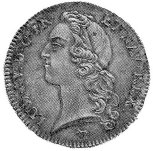
Had Louis XV been killed at Fontenoy he would have gone down to history as one of France’s better Kings, and certainly as one of the most popular. His subjects all but worshipped him. His charm and good looks were the admiration of all (even the humblest peasant was familiar with the Adonis-like profile on the coinage). For nearly twenty years Fleury had given the country unusual prosperity, while a French army had now won a glorious victory.
Yet despite the victory, France’s fight for an honourable peace dragged on for three more weary years. In Scotland, the rising of Prince Charles Edward, at first brilliantly successful, was crushed in 1746. In Italy, the French were defeated in the Milanese and in Piedmont. However, an Austrian invasion of Provence was swiftly repulsed by Marshal Belle-Isle, while in the north Marshal Saxe won two more great victories at Raucaux and Laffeldt, occupied almost the entire Austrian Low Countries and went on to invade Holland. But in 1747 Russia joined the enemies of France, who now stood alone. Across the Atlantic in New France, Louisburg fell to the English and also Cap Breton Island, which commanded the mouth of the St Lawrence, despite the gallant coureurs des boisand their Iroquois blood-brothers. France was exceedingly lucky to obtain such a favourable treaty as that signed at Aix-la-Chapelle in April 1748; it was a mutual agreement that each government should restore its territorial gains.
During the Fontenoy campaign, Louis had written every day to Mme d’Etioles; one letter contained the patent creating her Marquise de Pompadour. Meanwhile the Abbé de Bernis, a man of fashion, was instructing her in the mysteries of court etiquette. (Though many years later, Talleyrand heard that she never quite lost her ‘vulgar accent and gauche manner’.) Upon the King’s triumphant return to Versailles in September 1745 she was presented to the Queen by the Princesse de Conti (in return for the payment of her gambling debts), in Louis’s presence—he was red with embarrassment. The Queen greeted the new favourite with unexpected kindness. Mme de Pompadour was so agitated that, when taking her glove off, she broke her bracelet. Overcome, she told her lover’s wife with deep emotion that she would do her best to please her.
The favourite certainly succeeded in pleasing Louis. Besides organizing every sort of party and diversion, she kept him amused with such toys as private theatricals. A minute playhouse, with room for only fourteen spectators, was erected at Versailles, the first performance taking place in 1747; the play was Molière’s Tartuffe, which Louis thoroughly enjoyed. Later, the theatre was enlarged to hold over forty. More than sixty plays and operas were presented by the Théatre des Petits Cabinets before its creator brought it to an end in 1752, including works by such fashionable writers as Voltaire and Crébillon. The favourite chose the plays with great care, the King having a peculiar dislike of tragedies, preferring comedies with happy endings. The operas were those of Lully, Rameau and de Campra. There were also performances of sacred works—motets by Lalet and Mondonville. On one occasion Louis was so pleased by the little orchestra that he gave the musicians gold snuff boxes bearing his portrait. In the plays, however, the actors were all amateurs, consisting of Mme de Pompadour and her friends. Only very favoured members of the court were invited to the theatre.
Later, long after Mme de Pompadour’s death, Louis commissioned his favourite architect, Jacques Ange Gabriel, to build a full-sized theatre at Versailles; it was known as Gabriel’s Opéra. Less well known, perhaps, is another of the King’s commissions, the cathedral at Versailles which was begun by Mansard de Sagonne in 1743. In addition Louis slowly converted Versailles to suit his passionate desire for privacy, constructing the famous petits appartements on the upper floors of the right wing, overlooking the Marble Courtyard, and reached by secret staircases; the palace became a ‘rat’s nest’ of little flats. But at the same time he also redecorated the salons and great state rooms in the new Rococo style, supervising the redecoration, with almost unbelievably graceful results. His alterations at Fontainebleau were even more drastic. The Ecole Militaire and the Place de la Concorde (both by J A Gabriel) are also his creations—originally the latter was the Place Louis XV.
His mistress shared the King’s mania for building, landscape gardening and the decorative arts. She has been described as ‘undoubtedly the key to an understanding of French taste in the first half of the eighteenth century. She gave it just that exquisitely graceful and feminine touch which still fascinates us today.’ Her houses were fabled for their elegance and beauty—notably the châteaux of La Celle, and of Bellevue, and the Hôtel d’Evreux (now the Elysée and the home of the Presidents of France); she also built ‘hermitages’ at Versailles and Fontainebleau. The prosperity of the state porcelain factory at Sèvres owed a good deal to her influence. Nancy Mitford wrote of her, ‘Few human beings since the world began can have owned so many beautiful things.’ Perhaps the most fitting monument to the friendship—one might almost say partnership—between Louis XV and Mme de Pompadour is the delicious little palace which he built for her in the gardens of Versailles, but which she did not live to see completed—the Petit Trianon.
Mme de Pompadour made the King aware of a new world of intellectuals, bringing him into contact with men like her doctor, François Quesnay, who was a pioneer economist and founder of the Physiocrats. She admired the period’s leading thinkers, thePhilosophes, who returned her admiration; when she died, d’Alembert said, ‘She was one of us,’ and Voltaire went into mourning. But she failed to make a Philosophe of Louis XV, who although not without intellectual tastes—he amassed a fine library of scientific books, collected rare manuscripts, and spent much time in his laboratory—did not care for the new ideas. None the less, he cannot have objected to her patronage of men like Rameau.
One must not overlook the King’s own patronage. He jealously protected his Academie des Beaux Arts, giving the best pupils bursaries to study in Rome at the French Academy in the Palazzo Mancini. He also attended the annual exhibitions in the Salon Carée of the Louvre. As a leading authority on eighteenth-century French art (Alvar Gonsalez Palacios in Il Luigi XV, Milan 1966) tells us, ‘Louis XV himself could always recognize what was best in the art of his time. He could see talent even when it was accompanied by impertinence, as in the case of the painter Quentin La Tour’ [who was rude and half-crazy]. The King also took special pains to help Boucher whose paintings still convey so much of the reign’s atmosphere. Louis commissioned furniture from such masters as Oeben and Riesener, taking a keen interest in its manufacture, which sometimes took years. In addition he watched with pleasure the progress of the new state porcelain factory which had been founded in 1738 (at Vincennes—later it moved to Sèvres) as a rival to Meissen.
Mme de Pompadour was not strong, and after some years began to find Louis’s physical demands exhausting. She tried such aphrodisiacs as hot rooms, chocolate and truffles, and even celery soup, but to no avail; her lover said unkindly that she was ‘as cold as a coot’. In 1752 she therefore took the dangerous step of ceasing to sleep with him, relying on the indispensability of her companionship. She knew that so long as the King had his ‘Deer Park’ he would bed with illiterate girls who only interested him with their bodies, and ought therefore to be immune from the charms of any lady of the court. She had nothing to do with the Park, but prudently did nothing to discourage Louis in his use of it. Most unjustly it earned her the epitaph,
Ci-git qui fut vingt ans pucelle,
Quinze ans catin, sept ans maquerelle.
(Here lies a maid for twenty years, a whore for fifteen and a procuress for seven.)
The Parc aux Cerfs has given rise to pleasurable legends of naked young women being hunted through the woods by the King and his hounds. Carlyle writes zestfully of, ‘a fabulous Griffin, devouring the works of men, daily dragging virgins into thy cave’, Michelet of ‘an infamous seraglio of children whom he bought’. In reality, the Park was a modest house in the town of Versailles which discreetly procured healthy young women of the people for His Most Christian Majesty’s pleasure; many wealthy men of the period kept similar private brothels. The girls were engaged by Louis’s valet, Lebel, and brought to a little flat in the palace known as the ‘Bird Trap’; if they gave satisfaction they were then boarded—seldom more than one at a time—at the Park under the supervision of the house-keeper, Mme Bertrand. They were nearly always professional prostitutes with only their youth and beauty (and health) to recommend them. The most famous was Louise O’Murphy, whose posterior was immortalized by Boucher; she stayed at the Park for four years until she was dismissed for making an impertinent remark about Mme de Pompadour; the King arranged a good marriage for her. Before going to bed, Louis would sometimes make his little whores kneel down with him and they would say their prayers. Rumours about the establishment spread all over Paris and it was said that just as every man descends from Adam, so every Frenchman would descend from King Louis XV. Probably Louis sired no more than twenty bastards at most.
Otherwise, the King’s private amusements were far from sordid. It was the world of fêtes champêtres and commedia dell’ arte revels of the sort painted by Boucher and Fragonard, of picnics in Elysian parks, of Venetian carnivals, of parties on the water in gondolas, of balls in lamplit woodland glades where the court wore masks and dominoes and dressed as Pan and Flora, as Pierrot and Columbine. Louis loved music and adored dancing—pleasure has never been more elegant than it was in his reign. One bitter winter Mme de Pompadour had her flowerbeds filled with porcelain flowers while the air was sprayed with summer scents.
None the less, life at court was still stately and much of court etiquette remained unchanged until the Revolution. Even so, Louis XV’s timetable was very different from that of Louis XIV. Although he slept in his great-grandfather’s bed, instead of rising at the same hour every day he often slept long, telling his valet when to wake him; alternately he rose very early, before the servants, and lit his own fire. Having washed, shaved and dressed—he was scrupulously clean—he breakfasted on fruit and black coffee. He no longer used a chaise percée in public but had a modern, private cabinet with one of the new English water-closets. Council meetings, audiences and Mass occupied the morning, until he dined in public, by himself at a square table; unlike Louis XIV he ate with a knife and fork. He drank copiously but not heavily; his wines were usually burgundy or champagne (as Governor of Guyenne, the Duc de Richelieu once brought him the finest bordeaux obtainable, but the King merely sipped it, muttering ‘drinkable’, and never touched it again).
In the afternoon Louis hunted or shot; out of season he walked or went for a hard gallop. He killed on average over 200 stags a year, besides many wolves and wild boar, frequently exhausting his huntsmen and grooms. Violent physical exercise was essential to his wellbeing, though another reason why he, and indeed all Bourbons, were so passionately addicted to hunting may have been that it offered a chance of being by oneself and behaving naturally. There was a softer side to hunting which is often overlooked—ladies following the hounds down woodland rides in fast little phaetons, and the delightful hunt breakfasts painted by van Loo. Perhaps the greatest of all French sporting artists was discovered by Louis—Jean Baptiste Oudry, from whom the King commissioned a dazzling series of tapestries, ‘The Royal Hunts of Louis XV’.
Like most Bourbons, Louis liked working with his hands. Sometimes he would spend a whole day toiling with his gardeners. He was an expert silversmith and at Marly in 1738 made a pair of candlesticks. He also turned ivory.
In the evening the King joined the Queen and the Royal family at supper, after which—having a true Bourbon appetite—he would often slip away and eat a second supper with his mistress. Then he might drive to Paris to go to the opera, to dance masked at one of the public balls, or to visit a brothel. Sometimes he stayed at home, giving little supper parties, playing cards and making coffee into the small hours of the morning; frequently his pages fell asleep on his bed waiting for the Coucher. As soon as they had left him, Louis, who did not even bother to undress, would jump out of the state bed and join his mistress by a secret staircase.
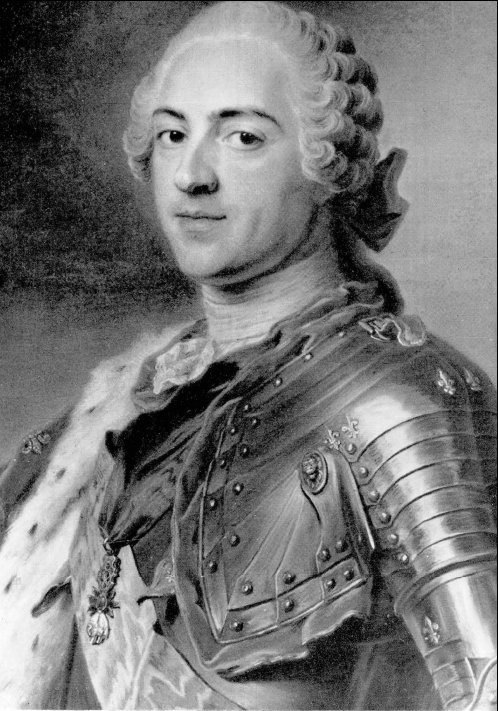
Louis XV by Quentin La Tour

Jean Antoinette Poisson, Marquise de Pompadour, by Boucher, 1759
Frequently the King was away from Versailles. He spent much time at Compiègne, Marly, Rambouillet, La Muette, Fontainebleau, moving about to escape from his awful boredom. When he went to inspect the fleet at Le Havre in 1749, he travelled all night and hunted all day, exhausting his entourage. He was always escorted by his hunt staff and by a special bodyguard of the Black and the Grey Musketeers; at Rambouillet 500 persons had to be housed on each visit. Louis understood little about money; once, hearing that the poor were starving, he sacked eighty gardeners, but took them back when it was explained to him that as a result they too would starve.
Although the King far preferred women’s company, he had his male cronies, some being lifelong friends. Among them were the Duc d’Ayen (a Noailles and a soldier) and the Comte de Coigny, who was killed in a duel over a card dispute in 1749. From his youth these two accompanied Louis everywhere, were invariably invited to his little supper parties, and escorted him on the nocturnal expeditions. Other men friends were the Duc de Vallière (one of the better French soldiers of the reign and a gunnery expert), and the rather silly Duc de Penthièvre, a bastard Bourbon who was Grand Huntsman of France, and whose lovely château of Saint Leger was frequently borrowed by the King. Ayen, Vallière and Penthièvre all had the misfortune of outliving their master and of surviving until the Revolution.
An outsize member of his little circle was that illiterate condottiere, Maurice de Saxe. One of the 365 children of Augustus II—‘The Strong’—of Saxony-Poland (Stanislas Leszczynski’s supplanter), Marshal Saxe had been a soldier since the age of twelve, entering the French service in 1720. Louis rewarded his many victories by creating him Marshal General of France and giving him the château of Chambord. Saxe had strange and colourful ambitions; after losing his delightful little Grand Duchy of Courland on the Baltic, he dreamt of making himself King of Madagascar. A huge, corpulent man, dropsical and stone-deaf, the Marshal was a glutton and a womanizer but his eccentricities were gladly suffered. He had an embarrassingly coarse wit; once, seeing Louis and Mme de Pompadour out walking together, he bellowed, ‘There go the King’s sword and the King’s scabbard.’ Saxe died in 1750, of over-exerting himself with a lady of pleasure.
The one member of the circle who dared to be openly hostile to Mme de Pompadour was the infamous Richelieu. Armand du Plessis, Duc de Richelieu and a great-nephew of the Cardinal, had been born in 1696 and was First Gentleman of the Bedchamber (and therefore in charge of all court entertainments) for more than half a century. A brave and skilful soldier—he captured Minorca from the English in 1757—he was also almost unbelievably venal and unscrupulous; once he offered to sell the frontier town of Bayonne to the Spaniards, while during the Seven Years War his soldiers nicknamed him Papa la Maraude (Daddy Plunder). A creature of exquisite elegance and breathtaking extravagance who gave wonderful parties, the Duke also had intellectual pretensions; he was elected to the Academie Française, was the friend and patron of Voltaire, and was a notorious free-thinker. However, Richelieu’s chief claim to fame was as a Don Juan; he was a sexual athlete whose uncanny gift of attracting women was attributed to supernatural powers; when he died at ninety-four, letters were found in his pocket from four ladies, who each begged for an hour in his bed. Countless scandals enveloped this insatiable debauchee and intriguer—he had been in the Bastille three times. Richelieu was really rather a horrible man, but the King, like most people, never tired of his disreputable, amusing company. Mme de Pompadour had the good taste to dislike him.
It is curious, even taking into account that war was the only occupation fit for a nobleman, that almost all Louis’s closest friends were distinguished generals. Ironically, in view of his distaste for bloodshed, the King was surrounded by soldiers. The guardsmen of the Maison du Roi numbered no less than 10,000, including such specialized troops as the 150 Horse Grenadiers (reputedly the finest-looking men in France). Even when he went to Mass he arrived to martial music from a fife and drum band.
The portraits of Louis XV by Nattier, van Loo and Quentin La Tour give some idea of his good looks. Those who knew the King were even more struck by his charm and beautiful manners; by now a unique and fascinating compound of majesty and simplicity, he could be delightfully gay and talkative, though only in private. Manners had relaxed generally, the honnête homme giving place to the bon compagnon as the pattern for gentlemanly behaviour, and sometimes Louis was the best of companions. The Prince de Croy tells us of little dinner parties (so informal that sometimes the gentlemen dined in their shirtsleeves); there were no servants in the small room under the eaves, everyone helping himself and the King making the coffee. The Prince says, ‘Often I felt more at ease with him than with almost anyone else—his kindness is engraved on my heart.’ In public he was a very different person, shy and stiff. ‘One could see that he wanted desperately to say something but the words died in his mouth’, observes a courtier. The King could be rude too, sulky and scowling, especially when his dreadful melancholy was upon him, though according to Croy ‘he never grumbled or shouted’. Savage things are said of Louis XV by other contemporaries who also knew him well, but these were invariably frustrated men whom he had dismissed from their posts.
His was a strange temperament. In his melancholy moods the King often showed a morbid obsession with death, which may have been due to his parents’ untimely fate; like the Prince of Denmark he sought for his noble father in the dust; on occasion he was very like Hamlet in the churchyard—once, passing a cemetery, he sent a groom to find out if there were any newly-dug graves. At court he frequently inquired about dangerous operations and serious illnesses, asking people where they would like to be buried and even foretelling their demise. For although Louis literally lived for pleasure, he knew little happiness. His entire character and intellect were vitiated by pessimism. Even if the hostile d’Argenson could admit that the King ‘gave orders like a master and discussed business like a minister’, at Council meetings his suggestions were too easily over-ruled by his ministers, while he would agree to policies which his innate shrewdness told him were misguided. His hopeless lack of purpose is illustrated by the immortal remark (made famous by Carlyle), ‘If I were Lieutenant of Police, I would prohibit those Paris cabriolets.’
Yet with all his frivolity and dissipation, Louis—like all Bourbons—was a deeply religious man. He never missed Mass, walked tirelessly in processions, had an expert knowledge of the liturgy, and prayed with real devotion; he once said naively, ‘I do not regret my rheumatism—it is in expiation of my sins.’ He was also like all his family in being in no way an intellectual. He found the ideas of the Philosophes—ces gens là as he scornfully termed them—quite incomprehensible; their excessive rationality did not appeal to a doubting mind which knew very well that men are fools by nature. The King was old-fashioned too in his complete conviction that he had received absolute authority from God—he believed it no less firmly than had Louis XIV. For all his Rococo tastes, Louis XV was more a man of the seventeenth than of the eighteenth century.
Unlike Louis XIV, the King did not enjoy the company of men of letters. None the less his reign was the silver age of French classical literature. It saw the publication of Candide, Manon Lescaut, Gil Blas, Emile and the Nouvelle Héloïse, of Buffon’s natural history and Vauvenargues’s maxims, to name only masterpieces.
Unfortunately for Louis XV, his prime coincided with the age of the ‘Enlightenment’. This was a climate of ideas, almost amounting to a new religious and political philosophy, which was largely derived from the thoughts of Newton and Spinoza, partly from the example of English freedom, and partly from the dissatisfaction of under-privileged bourgeois intellectuals. It was disseminated by Montesquieu, Diderot, Voltaire and a host of others, broadcast everywhere in France by means of a new encyclopaedia of knowledge which claimed to deal with every aspect of human activity. Later the Enlightenment was reinforced by Rousseau, though his pernicious ideas about equality and a return to nature were hardly compatible with reason. By the end of the reign, most literate Frenchmen had consulted the Encyclopédie, which could be obtained through the new Masonic lodges or at the public reading rooms despite every attempt at censorship. However, the Philosophes really wanted reform, not revolution. Their aim was to eradicate Diderot’s ‘artificial man’, the man of tradition, which meant putting an end to religious and intellectual intolerance (of which the Jesuits were a symbol, ‘fanaticism’s grenadiers’ as d’Alembert called them); humanizing the country’s barbarous mediaeval code; and setting the state on a sound economic basis. They were quite content with the Ancien Régime, so long as it could be brought up to date and made to function efficiently. They did not wish to destroy privilege, but merely to rationalize it, as—so they thought—had been done in England.
Louis disliked most new ideas, but eventually allowed the Encyclopédie to be published when ‘sincère et tendre Pompadour’ (Voltaire’s name for her) intervened in its favour. She tried to turn him into a ‘Benevolent Despot’ of the sort to be seen at Vienna or Berlin, but—predictably—was unsuccessful. None the less, he was not averse to his ministers holding fashionable views and actually made Voltaire his Historiographer Royal and a Gentleman of the Bedchamber.
Poor Queen Marie, prematurely aged, had become duller and dowdier than ever. Her dreadful red velvet bonnets were a constant cause for merriment. She painted execrable little pictures, performed dismally on the guitar, harpsichord and hurdy-gurdy, and worked day in, day out at her tapestry; her sole indulgences were gluttony and some mild gambling on a peculiarly dreary card game. Her religious duties were scrupulously observed—she frequently overspent her allowance on charities. The Queen was a frump, but a most dignified one—her stateliness put some in mind of the old court of Louis XIV—and everyone, including the King, respected her deeply. She had a cosy little circle of dull friends, most of whom joined with her in abominating all Philosophes and free-thinkers, in abhorring Jansenists and in cherishing Jesuits.
The Dauphin Louis, small-eyed and black-haired, resembled the King hardly at all. He was another Duc de Bourgogne, of whom some contemporaries had excessive hopes. Like his sainted grandfather, he had been an evil-tempered child who frequently struck his servants, but whose personality had completely changed when he was about fourteen; like his grandfather he became lethargic and taciturn, perhaps as a consequence of having grown unnaturally fat; he may well have suffered from a glandular affliction. Henceforward he was disturbingly pious; his intimate friends were fanatic priests and, to the alarm of all Enlightened courtiers, he would throw himself flat on his face at the Elevation of the Host. His preferred occupation was ‘vegetating’—his own name for it. His habitual rudeness, even boorishness, did not arouse affection. D’Argenson writes, ‘If there really is some spark in him, it is a dying one, extinguished by fat and bigotry.’ None the less, at sixteen he showed at Fontenoy that for all his lethargy he had plenty of courage, begging to lead a charge.
In 1745 the Dauphin married yet another Spanish Infanta, the red-haired Marie Theresa (sister of his father’s former betrothed) with whom he quickly fell in love, but the poor girl soon died. The young husband was prostrate. In 1748 he was forced to take a second bride, the fifteen-year-old Marie Joséphine, straw-haired and sapphire-eyed, who was shy and plain (although the sour d’Argenson thought her ‘a pretty child’). Despite bad teeth and a flat nose, she grew up high-spirited and surprisingly attractive, and the Dauphin fell in love again, becoming an uxurious husband; the pair shared a mutual love of religion and music, withdrawing into a secret world of their own. Five sons were born to them; the short-lived Ducs d’Aquitaine and de Bourgogne, and the Duc de Berry and the Comtes de Provence and d’Artois—the last three becoming Louis XVI, Louis XVIII and Charles X. There were also two daughters, Mesdames Clothilde and Elisabeth.
Louis had mixed feelings about the Dauphin. ‘My son is lazy, quick-tempered and moody. He is not interested in hunting, women or pleasure. But he really does love goodness, he is genuinely virtuous, and he is not without intelligence’; this seems to have been the King’s considered verdict. He cannot have been too pleased with the Dauphin’s calculated rudeness to poor Mme de Pompadour, to whom he could not even bring himself to speak; he referred to her father as ‘that gallows Bird’. Nor was Louis above sneering at him, especially at his plumpness—he once asked, ‘Do I not have a well-fed son?’ None the less, when the Dauphin was dangerously ill with smallpox in 1752, the King spent whole days and nights in his room.
Portraits of the Dauphin Louis show a not ill-looking face, a curious compound of sharpness and femininity. He undoubtedly had a stronger character than his father, and during a brief regency when the King was ill in 1757, showed himself both firm and able. It was not easy to overrule him—later he defended the Jesuits to the bitter end—and he had no illusions about the growing weakness of the monarchy; he wrote that the realm’s financial disorders must be attended to before anything else, that ‘the monarch is nothing but the steward of the state revenues’. In his personal life he was civilized enough, collecting books and pictures, and playing the organ, the harpsichord and the violin; surprisingly, he was an admirer of Rousseau’s Contrat Social. However, the Dauphin was no lover of the Philosophes, who—probably with reason—dreaded his accession and feared that the reign of ‘Louis the Fat’ would be a reign of bigotry and intellectual intolerance.
Another source of opposition to the Enlightenment were the King’s daughters. He had six who grew to womanhood, and although they were not particularly beautiful he adored them all (to the extent of holding their hands when their teeth were drawn). The two he loved best predeceased him; these were the twins, Mme Henriette who died very young; and Mme Elisabeth, Infanta of Spain and later Duchess of Parma, who despite her marriage had frequently returned to Versailles. Croy says that Mme Henriette’s death literally paralysed Louis, who was ‘in a frightful state’. The twins’ place in his affections was taken by the boyish, hot-tempered Mme Adelaide, who as a very pretty little girl had refused to leave him and be educated in a convent; she and the rather colourless Mmes Victoire—amiable and pretty—and Sophie—ugly and sly—never married, Adelaide and Victoire surviving the Revolution and dying only in 1800. The most unusual of the six was the youngest, the tiny, hump-backed Mme Louise. Brought up by the nuns of Fontevrault, from her girlhood Louise wished to take the veil. When she was over thirty her wish was granted and she entered the enclosed convent of the Carmelites at Saint-Denis, where she was blissfully happy praying for her sinful father. Until his death the King came to see her at least once a month, when she would bitterly attack the debauchery of the court and new ideas (later she was a critic of poor, giddy Marie Antoinette). ‘Soeur Sainte-Thérèse de Saint-Augustin’ was lucky enough to die just before the Revolution, in 1787. All Louis’s daughters were loyal supporters of the Jesuits.
By 1750 Louis was at last growing unpopular. Ridiculously, he was suspected of speculating in the grain trade and forcing up the price of bread. When a new road was being built from Versailles to Compiègne, he had it re-routed to by-pass Paris, explaining, ‘I do not see why I should go where people call me Herod.’ (This was a reference to a popular scare that the government were abducting children to send to the colonies; according to Michelet there were even rumours that Louis bathed daily in children’s blood ‘to renew his exhausted frame’.) The fact that taxation had not been decreased after the end of the war in 1748 did not endear him to his subjects. However, the principal reason for the King’s unpopularity was his association with Mme de Pompadour who had incurred the traditional hatred for all royal mistresses. Her bourgeois origins irritated the court—she was the first commoner to be maîtresse en titre—while everyone disliked her connection with a tax-farmer’s family. Increases in taxation were invariably blamed on her extravagance (and admittedly she spent over a million and a half of the King’s money, reckoned in English pounds of the period, in the course of her career). Savage pamphlets, the Poissonades, circulated, lampooning the poor woman without mercy. It was common knowledge that she ruled Louis. After meeting her, the Prince de Ligne described Mme de Pompadour as ‘a second Queen’, and M d’Argenson says in 1756, ‘She is more the First Minister than ever.’
Oddly enough, France was more prosperous than ever before. As Pierre Gaxotte says, the reign of Louis XV was truly ‘an era of agriculturists, bankers, ironmasters, shipwrights and planners’. For, after Orry’s stabilization of the currency in 1726, a period of really remarkable economic expansion had set in and lasted for the rest of the reign. Admittedly the peasantry in many areas were often near starvation when there was a bad harvest, but on the whole agriculture flourished, though there were very few ‘improving’ landlords. There was also an industrial revolution, with an impressive increase in the number of mines and foundries. In addition, there was a marked growth in trade with the colonies. Sugar, rum, tobacco and coffee flowed into the great French seaports, much of it to be re-exported, bringing economic wealth and capturing a considerable part of the European market from the English.
Machault—Orry’s successor as Controller-General—tried to introduce a new and equitable tax system, the vingtième, in 1749–51. This was to be a five per cent wealth tax on real property and capital, which would replace the old system with its inefficiency and injustices; under the new scheme everyone—noble and priest, bourgeois and peasant farmer—would pay, except tenant farmers or wage earners who were to be exempt. The scheme was quickly killed by the privileged classes—notably the clergy in general assembly and the Parlements.
The Parlements were challenging the monarchy once more. These powerful legal corporations, exclusive, rich and noble, had become bastions of reaction and privilege. The noblesse de l’épée were incapable of mounting another Fronde, and the mantle of rebellion had fallen on the Parlementaires who, once bourgeois and loyal, had with increasing exclusiveness grown feudal and fractious. By ‘liberty’ this judicial aristocracy meant a kind of legal neo-feudalism; in 1734 they burnt Voltaire’s Lettres Philosophiques, and they resisted any attempt to reform their archaic and often cruel statutes. They claimed to be the custodians of the law with supreme jurisdiction, and as such to constitute a ‘Senate of the Nation’ which spoke for France. Although entirely selfish and reactionary, they none the less managed to attract popular support in their self-styled rôle of ‘Fathers of the People’. Louis was not far wrong in describing the Parlement of Paris as ‘an assembly of republicans’. They were also the greatest single obstacle to reforming the Ancien Régime.
In the 1750s the Parlementaires derived considerable strength from their support of the Jansenists. Although by then this sect had its mindless fanatics, it did not derive its support from mere popular superstition alone, as is too often suggested; whole monasteries adopted the theology of Port Royal—in the middle of the eighteenth century an entire Carthusian community fled from Paris to join the Jansenists in Utrecht. Jansenists were popular because of their defiance of the Pope, they enlisted qualified support from thePhilosophes in their feud with the Jesuits, and they inspired respect by their piety. (In the next century even Stendhal admired their survivors, in Le Rouge et Le Noir.) By their reliance on the lower clergy in their battle with the bishops, the Jansenists undermined authority and helped spread republican ideas.
In 1752, the Archbishop of Paris forbade his clergy to give the last rites to dying men who could not produce a certificate proving that they had been shriven by a non-Jansenist priest. The Parlement thereupon ordered his pastoral letters to be burnt by the public hangman. The Crown intervened and a furious quarrel ensued, a number of magistrates being banished. Although the Jansenist conflict died down briefly in 1757—thanks to intervention by Rome—the Parlement of Paris then tried to unite with the provincial Parlements to form a single body which would work towards obtaining the powers of the English Parliament. Louis angrily ordered them to confine themselves to their normal business.
The King was keenly aware that the monarchy was in danger. ‘At least it will last my time,’ he muttered grimly to a friend. For his authority was under ceaseless attack from the privileged classes. In this context one should no longer distinguish between nobility of the sword and nobility of the robe; by the late 1750s some of the Dukes and Peers—‘obscure men of illustrious origin’ as Michelet calls them—were beginning to side with the Parlementaires. An aristocratic counter-revolution was taking place; as Tocqueville first recognized, the nobles were becoming a closed caste. Louis XIV had carefully excluded the nobility from the councils of state, but by the mid-eighteenth century they occupied almost all government posts, even those of the Intendants; the higher clergy were exclusively noble; the Parlements refused to admit lawyers who could not show four quarterings; and the army was becoming steadily more patrician.
Louis XV understood very well that the state’s financial machinery was inadequate and that corruption was spreading. Unfortunately his pessimism made him reluctant to act—as C P Gooch says, ‘for him all evils were incurable.’ Furthermore, the growth of literacy and the new critical climate introduced by the Enlightenment made it difficult for an eighteenth-century King of France to act in the way that Louis XIV had done—this was the age of Voltaire, no longer of Bossuet.
Louis XV’s unpopularity was made known to him in a peculiarly unpleasant fashion in January 1757. Ironically, he had already predicted that he would die like Henri IV. One snowy afternoon, as he was descending the Dogs’ Staircase at Versailles, an out-of-work serving man called Damiens stabbed him with a little pen-knife. At first Louis thought he had merely been hit. But touching his ribs he found them covered in blood, and cried, ‘Arrest that man, but don’t hurt him!’ Then he muttered, ‘Why do they want to kill me? I’ve harmed no one.’ He walked upstairs without assistance, but then fainted—from shock rather than loss of blood. Reviving, he demanded a doctor and confessor—above all he feared to die unshriven. Summoning his family, he informed the Queen, ‘I have been assassinated’, and told the Daulphin, ‘Govern better than I have done’, after which he asked their pardon for his scandalous life. When the priest came, after an hour and a half’s confession, he begged for the last rites.
Yet the assassin’s ‘weapon’ had had to penetrate a fur overcoat, a velvet jacket and two shirts. The wound was hardly more than a scratch, but Louis insisted, ‘I shall not recover.’ Eventually his huntsman, deeply trusted, managed to convince him that the wound was not mortal. Even so, the King refused to emerge from behind his curtains for over a week. He would not see Mme de Pompadour who feared that her reign was over; for some it was a day of Dupes; M d’Argenson refused to censor the royal post for her and was dismissed as soon as Louis was in circulation again.
At Fontenoy, in killing many dangerous stags with the sword, and in nursing the Dauphin’s smallpox, Louis XV had shown that he was no coward. To say that his behaviour on this occasion was due to his obsessive fear of damnation—he was not frightened of death—is only part of the explanation. His terror has an uncanny resemblance to the mood of Henri IV on the eve of his own assassination. In fact Louis showed many symptoms of a manic-depressive state. Revealingly, he told his doctor, ‘My body is all right, but this is bad and won’t heal’, pointing to his forehead. It is only fair to add that Damiens’s peculiarly horrible torture and execution—he suffered all the barbarous penalties for regicide—were imposed by the Parlement and not by the King.
The Seven Years War had begun in the previous year, 1756. Already the English, jealous of French colonial prosperity, had ordered its navy to board French merchantmen and even men-of-war. Meanwhile, France had realized that her traditional foe, Austria, was no longer her real enemy. At the same time the English, determined that the war should be fought on land as well as at sea, subsidized Frederick of Prussia, who was alarmed by the new Franco-Austrian alliance. He swiftly invaded and conquered Saxony, an ally of Austria, and won a series of victories in Bohemia.
The French army was in a parlous condition. Undeterred by terrible punishments, thousands deserted the colours every year, while since Saxe’s death there were no great commanders; the rank of Marshal of France had become a mere court perquisite instead of a victor’s accolade. Louis XV’s one positive contribution was the foundation of the Ecole Militaire in 1752, an officer-cadet school for the sons of country gentlemen. French troops have seldom been so badly led as they were during the Seven Years War.
To begin with, the French offensive went well enough. Marshal d’Estrées defeated the English and occupied Hanover; however Richelieu threw away the victory by allowing the Duke of Cumberland to escape. In 1757 there took place one of the most terrible disasters ever suffered by a French army. It was commanded by a brave and elegant friend of Mme de Pompadour, Charles de Rohan, Prince de Soubise, who marched into Saxony with 50,000 men, to attack Frederick who had only 20,000. But Richelieu and the allied generals had, with criminal incompetence, omitted to provide food for the French troops; they had not eaten for three days and were scarcely able to walk when they arrived at the little village of Rosbach where Frederick was waiting for them. None the less, the French marched doggedly towards the enemy. Suddenly they were mown down by hidden artillery, and then their unprotected right flank was overwhelmed by General von Seydlitz’s cavalry. The Prussians lost 165 men; 3,000 Frenchmen were killed, 7,000 taken prisoner. Soubise, the descendant of so many Huguenot paladins, wrote to the King, ‘I write to Your Majesty in an agony of despair. Your army has been totally routed; I cannot tell you how many of your officers were killed or captured or are missing.’ France was so horrified that the Dauphin begged to be sent to the front, without success. Next year, at Krefeld, Frederick again defeated the French.
Meanwhile the French navy was being annihilated. Thirty-seven ships of the line and fifty-six frigates were sunk by the English, the remnant of the fleets being finally destroyed by Admiral Hawke at Quiberon Bay in 1759. The enemy blockaded every French port, raiding Normandy and Brittany, and put the entire French coast in a stage of siege—any sorties were blown out of the water. It was impossible to send aid to the colonies. There were only 5,000 troops in Canada, badly short of ammunition and provisions; in 1759 Quebec fell to an English army of 40,000. Most of the French possessions in the Caribbean were overrun, in India Pondicherry fell and even in Africa Senegal was occupied. It was the most disastrous war which France had known for a hundred and fifty years.
Contemporaries tended to blame poor Mme de Pompadour. Undoubtedly she meddled in politics, making and unmaking ministers—she had had the excellent Orry dismissed in 1745, to please her tax-farmer friends. For her, politics was a matter of personalities—Bernis said she judged affairs of state like a child—and she chose people for amiable qualities rather than abilities. Between 1755 and 1763 no less than twenty-five ministers were appointed and dismissed, ‘falling one after the other like the figures in a magic lantern’, said Voltaire. D’Argenson commented, ‘C’est la vide qui règne.’ Nor was France able to make peace when Frederick openly laughed at ‘Cotillon (Petticoat) II’ and named one of his bitch puppies ‘Pompadour’.
Even if the idea of a woman prime minister does not seem so outrageous nowadays, it is difficult to find an explanation, let alone an excuse, for Louis XV’s trust in his mistress’s political judgement. Yet the twenty-five ministers were only peripheral; the key men were sound enough throughout the war, for the ‘harlotocracy’—Carlyle’s cruel definition—secured the appointment of Bernis and then Choiseul.
The Abbé François Joachim de Bernis had attached himself to Mme de Pompadour even before her meeting with the King, in poverty-stricken days when his highest ambition had been a garret under the eaves of Versailles. He was a light-weight, timid, hypochondriacal, an amateur of flowery verse, essentially a man of pleasure and fashion whose chief talents were those of the drawing-room. But, although he lacked the character to give them force, his political views were shrewd and sensible—he was a pioneer advocate of the Austrian alliance. The court did not take the fat little Abbé very seriously. However, Mme de Pompadour had him appointed Ambassador to Venice, where he did so well that, in 1755, he was made Minister of Foreign Affairs and charged with negotiating the new alliance with Austria. He was wise enough to see that any continuation of the war would benefit only England, a defeatist attitude which was too pessimistic even for Louis. Despairingly, the Abbé wrote, ‘I feel myself to be the Minister of Foreign Affairs for Limbo.’ He resigned in December, consoled with a Red Hat.
Bernis had carefully prepared the way for his friend Choiseul to succeed him. Etienne François, Duc de Choiseul, was a big, pug-faced nobleman with red hair and sharp blue eyes. Not yet forty, the scion of an ancient family from Lorraine, he had begun life as a penniless army officer but had made his fortune by marrying the daughter of a rich army contractor (‘manuring his lands’, as the court termed such an alliance). Choiseul eventually managed to squander all her vast wealth and went bankrupt. Although no less ruttish in his private life than the King, he was intelligent and amusing and succeeded in charming Mme de Pompadour (who came from much the same sort of background as his wife); he knew just how to please her—when he sent her a large opal from Rome, she made Louis give him the Cordon Bleu. It was she who had him appointed Ambassador to the Holy See, where he got on wonderfully well with the amiable Benedict XIV, before going on to Vienna. Energetic and even dynamic, Choiseul was quite sure that he knew what was best for France. To the post of Minister of Foreign Affairs he soon added those of Minister for War and Minister for the Marine and Post-Master General. From 1758 to 1770 he was First Minister in all but name.
As Foreign Minister, Choiseul’s skill inspired Catherine of Russia to call him ‘the coachman of Europe’. He achieved a major triumph with his Family Compact. This famous treaty, which was signed in August 1761, was an alliance between all the Bourbon sovereigns—the Kings of France, Spain and the Two Sicilies, and the Duke of Parma and Piacenza. This immediately procured for France the services of the Spanish navy, which if not particularly effective, did at least divert the attentions of the English. But not even Choiseul, a former Lieutenant-General, could win the war, though at least he ensured that England too fought to a standstill. Everyone wanted peace, and the war came to an end with the Treaties of Paris and Hubertusburg. For France, the price was her colonial empire—the English took Canada and half of Louisiana (the rest being given to Spain). She retained most of her rich West Indian possessions, but her ambitions on the Indian sub-continent were halted for ever.
Few Frenchmen seem to have regretted the loss of Canada, which Voltaire actually dismissed as ‘a mere few acres of snow’. Louis himself was more interested in power in Europe than in power overseas. Like most contemporary monarchs, he operated his own secret service. His main objectives were to save Poland from Russia and to weaken England. In the first he was unsuccessful, Poland being partitioned at the end of his reign, despite tireless work by his agents; the King was one of the few Frenchmen to recognize the full might of the Russian menace. After the Treaty of Paris he concentrated on M de Broglie’s scheme for invading England; later he allowed the plans to be shown to Choiseul who was impressed, and also sent an Irish officer to investigate a possible invasion of Ireland. The Secret du Roi achieved little but Louis regarded it as essentially a safeguard against any weakening of his authority. He once said, ‘At my own court I enjoy less power than some lawyer at the Chatelet, over my armies less power than a Colonel. It is through the Secret that I can recover what I’ve lost.’
Choiseul was the French Pitt. He toiled feverishly to restore his country’s position in the world. He handled the King brilliantly, never boring him with excessive details. Abroad he maintained the alliance with Austria and the Family Compact, besides detaching Portugal and Holland from England. The purchase and conquest of Corsica took place in 1768–9, an accession of territory which was a marvellous tonic for French pride, already soothed by the acquisition of Lorraine on the death of Louis’s father-in-law in 1766. As Minister for the Marine, he reorganized the ports and the navy, building over sixty ships of the line and fifty frigates with the King’s enthusiastic encouragement. At the same time, as Minister for War, he improved the army; the artillery was reorganized, training camps were set up, a serious attempt was made to raise the quality of non-commissioned officers, and colonels were no longer allowed to appoint their own junior officers. His ultimate objective, too, was the invasion of England.
At home Choiseul was less effective. Money was needed to pay for the debts of the Seven Years War and for the new navy, and further taxes could only be obtained with the agreement of the Parlements. Not only did the Duke have little understanding of national finances, but he was not prepared to risk a complete confrontation with the lawyers. Accordingly he tried to buy their support by sacrificing the Jesuits who, as Ultramontanes and the Jansenists’ arch-enemies, were hated by the Parlementaires. As one who sympathized with the Philosophes, Choiseul himself had little love for the Order. In 1761 the Jesuit administrator of the Fathers’ sugar plantations in the West Indies went bankrupt for a large sum (as a result of British privateering); the courts ordered the Order to pay, whereupon it unwisely appealed to the Parlement of Paris, who promptly accused the Fathers of seeking to undermine public morals and the fundamental law. Much against his will, Louis was eventually persuaded by Choiseul to banish the Jesuits from France and to close their schools; the King had done everything possible to save them. Later the Vatican was cajoled into suppressing the entire Order.
Unfortunately, far from being grateful, the Parlementaires remained as intractable as ever. In 1764 Louis summoned the leading members of the Paris Parlement to Versailles and threatened them, without effect. In 1766, in the Palais de Justice, at the famousSeance de la Flagellation—so called on account of the tremendous tongue-lashing which he gave them—the King told the Paris Parlement that ‘the courts depend for their very existence on me alone … to me alone belongs the legislative power’. But the lawyers remained unabashed. In 1768 he again had to force them to register new taxes by a lit de justice. Despite threats and banishment, they continued to obstruct the Government’s financial policy whenever possible. Choiseul was incapable of envisaging any solution.
Paradoxically, the Parlements who challenged absolutism were among the most repressive institutions in what was still an age of brutal intolerance and ferocious punishment. Admittedly, a knock on the door at night and the production of a royal lettre de cachetmeant arbitrary incarceration in the Bastille or Vincennes, but Louis XV was comparatively sparing in his use of this weapon. On the other hand the lawyers enforced their statutes with the utmost severity, especially on Protestants. When—ten years after the last Huguenot rising of 1752—some Protestant noblemen attempted to rescue their pastor who was being hanged, they were condemned and beheaded forthwith. The Calas affair (in which the Huguenot father of a young suicide was falsely accused by the Toulouse Parlement of murdering him for turning Catholic, found guilty and then barbarously executed) outraged public opinion; after a brilliant campaign of protest conducted by Voltaire, the King forced the Toulouse Parlement to make what reparation it could to the unfortunate man’s family.
By the 1760s Mme de Pompadour had grown old and plump. Her position was much more secure since being made a lady-in-waiting to the Queen in 1756. None the less, in recent years her sway had been far from unquestioned. Her best friend, Mme d’Estrades, the mistress of M d’Argenson, had plotted to discredit her with the King, while there had been a number of take-over bids by Mme de Choiseul-Romanet and by the bewitchingly pretty Marquise de Coislin (who was known as ‘Proud Vashti’ and who tried to extort vast sums of money). In 1763 the King had an affair with young Mlle de Romans, whose beautiful black hair and satin skin were admired by no less a connoisseur than Casanova. Mlle de Romans, who had ambitions, might have been a really formidable rival; Louis set her up in a house at Passy where she bore him a son and he created her Baronne de Meilly-Coulongé; but her conceit put him off, luckily for Mme de Pompadour.
Since 1756, poor Mme de Pompadour, already weakened by miscarriages, had suffered from tuberculosis, coughing blood with pitiful regularity; she was also afflicted with insomnia, bronchitis and breathlessness, hiding her ravaged face with more and more cosmetics and an unfailing smile. D’Argenson noted sweetly, ‘the bottom of her countenance is yellow and withered; as for her bosom it is kinder not to mention it.’ None the less, she continued to work at her patronage like some hard-pressed man of affairs, writing as many as sixty letters a day. The disasters of the Seven Years War hurt her deeply for she was a true patriot—she commented, ‘If I die it will be from grief.’ Eventually she found her position almost unbearable. According to her maid, she spent any time alone in tears; in 1763 she complained, ‘My life is like that of the early Christians—a perpetual struggle.’ She turned to religion—commissioning a Book of Hours illuminated by Boucher—and even considered returning to her husband. By now she was so short of breath that she had to move into a ground-floor flat. The poor woman was worn out, and when she contracted a bad inflammation of the lungs in February 1764 she sensed that her end was near. Louis went to Choisy to stay with her and then brought her back to Versailles, visiting her every day. Despite his soothing care, she grew steadily worse. The King now spent all his time in her room. Eventually they had to say good-bye, when the moment had come for her to receive the last rites. Mme de Pompadour died on 7 April 1764, with a courage which even the Dauphin admired. Louis could not attend her funeral, but watched from his study as the cortège left Versailles. He muttered, ‘a friend for twenty years’, and two tears fell from his eyes—he said to his servant Champlost, ‘Those are the only tributes I can pay her.’
In the autumn of 1765 Horace Walpole, visiting the French court, noticed that the Dauphin was ailing—‘He is a spectre and cannot live these three months’, he wrote. The poor Dauphin, coughing and spitting blood, had indeed lost all his plumpness and, despite devoted nursing on the part of his wife—every day he told her, ‘How I love you!’—died of tuberculosis on 20 December 1765. He was only thirty-four. The King was inconsolable, writing of ‘a terrible blow for me’, and of how he could have suffered ‘no greater loss’. Louis now displayed the better side of his nature. He had liked the Dauphine, Marie Joséphine from the very first; they frequently wrote affectionate letters to each other. He was ready with the kindest and most understanding sympathy—the young widow wrote that in her misery, his kindness had been her only comfort. But in 1767 Mme la Dauphine died too, of tuberculosis.
On 24 June 1768, Queen Marie Leszczynska died; she had long been suffering from a tumour. While she lay dying the King spent more time with her than he had for many years—perhaps even he felt a little guilty. For several weeks after her death he showed the most edifying signs of grief and remorse, though he also seemed somewhat preoccupied. The princesses, who fancied that he might remarry, suddenly realized with fury that the preoccupation was with a new mistress. At least the Queen was spared the news.
Since Mme de Pompadour’s death Louis had been lonely, and there had been several volunteers for the post of maîtresse en titre. Some time in 1768—it is not known exactly when—he met the Comtesse du Barry; it is even possible that the King’s valet brought her to the ‘Bird Trap’. Jeanne Bécu was born in 1743, the illegitimate daughter of a dressmaker; her father seems to have been a friar, Frère Ange. She first came to Paris at the age of five, when her mother found employment as a cook in the house of a rich contractor. This employer was a kindly man who paid for the pretty little girl to be educated at an excellent convent. Leaving school at fifteen, Jeanne was by turn a hairdresser, a companion to an old lady, and a shop girl in a milliner’s establishment where her lustrous dark eyes, radiant complexion and splendid bosom attracted both lovers and custom. She was taken up by M Jean Baptiste du Barry, a professional gambler and pimp, who peddled her services to various smart rakes. She lived with him for five years, calling herself Mme du Barry (although his wife was still alive) and meeting many noblemen from whom, despite being illiterate, she managed to acquire surprisingly polished manners. If she never actually worked in a brothel, she was none the less no better than a very high-class prostitute, albeit selective and at the top of her profession.
A singularly beautiful woman, far lovelier than Mme de Pompadour, she was nearly twenty-five when she first met the King. Choiseul privately thought that so low born a creature could only be a passing fancy. However, Jeanne had not been a prostitute for nothing; Louis told M d’Ayen that he was experiencing ‘sensual pleasure of an entirely new kind’, and M de Richelieu that ‘she is the only woman in France who can make me forget I am nearly sixty’ (the Duc de Noailles gave it as his opinion that this was because the King had never patronized a really good brothel). To make her respectable, M du Barry—who saw golden possibilities—hastily married her to his bachelor brother, a retired naval officer, who received a large down payment in cash and a magnificent pension before being sent back to the country. By November 1768 she was living at Compiègne next to Mme de Pompadour’s old flat, waited on by footmen in splendid livery; edifyingly, she attended the King’s Mass on Sundays and feast days.
Soon she had her own château at Louveciennes, with marble pillars and lapis lazuli chimney pieces, supervised by her Bengali page, Zamor. (Years later Zamor would testify against her when she was being tried for her life.) In April 1769, Mme du Barry made her official entrance to court where, wearing a dress of virginal white, her hair snowily powdered and blazing with diamonds, she was presented to the indignant princesses and the little Dauphin. Although nervous, she carried off the ordeal with some style. The King, with his arm in a sling—he had broken it in a hunting accident—watched admiringly. He was quite enslaved and soon afterwards closed the Parc aux Cerfs, no doubt for excellent reasons.
In May 1770 the Dauphin—Louis-Auguste, Duc de Berry—was married at Versailles to an Austrian Archduchess. Louis-Auguste was sixteen, a fat lethargic youth who was irritated at having to miss his hunting on a day of such glorious weather. (Even Mme du Barry called him ‘the fat, ill-bred boy’.) The Archduchess Maria Antonia—Marie Antoinette, as the French christened her—was a pink-faced little blonde of fifteen, dressed all in white. Among those who signed the register was the Dauphin’s cousin, the Duc de Chartres, who, as ‘Philippe Egalité’, would vote for Louis-Auguste’s execution nearly a quarter of a century later. A violent thunderstorm marred the evening and spoilt the firework display. At the great supper in the Versailles opera house—specially built for the occasion—the Dauphin, enjoying himself for the first time during that long, boring day, fell on the food with his customary voracious appetite. Poor Marie Antoinette merely picked at hers. The King whispered to his grandson, ‘You mustn’t have too heavy a stomach for tonight.’ ‘Why not?’ answered the Dauphin, ‘I always sleep much better after plenty to eat.’ Sure enough, almost as soon as he was in the nuptial bed, Louis-Auguste fell into a deep sleep.
There then began a fierce feud between the little Dauphine and la du Barry. When Marie Antoinette first inquired just what was that beautiful lady’s function, Mme de Noailles replied cryptically, ‘To make the King enjoy himself.’ On learning the exact nature of Mme du Barry’s employment, the Dauphine was horrified and refused to address a single word to her; soon the ladies of the court were supporting one side or the other, and fighting like cats. King Louis became irritated. News of his displeasure reached Vienna; the Empress Maria Theresa wrote to her daughter that she really must try to be polite to la du Barry, if only to please the King, and must feign ignorance of any squalid relationship. Finally, after nearly two years of ignoring her, the Dauphine at last acknowledged Mme du Barry’s presence at court by saying coldly to her, ‘Il y a beaucoup de monde aujourd’hui à Versailles.’ (There are lots of people at Versailles today.) Louis was delighted and sent beautiful gifts to Marie Antoinette. But the feud went on just the same.
Choiseul was silly enough to resent Mme du Barry, joking about her in public. The new favourite, who was very good-natured, did her best to make friends, but to no avail, and she ended by hating him. She then spared no opportunity of making spiteful remarks to him, especially during the King’s little supper parties. In December 1770 Louis dismissed him. Horace Walpole wrote, ‘Choiseul has lost his power ridiculously, by braving a fille de joie to humour two women—his sister and his wife.’ In his retirement Choiseul wrote vitriolic memoirs, in which his gibes at the King suggest that there was something a little unstable about the Duke.
Indeed, there was much more to Choiseul’s dismissal than the new favourite’s hostility. He had all but plunged France into a new war with England by his excessive support of Spain’s claim to the Falkland Islands. Nor was he the right man to cope with the Parlements. He was replaced by theTriumvirat—the Duc d’Aiguillon, the Chancellor Maupeou and the Controller-General Terray.
Louis’s choice of d’Aiguillon is often dismissed as sheer bad judgement. Admittedly the Duke, another courtier soldier, was mediocre. Yet it is probable that the King chose him for sound reasons. D’Aiguillon was the one public figure who was a declared enemy of the Parlements; as Governor of Brittany he had been harried for years by the Parlement of Rennes, while the Parlement of Paris had only recently failed in an attempt to try him for misgovernment. And unlike Choiseul, he could be relied on not to plunge the country into a war which she could not afford.
By now the Parlementaires had become an obstacle to national government. From obstructing taxes they had gone on to attacking the King’s officials. To make their point they frequently refused to allow any legal business to be transacted, thus bringing the courts to a standstill. Even Voltaire recognized that ‘this astonishing anarchy could not be allowed to continue. The Crown had to regain its authority or else the Parlement would have triumphed.’ After Louis had stopped the proceedings against M d’Aiguillon by alit de justice, they adopted their usual strike tactics. On the night of 19 January 1771, musketeers ordered them to resume their duties; they refused. Next day all 700 magistrates were exiled, after being informed that their offices had been abolished. The Parlements were dissolved all over France.
The Chancellor Maupeou set up new courts. Though these ‘Maupeou Parlements’ were laughed at, and even though they may have sometimes been corrupt, they were a step in the right direction—a blow against the most formidable obstacles to financial and even political reform.
Now that the Parlements were out of the way it was possible to introduce new taxes. Those envisaged were revolutionary, constituting an attack on wealth and privilege of almost twentieth-century proportions. The bad qualities of the Abbé Joseph Marie Terray—cynicism, avarice and lack of pity—made him an excellent Controller-General. He repudiated many of the government’s more questionable financial obligations, delayed repayment of loans, reduced the income from rentes, converted tontines into life annuities, and abolished a number of court pensions and reduced others. He introduced a swingeing five per cent tax on real property as well as on income, and planned to bring in an entirely new system of taxation. He set up a board to control the grain trade, taxing it but also regulating it to meet supply and demand. To every complaint, Terray—known as the Vulture—answered, ‘The King is master and necessity knows no laws.’ At the same time he did his best to persuade his master to economize on the royal household.
The work of the Triumvirat, who governed France for the rest of the reign, has some pretensions to be considered as a revolution. It has not received proper recognition because it came to an end prematurely; had it lasted, the Crown might well have succeeded in enforcing radical economies and political reforms in the teeth of the nobility’s counter-revolution. The coup d’état of 1770 against the Parlementaires needed real courage, as did Terray’s reforms. It is to Louis’s credit that for the remainder of his life he gave these strong ministers unqualified support.
No doubt France was in decline, but the decline was not apparent to contemporaries. She was still the richest, most populous country in Europe. French had consolidated its position as the universal language; in the Holy Roman Empire rulers and nobility alike spoke it in preference to their native German. Copies of Versailles continued to be built by kings and princes throughout the Western world. And, to give some substance to the illusion, France went on making remarkable economic and industrial progress until the late 1770s.
Louis was sixty-four in 1774, still the handsomest man at court. Michelet paints a compelling picture of these last years. ‘The god of flesh abdicated every vestige of mind. Avoiding Paris, shunning his people, ever shut up at Versailles, he finds even there too many people, too much daylight. He wants a shadowy retreat, the wood, the chase, the secret lodge of the Trianon.’ By now he was thoroughly unpopular, ‘Louis the well-hated’ as the Parisians sang. Yet Mme du Barry was making him surprisingly happy. It was a very intimate relationship. Despite a brilliant superficial polish, the Countess retained some of the inelegant ways of her youth. Once, when Louis was preparing breakfast at the Trianon, she told him, ‘France, you’re making a muck of the coffee.’
However, during Lent they were badly frightened by a sermon which closed with the words, ‘Forty days more and Nineveh will be destroyed.’ At the end of April, after spending the night with Mme du Barry at the Petit Trianon, the King woke up feeling feverish, but hunted as usual. The next night he felt ill again and was taken back to Versailles. Then he developed a rash. Mirrors were kept from him but he was suspicious, complaining to the doctors, ‘You tell me I’m not ill and will soon be well again, but you don’t believe a word of it—you should tell me the truth.’ In fact the doctors thought he had already had smallpox and was immune; they were mistaken. Meanwhile his daughters and Mme du Barry nursed him devotedly—the former by day, the latter by night. At last he saw the spots on his hands and asked for a mirror. ‘This is smallpox,’ he gasped; ‘at my age one doesn’t recover!’ Next day he sent Mme du Barry away—‘Had I known earlier, you would not have entered the room. Now I must arrange matters with God.’ He wept when he learnt she had gone—‘so soon?’ On 7 May he confessed, received Communion, and then asked the Grand Almoner to tell his gentlemen that he begged their forgiveness, and that of his people, for any scandal he might have given. His face was black and swollen, his body suppurating with sores and stinking; he told Adelaide that he felt neither happier nor calmer. The Prince de Croÿ writes, ‘During his illness Louis XV has shown a courage both heroic and simple, gentle and unassuming.’ Croÿ was a truthful man, yet the ‘Enlightened’ Duc de La Rochefoucauld-Liancourt tells us that the King lay dying ‘in inconceivable fear and pusillanimity’. Louis died painfully at three o’clock on the afternoon of 10 May 1774.
Suddenly ‘a terrible noise, just like thunder’ was heard in the ante-chamber where the Dauphin and Marie Antoinette were praying. It was the court running to acclaim their new sovereign. Meanwhile the late King’s body was in such a state of putrescence that his doctors dared not embalm him. He was therefore sealed in a lead coffin filled with quicklime and camphorated spirit, and taken by night to Saint-Denis. (So horrible were the rotting remains that one of the workmen paid to place them in their box is said to have died from uncontrollable vomiting.) As the cortège passed by, lit by flaring torches, the crowd jeered and cried, ‘Tally-ho!’ in mockery of Louis’s well-known holloa; others shouted, ‘There goes the ladies’ pleasure.’ In the words of Michelet, ‘That dead man was Old France, and that bier the coffin of the Old Monarchy.’
With his secrecy, his Shakespearean gloom and indecision, and his passion for elegant pleasures, Louis is very hard to assess—both as a man and a ruler. Carlyle’s sneers and the late C P Gooch’s subtler condemnation are fairly wide of the mark, but so too are the attempts at rehabilitation by right-wing French writers like Pierre Gaxotte. Louis was undoubtedly weak and apathetic; he was also shrewd and determined in the successful defence of his authority. On her deathbed Mme de Pompadour admitted that she found his personality indéchiffrable (indecipherable), and she had known and loved him for twenty years. In the end, Louis XV remains an enigma.