
4–10–16
Last night, a night of tension & anxiety—on a par with the night of the ship's destruction.… Sea & wind increase & have to draw up onto an old isolated floe and pray to God it will remain entire throughout the night. No sleep for 48 Hours, all wet Cold & miserable with a N.E. Blizzard raging … no sight of land & Pray for cessation of these wild conditions.
—FRANK HURLEY, diary
In the gathering dusk of the first night at sea, Shackleton and his men camped on a floe measuring some 200 by 100 feet, which rocked visibly in the ocean swell. Darkness came early, at around 7 p.m., but it was a mild evening, with the temperature around 18°. After a hot meal cooked by Green on the blubber stove, the men retired to their tents.
“Some intangible feeling of uneasiness made me leave my tent about 11 p.m. that night and glance around the quiet camp,” Shackleton wrote. “I started to walk across the floes in order to warn the watchman to look carefully for cracks, and as I was passing the men's tent the floe lifted on the crest of a swell and cracked right under my feet.” As Shackleton watched, the crack ran beneath the sailors' tent and emptied How and Holness, who was still in his bag, into the water. How struggled out, and Shackleton, grasping Holness's bag, hove it onto the ice before the edges of the floe clamped together again.
There was no more sleep that night. Hudson generously offered dry clothes to Holness, who was grumbling that he had lost his tobacco. Shackleton issued hot milk and Streimer's Polar Nut Food—a treat from the uncracked sledging rations—to all hands, who huddled around the blubber stove. From the leads of dark water around them, the blowing of the killer whales punctuated the long hours of the night.
When dawn broke at 6 a.m., the men discovered that the floe was surrounded by loose ice. While all hands waited anxiously for an opening to clear, a dangerous swell was growing, crashing the ice fragments together, as Lees noted, “with a force sufficient to smash a moderately sized yacht.”
By the time the boats were launched at 8 a.m., the wind was high and squally, at times reaching gale force. For two hours the men rowed against the heavy swell through a tortuous network of channels and leads, then through “survival ice,” old hummocky floes and brash at the outer margins of the pack. The crew's all-meat diet had taken a toll, as Lees had predicted. Lacking even minimal carbohydrates over the past months, the men working the oars were soon exhausted.
A light haze had descended upon an otherwise mild day, obscuring their intended landfall, Clarence or Elephant island, now a mere sixty or so miles distant. The overloaded, unwieldy boats did not allow for refinements in navigation. The Stancomb Wills in particular was already cause for grave concern, lacking “the canvas” to keep abreast of her more seaworthy companions. Shackleton had given orders that all three were to stay in hailing distance of one another, but this was not always easily accomplished.
Amid towering icebergs of fantastic shapes, the boats nosed their way closer and closer towards the edge of the ice. But when they finally broke triumphantly through it, they were hit head-on by a high sea unbuffered by the pack; abruptly, Shackleton ordered them back inside. Reluctant to head due north through open, running sea, they now turned their course west, towards King George Island.
At dusk, the boats turned to a circular floe, some twenty yards across, and made camp. Later in the night, the wind rose, dropping snow and rocking their camp with heavy swell. Chunks of the floe broke off in the wind-whipped waves, but Shackle-ton, who had remained up all night with the watchman, McNish, deemed the camp to be in no immediate danger, and let the men sleep—or try to. Hurley's diary indicates there were no illusions inside the tents about the safety of their position.
By dawn, a huge swell was running under overcast, misty skies that turned to snowy squalls. Heaving undulations of ice swept towards them. Shackleton, Worsley, and Wild took turns climbing to the peak of their rocking berg, searching for a break of open water in the ice, while the men stood by the boats and waited. As the hours passed, their floe, grinding against loose pack, became gradually smaller.
“One of the anxieties in my mind was the possibility that we would be driven by the current through the eighty-mile gap between Clarence Island and Prince George Island [as it was then called] into the open Atlantic,” wrote Shackleton. By noon, the squalls had slackened, and when a lane of open water appeared, the boats rushed into it. They had set out late in the day; with dusk falling at 5 p.m., few hours of light remained for sailing, and come nightfall they were still amid the loose pack. As before, a suitable floe was found for a camp, and Green and his blubber stove were disembarked. But it quickly became apparent that the floe could not serve them through the night, and Shackleton reluctantly determined that they would have to sleep in the boats.
Several hours of desultory rowing brought them under the lee of a heavy old floe, where the boats were moored alongside one another for the night.
“Constant rain and snow squalls blotted out the stars and soaked us through,” Into the Boats Shackleton wrote. “Occasionally the ghostly shadows of silver, snow, and fulmar petrels flashed close to us, and all around we could hear the killers blowing, their short, sharp hisses sounding like sudden escapes of steam.” A school of killer whales had languidly drifted around the boats, their sleek, sinister black forms surrounding them on every side for the duration of the long night. Of all the memories the men would carry with them, this—the slow, measured rising of the white-throated whales in the dark waters around their boats—remained one of the most terrible and abiding. In their long months on the ice, the men had borne abundant witness to the great beasts' ice-shattering power. Whether they would attack humans, no one really knew. For the men, these were prodigies of the deep, mysterious and evil, possessed of chilling reptilian eyes that betrayed disconcerting mammalian intelligence. Seasick and sleepless, the men bumped and jostled endlessly amid the ice and whales. It was this night that began to break the will of many.
Regarding his companions in the cold dawn that followed, Shackleton noted simply that “the strain was beginning to tell.” He promised a hot breakfast, and the men manned the oars to seek out a suitable floe, their frozen Burberry suits crackling and shedding shards of ice as they pulled. At eight o'clock, the “galley” was landed on a floe; by nine o'clock they were under way again. Around them, basking in the welcome sunshine, hundreds of seals lounged comfortably on floes flushed pink by the sunrise.
They had been travelling roughly northwest since the day they left Patience Camp. Now, under hazy sunshine, Worsley balanced himself against the mast of the Dudley Docker to take the first noon observation the weather had allowed. Expectations were high as to the miles gained. But the results were worse than anyone would have dreamed possible.
“A terrible disappt.,” wrote Worsley in his diary. Not a single mile had been gained. Instead, they had drifted back to the southeast—thirty miles east of their position at Patience Camp and eleven miles south. A strong easterly current concealed by the heavy swell, combined with a tortuous navigation through sinuous lanes, had obscured all sense of direction.
Shackleton tried to downplay the bad news, saying only that they had not “done as well as expected.” It was three in the afternoon, and dusk came at five. King George and Deception islands, to the west, were now out of reach. Elephant Island, to the north, the closest land, lay outside the pack, in high seas; behind them to the southwest, Hope Bay, on the tip of the Palmer Peninsula, was 130 miles away in water that was for the moment clear. After consulting with Worsley and Wild, Shackleton opted to take advantage of the northwest wind and turn the boats back towards Hope Bay.
By nightfall, they found themselves amid loose, fragmented ice in a choppy sea. The weather was becoming colder and wetter, and as on the previous night, no floe could be found large enough to establish a camp. Eventually, the boats were tethered one behind the other and moored to the lee side of a large chunk of ice.
At nine o'clock, a shift in the wind blew back the clouds, revealing a bright moon but also driving the boats against the jagged floe. Hastily, the painter of the lead boat, the James Caird, was cut, and with no other mooring available, the three small vessels drifted through the night in a sea of brash ice. The temperature had dropped, and new pancakes of ice had formed on the water's surface.
Shivering together in each other's arms, some of the men tried to snatch minutes of sleep; many preferred to row or fend off the chunks of ice that sped their way— anything to keep their cold arms moving.
“Occasionally from an almost clear sky came snow-showers,” wrote Shackleton, “falling silently on the sea and laying a thin shroud of white over our bodies and our boats.” Lees, in the Dudley Docker, had appropriated the only complete set of oilskins, which he adamantly refused to share. As his snoring indicated, he for one found sleep possible.
When a foggy dawn at last put an end to the night, the crew discovered that the boats were sheathed in ice, inside and out. The temperature in the night had dropped to –7°. As the ice was hacked off with axes, lumps were distributed for the men to eat.
“Most of the men were now looking seriously worn and strained,” Shackleton wrote. “Their lips were cracked and their eyes and eyelids showed red in their salt-encrusted faces.… Obviously, we must make land quickly, and I decided to run for Elephant Island.”
The wind had shifted again, blowing now from the southeast. Shackleton's decision to change course again and, at any cost, make for the nearest land was determined by the realization that he was now racing for the very lives of many of his men. He could no longer afford the luxury of caution. As the boats ran before the wind for Elephant Island, a man in the bow of each attempted to fend away lumps of brash while they plunged precariously down leads in the thin new ice. The wind grew stronger, and the boats made their way once again to the edge of the pack, and by noon had crashed into deep sapphire waters. With the sun out, the wind favorable and strong, they raced towards their destination.
By four in the afternoon, the wind had increased to a gale that blew surging waves into the boats, compounding the men's misery. The Stancomb Wills alone had not had her gunwales raised, and water poured in over stores and men. From the James Caird,Shackleton, sensing a need to lift morale if only in some small way, distributed extra food to all hands. A number, overcome with seasickness, could not take advan tage of this bonus; many were suffering from dysentery from uncooked dog pemmican, and were forced to relieve themselves over the side of the surging boats, balancing on the gunwales.
Shackleton's order that the boats stay in hailing distance of one another became increasingly difficult to obey. The Stancomb Wills was knee-deep in water, and Holness, one of the trawlerhands who previously made his living braving the icy north Atlantic, covered his face and wept with sheer terror and misery. Worsley, drawing abreast of the James Caird, suggested to Shackleton that they run through the night; but Shackleton, wary as ever of splitting his party, and afraid they might even overrun the island in the darkness, gave the order to lay to. It was a hard decision to make.
“I doubted if all the men would survive that night,” he stated simply. On top of all else, they had no water. Usually, ice was taken on board at each “campsite,” but the hasty departure from the veering floe the night before had made this impossible. Tormented by the salt spray flung continually in their faces, the men's mouths were swollen and their lips bloody. Frozen raw seal meat provided the only relief.
Sea anchors, made of canvas and oars lashed together, were flung overboard, and there began the third night in the boats. Through all the demanding days and all the long and terrible hours of darkness, the helmsmen—Wild and McNish, Hudson and Crean, Worsley and Greenstreet—had remained immovable at their posts as waves crashed over them, as their clothes froze upon them, as the wind and spray stung their tired faces.
The wind subsided in the night, and at dawn the sleepless men beheld the glorious mauve sunrise that flashed on the eastern horizon; and only thirty miles directly ahead lay Clarence Island, its snow-clad peak glowing in the dawn. Later, in full daylight, Elephant Island appeared, exactly on the bearings that Worsley had calculated, in Shackleton's words, “with two days' dead reckoning while following a devious course through the pack-ice and after drifting during two nights at the mercy of wind and waves.” Elephant Island was the less precipitous of the two; additionally, it lay to windward, ensuring that if the boats missed their first attempted landfall, they would have Clarence Island as alternative to their lee.
The night had taken its toll.
“At least half of the party were insane,” according to Wild, “fortunately not violent, simply helpless and hopeless.” The Stancomb Wills drew abreast of the Caird to report that Hudson had collapsed after seventy-two hours at the helm, and Blackborow reported that “there was something wrong” with his feet. Continual immersion in salt water had caused the eruption of painful boils on many men; their bodies were badly chafed, and their mouths throbbed with thirst. As the wind died they took to the oars, a task made painful by the blisters on their hands. By three in the afternoon, the boats were only ten miles from land, the harsh glaciers and icy mountains of Elephant Island now discernable in fine detail. At this point, the men encountered a strong tidal current that held the boats at bay. After a solid hour of rowing at the pitch of their strength, they were not so much as a mile closer to the island.
At five o'clock, lowering skies to the northwest darkened, and shortly afterward a storm broke. There would be no landfall after all, but another night in the pitching boats.
“We were in the midst of confused lumpy seas which running…from two directions were far more dangerous for small boats than the straight running waves of a heavy gale in open seas,” Worsley wrote. “The boats could never settle down, and to steer became a work of art.”
Now all three boats were bailed continuously; in the belabored Stancomb Wills, four of the eight men were completely incapacitated: McIlroy, How, and Bakewell bailed through the night for their lives and those of their shipmates, while Crean held the tiller. In the James Caird, McNish relieved Wild at the helm, but briefly fell asleep, exhausted. Wild, unshaken, unchanged, took over again, “his steel-blue eyes,” as Shackleton recorded with affectionate pride, looking “out to the day ahead.” In the Docker, around midnight, Cheetham heard the boat's back cracking, and all hands scurried to shift their stores. Huddled under the canvas of one of the tents, Green-street managed to light a match so that Worsley could glimpse his tiny compass. Later, some of the crew noticed that Worsley himself did not seem to hear them anymore, that his head was sinking on his chest. When at last he was persuaded to surrender the helm to Greenstreet, he was so stiff from hunching over the tiller that he could not unbend, and his rigid muscles had to be massaged before he could lie straight on the bottom of the boat: He had not slept for more than ninety hours.
“It was,” wrote Shackleton, “a stern night.” The James Caird had taken the limping Stancomb Wills in tow, though at times the latter was lost to sight, vanishing into the deep trough of the swell, then reemerging from the black sea, tossed on the crest of a wave. The survival of the Wills, the least sound of the boats, depended upon her keeping contact with the Caird, and throughout the night Shackleton sat with his hand on her painter, as it grew heavy with ice. He must have been very near exhaustion.
“Practically ever since we had first started Sir Ernest had been standing erect day and night on the stern-counter of the Caird,“ Lees wrote. “How he stood the incessant vigil and exposure is marvelous.” Shackleton had not slept since leaving Patience Camp.
A sudden heavy squall of snow hid the boats from one another, and when it cleared, the Dudley Docker was gone; she had vanished into the darkness and the racing sea. For Shackleton, this was perhaps the worst moment of the journey.
When the dawn came at last, the air was so thick with mist that the men aboard the Caird and the Wills were under the cliffs of Elephant Island before they saw them. Anxiously, they followed the precipitous coastline until at 9 a.m. they sighted a narrow beach at the northwest end of the island, beyond a fringe of surf-beaten rocks.
“I decided we must face the hazards of this unattractive landing-place,” wrote Shackleton. “Two days and nights without drink or hot food had played havoc with most of the men.” His own throat and tongue were so swollen he could only whisper, and his orders were passed along by either Wild or Hurley. Shackleton boarded the Wills to take her through first, and as he did so the Dudley Docker hove in sight.
“This,” wrote Shackleton, “took a great load off my mind.”
The Wills was carefully positioned at an opening in the reef, then shot through on the top of waves to the rough stony beach beyond. Shackleton gave the word that Blackborow, as the youngest member of the expedition, should have the honor of being the first to land; but Blackborow sat motionless.
“In order to avoid delay I helped him, perhaps a little roughly, over the side of the boat,” wrote Shackleton. “He promptly sat down in the surf and did not move. Then I suddenly realized what I had forgotten, that both his feet were frost-bitten badly.”
The Docker followed the Wills, and then the James Caird, too heavy to land, was unloaded in tedious relays before being taken through the reef and beached beside the other boats.
The men staggered onto land. With his Vest Pocket Kodak camera in hand, Hurley bounded out to record the landing of the boats and the first meal on Elephant Island.
“Some of the men were reeling about the beach as if they had found an unlimited supply of alcoholic liquor on the desolate island,” Shackleton wrote. His bemused, paternal tone conjures an almost comical scene of readjustment; but the diaries hint darkly at the journey's actual toll.
“Many suffered from temporary aberration,” Hurley reported, “walking aimlessly about; others shivering as with palsy.” “Hudson,” McNish states with characteristic directness, “has gone of [f ] his head.”
Some filled their pockets with stones, or rolled along the shingled beach, burying their faces in the stones and pouring handfuls over them.
“In the Wills, only two men were fit to do anything,” Wordie recorded. “Some fellows moreover were half crazy: one got an axe and did not stop till he had killed about ten seals.… None of us suffered like this in the Caird.”
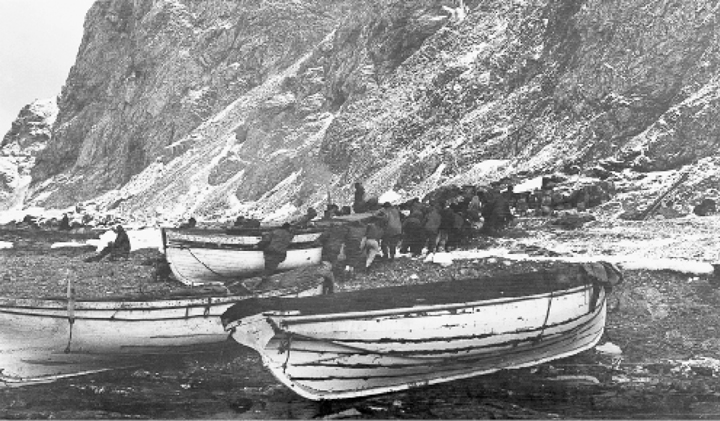
On Elephant Island
The James Caird, Dudley Docker, and Stancomb Wills safely ashore at Cape Valentine, Elephant Island. The men pull the Caird to higher ground; two figures, one in the distance, can be seen seated to the left of the boat, one of whom is probably Blackborow, crippled by frostbite. Off-loaded supplies can be seen on the beach above the boats.
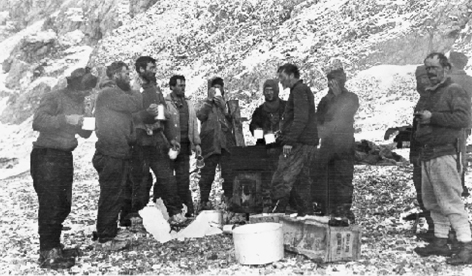
On Elephant Island; the first drink and hot food for three and a half days.
Left to right: Lees, Wordie, Clark, Rickinson (who would later suffer a heart attack), How, Shackleton, Bakewell, Kerr, and Wild.
They had spent seven fearful days in open boats in the South Atlantic, at the beginning of an Antarctic winter; 170 days drifting on a floe of ice with inadequate food and shelter; and not since December 5, 1914—497 days before—had they set foot on land.
After meals of seal steaks, the men laid their bags on the solid earth and turned in for the night.
“I did not sleep much,” Bakewell recalled, “just lay in my damp sleeping bag and relaxed. It was hard for me to realize that I was on good old solid earth once more. I got up several times during the night and joined the others, who were like me, just too happy to sleep. We would gather around the fire, eat and drink a little, have a smoke and talk over some of the past adventures.”
As they would soon discover, they had arrived on an abnormally fine day. Elephant Island offered salvation, but a grimmer or more hostile piece of land was difficult to conceive. The narrow shingle beach onto which they had drawn the boats offered little protection from high seas, and the morning after landing, Wild set out with Marston, Crean, Vincent, and McCarthy in the Dudley Docker to scout the coast for a better camp. He returned in the evening, after dark, with the news that there was a suitable place seven miles down the north coast. At daybreak on the 17th, the weary men loaded up the boats, leaving many boxes of sledging rations stacked against the rocks. No one had the energy to load them—and this at least ensured an emergency supply of provisions in the event a second boat journey was required. Shortly after they shoved off, another gale arose, threatening to sweep the boats out to sea.
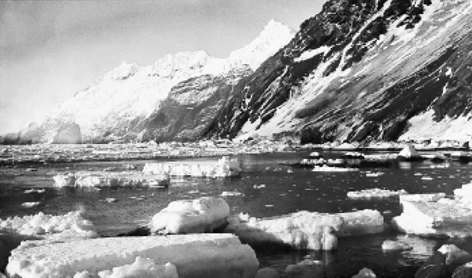
Elephant Island
Cape Valentine is thought to have got its name because the sealer-explorer who charted the South Shetlands in the early nineteenth century came through on St. Valentine's Day. “Scenically, our present environments are some of the grandest I have ever set eyes on. Cliffs that throw their serrated scarps a thousand feet into the skies are interspersed with glaciers that tumble in crevassed cascades down to the sea. Here they present walls of blue ice 100 to 180 feet in height.” (Hurley, diary)
“Weathered what we call the Castle Rock and finally reached our destination,” wrote Wordie, “more exhausted I think, than by the previous boat journey.”
The new camp offered a somewhat larger, gravelly beach, but was still foreboding.
“Such a wild & inhospitable coast I have never beheld,” Hurley wrote upon their arrival, and evoked the “vast headland, black and menacing that rose from a seething surf 1,200 feet above our heads & so sheer as to have the appearance of overhanging.” On the other hand, wildlife was abundant, with seals, gentoo and ringed penguins, and even limpets in the shallow waters, although no sign of the elephant seal from which the island took its name.
Many of the men were still incapacitated. The most critical were Blackborow with severe frostbite, Hudson with frostbite and a mysterious pain in his lower back, and Rickinson, who was believed to have suffered a heart attack. The others on the sick list were simply “stove in.”
After meals of seal steaks and hot milk, the men pitched their flimsy tents as high above the tidal mark of their new camp as possible, and retired to their wet sleeping bags. But a blizzard rose in the night, ripping the largest tent to ribbons and bringing the others down flat. Some of the men crawled into the boats; others simply lay under the collapsed tents, with the cold, wet canvas draped across their faces. The wind was severe enough to blow around the beached Dudley Docker—”and she is a heavy boat,” as Lees noted. Precious gear was lost to this unexpected gale, including aluminum cooking pans and a bag of spare warm underclothing—blown away to parts unknown.
On the 19th, with the blizzard still in full spate, the men were awakened by Shackleton bringing them their breakfast.
“The Boss is wonderful,” wrote Wordie, “cheering everyone and far more active than any other person in camp.” At least there was now plenty of food, and the men consumed prodigious amounts of blubber and seal steak. Hurley, Clark, and Greenstreet were enlisted as cooks, Green being one of the men on “the sick list.”
With shelter nonexistent, the sleeping bags were now sodden. The heat of the men's bodies melted not just the snow underneath them, but the frozen, reeking guano of the penguin rookery on which they lay.
For months the men had dreamt of land, and for long days and nights in the boats they had fought for it. But now the hard truth dawned on them that the conditions they had so far encountered on this particular piece of land did not represent some terrible aberration, or a run of atrocious weather; this was the way it was going to be as long as they were on Elephant Island. On April 19, a quiet rebellion against these cruel circumstances occurred among the sailors.
“Some of the men were showing signs of demoralization,” Shackleton noted. They had neglected to place their gloves and hats inside their shirts during the night, with the result that these items were frozen solid come morning—demonstrating, as Shackleton stated, “the proverbial carelessness of the sailor.” They used this negligence as an excuse not to do any work.
“Only by rather drastic methods were they induced to turn to,” wrote Shackleton. What happened here? As at Patience Camp, the diaries leave one with a sense that all the facts have not been plainly spoken.

On April 17, Shackleton led the men back out to sea and around to a spit of land seven miles to the west of their landing, which Frank Wild had discovered. The second campsite became known as Cape Wild—Cape Bloody Wild by the sailors—after both its “founder” and its weather. A blizzard raged for five straight days after the crew's landing.
“Some of the party … had become despondant,” wrote Wild, “& were in a ‘What's the use' sort of mood & had to be driven to work, none too gently either.” Wordie says, almost in passing, that “dejected men were dragged from their bags and set to work.” Hurley's pointed diary entry on this day, however, is blistering:

Elephant Island
“Such a wild & inhospitable coast I have never beheld. Yet there is a profound grandeur about these savage cliffs with the drifting snow & veiling clouds.…I thought of those lines of Service.—
‘A land of savage grandeur that measures each man at his Worth.' “ (Hurley, diary)
Now that the party are established at an immovable base I review their general behaviour during the memorable escape from the ice. … It is regrettable to state that many conducted themselves in a manner unworthy of gentlemen & British sailors.… Of a fair proportion of the [company] I am convinced they would starve or freeze if left to their own resources on this island, for there is such an improvident disregard for their equipment, as to allow it to be buried in snow, or be carried off by the winds. Those who shirk duties, or lack a fair sense of practicability should not be in these parts. These are harsh places where it takes all one's time & energies to attend to the individual, & so make himself as effective & useful a unit as possible.
It was perhaps no coincidence that Shackleton chose the following day, April 20, to gather his company to make a momentous announcement: A party of men under his command would shortly set out in the James Caird and make for the whaling stations of South Georgia. The stupendous difficulties of this journey required no elaboration to the men who had just arrived on Elephant Island. The island of South Georgia was 800 miles away—more than ten times the distance they had just travelled. To reach it, a twenty-two-and-a-half-foot long open boat would have to cross the most formidable ocean on the planet, in the winter. They could expect winds up to 80 miles an hour, and heaving waves—the notorious Cape Horn Rollers—measur-ing from trough to crest as much as sixty feet in height; if unlucky, they would encounter worse. They would be navigating towards a small island, with no points of land in between, using a sextant and chronometer—under brooding skies that might not permit a single navigational sighting. The task was not merely formidable; it was, as every sailing man of the company knew, impossible.
“There is a party of 6 going to Georgia in the Caird,“ wrote McNish. “The party includes
Sir Ernest
Skipper
Creen
Macnish
McCarthy
Vincent.”
The pride with which this concise entry is made is palpable. After he announced his plans, Shackleton had called McNish over to examine the Caird and asked him whether she could be made more seaworthy.
“He first enquired if he was to go with me,” Shackleton reported, “and seemed quite pleased when I said ‘Yes.' “ There is no evidence that any of the men chosen faced the prospect of the new ordeal with anything but matter-of-fact determination and satisfaction. Crean, indeed, had begged to be included, although Wild had wanted him to remain with him. Shackleton, it is true—as Lees took pains to inform him—could possibly have waited out the winter and then attempted to cross back the way they had just come to the whaling waters near Deception Island; but this option meant many long, fickle months of delay. Besides, the first boat journey had set him in motion, put him on a course from which there was now, it seemed, no turning back.

On April 20, Shackleton announced that he would attempt to sail the twenty-two-and-a-half-foot-long James Caird to South Georgia, 800 miles away. Immediately, McNish set to work adapting the boat for its momentous journey. On April 21, McNish wrote in his diary, “All hands are busy skining & storing penguins. Some repairing the Cairds gear 2 sewing canvas for the deck. Myself Marsten & McLeod are busy getting the Caird ready.… There are 5 on the sick list some heart trouble some frost bites & 1 dilly.” The negative for this photograph has been retouched, but apparently only to highlight faded details, rather than to change them.
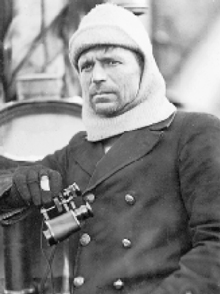
“ The Skipper” Lieut. F.A. Worsley RNR
Shackleton chose the crew for the momentous journey very carefully. Worsley had already distinguished himself as a navigator by landing the three boats safely on Elephant Island. He had served for several years in the Pacific for the New Zealand Government Steamer Service, where he had become proficient in sailing small boats and navigating for landfalls on small islands.

Tom Crean
Wild wanted him to stay with him on Elephant Island; Shackleton wanted him in the Caird. Everyone knew that this tough seaman, who had won the Albert Medal for bravery on Scott's last expedition, would be an asset to any cause he served. Crean was perhaps as close as one can come to being indestructible.
“Shackleton sitting still and doing nothing wasn't Shackleton at all,” wrote Macklin. “We'd had all that at Patience Camp.” Moreover, with his eye ever on the sailors, the Boss may have calculated that another long, demoralizing waiting game was not feasible; psychologically, it was better to offer his men the hope of even the longest of long shots.
The crew of the James Caird was chosen with care. Worsley had proved himself a gifted navigator. McNish would be useful as both shipwright and sailor—his rebellion on the ice notwithstanding, he was, with Crean, Vincent, and McCarthy (also Marston and Hurley), one of the handful of men whose performance during the boat journey had been singled out by Shackleton for commendation. Furthermore, Shackleton was once again gathering the potential troublemakers—Vincent and McNish—into his own safekeeping. Finally, in Crean, Shackleton knew he had a man who would persevere until the very bitter end.
Although the weather was still severe, all able hands now turned to equipping the lifeboat for its sea voyage. For the next few days, as the wind raged and driving snow fell, McNish was at work, mending a hole made by the ice in the boat's bow above the waterline and constructing a makeshift “decking.” The timber available, salvaged from the freeboard of the Dudley Docker and other odds and ends, fell short of what was required, and so in lieu of an entire deck he assembled a frame to be covered with a spare bolt of canvas.
“Cheetham and McCarthy have been busy trying to stretch the canvas for the deck & They had rather a job as it was frozen stiff,” wrote McNish. The canvas was thawed, foot by foot, over the blubber stove, allowing the brittle needles to be pushed and pulled through the heavy fabric with a pair of pincers. Heavy, wet snow fell throughout the day as they worked, and Wild, of all people, was overheard to say that if the weather continued much longer “some of the party will undoubtedly go under.”
On the 22nd, McNish, working with few tools and frost-nipped hands, completed his task. The blizzard finally ceased, although heavy snow continued to fall as all able hands gathered round to look over his masterful handiwork.
“The carpenter had contrived wonderfully with the very limited resources at hand,” wrote Lees. “She has been strengthened in the hull by having the mast of the Dudley Docker lashed along her keel inside.” The Caird carried two masts: a mainmast, rigged with a standing lugsail and jib, and a mizzenmast, also lug rigged.

The bosun of the Endurance mends a net, 1915
A former trawlerman who had worked in the North Atlantic, John Vincent was physically the strongest man on the Endurance. His bullying manner had already caused friction, but he had held up better than most in the first boat journey to Elephant Island. Shackleton wanted him on board the Caird for his strength, seamanship—and to ensure that he would not cause trouble on Elephant Island.
The foul weather held over the next two days, but moderated on the 24th, and Shackleton decided to launch the Caird. Having no ballast keel, the boat was ballasted with 1,500 pounds of shingle-filled bags made of blankets, and an additional 500 pounds of boulders. Worsley believed the ballast excessive and was concerned the boat would ride low and ship water—her freeboard was two feet two inches; Shackleton's fear was that a light boat would be in danger of capsizing in the high seas he knew they would face. The Caird also carried four oars and a pump that Hurley had made back at Ocean Camp from the binnacle of the Endurance. Additionally, bags of blubber oil were taken to pour on rough water, to prevent the breaking of waves.
Two barrels of melted ice were stowed along with the provisions. According to Hurley, these included:
30 Boxes Matches
8 Galls. Petroleum
1 tin Spirit
10 boxes flamers
1 box blue lights
2 Primus Stoves & parts & Prickers
1 Cooker Complete
6 sleeping bags
Spare apparel (clothes sox, etc.)
Food
3 Cases Sledging ration = 300 rations
2 Nut foods = 200 rations
2 Biscuits—300 in case
1 case lump sugar
30 packets trumilk
1 tin Bovril Cubes
1 tin Cerebos Salt
36 galls Water
112 lbs. ice
Insts. Sextant, Binoculars, Compass, Candles, Blubber Oil for Oil Bag, sea anchor, charts. Fishing line & triangle, twine & needle. Bit of blubber for bait. Boathook, Aneroid.

Launching the Caird
The decking of the Caird was completed on the morning of April 24, and as the weather was good, Shackleton decided to get under way as soon as possible. Here the men gather around the boat, preparatory to launching her. The Stancomb Wills, which was used to ferry supplies to the Caird for loading, is beached to the right.
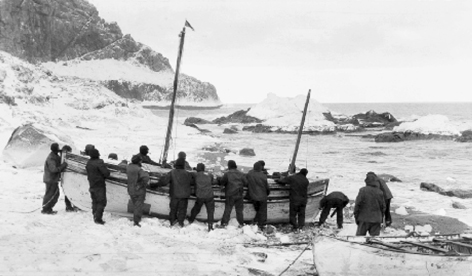
Launching the Caird
“Monday April 24 A fine morning I started on the boat at day break & finished at 10 AM. Then all hands were mustered & we launched her.” (McNish, diary)
Shackleton also took his double-barrelled shotgun and some cartridges, and two axes. McNish took some of his remaining tools, including a carpenter's adze.
The food supplies were calculated to last four weeks.
“For if we did not make South Georgia in that time,” wrote Shackleton, “we were sure to go under.” The charts were those Worsley had ripped from books in the library of the Endurance, before she was abandoned.
Should the relief expedition fail, Wild was under orders to make his way in the remaining boats to Deception Island in the spring. Meanwhile, he was in sole command mand of the men left behind. He too had begged to make the journey, but there was no other person—on Elephant Island or anywhere else—whom Shackleton so implicitly trusted as Frank Wild. He knew this man would undertake nothing that Shackle-ton himself would not. The two men talked late into the night, Shackleton laying on last-minute injunctions, and Wild, imperturbable, giving his silent assent.
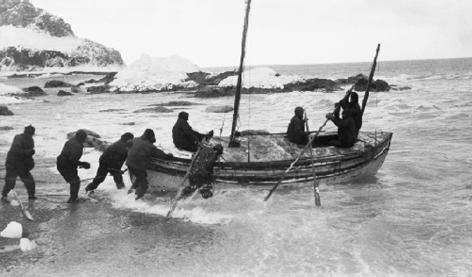
Launching the Caird
“As we were getting her of the beach a heavy surf came up & owing to us being unable to get her up of the beach she almost capsised as it was she emptyed Myself & Vincent overboard.” (McNish, diary)

The Caird launched
“Great difficulty was experienced in keeping her off the labyrinth of rocks & reefs which abound along the treacherous foreshores” (Hurley, diary). The Caird carried two masts, and although there are no photographs or descriptions of her sails, it is thought that she was lug-rigged—that is, her sails were four-cornered and held from the mast by an oblique yard arm.
The Caird was taken out beyond the reef, where supplies were ferried to her by the Stancomb Wills, to the accompaniment of a running stream of banter and rough joking.
“Many were solicitous that …my behaviour on reaching civilization should be above reproach,” wrote Worsley. “As for Crean; they said things that ought to have made him blush—but what would make Crean blush would make a butchers dog drop its bone.” Taking advantage of the rare sunshine and clear horizon, Worsley had spent his last morning on land rating his chronometer.
A bad swell was running, and Marston, Greenstreet, Kerr, and Wild, who were carrying supplies through the surf, became wet to their waists. An early accident nearly put an end to the whole venture: While her crew were standing on her to load provisions, the Caird rolled heavily, nearly capsizing, and pitched McNish and Vincent into the water. Volunteers offered to exchange dry clothes with the men, but McNish refused, as only his trousers were wet; Vincent was wet through, and although he exchanged his trousers with How, he refused to take off his jersey.
“His refusal to change … called forth some unfavorable comments as to the reason,” wrote Lees, “and it was freely stated that he had a good deal of other people's property concealed about his person.” How's wet trousers would take two weeks to dry. Shackleton deeply regretted the mishap, knowing it would be taken as an ill omen by the men left behind.

Loading the Caird
Some 2,000 pounds of shingles and boulders were ferried to the Caird as ballast in the Stancomb Wills. Here, the men relay sacks (made of blankets) full of shingles to the Wills, the bow of which is just visible beyond the knot of men. The Caird, still moored to shore, awaits the supplies.
A band of ice along the north coast had steadily extended east for several days. Fearful that it would soon surround the island and prevent all escape, Shackleton was anxious to be under way. After smoking a last cigarette with Wild and shaking hands with his men, he boarded the Stancomb Wills and was ferried out to the waiting Caird; at 12:30 p.m., without ceremony or speeches, the great journey began.
“We took good bye of our companions,” wrote McNish, “& set sail.” As the Caird cast off the painter from the Wills, the men on shore gave three enthusiastic cheers.
Standing high on the beach with his small pocket camera, Hurley captured the moment of departure—the waving of caps, the uplifted arms, the brave farewell. Before he left, Shackleton, ever the entrepreneur, had given Hurley written instructions to exploit “all films & photographic reproductions” in accordance with the contracts signed before the expedition's departure.
To Frank Wild, Shackleton wrote a somewhat cryptic last letter:
April 23rd, 1916 Elephant Island
Dear Sir
In the event of my not surviving the boat journey to South Georgia you will do your best for the rescue of the party. You are in full command from the time the boat leaves this island, and all hands are under your orders. On your return to England you are to communicate with the Committee. I wish you, Lees & Hurley to write the book. You watch for my interests. In another letter you will
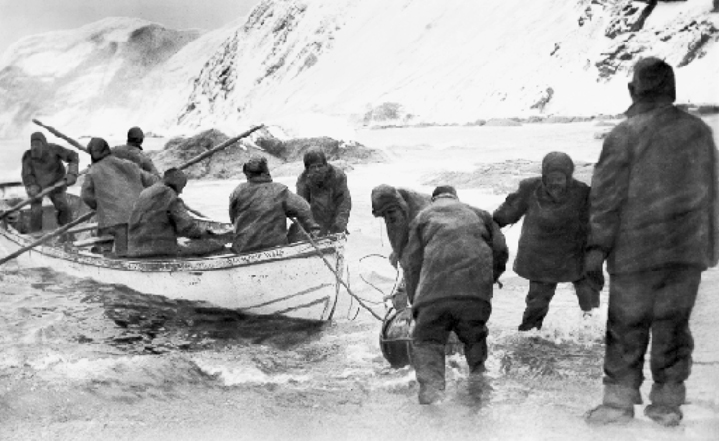
Hurley called this photograph “The landing on Elephant Island,” but it is clear from the landscape (and identical pattern of snowfall) that this was taken on the day the Caird was launched. In fact it depicts the Stancomb Wills preparing to set out on her fourth and last trip to supply theCaird. The object roped in the water is one of the two breakers of water for the Caird, which was floated in tow. The figure in the bow (facing the shore) holding the tow rope is probably Shackleton.

The Stancomb Wills supplying the Caird. “The Wills made heavy weather every time she came inshore, and most of the hands got wet loading her” (Wordie, Diary). Hurley called this photograph “Rescuing the Crew from Elephant Island”; but the boat is unmistakably the Stancomb Wills, and the photograph part of the sequence of loading the Caird.
find the terms as agreed for lecturing you to do England Great Britain & Conti nent. Hurley the U.S.A. I have every confidence in you and always have had, May God prosper your work and your life. You can convey my love to my people and say I tried my best.
Yours sincerely
E. H. Shackleton
Frank Wild
“The men ashore formed a pathetic group,” wrote Worsley. “As long as they thought that we could see them they kept up a wonderful appearance of optimism and heartiness.”
When the Caird had gone, the men turned back to their lonely camp on the wind-blasted beach; what their private thoughts were at this moment, they did not reveal even to their diaries. Wild's responsibilities were unenviable. He was in charge of the care of twenty-one demoralized, partially incapacitated, and perhaps rebellious men, with one man, Blackborow, gravely ill. The deserted, barren rock on which they would have to live was, as they had slowly come to realize, daily raked by gale-force winds and blizzards. They had insufficient clothing and no shelter. They had no source of food or fuel except for penguins and seals, which could not be counted on to be around forever. They were well beyond all shipping lanes. If the James Caird was unsuccessful, there was, as Shackleton himself wrote, “no chance at all of any search being made…on Elephant Island.”
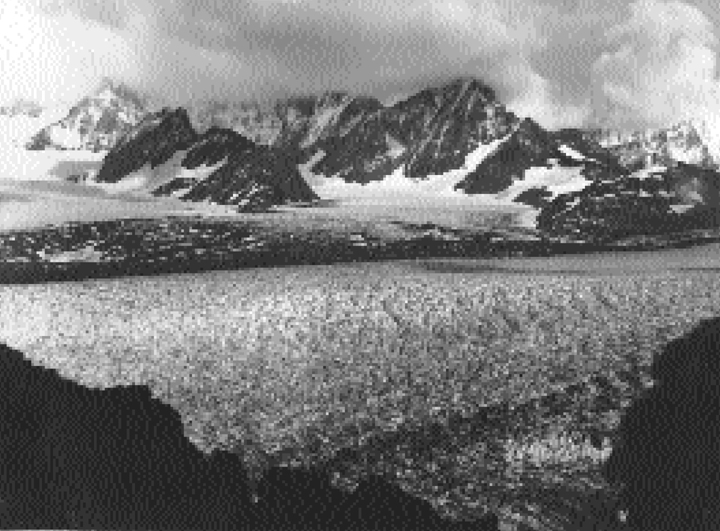
South Georgia Island
“The outlook was disappointing. I looked down a sheer precipice to a chaos of crumpled ice 1,500 feet below.” ( Shackleton, South)