
Chapter Fifteen

On September 5, 1864, abolitionist William Lloyd Garrison wrote a letter to his wife. He had just arrived in Albany by train, which caused him to reflect on how the locomotive had changed the country since their wedding thirty years earlier. “Then there was no railroad conveyance; now the whole country is covered in rails,” he wrote. “And through what enormous expenditure of money, and what incredible efforts of the human brain and hand!” Like many, he saw that railroads already were bringing a revolution—one that, as it spread beyond the Northeast, would foster national cohesion after the Civil War. As a devout Christian, he welcomed the prospect. “So may the modes of communication and the ties of life continue to multiply, until all nations shall feel a common sympathy and worship of a common shrine!”1
In late 1864, Cornelius Vanderbilt entered the third and most critical phase of his conquest of a railroad empire. It would drag out over the course of three frustrating years, because he doggedly tried to avoid a climactic war with New York's most important railway: the New York Central. As master of the lines that penetrated Manhattan, he depended entirely on the Central; it was the trunk line that connected his tracks to western markets. Year after year he would practice patient diplomacy with the Central's presidents in an effort to settle their persistent conflicts. In the end he would fail. His response would be a shocking demonstration of the nation's vulnerabilty to the railroads'—to his—power.
But what was that power? The importance of the railroad in the nineteenth century is a historical cliché; a cliché can be true, of course, but will have lost its force, its original meaning. Garrison's letter, on the other hand, speaks to the railroad's dramatic impact at the time of the Civil War. It was, one contemporary writer argued, “the most tremendous and far-reaching engine of social revolution which has ever either blessed or cursed the earth.” It magnified the steamboat's impact, instilling a mobility in society that unraveled traditions, uprooted communities, and undercut old elites. It integrated markets, creating a truly national economy. It was so central to the development of the United States that this writer could reasonably claim (by including steamboats), “Our own country is the child of steam.”2
In retrospect, this revolution had barely begun in 1864, yet already the railroad was central to American life. Everything went by rail, whether unmilled wheat or imported watches, an Irish immigrant or the president of the United States. Steamboats remained competitive for moving cheap, bulky goods (grain especially) or on particular passenger routes (notably the Hudson River), but even here trains gained rapidly on their aquatic competitors. The first all-rail shipments of grain from Chicago to Buffalo began in 1864; within a decade, they would surpass the volume carried by lake, river, and canal. The rise of cities that served as rail hubs was astounding. Kansas City was virtually nonexistent before the Civil War; afterward it rapidly sprouted as a cattle shipment center on the edge of the Great Plains, growing into a major city. The railroads had raised up Chicago even earlier, building on its status as a major lake port. Cook County, home to this midwestern metropolis, grew from 43,385 people in 1850 to 394,966 in 1870. Railways to the eastern seaboard allowed Pittsburgh to flourish as an iron and steel center; railways to the oil fields of Pennsylvania permitted Cleveland to emerge as a refining center; railways to the East brought farmers from Ohio to Nebraska into the global market. It is telling that the word “rail” was often dropped from “railroad;” the companies were, indeed, America's roads.3
The railroad sector surpassed all other industries combined, and individual railway corporations overshadowed any other kind of firm. Most manufacturing was still conducted in family-owned workshops and small mills; very few factories represented as much as $1 million of investment. (Historian Alfred D. Chandler Jr. counted only forty-one textile mills in the 1850s capitalized at $250,000 or more.) Even the largest commercial banks rarely boasted a capitalization of more than $1 million. By contrast, at least ten railroads had a capitalization of $10 million or more even before the war began. The stock of the New York Central alone stood on the books at about $25 million at par in 1865; even excluding its $14.6 million in outstanding bonds, this figure was equal to approximately one-quarter of all investment in manufacturing in the United States. Railroads connected American industries to sources of raw materials and to their markets—and were their most important customers, consuming vast quantities of products that ranged from coal, lumber, and iron to countless manufactured goods. Railroads were not simply the first big business, as Chandler famously called them; in Civil War America, they were the only big business.4
Size—geographical as well as financial—brought challenges faced by no other type of enterprise. The Hudson River Railroad, for example, was far smaller than any of the four trunk lines, yet it stretched 144 miles in length, with sixty-seven locomotives, twenty-nine baggage cars, 130 passenger cars, and 671 freight cars, not to mention twelve engine shops and numerous depots and stations; in 1864, it carried more than 2 million passengers and 600,000 tons of freight. The technical demands of managing such businesses were unprecedented. The best-trained minds in the United States grappled with the problem, developing new systems of organization, control, and accounting.5
The Commodore was surprisingly well prepared to serve as a chief executive in this emerging new world. He previously had served as president of the Stonington, of course, and had sat on the boards of a number of railroads since the 1840s. Perhaps more important was his experience in running far-flung steamship lines, involving multiple ports, transit operations in Central America, and a base on the far side of the continent. Not surprisingly, from his earliest days in railroads he demonstrated a comprehensive grasp of how to delegate authority “Are you a practical railroad manager?” a state assemblyman would ask him in early 1867. “No sir, I don't manage anything,” he would reply. “We have our superintendents, etc., who attend to those matters. All those matters of detail are done by our officers.”6
What Vanderbilt did was set general policies, as well as the overall tone of management. Any corporation has an internal culture shaped by the demands, directives, and expections that rain down from above. The Commodore created an atmosphere of efficiency, frugality and diligence, as well as swift retribution for dishonesty or sloth. As Lambert Wardell observed, “He thought every man could stand watching.” Even though he disclaimed any interest in practical management, he tellingly remarked, “Now and then I get hold of a point that I have to look to. Smooth matters they never say anything to me about.” Every employee knew he was watching.7
As the winter of 1864–65 set in, the end of the Civil War came into view—still a bloody distance away, but visible at last. Grant besieged Lee at Petersburg, and Sheridan had burned out the Shenandoah Valley. Railroads, which had grown little during the conflict, looked forward to peace with plans to lay new track, refurbish infrastructure, and generally reinvest their wartime profits. Lines short and long would soon burst out across the trans-Mississippi West, as seen in the famous example of the transcontinental Union Pacific. The Hudson River Railroad released its pent-up energies into the completion of a double track to the Albany bridge, an enormous span that it was building in conjunction with the New York Central and Western railroads.8
The railroads' massive demand for capital for new construction, even for ordinary maintenance and operations, drove another, subtler revolution. The financial world had long been ruled by generalized merchant capitalists such as Vanderbilt himself, but the railroads' appetite for money far outstripped the capacity of individuals to meet it. Financial institutions—investment banks—now aggregated and channeled the capital of American and foreign investors. The wartime nationalization of the U.S. financial structure, with the introduction of greenbacks and the national bank system, contributed to this development. The frenzy on Wall Street, so notable in Vanderbilt's Harlem corners, centered almost entirely in railroads, which provided by far the largest number of securities actively traded on the exchanges. This, too, played a role in the institutionalization of the economy. The identification of corporations with individuals, already waning when the war began, virtually disappeared in the 1860s, heightening the abstraction of the economic world. On the Pennsylvania Railroad, this process had gone one step further. This trunk line was managed by a professional staff rather than leading stockholders, with an engineer as president (J. Edgar Thomson) and a powerful vice president (Thomas A. Scott) who had risen through the ranks.9
Vanderbilt understood these financial changes; in part, that is why he relied so heavily on a vice president of the Bank of New York, James Banker. But he also represented a glaring exception to these trends. The Harlem was increasingly seen as his personal property, as the Hudson River would be before many months passed. He wielded financial might that surpassed that of the largest banks. The Hudson River estimated the cost of completing its second track to Albany at $900,000; Vanderbilt personally provided at least two-thirds of it, purchasing $600,000 in bonds at 105. This was Vanderbilt summarized in one transaction: maker and exemplar of his times, yet always standing apart, unique in his wealth and power.10
“The influence of one earnest, energetic life upon the world is scarcely appreciated,” Merchant's Magazine declared in January 1865, in a frontpage profile of the Commodore. His name was “inseparably connected with our commercial history.… Perhaps there are two or three men wealthier than he in New York city—but no more; and all of his vast wealth is the product of his own labor.” The theme that ran through the article was the intersection of the broad current of history and the individuality of this man. The journal observed, just as Courtlandt Palmer had back in 1841, that the Commodore valued his reputation for honor, and rewarded “frankness and honesty of speech.” His courtesy toward men worthy of respect was matched by mercilessness toward those who were not. “Deceit and underhand dealing,” the magazine added, “he has ever quickly detected and thoroughly hated.”11

ON DECEMBER 8, 1864, VANDERBILT AND HIS WIFE attended the wedding of their granddaughter, Sophia Cross, to Rev. J. B. Morse, at the home of the bride's parents, Phebe and James M. Cross.12 As the saying goes, their granddaughter had her entire life in front of her, yet she would never witness changes as sweeping as those the Commodore had both experienced and helped to bring about. The biggest had been the advent of change itself—change as a nearly constant state in American society.
“When I was a boy,” George Templeton Strong reflected in early 1865, “the aristocracy lived around the Battery, on Bowling Green.” So it had been since New York was named New Amsterdam, two centuries earlier. Young Cornelius and Sophia Vanderbilt had lived on Broad and Stone streets, in buildings and circumstances that might have been recognizable to Pieter Stuyvesant himself. Then, in the 1820s, the transformation of New York began, as immigrants swarmed in from Germany, Ireland, and the American countryside. The elite relocated, and kept on relocating every decade or so. In 1864, Strong declined to serve as president of Columbia College, since it would require him to move from Murray Hill (the current center of fashion) “to a frontier settlement… on Forty-ninth Street.” He little realized how quickly the city's center of gravity would shift to that very area.13
Each generation flatters itself with the thought that it is the vanguard of the new, sweeping away the stodgy ways of the past. Henry Clews imagined that he and his peers had introduced real cunning to the stock exchange in 1857—unaware that they could never surpass Nelson Robinson's skill at sharp dealing. The brokers who arrived on Wall Street during the Civil War told themselves that the aged Vanderbilt snorted at trains as “these steam contrivances that you tell us will run on dry land,” until he finally bought the Harlem.14 Much of it was nonsense, of course; but once upon a time the old had indeed been new for Vanderbilt and such contemporaries as Erastus Corning and Dean Richmond. These elder statesmen had grown up with the country, with the securities markets and corporations and mechanized transportation and rapid growth that were beginning to define the United States. Small wonder the venerable Commodore remained so quick to grasp possibilities, to accommodate change. Yet the world that they had created trapped them in an intractable conflict that defied even their most well-meaning attempts at compromise.
In April 1864, an exhausted Corning had resigned the presidency of the New York Central, passing the office on to his vice president, Dean Richmond.15 A burly man, more than six feet in height, the sixty-year-old Richmond exuded power. He combed a layer of dark hair across his large, round pate, and peered at his (smaller) fellow directors through heavy-lidded eyes set between arching eyebrows and above a fat, mushroom nose and the permanently pursed lower lip so common to jowly faces. He had the look of a man who never moved quickly, for anyone. He, too, had risen from a poor childhood, having moved from Vermont to Syracuse to Buffalo, from clerk to salt manufacturer to commission merchant, before entering the business of railroads. A man of volatile temper, he had little education, with handwriting so abominable that even Corning regularly ordered a clerk to transcribe his letters. He had worked closely with Corning in Democratic Party politics as well as business. The two were recognized as heirs to Martin Van Buren's Albany Regency—though Richmond, unlike Corning, refused to stand for elected office, exerting influence instead as chairman of the Democratic State Central Committee.16
Politics remained uppermost on Richmond's agenda—not electoral but railroad politics. The lucrative business provided by the federal government had muted competition among the trunk lines, but peace threatened to break out. On December 15 and 16, the Union army under General George H. Thomas annihilated the rebel Army of Tennessee at Nashville. At the end of the same month, Sherman completed his March to the Sea. “I beg to present you, as a Christmas gift,” he wired to Lincoln, “the city of Savannah.” And on January 15, 1865, a division led by General Adelbert Ames stormed into Fort Fisher, North Carolina; its capture effectively closed Wilmington, the last rebel seaport. Richmond worried that victory in the South would mean war in the North between the trunk lines.17
As Richmond embarked on his presidency in these troubling times, he spent many of his dinner hours with James Banker, the special representative of Commodore Vanderbilt. Though the Harlem and the Hudson River were minor powers on the railroad landscape, they occupied a strategic position. They provided the Central with a direct rail link to New York, and Richmond had no choice but to pay heed to Vanderbilt (who was, in any case, a major Central stockholder, with some four thousand shares). Still, Richmond saw no reason to cease the practice of shifting the Central's passengers and freight to the People's Line steamboats from spring through fall, when the Hudson was clear of ice and navigable all the way to Albany18
That infuriated John M. Tobin, the Hudson River Railroad president. “It was unjust to insist that the Hudson R.R.R. should form part of its [the Central's] trunk line during three months of the year and be excluded from the advantages of that traffic during nine months of the year,” Horace Clark later explained. “There never has been a man connected with the Hudson River Railroad Company who has not protested against and felt the wrong that such a state of things brought about.”19 This was the issue that brought Vanderbilt's and Richmond's railroads into conflict—the result of the fragmentation of the railroad network, which forced long-distance traffic to pass through the hands of successive companies, each with its own needs and agendas.
The problem came down to a central feature of railroad economics: the difference between through traffic from “competitive points” and purely local traffic from stations where a railway had a monopoly. For freight shipped to New York, the Central could charge higher local rates in Syracuse or Rochester, where it faced no competition, than it could in Buffalo or Chicago, where rival trunk lines fought for the business (especially exports, which theoretically could be shipped from Philadelphia or Baltimore as easily as New York). The Central set the rates for this through freight, and prorated its revenue with the Hudson River on a mileage basis. Daniel Drew's People's Line, on the other hand, operated more cheaply than the Hudson River Railroad, so it accepted less than a pro-rata percentage. Why wouldn't the Central give its business to the steamboats? As Clark admitted, “Before the [Albany] bridge was built, and bulk had to be broken, it might as well be broken and the freight go by river, as the other way.” For the Hudson River, however, this state of affairs brought “all the disadvantages of consolidation without any of its advantages.”20
Tobin wanted compensation—to receive the higher local rates on through freight during the winter.21 For Richmond, this was a frightening prospect. It would cripple the Central's ability to compete with the other trunk lines during the season of ice and snow. He anxiously asked Clark to arrange a meeting with Vanderbilt.
“Commodore Vanderbilt had a great admiration for Dean Richmond,” attorney Chauncey Depew later remarked. “The Commodore disliked boasters and braggarts intensely. Those who wished to gain his favor made the mistake, as a rule, of boasting about what they had done, and were generally met with the remark: ‘That amounts to nothing.’” As Depew's juxtaposition of these observations implies, the Central's president was much like Vanderbilt himself: authentic, honest, and direct. Vanderbilt agreed to intervene on his behalf. “After a severe struggle, Mr. Tobin's policy was overruled,” Clark recalled, “and an agreement was made for that winter through Mr. Richmond and through Mr. Vanderbilt. That winter… the N.Y Central R.R. Co. should fix rates such as they might see fit to fix, in accordance with their policy in competition with the other great trunk lines, and the Hudson R.R.R. Co. should carry them out.”22
Vanderbilt had other interests that impelled him to cooperate with Richmond—particularly the Athens railroad. He had helped Drew create it as a weapon against the Hudson River Railroad; now he needed Richmond's help to prevent it from being turned against himself. Nevertheless, he demanded a price for overriding Tobin: once the ice cleared from the river, the Central would make a permanent arrangement to either give the Hudson River a larger share of freight or pay it compensation.23
Time and again, Vanderbilt showed himself to be patient and diplomatic in his dealings with Corning and Richmond, as he sacrificed short-term profits in return for long-term stability. But the structural conflict between these lines would only get worse.
ON THE AFTERNOON OF February 6, 1865, a Wednesday, Vanderbilt climbed into his wagon outside his office on Bowling Green. He whipped his team of horses up Broadway until he reached Fulton Street, a block below City Hall Park. There he bowled over a woman named Caroline Walter; her fright and the ensuing confusion can only be imagined. An Officer Dodge arrested the Commodore and took him to the glowering, neo-Egyptian Tombs, the police court and city jail. Mrs. Walter did not appear to make a complaint, so the judge released Vanderbilt. The victim had not been seriously injured, and perhaps she thought it best to let the powerful man go about his business.24
One week prior to his brief imprisonment, the House of Representatives had voted to abolish slavery, by sending the Thirteenth Amendment to the states for ratification. It was both a revolutionary act and a practical recognition that the war had destroyed slavery as a functioning institution. In both senses, it demonstrated how thoroughly America's most costly conflict remade the nation.
But the war itself approached an end. In fighting that began on March 24, the Confederate position at Petersburg crumbled. On April 2, Grant launched a decisive attack that sent Lee's army fleeing to the west. The next day, Lincoln (who had been visiting the Army of the Potomac) entered the fallen Confederate capital.25
When the news reached Wall Street, the rector of Trinity Church began to ring the bell, over and over, joining a symphony of church bells that chimed all over New York. Crowds crowded the pavement. “All the cheers I ever listened to were tame in comparison,” Strong wrote. The massed men—for they were all men on Wall Street—sang “John Brown's Body” and “The Star-Spangled Banner,” and waved their hats in ecstasy now that the long nightmare had ended, and ended in victory. “I walked about on the outskirts of the crowd,” Strong added, “shaking hands with everybody, congratulating and being congratulated by scores of men I hardly know even by sight. Men embraced and hugged each other, kissed each other, retreated into doorways to dry their eyes and came out again to flourish their hats and hurrah. There will be many sore throats in New York tomorrow.”26
The war was not over yet. On April 7, Grant's troops caught Lee's army at Appomattox Courthouse, where a truce was called. Sheridan rode to meet Confederate general John B. Gordon, and complained that a South Carolina unit was firing on General Wesley Merritt's men. He asked Gordon to dispatch orders to cease fire. “He answered, ‘I have no staff-officer to send,’” Sheridan wrote in his memoirs.
Whereupon I said that I would let him have one of mine, and calling for Lieutenant Vanderbilt Allen, I directed him to carry General Gordon's orders to General Geary, commanding a small brigade of South Carolina cavalry, to discontinue firing. Allen dashed off with the message and soon delivered it, but was made a prisoner, Geary saying, “I do not care for white flags; South Carolinians never surrender.” By this time Merritt's patience being exhausted, he ordered an attack, and this in short order put an end to General Geary's “last ditch” absurdity, and extricated Allen from his predicament.
The Commodore's grandson was one of the last prisoners of the Civil War, and, ironically, carried one of the last Confederate orders. On April 9, Lee surrendered.27
“We have the astounding intelligence of the assassination of President Lincoln & the attempt to assassinate Mr. Seward,” New York Central director John V. L. Pruyn wrote in his diary on April 15. “The whole community has been stirred to its deepest depths by these events. Their results cannot be predicted.… Every face bears evidence of emotion. It is a terrible, a fearful tragedy.” At the moment of victory, the great emancipator had been shot dead by John Wilkes Booth—on Good Friday, no less. Three days later, Pruyn observed in Albany, “All buildings in the city almost without exception, are hanging emblems of mourning for the death of President Lincoln. Accounts from every part of the country show this to be the case everywhere. The grief seems to be universal & profound.”28
Lincoln's death was one of an estimated 620,000 in the Civil War: 360,000 from the North and 260,000 from the South, not including civilian casualties. Statistics cannot do justice to the extent of this loss, but they are devastating enough. In perhaps the most commonly cited comparison, this figure, in absolute numbers, surpasses the combined toll in American lives from all of the nation's other wars, up to and including the Korean War.29 The death count represented almost 2 percent of the nation's entire population as measured in the 1860 census. Nearly every family suffered.
Long after the Commodore had passed, this generation of the dead would continue to haunt the survivors. Statues would be erected, monuments built, and parades conducted through the end of the century. But for many veterans who lived through the fighting, the encomiums for their fallen comrades sounded bitterly empty. Unquestionably, the war accomplished profound good: it resolved a long-building conflict, freed 4 million slaves, and destroyed the peculiar institution of slavery forever. Yet the personal experience of the Civil War was often as dehumanizing, as poisoned by pettiness, random brutality, and stupidity, as in any other war.30
Out of the war emerged a corps of public intellectuals—Ambrose Bierce, Oliver Wendell Holmes, and Charles Francis Adams Jr., to name a few—with a dark sensibility shaped by such horrors. After Appomattox, these men would view the world with a grim realism that often overflowed into cynicism, stark and sometimes overblown. The outlook of this generation of writers and thinkers would influence historians, many of whom would picture the postwar years as a time of unrelenting self-aggrandizement, when vulgar, amoral tycoons and carpetbaggers corrupted a political process barely worthy of the name democracy.
There was another, more instinctive response to the war's death and destruction. It was a resurgence of a superstition that owed its modern origin to a pair of toe-cracking girls from Rochester, New York. With so many spirits to contact, Spiritualism became more popular than ever, attended by a general faith in the unseen. As Strong observed in 1865, “The tough, shrewd, unbelieving Yankee generally develops a taste for marvels—for infinitesimal homeopathy, magnetism, spiritualism.” It was a cultural current that moved even the toughest, shrewdest, most unbelieving Yankee of all, Cornelius Vanderbilt. Mrs. Mary Augusta Smett would later claim that she visited the Commodore in his office, apparently during the second Harlem corner, to ask him to spare a friend who faced ruin. As she was about to leave, Vanderbilt asked her, “Did you ever see my son George?” He pointed out a picture and said, “That poor fellow is dead. Would to God he had lived.” As Mrs. Smett recalled the moment, “His eyes filled with tears.” For a man who had grown accustomed to controlling the world around him, the possibility of mastering even death itself must have been appealing.31
A few years later, Vanderbilt asked a minister what he thought of séances. “I expressed emphatically my disbelief in modern spiritualism,” the preacher reported. “He said, ‘I think so too.’ He said nevertheless that there was skill and acuteness in it, and he felt interested.” The subject may have been introduced to the Commodore by his daughter, Mary La Bau, a devoted spiritualist. Medium James B. Mansfield would later testify that Vanderbilt approached him as early as 1864. Vanderbilt would write questions for the dead and put them in sealed envelopes, and Mansfield would write replies without reading the inquiries. (According to the medium, Vanderbilt initially tried to contact his father and John De Forest; since the latter had died in 1829, the mention of his name lends credibility to Mansfield's account.) If the answers made any sense, they would have impressed Vanderbilt, who recognized skill and acuity when he saw it.32
If the mournful and curious Commodore tried to speak to the dead, he was hardly unusual in that age of empty chairs and missing men, but he gave no sign that the spirits influenced a single decision he made. And he had many decisions to make in the months after Appomattox, decisions that could affect the lives of millions. Peace had come to the nation, and war would inevitably come to the railroads.
ON JUNE 6, 1865, TOBIN INFORMED the Hudson River Railroad board of directors “that he could not under any circumstances become a candidate for reelection as President,” the secretary recorded. Everyone at the table knew that Tobin was stepping down because Vanderbilt had undercut his authority—and that Vanderbilt would succeed him.33
One week later, after the annual stockholders' meeting, the board duly voted in the Commodore as president and his son William as vice president. But perhaps the ascension was not as predictable as it seems. The Commodore has been caricatured as a bloody-minded tyrant, yet his methods as a railroad executive often proved subtle. He preferred to hide his hand not only from his enemies, but from a public increasingly wary of the growing size and power of railroads. Vanderbilt put his son in operational control of both the Hudson River and the Harlem, but he kept the companies organizationally separate. Indeed, the two corporations—managed by a nearly identical slate of directors and senior executives—signed a contract under which the Hudson River paid the Harlem at least $10,000 a month in return for cooperation in setting rates. Perhaps it was simply a legal mechanism for subsidizing the weaker line; even if that was the case, it demonstrated the Commodore's caution as he widened his grasp.34
In his relations with other lines, too, he usually chose to exert influence quietly rather than resort to financial combat. In April, for example, he put James Banker on the board of the Michigan Southern & Northern Indiana, a key link in a chain of railways that gave the New York Central access to Chicago. Vanderbilt merely wanted a voice in its management, such as he had in the Erie and the Hartford & New Haven.35
In his role as railroad diplomat, the Commodore took a train to Albany less than six days after his election. By special invitation, he joined his friend Richmond and his lieutenant Banker on the directors' annual inspection of the New York Central line. In the afternoon of June 19, they boarded a special train amid thick heat for their westward journey. In cars outfitted with upholstered comforts and abundant food, they rattled through Syracuse and Rochester, visited Niagara Falls, inspected the Great Western of Canada, and chuffed back to Buffalo. “Commodore Vanderbilt,” John V. L. Pruyn noted in his diary, “had not been west in thirty years. Seemed to enjoy the trip very much.”36
That was good news for Richmond. He needed Vanderbilt's cooperation as he dueled with the other trunk lines. Despite the buoyant economy, tensions between the major railroads simmered. Richmond competed more aggressively than Corning had; at the same time, his relations with J. Edgar Thomson, president of the Pennsylvania Railroad, grew prickly, then broke down altogether. Desperate to keep rates low, Richmond again sent passengers and freight on Drew's People's Line. By summer's end, William H. Vanderbilt testified, “the Hudson River road felt itself very much aggrieved.” The Commodore understood the pressure on Richmond, but he made clear “that it was impossible for them to continue under their arrangement.” Richmond eventually agreed to give the Hudson River Railroad all of the “state freights” (those originating in New York, and not subject to competition from other trunk lines).37
As the Commodore engaged in these wearisome negotiations, he received news that Elizabeth Williams had died on August 31. “Libbie” was the older sister of his daughter-in-law Ellen, wife of Corneil, and a favorite member of a family that Vanderbilt loved deeply. Cheerful, even effervescent, she had liked to gossip about who was rising or falling in fashionable society, and had been openly jealous of her sister Ellen's invitation to the Vanderbilt golden wedding celebration. (“I trust mother will have her black satin dress converted into a fashionable one,” she slyly had written to Corneil before the event.) She was only forty-two when she died.38
“The dispatch I received yesterday from Corneil stating the death of our Dear Dear and much beloved Libbie completely unmanned me,” the Commodore wrote to Oliver Williams, Elizabeth and Ellen's father. “And I did not dare to say a word on paper, until this morning. And even now, I have no language to express my feelings; nor will I attempt it here.” In the context of Vanderbilt's earlier writings to the family (those in his own hand), there can be little doubt that this letter reflected his sincere emotions. Indeed, it briefly opens a window into the way this man, who owned so much and ruled so many, grappled with loss. It left him desperately vulnerable, and grasping for the faith that he had largely relinquished for most of his life.
It has pleased the great ruler of all things to take her away from us while in the enjoyment of health, beauty and usefulness; and as Christians we are bound to submit. But my dear Colonel I feel that I dare not trust myself to see her, for fear that my manhood may give way; therefore dare not attend the funeral.
The moment I have recovered from the shock, I will make the family a short visit.
Please give my love to all, and tell them to try and bear up with their irrecoverable loss.
I can say so no more at this moment. I feel too much depressed. Truly Yours,
C. VanDerbilt39
Vanderbilt's use of the words “unmanned” and “manhood” are significant. It is only natural, of course, that he should value a muscular masculinity; during his long career, he had gone from fistfighting sailor to boat-racing captain, from rapids-shooting Commodore to Wall Street warrior. But here he equated “manhood” with dignity reserve, self-control. His refusal to go to the funeral for fear that he would not be able to maintain his mastery over his emotions is telling. This sort of manhood, this self-possession, he clearly saw as a social as well as a business virtue.
These few lines may not be proof of how Vanderbilt conducted himself in private, but they call into question the image of him as an unmannered brute. In this letter, we see the man who dined with Daniel D. Tompkins, negotiated with Lord Palmerston, cooperated with William H. Aspinwall, and consulted with presidents Buchanan and Lincoln. And we see him vulnerable.
But he was still combative. On October 24, this most manly old man drove his rig out for a brush on Bloomingdale Road, or perhaps nearby Harlem Lane, where the new generation of fast men preferred to race. Again, the wheels of his wagon cracked into those of a rival; again, he pitched headlong to the ground, and had to be carried back to his bed, where he lay, helpless, as his family gathered around. “He did not seem conscious. His head was cut,” recalled his nurse, Margaret Cadwell. Then William, the diligent and trusted son, bent forward to fix the pillows, and his father snapped awake. “The Commodore told him to let them alone, that I would do them,” Cadwell added. “I suppose he thought I would be more gentle.”40
Perhaps he did—or perhaps family relations are simply more fraught than any other kind. His aggravation may have been all the worse because he was going to miss a special reception for General Grant at Dubois's Club House on Harlem Lane, on November 16, hosted by the owners of the fastest horses in New York. The general in chief, like the Commodore, was passionate about horses, and seemed to enjoy that afternoon far more than the “Gathering of the Wealth and Fashion of New York” that feted Grant at the Fifth Avenue Hotel, as the New York Herald reported, on the evening of November 20.41
Vanderbilt did eventually meet the general some weeks later. In February 1866, General Daniel Butterfield took Grant to 10 Washington Place. Vanderbilt descended the stairs from the second floor and exclaimed, “Why, General, you're nothing but a boy!” Grant and Vanderbilt, both direct and honest, struck up an instant rapport. Butterfield recalled, “The Commodore took him over the house, and then invited him out to lunch. Not long afterward they went down to the stables and… ‘talked horse.’” Grant liked nothing better.42
Vanderbilt's social life centered on cards almost as much as horses—particularly whist, the ancestor of bridge, which he liked to play with other men of wealth, power, and influence. He spent countless hours at Saratoga playing cards, and soon would in New York as well. “Let the women wail, for another club-house is about to be opened on Fifth Avenue,” announced the Round Table on November 25, 1865. “A company of gentlemen who combine democratic principles with aristocratic taste have bought one of the very few really handsome and well-built private houses of which… the Fifth Avenue can boast, and propose to install themselves therein, under the style and title of the ‘Manhattan Club.’” It had been organized the year before by the fashionable Democratic Party leaders—the “silk-stocking sachems”—including August Belmont, Samuel L. M. Barlow, Horace Clark, and Augustus Schell. They intended to establish a rival headquarters to Tammany Hall, which increasingly fell under the sway of William Tweed and his circle. In the summer of 1865, the club founders purchased a palatial building at 96 Fifth Avenue, at Fifteenth Street, for $110,000. By the time the Round Table published its story, all the marble and dark wood was in place.43
Vanderbilt was a charter member. Though he belonged to the Union Club and others, he began to spend most evenings in the Manhattan Club with his friends, railroad directors, and sons-in-law, playing whist for money, always for money. Eight years later an author would record, “The club has always been the headquarters of the Vanderbilt coterie.”44
The club's political tone served a valuable purpose. The Commodore, though thoroughly nonpartisan, could not avoid constant contact with the political world, for railroads remained the most political of businesses, constantly subject to criticism and legislation. The Manhattan Club gave him a social setting where he could interact with powerful Democratic leaders associated with his own followers, Clark and Schell, without seeming to be partisan himself. He soon would be talked of as a supporter of Grant for the presidency, for example, yet in December 1865 he asked the former secretary of state for New York, Democrat Chauncey M. Depew, to be the Harlem's attorney. President Andrew Johnson had nominated the thirty-one-year-old Depew to be minister to Japan, and the Senate had already confirmed him. “When I said this to the Commodore,” Depew recalled, “he remarked: ‘Railroads are the career for a young man; there is nothing in politics. Don't be a damned fool.’ That decided me.” It was a curious comment, if Depew remembered it accurately, because politics was a key reason for his selection. The lawyer was a rising Democratic leader, and Vanderbilt relied on his influence in Albany45
On December 13, it seemed that the Commodore's patient politicking in the business world finally achieved success. On that day, Dean Richmond sealed their alliance in the New York Central's annual election of directors. With Richmond's support, Horace Clark now joined the board. Banker, meanwhile, continued to serve as Vanderbilt's personal envoy, and came to be seen as the most influential director. But Corning fell off the board entirely. A split emerged between the Central's current and former presidents as Richmond pursued his own path. Thoroughly marginalized, Corning went into exile and plotted his return.46
“I WAS IN THE HABIT OF entertaining a good deal at my house the public leading men of the country,” Corneil would say, “and my expenses were very large, inasmuch as it was expected of me to sustain the honor of my family name as far as I could.” When asked precisely which “name” he meant, he loftily replied, “The name of my father, which was also my own. I maintained the honor of it in the State and city where I lived.”47
This statement revealed more than he probably intended. He equated “honor” with a lavish lifestyle, and the only one who “expected” it was Corneil himself. The Commodore gave him $100 per month, increasing the allowance to $150 after his marriage—more than the monthly salaries of many men, but hardly an income on which to entertain “the public leading men of the country.” Corneil could not escape the hope that he might suddenly multiply that amount with a hand of cards or a spin of the roulette wheel. He returned again and again to an ever-lengthening list of saloons: Portland's, at 139 Broadway; Charley Ransom's, on Twenty-fifth Street; John Daly's, on Broadway between Thirteenth and Fourteenth streets; Zachariah E. Simmons's policy bank, on Broadway near Fourth Street; and George Beers's place, on University Place at Thirteenth Street. At Beers's saloon, it was said, Corneil conveniently collapsed in an epileptic fit if he held a losing hand.48
And Corneil lost, and lost, and lost. He pawned his watch; he pawned his wife's rings; he pawned what self-respect remained to him. Like many addicts, he loathed himself, yet blamed his father for withholding his wealth. Corneil even forged the Commodore's name, to punish his father as much as to get money out of him. He wrote to Horace Greeley after he had finally struck bottom, “Discouragement, disgust, & an indicative desire to revenge myself upon my father by thus disguising his name forced me to everything vicious.”49
He collided with said bottom in late November 1865. Shattered emotionally and physically—“a discouraged, abandoned, and well nigh Godforsaken wreck,” as he described himself—he went to the home of his brother, whom he resented deeply. He handed over pawn tickets for his wife's jewelry and his own watch. Then he disappeared. “Corneil has now gone to Litchfield [Connecticut] to a private institution which receives but eight or ten patients,” Ellen wrote to William on December 3. “He was admitted through the influence of my family physician. I have never known him during all the years of our married life so completely undermined in his general health as between the last two or three months.”50
When Corneil went into the Litchfield asylum, he carried with him the love and support of two women who never turned away from him. He felt himself sustained, he wrote, by “many kind & encouraging letters that I have received from my dear wife & my noble, faithful mother (the only two in fact who had faith).” Greeley, too, maintained their friendship, despite Corneil's many unpaid loans; for good reason, Corneil called him “my truest & only self-sacrificing friend apart from mother & wife.”
Yet even those family members who had rebuked Corneil now rose to help him as he sought to help himself. On December 25, as Ellen ate her Christmas dinner alone at her home in Hartford, a messenger from William knocked on the door. He handed her the rings that Corneil had pawned and William had redeemed. The Commodore himself took pity. On February 26, 1866, Corneil wrote to Greeley about “a few lines received… from my serious & well meaning father, congratulating me on my present course & urging me to persevere in well doing.” This rare encouragement gave him “fresh ambition & determination to regain from him that confidence & esteem which my past recklessness so materially impaired.” Corneil wrote to William of his resolve to abandon “my wild, reckless, and unprincipled conduct… and to avoid likewise all connection with the corrupt and demoralized associates who have hitherto so artfully sought to entrap me by their wily and infernal concoctions.”51
But it is not easy to escape who we are. On December 27, Corneil had celebrated his thirty-fifth birthday in the Litchfield asylum. He was no longer at a formative or impressionable age. “I am sorry to state that our income is pledged by Ellen to joint creditors for five months to come,” he informed William, implying that his brother should cover the debts. He also wrote that it was “seriously inconvenient to be without a timepiece,” and glibly asked William to redeem his watch from the pawnshop, promising to pay him back later. Not long after he left the asylum, he returned to form, issuing promissory notes in August and September 1866 that he declined to pay52
There is little doubt that the Commodore felt betrayed by his son's relapse. Corneil, desperate for love and money, often went to 10 Washington Place to see his father, but Vanderbilt sent him away. “The Commodore said he didn't want Cornelius J. around at all,” recalled nurse Cadwell. When Corneil wrote a wordy appeal to his father, Vanderbilt thought it impressive—as a piece of sophistry. “I remember the Commodore receiving a letter once from Cornelius J.,” Cadwell added, “and saying that fellow, or that scamp, could write a letter to the Queen.” Sophia, on the other hand, could never bring herself to condemn her son. She let him into the house secretly, saw him privately, and kept him out of his father's sight.53
And yet, even Corneil, this creature of deceit, could not deny the truth about himself. He alternated his bombast with references to “my shame & mortification & sorrow.” He was literally fatalistic about his hope of reform. He wrote to Greeley of his “determination to humbly forfeit my lifeas the penalty of further vice.” It was the one prediction about himself that would come true.54
ON FEBRUARY 15, 1866, the locomotive Augustus Schell chuffed onto the Albany bridge and rolled westward along its 2,020-foot span, over a total of nineteen piers, across an iron turntable above the center of the river below, and rattled down into Albany itself. Following this symbolic inauguration, the first passenger train crossed one week later. After four years of construction (and many more of litigation), the bridge gave the New York Central a continuous, direct connection to the Hudson River Railroad, and thus to Manhattan. But its completed track became a lighted fuse.55
The Commodore's cold response to Corneil's backsliding revealed the icy judge who had always lurked behind the encouraging father. So, too, did the implacable warrior remain within the diplomat who had negotiated with Corning and Richmond. In December 1865, for example, the New York Court of Appeals handed down final judgment in the long-running court battle between Vanderbilt and the New York & New Haven Railroad over the shares that Schuyler had fraudulently issued in 1854. Over the years, weary shareholders had settled with the company—but the Commodore refused. He had waged his battle until the court ruled that the company owed $900,000 to Schuyler's victims. “The great principle is now settled by the highest court in this State,” wrote the Commercial and Financial Chronicle, “that railroad and other corporations are bound by the fraudulent acts of their own agents.”56
It was, indeed, a great principle—but businessmen also saw a more personal lesson in the Schuyler fraud case. “The Commodore's word is as good as his bond when it is fairly given,” wrote Matthew Hale Smith. “He is equally exact in fulfilling his threats.” Vanderbilt “pursued his purpose for years with the instinct of an Indian. He attained his end at last.” In a more nuanced way, the reporters for R. G. Dun & Co. drew much the same conclusion: that Vanderbilt was a good ally but a dangerous man to cross. “Is a bold operator, but does not [do] that [which] will hurt him much,” they wrote in 1865. “Has so many resources at his command that it is hard to be caught.” In 1867, they added, “Among the richest men in this country. Good as gold but sharp.”57
His edge would be felt again after the completion of the Albany bridge. Vanderbilt expected that the Central would finally end its custom of shifting freight to Drew's steamboats, as it was now more efficient to send through trains over the bridge. But once the ice on the river dissipated, the People's Line boats again churned up to the Albany docks and began to load freight. Even worse, March saw the completion of the Athens railway, giving the Central a shortcut to the river and a pier that allowed cars to run right alongside the steamboats. “That was one of the foolish acts of my life,” Vanderbilt would say of his investment in the Athens road, “but I don't cry about it.”58
Instead, he tried to do something about it. As the Railway Times later reported, “Commodore Vanderbilt, who is an owner in the Athens line to the extent of half a million of dollars, is reported to favor the taking up of the rails and the abandonment of the route.”59 The struggle over the thirty-eight-mile line was convoluted and largely hidden, pitting Vanderbilt against Richmond, Drew, and Henry Keep, each with his own interests and agenda. “I will tell you a very sore grievance to us,” Vanderbilt said to a state assembly committee several months later, speaking for the Hudson River.
We could send up hundreds of car loads of freight, and they [the Central] would uniformly send our cars back empty. We cannot afford that. Not only that, but they would take our cars that we would send up and send them over their road.… We would sometimes trace our cars to Athens. What business had they to send our cars to Athens?
Hauling empty cars back from Albany, of course, was a pure loss for the Hudson River Railroad, and the Central's appropriation of them was costly; but sending them to Athens was insulting. “I don't like your manner of getting our cars, running them to Buffalo, and then running them back to Athens,” he told Richmond.60
If these disputes seem trivial, they were in fact the birth pains of a truly national economy. These railroad companies had been created for parochial reasons—to connect New York to Albany, to connect the Great Lakes with the Hudson River, to undercut the Hudson River Railroad—but now they were pressed into a continental transportation system. Freight and passengers moved by rail across distances scarcely imagined just ten or twenty years earlier. As far as the public interest was concerned, the fragmentation of the system was problematic, for the repeated transfers of freight from one company to another was inefficient and costly. But these conflicts between connecting lines raised even greater dangers: What if one company simply refused to cooperate, and closed its rails to its neighbors' shipments? The result could be catastrophic.
Another of those pains came at the end of the second week of April, in the form of a strike by the Harlem streetcar drivers. “They held a mass-meeting this afternoon around the Washington statue on Union Square and afterwards marched in procession up Fourth Avenue,” Strong wrote in his diary. “I heard one of their orators, an unwashed loon. He spoke grammatically, fluently, and sensibly, and with good manner and action. Would that I enjoyed the same gift! I hear of no rioting yet and of but few cases of assault on newly enlisted drivers. The police seem wide-awake.”
A fluent and sensible unwashed loon? Strong's apparent confusion over the union leader reflects how rapidly the times were changing. The wartime boom—and polarization of rich and poor—spawned a proliferation of labor organizations. In 1861, there were roughly fifteen unions in New York City; by 1864, there would be 157. “A larger proportion of the metropolitan working population enrolled in trade unions between 1865 and 1873 than during any other period of the nineteenth century,” write two historians of New York. Between 1863 and 1873, workers carried out 249 recorded strikes. Of course, walkouts had occurred in previous decades, but the Harlem drivers' strike pointed to the future. The Harlem men were employees of a large, impersonal corporation. Most could anticipate working their entire lives for wages, rather than starting their own farms or shops as their fathers might have done. Strikes now broke out not simply over short-term grievances, but to rebalance the long-term relationship between capital and labor—as seen in the campaign for an eight-hour day. A labor movement emerged, mirroring the rise of the large business enterprise.61
The Commodore had never experienced such an existence as that faced by his employees. Even his relationship with Thomas Gibbons was more one of sponsorship than mere employment. From his perspective, labor represented a cost. His son William managed the workers under strict instructions to economize, even to the extent of hiring strike-breaking drivers. The fluent and sensible “spokesloon” for the strikers may not have appreciated it very much, but William carried out his task so well that the Harlem finally would pay a 4 percent dividend ($2 per share) in June.62
Wall Street and the railroad industry greeted the dividend with disbelief. “It has never been considered a paying road,” judged the Central's superintendent, Harlow W. Chittenden. “Mr. Vanderbilt paid a dividend but most people doubt whether he had earned it. I think it was like taking money out of one pocket and putting it in the other.” He and others saw it as an accounting trick, pulled by the man who owned most of the stock, in order to make his pet project look successful. But they were wrong.63
How do I make a profit? Vanderbilt would rhetorically ask in court in 1869. “I make it by a saving of the expenditures. If I cannot use the capital of that road for pretty nigh $2,000,000 per year better than anyone that has ever been in it, then I do not want to be in the road.” He would elaborate at length on this approach. “That has been my principle with steamships. I never had any advantage of anybody in running steamships; but if I could not run a steamship alongside another man and do it as well as he for twenty percent less than it cost him I would leave the ship.” His triumph in making the Harlem pay may well have been more satisfying to him than the award, on April 17, of the gold medal that Congress had authorized during the war.64
THE ATHENS RAILROAD, the Albany bridge, and the People's Line: this was the iron triangle in which the Central and the Hudson River railroads collided. And Henry Keep, Dean Richmond, and Daniel Drew were the three men whose interests and personalities shaped the conflict. In 1866, Vanderbilt would make one last attempt to reach an accommodation with each of them. His hope lay in the fact that Drew and Richmond, at least, had vulnerabilities that inclined them toward compromise.
Drew's were personal and pecuniary. In early 1866, he engaged in a massive short-selling campaign in Erie stock. Drew was treasurer of the railroad—but inside trading by corporate managers and directors had gone on for decades in America. Still, the Nationnoted, the Erie had suffered more than most railroads. “It has been milked dry by parasites and hangers-on,” it wrote on June 5. “Everybody has fattened except the company, which has grown poorer and poorer every year.” Drew had grown fattest of all, and always off the Erie's financial weakness. “There has never been a time these ten years that the Company has not owed him money,” Harper's Weekly later wrote. “It has borrowed of Mr. Drew—because no one else would lend it.”65
In early 1866, the railroad again needed money. Drew offered it, but he demanded Erie securities as collateral. The Erie (that is, Drew in his role as company treasurer) gave him (that is, Drew in his role as private speculator) 28,000 unissued shares created under a state law of May 4, 1864, along with $3 million in bonds that could be converted into stock at the holder's option. In return, Drew loaned the railroad a little less than $3.5 million. He then sold huge quantities of Erie stock at 90, on contracts that required him to deliver around the beginning of June. He steathily converted his bonds into stock, and on May 29 took all 58,000 shares out of his safe and threw them on the market. What he had sold at 90 instantly fell to 57½. Erie stockholders sold off in a panic, and Drew bought back his collateral for far less than he had sold it. It was “an operation,” Charles F. Adams Jr. later wrote, “which was at the time regarded as a masterpiece.”66
Throughout this highly profitable maneuver, Drew had faced one potentially fatal danger: his friend and fellow director Cornelius Vanderbilt, who was a creditor of the railroad and very much wanted it to clean up its finances. (A year earlier the Erie board had voted a dividend “against the remonstrance of Commodore Vanderbilt,” according to the Chicago Tribune)67 If Vanderbilt had turned his mighty fortune against Drew's bear campaign, it would have been far more risky, perhaps even catastrophic.
But Vanderbilt did not oppose his old friend. Did Drew make a bargain with him? It is impossible to know. What is known is that Drew suddenly called a halt to the battle between his paddlewheelers and the Hudson River Railroad on June 1. When John M. Davidson, one of Drew's partners, sent runners to the railroad stations to call out the lower fares on the boats, a messenger “call'd to see me,” Davidson wrote to Corning, “and says, Drew says it must be stopped. Of course we understand Drew. He wants the fight to go on, but dares not show his hand, from fear of Vanderbilt.” At some point in 1866, Drew also agreed to cease running his boats to Athens. Taken together, these two facts sound very much like Vanderbilt's price for leaving Erie stock alone.68
Richmond's vulnerabilities were strategic. He needed Vanderbilt's cooperation to settle a ruinous rate war with the other trunk lines. William Vanderbilt and James Banker joined Richmond in peace talks with the Pennsylvania, the Erie, and the Baltimore & Ohio on May 2 in Buffalo and May 22–23 at the St. Nicholas Hotel in New York. The negotiations produced a cartel—one of the “largest and most sophisticated cartels ever attempted in American business,” in the words of Alfred D. Chandler Jr. The trunk lines agreed to a schedule of rates; to end the special pricing represented by drawbacks and rebates; and to put themselves under the authority of Samuel Sloan as trunk line commissioner. He would receive a salary of $10,000 a year and have the power to fire any employee of any company who undercut the agreed rates.69
Despite the happy cooperation between Richmond and the Vanderbilts in the creation of this cartel, tensions between them continued to rise. William, for example, discovered “hundreds of instances” in which freight specifically consigned to the Hudson River Railroad was reconsigned in the Central's offices to the People's Line.70 Rather than continue to fight over these petty but intractable issues, Richmond proposed a bold solution. One day in May, he suggested to Horace Clark that the Central consolidate with the Hudson River into one super corporation.71
“I do not see how it is practicable,” Clark said. “To propose a law to consolidate the Hudson River and the Central roads would shake the State to its centre, because everybody would say that it was an attempt to increase the power of the railroad monopoly.” Clark's observation speaks to the political sensitivity that pervaded Vanderbilt's circle. Though railway corporations did indeed wield great influence (the Pennsylvania especially deserved its reputation for overshadowing its state legislature), they also operated under the eye of a cynical and suspicious public. In New York, they were influential, but not all-powerful. The Central labored under statutory restrictions on fares and faced repeated proposals in the legislature for further restraints. Many considered it to be dangerously large as it was.72
Richmond did not argue the point. He wryly observed, “Railroads can lease other roads. I wish you would talk with the Commodore about it, and see what he will do.” Richmond and Vanderbilt met to discuss the matter in person. “Mr. Richmond expressed himself that he was very anxious that these roads should be one,” Vanderbilt recalled. “We talked it over a number of times afterwards, and finally he got me to thinking of the thing. He talked then about a lease.”73
He got me to thinking of the thing: what Richmond proposed would smolder in the Commodore's mind, until, under the right conditions, it would flare spectacularly into fruition. For the time being, he rejected consolidation for the reasons Clark enumerated. And yet, surprisingly, he agreed to consider a lease of the Hudson River and the Harlem to the New York Central. In retrospect, Vanderbilt's openness to virtually abandoning his railroad career—a career that later went on to such triumphs—is stunning. It obliterates any notion that he harbored long-term plans for monopolizing New York's railways. Rather, he thought he would be content if his business peers accepted that he had successfully reformed his two companies, especially the Harlem.74
With lease talks under way, Richmond made his own conciliatory gesture by agreeing to lease the troublesome Athens railroad. Thus Vanderbilt would receive a return on his “foolish” investment, along with the satisfaction of seeing the line shut down, its threat to the Hudson River road ended for good.75
So much for Drew and Richmond; but there remained Henry Keep. To him, Vanderbilt and Richmond's gestures of peace looked like acts of war. Bearded and brooding, Keep had kept silent during this intricate game, but he felt badly used by the Athens lease agreement. “A dispute or misunderstanding arose as to the terms upon which it should be leased, and out of that misunderstanding it is supposed that some of difference of opinion arose between Mr. Vanderbilt and Mr. Keep,” Clark said. The Commodore himself remarked, “That Athens business is a matter which I suppose Mr. Keep does not feel well towards me about.”
No, he did not. Keep coldly told Banker “that he would have revenge against Mr. Vanderbilt if it cost him half he was worth.”76
SARATOGA, WROTE A CORRESPONDENT for the New York Tribune, was a place of “huge dining halls with long walls of staring white… ball-rooms with the same shadowless surfaces, with blinding glare of gas, and stifling atmosphere of odors.” The writer thought the only remnant of the elegant Saratoga of old to be the aristocratic Cubans who flocked to the Springs each summer. The rest were vulgar climbers. “From 8 o'clock till 11 there streams into the dining room a constant procession of over-dressed women, of flippant and loud-tongued men,” the reporter continued.
These fashionable young ladies audibly comment on the costumes of their neighbors, audibly snicker—I beg pardon of a polite world, but it is exactly what they do—at a toilet a little less fashionable, at a complexion a little less fair, at manners a little more rustic than their own. They paint and powder to a degree which arouses in one a desperate longing to get all of them under a pump.77
How like the reporting of the 1830s and ′40s this was. Saratoga had been the scene of social climbing since the collapse of the hierarchical culture of deference. The ladies' snickers were a testament to the triumph of democracy—for without inherited distinctions, social rank had become a battefield. Yet it was also true that, after the Civil War, a new elite was surpassing the old patricians in riches and in extravagance, and that Saratoga no longer remained the sole summer center of fashion. As the New York Herald had observed in 1865, “Newport seems to have become by common consent the watering place par excellence; and there wealth, fashion, rank, and beauty… have formed a colony, and consider it their summer home.” In May 1866, in a symbolic bit of destruction, fire destroyed Saratoga's far-famed Congress Hall hotel, built in 1812.78
But the Congress Hall would rise again, for Saratoga had not yet lost its supremacy as the nation's premier summer resort. Vanderbilt returned in 1866, as he had for at least three decades. This year, Saratoga chattered about his latest purchase, a six-year-old trotter named Mountain Boy. “I thought him the best horse of his age I ever saw,” Vanderbilt later wrote, worthy of his estimated price of $14,000.79
And Saratoga remained Wall Street's favorite haunt. “At other watering places, they talked stocks; at Saratoga they bought and sold them,” William Fowler wrote in 1870. “Little knots of dealers stood in the piazzas of the United States Hotel, the Union, and the Congress, and traded in Erie and Harlem. The great pulsations of the heart-financial, 180 miles away, throbbed here through the telegraphic wires.”80 In the summer of 1866, these clusters of brokers murmured stories that the Commodore's and Richmond's enemies had formed a coalition to take control of the New York Central Railroad at the December election.
The first element in this alliance was Corning, who wished to return to power in the railroad he had helped create. The second element was American Express, as embodied by William G. Fargo, the Buffalo businessman who had founded it (in addition to Wells, Fargo & Co.). Express companies had existed for decades, carrying expensive, high-priority items—especially money, for this was an economy that relied heavily on cash. They paid railroads rent to allow their messengers and safes to travel in the baggage cars of trains, though they often secured their routes by giving railway presidents shares in their companies—shares that were not publicly traded and paid double-digit dividends. Vanderbilt, impervious to this bribery, squeezed them to pay more to the Harlem and the Hudson River. “The directors of the [American], Adams Co. & United States [express companies] held a meeting to devise some means to break down the present prices charged by Vanderbilt & Co.,” John M. Davidson reported to Corning on June 19. “The whole thing may end in smoke, but at present it looks like a fight.” Already Fargo, on behalf of American Express, was buying Central shares in preparation for the December coup.81
So was Henry Keep, the third and most important party in the plot against Richmond and Vanderbilt. Keep, who turned forty-eight on June 22, was a powerful, if silent, figure on Wall Street. Orphaned at the age of twelve, he had served as an apprentice to a Joseph Grimmonds in Adams, New York, near Lake Ontario and the Canadian border. After five years, Keep ran away; Grimmonds posted a notice in the local newspaper, announcing, “All persons are forbid trusting him.” He became a teamster on the Erie Canal, then began to buy and sell bank notes and bills of exchange, and finally became a banker. He forged a connection with LeGrand Lockwood of the banking and brokerage firm Lockwood & Co., and together they manipulated the stock of the Michigan Southern & Northern Indiana, one of the Central's links to Chicago. Thickset with a thick beard, Keep rather resembled General Grant, not only in appearance but in his taciturn manner as well. As Fowler wrote, Keep kept “an open countenance but thoughts concealed, a still tongue but a busy brain.”82
Keep served as leader of the alliance. He was a past master of stock market battles; more than that, he had a personal vendetta against the Commodore, whom he saw as the real power behind Richmond. Keep, too, traveled to Saratoga that summer, and though he famously kept his mouth shut, word of his plot found its way to the ears of John Morrissey The prizefighter operated a kind of clearinghouse for “points” (as stock tips were called) in his Saratoga gambling saloon. “He (M) told us last night Keep and his party had control of all the Central stock here & they had arranged to carry it,” wrote G. C. Davidson, brother of John, “and [Keep had] gone to Europe to be gone till the Fall. He says they are in earnest and want to out the present directors.”83 Translated from Wall Street jargon, this meant that Keep and his allies had bought a majority of the shares and proxies held in New York, and had done so on credit. (To “carry” a stock was to hold it on margin.) Keep sailed for Europe to deceive Richmond and Vanderbilt as well as to buy up proxies for shares held in London.84
Keep did not fool the Commodore, but Vanderbilt responded in two starkly different ways. As a private investor, he limited his personal exposure. “I said, ‘I will not own any of this property where it is owned by such a set of men,’” he later testified. “I sold out.” On July 30, after the payment of dividends, he sold all of his 6,500 Central shares. As a railroad president, on the other hand, he behaved as if it were irrelevant who ruled the Central. As he often said, “I think the Hudson River Road can take care of itself.” Perhaps he thought that Richmond might survive after all. But he did not.85
“The announcement of the death of Dean Richmond creates a profound sensation in this city,” wrote an Albany correspondent for the New York Times on August 27. The railroad president, so long a titan in New York business and politics, had fallen ill at the Manhattan home of lawyer Samuel J. Tilden, and unexpectedly died. “He was sometimes abrupt in his manners,” the New York Central directors declared in their official tribute, but “he never betrayed a confidence reposed in him and never practised deception.”86 Those qualities explain why he and Vanderbilt liked each other so much.
Richmond's plan to lease the Hudson River and Harlem railroads died with him. In London, Keep received letters from his partners, warning “that there was great danger that the roads would be consolidated,” as he recalled. With his encouragement, the pool secured an injunction that prohibited any lease. But Richmond's demise created a power vacuum on the Central's board that Vanderbilt exploited.87
On October 18, William traveled to Albany to see the Central board “on matters of general business,” as he later said, and fell into a discussion over how the two sides could settle their problems. William wanted the Hudson River to have the Central's freight business all year round; the Central directors wanted to use the People's Line and set through rates as before. “It was urged that I should name a price—so much money” as compensation, William said. He had not been charged with the task of settling this great question; considering his father's temper—and need for control—he might well have begged off. But he did not. “I will take it upon myself to do it for $100,000 for a year,” William replied. As he recalled, “Two or three gentlemen jumped up from the table and said we will do that.”88
William's offer was an act of confidence in his authority as his father's agent, and he was soon punished for it. “There has never been any one act in my life that has so much met the disapprobation of Cornelius Vanderbilt as that act,” William recounted. “He said the privileges I had granted was worth a half million of dollars a year to the Central R.R. Co.” Considering the Commodore's past “disapprobation,” this was saying a great deal. But Vanderbilt also accepted his son's power to act in this matter. Indeed, this negotiation reveals the maturation of their relationship.
“The $100,000 was a mere bagatelle,” Vanderbilt remarked. “I did not care anything about it.” The specific amount paid “should not be a subject of any difference between the two companies if we can only have some understanding among ourselves hereafter.” But perhaps he went too far in making his point: he clearly wanted the maximum compensation possible for allowing the Central to treat the Hudson River Railroad as an extension of itself. Vanderbilt's company had numerous costs that he wished to shift, from the use of its engines and cars over the Central's tracks to the steep terminal expenses in Manhattan.
Eager to appease the Commodore, the rudderless Central board named a committee to balance the companies' accounts. The committee consisted of James Banker. He took the Central's treasurer, Edwin D. Worcester, to the Hudson River office on Thirtieth Street to see Vanderbilt. At the meeting, Worcester expected the Hudson River to pay the $97,000 it owed the Central for westbound freight. But the Commodore believed that the Central owed the Hudson River money, so he insisted on arbitrary deductions until the $97,000 debt disappeared. “I objected,” Worcester recalled, “to which Mr. Vanderbilt said it did not make any difference at what rate they were put in.”
“I said, ‘Damn the thing, I don't care anything about it,’” Vanderbilt recalled. “That is the way I did, and that is the way I generally do.” The whole thing was, he frankly admitted, “a kind of ‘jumped’ settlement.” He and the Central directors had fixed a payment, so they fiddled with the accounts until the books absorbed the agreed-upon amounts. However, none of this was what the Vanderbilts wanted. “We would a great deal rather do the business, than to get the money and not do the business,” William said. But at least the $100,000 and the other “jumped” amounts offered some compensation, and established the principle that they could not be taken for granted.89
But soon the Central would have a new president, one who would throw this hard-won compromise into chaos and replace respect with disdain. In November, Keep returned from Europe “with his coat-pockets full of London proxies,” the New York Timesreported.90 He promptly called on Vanderbilt. Keep informed him that he and his allies would take control of the board in December, and he planned to assume the presidency. He had no intention of paying $100,000 to the Hudson River for nothing, as he saw it, and would only prorate passenger fares and freight charges.
“You may break if you please, but I will not do your work,” Vanderbilt warned.
“We can live without the Hudson River Railroad,” Keep replied. “We do not want the Hudson River Railroad.”
After the struggles of the previous two years, Vanderbilt scorned this arrogance. “Mr. Keep, I do not care one rush who is elected President of the N.Y. Central road. There is one thing I do know, there is no party of men in the world who can manage its affairs more prejudicially to our interests than the last board of directors.”91
Vanderbilt was wrong. Things were going to get much worse.
AS THIS BUSINESS INTRIGUE played out after the death of Dean Richmond, Vanderbilt spent an evening on politics. On August 29, he attended a dinner for President Andrew Johnson at Delmonico's on Fourteenth Street, thrown by the great capitalists of New York. Among those invited were Charles Morgan, Cornelius Garrison, August Belmont, and Peter Cooper, as well as Vanderbilt's circle of subordinates and sons-in-law—James Banker, Horace Clark, Augustus Schell, Daniel Allen, Frank Work, and Richard Schell—and William Vanderbilt.92
The dinner was billed not as a political event, but as an appropriate gesture to honor the president. In truth, politics suffused the evening. Johnson visited New York as part of his “swing around the circle,” a speaking campaign designed to undermine congressional Republicans. He had broken with them in the spring in a fierce fight over the status of emancipated slaves and the nature of Reconstruction. Johnson, a longtime Democrat and a Southerner himself, had vetoed first an extension of the Freedmen's Bureau, and next a civil rights bill, which extended citizenship and some basic rights (but not the vote) to the freed people. Johnson argued that the latter bill would somehow discriminate against whites. In the face of rising violence across the South against blacks, however, his veto strengthened the radicals, who marshaled moderates to override it and pass the landmark Civil Rights Act of 1866. Johnson now launched an unprecedented effort to defeat the Republicans in the midterm elections.93
Vanderbilt most likely did not care much about the politics involved. He should have, though, because the dinner was a sign of how the political world was rotating beneath his feet. He still believed in the Jacksonian principles that he had embraced in the 1830s, in his battles on the Hudson and Long Island Sound: free competition, laissez-faire, limited government. In his youth, these beliefs were found on the radical side of the political spectrum. But the Civil War and its aftermath had put in motion a process that broke down this matrix. The federal government had taken on power to a previously unthinkable degree to defeat the rebellion. Then, in the turmoil and confusion of the postwar South, Congress found itself forced to intervene at the local level—the individual level—in ways that fell far outside the American political tradition. Before the war, the federal government had not reached down very far (except in the territories); it had delivered the mail, inspected steam engines, and helped to capture runaway slaves, but not much else. Now it taxed individuals, extended aid to freed people, defined citizenship, specified rights, prescribed penalties for violating those rights, and soon would impose direct military administration of most of the South. In this crisis, Americans awoke to the power of the central government.
The way was opening for a new political paradigm, in which those on the radical side would embrace government action to defend equality. At the moment, though, the older schools of politics remained alive. Most Republicans, in keeping with antebellum “free labor” ideology championed “the small-scale competitive capitalism” (to use historian Eric Foner's words) that still defined life in the North. They saw the individual as the primary actor in an economy of farms, workshops, and small mercantile houses. But their philosophy could not account for changes sweeping the nation. For example, the union movement—bolstered by rising numbers of wage workers in big companies such as railroads—staged a convention in Baltimore that left orthodox thinkers scratching their heads. “The tendency of the assembly… is to the recognition and indeed creation of a special class known as working men,” Harper's Weekly wrote. “Is such a tendency in this country wise, or is it even practicable?”94 It was inevitable. The unionists looked to government for help, calling for legal limits on the working day. It would not be long before farmers followed their example. Vanderbilt's laissez-faire principles were becoming conservative without changing at all.
Personal and business matters kept him busy through the fall. On October 6, Sophia and grandson William K. Vanderbilt set sail for Europe. On October 8, the Commodore convinced Trinity Church to sell St. John's Park to the Hudson River Railroad. Once an elegant quadrangle of townhouses surrounding a gated park, dominated by St. John's Chapel at one end, it had been the model for Gramercy Park and the final home of Thomas Gibbons. It had fallen into decay, however, and offered a large, open space in lower Manhattan, close to the docks. As early as 1859, the railroad's management had eyed it as a location for a freight depot. Vanderbilt agreed to pay $1 million on behalf of the company—$400,000 going to the church, the rest to the lot owners.95
Vanderbilt attended to his affairs in an office at 25 West Fourth Street, near Greene Street, adjacent to his stables in the rear of his Washington Place lot. After so many years on Bowling Green, he finally had relinquished his desk there. “He comes in about nine o'clock,” the Boston Journalwrote. “A digest of letters and papers is laid before him on a prepared sheet. Running his eye over the list, he dots down yes and no, and gives some brief direction to each.” Always puffing on a cigar, he moved around his office in a light linen coat and carpet slippers. Wardell kept a desk in the outer chamber, the walls covered with railroad maps and photographs of Vanderbilt's steamships and railway depots. The Commodore's room was in the back. “Through his rear window could be continually heard the chafing of his thoroughbreds, eager for the five o'clock drive which the indefatigable old gentleman gives them every afternoon,” a reporter for the New York Herald observed. After finishing whatever Wardell had prepared for his review, the Journal added, “he then goes out with some confidential friend to attend to what he calls business, which consists of going out to his stables and minutely examining his horses. After this he holds a levee [reception] in his office, and rides up to the Harlem and Hudson railroad.”96
Famous for his expensive horses and his frugality in all other areas, Vanderbilt proved more generous than his reputation would suggest. In June, he had agreed to serve as a trustee of Horace Greeley's pet charity, the American Institute; in December, he served as a reference for the artist who had designed his congressional gold medal. But he cared little about whether he was seen as a public benefactor. “He does not go much to churches, and no one ever sees his name on a subscription paper, or ever will,” the Heraldlater noted. “In his charities, which are numerous and liberal, he exhibits the reticence which marks his conduct as a man of business. He despises cant and humbug and pretentious show.”97 It was hard to imagine Vanderbilt ostentatiously putting his name on an institution of higher learning, as Daniel Drew did with a seminary*
ON DECEMBER 12, 1866, the New York Central Railroad held its annual election in Albany. For weeks, rumors had flown about the fight for control. The winner was Keep, elected to the presidency by a new board largely consisting of his allies: Fargo, Corning, Azariah Boody H. Henry Baxter, John H. Chedell, LeGrand Lockwood, and others. “The new regime may properly be called anti-Vanderbilt. All the Vanderbilt men in the old direction were thrown overboard,” the New York Herald wrote. It was, the New York Timesdeclared, a “revolution.”98
On December 20, the new Central board revoked the agreement to pay $100,000 to the Hudson River Railroad. “We supposed they had got quite enough in their hands and we would not give them more,” Keep later said. The Commodore recognized the crisis for what it was: the final battle in the long struggle between the two railroads. On December 29, he took William, Clark, Augustus Schell, and Charlick into a meeting with Keep, Corning, Baxter, and Boody, who had returned to New York from Albany. Again and again, William asked the same question: “Gentlemen, you have taken it upon yourselves to repudiate this contract, and to break up the connection under which the companies are running. We ask if you have anything to substitute in the place of it.” Keep offered only to prorate the charges for whatever freight or passengers the Central deigned to provide. They talked fruitlessly for five hours.99
“I thought at that meeting there was no possible chance to do anything with Mr. Keep,” the Commodore recalled. “When we left I said to Mr. Corning, ‘Get into my wagon and I will carry you up to the Fifth Avenue Hotel.’” He still respected Corning; Keep, on the other hand, he derided as “a shyster,” and was heard to say “that he should never be recognized by gentlemen.” Corning climbed up next to Vanderbilt, who held the reins and whipped his horses through the crowded New York streets. Vanderbilt said, “Mr. Corning, I am very sorry we cannot get along together in this matter.”
“I am too,” Corning replied. “If it was left to you and me we could fix it up in a little while.”
“I believe we could,” the Commodore said. The brief conversation told him all he needed to know. It was not left to Corning to fix it up. Clearly he had no power in the matter. Vanderbilt dropped his friend off at the hotel, certain that war was inevitable.100
On January 7, William received a notice from Worcester, the Central's treasurer, who said he was not authorized to pay the Hudson River's terminal charges. The Central also began to play with the accounts of the Albany bridge company, keeping for itself a certain amount of stock that should have been divided with the Hudson River.101 William showed the note to his father. “This thing is getting very serious,” the Commodore said. “Go to Albany.… Fix up some kind of arrangement with these people. I don't want to be compelled to split with them. Go to Albany.”
William and Schell took the train to Albany the next morning, and arrived at half past one in the afternoon. They immediately went into a conference with the Central directors. William told them that he only wanted to do what was right. “Your father said that the other day,” Keep replied, “but I have about made up my mind he does not know what is right and what is wrong.”
The insult stunned Schell. He watched the reaction on William's face, under the great pyramids of whiskers that extended out and drooped from his cheeks. William “controlled himself,” Schell recalled, and said “that he wished to avoid any personal difficulty, and he had come as a representative of the road to see if the matters in difference could not be fairly adjusted.” Under this calm surface, William seethed. He thought to himself that if his father “was inclined at all to break his business connections with the NY. Central R.R. he had cause enough now.”
William made one last proposal: to refer the dispute to arbitration. He said his father wished “to do nothing in the world that any man who walked the streets should not say was exactly right.” At that, Azariah Boody leaped up and shouted, “There was no man in the world who could say that. Mr. Vanderbilt has not made a fair proposition.” Keep coldly added, “We can settle our own business.”
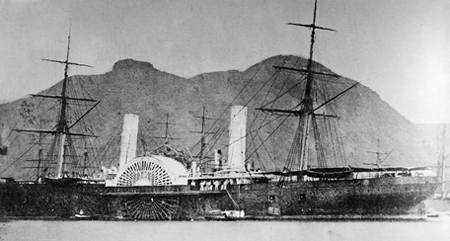
Vanderbilt equipped the Vanderbilt with a ram to destroy the Confederate ship Virginia and brought it to Hampton Roads, Virginia, where it bottled up the ironclad. He refitted it as a cruiser to search for the Confederate raider Alabama (note the cannons visible through gun-ports in this image) and sold it to the navy for one dollar. Library of Congress

Cornelius Vanderbilt as he appeared on a magazine cover in 1865. This image captures him just after he sold his last steamships and devoted himself to his growing railroad empire. Library of Congress

Confederate captain Raphael Semmes of the Alabama targeted Vanderbilt's Panama line, hoping to punish the Commodore for donating the Vanderbilt to the Union navy. On December 7, 1862, A. G. Jones, the captain of the Vanderbilt steamer Ariel, suspiciously watched the approach of the Alabama under a false U.S. flag. Naval Historical Center

Captain Jones attempted to escape the Alabama, but the Ariel was one of the slowest ships in the Vanderbilt fleet. But Semmes had been searching for the Champion, headed north with a cargo of gold; the Ariel was steaming south from New York, and had none. Semmes let it go after a few days. Naval Historical Center

In 1863, Vanderbilt took control of the struggling New York & Harlem Railroad, which had one key strength: it was the only steam railway to enter the center of Manhattan. Its trains ran down the surface of Fourth (later Park) Avenue to this station on Twenty-sixth Street, where they connected with the Harlem's horse-drawn streetcar line. New York Central System Historical Society

In keeping with steamboat and steamship tradition, locomotives were named in honor of leading officials of their companies. The Commodore Vanderbilt of the Hudson River Railroad was typical of those operated by Vanderbilt's lines. Library of Congress
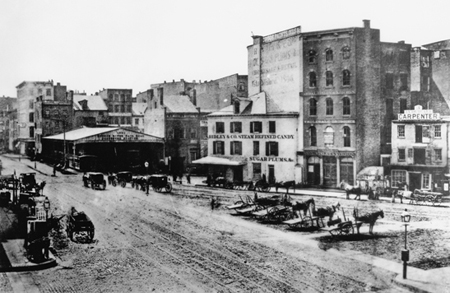
After taking control of the Harlem, Vanderbilt bought its principal competitor, the Hudson River Railroad, which ran from Albany along the river to this freight depot at Chambers Street. The horse-drawn carts illustrate one of the railroad's strengths: it ran down the West Side, close to the piers that served the city's abundant shipping trade. New York Central System Historical Society

Horace F. Clark, one of Vanderbilt's sons-in-law, emerged in the 1850s as a trusted lieutenant. A prominent Democratic politician, he sat on the boards of Vanderbilt's railroads and became president of the Lake Shore & Michigan Southern, which Vanderbilt controlled. In that position he struck out on his own, and forged an alliance with Jay Gould. Library of Congress

Augustus Schell was Horace Clark's close friend and political ally, and served as grand sachem of Tammany Hall after Boss Tweed's downfall. He also sat on the boards of Vanderbilt's railroads. Library of Congress

The railroad bridge across the Hudson River at Albany was seen as a major feat of engineering when it was opened in 1866. It allowed a direct connection between Vanderbilt's lines and the New York Central Railroad. Library of Congress
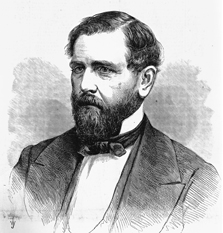
Henry Keep became a major figure on Wall Street in partnership with financier LeGrand Lockwood. In December 1866, Keep led a takeover of the New York Central, then provoked Vanderbilt by revoking a hard-won agreement with the Hudson River Railroad. Vanderbilt closed the Albany bridge to train traffic in retaliation, cutting the Central's link to New York. Keep capitulated. Library of Congress

Erastus Corning was one of New York State's leading businessmen and politicians. A resident of Albany, he rose to wealth as owner of an iron mill and president of the New York Central. Though Vanderbilt sometimes clashed with Corning, he liked and respected him. Library of Congress

Jay Gould shared a birthday with Vanderbilt, making Gould exactly forty-two years younger. He proved to be Vanderbilt's most determined enemy. In 1867, Gould asked Vanderbilt for his help in throwing Daniel Drew off the board of the Erie Railway; in the end, Gould sided with Drew to defeat Vanderbilt's attempt to corner Erie stock. Library of Congress

James Fisk Jr. emerged as Jay Gould's closest ally on the Erie board. Often understimated because of his outrageous behavior, he proved to be Gould's capable partner after the latter took the Erie presidency in 1868. A rival for the affections of a mistress shot Fisk dead in a hotel lobby in 1871. Library of Congress

As vice president and later president of the Pennsylvania Railroad, Thomas A. Scott made a striking contrast with Vanderbilt. Scott was a professional executive who rose through the ranks of management. He pioneered the use of shell corporations and holding companies, and was Andrew Carnegie's mentor. Library of Congress

Vanderbilt negotiated the purchase by the Hudson River Railroad of St. John's Park, the model for Gramercy Park, located where the exit of the Holland Tunnel is now. The railroad built the St. John's Park Freight Depot, pictured here, on that site. This image depicts the unveiling on November 10, 1869, of a statue of Vanderbilt centered in a bronze relief that depicted his career. New York Central System Historical Society
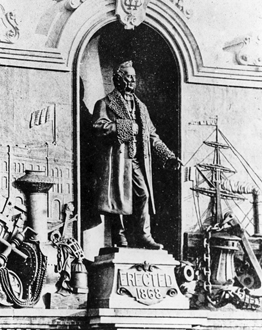
The St. John's Park Freight Depot statue was designed by Ernst Plassman and paid for by a fund organized by Albert De Groot, a former employee who had grown rich with Vanderbilt's assistance. Twelve feet tall, it (and the reliefs on either side) cost a reputed $500,000. In the early twentieth century it was moved to the front of Grand Central Terminal, where it remains today. New York Central System Historical Society

As the richest man in America, Vanderbilt was often caricatured by the press, which cast a cynical eye on the wealthy. This cartoon mocks Vanderbilt by making an unflattering comparison between him and James Fisk, in their “watering” the stock of their railroads—increasing the number of shares, considered a grave misdeed in 1869. Library of Congress

Vanderbilt's consolidation of the New York Central and the Hudson River railroads pioneered the giant corporation in American history. This 1870 cartoon shows Vanderbilt racing his newly merged company against Fisk of the Erie. Library of Congress

In 1869, the Harlem Railroad began to build the continent's largest railroad station, the Grand Central Depot. The station was located on the north side of Forty-second Street, well above the built-up portion of New York, because of legal prohibitions on the use of steam locomotives below that point. Vanderbilt personally paid for much of the construction. This photograph shows the arched supports for the vast train shed, or “car house.” New York Central System Historical Society

This engraving of Grand Central, completed in 1871, views it from the south, as most New Yorkers saw it. The depot anchored the rapid development of this district, and turned Forty-second Street into a major crosstown artery. Note the entrance on the far right for horse-drawn streetcars that rolled up Fourth Avenue from downtown. The depot was later rebuilt as Grand Central Station, and finally replaced by Grand Central Terminal on the same location. New York Central System Historical Society

The northern entrance of the Grand Central car house, shown here, opened onto Fourth Avenue. Because of complaints about the trains running on the surface of Fourth Avenue, Vanderbilt agreed to sink the tracks in an open cut. The cut was later covered over, and Fourth blossomed into Park Avenue. New York Central System Historical Society
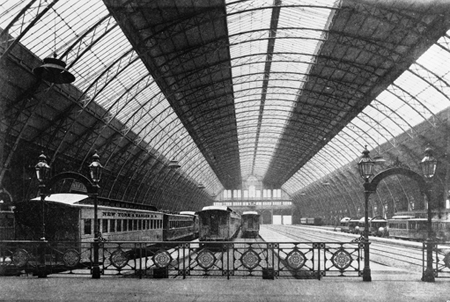
This view shows the interior of Grand Central's car house, beneath the enormous arched glass roof. Note the horse-drawn streetcars on the far right, which entered the station through a southern entrance. New York Central System Historical Society

An express train for Chicago departs Grand Central. During the 1870s, the New York Central and the Pennsylvania competed to run the fastest train between New York and Chicago. The Pennsylvania, with a more direct route, usually won. But the Central possessed a nearly level route, by far the most economical. New York Central System Historical Society

Four giant railroads, called the trunk lines, dominated traffic between the West and the Atlantic seaboard. Vanderbilt and his son William made the New York Central & Hudson River into the most profitable. A key strength, advertised here, was the unprecedented four-track line they built between Albany and Buffalo, at a time when many railroads had only one set of tracks. The four-track plan was Vanderbilt's brainchild. Library of Congress

Vanderbilt helped lift harness racing to social prominence in the 1850s, with his expensive horses and match races on the roads of rural upper Manhattan. The rising generation of Wall Street men chased the Commodore on Bloomingdale Road or Harlem Lane, shown here. Even after Vanderbilt (center-left foreground, with top hat and white cravat) turned eighty, he raced his expensive trotters on an almost daily basis. Library of Congress

Vanderbilt spent $14,000 on Mountain Boy, his finest horse and most prized possession, shown at right, racing its most famous rival, Lady Thorn. Mountain Boy began to dominate American harness racing in 1867 and became a national celebrity. The horse died in the epizootic of 1872, a loss that deeply affected Vanderbilt. Library of Congress

Starting in the 1830s, Vanderbilt went to the fashionable resort of Saratoga Springs every summer. This photograph shows him (seated at right, with crossed legs and top hat) on the veranda of the Congress Hall hotel in the early 1870s. He took part in Saratoga's highly social environment, playing whist and attending races. New York Public Library

Vanderbilt, shown here at about the age of eighty, impressed observers with his erect posture, physical energy, and youthful appearance. He acquired dignity with age, even winning praise for his courtly manners and fastidious dress. Library of Congress

Tennessee Claflin became Vanderbilt's magnetic healer, spiritualist medium, and possibly mistress. In 1870, she and her sister Victoria Woodhull claimed to have established the first female-run brokerage house on Wall Street with Vanderbilt's backing. There is no evidence that they conducted any trades or had Vanderbilt's support. Library of Congress

Victoria Woodhull used the fame of her purported brokerage house to take a leading role in the women's movement. Shown here addressing a committee of Congress (with her sister on her left), she declared herself a candidate for president in 1872. The sisters also launched Woodhull & Claflin's Weekly, devoted to spiritualism and radical causes. Though some have assumed that Vanderbilt supported the periodical, he did not. Library of Congress

Founder of the New York Tribune, Horace Greeley played a unique role in American public life. He befriended Vanderbilt's gambling-addicted son Corneil, and lent him tens of thousands of dollars. Greeley convinced Vanderbilt to serve as bondsman for the release of Jefferson Davis in 1867, which started him on the path toward his endowment of Vanderbilt University. Library of Congress

Vanderbilt's second wife, Frank Crawford Vanderbilt, was also his cousin. A native of Mobile, Alabama, Frank was a thirty-year-old divorcée when she gained the Commodore's acquaintance in 1868. A year later, they made a trip to Canada for a private wedding—after she signed a prenuptial agreement. A dignified woman with an aristocratic air, she brought her often-difficult husband fully into elite society. Albany Institute of History and Art
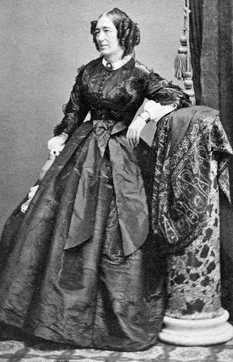
Vanderbilt's daughter Ethelinda married Daniel B. Allen, who served as a manager of his father-in-law's businesses for three decades. The Allens lived on Staten Island, not far from William H. Vanderbilt's farm. A permanent rift opened between the Commodore and the Allens in 1873 when Vanderbilt refused to save their son when his brokerage house failed. Albany Institute of History and Art

Vanderbilt's daughter Sophia married Canadian merchant Daniel Torrance, who ran his father-in-law's transatlantic line and served as vice president of the New York Central Railroad. Described by one nephew as “impulsive,” Sophia criticized Frank behind her back. On his deathbed, Vanderbilt insisted that Sophia apologize and shake hands with Frank. Albany Institute of History and Art

Mary, another Vanderbilt daughter, married Nicholas B. La Bau, a lawyer and politician. Mary led the resistance to Vanderbilt's will, in which he left most of his estate to William. “Now don't be stubborn and give trouble,” Vanderbilt told her on his deathbed. “I have left you all enough to live like ladies.” Unsatisfied with $500,000 worth of bonds, she challenged the will, leading to a long court battle. Albany Institute of History and Art

When Seymour Guy painted Going to the Opera in 1873, William and his wife Maria had already begun to establish their large family in patrician society, as shown here by the fine art that William purchased on repeated trips to Europe. The Commodore cultivated William's oldest sons, Cornelius II and William K. Biltmore Estate

The Panic of 1873 posed the greatest crisis of Vanderbilt's career. His son-in-law Horace F. Clark had dangerously increased the debt of the Lake Shore & Michigan Southern Railroad, and had embroiled both it and a major bank, the Union Trust Company, in his personal stock speculations. The Union Trust had to close its doors in the face of a run (shown here) during the Panic. Library of Congress

Vanderbilt turned eighty in 1874. This engraving—made from a photograph taken for Frank Leslie's Illustrated Monthly in early 1876—shows him at rest in his house at 10 Washington Place. He holds a young descendant, likely a great-grandchild, demonstrating a warmth that outsiders rarely saw. New York Central System Historical Society
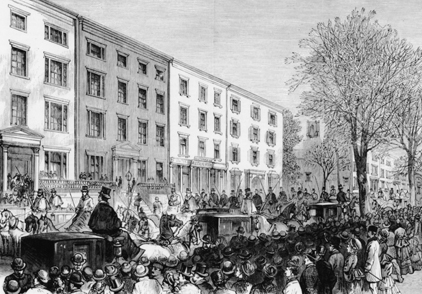
Vanderbilt's final illness began in May 1876, and he remained bedridden until his death on January 4, 1877. Though he was in agony for much of this period, his mind remained clear until very near the end. Here crowds are shown outside his double-wide house between Mercer and Greene streets, at 10 Washington Place, after word of his death. Library of Congress

Friends, family, and dignitaries crowded the Church of the Strangers on Mercer Street for Vanderbilt's funeral. Vanderbilt had purchased the church for Rev. Charles F. Deems, who ministered to fellow Southerners, or “strangers,” in New York, including Frank Vanderbilt and her mother. Vanderbilt gave it to Deems partly out of his desire to bring North and South together after the Civil War. Library of Congress

Vanderbilt was buried in the family vault in the Moravian Cemetery on Staten Island. Years after his death, he would be reinterred in a lavish tomb constructed by William H. Vanderbilt, still in existence in the same cemetery. Library of Congress

Vanderbilt's daughter Mary sued to break his will, which left an estimated $95 million to William. This illustration shows Vanderbilt's personal doctor, Jared Linsly, testifying on the first day of the trial, which lasted more than two years. As soon as William settled the suit, he sold a controlling stake in the New York Central to a syndicate organized by J. P. Morgan and constructed an enormous mansion on Fifth Avenue, initiating the Vanderbilt family's Gilded Age extravagance. Library of Congress

This was the world that Vanderbilt made: New York City a few years after his death, when more than a million people crowded onto Manhattan. Described as an “overgrown seaport village” when he was a young man, it grew into the commercial and financial capital of North America, home to the greatest riches (and most desperate poverty) in the United States—a transformation that Vanderbilt helped lead. Library of Congress
Given Boody's eruption, it is curious to note that just prior to the meeting he had taken William aside and told him that he and Baxter both desired a settlement. It gave William some hope. He urged the board to confer with him and Schell in New York by January 14, after which their power to negotiate would expire. They left.102
In New York, William reported what had transpired, still optimistic that the negotiations would resume when the Central board came to New York. “They are humbugging you,” the Commodore replied. “I'll tell you my opinion; when they come [to New York], they will keep away, they will never come nigh you. They are going to fool you and draw you along in this controversy through the winter, until spring comes and the river opens, and then they will tell you to go to the devil; that is their policy.”
Vanderbilt was being bullied, and he didn't like it. But he had one great advantage. It was deep winter, and the river was frozen. He proposed that they use their ultimate weapon: to break off all connections with the New York Central. “They do not think that we dare break with them, but they will find themselves mistaken for once,” he told his men. “We may as well break with those people tomorrow as at any time. I don't want to take two, three, or four days to do a thing that we can do in one.”
“Don't do that,” William replied. “Let it be. They will be here and we will have a meeting on Monday,” January 14.
“Very well,” Vanderbilt answered. “We will give them till that time, but they will not come.”103
They never came. Late on January 14, the boards of both the Hudson River and the Harlem railroads voted to suspend relations with the New York Central as of January 18. No tickets or freight would be accepted from it; no trains would cross the Albany bridge. (Vanderbilt's lines would halt their own trains on the east side of the Hudson River.) “It would have this effect,” William testified. “It would put the NY. Central road in a position that she could not go before the public and say she was a grand trunk line between New York and Buffalo.” For the Central, it was apocalyptic.104
Notice of the impending break reached the Central directors on January 15. They immediately asked for the meeting that they had previously scorned. Now it was the Commodore's turn to display indifference. “I did not have the time,” he blithely explained. “Life is not a bit too long for me, and I like to play whist; and I will not permit any business to come in and interfere with that.”
As Vanderbilt enjoyed himself in the card rooms of the Manhattan Club, a howling blizzard swept down on the state. The heaviest snowfall in a decade piled up in enormous drifts; temperatures plunged below zero. “The present winter is to pass into the annals of the ‘extraordinary’” the Albany Evening Journal remarked on January 18. Passengers were forced to trudge across the ice at Albany, or hire sleighs to carry them and their baggage over, in order to buy tickets directly from the respective lines. Freight from the west piled up at the Central's terminus. Shippers turned to the Erie and the Pennsylvania, but those lines had to use ferries to cross the Hudson into Manhattan, and the severe weather made this connection intermittent. In a season and an age when everything depended on the railroad, Vanderbilt had not only cut the Central off from New York, he had cut off New York from the country105
It was a shocking example of a private company's power over the city, if not the nation itself. Vanderbilt, the Brooklyn Eagle wrote, “was placing the metropolis in a state of strict blockade, and cutting off its supplies.… We can imagine no act more criminal than this or more deserving of exemplary punishment.” The New York Herald said, “Railroad corporations, whether ruled by boards or held within the grasp of a single individual, should not forget that they owe some consideration to the people who grant them special and valuable privileges, and to whose patronage and support they are indebted for their success.” In the state senate, Henry C. Murphy of Brooklyn offered a bill to require connecting lines to carry through passengers and freight without breaking bulk, and to refer all disputes to the state engineer for arbitration. The assembly's Railroad Committee began hearing testimony on January 18.106
On February 5, the aged, erect figure of Cornelius Vanderbilt sat before this committee. His foes had testified first, excoriating him at length. His son and other Hudson River directors had followed, explaining the long history of their conflict with the Central and the details of the current crisis. But the assemblymen most wanted to hear from the Commodore himself. “Did you not take it for granted,” one of them asked, “that the Central Railroad were legally bound to pay you a $100,000 annually?”
“When you talk about ‘legally’ I suppose your next question will be: ‘Why didn't you prosecute them?’” Vanderbilt replied. “It is not according to my mode of doing things, to bring a suit against a man that I have the power in my own hands to punish.… The law, as I view it, goes too slow for me when I have the remedy in my own hands.” As he elaborated a few minutes later, “Let the other parties go to law if they want, but by God I think I know what the law is; I have had enough of it.”
One of the committee members pointed out that the Commodore had personal friends on the Central board. “My personal friends, when they take such grounds as they did, I am afraid of. I am not afraid of my enemies, but, my God, you must look out when you get among your friends,” he said. “No, sir, I never did any act in my life that I did with more reluctance than I did to assert my rights in that controversy with the N.Y. Central Railroad. But I would have asserted them if it had cost me half I was worth. It was not a matter of dollars and cents; it was a matter of principle.”107
Vanderbilt's words later would be distorted into a sneer, one that mixed the essence of his speech with the caricature of him as a brute. “Law! What do I care about the law?” he would be quoted as saying. “Hain't I got the power?” This fabrication would have an enduring and misleading impact on his image. Over the course of his life, he had resorted to lawsuits many times; he found them inefficient, but he hardly spurned the courts. Far from a mere tyrant, he practiced patient and skillful diplomacy. Nor was his speech quite so crude—though he did say “damn” and “devil” far more often than was thought proper in the 1860s. But one point of both quote and misquote was the same: he had the power to punish.
The testimony of Vanderbilt and his men produced “a decided change in public sentiment, which had previously run altogether in favor of the Central management,” the Times reported. For one thing, Vanderbilt had a chance to present himself in his own terms. “I have always served the public to the best of my ability” he remarked. “Why? Because, like every other man, it is to my interest to do so, and to put them to as little inconvenience as possible.” More important, Vanderbilt and his men turned attention from the trivialities of business to the underlying problems: the fragmentation of the railway system that pitted connecting lines against each other, and the contradictory nature of railroads as both private businesses and public works. Clark and William pointed out that Senator Murphy's bill could strip a company of its power to defend itself against ill-treatment. How could society demand that private citizens provide the capital for the nation's railways, but leave them unable to protect their investments? Left unanswered was the question of how the public interest—and the public's interest in uninterrupted railway transportation was enormous—could be protected from disruptions caused by purely private disputes. The Central blockade contributed to a growing political conviction that railroads required regulation.
Vanderbilt voiced no worries. “If you could pass a law compelling men to take better care of their interests than their interests will compel them without the law, then it is well enough,” he said. “I don't care what law the legislature makes in reference to railroads, provided it is general, and applies to all roads. For if I cannot exist upon the same terms with the rest of them, I will retire and go out of the business.”108
By the time he said these words, the blockade had already ended. The demonstration of his ruthlessness had driven even Keep into a panic. “What is to be done?” Keep telegraphed Corning on January 17, as soon as he received word of the blockade. He transferred all power to settle the matter to Corning, Boody, and Baxter, the three directors most open to a compromise. The trio took a carriage to Vanderbilt's office on West Fourth Street and began peace talks. “I will do Commodore Vanderbilt the justice to say that he was, during the negotiation… the most anxious man in the party to settle,” Baxter said.109
On January 19, they agreed to a new contract. The Central committed to delivering as much through freight “from competing points” to the Hudson River as the Hudson River delivered to it. There would be no more empty cars returning from Albany. The Central also agreed to pay its share of the Hudson River's terminal charges. There would be no $100,000 payment, but William considered the Central's concessions to be worth twice that. On January 21, the New York Herald announced, “END OF THE RAILROAD WAR.” Murphy's bill died, as did the assembly inquiry110
In speaking to the assembly committee, Keep noted that Vanderbilt “claims to have had everything his own way, and I am afraid he has. I am very thankful that I have not been a party to it.” This was a remarkable statement. He was president of the company, and yet he was not “a party to” its agreement? It was a sign that Vanderbilt had defeated him mentally, morally, emotionally, from the moment the great and unexpected blow fell. Keep gave Corning's committee responsibility for making peace, and then began to dump his New York Central shares. “Keep & Lockwood are large sellers. They have flooded the market with stock,” John M. Davidson wrote to Corning on January 24. Vanderbilt, he recorded, had been out “on the road” driving his fast horses, “& said that he had instructed Wm never to notice any communications from Keep, that he was unworthy of notice, etc., etc.” Tellingly, Vanderbilt advised his horse-racing friends to buy and hold Central stock.111
“Keep is cursed by all parties,” Davidson wrote to Corning the next day. “The swearing against him by the stockholders is terrible. They talk of getting up a meeting requesting him to resign. This man, Mr. Corning, is a bad one, for the interests of your road. He has a worse reputation than Vanderbilt. The difference between the two is this: Keep will throw over the stockholders' interests by twisting the stock, while Vanderbilt will sustain stocks by holding them—for instance Hudson & Harlem.” In all likelihood, Keep and Lockwood had been carrying their shares on narrow margins, and decided to cut their losses when the price fell during the blockade. As for Davidson, he joined the crowd in hurling his own Central shares into the flood.112
He should have paid attention to what Vanderbilt told his companions on the road. The Commodore's victory turned out to be more complete than he ever could have predicted. He not only had forced the Central to acknowledge his railroad's demands for justice, he had broken the spirit of its largest stockholders. As Central shares grew cheap and abundant, Vanderbilt saw an opportunity. He took it.
* The seminary Drew endowed is now Drew University, in Madison, New Jersey.