
Chapter Three

The tablespoon glittered in the craftsman's shop. As new silver, it would have been heavy and untarnished in Vanderbilt's hand. Looking into it on March 31, 1824, two months short of his thirtieth birthday, he would have seen himself in his prime: full lips, a long nose, and a high forehead, growing higher by the day as his hairline ebbed. It was the reflection of a man who had just won the biggest victory of his life.
The craftsman had engraved the spoon with a single word: Thistle. For Vanderbilt, it was the name of the future. The tablespoon was one of twenty-four specially prepared for the newly launched Thistle, along with sets of sugar tongs, mustard spoons, and five dozen teaspoons. Vanderbilt found them acceptable, paid for them, and carried them down to the dock. The Thistle belonged to his employer, Thomas Gibbons, but he attended to the boat's every detail himself, from bell covers to block straps, as it was built in a New York shipyard. At more than 123 feet long, twenty-three wide, and 210 tons, it was an “elegant Steam Boat,” in the words of the New York Evening Post. On her first trial, it made thirteen miles per hour against the tide—truly a marvel of speed.
On April 19, Vanderbilt commanded it on its initial run to New Brunswick, where an enthusiastic crowd swarmed the dock to meet him. He piloted the Thistle to its moorings under the echoing boom of a small cannon, fired by a local merchant and two others to welcome the flagship of the new era of free competition. Then the cannon exploded, blasting off the fingers of two men and scorching the face of the third.1
In later years, many observers would ponder the gargantuan figure that Cornelius Vanderbilt had become and wonder if the unchecked marketplace had not blown up in everyone's face. In the immediate aftermath of Gibbons v. Ogden, however, no one doubted that the world had become a better place. The Livingston monopoly could not stop steamboats from entering New York waters from other states, the Supreme Court ruled; to the public, this was a blow for freedom.
Chief Justice Marshall's decision provided one of those rare turning points in history that is recognized as one at the time. Newspapers across the country greeted the ruling with lengthy coverage. “The interest excited by the decision,” wrote the Washington Republican, “has induced us to… gratify our readers.” Niles' Register reprinted the decision in full, filling almost eight pages.
“It is the fashion to praise the Chief Justice's opinion,” John Randolph of Virginia observed. Indeed, it proved to be almost universally popular, perhaps the most popular of his long career. The Evening Post captured the mood when it called the decision “one of the most powerful efforts of the human mind that has ever been displayed from the bench of any court.” It represented “a forecast, in relation to the destinies of our great confederacy.” John Marshall foresaw a destiny of commerce, free and abundant, and the people wholeheartedly agreed.2
“Chief Justice John Marshall's great disquisition on the commerce clause,” writes legal scholar Leonard W. Levy, “is the most influential in our history.” In constitutional terms, it completed his great nationalist project, the establishment of federal supremacy. It struck down the New York steamboat monopoly as an affront to Congress's exclusive jurisdiction over interstate commerce, refuting the claim that the states shared power in that area. In practical terms, it threw the high court's weight behind the gathering momentum of competitive individualism—of laissez-faire—in American law and culture. “Marshall's nationalism,” writes R. Kent Newmeyer, “aimed to create not a nation-state but a national market, an arena in which goods and credit moved without hindrance across state lines.” Though the decision said nothing about the legality of government-granted monopolies as such, it added to a growing sense among many that they ran against the natural law of economics and the principle of equality And Marshall fully recognized the need to expand transportation to develop (and unify) the sprawling republic. (After the Court adjourned at the end of March, he ruefully decided to return home by taking his first trip in a steamboat.)3
A century after Gibbons v. Ogden, legal historian Charles Warren hailed the decision as “the emancipation proclamation of American commerce.” Marshall's admiring biographer, Albert Beveridge, claimed that it “has done more to knit the American people into an indivisible Nation than any other force in our history, excepting only war.” More recent legal scholars have stepped back from such extravagant praise, noting the ways in which this sweeping decision was soon hemmed in.4 And yet, there is much truth in these earlier assessments, especially when the case is set in a context larger than constitutional law. Marshall captured and codified a new mood in the country, after nearly fifty years of independence. Commerce, interstate commerce in particular, was the stuff of daily life as never before. The chief justice proclaimed that, yes, the United States was a common market; no matter how the states would later eat away at the edges of his ruling, he gave voice to what most Americans now believed—that freedom of movement and trade across state lines was a basic right.
Gibbons v. Ogden came at an extraordinary moment. Within a year, the most important work of public engineering of the era, the Erie Canal, would be complete from Albany to Lake Erie. The unleashing of steamboats in New York waters and the opening of the canal that connected the nation's interior to the Atlantic coast would integrate markets and open the way for new economic growth. They would also guarantee New York City's dominant position in the American economy, and make way for Vanderbilt's rise.5
The results could be seen almost at once. The Thistle was only the first of many new vessels to be launched after the death of the monopoly. The steamboats registered at the New York Custom House jumped from one or two per year to twenty-two. Even more churned in from neighboring states. In November 1824, Niles' Register reported, the number of paddle-wheelers in New York had increased from six to forty-three. New York went from stumbling block to keystone in the American economy6
Aaron Ogden—hero of the Revolution, former New Jersey governor, former United States senator, hated by no one but Thomas Gibbons—went bankrupt. Gibbons had the great satisfaction of seeing his old foe descend into the indignity of debtors' prison. He went free thanks to the aged but still-influential Aaron Burr, who lobbied the New York legislature to enact a law to spare all Revolutionary veterans from imprisonment for debt. Ogden moved to Jersey City in 1829, received an appointment as collector of customs there, and died on April 19, 1839. A man who merely played by the rules of the day, he paid for the sins of the entire system, and was sacrificed for its transformation.
The Livingston clan was stunned by the Supreme Court's decision. “I had no idea of the court's going to the extent it has,” mused a troubled Edward P. Livingston. “It seems to have adopted opinions which I had thought settled long ago.” He and his brother Robert L. felt insulated, however; their North River Steam Boat Company operated entirely within New York State boundaries, where the monopoly still prevailed. The defeat really belonged to their uncle, John R. Livingston, whose rights covered the waters shared with neighboring states. But the ill-tempered John was determined to make his nephews suffer just as he did. Bitterly admitting failure in his battle against Vanderbilt, he took the Olive Branch off the line to New Brunswick and sent it to Albany to compete against his own family. In the resulting court case, the now more democratic state courts overturned the monopoly entirely. John R. Livingston, one of the oldest survivors of the culture of deference, had destroyed its last remnants. Like the rest of the old patricians, the Livingstons had become merely rich men in an economic war of all against all.7
For the man who sat in the office of the Thistle as it floated at its New Brunswick dock, counting out shillings and scratching entries in ledgers, the courtroom victory posed an entirely different conundrum. As the commander of Gibbons's forces, Vanderbilt had fought loyally under his chief in a great campaign. But his service had been a whetstone to sharpen his ambition. Now, with Ogden crushed, the Livingstons dispersed, and the monopoly in ashes, what was there to keep him in his master's pay? If even the aging chief justice had caught the rising spirit of the times—a rough, combative individualism—what would restrain the mariner-businessman who best embodied it? In Gibbons's dark, suspicious heart, he knew it was only a matter of time before his iron-willed captain fought his battles for himself.
WORKMEN BUSTLED AROUND BELLONA HALL, hammering together an extension on the building, laying a new terrace, making improvements to the stables. Vanderbilt urged them to finish by the end of May, when traffic between New York and Philadelphia would pick up dramatically8 His mind raced with ideas for the months ahead, searching for any competitive advantage for the Union Line. The Supreme Court had eliminated Ogden and the Livingstons as competitors, but in so doing had unleashed anarchy upon a business long restrained by law and custom. Already a new rival had appeared: the Citizen's Line, which ran the steamboat Aetna (or “Etney” as Vanderbilt typically chewed up the name). The war of all against all had begun.
As if to underscore the uncertainties of the age, the Aetna erupted in a massive boiler explosion on the waters of New York Harbor on May 16, 1824. The spectacular accident created a new anxiety—“the lurking fear that we might burst the boilers,” as one passenger called it. Though Americans were still entranced with the technology of steam, the Aetna disaster planted a seed of that most modern awareness: that progress marches with tragedy, that new capacities breed new horrors. At the time, the press merely focused on the choice of machinery, angrily denouncing the Aetna's owners for using a high-pressure engine. “Let no such boats be trusted,” the Evening Post fumed. Vanderbilt swiftly took advantage by notifying the newspaper that all of the boats on the Union Line “are propelled by the low pressure Steam Engines.”9
Time would show that the difference between high- and low-pressure engines barely mattered when opposing captains strained their boilers beyond their limits. It was not merely the technology but the new culture of economic conflict that made the steam engine so dangerous to the public. Yet competitive zeal was what powered Vanderbilt in those weeks after Gibbons v. Ogden; rivalry seemed to make his mind ever more nimble, ever quicker, in these rapidly changing times.
At the end of May, he spent his thirtieth birthday consumed by the threat of a new and more dangerous foe, “the elegant Steam Boat Legislator,” as the Evening Post hailed it. “The Legislator has a large and airy centre dining cabin,” the paper reported, “finished off with mahogany and curled maple; a ladies' cabin richly and beautifully furnished; beside a large and convenient forward cabin containing a bar for refreshments, &c. and is in reality a splendid floating Hotel.”
Vanderbilt informed Gibbons that the Legislator belonged to a corporation based in New Brunswick; the shares were selling below par, he noted, and soon they might be able to buy enough to take control. (The par value was the official price which the original incorporators were technically obligated to pay.) It was a remarkable piece of creative thinking. In 1824, the corporation was a mysterious abstraction to most Americans, but Vanderbilt already grasped its nature and the market in stocks.10 Indeed, the proposal offered an early hint of methods that would later define his career.
But it went nowhere. Instead, he and Gibbons met the Legislator with a fare war that drove the cost of the forty-mile journey from New York to New Brunswick down to a shilling. “But within a few days past the fare has been still farther reduced,” commented the New York Daily Advertiser on June 4, “and they now carry for nothing; in some instances a good dinner has been given to all who would accept it.” Vanderbilt—always alert to his personal interests—touted his inn in Union Line advertisements. “The elegant hotel, Bellona Hall, is connected with these boats,” he boasted, “where travellers can be well accommodated, and horses kept at low rates.”
The Legislator, meanwhile, suffered from its crew's inexperience. Several days after it began to run, schoolteacher Sam Griscom boarded it in New York. “We were getting along very fast, and were in hopes of getting to New Brunswick nearly as soon as the other Boat,” he wrote in his diary; “then thro want of skill the pilot ran the boat on a bar in Raritan Bay.… The captain was very much mortified. I believe that neither he nor his pilot was acquainted with this passage; to add to his mortification, a steam boat passed us, which would carry the tidings of our disaster to N. York”11
As a teacher, Griscom had no reason to fret about a few minutes' difference in the journey to Philadelphia, but he was caught up in the craze for competition. “The sport arising from ‘boat racing,’” the Evening Post observed, captured the public imagination, as each vessel attracted dedicated adherents. English actress Anne Royall witnessed a race from aboard the Legislator; referring to the boat as “our heroine,” she recounted the chase with breathless excitement. “Although she seized upon the middle of the channel, her rival drew up alongside somewhat boldly, and sometimes had the presumption to run ahead,” she wrote, with a fan's attention to technical detail, “which her ability to sail in shoal water enabled her to do.” Here was everything exciting about the age, captured in a moment: the power of the new machines, the ease and rapidity of travel, the thrill of the daily duel. And the benefits of this competition were clear to see: the passage between Philadelphia and New York shrank to less than ten hours, and fares had never been cheaper.12
To Vanderbilt's consternation, the Legislator's captain, Lawrence Fisher, rapidly got better, and soon began to beat the Thistle with alarming frequency. On September 3, Vanderbilt won the race to New York; as the Thistle churned up to the pier that was used by both vessels, he ordered his deckhands to tie up in the middle, leaving no room for the enraged Fisher. Harbormaster John Minugh ran out on the dock and ordered Vanderbilt “to haul ahead in order to accommodate the… Legislator.” With characteristic contempt for empty authority, Vanderbilt “refused so to do,” Minugh reported. Vanderbilt continued to block out Fisher whenever he could, snorting at the threat of a $250 fine. The battle was all that mattered.13
Shortly before six o'clock on the morning of June 2, 1825, Vanderbilt and Fisher ordered their engineers to build up steam for the morning race to New Brunswick. Men and women bound for New Jersey and Philadelphia lined up on the dock, boarding the boats at their berths. Vanderbilt glowered at his rival as Fisher strutted on his deck with pride. “He had beaten the Thistle yesterday,” a passenger remembered Fisher saying, “and [he] intended to go ahead of her still farther today.” The Legislator's engineer was new, but he understood his mission well. “She must beat theThistle,” he told his assistant (one of many black men who worked the harbor's ferries), who accordingly held down the safety valve to build up extra pressure. The two captains ordered their deckhands to cast off the lines.
An enormous roar split the air. In the center of the Legislator, the superheated boiler exploded, disintegrating into a shock wave of scalding steam and metal fragments that shattered decks, windows, wheels, bulkheads, and bodies. In horror, Vanderbilt and his passengers watched splinters of the rival vessel shower the water and the dock amid the screams of the wounded. Four died in the blast: two black men (one a slave), one white man, and a boy who worked as a waiter. The new American ethic, to win at all costs, was proving costly14

THE TIME HAD COME to say farewell to the age of the Founders. The Jubilee—the fiftieth anniversary of independence—approached, and the ever forward-moving Americans chose to look backward. “It is a moment that American history has forgotten,” writes Andrew Burstein, “a moment when two critical generations reaffirmed their connection.” It was a moment of tribute to the last few survivors of that founding generation, in a world that had changed radically since 1776, and changed still more with each passing day.
The long good-bye began two years early, with the arrival of Marquis de Lafayette, the French nobleman who had thrown himself into the cause of American independence. At the invitation of President Monroe, he sailed to the United States in 1824, making landfall on Staten Island on Sunday, August 15. The Nautilus steamed out to greet him, and he spent his first night in Vice President Tompkins's mansion. The next day Lafayette sailed to Manhattan, where the entire city turned out to welcome him. “It is impossible to describe the majesty of this procession,” wrote one of his companions. “The water was covered with vessels of all descriptions, elegantly decorated.… At length we could perceive the crowds which everywhere covered the shore.” The mayor of New York led squads of troops and public officials in making a formal salute. Lafayette, once the symbol of youthful rebellion, had become the aged emblem of the venerable past to a nation that was joyously sentimental about the Revolution.15
Even calculating Cornelius found himself swept up in the enthusiasm over the hero's visit. On September 24, the mariner joined a delegation of New Brunswick's dignitaries that awaited Lafayette's arrival at the bridge into town, along with a crowd of some eight thousand citizens. At length the old soldier appeared, and a battery of artillery fired a sixty-nine-gun salute. Vanderbilt presented a fine carriage pulled by four white horses, and personally drove Lafayette on a parade through the streets.16
Curious, this regard for the past: in so many other ways, Vanderbilt disdained the delicacy of cultured men, the sentiment that caramelized in the diaries and letters of the literate. “I love you? dearest—Ay, do I love you—and when I love you not, chaos is come again,” Attorney General William Wirt wrote to his wife, in a typical note of the era. Vanderbilt would sooner start writing in Russian than write such things. He was the most commercial creature of a society that was throwing away the traditional social bonds—a self-made man, where the Founders themselves mostly had been old patricians. And yet, his patriotism was sincere, his veneration authentic. His heroes can be identified by the names he gave to his sons: William Henry (after General William Henry Harrison, hero of the War of 1812), George Washington—and Cornelius.17
As Vanderbilt rose, Thomas Gibbons declined. The old Tory who had helped unlock the “radicalism of the American Revolution,” in Gordon Wood's phrase—the dueling aristocrat who had overthrown aristocratic privilege—faded in the twilight of his generation. His sense of purpose seemed to evaporate in the heat of victory, and the flood of letters that poured from his pen dwindled. His chronic ailments overcame him, and he moved to the elegant patrician enclave of St. John's Park in New York. Vanderbilt largely ran Gibbons's steamboat enterprise, tracking income and expenses on large spreadsheets, boat by boat, month by month. Tension rippled through their relationship as days, even weeks passed between the captain's visits to his employer. “I used to do some things without his knowledge,” Vanderbilt later testified, “and he used to bear me out in them, though sometimes he said he would not do so.”18
And yet, despite their equally headstrong personalities, the seemingly inevitable conflict between the two never came to pass, thanks in large part to Vanderbilt's admiration for Gibbons. His regard for this impossible old man seemed to run together with his reverence for the Founders, mingling his esteem for the men who had made the nation with that for the former Tory who had helped reshape it.
Often bedridden, Gibbons played no part in the festivities of those years, in the farewell to the old and the heralding of the new. He shriveled as John Quincy Adams, son of John Adams, entered the White House in March 1825, in a literal transition to the Founders' children. He remained out of sight for the eventful week between October 26 and November 4, 1825, the grand celebration of the completion of the Erie Canal, that final gift from the aristocrats who had launched the project back when they still ruled the state. This historic achievement of engineering, cutting through a curtain of mountains, was all the more important for Gibbons's courtroom victory, yet his name was left unsaid throughout the ceremonies. Finally, on the afternoon of May 16, 1826, he wobbled out of his house to the corner of Hudson and Beach streets, where he collapsed and died.
Though the public scarcely noticed, Gibbons's death was also part of the passing of the founding generation. For all his acquisitive, competitive fervor, he was, to the end, an aristocratic, slave-owning Southerner who was obsessed with honor. A little over a month later came the deaths of both Thomas Jefferson and John Adams—on July 4, 1826, the very moment of the Jubilee.19
Gibbons's vast estate now passed into the hands of his son, William. But where the whip-wielding Thomas had effortlessly straddled the eighteenth and nineteenth centuries, his son remained somewhat ill at ease in these new times. Given to quarreling with his partners and dimly suspicious of competition, he seemed even more a product of the plantation South than his father.
In many ways, William represented the opposite of generational change—and therein lay a serious problem. When he inherited the Thistle, he also inherited its hard-driving captain; but Vanderbilt brusquely dismissed William's business acumen and, even more important, his strength of will. “I do not know that William Gibbons ever started a project which his father did not originate,” he later claimed. “When they disagreed, the old man would have his own way.” By contrast, Vanderbilt himself often had carried his point with “the old man.”
The undertone of sibling rivalry is unmistakable. Cornelius had fondly sent Thomas Gibbons bushels of oysters and other tokens of affection; for the son (who was a year younger than himself) he felt no such admiration. Rough-edged, hard-muscled, and self-made, Vanderbilt couldn't quite bring himself to hate William, but he seemed to suspect that this rich boy lacked the drive, even the mental machinery, to cope with the age of commerce. Was it not Cornelius himself who best resembled Thomas Gibbons, in his energy, his entrepreneurial creativity his sheer force of personality?20
Vanderbilt seemed to be nothing but energy as he burned through the year on the hunt for every possible source of profit. On summer Sundays, when William had the Thistle sitting idle, Vanderbilt leased the Bellona to take New Yorkers to the Union Garden on Staten Island. He even arranged to sell the manure from Bellona Hall's stables to James Neilson, a self-styled gentleman farmer. Meanwhile he supervised the construction of a new vessel for the Union Line. Christened the Emerald, it was a “splendid new steam boat,” as it was advertised, and he proudly took command. But not for long.21
At half past one o'clock in the morning on November 5, 1826, Vanderbilt awoke in his bed at Bellona Hall to the cries of his crewmen. The Emerald had caught fire. He raced out the door to the wharf, where “the vessel was found to be one enormous sheet of flame,” the New York Gazettereported. The captain sent for help and hurried with his men to set up pumps to hose down the fire. They accomplished nothing. The flames crackled and burned along the length of the boat, eating down to the waterline. Seeing that the cause was hopeless, Vanderbilt ordered the men to cut its lines and set it adrift, lest a sloop at the dock catch fire as well. As the enormous torch floated into the current, he helplessly watched the destruction of much more than his employer's asset. “Capt. Vanderbilt lost considerable property in papers, &c.,” the Gazette reported, “and every article of clothing.”22
A shame, to be sure—almost a tragedy, in fact, though no lives were lost. But the press report begs a fistful of questions. Every article of clothing? Was he living entirely on the boat? What about Bellona Hall? What about his wife and children? Thomas Gibbons had largely abandoned his family in his self-absorption and his greed; was Vanderbilt doing the same?
FIFTY YEARS LATER, in a courtroom packed with spectators and reporters, in a city home to more than a million, “a gentleman with silvery white hair and iron gray moustache” took the stand, the New York Times reported, and testified about Vanderbilt's wife, Sophia. The witness was Daniel B. Allen; he was married to Sophia's second child, Ethelinda, and had heard hours of conversation among the siblings who had lived in Bellona Hall—Phebe (born in 1814), Ethelinda (1817), Eliza (1819), William, or Billy (1821), Emily (1823), and Sophia (1825). Their reverence for their mother knew no bounds. “The fact that Mrs. Vanderbilt had fulfilled the duties of a mother more completely than any woman they had ever known, had been talked over,” he testified. “In everything that interested her children she had full control. During a considerable portion of her life she had not only taken care of them, but fed, clothed, and educated them at her own expense, without getting a cent from [Cornelius].”
But what did they know of their father? As the Emerald disaster showed, he lived on his boats, starting his runs as early as six in the morning, sometimes even working on Sundays. He spent his leisure hours in the stables with his horses, training them for future races. He did spend enough time at Bellona Hall that his wife was with child for nine months out of every twenty-four through the 1820s and ′30s. Baby Sophia was followed by Mary in 1827, Frances in 1828, Cornelius Jeremiah at the end of 1830, George Washington in 1832, Mary Alicia in 1833, Catherine Juliette in 1836 (the year George died), and a second George Washington in 1839. All the children eventually found their father remote, stern, at times antagonistic. As Allen recalled, they later asked each other “what the children would have been, or even [their] father, had it not been for the exertions of [their] mother.”23
The trial that brought Allen to the stand in 1877 was staged to settle the fate of the Vanderbilt fortune, so his testimony ranged far beyond those early days in New Brunswick. But one more thing he said shed light on the man his father-in-law was back in the 1820s. “The Commodore was determined to have his own way, always, to a greater extent than any man I ever saw,” Allen asserted, using a title as yet undreamed of in 1827. “It was his most prominent characteristic.” In Bellona Hall, Vanderbilt's busy, harried, and pregnant wife could only have agreed, for she saw that trait expressed in every relationship, public and private.
During these years, the health of Vanderbilt's own father began to decline; he had accumulated a good-sized estate, worth some $40,000, and his will came under discussion whenever the family gathered on Staten Island. Cornelius senior wanted his wife to inherit everything. Cornelius junior, however, insisted on a particular provision: if his mother remarried, the estate would be divided immediately among the children; only if she remained single would she have the property for the duration of her life. “That feature of the will, Mrs. [Sophia] Vanderbilt said, had been a source of great discomfort to the Commodore's mother,” Allen reported.24
A day would come when Vanderbilt's love for his wife and children would become apparent, suggesting that he had always harbored affection for them out of historical view. In the early hours of his rise, though, his ambition seems most striking, defining both his personal and historical role. Alexis de Tocqueville later would observe that the “respect, attachment, and service” that held men together in aristocratic societies had disappeared in America; now they were bound by “money only”25 In Vanderbilt's case, that ever-present calculation, and competition, seeped into his own family relations. In place of the duel, the elaborate ritual for protecting the honor that defined a patrician society, he substituted brute force—emotional, and sometimes physical.
On the morning of May 9, 1827, the thirty-two-year-old Captain Vanderbilt started the new Union Line steamboat, the Swan, on its morning run; satisfied that the pilot had matters well in hand, he retired to the dining room for breakfast. In his customary chair sat Patrick Rice, whom he knew to be a difficult passenger. Vanderbilt tersely ordered him out. Rice refused. With the swing of a meaty hand, he sent Rice flying. The next morning, court papers dryly report, “without the permission of [Vanderbilt], and without any right to do, [Rice again] took possession of the seat of [Vanderbilt] at the breakfast table.” In the hilariously understated legal language of Vanderbilt's account, he “gently laid his hands upon the said plaintiff to remove him.” Too gently, it appears, for Rice (possibly drunk) sneaked back into the chair. At that, Vanderbilt curled his fingers into a pair of practiced fists “and did then and there beat, wound, and ill treat him so that his life was greatly despaired of,” as Rice complained. The infuriated Vanderbilt dragged the apparently unconscious Rice up to the pilothouse, hurled him onto the floor, and locked him inside. Rice not only lost his ensuing lawsuit, but had to pay damages to the man who had pummeled him.26
In the year since Thomas Gibbons's death, Vanderbilt's aggressiveness—his will to dominate—had grown fierce to the point of danger for those around him. At the same time, William Gibbons seemed to contract. In 1827 he leased to Vanderbilt the ferry rights to Elizabethtown Point (once rented by Aaron Ogden). In early 1828, Vanderbilt launched the first steamboat that was entirely his: the Citizen, a speedy 106-foot, 145-ton sidewheeler. With cousin John Vanderbilt and little brother Jacob alternating as captain, the Citizen connected Elizabethtown to New York with stops on Staten Island's northern shore. Cornelius also bought shares in the New Brunswick Coal Mining Company (a hint that he was interested in new sources of energy for steamboats), again demonstrating his ease with the complexities of the new economy27
Gibbons, on the other hand, had difficulty adjusting to the world that his father had helped make. He fell into a series of squabbles with the Stevens family of Hoboken, who owned the Union Line boats on the Delaware River. He reacted with exaggerated alarm to the appearance of competing lines. Unlike Vanderbilt, he feared that still-uncommon, still-mysterious form of business organization, the corporation; when rival lines obtained corporate charters from the New Jersey legislature, he protested wildly. It was a “swindle,” he complained, that would “check individual enterprise.” Gibbons was hardly alone in such suspicions. Indeed, his response reveals how unfamiliar the corporation remained to the American mind in general, even as it shows how unsophisticated he himself was as a businessman.
On July 8, 1828, Gibbons gave in to despair and offered for sale his three vessels (the Bellona, the Thistle, and the Swan). Then he thought better of it—then he gave up again. The final blow was the incorporation of yet another rival company. With that, Gibbons abandoned the field with all the dispatch of Darius in his chariot, fleeing before Alexander's army. “I intend to retire from the employment of steamboats,” he wrote on February 6, 1829, “as soon as I can dispose of my boats.” Before the end of the month, he had sold his paddlewheelers, rented out his docks, and ended the enterprise that had sealed his family name in history28
So began Vanderbilt's career as an independent steamboat entrepreneur. It was probably a relief. He had never been comfortable working for this younger, less acute man. Vanderbilt leaped into the race that William Gibbons had abandoned, sending the Citizenon shilling-a-head runs to New Brunswick. But the stress he now faced was unmistakable. It is not too much to say that Thomas Gibbons had been a second father to him, complete with father-son conflict. No matter how many businesses Vanderbilt had kept going for himself, he had remained within Gibbons's house, which gave him both shelter and a sense of purpose. Now the old man was dead, the house closed up. Vanderbilt would have to find his own way forward, to use what he had learned from Gibbons to shape his enterprises, to develop his own vision of his future. In his solitary steamboat, he sailed off to fight the economic war.29
ON THE EVENING OF APRIL 24, 1829, the Citizen pulled into its berth on New York's North River shore, at the hour when the glow of the setting sun reflected in a thousand orange points off the rippling waters. The deckhands tied up the boat, and the passengers began to debark. Vanderbilt joined them, as did Sophia, and together they walked into the crowded, dirty streets that ran between the low brick and wooden buildings of lower Manhattan. The Vanderbilts still lived in Bellona Hall, but had come to spend a Friday night in the city.
Someone bumped against Vanderbilt's side, then disappeared into the river of people pouring off the dock. Vanderbilt jammed his hand into his coat pocket. His wallet was missing. He pushed through the crowd, then sprinted after the man he believed to be the thief. In a moment he tackled him and held him fast as he searched his coat. The pocketbook contained “about $200 in money,” the press reported, “and certificates for several thousands in [New] Brunswick Bank stock.” None of it appeared in the man's pockets. Regardless, Vanderbilt hauled him off to High Constable Jacob Hays.
The high constable must have rubbed his bald head in delight when his former rival burst into his office. The man Vanderbilt dragged along was “identified there by Hays as one of the most noted pickpockets in the country,” the New York Gazette explained. “Hays says he has passed by the name of Henry Baptiste Lambert, and he graduated in the Pennsylvania State Prison. It is probable that he had an accomplice, to whom he handed Captain V's property, as soon as he got out of his reach. The Captain is positive he is the thief.” The now-incarcerated criminal had the perverse fortune to have picked a rich target—a rapidly rising businessman—who was also as big and tough as any thug on the waterfront.30
The city where his pocket was picked was far from the “overgrown seaport village” that he had moved to from Staten Island during the War of 1812. It swarmed with people, swelled with people, was bulging from every door and window with people who poured in from the schooners, steamboats, and ships that clogged the slips. “New York was changing with disruptive speed,” writes historian Allan Horlick. “It was becoming strange where it had been familiar, and mysterious where it had been predictable.” At mid-century Joseph Scoville looked back to his youth and recalled a time when an average New Yorker “of no very extended acquaintance” could point out all the leading merchants, even direct a visitor to their homes.31 That memory faded rapidly as new faces arrived daily to rent apartments, find work, or start businesses.
The most popular story of the day, Joyce Appleby notes, was Peter Rugg, the Missing Man, about a farmer who disappeared before the Revolution, only to reappear in the mid-1820s. “Poh, New York is nothing,” Rugg scoffs to his contemporary guide. “No, sir, New York I assure you is but a sorry affair, no more to be compared to Boston than a wigwam to a palace.” Then Rugg wanders down Broadway, and he cannot believe his eyes. “There is no such place as this in North America,” he stammers. “Here is seemingly a great city, magnificent houses, shops and goods, men and women innumerable, and as busy as real life, all sprung up in one night from the wilderness.”32
It virtually had. In 1790, Manhattan's population had barely topped 33,000; in 1820, it reached 123,700; by 1830, it would pass 202,500. In just another five years, seventy thousand more people would cram into the city, pushing the population density to more than 25,000 per square mile. New York, then, remained tightly packed, but it was obviously expanding geographically as well. In 1811, the city extended only to Houston Street; by 1828, Broadway reached Tenth Street, and work began on Fourteenth Street from river to river. “Here the earnest merchant steps,” observed Anne Royall in the mid-1820s, “there the gay cook and merry chambermaid, with some scores of honest tars, hucksters, rude boys, and chimney sweeps, with the rolling coaches, the rattling carts, may give some idea of this life-inspired city.” As with every visitor, she reserved most of her astonishment for the island's watery edges, where the city met the world:
But all that is only a drop in the bucket compared to that on the wharves or slips (as they are called here), the warehouses, docks, ship-yards, and auction stores, which occupy South, Front, and Water streets, pouring a flood of human beings. Here the sound of axes, saws, and hammers, from a thousand hands; there the ringing of the blacksmith's anvil; hard by the jolly tar with his heavo; the whole city surrounded by masts; the Hudson, East river, and the bay covered with vessels, some going out and some coming in, to say nothing of the steam-boats; in short, imagine upwards of an hundred thousand people, all engaged in business; add to these some thousand strangers which swarm in the streets and public houses; such is New-York.33
They were coming not so much from the impoverished districts of Europe (not yet, at least) as the fields and towns of the United States itself, especially New England and rural New York State. And that, to some small degree, was Vanderbilt's doing, for he had stood on the barricades of the transportation revolution and commercial expansion that were transforming American life. The northeastern states felt the effects first, due to both their access to tidewater and their proximity to capital-rich merchants of the seaports, who bought produce from farmers, sold them goods, and built the first cotton and woolen mills in their villages. Semi-subsistence farming disappeared; country folk left home as never before, looking for opportunities or simply some kind of cash income. Between 1820 and 1850, the percentage of the U.S. population living in towns and cities rose from 7 to 18 percent, and the absolute numbers increased fivefold. Uprooting oneself to find one's fortune became a new way of life; one Bostonian described his move to New York in 1833 as the product of “the general principle of Yankee roam-all-over-the-worlditiveness.”
Now all depended on the marketplace, which linked together once-isolated communities. “Ten years ago we had nothing” exclaimed the Catskill Recorder in 1828, “now we have everything.” In 1826, the New York Evening Post announced—in the same issue that marked Thomas Gibbons's death—the first shipment of Michigan pork through the Erie Canal. With such humble items new eras are made.34
Newly mobile, self-interested, unbound by the old culture of deference, this emerging nation of strangers gave rise to an aggressive spirit of enterprise. They called it “go-ahead.” It became a New York catchphrase, for this business-minded city began to overflow with the chosen people of go-ahead, the New England Yankees. From farmboys to clerks to merchants, they invaded Manhattan and made it the capital of “the universal Yankee nation,” as P. T. Barnum called it.
Fiercely calculating, afloat in a sea of drifting people who knew nothing of each other's character, the Yankees of New York and New England crafted new values to suit the age of the marketplace. To outsiders—English aristocrats, for example—they seemed to be “uncouth and curious rustics,” one historian writes, “whose energies were exclusively given over to the pursuit of the main chance.” In the course of two years in America, Frances Trollope learned the Yankee character well, and concluded that they cherished no attribute more highly than sharp dealing, better known as being “smart.”
“I like them extremely well,” she wrote of Yankees, “but I would not wish to have any business transactions with them, if I could avoid it, lest, to use their own phrase, ‘they should be too smart for me.’” On her first visit to New York in the late 1820s, she “neglected” to strike a deal with a carriage driver before the ride, and was forced to pay an exorbitant sum. “When I referred to the waiter of the hotel, he asked if I had made a bargain. ‘No.’ ‘Then I expect’ (with the usual look of triumph) ‘that the Yankee has been too smart for you.’” Americans from other regions, she wrote, described them “as sly, grinding, selfish, and tricking. The Yankees… will avow these qualities themselves with a complacent smile, and boast that no people on earth can match them at over-reaching in a bargain.” It was a curious kind of vanity, she observed; if you listened to a Yankee describe himself, “you might fancy him a god—though a tricky one.”35
Cornelius Vanderbilt needed every ounce of shrewdness in the enterprise he now embarked on. In May 1829, he sealed an arrangement with some stagecoach men and Captain Wilmon Whilldin on the Delaware to form the Dispatch Line, providing through service between New York and Philadelphia via New Brunswick and Trenton. The gatekeeper on the turnpike tracked the line's rising tolls as the Citizen carried ever more passengers: $19.30 in May, $73.75 in June, $126.22 in July, $157 in August. Vanderbilt stretched his resources to the limit to purchase more steamboats: his old favorite, the Bellona; the rebuilt Emerald (which he sent around Cape May to run on the Delaware); and the Baltimore and the John Marshall in early 1830. Now the master of a mostly secondhand fleet, with his brother Jacob and cousin John as captains, Vanderbilt carried the battle to the competition—who were none other than the new owners of the Union Line. A rate war broke out; the fare to Philadelphia plunged to a dollar, including free meals on board.36
Then, at the start of the 1831 season, the Dispatch Line would take a startling turn.
NOTHING ENTIRELY DISAPPEARS in history. The threads of tattered old fabric—especially social fabric—are ever woven into new tapestries. While Vanderbilt wrestled with his pickpocket in New York, his competitors plotted in their gardens to remake the culture of deference—or, at least, to maintain some sort of continuity, to impose some kind of order on the chaos of the marketplace.
Their gardens could be reached from New York only by boat, a special steam ferry that carried world-weary city folk across the Hudson to enjoy their splendor. Indeed, the name of this resort became a synonym for tranquil beauty: Hoboken. All 564 acres of the place belonged to Colonel John Stevens, who with his sons had long been Vanderbilt's allies, and now were his rivals.
The Stevenses were what the Livingstons might have been—patricians who successfully made the transition to this more individualistic, commercial, and ruthless age. Colonel Stevens, in fact, was the late Chancellor Livingston's brother-in-law. Like the chancellor, he dabbled in the sciences; and like the chancellor, he dabbled with little real ability, though he freely appropriated the inventions of those who worked for him. The Livingstons' monopoly had forced him to send his first steamboat to the Delaware; his sons (John, Robert, Edwin, and James) soon dominated that river with more and better boats, and collaborated with Gibbons on the Union Line.
The sons inherited the colonel's technological interests, but with actual mechanical talent. Robert L. (for Livingston) Stevens proved to be one of the great engineers of the day, repeatedly improving steamboat design. The brothers mastered business competition as well, in sharp contrast to the Livingstons, whose North River Steamboat Company failed in 1826—whereupon the Stevenses immediately began to run their own boats from New York to Albany. In New Jersey, they took over the Union Line from William Gibbons, purchasing the Thistle and the Swan. In 1829 they drove the Citizen's Line into extinction. They intended to do the same to Vanderbilt's upstart Dispatch Line.37
Their strategy involved far more than free meals and discounted fares: they intended to make the stagecoach obsolete. As far back as 1812, the colonel had published a pamphlet proposing that a steam engine be put on wheels and pull a train of carriages on a road of rails. By the late 1820s, the “rail road” had become reality on such lines as New York's Mohawk & Hudson. The Stevenses reasoned that it was the perfect replacement for the bone-rattling stagecoach ride across New Jersey's turnpikes, and so they collected investors to build one. And, along with capital, they sought something the chancellor would have approved of: a legal monopoly.
This was not the eighteenth century, however, and this would not be a copy of the Livingston monopoly. For one thing, the family worked through a corporation chartered by the state legislature—the Camden & Amboy Railroad—with publicly traded shares. For another, the Stevenses faced fierce opposition from other interests, including the organizers of the Delaware & Raritan Canal, led by Robert F. Stockton, a wellborn navy lieutenant who was a swashbuckler at sea and in business alike. Stockton maneuvered the Stevenses into merging their well-financed railroad with his undercapitalized canal on February 15, 1831, creating the “Joint Companies,” as the enterprise was known. The immense size of this new entity gave it the leverage to extract a remarkable bounty from the legislature: “That it shall not be lawful… to construct any other railroad or railroads in this State, without the consent of said companies.” By signing over such a valuable piece of its sovereignty to a consortium of wealthy men, New Jersey earned the snide nickname “the Camden & Amboy State.” The price for its virtue was an annual fee of $30,000 and a limit of $3 on the through fare (three times what Vanderbilt charged). The Stevenses had finally brought order out of the anarchy of competition—or boughtorder, to be precise.38
At just about this time the Dispatch Line disappeared. The standing assumption has always been that the Stevens brothers bribed Vanderbilt. According to an old New Brunswick mariner, “It was said they bought him off here and yonder and made him rich.” The payoff was motivated by fear, the man claimed; Vanderbilt “fought 'em so hard that he left here with a reputation that scared people.”39
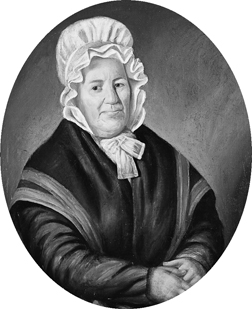
Tough, shrewd, and frugal, Phebe Vanderbilt strongly influenced her son Cornelius, who revered her. Of English descent, she married into an old Dutch family on Staten Island. Her husband ran a small farm and a sailboat ferry to Manhattan; she earned her own money, which she lent out at commercial rates of interest. Collection of the New-York Historical Society

The Staten Island of Vanderbilt's youth was a rural landscape at the mouth of busy New York Harbor. This 1833 view from the Narrows captures both the shipping and the undeveloped hillsides behind the Quarantine, the state hospital for immigrants. Young Vanderbilt ran a sailboat ferry like the one shown here. Library of Congress

Hardworking, modest, beloved by her offspring, Sophia Johnson Vanderbilt was Cornelius's first wife and cousin. Their early years together weren't always easy, yet their intimacy grew over time, as they traveled together and grappled with family turmoil. Biltmore Estate

New York Harbor, as seen in 1830 from the Battery, the promenade at the southern tip of Manhattan. Staten Island lies directly across the bay; to the right is the curved battlement of Castle Clinton, just offshore, later enclosed by landfill. The abundant shipping and display of fashion depicted here drew much comment from visitors. Collection of the New-York Historical Society

The open-air Fly Market, shown here in 1816, represented the sphere that Sophia Vanderbilt occupied after the young couple moved to New York during the War of 1812. As seen here, women both sold and purchased goods amid the densely built-up city, where packs of pigs and dogs roamed freely Collection of the New-York Historical Society

Young Vanderbilt inhabited the lower social and economic tiers of a world captured in Francis Guy's 1820 painting of the corner of Wall and Water streets. To the right, the ships can be seen moored along South Street. On the left, with flag, is the Tontine Coffee House, the city's first financial market. Collection of the New-York Historical Society

An aristocratic Southern planter who settled in Elizabethtown, New Jersey, Thomas Gibbons was Vanderbilt's mentor and only employer. He turned a personal dispute into an attack on the Livingston family's monopoly on steamboats in New York waters. That culminated in Gibbons v. Ogden, the U.S. Supreme Court's first commerce-clause case and a legal landmark to this day. Drew University
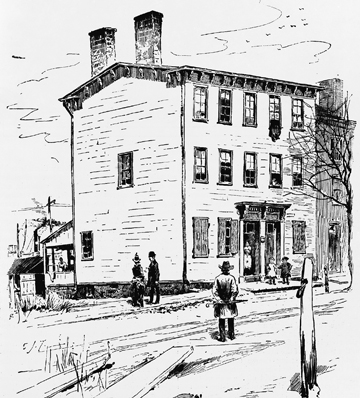
Legal complications stemming from the battle against the steamboat monopoly led Vanderbilt to move his family to New Brunswick, New Jersey, the southern end of the ferry line he operated for Gibbons. His wife Sophia managed an inn in their home, dubbed Bellona Hall, through the 1820s. She used the proceeds to feed, clothe, and educate the children, without her husband's aid. Library of Congress

Vanderbilt emerged as one of the leading maritime architects of the paddlewheel era, a distinction perhaps first earned in 1835 with the revolutionary Lexington. Faster and more fuel-efficient than any steamboat afloat, it inaugurated his competition in the combined steamboat-and-railroad routes between New York and New England. On January 13, 1840, cotton bales piled on the deck ignited and started a tragic fire. Library of Congress

In the late 1840s, at the height of Vanderbilt's career as a steamboat entrepreneur, New York swelled with immigrants and bustled with commerce as the city became the nation's primary seaport and emporium. Vanderbilt's most famous steamboat, the Cornelius Vanderbilt, is seen here behind the rival Bay State. Museum of the City of New York

One of the earliest daguerreotypes of Cornelius Vanderbilt, made in 1845. At the age of fifty or fifty-one, he now dominated steamboat traffic on Long Island Sound. Within two years of the making of this image, he would engineer his election to the presidency of the Stonington Railroad. Library of Congress
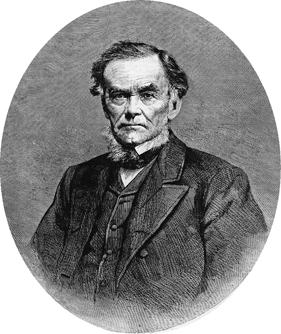
Famous as Vanderbilt's enemy in the Erie War of 1868, an epic fight over the Erie Railway Daniel Drew spent most of his life as Vanderbilt's secret partner. Drew used his experience with street-level finance to become a steamboat entrepreneur financier and stock operator. He went bankrupt shortly before Vanderbilt's death. Library of Congress

Canal contractor, steamboat entrepreneur, and political manipulator, George Law represented both the business energy and corruption of the antebellum era. For twenty years he loomed as one of Vanderbilt's most notorious enemies. In 1847 Law's steamboat Oregon defeated the Cornelius Vanderbilt in a famous race on the Hudson, watched by thousands of spectators. Library of Congress

William Henry, Vanderbilt's oldest son, was born in 1821. As a young man he went to work in the Wall Street office of Daniel Drew. William suffered an emotional breakdown, and his father sent him and his wife, Maria Kissam, to live in this farmhouse near New Dorp, Staten Island. Vanderbilt took notice as his son built his farm into a successful operation. Library of Congress
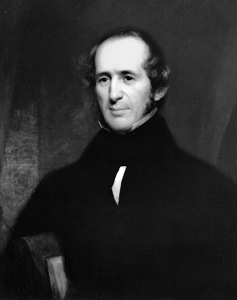
Nathaniel Jocelyn of New Haven painted this portrait of Vanderbilt in 1846, when the entrepreneur was starting to look for social respectability. That year he moved to Washington Place, in the heart of New York's most aristocratic district. The merchant elite trusted and feared him, but did not yet accept him as a social equal. National Portrait Gallery, Smithsonian Institution

No sooner had the thousand or so residents of Yerba Buena renamed their village San Francisco than the gold rush began. This 1848 engraving shows the sleepy town on the eve of the deluge, looking into San Francisco Bay. Library of Congress
If the Stevens brothers did bribe him, then he proved himself a tricky god indeed. He never intended for the Dispatch Line to last. He knew all along that the railroad, when complete, would destroy rivals who depended on stagecoaches. (This threat had weighed heavily on William Gibbons as early as January 1829.) Hardly had he launched his line than he began to plan a full-scale assault on an entirely different route, to the coastal towns of Westchester County and western Connecticut. Charles Hoyt and Curtis Peck currently ran a boat there with little or no opposition, making them vulnerable to an attack by a hardened fighter like Vanderbilt.
He carefully scouted the passage, and spotted a strategic spot for a new landing—an outcropping known as Jay's Rock near the shore of Sawpits, a cluster of lumber mills on the Westchester border with Connecticut (later dubbed Port Chester). On June 8, 1829, when the Dispatch Line had just started, he signed a ten-year lease to the rock with Mary De La Montaigne and Susan Moore, “for all docking privileges…; the said Vanderbilt is to [bear] all the expense of building such wharf or wharves as he may think proper from said rock to the mainland for steam boat purposes.” Soon he had a crew of workmen driving in piles and pouring in cartloads of dirt to build a dock to Jay's Rock. He put the Citizen and his old Fanny on daily runs between New York and Norwalk, Bridgeport, and New Haven with a stop at his Sawpits pier.
In early 1830, with the Dispatch Line's fare war still raging, Vanderbilt began his retreat from New Jersey. He and Sophia packed up Bellona Hall and loaded one of the steamboats with their belongings, their horses, and their children. They debarked in New York and made for a narrow town-house at 134 Madison Street, near gritty Corlears Hook.40
The disappearance of the Dispatch Line, then, should be no mystery, bribe or no bribe. Vanderbilt did retain an interest in New Jersey, however, with his lucrative ferry to Elizabethtown. Nor was his brief fare war his last contact with the Stevens brothers. He would encounter them again—and next time it would end in bloodshed.
“I HEARD AN ENGLISHMAN… declare,” reported Frances Trollope in 1832, that “in the street, on the road, or in the field, at the theatre, the coffee-house, or at home, he had never overheard Americans conversing without the word DOLLAR being pronounced between them.”41 Who better exemplified this mania for money, this frenzy for calculation, than Vanderbilt? And yet, as he acquired more boats and hired more employees, as he grappled with the growing complexity of his business, he faced the fundamental problems of this new nation of self-serving strangers. How could a man earn a profit in a world where anything could come under attack at any time? How could you know whom to trust?
The anarchy of the new competitive culture naturally prompted a reaction. The Stevenses, by securing a legal monopoly for their railroad, had refashioned some of the tools of the culture of deference to bring order to their world. Vanderbilt drew on far more ancient concepts: family and reputation. As his stature grew, he made a determined effort to polish his image as a man who stayed true to his word. And as his business grew, he spent more and more time thinking about how he could find trustworthy people, and bind them to himself.
On his steamboat trips to Norwalk in 1830, he fell into conversation with an earnest twenty-five-year-old man from Danbury, Connecticut, named Hiram Peck. Peck, Vanderbilt learned, was intensely devout, an eager participant in a wave of religious fervor known as the Second Great Awakening. Being a good Yankee, Peck also intended to make his fortune; for that, he was moving to New York to open a shop. Vanderbilt (himself just thirty-six) gave Peck a temporary home until he found permanent quarters; afterward he frequently invited him to his house for tea or supper. There Peck mingled with Vanderbilt's family and senior employees, such as John Brooks Jr., captain of the Citizen.
The robust social scene in New York among such men of go-ahead startled the pious Peck. An oyster dinner hosted by his landlord, for example, featured “wine, some songs, & some stories,” he reported to his diary. “I left about 11:00. Some staid much later. I do not enjoy myself well in such places. I prefer solitude with my book or some few included in company which we can be social without indulging in those love songs and dirty stories some of which would be debasing for a beast to express in language.” He found Vanderbilt's company more agreeable, but the captain's energy pointed up a contrast with himself. “Called at Mr. Vs in the evening with Sister Harriet & husband,” he wrote on September 22, 1830. “I often have to regret that I have not more perseverance in doing any kind of business because I almost daily see that a man may attain to almost anything with sufficient application.”
Vanderbilt kept his eye on Peck. The young man's earnestness marked him as a useful tool, should an appropriate use present itself. Peck observed him in return as he played father to his children, a role Vanderbilt had long neglected. In the heat of August, Vanderbilt invited the young man to join them on an outing to the shore. “I have been down to the Steam Boat to see Mr. V. & his family.… It is a very pleasant thing to have a pleasant companion and a little group of lovely offspring,” Peck scribbled in his diary. “To be sure there is much trouble with them sometimes. But then there is I can well conceive a satisfaction which repays for all four fold and whatever I may argue in favor of a life of celibacy my own feelings do not at all respond to it.”42 The “trouble” with the children was obvious, and Peck had to talk himself into believing that there must be emotional compensation for it all.
Indeed, there must have been some, as the couple had still more children. In 1830, Sophia returned to Staten Island, pregnant, to lie in with her family, and gave birth to Cornelius Jeremiah. For Vanderbilt, the role of patriarch was hardly at odds with that of the clever businessman. There was, perhaps, no better way to exert control in a city of strangers, a city of tricksters, than through friends and family. As Vanderbilt cast his eyes across the dinner table, he saw more than a pious companion and various relatives—he saw assets.43
WAS THERE EVER A PRESIDENT like Andrew Jackson? This lean and predatory Tennessean, with his bristling mane of gray hair, resembled nothing so much as a hungry wolf, a creature of ferocious passion and territorial instincts, whether defending his inner landscape of honor or the physical boundaries of the United States. The only chief executive to have killed a man in a duel, this former general had defeated the British at New Orleans in 1815, crushed Indian tribes, and essentially conquered Florida. His presidency saw the last conflict with Native Americans in the Old Northwest (the Black Hawk War in 1832) and the forced removal of five Indian nations on the infamous Trail of Tears. A cloud of danger hung about the age of Jackson.
There was also a scent of triumph. When the general took the oath of office in 1829, at the age of sixty-two, he and his followers saw it as a vindication. Four years before, he had won the popular vote but been denied the office by maneuvers in the House of Representatives (which decided the election in the absence of an Electoral College majority). His sweeping victory in 1828, they thought, rang in what would be hailed as “the era of the common man”—a romantic and partisan title, to be sure, but one that reflected his supporters' fervent beliefs. To them, Jackson's rise epitomized the rise of the West, the triumph of the millions who had poured across the Appalachians; Jackson represented the victory of an expanded electorate, a rebuke to the old elite. In a famous and telling incident, average folks mobbed the White House for his inaugural reception, spitting tobacco and trampling on the furniture.44
To many Americans, the president embodied the energy, mobility, and enterprise that they believed defined their nation. So it makes perfect sense that the name General Jackson appeared on the side of the Hudson River steamboat commanded by Jacob Vanderbilt, Cornelius's younger brother. At 175 tons, it was fast and successful on its route between New York and the Westchester town of Peekskill. Jacob, just twenty-four, had bought a half share at the end of 1830 and took over as captain. He would continue to loyally aid Cornelius's enterprises, but he, too, was in business for himself. A broad-faced man with a wide smile, a round nose, and friendly eyes, he made a stark contrast with his brother (though they shared a receding hairline and abundant, cheek-filling sideburns). Jacob seemed to be warm where Cornelius was brusque, collegial as much as commanding. He rapidly became a popular figure in Peekskill.45
That changed abruptly at half past three in the afternoon on June 7, 1831. Coming down from Peekskill, the General Jackson chuffed across the river to Grassy Point, where the Hudson begins to widen into the expanse of Haverstraw Bay. The pilot guided the vessel to the crowded pier and Jacob jumped ashore to help load the luggage and boxes of merchandise. Then the engine detonated. “Such was the force of the explosion,” noted one newspaper, “that the boiler was blown entirely from its place.” The hot, expanding gas turned the boiler into a rocket. A wave of steam blasted through the hull as the apparatus roared into the air, then splashed heavily into the space that opened between the boat and the dock. The explosion “shivered to splinters” the bow and upper decks, the press reported. “In about 20 minutes the boat sank, the stern only being visible above the surface of the water.”
Shattered pieces of wood, metal fragments, and shreds of clothing showered the water and the dock as some forty passengers screamed in panic or pain. At least nine would die from the scalding shock wave of steam, and two more were sealed in the sunken hull. Jacob was knocked to the ground, miraculously uninjured, with the dead and dying all around him. He then boarded a passing steamboat, the Albany, and left the bloody scene for New York. It was a public relations disaster.
“The public mind is painfully aroused to the subject of steamboat explosions,” observed the New York Evening Post. The urge to “go ahead” as rapidly as possible increasingly strained against the daily fear of a horrible death. “I had never been on board a steamboat before,” a New Englander recalled, describing his move to New York around that time. “As I heard the whizzing and puffing of steam, and the splashing of water—‘Heavens!’ thought I, 'sposin' the biler should bust, what in the deuce would become of me?’ So I stationed myself at the extreme bow of the boat, as far, I thought, as I could get from the boilers.” After disasters, safety barges would proliferate, allowing nervous passengers to ride in a raft towed behind the steamer.
But nothing could quell the fury of the victims and their families. As outrage spread, Jacob defended himself in a letter to the New York newspapers. “I was one half owner of the General Jackson” he wrote, “and by her destruction found myself in one moment stripped of my property and ruined in my prospects.” He only went to New York to get help, he said. He anchored his defense with one of the best-respected men in the business: his brother Cornelius. The engineer, he wrote, had been “strongly recommended by the owner of the steam boat Citizen, whose great experience in steam navigation is well known to the public.”46
No one knows where Cornelius was at the time of Jacob's narrow escape from death, but it would not be surprising if he was in Huntington, Long Island, where his prize horse Bullcaff ran the races on these cool June days.47 With his customary hard-eyed calculation, he saw an opportunity in his brother's misfortune, a chance to seize for himself the market that Jacob had lost. The endeavor would open a window on the customs that steamboat entrepreneurs were devising to bring order to the new chaos of the marketplace.
Six days before the General Jackson sank, Cornelius had received an influx of capital from his competitors on Long Island Sound, Charles Hoyt and Curtis Peck. The pair had desperately wanted him to go away, and eagerly accepted the deal he offered. On June 1, they agreed to buy the Citizen, along with the rights to his Sawpits pier and wharves at Stamford and Catherine Street in New York, for the inflated price of $30,000.
As they closed the deal, a visibly irate Hoyt snapped that he and Peck “were paying [Vanderbilt] a large sum of money for the route.” Vanderbilt shook his head, and “distinctly requested… Hoyt to understand that all [he] sold them was the steam boat with the leases and docks.” It was understood that he would not compete against them, he told Hoyt. They needed no formal deal on that score, because it was part of the steamboat man's code of conduct, the unwritten rules that had arisen to regulate competition after Gibbons v. Ogden. As Vanderbilt told a court, “In cases of sales of steamboats which are expected to run on a particular route, it is generally understood that the vendor would be considered as acting unfairly were he to oppose the purchaser with steamboats on the same route, except and unless in self defense.”48
Monopoly on a line was the standard, the assumed state of affairs, and a sale by a competitor confirmed it. If the seller violated the code, the buyer could fairly counterattack against one of the seller's other routes. Vanderbilt made it a point of pride to refuse to make any formal agreement. Tellingly, Curtis Peck, an experienced steamboat man, “did not consider it worth his while to require or exact any stipulation… on the subject.” Vanderbilt, he believed, would keep his word.
Vanderbilt claimed that he was abandoning “the run between the city of New York and Norwalk because he considered it a hazardous run and not desirable in itself.” There was some truth to this: in April, the Citizen had struck a rock off New Rochelle, sank, and had to be raised. But the money came at a critical moment.
With the General Jackson sitting on the bottom of the Hudson, Vanderbilt quickly leased the Flushing to take its place. Meanwhile he built a new steamboat, the Cinderella, to take over the route permanently. It seems he chose the name to charm a public disenchanted with the Vanderbilt family. “A fine little steamboat, of the fairy order, and appropriately ycleped [called] the ‘Cinderella’ was tried in our waters,” the New York Gazette reported in September. “She sat buoyantly on the stream, gaily decked out in her best attire, and… she is ‘swift as the flash.’ The new Cinderella is decidedly in the field as a resolute competitor.”49
By the time the Cinderella began to run, she already faced a rival, and a big one: the 207-ton, 134-foot Water Witch. Even more dangerous than the boat was the leading spirit behind it. He was a grim-faced man of thirty-four, with dark hair parted on one side, narrow eyes, and such a crimped jaw and sharp cheekbones that it looked as if his collar had compressed the lower half of his head—but then, he did make an art of keeping his mouth shut. His name was Daniel Drew.
A native of landlocked Carmel, New York, Drew had started his working life by driving cattle down to the meat markets of Manhattan. It would later be said—inaccurately—that he invented the “watering” of livestock, the trick of preventing them from drinking on the drive to market, then encouraging them to gorge, once they arrived, to inflate their weight. Incorrect as the attribution was, it speaks to the formidable reputation Drew developed for sharp dealing—which stood in odd juxtaposition with his eventual standing as a devout Methodist in an age of revivalism. Drew was “shrewd, unscrupulous, and very illiterate,” Charles F. Adams Jr. would later write, “a strange combination of superstition and faithlessness, of daring and timidity—often good-natured and sometimes generous.” Sly, silent, and stoop-shouldered, he seemed to take pleasure in passing down the street unnoticed by the crowd. One man thought that he resembled “a cross between a cartman and a small trader.” But if you should catch his eye, “you will observe a sharp, bright glance in it, with a look penetrating and intelligent.” As a another writer later remarked, “We have said his intellect was subtle. The word subtle does not altogether express it. It should be vulpine.”50
Drew's peculiar character, and his background in cattle, led to his rise as a figure of street-level finance. In 1830, he took over the Upper Bull's Head Tavern, located on Third Avenue at the Two-Mile Stone (according to the street grid plotted in 1811, this was at Twenty-fourth Street, still far above the settled portion of the city). A large three-story wooden building, the Bull's Head was described by one stagecoach driver as “the common resort for all travellers (and particularly drovers)” on the main route down Manhattan. Drew became a central figure in the cattle business, trading promissory notes and lending money, establishing himself as “a man of sufficient and ample means,” in the driver's words.51 It was natural enough, then, that an old friend, circus proprietor Heckaliah Bailey, should approach him in the summer of 1831 to ask him to buy a share in the Water Witch, and to take charge of its affairs on behalf of himself and a group of Westchester investors who had built it.
Vanderbilt soon realized that he faced a worthy foe in Drew. Inevitably, a rate war erupted, driving fares down to a shilling—only now, unlike his war against the Livingstons, the public was against him. “In the midst of the storm of indignation” over the General Jackson, “the very name of Vanderbilt aroused execrations deep and loud all along the North River,” declared Harper's Weekly in an 1859 profile. “The exasperated river towns and villages… would not allow his boat to make fast to their piers.… When he ran to a wharf he could get no hand to take the ropes he threw ashore to make fast. As to business, it is recorded that more than once his daily receipts did not exceed $0.12½. When a solitary passenger did take passage in his boat he hid himself from the public gaze, as though he had been doing a guilty thing.” The Water Witch, on the other hand, “was welcomed daily with huzzas and uproar from the thronging crowds at the landings,” according to another 1859 profile—this one of Drew.
Drew, it was later said, often slouched on the dock as the Cinderella steamed up, Vanderbilt looming tall at its bow, confidently riding out the public's rage. “You have no business in this trade,” Vanderbilt told him. “You don't understand it, and you can't succeed.” But Drew understood it all too well. He didn't need to make a profit; he simply had to make his opponent suffer to the point that he was willing to make a deal. The same tactics that Vanderbilt had employed against Hoyt and Peck—to drive down fares until the established line bought him out of the market—now worked against him. If he wanted the Water Witch to go away, he would have to purchase it at a hefty premium. And so, in 1832, the people of Westchester were startled to discover that their champion boat had been bought by Vanderbilt, who promptly raised the fare again.
It was the beginning of a long and peculiar friendship. For the first time in Vanderbilt's life, he had been forced to pay for what was already his, and he couldn't help admiring the man who had done it to him. Over the course of their lives, these starkly contrasting businessmen would mix partnership and rivalry in a bewildering dance of mutual respect and self-interest.52
ON MAY 20, DEATH HAUNTED the Vanderbilt family. Three years before, on May 20, 1829, Cornelius's brother-in-law and old partner, Captain John De Forest, had died, leaving his sister Charlotte a widow. Now, on May 20, 1832, Cornelius Vanderbilt senior died, pulling his son back to Staten Island for the Moravian Church funeral, the settlement of the will, and attendance on his bereaved mother.
Death defined not only the date, but the year as well. Rumors began to spread of an epidemic. “Some considerable said about the Cholera,” noted Hiram Peck in his diary on July 5. Soon the newspapers began to track the disease's daily harvest—one hundred dead on July 20, 104 on July 21, ninety on July 22—as quarantines and a general panic shut down intercity travel. Then a fever struck Vanderbilt himself in September. Dr. Jared Linsly treated him with quinine, but the “ague,” as the doctor called it, forced him to bed repeatedly for three months.53
Bankruptcies shadowed Vanderbilt as well—though this was not entirely a bad thing. Like Drew, he lent money to his fellow businessmen, drawing on reserves created by his cash-based steamboat trade; bankruptcies brought him collateral. In September, one debtor handed the keys to a store over to Vanderbilt, who thought of young Hiram Peck. For two years he had cultivated the friendship of this earnest churchgoer; now he had just the right use for him. “I have also today been negotiating with Capt. C. Vanderbilt to take charge of the business assigned to him by Mr. John Coten,” Peck wrote in his diary on September 12. “Was at his house at noon and down to the store in the afternoon and at his house in the evening.” Three days later he added, “Attended at the store again and came to the conclusion to have the business transacted in my name and Capt. Vanderbilt is to endorse for me. I am to get books and such things as necessary. I have not quite finished bargain about my salary but am to be liberally paid.… We commence taking an inventory this afternoon.” Ultimately Vanderbilt granted him a salary of a thousand dollars a year, plus $250 if he returned “a good profit.”54
Peck, then, served as the front man, while Vanderbilt lurked behind as the silent partner. It was hardly an unusual arrangement, but it underscored the uncertainties and suspicions that now ran through every business transaction. On March 29, 1833, for example, Vanderbilt sold his steamboat Westchester for $30,000 to John Brooks, former captain of the Citizen, and two other men; they put the boat on Vanderbilt's old line to Connecticut. The move outraged Charles Hoyt, who believed that Vanderbilt was using Brooks as a front man. Even Curtis Peck was ready to think the worst of the man whose word had been good enough a year before. The two filed a lawsuit, asking the court to enforce their unwritten understanding that Vanderbilt would not compete against them on this route.
Vanderbilt indignantly denied that he was behind Brooks's move, but it is difficult to know the truth. He proudly imagined himself to be a man who stood by his agreements, but he also possessed a Gibbons-like streak of self-righteousness that looked suspiciously like duplicity to others, when he interpreted agreements in what appeared to be self-serving ways. Was he a force for businesslike order or competitive anarchy? Even his contemporaries struggled to understand him.55
Vanderbilt's proud idea of himself soon clashed again with his public image. On June 12, 1833, President Jackson visited New York, sparking what the Evening Post called “one of the most striking public ceremonies ever witnessed by the people of this city.… The inhabitants of the city seemed to have deserted all the other quarters for the Battery and Broadway.” On June 14, he toured northern New Jersey, and returned to New York on the Cinderella, commanded by Vanderbilt himself.
It was a striking moment, this convergence of two iron-willed men, one who gave his name to the age and the other who in many ways typified it. But Vanderbilt was merely Jackson's pilot, not his peer. In New Jersey, the president met with the still-famous Aaron Ogden, and most likely with Colonel Stevens and his sons, but he probably had no idea who Vanderbilt was.
Pride is often the door to humiliation. The contrast between the captain's ambitions and his actual status must have scraped his thin skin like sandpaper. Frances Trollope had come away highly impressed by New York's refined, wealthy elite—the “Medici of the Republic,” as she called them—but Vanderbilt was not one of them. Though always unpretentious, he sorely wanted respect. On October 30, for example, he entered a four-year-old colt in races at the Union Course in Long Island against horses belonging to the patriarchs of transportation, past, present, and future: William Gibbons, Robert L. Stevens and his brother John, and Robert F. Stockton. It was a symbolic race—and Vanderbilt's horse was disqualified.56
If he had been disposed to dwell, he might have stewed gloomily on all that had happened in the previous two years: the death of his father, his defeat by Drew, his humiliation at the racetrack. By temperament and necessity however, he was given not to reflection, but to movement. The Legislator had exploded in his face, and he had gone ahead; his brother had barely survived a steamboat explosion, and he had gone ahead; he himself had narrowly overcome a deadly fever, and he had gone ahead. He saw no point in mulling over dangers when a world of competition demanded that he seize the next opportunity. Like one of his paddlewheelers caught in the currents of Hell Gate, he had to drive forward or be wrecked.
Fortunately for Vanderbilt, whose entire business was transportation, transportation was precisely where the next opportunity appeared. The first rattling, chuffing, clanking trains of steam-drawn railway cars captured the public imagination—and no better example could be found than the Camden & Amboy the special project of the Stevens family. It set off what one magazine called a “fever,” for both the faster travel and the rich profits it promised to bring. “If any doubt existed as to the excitement about railroads,” it argued in 1831, “it could have been removed by a view of the crowds thronging for stock to the… Camden.” With the line now complete, the national press breathlessly reported that it carried passengers thirty-five miles in one hour and forty-six minutes, cutting the passage from New York to Philadelphia to just seven hours and forty-five minutes.57
On November 8, 1833, Vanderbilt sailed over to South Amboy to examine it for himself. The locomotive resembled an oversize barrel with a smokestack in front; the engineer and fireman stood on a rear platform with no shelter from the elements. Three passenger carriages trailed behind, linked by heavy chains. Each car looked as if three stagecoaches had been fused together, with three compartments, each of which had a side door, topped by one continuous flat roof for baggage. The whole rested on a leaf spring, set high above the large cast-iron wheels with wooden spokes—two pairs of wheels connected by iron axles. Vanderbilt stepped up into the middle car (the last being reserved for baggage). The engine began to chug, building to twenty-five miles per hour.
For Vanderbilt, as for almost all of the twenty-four passengers in his car, this was an entirely new sensation. The startling speed and relatively smooth ride (compared to stagecoaches) must have thrilled them—the woman from Washington, D.C., who cradled her baby, the minister from Pennsylvania, the gentleman from North Carolina. Just the day before the railroad had broken its own record, cutting the time between New York and Philadelphia to six hours and thirty-five minutes. The countryside slipped past them in a blur as they moved at a rate never known on land before.
Without warning, an axle broke in the lead car. With only two axles per car, the result was catastrophic. The lead car jumped off the tracks; sitting in the one behind it, Vanderbilt saw its roof and walls suddenly spin. His car pitched down the embankment, then tumbled and bounced heavily on its side as the locomotive dragged it farther before the engineer could stop the train.
Vanderbilt found himself at the bottom of the embankment. His clothes had been shredded, and his knees oozed blood where the skin had been torn off. He took a breath, and stopped at the knifing pain where his ribs had pierced his lungs, then suffered even greater agony when he convulsively coughed, blood filling his mouth. His body felt crushed, his back broken. Turning his eyes to the bodies splayed around him, he saw a man's thigh bone jutting through his pants; the woman from Washington, her arm broken, her baby motionless; a man with arms and legs mangled; and the North Carolina fellow, his rib cage driven over his face. The uninjured staggered past—including former president John Quincy Adams, who had been in the lead car.
As Vanderbilt lay at the bottom of the ditch, unable to move, one thought overwhelmed all others: He was going to die.58