
Chapter Six

Marx says somewhere that men make their own history, but they do not make it just as they please; they do not make it under circumstances chosen by themselves.1 He forgot to add that great plans often come about by accident. How many times had Vanderbilt embarked on important enterprises only because of chance? His start in steamboats under Gibbons, his Dispatch Line to Philadelphia, his lower Hudson route, his People's Line to Albany, all originated in the unexpected. He was quick to turn trouble to his advantage, and to prey on the weak and vulnerable.
In the 1840s, the strategic balance in the transportation network of Long Island Sound destabilized as new railways were constructed alongside the Boston & Providence and the Stonington. The decade began with the completion of both the Hartford & New Haven and, more important, the Norwich, a line that descended from Worcester, Massachusetts, to the Connecticut seaport that gave it its name. And the Long Island Railroad advanced eastward by the hour. Though it would one day become a commuter line, it was designed to connect New York and Boston by way of a steamboat ferry from its eastern terminus to New England's railways.
Even among these competitors, the Stonington should have throbbed with traffic and profits, for it was still the fastest route between New York and Boston. Instead it writhed in bankruptcy—mercilessly exploited by the Navigation Company (formerly the Transportation Company) and tormented by a feud between its angry stockholders and the Philadelphia bankers who held its bonds.2
Vanderbilt entered the 1840s with no particular plan to take advantage of the Stonington's weakness, despite his conference with McNeill. His enemies, on the other hand, embarked on a game of deep subterfuge and indirect pressure. It began in May 1841 with the appearance of Curtis Peck, the captain who had purchased the Citizen from Vanderbilt exactly a decade earlier. Peck advertised discounted fares from New York to Providence with the steamer Belle. This was now called the “outside” route; the Stonington and the Norwich were “inside” lines, since they cut inside Point Judith. Though the outside route was slower and rougher, passengers readily switched to it when fares went low enough. “Knowing the Yankee character, & how highly they value the sixpence,” Palmer, president of the Stonington, worried that the railroad's passengers would start to take the Belle—as indeed they did.3
Vanderbilt followed this gambit with intense suspicion. It was not like Peck to run on the outside route; he operated short lines from New York to Flushing, Long Island, and Norwalk, Connecticut. But Peck was something of a mercenary. In 1834, for example, he had sailed the Citizen to Sing Sing, New York, in opposition to Vanderbilt, at the behest of the Hudson River monopoly. Was he acting now as a front for someone else?
As Vanderbilt hunted out intelligence on the stinking docks and in gaslit offices, he had a very short list of suspects. There were three major forces controlling Long Island Sound's steamboat business: first was the Navigation Company, which dominated the outside route to Providence and the inside to Stonington; second was Vanderbilt himself, who ran to the Connecticut River and New Haven, where he connected with the Hartford & New Haven Railroad; and third was Menemon Sanford, who connected to the Norwich Railroad with his Charter Oak, along with W. W. Coit, who commanded the Worcester.
Clearly the Navigation Company was not backing Peck, since it suffered badly from this maneuver. Comstock, its outspoken agent, denounced Peck's attack as “the most outrageous and unprovoked on record.” The culprit, then, was most likely Sanford. Vanderbilt had long been a deadly enemy of Sanford's, and had recently driven him off the Connecticut River route to Hartford; he could easily believe that his old foe was to blame. Comstock came to the same conclusion. “I believe Sanford has an understanding with Peck,” he wrote to the Navigation Company president, Charles Handy. “I have been suspicious of Sanford since last winter.” But what could Sanford possibly gain from a fare war on the outside route—one that pulled traffic away from his own Norwich line?
By the end of July, Vanderbilt believed he had the answer. Under the financial pressure of Peck's opposition, the Stonington and the Navigation Company agreed to a proposal by Sanford and the Norwich to pool all their revenue from the through travel between New York and Boston, and divide it according to a fixed formula. Ordinarily it would have been a foolish move for the Stonington, as it usually garnered the greatest share of traffic. But its executives concluded, as chief engineer McNeill wrote, that “it is better even to waive a portion of our advantages over the Norwich route… than continue to lose money.” A few days after they sealed the deal, Peck took the Belle off the outside route—and ran it instead to New Haven, in opposition to Vanderbilt.4
Vanderbilt was incensed. Using Peck as a decoy, Sanford had played the Stonington and the Navigation Company for fools, arranging to skim their profits and build a united front that excluded Vanderbilt. Then Sanford pitted Peck against Vanderbilt's own line. It was a masterful piece of indirection that demanded retaliation.
Too late, Comstock realized that his corporation had been duped. “Sanford, etc., have cheated you into the Norwich contract by false means,” he told Handy. But he seethed with fury at Vanderbilt's response—to run a small steamboat, the aptly named Gladiator, to Providence at a very low fare. This struck Comstock as a flagrant violation of the verbal noncompetition agreement made when the Lexington changed hands. “I… expected it from Vanderbilt as he has avowed it more than once,” he remarked bitterly.
Vanderbilt received a message from Courtlandt Palmer, asking him to come and explain his move. Vanderbilt only had to stalk a few blocks from his office through the crowded, narrow streets of the Wall Street district to reach the Stonington's door. As he sat down in Palmer's office, the tall, powerful Vanderbilt could hardly have concealed his contempt for the officious weakling who ran the Stonington. He explained what had really happened that summer, how Sanford had tricked them and thrown Peck against Vanderbilt's own New Haven line. “To punish Sanford for this he runs the Gladiator, charging $2 fare to Providence and $3½ to Boston to draw the long travel from the Norwich route, where (with us) they charge $5,” Palmer wrote to the banker Lewis. “He states that the opposition is to the Norwich line, not ours.”
Within the Navigation Company and the Stonington, this logic was angrily dismissed. “Vanderbilt's excuse is a miserable one indeed,” Comstock thought. Palmer called the explanation “a mere pretext. He puts his boats on to make money, and a more outrageous violation of his pledged faith to us… could not be made.” Vanderbilt, of course, had a different view—and, as usual, he was sure he was right. “Vanderbilt says he recognizes all his pledges to us,” Palmer continued, “but says we have, in our arrangements with the Norwich Company, absolved him from them, and to satisfy us, he proposes to refer it to arbitration whether he shall pay us damages or we, him.”5
As Palmer and Comstock dipped pens in inkwells and scratched out letters to their respective masters, their outrage soaked through the paper. They each took particular aim at Vanderbilt's reputation as a man of his word. Comstock sarcastically referred to him as “the Honourable Capt. C. Vanderbilt.” Soon he simply abbreviated his views. “As to CV—you know my opinion of his word and honour,” he told Handy. The humorless Palmer was more ornate: “I think Vanderbilt ought to be exposed to the public for the violation of his pledges to us, as nothing was ever more gross or unprovoked. This exposure would annoy him more than anything we could do, as he is very desirous of being considered a man of honor and integrity, and would be severely mortified to have his baseness trumpeted forth to the world.”
Wisely, the railroad did no such thing. As Vanderbilt surely knew, the public hardly would be upset because he ended an agreement that protected the Stonington and the Navigation Company (“that vast and overshadowing monopoly,” in the words of the Brooklyn Eagle). What is curious is that Palmer did not see that; it showed the persistence of an older elitism and Whiggish disdain for economic anarchy. McNeill, on the other hand, understood their precarious public position. “In our political climate,” he sarcastically explained, “corporations must subsist on a very spare diet & practice very fascinating manners, or the Sovereign People will crawl them all over.”6
In this conflict, both Vanderbilt's power and his self-righteousness would prevail. He forced Sanford and Coit to pay him one-third of their steamboat profits for as long as Peck competed with him. The dispute went to arbitration, and the panel (which included William Gibbons, at Vanderbilt's request) ruled against the Stonington and the Navigation Company, and awarded Vanderbilt $1,733.33 in damages. With the judgment of his peers to justify his aggression, Vanderbilt laid siege to the two corporations. Under the name “Vanderbilt's Independent Line,” he sent his New Haven to Providence in December 1841. “That Vanderbilt,” the prim Palmer exclaimed to Lewis, “is a great ______ (you must fill in the blank)”7
Now committed to full-scale warfare, Vanderbilt battered his opponents with his grasp of both tactics and strategy. His main strength was, in a word, everything; the attack was nothing less than an all-enveloping onslaught, omitting no possible competitive advantage. He was better capitalized than his opponents, which enabled him to absorb losses. But he also could make money even in a fare war, thanks to his ability to control costs. In part, this was a technical advantage: the Lexington's engine and hull design had saved an estimated 50 percent in fuel expenses, by far the largest operating cost, and all his later boats followed its plan. He kept personnel expenses down by shifting them to his customers; passengers began to complain that they were expected to tip for almost everything. And Comstock's letters to Handy bemoaned the way that Vanderbilt outmatched them in everything from pricing to renting office space to distributing handbills. “Vanderbilt has several agents in Boston making great efforts to obtain freight and passengers,” he wrote. “The New Haven's passengers and freight increases daily,” he noted on another occasion. “We are losing some of our regular freight customers.”8
Vanderbilt reached an agreement with the Boston & Providence Railroad—the erstwhile ally of the Navigation Company—that gave him a 25 percent rebate on freight charges. He put the Cleopatra on the line, which became very popular. (“She proves to be very fast,” Comstock admitted.) He even hired a lobbyist to petition Rhode Island's legislature to stop the Navigation Company from having exclusive rights to its dock. “V is determined to put us to as much trouble and expense as possible,” Comstock said. “There is a great disposition here [in Providence] to assist him.”
On the strategic plane, Vanderbilt shifted the Sound's travel patterns as he drew thousands of passengers away from the Norwich and Stonington railroads. Palmer was utterly flummoxed. “To the astonishment of everybody he has not lost money & it is supposed that he has made,” he wrote to Lewis. “We have made every effort in our power during the winter to induce Vanderbilt to withdraw from the line but to this day have been entirely unsuccessful.… He is a very hard & troublesome customer.”
As the spring of 1842 came and went, Palmer verged on a breakdown under the pressure. “His great wealth & tact in the management of steamboats renders him the most formidable opponent that could come in opposition,” he moaned on March 6. A few weeks later he whimpered, “Vanderbilt's boat (the New Haven) lessens our receipts nearly one half. We are barely paying expenses.” In June, he wailed, “Vanderbilt is pushing his opposition against us with great vigor, & as you must have perceived by our weekly returns is ruining our business.” McNeill put it more graphically. Vanderbilt, he warned, “is gnawing at our very vitals.”9
WHATEVER HUGH MCLAUGHLIN SAID OR DID, Cornelius Vanderbilt didn't like it. On Staten Island on December 1, 1843, Vanderbilt flared in rage at McLaughlin, and bashed him with his knuckles until he reduced him to a bleeding wreck. What's remarkable about the story is not the beating, but McLaughlin's nerve in then suing him for $1,000. Vanderbilt's reputation usually terrified people.10
On January 27, 1842, for instance, a committee from the Elizabethport & New York Ferry Company met him to discuss his proposal to sell them some waterfront land in Port Richmond, Staten Island. Coming from Vanderbilt, the most innocuous offer sounded like a threat. If they bought the land, they asked, would he sign an agreement to not compete with their ferry? “Capt. Vanderbilt would not agree to bind himself by any written agreement,” the committee reported, “but said his word was better than his bond & that he has no intention of running an opposition to us any more than he should think of running a boat to Quebec.” The delegation didn't believe him, but finalized the deal just the same, “believing that he will not interfere with us, if we make the purchase,” as the committee put it. It was an offer they couldn't refuse.11
They did not have to look far for examples of Vanderbilt's ruthlessness. After taking over the Richmond Turnpike Company, he had pummeled his cousin Oliver—matching his fare cuts, filing lawsuits, even fencing in his dock and dumping gravel on it. And Vanderbilt insisted on a $20,000 bribe from the Navigation Company to leave the outside line. “Sooner than pay him one dollar tribute,” Comstock sputtered, “I would die in a ditch.… In fact I protest as an owner to paying him one dollar, directly or indirectly.” The company paid.
But this was not the usual sort of extortion. It formed part of a larger deal in August 1842 that forced Sanford off the Sound and gave Vanderbilt the right to connect to the Norwich Railroad. Sanford retreated to lines between Boston and Maine, and Coit sold his Worcester to Vanderbilt. Daniel Allen began to sell through tickets via the Norwich on the “New York and Boston Railroad Line” for the Worcester under Jacob Vanderbilt and the Cleopatra under Captain Isaac Dustan.12
The Norwich maneuver was the first of a series of strategic moves that would transform Vanderbilt from a spoiler to the ultimate insider. He began to systematically seize power in the companies that provided transportation around New York. On November 20, 1843, he bought 490 shares (out of 998 total) in the Elizabethport Ferry Company, which effectively gave him control of the second major ferry service to Staten Island (the company's boats stopped at Port Richmond on their way to New Jersey). On March 1, 1844, Vanderbilt became a director and treasurer; in July, he had Allen named secretary, and moved its offices in with his own, now at 34 Broadway13
Also in March, another corporate delegation visited Vanderbilt—this one from the Long Island Railroad, now nearing completion to its eastern terminus, the village of Greenport. They had discovered, they told him, that the New England railroads across the Sound refused to supply a connection to Boston “without the concurrence of the steamboat proprietors connected with such railroads.” As negotiations wound on, the corporation invited him to join the grand festivities that marked the opening of the line on July 29 and 30. Vanderbilt and some five hundred dignitaries, including the mayors of New York and Brooklyn, rode in the first set of trains to make the ninety-five-mile journey from Brooklyn to Greenport. In August, he closed a deal to sell the railroad the Cleopatra, the Worcester, and the New Haven for $120,000 in railroad stock and $125,000 in bonds. He joined the board of directors, and was named to the three-man committee that managed its steamboat affairs.14
In all these moves, Vanderbilt bracketed the Stonington with his attacks. First, as an individual proprietor he had drawn traffic to the outside route. Then his agreement not to compete with the Stonington and the Navigation Company in return for $20,000 had only bound him as an individual proprietor, not as a corporate director. So he operated through those corporations, undermining the Stonington through the railroads that ran parallel to it. He undercut it on both sides, by selling $2 tickets to Boston via the Norwich and, in 1845, arranging for the Long Island Railroad to switch its steamboat connection from Stonington to Providence.15
The Stonington, however, transformed from a bankrupt enterprise into a potential fountain of profits and dividends. It began with the rise of Elisha Peck to the board of directors in January 1843. This was a powerless position; with the Stonington in the hands of its bondholders, led by William Lewis of the Girard Bank, the stockholders had no influence. But Peck had a plan to reduce the crippling debt by half and regain control: the railroad would take back the existing bonds in exchange for new ones worth 50 percent less. He argued that it was better for the creditors to accept half than to hold title to a whole that would never be paid. The deal would allow the company to resume its interest payments and therefore restore its financial health.
Elisha Peck (apparently of no relation to Curtis Peck) was an ill-educated, hardheaded man, much like Vanderbilt. The polished and aristocratic Lewis mocked his unorthodox grammar and the sharp scrawl of his handwriting. But Peck proved that he understood his business very well indeed. He assembled a block of stockholders dedicated to “the work of regeneration & reform,” as broker Samuel Jaudon put it—a reform in administration as well as debt. Peck maneuvered to remove Courtlandt Palmer as president.16
Peck pulled off his coup—assisted by Lewis, who literally sold out Palmer. Lewis arranged to have the Girard Bank sell the old bonds to a consortium of speculators at twenty-five cents on the dollar. Then the consortium swapped them with the railroad for its new bonds, as Peck had proposed, at a rate of fifty cents on the dollar, doubling the speculators' money. That consortium of lucky men included Peck, his faction of stockholders, and Lewis himself, who blithely profited at his own bank's expense. Peck ascended to the Stonington's presidency, and the railroad, with its debt reduced by half, finally emerged out of bankruptcy17
But hardly had Peck assumed the presidency than he confronted the same problem that had wrecked Palmer. At the end of 1845, Peck wearily explained it in the railroad's annual report. “The receipts of the Company it will be seen, have fallen off materially, compared with those of the former years,” he wrote. “This has been caused by the very low rate of fare produced by an active opposition.”
That opposition came from Cornelius Vanderbilt, of course, in conjunction with an old friend. “It appears that Vanderbilt, Newton, & Drew are all connected in their steam boat operations,” Comstock wrote Handy. (He was referring to Isaac Newton, Drew's partner in the People's Line on the Hudson.) “I have it from pretty good authority that Mr. Newton & Drew are both interested” in Vanderbilt's operations on the Sound.18
And so they were. In recent years, Drew and Vanderbilt each had done his best to keep the other, a potentially deadly enemy, as close as possible. When Drew and Newton (an expert in the field of steamboats, unlike Drew) reorganized the People's Line as a joint-stock association in July 1843, Vanderbilt bought $11,500 worth of shares in the business, out of a total capitalization of $360,000, and took a seat on the board as one of five directors. (Drew owned $108,500, and Newton $52,000.) In December 1844, Daniel Allen became a partner in Drew's banking and brokerage firm, Drew, Robinson & Co.19
When Allen entered Drew's office, he learned that the latter had concocted a scheme to buy control of the Mohawk & Hudson, New York State's pioneering steam railroad, which offered a shortcut between the Erie Canal at Schenectady and the Hudson River at Albany. Starting on September 16, 1844, Drew's partner Nelson Robinson, a man renowned for his cunning as a broker, set out to acquire the necessary shares. He regularly would pass under the colonnaded facade of the Merchants' Exchange, a large building between Wall and William streets, and between Exchange Place and Hanover Street, completed in 1842. The edifice housed the long room where mere handfuls of brokers gathered in front of a table where the few publicly traded stocks were called in a daily auction. By June 11, 1845, Robinson had purchased enough shares to elect Newton as the Mohawk & Hudson's president, and both Allen and Drew as directors.20
With a man inside Drew's firm, Vanderbilt came to understand these operations intimately. They offered a promising model for his own offensive on the Sound. Barred by agreement from competing personally with the Stonington Railroad, he arranged in 1845 for the People's Line to take a steamboat off the Hudson and throw it on the outside route to Providence. Meanwhile, he used his position within the Norwich and Long Island railroads to further slash fares to Boston.
“All of these lines are probably run for the pleasure of doing an active business,” the Boston Advertiser joked, for it seemed impossible that they made enough money to pay expenses.21 This fare-cutting assault marked the final offensive of Vanderbilt's long war on the Stonington and the Navigation Company. This time, however, he had his eye not only on the movements of passengers on the Sound, but on the movements on Wall Street. He did not want a bribe—he wanted possession.
On July 4, 1845, the New York Herald published a lengthy analysis of Vanderbilt's attack, without mentioning his name. “The parties engaged in the running of the opposition boat, are perfectly indifferent about its earnings—they do not look for a single cent in return for the outlawry in that quarter,” the paper stated, using the revealing term “outlawry” for the ruthless reduction in prices.
The support of the opposition is purely a Wall Street stock operation, and so long as it suits the interests of these brokers cornering Long Island, Norwich and Worcester, and Stonington Railroad stock, the boats will be regularly employed on the route.… The stock of the Stonington Railroad Company has thus far been more seriously affected than any other. That road having no local travel of consequence, depending almost entirely upon the receipts from through travel, its income has been badly reduced by the attraction of passengers to other routes.
Perversely, the very reforms that Peck had carried out now made the Stonington a desirable property, and thus a target of attack. Vanderbilt waged his ferocious fare competition in order to drive down its stock price, in order to gain control. With Drew's firm (and most likely Nelson Robinson personally) handling the trading, Vanderbilt bought up large blocks of shares. He convinced Drew and his partners to buy shares as well, on the promise of a large rise in price once he assumed control of the corporation. As the annual meeting approached, Vanderbilt tried to rally support among the other investors. “A meeting of the stockholders of the Stonington Railroad is to be held at the Astor [House hotel] this evening,” the Herald reported on September 26, 1845. “The late movements which have taken place in this Stock are said to be for the purpose of producing a change in the Direction.”
A few days later, the old board of directors won reelection.22 But the steady pressure Vanderbilt exerted on the railroad's business allowed him to acquire more and more shares. To that end, he next moved into the Hartford & New Haven Railroad. For its first few years, the line had staggered along with only local traffic; then, in December 1844, it completed a connection to Boston through an extension to the Western Railroad at Springfield, Massachusetts. “The result has produced a complete renovation of the affairs of the company,” the American Railroad Journalreported, as revenue more than doubled. On June 1, 1846, Vanderbilt sold to Hartford & New Haven three modest steamboats in return for $180,000 in stock at the par value of $100 per share (which paid a dividend of 7.5 percent, or $7.50 per share). This made him a major shareholder and a company director. It was another route on which he could cut fares to Boston—another finger in his grip on the Stonington's throat.23
In September 1846, he seized Stonington directorships for himself, sons-in-law Allen and William Thorn, and Drew and his partner Eli Kelley. The Navigation Company succumbed as well, as Drew bought control of the old foe in early August 1846 (undoubtedly with Vanderbilt's assistance). Finally, in 1847, Vanderbilt and his partners forced Peck off the Stonington's board, replacing him with Nelson Robinson, and Vanderbilt assumed the presidency. “The road never was under better management or more prosperous condition,” the Herald reported. The monopolists' nemesis, the champion of the people, was now the prince of Long Island Sound.24
“NO ONE WHO SAW IT WILL DENY that the Whig Procession yesterday surpassed anything of the kind ever seen in this country,” the New York Tribune exclaimed on October 31, 1844. “The Procession occupied two hours and a half in passing Canal street, while it was half an hour longer in wheeling into Broadway from Marketfield st.” Brass bands, columns of banner-wielding marchers, and formations of mounted men demonstrated in favor of Whig presidential candidate Henry Clay—and against Democrat James K. Polk, derided by the Tribune as “the creature and heir of the Annexation Conspiracy!”25
The intended insult spoke of an ominous shift in American politics. The old political debates still smoldered, but had cooled somewhat. Many Whigs remained unhappy with cutthroat competition, and many Democrats with banks and corporations, but they were learning to endure them. Policy makers from both parties often proved more pragmatic than ideological. In 1838, for example, New York's Whigs had introduced free banking, which allowed anyone who met certain requirements to obtain a charter for a bank; the Whigs had intended to end the political abuse of bank chartering by Martin Van Buren's Albany Regency, but the result was to open the field to all who wished to compete. And the Democrats generally embraced the largest and most active part of the federal government, the Post Office, which subsidized newspaper delivery and (until 1845) many stagecoach lines. Meanwhile a wave of defaults by state governments on their bonds after the Panic of 1837 had tempered the enthusiasm for internal improvements, and President Van Buren's creation of the independent treasury system (removing federal money from private banks) had settled the Democrats' gravest complaints with the banking system.26
But politics still generated searing heat, thanks to slavery. For the previous decade, abolitionists had been organizing and agitating, particularly in pious New England. On the other side, Democrats in particular wanted to annex Texas, where slave-owning settlers from the United States had won their independence from Mexico in 1836. Candidate Polk craved an expansion of the republic, hungrily eyeing Oregon, California, and New Mexico. But it was his enthusiasm for Texas that sparked the fury of many Northern Whigs. The idea of absorbing a territory where slavery actually existed upset even conservatives who frowned on the rabble-rousing abolitionists. And Mexico refused to accept Texas's independence, raising the danger of war. “It would ill become this nation, so boastful of its love of freedom,” declared Horace Greeley the Tribune's editor, “to embark in a foreign war, assume a foreign debt, and involve itself in a web of responsibilities the end whereof no man can predict, for the clearly discerned purpose of extending and fortifying slavery”27
And so the mammoth parade proceeded through New York's streets on October 30, 1844. It is too simple to say that passions ran high; the cliché conjures up none of the anger that vibrated between the watching crowds and the columned marchers, none of the hate in the eyes of the union members, the Irish immigrants who had flooded into the city since 1830, the expansionistic Democrats who saw the Whigs as aristocrats who conspired to hold them down. First came the shouts and insults, then pushing, and finally punching. All along the route, skirmishes erupted, in a daylong moving battle.28
Of all the Irish Democrats who smashed Whig cheeks and broke Whig teeth, perhaps the most feared was Yankee Sullivan. Born in Ireland in 1813, he had been transported by British authorities to Botany Bay, Australia, for an unknown felony. In 1839 he had stowed away on a ship to the United States, where he rose to fame as a bare-knuckle prizefighter. He had opened a tavern, the Sawdust House, in the infamous Five Points slum and became an enforcer for the Democratic Party in the city. Sullivan was flamboyant, crafty, and merciless. In one fight, he was losing badly until he broke his foe's arm; Sullivan then punched the broken arm relentlessly until the opponent gave up. In another, he got caught in a headlock, gasped that he was done for, and went limp. When the enemy let him go and turned toward his corner, Sullivan leaped up and hammered his head behind the ear.29
“Vanderbilt… was an ardent supporter of Henry Clay,” an old Staten Islander told the New York Times in 1877, “and organized and commanded a magnificent troop of horsemen composed of about 500 of the finest men in the Whig Party on the Island. When the grand… procession took place in New-York, Commodore Vanderbilt and his troop of horsemen occupied a very conspicuous position in it.” Yankee Sullivan, the man recalled, was drinking in his bar with “a gang of roughs” as Vanderbilt rode by. “Rushing out, he [Sullivan] seized the reins of his horse and tried to compel him to alight. The horse reared, the Commodore cut ‘Yankee’ Sullivan across the back with his whip, and then, leaping to the ground, so badly beat him that his friends took him [Sullivan] away in a nearly senseless condition.”
The story is too good not to repeat: one of the richest men in the city now fifty years old, bludgeoning the greatest boxer of the day in a street brawl. Vanderbilt loomed over six feet tall, and he was a seasoned fighter; he suffered none of the hesitation, the muscle-tensing slowness, that an inexperienced man feels when an exchange of blows is imminent. Less than a year earlier, he had beaten a man down on Staten Island. And the details the old Staten Islander provided fit perfectly with the events of the day. Unfortunately, there is no evidence for the fight beyond this anecdote, which first appeared decades later. Yankee Sullivan was a celebrity and the newspapers covered him closely. A beating at the hands of a prominent capitalist surely would have found some mention in the press. There were none. It most likely never happened.30
But the symbolism of the story says more than the facts. Despite ten years of lavishing Jacksonian rhetoric on the public, Vanderbilt would be remembered as a Whig. Long the darling of the Democratic press, he would be depicted as thrashing a working-class Irishman of Five Points—a Tammany Hall operative, no less. In memory, at least, the champion of scrapping, competitive individualism ascended into Whiggery into the party of social prejudice and Wall Street insiders. It is not an accurate portrait (in no other case was Vanderbilt portrayed as seriously engaged with either party), but this anecdote can be seen as a reflection of his slowly changing social status.
In later years it would often be said that New York's social elite snubbed Vanderbilt. Not only is this biographical cliché misleading, it also oversimplifies the extreme instability of fashionable society at this time. In the eighteenth-century culture of deference, the differentiations of rank could not have been more clear: wealth, social status, and political power had been wrapped in a bundle as tight as the leases that bound tenant farmers to manorial lords. But the destruction of that culture wiped out the rules of hierarchy, replacing them with a mad scramble for standing. The competitive individualism of the economy found its reflection even in Sara toga Springs.
“In this country, where a democracy on the broadest scale is supposed to exist, we discover at our watering places an eternal struggle for ascendancy,” the Herald observed in 1845.
Exquisites in broad-cloth and patent leather, and female miracles of elegance and taste—the posterity of some Irish washerwoman, turn up their noses at Mrs. Smith and Misses Smith, because their papa keeps a hardware store in Pearl street; and an effeminate and deteriorated specimen of humanity, descended from the loins of some poor porter, pronounces the whole company “decidedly vulgar, and shockingly low.”
The phenomenon of the newly rich caught the attention of many observers, as those who came into fortunes fought for social respect. Francis Grund derided them as “the mushroom aristocracy of New York” to underscore their lack of lineage, their reliance on mere wealth and pretension. “Do you observe that gentleman in tights, with large black whiskers?” he snidely asked. “He is one of the most fashionable and aristocratic gentlemen in the city. I believe he served his apprenticeship in a baker's shop, then went into an auction-room, then became a partner in the firm, and lastly took a house in Broadway, set up a carriage, and declared himself a gentleman.”
The Herald mocked these rivals in snobbery, who “calculated to a nicety the number of dollars which may enable them to ‘astonish the Browns’ at the Springs.” Few of the striving new toffs were truly self-made, despite the rhetoric of these observers; the point, rather, is that they struggled to invent social status in a culture that no longer depended upon hierarchy to function. A Livingston of 1800 did not desire distinction; she simply had it. But these latter-day climbers had to conjure up artificial ranks now that the organic ones were gone.31
This was the class that Vanderbilt never belonged to: an affected aristocracy, the patricians of puffery. And yet, he was a first-generation entrant into the ranks of the wealthy. To that extent, he had a fraught relationship with a distinctly different fashionable set—the remnants of the old knickerbocker elite, the descendants of those who had once stood atop the culture of deference. The onslaught of recently rich outsiders caused this group to rally around each other, to construct elaborate new forms of social exclusivity They had launched this campaign on February 27, 1840, with a “grand fancy dress ball at Brevoort Hall,” as the New York Herald called it. It was the first fancy ball held in a private residence in New York; it took place on Fifth Avenue and Ninth Street, at the grand home of Henry Brevoort, “a lineal descendent of the celebrated Dutch merchant, who… first settled Dutch colonies in North America.” More than five hundred of the oldest and most prestigious families in the country came in costume. “The dresses worn on this occasion must have cost, we verily believe, nearly half a million of dollars,” the Herald reported. The ball, the paper observed, marked the beginning of a new era, “as it is the first of its kind.”32
All this—the affectations of the newly rich and the closing of the ranks of the old patrician families—reflected the same phenomenon. For centuries, the social, political, and economic elite had been one and the same; power and influence had gone together with social standing and family prestige. The democratization of politics and the unleashing of the market, however, had destroyed the functional purpose of social standing. One no longer had to be a Jay, a Colden, or a Beekman to dominate business or politics. Money was no respecter of persons, and neither were voters any longer. Though the old patrician families still carried on in wealth and, to a lesser extent, in politics as well, they had no choice but to make room for those who could clamber up, now that family connections ceased to be a requirement for success.
In the early nineteenth century, for the first time, a distinction emerged between the social elite and the elite of true power and wealth. They overlapped, of course, but they also existed in a state of tension. Vanderbilt went to Saratoga Springs each August; he built a palace on Staten Island; he bought teams of expensive horses. These activities reflected his sense of his own importance, and they were necessary, to a certain extent, to allow him to engage in highly practical socializing. But he did not go to the balls at Brevoort Hall, nor did his children marry the Livingstons and Van Rensselaers. Instead, he moved in a special zone established by fashionable society, one that allowed the elite to engage social outsiders such as himself. In 1844, for example, John C. Stevens of the patrician railroad-and-steamboat family organized the New York Yacht Club, which immediately attracted the likes of Philip Hone, Moses Grinnell, Oroondates Mauran, Peter Schemerhorn, William H. Aspinwall, and August Belmont, among others, a mixed group of men from old and new families, united only in wealth and influence. And on July 2, 1846, they welcomed Cornelius Vanderbilt into the club.33
VANDERBILT MIRRORED THE CITY'S own struggle for respectability as its wealth and reputation for enterprise grew. It had long suffered from polluted water and runaway fires, but on June 23, 1842, it opened the Croton Aqueduct, carrying millions of gallons of pure water down from West-chester County. Other moves were less successful. In April 1844, a nativist movement played on fears of Irish Catholic immigrants (and the rampant violence of street gangs) to elect James Harper mayor. He tried to both close businesses and stop the sale of alcohol on Sunday, the only day most workers had free. “In less than two months,” writes historian Edward K. Spann, “the crusade had broken down in a cloud of protest, recrimination, and frustration.” But 1844 also saw the birth of a professional police force that replaced the amateur constables and night watchmen who had worked under the venerable Joseph Hays.34
In the 1840s, New York rebounded from depression. One writer wryly called it “that town which it is the fashion of the times to call the Commercial Emporium of America—as if there might very well be an emporium of any other character.” As Vanderbilt took the ferry daily between his Staten Island mansion and Manhattan, he saw the buoyant scene that Dickens described in 1842, the “confused heaps of buildings, with here and there a spire or steeple, looking down upon the herd below; and here and there, again, a cloud of lazy smoke; and in the foreground a forest of ships' masts, cheery with flapping sails and waving flags.” Every time the Sylph or the Staten Islander chuffed closer to Whitehall Slip, Vanderbilt heard “the city's hum and buzz, the clinking of capstans, the ringing of bells, the barking of dogs, the clattering of wheels.” Walking up to his office at 34 Broadway, he entered a daily parade of fashion. “Heaven save the ladies, how they dress!” Dickens exclaimed. “What various parasols! what rainbow silks and satins! what pinking of thin stockings, and pinching of thin shoes, and fluttering of ribbons and silk tassels, and display of rich cloaks with gaudy hoods and linings!” Young clerks turned down their collars and grew whiskers under their chins, while Irish laborers marched by with “long-tailed blue coats and bright buttons.”35
As Vanderbilt thrived, the city thrived; as he conquered corporations and lines of travel, the republic looked to conquer as well. Polk defeated Clay and entered the White House in 1845, and territorial expansion became a national mission. “The movements for the annexation of Texas by the government of the United States, and the extraordinary sensation which it has produced,” the New York Herald wrote on July 2, 1845, “is only a strong manifestation of the spirit of the age.… At all hazards Texas will be annexed to this country. California will follow—Oregon will be occupied.”
Signs of trouble appeared, of course. “On all hands, you hear the question, will Mexico make war against the United States?” the Herald observed. “The merchant, the manufacturer, every man at all interested in the affairs of the country is asking.… Will there be war?” But Polk's plans proceeded heedless of such worries. So, too, with Vanderbilt, who rammed through all obstacles. On July 19, 1845, a huge fire destroyed some three hundred buildings along Whitehall and Broad streets, “occupied principally by importing and other merchants,” the press reported. The blaze burned down Vanderbilt's office, wiping out such records as the stock ledgers of the Elizabethport Ferry Company. He steamed ahead regardless, opening a new office at 8 Battery Place and re-creating the lost books, as he built a vast new ferry dock on Staten Island.36
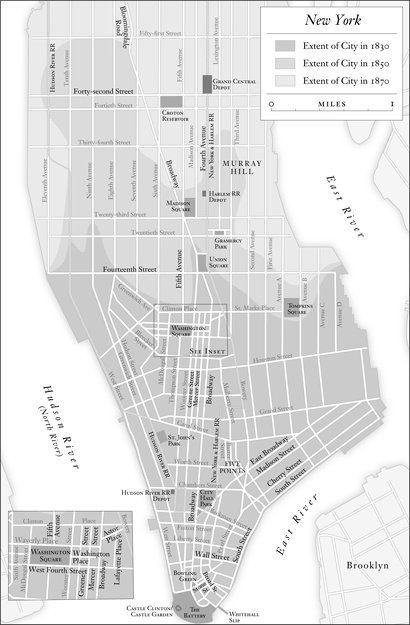
Even before the fire, Vanderbilt decided to make a declaration of his rising status by moving into the heart of the great city. He purchased two adjacent lots that stretched the width of the block between Washington Place and Fourth Street, between Mercer and Greene streets east of Washington Square Park, for $9,500. Just a short distance away from the site where New York's social elite were building Grace Church, not far from the foot of Fifth Avenue, this was the heart of the most fashionable district. Typically, Vanderbilt dictated to mason Benjamin F. Camp every detail of the mansion to be built on the site. He called for stables and a carriage house in the back, facing Fourth Street; a paved courtyard; and a four-story double-wide house of “red brick, with brown-stone trimmings,” as the New York Times later described it, sixty-five feet deep and forty feet wide, with an entrance at 10 Washington Place. Camp went to work in May 1845. Rumors flew around the “splendid house,” as one newspaper called it, being built for “the well-known steamboat proprietor.” One account put the cost at an astronomical $180,000. Three decades later, the Times reported a figure of $55,000, noting, “It is reckoned to be one of the strongest and best constructed buildings in the City.”37
On Staten Island, the house of Vanderbilt echoed with conspiratorial whispers and angry shouts. In April 1844, Vanderbilt's hard-nosed mother, Phebe, foreclosed on a mortgage she had taken for a loan to her son-in-law, Charles Simonson (one of the builders of the Lexington). Charles had died a year earlier, so the property she seized belonged to her own widowed daughter. On May 10, Vanderbilt bailed out his brother Jacob and cousin John, who had been arrested for missing mandatory payments to the disabled sailors' fund. And Vanderbilt's daughters rallied around his son Cornelius Jeremiah, who aroused his wrath and scorn. Shortly before the move to Staten Island, the boy had suffered an epileptic seizure; though the condition had not reappeared, he lingered at home, thin and aimless, in the shadow of his robust patriarch. “My treatment by my father was rather rough,” he dryly recalled.
Vanderbilt was equally hard on Billy. He spoke to his elder son daily, often with “offensive” language, as Daniel Allen recalled. “The substance of the Commodore's remarks was that William was deficient in brains.” Afterward, Billy would stop at Allen's home to complain of his abuse by “the old man.”38
In 1846, Vanderbilt's children began to suspect that he had designs on the governess, a young woman who cared for the youngest siblings. He often took her on carriage rides as his offspring whispered about the “impropriety” of the relationship. Then, in June, the “old man” pulled Allen aside and suggested that he and Ethelinda take his wife on a trip to Canada. “She was at the change of life,” Allen remembered, “and had been afflicted with the ailments incidental to that period for about a year, although she was naturally a woman of strong mind and body.” She must have had a very strong body indeed, to have endured an unbroken string of pregnancies up to the start of menopause. Allen agreed to the proposal. Mrs. Vanderbilt “was more excitable than usual,” he thought. “The Commodore told me that her physician advised a change of scene.”39
With his wife away, Vanderbilt undertook the construction of the largest steamship ever built in the United States: the Atlantic, a 321-foot monster sidewheeler commissioned by the Norwich Railroad. Perhaps the most telling aspect of the vessel was not its size, but its aristocratic luxury. “On ascending the stairs, and reaching the upper saloon, one is almost bewildered with the variety of magnificent adornments which dazzle the eye,” the New York Herald reported. Elegant staterooms, “furnished like the chambers of European hotels,” surrounded the saloon, which featured “soft carpets, original settees, and courting couches… magnificent mirrors and rich curtains.” On the distant Rio Grande, war with Mexico began—“the war for the extension of slavery,” as the Tribunedenounced it—but Vanderbilt abstained from politics, concerning himself with the Stonington, his liners, and his governess.40
After six weeks, Sophia returned and the governess left, to Vanderbilt's distress. Allen told him that the vacation had not improved Sophia's disposition. “During that journey she exhibited great excitability; her nervous system was apparently much shattered.” It is impossible to specify the cause of her anguish, but perhaps her husband's wealth did not compensate for the stress he strung like cobwebs across every open space in their household. With the mansion at 10 Washington Place nearly complete, Vanderbilt mused openly about sending Sophia to an insane asylum.
Perhaps he was simply unable to cope with her distracted state. Or perhaps he wished to make room for the return of the young governess, a prospect he discussed as the move to Manhattan approached. Billy told Allen “that the ‘old man’ had induced some of his daughters to write to the governness and ask her to come back there.”
Asked his daughters to write her? The maneuver seems strikingly uncharacteristic of an overweening titan who took what he wanted. Indeed, it is a rare glimpse of the vulnerability within the warrior. Though he blasted his eldest son—who only tried to please him—as a weakling and a “sucker,” he found himself unable to express his tenderness and need for the young woman who cared for his children. From his earliest days, navigating the subtleties of the inner life escaped him, even if he could not escape its swirling emotions and compulsions. What attracted him to the governess? Was it sexual desire, a longing for youth, mere affection for a sweet girl his children loved? The unknowable answer may be less revealing than his response to her loss. He could not bring himself to demand her return, nor could he approach her directly and simply ask, so he delegated the emotional burden he found so bewildering.
Allen and Billy met to discuss the worsening family situation. They spoke as childhood friends and, in a way, as rival siblings. Allen cultivated a dignified air of efficiency and moral uprightness. He managed the details of Vanderbilt's businesses and served as his agent within Drew's brokerage firm. The blood son Billy, on the other hand, had been exiled from Wall Street to a farm. Slumping, sometimes whining, he had the disposition of someone accustomed to being beaten down. There is little sign that Billy resented Allen, but he had learned to be guarded in his dealings with his overbearing father.
“The old man was bound to have his way,” Allen remembered him saying, “and it was useless to oppose him. He (William) had made up his mind not to do so, as he thought his own interests were too much at stake.” Allen pointed out how angry Billy's sisters were. They had kept their mouths shut about their mother's forced vacation, but “her removal from home” would be too much. “The fact that Mrs. Vanderbilt had fulfilled the duties of a mother more completely than any woman they had ever known, had been talked over,” Allen recalled. He told Billy that Ethelinda had denounced, directly to Vanderbilt's face, the plan to send her mother away and bring back the governess. Even Corneil, the younger brother, had spoken out “manfully.”
Billy shook his head. He couldn't “justify the act,” he told Allen. “He had a great deal of sympathy for his mother.” And yet, “opposition would only provoke the old man's enmity.… The ‘old man’ would be ‘down on him’ forever and had at one time threatened to break up his family and go to Europe if his wishes were opposed.” It was better to approach the problem indirectly, Billy argued. Take the departed governess, for example. “If she don't come back I'll find some woman to take her place,” he said. “The old man is bound to fall under some woman's influence, and I'll have that influence.”
A month after Sophia Vanderbilt's return from Canada, her husband dispatched her to an insane asylum run by a Dr. McDonald in Flushing, Long Island. Shortly afterward, in November 1846, Vanderbilt and his family settled into the house at 10 Washington Place—along with a new governess, the twenty-five-year-old cousin of Billy's wife.41
The meaning of all this should not be overblown. It is doubtful that Billy actually exerted any dire “influence” on the old man through the new governess. Allen saw no impropriety in their relationship; indeed, Billy may well have intended to flush scandal out of the household by replacing his father's mistress with a pious minister's niece. What's more, Sophia joined her family on Washington Place after her discharge from the asylum a few months later.*
And yet, the children's byzantine plotting does illustrate the strain placed on the family by its patriarch, a man who grew more imposing with every million. This unhappy family was unhappy in a way that only wealth and power (more specifically, a will to power) could bring. The very qualities that made Vanderbilt a formidable businessman—his ferocity, his obsession with control—left him unable to manage the murkier negotiations of love, affection, and fatherhood.
AT THE SAME MOMENT THAT Vanderbilt moved to Washington Place, the finest boat he had ever built was swallowed by the Sound. Shortly after midnight on November 27, the Atlantic picked up the Norwich Railroad passengers at its Allyn Point terminal and set out for New York. Then the boiler burst just as a “perfect gale” blew in, seizing the vessel from Captain Isaac Dustan. For long hours he made frantic efforts to save it. He put out multiple anchors and pulled down the smokestacks to reduce wind resistance, but nothing worked. The howling storm drove the steamer upon the rocks of Fishers Island, killing at least fifty of perhaps seventy passengers and crew, including Captain Dustan, a Staten Islander and past commander of many of Vanderbilt's boats.42
There is no evidence that Vanderbilt paid attention to the wreck of his creation, any more than he noticed the agonizing within his household. Ever awkward in his own home, he did not dwell in the domestic interiors of family, but rather in the outer world of men of affairs. It was said as a teenage ferry master that he slept in his periauger; as captain of the Bellona, he rose before dawn and returned after dark; as a “well-known steamboat proprietor,” he spent his life in his office, shipyard, or on the docks, when not in the stables with his horses. What his family thought of him apparently mattered little to him; but among his business peers, Courtlandt Palmer had observed, “He is very desirous of being considered a man of honor and integrity.”
In early 1847, he launched a new steamer—the second craft he named Cornelius Vanderbilt. “She is a magnificent structure,” the New York Herald declared. “The model of the Vanderbilt differs from all others, and it is pronounced, by old and experienced shipmasters, peculiarly adapted to rough navigation.” It became the very embodiment of his reputation.43
On May 25, 1847, Vanderbilt joined his brother Jacob on the Bay State for a social gathering of the leading steamboat men of New York. The Bay State itself was a beautiful new Long Island Sound steamer belonging to the Navigation Company; the host of this little party was Captain Com-stock, the corporation's gruff general agent. But who wasn't gruff in this gathering? In addition to the notoriously rough-edged Vanderbilts, Isaac Newton was there, along with George Law, owner of the extraordinarily fast Oregon. The only missing men were Drew himself and Charles Handy, the Navigation Company's outgoing president.
No body of men could have better exemplified the ironies of the American economy in the 1830s and ′40s. Steamboat proprietors were famous for their competitiveness, symbols of a hotly individualistic society in which hatred of monopoly was a pillar of politics. On the other hand, perhaps no other businessmen had worked so hard to construct mechanisms to limit or even eliminate competition. They made agreements to divide up routes, split profits, and punish those who violated their unwritten code. The business culture they created demonstrates how the impulse to stifle competition arose inseparably from competition itself in the American economy, with sometimes bewildering consequences. The banker Lewis Palmer, for example, was exasperated when he tried to sell the Eureka because he was told that, if it went into opposition on some line, her sale would be considered a hostile act and lead to retaliation. “But whither would this doctrine lead?” he asked. “If the boat is only to be sold so as to interfere with nobody's route, who then would like to buy her?”44
The contradictory fact was, if one wanted to enforce monopolies, one had to be a master of competition. Such was each of those who sat in the saloon of the Bay State—good businessmen who divided markets to maximize profits, and ruthless warriors who savored triumph. And Jacob Vanderbilt spoke proudly of the most ruthless of them all, his older brother, and that brother's greatest achievement, the Vanderbilt, “new, strong, and elegant,” as Scientific American called it, “first rate in every respect.” Jacob suggested a race against the others' fastest steamers, Newton's Hendrick Hudson, Comstock's Bay State, and Law's Oregon. They could start at the Battery, he suggested, run up the Hudson to Haverstraw Bay, where the river widened enough for four large boats to turn, then drive back to the city. He suggested a wager of $500.
Why only $500? Cornelius asked. “I say, I will run the C. Vanderbilt, untried as she is, against any boat afloat to any place they name where there is sufficient water to float her, for any sum from $ 1,000 to $ 100,000.” Newton sat silent, and Comstock said something about consulting with Handy first. But George Law took the bet. Twice before he had challenged Vanderbilt steamers (most recently the Atlantic) to race his Oregon. Now he would get his wish. The prize would be $1,000. They agreed to June 1, during the regatta of the New York Yacht Club.45
Law had emerged as a leader in transportation only three years earlier. Like Daniel Drew, he had no practical experience in navigation, and had moved into steamboats purely as an investment. Born near Saratoga in 1806, he had started his career by digging canals, working as a contractor on several major projects. From 1839 to 1842 he had built the mighty High Bridge over the Harlem River, the most impressive piece of the most important work of civil engineering in a generation, the Croton Aqueduct. He had proved as gifted at finance as at construction; he had set up a retail canteen for his bridge workers, for example, and soon put many of them in his debt. In 1842, he had taken over the troubled Dry Dock Bank, where he now made his office, as well as the nearly worthless Harlem Railroad; in short order, he had turned both businesses around. In 1843 he had bought his first steamboat; two years later he had launched the Oregon and begun to compete on the Hudson (where he forced Drew to pay him $4,000 to leave the river) and Long Island Sound.46
War filled the columns of the newspapers on June 1—detailed accounts of the American triumph over the Mexicans at Buena Vista three months earlier. Though that new invention, the telegraph, could carry news as fast as light, the wires had been strung only as far south as Maryland, so information from the battlefield trickled back slowly. Between the victory and the race, a holiday air breezed through the city. Crowds began to gather at ten o'clock in the morning, filling the Battery, the piers, and “every elevated position in the neighborhood of the Battery, as well the rigging of the various vessels lying at anchor,” according to the New York Evening Post.
At eleven o'clock the Oregon and Vanderbilt were seen opposite Castle Garden, near the Jersey shore… and then both started off on the race. For a few moments they kept side by side, and neither boat appeared to have the advantage of the other, but soon the Vanderbilt sheered off for the east shore, and the Oregon took the western side of the river, so that it was impossible to tell whether either boat was ahead of the other.
Vanderbilt commanded his steamer in person as the two great vessels, each more than three hundred feet long, thrashed up the Hudson, smoke trailing from their funnels, the furious splashing of the enormous side-wheels echoing inside their arching wooden cases. For thirty-five miles they raced bow by prow with no discernible lead. At one point, the Hendrik Hudson drew close with a boatload of spectators; Vanderbilt ran to the rail and shouted at it to “fall back.” He returned to the pilothouse, only to see the Oregon pour on steam and gradually pull ahead. As they drew near the designated turning point, the “flag-boat” anchored in Haverstraw Bay, Vanderbilt ordered a cut in speed in order to make a short, inside turn. His steamer promptly smashed its bow into the starboard paddlewheel housing of the Oregon.
Then the Vanderbilt suddenly slowed to a near dead stop. It would later be said that her anxious proprietor interfered with the pilot, but the Herald reported that “the engineer of the Vanderbilt made a mistake in answering the bell from the wheel house, and instead of reducing the speed so as to allow the boat to turn quicker, stopped the engine entirely, which retarded her progress very materially.” The Oregon kept up its velocity, taking a wide turn of a full mile, but precious minutes passed as the Vanderbiltpainfully regained its momentum. The Oregon pulled ahead and kept the lead down the river as they approached the northern tip of Manhattan.
Just as Law's boat passed the mouth of the Harlem River, its engine room ran out of coal. Desperate to win, Law ordered his crew to burn anything at hand. The firemen ripped out berth slats and doors, broke apart settees, tables, and chairs, and threw it all into the fire. The Vanderbiltrapidly gained on her—but it was too late. The Oregon steamed over the finish line two minutes ahead. “The river as far as Yonkers was crowded with people,” the New York Tribune reported, “and when the boats hove in sight on their return the wharves of the city were a mass of spectators. As the Oregon swept in she was greeted with a continuous huzza from Hammond st. to the Battery”47
“Captain Vanderbilt was beaten for once,” Philip Hone wrote in his diary. Hone's tone of surprise underscores the formidable reputation that Vanderbilt had made for himself. The “enterprising proprietor,” as Hone called him, was expected to win. Indeed, the race only seems to have enhanced his stature. At the end of the month, President Polk began a triumphal tour of the northeastern states, a kind of political counterpart to the military thrust that General Winfield Scott was making from Veracruz to Mexico City For the journey from South Amboy New Jersey, to New York, the presidential party traveled in the Vanderbilt, dubbed “the pride of the rivers” by the Herald. “She was in charge of Capt. Vanderbilt himself, who performed the double duty of commander and pilot. Every subordinate was in his place, and every waiter punctual in the performance of his duty… Nothing could exceed the completeness of the arrangements on board.” Despite his admiration for Clay, Vanderbilt had laid any partisanship aside after Polk's victory in 1844—though throughout the president's speech at South Amboy, the vessel loudly let off steam, “rendering it almost impossible to hear a word of what was said at two paces distant from the speakers.”48
This was the year that the general public promoted Vanderbilt from the rank of captain. In court testimony taken in September, a man casually referred to him as “Commodore Vanderbilt,” a title even his family began to use in everyday conversation. When not escorting presidents, he hobnobbed with Philip Hone's set at the yacht club and bought up Manhattan real estate. In business, he continued to display his ability. He sold his Long Island Railroad shares shortly before it became obvious that the railroad suffered grave difficulties. After taking over as president of the Stonington, he immediately set to work to improve the long-troubled line's prospects. Soon he launched a new steamer to run to Stonington in conjunction with the Vanderbilt. He called it the Commodore.49
At almost the same moment that Vanderbilt ascended to the presidency of the Stonington, General Scott occupied Mexico City On March 10, 1848, the Senate would ratify the Treaty of Guadalupe Hidalgo, which would strip 500,000 square miles from Mexico (roughly a third of that republic) and annex them to the United States, in return for $15 million. Even in the clamor of joy over the great victory, however, hints of future trouble could be heard. As popular as the war was, a significant group of Northerners—from Congressman Abraham Lincoln to Lieutenant Ulysses S. Grant—had opposed it, fearing that it would primarily enlarge the territory of slavery. Hardly had the fighting started in 1846 when Representative David Wilmot of Pennsylvania attached an amendment to an appropriations bill prohibiting the expansion of the “peculiar institution” into any land acquired from Mexico. Though the “Wilmot Proviso” failed to pass, it sparked abiding outrage across the South.
Perhaps Vanderbilt little imagined that the war and its foreboding aftermath would ever affect him. And yet, he had always existed in curious synchronization with the republic, living the larger struggles of the day in pursuit of his selfish interests. In his youth, he had helped to throw down the culture of deference, with its aristocratic privileges and mercantilist policies. He had risen to wealth and power by battling monopolies on the primary lanes of commerce as he vocally championed competitive individualism. Now he was coming to embody the rise of corporations in his railroad directorships and presidency of the Stonington. He worked toward a kind of synthesis between competition and incorporation that reflected gradual changes in the nation's culture. In early 1848, the American Railroad Journal, a periodical devoted to an industry consisting entirely of corporations, would declare, “It would be much more for the prosperity of business—much more for the credit of the people, and much more in accordance with the spirit of the age—to allow and encourage competition.”
Even his ambiguity—his stubborn, irreducible ambiguity—mirrored these trickster times, the eternal ambivalence of the free market: he who drove down fares and improved service, yet demanded bribes to abandon competition; who praised free trade yet enforced his own monopolies; who celebrated the people yet summered in Saratoga and knocked knees with old knickerbockers. Dickens had noted with irritation the smug self-satisfaction of most Americans; the Commodore must have shared it when he contemplated his kingdom from his castle on Washington Place. He was “reputed to be worth some millions,” the press reported. Almost everyone who traveled between New York and Boston took a Vanderbilt boat or a Vanderbilt train.50
An observer on December 31, 1847, would have found it absurd to think that all this would one day be half forgotten, that obituary writers would dismiss in a few sentences these fifty years of fistfights and Supreme Court cases, steamboat races and stock market machinations. But already forces were in motion that would upend the population of the continent, launch the nation toward civil war, and unleash an ambition in Vanderbilt greater than anyone could have imagined.
* Edward J. Renehan Jr. claims, in his book Commodore: The Life of Cornelius Vanderbilt (New York: Basic Books, 2007), 155, to have discovered the privately held diary of Dr. Jared Linsly, asserting that it shows that Vanderbilt contracted syphilis in 1839. In light of significant contradictory evidence and subsequent developments that cast doubt on Renehan's credibility I must discount the validity of such a diary and Renehan's claims for it. See the bibliographical essay, pages 581–4, for a full discussion.