
|| Chapter 6 ||
If you drive west heading out of downtown Topeka, Kansas, you will cross fifteen streets that are named chronologically for the antebellum presidents. One name is missing. After Topeka became the state capital, the legislature, dominated by the Free Soil Party, decided not to name a street after Franklin Pierce. Instead, they named the fourteenth cross street for Henry Clay. If Pierce is remembered in Topeka, it is ironically because of the deliberate effort to forget him.
Historians and others dismiss Pierce as one of America’s most inept presidents. Nothing before his election promised otherwise: In six years in the House and five as a senator, he never sponsored any important legislation and rigidly followed the Democrats’ party line. When Pierce’s wife Jane was told that her husband was the Democratic nominee for president, she fainted. She worried that the pressures of the presidency would cause her husband to begin drinking again,1 while Pierce’s college roommate, Nathaniel Hawthorne, told Pierce after he won the 1852 presidential election, “I pity you—Indeed I do, from the bottom of my heart!”2
The low expectations for Pierce’s presidency fell further when, just two months before his inauguration, the railcar in which he, his wife, and their only son Bennie were traveling suddenly derailed and fell down an embankment. Bennie was killed as Pierce and his wife watched helplessly. Neither Pierce nor his wife recovered. Jane spent much of her time in the White House alone, writing letters to Bennie and blaming Pierce’s political ambitions for her son’s death. Bennie’s death was clearly on Pierce’s mind as he entered the presidency: He referred to his child twice in his inaugural address—once in its opening line and again in the second paragraph when he asked the American people to “sustain me by your strength.”3 For the next three years, Pierce sought solace in a renewed commitment to his religious faith. He refused to work on the Sabbath except for the one occasion he met with congressional leaders to forge the Kansas-Nebraska Act, whose enactment and enforcement were the most consequential constitutional events of his presidency.
In spite of generating low expectations as the second dark horse after Polk to win the Democratic presidential nomination,4 Pierce benefited in the general election from several factors—his general amiability; the arrogance and stiffness of his Whig opponent, General Winfield Scott; his stature as a Doughface (a northern politician who sympathized with the South and slaveholders); a flattering campaign biography (written by Hawthorne) that made his exploits as an officer in the Mexican War more heroic than they were. Pierce won a decisive victory in the Electoral College, making him the fifth general to be elected before the Civil War. Yet, with more than three million votes cast in the general election, Pierce received less than 50,000 votes more than his five opponents combined. Once in office, he quickly lost favor with his fellow Democrats, who viewed him as inept, indecisive, and weak. He became the only popularly elected president denied renomination by his party. More embarrassingly, he lost the nomination to his ambassador to Great Britain, James Buchanan. In retirement, his drinking increased, as did the stridency of his criticism of Lincoln for waging war against the South. After Lincoln’s assassination, Pierce managed to escape a crowd gathered outside his home to lynch him because he had not displayed a flag in mourning for the dead president. Pierce drank himself to death, stubbornly insisting to the end that northern abolitionists caused the Civil War. It took more than fifty years for the citizens of his hometown to erect a statue in his honor.
Pierce’s problem was, however, not so much that he was indecisive and vacillating, but rather that he was surprisingly effective in implementing his uncompromising, flawed constitutional vision. He is the first and only president who served a complete term without a single change in his cabinet.5He was known as “Young Hickory of the Granite Hills” because he had modeled his presidency and constitutional vision on those of “Old Hickory” Andrew Jackson and “Young Hickory” James Polk. Yet his strict construction was more extreme than either of theirs. He insisted that the Constitution was not neutral on the question of slavery but rather protected the rights of slaveholders and obliged the federal government to enforce laws restricting antislavery activities.6 His unrelenting commitment to strict construction of the Constitution had more than the salutary effects of expanding the country’s continental borders to where they now stand and marshaling federal power to protect slavery. His constitutional commitments backfired, producing near-civil war in Kansas, fracturing his party, and fomenting the rise of the Republican Party. Pierce has a substantial constitutional legacy, though it is one that even he drank to forget.
I .
The first of Pierce’s three significant constitutional legacies is his strict construction of the Constitution. While this mode of constitutional interpretation can be traced back to Jefferson and Jackson, strict constructionists during the first half of the nineteenth century generally agreed that the Constitution’s authority derived from the states rather than the people of the United States. Yet they differed over the extent to which the Constitution allowed states to disregard federal laws with which they disagreed or to secede from the Union. While Pierce, before becoming president, had managed to avoid endorsing either the doctrine of nullification or secession, his strict construction of the Constitution required vigorous protection of states’ rights and the rights of slaveholders. His persistent espousal of strict construction also signaled that as president he was on the side of southern Democrats in the great constitutional debates of the times.7 In his inaugural address, Pierce declared that “the Federal Government” should “confine itself to the exercise of powers clearly granted by the Constitution,” and he explained that “involuntary servitude, as it exists in different States of this Confederacy, is recognized by the Constitution. I believe that it stands like any other admitted right, and that the States where it exists are entitled to efficient remedies to enforce the constitutional provisions.”8 After reiterating his campaign pledge to stand by the Compromise of 1850, Pierce expressed his belief that “the constitutional authorities of this Republic are bound to regard the rights of the South in this respect as they would view any other legal and constitutional right, and that the laws to enforce them should be respected and obeyed, not with a reluctance encouraged by abstract opinions as to their propriety in a different state of society, but with cheerfulness and according to the decisions of the tribunal to which their exposition belongs.” Promising to act on his convictions, Pierce hoped that “the question [of slavery’s future] was at rest” and “that no sectional or fanatical excitement may again threaten the durability of our institutions or obscure the light of our prosperity.” He was soon proved wrong.
Subsequently, the theme Pierce expressed most consistently in his public addresses was his commitment to strict construction of the Constitution. This commitment is evident in all four of his annual messages to Congress. In each of the first two, Pierce sounded the same theme he had previously espoused as a member of Congress, namely, that strict construction required recognizing funding internal improvements as beyond the power of Congress. In the first message, he reminded Congress of President Jackson’s opposition to such funding, and following that example, he questioned the pending proposal of federal aid for a transcontinental railroad: “Is it not the better rule to leave all these works to private enterprise, regulated and, when expedient, aided by the cooperation of the State?”
In each of Pierce’s remaining annual messages, he emphasized the fundamental importance of strict construction to the nation’s survival. He emphasized that the Constitution’s guaranteed protection of states’ rights was forged “under a written compact between Sovereign States, uniting for specific objects and with specific grants to their general agent.”9 He explained that the Union, which he often referred to as a “confederation” or “the Confederacy,” could survive only by “strictest fidelity to the principles of the constitution as understood by those who have adhered to the most restricted construction of the powers granted by the people and the States.”
Pierce’s last annual message was his most vitriolic, extreme declaration of the link between strict construction and constitutional protection of slave owners’ rights. The stridency was surprising, for he had become a lame duck and been dismissed as irrelevant by Congress and the rest of the nation as it prepared for Buchanan’s inauguration. Pierce’s strict construction of the Constitution lapsed into a shrill political manifesto: He construed James Buchanan’s 1856 election as vindicating his conviction that the nation had rejected the idea of sectional parties and instead had affirmed “the constitutional equality of each and all the States of the union as states; they have affirmed the constitutionality of each and all the citizens of the United States as citizens.”10Moreover, in Pierce’s judgment, the American people “have maintained the inviolability of the constitutional rights of the different sections of the Union, and they have proclaimed their devoted and unalterable attachment to the Union and to the constitution, as objects of interest superior to all subjects of local or sectional controversy, as the safeguard of the rights of all.” Although Pierce did not name the newly formed Republican Party, he accused it of pretending to stop the spread of slavery while really being determined “to change the domestic institutions of existing States.” He ended with a litany of the ways in which northern aggression “against the constitutional rights of nearly one-half of the thirty-one States” was responsible for all the country’s sectional troubles.
Pierce’s strict construction of the Constitution was not just rhetorical. He also tried vigorously to implement it through his exercise of the presidency’s unique powers. He vetoed nine laws on constitutional grounds, five of which Congress overrode. Most of the vetoes involved internal improvement projects, which Pierce explained, as a matter of strict construction, Congress had no constitutional authority to enact. Indeed, his most memorable veto clearly reflected this perspective: It involved a bill to set aside twelve million acres of public land to fund institutions for the indigent mentally ill.11 Dorothea Dix, who would become internationally famous for her efforts to help the mentally ill, had devoted years to building support for the measure. In various forms the bill had been under consideration since 1848, and it enjoyed the support of many Whigs and Democrats in Congress, as well as strong public support and favorable editorial opinion. But in a lengthy veto message Pierce declared the bill unconstitutional. “The Constitution did not grant authority to make the federal government “the great almoner of public charity,” wrote Pierce. Indeed, he found the bill to be “subversive of the whole theory upon which the Union of these States is founded.” Congress failed to override the veto. Most of Pierce’s other vetoes involved other internal improvement projects, most of which had been planned for the Northwest, while one nixed a southern project.
Pierce used his judicial and other appointments to entrench his strict construction of the Constitution. In fact, the Senate confirmed all but one of his judicial nominees, who professed strong fidelity to the same constitutional philosophy. Pierce’s most prominent judicial appointment was his first and only Supreme Court appointment. Because of the Senate’s refusals to approve any of Fillmore’s three nominations to replace Justice McKinley, who had died in the summer of 1852, Pierce found himself in the first week of his presidency with a Supreme Court vacancy to fill. In an unprecedented move, Justices John Catron and Benjamin Curtis delivered letters from all the justices asking Pierce to appoint John Campbell of Alabama. As a strict constructionist, Campbell shared Pierce’s constitutional philosophy, but his nomination commanded bipartisan support because of his reputation as one of the nation’s most learned lawyers and best appellate advocates and his expressed opposition to secession. Although Campbell had been Chief Justice Roger Taney’s choice as a successor, he left the Court after only eight years to join the Confederacy. While on the Court, he consistently defended states’ rights from federal encroachment and concurred, as a matter of strict constitutional construction, with the majority in Dred Scott v. Sanford.12 After the Civil War and a short prison term for aiding the Confederate states, Campbell resumed his law practice and reestablished his reputation as a preeminent Supreme Court advocate. Over the next quarter century, Campbell argued forty-three more cases before the Court, including representing the plaintiffs in the first case to test the meaning of the newly adopted Fourteenth Amendment.13
Pierce was the first president to vest in his attorney general control over the selection of federal judges, though he reserved the authority to establish guidelines for their selection and to make specific recommendations. Pierce’s attorney general, Caleb Cushing, recommended that Pierce nominate only candidates who were Democrats, were “well qualified by experience,” and were committed to strict construction of the Constitution and enforcement of the Fugitive Slave Act. With Cushing’s help, Pierce appointed fifteen judges to lower courts, two to the Circuit Court for the District of Columbia, one to a special Circuit Court for the District of California, and twelve others to territorial district courts. Each of Pierce’s judicial nominees was strongly committed to strict construction of the Constitution14 and strict enforcement of the Fugitive Slave Act.
Moreover, many of Pierce’s major nonjudicial appointments were strict constructionists. Of his seven-member cabinet, the three on whom Pierce most heavily relied were strict constructionists—Caleb Cushing as attorney general, Jefferson Davis as secretary of war, and James Guthrie as treasury secretary.
II .
Pierce’s second constitutional legacy consists of his relationship with his cabinet and its consequences. In assembling his cabinet, he was neither vacillating nor indecisive. To the contrary, he understood he had unilateral authority over his cabinet choices and deployed it to the extreme, but his independence and decision not to consult with congressional leaders backfired politically: The cabinet he assembled did not unify Democrats or his administration. It had geographic representation but omitted southern Unionists and many powerful Democrats. Nor did Pierce appoint any moderates to his cabinet. These omissions put the administration at odds philosophically and programmatically with the party’s most powerful leaders, including Stephen Douglas of Illinois.
Moreover, Davis and Cushing held extreme constitutional opinions that many Democrats and Whigs rejected. Nonetheless, the Senate confirmed them both. The fact that Democrats held a large advantage in the Senate—thirty-eight of sixty-two seats—helped both Davis and Cushing. Moreover, Davis benefited from senatorial courtesy on which Pierce, himself a former senator, had counted. Since the Senate also confirmed William Marcy, another former senator, as Pierce’s secretary of state, Pierce helped to entrench senatorial courtesy in the balance of power on federal appointments.
To complicate matters, the cabinet as a whole was dysfunctional. At meetings, the best Pierce could do was to moderate, not lead, discussion. Though he often sounded out his cabinet on policy options and frequently visited the different departments, forging consensus within the cabinet was impossible. When the cabinet met, members often yelled at each other, and Pierce found it easier to conduct business with cabinet members individually rather than as a group.
As Pierce’s secretary of state, New York’s William Marcy initially seemed an odd choice. He had been governor of New York and Polk’s secretary of war, but he had no meaningful foreign policy experience and was Pierce’s third choice for secretary of state. Yet Marcy was instrumental in helping Pierce to keep his campaign promise to energetically extend American influence throughout the Western Hemisphere. In pursuit of these goals, Pierce and Marcy had one great success and one terrible failure. Marcy was a chief architect of the great success, which was the Gadsden Treaty of 1854, named after James Gadsden of South Carolina, whom Pierce had appointed at Davis’s suggestion, to negotiate with Mexico to buy at a cost of $10 million 45,535 square miles of territory.15 The configuration of the tract covered what is now southernmost Arizona and New Mexico and provided the straightest possible path for a transcontinental railroad, which Davis had been proposing to benefit the South and to make it easier to transport the army and supplies to protect the western frontier. The deal did not produce as much additional acreage as southern expansionists had wanted or northern antiexpansionists had feared. Consequently, it did not provoke strong opposition in the Senate, which ratified the treaty.
But Pierce and Marcy failed in their ambitious enterprise to acquire Cuba from Spain.16 Cuba’s annexation was attractive to Democrats who sympathized with Cuban victims of Spanish tyranny, expansionists who valued its strategic location, and Southerners who saw Cuba as another potential slave state. Davis supported Pierce in appointing three prosouthern men, all strict constructionists, to posts that would be enormously important to the acquisition of Cuba— John Mason of Virginia as minister to France, James Buchanan as ambassador to Great Britain, and Pierre Soule of Louisiana as minister to Spain.
The three men produced the Ostend Manifesto,17which urged that the United States offer to purchase Cuba for $120 million and asserted that, if Spain refused to sell, the United States “shall be justified in wresting it from Spain, if we possess the power.” The manifesto maintained that “Cuba is as necessary to the North American republic as any of its present members, and that it belongs naturally to that great family of States of which the Union is the providential nursery.” Besides dooming the negotiations, the manifesto was leaked to the New York Herald, which published it. Consequently, the negotiations fell apart, and Pierce and Marcy were publicly humiliated and repudiated the manifesto to save face.18
Davis was not the only cabinet officer, besides Marcy, to encourage Cuba’s acquisition. It was also the desire of Attorney General Cushing.19Whereas Davis could forge friendships across the political aisle, Cushing could not; he was arrogant and disdainful of people with differing views and managed over the course of a political career spanning more than four decades to have been a Whig, a Democrat, and a Republican, picking up enemies across the political spectrum but managing to be elected president of the Democratic National Convention in 1860 and serving as President Grant’s minister to Spain a few years after Grant had unsuccessfully nominated him to be chief justice.20
Nonetheless, Cushing became one of the most influential attorneys general in American history. Though he initially had no department to oversee, he persuaded Pierce to propose new legislation, which Congress passed, to allow Cushing to become the first attorney general to receive an annual salary so that he could devote his full attention to the job. Cushing expanded the office’s jurisdiction to take responsibility for legal issues previously handled by the State Department, and he cleared the backlog of cases left by the former administration. At Pierce’s request, Cushing wrote the first complete history of the Office of Attorney General.21 Cushing’s analysis became the standard description of the office. Pierce further suggested that the attorney general should make periodic reports to the president and through him to Congress, prosecute all suits in which the United States had an interest, be given authority to grant pardons, and be in charge of issuing all judicial commissions. By the time Cushing left office, he had written 387 official opinions of the attorney general, the most produced by any attorney general until 1870, the most produced by the attorney general on his own, and the highest rate of productivity of any attorney general at least until 1870.
Many of Cushing’s opinions have had significant influence on American law. In one opinion, he anticipated, for example, the Supreme Court’s 1983 decision striking down a one-house veto22 when he concluded that a resolution not enacted into law by a majority in each chamber of Congress and signed by the president as Article I requires for all lawmaking could not bind the executive branch as a legal rule of its own force or as an authoritative interpretation of existing law.23 In another opinion, he concluded that while Congress has the power to create “administrative departments” to assist presidents in exercising their constitutional responsibilities, “the great constitutional fact remains that the ‘executive power’ is vested in the President, subject only, in the respect of appointments and treaties, to the advice and consent of the Senate.”24 In further opining that the president unilaterally had the authority to control all the actions of his subordinates, Cushing adopted a perspective that the Court later ratified in holding that a president has inherent authority to remove any officials performing purely executive functions within the executive branch.25 Cushing’s legal opinions on the president’s constitutional authority to appoint or remove any official exercising executive authority are still cited by Justice Department officials (and scholars), particularly for their support of the unitary theory of the executive.
As a strict constructionist, Cushing strongly defended states’ rights and the rights of slaveholders.26 He wrote several presidential proclamations and messages and regularly spoke to the press on behalf of the administration.27His most notorious missive is known as “Cushing’s Ukase,” which he published, with Pierce’s approval, when forces opposed to slavery appeared to be gaining an upper hand in the midterm elections to be held in Massachusetts.28 Triggering the loss of key Democratic support in Massachusetts, Cushing declared that the antislavery movement should be “crushed” and threatened that the president would eradicate “the dangerous element of Abolitionism, under whatever guise or form it may present itself.” He subsequently wrote several opinions supporting strict enforcement of the Fugitive Slave Act,29 and another opinion anticipating arguments adopted by the majority in Dred Scott v. Sanford.30
Yet it was Davis on whom Pierce relied most heavily.31 Even though they had only met once before Pierce’s election, Davis was one of the first people whom Pierce asked to join his administration. Pierce appreciated that among southern politicians Davis had inherited Calhoun’s mantle as the chief spokesperson for states’ and slaveholders’ rights, even though Davis never endorsed Calhoun’s nullification doctrine.
As secretary of war, Davis was energetic and innovative. The department had not been seriously reformed since Calhoun was secretary of war from 1817 to 1825. Davis had several impressive achievements as secretary of war, including increasing the army’s size, raising army officers’ salaries, upgrading the curriculum and facilities at West Point, streamlining the army’s chain of command, improving the quality of officers promoted within the army, upgrading and helping to produce and distribute throughout the corps a new tactics manual, and overseeing substantial progress in building the Washington Aqueduct and expanding the Capitol. But Davis’s most significant achievement as secretary of war was establishing that in the chain of command the army’s commanding general, Winfield Scott, reported to the war secretary. Scott believed he had no superior but the president, while Davis insisted that he was Scott’s superior as the duly authorized person appointed by the commander in chief to run the War Department. After intense bickering, Davis turned to Pierce and Cushing for help. Acting upon an official opinion of the attorney general that unequivocally supported Davis’ position,32 Pierce directed that the secretary of war had command authority over the army’s commanding general. The improvements Davis made in the army’s organization and command made it better able to defeat his southern forces in the Civil War.
Pierce’s personal and ideological affinity for Davis is evident from the fact that in July 1843 Davis was one of three cabinet members whom Pierce took with him on a trip to attend the Exhibition of All Nations in New York City. At each stop along the way, Davis delivered the same public remarks, each time with Pierce in attendance. He spoke about his pride in being an American, stressed the importance of strict construction of the Constitution, and recognized the importance of the “fraternity” of states on which “our Union was founded.”33
The accomplishments of Pierce’s cabinet secretaries came at a price. Their reform efforts produced fractures within the Democratic Party that destroyed his presidency, particularly when combined with the fallout from Pierce’s most momentous constitutional judgment as president to break his campaign pledge to stand by the Compromise of 1850.
III .
Pierce’s third constitutional legacy is the fallout from his signing into law and enforcing the Kansas-Nebraska Bill of 1854. Besides the bloody violence it provoked in the Kansas territory, the law was Congress’s most significant attempt to leave the question of slavery to state sovereignty.
To understand the bill’s constitutional significance, we need to recall that, a year into his presidency, Pierce faced a constitutional conundrum largely of his own making: Strict constructionists, like Pierce, had argued that Congress lacked the power to restrict slavery in the territories, but as a candidate Pierce had sworn to uphold the Compromise of 1850, which, in reauthorizing the original Missouri Compromise, had barred slavery from the territories it covered. By 1854, pressures for organizing territorial governments in Kansas and Nebraska had intensified to the extent it became impossible for Pierce and Congress to ignore them. Although Pierce urged strict enforcement of the fugitive slave law, he preferred not to revisit the Missouri Compromise and thus left the burden for taking action on Congress, where Illinois senator Stephen Douglas chaired the Senate Committee on Territories. Douglas devised a plan to promote settlement of the West and facilitate construction of a transcontinental railroad.34 After his plan failed to pass the House, Douglas developed a new one allowing settlers in the newly organized territories of Kansas and Nebraska to decide for themselves whether to permit slavery. His objective was to institutionalize popular sovereignty—or local control—over the slavery question. He believed that popular sovereignty held the greatest promise of averting civil war and was at the core of the Kansas-Nebraska Act, his reelection to the Senate in 1857, and his unsuccessful presidential campaign in 1860.
Initially, Douglas planned to say nothing about repealing the Missouri Compromise but instead to report out a bill giving settlers in Kansas and Nebraska the right to draft state constitutions at the time of statehood. Southern Whigs and Democrats told Douglas, however, they would not support the bill unless it implemented genuine popular sovereignty in Kansas and Nebraska—that is, allowed local inhabitants to vote on the slavery question during the territorial years and thus to repeal the Missouri Compromise, which restricted slavery in territories.
Up until this point, neither Pierce nor his cabinet had participated in the negotiations over Douglas’s bill. In a belated response to the policy developing in Congress, Pierce met with his cabinet on Saturday, January 21, 1854, to discuss whether the Missouri Compromise should be repealed. With the backing of a majority of his cabinet,35 Pierce agreed to bring the question to the Supreme Court, which he expected would declare the Missouri Compromise unconstitutional on the ground that by stripping slave owners of their slaves it violated the Fifth Amendment’s ban on seizing private property without due process of law. Pierce liked having the Court take the heat for eradicating the Missouri Compromise.
Later that same day, Douglas agreed to repeal the Missouri Compromise to maintain the support of southern Whigs and Democrats. Because he had to present an amended bill on Monday or face delay, he realized that he had to meet with Pierce the next day, Sunday.
On Sunday morning, Douglas appeared with a group of southern Democratic members of Congress at Davis’s residence. They asked Davis to arrange a meeting with Pierce later that day. After being persuaded on the need for urgency, Davis went with the group to the White House and privately urged Pierce to meet with them. Begrudgingly, Pierce agreed.
After listening to the delegation, Pierce agreed to support the bill as amended. He was persuaded that the bill was consistent with the constitutionally protected rights of states and slaveholders and the ideal of popular sovereignty. Determined that Pierce not change his mind, Douglas asked Pierce to write out the portion of the bill repealing the Missouri Compromise. When he did, Pierce transferred responsibility for the bill from Douglas to himself.
Pierce used all the powers of the presidency to secure the bill’s passage. In the Senate, the Democratic majority was so large as to make its passage a virtual certainty, but Pierce made supporting the bill a test of loyalty for House Democrats and promised to withhold patronage and other favors he had to bestow from anyone who voted against the bill. When the dust settled, a coalition of more than half the northern Democrats and most Southerners approved the bill by 37–14 in the Senate and by a narrower vote in the House. Eight days later, Pierce signed the Kansas-Nebraska Bill into law.
The rest, as they say, is history: The Kansas-Nebraska Act transformed the constitutional landscape instantaneously. By repealing the Missouri Compromise, President Pierce and Congress were rejecting a landmark piece of legislation and the principle it embodied—Congress’s power to bar slavery in federal territories, which had been a constitutional fixture since Monroe’s presidency. The Kansas-Nebraska Act embraced the entirely different constitutional principle of popular sovereignty, which, Pierce explained in his Second Annual Message, allowed the states and territories to decide for themselves on whether to allow slavery. Yet this new principle was largely untested. It had worked in Nebraska, where the people overwhelmingly opposed slavery. But Pierce, Douglas, and the majority in Congress were betting that popular sovereignty would work in Kansas as long as the losers accepted the results.
The bet was a bust of monumental proportions. While southern Democrats and the people of Nebraska were satisfied, the Democratic Party suffered huge losses in the midterm elections. In the congressional elections, Democrats lost every antislavery state except California and New Hampshire. Losing more than fifty seats in the House, the Democrats went from having a solid majority in the first two years of Pierce’s presidency to a minority in its last two years. While Democrats actually increased their seats in the Senate to forty, the gain was illusory: The coalition that had brought Pierce to the White House was shattered, and Democrats who opposed slavery, such as Seward and Ohio’s Salmon Chase, left the party.
During the remaining two years of Pierce’s presidency, the violence in Kansas intensified, while its ramifications were felt throughout the nation.36In the fall of 1854, a territorial government was established, and Pierce appointed the leaders of the new regime, including Andrew Reeder as its first governor and Samuel Lecompte as its first chief justice. Reeder had the authority to set the dates for elections, and the first date he set for electing a congressional delegate was near the end of November 1854. Meanwhile, proslavery residents of Missouri, at the insistence of Missouri’s proslavery senator David Atchison, flooded the territory, to vote for a proslavery delegate to Congress, while antislavery residents, mostly settled in the southern part of Kansas, voted for Reeder as their delegate to Congress. Atchison and other Missouri politicians exhorted proslavery residents of Missouri to flood into Kansas to prevent northern abolitionists from taking control of the territory. On March 30, 1855, proslavery settlers voted to select a proslavery legislature, which quickly passed a statute criminalizing antislavery activities. Antislavery residents protested that the proslavery legislature and the bills it passed were illegitimate, because proslavery residents from nearby Missouri had infiltrated the electorate; however, proslavery forces claimed they had fairly won the election to choose the legislature. As Reeder adjudicated claims of voter fraud, his armed guard stood on one side of the room, while proslavery settlers stood on the other side flaunting their weapons. Even though Reeder upheld at least two-thirds of the proslavery settlers’ claims, proslavery forces were displeased. To no avail, he suggested a compromise solution—resolving the election in favor of the proslavery residents but requiring the legislature to meet in the state’s northern part populated largely by antislavery residents.
After the legislature refused to meet as Reeder directed, Atchison and the proslavery legislature of Kansas urged Pierce to dismiss Reeder. He replaced Reeder with Wilson Shannon, who was a Doughface and former Ohio governor. By the time Shannon arrived in Kansas, antislavery settlers in the north of the territory had formed their own government under what they called the Topeka Constitution. After proslavery residents in the southern half refused to recognize the legitimacy of the Topeka Constitution and reiterated their belief in the legitimacy of the government that they had formed, something had to give. Violence soon erupted. Shannon repeatedly urged Pierce to send federal troops to restore law and order. Pierce did nothing until January 24, 1856, when he formally addressed the controversies percolating in Kansas.37 Pierce refused to differentiate among the laws the proslavery legislature had passed, insisting that they were all valid and that he would use force if necessary to ensure they were enforced. He condemned the Topeka Constitution and rejected the request of antislavery residents for statehood under it. Pierce further characterized the free-soil movement that had supported the Topeka Constitution and the election of an antislavery governor as “of revolutionary character.” If that movement led to organized resistance by force to the federal government or its duly enacted laws, it would be “treasonable insurrection.”
In his formal statement, Pierce briefly mentioned the Kansas problems, blaming them on “inflammatory agitation,” which for two decades had produced “nothing save unmitigated evil, North and South.” Without such agitation, he argued, the Kansas issue would have aroused little emotion. He recommended that as soon as there were enough settlers in the territory they should elect delegates to a constitutional convention to prepare for statehood “through regular and lawful means,” and he asked Congress to enact the necessary legislation.
In the same message, Pierce reiterated his view that the Constitution protected the rights of slaveholders, that each state retained its sovereignty under the Constitution, and that each state retained the right to allow slavery within its borders. The Constitution, he believed, further required the return of fugitive slaves to their owners. As he explained, “While the people of the Southern states confine their attention to their own affairs, not presuming officiously to intermeddle with the social institutions of the Northern states, too many of the inhabitants of the latter are permanently organized in associations to inflict injury on the former by wrongful acts.” As violence spread through Kansas, Pierce urged the repeal of the Missouri Compromise. Abandoning his campaign pledge to stand by it, he defended its repeal because its continued existence threatened to disrupt the United States. He rejected the possibility that slavery could ever end, proclaiming that the slavery conflict would “inevitably dash itself in vain against the unshaken rock of the Constitution.” In his view, the Union was stronger “than all the wild and chimerical schemes of social change which are generated one after another in the unsuitable minds of visionary sophists and interested agitators.” He staked his constitutional claim on the side of the South and slaveholders.38
Southerners applauded Pierce’s message, but it was roundly condemned elsewhere. The recently elected governor of Ohio, Salmon Chase, responded in a special message to the state legislature, and the legislature accepted Chase’s recommendation for resolutions of sympathy and support for a free Kansas. Northern states responded similarly to bleeding Kansas.
Shortly thereafter, Pierce issued a proclamation warning both sides in Kansas to stop the violence. The House authorized a broad inquiry into the possible causes of the troubles in Kansas and who should be the territory’s congressional delegate. It sent a delegation to Kansas to investigate, while Pierce agreed to the House’s request to station federal troops at Forts Leavenworth and Riley at the disposition of the territorial governor.39
In early May, Chief Justice Lecompte convened a grand jury to indict former governor Reeder and then-governor Charles Robinson, who had been chosen by the antislavery, free-soil movement in the state. After they were indicted for treason, Lecompte ordered their arrest and detention until their trial. When the federal marshal attempted to arrest Reeder while he was meeting with the congressional delegation investigating who should be the territory’s congressional delegate, Reeder resisted. Lecompte added a contempt charge to Reeder’s indictment. Eventually, Pierce released Robinson and Reeder.
The violence in Kansas spread, at this point, onto the floor of the Senate. On May 19–20, 1856, Massachusetts senator Charles Sumner delivered what he believed was the most important speech of his career. He was right, but for the wrong reason: He not only spoke of a widespread conspiracy involving the Pierce administration to foist slavery on the settlers of Kansas, but also directed insulting personal attacks against Douglas, James Madison, and South Carolina senator Andrew Pickens Butler. Two days after the speech, Congressman Preston, a cousin of Senator Butler, approached Sumner as he was writing at his desk on the Senate floor. Declaring the speech a libel on South Carolina and Senator Butler, Brooks began striking Sumner repeatedly with his walking stick. Sumner was stunned and blinded by the first few blows, after which he wrenched his desk from its mooring and fell onto the Senate floor, bleeding and unconscious. Several members of Congress watched but did nothing to stop Brooks.40 Although the physical and psychological damage kept Sumner out of the Senate until 1859, he was reelected in 1857. Meanwhile, an investigating committee of the House recommended expulsion for Brooks, but the House censured him instead. Brooks resigned from the House but was reelected to his seat.
When informed that those elected to the legislature under the Topeka Constitution were preparing to meet, Pierce ordered them not to meet (again on the basis he was faithfully executing the law in the form of the Kanas-Nebraska Act). They defied the order, assembling in Topeka where Colonel Edwin Sumner, who led a squadron of the U.S. Army, ordered the legislature to disperse. Shortly thereafter, Davis censured Sumner for acting precipitously, while the House considered whether to add a provision to a new army appropriations bill that forbade the army from being used to enforce the laws of the Kansas territorial legislature unless Congress had declared its validity. Although the House adjourned before voting on the bill, Congress was called back into session by proclamation and passed it.
After removing Shannon as the territorial governor of Kansas on July 28, 1856, Pierce appointed a new governor, John Geary. Although Geary is generally credited with restoring some law and order to the territory, the proslavery resistance to his efforts intensified. Like Shannon, he constantly received death threats. Yet in November Geary wrote a letter to Pierce requesting that he dismiss Lecompte as chief justice. Although Pierce agreed with Geary’s assessment of Lecompte’s liabilities, he did not settle on a successor—James O. Harrison— until early December. On December 12, Pierce wrote Geary to commend what he was doing and to urge him to “cultivate kind relations with” another proslavery justice whom Pierce had appointed in Kansas.41 Pierce submitted Harrison’s nomination to the Senate, but he neglected to send a letter dismissing Lecompte. The Senate refused to confirm Harrison since Lecompte remained in office. Meanwhile, Lecompte wrote a letter defending himself to Cushing and Pierce, which the Senate requested and which convinced southern senators to reject Harrison. Lecompte thus remained in office for the duration of Pierce’s term.
The official, proslavery legislature of Kansas joined Lecompte in harassing Geary. When it first met in Lecompton in January 1857, it formally denounced Geary and secretly voted to override all of his vetoes. In spite of being threatened at gunpoint, Geary vetoed a censure bill that the legislature had passed to prepare for a summer election of delegates to a constitutional convention, and the legislature overrode his veto. Geary resigned on the same day as Buchanan was inaugurated.
As the news of “bleeding Kansas” spread around the country, public opinion, particularly in the North, became increasingly antislavery. It intensified further when Anthony Burns, a fugitive slave, was arrested in Boston on a trumped-up charge that he had broken into a jewelry store. When a local marshal informed Pierce by wire that an angry mob had failed to break Burns out of jail and that two companies of federal troops were stationed in the courthouse where Burns was being held, Pierce wired back, “Your conduct is approved. The law must be executed.”42Three days later, the U.S. attorney reported to Pierce that he expected armed resistance and asked if the military expense could be paid if it became necessary for the mayor to further employ the federal troops. Pierce responded, “Incur any expense deemed necessary by the Marshal and yourself, for city military or otherwise, to insure the execution of this law.”
Although Richard Henry Dana Jr. ably defended Burns, Commissioner Edward Loring ruled that Burns ought to be returned to his master in Virginia. As reportedly 50,000 Bostonians watched, all available police and federal troops escorted Burns from the courthouse to the ship taking him south. Subsequently, several antislavery men who had attempted to free Burns were indicted for rioting. The trial was postponed until the spring of 1855, when the judge dismissed the indictments on technical grounds. Nonetheless, Burns’s extradition intensified criticism of the law throughout the North.43
As fallout from the Kansas-Nebraska Act mounted, Attorney General Cushing tried to strengthen the law. In one opinion, he defended federal payments to defense counsel in any case in which a federal marshal was sued by a black for illegal imprisonment.44 In another opinion, Cushing said slave owners had the right to remove fugitives from all states and organized territories and even from unorganized territorial possessions of the United States.45 If no commissioner was available, the owner could recapture his slave without legal process. Later, Cushing declared that a federal marshal in pursuit of a fugitive slave had the authority to enlist able-bodied men “as a posse comitatus” and to request military
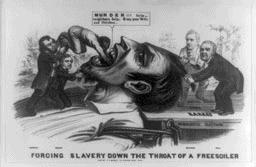
Figure 6.1 The artist lays on the Democrats the major blame for violence perpetrated against antislavery settlers in Kansas in the wake of the Kansas-Nebraska Act. Here a bearded “freesoiler” has been bound to the “Democratic Platform” and is restrained by two Lilliputian figures, presidential nominee James Buchanan and Democratic senator Lewis Cass. Democratic senator Stephen A. Douglas and President Franklin Pierce, also shown as tiny figures, force a black man into the giant’s gaping mouth. The freesoiler’s head rests on a platform marked “Kansas,” “Cuba,” and “Central America,” probably referring to Democratic ambitions for the extension of slavery. In the background left is a scene of burning and pillage; on the right a dead man hangs from a tree. (Library of Congress Rare Book and Special Collections Division Washington, D.C. 20540 USA)
force if necessary.46He found that habeas corpus did not apply in cases involving the lawful arrest of a fugitive slave.47 Cushing’s final opinion as attorney general authorized U.S. postal officials to honor Mississippi law by refusing to deliver abolitionist mail sent from Ohio to that state. While today any such postal policy would be dismissed as violating the First Amendment, Cushing’s opinion reflects the lengths to which strict constructionists went to defend the slavocracy.48
After the Civil War, the principal place to find any reminders of Pierce’s presidency was New Hampshire, which begrudgingly recognized Pierce as the only resident to be president. Although the state’s only law school was named in his honor, it dropped its name and ceased to be private in 2010 when it was rebranded as the University of New Hampshire Law School. Pierce’s home state made forgetting him easier.
Pierce’s successor vigorously adhered, like Pierce, to strict constitutional construction. President Buchanan agreed that strict construction required upholding the constitutional rights of slaveholders, though he denied that the Constitution protected antislavery activities or authorized the federal government to stem the tide of impending secession, which, like Pierce, he blamed on northern abolitionists rather than anything he had done as president.