
36
Tuesday 5 September 1944
They lay strewn across the hillside. The Savinja Valley was idyllic. Behind them was a stone cottage with chickens, a goat, and a few pigs milling about, the garden overflowing with beans and potatoes. Across the valley, grapevines and fruit trees were bursting with ripened fruit. The old couple who owned the cottage came out and exchanged greetings with the Partisans.1 For the first time all week, the escapees ate more than žganci. In its place was a hearty potato and corn soup, with chunks of black bread and fresh fruit – and, of course, the half of mutton retained from the ambush. But despite the fruit and the landscape, the mood was bitter.
After a few hours of sleep, Ralph joined the Partisan officers inside the farmer’s cottage, if only to escape the glares of his own comrades. On top of his immense task Švejk was now having to juggle propaganda duties: he was trying to ‘educate’ the farmers. The couple were regarding the lecture with polite indifference. Ralph looked at the walls full of religious icons. Despite their piety, the inhabitants seemed happy to cooperate with a Communist-led movement against the Germans.2
The Crow’s mind was on his most pressing task: rallying the men. He wasn’t sure if this was the end or if there was further to march. If the men weren’t at least brought into line, the whole column might disintegrate. Franjo came in and provided the solution. ‘Ralph, I’ve been told you’ll be meeting British officers in the next town.’
Ralph rubbed his stubble. He feared the Frenchmen’s mutinous sentiments were spreading; not to mention, the whole column was pretty lousy, and Ralph hated being unclean and untidy. He would try a carrot to get the men in line and, for those that didn’t take the carrot, a stick. He went outside to find the men, many of whom were just waking from their slumber. Les was with Andy and Len. The Crow found a rock to stand on. ‘Right, listen up! I know how tough this is, fellas, but pull yourselves together.’ Most greeted this pep talk sullenly. ‘We’re British soldiers!’ he went on. ‘We must fight with everything at our disposal, not sit in our cosy billet waiting for others to fight on our behalf.’ Some murmurs of approval; death glares from others. The Partisans watched on, curious. ‘I can’t stop anyone who wants to leave. But I know I would regard anyone who did as a deserter. Our Partisan friends have informed me we’ll be meeting some of our officers in the next village.’3
The dissenters bristled. The Crow’s threat of ratting them out was no longer idle. Most had not met one of their officers in over three years, let alone one who wielded actual authority. It didn’t make The Crow popular, but for now it brought the dissenters into line. ‘Now, you’re all bloody filthy. That’s no way to present to an officer. Everyone go get yourself cleaned up in the river!’ The men dispersed and wandered down to the Savinja river. Ralph had a point. They all stank, and the chilly waters proved a good substitute for tea in jolting the men awake.
Then Švejk gave the order to move out. He looked in far worse condition than his charges, who were still fat from The Combine. Švejk’s last reserves seemed to have been sapped; he looked almost emaciated – pale, like the bodies Ralph had pulled from the railway shed.4 Yet on he went, flanked by the Partisans of the Lackov Odred. Today they marched by daylight, but although they were in a ‘safe’ area the column took the vertical climb over the hills rather than the main road between the villages, and spent the next few hours winding through woods and meadows.5
On the descent, there, all of a sudden, was the shining white, red, and green of Gornji Grad, an elegant town with its large and imposing baroque church. Thriving, full of smiling people, and free. To the liberated prisoners it was the greatest sight in the world.
The column emerged on the east end of town. Remembering Franjo’s information, The Crow formed his men up in marching order – for most of them the reality of returning to soldiering had not sunk in. Franjo dropped back: ‘Hey, Ralph, could your men sing “Long Way to Tipperary”?’6
The Crow tried to keep up an orderly march, then, as they followed the road into town, he looked back over his shoulder:
Up to mighty London came,
An Irish man one day . . .
Les, Andy, Len, Donald, and Henare’s voices led. Those with some fire left in their bellies joined in.
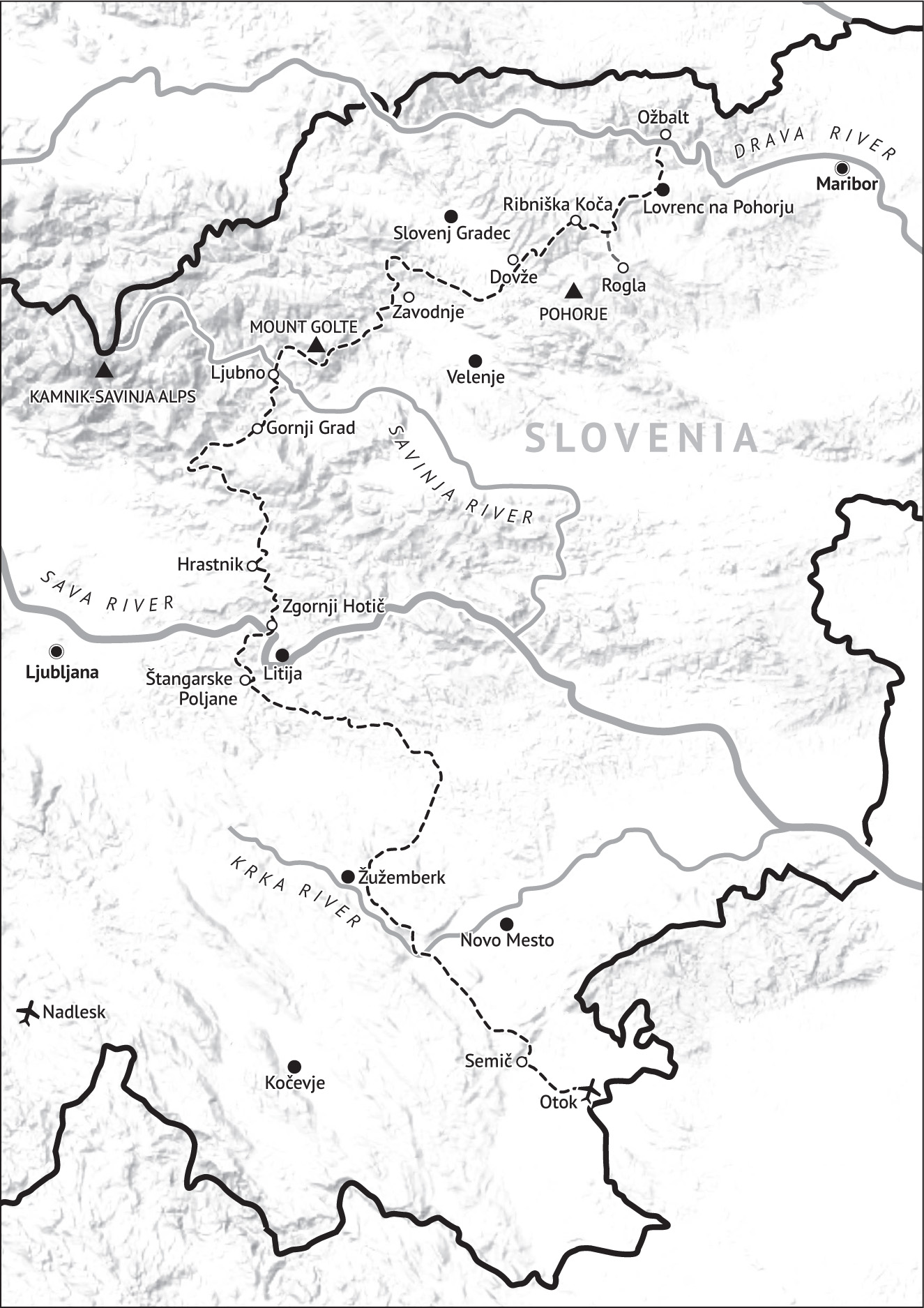
A map of northeastern Slovenia shows an escape route leading south west from Ožbalt through mountains, and then south until escape by air from Otok.
Map 10. The escape route
. . . all the streets were paved with gold
So everyone was gay!
Singing songs of Piccadilly,
Strand, and Leicester Square.
Till Paddy got excited and
He shouted to them there:
‘It’s a long way to Tipperary
It’s a long way to go.
It’s a long way to Tipperary
To the sweetest girl I know!’
Ahead of the column, by the grand white church, a reception committee had gathered. Partisans, officers, clerks, and curious locals watched the group march in. That’s why Franjo wanted us singing, Ralph thought: the sight of 100 singing Allied soldiers was quite something. It proved beyond a shadow of a doubt that the Partisans were with the Allies. The Crow followed up with ‘Pack Up Your Troubles in an Old Kit-Bag’ – with both prisoner and Partisan living off not much else, it seemed an appropriate choice. Even a few of the men who’d been nothing but sour since escaping cracked a smile, basking in the affection of the crowd.
The Crow looked around for a British officer. Easier said than done – the Partisans had been given so many British uniforms by airdrop that several of the tunics matched his own. He gave up trying to distinguish by tunics and assessed hats, ruling out any that bore a red star. Finally, his eyes picked out a cap. It was not British: it bore a golden eagle. It was American.7 ‘Eyes right!’ The Crow ordered. The column turned their heads. Major Franklin Lindsay beamed and saluted.
The pass-by complete, the column halted. The Partisans broke ranks to embrace old friends at 4th Zone HQ. Lindsay approached Ralph. ‘You surprise me – I’ve always understood the Australians reserved saluting for special people and special occasions.’
‘Believe me, sir,’ replied Ralph, ‘this measures up on both counts.’8 He hadn’t expected an American.
‘Excellent,’ said Lindsay. ‘Fall your men out and have them give their details to our Partisan friends.’ He gestured to a desk and typewriter with a female Partisan clerk. Ralph ordered the men to assemble and give their name, service number, and address. The clerk had a good grasp of English and bashed away on the keys, though with so many colourful accents among the group she had to make her best guesses. ‘Hartlepool’ became ‘Hotlipool’.9
Once Leslie’s name was down, Ralph beckoned him over. ‘This is Leslie Laws, sir,’ he told Lindsay. ‘He’s the one who got us in on this whole endeavour.’10
Lindsay congratulated Les and Ralph on a job well done. ‘Thank you, sir.’ Les was, like everyone else, exhausted but, despite the pageantry, his mind was on finishing the job. ‘What’s the plan, sir? Are we home safe?’
‘I’m afraid not,’ replied Lindsay. ‘You’ll be headed south to cross the Sava. I can’t tell you anything more than that. But you’ll be in safe hands. Trust me when I say the Partisans excel at pulling a fast one. There is something for which I need your help, though. We’ve got a flying officer with us, Melrose. His whole crew was killed, and he was beat up pretty bad. I’m sending him with you. Get him home.’11
‘Of course, sir.’
That sorted, Lindsay waved for Ralph and Les to enjoy themselves. ‘We’ve had plenty of food prepared for you. I even got a few English-speakers to mingle with you. Enjoy yourselves, and get a good night’s rest.’
‘Thank you, sir,’ said Leslie and Ralph in unison.
With that, Franklin departed and left the men to bask in the afternoon sun and enjoy the picnic laid on for them. A few ‘eternal Yank’ Partisans chatted with them, warning them that the most dangerous roads lay ahead: territory controlled by the Bela Guarda (White Guards), the Partisans’ name for the Domobranstvo.12
The Lackov Odred took a much-needed rest. There was no such luxury for Švejk, though, whose monumental task wasn’t done yet: in the morning, he had been informed, the column would take on 150 new members – fresh recruits being sent south, along with some refugees and wounded for the hospitals or evacuation.*13
Wednesday 6 September 1944
During the night, reports came that another Ratweek effort to blow up the tunnel and cliff walls along the main Ljubljana–Zagreb railway line had done no long-term damage.14 Lindsay’s brief was primarily destruction, not rescue, and he was irritated that there had been no attempt by the Sava Navy to blow the railway bridge near Litija, thereby putting the line to Zagreb out of action for the rest of the war. It had apparently been planned but, much to Lindsay’s dismay, the Sava Navy had got cold feet during the night and called off the attack.15
The morning returned the escapees to a cracking pace, departing Gornji Grad at 08.15 while Lindsay watched from the hills.16 In many ways, his jobs were incompatible. For MI9, he had to guarantee the safety of Allied personnel, pilots and prisoners. For SOE, he had to stir the hornets’ nest.
The situation was far more fragile than anyone knew. The Partisans had escaped destruction many times, but it would take only one slip for the entire movement to be wiped out. In this tiny corner of Europe, the Slovenians had joined the war at a time when Europe stood on the brink, and though victory in much of Europe now seemed assured, in Slovenia it was perhaps not. There was still such a long way to go. How many of these young rebels flocking again to the Partisan banner would survive? Would the men Lindsay had helped free make it home?
On the group’s way out, the 14th Division photographer Jože Petek snapped a photo of the column ascending a hill; it shows how everyone had had a chance to shave and clean up in Gornji Grad. Leading the way as usual was Čolo, the model scout. Behind him was Franjo, hatless and showing off his hair. Ralph was next, a look of determination in his eyes. Then Leslie, with his rucksack over his shoulder. Behind these four were the 250 members of the column, snaking along the track and into the forest. Švejk walked to the side, keeping watch.17
At least marching by night had kept a cap on the pace that could be set – by day the escapees could not keep up with the Partisans. Today’s march covered thirty kilometres: 800 metres up, 750 metres down, and the men with inadequate clothing again hissed their dissent. Ralph put in more walking than anyone, going up and down the column doing headcounts and keeping the mood as good as he could. The group held together, blitzing their way south, and successfully crossing their first road in daylight. They bypassed two towns held by the enemy and had climbed above the next valley by sunset. They came to a rest on a hill above a river that ran alongside the main road from Ljubljana to Maribor. Night fell. Čolo scouted ahead, the men separated into tens again to get across, and the column reformed to storm up the side of the next valley, where they rested for the night at Hrastnik. The Crow joined Švejk in a farmhouse owned by a young couple, one of whose small children took a great interest in Ralph’s hat and ran around the kitchen wearing it.18
Thursday 7 September 1944
A short morning march took them to Mala Sela, a wooded hill above the Sava, where a courier from the Sava Navy, the Kamnik-Zasavje Odred that had got Cuckold Mission across the Sava river, arrived to brief Švejk. Švejk then summoned Ralph, Leslie, and Franjo and laid a detailed map of the Sava across a fallen log. ‘We’ll be handing you over this evening to the Kamnik-Zasavje Odred,’ Švejk declared. ‘We’ll wait until night, and you will cross here –’ he pointed to a wooded area just west of the riverside village of Zgornji Hotič. ‘A diversion has been planned to clear your way. The local farmers will move their work animals across the river tonight – they have permission from the Germans to do this. They’ll do it as noisily as possible.’ The column would wait in the forest to be handed over. For the Lackov Odred, there would be a few days’ rest in the Savinja Valley, then back to Pohorje.
Ralph took this moment to appraise their commander. He had been too hard on the man, he realized. Švejk’s German jacket had become more ill-fitting by the day, and his face more sunken. More than anyone, the march had taken a toll on The Good Soldier Švejk. Ralph guessed the poor fellow had tuberculosis. Švejk may have been the night to the day of Franjo’s charm and enthusiasm, but he had been a model officer: professional, relentless, inventive, and calm under pressure. Right now, though, he did not look as though he would survive the war.
Leslie and Ralph decided to keep the men in the dark about the plan, both to avoid worrying them and to protect the locals in case something went wrong.19 It was only a little after midday, and time would pass more easily if they were ignorant of the task ahead. Everyone snatched what sleep they could. In the early evening, a Kamnik-Zasavje Odred officer, Tone Poljanšek, arrived to relieve Švejk.
Franjo came over. ‘This is where we leave you, Ralph.’
Ralph found he couldn’t speak. This man, still a boy in many ways, had risked his life to save them, making a dangerous diversion from his real mission: to save his own people and his homeland. ‘Thank you, comrade.’ Ralph embraced him. It was strange: with the Partisans of Štajerska Ralph found a camaraderie more profound than any other.
‘Take this,’ said Franjo, handing Ralph a small piece of paper. ‘Write to me after the war.’
Ralph unfurled the paper to find Franjo’s parents’ names and address on it.20 It was a shockingly risky act, testament to the strength of their bond. If Ralph were captured or killed by the Germans or the Domobranstvo, then Franjo’s family would be murdered. The young Partisan would have no home to return to.
With that dramatic gesture, the volunteers of the Lackov Odred departed, back north, back to the fight.
Ralph and Leslie scanned the way ahead. Were they destined to walk all the way to the Adriatic? Beyond lay not only the mighty Sava river, but also the main road from Ljubljana to Zagreb. It was one of the Ustaše regime’s lifelines to the Reich, and one of the main routes to Belgrade.
Night fell, and at 22.00 the Sava Navy moved all 250 in the column to the riverbank. Upstream and downstream, the night was punctuated by a crashing of hooves in water. Beyond was the sound of distant gunfire – a diversionary attack.21 Franklin was correct: the Partisans excelled at pulling a fast one. The column boarded small wooden boats, half a dozen at a time. The cacophony of cattle herding masked the sound of oars and punts as the boats battled against the current. Partisan scouts watched over the farmers, keeping an eye out for enemy patrols – an Axis garrison by the Litija railway bridge was less than 1,000 metres from the crossing site.22 If the Sava Navy had attacked it, as Lindsay had wanted, the whole river would be swarming with Germans. The Sava Navy had most likely not got cold feet. Rather, it seems likely that they were trading the last chance of Ratweek success for the safety of the escapees and recruits and – most important to the Partisans – the safety of the only route south.
It took hours to complete the crossing, Ralph growing more nervous by the minute. Fearing recapture, he tore up Franjo’s note and prayed he would remember the address.
Friday 8 September 1944
The crossing complete, the escapees were handed over to the care of the Dolenjska Odred, who had been given special orders to take the column south.23 They marched through what was left of the night. These Partisans were far more nervous about the loyalty of the locals than in the north. The darkness faded at the edge of a treeline above a steep descent and the small village of Štangarske Poljane. Directly below was a meadow, a farmhouse, and a barn. The 250 men were divided into pairs. Each pair was directed to move in silence past the farm and into the barn – once one was in, the next would follow. When they’d all made it in, they lay down like sardines. The final Partisan closed the door on gloomy morning clouds.24 Rain would pour down all day, but inside the barn they were warm and dry, though morale wavered as another serving of žganci was dolloped out. The Sava was crossed, and the column was less than thirty kilometres from Ljubljana.
At the isolated village of Nadlesk, MI9’s Captain Jack Saggers had succeeded in his task. He and an Anglo-Partisan team had carved out a dirt airstrip (codenamed Piccadilly Club). Shielded by a large, hilly forest, the airfield received Allied aircraft from late July 1944.25 Weapons, uniforms, and food were delivered by the box, while wounded Partisans and E&Es departed to southern Italy on the return journey. But the Domobranstvo were not far off. Gathering intelligence for the Germans, they had learned of the airfield but lacked the strength to strike alone. Thanks to Ratweek, some of their strongest units had been redeployed to guard key railway lines. Perhaps the Domobranstvo’s only chance of victory was to isolate the Slovenian Partisans from the wider war: from the Yugoslav Partisans, and from the Allies. To achieve this, the airfield must be destroyed, and any escape lines with it. The Allied missions that ran them were to be killed or handed to the Germans.
To shore up their forces, the Domobranstvo called for German aid and were assigned battalions from the 14th SS-Police Regiment, and Wehrmacht mountain troops from the 188th Gebirgsjäger Division. Their combined force would attack the Allies in three prongs, the central objective being the airfield. The first prong, dubbed ‘Schmitz’, would attack from the north-east, pushing any Partisans towards the airfield. The second, ‘Schumacher’, would begin a drive from the north-west on 9 September and link up with Schmitz. The third column, ‘Buchberger’, would stalk the forests and move in from the west. Then the three prongs would launch a combined assault before dawn on 10 September. The operation began as the escapees slept through the day, with Schmitz moving out first.26
At the Štangarske Poljane, the rains had passed, so the escapees and Partisan recruits left the barn and moved out at 19.00. They now followed different paths, with the escapees heading south-east, almost parallel to the Sava, away from Ljubljana.27