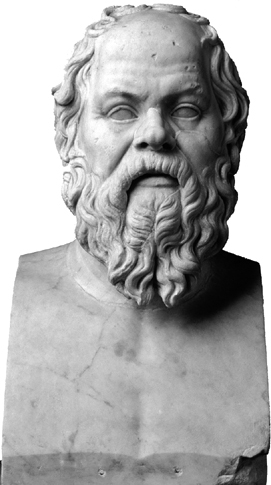
Those who are already wise no longer love wisdom – whether they are gods or men.
Similarly, those whose own ignorance has made them bad, rotten, evil, do not strive for wisdom either. For no evil or ignorant person ever strives for wisdom.
What remains are those who suffer from ignorance, but still retain some sense and understanding. They are conscious of knowing what they don’t know.
Socrates, in Plato’s Lysis, 218b, fourth century BC
PUT TWO AUTHORS TOGETHER IN A room and someone is bound to leave mildly depressed. The only exception seems to be when one of the pair is Peter Cook. Meeting a fellow writer in a bar, so the anecdote goes, he was asked whether he was penning a book. ‘Yes, I’m not either …’ came the soothing reply.
No such comfort for me. Sharing breakfast in an Edinburgh hotel with an award-winning novelist, just as I embarked on this book, the friendly chat came round to our next projects.
‘Socrates! What a doughnut subject!’ he exclaimed. ‘Gloriously rich, with a whacking hole in the middle where the central character should be …’ My smile fixed. Of course he is right: because as far as we know, Socrates wrote down not one word of philosophy. The idea of Socrates is immensely influential, and yet everything we know of him is hearsay. He is, historically, conspicuous by his absence. And thus for the past five years, as I’ve typed, I have had a spectral doughnut hovering over my shoulder.
But painters will tell you that the truest way to represent a shape is to deal with the space around it. The primary-source, autobiographical, historical Socrates is a lacuna; my hope is that by looking at the shape around the Socrates-sized hole, at the city in which he lived – Athens in the fifth century BC – I can begin to write not quite a life of Socrates, but a vivid sketch of Socrates in his landscape; a topography of the man in his times.
I have a warehouse full of unusual allies in this task – the earth-shifters, bulldozers, spades and trowels that have been picking over the Greek landscape in the last few years. The millennial year of 2000, the promise of a Greek Olympics in 2004, the new Acropolis Museum, a change in planning law – all these things have yielded huge amounts of material evidence from the fifth century BC. Socrates is an eidolon – the Greek word gives us idol, a ghost – who haunts a very real landscape. By exploring this physical landscape my hope is to flesh out this idol, and to imagine the life of one of the most provocative and provoking thinkers of all time.1