
10
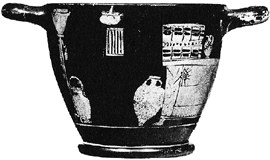

Outside Athens’ city walls, 450 BC
Moreover Socrates was the first to call philosophy down from the sky.
Socrates autem primus philosophiam devocavit e caelo.
Cicero, Tusculan Disputations, 5.10
GOLDEN AGE ATHENS WAS SURROUNDED by antiquity’s equivalent of a ring of steel: an encircling building programme of walls 3¾ miles long that buttressed the city, and then remarkably by 452 BC reached out for 15 miles to link Athens with its sister city – the downtown port district of Piraeus – the city-harbour that gave Athens an ocean-mouth.1
The building material used for construction was ‘Persian rubble’ – the remains of the city that the Persians had tried to destroy. The builders were ordinary men, women, children and slaves, all survivors who had staggered back home after the Persian nightmare had ended with the wake-up call of Salamis.2 Athenians were fervent; they never wanted to suffer such carnage again. And so an ambitious construction programme began. Athens started to resemble the great cities of the Near East – Babylon, Nineveh – superstates protected by a defensive statement visible for miles around. Yet whereas Babylon’s walls were blue-brick glazed, and Nineveh’s carved with fantastical visions of paradisiacal gardens, it is clear that Athens’ walls were put up in a hurry.3 All kinds of debris ended up squashed in amongst the masonry blocks: chips of tombs, law decrees, broken pots.4 Scrabbling to put something concrete between themselves and atrocity, the Athenians used what they could lay their hands on to keep Athens fortress-safe.
The protection offered by strong walls was written into the literature and psyche of the period. The philosopher Heraclitus from Ephesus in Asia Minor declared, ‘The people should fight for the law as for their city wall.’ A study of the texts of the Old Testament drives home the horror of city walls tumbling down: ‘I have wiped out many nations, devastating their fortress walls and towers. Their cities are now deserted; their streets are in silent ruin. There are no survivors to even tell what happened.’5 And Yahweh thunders, ‘I will reduce the wicked to heaps of rubble.’6 The Athenians had no intention of enduring such a reduction and so they hand-lifted one block up onto another. The project was completed with all the subtlety of a juggernaut; houses, roadways, olive groves were swept aside. Athens saw that without a bullish defence system and permanent, controlled access to the port at Piraeus, she remained just another land-locked city-state, a beached sitting duck.
Because although Athens had become head of the Delian League, even though her boatyards were filled with the sleek ‘wooden walls’ of the Delphic Oracle, and despite the fact that she had brought a new word – ‘democracy’ – to the world and had sent the Persians packing, she was not universally loved.
CORINTH: Keep it in mind that a tyrant city has been set up in Greece, and it has been set up against all of us alike; some of us it rules already, the rest it plans to add to its empire.7
As well as the flattering epithet ‘violet-crowned’, at this time Athens garnered herself another: ‘busybody Athens’. Without the common enemy of Persia as a clear and present danger, the city-states started to notice who amongst them had best picked themselves up and dusted themselves down. There was no doubt that Athens deserved that particular laurel. As well as mutterings from the Corinthians, the Spartans too (down in Lakonia in the Peloponnese) were none too happy with the reports that protective walls were rising from the Attic plain.8 Sparta despised walls. Plutarch tells us that the Spartans boasted proudly that ‘our young men are our city walls, their battlements the tips of our spears’.9 About 75 per cent of all Greek city-states had some form of enclosing wall by the time of Socrates’ death. An extravagantly walled city takes on a mythic quality – it declares it can never be assailed. Athenians must have suspected that their building programme would antagonise the other superstate of the region, Sparta, but they had no intention of relenting. By 478 BC the city-wall fortifications were complete. Socrates was born outside the cordon of a truculently, hermetically sealed state.

By the time Socrates was nineteen, Athens had been fully democratic for just twelve years.10 So as the philosopher grew up, democracy too was beginning to ripen. Democracy was a strange, bold, radical experiment.11 And, like all good experiments, it could yield the best results under stringent conditions. Athens hardly constituted an open society. The radical developments in the city were very recent, very raw. Its enemies were still only a morning’s march away. The city built a cucumber-frame around its tender shoots. It became fiercely protective. Outside were foreigners, journeymen, the demi-monde. Inside were citizens, stakeholders. Golden Age Athens was truly a fortress city. Crenellated towers and battlements, at least 40 feet high, kept the haves apart from the have-nots.
Walk due north-west from the Acropolis today and one finds one of the most exciting ongoing Athenian archaeological digs – in that dangerous space beyond the mortar shield. The road to this, the Kerameikos district, still has a marginal feel. Moustachioed, toothless men play backgammon; there is an apologetic flea-market, where old magazines nestle up to older knives, but even the vendors recognise that most of what they sell is tat and abandon it to the dustmen when it rains.
It is this literally edgy district that can give us many clues to Socrates’ life. Imagine approaching Athens not from the usual direction – via the writings of proud Athenians or self-confessed Atheno-philes – but instead from outside in. From afar the Acropolis, crowned with monumental temples and sanctuaries, dominated the skyline, as it does now. Closer in, the city’s stench (no sewage system, no rubbish collection here) and its lime-polished patrolled defences (wide enough for troops to march along) would have announced that civilisation was close at hand. Here entry to the city was via a scrappy shantytown and through monumental double-gates.
The walls and the north-west Dipylon gate with its interior courtyard, 130 feet deep, covering in total 2,160 square yards – the largest gateway in the Ancient World, cut right across an ancient district. A fountain here was used to refresh and cleanse travellers before they entered the city. Named for the divinity Kerameus (his name means potter), this liminal area was colonised by eponymous craftsmen. The potmakers of the Kerameikos gave us the thing that, for many, defines the classical world: the Greek vase. We inadvertently honour their efforts, and Kerameus, each time we talk of ‘ceramics’.
The Kerameikos must have been a gaudy, stinking, pulsating place: a place you came to celebrate both life and death. The River Eridanos flowed freely here; now reduced to a boggy, subterranean trickle. Tortoises amble purposefully above the ghost of the river.12 Leaving the city, through its own door in the city walls, the river-water in Socrates’ day was soiled and rank. But still the brown liquid stream was used to feed bathhouses, popular ones. The playwright Aristophanes declares, with a nudge and wink, a ‘sausage-seller’ (double entendre intended) here ‘sells sausages of mashed up dog and ass meat, knocks back the booze, and trades insults with the whores, slaking his thirst with the used, dirty water from the baths’.13
When the young Socrates ambled through this district he would have found plenty of whores available to josh with: the Kerameikos supported scores of prostitutes, operating in what were often described in the Greek as ‘factories’ or ‘fuck-factories’. Walking through the excavations today, you can still see their stalls. Tussock-grass and wild lupins grow here and all is open to the sky. But the squashed footprint of the buildings forces the imagination: rows of women, weaving clothes their day-job, busier still at night. A chunky silver medallion found in the corner of one of the rooms bears a plump ‘laughter-loving’ Aphrodite riding on a goat through a star-studded night sky, and is an honest indicator of the bawdy nature of the place 2,500 years ago.14
One fourth-century source describing Athens’ red-light district tells us that ‘women sunbathe with bare breasts, stripped for action in semi-circular ranks; and from among these women you can select whichever one you like: thin, fat, round, tall, short, young, old, middle-aged or past it’.15 Females of all hues too: many prostitutes were enslaved during military campaigns in Thrace, Syria and Asia Minor. These captives (not allowed into Athens itself) became an exotic fringe to the city. Women plucked and singed off their pubic hair to be ready to suit any sexual tastes. Men rocked up for a quick session ‘in the sack’; or, as the Athenians would have put it, ‘middle-of-the-day marriages’. Male flesh was, of course, available. Aeschines describes boys lined up, ‘sitting in stalls’.16 In years to come, it would be one of these stall-boys – a fallen aristocrat from Elis called Phaedo – who allowed Socrates to stroke his soft hair while the philosopher waited for death. Some prostitutes in the Kerameikos were brought so low even slaves could afford them: one obol a shag.
Love, sex, death, it was all here. From the twelfth century BC onward this had been a burial ground, and in Socrates’ day the main thoroughfare was still lined as far as the eye could see with dressed stone graves – simple affairs, not the showy painted tombs that smelt of aristocratic power, but something more democratic. The dead were listed in tribal groups. A discrete ‘political’ cemetery housed public burials. But still the fallen of all degrees were honoured; orators celebrated the virtues of brave soldiers. Specially organised athletic games sent the dead off to Hades.
It is this noisy, pleasure-death-ground that Socrates, we are told, frequented as a young man. The Kerameikos is a key clue to his story and to the story of Athens’ Golden Age. These visceral, vacillating lanes, nooks and crannies were his ethical nursery. This is a zone where man’s basic needs, as well as his more elevated tastes, were catered for. Socrates makes it clear that his philosophy comes from observing, and living in, the good, bad and ugly place we humans call home. Despite what the world throws at us, his simple, infuriating, inspiring message is that however mongrel and challenging our surroundings, we should identify and embrace the good, the pleasant in life.
Tell me: do you agree that there is a kind of good which we would choose to possess, not from desire for its after-effects, but welcoming it for its own sake? As, for example, joy and such pleasures are harmless and nothing results from them afterwards save to have and to hold enjoyment.17
He used to praise leisure as the most valuable of possessions, as Xenophon tells us in his Symposium.18
Interestingly, as a young man, Socrates’ enquiries seem to have been not just about the nature of goodness and happiness, but of a more scientific bent. In the Kerameikos the juvenile sage came to learn new things; he spent time, we are told, with the sophists, the professional thinkers who were drawn to Athens like iron filings to a magnet. Their studies were explosive: Was the world round or flat? (Socrates came to the conclusion it was round.) What was air made of? What was the point of the stars? These thinkers’ investigations oriented around phusis – the function of nature.
SOCRATES: When I was young, Cebes, I was tremendously eager for the kind of wisdom which they call investigation of nature. I thought it was a glorious thing to know the causes of everything, why each thing comes into being and why it perishes and why it exists; … I prized my hopes very highly, and I seized the books very eagerly and read them as fast as I could, so that I might know as fast as I could about the best and the worst.19
Socrates would have been in good company during these al fresco seminars; for the well heeled in Athena’s city, this was what the leisured boys of sixteen, seventeen, eighteen did. With two, possibly three slaves to every adult citizen, the young well-to-do Athenian did not have to trouble himself with too much work. Instead he spent his waking hours honing his body and mind.20 All young citizen men (and particularly wealthy young men), outnumbered as they were by the population of slaves, had vast amounts ofschole – leisure-time. It has been estimated that the young and middle-aged may well have spent three-quarters of their day at the gym. Here they prepared for competitions, for war, for being ‘beautiful’ and for their role in the city’s many festivals.
At certain ages in Athens you could do certain things: Socrates, like all other healthy sons of citizens, had already been welcomed into Athenian society as a toddler at the Anthesteria festival. At seven he would have been allowed to read. At twelve to participate in religious rites, and then at eighteen – the real coming of age when beardless boys became bearded men – the number of festivals that he could attend increased exponentially.
The almost-daily religious festivals – the majority of which Socrates would have had the chance to participate in – gave Athens both a sense of security and a sense of purpose.21 Its most splendid was the show-stopping Great Pan-Athenaea, a four-yearly fixture when outsiders were allowed into the city to marvel at Athenian greatness. Between the rival ten tribes of Attica, competition was fierce. It is the Great Pan-Athenaea that is represented on the Parthenon frieze. Foreigners carry honey-cakes, aristocrats parade along the street on horseback, their charges rearing and prancing; there are flute and lyre players; gods mix with men, young girls carry furniture in preparation for religious ritual to a high-priestess; and standing back to back with this priestess is none other than theArchon Basileus himself, the man who oversaw Socrates’ trial. On the Parthenon’s delicately carved marble the Archon, a stocky, well-honed figure, masterfully, tenderly folds a thick, heavy peplos, a new cloak for the premier goddess of the city – wise Athena.
There is no doubt that Socrates himself would have participated in the Pan-Athenaea. The celebrations lasted a week and spread right through the city. The festival route – the Pan-Athenaic Way – ran from the Dipylon Gate up to the Acropolis. Passing along it, one would have smelled the hot sweat of the athletes in the Agora running in full body armour and the hot breath of horses as they clattered past to cavalry and chariot events. In the harbour there were boat races, on the slopes of the Acropolis orchestral competitions, and up at the Pnyx recitations of Homer. Winning at the Pan-Athenaea was not just for honour, but for gain. First place in the chariot race for adult horses, for instance, earned you a whacking 140 amphoras of prize olive oil – approximately 7,850 pints. Winners flaunted their prizes during the florid parade in honour of Athena: the name of this procession – the pompe, initiated in the Kerameikos at the Pompeion – still suggests to us the ultimate in ceremonial greatness, a moment of pomp and circumstance.
Socrates grew up in a city that had become a master at doing things: yet this young man from Alopeke, at some point around 450 BC, appears to have decided to pursue not just the what, but the why.
One year when Pan-Athenaic carnival spirit was abroad in the air, there were two particularly respected visitors to the Kerameikos district: two great elder-statesman thinkers of the day, Parmenides and Zeno.22 Pupil and master, lovers – all kinds of rumours circulated about these two travellers, footsore all the way from Magna Graecia, southern Italy. Theirs was a progressive idea: that our internal lives are as valuable as our corporeal existence. In all the pulsating, sweaty business of living, it seems that here Socrates, soaking up the eclectic experiences available to him, was quickened to the concept of being.
Parmenides was clearly a firebrand thinker, a man who burned his own path through society’s undergrowth. Many credit him as the founder of all Western philosophy. The sophist wrote poetically, and in lush, descriptive terms. He conjures up luminous images to express his ideas: a divine chariot, driven by maidens – daughters of the sun, no less – and pulled by docile mares, which draws him down the path of truth. At the end of this path he will discover what it is ‘to be’. His pupil Zeno developed philosophy further by establishing ‘dialectics’ – a method of testing the tenacity of an idea by taking it to its most ludicrous, paradoxical potential.
In this fledgling democracy, repeatedly throwing the rulebook out of the window – where new political structures, new built environments, new world orders are a possibility – maybe whole new ways of thinking, of living life itself, are a possibility too. Ideas such as these would have been eagerly discussed by the young men who gathered in the Kerameikos district. Over the outdoor braziers, and juggling too-hot fish from charred earthenware frying pans (one such was discovered during city-centre excavations in 2007 and is currently on display in the new Acropolis Museum), fundamentally illuminating ideas were played with. Socrates was born into very exciting times.
And one hot summer (the Great Pan-Athenaea took place in July/August), searing news.
Although the two alien philosophers Zeno and Parmenides were staying in this low-rent motel-strip of the ancient city, they had brought with them something priceless. A new book. Imagine the impact. The leather pannier opening, the papyrus unwrapped, the words, inked black with oak-gall and charcoal, marking out a fresh landscape of ideas.
Zeno and Parmenides once came to Athens for the Great Pan-Athenaea. Parmenides was a man of distinguished appearance. At that time he was well advanced in years, with his hair almost white. He may have been sixty-five years old and Zeno perhaps forty. They were staying with Pythodorus outside the walls of the Kerameikos. Socrates and a few others went there, anxious to hear a reading of the book Zeno had brought to Athens for the first time. Socrates was then quite young.23
Quite young – probably nineteen or so. His age was significant. Athens was not just a city divided by gender, tribe, wealth, but – and this is vitally important – by age-groups.
If the dating fits, then, during that same summer, as day slipped into night, Socrates’ exact contemporaries (possibly even Socrates himself) would have been introduced to the citizen-body of Athens in all their naked glory down at the Kerameikos. The Athenian year ran from summer solstice to summer solstice. And round about the beginning of the New Year – in this case, the night before the Great Pan-Athenaea kicked off – boys became men by racing against one another from the altar of love in the Academy to an altar in the city.24 These boys – all just eighteen or older, of an age one scholar describes, evocatively, as ‘striplings’25 – were stark naked, and each carried a torch.26 It must have been a genuinely rousing sight – and we hear that many spectators gathered to give those young bottoms ‘slaps of Kerameikos’ as they went past.27
Their fathers had been slaughtered over the stretch of a half-century by the Persians, their mothers raped. And still they had not caved in. This new generation had much to live up to. Now the boy-children, Socrates’ peers, healthy skin-oiled, flame-lit, pound along the Pan-Athenaic Way into Athena’s city to show they are on their way to becoming men; and the Athenian horizon looks rosier.
At the end of the Pan-Athenaea festival, there was a mass slaughter. Each and every city that owed tribute to Athens had to provide victims for sacrifice, and many hundreds of animals (mostly heifers) were killed. The bloodied cuts of meat were then processed down from the Acropolis to the Kerameikos, and the flesh cooked up in a massive feast for the people of Athens’ demes. Socrates would certainly have participated in such communal activity. As the smell of roasting flesh met the night air, as travellers shared tales, as new perspectives on human life were explored, Athena’s city was sated. The world and its wealth were coming to Athens because it was strong and confident and powerful.
It is a vivid scene. The stonemason’s son, his suburban friends, the well-bred of Athens gathering to celebrate their city and to hear new ideas to add to their own fast-developing, novel world. In a cosmos dominated by irascible, anthropomorphic gods; gods who drank and argued and slept with each other’s wives, together nature, phusis and democratic man suddenly appeared capable of producing her and his own mysteries and pleasures. A combination as powerful as that was unlikely to escape the notice of the authorities. The possibilities of the world – revealed by the brightest of sparks in this democratic city – might be fathomless. And in Athens one man, who was beginning to enjoy enormous influence, chose to open his doors to these new opinions, these new options and the radicals who propounded them.
Socrates was about to earn himself a taste of the high, as well as the good, life.