ACT SIX


33
Domestic dwelling, Athens, 416 BC
SOCRATES: … savouries, perfumes, incense, prostitutes, pastries …
Plato, Republic, 2.373a1
WINE WAS A SERIOUS BUSINESS IN Athens. During excavations of Athens’ city-centre a well was found bunged up with terracotta debris, the mess clearly derived from great drinking binges. Deep inside were pitchers and black-glazed drinking cups, along with amphoras that told of the origins of some of the booze on offer. Here there was honeyed wine from the windy island of Lesbos – alma mater of the poetess Sappho – and here too a vintage from Corinth, on the coast road that ran down to the Peloponnese, and, sweet as nectar, wine from remote Thasos – the island so irresistible to Athenians – and Dionysos himself was said to have blessed it.
So, around 416 BC, according to Plato, we find Socrates entertaining democratic daytime Athens with perceptive, withering philosophical insights, and then in select company consuming the crushed fruits of empire as the sun sets.
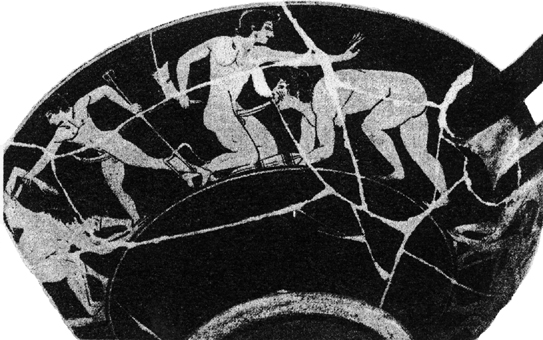
Dinner defined the Golden Age citizen. He was the true inheritor of Athens’ greatness, who could lie on a couch, listen to flute-girls, flirt with young boys and eat delicacies grown by another’s hand. It is often said that Socrates was anti-material because he refused payment for his work – but he did accept dinner: and the symposium was up there with the finest gifts that any could give a man. This was, traditionally, how the aristocrats of the day strengthened their blue-blood bonds. How they kept themselves sleek in a landscape that could feel stony and barren. It was a gift, however, that lacked some finesse. Symposia were bawdy, and however high-minded the conversation, the evening often ended crudely. Drinking games such as the popular kottabos (where a cup is balanced on a stick in the middle of the room and the assembled company attempts to knock it off with their wine-dregs) could only operate with slaves on hand to clear up the citizens’ mess. Socrates debauched with the best of them, and his presence at thesymposia shows that his tastes were discreetly, plangently Athenian.
The argot of Golden Age Athens was money and food. In Attic comedy men often joked about the honesty of an empty belly, and poets fantasised about the wealth – and feasts – in store, should the Persian Empire ever be conquered,
While trees on the hill will shed at our will, not leaves but giblets of kid
And deciduous bushes drop fricasseed thrushes and succulent gobbets of squid.2
In preparation for the symposium (literally, the ‘drinking together’), slaves would cook relatively wholesome food throughout the day (none of the excesses of Roman banquets here, although the Athenians did have a soft spot for pastries – in fact, fried fish, lentil soup, sausages and raisins were more likely to be on the menu than flambéed peacock). Male guests, eleven or so, were typically wreathed for the occasion: myrtle, rose, wild celery could all be worn. A hymn was sung, usually to Zeus Soter, Zeus the Saviour, and the symposiarch – the colleague elected by his fellow diners to be in charge – would decide how many units of watered-down wine (often three parts water to one part wine) should be drunk that night.
At Socrates’ symposium – reports Plato – the agreement was that the guests themselves should decide how much to drink, a hint that even within closed aristocratic circles democracy was in action. But although this detail does copper-plate Socrates’ democratic credentials, Plato’s point was not heavy-handed. The symposia were far more than just a chance to imbibe and consume; they were the unofficial gatherings that kept the world turning. These were evenings (sometimes longer: a symposium could run for thirty-six hours) that enabled small groups of men to get together behind closed doors. Since the Late Bronze Age these drinking events had been the way in which the elite of society shared experience and advice, where the young bloods were properly educated. At asymposium in democratic Athens, things might now be done a little differently, but just by being there aristocrats could relive those days when they called the shots; and they could talk about Demokratia behind her back. Years later, in the Archon’s courtroom, there is no doubt that Socrates’ ready association with these exclusive groups would be held against him.
Symposia were claustrophobic affairs. To appreciate their scale it is best to leave Athens and drive five hours north to the magical little hill of Olynthos, back in fact to the district where Socrates had been fighting around 424 BC. Olynthos, 20 miles north of Potidaea, 120 miles south-west of Amphipolis, was laid out on a Hippodamian-style grid (Hippodamus being the Milesian architect who had also designed Athens’ Piraeus district so neatly) – part of the region’s redevelopment programme after the fierce fighting of 432 BC. Olynthos’ appearance resembled Athenian mores, if not its constitution; this was a town led by an oligarchy, one that resisted Athens’ offer of democracy, but it still looked to the future: to a time when urban planning would make life better.
Because vast sections of fifth-century Athens lie smothered and inaccessible under the modern city, Olynthos – recently re-excavated – offers us a more complete glimpse of the built environment that Socrates would have enjoyed. There is a down-the-rabbit-hole feel to the architectural remains at Olynthos today, as if you are marching through some giant golden board game. The footprint of the town’s layout has been raised, four blocks of stone high, and what is striking (apart from the odd tree that has established itself as a rare umbrella of shade) is the regularity of the place: little boxes on the hillside where fifth-century Greeks settled down to the business of promoting Greek civilisation.
One house at Olynthos has been particularly well preserved; and fortunately for archaeologists and historians one room here is in particularly good nick – it is the men’s room, the andron. In a sense there are no women’s quarters in Ancient Greek homes – the whole domestic space was a woman’s turf:3 apart, that is, from the andron. The andron was an area for men only. Most were built with doors to the outer street so that women didn’t have to sully the atmosphere by passing through to reach the rest of the house. Serving slave-girls, flute-girls and hetairai were, of course, an exception.
Although Athenian houses of this period were notably simple, the one room where you were likely to find internal decoration was the andron: this was, after all, a place of pleasure. At Olynthos the mosaics from two of the andrones still exist. Charming, if slightly crude, things, made up of river pebbles, they show Bellerophon mounted on Pegasus, killing the Chimaera, and Nereids frolicking with sea-horses. Stone-slab seats, wide enough for two lean Greeks to recline side by side, edge the room. Wooden couches were often brought in to sit on top of these platforms. Here songs were sung, toasts were made, poetry was composed and the talk was of politics – the things of import to the polis. At the time when the Symposium is set, there is a war on: battle-weary men, deep in their cups, were also here to lick the wounds and extend the bonds made during the fighting.
Socrates’ nights on a low couch tell us about far more than his preference for good wine and tasty, slave-prepared food. Not everyone went to symposia. Some of those ‘born to rule’ kept themselves above such things. Pericles, we are told, strode straight from the Agora to the Boule (the council) without stopping to waste his time with chat and networks.4 The ‘Olympian’ had better things to do than shoot the breeze and stir up aristocrats. But Socrates was a philosopher who enjoyed hanging out with the top drawer of society as well as with its artisans and dogsbodies.
Plato’s Symposium may be pure fantasy, but it is at once a brilliant psychological drama and an acute picture of precisely the kind of event that could, and did, happen on many a fifth-century Athenian night.5
The Symposium party is being thrown in January or February 416 BC by a group of well-heeled businessmen. One of the symposiasts, Agathon, Socrates’ host for the evening, has won a prize for tragedy at a prestigious dramatic festival.6 Drama is so hard to write and produce well that winning really meant (and means) something. We should imagine that spirits are high. There are songs, discussions, party games.
There appear to be many great minds round this table: Aristophanes, whose waspish pen would help to bring Socrates closer to hemlock, lay on one bench, and together with Agathon burned the tallow low with Socrates and his companions.7 Plato paints strong, black-outlined characters here. Alcibiades bursts in, more debauched than normal; Socrates is more self-deprecatory and enigmatic; the host, Agathon, is preternaturally beautiful (his soft white skin is tenderly described); and a kind of mystery guest – a woman no less – is part of the dialogue too: Diotima, the thoughtful, articulate priestess whose ideas are, in Plato’s Symposium, reported by Socrates.
Many symposia were, doubtless, dreary. Others must have sparkled. Aristotle, Xenophon, Euripides – all these men spent time wreathed with laurels and lying on the symposiasts’ couch. These high-octane experiences must surely have given Socrates food for thought. And at this particular symposium, the guests appear on fine form.8 Alcibiades teases Socrates about his delight in self-denial; there is discussion of Socrates’ oddness, of the fact that much that he says has an ambiguous ‘dream-like quality’. His ugliness is mocked. But then something rather interesting happens. Socrates is compared to one of the cult statues of the city – wooden and coarse on the outside, but a structure that opens up to reveal a thing of great beauty within:
ALCIBIADES: … If you chose to listen to Socrates’ discourses you would feel them at first to be quite ridiculous; on the outside they are clothed with such absurd words and phrases – all, of course, the hide of a mocking satyr. His talk is of pack-asses, smiths, cobblers and tanners, and he seems always to be using the same terms for the same things; so that anyone inexpert and thoughtless might laugh his speeches to scorn. But when these are opened and you obtain a fresh view of them, by getting inside, first of all you will discover that they are the only speeches that have any sense in them; and secondly, that none are so divine, so rich in images of virtue, so largely – no, so completely – intent, they are relevant to most or rather to all things worth considering for someone who strives to be beautiful and good.9
Beauty at the time of Socrates
Beauty in Athens at this time was seriously considered to be the sign of a brilliant and noble spirit; a gift of the gods. Those laudable qualities that justified privilege and dominance were believed, naturally, to have been given an appropriately attractive shell. And all those heroically naked paragons around the city itself (both the living, breathing men in the gymnasia and the bronze and marble statues) reflected the visual experience of Athens – this was a land where men stripped to exercise, to bathe, to talk, to worship their gods, to work in the fields. The goddess Athena was honoured by a city-wide kallisteion, an all-male beauty contest at the time of the Pan-Athenaea. The winning beauty was handsomely rewarded with more than one hundred amphoras of sacred olive oil. In Socrates’ Athens the ‘body-beautiful’ also signified a beautiful mind.10 Being beautiful meant that you possessed a moral beauty; kalon in Greek means ‘fine’ and ‘praiseworthy’ as well as ‘fit’.
And so the notion proposed here, that inner beauty can sometimes be contained within a hoary shell, is radical. In the Socratic canon itself, an entire dialogue, the Hippias Major, is devoted to a discussion of the definition of ‘the beautiful’. Socrates suggests that beauty is not just to do with the line of your leg, the proportion of your nose, the gleam of your skin, but with the state of your soul:
By means of beauty, all beautiful things become beautiful.11
If you weren’t yourself beautiful, your inner beauty, your virtue could catalyse great things; a man ‘moving towards the goal of the erotic suddenly glimpses a “beautiful” which is of wondrous essence, precisely that for which he had previously given such pains, the pure being, imperishable and divine, the “idea of the beautiful”.’12 These are left-field thoughts for Greek society; an internal character differs from, but is as potent as, external show. Beauty is an attitude, a psychological goal, not just a set of vital statistics.
In classical Athenian terms, Socrates’ appearance was utterly dysfunctional, repellent. As soon as figurines of Socrates were commissioned, they were moulded in the form of a satyr. Satirical Socrates seemed to care not two hoots.
My eyes are more beautiful than yours, because yours only look straight ahead, whereas mine bulge out and look to the sides as well.13

Socrates takes the affectionate jibes at the symposium on the chin. Once again he wrong-foots Athenian standards and the mono-allure of kleos (fame, celebrity, being talked about). Here, in Agathon’s friendly soirée with its spiky guests, the philosopher proves how odd he is: he resists sexual advances; despite drinking all night he talks cogently; he is happy not to fit into the good Athenian stereotype of being kalos k’agathos – beautiful on the outside and noble on the inside – he’s a satyr and that’s the end of it. After thesymposium he does not even need access to one of the many hangover cures available in Athens, and bounces off the following day for a full philosophising session, plus a quick trip to the gym.
But the important thing to note is that he is still there. Unlike those unfortunate Pythagoreans who shut themselves up in a ‘Thinkery’ in Croton to philosophise (and were then burned alive), Socrates both refuses to cut himself off from the real world and yet has, so far, despite his lambasting in the Theatre of Dionysos, managed to escape persecution. His relationship with the other guests at the Symposium is immediate, comradely, corporeal, concrete, flirtatious, fond. It is in the Symposium that you get the sense of a man who thought it important to live life to the full, who refused to bend with the political wind.
Perhaps no surprise then that Socrates also allows for the pursuit of pleasure in his ‘good life’. Of course, this quest cannot be excessive, harmful, selfish, degenerate, but Socratic ‘good’ does not deny the place of delight – hedonism even – in human lives. In Plato’s Gorgias, Socrates himself declares that his two loves in life are ‘philosophy and Alcibiades’.14 He judges his own face to be that of a sensualist.15 Alcibiades is not to be rejected just because he is flawed. Alcibiades’ love is visible, it is ‘obvious’.16 But Socrates is attracted to him precisely because he is extrovert, charming. No one can accuse Socrates of asceticism; drinking, chatting, eating around a low dinner-table on a warm Athenian night, once again he proves himself a philosopher of the people, someone who did not divorce the physical from the meta-physical.17
And what the Symposium reveals most cogently about Socrates is what he thinks of the power of love in the real, messy human world that we all occupy.