35

Athens, 416 BC
Wisdom is a most beautiful thing, and love is of the beautiful; and therefore love is also a philosopher or lover of wisdom, and being a lover of wisdom is in a mean between the wise and the ignorant … Such, my dear Socrates, is the nature of the Spirit of Love.
Plato, Symposium, 204b1
IN SOME SENSES THE SYMPOSIUM IS the most urgent of all Plato’s works – the narrative trips over itself to arrive on the page, the dining room in a back street of Athens is a factory for beautiful ideas, ideas of beauty, beautiful things. Even the silences sparkle.
At this dinner party, set more than 2,400 years ago, Love is the night’s theme. The Symposium can still be read as one of the greatest stories of love in Western literature. The only subject in the world that Socrates believes himself to be the unsurpassed master of is love.2 ‘I cannot remember a time when I was not in love with someone.’3 Socrates loves his fellow men with an overpowering eroticism, and because he believes he can look into their eyes and understand a little about himself as he does so, we are taught that it is through our relationship with the world around us that we can become whole. Socrates sees the massive power of love.4 We too are just beginning to unpick the complex, psychophysical parcel that love is. Socrates makes our relationships with one another his life’s work.
Socratic love is enormously powerful, it turns the world upside down. What the philosopher knows is that we love love-stories, and our love is often a love-story played out. But nowhere does he mock. Socrates’ love is literal: the point of life is to love it. He is erotic. He states that if Eros passes you by in life, you are a nonentity. All those aspects of love he approves of, as good-life glue for society, since ‘festivals, sacrifices, dances’ are motivated by Eros. And, more than that, love is a guide – a passion for what is good and a horror for what is degrading.5
And the genuinely heart-warming revelation of Socrates in the Symposium is that dedication to love is not a selfish pursuit. The point of love is not gratification, but symbiosis. And love, desire, ambition, hope, concord, enthusiasm, drive whatever you want to call it – if tended, if not allowed to burn itself out, plays a long game. His love is not flash-in-the-pan passionate. In Socrates’ eyes, it is honesty and a pursuit of knowledge rather than ignorance that leads to loveliness in life. For him, love has a purpose. It is the life-force, the desire to do, to be, to think. It is the thing that makes us feel great about our world, and therefore makes us be great in it. Socrates describes these ‘good’ dynamos as ta erotika – the things of love.
SOCRATES: Those who are already wise no longer love wisdom, whether they are gods or men. Neither do those who are so ignorant that they are bad, for no bad and stupid person loves wisdom. There remain only those who have this bad thing, ignorance, but have not yet been made ignorant or stupid by it. They are conscious of not knowing what they don’t know.6
Socrates and women
Socrates has positioned love, goodness and companionship squarely at the centre of his idea of a well-functioning society. But still the philosopher needs to sort out what to do about women. The nobility of love between men is possible to imagine – but between a man and a woman? Given that the first created woman was nominated by Hesiod the kalon-kakon, the beautiful-evil thing, this is going to take quite some untangling. Unlike so many men of his day, Socrates does not choose just to ignore the female of the species. And since he is keen on those who really know about a subject rather than just pretend knowledge, he turns to the figure of a woman for illumination.
They praise in such splendid fashion that … they bewitch our souls … [E]very time I listen fascinated [by their praise of me], I am exalted and imagine myself to have become all at once taller and nobler and more handsome … owing to the persuasive eloquence of the speaker.7
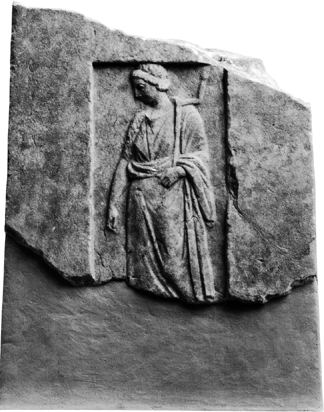
And so into the theatrical setting of the symposium enters a female character: the priestess Diotima.
Diotima is, I am sure, used to some extent as a mouthpiece for Platonic ideals – voicing ways to build the perfect society. (She is one character who is a free and equal participant in Plato’s Symposium, and, atypically, she is a woman.) It is useful to have a woman here in Socrates’ symposium because the discussion is so much about the male/female act of fertilisation and then the female business of gestation and parturition. There are complex discussions of how what we would describe as ‘heterosexuals’ and ‘homosexuals’ give ‘birth to beauty’, through children and through accounts of virtue, respectively – the former via pregnancy of the body, the latter via pregnancy of the soul. Relationships with beauty and beautiful things can lead to a bigger and better kind of beauty. You can see why Socrates lends himself so well to Judaeo-Christian and Islamic philosophy; positively seeking out good here on earth brings about the good of mankind and the good of the hereafter. Unfortunate, perhaps, that Socrates’ respect for the opinions and standing of this priestess character did not also prove tenacious within the later iterations of the monotheistic religions that supplanted paganism, nor unassailable within Golden Age Athens itself. Because the character of Diotima tells us much about the value of women both then and now.