2

Athens, 800–500 BC, the Archaic period
For Athens I say forth a gracious prophecy –
The glory of the sunlight and the skies
Shall bid from earth arise
Warm burgeoning waves of new life and glad prosperity.
Aeschylus, Eumenides, 922–61
THERE HAD BEEN A SETTLEMENT AT Athens since pre-history. Between around 2100 and 1000 BC, the time described by archaeologists as the Bronze Age, but thought of by the classical Greeks as ‘The Age of Heroes’,2 men and women encamped on the Acropolis – the great lump of red-cretaceous limestone that improbably juts out of the Attic plain. Early Athenians lived and worshipped here. Eventually the prehistoric community started to sleep and eat in the shadow of the Acropolis as well as atop it. As time went on these lower settlements expanded, there was a degree of town-planning, a community with an identity was established. Athens could now call herself a polis, a city-state. The Acropolis itself, rising 230 feet above sea-level, believed to hold sacred powers, was predominantly a home for the god-tribe – when humans sheltered high on this geological fortress it usually meant that the city was under attack or in crisis.
Socrates’ Athens was axiomatic: history began with geography. Greece in his time, Hellas (as it was and still is known), was a loose connection of close on 1,000 seperate poleis or city-states. These city-states – originally a coalition of neighbouring families and tribes who gathered together around a central locale for self-protection – were isolated from much of Europe by mountains and from Asia Minor by the sea. Each Hellenic polis (with populations of anything from 1,000 to 30,000) was, typically, run as a republic. Kings had been all but lost with the downfall of the Bronze Age – the epoch immortalised by literary hero-leaders such as Menelaus, Agamemnon, Priam, Ajax. Philosophy and literature from across the period (found in the works of the poet Hesiod, the law-giver Solon, the historian Herodotus, the dramatist Sophocles, inter alios) indicate that all sense of society revolved around this polis, this collective whole. Morality meant the goodness of the community; loyalty to the city-state was paramount. Farmercitizens, rather than following one military leader, together defended their poleis (their cities) – frequently against the hoplites (armed foot soldiers),3 of another.
‘Man is a political animal.’ Pride bursts from Aristotle’s voice. The Hellenic unit of society (polis is the root of our word ‘political’) fostered, without a shadow of a doubt, a sense of community and commonality. And within that polis there were men – embodied in the sturdy Farmer of Hesiod’s Works and Days – who valued personal independence above (almost) everything, who fought hard against the smothering rule of aristocratic factions and despots, who made democracy a possibility. The poems of Hesiod show us that these Greeks had a fierce sense of self-reliance – if you were dependent on someone, or on the work of others, you were a kolax (a flatterer) or a parasitos (a parasite).4 Hesiod’s ideal Greek man works, works and works. He is industrious to a fault – he strives to better himself and the lives of his immediate neighbours.
Take fair measure from your neighbour and pay him back fairly, with the same measure, or better, if you can.5
The Greek – the Hellene – was loyal first and foremost to his city, and then to a loose notion of ‘Greece’, or rather ‘Greekness’. A Hellene was Hellenic because he was Hellenic rather than barbaric; Greek rather than barbarian. Barbarians, in the eyes of the Greeks, were those who talked gibberish, who literally bar-bar-bared in their own language: Lydian, Persian, Thracian, Nubian, Goth, they came from all points of the compass.
The Greeks cheerfully demonised the way these ‘others’ ran their own affairs. They despised the monomaniacal autocracy of eastern super-kings, the slavish devotion to political orthodoxy, the dynasties of ruling classes of priests. They had to hate them, because these barbarians had become their enemies. Whereas once the whole eastern Mediterranean had been held together by the notion of xenia – an unspoken allegiance between the aristocrats of Greece, but also of Anatolia, Egypt, Macedonia – now dividing lines had been firmly traced: one, vertical, ran north and south, following the Bosporus, the other stretched horizontally across the Balkans.6 Mountain ranges – the Carpathians, the Julian Alps, the Dinaric Alps, the Pindus – divided Greece from the rest of Europe; the Aegean and Libyan Seas segregated Greek communities from those in Egypt and North Africa.
This Hellenic land-mass (with satellites on the western shore of what is now Turkey), whose population appears largely to have lost the power of literacy between about 1100 and 800 BC, no longer part of a tight network of trading routes, was, on the whole, left to its own devices. Jealousies between rival city-states festered. Citizen-soldiers, men who farmed in the spring and autumn and fought throughout the summer, now stood side by side and defended their home-town against that of their neighbour. The default position of the Greek polis through the Archaic period was to watch its own back.7 The archaeological evidence tells us that city-states such as Athens were, in the hundred years running up to Socrates’ birth, no strangers to warfare and conflict.

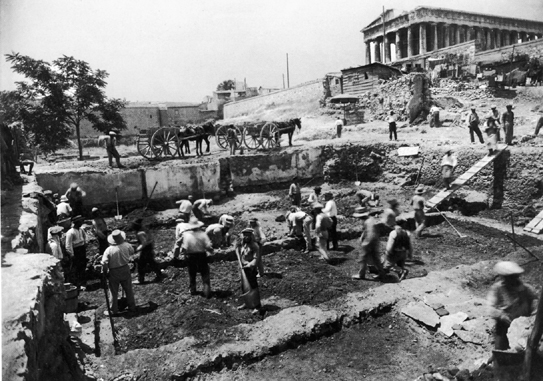
In the mud, scree and debris that rises 15–20 feet above Socrates’ Athens, up from the street level of 2,400 years ago, archaeologists discover, every year, new shards of the philosopher’s city. In 2008 a sliver of a beautiful woman’s stone face was excavated from the gravelly subsoil; within days her outstretched hand was also identified. In 2009 a marble horse’s hind-leg was found just 30 inches below the surface; even more recently, limestone flowers have been unearthed. These amputated bits and pieces are remnants of the fine decoration that once rimmed the great Parthenon temple up on the Acropolis: classical stoneworks that were carved and hoisted into place when Socrates was still alive. Work on the Parthenon of Socrates’ day was begun in 447 BC and completed in 432 BC. The woman, the horse, the flowers survived in place throughout antiquity, but were hacked at by offended Orthodox Christians, ground down for lime, and then blown apart in 1687 by a Venetian cannon.8 The firepower was there to attack Ottoman Turks – the occupying power in Athens since 1458 – who by the seventeenth century were using the Parthenon as a mosque and an arms store.
The fragments that archaeologists are now carefully piecing back together have been doubly traumatised. Some of the earlier sculptures that have come to light were bruised by ancient Athens’ bullying nemesis – the superpower that harried Greek lands through the sixth and fifth centuries BC: Persia. In 480 BC and again in 479 Persian forces breathed down the very necks of the Athenians; a Persian garrison occupied the Acropolis itself, and Persian forces smashed and burned all they could find there. Persians – powerful, ambitious, greedy for land and human booty – had been the enemies of Athens for a hundred years. By 522 BC the Persian Empire stretched from the Balkans to the River Indus. The size of the Persians’ geopolitical appetite can be measured by the words carved high into the rockface at Behistun beside the royal road to Babylon. In three languages, Akkadian, Old High Persian and Elamite, their ruler at this time, King Darius, thunders:
I am Darius the great King, the king of kings, the King of Persia, the king of all lands … so says Darius the King … these lands obeyed my rule. Whatever I told them to do, was done …9
A cousin of the next Persian leader, Xerxes – who invaded Athens just a decade before Socrates was born – was reported to have roared that he would ‘complete the enslavement of all the Greeks’.10 It is impossible to understand Socrates’ life without appreciating the bogeyman horror that the Persians represented to all Athenian citizens. Persian diabolics would come to be contrasted with Greek heroics. Socrates was a child when, at last, the Eastern threat appeared to have receded: after Persian forces had been conclusively defeated by a collection of Greek allies, Athenians, Corinthians, Spartans et al., at the Battles of Salamis and Plataea. ‘Liberty’ had become the watchword of all Athenians; a freedom not to be enslaved or oppressed by the ‘dog-barbarians’ of the East. As Socrates grows up there is a sense, clearly, that a new age is dawning. The greatest despot in remembered history – Persia – has been thwarted, and the dream of people-power has become conscious. Socrates is born when the world is different. Because Athens is entertaining an extraordinary new ideology: democracy.
Demos-kratia
and a new town for a new democracy,
508–404 BC
May the people who hold the power in the polis maintain their office confidently: a system of rule that looks ahead and concerns itself with the welfare of the community.
Aeschylus, Suppliant Women, 698–700
When Socrates was growing up, we should try to imagine the flurry of papyrus sheets on workbenches and the fingers sketching in the dirt as draughtsmen and architects laid out plans for their new, newly democratic city. Stylus pens have been found deep in the earth all around the Agora. Project leaders would have been appointed, and slave-labourers briefed. Masonry blocks were laid one on the other to give a physical incarnation to the democratic ideology. A new, voguish, solid, round limestone building, theTholoschamber, gave nightly dinners to fifty of those who served on the Boule – Athens’ council. Five hundred ordinary men were picked by lot to meet here to administer the business of the Athenian Assembly for the space of one year.11 In the sturdy, rectangular council chamber itself, the bouleuterion, and also in the Agora, business was prepared for the Assembly’s citizen-politicians. The Assembly hovered like a stone cloud above the Agora – its home, known affectionately as the Pnyx, the ‘packed-place’, a natural, limestone-smooth auditorium where all Athenian citizens could decide how their polis should be run.
Greece already has a close-on-1,000-year-old written history at the moment we pick up Socrates’ story – and in that history the powerful persecute the weak, might is right and tyrants lead men. Warlords and high priests dominate society. Ordinary men may have access to councils of peace and battle, but the final decision is never theirs.
Democracy is the most thrilling of developments. Now, for around 50,000 or 60,000 (the number varies, depending on population size through the fifth century BC) adult, male, Athenian citizens, not only could their voice be heard, but they could actively mould their society. You, your brother, your father, your son, could choose which issues were important to debate, which vital to legislate. The city built around Socrates was designed to keep democracy alive. Democratic Athenians did not serve the state, they were the state: its army, its executive, its judiciary.
Demos had for much of its history been a dirty word. Hoi polloi, the people, the great unwashed, were something to be feared, to be mistrusted. But Socrates witnessed an extraordinary human development. Instead of kings and tyrants, instead of councils of elders and aristocrats, the demos – the people – were now in charge. Over a period of a hundred years a massive rupture had taken place in life on earth. Men in one city-state, Athens, had agreed, collectively, to rule themselves, and to be ruled in turn.12
The conditions for change were there in the place we now call Greece. Throughout the Archaic period, in the eighth and seventh centuries BC, Greece lay on the edge of things. Those unfortunate enough to live through ‘interesting times’13 were to be found on the other side of the Bosporus: Assyrians, Medes, Babylonians – all contained, as our story begins, within the vast Persian Empire. Many Greeks on Asia Minor’s western seaboard lived under Persian rule. But mainland Greece had always been truculent geographically. Too many islands, too many shores; mountains too high to conquer easily. Greek colonists might be establishing settlements right across the eastern Mediterranean, but there is an admission that, in spirit, the Greek world has shrunk.14 Men are no longer achieving that which the heroes of the Age of Heroes once did; they are not walking through palaces decorated with lapis lazuli from the Caucasus, not sitting on rock-crystal thrones, not boasting that they possess the most beautiful women in the world, that they are thalassocrats, ‘rulers of the sea’. For centuries there has been a sense of waiting; of suspended animation. But Socrates has been born into a time and place where all that has changed.
In 594 BC the Athenian poet and law-giver Solon had already made bold attempts to make society work well. Sick of the filibustering influence of a network of aristocratic families, he instituted a series of reforms. He reduced the reach of those who had ‘pushed through to glut yourselves with many good things.’15 He broadened Athens’ power-base. Up on the cluster of polished limestone rocks – the areios pagus (hence Areopagus) – just in the shadow of the Acropolis, a broader-based council now sat whose role it was to protect the interests of the people. The men on the areios pagus were elevated, as close to the sacred inhabitants of the Acropolis as they were to mere mortals. Yet Athens’ political reforms – founded on a Hellenic philosophical bedrock of justice and wisdom – paved the way for Athena’s city to be stand-out progressive.
Some of the resulting laws from Solon’s new political vision would play happily in any modern new-town development. Houses, walls, ditches, beehives and certain kinds of trees had to be an acceptable distance from your neighbour’s property. You could not speak ill of the dead (or indeed the living). These reforms – which convey a sense both of solidarity and of self-determination – are a charming mix of the ultimately ideological and the extremely pedestrian. Solon was estimated a wise man, a sophos. He respected the common man’s timē – his honour. But this revolution was circumscribed, this revolutionary was no democrat, he was an oligarch – a man who believed that the oligoi, the few, should maintain control, he had no desire ‘to stir up the milk and lose the cream’:
This is how the demos can best follow its leaders
if it is neither unleashed nor restrained too much
For excess breeds hubris, when great prosperity comes
to men of unsound mind.16
Solon had no taste for tyrants, but he helped those who could help themselves. Even though the foundations of a new political order had been laid, political life was still dominated by the ambition of rival aristocrats. We can meet them today on the lavish gravestelai (stone blocks) they commissioned to outdo one another, monuments that would be ostentatiously raised along the roadsides of Athens. Between one and six feet high, these soft yellow stones are monolithic snapshots of the past. On the stelai in the Piraeus Museum well-bred, well-fed, well-formed men caress their peers; lavishly draped fathers crown sons with laurels. In the National Archaeological Museum six young, upper-class athletes on the base of a funerary monument play a game similar to hockey. The atmosphere is jovial, but the hunch of their carved backs gives away the deadly seriousness of the competition.17 Without kings in Athens, the balance of power was constantly shifting between one family and another as they jostled to gain the upper hand.
It was during one particularly rancorous squabble, a scant ninety years after Solon’s reforms, between the pro-Spartan Isagoras (an aristos with kratos – a high-born man with power) and the pro-demos, pro-Athenian Kleisthenes that, at the very end of the sixth century in Athens, a Rubicon was (prematurely) crossed.
Isagoras had invited the Spartan army, led by King Kleomenes, into Attica and then on into Athens to oust Kleisthenes – who had a particular taste for reform.18 But Isagoras had miscalculated the mood of the moment. The Athenian people had got wind of Kleisthenes’ more demotic tendencies and liked the sound of them. Returning from exile, Kleisthenes found he had a groundswell of support in his mother-city.
And thus, in 508 BC, the people of Athens did an extraordinary thing. Sheltering the Spartan king Kleomenes – ally of that bullish aristocrat Isagoras – the Acropolis was suddenly, violently occupied by hoi polloi, the common crowd. The polloi (the many) besieged the Spartan king for three days. Kleisthenes had little taste for making his personal struggle with Isagoras another tale for the rhapsodes – the tellers of epic tales who sang the deeds of great warrior men. His was a more pragmatic plan. Herodotus, the ‘Father of History’, records the moment – and you can hear the emotion in his voice as he does so, a mixture of horror and awe:
Then Kleisthenes took into his faction the common people.19
By storming the Acropolis with Kleisthenes’ blessing and support, ho demos, ‘I, the people’, for the first time in recorded history, acted as one, as a political agent.20
And thus a thing that will be called demos-kratia, ‘people-power’, had been invented. The word was first used, as far as we know, in 464/3 BC, but quickly caught on. Wailing newborn boys, signs of the times, were baptised Demokrates.21 Herodotus rolled the words around in his histories like a child tasting something new, something suspicious; the actors of Aeschylus’ Suppliant Women, performed in 463 BC, beat out the concept in poetic metre: ‘demou kratousa cheir’ – ‘the demos’ ruling hand’; ‘to damion to ptolin kratunei’ – ‘the people which rules the polis’.22
The impassioned, emotional way that the people dealt with this new creature in their midst, this female quality demokratia – literally, the power, the grip of the people – was to fetishise her. As with other, troubling, slippery, nebulous concepts (nemesis – retribution; themis – order or divine right; peitho – persuasion), she was personified as a woman. Law-courts were reformed in her name, territories seized. Demokratia became a concept that was potent, promiscuous and manipulated. Even immature, Democracy’s name was taken in vain by orators keen to demonstrate that Athens bettered her non-democratic neighbours. Foreign policy became a series of ideological fixtures: Democrats vs Tyrants, Democrats vs Oligarchs. By 333 BC Demokratia was being worshipped as a goddess.23 For a territory that had been living by aristocratic warrior codes for at least 2,000 years, the rate of change was exponential.
Democracy in Athens in the fifth century was – there is no doubt – a radical development. Every male Athenian over the age of eighteen could, by right, attend the ecclesia, the Assembly, which convened about once a month, usually on that raised, natural limestone auditorium close to the Acropolis, the Pnyx. Up here, where the sun beats hard and the clouds feel close, the active Athenian citizen had the chance to make direct decisions about his city-state’s affairs and ethos: should Athens go to war? What is an acceptable rate of tax? What the best penalty for rape? High offices, influential positions, were held by ordinary men, selected at random, on a daily basis. We say a week is a long time in politics: for democratic Athenians, political life could be conceived and terminated in the span of one day.
Stage-set democracy
Complicated systems were developed to ensure fairness in all things. Public officials, juries, state administrators were all chosen by lot. The selection process was closely scrutinised to prevent tampering or corruption. Public records were displayed on inscribed stone and inked papyrus notices across Athens – the workings of the democracy were expected to be transparent. Old dynastic ties were weakened by law. Showy displays of wealth were frowned upon. Athens had built itself a robust and ground-breaking political system, and now architects put their minds to how they could create spaces and buildings and courtrooms and walkways that enabled a direct, participatory democracy to thrive. Socrates grew up inhabiting a purpose-built democratic landscape – the first of its kind in history. On his journey through the Agora and into the law-court, Socrates and those who had come to judge him were shadowed by dramatic, physical reminders of the brave democratic idea.
These buildings are still being excavated today. Twenty feet below street-level next to the cheap and cheerful tavernas at the bottom of Adrianou Street in central Athens, the massive Doric columns (so far the internal Ionic columns are squashed under a family business that refuses to budge) of the Stoa Poikile – the Painted Stoa – are rising back up out of the earth. At least 140 × 40 feet, this grand covered walkway would have been decorated with outsize painted wooden boards – each scene representing the defeat of Athens’ enemies by honest-to-god Athenians. The Persians are thwarted at Marathon, Amazons are hacked down. Here ordinary citizens of Athens, just at the edge of the main political zone in the city, in the balm of the shade, were encouraged to walk and talk, to buttress the business of living in this radical democracy, with a cool packed-earth floor beneath them.
But there was a problem. Emphasis on the power of speech in this new democracy where every male citizen had, in theory at least, a voice also engendered a cult of personality and mass jealousy towards high-flyers. The democratic reformers, Solon, Kleisthenes and then later Ephialtes and Pericles, might have papered over the cracks in society, but the divisions between aristocrats and hoi polloi, between rich and poor, between the talented and the unexceptional, the ‘few’ and ‘the many’, had not been filled. Socrates’polisseemed robust, but was in truth a chimera, a morphing thing. As Socrates grew up, from babe-in-arms to toddler and then child, democracy too was finding its feet. Towards the end of the philosopher’s life the democratic experiment would prove as divisive as it had originally been cohesive. Socrates lived through fragile, politically jumpy times.24
And there was one polis, 150 miles deep into the Greek mainland, the Peloponnese, which despised Athens’ democratic revolution with a particularly fierce and bitter loathing. This city-state spotted the internal divisions within Athena’s great city and chose to play them to her own advantage. Socrates was in fact fascinated by this polity and her extreme ideas, but in truth she was a polis that would prove to be both the philosopher’s and Athens’ nemesis. Her name was Sparta.
Sparta
Socrates’ story is a tale of two cities, of Sparta and Athens.
Three days’ brisk walk south of Athens, a three-hour drive today, sat the polis of Sparta – in the region of Lakonia. Sparta was Athens’ sometime ally and oft-time enemy.
During Socrates’ lifetime the city-state of Sparta had legendary status. Protected by five mountain ranges and a shroud of secrecy, this was a place where another social revolution had taken place, but with rather different results. By the time of Socrates’ birth, Sparta had become one of the most extreme city-states in the whole of Greece.
The Spartan landscape lulls one into a false sense of security. On a spring day it is fragrant with almond blossom, in the summer with oranges ripening in orange groves. The River Eurotas, high-reeded, fed by bubbling tributaries, winds through Sparta’s river plain. Land here is flat and fertile – a rare commodity in Greece. The Tayegetan mountain range all around keeps its snow long into the summer. Stretching over 5,000 square miles, ancient Sparta was the largest city-state in Greece. But this was a Shangri-La with a rock-hard heart.
Sparta had trumped Athens in the political reform stakes. When the Athenian democratic experiment was still 200 years in the future, the Spartans revolutionised their society. As early as the seventh century BC Sparta had undergone a massive social and political head-shift. All land was shared equally amongst the homoioi – the equals – an elite group of supercitizens. These men had no profession other than to be crack soldiers; between the ages of seven and thirty all males lived together in a brutal military training camp called the syssition. Boys were raised in the agoge – the word means ‘a herd’ and they were indeed treated like animals. Given one cloak to wear all year round, taught to fend for themselves in the woods that still fringe the city, bare-footed, they had one sole purpose in their lives: to grow up to be perfect warriors. Spartan men were commemorated with a headstone only if they died in battle, Spartan women if they died in childbirth.
The Spartans believed that all Spartiate men (that is, all full, male Spartan citizens) should hold land and wealth equally. That all decisions should be made for the betterment of the city-state, and that the individual counted only as a healthy part of a supra-healthy whole. No Spartan adult worked – he devoted himself simply to being the ‘perfect Spartan’. The homoioi (on average there were 8–9,000 of these ‘equals’ in the city-state at any one time) could afford to live so exclusively and with such unilateral focus because close to 725 BC the Spartans had enslaved another entire Greek people, the Messenians, to be their heilotes – more than just slave or servant, helot translates as ‘captive’. It was by the sweat of this captive race of Greeks that the Spartans made their city-state great. Messenia had at one time owned wide and fertile territories. The Spartans deprived them of all land and all rights. The Messenians became a non-people, Messenia became an ex-city-state. These helots, once free men, lived and died only to serve their Spartan masters.
In Sparta, obedience was all. Citizens had to adhere to a curious set of rules. Coined money, moustaches and prostitution were banned. The ‘national dish’ was melas zomos, black broth – an unappetising stew made from boiled pig’s blood and vinegar. Babies (we are told) were bathed in wine to toughen them up, girls were encouraged to train to fight and to eat the same rations as their brothers and boy cousins. Secret societies of Spartan youths, the krypteia, were sent out at night to kill and maim the under-class of helots at will. And secrecy was paramount in all things. Spartans were not allowed to talk about the workings or culture of their polis, and foreigners were frequently expelled.25
The Athenians decided to despise Sparta and all that it stood for. Although the two city-states, once described as ‘yoke-fellows’, had been allies against the Persians, and the only two poleis who refused to bring King Darius symbolic offerings of earth and water, as time went on the democracy recoiled from Spartan statecraft, which was totalitarian in tone. Athenian rhetoric, Athenian superiority and Athenian transparency came to be measured against Spartan secrecy and degeneracy.
There is a great difference between us and our opponents … Our city is open to the world, and we have no periodical deportations in order to prevent people observing or finding out secrets which might be of military advantage to the enemy. This is because we rely, not on secret weapons, but on our own real courage and loyalty. There is a difference too in our educational systems. The Spartans, from their earliest boyhood, are submitted to the most laborious training in ‘courage’; we pass our lives without all these restrictions, and yet are just as ready to face the same dangers as they are.26
Ideologically, militarily, culturally, Sparta and Athens would, in hindsight, be certain to cross swords.
In Socrates’ lifetime the climax of Spartan/Athenian rivalry would judder throughout the Greek world; it was a conflict responsible for decimating the Athenian population by the time of Socrates’ trial. This trauma the Ancient Greeks simply called stasis – strife, discord – but we now label it ‘the Peloponnesian War’. The war lasted a full generation, from 431 to 404 BC. Come the year of Socrates’ death, it was Spartan brawn that had broken down Athens’ city walls; Spartan fires that had torched the precious stretches of farmland outside the city walls. The war devastated the earth’s very fertility, it caused the deaths of many hundreds of thousands. The territories that Socrates travelled through as a soldier were blackened with the back-fires of aggression. The young men that Socrates exercised with in the gym and with whom he debated – these were the children of strife, they grew up knowing nothing other than conflict.
And so when Socrates walked through the Agora to his trial in 399 BC he was surrounded by war damage and by a community that had been psychologically traumatised. When he was tried, Athens, which had once achieved so much, was a defeated society. The milk-and-honey promise of the democracy had curdled. Athenians were no longer champions of the world, they were the defeated. We can trace the disintegration of the polis in the woeful lines of Sophocles, Euripides and Aristophanes, Athens’ playwrights, the men who documented Athens’ trauma:
War will be men’s business.27
So those men, who waxed so proud with bitter speech, are themselves in the mansions of the dead, all of them, and their city is enslaved.28
For here begins trouble’s cycle, and, worse than that, relentless fate; … with trouble from an alien shore … as its result war and bloodshed and the ruin of my home; and many a Spartan maiden too is weeping bitter tears in her halls on the banks of the fair Eurotas, and many a mother whose sons are slain is smiting her grey head and tearing her cheeks, making her nails bloody in the furrowed gash.29
Although Socrates’ professed concern was with the moral fundamentals of life, it was this tangled web of realpolitik and rival beliefs, of conflict and anxiety, that drew him to a religious court to defend himself against capital charges.
Yet war can stimulate as well as destroy. Before it drew to a close, the fifth century BC witnessed the most remarkable resilience and a breathtaking cultural efflorescence. Democracy in Socrates’ day provoked rational thought, artistic experiment and wildly ambitious social and political schemes. During the fight with Sparta some of the most exquisite buildings – buildings that we consider to be the epitome of classical achievement – were constructed. Although maimed and denuded on that May morning in 399 BC, for much of Socrates’ life Athens was a beautiful city. And the Athenian Agora in particular, Socrates’ favoured stamping-ground, was one of the most exciting, if not the most vivacious and eye-opening of places to visit the length and breadth of the ancient world. The Agora, 37 acres of human endeavour, rimmed with boundary stones, was Socrates’ second home. To appreciate why the philosopher enjoyed such influence and earned such hatred, we need to join him there once again as he travels, in 399 BC, to his show-trial.