
NINE
If the special interest of the investor is liable to clash with the public interest and to induce a wrecking policy, still more dangerous is the special interest of the financier... These great businesses—banking, broking, bill discounting, loan floating, company promoting—form the central ganglion of international capitalism. United by the strongest bonds of organisation, always in the closest and quickest touch with one another, situated in the very heart of the business capital of every State, controlled, so far as Europe is concerned, chiefly by men of a single and peculiar race, who have behind them many centuries of financial experience, they are in a unique position to manipulate the policy of nations ... Does anyone seriously suppose that a great war could be undertaken by any European State, or a great State loan subscribed, if the house of Rothschild and its connexions set their face against it?
Every great political act involving a new flow of capital, or a large fluctuation in the values of existing investments, must receive the sanction and the practical aid of this little group of financial kings ... As speculators or financial dealers they constitute ... the gravest single factor in the economics of Imperialism ... Each condition ... of their profitable business ... throws them on the side of Imperialism ... There is not a war, or a revolution, an anarchist assassination or any other public shock, which is not gainful to these men; they are harpies who suck their gains from every sudden disturbance of public credit... The wealth of these houses, the scale of their operations, and their cosmopolitan organisation make them the prime determinants of economic policy. They have the largest definite stake in the business of Imperialism, and the amplest means of forcing their will upon the policy of nations ... [F]inance is ... the governor of the imperial engine, directing the energy and determining the work ...
J. A. HOBSON, IMPERIALISM: A STUDY (1902)
Decline is a relative concept. Compared with their commanding position in the international capital market before 1880, the Rothschilds unquestionably declined thereafter. Compared with rival banks, they were less profitable and grew less rapidly. Yet as table 9.i shows, the Rothschilds remained in absolute terms a formidable financial force even on the eve of the First World War. N. M. Rothschild & Sons was far and away the largest private bank in the City of London in terms of capital. This dominance is even more impressive if one recalls that the London house was still just one of four Rothschild houses. Illustration 9.i shows the combined capital of the Rothschild houses according to successive partnership contracts. Between 1874 and 1887 it rose from £34.4 million to £38.0 million, and reached a peak of £41.5 million in 1899. In 1904, the last year for which combined figures were drawn up, it was still £37.1 million. If capital had not been withdrawn after 1898, the total capital would have been in excess of £45 million. This made N. M. Rothschild not only the biggest private bank in London, but one of the biggest banks of any kind in the world. In 1881 seventy-one different credit establishments were quoted on the Paris bourse with a paid-up capital of 1.49 billion francs: the combined Rothschild houses alone had capital not far short of a billion francs and the Paris house—with capital of 590 million francs—was still one of the biggest French banks. In 1913 the total share capital of the five German great banks (the Darmstädter, the Disconto-Gesellschaft, the Deutsche, the Dresdner and the Berliner Handels-Gesellschaft) totalled 870 million marks (£43 million)—not much more than the combined capital of the Rothschild houses a decade before.
Of course, the Rothschilds’ balance sheet was substantially smaller than that of the big joint-stock deposit banks. The biggest British “clearing” bank, the Midland, had deposits worth £125 million on the eve of the First World War, compared with an equivalent figure for the London house (assets minus capital) of just over £14 million. For Deutsche Bank—the biggest German bank in 1914—the figure was £74 million. But this does not compare like with like. The Rothschilds had never been interested in taking deposits. Their principal concern was to use their capital as the basis for large-scale bond market underwriting, attracting outside funds directly into new securities, rather than soliciting deposits.
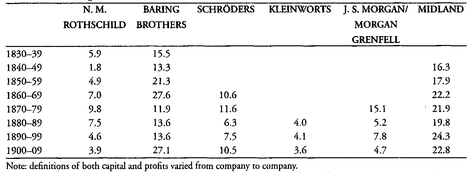
The less impressive difference between the Rothschilds and their rivals was that the former were less profitable in relative terms. Table 9b allows a more systematic comparison with five other major City banks. It shows that the London house’s average profits as a percentage of capital tended to decline from a peak of 9.8 per cent in the 1870s to just 3.9 per cent in the decade 1900-9. The Rothschilds, it seems, played safe: with their enormous accumulation of capital inherited from the previous generations, Natty and his brothers apparently felt under no pressure to aim at the kind of high returns achieved by Barings or Schröders, much less a joint-stock bank like the Midland. Figures for acceptances between 1890 and 1914 also show the London house lagging behind Kleinworts, Schröders and Morgan Grenfell, and even being overtaken by Brandts and Hambros after 1910. Annual acceptances by N. M. Rothschild for the period 1890-1914 averaged £2.7 million, compared with £5.6 million for Barings, £7.2 million for Schröders and £9 million for Kleinworts, the market leader. In terms of assets, the available balance sheet figures show Barings and Schröders rapidly gaining on N. M. Rothschild in the decade before 1914. In 1903 assets at New Court had totalled £25 million, compared with £10.3 million at Schröders and £9.9 million at Barings. Ten years later, the Rothschild total was more or less unchanged, while Schröders had increased their balance sheet to £19.1 million and the figure at Barings had risen to £15.8 million.
9.i: Combined Rothschild capital, selected years (& thousand).
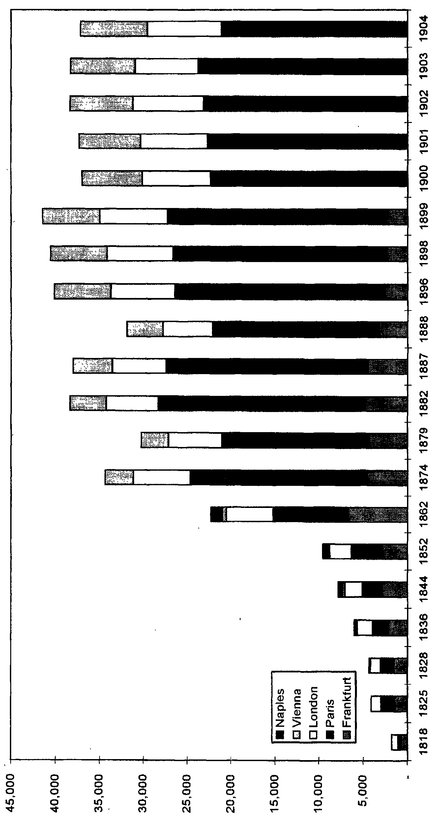
Table 9a: Capital and acceptances of N. M. Rothschild & Sons and other City merchant banks, 1870-1914 (£ million).
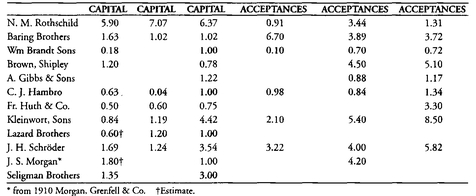
Sources: RAL, RFamFD/13F; Cassis, City, p. 33; idem, City bankers, pp. 31f.; Kynaston, City, vol. I, pp. 312f.; vol. II, p. 9; Chapman, Merchant banking, pp. 44, 55, 121f., 200f., 208f.; Roberts, Scbroders, pp. 44, 57, 99, 527-35; Ziegler, Sixth great power, pp. 372-8; Wake, Kleinwort Benson,pp. 472f.
Another indicator of relative decline is the fact that, in terms of individual wealth, the Rothschilds ceased to be exceptional. Natty was the richest of his generation of English Rothschilds (leaving £2.5 million when he died in 1915); but at least thirteen British millionaires in the period 1890-1915 left as much as or more than him. Across the Atlantic, Junius Morgan had already left that amount when he had died in 1890. When his son Pierpont died in 1913, the estimated net value of his estate, excluding his art collection, was $68.3 million (£14 million); including artworks, his fortune was closer to £24 million. Small wonder the Morgans partner Clinton Dawkins felt like bragging in 1901:
Old Pierpont Morgan and the house in the U.S. occupy a position immensely more predominant than Rothschilds’ in Europe ... Taken together, the Morgan combination of the U.S. and London probably do not fall very far short of the Rothschilds in capital, are immensely more expansive and active, and are in with the great progressive undertakings of the world.—Old P Morgan is well over 60 ... [but he has] behind him ... young Morgan, under 40 with the makings of a biggish man, and mysetf.—The Rothschilds have nothing new but the experience and great prestige of old Nattie ... Therefore, provided we can go on and bring in one or two good men to assist the next 20 years ought to see the Rothschilds thrown into the background and the Morgan group supreme.1
A number of qualifications need to be made, however. Firstly, if the figures for the period 1830—69 are taken into account, the performance of N. M. Rothschild & Sons after 1879 was not in fact markedly worse than it was for the period before. The 1870s were an exceptional decade; the period before and the period after did not greatly differ from one another. To speak of decline relative to the past is therefore misleading. Secondly, by continuing to play safe, the Rothschilds were safe. The story of Barings presents a profound contrast in this period. The figures in table 9b also reflect the extent of the rival bank’s contraction as a result of the 1890 crisis; Barings’ high profit rate was partly a function of its dangerously narrow capital base.
Table 9b: Profits at six major London banks as a percentage of capital, 1830-1909 (decennial averages).
Sources: RAL, RFamFD/13F; Roberts, Schröders, pp. 44, 57, 99, 527-35; Ziegler, Sixth great power, pp. 372-8; Wake,
Kleinwort Benson, pp. 472f.; Burk, Morgan Grenfell, pp. 260-70, 278-81; Holmes and Green, Midland, pp. 331-3.
The Rothschild combination of relatively low profitability and longevity recalls Friedrich Gentz’s illuminating point made as early as 1827 that one of the two fundamental Rothschild principles was:
never to strive for excessive profits in their undertakings, to give each of their operations clear limits and, no matter how much human ingenuity and caution it may require, to insulate themselves from the play of happenstance. In this maxim lies one of the chief secrets of their strength. There is no question that, with the means at their disposal, they could achieve far higher returns on this or that operation. But even if doing so would not have compromised the safety of their undertakings, they would in any case have made less in the end than they do by distributing their resources over a larger number of transactions which constantly recur and are repeated no matter what the [economic] conditions.
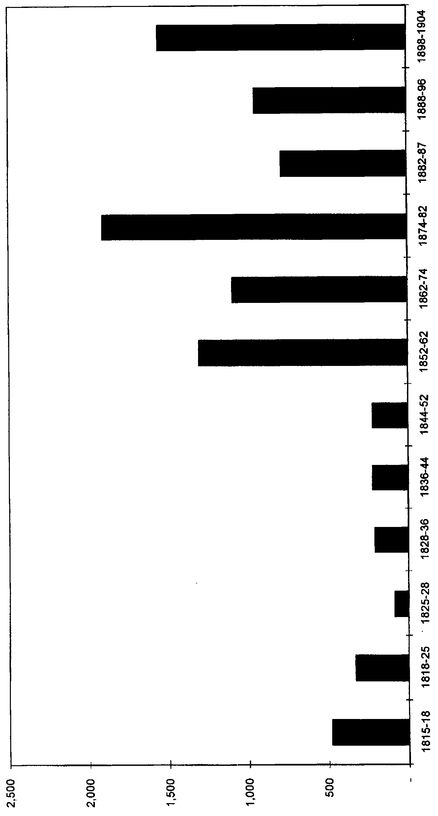
Nor should the fact that N. M. Rothschild fell behind Schröders and Kleinworts in the acceptance market necessarily be interpreted as a sign of decline: even if these figures are correct,2 the Rothschilds were never as reliant on acceptances to generate their profits as other London merchants. As in the past, they concentrated their resources on the bond market and there they remained pre-eminent. Finally, the profits of the London house should not be looked at in isolation from those of other houses, a substantial part of which continued to be shared between the various partners. The profits of the combined Rothschild houses are difficult to calculate because of the large sums which were withdrawn as individual partners died, but illustration 9.ii presents appropriately adjusted figures. Once again, the impression is not one of decline: average annual profits slumped—by nearly half—in the depressed years 1874—9 (having exceeded £1 million between 1852 and 1874); but the years 1879—82 seem to have been the most profitable in the Rothschilds’ history (average annual profits were in excess of £4 million), and although this could not be sustained, the trend between 1888 and 1904 was upwards (from £785,000 a year in the mid-1880s to £1.6 million between 1898 and 1904).
There is a useful parallel to be drawn here between the performance of the London Rothschilds and that of the British economy as a whole. For years, economic historians have argued that the British economy after around 1870 suffered from relative decline, noting the more rapid growth of the American or German economies in the period and the decline in Britain’s position as the dominant exporter of manufactures. While some have blamed this relative decline on “entrepreneurial failure” or even a culturally determined “decline of the industrial spirit,” others have identified the City of London as an institutional culprit which impeded the modernisation of Britain’s industry by encouraging excessive levels of capital export in the late nineteenth century. The Rothschilds had throughout the nineteenth century played a major role in encouraging this capital export, and continued to do so right up until 1914. The possibility therefore arises that Natty can be blamed not only for the decline of his own firm, but for that of the British economy as a whole.
The reality is that the decline of the British economy, like the decline of the Rothschilds before 1914, has been exaggerated. Capital exports were only starving British industry of investment if it can be shown that there was a capital shortage inhibiting firms from modernising their plant; there is little evidence to support this view. In fact, the high level of capital export from Britain was an integral part of the British economy’s global role as an exporter of manufactures, an importer of food and other primary products, the lender of last resort in the international monetary system, a major exporter of skilled colonists and, not least, the imperial guarantor of law and order on most seas and vast tracts of land (9.5 million square miles in 1860; 12.7 million in 1909). To measure the costs and benefits of this system too narrowly—in terms of the prosperity of those Britons who remained within the British Isles—is to miss the point. Some 444 million people lived under some form of British rule on the eve of the First World War: contrary to the nationalist propaganda of the decolonisation era, British statesmen could not and did not make economic policy solely for the benefit of the 10 per cent who happened to live in the United Kingdom. While the profits of overseas expansion unquestionably flowed to a relatively small elite of investors, the broad “multiplier” effects of British-financed investment and trade were felt far beyond Britain herself. Nor should the costs of governing and defending the Empire be exaggerated; the tax and debt burden incurred by Britain was in fact small relative to the enormous extent of British power and the economic benefits generated by a secure empire of more or less free trade, free capital movement and free migration.
Already by the 1850s British overseas investments totalled in the region of £200 million. In the second half of the century, however, there were three great waves of capital export. Between 1861 and 1872, net foreign investment rose from just 1.4 per cent of GNP to 7.7 per cent, before dropping back down to 0.8 per cent in 1877. It then rose more or less steadily to 7.3 per cent in 1890, before once again falling down below 1 per cent in 1901. In the third upswing, foreign investment rose to an all-time peak of 9.1 per cent in 1913—a level not subsequently surpassed until the 1990s.3 In absolute terms, this led to a huge accumulation of foreign assets, rising more than tenfold from £370 million in 1860 to £3.9 billion in 1913—around a third of the total stock of British wealth. No other country came close to this level of foreign investment: the closest, France, had foreign assets worth less than half the British total, Germany just over a quarter. Britain accounted for something like 44 per cent of total foreign investment on the eve of the First World War. Although there was an inverse relationship between the cycle of foreign investment and that of domestic fixed investment, this high level of capital export should not, however, be understood in crude terms as a “drain” of capital from the British economy. It is also a mistake to see capital exports as in some sense “causing” the British trade deficit to widen. In fact, the income earned on these investments more than matched the export of new capital, just as (when coupled with revenue from “invisible” earnings) it invariably exceeded the trade deficit. In the 1890s net foreign investment amounted to 3.3 per cent of GNP, compared with net property income from abroad of 5.6 per cent. For the next decade, the figures were 5.1 and 5.9 respectively.
9.ii: Average annual Rothschild profits (combined houses), selected periods (&thousand).
Why did the British economy behave in this way? The greater part of overseas investment was “portfolio” rather than “direct” in nature, in other words it was mediated by stock exchanges through sales of bonds and shares issued on behalf of foreign governments and companies. According to Edelstein, the explanation for the “pull” of foreign securities was that, even allowing for the higher degree of risk involved, their yields were rather higher (by around 1.5 percentage points) than those of domestic securities when averaged out over the period 1870-1913. However, this averaging conceals substantial fluctuations. Analysing the accounts of 482 firms, Davis and Huttenback have shown that domestic rates of return were sometimes higher than foreign—in the 1890s for example. Their work also quantifies the importance in the eyes of investors of imperialism, as rates of return on investments in the Empire were markedly different from those on investments in foreign territories not politically controlled by Britain: as much as 67 per cent higher in the period before 1884, but 40 per cent lower thereafter. Was the rising level of British investment abroad therefore an economically irrational product of imperialism—a case of capital following the flag rather than maximum profits? Much modern historiography tends to emphasise the non-economic motivations for the rapid expansion of the British Empire. On the other hand, Davis and Huttenback show that imperial possessions were not the main destination of British investment taken as a whole: for the period between 1865 and 1914, only around 25 per cent of investment went to the Empire, compared with 30 per cent for the British economy itself and 45 per cent for foreign economies. Their work points to the existence of an elite of investors with a material interest in the Empire as a mechanism for stabilising the international capital market as a whole. Late-nineteenth-century imperialism was the political accompaniment to an economic process similar to the “globalisation” of the late twentieth century.
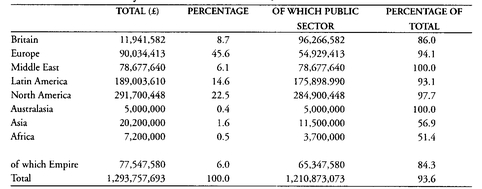
As leading members of that elite of imperial investors, the Rothschilds’ role in British imperialism was substantial. Public issues of foreign securities in London between 1865 and 1914 totalled £4,082 million. N. M. Rothschild & Sons were either solely or jointly responsible for over a quarter of this total (£1,085).4 No other bank could match this, though Barings tried in the 1860-90 period and Pierpont Morgan came close thereafter, with the Seligman brothers not far behind and Ernest Cassel a formidable rival from the turn of the century. Table 9c gives a breakdown of the geographical distribution and type of Rothschild loans issued for the period after 1852.
Table 9c: Loans issued by N. M. Rothschild & Sons, 1852-1914.
Sources: Ayer, Century of finance, pp. 14—81; RAL.
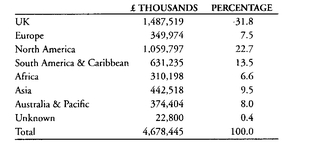
A comparison of the Rothschild figures with the data in Davis and Huttenback (see table 9d) reveals that N. M. Rothschild continued to be far more interested in government finance than in private sector issues. Only around 36 per cent of all “called up” capital between 1865 and 1914 was for governments; the equivalent figure for loans issued by the London Rothschilds in (approximately) the same period is over 90 per cent. (Almost all the rest was accounted for by foreign railway companies.) The extent of Rothschild dominance in government bond issues was astonishing. For the London market as a whole, foreign public sector issues between 1865 and 1914 amounted to £1.48 billion, of which close to three quarters were handled by the Rothschilds solely or in partnership. New Court also remained far more interested in Europe and far less interested in Britain than the London market as a whole, and was under-represented in African, Asian and Australasian issues. Perhaps the most striking difference of all, however, is that the Rothschilds were relatively uninvolved in imperial issues, which accounted for only 6 per cent of their business, compared with around 26 per cent for the British capital market as a whole. Given Natty’s and Alfred’s influential role in the politics of imperialism, this is a highly surprising finding, suggesting that they attached relatively little importance to the Empire as a field for their own private financial activities. To be more precise, they showed no preference for states (for example, Egypt) whose bonds were guaranteed by British financial control over states (for example, Brazil) which remained politically independent. It was therefore quite wrong to say (as Ernest Cassel said of Alfred) that the Rothschilds “would hardly take up anything that did not have the British government guarantee about it.”
In two respects only was the London house “representative” of the City as a whole. North and South American issues accounted for almost exactly the same proportions of its business as they did for the total market. And the Rothschilds shared the City’s relative lack of interest in domestic private sector finance, which accounted for just over 1 per cent of all Rothschild issues (though the Rothschilds had the reputation of being especially indifferent to domestic industry). When Sir Edward Guinness sought to float his Irish brewing company on the stock market in 1886, the London house refused to handle the £6 million flotation, which was snapped up by Barings. The shares and debentures proved immensely popular (they were oversubscribed nearly twenty times) and Barings made a profit on the issue of around £500,000. Yet, when asked by a journalist if he regretted turning the business down, Natty replied: “I don’t look at it quite that way. I go to the House every morning and when I say ‘No’ to every scheme and enterprise submitted to me, I return home at night carefree and contented. But when I agree to any proposal, I am immediately filled with anxiety. To say ’Yes’ is like putting your finger in a machine: the whirring wheels may drag your whole body in after the finger.” This is often seen as epitomising the caution of the fourth generation. Thus, while others reaped substantial profits from financing the construction of the London underground rail network, the Rothschilds kept their distance. Even the idea of a Channel Tunnel—which appealed to the French Rothschilds as a way of increasing the traffic on their Nord line—left Natty cold. “You can take it from me quite positively,” he told his cousins in 1906, “that this measure [the Channel Tunnel Bill] would be rejected by an enormous majority in the House of Lords and it is certainly not worthwhile for you to waste your time or your money on it.”
Table 9d: Geographical distribution of all British capital called up, 1865-1914.
Source: Davis and Huttenback, Mammon, p. 46.
There were some exceptions to this rule of abstention, admittedly. Perhaps seeking to emulate Barings’ success with Guinness, Natty undertook four successive share and debenture issues for the Manchester Ship Canal between 1886 and 1891, worth a total of £13 million. But, as Edward Hamilton commented, the failure of the first of these issues led to “an invidious comparison” being drawn in the City between “Rothschild’s water” and “Baring’s beer.” Even in partnership with Barings it proved impossible to make the second issue a success. Similarly, having been pioneers of rapid communication in the early part of the century, the Rothschilds might have been expected to grasp the significance of an innovation like the telephone. Indeed, they themselves began to experiment with the telephone as a way of communicating between Paris and London as early as 1891. But a share issue of £488,000 the following year for the New Telephone Company was a trifling affair, and it is remarkable that the London and Paris partners continued to communicate with one another by handwritten letter just as their fathers, grandfathers and great-grandfather had done.
All this helps explain why historians have often characterised the Rothschilds of this generation as “conservative” in their approach to finance. (The obvious contrast is with the French house, which remained a major shareholder in railway lines like the Nord.) Yet this critique rests on a misunderstanding of the Rothschilds’ modus operandi and their role in the process of late-nineteenth-century globalisation. There was, for example, one domestic industrial sector in which the Rothschilds did enjoy some success: predictably, perhaps, it was the sector most closely linked to government—derence. And of far greater importance than any involvement in domestic industry and transport were the Rothschilds’ interests in foreign mining and the international market for metals and precious stones (which are discussed in the next chapter).
The Rothschilds’ role in the economics and politics of imperialism should not therefore be caricatured as part of a wider teleology of decline. In many ways, imperialism did not represent a dramatic break with their past success. Foreign public sector investment remained their principal interest, with “home” government borrowing in second place, in so far as France, Austria-Hungary and to a lesser extent Britain were all forced to continue to issue new bonds to finance the rising costs of defending their empires. Here, in the international bond market, the Rothschilds had few if any real equals. Their role in foreign private sector finance (especially railways) was more modest, as was their acceptance business. But their international mining interests, as we shall see, were vast.
As in the past, the Rothschilds continued to have an interest in the continuation and expansion of a global economic system in which capital, goods and indeed people could move as freely and as securely as possible. However, if this could be achieved without political intervention, they were content: thus the long history of Rothschild involvement in Brazil shows that they did not regard formal imperial control as a precondition of profitable capital export. Only where important bonds appeared to be in jeopardy as a result of political instability in the borrowing territory did the Rothschilds support direct political intervention. Their mining interests in Spain and Mexico did not require foreign intervention, despite the recurrent instability of politics in those countries; whereas it is hard to imagine their investments in Burmese ruby mines or New Caledonian nickel mines in the absence of direct European control. The South African case illustrates the ambivalence of Rothschild attitudes to imperialism as personified by Cecil Rhodes: though strongly attracted to gold and diamond mining, they were suspicious of Rhodes’s wilder schemes to extend British political influence north of the Cape colony. Nor is there any sign of a preference for railways in imperial territory.
Generally, the Rothschilds backed British empire-building only when they felt confident that this could be achieved without precipitating conflict with other European powers, or (less often) when they felt that a rival power would impose a more economically restrictive colonial rule if Britain did not act (it was usually assumed that a French or German regime would be more protectionist than a British one, though in reality French and German tariffs were not vastly higher). The desire to avoid international conflict explains the Rothschild preference for what might be called multinational imperialism, where economic interests were guaranteed by more than one European power. The classic illustration is the case of Egypt, where the Rothschilds sought to reconcile conflicting British and French political interests in the shared interests of bondholders of both nationalities. (The Rothschilds were less interested in Greece and Turkey, where such multi-national financial guarantees were also used.) In China too they favoured co-operation between the European powers.
There was, it should be stressed, a certain instinctiveness about all this: while critics like Hobson had theories of imperialism, the imperialists themselves did not. “[I]t is a curious thing,” wrote Natty to Paris in May 1906, “how investors & capitalists dread the stocks of their own countries particularly if they live in Europe.” He had a hazy notion that investors were attracted to “exotics” by their higher yields, and that these reflected the higher risks of investing overseas; but his own preferences for particular regions or sectors appear to have been based in large part on unspoken assumptions. Yet his assumptions about the politics of imperialism were far from unspoken: no member of the family before or since has been more politically active. Here there was an important discontinuity. In the past, the Rothschilds had tended to view politics through the prism of their own financial interests: nearly all James’s interventions in the realm of diplomacy had been based on business calculations. This cannot be said of the members of the fourth generation. Economic self-interest was still paramount; but sometimes Natty and Alfred took positions for “purely” ideological or party political reasons which were unrelated to the portfolio of N. M. Rothschild & Sons, just as they had private interests in areas where imperial control was never a serious possibility. Natty in particular thought of himself as “wearing different hats”: there was one for New Court and one for Westminster (or, as he would have said, one for the East End and one for the West End). The full-time politicians tended to think the same way, though in neither case was the distinction between private and public interest perfectly maintained.
In fact, the politics of imperialism took precedence over economic considerations more often than the Rothschilds themselves may have realised. Although it is undeniably true that they profited from high levels of capital export, in particular cases the fourth generation often allowed national political considerations to take precedence over the collective economic interest of the Rothschild houses. The fact was that the reorientation of British finance away from continental Europe made the Rothschilds’ network linking London, Paris, Frankfurt and Vienna somewhat obsolescent. At the same time, colonial conflicts of interest between France and Britain presented the Rothschild houses with difficult choices. It was in this period that the various houses began to operate more and more independently of one another: these Anglo-French disagreements, and the Austrian indifference to the world outside Europe, help to explain why.
The Financial Politics of Empire: Egypt
The best-known example of Rothschild involvement in British imperialism is the case of Egypt. Famously, it was the London house which advanced £4 million to Disraeli’s government in 1875, allowing the British crown to acquire a substantial shareholding in the Suez Canal Company. Quite apart from the romantic penumbra which surrounds this transaction, this is often seen as the first step down the road towards the British military occupation and financial control of the country after 1882, a process which the Rothschilds also helped to facilitate. Yet the roads to and from the Suez share purchase were far from straight; in many ways the Rothschilds’ role in Egypt illustrates the ambiguities and contingencies which lie behind a historical construct like “imperialism.”
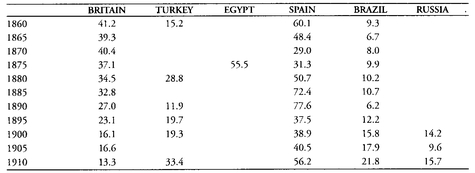
To understand the significance of the hectic events of 1875, it is necessary to know something of Middle Eastern finance. In the aftermath of the Crimean War, both the Sultan in Constantinople and his vassal the Viceroy or “Khedive”5 in Cairo had begun to accumulate huge and ultimately unsustainable domestic and foreign debts. Between 1855 and 1875, the Ottoman debt increased from around 9 million Turkish lire to around 251 million. In relation to the financial resources of the Ottoman government, this was wholly unsustainable: as a percentage of current revenue, the burden rose from 130 per cent to around 1,500 per cent; as a percentage of expenditure, interest payments and amortisation rose from 15 per cent in 1860 to a peak of 50 per cent in 1875. The Egyptian case was similar: between 1862, the date of the first Egyptian foreign loan, and 1876, the total public debt rose from 3.3 million Egyptian pounds to 76 million, roughly ten times total tax revenue; in addition, the Khedive Ismail owed around 11 million pounds on his own private account. The 1876 budget showed debt charges at more than half (55.5 per cent) of all expenditure.
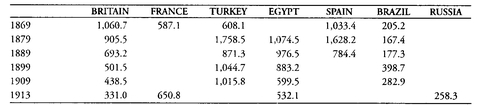
It is worth setting these figures into some sort of comparative perspective, if only to establish an approximate notion of what constituted sustainable borrowing in the nineteenth century. For most of the century (until 1873), the British national debt had been more than ten times total public tax revenue; while debt charges accounted for around 50 per cent of gross expenditure from 1818 until 1855. However, the trend for Britain from the 1840s until 1914 was more or less uninterruptedly downwards, so that by the eve of the First World War, total debt was just over three times total revenue and debt charges accounted for a mere 10 per cent of total expenditure. Moreover, the British economy grew at historically unprecedented rates. In the Turkish and Egyptian cases, debt ballooned in the two decades to 1875 relative to the state budgets, yet economic activity stagnated. Compared with other major borrowers on the international market (such as Brazil or Russia), Turkey and Egypt were out of control. Brazilian and Russian debts were never much more than three times greater than total tax revenue, while debt service typically accounted for less than 15 per cent of total spending. In fact, the closest parallel to the Middle Eastern experience was that of Spain, which also defaulted in the 1870s (see tables 9e and 9f). In the context of the general financial crisis which afflicted all the European markets after 1873, a Middle Eastern debt crisis was thus inevitable.
Table 9e: National debt as a percentage of tax revenues, selected years and countries, 1869-1913.
Sources: Mitchell, British historical statistics pp. 396-9, 402f.; Crouchley, Economic development, pp. 274ff.: Shaw, “Ottoman expenditures and budgets,” pp. 374ff.; Issawi, Economic history of the Middle East, pp. 100f., 104ff.; Levy, “Brazilian public debt,” pp. 248-52; Mitchell, European historical statistics, pp. 370-85, 789; Martin, Rothschild ; Carreras, Industrializacion Espanola, pp. 185-7; Gatrell, Government, industry and rearmament, pp. 140, 150; Apostol, Bernatzky and Michelson, Russian public finances, pp. 234, 239; Hobson, “Wary Titan,” pp. 505f.
Strategic considerations had served to start the ball of indebtedness rolling. It was to support the Ottoman military position during the Crimean War that the first British loans to the Porte were made in 1854 and 1855 (the second of these through the London Rothschilds) and the Banque Ottomaine (later the Imperial Ottoman Bank) was set up in 1856. Both these loans were formally secured on all the Ottoman government’s tax revenues from Egypt. However, European loans to the Middle East after 1860 were principally based on economic calculations. In the case of Turkey, European railway promoters (led by Hirsch) envisaged an expansion of the Austrian railway network through the Balkans to the Bosphorus, thus opening up Turkish markets to new kinds of European commerce; while the French entrepreneur-cum-visionary Ferdinand de Lesseps saw that to realise the ancient dream of a canal between the Mediterranean and the Red Sea would create a vital artery of international trade, shortening the sea route between London and Bombay by more than 40 per cent. The artificial stimulus to Egyptian cotton exports provided by the American Civil War also played a part. Despite the obvious importance of the Suez Canal to British trade with India and the traditional importance attached by British diplomacy to strengthening the Ottoman Empire, it was not primarily British investors who financed the Turkish and Egyptian deficits. In Turkey the lead before 1875 was taken by French banks (notably the Société Générale); in Egypt by the Frankfurt-born financiers Hermann and Henry Oppenheim and the French brothers Edouard and André Dervieu. In the short run, this was presumably profitable business for the issuing houses: by 1877 the Turkish debt had reached 251 million lire, of which, after commissions and discounts, the Treasury in Constantinople had received just 135 million. Far from promoting Middle Eastern economic development, however, the hapless bondholders were merely bankrolling chronically profligate governments. Millions were squandered by the Sultan Abdul Aziz on his luxurious European tour of 1867; still more by his successor Abdul Mejid on the new Dolmabahçe palace, a cross between a seraglio and a Victorian railway station. And even the private undertakings like Hirsch’s railways and Lesseps’s canal proved less profitable than had been anticipated. Indeed, the concessions granted to Hirsch and Lesseps cost the two governments substantially more money than they received.6
Table 9f: Debt service as a percentage of expenditure, selected years and countries, 1860- 1910.
Source: as table 9e.
The Rothschilds’ abstention from involvement in the Middle East between 1855 and 1875 therefore looks prudent with hindsight. We know, for example, that Lesseps approached James seeking support for his canal project as early as June 1854—five months before he secured the necessary concession from the Khedive— but was rebuffed. Landau, the Rothschild agent in Turin, had a brother in Alexandria who worked in tandem with the Oppenheims and sought to lure the Rothschilds into lending to the Egyptian government in the mid-1860s, but in vain. Though the ageing James was tempted, this was one of the rare occasions when his nephew Nat’s risk-aversion prevailed—and with good reason. Although Lionel was directly approached by an Egyptian representative who came bearing gifts in 1867, he politely demurred. By 1869, even as the canal was formally opened, Alphonse was predicting the collapse of the Suez Canal Company and the assumption in London was that the Egyptian government would not be far behind it. The London and Paris Rothschilds took an equally dim view of Turkish financial prospects: Anselm’s interest in extending the Südbahn through the Balkans was evidently not shared by his cousins. When the Egyptian Finance Minister Ismail Sadyk Pasha sought financial assistance from the Rothschilds in 1874, the request was firmly turned down. The most they were willing to do was to make sure Verdi got his fee for conducting the world premiere of Aïda at the Cairo Opera House in 1871.
By the beginning of 1875, there was still no obvious reason for the Rothschilds to alter their view. Lesseps, on the verge of bankruptcy, had been touting around the idea of selling the canal to one or more of the European powers since 1871, but the Ottoman government vetoed all the schemes mooted, the Gladstone ministry had shown no interest and the future of the canal had become entangled in complex legal wrangles about its tolls. Disraeli’s return to power in February 1874 was the first crucial change which brought the Rothschilds into play. Always a romantic on Oriental matters—but also realistic in discerning the approach of a new “Eastern crisis” and the future strategic importance of Egypt—Disraeli asked Lionel to reopen the question of a British purchase of the canal, and Natty was duly despatched to Paris. For their part, the Rothschilds were keen, seeing the chance to repeat for the Egyptian canal what they had previously managed for European railways, namely the financing of a major asset sale. Yet, as Gustave reported, French political opposition to the idea of a British purchase seemed insuperable. When Disraeli proposed instead a direct offer through the Rothshilds to buy the Khedive’s canal shares, this opposition took on a financial dimension, reflecting the close links between the Credit Foncier, the Société Générale and the Anglo-Egyptian Bank.
It was the declaration of Turkey’s bankruptcy by the Ottoman prime minister Mahmud Nedim Pasha on October 7 which transformed the situation by suddenly weakening the position of both the Khedive and his French bankers.7 With Turkey bankrupt, it would be no easy matter for Egypt to borrow more money; yet Ismail needed—so he said—between three and four million pounds to meet payments due by the end of November. Schemes were devised by both the French banks and Dervieu to advance the Khedive money on the security of his canal shares, but the rival syndicates soon became deadlocked. This gave Disraeli his chance. A request for assistance from the British Treasury to “reorganise and control” Egyptian finances on November 10 had already signalled the readiness of the Khedive to turn to London as a last resort. Four days later, Frederick Greenwood, the editor of the Pall Mall Gazette, heard from Henry Oppenheim—recently settled in London—about the negotiations with the Anglo-Egyptian Bank and Dervieu, and suggested (not quite correctly) to the Foreign Secretary Lord Derby that the Suez Canal shares were about to pass into French hands. In fact, the Credit Foncier did now propose to buy the shares for 50 million francs (£2 million) and indeed acquired an option to do so, but the French Foreign Minister, the duc de Decazes, chose not to proceed without Derby’s blessing and this was flatly denied. The Khedive therefore had little option but to sell to Britain, and on November 23 offered to relinquish his shares for £4 million, pledging to pay an additional 5 per cent on the purchase money until the pawned coupons were restored and dividend payments resumed. Derby and the Chancellor Sir Stafford Northcote were against accepting the offer, arguing that the canal should be controlled by an International Commission; but, when the matter was discussed in the five Cabinet meetings held between November 18 and 24, Disraeli eventually prevailed.
Four million pounds was a huge sum in 1875: the cost of the purchase was equivalent to 8.3 per cent of the entire UK budget net of debt charges. Moreover, as Disraeli told the Queen in his letter of November 18, there was “scarcely breathing time” as the Khedive required the money “by the 30th of this month.” The difficulty was that Parliament was not sitting and it was unclear whether the government could raise the money from the Bank of England without its authority. This explains why it was that on November 24 (or possibly the day before), as soon as he had the Cabinet’s agreement to buy the shares, Disraeli sent his principal private secretary Montagu Corry to see Lionel, an episode which Corry was later heard to recount with all the narrative verve of his master:
Disraeli had arranged with him that he should be in attendance ... just outside the Cabinet room and, when his chief put out his head and said “Yes,” should take immediate action. On this signal being given he went off to New Court and told Rothschild in confidence that the Prime Minister wanted £4,000,000 “to-morrow.” Rothschild ... picked up a muscatel grape, ate it, threw out the skin, and said deliberately, “What is your security?” “The British Government.” “You shall have it.”
This was partly fantasy. In all likelihood, the Prime Minister had already privately discussed the matter with Lionel, so the decision was not a split-second one (Disraeli himself later told the Prince of Wales that the Rothschilds had “4 & 20 hours to make up their minds”). The terms agreed were that money was to be advanced to the British government—to be held at the disposal of the Egyptian government (beginning with £1 million on December 1 and the rest by January)—in return for a commission of 2.5 per cent; the government was also to be charged 5 per cent per annum interest until the money was repaid (though this was effectively passed on to the Khedive, who had to pay the Treasury 5 per cent interest until the shares once again yielded a dividend). On November 25 the contract was signed by the British consul-general, General Stanton, and the Egyptian Minister of Finance; and four days later Lionel telegraphed to the Egyptian government that he would hold £2 million at its disposal from December 1 (double the first instalment originally envisaged), £1 million from December 15 and the last million from January 1, 1876. By January 5, N. M. Rothschild & Sons had paid the full amount due (£3,976,582 2s 6d), much of it directly to the Egyptian government’s creditors.8 Parliament voted the payment of £4,080,000 on February 21 (the bulk of it raised by the creation of 3.5 per cent Exchequer Bonds), and the advance was repaid from the proceeds in the course of March, along with the commission of £99,414. The interest due (£52,485) was finally paid on June 2.
Two different accounts of this quite unprecedented transaction have passed into the historical record. The first is Disraeli‘s, as relayed in his letters to Queen Victoria at Balmoral. Ownership of the shares, he told her, “wd. give the possessor an immense, not to say preponderating, influence in the management of the Canal. It is vital to Her Majesty’s authority & power at this critical moment, that the Canal should belong to England.” Having succeeded, he was triumphant and quite happy to share the glory with Lionel:
It is just settled: you have it, Madam. The French Government has been outgeneraled. They tried too much, offering loans at an usurious rate, & with conditions wh: would have virtually given them the government of Egypt.
The Khedive, in despair & disgust, offered Yr Majesty’s Government to purchase his shares outright—he never would listen to such a proposition before.
Four millions sterling! and almost immediately. There was only one firm that cd do it—Rothschilds. They behaved admirably, advanced the money at a low rate [what appears to be “five percent” scored out], and the entire interest of the Khedive is now yours, Madam.
Yesterday the Cabinet sate four hours and more on this & Mr Disraeli has not had one moment[‘]s rest today; therefore this despatch must be pardoned, as his head is rather weak. He will tell the whole wondrous tale tomorrow.
He was in Cabinet today, when Yr Majesty’s second tel: arrived, wh. must be his excuse for his brief & stupid answer—but it was the crisis.
The Govt. & Rothschilds agreed to keep it secret but there is little doubt it will be known tomorrow from Kairo.
He was even more extravagant in his account to Lady Bradford:
We have had all the gamblers, capitalists, financiers of the world organized and platooned in bands of plunderers, arrayed against us, and secret emissaries in every corner, and have baffled them all, and have never been suspected. The day before yesterday, Lesseps, whose company has the remaining shares, backed by the French whose agent he was, made a great offer. Had it succeeded, the whole of the Suez Canal would have belonged to France, and they might have shut it up ... The Fairy [Queen Victoria] is in ecstasies ...
To add to the impression of a diplomatic triumph at the expense of France, Disraeli later told the Prince of Wales that Lionel had not been able to “appeal to their strongest ally, their own family in Paris, for Alphonse is si francisé that he wd. have betrayed the whole scheme instantly.”9According to Lord John Manners, Disraeli had been “much elated” by his coup and “anticipate[d] a great revival of English influence abroad in consequence.” It also suited Bismarck to portray what had happened as a blow to French prestige; and the idea that Disraeli had outwitted the French government with Rothschild support was, as we have seen, later taken up by French anti-Semites like Chirac.
The opposing interpretation—to be precise, the Opposition interpretation—was confused, suggesting that Disraeli had, if nothing else, outwitted the Liberals. Gladstone was immediately up in arms. “I am aware of no cause,” he wrote to Granville, “that could warrant or excuse it, except its being necessary to prevent the closing of the canal. But ... the closing of the London and North Western [railway] would be about as probable.” Even if the purchase had been done “in concert with the other Powers” it was “an act of folly, fraught with future embarrassment”; if it had been done unilaterally, it was “an act of folly fraught with personal danger.” He foresaw “grave consequences.” According to Gladstone, the proper course of action would have entailed parliamentary consultation and the involvement of the Bank of England. But Granville’s letter to Gladstone on November 28 was little more than a succession of half-baked questions. “As regards my first impressions,” he wrote, “which I mistrust, it appears to be very foolish.” But he was uncertain why. Was it “without precedent ... that the Gov should become part shareholders of a private undertaking over which by normal means they can have no control?”:
Is it not enough of a political measure, to induce and justify other countries in taking precautionary means [?]
Is it not possible that Lesseps and the Rothschilds have duped the Govt into giving this great impetus to the value of the Suez Canal shares, by threatening them with a purchase by French Capitalists[?]
Is it the intention of the Gov to buy in the open market another 100,000 shares at enhanced prices, in order to have an effective control [?] If they do so, cannot the remaining Shareholders still get them into endless difficulties[?]
Will it not give rise to all sorts of international difficulties, & questions [?]
Is the canal to remain subject to the discretionary powers, which we have always maintained, belonged to the Sultan[?]
Ought so great a responsibility to be taken without immediately consulting Parliament[?]
“I suppose,” he concluded after starting these decidedly lame hares, “that the quieter we keep about the Suez Canal at present the better.” This was a view echoed by Lord Hartington, who was now formally the leader of the Liberals following Gladstone’s resignation and who discerned the popularity of Disraeli’s coup.
It therefore fell to the former Chancellor, Sir Robert Lowe, to give full vent to Gladstone’s instinctive sense of disapproval. In what Disraeli sarcastically predicted would be “a great invective against a stock-jobbing Ministry,” Lowe argued that the Rothschilds’ total charges—£150,000 for a loan of £4 million for three months—amounted to 15 per cent per annum interest, a figure more appropriate for an Egyptian government than a British one. (This view was evidently shared by some at the Treasury, including the Secretary to the Treasury W H. Smith.) Liberal critics also took up Granville’s suggestion that the purchase of the shares had given rise to “gambling on the Stock Exchange”—that is, speculation in Egyptian bonds by those in the know, namely the Rothschilds. This was subsequently given credence by Disraeli’s solicitor Philip Rose, who believed the Rothschilds had “benefited largely,” having “bought to the extent of millions of Eyptian stock.” Disraeli himself heard rumours that they had made “at least 1/4 of a million,” though Montagu Corry heard from another source that “the Rothschilds had not made the slightest use of the intelligence, as they considered themselves standing in the position of the Government.” Another Opposition claim was the old chestnut that, as an MP, Natty was prohibited from profiting from a government loan; this was more easily rebutted by the argument that Natty was not yet a full partner in the bank, while Lionel had lost his seat in Parliament in 1874.
The truth lies somewhere between these two extremes. Politically, it was not quite true to suggest that Britain had secured control and thwarted the French government in the process. According to Wolf, the French government had decided against attempting a French purchase and therefore saw the British intervention as a welcome solution to the Egyptian crisis. Nor did ownership of 44 per cent of the Canal Company’s original shares give Britain control over the canal itself (especially as the shares had no voting rights until 1895 and had only ten votes thereafter). On the other hand, the Khedive’s pledge to pay 5 per cent in lieu of dividends on the canal shares gave the British government a new and direct interest in Egyptian finances. Disraeli was wrong to suggest that the Canal Company was in a position to close the canal to British shipping; in law, that was not the case. On the other hand, there was no guarantee that the law binding the company to keep the canal open to all shipping would always be respected, and, as Disraeli rightly said, the ownership of the shares gave Britain an additional “leverage”—a stronger justification to retaliate—in the event of a threat to her communications. This view was accepted by The Times and by other bankers (including Lord Overstone), and with hindsight it seems justified. If the French government had been entirely content with the purchase, it would not have been necessary for the Rothschilds to maintain such strict secrecy between November 23 and 25. Gustave’s letter of December 31 indicates that there had initially been “panic” in Paris at the thought of a British takeover of Egypt. Two weeks later, his elder brother relayed a veiled warning from the French government: “Should England now accentuate even more her policy of intervention in the Egyptian affairs by coming to the rescue of the Khedive by means of another financial operation and by taking hold of the Country’s principal revenues, the position of the French Govt. might become very delicate ...”
Financially too, the Liberal criticisms were ill-founded. As Disraeli pointed out in a withering response to Gladstone and Lowe in the Commons, Lowe’s arguments understated the opportunity-cost to the Rothschilds of immobilising at such short notice so large a sum even for three months, especially when (as the Rothschild letters from Paris and Frankfurt confirm) the possibility of a French or Russian diplomatic reaction could not be ruled out. When it was suggested by the stockbroker Arthur Wagg that the Rothschilds should have provided the money free of charge, Lionel was dismissive. “Arthur Wagg,” he retorted, “you’re a young man and will learn better. I’ve made £100,000 out of the deal, I wish it had been £200,000.” As he pointed out to Corry on February 19, there had been a real risk involved: the Khedive might have insisted on payment in gold; “unforeseen events” might have tightened the money market; another government “accustomed to do business with the Rothschilds might have called upon that Firm to undertake a transaction involving large ready money payments, and finding the Firm unable to meet the demand, have transferred the business to other hands.” Nor was it guaranteed that the Bank of England would have been willing to furnish the money, had it been approached.
As Corry told Disraeli after his interview with Lionel, that was:
a point ... which could only have been determined by the full Board, at the obvious sacrifice of dispatch and secrecy ... Baron Rothschild imagines that the Government might, possibly, have compelled the Bank to find the four millions (and at a lower rate of commission). But this would have been a violent act, before the commission of which, he maintains, they were bound to use every endeavour to obtain the money from independent Firms. He declares too, without hesitation, that the Bank of England could not have found the required sum without grave disturbance of the money market.
It was, Lionel concluded, “the entire absence of such disturbance” which provided the best “vindication of the commission charged.”
These arguments cannot be dismissed as mere special pleading. Rothschild profit and loss accounts also refute the charge of large-scale speculation in Egyptian bonds suggested by Granville and Lowe: the 1875 accounts show a sale of £12,682 of 1873 Egyptian bonds, but even if these had been bought at 55 and sold at 76 on November 26, the total profit would have amounted to just £3,505. The real financial significance of the transaction may have been the breathing space it gave to the French banks like the Credit Foncier whose holdings of Egyptian bonds were much larger. In this sense, the purchase of the canal shares was far from being a blow to French interests. Finally, the purchase of the shares proved a much better deal for the British taxpayer than the critics anticipated. By January 1876 they had risen from £22 10s 4d to £34 12s 6d, a 50 per cent increase. The market value of the government’s stake was £24 million in 1898; £40 million on the eve of the First World War; and £93 million by 1935 (around £528 a share).10 Between 1875 and 1895, the government received its £200,000 a year from Cairo; thereafter it was paid proper dividends, which rose from £690,000 in 1895 to £880,000 in 1901.11
Another Eastern Question
As Overstone and others realised, the purchase of the canal shares was merely the prelude to a large-scale British involvement in Egyptian finance and, ultimately, government; it also signalled a renewed British determination to exert influence on the Eastern Question as a whole. As early as July 1876, it was rumoured in Berlin that “the English Government had purchased the suzerainty of Egypt for £10 million.” However, it would be wrong to portray the road from 1875 to the military occupation of 1882 as a straight one; and it would be equally misleading to suggest that the Rothschilds were eager to go down it. In the immediate aftermath of the Suez coup, Derby despatched the Paymaster-General Stephen Cave to Egypt in a belated response to the Khedive’s earlier request for British financial assistance. Cave’s first objective was to establish some kind of control over Egyptian finances, if only to ensure that the 5 per cent interest due on the newly acquired canal shares continued to be paid. The corollary, it soon emerged, was that the Rothschilds should assist with the consolidation and conversion of the Egyptian regime’s multiple debts—a view strongly advanced by Charles Rivers Wilson, comptroller-general of the National Debt Office and the British government’s representative on the Suez Canal council. However, their private correspondence shows what reluctant imperialists the Rothschilds were. From an early stage, they advised against the publication of Cave’s report and emphasised to Disraeli “the difficulties of putting ourselves at the head of a large financial operation.” Their reluctance was partly based on narrow financial considerations: although happy to speculate in small amounts of Egyptian bonds, Lionel and Alphonse plainly felt that Cave and Rivers Wilson were underestimating how difficult it would be to stabilise Egyptian finances while Ismail remained Khedive.
There was a further political reservation, however. Lionel and Alphonse continued to attach more significance to maintaining harmonious relations between the great powers—in this case France and England—than to imposing foreign financial control on Egypt. Indeed, it was through Alphonse that the British government was first informed of the French President MacMahon’s compromise proposal: a multi national commission to oversee Egyptian finances, on which England, France and Italy would be equally represented. From Paris, Alfred relayed Decazes’ “anger” at Derby’s prevarications and warned the government not to “throw cold water” on the French proposal; Lionel relayed Disraeli’s reponse: “[T]hey want the French to make a good plan and not one that will put money into their pockets and without doing the Khedive any good.” The difficulty was that there was a conflict of interest between those who held interest-bearing Egyptian bonds and those—mainly the French and Egyptian banks—who had been advancing money short-term to the Khedive. In essence, the bondholders refused to accept that the short-term lenders had an equal claim and so vetoed a generalised writing-down of all Egyptian debts by 20 per cent—a position endorsed by the British government. This paralysed the new Caisse de la Dette Publique which had been set up in May. In the absence of Anglo-French accord, the Rothschilds simply refused to take on the task of restructuring the Egyptian debt, and it was left to a commission of inquiry to fix the consolidated debt at £76 million (a figure which did not include £15 million of private debts secured on the Khedive’s lands and a substantial floating debt which may have been as much as £6 million).
It was not until 1878 that these difficulties seemed to have been overcome, with the creation of a committee composed of the Caisse representatives, Lesseps, Rivers Wilson and one Egyptian, and their recommendation that an “international” government be appointed under Nubar Pasha, with Rivers Wilson as Finance Minister and the Frenchman Eugène de Blignières as Minister of Public Works. Simultaneously, the English and French Rothschilds agreed to float an £8.5 million loan, to be secured on a large tract of the Khedive’s domain lands. Apart from the confidence it gave investors, the significance of this lies in the impression it gave of Anglo-French amity, the Journal de Débats going so far as to describe it as “almost equivalent to the conclusion of an alliance between France and England.” This was undoubtedly the impression the Rothschilds wished to convey. However, like investors’ confidence in Egypt, it proved ephemeral.
British and French policy in Egypt cannot be viewed in isolation; it was in truth merely a sub-plot in the bigger story of the Ottoman debt crisis which, as we have seen, had been a precondition of the sale of the Suez Canal shares by the Khedive. The Ottoman debt crisis too needs to be seen in the context of great-power diplomacy; it had after all been precipitated by a revolt against Ottoman rule in the provinces of Bosnia—Hercegovina and Bulgaria. This was a “Christian” cause which Russian diplomats sought to exploit for foreign political reasons, and British Liberals sought to exploit for domestic political ones. If the Rothschild role in Egypt had been politically sensitive, their position in the Balkan crisis of 1875-8 was much more so. Their sympathy with Disraeli naturally inclined them to support his essentially pro-Turkish policy; but their financial commitment to Russia ran directly counter to this.
Russia had been pursuing a “forward” policy towards Turkey from October 1870, when the Tsar had repudiated the Black Sea clauses of the 1856 Treaty of Paris. True, the ending of the neutralisation of the Straits—one of the few concrete results of the Crimean War—had to be sanctioned by the other powers at an international conference in London; and Bismarck’s policy of reconciling Germany, Austria and Russia under the banner of the “Three Emperors” League“ (Dreikaiserbund) tended to restrain Russia’s Balkan policy in the early 1870s. However, some kind of confrontation between Russia and Britain over Turkey was a strong possibility, especially with Disraeli dreaming about breaking up the Three Emperors’ League. No sooner had the revolt broken out in Bosnia-Hercegovina in the summer of 1875 than Disraeli began to accuse Russia, Austria and Prussia of fomenting the disintegration of the Ottoman Empire. In reality, both Andrássy, the Austro-Hungarian Foreign Minister, and Gorchakov, his Russian counterpart, would have been content with a six-power agreement to impose ”effective measures“ on Turkey, and Derby would probably have accepted this (as France and Italy did). But Disraeli was not interested.
On May 26, 1876, Lionel wrote to Disraeli: “I hope very soon to be able to congratulate you on the conclusion of an arrangement, which will ensure peace for a good many years owing to an energetic and determined policy.” In truth Disraeli’s “energetic policy” of sending the fleet to Besika Bay and seeking to split the Three Emperors’ League came close to embroiling Britain in war. The Sultan abdicated in May 1876, Serbia and Montenegro joined the anti-Turkish revolt the following month and the “Bulgarian atrocities”—in which up to 15,000 Bulgarian Christians were allegedly killed by Ottoman irregulars known as Bashi-Bazouks—gave Gladstone a perfect opportunity to emerge from retirement, filled with righteous indignation. When Disraeli met the Russian ambassador Shuvalov at a dinner at Lionel’s on June 9, his unease at Britain’s diplomatic isolation was evident. Indeed, when the Indian Secretary, Lord Salisbury, went to Constantinople to attend the international conference called by Derby, he came close to agreeing with the Russian plenipotentiary Ignatiev that Turkey should grant autonomy to a partitioned Bulgaria; while Disraeli’s crude attempt to buy Austria out of the Three Emperors’ League—“How much money do you want?” was his blunt question—came to nothing. Lionel’s letter to Disraeli of September 8, one of a series which offered the Prime Minister encouragement as well as City intelligence, confirms that he was having “a very difficult uphill fight.” If Britain and Russia had indeed gone to war in June 1877, the responsibility would have been as much Disraeli’s as Gorchakov‘s, and perhaps more so. As it was, he lost two senior ministers (Derby and Lord Carnarvon) over the issue.
To the Rothschilds, the prospect of such a war was alarming in the extreme for one good reason. Between 1870 and 1875, the London and Paris Rothschilds had jointly issued Russian bonds worth a total of £62 million, thus finally securing that influence over Russian finances which had eluded them for so long. It had been a profitable business: the price of Russian 5 per cents had risen from 85 in March 1870 to 106 in August 1875, a 24 per cent increase. The Eastern crisis of 1875-7 more than wiped out this improvement, driving the price down to 74 in October 1876 and 68 in April the following year when Russia declared war on Turkey. The effects were felt on most government bonds and on all the major European bourses. Natty himself later called the 1878 banking crisis, which began with the collapse of the City of Glasgow Bank and culminated in the failure of the West of England Bank, the biggest “ever known in the history of English banking.” The dilemma which faced Lionel and Natty (as he prepared to succeed his ailing father) was acute: should they support Russia, at the risk of seeing the Ottoman Empire humiliated and even broken up, with all that might imply for Egypt and for Britain herself?
They chose Turkey, leaving the 1877 Russian loan to a consortium of German bankers led by Mendelssohn, with the French joint-stock banks—notably the Comptoir d‘Escompte and the Credit Lyonnais—vying for a share.12 The Rothschilds, Disraeli was able to assure the Queen in August, were “extremely hostile to the present Russian policy, & have refused to assist the Czar in his present exigency.” 13 This was a real sacrifice, as it more or less excluded the Rothschilds from Russian finance for a decade and a half. It cannot merely be explained in terms of their economic interests in the Ottoman Empire, because these were almost non-existent at the moment of crisis in 1877. The major railway concessions in the Balkans were largely in the hands of Hirsch; they continued to spurn requests for financial support from Constantinople; and the first big loan to Egypt was over a year away. The only credible explanation is therefore a non-economic one.
There is little doubt that Gladstone’s and Lowe’s attacks on the Rothschilds’ role in the Suez Canal share purchase had done much to undermine Lionel’s sense of party-political loyalty. More important, the Rothschilds regarded a Slav nationalist triumph in the Balkans as undesirable from the point of view of their “co-religionists.” From the moment he published his pamphlet Bulgarian Horrors and the Question of the East in September 1876, Gladstone had made his campaign against Disraeli’s policy a religious crusade. By its very nature, this appeal on behalf of the Balkan Christians was of limited interest to the Rothschilds (and other wealthy Jews like the Goldsmids), especially when it reminded voters of Disraeli’s Jewish origins—and those of his supporters. As Derby commented, “Gladstone ... deplores the influence of ‘Judaic sympathies,’ not confined to professing Jews, on the eastern queston: whether this refers to Disraeli, or to the Telegraph people, or to the Rothschilds ... is left in darkness.” Lionel was scathing about “all these public meetings” where the Turks were attacked but nothing was said “about the cause of the insurrection & disturbances.” His concerns were quite different, as can be seen from the letter he wrote to Disraeli which was read aloud at the Congress of Berlin: it was the persecution of Jews in Eastern Europe (particularly Rumania) to which he wished to draw attention. Alphonse sought to exert similar pressure on Bismarck through Bleichröder. Article 44 of the final Treaty of Berlin, which guaranteed religious toleration for all faiths in the Balkans, manifestly counted for more in the Rothschilds’ eyes than the convoluted compromise over Bulgaria.
Lionel therefore gave Disraeli’s policy his unequivocal backing. “[H]ow truly I rejoice,” he wrote at the end of March 1877, “at the success of a patriotic and just policy—Owing to your great firmness and statesman-like views we have arrived at a point when we may confidently expect soon to be able to congratulate you on the prospects of a general peace.” Natty too assured Montagu Corry of his firm “Turkish” sympathies.14 Throughout the crisis, they sent Disraeli regular summaries of their intelligence from the continent and offered to act as a channel of informal communication to Vienna. In August, for example, Disraeli informed the Queen that he had “made up his mind to consult Messrs. Rothschild confidentially on the matter” of Russian undertakings to Austria with regard to the neutrality of Serbia and Bulgaria. “They are intimately connected with Austria and the Austrian Imperial Family. Baron Rothschild consented to telegraph to the head of the family at Vienna, & requested, that, before any advance was made, he shd. obtain from Count Andrassy an explicit declaration on the matters in question ... Two days after th[e]y. received a reply ... [containing information] different from the impression then afloat. Such was the Rothschilds’ intimacy with the Prime Minister that other key diplomatic actors—including the Russian ambassador and the British Foreign Secretary himself—felt positively marginalised. ”Schou. [Shuvalov] tells L[ad]y D[erby]. that he finds the Rothschilds acquainted with everything that goes on,“ complained Derby in December 1877:
even more so than the ministers: he is convinced that they are in daily communications with the Premier, hear all that passes, & use it for their own purposes. From other sources I am certain that the leakage of cabinet secrets, of which we have so often complained, is mainly in that quarter: for when Ld B[eaconsfield]. goes out of town there is generally but little gossip of that kind ... the Rothschilds no doubt get their news direct from himself.
Nor did the Disraeli—Rothschild relationship go unnoticed by the Liberal leadership. “The Rothschilds are behaving abominably,” Granville reported to Gladstone in August 1877, three months after Gladstone had moved his “Resolutions [for] a vital or material alteration of the declared policy of Her Majesty’s Government” in the Commons. Four months later, Granville was incensed to hear “that N. Rothschild (a red hot Turk) ridicules the notion of Dizzy intending war. He says that the Turks have placed themselves in his hands (a charming trust to have) and that Russia will yield.” According to Natty, “Dizzy does not mean to go to war against the Straits being opened to all vessels of war.” That was not what he later told the historian J. A. Froude, whom he unsuccessfully tried to persuade to write a biography of Disraeli “in accordance with his (Ld R’s) views.” Looking back, Natty admitted “that he (Ld B[eaconsfield]) had determined in favor of war: that it was necessary to his policy: that the Queen pressed him on ... and that he was checked only by the opposition which he met with both in and out of the cabinet.”
Whether bluffing or not, Disraeli was lucky. Firstly, Bismarck chose not to support Gorchakov and Ignatiev, fearing that too complete a Russian success would fatally demote Austria-Hungary from great-power status. Secondly, the Russians stumbled militarily when their advance was checked at Plevna in December 1877. Thirdly, they overplayed their hand in trying to create a new “Big Bulgaria” by the treaty of San Stefano while reneging on their earlier undertaking to let Austria-Hungary have Bosnia-Hercegovina. All this made Salisbury’s task when he succeeded Derby as Foreign Secretary in the spring of 1878 a good deal easier than it might have been. By concluding a series of bargains with Russia (which secured Bessarabia and Batum), Turkey (which surrendered Cyprus to Britain in return for a guarantee of her Asian territory) and Austria (which was allowed to occupy Bosnia—Hercegovina and the Sanjak of Novibazar between Serbia and Montenegro), Salisbury paved the way for Disraeli’s diplomatic “triumph” at Berlin.
How far Berlin really represented a victory is in fact debatable: the division of Bulgaria into three—Bulgaria, which became autonomous, Eastern Rumelia, which remained under Turkish suzerainty and Macedonia, which remained part of the Ottoman Empire—did not have the look of a lasting solution; and Turkey had been made to surrender all but a vestige of her power in the Balkans. To be sure, Russian troops were withdrawn from the Balkans by the end of 1879, and Disraeli had undoubtedly reasserted British leadership in the diplomacy of the Eastern Question. He also had the satisfaction of seeing Russia at odds with Germany and Austria-Hungary. The Rothschilds’ warm praise for Disraeli was not wholly unjustified. Nevertheless, the open-ended nature of the settlement was confirmed within less than a year of the Congress of Berlin.
In April 1879 the Khedive dismissed the “international” government, which had predictably made itself unpopular with Egyptian taxpayers. The result was a sharp drop in the new Rothschild-issued bonds. It has often been suggested that from this point onwards Natty agitated for a British military intervention in Egypt. This is incorrect. Natty accepted Rivers Wilson’s argument for “the immediate removal of the Viceroy by a firman from the Porte, supported by the Powers, and at the same time the nomination of his eldest son,” Tewfiq. But he opposed the idea of suspending the 1877 loan, which the former minister believed would help bring this enforced abdication about, declaring that he and his French cousins “object[ed] strongly to Wilson’s proposal to withdraw the loan, which they would consider a very dishonourable proceeding.” Once again, their objective was one to which Gladstone could scarcely have objected: a concerted action in partnership with the other interested powers to depose Ismail and replace him with Tewfiq. However, the old conflicts between the different creditor interests soon resurfaced. Naturally, the Rothschilds’ first priority was to re-establish the security of their 1877 bonds, an object not shared by the holders of earlier Egyptian paper. It took until December 1879 to secure the consent of the Austrian and Greek governments to a compromise which ring-fenced the domain lands on which the Rothschild loan was secured, without demoting the other creditors’ claims. Nevertheless, the new regime—effectively under the control of a new Anglo-French-dominated Commission of Liquidation, was to prove almost as short-lived as its predecessor. Within a matter of months, the system of “dual control” was to fall apart, never to be restored.
From Investment to Invasion
Gladstone lost no time in fulfilling the Rothschilds’ worst expectations following his election victory in the spring of 1880. He came to power in the wake of another Turkish declaration of bankruptcy, and almost immediately sought to organise some kind of economic sanction on behalf of that large and disparate group of Turkish creditors of which he himself was a member (see below). In addition to withdrawing British military consuls from Turkey and compelling the Porte to make the concessions to Greece and Montenegro which had been agreed at Berlin, he contemplated seizing the port of Smyrna. This appalled the Rothschilds, not least because, as Natty pointed out to Disraeli, the revenues of Smyrna were already hypothecated to the guaranteed loan which the Rothschilds had issued in 1855. Warning Disraeli that only Russia and perhaps Italy were likely to support this policy, Natty predicted international complications arising from Gladstone’s “arrogance”: “In the stock exchange they say tickets for the European Concert are very much offered.” “If the other powers disagree,” he told Bleichröder on October 8,
nobody knows what will happen. As passionate and irritable a man as Gladstone may do anything. If he goes on alone with Russia and Italy, this would make the worst impression and be very unpopular. There is only one man who could manage this damned business—it is Prince Bismarck who has to put into order the Egyptian business. It is desirable that he should take matters in hand.
When Granville called on the German ambassador Count Münster that morning he found Alfred already there. “He and Alfred Rothschild looked rather sheepish at being found together,” Granville told Gladstone. “I asked what did R. want to know. Münster said he came to tell me that he knows it is Smyrna.” Natty felt sure that “Gladstone would like to go it alone” but was confident that he would not be able to do so “without asking the other ministers [foreign ambassadors] for their advice. England will not act without Germany, and never alone with Russia—I have good reason for my opinion. The best informed people tell me that Bismarck is stronger in foreign policy than ever before.”
As it turned out, Gladstone was able to secure his objective without needing to occupy Smyrna. On December 20, 1881, the Sultan promulgated the Decree of Muharrem which reduced the Turkish debt and annual charges15 and established a new Administration of the Ottoman Public Debt. Formally, this was a pre-emptive action agreed with the bondholders to prevent direct intervention by the great powers under the terms of the resolutions passed at the Congress of Berlin. In practice, the various national representatives on the Administration were appointed with government approval; and, with the chair of the Administration being taken alternately by a British and French representative, it looked at first sight like an extension of the Egyptian system of “dual control” (though with anomalies like the farming out of the tobacco monopoly to a consortium including the Vienna Rothschilds, the Creditanstalt and Bleichröder). Not for the last time, Gladstone had ended up delivering a solution to which the Rothschilds could hardly object. Despite Alphonse’s continuing reservations about the stability of Turkish finance, they themselves issued two major loans under the new dispensation, one in 1891 for £6.9 million and another three years later for £9 million (in partnership with the Ottoman Bank). Significantly, both were secured on the Egyptian tribute, like their previous Turkish loan of 1855.
To understand the Decree of Muharrem, it is necessary to appreciate the shifting diplomatic relationships between the other European powers at this time. In the wake of the Russo-Turkish war, Bismarck had struggled to restore the Three Emperors“ League between Germany, Austria—Hungary and Russia, beginning with a secret defensive alliance with Austria in October 1879. Although this was in fact directed against Russia, he then encouraged the Russians to seek some kind of understanding with Austria, which culminated in the second Dreikaiserbund of June 1881. Essentially, this was a pact of neutrality if one of the three was involved in a war with a fourth power, but the terms with respect to the Balkans were its more important aspect. Conflict with Turkey herself was excluded from the terms of the alliance, but Austria—Hungary effectively gave Russia a free hand in ”unifying“ Bulgaria, while the Russians accepted the possibility of an Austrian annexation of Bosnia—Hercegovina (which she had occupied since the Congress of Berlin). In addition, Austria established what amounted to a protectorate over Serbia, recognising King Milan in 1881, and two years later securing a German commitment to the defence of Rumania against a Russian attack. At the same time, a quite distinct Triple Alliance was formed in May 1881 between Germany, Austria and Italy, which was partly directed against French Mediterranean expansion (signalled by the occupation of Tunis in 1881), but also bought Italian neutrality in the event of an Austrian war with Russia. There was plainly a contradiction between the Three Emperors’ Alliance and the Triple Alliance; but in the absence of conflict between Austria and Russia, it was a latent contradiction, and the Dreikaiserbund was renewed with little difficulty in March 1884. So swiftly were the agreements struck at Berlin in 1878 overhauled.
Where did this leave Britain and France? The answer was potentially isolated if their relations deteriorated in Egypt—unless of course a pro-Russian policy were adopted by one or both. The chances of an Anglo-Russian understanding were whittled away as Russian influence extended through Central Asia towards Persia, Afghanistan and the North-Western frontier of the Raj. Despite the immense political differences between the Republic and Tsardom, Franco-Russian rapprochement was a more realistic possibility, and fear of such a constellation was in many ways the key to Bismarck’s elaborate system. In essence, he was able to cast Germany not just as a broker in colonial disputes but even as a potential ally.
The English Rothschilds were evidently attracted by this. Rothschild policy after 1880 therefore became increasingly subject to a subtle Bismarckian influence, with Bleichröder at last able to play the role of intermediary which he had previously been denied. Bismarck, once the bane of financial stability, became in the 1880s its apparent guarantor. When the British ambassador Lord Ampthill called on Bleich roder in 1882 he reported seeing a telegram from the Paris Rothschilds asking for immediate news of the Kaiser’s health. “I asked Bleichröder what effect French financiers expected from the Emperor’s death upon the Paris Bourse. ‘A general baisse of from 10-15 per cent,’ he replied, ‘because of the uncertainty of Bismarck’s tenure of office under a new reign.’ ” A year later, the German ambassador in London was told by Natty that an Anglo-German understanding was what “most reasonable Englishmen, except for a few ministers” wanted. The fact that after 1881 a rising proportion of Turkish debt was absorbed by the Berlin capital market—with the Deutsche Bank playing a leading role—helps to elucidate this Germanophile tendency.16
The disadvantage of an Anglo-German rapprochement from the Rothschild point of view was that it was likely to imply a deterioration in Anglo-French relations. In fact, that was already on the cards when a nationalist military revolt led by Arabi Pasha against the Khedive Tewfiq’s supine regime paralysed the system of “dual control” in Egypt. The flexing of French muscles in both Morocco in 1880 and Tunis the following year may explain the reluctance of the Gladstone ministry to embark on the policy of concerted Anglo-French intervention. It had little to do with Gladstonian squeamishness about intervention in Egyptian affairs per se, for within a remarkably short space of time he had given the order to shell Alexandria (July 1882) and overthrow Arabi (September).
The Rothschilds’ role in this astounding sequence of events was essentially to mediate between the British and French governments. It was already difficult enough in London because of the suspicion between Natty and Gladstone; the political position in France might have made it a good deal harder, had it not been for the ramifications of the Union Générale banking crisis.
The rise and fall of the Union Générale have already been touched upon as the inspiration for Zola’s novel L‘Argent. It is now time to relate it to the complex politics of the Third Republic and the Eastern Question, in which, for a brief period, it played a role as important as that played by the Suez Canal. At root, the Union Générale was a product of the effort, initiated by Langrand-Dumonceau and taken up by Hirsch in the late 1860s, to build a rail link—the Orient line—through the Balkans to Constantinople, an effort which ran into trouble when Turkey defaulted and the Treaty of San Stefano transferred parts of the original Turkish concession to the newly independent Balkan states. Paul Eugène Bontoux was an obscure French railway engineer who had worked for both the Staatsbahn and the Rothschild-owned Südbahn before beginning to build his own Austro-Hungarian business empire in the mid-1870s. Initially, he wished to channel French capital into a range of Central European businesses. By the time he quit the Südbahn in 1878, however, he had become convinced of the need to establish a new financial institution to challenge the dominant position of the Rothschild—Creditanstalt group in Vienna. If the first step was the relaunching of the Union Générale in 1878 with a capital of 25 million francs, then the creation of the Österreichische Länderbank in 1880 was the second. With the support of the Austrian Chancellor Taaffe, Bontoux acquired interests in Austro-Hungarian railways and coal mines and sought to replace Hirsch in the development of the rail links to Belgrade, Constantinople and Salonica. Later he diversified, so that the Union Générale ended up with a wide range of shareholdings throughout Europe.
Yet the Union Générale was always more than just another investment trust on the Credit Mobilier model. Like Langrand-Dumonceau before him, Bontoux used Ultramontane and anti-Rothschild rhetoric to mobilise the savings of self-consciously conservative Catholic investors. The Legitimist Pretender, the comte de Chambord, was among those who invested in Union Générale shares. The scale of the enterprise should not be exaggerated: at its peak its assets amounted to little more than 38 million francs. However, Bontoux’s practice of increasing its nominal capital well beyond the genuine subscriptions he was able to raise meant that the Union Générale was a speculative house of cards, with insufficient capital for the kind of long-term investments and short-term deposits which made up its balance sheet. By December 1881 shares with a nominal price of 500 francs stood at 3,000, but the bank’s supposed profits were anticipated rather than real and, despite Bontoux‘s denials, a substantial proportion of Union Générale shares (over 10,000, worth some 17 million francs) were held by the bank itself. By the end of 1881, as the Banque de France began to push up interest rates, the speculative bubble was close to bursting. In the two weeks after January 4, the share price fell from 3,005 to 1,300 and on January 31 the Union Générale was forced to suspend payments. After his conviction for financial malpractice and flight to Spain, Bontoux repeatedly claimed that he was the victim of a “Jewish plot”; but there is no evidence to support this allegation. In fact only a large loan from the major Paris banks, to which the Rothschilds contributed 10 million francs, averted a domino-like financial collapse on the Paris market. (As we shall see, this form of collective rescue was to be used again in London when Barings crashed eight years later.)
The historical significance of the Union Générale crash lies mainly in its timing. For in November 1881—on the eve of the crash—Léon Gambetta had become the French premier, committed (as it appeared) to a policy of external adventure and internal radicalism. Although the proximate cause of his fall a mere two months later was a defeat in the National Assembly on the issue of electoral reform, it was arguably the financial crisis of January which really scuppered him, wrecking his plans for a large-scale debt conversion and railway nationalisation. The evidence remains circumstantial, but there is no question that the fall of Gambetta (and the return of Say to the Finance Ministry) was welcome to the Rothschilds from an international point of view. On January 25 Alphonse had written to Natty warning him that Gambetta was unwilling to co-operate with England over Egypt on the terms proposed by the British ambassador Lord Lyons and casting doubt on the Anglo-French commercial treaty also under discussion. Natty passed the letter on to Dilke (now parliamentary under-secretary to the Foreign Office) with the cryptic comment that it was “unsatisfactory.” The very next day Gambetta was forced to resign. Less than a fortnight later, Alphonse met Lyons at the French Foreign Ministry and asked him “what he would like me to say to M. de Freycinet with regard to the Egyptian question? After quite a moment of reflection he replied: ‘Tell him to effect the treaty of commerce.’ ” It seems that Natty and Alphonse were acting, as their fathers had before them, as an unofficial channel of communication to the new French government, Natty writing to Paris “in the sense [Dilke] indicate[d]” and Alphonse replying with the assurance that “there is no one in the whole French Cabinet who understands the importance of the commercial treaty with England better” than Say. Despite their habitual suspicion of Rothschild motives, Granville and Gladstone could not deny that this information was “interesting.”
Even more interesting were the strong indications from Alphonse that the French government would not object to firm action by Britain to get rid of Arabi Pasha. As Alphonse argued, there would be too much opposition in the French Chamber for the French government to participate in full-scale “armed intervention”; what he and Say evidently wished was for Britain to go ahead on her own. This information reached London at a time when Gladstone was still hoping to arrive at a multilateral solution via a conference at Constantinople, despite pressure from members of his Cabinet (notably Hartington) for unilateral military action. When British ships bombarded Alexandria in July—a month after riots in the city had seemed to strengthen the case for military action—Alphonse was delighted, noting that “England can now no longer withdraw until law and order are re-established all over the country; this is the best guarantee ... to all those with legal interests in Egypt.” He took “the greatest satisfaction” from the news of General Wolseley’s victory at Tel-el-Kebir less than two months later. It is difficult to avoid the conclusion that the Rothschilds encouraged the British government to override Gladstone’s conscientious scruples and (as the Cabinet minute of July 31 put it) forcibly to “put down Arabi.” That decision was taken on the same day Gambetta’s successor Freycinet was defeated in the Chamber for proposing joint Anglo-French occupation of the canal zone. By September 7 Granville had more or less accepted Natty’s view that in Egypt “it was clear that England must secure the future predominance.” It is doubtful that this change of heart would have been possible in the absence of strong indications that France would acquiesce, and these the Rothschilds were happy to provide. In only one respect did Alphonse and Natty view the Egyptian occupation differently: for the former, it was intended as a signal to Bismarck of Anglo-French unity, while the latter was keen to act in accord with the German Chancellor.
If the Rothschilds had wished to set a trap for Gladstone, they could hardly have done better than to lure him into the occupation of Egypt. Gladstone himself had accurately prophesied the complications which would arise from such an action; now he found himself beset by them. Firstly, it was not at all obvious how the Khedive’s government was to be reconstituted. Secondly, there was the long-standing financial question as to which creditors should have precedence. Thirdly, there was the domestic political difficulty that Gladstone had played into the hands of the Opposition by adopting imperialism so reluctantly. Finally, and perhaps most important, he had handed the other European powers a stick with which to beat Britain.
The French acquiescence in the English takeover of a territory in which France had by far the greater economic stake was always bizarre; it did not last long. Within less than a month of Wolseley’s victory, as Gustave reported to Natty and Natty to Granville, rumours began to circulate in Paris that the British government was trying to buy Suez Canal shares on the open market with the intention of acquiring a majority holding. This seems to have been what Natty wanted the government to do; but Gladstone remained deeply suspicious of anything which resembled Disraeli’s original share purchase of 1875—he still felt aspects of the transaction were being concealed from him—and in any case it proved impossible to reach an agreement with Lesseps and the French shareholders in the Canal Company.
The canal was only a part of the Egyptian problem. Perhaps not surprisingly, for reasons discussed below, Gladstone regarded Egyptian finance as a “holy subject”; but he was still determined to resolve the issue through the “concert of Europe.” In the era of Bismarckian Realpolitik this was an impossibility. Bleichröder was soon relaying signals from Berlin which seemed to imply a sudden German change of heart over English policy in Egypt, and the London conference on which Gladstone pinned his hopes ended in stalemate in the summer of 1884. Isolated, Gladstone had no alternative but to entrust the restructuring of Egyptian finance to the classic City combination of Rothschild and Baring. On August 4 the First Lord of the Admiralty, Lord Northbrook—a member of the Baring family, though never a partner in the bank—was despatched to Egypt to enquire into the country’s finances. As Randolph Churchill pointed out indignantly in the Commons, his cousin Evelyn Baring (later Lord Cromer) was already in Cairo as consul-general.17 “Therefore,” thundered Churchill,
two members of the great house of Baring are to be entrusted, so far as I can make out, with the sole disposal and almost unlimited control of England’s political and financial interests in Egypt ... I should like to point out, in this connection, that there literally would be no difference whatever in sending out two members of the house of Rothschild to sending out two members of the house of Baring. The two are almost equal in greatness and in their great pecuniary interest in the East; and it stands to reason that if Her Majesty’s Government had proposed—supposing a member of the house of Rothschilds, by circumstances and his public position, fitted to undertake the task—to send out such a member, there would have been a great cry of displeasure from the House of Commons and the country. But there would have been no difference between the position of Rothschilds and Baring ...
Given Northbrook’s political track-record (he was a former Viceroy of India) Churchill was scoring a cheap point, and his claim that “the public service of this country has hitherto been uniformly free from the least connection with the commercial and financial private enterprises of the City of London” was, of course, nonsense. But it is of some interest that he believed a Rothschild involvement in Egyptian policy would have aroused more public objection than a Baring involvement.
What Churchill did not know was that, the very day after Northbrook was sent to Egypt, Natty gave Granville an assurance that his firm would provide a short-term loan of £1 million to meet Egypt’s immediate deficit, though he pointedly demanded to know “what will Govt. do to help to secure his debt?” The need to renew this loan gave the Rothschilds precisely the kind of financial leverage over policy which Churchill erroneously attributed to the Barings: talking darkly of an impending Egyptian bankruptcy, Natty told Granville on December 26 that he was willing to renew the loan only for two weeks, in order to speed up negotiations with the other powers. Even as he tightened the screw, Natty seems to have enjoyed tormenting the government with conflicting and irreconcilable messages from Berlin and Paris. “Our only chance is to come to terms with Bismarck,” he told Hamilton in August. On September 1, he warned Granville that “Bismarck is very angry, [and says] that he will defend the rights of the German ... bond holders, that he will oppose illegal action on the part of the Egyptians and give us an ultimate [sic] ratio, the Mandate of Europe to France, & in his opinion we should not like to face this.” But when he dined with Gladstone three months later, he “scoffed at the French computation of Egyptian Land Revenue,” strongly endorsing the estimates in Northbrook’s report the previous month which had called for a sole British control of Egyptian finance.
It is hard not to sympathise with Gladstone as he was inexorably driven towards a de facto British protectorate: so ubiquitous did the Rothschilds seem that he accused them of leaking critical information to the French government—at a time when Hartington was supplying Natty with details of Northbrook’s report to pass on to Bismarck. There was probably something in this: in October the French premier Jules Ferry told Bismarck’s son Herbert “that England was agitating the great financial houses, and especially the Rothschilds, and was giving them to understand that the Egyptian Loans would become valueless, and the bondholders would lose everything, if the British Government were to be driven to extremities ... The financiers were now really anxious and were trying to modify the French Government’s attitide towards England.” Small wonder Rosebery hesitated to join the Cabinet at this critical juncture: he doubtless imagined another fierce speech on the subject of financial families from Churchill. Even as it was, Churchill made a wild speech about “a gang of Jewish usurers in London and Paris seducing Ismail Pasha into their net” and alleged that “Gladstone had delivered the Egyptians back into the toils of their Jewish taskmasters.”
Finally, and fatally, there was the question of where to stop Britain’s new jurisdiction. To the south of Egypt, religious revolt was raging in the Sudan under the leadership of the Mahdi. Again the Rothschilds encouraged British intervention, and again Gladstone found himself unable to resist the combination of imperialist sentiment at home and the over-ambition of “the man on the spot,” in this case “Chinese” Gordon. All concerned overestimated British power, the French Rothschilds cheerfully repeating a bourse story “that Gordon Pasha carried along £100,000 in Bank of England notes, the best English weapon to put an end to the revolt.” Far from reporting on the logistics of withdrawal from Sudan, as he had been instructed to do, Gordon sought to take on the Mahdi. The news reached London of his probable death on February 5, 1885. It was this crisis which finally persuaded Rosebery to join the government, a decision welcomed by Natty in revealing terms: “[Y]our clear judgments and patriotic devotion will help the Govt. and save the country. I hope you will take care that large reinforcements are sent up the Nile. The campaign in the Soudan must be a brilliant success and no mistake.”
There can be no question that the Rothschilds benefited directly from the British occupation of Egypt. As Gustave said, British control was good news for most (though not all) Egyptian bondholders as “Egyptian credit obviously would benefit should England become jointly liable for Egypt’s external obligations.”18 Not only that, but it created a secure new form of bond for the Rothschilds themselves to issue: after 1884 all Egyptian bond issues were effectively underwritten by Britain. Between 1885 and 1893, the London, Paris and Frankfurt houses were jointly responsible for four major Egyptian bond issues worth nearly £50 million. The fact that these issues were handled by the Rothschilds, in partnership with Bleichröder and in one case the Disconto-Gesellschaft, had a diplomatic significance. In March 1885 it was agreed that the first of these loans would be guaranteed by all the interested powers, but Bismarck made ratification of this agreement conditional on German banks—meaning Bleichröder—being given a share in it. This ruled out the option of issuing the bonds through the Bank of England (as happened with issues for India and other colonies), and made a Rothschild operation the obvious solution. One of Salisbury’s first tasks on forming a minority administration in the summer of 1885 was to break the news to the Bank that he was “entrusting the issue of the English portion of the Loan to the agency of N. M. Rothschild, because that firm is one with the Houses of the same name in Paris and Frankfurt, and is in similar relations with the House of Bleichroeder in Berlin.”
More important than any guarantee was the success with which Evelyn Baring stabilised Egyptian finance. The loans of 1890 and 1893 were conversion loans, issued to lower the interest on the Egyptian debt. Nor can this be portrayed in Egyptian nationalist terms as a triumph of foreign investors over Egyptian interests: under Baring, there were substantial infrastructural investments (railways and, most famously, the Aswan dam built between 1898 and 1904); yet the absolute debt burden fell from a peak of £106 million in 1891 to just £94 million in 1913 and with it per capita taxation. Put another way, at the beginning of the period the debt burden had been ten times current revenue; by the end the figure was just five. So strict was the British financial control that the Rothschilds were soon complaining that their commissions on Egyptian business were being squeezed. This may partly explain why the Rothschilds increasingly abandoned the field to Ernest Cassel after Baring left Egypt in 1907, though a more likely explanation is that Natty feared British control was slipping in the face of resurgent Egyptian nationalism.
The heaviest cost of the shift to formal British control was paid not by bondholders or taxpayers but by British foreign policy. Between 1882 and 1922, Britain felt obliged to promise the other powers no fewer than 66 times that she would end her occupation of Egypt, but all attempts to extricate Britain from Egypt foundered in the face of the irreconcilable views of the other powers. In September 1885 Natty was asked to take soundings in Berlin about Drummond Wolff’s idea of replacing British troops with Turks in Egypt. Bismarck’s son Herbert replied on his father’s behalf with a resounding negative. The idea floated by the Foreign Office in 1887 of “Neutralisation of Egypt under English Guardianship” was equally foredoomed to fail; the French insisted the Sultan say no. In practice, a “veiled Protectorate” (Milner’s phrase) had been established and a momentous precedent set—just as Gladstone had warned would happen at the time of the Suez Canal share purchase.
The ultimate irony is that one of the principal beneficiaries of the operation proved to be none other than Gladstone himself. In late 1875—possibly just before his arch-rival’s purchase of the Suez Canal shares—he had acquired £45,000 (nominal) of the Ottoman Egyptian Tribute loan of 1871 at a price of just 38. As the editor of his diaries has shown, he had added a further £5,000 (nominal) by 1878 (the year of the Congress of Berlin); and in 1879 a further £15,000 of the 1854 Ottoman loan, which was also secured on the Egyptian Tribute. By 1882 these bonds accounted for no less than 37 per cent of his entire portfolio (£51,500 nominal). Even before the military occupation of Egypt—which he himself ordered—these proved a good investment: the price of 1871 bonds rose from 38 to 57 in the summer of 1882, and had indeed reached 62 the year before. The British takeover brought the Prime Minister still greater profits: by December 1882 the price of 1871 bonds had risen to 82. By 1891 they had touched 97—a capital gain of more than 130 per cent on his initial investment in 1875 alone. Small wonder he once described Turkish state bankruptcy as “the greatest of all political crimes.” When we speak of Victorian hypocrisy, Gladstone’s repressed attitude towards sex often springs to mind; but it was his attitude to imperial finance which was truly hypocritical. It had been heroic hypocrisy on his part to denounce the purchase of the Suez Canal shares by Disraeli on behalf of the government when he was making one of the most profitable private speculations of his career on the back of it. The Eastern Question was one of the main causes of the schism between the Rothschilds and Gladstone in this period; it is tempting to conclude that Gladstone’s double standards—contrasting so markedly with Disraeli’s romantic hyperbole—were at the root of the rift.