
‘No-one ever believes this, but my mother would have always verified it for me. My earliest recollection is of when I was nine months old.’
Michael Palin, in his published diaries The Python Years, describes my father perfectly. Palin is at a party at the BBC in 1972 which is full of showbiz celebrities, Eric among them. ‘Eric Morecambe is another one who never dropped his comic persona all evening,’ he writes. ‘If one talked to him, or if one heard him talking to anyone else, he was always doing a routine. He has a very disconcerting habit of suddenly shouting at the top of his voice at someone only a foot away.’ While Palin puts in print what is genuinely recognized but rarely remarked upon, I would just add that my father not dropping his comic persona and speaking loudly at close quarters was not reserved just for evenings out. It’s difficult to think of a time when he wasn’t ‘on’. Add that to the lifestyle of his chosen career, and really it’s no wonder he ended up seriously ill and leaving us so prematurely. Later in his book Palin mentions that he’d heard Eric loved his BBC TV series Ripping Yarns but would never be able to verify if that was true. Well, if you happen to read this Michael, it is true. Eric adored the series and often I would sit down with him at the family home and we’d watch it.
Eric as this rather disconcerting, loud, and boisterous adult was not, it seems, so very different as a child. A little more refined in later years, perhaps, as we already know how as a boy he would misbehave at the local cinema.
Interviewing him in 1982 I asked my father to recall some of his childhood memories. This wasn’t something he normally discussed at length, but I caught him on a good day when he was feeling somewhat sprightly in his tweed jacket and bow-tie, with an endless Havana cigar protruding from his mouth in a meerschaum holder—a kind of Lord Grade pose. The sun was shining through his office window on his portable typewriter, where all his work was keyhammered onto A4 for posterity, and that day he was well up to a bit of gentle reflection:
No-one ever believes this, but my mother would have always verified it for me. My earliest recollection is of when I was nine months old. I remember being put on the kitchen table in our home in Buxton Street, to be wrapped in a coat and long scarf before being taken out in my pushchair. I can also remember that the roof of that house had caved in, and that was why we were the first on the list to be moved to Christie Avenue by the council.
I only know as far back as my great-grandfather on my Dad’s side, who brought his family to Lancashire from what was then Westmorland, but is now Cumbria. So we have been Lancastrians for approximately a hundred and fifty years or so. By coincidence, my grandparents on my mother’s side were also from Westmorland, but came down some years afterwards.
I remember making an inkwell at school during woodwork lessons—we didn’t call them carpentry lessons in those days, you know. I could have been no older than seven or eight. This inkwell that I proudly presented to my parents was in fact just a plain lump of wood with a hole skewered in the middle. You couldn’t have put any ink in it. It was terrible! But my mother thought it was brilliant. ‘Oh lovely, Eric,’ she said when I gave it to her. Then she called my Dad. ‘Look, George. Come and see what our Eric has made.’ She actually kept it, along with many similar items, throughout her lifetime.
I remember once going with the family on a picnic to Hest Bank [on the edge of Morecambe]. I was ten at the time but I really remember it as though it was this morning. I would have to wear a blazer suit if I was going to look my best. That was short blue flannel trousers and a blue flannel jacket. We were standing at the bus stop waiting to go home when a thunderstorm started and it poured with rain. The whole of my suit seemed to become spongelike, soaking up the rain as it fell. I began wiping the rain from my face and hands and legs with my jacket sleeves, but it wasn’t just rain—it was blue dye pouring out of my suit. By the time I got home I was blue from head to foot.
I often have a chuckle to myself when I recollect some of my father’s endeavours. There was a time when I was a boy when I would sit and watch him catch starlings. He used a dustbin lid and a stick with a piece of string connected to it. Then he would put a lump of bread under the lid and use the stick to support it. When the starling went to have a nibble, he would pull the string and trap the poor little thing. He would catch between ten and twenty of these birds, kill them, then give them to my Auntie Maggie to bake in a pie. She needed about twenty, because when you pluck a starling you’re not looking at too much flesh. I once had an airgun as a lad and he borrowed it to shoot a seagull off our neighbour’s roof. He hit it cleanly enough, but it toppled straight down their chimney pot and into the fireplace round which the family were gathered at the time. That must have given them some shock.
I can recall walking with my mother by the river that weaves its way through Hest Bank. I was fifteen, and she turned to me and said, ‘Now one day you’ll be a big star, as long you don’t get big-headed. But when you are a big star, you will buy me a house in Hest Bank, won’t you?’
I nodded dumbly, and said, ‘Yes, Mam; I’ll buy you a house out here.’
Many years later, in the latter part of the sixties, whenever I saw her she would say, ‘Well you are a big star, and now where’s my house you promised me at Hest Bank?’ And eventually I bought her a home in Hest Bank.
Before and during these times remembered from his childhood days, my father was being his lively self, usually in the company of his biggest mate and cousin, George ‘Sonny’ Trelfall.
‘Seeing Eric go off to dance class meant we all gave him a hard time…but it was the right thing for him without a doubt.’
Like Eric, Sonny was a bundle of fun, mischief, humour, and constant laughter. Recently I was speaking with Sonny’s son, Michael (known to all as Wiggy—nicknames were seemingly obligatory in the Trelfall family), who is now sixty. Born, bred, and still living in Morecambe, he’s someone I’ve known all my life but never discussed the early days with very much. But talking to him now I learned that when Eric first decided to embark on a career in entertainment he approached Sonny to see if he wanted to form a double act with him. ‘But my dad,’ said Wiggy, totally unfazed by the notion of what might have been, ‘couldn’t really be bothered, you know. I mean, he thought it sounded like very hard work—all a bit tiring. And it wasn’t his thing. It wasn’t really anyone’s thing back then if you were a bloke. My dad went into the Army instead at that time.’ This was echoed by Alan Hodgson, who went to the same school as Eric but knew him more through being a neighbour and great friend of his cousin Sonny. ‘There’s nothing more cruel than kids,’ he explained, ‘and seeing Eric go off to dance class meant we all gave him a hard time. I don’t know how he did it. But it was the right thing for him without a doubt, considering the rest of his career.’ This was said with genuine honesty, something I would find in great supply on my research trip to Morecambe. Those still living who knew my father have such respect for what he achieved. There was never an ounce of envy or affectation shown to me.
Wiggy gave me a picture of my father that implied there were two Erics—the kid doing dance class and the kid who kicked a ball around and was one of the lads from the Christie Avenue estate. ‘Uncle Eric and my dad were never bad as such, but they were always up to mischief,’ he said. ‘They’d take Auntie Sadie’s jam pots, empty them out, go back to the shop and claim the refund on the jars.
‘But my dad was thrilled for Uncle Eric,’ Wiggy went on in his strong Lancashire accent. ‘He always thought he had it in him. And when Uncle Eric visited they would get together and laugh and laugh. All his life my dad would make your dad laugh.’
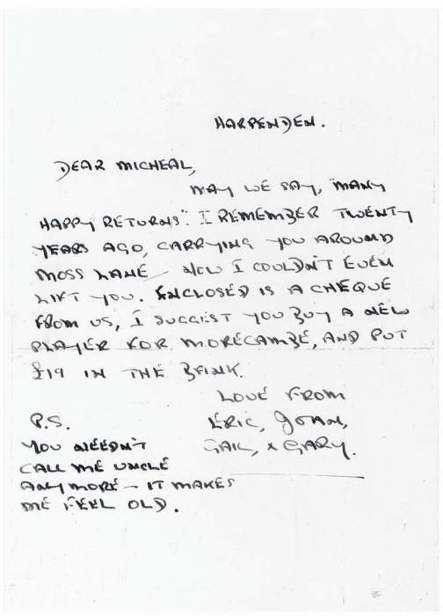
A letter from Eric to Michael Threlfall (a.k.a. ‘Wiggy’). Eric kept in touch with Sonny, his cousin and Michael’s father, throughout his life.
And he’s right! I remember my father telling me as much. That shared camaraderie of childhood never goes away. Former school and dance class friend Betty Ford remembers it well. ‘I think Eric enjoyed talking about the old times and seeing familiar faces,’ she said. Betty recalls my father with genuine fondness. ‘He would just shuffle into school, his hands deep in his pockets, totally unconcerned that he might be late for lessons. He was moonlighting, of course—doing his showbiz stuff most evenings, so was always a bit tired. He was definitely quite slovenly in appearance. But he was a very popular lad at school. I wouldn’t say he was a cheerful personality, because he looked so tired in the mornings.’
The co-ed system worked slightly differently back in the thirties, Betty explained. ‘It’s interesting to recall that back then the girls and boys were split up at school. We were literally segregated and I would talk to Eric through the railings. It was like a mixed school, but you weren’t really allowed to mix much, although you could in classes except for the last year, where it was boys—and girls-only classes. I think they didn’t want us to socialize with each other.’ With a smile she said, ‘It’s not like that now, of course. And they’ve brought the railings down.’
And what of those very average school reports that brought his mother, Sadie, close to apoplexy? ‘Well, Eric certainly wasn’t academic,’ recalled Betty, with wonderful understatement. ‘He could be very lazy. But he got on all right, though. And he was mischievous, yet in a quiet sort of way, if you know what I mean.’ I certainly do know what she means: that quiet mischievousness never left him; indeed it is the best way one can describe his antics around the family and the home and his working persona as half of Morecambe and Wise. ‘But he wasn’t a loudmouth sort of lad,’ Betty added. ‘He kept to himself quite a bit.’
And what about the teachers who must have felt very let down by my father’s lack of contribution to school life? ‘The teachers, in fact, thought a great deal about him,’ Betty told me. ‘I saw some of them a while after leaving school and they were all very fond of him.’
I was interested to get a sense of what Eric’s success meant to these childhood friends. ‘We were all thrilled for him,’ said Betty, cautiously adding, ‘Of course, his mother did push him hard, though.’ It wouldn’t be the last time I would hear this during my visit to Lancashire.
I was keen to learn a little more about Eric’s dancing lessons, which would go on to serve his career so well. On this subject Betty was a good starting point, considering she went to the Royal Ballet School and in later years started a chain of her own dance schools.
‘It was mostly through dancing that I got to know Eric,’ she said. ‘Eric went to Mrs Hunter’s dancing school, and I went to the Plaza School of Dancing. But we did dance together. We danced at the Mickey Mouse Club sometimes.’
The Mickey Mouse Club, Betty explained, was a Saturday morning cinema club at the local Odeon, where kids paid sixpence to watch a movie—like a Flash Gordon feature starring Buster Crabbe—and then danced on the stage to music.
‘Me and Eric would sometimes leave together afterwards and go back to his house on Christie Avenue, because it backed on to the football ground. In those days, before all the stands were built, we could watch the Saturday home matches through his bedroom window.’
Then Betty gave me an insight into Eric’s home town in the late thirties. ‘It was wartime, and Morecambe was full of RAF. So we used to go round doing shows at all these churches where they had clubs for the RAF personnel billeted in and around the town. Eric used to entertain them, too, but I remember him as a dancer and not a comedian, though it was more as a comedian that he did his entertaining even back then. This would have been about the time he met Ernie Wise.’
Betty remembered inviting Eric to her birthday party at her house. ‘He tried to teach me how to wink, and I still can’t do it. We used to play this game where the girls are sitting on chairs with the boys behind, and whoever they want to kiss they wink at, and then they change places. It was my twelfth birthday, and I think why I remember it so well is that Eric brought me some perfume and a handkerchief.’
It became clear to me that all these old school friends of my father’s that I was slowly getting to meet and interview for this book had remained in contact with one another. And that, as Betty pointed out, was mostly because they had stayed in the area. ‘But I didn’t see your father for years after he left,’ she said. ‘Then one day a relation of your father’s told me that he was coming to Morecambe and that he really wanted to see me. He turned up in his Rolls-Royce at my husband’s chemist shop. He stayed a couple of hours. He told me he hadn’t someone whom he could just call on to see for a cup of coffee.’
Eric also made other visits to the area, Wiggy told me. ’He would sometimes come and watch Morecambe play at Christie Park. He’d be wearing a long coat and a deerstalker. You couldn’t recognize him, which is just what he wanted. But I’d go up to him anyway and say, “Hi, Uncle Eric,” and he’d put a finger to his lips. “Shh!” he’d go. “I want to watch the match without being noticed. Don’t give me away.”’
Wiggy added that my father would try to visit old familiar faces in the neighbourhood. ‘Mr Lee was one of them. Eric, now a big star, would stand awkwardly in his sitting room while Mr Lee would be in his armchair puffing on a pipe. After a while, Mr Lee said, “Eee—I don’t know what it is they find funny in thee, lad!”’
My father also returned to Morecambe when Wiggy was working on a building site. ‘One of the lads exclaimed, “Look! It’s Eric Morecambe down there. Would you believe it?” I smiled to myself and said,“Oh yes, so it is. Well, I think I’ll go down and have a crack with him and see how he is.”They looked at me flabbergasted—they had no idea of the connection. So I went down and said quietly, “Hi, Uncle Eric.”Your dad gave me a smile and then a big hug. The lads on the site couldn’t believe what they were seeing from above. Hilarious.’
‘I remember him as a dancer and not a comedian, though it was more as a comedian that he did his entertaining even back then.’
I was reminded of a visit Eric made to Hest Bank in the early seventies. By now his parents were living in the village. He dropped in on a neighbour and purely by coincidence The Morecambe and Wise Show was on TV. ‘Oh great!’ said my father. ‘Do you mind if I watch it for a bit?’ The neighbour said that was fine and went to make them a cup of tea. At that point the neighbour’s son turned up with his mates and wandered into the sitting room to be confronted by the sight of Eric Morecambe sitting there in his house with a cup of tea in hand watching his own TV show. A surreal moment.
Wiggy made the interesting point that Eric used aspects of his northern upbringing in routines on The Morecambe and Wise Show. ‘I don’t know if everyone noticed it,’ he said, ‘but every now and then you would see a character and think,
“I know exactly who that’s supposed to be.” One character was the pigeon-keeper Eric pretended to be in a Thames TV show he and Ernie did. That was based on someone in Morecambe. So, too, the character he portrays walking across the back of the stage at the end of the show wearing a long coat, cloth cap, and carrying a big bag. These people existed,’ Wiggy assured me. ‘I knew these people.’
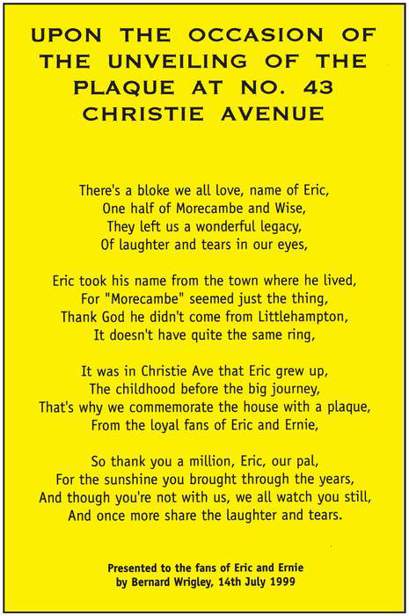
It seems Morecambe was a small world in many ways back then. After Eric and his parents left 43 Christie Avenue, where Eric had spent so many years of his childhood, to move to a new but still local address, Wiggy’s parents, Sonny and Ethel, moved in. If that isn’t keeping it in the family!
‘It seems the young Eric tried quite hard to keep up with his older mates.’
It was at Christie Avenue that Eric nearly died in an ‘accident’. ‘They were playing Cowboys and Indians,’ explained Wiggy. ‘Eric, being the youngest of the gang, got to be the fall guy, and was the one chosen to be lynched. My dad and others stood him on a dustbin with a rope around his neck. When they pushed him off and left him dangling, Auntie Sadie happened to glance out the window and rushed outside. She gave them a hard time for that. She went absolutely berserk, my dad told me years later. To be honest, Auntie Sadie used to scare me a bit. I think we were all a bit frightened of her.’
It seems the young Eric tried quite hard to keep up with his older mates. ‘All the young kids wore short trousers,’ Wiggy recalled. ‘But Eric got Sadie to cut a piece of cloth and make him some long ones so he could walk tall with the others.’
For me it was hard to appreciate what Morecambe had been like in those days. Wiggy described it as ‘a lively little place back then’, adding that, ‘It was the holiday package industry that started to kill it. But it’s coming back again now.’ And he’s right. There’s been a huge financial injection, particularly along the sea front. The Midland Hotel, the Art Deco pride of Morecambe, has been
completely renovated by the developer Urban Splash and opened in the summer of 2008. The Eric Morecambe Statue and the memorial area it occupies has apparently increased tourism to the area by nearly thirty per cent. There have been great efforts to invigorate the region’s wildlife and bird-watching attractions, the pier has gone, replaced by a modern stone jetty, and sand has been delivered by the ton to at last give Morecambe the kind of beach visitors to Blackpool have taken for granted for over a century of sea-bathing.
What captured my imagination was that in Morecambe there had been a community of children who played and learned together, swearing and daring one another on, struggling for rank and status, inventing elaborate games for which none of today’s technology was necessary; exploring their surroundings and waging mock battles with their rival peers. It was a time of dirty knees, torn pullovers, collarless shirts, leather shoes with soles worn paper-thin from years spent running down streets kicking cans and stones and one another. This was the hand-me-down era, when words like ‘fashion’ and ‘trends’ were the last words you would hear on most people’s lips. This was the New York Bronx world of outer Lancaster.
I caught a glimpse of that era when I returned to Christie Avenue to take a little look at the front of the house where Eric had lived, and the street where Eric had played football and set off to dance classes.
‘The Eric Morecambe Statue and the memorial area it occupies has apparently increased tourism to the area by nearly thirty per cent.’
My father recorded in his own words how as a kid he would go fishing with his dad in Morecambe Bay. They would get up at daybreak and Eric would perch on the back of George’s bicycle as he pedalled them down to the sea front (just in front of where Eric’s statue now stands). And, as Wiggy told me, ‘Eric’s dad, George, made his own fish hooks. He would often fish in the big basin of deep water right next to the old bridge at Hest Bank. He was always going on about this huge pike he knew that lurked down there. “I had it on my line once, but it got away,” he would say. I don’t think he ever caught it.’
was taken. Patricia Gerrard, née Goodyear, remembers how her late husband, Frank, would take Eric fishing both as boy and man. Frank, who would eventually become chief director of a Morecambe trawling company, and Eric were old school friends. The trawlers are responsible for bringing in the famous Morecambe shrimps, along with various kinds of fish. ‘Eric was addicted to potted shrimps,’ recalled Patricia. ‘In the early years, when Eric was at the Winter Gardens, he wasn’t quite as famous nationally as he later became, but in Morecambe he was very well known. And Morecambe in those days was heaving with people, it was that busy, and they used to crowd to see Eric.’
Patricia recalls Eric visiting her and her husband at the trawlermen’s market. ‘They had to close the doors when he visited there, that many people were trying to get to him.’ I pictured my father’s reaction to the situation being, ‘They
were an angry mob who’d just seen my act!’ Patricia continued, ‘I walked up to him and he grabbed my arm and said to the others, “You haven’t met my wife, Patricia. The best catch of the season!” Later I started musing about what the future might hold. Eric looked at me and said in the voice of a weatherman, “Wet at night, warm and close, then later a little son!”
‘What my husband and Eric did back then was to hire a boat so they could do a day’s fishing and get away from the crowds. Apparently Eric was hilarious all the time. My husband tried to get the boat out and it drifted sideways and Eric teased, “Are you sure you know how to work this thing!”’
Patricia also told me about Eric and Frank as kids. ‘They were both into wildlife, including frogs, newts and insects: anything to do with the outdoors. There was an Auntie Harriet on my husband’s side who the boys visited occasionally. She always wore a big hat with a large brim around it. Eric would say, “I like the brooch on your hat, Aunt Harriet.” And the ‘brooch’ would start running around the brim. It would be a small frog, or something. She’d shriek and catch it and Eric and Frank would run outside and down the street in hysterics.’
Like Eric’s old school friend Betty Ford, Patricia would go to the Mickey Mouse Club. The dancing that would follow the Saturday morning film show I find a strange concept to get my head around when nowadays we have access to so many forms of entertainment. Patricia remembered Betty being a superb dancer, and Betty herself told me that when Eric returned to Morecambe in the early seventies and bumped into her, he was surprised to find she hadn’t left the area. ‘He thought I’d have gone on to have an amazing dancing career around the world,’ she says, ‘but it was teaching that interested me.’
‘When he was a boy, Eric used to go to the dance school in Queen Street with Betty,’ Patricia said. ‘The Co-op was down there, and the late, great actress Thora Hird, then a young girl, but a couple of years older than Eric, would be in the window in a kiosk “selling fags”, as she put it. Eric would come down the street on the way to the dance school, and Thora would shout out to him and ask him how the dance lessons were going. They never really had the chance to become friends, possibly because of the age difference, but they were both more than aware of the other and destined for the same profession.’
‘Eric was the star of the production—always. His tap dancing was brilliant.’
Patricia remembered the dance school itself as being one floor in a building of floor upon floor. ‘In this dance school, Eric came on brilliantly because of Betty’s ability. That was a huge influence on him. Then Betty told me one day, “Guess what? Eric’s going to London, and he wants me to go with him!” I smiled and said, “You’d better be careful, then.” I mean, not many people went off to London like that back then. And Betty didn’t go with him, and Eric set off on what would become his career.
‘Betty and I reflected on those times years later. “Wasn’t that Eric Morecambe a laugh as a boy,” we’d say. And he was, because he would be so funny even when he was dancing with Betty at the Mickey Mouse Club.’
Eventually, as part of a redevelopment plan, the Co-op and the Royalty Theatre came down, and they built an Arndale Centre in its place. Eric was asked to open it, which he did. ‘You should have seen the crowds,’ said Patricia. ‘Eric had to cut the ribbon with a giant pair of scissors, which was a funny sight straight off. Then he said,“This looks like a big house!”Then he pointed to the shining new escalators and said, “They’ve even got an escalator going to your bedroom!”’
Nora Longfield is another former school and dance class friend of my father’s who still lives in Morecambe. ‘I wasn’t in his class as he was younger than me,’ she told me. ‘I remember him there, of course, because we used to get on the bus for the same school but at different stops. Sometimes he would come and sit with me, and sometimes he wouldn’t, depending on how he felt.’
It was through the dance classes that Nora got to know my father, and looking back she described him as a comedian from the outset. ‘Wherever he was, whatever he was doing, he made you laugh. There was a gang of us who used to go to the Floral Hall together to the Saturday night dance. We’d dance together—ballroom-dance—and Eric couldn’t do it at all: he had two left feet.’ This I found interesting as his own father was an accomplished ballroom dancer. ‘The rest of his dancing, and what he was learning at dance classes, was unbelievable,’ Nora went on. ‘At school we couldn’t wait for him to do his bit for the Christmas Show, which was part of the festive celebrations. He would do his dance in top hat and tails with a cane. We all adored it and looked forward to it. Eric was the star of the production—always. His tap dancing was brilliant. Just because the ballroom dancing wasn’t his thing didn’t stop us dancing with him because we knew invariably he’d make us laugh. He’d always come out with something very, very funny and have us in fits. It was in his nature.
‘Later, when we all left school, we drifted apart and we never crossed paths again, although I always sensed he was someone who never forgot his roots. He came back more than people realized, because often we’d hear about it through someone, like my daughter, telling us they’d spotted him out and about.’
As I sat in Nora’s small but comfortable home at Hest Bank, a house and a world not unlike those of all my father’s contemporaries that I was privileged to meet on my visit, I couldn’t help but ask her if Eric’s remarkable rise to stardom had surprised her.
‘No, not at all,’ she answered at once. ‘It was almost obvious what was going to happen, as the talent was there from such a young age. It would have almost been stranger had it not happened. He took it in his stride. And his mother was a big part of his success; she pushed him, but he must have loved to do it really, or he wouldn’t have done it. For instance, those school performances: it should be remembered he volunteered for them.
‘But despite the passing years, you never forget someone like Eric. It’s just that you end up on different tracks in life. That’s just the way it is.’