
‘Between you and me, I don’t really mean all those insults I hurl at Des O’Connor. I think he’s one of the greatest singers in the country. He just struggles when he sings in the town, that’s all. Have you heard his latest record, Songs for Deaf Lovers? There’s a government health warning on every cover.’
The forties and fifties had been Eric’s bread-and-butter years before the jam arrived in the sixties in the shape of television. Most achievement in the earlier decades was through radio shows and theatre work, as mentioned in the previous chapter, but TV had lurked there, albeit in the form of appearances on other people’s shows, or through their own first BBC series in 1954, Running Wild, which seemed to have people running scared!
Below is a wonderful article from that year, published in the weekly magazine TV Mirror, about Eric and Ernie’s this failed series before it had aired for the first time. What interests me beyond the fact that Running Wild nearly finished their careers is that the writer of the piece—like the public at large—didn’t really know much about them and had to use physical descriptions to help him. Very different from twenty years later, when they were arguably the most famous faces in Britain.
The Lads Who’ve Got Nothing To Lose
An Article published in TV Mirror
Morecambe and Wise, the young comedians from the north, have gained a big reputation on radio. Tonight they begin a new comedy series on TV.
Ever since it was announced that a new fortnightly comedy series starring Morecambe and Wise was starting, the two bright lads from the North have been receiving good advice from their colleagues and friends.
‘You keep off TV—it’ll do you no good,’ was the general burden of their advice.
But Eric Bartholomew, who comes from Morecambe (hence the name), and Ernie Wiseman, who claims Leeds as his native town, think differently. After no fewer than forty-five appearances in Variety Fanfare, and their own weekly variety series You’re Only Young Once, they have no doubts about the power of sound radio to help an artist on his way.
And whatever the dismal Johnnies may say about the dangers of a TV series that gets panned by the critics—well, Morecambe and Wise just aren’t worrying.
‘The way we look at it is this,’ said Morecambe (he is the tall one with glasses), ‘TV has come to stay and we’ve been given our big opportunity. We’d be daft if we didn’t take it with both hands. You see, we’ve got everything to gain and nothing to lose.’
‘It isn’t as though we were at the end of our careers,’ added Wise (the small one with the fair hair). ‘You’re only young once, that’s quite true. But we’re young now, both of us. I’m 28 and Eric is 27. And I’d say we’ve got a few years to go yet.’
A radio series too
‘If the public don’t like us on Wednesday, that’s just too bad. But it won’t mean we’re finished. Why, we’ve hardly started yet!’
‘And there’s another radio series starting in May to keep the wolf from the door,’ said Morecambe.
‘Not that we’re going to flop,’ put in Wise, touching wood and stroking the nearest black cat. ‘We’ve had our TV flop already, years ago, in—what was the show called, Eric?’
‘Shh!’ said Morecambe, quickly. ‘You know we never talk about that one. Still, there was one good thing about it. Our producer on that occasion was good old Bryan Sears’—here they fell to their knees and touched their foreheads to the ground—‘and it’s Bryan who’s going to put us across in this new series.’
I tried to find out something about the new show.
The two boys looked at each other, scratched their hair and seemed a little embarrassed. ‘Well, it’s a comedy show—we know that much. And it’s a revue—there’s no harm in telling you that. But as for what it’s going to be—look, why don’t you watch it and find out?’
‘That’s what we’re going to do,’ said Morecambe, changing the subject.
Forty-five ‘Fanfares’
Bryan seems a lucky name in the story of Morecambe and Wise. It was another well known Bryan—Michie this time—who first discovered the pair at a juvenile talent contest. That was in 1939, when Eric and Ernie were in their very early teens.
Two years later they were touring with Bryan Michie in his road show. In 1943 they went into Strike a New Note at the Prince of Wales Theatre in London—with that great comedian Sid Field.
That’s where they were when calling-up time came. Ernie went off with the Merchant Navy; Eric went down the mine, surely the only west-end comedian to become a Bevin Boy.
The war over, back they came to the halls, touring here, there and everywhere—and only just out of their teens! Then came a broadcast from Manchester in Variety Fanfare. And another. More followed. Finally they notched up that record of forty-five Fanfareappearances since the end of 1951.
‘But you’d better not put that in,’ advised Morecambe, ‘we’ve always depended on the fact that Ronnie Taylor, the producer, can’t count. If he reads that, he won’t book us again.’
When I could get them talking seriously I got some pretty definite opinions out of Morecambe about this new TV series. ‘It’s like this,’ he said. ‘No one, with the possible exception of Arthur Askey, has yet managed to bring off a TV series with any real success.
‘Now don’t imagine that we’re comparing ourselves with Askey—we don’t wear the same size in combs. But we’re prepared to look on TV as a completely different medium. We’re ready to change our approach and our styles as much as is wanted.’
It is my opinion that they will be a big success.
The writer of the article probably came to doubt his own opinion thereafter.
In the fifties the trials and tribulations that would ultimately lead to a staggering television career were still some years off. In fact so uncertain was the future of what would become Britain’s most popular double act, and work of any performing kind so scarce around 1950, that, it has come to light, Ernie wrote to Eric to end the partnership. I have known about this incident since the seventies, when my father, with a reflective chuckle at the fact that it never happened and they had gone on to immense success, one day chose to tell me all about it. What I had not realized was that Ernie’s letter still existed. I had never seen it until my mother showed it to me while I was working on this book. So fascinated am I by the letter that I persuaded her to allow me to publish it. What strikes me most is the great dignity Ernie retains. Beautifully written with integrity, it expresses warm wishes and the desire to continue their great friendship outside the partnership.
This is the letter in its entirety:
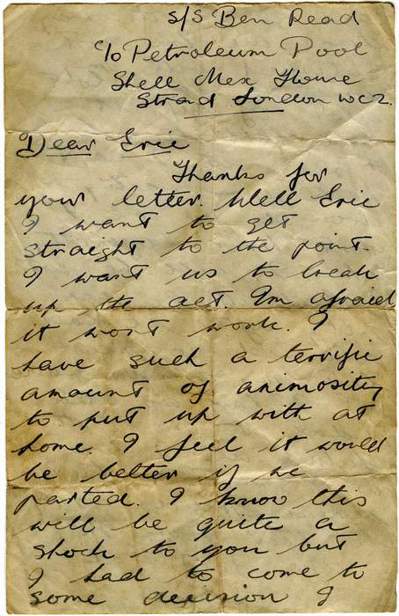
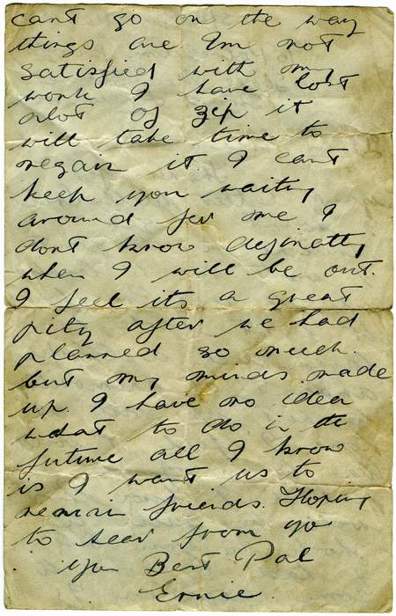
My father’s response, he told me, was to write straight back basically saying he’d never heard such rubbish in his life and that Ernie should have a few days’ rest to get over it and then they should get back to finding some work—which essentially is what happened.
For me the world of theatre conjures up many images, some of which no doubt can be traced back to the conversations I had with my father throughout my childhood and the hours I spent in those times hanging around theatres and dressing rooms. Eric genuinely loved that era—even the struggle that went with it. ‘I would do everything the same only quicker!’ he once told me, and it is a line that amused not only me but my own children when I repeated it to them. Though he said it half in jest, I find myself wondering how he could have done any of it quicker—he moved like greased lightning as it was. Harry Secombe said Eric had a quicksilver brain and even nicknamed him ‘Quicksilver’. Incidentally, many years before that his mother used to call him ‘Jifflearse’, a name which is meaningless in the strictest sense yet suggests someone restless and always on the go. This was a total Sadie creation, a word that for her—and me, I should add—conjured an image of someone who can’t sit still for a moment, ‘jiffle’ being similar to ‘jiggle’, as in ‘jiggle about’, and ‘arse’, well…
Talking of theatres, Ernie recalled, ‘Some of the funniest things happen backstage in the theatre business. We were appearing at a tiny theatre in a very out-of-the-way town. The theatre was old, and the lighting equipment was even older. We asked the electrician backstage to throw the main switch of all the lights in the theatre as a pay-off line to a comedy sketch we were doing at the time. We wanted the whole theatre darkened for just one minute.
‘On the first night of the show, we checked with him that he knew exactly when to throw the switch and he nodded that he fully understood. But we were worried, for he was wearing huge rubber boots and thick rubber gloves.
‘When the time came for him to throw the switch there was a terrific blue flash and the little electrician was hurled almost from one side of the wings to the other.
‘We rushed to pick him up for fear he might have been electrocuted. “Are you all right?” we asked anxiously. “What happened?”
‘“Nothing,” replied the charred prostrate little man taking off one of his rubber gloves. “It happens every time I throw that switch!”’
And Eric recalled a time in 1960 when they were working the theatres.‘A cousin [of mine], a rather irresponsible lad with a natural ability to upset other people, asked us if we could get him holiday digs using our names to help him obtain some very pleasant accommodation.
‘Naturally we used some influence and fixed up a hotel in Torquay. After a week we had a letter from him saying he was fed up because he had been thrown out of the place.The proprietor had had enough of his practical jokes. He asked us to help him again.
‘We managed to fix him some accommodation in Exmouth. Everything was quiet for a few days then another letter arrived.The same thing had happened. He was out, and he wanted help.
‘We were tired by this time. But we thought we’d do our best for him just once more.We secured a room for him atWeymouth, and wrote back warning him we had tolerated his troubles long enough.
‘For a few weeks all was calm then we received a telephone call:“I’m thrown out again, and I’m mad!” he said.“You ought to get in touch with these proprietors. Tell them, how dare they do this to You!”’
Eric and Ernie would keep in touch with theatre work even after the ‘jam’ had arrived and they no longer really needed panto and summer season. Once they were regular fixtures on television, and this was evident around 1962, they continued the theatre seasons more out of habit than need. It was a habit which lasted right up to Eric’s heart attack in November 1968, which would signal the end of many things—including winter and summer seasons—but also the beginning of their television superstardom.
If they thought they were stars in the sixties, then the seventies would show them just how far they could still go.