
Introduction
1 Ellen J. Hammer, A Death in November: America in Vietnam, 1963 (New York: E. P. Dutton, 1987), 317.
2 Hoang Ngoc Thanh and Than Thi Nhan Duc, Why the Vietnam War? President Ngo Dinh Diem and the US: His Overthrow and Assassination ([San Jose, Calif.:] Tuan-Yen and Quan-Viet Mai-Nam, 2001), 485.
3 The Roman Catholic Church has been established in Vietnam since the sixteenth century, but she has also suffered periods of persecution. Jacob Ramsay’s Mandarins and Martyrs: The Church and the Nguyen Dynasty in Early Nineteenth-Century Vietnam(Stanford, Calif.: Stanford University Press, 2008) attempts to explain how persecutions could arise even when it appeared that the Church was well accepted in Vietnamese society.
4 Charles Keith, Catholic Vietnam: A Church from Empire to Nation (Berkeley: University of California Press, 2012), 98.
5 “South Viet-Nam: The Beleaguered Man”, Time, April 4, 1955, 23-24.
6 Ngo Dinh Kha was well respected by Catholics and Buddhists alike and had a reputation for wisdom and good judgement. He nevertheless suffered occasional persecution, and his patience through these ordeals won him even more admiration. See Keith,Catholic Vietnam, 169-70.
7 Andre Nguyen Van Chau, “The Late President Ngo Dinh Diem of Vietnam as Seen by Members of the Family and Some of His Friends”, paper presented at the conference “The Rise and Fall of Ngo Dinh Diem: Its Implications for the United States and for Vietnam”, Vietnam Center and Archive, Texas Tech University, Lubbock, Texas, October 24, 2003.
8 Douglas Pike became acquainted with President Diem while a Foreign Service officer in Saigon. He said, “Diem fit neither the classical nor the contemporary American stereotype of a tyrant. He was not brutal, mean, or arrogant. He was educated, cosmopolitan, and far more liberally minded than the emperor Bao Dai who preceded him. . . . However politically misguided Saigon’s undemocratic practices may have been, they were chiefly a military response to [an] external challenge. By that measure they were neither excessive nor unreasonable.” Douglas Pike, “South Vietnam: Autopsy of a Compound Crisis”, in Friendly Tyrants: An American Dilemma, ed. Daniel Pipes and Adam Garfinkle (New York: St. Martin’s Press, 1991), 38, 47, 52-53.
9 Dennis J. Duncanson, Government and Revolution in Vietnam (London: Oxford University Press / Royal Institute of International Affairs, 1968), 214.
10 Denis Warner, The Last Confucian: Vietnam, Southeast Asia, and the West, rev. ed. (Sydney, Australia: Angus and Robertson, 1964), 92.
11 There had been periods of benign acceptance and periods such as the “great persecution” under Emperor Ming Mang during the mid-nineteenth century, wherein over 130 priests, missionaries, and other lay Church leaders were executed. See Ramsay,Mandarins and Martyrs, 68.
12 Tran Van Dinh, “Why Every American Should Read Kim Van Kieu”, in We the Vietnamese: Voices from Vietnam, ed. François Sully (New York: Praeger, 1971), 236-37.
13 Hammer, Death in November, 47.
14 Tran Van Don, Our Endless War: Inside Vietnam (San Rafael, Calif.: Presidio Press, 1978), 48.
15 Nguyen Cao Ky, Twenty Years and Twenty Days (New York: Stein and Day, 1976), 19, 31-33.
16 Some of this story is related by Stanley Karnow. He discussed this incident in early 1981 with the propaganda chief of the Vietnamese Communist Party, Hoang Tung, who told him that Ho had made a serious mistake concerning Diem and should have had him killed. See Stanley Karnow, Vietnam: A History (New York: Viking, 1983), 216-17.
17 “South Viet-Nam”, 24.
18 Robert Shaplen, “A Reporter in Vietnam: Diem”, New Yorker, September 22, 1962, 103.
19 Warner, Last Confucian, 89.
20 Shaplen, “Reporter in Vietnam”, 103.
21 Ibid., 106.
22 Ibid., 108.
23 Frances Fitzgerald, Fire in the Lake: The Vietnamese and the Americans in Vietnam (New York: Vintage Books, 1989), 103. Another account of Diem’s relationship with the Japanese is given by Ellen Hammer, who had personally queried Diem on this point. He denied that they had tried to make him a prime minister. See Shaplen, “Reporter in Vietnam”, 51.
24 Bernard B. Fall, The Two Viet-Nams: A Political and Military Analysis (New York: Praeger, 1963), 240.
25 “South Viet-Nam”, 24.
26 Both Ngo Dinh Diem and his brother Ngo Dinh Nhu admired the French thinker Emmanuel Mounier and his ideas concerning the need for Catholics to take an active role in the world while maintaining the vision of their true destiny in the heavenly Jerusalem. Mounier called his philosophy “personalism” as set forth in his book Be Not Afraid, and the Ngo Dinhs attempted to incorporate it into their political thought. See Keith, Catholic Vietnam, 239.
27 Shaplen, “Reporter in Vietnam”, 116.
28 Ellen Hammer explained this well: “His standing among his own people as a political leader was grounded on a stubborn refusal to compromise his principles and on an unswerving attachment to the cause of Vietnamese independence. The Americans who admired him had no idea that these same qualities one day would lead him into conflict with the Washington government.” Hammer, Death in November, 52-53.
29 Fall, Two Viet-Nams, 242.
30 Shaplen, “Reporter in Vietnam”, 116.
31 Philip E. Catton, Diem’s Final Failure: Prelude to America’s War in Vietnam (Lawrence, Kans.: University Press of Kansas, 2002), 6.
32 William O. Douglas, North from Malaya (New York: Doubleday, 1953), 180-81.
33 Ibid., 181.
34 Van Chau, “Late President”.
35 This story, attended by a smile and a chuckle, was related to this writer by the late General Nguyen Khanh, who had been present at Nhu’s frustrated outburst.
36 As a military intelligence officer, Edward Geary Lansdale successfully countered insurgents in the Philippines with President Ramon Magsaysay. He then advised French troops fighting against the Viet Minh in Indochina before the foundation of South Vietnam and its government, which he helped to establish. Lansdale took a near-instant liking to President Diem, and this friendliness was reciprocated by the Vietnamese leader. After he retired from the military with the rank of major general, Lansdale returned to Vietnam, where he worked in the American embassy in Saigon. Even when the U.S. government turned against Diem in 1963, Lansdale remained his staunch defender.
37 Robert Scheer, “The Genesis of United States Support for Ngo Dinh Diem”, in Vietnam: History, Documents, and Opinions of a Major World Crisis, ed. Marvin E. Gettleman (Greenwich, Conn.: Fawcett Publications, 1965), 248-52.
38 Ibid., 250.
39 In his own words, Diem stated: “The Buddhists are calm and more contemplative; they look inside themselves and they try to improve themselves; they are not going out into society and trying to create trouble.” Van Chau, “Late President”.
Chapter 1
1 Sir Robert Thompson gave a competent overview of these problems in his Defeating Communist Insurgency: Experiences from Malaya and Vietnam (London: Chatto and Windus, 1966); see esp. 21-23.
2 William R. Andrews, The Village War: Vietnamese Communist Revolutionary Activities in Dinh Tuong Province, 1960—1964 (Columbia, Mo.: University of Missouri Press, 1973), 51, 54-55. Andrews’ work is supported by RAND Corporation and Military Assistance Command, Vietnam J-2, “Studies of the National Liberation Front of South Vietnam” (Saigon, n.d.), DT-86, 2; DT-99, 2; DT-84, 2; DT-88, 1.
3 Quotation in RAND Corporation and Military Assistance Command, Vietnam J-2, “Studies of the National Liberation Front”, DT-99, 2. Found in the notes of Andrews, Village War, 51, 54-55.
4 See Alexander Dallin and George W. Breslauer, Political Terror in Communist Systems (Stanford, Calif.: Stanford University Press, 1970), 7, for an explanation of why Communist insurgents are so dependent on the use of terror.
5 Ellen J. Hammer, A Death in November: America in Vietnam, 1963 (New York: E. P. Dutton, 1987), 47.
6 Ibid.
7 General Nguyen Khanh, interview by author, June 16, 1994, United States Air Force Special Operations School, Hurlburt Field, Fla., transcript, 61, Vietnam Center and Archive at Texas Tech University, Lubbock, Tex., and the United States Air Force Special Operations School, Hurlburt Field, Fla.
8 Even the massacre that took place at My Lai, many years later, paled in comparison to what the Communists did.
9 At other times, in different circumstances, the terror of the Destruction of the Oppression, which apologists for the party have often excused on the grounds that it was “selective”, could take on the appearance of a charnel house. In a Cai Lay village that had changed hands between the Communist National Liberation Front and the South Vietnamese government four times in as many years, twenty persons, including women, were accused of being government spies: “They all had their heads cut off and their bodies were thrown in the street. On them were pinned the charges written on a piece of paper.” In another execution, “The hamlet chief in this instance had been tied to a stake in the middle of the market place in full view of the assembled villagers. The man was slowly disembowelled, his children decapitated, and his pregnant wife then tied to the same stake and similarly disembowelled.” Malcolm Browne, The New Face of War (New York: Bobbs-Merrill, 1965), 103.
10 “The Party at times accused and then executed or humiliated certain persons for their pro-Government activities when even a cursory examination would have revealed the charges to be baseless. Had the Party been consistently discriminatory, eliminating only those persons widely known to be class enemies, then the terror would have become highly predictable and incapable of creating the desired level of anxiety response among the villagers.” Andrews, Village War, 57-58.
11 Here are Andrews’ figures:
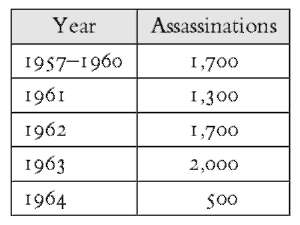
Source: Ibid., 60.
12 These figures of Andrews are supported by the studies of Viet Cong expert Douglas Pike. See his Viet Cong: The Organization and Techniques of the National Liberation Front of South Vietnam (Cambridge, Mass.: MIT Press, 1966), 102.
13 See Douglas Pike, History of Vietnamese Communism, 1925—1976 (Stanford, Calif.: Hoover Institution Press, 1978), 115-18.
14 Seymour M. Hersh, The Dark Side of Camelot (Boston: Little, Brown, 1997), 423.
15 The sects—the Cao Dai, the Hoa Hao, and the criminal Binh Xuyen—had been a challenge to Diem’s political legitimacy from the beginning of his government (see Bernard B. Fall, The Two Viet-Nams: A Political and Military Analysis [New York: Praeger, 1963], 239). These groups, which had fought against the French during the First Indochina War, controlled key areas of South Vietnam and had access not only to a bounty of arms and soldiers for hire but also, at least in the case of the Binh Xuyen, to government officials and police in Saigon (see Dennis J. Duncanson, Government and Revolution in Vietnam [London: Oxford University Press / Royal Institute of International Affairs, 1968], 220-21). To govern a united South Vietnam and to resist attempts by the North to take over the country, Diem needed to counter these groups. In the case of Binh Xuyen, he knew that “as a matter of both government integrity and his own survival, the police must be under his control.” David L. Anderson, “J. Lawton Collins, John Foster Dulles, and the Eisenhower Administration’s ‘Point of No Return’ in Vietnam”, Diplomatic History, no. 12 (Spring 1988): 132.
16 Duncanson, Government and Revolution, 252.
17 After Ngo Dinh Diem repudiated demands for all-Vietnam elections, the rate at which murders were committed seems to have increased. Although the government’s limited administrative control obscured much of what was going on, it is now generally thought that during the nine years that Diem was in power, close to twenty thousand people lost their lives to Communist insurgents. See Duncanson, Government and Revolution, 252.
18 Thompson, Defeating Communist Insurgency, 27.
19 Congress, House, Committee on Armed Services, “Rebellion against My-Diem”, tab 2 of Evolution of the War: Origins of the Insurgency, 1954—1960, section IV.A.5 of bk. 2 of United States—Vietnam Relations, 1945—1967: Study Prepared by the Department of Defense (Washington, D.C.: United States Government Printing Office, 1971), 46.
20 Edward Geary Lansdale, who had led undercover operations in North Vietnam, had predicted that just prior to the planned 1956 elections, the North itself would probably have found a convenient way around the process and blame the South for violating the Geneva Accords, which the South had not signed, because they had serious political problems of their own making (see Edward Geary Lansdale, In the Midst of Wars: An American’s Mission to Southeast Asia [New York: Harper and Row, 1972], 346). One of these problems was the bungling of their land reform, which had led to open revolt (see Pike, History of Vietnamese Communism, 108-13). Furthermore, although the Ho Chi Minh regime did sign the Geneva Accords, it was committing violations of its own, not least of which was the build-up of their army: from 7 to 20 divisions, from 200,000 to 550,000 troops, and from 600 to 700 Chinese instructors. A total of several thousand Chinese and Russian advisors were in all echelons of the army. Congress, House, Committee on Armed Services, “Failure of the Geneva Settlement”, tab 1 of Evolution of the War: Origins of the Insurgency, 1954—1960, 29-30.
21 Andrews, Village War, 20.
22 “Disorientation is the objective par excellence of the terrorist removing the underpinnings of the order in which his targets live out their daily lives. The primary responsibility of any incumbent group is to guarantee order to its population, and the terrorist will attempt to disorient the population by demonstrating that the incumbent’s structure cannot give adequate support.” Thomas Perry Thornton, “Terror as a Weapon of Political Agitation”, in Internal War: Problems and Approaches, ed. Harry Eckstein (New York: Free Press, 1968), 83.
23 This observation is supported by RAND Corporation studies. See Stephen T. Hosmer, Viet Cong Repression and Its Implications for the Future, Report Prepared for the Advanced Research Projects Agency; R-475/1-ARPA (Santa Monica, Calif.: RAND Corporation, 1970), 7-8.
24 “A conventional attack by Ho Chi Minh’s People’s Army of Viet-Nam patterned after the invasion of South Korea probably would have succeeded because the Army of the Republic of Viet-Nam was weak and fragmented, but two factors mitigated against such a move: world opinion and the alternative means possessed by the Lao Dong to destroy the South Vietnamese Government. . . . [which] bypassed the difficulties of conventional military action; that means was revolutionary guerrilla warfare. Conditions in South Viet-Nam, no matter how improved, were advantageous for such an undertaking.” Andrews, Village War, 20-21.
25 “And of course the communists’ conclusion out of this was, no chance. No chance of playing a role, and we’re being crushed by the momentum of the government, by this positive momentum of the economic and social development that was in the process. And I think that is what led them to the decision, we’ve got to go back to the war. Otherwise we’ve lost it, and we’ve not only lost it in South Vietnam, we may lose it in North Vietnam as well.” William Colby, interview by Ted Gittinger, June 2, 1981, Washington, D.C., interview 1, transcript 1, Lyndon Baines Johnson Presidential Library Oral History Collection, University of Texas at Austin, pp. 1, 7-9.
26 Ibid.
27 Edward Geary Lansdale’s observations corresponded to Colby’s: “Paradoxically, the Communist campaign of terrorism started just as life in the countryside was beginning to show great promise for the people on the land. It wasn’t only that the armies had departed from the former battlegrounds in the rice paddies, letting farmlands be tilled in peace; there were, as well, a multitude of new efforts being made to improve the whole agrarian economy of Vietnam. Each time that I visited President Diem in his office, I would find him deep in the study of some new program, often of vast dimensions.” In the Midst of Wars, 354.
28 Denis Warner, The Last Confucian: Vietnam, Southeast Asia, and the West, rev. ed. (Sydney, Australia: Angus and Robertson, 1964), 146.
29 John Osborne, “The Tough Miracle Man of Vietnam: Diem, America’s Newly Arrived Visitor, Has Roused His Country and Routed the Reds”, Life, May 13, 1957, 168.
30 Duncanson, Government and Revolution, 267.
31 Congress, House, Committee on Armed Services, “Rebellion against My-Diem”, 34.
32 Duncanson, Government and Revolution, 267.
33 Congress, House, Committee on Armed Services, “Rebellion against My-Diem”, 39.
34 Edward Geary Lansdale, “Memorandum for Secretary of Defense [and] Deputy Secretary of Defense; Subject: Vietnam” [between January 14 and 17, 1961], in “U.S. Perceptions of the Insurgency, 1954—1960”, tab 4 of Evolution of the War: Origins of the Insurgency, 1954—1960, 67, 69, 73.
35 William Colby and Peter Forbath, Honorable Men: My Life in the CIA (New York: Simon and Schuster, 1978), 159.
36 Colby, interview by Gittinger, interview 1, p. 11.
37 Launched in 1959, the Agroville Program moved peasants from areas being destabilised by Communist insurgents to areas secured by the Army of the Republic of Vietnam.
38 The Can Lao Party, led by Diem’s brother Ngo Dinh Diem, was created to support the Diem government.
39 See Duncanson, Government and Revolution, 267.
40 Robert Shaplen, “A Reporter in Vietnam: Diem”, New Yorker, September 22, 1962, 125.
41 Colby, Honorable Men, 159.
42 George C. Herring, America’s Longest War: The United States and Vietnam, 1950—1975, 2nd ed. (New York: Alfred A. Knopf, 1986), 65.
43 “[T]he land reform worked according to the way most of the successful land reform programs had worked in the past [e.g., Japan and Taiwan] in which the government took the land from the larger landowners, and particularly the French, and then loaned the peasant the money, which he then repaid over the next few years. Now the communists very intelligently focused on that as just a way of insisting on further payment of taxes. Because during the intervening years, the years of the war, there were no taxes collected because the backcountry was in a turmoil and in an uproar, and so the peasants weren’t paying any taxes. So that the interpretation successfully put forward by the communists, which was in a sense accurate, was that this legal mumbo jumbo meant that the peasants would be required to pay taxes today that they hadn’t been required to pay before.” Colby, interview by Gittinger, interview 1, pp. 13-14.
44 Lansdale, In the Midst of Wars, 354-56.
45 Ibid.
46 Bernard B. Fall, Last Reflections on a War: Bernard B. Fall’s Last Comments on Vietnam (Garden City, N.Y.: Doubleday, 1967), 198-99.
47 Larry E. Cable, Conflict of Myths: The Development of American Counterinsurgency Doctrine and the Vietnam War (New York: New York University Press, 1986), 185.
48 Lansdale, In the Midst of Wars, 346.
49 Jean-Louis Margolin, “Vietnam and Laos: The Impasse of War Communism”, in The Black Book of Communism: Crimes, Terror, Repression, trans. Mark Kramer and Jonathan Murphy (Cambridge, Mass.: Harvard University Press, 1999), 569.
50 Lansdale, In the Midst of Wars, 345.
51 See Fall, Last Reflections, 198.
52 Robert Thompson, however, did not ignore what Diem said or did in this context, and he supported the Vietnamese president in his attempts to purge Communist control from the villages. See Thompson, Defeating Communist Insurgency, 78-79.
53 Colby, Honorable Men, 159-60.
54 Ibid.
55 Ibid., 161-70.
56 Thompson, Defeating Communist Insurgency, 51.
57 Colby, Honorable Men, 161-70.
58 Thompson, Defeating Communist Insurgency, 68.
Chapter 2
1 Martin Weil, A Pretty Good Club: The Founding Fathers of the U.S. Foreign Service (New York: W. W. Norton, 1978), 53, 235, 268.
2 Smith Simpson, Anatomy of the State Department (Boston: Beacon Press, 1968), 75, 138, 142.
3 Weil, Pretty Good Club, 267.
4 In a despatch (desp. no. 278) sent to Washington via diplomatic pouch, Durbrow noted the following: (1) VC tactics had changed from attacking individuals to carrying out more frequent and daring attacks upon government security forces. (2) VC planned more guerrilla warfare for 1960 and intended to stage a coup that same year. (3) ARVN weaknesses were becoming more apparent, and more training was needed; and (4) people in rural areas were unhappy with Diem. The primary cause was the sustained VC terror campaign. The GVN was seen as not protecting them, and local officials, who in their frustration at attempting to overcome the inroads made by VC terror, were opting for coercion in implementing programs decided upon in Saigon. See Elbridge Durbrow, “Special Report on Current Internal Security Situation”, in 1956 French Withdrawal—1960, section V.B.3.d of bk. 10 of United States—Vietnam Relations, 1945—1967: Study Prepared by the Department of Defense, by Congress, House, Committee on Armed Services (Washington, D.C.: United States Government Printing Office), 1255-56.
5 Ibid.
6 Early Pentagon analyst reports indicate that police forces were effective in curbing Communist insurgent activity, even though they had not been developed in anywhere near the numbers and capabilities of those in Malaya: “The police services, which include the 7,500-man Vietnamese Bureau of Investigation, and 10,500-man police force stationed in the main cities, have had considerable success in tracking down subversives and terrorists and are developing into efficient organizations.” Congress, House, Committee on Armed Services, “Major Trends in South Vietnam”, in 1956 French Withdrawal—1960, 1193.
7 According to author Marguerite Higgins: “With education left in a lamentable state by the French, it is true that the Catholics, being better organised than other faiths, tended to be better educated.” Our Vietnam Nightmare (New York: Harper and Row, 1965), 43.
8 For the persecution of Vietnamese Catholics by Ho Chi Minh’s Communists in the Democratic Republic of Vietnam in the 1950s, see Charles Keith, Catholic Vietnam: A Church from Empire to Nation (Berkeley: University of California Press, 2012), 238.
9 William Colby stated: “Diem of course had no hesitation in arming a Catholic community because he had confidence that they would fight, and they did.” Interview by Ted Git-tinger, June 2, 1981, Washington, D.C., interview 1, transcript, 34, Lyndon Baines Johnson Presidential Library Oral History Collection, University of Texas at Austin.
10 Higgins explained: “But in Diem’s immediate entourage—his cabinet—there were only six Catholics out of seventeen men. The Vice-President of Vietnam, Nguyen Ngoc Tho, was a Buddhist and was in charge of the efforts to achieve a truce with the Buddhist extremists. In the military sphere most generals were Confucianists, Buddhists, and Cao Dai. Out of seventeen generals on active duty, three were Catholic and the rest non-Catholic.” Our Vietnam Nightmare, 43-44.
11 Fr. Piero Gheddo, The Cross and the Bo-Tree: Catholics and Buddhists in Vietnam, trans. Charles Underhill Quinn (New York: Sheed and Ward, 1970), 136-37.
12 Interview with Everett Bumgardner on “America’s Mandarin (1954—1963)”, program 2 of Vietnam: A Television History, PBS, 1983, http://www.pbs.org/wgbh/amex/vietnam/series/pt_02.html. A hard-copy transcript is available in the Frederick (Fritz) Ernest Nolting Jr. Papers, accession 12804, Special Collections, Alderman Library, University of Virginia, Charlottesville, box 28, Professional Papers—Historical Backgound Records, 8 of 10 (hereafter cited as Nolting Papers; quote is located on p. 8).
13 “We believe US should at this time support Diem as best available Vietnamese leader, but should recognize that overriding US objective is strongly anti-Communist Vietnamese government which can command loyal and enthusiastic support of widest possible segments of Vietnamese people, and is able to carry on effective fight against guerrillas. If Diem’s position in country continues deteriorate as result failure to adopt proper political, psychological, economic and security measures, it may become necessary for US Government to begin consideration alternative courses of action and leaders in order achieve our objective.” “Telegram from the Ambassador in Vietnam (Durbrow) to the Department of State”, September 16, 1960, Saigon, in United States Department of State,Foreign Relations of the United States, 1958—1960, ed. John P. Glennon, vol. 1, Vietnam (Washington, D.C.: United States Government Printing Office, 1986), document 197, p. 579 (hereafter cited as FRUS, 1958—1960).
14 See Elbridge Durbrow, “Memorandum Handed to President Diem by Ambassador Durbrow on December 23, 1960”, in Congress, House, Committee on Armed Services, 1956 French Withdrawal—1960, 1353-55.
15 Elbridge Durbrow to the Department of State, telegram, December 24, 1960, Saigon, no. 1216, in Congress, House, Committee on Armed Services, 1956 French Withdrawal—1960, 1348-51.
16 “Some very tough laws were enacted in Malaya. One enabled the government to seize and deport all Chinese found in a declared bad area. Another allowed the government to impose a collective fine on all the inhabitants of an area where the people were uncooperative. . . . Laws imposing strict curfews, a mandatory death penalty for carrying arms, life imprisonment for providing supplies or other support to terrorists, restricted residence or detention for suspected terrorist supporters and so on were introduced and used effectively. The main point about them was that they were seen by the population to be effective and were applied equally to all.” Robert Grainger Thompson, Defeating Communist Insurgency: Experiences from Malaya and Vietnam (London: Chatto and Windus, 1966), 53.
17 Colby, interview by Gittinger, interview 1, p. 11.
18 Ellen J. Hammer, A Death in November: America in Vietnam, 1963 (New York: E. P. Dutton, 1987), 37-38.
19 Congress, House, Committee on Armed Services, “Rebellion against My-Diem”, tab 2 of Evolution of the War: Origins of the Insurgency, 1954—1960, section IV.A.5 of bk. 2 of United States—Vietnam Relations, 1945—1967: Study Prepared by the Department of Defense (Washington, D.C.: United States Government Printing Office, 1971), 46.
20 Hammer, Death in November, 38.
21 Other changes included making Vice President Nguyen Hgoc Tho, a Southerner totally subservient to Diem, minister of the interior; Diem giving up the ministry of defence and appointing a new full-time minister; sending Diem’s brother Nhu to a foreign embassy; naming one or two members of the opposition party to the cabinet; lifting controls on the press; stimulating National Assembly investigations, on the American model, into corruption and mismanagement; and implementing a series of economic measures such as subsidies to rice farmers. See William E. Colby, Lost Victory: A Firsthand Account of America’s Sixteen-Year Involvement in Vietnam, with James McCargar (Chicago: Contemporary Books, 1989), 74-75.
22 Ibid.
23 Elbridge Durbrow, “English Text of Memorandum Handed to President Diem”, in FRUS, 1958—1960, vol. 1, pp. 598-602.
24 Elbridge Durbrow, “Telegram from the Ambassador in Vietnam (Durbrow) to the Department of State”, in FRUS, 1958—1960, 1:596.
25 Ibid., 595.
26 Congress, House, Committee on Armed Services, “Rebellion against My-Diem”, 44.
27 George A. Carver Jr., “An Unheeded Firebell: The November 1960 Coup Attempt”, in Kennedy in Vietnam, by William J. Rust and the editors of U.S. News Books (New York: Scribner, 1985), 2.
28 Rust, Kennedy in Vietnam, 7.
29 Edward Geary Lansdale, “Memorandum for Deputy Secretary Douglas”, in Congress, House, Committee on Armed Services, 1956 French Withdrawal—1960, 1330-31.
30 Colby, quoted in Rust, Kennedy in Vietnam, 19.
31 Colby made this remark privately to me and during his talk at the first conference on Vietnam, “Paris and 20 April 1993”, given by the Vietnam Center and Archive at Texas Tech University, Lubbock, Texas.
32 Robert Shaplen, “A Reporter in Vietnam: Diem”, New Yorker, September 22, 1962, 110.
33 Michael Field, The Prevailing Wind: Witness in Indo-China (London: Methuen, 1965), 314.
34 There was one notable area where the Can Lao had no jurisdiction, and that was the administrative region around Hue controlled by Diem’s brother Ngo Dinh Can. Can’s control of this area was almost medieval in its absoluteness and near-Stalinist in its ability to gather intelligence on any and all dissidents operating in the area. See Congress, House, Committee on Armed Services, 1956 French Withdrawal—1960, 1192.
35 See Edward Geary Lansdale, “Memorandum for Secretary of Defense [and] Deputy Secretary of Defense; Subject: Vietnam” [between January 14 and 17, 1961], in “U.S. Perceptions of the Insurgency, 1954—1960”, tab 4 of Congress, House, Committee on Armed Services, Evolution of the War: Origins of the Insurgency, 1954—1960, 74.
36 John Osborne, “The Tough Miracle Man of Vietnam: Diem, America’s Newly Arrived Visitor, Has Roused His Country and Routed the Reds”, Life, May 13, 1957, 166.
37 Field, Prevailing Wind, 314.
38 “It was probably Ngo Dinh Nhu who created the situation in 1954 in which his elder brother was the most obvious candidate for the premiership, and it was probably he who worked out the tactics by which the Caodaists and the Hoa-Hao were out-manoeuvred in Cochinchina during the following year.” Ralph Smith, Viet-Nam and the West (Ithaca, N.Y.: Cornell University Press, 1971), 152.
39 Robert McClintock, “The Chargé at Saigon (McClintock) to the Department of State” in Foreign Relations of the United States, 1952—1954, by United States Department of State, ed. John P. Glennon, vol. 13, pt. 2, Indochina (Washington, D.C.: United States Government Printing Office, 1982), pp. 1762-63 (hereafter cited as FRUS, 1952—1954).
40 Frederick Nolting, From Trust to Tragedy: The Political Memoirs of Frederick Nolting, Kennedy’s Ambassador to Diem’s Vietnam (New York: Praeger, 1988), 101.
41 Ibid.
42 Nolting continued, “Quoting Aristotle, I said to Nhu, ‘You mean that the essence of man is to strive to be human.’ With some elaboration he agreed.” Ibid.
43 Ibid., 103-4.
44 Edward Geary Lansdale, “Memorandum for Secretary of Defense [and] Deputy Secretary of Defense”, in U.S. Involvement in the War, Internal Documents: The Kennedy Administration, January 1961—November 1963, Book I, section V.B.4 of bk. 11 ofUnited States—Vietnam Relations, 1945—1967: Study Prepared by the Department of Defense, by Congress, House, Committee on Armed Services (Washington, D.C.: United States Government Printing Office, 1971), 3-4.
Chapter 3
1 Edward Geary Lansdale, “Annexes to a Program of Action for South Vietnam”, in U.S. Involvement in the War, Internal Documents: The Kennedy Administration, January 1961—November 1963, Book I, section V.B.4 of bk. 11 of United States—Vietnam Relations, 1945—1967: Study Prepared by the Department of Defense, by Congress, House, Committee on Armed Services (Washington, D.C.: United States Government Printing Office, 1971), 102.
2 Nolting’s paternal grandfather had emigrated from Germany in 1839 and immersed himself in the tobacco business in Virginia. Nolting’s father, before the Depression, had been involved in the business of investment banking in Richmond. Nolting’s mother could trace her American heritage back to the Revolutionary War in Virginia. Lindsay Nolting, interview by Geoffrey D. T. Shaw, February 3, 1999. Also see Jeanne C. Pardee, “Biographical Sketch”, p. 1, in rg-21/102.921, The Nolting Papers.
3 Ibid.
4 Ibid., 2.
5 Frederick Nolting, From Trust to Tragedy: The Political Memoirs of Frederick Nolting, Kennedy’s Ambassador to Diem’s Vietnam (New York: Praeger, 1988), 23.
6 Lindsay Nolting still has one of her husband’s papers, upon which Bertrand Russell wrote: “If you had agreed with my book—I would have given you an A plus.” As it stood, Russell had given him an A minus. Lindsay Nolting, interview, February 4, 1999.
7 Lindsay Nolting recalled that Frederick had been extremely fortunate in completing his university education before signing up with the U.S. Navy after Pearl Harbor had been bombed in December 1941. Lindsay Nolting, interview, February 3, 1999.
8 Ibid.
9 Nolting, From Trust to Tragedy, 11. Lindsay Nolting told this writer that her husband had no special contacts within DOS that would have guaranteed him a diplomatic career. Nevertheless, with his war service record, his considerable academic achievements, and his interest in foreign policy, he was able to enter the Foreign Service. Lindsay Nolting, interview, February 3, 1999.
10 Frederick E. Nolting, interview by Joseph E. O’Connor, May 14, 1966, Paris, interview 1, transcript, 1, John F. Kennedy Oral History Collection, John F. Kennedy Presidential Library, Boston.
11 Nolting, From Trust to Tragedy, 11.
12 “When Kennedy took office, the prospect of an eventual crisis in Vietnam had been widely recognized in the government, although nothing had yet been done about it. Our Ambassador in Saigon [Durbrow] had been sending worried cables for a year, and twice in recent months (in September 1960 and again in December) had ended an appraisal of the situation by cautiously raising the question of whether the U.S. would not sooner or later have to move to replace Diem.” Congress, House, Committee on Armed Services,The Kennedy Program and Commitments, 1961, bk. 1 of The Evolution of the War: Counterinsurgency; The Kennedy Commitments, 1961—1963, section IV.B of bk. 2 of United States—Vietnam Relations, 1945—1967: Study Prepared by the Department of Defense(Washington, D.C.: United States Government Printing Office, 1971), 1.
13 Nolting, interview by O’Connor, 2.
14 Ibid., 3.
15 Ellen J. Hammer, A Death in November: America in Vietnam, 1963 (New York: E. P. Dutton, 1987), 34.
16 Nolting, interview by O’Connor, 3.
17 Arthur M. Schlesinger Jr., A Thousand Days: John F. Kennedy in the White House (Boston: Houghton Mifflin, 1965), 538-39.
18 Nolting, interview by O’Connor, 3.
19 Congress, House, Committee on Armed Services, “The Spring Decisions—I”, in The Kennedy Program and Commitments, 1961, bk. 1 of The Evolution of the War: Counterinsurgency; The Kennedy Commitments, 1961—1963, section IV.B of bk. 2 of United States—Vietnam Relations, 1945—1967: Study Prepared by the Department of Defense (Washington, D.C.: United States Government Printing Office, 1971), 19.
20 R. A. Robbins Jr., “Meeting between President Diem and Deputy Secretary Quarles”, May 10, 1957, in 1956 French Withdrawal—1960, section V.B.3.d of bk. 10 of United States—Vietnam Relations, 1945—1967: Study Prepared by the Department of Defense, by Congress, House, Committee on Armed Services (Washington, D.C.: United States Government Printing Office, 1971), 1103-7.
21 “Kennedy would have had Eisenhower’s personal support if he decided to fight in Laos. But the young president was chastened by one disaster—the rout of the invasion he had authorized against Fidel Castro at the Bay of Pigs [April 1961]—and did not want to risk another. When Kennedy put hard questions to the chiefs of staff, he found them ready to go to war in Laos but unable to promise an easy victory, or any victory at all, without the right to use nuclear weapons.” Congress, House, Committee on Armed Services, “The Spring Decisions—I”, 28-29.
22 Arthur Schlesinger maintained that there was some disagreement between DOS and DOD over where U.S. support should go in Laos. In the end, DOD won out in their support of Phoumi, who took power through a CIA-backed coup. See Schlesinger,Thousand Days, 325-26.
23 Congress, House, Committee on Armed Services, Kennedy Program and Commitments, 1961, 50-51. Also see “Spring Decisions—I”, 53.
24 Ibid., 20.
25 Nolting, From Trust to Tragedy, 12.
26 Membership of the presidential task force on South Vietnam, led by Roswell Gilpatric, included General Edward Geary Lansdale (Operations); Colonel Edwin F. Black, military assistant to the deputy secretary of defense (executive secretary and DOD representative); Walt Rostow (White House representative); Major General Charles H. Bonesteel III, secretary of the general staff, U.S. Army (Joint Chiefs of Staff representative); Thomas C. Sorenson, deputy director, U.S. Information Agency; U. Alexis Johnson, deputy undersecretary of state; and for the CIA, Desmond Fitzgerald. “Editorial Note”, in “Creation of the Presidential Task Force on Vietnam and the Drafting of a Program of Action on Vietnam, April—May”, pt. 3 of United States Department of State, Foreign Relations of the United States, 1961—1963, ed. John P. Glennon, vol. 1, Vietnam, 1961 (Washington, D.C.: United States Government Printing Office, 1988), document 31, p. 74 (hereafter cited as FRUS, 1961—1963).
27 Frederick Nolting, interview by Dennis O’Brien, May 6, 1970, New York, interview 2, transcript, 36-37, John F. Kennedy Oral History Collection, John F. Kennedy Presidential Library, Boston.
28 Nolting, From Trust to Tragedy, 12.
29 Seymour Weiss, “Draft Memorandum of the Conversation of the Second Meeting of the Presidential Task Force on Vietnam”, May 4, 1961, the Pentagon, in FRUS, 1961—1963, vol. 1, document 43, p. 121.
30 Nolting, From Trust to Tragedy, 13.
31 Ibid.
32 In interviews with General Nguyen Khanh, when the subject of American expertise in Southeast Asia was broached, the former prime minister of South Vietnam always seemed to accord Lansdale a mantle of greatness. This was a respect that was clearly lacking in the general’s estimations of nearly every other American advisor (with the exceptions of William Colby and Frederick Nolting).
33 Nolting, From Trust to Tragedy, 14.
34 “The representatives, even the chiefs, of the various American agencies in Saigon were career officers whose hopes and futures lay in their agencies. An officer’s success or failure—that is, his subsequent assignments and professional progress—would be determined by his fulfilment of the agenda of his own agency.” William E. Colby, Lost Victory: A Firsthand Account of America’s Sixteen-Year Involvement in Vietnam, with James McCargar (Chicago: Contemporary Books, 1989), 104-5.
35 Ibid., 104.
36 Ibid.
37 “Like the blind men around the elephant, the Foreign Service Officers of the State Department, the Agency for International Development, the United States Information Service, the CIA, and the comparatively large contingent of the American military—Army, Navy, Air Force, and Marines—gathered about the Diem Government, each dealing with different pieces and sections of its problems and defining the animal accordingly.” Ibid., 105.
38 “We must continue to work through the present Vietnamese government despite its acknowledged weakness. No other remotely feasible alternative exists at this point in time which does not involve an unacceptable degree of risk. . . . Given Diem’s personality and character and the abrasive nature of our recent relationships, success or failure in this regard will depend very heavily on Ambassador Nolting’s ability to get on the same wave-length with Diem.” Congress, House, Committee on Armed Services, “Spring Decisions—I”, 47-48.
39 Nolting, interview by O’Connor, interview 1, p. 4.
40 John F. Kennedy, “Letter from President Kennedy to President Diem”, April 26, 1961, Washington, in FRUS, 1961—1963, vol. 1, document 34, 81.
41 Colby, Lost Victory, 109-10.
42 Ibid., 110.
43 Nolting, From Trust to Tragedy, 20.
44 Ibid.
45 Ibid., 21.
46 Johnson explained his unfaltering support of Diem in his memoirs: Lyndon Baines Johnson, The Vantage Point: Perspectives of the Presidency, 1963—1969 (New York: Popular Library, 1971), 54-62.
47 Nolting, From Trust to Tragedy, 22.
48 Nolting, interview by O’Brien, interview 2, pp. 32-33.
49 Nolting, From Trust to Tragedy, 24-25.
50 “He had been in the country since February 1958. Arthur was an old friend, and I suspect that, rather than being anti-Diem, he was disillusioned and disheartened. He had worked very hard and ably and felt that the Vietnamese economy should have responded better to the infusions of money it was receiving, as well as to his. . . efforts in training and advice.” Ibid., 24-25.
51 Ibid.
52 See, e.g., Wilfred G. Burchett, Vietnam: Inside Story of the Guerrilla War (New York: International Publishers, 1965), 177.
53 “Every insurgency, particularly a communist revolutionary one, requires a cause. . . . The basic cause was ready at hand: anti-colonialism. It was on this that the Emergency was based and also the war against the French in Indo-China. It did not quite fit the situation prevailing in South Vietnam after 1954, but by twisting the cause to anti-imperialism it could be made to apply to the United States’ presence in South Vietnam at the invitation of and in support of the Ngo Dinh Diem government.” Robert Grainger Thompson, Defeating Communist Insurgency: Experiences from Malaya and Vietnam (London: Chatto and Windus, 1966), 21-22.
54 Brown elaborated: “By very costly and careful efforts we sought to influence the villages to support Saigon through appeals to their hopes; while by terror and murder the Vietcong tried to win power through popular fears. Only as long as American or Saigon troops stayed in the village to protect it was security possible. With their departure the enemy returned and resumed his destruction. Rural turbulence made life a nightmare for millions.” Weldon A. Brown, Prelude to Disaster: The American Role in Vietnam, 1940—1963 (Port Washington, N.Y.: Kennikat Press, 1975), 160.
55 “[A]s is the case with anybody new, one wants to find out by getting to know a person and getting to know his philosophy and his way of doing things, his character, and that of his principal assistants. And, so I spent a lot of time when I first got out there on this. And I came out with what I felt was a fresh conclusion: that this was an extremely able and dedicated man, working in a very difficult situation, subject to a great deal of unjust criticism, having weaknesses, of course, as all of us do. But a person of real integrity, whose philosophy I could agree with.” Nolting, interview by O’Brien, interview 2, pp. 34-35.
56 Nolting, From Trust to Tragedy, 146; Frederick E. Nolting, “Telegram from the Embassy in Vietnam to the Department of State”, July 14, 1961, Saigon, in FRUS, 1961—1963, vol. 1, document 92, pp. 217-19.
57 Ibid.
58 Ibid.
59 Ibid.
60 William Colby, speech to the Miller Center at the University of Virginia, in Diplomacy, Administration and Policy: The Ideas and Careers of Frederick E. Nolting, Jr., Frederick C. Mosher, and Paul T. David, ed. Kenneth W. Thompson (Lanham, Md.: University Press of America, 1995), 8.
61 Ibid., 8-9.
Chapter 4
1 Bernard B. Fall, Last Reflections on a War: Bernard B. Fall’s Last Comments on Viet-Nam (Garden City, N.Y.: Doubleday, 1967), 118.
2 See Paul F. Langer and Joseph J. Zasloff, North Vietnam and the Pathet Lao: Partners in the Struggle for Laos (Cambridge, Mass.: Harvard University Press, 1970), 202-5.
3 Ibid.
4 Since 1956 the Americans had been keeping a watchful and concerned eye on Prince Souvanna Phouma because he had come to an agreement with Pathet Lao about the need for a cease-fire in the disputed areas, a foreign policy of neutrality, and the political rights of the Pathet Lao. When the prince made a two-week trip to Peking and Hanoi, “this trip was the turning point for many people in Washington—proof that Souvanna would knuckle under to the Asian Communist leaders. American officials tried hard to prevent the trip by repeated warnings of the dangers of getting too close to the Communists. Coming so soon after the agreement. . . the journey was symbolic confirmation that Souvanna meant to work with the devil.” Charles A. Stevenson, The End of Nowhere: American Policy toward Laos since 1954 (Boston: Beacon Press, 1972), 40-41.
5 Langer and Zasloff, North Vietnam and the Pathet Lao, 202.
6 United States Department of State, “Memorandum of a Conference with the President, White House, Washington, December 31, 1960, 11:30 A.M.”, in FRUS, 1958—1960, vol. 16, East Asia—Pacific Region; Cambodia; Laos (Washington, D.C.: United States Government Printing Office, 1992), 1025.
7 Editorial note in FRUS, 1958—1960, vol. 16, document 496, p. 1021.
8 United States Department of State, “Memorandum of Conference with President, December 31, 1960”, 1025.
9 John Colvin, Giap: Volcano under the Snow (New York: Soho Press, 1996), 116-17.
10 United States Department of State, “Memorandum of Conference with President, December 31, 1960”, 1025.
11 Ibid., 1028-29.
12 Prince Oum’s regime was officially recognised by the U.S. government in mid-December 1960.
13 United States Department of State, “Memorandum of Conference with President, December 31, 1960”, 1028-29.
14 See Patrick Anderson, The President’s Men: White House Assistants of Franklin D. Roosevelt, Harry S. Truman, Dwight D. Eisenhower, John F. Kennedy and Lyndon B. Johnson (Garden City, N.Y.: Doubleday, 1969), 285.
15 “Memorandum of Conference with President, December 31, 1960”, 1028-29.
16 “Memorandum of Conference on January 19, 1961 between President Eisenhower and President-elect Kennedy on the Subject of Laos”, copy of original 1961 memorandum sent from Clark Clifford to President Johnson, September 29, 1967, in 1956 French Withdrawal—1960, section V.B.3.d of bk. 10 of United States—Vietnam Relations, 1945—1967: Study Prepared by the Department of Defense, by Congress, House, Committee on Armed Services, 1360-63.
17 Ibid.
18 John P. Leacacos, Fires in the In-Basket: The ABC’s of the State Department (Cleveland: World Publishing, 1968), 89.
19 Ibid.
20 Smith Simpson, Anatomy of the State Department (Boston: Beacon Press, 1968), 228.
21 Stevenson, End of Nowhere, 135.
22 Ibid.
23 Ibid.
24 John F. Kennedy, “The President’s News Conference of March 23, 1961”, in Public Papers of the Presidents of the United States: John F. Kennedy, vol. 1, 1961 (Washington, D.C.: United States Government Printing Office, 1962), document 92, p. 214.
25 Robert S. McNamara, In Retrospect: The Tragedy and Lessons of Vietnam, with Brian VanDeMark (New York: Random House, 1995), 52.
26 Larry E. Cable, Conflict of Myths: The Development of American Counterinsurgency Doctrine and the Vietnam War (New York: New York University Press, 1986), 197.
27 Ellen J. Hammer, A Death in November: America in Vietnam, 1963 (New York: E. P. Dutton, 1987), 39.
28 Cable, Conflict of Myths, 197.
29 Hammer, Death in November, 39.
30 Martin E. Goldstein, American Policy toward Laos (Cranbury, N.J.: Associated University Presses, 1973), 234.
31 Ibid.
32 Ibid.
33 Chester Bowles, Promises to Keep: My Years in Public Life, 1941—1969 (New York: Harper and Row, 1971), 286-87.
34 Ibid., 334.
35 Peter Macdonald, Giap: The Victor in Vietnam (New York: W. W. Norton, 1993), 16-17, 22.
36 William J. Duiker, The Communist Road to Power in Vietnam, 2nd ed. (Boulder, Colo.: Westview Press, 1996), 69.
37 Ibid., 83.
38 Macdonald, Giap, 17.
39 Ibid., 23.
40 Ibid., 41-42.
41 “After the Black River campaign of 1952, Giap withdrew to regroup, replace losses of men and equipment, and to plan the assault on Laos. . . . The opportunities for dividing the forces of the French Union once again and concentrating the Viet Minh against a weakened and dispersed enemy in the Red River Delta, Laos, Tonkin or the Central Highlands, were strategically evident to Giap. In April 1953 his troops advanced in multi-divisional strength into Laos.” Colvin, Giap, 113.
42 Theodore C. Sorenson, “Memorandum from the President’s Special Counsel (Sorenson) to the President”, April 28, 1961, Washington, in FRUS, 1961—1963, vol. 1, document 37, pp. 84-85.
43 “At the North Vietnamese Communist Party Congress in September 1960, the earlier declaration of underground war by the Party’s Control Committee was re-affirmed. This action by the party Congress took place only a month after Kong Le’s coup in Laos. Scarcely two months later there was a military uprising in Saigon. The turmoil created throughout the area by this rapid succession of events provides an ideal environment for the Communist ‘master plan’ to take over all of Southeast Asia.” Roswell Gilpatric, “A Program of Action to Prevent Communist Domination of South Vietnam”, attachment to “Memorandum from the Deputy Secretary of Defense (Gilpatric) to the President”, May 3, 1961, Washington, in FRUS, 1961—1963, vol. 1, document 42, p. 93.
44 “The effect of these negotiations on the situation in Vietnam will be threefold: First, the very fact that the Fourteen Powers are meeting under essentially the same ground rules as the 1954 Geneva Accords, including the concept of an ICC [International Control Commission] mechanism in Laos, Vietnam and Cambodia, could have a politically inhibiting effect on any significant measures which the U.S. might undertake to prevent a Communist take-over in South Viet-Nam.
“Second, as has been their practice in the past, the Communists can be expected to use the cover of an international negotiation to expand their subversive activities. In this case, close coordination of their efforts in Southern Laos, Cambodia and Viet-Nam can be expected. The 250-mile border between South Viet-Nam and Laos, while never effectively sealed in the past, will now be deprived of even the semblance of protection which the friendly, prowestern Laos offers.
“Third, the three principal passes through the Annamite Mountains—the Nape Pass, Mugia Gap, and the pass that controls the road from Quang Tri to Savannakhet—tie in Southern Laos. These passes control three key military avenues of advance from North VietNam through Laos into the open Mekong valley leading to Thailand and South Viet-Nam. A Lao political settlement that would afford the Communists an opportunity to maintain any sort of control, covertly or otherwise, of these mountain passes would make them gate keepers to the primary inland invasion route leading to Saigon and flanking the most important defensive terrain in the northern area of South Viet-Nam.” Ibid., 94-95.
45 Langer and Zasloff, North Vietnam and Pathet Lao, 1.
46 Ibid., 79.
47 Ibid., 80.
48 “From their own point of view, the North Vietnamese had made substantial gains: Not only was the area of the Ho Chi Minh Trail now securely in Communist hands, but the northern provinces bordering on Vietnam were also clearly within Communist control, thereby providing a buffer between Vietnam and a potential enemy. In the future, this buffer zone could serve as a staging area for further advances into other parts of the country. Laos was now divided, and it seemed unlikely that peaceful reunification could be achieved without North Vietnamese consent.” Ibid., 79-80.
49 Ibid.
50 Thomas C. Thayer, “Patterns of the French and American Experience in Vietnam”, in The Lessons of Vietnam, ed. W. Scott Thompson and Donaldson D. Frizzell (New York: Crane, Russak, 1977), 35-36.
51 Douglas Pike, War, Peace, and the Viet Cong (Cambridge, Mass.: MIT Press, 1969), 44.
52 John F. Kennedy, “The President’s News Conference of November 29, 1961”, in Kennedy, Public Papers, vol. 1, document 488, p. 760.
53 Ruby Abramson, Spanning the Century: The Life of W. Averell Harriman, 1891—1986 (New York: William Morrow, 1992), 578-82.
54 Walter Isaacson and Evan Thomas, The Wise Men: Six Friends and the World They Made; Acheson, Bohlen, Harriman, Kennan, Lovett, McCloy (New York: Simon and Schuster, 1986), 214.
55 Ibid.
56 W. Averell Harriman, America and Russia in a Changing World: A Half Century of Personal Observation (Garden City, N.Y.: Doubleday, 1971), 28-29, 31, 33-34.
57 Frederick Nolting, interview by Dennis O’Brien, May 7, 1970, Washington, D.C., interview 3, transcript, 89-90, John F. Kennedy Oral History Collection, John F. Kennedy Presidential Library, Boston.
58 “His episodes of impatient snapping in the genteel atmosphere of the White House caused McGeorge Bundy to liken him to an old crocodile arousing from a feigned doze with flashing jaws. . . . Harriman loved the image because it enhanced a reputation for toughness which he had valued and long cultivated by sprinkling cables and memoranda with references to how ‘blunt’ or ‘brutal’ or ‘tough’ he had been with one foreign official or another.” Abramson, Spanning the Century, 603.
59 Harriman, America and Russia, 112-13.
60 Abramson, Spanning the Century, 586-87.
61 Isaacson and Thomas, Wise Men, 618.
62 “However, due to Pathet Lao intransigence and the North Vietnamese violations of the agreement, a de facto partition of the country has resulted. . . . In violation of the specific terms of the agreement, the North Vietnamese have continued to use the Ho Chi Minh Trail and have supported the Pathet Lao in order to achieve this objective.” Harriman, America and Russia, 112-13.
63 Abramson, Spanning the Century, 586-87.
64 Sally Bedell Smith, Reflected Glory: The Life of Pamela Churchill Harriman (New York: Simon and Schuster, 1997), 257.
65 Frederick Nolting, “Kennedy, NATO, and Southeast Asia”, in Diplomacy, Administration, and Policy: The Ideas and Careers of Frederick E. Nolting, Jr., Frederick C. Mosher, and Paul T. David, ed. Kenneth W. Thompson (Lanham, Md.: University Press of America; Charlot-tesville, Va.: Miller Center, University of Virginia, 1995), 34-35.
66 Abramson, Spanning the Century, 601.
67 Ibid., 587.
68 Nolting, interview by O’Brien, interview 3, pp. 84-86.
69 Editorial, Week’s End, Richmond News Leader, June 9, 1962, 10, Nolting Papers, box 23, Professional Papers—Newsclippings, 1 of 2.
70 Statements made at Geneva, May 31, 1961, in United States Department of State, American Foreign Policy (Washington, D.C.: United States Government Printing Office, 1961), 1013, quoted in Goldstein, American Policy toward Laos, 249.
71 Nolting, interview by O’Brien, interview 3, 88-89.
72 Quoted in Hammer, Death in November, 31.
73 Abramson, Spanning the Century, 606.
74 Hammer stated: “In 1961, Diem might have accepted a partitioned Laos if that were the only way to cut the Ho Chi Minh Trail, even (he said) a hostile Laos where he would have been free to harass Communist bases and communication lines. But not this ‘neutrality’ preached by Harriman that would stigmatize South Vietnamese forces as aggressors if they entered Laos, while leaving the North Vietnamese free to use Laotian territory as they chose because the treaty lacked any enforceable safeguards.” Hammer,Death in November, 30.
75 Nolting, “Kennedy, NATO, and Southeast Asia”, 20.
Chapter 5
1 Robert Thompson, “Rear Bases and Sanctuaries”, in The Lessons of Vietnam, ed. W. Scott Thompson and Donaldson D. Frizzell (New York: Crane, Russak, 1977), 101.
2 After the failed Bay of Pigs invasion of Cuba in April 1961, President Kennedy lost faith in his Joint Chiefs of Staff and appointed Korean War commander Taylor as his chief military advisor. On October 1, 1962, Kennedy made Taylor chairman of the Joint Chiefs of Staff.
3 Walt W. Rostow, “Memorandum from the President’s Deputy Special Assistant for National Security Affairs (Rostow) to the President”, November 14, 1961, Washington, in FRUS, 1961—1963, vol. 1, document 251, p. 601. These figures are a little in excess of Hanoi’s own records, which show North Vietnam sent approximately 14,573 infiltrators to the South in this period. Steven Young, “A Very Accurate Threat Assessment: The State Department Vietnam White Papers of 1961 and 1964 in Retrospect”, paper presented at “After the Cold War: Reassessing Vietnam”, Second Triennial Symposium, Vietnam Center and Archive, Texas Tech University, Lubbock, Tex., April 18-20, 1996.
4 Edward Lansdale, “Memorandum from the Secretary of Defense’s Deputy Assistant for Special Forces (Lansdale) to the President’s Military Representative (Taylor)”, October 21, 1961, Saigon, in FRUS, 1961—1963, vol. 1, document 182, pp. 411-12.
5 Galula then listed those on the arduous side: “The junior officer in the field who, after weeks and months of endless tracking, has at last destroyed the dozen guerrillas opposing him, only to see them replaced by a fresh dozen; the civil servant who pleaded in vain for a five-cent reform and is now ordered to implement at once a hundred-dollar program when he no longer controls the situation in his district; the general who has ‘cleared’ Sector A but screams because ‘they’ want to take away two battalions for Sector B; the official in charge of the press who cannot satisfactorily explain why, after so many decisive victories, the rebels are still vigorous and expanding; the congressman who cannot understand why the government should get more money when it has so little to show for the huge appropriations previously granted; the chief of state, harassed from all sides, who wonders how long he will last—these are typical illustrations of the plight of the counterrevolutionary.” David Galula, Counter-Insurgency Warfare: Theory and Practice(New York: Frederick A. Praeger, 1964), xii.
6 L. L. Lemnitzer [chairman, Joint Chiefs of Staff], “Memorandum for the Secretary of Defense; Subject: Recommendations on South Vietnam”, April 11, 1961, in U.S. Involvement in the War, Internal Documents: The Kennedy Administration, January 1961—November 1963, Book I, section V.B.4 of bk. 11 of United States—Vietnam Relations, 1945—1967: Study Prepared by the Department of Defense, by Congress, House, Committee on Armed Services (Washington, D.C.: United States Government Printing Office, 1971), 19-21.
7 S. L. A. Marshall, “Thoughts on Vietnam”, in Thompson and Frizzell, Lessons of Vietnam, 47.
8 Ibid., 48.
9 Dean Rusk to American embassy in Saigon, “Joint State-Defense-ISA [Office of International Security Affairs] Message; [subject: counterinsurgency plan]”, telegram, February 3, 1961, no. 2761, in Congress, House, Committee on Armed Services, U.S. Involvement in the War: Book I, 14.
10 John F. Kennedy, “Memorandum For: The Secretary of State [and] the Secretary of Defense”, January 30, 1961, White House, Washington, in Congress, House, Committee on Armed Services, U.S. Involvement in the War: Book I, 13.
11 Rusk, “Joint State-Defense-ISA Message”, 14-16.
12 Congress, House, Committee on Armed Services, Evolution of the War: The Strategic Hamlet Program, 1961—1963, section IV.B.2 of bk. 3 of United States—Vietnam Relations, 1945—1967: Study Prepared by the Department of Defense (Washington, D.C.: United States Government Printing Office, 1971), 7-8.
13 Dean Rusk, “Telegram from the Department of State to the Embassy in Vietnam”, March 1, 1961, Washington, in FRUS, 1961—1963, vol. 1, document 16, pp. 40-41.
14 For example, see Edward Geary Lansdale, “Memorandum for Secretary of Defense [and] Deputy Secretary of Defense; Subject: Vietnam”, [between January 14 and 17, 1961], in “U.S. Perceptions of the Insurgency, 1954—1960”, tab 4 of Congress, House, Committee on Armed Services, Evolution of the War: Origins of the Insurgency, 1954—1960, 69, 73.
15 United States Department of State, “Memorandum Prepared in the Department of State: Suggested Contingency Plan”, October 20, 1961, Washington, enclosure to “Letter from the Assistant Secretary of State for Far Eastern Affairs (McConaughy) to the Ambassador in Vietnam (Nolting)”, by Walter McConaughy, in FRUS, 1961—1963, vol. 1, document 181, pp. 408-11.
16 “Contrasting DOD [Department of Defense] and State Appreciations”, Defense 982994 to CINCPAC, 162156Z Sep 60, in “U.S. Perceptions of the Insurgency”, tab 4 of Congress, House, Committee on Armed Services, Evolution of the War: Origins of the Insurgency, 1954—1960, 62.
17 Ibid.
18 “The unsuccessful U.S. attempts to secure organizational reforms within the Diem government had assumed psychological primacy by the time of General Taylor’s October 1961 mission to Saigon. The American position was essentially that no operational plan could succeed unless GVN was reorganized to permit effective implementation.” Congress, House, Committee on Armed Services, Evolution of the War: Strategic Hamlet Program, 9-10.
19 Edward Geary Lansdale, “Memorandum from the Secretary of Defense’s Deputy Assistant for Special Operations (Lansdale) to the President’s Military Representative (Taylor)”, October 23, 1961, Saigon, in FRUS, 1961—1963, vol. 1, document 185, pp. 418-19.
20 Ibid.
21 Edward Geary Lansdale, “Letter from the Secretary of Defense’s Assistant for Special Operations (Lansdale) to General Samuel T. Williams”, November 28, 1961, Washington, in FRUS, 1961—1963, vol. 1, document 293, pp. 687-89.
22 Harriman’s attitude toward Diem can be seen in these words in a letter he wrote during the Laos negotiations and the development of the CIP: “The best any international settlement can do is to buy time. If the Government of South Viet-Nam continues a repressive, dictatorial and unpopular regime, the country will not long retain its independence. Nor can the United States afford to stake its prestige there. We must make it clear to Diem that we mean business about internal reform. This will require a strong ambassador who can control all U.S. activities (political, military, economic, etc.) and who is known by Diem to have the personal intimacy and confidence of the President and the Secretary.” W. Averell Harriman, “Letter from the Ambassador at Large (Harriman) to the President”, November 12, 1961, Washington, in FRUS, 1961—1963, vol. 1, document 239, pp. 580-82.
23 Robert Grainger Thompson, Defeating Communist Insurgency: Experiences from Malaya and Vietnam (London: Chatto and Windus, 1966), 20.
24 Thompson added, “The original organisation [of the Viet Cong] was built up during the Japanese War and then forged during the Vietminh War against the French colonial power. This organisation could not have been created from scratch in South Vietnam, on the basis of the cause which the Vietcong were promoting at the beginning of the present war in the short time available between 1954 and 1959. If that had been the case President Diem would have had little difficulty in dealing with it as he dealt with the Binh Xuyen bandits in Saigon immediately after he came to power.” Robert Thompson, No Exit from Vietnam, updated ed. (New York: David McKay, 1970), 30-31.
25 Thompson, Defeating Communist Insurgency, 171.
26 Thompson, No Exit from Vietnam, 63-64.
27 Ibid.
28 Robert B. Asprey, War in the Shadows: The Guerrilla in History (New York: William Morrow, 1994), 739-40.
29 “Thompson provided Diem with his initial ‘appreciation’ (or, in U.S. terminology, ‘estimate of the situation’) in October 1961. His assessment was well received by the President, who asked him to follow it up with a specific plan. Thompson’s response, an outline plan for the pacification of the Delta area, was given to the President on 13 November. In effect, Thompson was in the process of articulating one potentially comprehensive strategic approach at the same time that the U.S. was deeply involved in fashioning a major new phase in U.S.-GVN relations in which major new U.S. aid would be tied to Diem’s acceptance of specified reforms and, inferentially, to his willingness to pursue some agreed, coordinated strategy. Thompson’s plan was, in short, a potential rival to the American-advanced plans represented by the CIP and the geographically phased MAAG plan of September 1961.” Congress, House, Committee on Armed Services, Evolution of the War: Strategic Hamlet Program, 10.
30 Frederick Nolting, From Trust to Tragedy: The Political Memoirs of Frederick Nolting, Kennedy’s Ambassador to Diem’s Vietnam (New York: Praeger, 1988), 37.
31 Congress, House, Committee on Armed Services, Evolution of the War: Strategic Hamlet Program, 10.
32 Ibid.
33 Ibid.
34 Frederick Nolting, “Telegram from the Embassy in Vietnam to the Department of State”, November 30, 1961, Saigon, in FRUS, 1961—1963, vol. 1, document 299, pp. 698-700.
35 Ibid.
36 Quoted in Ellen J. Hammer, A Death in November: America in Vietnam, 1963 (New York: E. P. Dutton, 1987), 41.
37 Richard A. Hunt, Pacification: The American Struggle for Vietnam’s Hearts and Minds (Boulder, Colo.: Westview Press, 1995), 20.
38 See Stanley Karnow, Vietnam: A History (New York: Viking Press, 1983), 231.
39 Dennis Duncanson, Government and Revolution in Vietnam (London: Oxford University Press / Royal Institute of International Affairs, 1968), 261-62.
40 Hunt, Pacification, 20.
41 William Colby, interview by Ted Gittinger, June 2, 1981, Washington, D.C., interview 1, transcript, 15-16, Lyndon Baines Johnson Presidential Library Oral History Collection, University of Texas at Austin.
42 Stanley Karnow made the classic complaint with regard to the Agroville Program: “For one thing, peasants assigned to the agroville had been uprooted from their native villages and ancestral graves, and their traditional social pattern disrupted, for reasons they could not fathom.” Karnow, Vietnam, 231. Gabriel Kolko wrote that the project was detested by the South Vietnamese and that they did not cooperate with the program. Gabriel Kolko, Anatomy of a War: Vietnam, the United States, and the Modern Historical Experience (New York: Pantheon Books, 1985), 96, 103, 131.
43 Colby, interview by Gittinger, interview 1, pp. 15-16.
44 Cao Van Vien and Dong Van Khuyen, Reflections on the Vietnam War, Indochina Monographs (Washington, D.C.: United States Army Center of Military History, 1980), 9.
45 Quoted in Larry E. Cable, Conflict of Myths: The Development of American Counterinsurgency Doctrine and the Vietnam War (New York: New York University Press, 1986), 197.
46 Colby, interview by Gittinger, interview 1, pp. 17-18.
47 Milton E. Osborne, Strategic Hamlets in South Viet-Nam: A Survey and Comparison, Data Paper 55, Cornell University, Southeast Asia Program (Ithaca, N.Y.: Southeast Asia Program, Department of Asian Studies, Cornell University, 1965), 20.
48 Ibid.
49 William A. Nighswonger, Rural Pacification in Vietnam, Praeger Special Studies in International Politics and Public Affairs (New York: Frederick A. Praeger, 1966), 54.
50 Ibid., 55.
51 William E. Colby, Lost Victory: A Firsthand Account of America’s Sixteen-Year Involvement in Vietnam, with James McCargar (Chicago: Contemporary Books, 1989), 98-99.
52 Cable, Conflict of Myths, 191.
53 Colby, Lost Victory, 98-100.
54 Ibid.
55 Douglas Pike, Viet Cong: The Organization and Techniques of the National Liberation Front of South Vietnam (Cambridge, Mass.: MIT Press, 1967), 66-67.
56 Colby, Lost Victory, 98-100.
57 Anne Miller, “And One for the People: The Life Story of President Ngo Dinh Diem” (unpublished manuscript, July 30, 1965), microfilm, 2:337-46. Copies of the manuscript are available through the Vietnam Center and Archive, Texas Tech University, Lubbock, Tex.
Chapter 6
1 See Howard L. Burris, “Memorandum from the Vice President’s Military Aide (Burris) to Vice President Johnson”, March 30, 1962, Washington, in United States Department of State, FRUS, 1961—1963, ed. John P. Glennon, vol. 2, Vietnam, 1962(Washington, D.C.: United States Government Printing Office, 1990), document 136, pp. 284-85.
2 “While all this is being created during the hold phase of operations, the close defence of the hamlet must be provided by the paramilitary forces, with the army holding the ring to prevent attacks by major insurgent units. Both the paramilitary forces and the army should be so deployed at this stage that they can rescue hamlets if attacked by more than local village guerrilla squads, which the hamlet militia should be capable of keeping at bay.” Robert Grainger Thompson, Defeating Communist Insurgency: Experiences from Malaya and Vietnam (London: Chatto and Windus, 1966), 124.
3 According to Colby, he shared “Nhu’s view, of course, having argued its advantages with him, so this difference between Thompson and myself persisted for years. We so closely agreed on the necessity of a village-based approach, however, over the military one that we remained the closest of friends and collaborators.” William E. Colby, Lost Victory: A Firsthand Account of America’s Sixteen-Year Involvement in Vietnam, with James McCargar (Chicago: Contemporary Books, 1989), 100.
4 Sterling J. Cottrell, “Memorandum from the Director of the Vietnam Task Force (Cottrell) to the Assistant Secretary of State for Far Eastern Affairs (Harriman)”, April 6, 1962, Washington, in FRUS, 1961—1963, vol. 2, document 149, p. 311.
5 Milton E. Osborne, Strategic Hamlets in South Viet-Nam: A Survey and Comparison, Data Paper 55, Cornell University, Southeast Asia Program (Ithaca, N.Y.: Southeast Asia Program, Department of Asian Studies, Cornell University, 1965), 26.
6 Richard A. Hunt, Pacification: The American Struggle for Vietnam’s Hearts and Minds (Boulder, Colo.: Westview Press, 1995), 21.
7 According to New York Times reporter David Halberstam, “Nhu made no attempt to conceal his lack of interest in the needs of the Vietnamese people; he was an intellectual and an aristocrat, and they were not.” The Making of a Quagmire: America and Vietnam during the Kennedy Era, rev. ed. (New York, Alfred A. Knopf, 1988), 51.
8 According to Phillips: “Mr. Nhu said that although he had originated the strategic hamlet program, it was only an idea, a ‘pipe-dream’, to him until the last four months. Since that time he has been making constant trips to the provinces, particularly to the south. During his more recent trips, all ceremonies were eliminated and he insisted on only single course meals. Most of his time was consumed by visits to hamlets and meetings with strategic hamlet teams, hamlet chiefs, province chiefs, district chiefs and committees. These discussions often lasted as long as five hours. He found the trips very tiring but at the same time exhilarating because he had been able to test out his theories about strategic hamlets through actual experience.” Rufus Phillips, “Memorandum from the Special Consultant for Counterinsurgency, United States Operation Mission (Phillips) to the Acting Director of the Mission (Fippin)”, June 25, 1962, Saigon, in FRUS, 1961—1963, vol. 2, document 227, pp. 470-71. This writer met Phillips at a conference given by the Lyndon Baines Johnson Presidential Library in 1993. Phillips touched upon the strategic hamlets, amongst other topics. His recollections were consistent with the memoranda he wrote in 1962.
9 From Phillips’ memo: “He said the imposition of democracy at the top in an underdeveloped country brought anarchy, which resulted in dictatorship. Democracy must be instituted at a level where the people can understand it and where it can be a revolution to eliminate the existing system of privileges and the defeatism and separatism which exists in the minds of the people.” Ibid.
10 Ibid.
11 Ibid.
12 Roger Hilsman claimed credit for the Strategic Hamlet Program when, in fact, his ideas were essentially borrowed from Thompson. Nevertheless, Hilsman went on record as one of the major critics of the way Nhu implemented the program. See Kent M. Streeb, paper based on interview with Roger Hilsman, November 26, 1994, Reston, Va. (available through the Vietnam Center and Archive, Texas Tech University, Lubbock, Tex.). See also Hilsman, To Move a Nation: The Politics of Foreign Policy in the Administration of John F. Kennedy (Garden City, N.Y.: Doubleday, 1967), 464.
13 “Those local officials who had a CIA-sponsored project in their area (and by 1962 there were some 30,000 armed members of such projects throughout the country) had an advantage of course, as they could—and did—simply fold their projects into the strategic hamlets program, giving them an instant accomplishment to report. And despite some grumbling, from the Station about the loss of our direct influence over the experimental communities we had armed, I saw their incorporation into the strategic hamlets program as a means by which the approach they represented could become the much-needed fundamental strategy of the Diem Government to fight the people’s war it faced. I thus welcomed this as a step taking us beyond the limited capabilities of the CIA to a national effort.” Colby, Lost Victory, 101.
14 Colby stated: “The Americans were somewhat bewildered by the sudden appearance of a major activity that had not been processed through their complex co-ordinating staffs. Under the leadership of Ambassador Nolting, however, they subordinated their injured pride and swung into support of what appeared to be a genuinely Vietnamese initiative.” Ibid., 101-2.
15 In a telegram, Nolting stated: “Although Task Force Saigon fully appreciates importance establishment geographical priorities for Strategic Hamlet program, we favor somewhat different approach from that suggested. . . . Task Force some time ago agreed on geographically phased counter-insurgency program including priorities. . . . This program has served as basis US advice to GVN on Strategic Hamlet Program and in deciding allocation of US resources to specific clear and hold operations. Believe we now have more effective means of applying these priorities de facto to ongoing Strategic Hamlet Program.” Frederick Nolting, “Telegram from the Embassy in Vietnam to the Department of State”, July 20, 1962, Saigon, in FRUS, 1961—1963, vol. 2, document 245, pp. 539-40.
16 Rudy Abramson, Spanning the Century: The Life of W. Averell Harriman, 1891—1986 (New York: William Morrow, 1992), 608.
17 Ibid., 610.
18 For Halberstam’s critique of the SHP, see his Making of a Quagmire, 184-87.
19 Harriman wrote to Nolting: “I would like your views on whether we are doing everything possible to put in administrative support in villages which have been recently liberated. . . While I realize that progress is being made in improving the GVN’s image, for example President Diem’s speech at the opening of the National Assembly, I am still concerned that the Viet Cong propaganda machine is more effective. In general I think that the question will be solved through concrete steps taken to help the villagers, while unfounded public claims by the GVN will only hurt their cause. . . . In general I feel that we are doing better militarily but that more must be done to help the villagers themselves, not only by arming them more rapidly but also socially and economically.” W. Averell Harriman, “Letter from the Assistant Secretary of State for Far Eastern Affairs (Harriman) to the Ambassador in Vietnam (Nolting)”, October 12, 1962, Washington, in FRUS, 1961—1963, vol. 2, document 300, pp. 693-96.
20 Thompson, Defeating Communist Insurgency, 122.
21 Ibid., 127.
22 Robert Thompson to Ngo Dinh Diem, enclosure 1, despatch 205, November 11, 1961, Saigon, in U.S. Involvement in the War, Internal Documents: The Kennedy Administration, January 1961—November 1963, Book I, section V.B.4 of bk. 11 of United States—Vietnam Relations, 1945—1967: Study Prepared by the Department of Defense, by Congress, House, Committee on Armed Services (Washington, D.C.: United States Government Printing Office, 1971), 345-46.
23 United States Department of Defense, “The Strategic Hamlet Program, 1961—1963”, in The Pentagon Papers: The Defense Department History of United States Decisionmaking on Vietnam, ed. Mike Gravel (Boston: Beacon Press, 1971), 2:139-40.
24 Robert Thompson to Ngo Dinh Diem, enclosure 2, memorandum [subject: counterinsurgency plan], despatch 205, November 13, 1961, Saigon, in Congress, House, Committee on Armed Services, U.S. Involvement in the War: Book I, 347.
25 Ibid., 357-58.
26 Lionel McGarr, “Letter from Chief of MAAG Lt. General Lionel C. McGarr to Admiral Heinz”, Progress of CIP Plan, Jan.—Feb.—Mar.—Apr. 1961, Spector Files, RG 319, Box 11, SEA-RS-798, pp. 1-6; and Kent M. Streeb, “A Fragmented Effort: Ngo Dinh Diem, the United States Military and State Department and the Strategic Hamlet Program of 1961—1963” (paper, George Mason University, December 10, 1994), 15, Vietnam Center and Archive, Texas Tech University, Lubbock, Tex.
27 Indeed, prisoner-of-war status invokes international conventions and laws that legitimise guerrillas and insurgents and separate them from civil and criminal law. This has been a very complex issue since 1945, when the United Nations began to grapple with the problem of legal combatant status for insurgents.
28 From Thompson’s plan: “This is a battle for the control of the villages and the protection of the population. If security and Government control are restored, then, with the assistance of the people themselves, the elimination of the Vietcong will automatically follow. The Vietcong cannot exist unless they can intimidate and gain the support of elements in the population. They depend on these elements for supplies, food, intelligence and recruits. This is a continual traffic and represents the weakest link in the Vietcong organisation.”
Robert Thompson, “Draft Paper by the Head of the British Advisory Mission in Vietnam (Thompson)”, National Security Council, Policy Directive No. . . . [ellipsis in original], Delta Plan [February 7, 1962?], Saigon, in FRUS, 1961—1963, vol. 2, document 51, pp. 101-2.
29 The British had used some very formidable military units in Malaya to engage the Communist guerrillas. For example, the Special Air Service (SAS) and the Gurkhas were used to take over from the police at the jungle’s edge in what Americans might call a “tag team” effort. Noel Barber, The War of the Running Dogs: Malaya, 1948—1960 (London: Arrow Books, 1989), 184. See also Anthony Kemp, The SAS: Savage Wars of Peace, 1947 to the Present (London: Penguin / Signet Books, 1995), 22.
30 “The framework will depend for close defence mainly on the Self-Defence Corps supported by the Republican youth as part-time members of the Self-Defense Corps. Immediate close support in a mobile role will be provided by the Civil Guard. Where defended hamlets are established in areas which have been heavily penetrated by the Vietcong it may be necessary to employ Civil Guard in their close defence until such time as reliable Self-Defence Corps units can be called. During the establishment of the framework it will be the task of the Army to keep regular units of the Vietcong harassed and off balance so that the security framework can be consolidated.” Thompson, “Draft Paper”, 102.
31 Thompson, Defeating Communist Insurgency, 103.
32 Ibid., 103-4.
33 Congress, House, Committee on Armed Services, Evolution of the War: The Strategic Hamlet Program, 1961—1963, section IV.B.2 of bk. 3 of United States—Vietnam Relations, 1945—1967: Study Prepared by the Department of Defense (Washington, D.C.: United States Government Printing Office, 1971), 10.
34 Ibid., 11.
35 “Thompson’s recommended command arrangements, if adopted, would demolish the prospect of a unitary chain of command within ARVN, an objective toward which he [McGarr] had been working for over a year. Additionally, the Thompson proposals would leave Diem as the ultimate manager of an operation dealing with only a portion (the Delta) of RVN [the Republic of Vietnam]. The elimination of practices such as this had been an explicit objective of the entire U.S. advisory effort for a long time.” Ibid.
36 Streeb, “Fragmented Effort”, 8.
37 Ibid.
38 Congress, House, Committee on Armed Services, Evolution of the War: Strategic Hamlet Program, 11-12.
39 Thompson, Defeating Communist Insurgency, 84-86.
40 Ibid.
41 United States Department of Defense, “Strategic Hamlet Program”, in Pentagon Papers, 2:141.
42 McGarr, “Letter from Chief of MAAG”, 1-6; Streeb, “Fragmented Effort”, 9.
43 Defeating Communist Insurgency, 126.
44 “Thompson’s stated desire to emphasize police forces in lieu of regular military forces was regarded by the U.S. military advisory chief as unrealistic—a transferral of Malayan experience to a locale in which the existing tools of policy were very different.” Congress, House, Committee on Armed Services, Evolution of the War: Strategic Hamlet Program, 13.
45 L. L. Lemnitzer, “Memorandum for General Taylor; Subject: Counterinsurgency Operations in South Vietnam”, October 18, 1961, Washington, in U.S. Involvement in the War, Internal Documents: The Kennedy Administration, January 1961—November 1963, Book I, section V.B.4 of bk. 11 of United States—Vietnam Relations, 1945—1967: Study Prepared by the Department of Defense, by Congress, House, Committee on Armed Services (Washington, D.C.: United States Government Printing Office, 1971), 324-26.
46 Ibid.
47 Congress, House, Committee on Armed Services, Evolution of the War: Strategic Hamlet Program, 13.
48 Ibid.
49 “Bob Thompson was very good. He had a very small mission—six men. I think all of them had served at one point or another in Malaya under Sir Gerald Templar. Bob Thompson was the head of the British mission. He got there, I believe, shortly after I did. I liked him, worked closely with him, learned a lot from him. He was quite persuasive, vis-à-vis President Diem, who could see that he knew what he was talking about because of his experience in Malaya. We quite often went together to put up a proposal. Yes, they did a lot of good work. They did not have much to work with other than their experiences as individuals. They didn’t have any supplies. . . . I had a high respect for Bob Thompson.” Frederick Nolting, interview by Dennis O’Brien, May 6, 1970, New York, interview 2, transcript, 55-56, John F. Kennedy Oral History Collection, John F. Kennedy Presidential Library, Boston.
50 Frederick Nolting, From Trust to Tragedy: The Political Memoirs of Frederick Nolting, Kennedy’s Ambassador to Diem’s Vietnam (New York: Praeger, 1988), 36.
51 Consider, for example, Hilsman’s praise for Thompson: “The more I reflected on my own experience as a guerrilla in Burma and imagined what it would have been like if we had been facing strategic hamlets during World War II, the more I was persuaded. . . . It seemed more and more possible that an effective strategic concept could be developed by combining Thompson’s strategic hamlet plan with the work in Washington and Fort Bragg on both the military tactics to be pursued and the measures to combat the strains of modernization with which Rostow was concerned. . . . What was clear above all else was that the single most important principle of all—as the British had discovered in Malaya—was that civic, police, social, and military measures had to be combined and carefully co-ordinated in an over-all counter-guerrilla program and that there had to be a unified civilian, police, and military system of command and control.” Roger Hilsman, To Move a Nation: The Politics of Foreign Policy in the Administration of John F. Kennedy (Garden City, N.Y.: Doubleday, 1967), 434-35.
52 Congress, House, Committee on Armed Services, Evolution of the War: Strategic Hamlet Program, 14.
53 Ibid.
Chapter 7
1 W. Averell Harriman, “Letter from the Assistant Secretary of State for Far Eastern Affairs (Harriman) to the Ambassador in Vietnam (Nolting)”, February 27, 1962, Washington, in FRUS, 1961—1963, vol. 2, document 89, pp. 182-83.
2 W. Averell Harriman, “Telegram from the Consulate General in Switzerland to the Department of State”, October 13, 1961, Geneva (forwarded by Harriman to President Kennedy at Hyannis Port, Mass., on October 13, 1961), in FRUS, 1961—1963, vol. 1, document 164, pp. 363-64.
3 Ibid.
4 Frederick Nolting, “Telegram from the Embassy in Vietnam to the Department of State”, October 16, 1961, Saigon, in FRUS, 1961—1963, vol. 1, document 171, pp. 383-86.
5 James Ronald Stanfield, John Kenneth Galbraith (New York: St. Martin’s Press, 1996), 1.
6 Ibid., 2-3.
7 According to James Ronald Stanfield, Galbraith’s biographer: “Galbraith’s ardent partisanship is quite unusual. To be sure, political activity is not uncommon among economists. There are highly visible advisers to candidates and administrations and frequent testimony to congressional committees. There are popular essays that convey the author’s political slant. Economists at least tend to know each other as inclined to one political persuasion or another. But Galbraith’s uninhibited partisanship coupled with his refusal to neatly separate his politics from his economics sets him well apart from his more conventional colleagues.” Ibid., 4.
8 Arthur M. Schlesinger Jr., A Thousand Days: John F. Kennedy in the White House (Boston: Houghton Mifflin, 1965), 11-15.
9 Ibid., 28.
10 Ibid., 152.
11 John Kenneth Galbraith, “To Director, CIA, from Bangkok, 20 November 1961: For the President from Ambassador Galbraith”, in U.S. Involvement in the War, Internal Documents: The Kennedy Administration, January 1961—November 1963, Book I, section V.B.4 of bk. 11 of United States—Vietnam Relations, 1945—1967: Study Prepared by the Department of Defense, by Congress, House, Committee on Armed Services (Washington, D.C.: United States Government Printing Office, 1971), 406-8.
12 Ibid.
13 John Kenneth Galbraith, “Paper Prepared by the Ambassador to India (Galbraith): A Plan for South Vietnam”, November 3, 1961, Washington, in FRUS, 1961—1963, vol. 1, document 209, p. 475.
14 Rudy Abramson, Spanning the Century: The Life of W. Averell Harriman, 1891—1986 (New York: William Morrow, 1992), 622.
15 John Galbraith, “Telegram from the Embassy in India to the Department of State”, November 26, 1961, New Delhi, in FRUS, 1961—1963, vol. 1, document 282, p. 671.
16 Dean Rusk, “Telegram from the Department of State to the Embassy in India”, November 28, 1961, Washington, in FRUS, 1961—1963, vol. 1, document 290, p. 681.
17 john Kenneth Galbraith, Ambassador’s Journal: A Personal Account of the Kennedy Years (Boston: Houghton Mifflin, 1969), 294.
18 Walter Rostow, “Memorandum from the President’s Deputy Special Assistant for National Security Affairs (Rostow) to the President”, November 24, 1961, Washington, in FRUS, 1961—1963, vol. 1, document 274, p. 661. Under cover of a brief letter of November 25, 1961, Rostow sent Galbraith a copy of this memorandum.
19 John Kenneth Galbraith, “Memorandum from the Ambassador to India (Galbraith) to the President”, April 4, 1962, Washington, in FRUS, 1961—1963, vol. 2, document 141, p. 298.
20 Thomas J. Schoenbaum, Waging Peace and War: Dean Rusk in the Truman, Kennedy, and Johnson Years (New York: Simon and Schuster, 1988), 29-32.
21 Ibid., 53.
22 Ibid., 84-92.
23 Ibid., 142-43.
24 Ibid., 135.
25 In the words of Rusk’s biographer: “It was a very exclusive group in which everyone was on a first name basis, and not without a certain haughtiness, a feeling of being anointed to decide questions of war and peace for the rest of the nation. Presidents might come from obscure origins in places like Independence, Missouri, but not the foreign policy establishment.” Ibid., 143.
26 Frederick Nolting, From Trust to Tragedy: The Political Memoirs of Frederick Nolting, Kennedy’s Ambassador to Diem’s Vietnam (New York: Praeger, 1988), xiii—xiv.
27 Ibid., 129.
28 Chester Bowles, Promises to Keep: My Years in Public Life, 1941—1969 (New York: Harper and Row, 1971), 407, 408, 409.
29 Chester Bowles, “Memorandum from the Ambassador at Large (Bowles) to the Secretary of State”, July 12, 1962, Washington, in FRUS, 1961—1963, vol. 2, document 241, pp. 516-19.
30 Bowles, Promises to Keep, 416-17.
31 Averell Harriman, “Memorandum from the Assistant Secretary of State For Far Eastern Affairs (Harriman) to the Secretary of State”, July 30, 1962, Washington, in FRUS, 1961—1963, vol. 2, document 253, pp. 565-66.
32 “The main impact of government measures [in Malaya] occurred. . . from 1952 to 1954, and it was during this period that the communists’ organisation and military strength were broken, so that by the end of 1954 their eventual military defeat became apparent. Their strength was declining rapidly; they were losing arms at a higher rate than the government, and their subversive political organisation was being uprooted. Politically, this enabled the British to set the date for independence in 1957 and to inaugurate countrywide elections for a Malayan government, which was established in 1955 with Tunku Abdul Rahman as Chief Minister. . . .With a new Malayan government in the saddle, pledged in its election platform to offer an amnesty to end war, the Communist Party accordingly put out peace feelers. The military pressure was temporarily taken off, and arrangements were made for peace talks to be held at Baling near the Malayan-Thai frontier.” Robert Grainger Thompson, Defeating Communist Insurgency: Experiences from Malaya and Vietnam (London: Chatto and Windus, 1966), 45.
33 Cf. Nolting, From Trust to Tragedy, 42-43
34 Quoted in Roger Hilsman, To Move a Nation: The Politics of Foreign Policy in the Administration of John F. Kennedy (Garden City, N.Y.: Doubleday, 1967), 153.
35 A small sampling of these reports includes the following: Associated Press, “Rightists in Laos Repel Red Drive: Call Leftists’ Losses Heavy at Town in South as Fight among Factions Spreads”, New York Times, June 14, 1963, 1, 10; United Press International, “South Laos Fighting at 2 Towns Noted”, New York Times, June 16, 1963, 18 (“Neutralists and right-wing troops were reported battling Pathet Lao forces at two towns in southern Laos”); Reuters, “Laotian Reds Pound ‘Rightist’ Garrison”, New York Times, June 21, 1963, 15; James Feron, “Britain Assails Soviet Account of How Laos Peace Broke Down”, New York Times, June 22, 1963, 6; Hedrick Smith, “U.S. Says Hanoi Renews Laos Aid: Charges North Vietnamese Give Arms to Pro-Reds in Breach of Geneva Pact”, New York Times, October 30, 1963, 1, 10.
36 The following is from a letter Nolting sent to Nhu on October 13, 1962:
“Dear Mr. Counselor: I have already taken much time of your Government’s officials, including the President, on the subject of relations with the Laotian Government, and I hope you will pardon my sending this note on the subject to express once again my Government’s strong hope that the Government of Viet-Nam will find a way to continue diplomatic relations with the Laotian Government. . . . President Kennedy feels that the United States has the right to ask for the continued cooperation of the Government of Viet-Nam in this matter. He also recognizes and appreciates the fact that your Government has gone along thus far even despite grave misgivings. He feels that it would be a great mistake to break diplomatic relations at this point, regardless of what the Laotian Government may do in recognizing the Hanoi regime.” Frederick Nolting, “Letter from the Ambassador in Vietnam (Nolting) to the Vietnamese President’s Political Counselor (Nhu)”, October 13, 1962, Saigon, in FRUS, 1961—1963, vol. 2, document 301, pp. 696-97.
37 Averell Harriman, “Telegram from the Department of State to the Embassy in Vietnam”, October 18, 1962, Washington, in FRUS, 1961—1963, vol. 2, document 304, p. 707.
38 “Memorandum for the Record”, October 21, 1962, Saigon, in FRUS, 1961—1963, vol. 2, document 305, pp. 708-9. This memorandum was prepared from the interpreter’s notes.
39 Ibid., 711.
40 From the memorandum recounting the meeting: “Admiral Felt said that he had never heard the faintest whisper of such an idea [i.e., the Americans using the neutrality accords as a reason to leave Vietnam]. Mr. Nhu then said that he, personally, was convinced the United States had no idea of abandoning Vietnam, but that others could not understand the reason for what had taken place in Laos. Those who had the desire to confront the Communists thought that Laos offered the perfect terrain for their struggle.” Ibid., 714.
41 From the memorandum recounting the meeting: “He [Nhu] then referred to Mr. Harriman’s written account of the Yalta Agreements pointing out that these agreements rested on the signature and the word of Stalin. He quoted Harriman’s question in which he asked Stalin why he had not lived up to the agreements—and Stalin’s answer that the conditions which had made the agreements necessary no longer prevailed. Mr. Nhu then said that the events in Laos were the direct consequence of the Vienna discussions between Khrushchev and Kennedy. . . . Mr. Nhu replied that the actions of the countries of the Free World were such that the initiative was always left with the Communists. The ‘agreements’ in Laos were entirely dependent upon the will of Khrushchev.” Ibid., 711-12.
42 This point was driven home when South Vietnam collapsed under the Communists’ assault. After the Communist victory in 1975, those who were not killed outright by the victors were subject to decades in concentration and reeducation camps.
43 Frederick Nolting, “Telegram from the Embassy in Vietnam to the Department of State”, October 20, 1962, Saigon, in FRUS, 1961—1963, vol. 2, document 306, pp. 716-17.
44 Averell Harriman, “Telegram from the Department of State to the Embassy in Vietnam”, October 22, 1962, Washington, in FRUS, 1961—1963, vol. 2, document 307, pp. 717-18.
45 Frederick Nolting, “Kennedy, NATO, and Southeast Asia”, in Diplomacy, Administration, and Policy: The Ideas and Careers of Frederick E. Nolting, Jr., Frederick C. Mosher, and Paul T. David, ed. Kenneth W. Thompson (Lanham, Md.: University Press of America; Charlottesville, Va.: Miller Center, University of Virginia, 1995), 24-25.
Chapter 8
1 According to Arthur Schlesinger Jr.: “Chester Bowles, as Under Secretary, had the second place of responsibility in the State Department. . . . It was Bowles himself, with his sure instinct for appointments, who first proposed putting Harriman in charge of Far Eastern affairs.” A Thousand Days: John F. Kennedy in the White House (Boston: Houghton Mifflin, 1965), 437, 443-44.
2 Forrestal was a Harriman protégé who went to work for President Kennedy, transferring from DOS to the White House as the National Security Council’s specialist on Far Eastern affairs. Rudy Abramson, Spanning the Century: The Life of W. Averell Harriman, 1891—1986 (New York: William Morrow, 1992), 571, 581, 589.
3 According to Arthur Schlesinger, Galbraith shared Harriman’s dislike of Diem and supported Harriman in his battles to turn policy away from supporting him. See Schlesinger, Thousand Days, 547.
4 Hilsman had been the DOS director of intelligence and research and then became the assistant secretary for Far Eastern affairs. For his anti-Diem opinions, see George W. Ball, The Past Has Another Pattern: Memoirs (New York: W. W. Norton, 1982), 288, 371-72.
5 According to Ambassador Nolting, Kattenburg, who later became head of the Vietnam Task Force, held a very low opinion of Ngo Dinh Diem. Frederick Nolting, From Trust to Tragedy: The Political Memoirs of Frederick Nolting, Kennedy’s Ambassador to Diem’s Vietnam (New York: Praeger, 1988), 128.
6 Mendenhall had been the Saigon embassy’s counsellor for political affairs. Before his return to Washington he told Ambassador Nolting that he intended to write a thesis on alternatives to President Diem. See ibid., 24-25.
7 Sullivan was a Harriman protégé who helped with the Laotian negotiations and who, with Harriman’s help, became ambassador to Laos. Charles A. Stevenson, The End of Nowhere: American Policy toward Laos since 1954 (Boston: Beacon Press, 1972), 157.
8 Abramson, Spanning the Century, 611.
9 Ibid., 611-12.
10 Ellen J. Hammer, A Death in November: America in Vietnam, 1963 (New York: E. P. Dutton, 1987), 31.
11 Ibid, 33, quoting Robert F. Kennedy, interview by John Bartlow Martin, April 30, 1964, John F. Kennedy Oral History Collection, John F. Kennedy Presidential Library, Boston.
12 Abramson, Spanning the Century, 612.
13 Ibid., 614-15.
14 Ibid., 615.
15 Smith Simpson, Anatomy of the State Department (Boston: Beacon Press, 1968), 141.
16 Simpson suggested that Kennedy’s reorganisation caused considerable grief in the department and that, owing to the president’s interference, over two hundred experienced diplomats retired from the U.S. Foreign Service. See ibid., 140-42.
17 Schlesinger, Thousand Days, 446-47.
18 Robert S. McNamara, In Retrospect: The Tragedy and Lessons of Vietnam, with Brian Van-DeMark (New York: Times Books, 1995), 46-49.
19 Robert Grainger Thompson, No Exit from Vietnam, updated ed. (New York: David McKay, 1970), 120.
20 Even Arthur Schlesinger Jr., who was no friend of Diem or the GVN, was forced to acknowledge the success of 1962 in terms of defeating Communist insurgency and Diem’s reclamation of authority. See Schlesinger, Thousand Days, 982.
21 Frederick Nolting, “Kennedy, NATO, and Southeast Asia”, in Diplomacy, Administration, and Policy: The Ideas and Careers of Frederick E. Nolting, Jr., Frederick C. Mosher, and Paul T. David, ed. Kenneth W. Thompson (Lanham, Md.: University Press of America; Charlottesville, Va.: Miller Center, University of Virginia, 1995), 22.
22 Quoted in Schlesinger, Thousand Days, 982.
23 Congress, House, Committee on Armed Services, “Introduction”, in Evolution of the War: Counterinsurgency; The Overthrow of Ngo Dinh Diem, May—November, 1963, section IV.B.5 of bk. 3 of United States—Vietnam Relations, 1945—1967: Study Prepared by the Department of Defense (Washington, D.C.: United States Government Printing Office, 1971), 2.
24 According to Nolting, French diplomat Maurice Couve de Murville told him on two occasions that the American effort in 1961 and 1962 was succeeding from the point of view of the French interests still in South Vietnam. “The Michelin Rubber Company, the major banks, and the major shipping companies were all saying, ‘Keep it up; the country is beginning to get pacified; it is beginning to work.’ ” Nolting, “Kennedy, NATO, and Southeast Asia”, 23.
25 Wilfred G. Burchett, Vietnam: Inside Story of the Guerrilla War (New York: International Publishers, 1965), 189.
26 Nolting, “Kennedy, NATO, and Southeast Asia”, 22.
27 George C. Herring, America’s Longest War: The United States and Vietnam, 19S0—1975 (New York: John Wiley, 1975), 91-92.
28 Theodore White and Annalee Jacoby penned the well-known Thunder out of China (New York: William Sloane Associates, 1946). Once White’s credentials were established amongst liberal intellectuals, he was able to secure a Pulitzer Prize for his book The Making of the President, 1960 (New York: Atheneum, 1961).
29 Clare Boothe Luce, “The Lady Is for Burning: The Seven Deadly Sins of Madame Nhu”, National Review, November 5, 1963, 395-99.
30 Clare Boothe Luce, “The Lady is For Burning: The Seven Deadly Sins of Madame Wu”, in a full-page advertisement taken out by the National Review in the New York Times, Wednesday, October 30, 1963, p. 40.
31 For Neil Sheehan’s views on Diem’s military leadership, see his A Bright Shining Lie: John Paul Vann and America in Vietnam (New York: Vintage Books, 1988).
32 William E. Colby, Lost Victory: A Firsthand Account of America’s Sixteen-Year Involvement in Vietnam, with James McCargar (Chicago: Contemporary Books, 1989), 236-37.
33 Nolting, From Trust to Tragedy, 87.
34 For David Halberstam’s views on Diem’s government, see his The Making of a Quagmire (New York: Random House, 1965), 68.
35 Nolting, From Trust to Tragedy, 87.
36 Halberstam on Nolting: “Nolting came to remind me of some white community leaders I had known in Mississippi and Tennessee, men who—at a time when their communities were about to blow up in racial disorder—reassured me that all was well, that the Negroes were satisfied with the status quo, that the problem was entirely the work of outside agitators and that writing about it would only make the situation worse. These men had no contact with the Negro community except for what their maids or hired people told them, and they went on believing what they wanted to believe.” Making of a Quagmire, 73-74.
37 Nolting explained that the tour occurred after the opening of a vocational school in the provinces at which President Diem and he were present. “After a brief ceremony, Diem, as was his custom, tramped around the countryside, looking at the rice paddies, the dikes, and the fish ponds, and talking with the people there. . . . [Bigart] did not like anything about it, and he made it clear that he most definitely did not want to be there.” From Trust to Tragedy, 87-88.
38 In a letter to war correspondent Marguerite Higgins, Ambassador Nolting noted: “Diem was an indefatigable traveller. He was out of Saigon in the provinces two—three days out of every week. He ran us ragged trying to keep up with him. In addition to Army headquarters and outposts, he visited the remotest villages and districts. . . . As you know, Diem had been a Province Chief under the French (a darned good one) and he was intensely interested in local rural problems—health conditions, schools, water supply, roads, canals, seeds, fertilizer, crop diversification, land ownership, land rents, housing, etc. He was especially interested in, and proud of, the agricultural improvement stations which his government had established, teaching many things, from fruit and nut-tree raising to fish-ponds, manioc-grinding, and even mushroom-raising in rice-straw stacks. . . . I accompanied Diem on many, many trips.” Frederick Nolting to Marguerite Higgins, July 2, 1965, 1, Nolting Papers, box 12, Selected Correspondence—Higgins, Marguerite.
39 From Trust to Tragedy, 88.
40 American reporters faulted Diem for taking exception to their articles. Halberstam: “Nolting’s job was difficult, but it was made even more difficult by the almost psychotic preoccupation of Diem and his family with the Western press—she one element operating in Vietnam, other than the Vietcong, which they could not control. . . . Diem devoted time and energy to reading what the American reporters were writing about him, far beyond what could be considered the understandable sensitivities of a leader whose country is engaged in a difficult war.” Making of a Quagmire, 74-75.
41 From Nolting’s memoirs: “I expected a word of appreciation, possibly even a change of attitude. Instead, he expressed considerable annoyance. He informed me that he had wanted to get away from his Vietnam assignment for some time and that this expulsion would have made his exit sensational. My intervention had only prolonged his stay and spoiled his story.” Nolting, From Trust to Tragedy, 88.
42 Ibid.
43 Ibid.
44 See “Memorandum of a Conversation, Gia Long Palace, Saigon, December 1, 1962, 11:30 A.M. [subject: Senator Mike Mansfield’s visit to Vietnam]”, in FRUS, 1961—1963, vol. 2, document 323, pp. 752-53.
45 Quoted in Schlesinger, Thousand Days, 984 and 983.
46 Kennedy had just received Senator Mansfield’s report (from Mansfield’s December 1962 visit to Vietnam; see footnote 44 above), which was pessimistic, and had tried to have Halberstam recalled by the New York Times.
47 Roger Hilsman and Michael V. Forrestal, “Memorandum from the Director of the Bureau of Intelligence and Research (Hilsman) and Michael V. Forrestal of the National Security Council Staff to the President: A Report on South Vietnam”, January 25, 1963, Washington, in United States Department of State, FRUS, 1961—1963, ed. John P. Glennon, vol. 3, Vietnam, January—August 1963 (Washington, D.C.: United States Government Printing Office, 1991), document 19, pp. 49-50.
48 Ibid., 52.
49 Hammer, Death in November, 70.
50 John S. Bowman, ed., The Vietnam War: An Almanac (New York: Random House, 1985), 491.
51 Robert Scheer, “The Genesis of United States Support for Ngo Dinh Diem”, in Vietnam: History, Documents, and Opinions on a Major World Crisis, ed. Marvin E. Gettlemen (Greenwich, Conn.: Fawcett Publications, 1965), 251-52.
52 “He [Mansfield] said the issue ‘is not Diem as an individual but rather the program for which he stands’. That program ‘represents genuine nationalism,. . . is prepared to deal effectively with corruption and. . . demonstrates a concern in advancing the welfare of the Vietnamese people’. The Senator felt it ‘improbable’ that any other leadership ‘dedicated to these principles’ could be found and recommended the Government ‘consider an immediate suspension of all aid to Vietnam and the French Union Forces there, except that of a humanitarian nature, preliminary to a complete reappraisal of our present policies in Free Vietnam’ if Diem fell.” The Pentagon Papers: The Defense Department History of United States Decisionmaking on Vietnam, ed. Mike Gravel (Boston: Beacon Press, 1971), 1:222.
53 Ibid.
54 Ronald H. Spector, The United States Army in Vietnam: Advice and Support; The Early Years (Washington, D.C.: Center of Military History, United States Army, 1983), 248.
55 Mike Mansfield, “Report by the Senate Majority Leader (Mansfield): Southeast Asia—Vietnam”, December 18, 1962, Washington, in FRUS, 1961—1963, vol. 2, document 330, pp. 780-82.
56 Herring, America’s Longest War, 93.
57 Thomas J. Schoenbaum, Waging Peace and War: Dean Rusk in the Truman, Kennedy, and Johnson Years (New York: Simon and Schuster, 1988), 395.
58 Colby, Lost Victory, 236.
59 Summary telegram 677 from U.S. Army, Pacific, to Joint Chiefs of Staff, January 4, 1963; Kennedy Library, National Security Files, Vietnam Country Series, 1/63. “Editorial Note”, in “Reassessment, January 1—March 14, 1963: Hilsman-Forrestal Report, Wheeler Mission, Mansfield Report, Comprehensive Plan, Thompson Report”, pt. 1 of FRUS, 1961—1963, vol. 3, document 1, p. 1.
60 For Sheehan’s account of the Battle of Ap Bac, see his Bright Shining Lie (203-65).
61 From the editors of FRUS, 1961—1963: “The battle of Ap Bac was reported in the press in the United States as a ‘major defeat’ in which ‘communist guerrillas shot up a fleet of United States helicopters carrying Vietnamese troops into battle’ ” (The Washington Post, January 3, 1963; The New York Times, January 4, 1963). On January 7, The Washington Post printed a front-page assessment of the battle by Neil Sheehan in which he wrote that ‘angry United States military advisers charged today that Vietnamese infantrymen refused direct orders to advance during Wednesday’s battle at Ap Bac and that an American Army captain was killed while out front pleading with them to attack.’ An assessment done in the Department of State on January 15 of press reaction across the country to the battle of Ap Bac noted that ‘since Ap Bac the complaint has been increasingly heard that the American public is not “getting the facts” on the situation in Viet-Nam, even at this time when American casualties are mounting.’ ” “Editorial Note”, in “Reassessment, January 1—March 14, 1963”, pt. 1 of FRUS, 1961—1963, vol. 3, document 1, p. 2. The editorial note quotes “ ‘Alert’ on Viet-Nam: Current American Concern and Misunderstanding”, National Archives and Records Administration, RG 59, Files of the Office of Public Opinion Studies, U.S. Policy on S. Vietnam, April—Dec. 1963.
62 David Halberstam, “Vietnamese Reds Win Major Clash: Inflict 100 Casualties in Fighting Larger Force”, New York Times, January 4, 1963, 2.
63 David Halberstam, “Vietnam Defeat Shocks U.S. Aides: Saigon’s Rejection of Advice Blamed for Setback”, New York Times, January 7, 1963, 2.
64 David Halberstam, “Harkins Praises Vietnam Troops: Defends Soldiers’ Courage against U.S. Criticism”, New York Times, January 11, 1963, 3.
65 “What’s Wrong in Vietnam?”, special ed., New York Times, January 15, 1963, 6.
66 “Editorial Note”, in “Reassessment, January 1—March 14, 1963”, 2.
67 Quoted in FRUS, 1961—1963, 2-3.
68 Nolting, From Trust to Tragedy, 96.
69 “No one, not President Diem, not Paul Harkins after his many talks with Diem, not Nguyen Dinh Thuan, the effective Defense Minister, ever said or intimated to me that the South Vietnamese government was ordering the Army to hold its punches. I never saw or heard of any orders to avoid combat. I do recall many discussions with Diem and other officials who thought the fewer the casualties among the Army, the villagers, the fence sitters, and even the Viet Cong, the sooner pacification of the countryside could take place. Both the Vietnamese armed units and their American advisors were instructed to be careful about whom they attacked, since we wanted to bring dissenters over to our side, not kill them.” Ibid., 96-97.
70 Roger Hilsman, To Move a Nation: The Politics of Foreign Policy in the Administration of John F. Kennedy (Garden City, N.Y.: Doubleday, 1967), 446.
71 Hilsman and Forrestal, “Memorandum from Director of Bureau of Intelligence and Research and Michael V”, 59.
72 Nolting, From Trust to Tragedy, 97.
73 Roger Hilsman, “Memorandum for the Record by the Director of the Bureau of Intelligence and Research (Hilsman)”, January 1963, Saigon, in FRUS, 1961—1963, vol. 3, document 3, pp. 5-11.
74 Roger Hilsman, “Memorandum for the Record by the Director of the Bureau of Intelligence and Research (Hilsman); Subject: Country Team Meeting on Wednesday, January 2, 1963”, January 2, 1963, in FRUS, 1961—1963, vol. 3, pp. 12-13.
75 Nolting, From Trust to Tragedy, 96.
76 Ibid.
Chapter 9
1 William E. Colby, Lost Victory: A Firsthand Account of America’s Sixteen-Year Involvement in Vietnam, with James McCargar (Chicago: Contemporary Books, 1989), 114.
2 Michael V. Forrestal, “Memorandum from Michael V. Forrestal of the National Security Council Staff to the President; [subject:] South Vietnam”, January 28, 1963, Washington, in FRUS, 1961—1963, vol. 3, document 21, pp. 63-64.
3 “Current Intelligence Memorandum Prepared in the Office of Current Intelligence, Central Intelligence Agency”, January 11, 1963, Washington, in FRUS, 1961—1963, vol. 3, document 11, pp. 19-21. The source text is labelled “sanitized copy”, and the original classification has been obliterated. Ellipses throughout the document are in the source text.
4 Sheehan intimated that a disaster was in store for the GVN and the ARVN based upon the poor performance at Ap Bac and the subsequent attempts at a cover-up. See Neil Sheehan, A Bright Shining Lie: John Paul Vann and America in Vietnam (New York: Vintage Books, 1988), 271-78.
5 “Current Intelligence Memorandum”, 22.
6 Earle G. Wheeler, “Report by an Investigative Team Headed by the Chief of Staff, United States Army (Wheeler), to the Joint Chiefs of Staff”, January 1963, Washington, in FRUS, 1961—1963, vol. 3, document 26, pp. 81-87.
7 Ibid., 81-82.
8 Thomas J. Schoenbaum, Waging Peace and War: Dean Rusk in the Truman, Kennedy, and Johnson Years (New York: Simon and Schuster, 1988), 395.
9 Dean Rusk, “Telegram from the Department of State to the Embassy in Vietnam”, January 24, 1963, Washington, in FRUS, 1961—1963, vol. 3, document 17, pp. 34-35.
10 In the conclusions of the Wheeler team’s report to the Joint Chiefs of Staff, the following was noted: “The schism between the United States press and the Government of Vietnam is more than a simple lack of communications. To span the gap requires great effort and, on our side, much patience. An objective, on-the-spot appraisal of the war by mature, responsible newsmen is gravely needed as a counter to the sometimes frustrated reporting of the resident correspondents.” Wheeler, “Report by Investigative Team”, 93.
11 Ibid.
12 W. Averell Harriman, “Letter from the Assistant Secretary of State for Far Eastern Affairs (Harriman) to the Ambassador in Vietnam (Nolting)”, January 30, 1963, Washington, in FRUS, 1961—1963, vol. 3, document 24, pp. 67-69.
13 FRUS, 1961—1963, vol. 3, document 24, p. 69n5.
14 Frederick E. Nolting, “Telegram from the Embassy in Vietnam to the Department of State”, February 5, 1963, Saigon, in FRUS, 1961—1963, vol. 3, document 30, pp. 98-100.
15 Nolting elaborated, “Besides their public dispatches, newsmen have reported at length by mail and private cable to editors back home on indignities of working Vietnam. Chances are when Ap Bac story broke, GVN had hardly a friend in any editorial room in United States. What happened looks from here like savagely emotional delayed reaction to ousters of [reporters] Sully and Robinson, Mme. Nhu’s charge that whole American press is ‘communist’ and every other harassment over past six months. Ap Bac was reported as major GVN failure at cost of American lives, and it appears from here that American editorial writers, commentators, columnists licked chops with delight and reached for simplest adjectives they could muster.” Ibid., 100.
16 Colby, Lost Victory, 112-14.
17 Ibid.
18 Nolting, “Telegram from Embassy in Vietnam to Department of State”, February 5, 1963, p. 101.
19 Michael V. Forrestal, “Memorandum from Michael V. Forrestal of the National Security Council Staff to the Assistant Secretary of State for Far Eastern Affairs (Harriman)”, February 8, 1963, Washington, in FRUS, 1961—1963, vol. 3, document 33, pp. 105-6.
20 Frederick Nolting, “Letter from the Ambassador in Vietnam (Nolting) to the Assistant Secretary of State for Far Eastern Affairs (Harriman)”, February 27, 1963, Saigon, in FRUS, 1961—1963, vol. 3, document 45, pp. 126-28.
21 Ibid.
22 Frederick Nolting, interview by Dennis O’Brien, May 7, 1970, Washington, D.C., interview 3, transcript, 93-94, John F. Kennedy Oral History Collection, John F. Kennedy Presidential Library, Boston.
23 Frederick Nolting, From Trust to Tragedy: The Political Memoirs of Frederick Nolting, Kennedy’s Ambassador to Diem’s Vietnam (New York: Praeger, 1988), 97-98.
24 Ibid.
25 Mike Mansfield, “Report by the Senate Majority Leader (Mansfield): Southeast Asia—Vietnam”, December 18, 1962, Washington, in FRUS, 1961—1963, vol. 2, document 330, pp. 780-82.
26 Nolting, From Trust to Tragedy, 98.
27 Ibid.
28 Wheeler, “Report by Investigative Team”, 91.
29 Frederick Nolting, “Telegram from the Embassy in Vietnam to the Department of State”, March 18, 1963, Saigon, in FRUS, 1961—1963, vol. 3, document 62, pp. 161-62.
30 Ibid.
31 Frederick Nolting, “Telegram from the Embassy in Vietnam to the Department of State”, March 28, 1963, Saigon, in FRUS, 1961—1963, vol. 3, document 68, pp. 183-84.
32 Dean Rusk, “Telegram from the Department of State to the Embassy in Vietnam”, March 29, 1963, Washington, in FRUS, 1961—1963, vol. 3, document 69, p. 185.
33 John F. Kennedy, Public Papers of the Presidents of the United States: John F. Kennedy, vol. 3, 1963 (Washington, D.C.: United States Government Printing Office, 1964), 243-44, quoted in Rusk, “Telegram from Department of State to Embassy in Vietnam”, March 29, 1963, 185.
34 Frederick Nolting, “Telegram from the Embassy in Vietnam to the Department of State”, March 30, 1963, Saigon, in FRUS, 1961—1963, vol. 3, document 70, p. 186.
35 Chalmers B. Wood, “Memorandum of a Conversation, Department of State, Washington, April 1, 1963, Noon”, in FRUS, 1961—1963, vol. 3, document 73, pp. 193-94.
36 Chalmers B. Wood, “Memorandum of a Conversation, White House, Washington, April 4, 1963, 10 A.M.”, in FRUS, 1961—1963, vol. 3, document 77, p. 198.
37 Ibid., 199.
38 Ibid., 199-200.
39 Ibid., 199.
40 James W. Dingeman [executive secretary of the Special Group for Counterinsurgency], “Minutes of a Meeting of the Special Group for Counterinsurgency, Washington, April 4, 1963, 2 P.M.”, in FRUS, 1961—1963, vol. 3, document 78, pp. 201-3.
41 Ibid., 202.
42 Chalmers P. Wood, “Letter from Director of Vietnam Working Group (Wood) to Ambassador in Vietnam (Nolting)”, April 4, 1963, Washington, in FRUS 1961—1963, vol. 3, doc. 79, pp. 203-6.
43 Ibid., 205.
44 Frederick Nolting, interview by Dennis O’Brien, May 6, 1970, New York, interview 2, transcript, 70-71, John F. Kennedy Oral History Collection, John F. Kennedy Presidential Library, Boston.
45 Ibid., 77.
46 Frederick Nolting, “Telegram from the Embassy in Vietnam to the Department of State”, April 5, 1963, Saigon, in FRUS, 1961—1963, vol. 3, document 81, pp. 208, 212-13.
47 Nolting described the impact of these negative reports: “I didn’t realize at the time how much of this there was, and I still don’t know how much there was. But I did discover later on that a lot of Washington thinking had been changed by this type of sort of informal and unofficial communication.” Nolting, interview by O’Brien, interview 2, p. 97.
48 Frederick Nolting, “Telegram from the Embassy in Vietnam to the Department of State”, April 7, 1963, Saigon, in FRUS, 1961—1963, vol. 3, document 82, p. 214.
49 Frederick Nolting, “Telegram from the Embassy in Vietnam to the Department of State”, April 17, 1963, Saigon, in FRUS, 1961—1963, vol. 3, document 91, p. 227.
Chapter 10
1 Piero Gheddo, The Cross and the Bo-Tree: Catholics and Buddhists in Vietnam, trans. Charles Underhill Quinn (New York: Sheed and Ward, 1970), 176. See also Mai Tho Truyen, Le Bouddhisme au Vietnam (Saigon: Xa Loi Pagoda, 1962).
2 Gheddo, Cross and Bo-Tree, 177.
3 Ibid., 133.
4 Here are the precise figures for Diem’s government with regard to religious affiliation: “Diem chose a Buddhist to be his Vice-President during his two terms in office. In his cabinet during the last year of his administration, the Vice-President, Nguyen Ngoc Tho, was a devoted Buddhist. His Foreign Minister, Vu Van Mau, was another outstanding Buddhist. Among the 18 members of Diem’s cabinet in 1963, five were Catholics, eight were Buddhists, and five were Confucians. The military governor of Saigon-Cholon, General Ton That Dinh, and the Commander-in-Chief, General Le Van Ty, were also Buddhists. Among the top 19 generals, there were only three Catholics. The others were Buddhists, Confucians, and Taoists. Although many of the best schools were Catholic, there were only 12 Catholics among the 38 provincial governors. The rest were Buddhists, Confucians, and Taoists.” Stephen Pan and Daniel Lyons, Vietnam Crisis (New York: East Asian Research Institute, 1966), 115.
5 Nguyen Khanh, interview by author, June 16, 1994, United States Air Force Special Operations School, Hurlburt Field, Fla., transcript, 61, Vietnam Center and Archive at Texas Tech University, Lubbock, Tex., and the United States Air Force Special Operations School, Hurlburt Field, Fla.
6 Gheddo, Cross and Bo-Tree, 133-77.
7 Frederick Nolting, From Trust to Tragedy: The Political Memoirs of Frederick Nolting, Kennedy’s Ambassador to Diem’s Vietnam (New York: Praeger, 1988), 106.
8 Quoted in Ellen J. Hammer, A Death in November: America in Vietnam, 1963 (New York: E. P. Dutton, 1987), 77.
9 Gheddo, Cross and Bo-Tree, 178-79.
10 Ho Son Dai and Tran Phan Chan, Lich Su Saigon-Cho Lon-Gia Dinh Khan Chien, 1944—1975 (Ho Chi Minh City: Ho Chi Minh City Publishing House, 1994) 364. In interviews with the author, William Colby, Lindsay Nolting, and General Nguyen Khanh all said that although they lacked proof they believed that Thich Tri Quang was a Communist agent.
11 Marguerite Higgins, Our Vietnam Nightmare (New York: Harper and Row, 1965), 28-29.
12 Ibid., 25.
13 Ibid., 30.
14 Douglas Pike, Viet Cong: The Organization and Techniques of the National Liberation Front of South Vietnam (Cambridge, Mass.: MIT Press, 1966), 157-58.
15 Mieczyslaw Maneli spent five years in Vietnam (1954—1955 and 1962—1964) as head of Poland’s delegation to the International Control Commission and was in constant contact with Hanoi during this time. He admitted that in the spring and summer of 1963 the North was willing to go along with any plan that would divorce the Americans from Diem. See Mieczyslaw Maneli, War of the Vanquished, trans. Maria de Görgey (New York: Harper and Row, 1971), 134-35.
16 Pike, Viet Cong, 353.
17 Ibid., 431.
18 Pan and Lyons, Vietnam Crisis, 110-11.
19 Gheddo, Cross and Bo-Tree, 133.
20 Frederick Nolting, interview by Joseph E. O’Connor, May 14, 1966, Paris, interview 1, transcript, 19, John F. Kennedy Oral History Collection, John F. Kennedy Presidential Library, Boston.
21 Nolting, From Trust to Tragedy, 95.
22 Quoted in Evolution of the War: Counterinsurgency; The Overthrow of Ngo Dinh Diem, May—November, 1963, section IV.B.5 of bk. 3 of United States—Vietnam Relations, 1945—1967: Study Prepared by the Department of Defense, by Congress, House, Committee on Armed Services (Washington, D.C.: United States Government Printing Office, 1971), 2.
23 The details of these reports and their estimations can be found in “National Intelligence Estimate: NIE 53-63; Prospects in South Vietnam”, April 17, 1963, Washington, in FRUS, 1961—1963, vol. 3, document 94, pp. 232-35. A CIA report stated: “The strategic hamlet program has so well proven itself in those areas where it has been well executed that there is every reason for optimism and confidence.” Rufus Phillips, “Memorandum from the Assistant Director for Rural Affairs, United States Operations Mission in Vietnam (Phillips), to the Director of the Mission (Brent); Subject: An Evaluation of Progress in the Strategic Hamlet—Provincial Rehabilitation Program”, May 1, 1963, Saigon, in FRUS, 1961—1963, vol. 3, document 102, p. 258.
24 Nolting, From Trust to Tragedy, 95.
25 Hammer, Death in November, 83.
26 Ibid., 84.
27 Nolting, From Trust to Tragedy, 106.
28 Cf. John J. Helble, “Telegram from the Consulate at Hue to the Department of State”, May 9, 1963, Hue, in FRUS, 1961—1963, vol. 3, document 112, p. 277.
29 Telegram 1005 from American embassy, May 9, 1963, Saigon, ibid., 277n2.
30 Higgins, Our Vietnam Nightmare, 89-90.
31 Ibid.
32 Ibid., 91.
33 Hammer, Death in November, 110, 112-13.
34 Higgins, Our Vietnam Nightmare, 30.
35 Ibid., 92-93.
36 Hammer, Death in November, 113.
37 Ibid., 114-15.
38 Stanley Karnow, Vietnam: A History (New York: Viking, 1983), 279.
39 John Mecklin, Mission in Torment: An Intimate Account of the U.S. Role in Vietnam (Garden City, N.Y.: Doubleday, 1965), 120.
40 Ibid, 120.
41 Gheddo, Cross and Bo-Tree, 109.
42 Higgins, Our Vietnam Nightmare, 101.
43 Pan and Lyons, Vietnam Crisis, 112-13.
44 Higgins, Our Vietnam Nightmare, 101.
45 Hammer, Death in November, 117.
46 The contents of the Buddhists’ demands closely match the points President Diem addressed. See “Manifesto of Vietnamese Buddhist Clergy and Faithful”, May 10, 1963, Hue, in FRUS, 1961—1963, vol. 3, document 118, pp. 287-88.
47 “From Diem’s extensive remarks to me, it was quite clear that he is convinced that (a) Hue incident was provoked by Buddhist leaders, (b) deaths were caused by grenade or grenades thrown by VC or other dissidents and not by GVN, and (c) certain Buddhist leaders are seeking to use Hue affair as means of enhancing their own positions within Buddhist movement.” Frederick Nolting, “Telegram from the Embassy in Vietnam to the Department of State”, May 22, 1963, Saigon, in FRUS, 1961—1963, vol. 3, document 131, p. 314.
48 According to Gheddo, the agreement included “a new and carefully worked out regulation on the public display of religious banners (art. 1); the government’s promise to pass at the beginning of 1964 a new law on religious assemblies and associations (art. 2); the setting up of an enquiry commission on the injustices denounced by the Buddhists and the act of presidential clemency for all who in the Buddhist demonstrations had broken the law (art. 3); the renewal of the guarantees for more ample religious freedom in all its aspects (art. 4) and, finally, the punishment of the members of the police who were proven guilty in the clash with Buddhists and the agreement to give aid to the families of the victims (art. 5).” Gheddo, Cross and Bo-Tree, 181.
49 John J. Helble, “Telegram from the Consulate at Hue to the Department of State”, May 10, 1963, Hue, 2 A.M., in FRUS, 1961—1963, vol. 3, document 116, p. 285.
50 Ibid., 284-85.
51 John J. Helble, “Telegram from the Consulate at Hue to Department of State”, May 10, 1963, Hue, 3 P.M., in FRUS, 1961—1963, vol. 3, document 117, p. 285.
52 Frederick Nolting, “Letter from the Ambassador in Vietnam (Nolting) to Secretary of State at the Presidency and Assistant Secretary of State for National Defense Thuan”, May 10, 1963, Saigon, in FRUS, 1961—1963, vol. 3, document 119, pp. 289-90. In addition to Nolting’s correspondence with Thuan, on May 17, 1963, President Diem and Nolting issued a joint communiqué that announced that the U.S. and South Vietnamese governments had reached an agreement on counterinsurgency funding. “Editorial Note”, in FRUS, 1961—1963, vol. 3, document 127, pp. 307-9.
53 Nolting, From Trust to Tragedy, 103-4.
54 Dean Rusk, “Telegram from the Department of State to the Embassy in Vietnam”, May 13, 1963, Washington, in FRUS, 1961—1963, vol. 3, document 122, pp. 294-96. (Drafted by Heavner and cleared by Hilsman.)
55 “I hope you able to find additional opportunities continue impress on Diem and Nhu fact that we having rough going defending our Viet-Nam program at best and this incident likely leave lasting bad impression in spite of communiqué. You may say we hope future statements will be more helpful to joint effort defeat VC.” Roger Hilsman, “Telegram from the Department of State to the Embassy in Vietnam”, May 17, 1963, Washington, in FRUS, 1961—1963, vol. 3, document 128, pp. 308-9.
56 Nolting to Department of State, telegram, May 20, 1963, Saigon, ibid., 309n3.
57 Hammer, Death in November, 120-21.
58 Ibid.
59 David Halberstam, “Americans Vexed by Inability to Act in Vietnam Dispute”, New York Times, June 10, 1963, 1, 6. For more articles in this vein, see David Halberstam, “U.S. Avoids Part in Saigon Dispute: Tells Its Troops Not to Help Stop Buddhist Protests”, New York Times, June 11, 1963, 6; Max Frankel, “U.S. Warns South Vietnam on Demands of Buddhists: Diem Is Told He Faces Censure If He Fails to Satisfy Religious Grievances, Many of Which Are Called Just”, New York Times, June 14, 1963, 1, 10; David Halberstam, “Saigon Buddhists Clash with Police”, New York Times, June 16, 1963, 1, 18; David Halberstam, “Discontent Rises in Vietnam Crisis: Regime Losing Ground over Treatment of Buddhists”, New York Times, June 22, 1963, 6.
60 Higgins, Our Vietnam Nightmare, 41.
61 James W. Dingeman [executive secretary of the Special Group for Counterinsurgency], “Minutes of a Meeting of the Special Group for Counterinsurgency, Washington, May 23, 1963, 2 P.M.”, in FRUS, 1961—1963, vol. 3, document 132, pp. 315-16.
62 According to the minutes of the meeting: “He [Serong] pointed out that there are problems with the press in Viet-Nam, but they are reporting what they see or are being told. He believes this situation can be improved by working more closely with them in the field. Our U.S. military advisors are reflecting in their comments to the press their frustrations to get the Vietnamese to accept their advice. The big success story in Viet-Nam is the strategic hamlet program and this story has not yet been fully told. He stated that out of a total population of about 16 million some 8 million have been moved into the strategic hamlets, resulting in one of the biggest population moves in history.” Ibid., 315.
63 Michael V. Forrestal, “Memorandum from Michael V. Forrestal of the National Security Council Staff to the President”, May 10, 1963, Washington, in FRUS, 1961—1963, vol. 3, document 120, p. 291.
64 One of the best documents supporting the argument that Harriman was already looking for another, more compliant leader for South Vietnam is a telegram he sent to Nolting February 18, 1963—that is, before the Buddhist crisis—asking him to seek alternative leaders and to lend support to Diem’s opponents: “However you, and your very competent Labor Attaché, might wish to consider using CIA to supply some discreet support to Mr. Buu’s labor union in order to counteract repressive measures taken against it by GVN.” W. Averell Harriman to Frederick E. Nolting, February 18, 1963, 1, Nolting Papers, box 12, Selected Correspondence—Harriman, W. Averell. The State Department claims that it could not find this document, which was mentioned by Nolting in a return telegram to Harriman; see Frederick E. Nolting, “Letter from the Ambassador in Vietnam (Nolting) to the Assistant Secretary of State for Far Eastern Affairs (Harriman)”, February 27, 1963, Saigon, in FRUS, 1961—1963, vol. 3, document 45, p. 126n2.
65 Michael Charlton, “The New Frontiersmen Hold the Line”, program 4 of Many Reasons Why: The American Involvement in Vietnam, British Broadcasting Corporation, 1977, manuscript copy, 4, Nolting Papers, box 13, Professional Papers.
Chapter 11
1 John Mecklin, Mission in Torment: An Intimate Account of the U.S. Role in Vietnam (Garden City, N.Y.: Doubleday, 1965), 168.
2 Frederick Nolting, From Trust to Tragedy: The Political Memoirs of Frederick Nolting, Kennedy’s Ambassador to Diem’s Vietnam (New York: Praeger, 1988), 108-9.
3 Ibid., 108.
4 Frederick E. Nolting, “Final Report on Mr. William C. Trueheart, Deputy Chief of Mission”, August 17, 1963, 1-2, Nolting Papers, box 13, Selected Correspondence—Trueheart, William.
5 Frederick Nolting, interview by Joseph E. O’Connor, May 14, 1966, Paris, interview 1, transcript, 21, John F. Kennedy Oral History Collection, John F. Kennedy Presidential Library, Boston.
6 These attempts by Diem to placate the bonzes were duly noted in the cable traffic between the embassy in Saigon and DOS in Washington. In a telegram June 15, 1963, Trueheart explained that the South Vietnamese government was having difficulty keeping the bonzes at the table because the latter had many reasons for not negotiating with the government, including the sympathy of the press. See William Trueheart, “Telegram from the Embassy in Vietnam to the Department of State”, June 15, 1963, Saigon, inFRUS, 1961—1963, vol. 3, document 176, p. 395. A note on another copy of this telegram indicates that President Kennedy read it.
7 Associated Press, “Monk Suicide by Fire in Anti-Diem Protest”, New York Times, June II, 1963, 4.
8 Marguerite Higgins, Our Vietnam Nightmare (New York: Harper and Row, 1965), 18.
9 See Ellen J. Hammer, A Death in November: America in Vietnam, 1963 (New York: E. P. Dutton, 1987), 140-41.
10 Ibid., 141.
11 Douglas Pike, Viet Cong: The Organization and Techniques of the National Liberation Front of South Vietnam (Cambridge: Mass.: MIT Press, 1966), 431.
12 Father Piero Gheddo’s investigations uncovered an article entitled “World Coexistence of Buddhism and Communism” in a radical Japanese Buddhist publication from Tokyo, Young East, no. 56 (1965): 18-24. This article made plain that there was “a desire to show that the oppression in Asia comes from Christianity and white people, while salvation comes from Buddhism united with Communism since both complement one another and have the same aspirations and the same goals.” Father Gheddo went on to explain that this article’s main argument was that “between Buddhism and Communism there is more that unites than divides.” Fr. Piero Gheddo, The Cross and the Bo-Tree: Catholics and Buddhists in Vietnam, trans. Charles Underhill Quinn (New York: Sheed and Ward, 1970), 206.
13 Nolting, From Trust to Tragedy, 115.
14 The American newspapers did not concern themselves with the outright persecution of Buddhists by the Communist Party in North Vietnam. According to Father Gheddo: “That there were discriminations [in South Vietnam] in favor of the Catholics (not qua Catholics but as certain foes of Communism) is undeniable, but that Diem ‘declared a religious war against four-fifths of the population, who were Buddhists’ passed for the truth only with a certain kind of Western press which never raised the least protest about the absolute authentic persecutions suffered by Buddhism in North Vietnam. . . .
“It is enough to say that the two largest Buddhist organizations of North Vietnam (North Vietnam Buddhist Association and the North Vietnam Sangha) have, and had even in Diem’s time, settled in Saigon, after having fled from the North (World Buddhism, January, 1963, p. 20).” Gheddo, Cross and Bo-Tree, 184, 204.
15 Nolting, From Trust to Tragedy, 115-16.
16 Stephen Pan and Daniel Lyons, Vietnam Crisis (New York: East Asian Research Institute, 1966), 113-14.
17 Quoted in Hammer, Death in November, 145-46.
18 Nolting, From Trust to Tragedy, 112.
19 Higgins, Our Vietnam Nightmare, 33-35.
20 Hammer, Death in November, 145-46.
21 William Colby, interview by Ted Gittinger, June 2, 1981, Washington, D.C., interview 1, transcript, 20, Lyndon Baines Johnson Presidential Library Oral History Collection, University of Texas at Austin.
22 Ibid.
23 Nolting, From Trust to Tragedy, 112.
24 Higgins, Our Vietnam Nightmare, 100.
25 Nolting, From Trust to Tragedy, 113.
26 Ibid.
27 “Kennedy would send people out there, you know, like myself or Mike Forrestal and others, and they would come back and say Nolting has become wedded to Diem. Localitis, we used to call it, you know. . . . Then you see Nolting goes on leave and Bill Trueheart his deputy, his protégé, after a month of Nolting’s leave, begins to be anti-Diem. So it is almost unanimous.” Michael Charlton, “The New Frontiersmen Hold the Line”, program 4 of Many Reasons Why: The American Involvement in Vietnam, British Broadcasting Corporation, 1977, manuscript copy, 11-12, Nolting Papers, box 13, Professional Papers.
28 Nolting, From Trust to Tragedy, 113.
29 William Trueheart, “Telegram from the Embassy in Vietnam to the Department of State”, Saigon, June 1, 1963, in FRUS, 1961—1963, vol. 3, document 142, p. 341.
30 Chalmers B. Wood, “Telegram from the Department of State to the Embassy in Vietnam”, June 1, 1963, Washington, in FRUS, 1961—1963, vol. 3, document 143, p. 342. (Cleared by Rice and Hilsman. Signed “Rusk”.)
31 Mecklin, Mission in Torment, 155.
32 William Trueheart, “Telegram from the Embassy in Vietnam to the Department of State”, June 4, 1963, Saigon, in FRUS, 1961—1963, vol. 3, document 146, p. 346.
33 Hammer, Death in November, 136.
34 “The professional ethics of the Saigon newsmen occasionally were at least debatable. . . . On one occasion we had received a preliminary report indicating that Vietnamese police had used some kind of ‘blister gas’ against a Buddhist demonstration in Hue. Since this could provoke serious repercussions, I persuaded the chargé d’affaires, William Trueheart, to call in the newsmen, tell them all we knew, and then appeal for omission of references to ‘blister gas’ until the report could be investigated. The newsmen agreed, but one of them immediately filed a dispatch that was widely published in the U.S. accusing the government of using ‘blister gas.’ As we had hoped, investigation revealed that the burns had been caused by deteriorated tear gas grenades, but by then the damage had been done.” Mecklin, Mission in Torment, 127.
35 Trueheart, “Telegram from Embassy to Department of State”, June 4, 1963, 346n2.
36 Mecklin, Mission in Torment, 157.
37 Ibid., 158-59.
38 Ibid.
39 Ibid.
40 Higgins, quoted in ibid.,122-23.
41 Higgins, quoted in ibid.,127-28.
42 David Halberstam, “Discontent Rises in Vietnam Crises: Regime Losing Ground over Treatment of Buddhists”, New York Times, June 22, 1963, 6.
43 New York Times, July 3, 1963, 1.
44 Max Frankel, “Vietnam’s ‘Untidy’ War: Washington Is Unhappy with Saigon, but Thinks That Support Is Necessary”, New York Times, July 3, 1963, 8.
45 Ibid.
46 Trueheart’s orders can be seen in DOS telegrams 1171 (June 3, 1963), doc. 147; 1173 (June 3, 1963), doc. 148; 1194 (June 8, 1963), doc. 158; 1196 (June 8, 1963), doc. 159; and 1207 (June 11, 1963), doc 167 in FRUS, 1961—1963, vol. 3, pp. 147-167.
47 John Mecklin, quoted in Higgins, Our Vietnam Nightmare, 100.
48 Lindsay Nolting, interview by Geoffrey D. T. Shaw, January 29, 1998.
49 Nolting, interview by O’Connor, interview 1, p. 21.
50 William Trueheart, “Telegram from the Embassy in Vietnam to the Department of State”, June 12, 1963, Saigon, in FRUS, 1961—1963, vol. 3, document 169, pp. 386-87.
51 Chalmers B. Wood and Roger Hilsman, “Telegram from the Department of State to the Embassy in Vietnam”, June 11, 1963, Washington, in FRUS, 1961—1963, vol. 3, document 167, p. 381. (Drafted by Wood and Hilsman and cleared in draft by Harriman. Signed “Rusk”.)
52 Trueheart, “Telegram from Embassy to Department of State”, June 12, 1963, 386n5, 387n5.
53 Chalmers B. Wood, “Telegram from the Department of State to the Embassy in Vietnam”, June 14, 1963, Washington, in FRUS, 1961—1963, vol. 3, document 175, p. 394. (Cleared by Hilsman and Harriman. Signed “Rusk”.)
54 Trueheart, “Telegram from Embassy to Department of State”, June 16, 1963, 398-99.
55 Nolting, interview by O’Connor, interview 1, pp. 22-23.
56 Ibid., interview 3, pp. 102-3.
57 Ibid., 103.
58 Roger Hilsman, “Memorandum of a Conversation, White House, Washington, July 4, 1963, 11-11:50 A.M.; Subject: Situation in South Viet-Nam”, in FRUS, 1961—1963, vol. 3, document 205, pp. 451-52.
59 Ibid., 452.
60 Ibid., 453.
61 Ibid., 452.
62 Ibid., 453.
63 According to Hilsman’s memorandum of the conversation: “The President volunteered that Ambassador Nolting had done an outstanding job, that it was almost miraculous the way he had succeeded in turning the war around from the disastrously low point in relations between Diem and ourselves that existed when Ambassador Nolting took over. . . and the President said that he hoped a way could be found to commend Ambassador Nolting publicly so as to make clear the fine job he had done and that he hoped an appropriate position could be found for him in Washington.” Ibid.
64 Michael V. Forrestal, “Memorandum from Michael V. Forrestal of the National Security Council Staff to the President’s Special Assistant for National Security Affairs (Bundy)”, July 9, 1963, Washington, in FRUS, 1961—1963, vol. 3, document 215, pp. 481-82.
65 The following is from a memorandum of a telephone conversation that took place between Harriman and Hilsman: “WAH [Harriman] told RH [Hilsman] that he was disturbed about the reports of Nolting’s statement on the Buddhists, WAH said he ought to be recalled at once. RH said he couldn’t agree more.” “Memorandum of a Telephone Conversation between the Under Secretary of State for Political Affairs (Harriman) and the Assistant Secretary of State for Far Eastern Affairs (Hilsman), Washington, August 1, 1963, 9:55 A.M.”, transcribed by Eleanor G. McGann of Harriman’s staff, in FRUS, 1961—1963, vol. 3, document 243, p. 550.
66 Frederick Nolting, telegram, August 1, 1963, Saigon, no. 161, quoted in ibid., 550n2.
67 Nolting, From Trust to Tragedy, 111.
68 Chalmers B. Wood, “Memorandum of a Conversation, Department of State, Washington, July 5, 1963; Subject: Current Situation in Viet-Nam”, in FRUS, 1961—1963, vol. 3, document 208, p. 466.
69 Ibid., 467.
70 William Trueheart, “Telegram from the Embassy in Vietnam to the Department of State”, July 7, 1963, Saigon, in FRUS, 1961—1963, vol. 3, document 210, p. 470.
71 Malcolm Browne et al., “Telegram from Malcolm Browne of the Associate Press, David Halberstam of The New York Times, Peter Kalischer of CBS News, and Neil Sheehan of United States Press International to the President”, July 7, 1963, Saigon, inFRUS, 1961—1963, vol. 3, document 211, p. 472.
72 From Trust to Tragedy, 113.
73 “Department should be aware that in recent weeks resident correspondents have become so embittered towards GVN that they are saying quite openly to anyone who will listen that they would like to see regime overthrown. GVN no doubt has this well-documented. GVN also unquestionably considers that correspondents have been actively encouraging Buddhists. Diem is therefore most unlikely to accept view that correspondents merely carrying on normal functions of keeping US public informed.” William Trueheart, embassy in Vietnam to Department of State, telegram, July 10, 1963, Saigon, no. 65, quoted in FRUS, 1961—1963, vol. 3, document 211, p. 472, unnumbered footnote.
74 Quoted in Nolting, “Telegram from Embassy to Department of State”, July 11, 1963, 486n1.
75 Frederick Nolting, “Telegram from the Embassy in Vietnam to the Department of State”, July 15, 1963, Saigon, in FRUS, 1961—1963, vol. 3, document 219, p. 487.
76 Ibid., 487-88.
77 Frederick Nolting, “Telegram from the Embassy in Vietnam to the Department of State”, July 17, 1963, Saigon, in FRUS, 1961—1963, vol. 3, document 223, pp. 493-94.
78 Theodore J. C. Heavner, “Telegram from the Department of State to the Embassy in Vietnam”, July 19, 1963, Washington, in FRUS, 1961—1963, vol. 3, document 230, pp. 517-18. (Cleared by Kattenberg, Rice, and Rusk. Signed “Rusk”.)
79 Frederick Nolting, “Telegram from the Embassy in Vietnam to the Department of State”, July 20, 1963, Saigon, in FRUS, 1961—1963, vol. 3, document 232, p. 521.
80 Marguerite Higgins wrote: “I asked her why she had used the word ‘barbecue’ to describe the Buddhist suicides. . . ‘If I had it all to do over again, I would say the same thing,’ she said defiantly. ‘I used those terms because they have shock value. It is necessary to somehow shock the world out of this trance in which it looks at Vietnam with false vision about religious persecution that does not exist.” Higgins, Our Vietnam Nightmare, 62-63.
81 Hammer, Death in November, 145.
82 Higgins, Our Vietnam Nightmare, 64.
83 From Nolting’s memoirs: “She had little formal education in the Western sense, but she had extraordinary vitality and energy. Being young, photogenic, and only too willing to talk, she was a natural target for the press. Her command of English seemed much greater than it was (she never used English in private conversation if there was a choice), and while her indiscreet public pronouncements influenced history, I think she did not understand the implications of some of her own outrageous remarks.” Nolting, From Trust to Tragedy, 99.
84 Nolting recalled: “At a conference of American regional ambassadors at Baguio called by Averell Harriman, while some fifteen of us were seated at a long table, the chairman, Harriman, was handed a telegram from Saigon. It contained a description of another ‘anti-American’ speech made by Madame Nhu. Harriman read it and passed it down the table with a note to me: ‘Nolting—what are you going to do about this b—ch?’ I passed it back with a note: ‘What would you propose, Sir?’ ” Ibid., 101-2.
85 Specifically, Ball told Nolting: “You are accordingly to seek new interview with Diem and tell him again that while we recognize Mme Nhu is private citizen rather than GVN official it clear we cannot ignore such destructive and insulting statements by person so clearly identified with him. Diem cannot overlook effect this has of undercutting his authority and creating image abroad that he being led around by apron strings. . . . We have in mind action similar to that taken in early years Diem regime when she sent to Hong Kong convent.” George Ball, “Telegram from the Department of State to the Embassy in Vietnam”, August 8, 1963, Washington, in FRUS, 1961—1963, vol. 3, document 248, pp. 557-58. (Drafted by Heavner and Kattenburg, cleared by Harriman and Forrestal, and approved by Hilsman.)
86 Frederick Nolting, “Telegram from the Embassy in Vietnam to the Department of State”, August 10, 1963, Saigon, in FRUS, 1961—1963, vol. 3, document 250, p. 560.
87 Ibid., 561-62.
88 Higgins, Our Vietnam Nightmare, 62-63.
89 United Nations, “The Violation of Human Rights in South Vietnam”, document A/5630, December 7, 1963, quoted by William F. Buckley, in Nolting Papers, box 23, Professional Papers—Newsclippings, 1 of 2.
90 According to the editors of FRUS, 1961—1963: “Manning was sent to Vietnam by President Kennedy to investigate and report on the type of problems relating to American journalists which had led to the telegram sent to the President by a group of journalists on July 7, Document 211 [of FRUS, 1961—1963; see footnote 71 above].” “Memorandum of a Conversation, Saigon, July 17, 1963”, in FRUS, 1961—1963, vol. 3, document 226, pp. 496-97n1.
91 Marshall Wright, “Memorandum of a Conversation, Saigon, July 17, 1963”, in FRUS, 1961—1963, vol. 3, document 226, pp. 502-7.
92 According to John Kenneth Galbraith, Bowles had been removed as undersecretary of state and made ambassador to India “ostensibly because of his unduly loquacious style, in fact because he was not in harmony with the brisk, sanguinary anti-Communist faith of Dean Rusk. Bowles had persuaded himself that beneath the evil of Communist design and supporting it were social discontents and political abuses that drove men and women to extreme solutions. That there were forthright military remedies he thought overly simple. And admittedly he was inclined to enlarge at length on these views as well as to be guided by them. The stern foreign-policy men of the time had responded with amused contempt but also with a firm determination to bring an end to such nonsense. In consequence, Bowles had been idling for many months in a face-saving White House post, that of presidential adviser on economic development. Now, to his great relief, he became my replacement. He had, of course, previously served as Ambassador to India (and Nepal) under Harry Truman.” John Kenneth Galbraith, A Life in Our Times: Memoirs (Boston: Houghton Mifflin, 1981), 444.
93 Chester Bowles, “Letter from the Ambassador in India (Bowles) to the President’s Special Assistant for National Security Affairs (Bundy)”, July 19, 1963, New Delhi, in FRUS, 1961—1963, vol. 3, document 231, p. 519.
94 Colby, interview by Gittinger, interview 1, p. 22.
95 Ibid.
96 Ibid.
97 Those generals who sought power argued that Diem “was risking American support of Vietnam against the Communists. . . . He was going to lose the war because the Americans were going to back away. . . . [T]he fact was that they wouldn’t have had a revolt if the United States had not encouraged it. There is no doubt about that whatsoever.” Ibid., 21-22.
98 Ibid.
99 Frederick Nolting, “Telegram from the Embassy in Vietnam to the Department of State”, August 12, 1963, Saigon, in FRUS, 1961—1963, vol. 3, document 251, p. 563.
100 Ibid.
101 From the State Department’s cable to Nolting: “We note that [Vice President] Tho appears indicate GVN intends prosecute Buddhists for May 8 affair, which is in direct conflict with Buddhist insistence GVN officials responsible for May 8 deaths. Such action is not only refusal of Buddhist request that these officials be identified and punished but is sure to provide further and legitimate grounds for Buddhist charges of persecution.” Theodore J. C. Heavner, “Telegram from the Department of State to the Embassy in Vietnam”, August 13, 1963, Washington, in FRUS, 1961—1963, vol. 3, document 252, p. 564. (Cleared by Kattenburg and approved by Hilsman. Signed “Rusk”.)
Chapter 12
1 According to the editors of FRUS, 1961—1963: “Diem’s statement was made to newspaper correspondent Marguerite Higgins. As quoted in The Herald Tribune, August 15, Diem stated ‘the policy of utmost reconciliation [with the Buddhists] is irreversible’ and ‘that neither any individual nor the government could change it at all.’ In a veiled reference to Madame Nhu, Diem was quoted as saying, ‘It is only because some have contributed, either consciously or unconsciously, to raising doubts about this government policy that the solution of the Buddhist affair has been retarded.’ ” Frederick Nolting, “Telegram from the Embassy in Vietnam to the Department of State”, August 14, 1963, Saigon, in FRUS, 1961—1963, vol. 3, document 253, p. 566m.
2 Ibid.
3 Frederick Nolting, From Trust to Tragedy: The Political Memoirs of Frederick Nolting, Kennedy’s Ambassador to Diem’s Vietnam (New York: Praeger, 1988), 118-19.
4 Ibid., 119.
5 Frederick Nolting, Foreign Service Journal, July 1968, 20.
6 Frederick E. Nolting, “Kennedy, NATO, and Southeast Asia”, in Diplomacy, Administration, and Policy: The Ideas and Careers of Frederick E. Nolting, Jr., Frederick C. Mosher, and Paul T. David, ed. Kenneth W. Thompson (Lanham, Md.: University Press of America; Charlottesville, Va.: Miller Center, University of Virginia, 1995), 26.
7 Ibid.
8 Frederick Nolting, “Telegram from the Embassy in Vietnam to the Department of State”, April 7, 1963, Saigon, in FRUS, 1961—1963, vol. 3, document 82, p. 213.
9 Ellen J. Hammer, A Death in November: America in Vietnam, 1963 (New York: E. P. Dutton, 1987), 120-21.
10 Marianna P. Sullivan, France’s Vietnam Policy (Westport, Conn.: Greenwich Press, 1978), 67.
11 Ibid.
12 Hammer, Death in November, 121.
13 Ibid.
14 Tran Kim Tuyen, Hoa Binh, August 8, 1970, quoted in ibid.
15 Hammer, Death in November, 121-22.
16 William E. Colby, Lost Victory: A Firsthand Account of America’s Sixteen-Year Involvement in Vietnam, with James McCargar (Chicago: Contemporary Books, 1989), 96.
17 Ibid.
18 Nolting, From Trust to Tragedy, 117-18.
19 Lindsay Nolting, interview by Geoffrey D. T. Shaw, January 29, 1998.
20 Frederick Nolting, interview by Dennis O’Brien, May 7, 1970, Washington, D.C., interview 3, transcript, 15, John F. Kennedy Oral History Collection, John F. Kennedy Presidential Library, Boston.
21 Ibid.
22 Nolting, From Trust to Tragedy, 118.
23 Mieczyslaw Maneli, War of the Vanquished, trans. Maria de Görgey (New York: Harper and Row, 1971), 118.
24 Ibid.
25 Lindsay Nolting, interview by Shaw, January 29, 1998.
26 Hammer, Death in November, 220-21.
27 Maneli, War of the Vanquished, 118-21.
28 From Manelli, “Report of May 5, 1963”, quoted in ibid., 125-26.
29 Material on Maneli’s background can be found in Maneli, War of the Vanquished, 1-18.
30 Ibid., 129.
31 Ibid., 121.
32 Ibid., 122.
33 Hammer, Death in November, 222.
34 Maneli, War of the Vanquished, 127-28.
35 Maneli recalled: “I asked Pham Van Dong, in the presence of Ho Chi Minh, whether they see the possibility of some kind of federation with Diem-Nhu or something in the nature of a coalition government. Pham answered: ‘Everything is negotiable on the basis of the independence and sovereignty of Vietnam. . . . We can come to an agreement with any Vietnamese. . . . We have a sincere desire to end hostilities, to establish peace and unification on a completely realistic basis. We are realists.’ ” Ibid.
36 Maneli intimates that secret talks had already begun by July 1963: “Saigon is buzzing with rumors about secret contacts between Diem-Nhu and Ho Chi Minh. In Hanoi no one confirms this, but no one has given me—when I have asked—a clear, negative answer. . . . On the basis of information I received strictly privately in the North, it is possible to conclude that some kind of Ngo-Ho talks have already begun: through direct emissaries of the North, with the help of the French—at least technical help at this stage.” Ibid., 127.
37 There was one notable exception to this unofficial cease-fire: the Communist propaganda venom directed at the strategic hamlets. Likewise, violence directed toward the strategic hamlets continued unabated until the program was abandoned.
38 Hammer, Death in November, 224-25.
39 Ibid., 225.
40 Maneli explained: “There was no doubt that the French government, and de Gaulle personally, decided to seize the chance, to take control of the Diem government, make it dependent on the help of the French government, and somehow oust the Americans. In this way at last the barbarians from across the ocean would learn what French culture, intelligence, and experience meant. . . . De Gaulle and Lalouette were right. In 1963-64 it might have been possible to end the war and achieve neutralization in a sovereign Vietnamese state independent of Moscow and Peking.” War of the Vanquished, 151-52.
41 Hammer, Death in November, 228-29.
42 Maneli, War of the Vanquished, 151.
43 Hammer, Death in November, 229.
44 Maneli recounted Lalouette’s words: “It is difficult to defend the Diem-Nhu regime since the raid on the pagodas. They are discredited, but nevertheless I feel that only Diem can conclude peace with the North and come to an agreement with the Front. . . . Any other government will be even more dependent on the Americans, will be obedient to them in all things, and so there will be no chance for peace.’ ” War of the Vanquished, 141-42.
45 Hammer, Death in November, 229.
46 Ibid., 229-30.
47 Ibid., 230.
48 Charles Bartlett was such a close friend that when Kennedy became more secluded in the White House due to his duties as president, he still made time to go to dinner at Bartletts’. See Arthur M. Schlesinger Jr., A Thousand Days: John F. Kennedy in the White House (Boston: Houghton Mifflin, 1965), 94, 667.
49 Quoted in Seymour M. Hersh, The Dark Side of Camelot (Boston: Little, Brown, 1997), 418.
50 Hersch wrote: “If Diem made a deal, the deal was that the US would leave and South Vietnam would become a neutral country. Vietnam would still be divided. For Kennedy, this was anathema, because they [his political opponents in the 1964 elections] would say, ‘He lost Vietnam because he let it go neutral.’ So that meant you had to get rid of Diem.” Ibid., 422-23.
51 There is little doubt that the possibility of a deal done with the North by Diem and Nhu was worrying Washington. For example, Ambassador Lodge had sought the advice of Robert Thompson with regard to Nhu’s capabilities for pulling off a deal with the North. Lodge reported the following to Washington through a classified cable: “Brother Nhu was always thinking of negotiating with North Vietnam and [Thompson] believed he was clever enough to bring it off now that, in his opinion, South Vietnam was somewhat stronger than it was two years ago. Thompson believed the only trump card Nhu had was the withdrawal of the US. For this, he said, North Vietnam would pay almost any price. What, he asked, would we do if the Govt of Vietnam invited us to leave?” Henry Cabot Lodge to secretary of state, telegram, September 12, 1963, Saigon, no. 496, p. 1, Nolting Papers, box 26, Professional Papers, 1963—1982, 1 of 3.
Chapter 13
1 Frederick Nolting, From Trust to Tragedy: The Political Memoirs of Frederick Nolting, Kennedy’s Ambassador to Diem’s Vietnam (New York: Praeger, 1988), 132.
2 DOS noted in an internal document, “We expect to issue a statement on August 21 stating that the repressive measures against the Buddhists undertaken by the GVN represent a direct violation of its assurances that it was pursuing a policy of reconciliation with the Buddhists and consequently the actions of the GVN cannot be condoned by the United States.” “Department of State Daily Staff Summary”, August 21, 1963, Washington, in FRUS, 1961—1963, vol. 3, document 263, pp. 598-99.
In a telephone conversation on September 10, Senator Frank Church took Hilsman to task over why the United States still had not made an international public statement condemning Diem for religious persecution. Hilsman’s memorandum of the conversation stated, “Mr. Hilsman said that Nolting and Maggie Higgins have insisted that there is no religious persecution. But, however, he [Hilsman] said that he could assist Senator Church with the language.” Roger Hilsman, “Memorandum of a Telephone Conversation between the Assistant Secretary of State for Far Eastern Affairs (Hilsman) and Senator Frank Church, Washington, September 10, 1963, 11:55 A.M.”, vol. 4, document 84, p. 168.
3 Nolting, From Trust to Tragedy, 121. Nolting’s recollection in his memoirs is consistent with earlier interviews he gave for the Lyndon Baines Johnson Presidential Library Oral History Collection, as noted by the editors of FRUS, 1961—1963: “In an oral history interview, Nolting remembers that he was ‘shocked’ at the raids and that he sent Diem a personal message from Honolulu in which he told Diem: ‘This is the first time that you have ever gone back on your word to me.’ ” Johnson Library, Oral History Program, Frederick E. Nolting Jr., November 11, 1982, quoted in Bromley Smith, “Memorandum of a Conference with the President, White House, Washington, August 27, 1963, 4 P.M.; Subject: Vietnam”, in FRUS, 1961—1963, vol. 3, document 303, p. 661n6.
4 “From Colby:—endeavor to induce the GVN quickly to take a series of favorable actions respecting the Buddhists to exhibit that the repressive measures were necessary to establish the tranquillity in which the religious problem could be solved.” Victor H. Krulak, “Memorandum for the Record by the Joint Chiefs of Staff’s Special Assistant for Counterinsurgency and Special Activities (Krulak)”, August 21, 1963, Washington, in FRUS, 1961—1963, vol. 3, document 265, pp. 601-2.
5 Colby said that SHP stalled “when the attention of the palace drifted off after May of 1963 to the problems with the Buddhists and with the Americans.” William Colby, interview by Ted Gittinger, March i, 1982, interview 2, transcript, 6, Lyndon Baines Johnson Presidential Library Oral History Collection.
6 William Colby and Peter Forbath, Honorable Men: My Life in the CIA (New York: Simon and Schuster, 1978), 208-9.
7 Colby explained this in his memoirs: “Because of the CIA’s secrecy and its long-time close relations with Nhu and Diem, the immediate question was raised in many minds whether the Agency might be pursuing its own policy at cross purposes with the official United States position, and even have had something to do with the raids. For, as it developed, the troops who had carried out the raids had been led by the Vietnamese Special Forces which were supported by CIA. . . . In fact, however, they had been assembled for the pagoda raids totally without the CIA’s knowledge, and it fell to me to convince Americans and Vietnamese alike that this was so.” Ibid., 209.
8 Colby continued, “Now, there were other people in Washington who claimed that it was hopeless with Mr. Diem, that the dislike for his authoritarian rule, the political opposition was so strong, that the communists could not help but win in the long term with that kind of government. . . . The key question was never answered. Which one are we interested in? Are we interested in a perfect constitutional democracy in a small under-developed country in Asia, recently freed from a hundred years of colonial rule? Or are we interested in some kind of a structure that will prevent further expansion of communist control?” Interview in Michael Charlton, “The New Frontiersmen Hold the Line”, program 4 of Many Reasons Why: The American Involvement in Vietnam, British Broadcasting Corporation, 1977, transcript copy, 8-9, Nolting Papers, box 27, Professional Papers.
9 Henry Cabot Lodge had taken over the post of U.S. ambassador to South Vietnam and had first set foot in Saigon on the night of August 22, 1963. See Anne E. Blair, Lodge in Vietnam: A Patriot Abroad (New Haven, Conn.: Yale University Press, 1995), 24.
10 Roger Hilsman, “Telegram from the Department of State to the Embassy in Vietnam”, August 24, 1963, Washington, in FRUS, 1961—1963, vol. 3, document 281, pp. 628-29. (Drafted by Hilsman and cleared by Hilsman, Forrestal, and Ball. Approved by Harriman for transmission and classification. Signed “Ball”.)
11 Nolting, From Trust to Tragedy, 124.
12 Hilsman, “Telegram from Department of State to Embassy in Vietnam”, August 24, 1963, 628n1.
13 Nolting, From Trust to Tragedy, 124.
14 Robert S. McNamara, In Retrospect: The Tragedy and Lessons of Vietnam, with Brian Van-DeMark (New York: Random House, 1995), 54. McNamara’s description certainly supports Nolting’s contention that the Harriman group had masterminded this effort: “After Hilsman completed the cable, on August 24, Averell Harriman, who had just become under-secretary of state for political affairs, approved it. Michael Forrestal, son of the first secretary of defense and a member of the NSC [National Security Council] staff, immediately sent the cable to President Kennedy in Hyannis Port, stating, ‘Clearances are being obtained from [Undersecretary of State George] Ball and Defense. . . . Suggest you let me know if you wish. . . to hold up action.’. . . The cable’s sponsors were determined to transmit it to Saigon that very day. They found George Ball on the golf course and asked him to call the President on Cape Cod. He did, and President Kennedy said he would agree to the cable’s transmission if his senior advisers concurred. George [Ball] immediately telephoned Dean Rusk in New York and told him the president agreed. Dean [Rusk] endorsed it, though he was unenthusiastic. Averell, meanwhile, sought clearance from the CIA. Since John McCone was absent, he talked to Richard Helms, the deputy director for plans. Helms was reluctant, but, like Rusk, went along because the president had already done so. . . . Forrestal, meanwhile, called Ros [Roswell] Gilpatric at home and told him the same story: the president and the secretary of state had seen the cable and concurred.” Ibid., 53.
15 Ibid., 54-55.
16 Interview by Charlton in “New Frontiersmen”, 27-29.
17 Ibid., 29.
18 Ibid., 30.
19 Ibid.
20 Nolting, From Trust to Tragedy, 124-25.
21 Ibid.
22 Ibid., 638.
23 Marguerite Higgins, Our Vietnam Nightmare (New York: Harper and Row, 1965), 124-25.
24 Ibid., 125.
25 For Nolting’s description of this meeting, see From Trust to Tragedy, 638-41.
26 McNamara, In Retrospect, 58.
27 The official record observed: “Mr. Hilsman commented that Nolting’s views are colored, in that he is emotionally involved in the situation. Upon hearing this, the President observed, ‘Maybe properly.’ ” V. H. Krulak, “Memorandum for the Record of a Meeting at the White House, Washington, August 26, 1963, Noon”, in FRUS, 1961—1963, vol. 3, document 265, p. 641.
28 Nolting, From Trust to Tragedy, 125.
29 Kennedy had also instructed Lodge, if the latter chose to reply, to address his answer “For President Only, Pass White House directly, no other distribution whatever.” John F. Kennedy to Henry Cabot Lodge, telegram, August 29, 1963, Washington, Nolting Papers, box 26, Professional Papers, 2 of 3.
30 Henry Cabot Lodge to George Ball, telegram, August 30, 1963, Saigon, 1-2, Nolting Papers, box 26, Professional Papers, 1 of 3.
31 CIA, “Philippine Foreign Secretary Lopez’ Belief that the Philippines Must Support the United States’ Backing of Ngo Dinh Diem as an Anti-Communist Bulwark”, telegram information report TDCS 3/558,907, reference 17430, September 7, 1963, 1, Nolting Papers, box 26, Professional Papers, 1963—1982, 1 of 3.
32 Jack Wilson Lydman to secretary of state, telegram, September 10, 1963, American embassy in Canberra, 1, Nolting Papers, box 26, Professional Papers, 1963—1982, 1 of 3.
33 Henry Cabot Lodge to secretary of state, telegram, September 11, 1963, Saigon, no. 484, p. 1, Nolting Papers, box 26, Professional Papers, 1963—1982, 1 of 3.
34 “By their own admission, they had taken up the story of a developing dispute between Diem and various Buddhist groups as a vehicle for writing about the political situation in South Vietnam with the quite conscious motive of promoting a coup against Diem. The Halberstam-Sheehan group made the ‘Buddhist crisis’ story their own; their copy was the basis for almost all the reports that appeared in major American daily newspapers and weekly magazines such as Time and Newsweek. The group’s promotion of the story put Vietnam on front pages for several weeks, prompting many editorials and readers’ letters abhorring U.S. support of Diem. This development threatened to open up public debate on the conduct of the war that Kennedy wished to avoid.” Blair, Lodge in Vietnam, 13.
35 According to Blair, “During the summer of 1963, Kennedy seems to have conceptualized Vietnam as a political and public relations issue rather than a war. He consulted only with a select few from State, especially Harriman and Hilsman. Representatives of the Defense Department, the Joint Chiefs of Staff, and the CIA were not included in these discussions. As a result, William Bundy recorded, these principals did not know the thinking of Harriman, Hilsman, Kennedy, and Lodge on the political situation in Saigon. . . . If Kennedy’s bypassing key representatives of the National Security Council on Vietnam policy seems grave enough, there was yet another twist. In effect, the Department of State team had also cut themselves off from those officials most in a position to advise them on how to deal with Diem and his family. Two of these men were John Richardson of the CIA, whose special job it was to liaise with Ngo Dinh Nhu, and William Colby, then chief of the Far Eastern Division of the CIA in Washington and formerly head of the agency in Saigon.” Ibid., 16-17.
36 Henry Cabot Lodge, “Telegram from the Embassy in Vietnam to the Department of State”, August 29, 1963, Saigon, in FRUS, 1961—1963, vol. 4, document 12, p. 21.
37 Dean Rusk to Henry Cabot Lodge and Paul Harkins, telegram, August 29, 1963, Washington, no. 272, Nolting Papers, box 26, Professional Papers, 1963—1982, 1 of 3.
38 Bromley Smith, “Memorandum of a Conference with the President, White House, Washington, August 29, 1963, Noon”, in FRUS, 1961—1963, vol. 4, document 15, vol. 4, pp. 27, 31.
39 Roger Hilsman, “Memorandum of a Conversation, Department of State, Washington, August 30, 1963, 2:30 P.M.”, in FRUS, 1961—1963, vol. 4, document 26, p. 54.
40 Ibid., 55.
41 Roger Hilsman, “Memorandum of a Conversation, Department of State, Washington, August 31, 1963, 11 A.M.”, in FRUS, 1961—1963, vol. 4, document 37, p. 73. General Krulak’s memorandum of this meeting is printed in U.S. Involvement in the War, Internal Documents: The Kennedy Administration, January 1961—November 1963, Book II, section V.B.4 of bk. 12 of United States—Vietnam Relations, 1945—1967: Study Prepared by the Department of Defense, by Congress, House, Committee on Armed Services (Washington, D.C.: United States Government Printing Office, 1971), 540-44.
42 Ibid., 74.
43 Ibid.
44 Ibid., 74n7.
45 Ibid., 74. Otto Passman was a conservative-minded Democratic congressman from Louisiana.
46 Bromley Smith, “Memorandum of a Conference with the President, White House, Washington, September 6, 1963, 10:30 A.M.”, in FRUS, 1961—1963, vol. 4, document 66, p. 120.
47 Roger Hilsman, “Memorandum of a Conversation, White House, Washington, September 10, 1963, 10:30 A.M.”, in FRUS, 1961—1963, vol. 4, document 83, p. 162.
48 Ibid.
49 Although Phillips was ready to discredit and abandon Colonel Tung, William Colby—Phillips’ predecessor—had had the utmost respect for the man. The CIA was very possibly as divided as DOS over Vietnam.
50 Hilsman, “Memorandum of Conversation, September 10, 1963”, 163-64.
51 Ibid., 165.
52 Quoted in ibid., 165n6.
53 Bromley Smith, “Memorandum of a Conversation, Department of State, Washington, September 10, 1963, 5:45 P.M.”, in FRUS, 1961—1963, vol. 4, document 85, p. 169.
54 Ibid., 169-70.
55 Ibid., 170-71.
56 Paul Harkins, “Telegram from the Commander, Military Assistance Command, Vietnam (Harkins) to the Joint Chiefs of Staff’s Special Assistant for Counterinsurgency and Special Activities (Krulak)”, September 12, 1963, Saigon, in FRUS, 1961—1963, vol. 4, document 96, p. 194.
57 See Maxwell D. Taylor, “Memorandum from the Chairman of the Joint Chiefs of Staff (Taylor) to the President” [September 3, 1963], Washington, in FRUS, 1961—1963, vol. 4, document 53, pp. 98-99.
58 “Editorial Note”, in “Period of Interlude, September 7—October 22, 1963: Assessment of the Progress of the War, U.S. Efforts to Reform the Diem Government, the McNamara-Taylor Mission to Vietnam and Report, U.S. Policy on Coup Plotting in Vietnam”, pt. 2 of FRUS, 1961—1963, vol. 4, document 141, pp. 277-78.
59 Quoted in ibid., 278.
60 Ray S. Cline, “Memorandum Prepared for the Director of Central Intelligence (McCone); Subject: Possible Rapprochement between North and South Vietnam”, September 26, 1963, Washington, in FRUS, 1961—1963, vol. 4, document 151, p. 297.
61 Frederick Nolting was excluded from all of the October 1963 White House conferences. Later, in 1964, Nolting informed the editor of the New York Times that he had had no voice in any matter of policy concerning Vietnam since August 27, 1963. See Frederick E. Nolting Jr., letter to the editor, New York Times, March 19, 1964, Nolting Papers, box 12, Editor, New York Times.
62 Quoted in V. H. Krulak, “Memorandum for the Record by the Joint Chiefs of Staff’s Special Assistant for Counterinsurgency and Special Activities (Krulak)”, October 28, 1963, Washington, in FRUS, 1961—1963, vol. 4, document 222, p. 446.
63 W. Averell Harriman, interview by Arthur M. Schlesinger Jr., January 17, 1965, Washington, D.C., interview 2, transcript 105-17, John F. Kennedy Oral History Collection, John F. Kennedy Presidential Library, Boston.
64 Blair, Lodge in Vietnam, 13.
65 Thanh and Duc. Why the Vietnam War? President Ngo Dinh Diem and the US: His Overthrow and Assassination ([San Jose, Calif.:] Tuan-Yen and Quan-Viet Mai-Nam Publishers, 2001), 391.
66 Nguyen Khanh, interview by Geoffrey D. T. Shaw, June 16, 1994, United States Air Force Special Operations School, Hurlburt Field, Fla., transcript, 46-48, Vietnam Center and Archive at Texas Tech University, Lubbock, Tex., and the United States Air Force Special Operations School, Hurlburt Field, Fla.
67 General “Big” Duong Van Minh harboured a grudge against the Ngo Dinh brothers for three reasons. After he was caught pilfering money in 1954, when he led ARVN troops against the criminal organisation Binh Xuyen, Ngo Dinh Nhu forced him to return the stolen money to the government. Nhu did not have Minh charged or dismissed from the government, since he seemed to have calculated that Minh’s loss of face was punishment enough. After the defeat of the Binh Xuyen, Minh was charged with capturing Ba Cut, the leader of Hoa Hao sect. After two failed attempts, Nhu stepped in, criticised Minh for not being clever or brave enough in his efforts, and drew up a plan that succeeded. Finally, Minh was caught contacting the Viet Cong via his own Viet Cong brother, Duong Van Nhut. Nhu removed him from active duty and made him the army’s comptroller. Source, Paul Nghia, editor of the newsletter of the Saigon Arts, Culture, and Education Institute (SACEI), e-mail to author, March 5, 2014.
68 Khanh, interview by Shaw, 48-50.
69 Hoang Ngoc Thanh and Than Thi Nhan Duc, Why the Vietnam War?, 419.
70 Quoted in Howard Jones, Death of a Generation: How the Assassinations of Diem and JFK Prolonged the Vietnam War (New York: Oxford University Press, 2003), 435.
71 Quoted in ibid, 435-36.
Conclusion
1 Howard Jones, Death of a Generation: How the Assassinations of Diem and JFK Prolonged the Vietnam War (New York: Oxford University Press, 2003), 436.
2 “Johnson Conversation with Eugene McCarthy”, February 1, 1966, tape WH6602.01, conversation 9602, from Presidential Recordings of Lyndon B. Johnson, Miller Center, University of Virginia, http://millercenter.org/presidentialrecordings/lbj-wh6602.01-9601.
3 Monique Brinson Demery, Finding the Dragon Lady: The Mystery of Vietnam’s Madame Nhu (New York: PublicAffairs, 2013), 214.
4 Hoang Ngoc Thanh and Than Thi Nhan Duc, Why the Vietnam War? President Ngo Dinh Diem and the US: His Overthrow and Assassination ([San Jose, Calif.:] Tuan-Yen and Quan-Viet Mai-Nam Publishers, 2001), 418.
5 Jones, Death of a Generation, 436.
6 Frederick Nolting, From Trust to Tragedy: The Political Memoirs of Frederick Nolting, Kennedy’s Ambassador to Diem’s Vietnam (New York: Praeger, 1988), 134-35.
7 Frederick E. Nolting, “Kennedy, NATO, and Southeast Asia”, in Diplomacy, Administration, and Policy: The Ideas and Careers of Frederick E. Nolting, Jr., Frederick C. Mosher, and Paul T. David, ed. Kenneth W. Thompson (Lanham, Md.: University Press of America; Charlottesville, Va.: Miller Center, University of Virginia, 1995), 25.
8 Paul D. Harkins to Frederick Nolting, March 27, 1964, 1-2, Nolting Papers, box 12, Selected Correspondence—Harkins, Paul D.
9 Frederick Nolting to Paul D. Harkins, April 7, 1964, 1, Nolting Papers, box 12, Selected Correspondence—Harkins, Paul D.
10 Paul D. Harkins to Frederick Nolting, July 22, 1971, 1-2, Nolting Papers, box 12, Selected Correspondence—Harkins, Paul D.
11 Nguyen Khanh, interview by Geoffrey D. T. Shaw, June 16, 1994, United States Air Force Special Operations School, Hurlburt Field, Fla., transcript, Vietnam Center and Archive at Texas Tech University, Lubbock, Tex., and the United States Air Force Special Operations School, Hurlburt Field, Fla.
12 Sunday Examiner (Hong Kong), July 30, 1965, 12.