
CHAPTER 11

You say that you are my judge. Consider well what you are about, for in truth I am sent from God, and you are putting yourself in great danger.
—Joan of Arc, in response to an inquisitor’s question at her Trial of Condemnation, 1431
THE UNIVERSITY OF PARIS was without question the most distinguished and influential school of theology in fifteenth-century Europe. Those of its students who managed to survive the grueling course of study—six years of preparatory work in the general arts followed by a further nine years under the exacting tutelage of the faculty of theology—were more or less assured a lucrative path to prominence among the priesthood. An institution as vast and complex as the medieval Church had a never-ending need for competent officials to tend to the administration of its many benefices, and the best of these positions—canon, dean, bishop, archbishop, cardinal—were disproportionately populated by masters of theology from the University of Paris. As these ecclesiastic appointments all boasted an income stream or “living” that was pocketed by their administrators, masters of theology could also hope to attain great wealth in addition to eminence. Naturally, there was considerable competition for the better assignments—the larger and more prestigious the diocese, the more profitable the living. Moreover, those who succeeded in ascending to the upper regions of the Church hierarchy could expect to hold positions of authority in the courts of secular princes as well. High-ranking ecclesiastics and masters of theology were in great demand as ambassadors and counselors, and were royally rewarded for their efforts with gifts of money or additional benefices. This symbiotic convergence of Church and state ensured that the University of Paris functioned as a political institution as much as an academic one—perhaps more so.
Consequently, the school and its various officials did not stand coolly above the civil passions that gripped the rest of the kingdom. Rather, the masters of theology had played a prominent role in the war since its inception. As in the general population, some of its members had favored the Armagnac position while others supported the Burgundians. The fortunes of each side had risen and fallen with the pace of the conflict, and with the triumph of Henry V, the Armagnac masters, even those who were revered for their erudition, had been forced to flee Paris and had taken refuge with Charles, who made use of their services. Similarly, the remaining masters, all Burgundian partisans, welcomed the English occupation and threw the full force of the university behind Henry V and his successors.
As might be expected, the influence of the Maid on the course of the war, her hold on the public consciousness, and in particular her assertion that she came as a messenger from God aroused the extreme umbrage of those Burgundian masters who now controlled the theological faculty. This ire had become further inflamed when some of their former colleagues, the exiled Armagnac masters acting for Charles, had examined Joan at Poitiers and approved her mission, in effect declaring her to be a prophetess. The crowning blow had fallen when, immediately following the raising of the siege of Orléans, the great Armagnac theologian Jean Gerson, a former chancellor of the university and the most esteemed academician of the period, published a prodigiously learned monograph on the subject of the Maid, in which, citing the relevant cases of Divine Law, he asserted that Joan was not forbidden from assuming male attire. His thesis was subsequently reinforced by the archbishop of Embrun, another Armagnac scholar, who justified Joan’s wardrobe as not only necessary to her occupation but required as, in her case, being constantly in the presence of warriors, it was a matter of decency. It was at this point that the question of the divine nature of Joan’s mission was raised to the level of a faculty disagreement, and the University of Paris was a place that took its faculty disagreements very seriously. In the previous century, a chancellor had been hauled up on charges before the pope and ultimately dismissed from his post over a dispute arising from the order of seating preference at the annual end-of-term banquet.
With the capture of Joan at Compiègne, the Burgundian masters saw their chance. They dispatched a letter to Philip the Good in the name of the Inquisitor of France entreating that the Maid be delivered to the university as soon as possible to stand trial for false doctrine. “Whereas all faithful Christian princes and all other true Catholics are required to extirpate all errors arising against the faith . . . and that it be now of common renown that by a certain woman named Joan whom the adversaries of this kingdom call the Maid, have been in several cities, good towns and other places of this kingdom, broadcast and published . . . diverse errors . . . we implore you of good affection, you, most puissant prince . . . that the soonest and most safely and conveniently it can be done, be sent and brought prisoner to us the said Joan, vehemently suspected of many crimes smacking of heresy, to appear before us and a procurator of the Holy Inquisitor, to answer and proceed as in reason bound,” they wrote. The extent of the university’s desire to repudiate their former colleagues’ arguments may be measured by the speed with which they proceeded. Word of the Maid’s apprehension reached Paris on May 25; the letter was dated May 26.
The duke of Burgundy, having received this communication, went to interview Joan on June 6 and there met with his vassal, John of Luxembourg. Although there is no record of their conversation, it is likely they discussed what should be done with her. Apparently this did not include simply handing her over to the university, as no move was made in that direction. The theological faculty, failing to obtain a satisfactory response to its first salvo, recognized that stronger measures were called for and handed the responsibility for securing Joan to a man uniquely qualified to accomplish the task: Pierre Cauchon, the bishop of Beauvais.
The career of Pierre Cauchon was a conspicuous example of the advantages to be drawn through the assiduous massaging of the shared ambitions of Church and state. A former rector—a position equivalent to head of school—and an impassioned mouthpiece for the Burgundian agenda, Cauchon had thrown the full weight of the university behind the duke of Burgundy and the English occupation. Under his supervision, the theological faculty had provided the intellectual and scholastic arguments, known as the “theory of the double monarchy,” which had justified the crowning of Henry V, and he himself had helped to negotiate the Treaty of Troyes, by which agreement the dauphin had been disinherited. For these services, Cauchon had been rewarded with the bishopric of Beauvais by the duke of Burgundy. Since then, he had so ingratiated himself with the duke of Bedford that he succeeded in having himself appointed as a counselor to Henry VI, a position for which he was compensated by a stipend of 1,000 livres, paid by the English treasury.
Recently, however, Cauchon’s career had stalled. Despite his best efforts to prove his worth to his English employers over the previous decade, he was still only a bishop. Still, Cauchon had hope, for just at the time of Joan’s capture, the archbishopric of Rouen, a particularly valuable diocese, fell vacant. There would of course be strong competition for the posting, so the bishop of Beauvais knew that he would have to perform a meaningful service to the duke of Bedford to secure the appointment. The procurement of Joan for trial and punishment presented itself as a happy confluence of interests. It was no great secret that the English wanted the Maid delivered into their hands for execution.
And Cauchon had his own grudge against Joan. He had been in Reims just prior to Charles’s coronation, and with the coming of Joan and her army had been forced to flee in a manner that he considered most unbecoming to his position. He had subsequently taken refuge in his home bishopric of Beauvais, only to be forced out a second time when, in the aftermath of the coronation, this city too had embraced Charles’s side in the war. Even more ominously for Joan, the fall of Beauvais to the opposition did worse than ruffle Cauchon’s vanity; it deprived him of the living associated with his bishopric, and Pierre Cauchon was not a man who took a loss of income lightly.
Thus inspired, the bishop of Beauvais fell to work, opening a channel of communication between the duke of Bedford and the University of Paris. Although there was some feeling within the English camp that the best strategy with regard to the Maid was simply to force the duke of Burgundy to hand her over, tie her into a sack, and drown her in the river, Cauchon was soon able to make his allies see the political advantages of the Inquisition’s first publicly trying her and condemning her for heresy. By obtaining the imprimatur of the Holy Church—for Joan would certainly be found guilty—those among the opposition whom she had beguiled would be undeceived, and Charles and his Armagnac theological advisers discredited and humiliated. Moreover, as the punishment for heresy (which, as everyone knew, was to be burned at the stake) was always carried out by the secular authority within whose jurisdiction the trial was held, the English would ultimately have the satisfaction of executing Joan in the most painful way possible.
The merits of this plan to both sides were so obvious that it took very little time to work out the details. On July 14, 1430, at a private audience, Pierre Cauchon was able to personally hand John of Luxembourg an official summons. “It is by this that it is required by the Bishop of Beauvais of my lord the Duke of Burgundy and of my lord John of Luxembourg . . . in the name on behalf of the King our sire [Henry VI] and on his own behalf as Bishop of Beauvais: that the woman who is commonly called Joan the Maid, prisoner, be sent to the King to be delivered over to the Church to hold her trial because she is suspected and defamed to have committed many crimes, sortileges, idolatry, invocations of enemies and other several cases touching our faith and against that faith.” The document was strongly worded, but it was not upon language that the bishop of Beauvais relied to ensure the success of his mission. With these papers came the offer of a ransom of 10,000 livres tournois drawn on the English treasury.
To have a ransom paid by the enemy was definitely not what the chivalric process had intended. As word of the offer leaked out, Charles was provoked to a semblance of action. He sent an embassy to the Burgundians in which he informed them sharply that “they should not for anything in the world lend themselves to such a transaction or, if they did, he would inflict similar treatment on those of their party whom he had in his hands.” This was largely a hollow threat—it is unlikely that the king of Scotland, for example, would pay much for a Burgundian prisoner of war—but it demonstrates that this course of action was unusual enough that it had not been anticipated by the French side. The king also responded by sending military aid to Compiègne, which was being besieged by the Burgundians. It is true that Charles did not offer a competing ransom (not that he had the money), but to do so would have been pointless; the English would never have allowed the duke of Burgundy to return Joan to the French. They feared her effect on the civilian population and the war too much. The best result Charles could hope for was that she be allowed to remain where she was.
Ten thousand livres tournois was not a tremendous sum, but it was still a good deal of money, and gives a sense of just how badly the English wanted Joan delivered into their hands. And yet John of Luxembourg hesitated. He was surrounded by women who were sympathetic to Joan and who had no love of the English. He had married Joan of Béthune, whose first husband, Robert, duke of Bar, had been killed fighting against Henry V at Agincourt. Robert had been Yolande of Aragon’s uncle, so Joan of Béthune was her aunt by marriage.21 The Maid had an even stronger advocate in the person of John’s elderly aunt, the lady of Luxembourg, who had stood as godmother to Charles VII at his christening, and appears to have promised her nephew that she would make him her heir if he would refuse the English offer. Joan herself reported, “The lady of Luxembourg asked my lord of Luxembourg that I not be delivered to the English.”
Despite this promise of protection, Joan, who was under no illusions as to what Cauchon’s offer meant, spent the summer and early fall in terror of being sold to her enemies and begged her voices to help her. “I would rather die than be put in the hands of the English,” she told Saint Catherine, whom Joan claimed responded that “God would aid me and also the people of Compiègne.” So overpowering was Joan’s dread that despite her angel’s reassurance and against her explicit instructions, the prisoner eventually despaired and threw herself from the window of the high tower in which she was being held. The injuries Joan sustained in this fall were so severe that at first her Burgundian jailers believed her to be dead, and it was several days before she recovered sufficiently to be able even to eat or drink. Asked later by her inquisitors, “What was the reason you jumped from the tower of Beaurevoir?” Joan replied, “I had heard that all the people of Compiègne beyond the age of seven would be subjected to fire and sword, and I preferred to die rather than to live after such a destruction of good people, and that was one of the reasons why I jumped; and the other was that I knew that I had been sold to the English, and I would have preferred to die rather than to be in the hands of the English, my enemies.”
Her worst fears were realized when in autumn two events occurred that sealed her fate. On September 18, the aged lady of Luxembourg succumbed to overexertion and died while undertaking a fatiguing journey to Avignon, depriving Joan of her most formidable champion; and on October 24 the siege of Compiègne was lifted with the aid of an army sent by Charles under the leadership of the count of Vendôme and the lord of Boussac, who had fought beside Joan at Orléans. John of Luxembourg, who was in command of the siege for the duke of Burgundy, was obliged to retreat ignominiously from the field, leaving behind his heavy artillery. He returned to the castle of Beaurevoir in what might be expected to be none too fine a humor, and under pressure from Philip the Good and the regency government he at last accepted the English offer. The ransom payment was hurriedly forwarded on December 6 and Pierre Cauchon, gleeful at his success and anxious to claim his prize, arrived soon afterward to arrange for Joan’s removal by an armed escort. “The Bishop of Beauvais whom I saw return after he had been to fetch her [Joan] . . . [gave] an account of his embassy . . . with joy and exultation,” reported an eyewitness. By Christmas Joan had been transferred to Rouen, deep in the heart of English territory, there to await interrogation by the Inquisition on matters pertaining to the true faith in preparation for her trial on charges of heresy and witchcraft.
THE JUDICIAL ACTION against Joan of Arc began on January 9, 1431, and lasted nearly five months. During this period, both her jailers and the vindictive men who set themselves up as her examiners made every attempt to break her spirit by subjecting her to a continual stream of mental, verbal, and physical abuse. Although as a defendant in an Inquisition trial Joan had the right to be held in a Church prison and given access to the protection of nuns, she was instead consigned to the civil authorities, who placed her under a male guard in a tower cell of the castle of Rouen, owned by the English earl of Warwick. Under pretense of preventing her escape, she was kept shackled throughout the entire ordeal. “And I know for certain that at night she slept with two pairs of irons on her legs, attached by a chain very tightly to another chain that was connected to the foot of her bed, itself anchored by a large piece of wood five or six feet long. The contraption was fastened by a key,” Jean Massieu, a member of the French escort responsible for conveying Joan back and forth from her cell to the courtroom, later testified. Joan was also kept fettered in irons during the day while at trial, and she was further threatened with imprisonment in an iron cage, specially built to hold her, in which she would be kept standing “fastened by the neck, the hands, and the feet,” if she misbehaved or attempted flight. Of the five soldiers who guarded her, three were stationed inside her cell and two just outside the door; all were “Englishmen of the lowest rank, those who are called in French houssepaillers [abusers],” reported another eyewitness. When she first arrived, Joan had been required to expose herself to yet another intimate physical examination to confirm her virginity, this one conducted under the auspices of the duchess of Bedford (the duke of Bedford concealing himself “in a secret place” and peeping at her to satisfy his curiosity). The prisoner’s maidenhood being established, the duchess “had the warders and others forbidden to offer her any violence.” However, while this may have prevented Joan from actually being raped by her guard, it did not stop the soldiers from abusing her in other ways just short of that, or of attempting to humiliate her through lewdness, and they evidently were encouraged to give free vent to their contempt, as Joan was to complain of their behavior toward her throughout her captivity.
Again contrary to established procedure, she was given no counsel, and when both a leading Church lawyer and a local cleric objected to this irregularity, the one was ostracized and the other jailed. Pierre Cauchon dispatched a spy to Domrémy to obtain incriminating evidence about Joan’s past that could be used against her in court; when the man reported back that he had found “nothing concerning Joan which he would not have liked to find about his own sister,” the bishop flew into a rage and refused to pay him for his time and expenses, complaining that “he was a traitor and a bad man and that he had not done what he should have done and was ordered to do.” Even more odiously, in a flagrant violation of canon law that stated clearly that only ecclesiastics from the diocese of Rouen had the authority to adjudicate the case, the bishop of Beauvais contrived to have himself named as the second of Joan’s two judges. His appointment, condoned by the duke of Bedford, drew strong protest from the other principal magistrate in the case, the vice-inquisitor, that “as much for the serenity of his conscience as for a more certain conduct of the trial, he did not wish to be involved in this affair.” Cauchon was forced to appeal to the chief inquisitor of France in order to compel his fellow judge to undertake his duty; the vice-inquisitor eventually appeared in court but continued to sulk throughout the trial, and his reluctance to officiate was obvious to all who participated in the inquest.
Although only Cauchon and the vice-inquisitor had the power to judge and pass sentence on Joan, dozens of other clerics, some sixty-three in all representing both England and France, including a prestigious contingent of masters from the University of Paris, took part in her examination and trial in an advisory capacity. Known as “assessors,” many of these prelates were as anxious as Cauchon to play a visible role in Joan’s conviction and so advance their careers. They made for such a noisy crowd on the first day of her interrogation that the notary responsible for recording the questions and answers couldn’t hear to do his job properly. “The assessors with the judges put questions to her, and sometimes at the moment when one was questioning her and she was answering his question, another interrupted her answer so much so that she several times said to those who were interrogating her: ‘Fine lords, ask one at a time,’ ” reported Jean Massieu.
Every deception and ruse that could be used to undermine her testimony was employed so shamelessly that even the administrative staff of the court protested. To ensure that the official record portrayed Joan’s responses as being sufficiently heretical, two concealed priests, one of them a canon of Rouen, kept a separate, edited account of the proceedings. “At the beginning of the trial, during five or six days, while I set down in writing the Maid’s answers and excuses, sometimes the judges tried to constrain me, by translating into Latin, to put into other terms, changing the meaning of the words or, in some other manner, my understanding,” Guillaume Manchon, the official court notary, later complained. “And were placed two men, at the command of my lord of Beauvais, in a window near to the place where the judges were. And there was a serge curtain drawn in front of the window so that they should not be seen. These men wrote and reported what was charged against Joan, and suppressed her excuses. . . . And after the session, while collating what they had written, the two others reported in another manner and did not put down Joan’s excuses.” Manchon protested this surreptitious note-taking by insisting on highlighting the differences between the clandestine register and his own official record. “On this subject my lord of Beauvais was greatly enraged against me,” he observed. This same canon of Rouen, a crony of Cauchon’s, ingratiated himself with Joan, the better to betray her. “[He] pretended to be of the Maid’s own country and, by that means, contrived to have dealings, interviews and familiar talk with her, by giving her news from home which were pleasing to her, and he asked to be her confessor,” Manchon continued. “And what she told him in secret he found means to bring to the ears of the notaries.” Again, the bishop of Beauvais made use of subterfuge and concealment in order to entrap Joan in the act of committing heresy. “In fact, at the beginning of the trial, myself and Boisguillaume, with witnesses, were put secretly into a room near to where there was a hole through which one could listen, so that we could report what she said or confessed to the said [canon],” complained the notary.
To these as well as all other attempts to confuse, deceive, intimidate, or degrade her, Joan responded with a degree of courage that surpassed any feat she had achieved on the battlefield. During the investigatory phase of the trial, which lasted from her first court appearance on February 21, 1431, until March 26, she would frequently spend up to seven hours a day—from eight o’clock in the morning until noon, with a second session following the midday meal—patiently answering the inquisitors’ questions and often sparring with them verbally when the line of interrogation became too repetitive or inane. Fettered in irons throughout, she endured the assessors’ unending, none-too-subtle probing into her early life and religious beliefs, after which she would be marched back to her cell in the evening, dragging her chains, to face the insults and depravity of her English guard. Still wearing the leg irons, she would then be clamped into a second set of iron restraints. In these she would snatch what sleep she could, conscious always of the presence of the soldiers by her bed and the need to fend them off if necessary, only to be dragged from her quarters early the next morning to face her accusers for another long day of interrogation.
Throughout, she never flagged. The inquiry emerged as a test of wills between Joan and her examiners as the assessors tried, often with a conspicuous lack of success, to break her down. The first session, for example, was almost entirely devoted to Cauchon’s getting Joan to swear an oath “to speak the truth . . . in all matters on which you will be questioned,” and to demonstrate her religious training by having her recite the Pater Noster. Joan countered that she could not take such an oath as “it may happen that you will ask me a thing which I shall not tell you,” and declined to recite either the Pater Noster or Ave Maria unless Cauchon first agreed to hear her in confession and render absolution, an act that would have precluded the bishop of Beauvais from further participation in her prosecution. After persistent haranguing, the best Cauchon could do was to elicit a compromise from Joan: “About my father and mother, and everything that I have done since I took the road to come to France, I shall willingly swear; but never have I said or revealed anything about the revelations made to me by God except to Charles, my king. And even if you wish to cut my head off , I will not reveal them, because I know from my visions that I must keep them secret.” Joan was equally unmovable when it came to Cauchon’s second demand; as the bishop ultimately refused her request to hear her confession, she never declaimed the Lord’s Prayer.
By the second day and for many of the sessions following, the inquiry shifted to Joan’s childhood, the emergence of her voices, her journey to the royal court at Chinon, and her mission in France. This interrogation was handled by Master Jean Beaupère, another former rector of the University of Paris who, like Cauchon, was in the employ of the English king. It was Beaupère’s job, as a man of superior theological learning, to trick Joan into a heretical statement. This he was unable to do despite repeated attempts. “This voice which you say appears to you, is it an angel or does it come immediately from God, or is it the voice of a saint?” he asked, and then, “Do you believe that it displeases God that the truth be told?” and, finally, “Do you know if you are in God’s grace?” to which Joan famously replied, “If I am not, may God bring me to it; if I am, may God keep me in it,” a statement of such obvious and forceful piety that Beaupère subsequently gave up on that line of questioning altogether.
Despite this setback, the following day Beaupère continued as Joan’s principal interrogator. Under his direction, the inquiry now took an extremely curious turn. In a discussion of her childhood in Domrémy, the assessor suddenly asked Joan about the Fairy Tree and the spring.
“Asked about the tree: [ Joan] replied, that quite near to Domrémy there was a tree that was called the Ladies’ Tree, and which others called the Fairies’ Tree, and nearby was a spring (fontaine) and that she had heard tell that people with fevers drank of it and that they visited this spring in this way seeking a cure. But she did not know whether or not they were cured. . . .
“That she had gone sometimes with other girls in summer time and made garlands for our Lady of Domrémy there . . . that she had heard from many old people, not of her own generation, that the fairies frequented the place; and that she had heard tell of one named Jhenne, wife of the mayor of the town of Domrémy, her godmother, that she had seen them there. Whether or not it was true she did not know . . . that she had never seen a fairy, as far as she knew, there or anywhere else.”
By the fifteenth century, the language of witchcraft (for the English demanded that Joan be tried as a witch) was very specific. Evil sorcery was connoted by the Latin term maleficium, which referred in general to demons, necromancers, witches, and diabolism. From 1400 to 1430 there were at least seventy recorded cases of witchcraft that came to trial in Europe. The records of these proceedings invoked the devil, evil invocations, black magic, witches’ sabbaths, sodomy, demon worship, attempted murder through sorcery, ritualized spells, bewitchment, incantations, conjuring, apostasy, cults, desecration, infanticide, phantasms, cannibalism, divinations, and secret compacts with Satan. However, the word “fairy” does not appear in any of them. “It has long been clear that most of the charges leveled against Joan were deliberate falsifications,” wrote medieval witchcraft specialist jeffrey Burton Russell. “But the irrelevance of witchcraft in her case is even more fundamental. . . . These charges . . . were quite removed from the usual witch tradition. Dancing with fairies or adoring them was an accusation drawn from old folklore, not from the thoroughly developed witch traditions from the mid-fifteenth century.”
Yet the inquisitors hammered away on this point: the tree (standing in for the wood where Raymondin had wandered despondently after killing his uncle) and the spring (representing the fountain where he first met the fairy Melusine), and, later, whether Joan had interacted with anyone in addition to her godmother who had “erred with fairies.” It is clear that the assessors, too, knew the story of Melusine, and were trying to taint Joan with it. Again and again she denied it. “She said that she had heard it said to her brother that they said in the countryside that she got her revelations from the tree and the fairies, but she did not and she had told him clearly to the contrary,” the official record reported.
Beaupère’s pointed probing of the Melusine mythology, so out of place in a late medieval witchcraft trial, remains one of the strongest pieces of evidence to date that the decision to introduce Joan to the royal court at Chinon had its genesis in this classic romance. Too many people, both on the king’s side and within the French Inquisition, saw the parallels between the Maid’s mission and Jean of Arras’s well-known work for this to have been a coincidence. Only the Maid herself, illiterate and ignorant of the novel, did not make this connection. Joan’s voices sprang from her deep spiritualism and unshakable belief in God; even if she had heard something of the tale of Melusine, she would not have associated the story with herself. Joan knew that she was not a fairy.
THE TRIAL DRAGGED ON. The assessors plumbed every incident of Joan’s life in an attempt to elicit responses that could later be used against her in an indictment. She, in turn, demonstrated the quick tongue and passionate defiance that had so impressed Charles’s religious advisers at Poitiers. Asked by her interrogators if Saint Michael appeared to her naked, she retorted, “Do you think that God cannot afford to clothe him?” When further probed as to whether or not the saint had hair, she asked, “Why should it have been cut off ?” Time and again Pierre Cauchon tried to find out what sign she had given Charles to make the king believe her to be a messenger of God; time and again she refused to say until at last she snapped, “I have always told you that you will not drag that out of my mouth. Go and ask him!”
As might be expected given the Armagnac masters’ defense of Joan’s male attire, the Burgundian University of Paris assessors made sure to introduce this issue. Beaupère, the theorist, was again responsible for Joan’s interrogation on this point. Responding to one of Joan’s statements that she was forbidden by God from answering a certain question, he asked, “How do you know how to make the distinction when you answer on certain points and others not?”
“On certain points I asked permission [of her voices] and received it,” she replied. “I would rather be torn apart by four horses than to have gone to France without God’s permission.”
“Did he command you to wear man’s clothes?” Beaupère, seeing his chance, continued.
“The clothes are a trifle, the very least of things,” Joan replied. “I did not put on man’s clothes by the counsel of any man in the world and I did not put on the clothes and I did not do anything excepting by the commandment of God and the angels.”
“Do you believe that you did right to put on man’s clothes?” Beaupère pressed.
“All that I have done, I have done by God’s commandment and I believe that I did right, and I expect from it good warrant and good succour.”
“In the particular case of taking on man’s clothes, do you think that you did right?” Beaupère insisted.
“Of what I have done in the world I have done nothing but by God’s commandment,” Joan replied, demonstrating her ability to answer honestly without straying into the heretical.
Much later, Beaupère would recall the Maid’s dexterity in this regard. “She was right subtle, with a subtlety pertaining to woman,” he observed with annoyance.
Sustained by her faith and her belief that her voices would save her, Joan maintained her self-possession and strength of character throughout the long weeks of relentless interrogation. The humble yet joyous piety that permeated many of her responses still resonates today. “Since your voices have told you that in the end you would go to Paradise, do you hold yourself assured of being saved and of not being damned in hell?” demanded one of her inquisitors. “After that revelation, do you believe that you cannot commit mortal sin?” “I know nothing about that, but in all things I trust in God,” replied Joan. “That answer is of great weight,” warned the inquisitor. “Wherefore I hold it to be a great treasure,” Joan countered.
Of course, in the end, it didn’t matter how well she answered or how pure her spirit or how innocent she was of the crimes for which she was being investigated. Joan was in the hands of the English, and the English wanted her condemned as a witch and burned at the stake. On March 26, the interrogatory phase of the proceedings ended and the next day a document officially charging Joan with heresy and witchcraft in seventy instances, of which three articles specifically referred to the defendant’s interaction with fairies and six condemned her assumption of male attire “which the laws of God and man do forbid her to wear,” was drawn up and read aloud by the clerk of the court.22 The second phase of Joan’s ordeal, in which the bishop of Beauvais and the vice-inquisitor would hand down their judgment on her, had begun.
THIS NEW STAGE in the legislative process focused not on the question of Joan’s guilt or innocence but rather on trying to force Joan to recognize her errors and the authority of the Church to punish her. This Joan had so far steadfastly refused to do. “If the Church Militant [the Church of the living] tells you that your revelations are illusions or somehow diabolic, would you defer to the church?” she was asked. “In that case, I would defer as always to God, whose command I have always obeyed,” she answered, “and should the Church Militant command me to do otherwise, I would not defer to any man of the world, other than our Lord, whose good command I have always done.” “Have you received the command from your voices not to submit to the Church Militant, which is on earth, nor her judgment?” the inquisitors persisted. “They do not command me not to obey the church, God being first served,” Joan replied.
This position—that through her voices Joan had received divine instruction that superseded the teachings of the established Church—infuriated her inquisitors, and they made the issue of bringing Joan to obedience the focal point of their efforts over the next months. Cauchon tried to force her into submission by forbidding her to attend mass or receive confession while she remained obdurate, and eventually threatened her with torture, to which Joan bravely replied, “Truly, if you pull my members apart and make the soul leave the body, I will not tell you anything else, and if I should tell you something, afterward I shall always say that you made me say it by force.” The proceedings were delayed somewhat when Joan fell seriously ill in April from eating spoiled carp, but even in this extremity the bishop of Beauvais pursued his case. When Joan, apparently near death from food poisoning, begged to be allowed to receive the last rites, Cauchon saw his opening. “If you have the sacraments of the Church you must declare yourself a good Catholic and submit to the Church,” he admonished sternly. “I am not able to say anything else to you at present,” Joan replied. “The more you fear for your life because of the sickness which you have, the more should you amend your ways,” Cauchon wheedled. “Since you ask that the Church give you the sacrament of the Eucharist, will you submit yourself to the Church Militant and a promise to give you that sacrament will be given you?” “I shall not do otherwise about that submission,” she refused him again. Joan recovered soon afterward with the help of a number of prominent physicians who were hurriedly called in to attend her. “The earl of Warwick told us that Joan was sick, . . . and that he had summoned us to take care of her, because more than anything in the world the king [of England] did not wish her to die a natural death,” one of these doctors later reported. “The king considered her very precious and had bought her dearly, and he did not wish her to die except at the hands of justice and he wished that she should be burned.”
It was at this juncture, after almost losing her to illness, that the English government began to grow restive. The trial was costing the treasury a great deal of money and they had yet to see a conviction. The earl of Warwick invited Cauchon to a large banquet on Sunday, May 13, and told him to speed things up. On May 19, Cauchon, who had by this time also received the official sanction of the University of Paris to condemn Joan for heresy and witchcraft, brought all of the assessors together to conclude the proceedings.
But the Church had still failed in its primary objective, to break the heretic’s spirit and bring her into obedience “for her own good,” as one of the assessors observed, and this omission rankled. In a last effort to get her to admit her errors, on Thursday, May 24, Joan was subjected to what amounted to a dress rehearsal of her own execution. She was brought under guard to the cemetery of a nearby abbey where, against the backdrop of all the gravestones—a chilling reminder of the reality of these proceedings—her judges and assessors solemnly awaited her on a series of platforms specially erected for the occasion. In sight of the executioner, who was waiting to take her away in a cart, one of the masters from the University of Paris delivered a long, vengeful sermon against Joan and the Armagnacs. “O Royal House of France!” he thundered. “You have never known a monster until now! But now behold yourself dishonored in placing your trust in this woman, this magician, heretical and superstitious,” impelling Joan to cry out, “Do not speak of my king, he is a good Christian.”
At the end of his harangue, the master turned to Joan and demanded that she publicly repent. Joan pleaded that her case be submitted to the pope. This was denied. The master ordered her again to admit her errors. “I appeal to God and to our holy father the pope,” Joan reiterated.
A piece of parchment was suddenly thrust into her hand. On it were written some eight lines in Latin. As the master exhorted her to abjure a third time, Joan was instructed to sign the document. “Do it now, otherwise you will end your days by fire,” the master threatened. Not knowing what the writing said, she at first drew a circle on the paper. As this was deemed insufficient, her hand was guided by one of the clerics to form a cross. As she made the mark “a great murmur arose among those who were present.” She had signed a letter of retraction.
I, Joan, called the Maid, a miserable sinner, having now realized the sink of error into which I had come and having by the grace of God returned to the holy church our mother, in order that it may be seen I have returned to her not half-heartedly but with a good heart and will, do confess that I have grievously sinned, by claiming lyingly that I had revelations from God and his angels St. Catherine and St. Margaret, and all those my words and acts which are against the church I do repudiate, wishing to remain in union with the church, never leaving it.
By the testimony of my sign: X
The document was subsequently read to her, and the person who did so remembered much later that it said also that “in future she would neither carry arms, nor wear men’s clothes, nor cut her hair short.” Although Joan was reported to have laughed when the letter was first read to her, she did not repudiate it and that day let her hair down and exchanged her male attire for women’s clothing.
The English were furious. Having recanted, Joan could not now be condemned and burned at the stake. In their view, the entire trial had been a waste of time, money, and prestige. Cauchon lost his archbishopric in that moment. “The king has spent his money very badly on you,” a member of the earl of Warwick’s entourage was said to have hissed at him afterward.
But the bishop of Beauvais recovered quickly. He had spent months interrogating Joan; he knew her character. She may have broken down in the pressure of the moment, but he knew her admission would gnaw at her. The Church’s purpose had been served by publicly forcing Joan to recant; Charles’s “prophetess” had admitted that she had basely lied and deceived her supporters, and had violated the laws of the true religion by assuming male attire; the Armagnac masters who had condoned such behavior were refuted and humiliated. Now the bishop could satisfy the English appetite for vengeance. To the earl of Warwick, who complained bitterly that “it would go badly for the king because Joan would escape them,” Cauchon and the other masters had a ready answer. “My Lord, do not worry; we will catch her again.”
THE PROBLEM was how to do it quickly, for the English were in no humor to wait. Again, Cauchon was forced to circumvent established procedure. Once Joan had renounced her former errors and returned in full obedience to the Church, canon law required that she now be delivered from the civil authority. She seems to have understood this as, after the ceremony, she asked that “some of you men of the church take me into your prison so that I be no longer in the hands of these Englishmen.” But Cauchon made a point of restoring her to her English jailers. “Take her back to where you found her,” he ordered.
And so Joan, still chained but now wearing a woman’s gown supplied by a seamstress who worked for the duchess of Bedford, was returned to her cell at the castle of Rouen. There she remained under the same male guard, the only difference being that she had lost whatever spiritual comfort or symbolic protection she had formerly acquired from her male garb.
The English waited two days for her to relapse into heresy on her own. When she did not, they forced the issue. The knight’s clothing that Joan had worn had not been removed from her cell but instead had been stuffed into a sack and kept at hand. On Sunday morning, May 27, Joan awoke and as usual asked for her clothes so that she could rise to go to the bathroom. The guard, who had hidden her gown the night before, instead shook the male attire out of the bag and threw it at her. Joan resisted at first—“Gentlemen, you know that it is forbidden me, without fail I will not wear it”—but they continued to withhold her approved apparel, and it became a question of rising naked to urinate or accepting men’s garb. Modesty won the struggle, and the second she put on the proscribed clothing, Cauchon was informed that she had relapsed into heresy.
The next day, her two judges, the bishop of Beauvais and the vice-inquisitor, along with a group of assessors visited her in her cell and sealed her fate by forcing her to confront the significance of having publicly recanted. “You said, upon the scaffold and the tribune, before us, judges, and before others and before the people, when you made abjuration, that it was falsely that you had boasted that those voices were the voices of Saints Catherine and Margaret,” Cauchon reminded her. “I did not mean to do and say so,” Joan fatally replied. “I did not say or mean to revoke my apparitions. . . . I would rather make my penitence once and for all, that is to say die, than to suffer any longer the pain of being in prison. I have never done anything against God and against the faith, whatever I may have been made to revoke; and for what was contained in the cédule of abjuration [the parchment she signed], I did not understand it. I did not mean to revoke anything unless provided it pleased God. If the judges wish it I will resume woman’s clothes; for the rest, I will do nothing about it.”
This was the admission Cauchon had been waiting for. Her reply was duly noted and recorded. As he and the others left the cell, the bishop of Beauvais turned to the English officials who were waiting in the hallway. “Farewell, it is done,” he said.
And so came the morning of Wednesday, May 30, 1431, the day established by her judges for her public condemnation and execution. To accommodate the earl of Warwick, the bishop of Beauvais had wasted no time and called an immediate meeting of the assessors, at which Joan’s relapse was confirmed by majority vote. The English used the intervening hours to erect raised platforms for the officers who would attend the burning and to construct a low circular stone barricade in the middle of the public square of the Old Market of Rouen, the venue deemed most suited to accommodate the expected crowd. Into this a stake was driven.
Joan was informed of her impending death when she awoke that Wednesday by Brother Martin Ladvenu, who had been sent by Cauchon to hear her confession, another irregularity, as the prisoner’s heresy should have prohibited her from receiving this solace. This time there would be no reprieve, and Joan knew it. “‘Alas! Do they treat me thus horribly and cruelly, so that my body, clean and whole, which was never corrupted, must be this day consumed and reduced to ashes! . . . Alas! Had I been in the ecclesiastical prison to which I submitted myself, and been guarded by men of the Church and not by my enemies and adversaries, it had not so wretchedly happened to me as now it has! Ah! I appeal before God, the Great Judge, from the great wrongs and grievances being done to me.’ And she complained marvelously in that place of the oppressions and violences which had been done to her in the prison by the gaolers and by others who had been let in against her,” remembered an eyewitness. Nor did Joan fail in her despair to identify her true adversary. After her confession, Cauchon himself visited Joan for one last interview. “Bishop, I die by you,” she cried out passionately as he entered her cell.
She was made to put on the long robe and hood of the condemned and in this costume was paraded down to the Old Market. The English, taking no chances, surrounded her with some eight hundred soldiers equipped with blades and axes; more were waiting at the square. By nine o’clock when she arrived, the platforms were already filled by her judges and assessors, as well as numerous English officials, and a great crowd had gathered, some in the marketplace, others hanging out of windows or perched on roofs.
Again, she was first made to endure a protracted sermon on the evils of heresy and the need for all true Christians to snuff it out without mercy, lest the one infect the whole; but this time she was not offered the chance to recant. Instead, as soon as the pastor had finished, Cauchon stepped forward and delivered the judges’ verdict:
“We declare that thou, Joan, commonly called the Maid, art fallen into diverse errors and diverse crimes of schism, idolatry, invocation of devils and numerous others. . . . And thereafter, after abjuration of thine errors, it is evident that thou hast returned to those same errors and to those crimes, your heart having been beguiled by the author of schism and heresy. . . . Wherefore we declare thee relapsed and heretic.” Then the bishop uttered the words that the English had been waiting for since they had first laid down their 10,000 livres tournois the previous December. “By this sentence . . . we rule that like a rotten limb you be cut off and rejected from the unity of the church and we remit you to secular justice.”
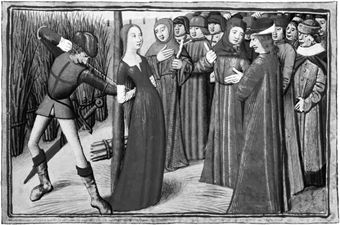
The execution of Joan of Arc.
Again by precedent, Joan ought to have at this point been handed over to the sheriff and taken to a civil court, there to go through the official process of sentencing and punishment, but the English were in no mood for formalities. No sooner were the words out of Cauchon’s mouth than she was seized by the executioner and dragged to the stake.
And it was at this point that Joan broke: Joan who in an effort to exhort her men to victory had so often in the past defiantly planted her standard in the name of God and king, enduring with steadfast purpose a rain of arrows and cannonballs by the enemy; Joan who had met without fear or doubt those who were her superiors in age, learning, and lineage, expertly trading barb for barb, subtlety for subtlety, for months on end without losing her composure; Joan who by nineteen had suffered deprivation, humiliation, and oppression such as the most hardened soldier of fortune had not experienced and who yet never lost the clear song nor sweet joy of her faith, finally succumbed to the terror and anguish that lay before her. Piteously shrieking and crying, “imploring and invoking without cease the aid of the saints of paradise,” so that she moved the hearts of even those who supported the English cause, she was bound to the stake and the fire lit. Because of her youth and vitality, and the low stone parapet encircling the stake, which prevented the fire from overtaking her at once, the duration of Joan’s agony was prolonged even beyond that which was common for the ordeal. In the over half an hour that it took for her to die in the smoke and flames she continued to beg her angels for mercy and to proclaim her faith in God: “Once in the fire, she cried out more than six times, ‘Jesus!’ and especially in her last breath, she cried with a strong voice, ‘Jesus!’ so that everyone present could hear it; almost all wept with pity,” recounted an onlooker. After this, her head fell forward, the flames finally overcame the stone parapet that surrounded her, and she perished.
The English remained cautious of Joan even in death, so much so that after the fire died down, the executioner was ordered to throw her heart, which had remained intact, along with the rest of her ashes, into the Seine. This prevented their being used as relics but also, according to witnesses, “because they feared lest she escape or lest some say she had escaped.”
Still, the English had gotten what they had paid for: the Maid who had so humbled their army had been made to suffer torments and was now gone. But at least one of those present had an inkling of what the victory over this single, transcendent French soul had cost them. Master Jean Tressard, secretary to Henry VI, witnessed the execution and returned afterward to the castle much troubled.
“We are all lost,” he said.