
CHAPTER 13

YOLANDE OF ARAGON was a sufficiently astute politician—after nearly two decades, perhaps the most experienced diplomat on Charles’s side in the war—to grasp instantly the implications of René’s intelligence. If what her son told her was true, the Burgundian chancellor was signaling that the duke might be receptive, or at least that the timing was propitious, and that Philip the Good might be coaxed into considering a separate peace agreement with Charles VII. And she also understood why this communication had come to her through René, and had not gone directly to the royal ambassadors. It was because Nicolas Rolin did not trust Georges de la Trémoïlle, and everybody on both sides of the French and Burgundian courts knew that the queen of Sicily opposed the lord of Trémoïlle as well, and openly advocated that he be replaced by her candidate, the constable Arthur of Richemont.
Nicolas Rolin’s misgivings about Charles’s favorite councillor were well founded. La Trémoïlle had completely misread the situation; instead of trying to work with Rolin, he was trying to get rid of him. La Trémoïlle’s idea of a diplomatic initiative was to have Nicolas kidnapped or killed, and he had already botched one attempt to ambush the Burgundian chancellor. Nicolas had been forced to surround himself with an escort of twenty-four bowmen whenever he appeared in public. He did not appreciate having to exercise this level of caution, and thought that perhaps the queen of Sicily might be able to do something about it.
Yolande was well aware of La Trémoïlle’s unsavory tactics. Arthur of Richemont had been targeted for political assassination by the lord of Trémoïlle as well, and only escaped death during a hunting party in the fall of 1430 when the three agents assigned to perpetrate the crime were betrayed and arrested before they had a chance to execute the plot. More than this, La Trémoïlle was deliberately impeding Yolande’s efforts to recover her properties in Anjou and Maine by sending in mercenaries, not to combat the English, but to battle the constable’s troops, who were fighting on her behalf. “La Trémoïlle’s . . . one thought was to overthrow Richemont and get rid of the Queen of Sicily, Queen Marie of Anjou, and her brother Charles of Maine,” the great French medievalist and specialist in the Hundred Years War, Edouard Perroy, stated flatly.
As tempting as René’s intelligence was, Yolande moved cautiously. She looked first for proof of the estrangement between Philip the Good and his English allies. It was not long in coming. On November 14, 1432, Anne of Burgundy, the duke of Bedford’s wife and Philip the Good’s sister, died in Paris, severing the important familial link between the regent and the duke of Burgundy. The duke of Bedford remarried in April of the following year. He did not bother to consult Philip, as was customary, before entering into this contract. This insult did not recommend the regent to his ally. By the next month, May 1433, the coolness between Bedford and his former brother-in-law was publicly observed when the two arranged to meet for talks in the Burgundian town of Saint-Omer. Both men arrived at the appointed time and place, but they never met or spoke as neither would stoop to call upon the other. “The duke of Bedford expected that the duke of Burgundy should come to him at his lodgings, which he would not do,” the chronicler Enguerrand de Monstrelet reported. “Many of their lords went from the one to the other to endeavor to settle this matter of ceremony, but in vain. . . . Within a short time, the two dukes departed from Saint-Omer without anything further being done, but more discontented with each other than before,” the chronicler noted.
This was all the proof Yolande needed. In June 1433, soon after the episode at Saint-Omer, Georges de la Trémoïlle was given a taste of his own methods. The king was back in Chinon and La Trémoïlle was with him, housed as was customary in the castle of Coudray. Late one night, four men, all of them in service to Yolande of Aragon, having previously subverted the guard, quietly entered the castle through an ulterior doorway and made their way to La Trémoïlle’s chamber. They surprised the councillor in his bed, and when he made a move to resist, they made use of their swords, but only to injure, as the councillor survived and quickly surrendered. (The chroniclers claim that La Trémoïlle was protected from their knife thrusts by his considerable fat, which prevented his enemies’ blades from penetrating too deeply into his organs.) Bleeding from his wounds, the king’s favorite adviser was hustled out of the castle and out into the grounds where a larger group, numbering some dozen men-at-arms in all, were waiting. “They made him prisoner, and carried him away, taking him from the government of the king,” Enguerrand de Monstrelet reported. “He afterward, by treaty . . . promised never to return to the king, yielding up many forts that he held as security for keeping the said treaty. Shortly after, the constable [Arthur of Richemont] was restored to the good graces of his monarch, who was well satisfied to receive him, although he was much vexed at the conduct that had been held to the lord de La Trémoïlle.”
Although another chronicler, Jean Chartier, assigned the responsibility for this successful maneuver to Yolande’s nineteen-year-old son, Charles of Anjou, the organization of so efficient an operation bore all the trademarks of his far more capable and sensible mother. Overweight or no, it was four against one and the councillor could easily have been killed; the fact that he was not indicated that the conspirators had been told to exercise restraint. It was not Yolande’s way to murder her opponents. Assassinating people was what had gotten the French into this mess in the first place.
To ensure a smooth political transition, Yolande also enlisted the aid of her daughter Queen Marie, who was only too thrilled to see the last of this particular adviser. Charles VII was angry at first, thinking that Arthur of Richemont had planned and executed the coup for his own purposes, but Yolande had been clever enough to keep the constable out of it. Marie made her husband realize that Arthur was not among those who had spirited his favorite away, and calmed him down so that he could hear the charges against La Trémoïlle. It turned out that the chamberlain had been engaged in some rather unorthodox financial transactions that were much to the detriment of the king and the royal treasury. The disclosure of these indiscretions was exactly calculated to turn the king’s anger away from the perpetrators of the coup and toward its victim. Charles VII was quickly resigned to his loss and “Yolande [of Aragon] resumed all her lost ascendancy over her son-in-law, and the Constable . . . returned to favor,” Edouard Perroy reported.
Two months later, at a council in Basel that had been convened earlier in the year by the Church to discuss the conflict between France and England, the duke of Burgundy suddenly and without warning ordered his representatives, who had been sitting for the past months on the same bench with the delegation representing England, to change their seats and remove themselves from their English counterparts. The process of reconciliation with France had begun.
WITH YOLANDE OF ARAGON and her protégé Arthur of Richemont once more in control of the court, Charles VII’s diplomatic policy focused on an all-out effort to isolate England by coming to a separate peace arrangement with Philip the Good. But this time, the king did not, as he had after his coronation at Reims, make the mistake of suspending French combat efforts during the negotiations in order to induce the duke of Burgundy to come to terms; rather, he increased the pressure, both diplomatically and militarily, on his adversary. After so many years spent in conflict, even Charles had learned how to prosecute a war.
And so raids continued to be conducted into English and Burgundian territory, penetrating as far as the capital. “The war got worse and worse,” the anonymous chronicler known as the Bourgeois of Paris complained in 1434. “Those who called themselves Frenchmen [Charles VII’s supporters]—at Lagny and the other fortresses around Paris—came every day right up to the gates of Paris. They stole, they killed. . . . There was no news at this time of the Regent or of the Duke of Burgundy; they might have been dead. Every day the people were told that they were coming very soon, now this one, now that; meanwhile the enemy came every day and plundered right outside Paris because no one . . . did anything to stop them.” As a result of the perpetual conflict prices rose and food became scarce; an epidemic of plague struck the city, and the death rate increased alarmingly. In the face of such horrendous conditions, even those Parisians who had supported the regency government began to turn against the English.
The French royal court also secured a major diplomatic coup by coaxing the Holy Roman Empire into the conflict. In April 1434 the emperor, who claimed suzerainty over Lorraine, declared René to be its legitimate duke, dashing Antoine’s hope of assuming power. Philip the Good was so incensed by this decision that he demanded that his hostage, who had been granted a temporary leave of absence from captivity in order to negotiate the terms of his ransom and permanent release, return at once to his prison cell in Dijon, an order that the hapless René, bound by the code of chivalry and honor, was reluctantly compelled to obey. This act of pique on Philip’s part, while no doubt emotionally satisfying, turned out to be somewhat less effective diplomatically. The following month the emperor retaliated by signing a treaty with Charles VII in which Philip was labeled as a “disobedient rebel, self-styled duke of Burgundy,” an unpropitious turn of phrase that was followed six months later by a formal declaration of imperial war.
THE PROSPECT of having to fight the French and the empire simultaneously was sufficiently unpleasant that in January 1435, strongly encouraged by his chancellor, Philip the Good agreed to participate in a series of secret meetings with key ambassadors from Charles VII’s court, including the constable, Regnault of Chartres, and the duke of Bourbon (formerly the count of Clermont). The talks were held in the Burgundian town of Nevers. The duke of Bourbon, who was specifically chosen for this assignment because he had the good fortune to be married to another of Philip’s sisters, sent his wife and children to Nevers in advance of the negotiations to soften the duke of Burgundy. The stratagem worked: “At length the duchess came, accompanied by her two sons and a brilliant attendance of knights, esquires, ladies, and damsels,” reported Enguerrand de Monstrelet. “The duke of Burgundy went out of the place to meet her, and received her with much affection and joy, for he had not seen his sister for a long time, and showed the same love to his nephews, although they were very young. . . . On the next day a council was held, when it was determined that Arthur of Brittany, constable of France, and the archbishop of Reims, should be sent for.” In due course these gentlemen arrived and the parley began in earnest. To everyone’s great relief, the prospect of peace, so long elusive, began to take shape. In fact, Philip experienced such a change of heart at these meetings, and demonstrated such goodwill and hospitality toward his former enemies, that a Burgundian knight, observing his master’s behavior, complained aloud that “we are very foolish to risk our bodies and souls at the will of princes and great lords who, when they please, make up their quarrels, while we oftentimes remain poor and in distress.”
In this congenial atmosphere, which could easily have been mistaken for a joyous family reunion rather than a serious political conference, the duke of Burgundy at last overcame his aversion to treating with his father’s killer, and allowed himself to be munificently bribed. In exchange for formally abandoning England and allying with Charles, Philip got 50,000 gold crowns, payable on signing of the peace treaty. He was allowed to keep all the territory he had already been given by the English, and the French ambassadors even threw in some new property, including the lucrative Somme towns and the county of Ponthieu (although these could be redeemed in the future by Charles for 400,000 gold crowns). Charles would issue a formal apology acknowledging any emotional hardship the duke of Burgundy might have suffered as a result of the murder of his father, and although Philip would officially recognize Charles as the legitimate sovereign of France and become his vassal once again, in deference to any lingering sensitivity he was absolved during his lifetime from having to do personal obeisance to the king.25 (The duke of Burgundy’s heirs would, however, have to pay homage to future kings of France.)
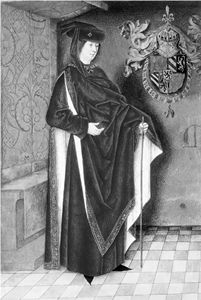
Portrait of Philip the Good.
Nor was the Burgundian architect of this peace forgotten. On July 6, 1435, Charles VII wrote from his castle in Amboise to Nicolas Rolin and others on Philip the Good’s council: “Charles, by the grace of God, king of France, greetings to all those who see these letters. Be it known that we, having heard on good authority . . . of the good will and affection which Nicolas Rolin, knight . . . and chancellor [of Burgundy] and the lords of Croy, Charny and Baucignies, councilors and chamberlains of our cousin of Burgundy, and other servants of his, cherish for the reconciliation and reunion of us and our cousin . . . bearing in mind that this peace and reconciliation is more likely to be brought about by our cousin’s leading confidential advisers, in whom he places his trust, than by others of his entourage . . . we grant and have granted by these present letters the sum of 60,000 gold saluts . . . to divide between them as follows: To the said Nicolas Rolin, 10,000 saluts, to the said lord of Croy, likewise . . . to the said lord of Charny, 8,000 [saluts] . . . to the lord of Baucignies, 8,000.”
After the agreement of Nevers, there remained only the uncomfortable task of Philip’s informing the unsuspecting English that, alas, he was no longer their ally. Sensitive to the charge that his behavior might be construed as falling somewhat short of the cherished chivalric ideal of honor—Philip was, after all, secretly conspiring with Charles VII while still pretending to remain faithful to his sworn oath to support Henry VI—to save face the duke of Burgundy insisted that Charles at least try to make peace with England by calling for a general conference, at which all sides would be present, to be mediated by representatives of the Church. He even offered to host the event, and it was decided, before everyone left Nevers, to issue an invitation to the English to meet later in the year in Arras. “Within a few days many councils were held respecting a peace between the king of France and the duke of Burgundy; and various proposals were made to the duke concerning the murder of the late duke John that were agreeable to him, insomuch that preliminaries were agreed on, and a day appointed for a convention at Arras to put a final conclusion on it,” reported Enguerrand de Monstrelet. “When this was done, they separated most amicably; and news of this event was published throughout the realm, and other countries: notice of it was sent to the pope and the council at Basel, that all persons who chose might order ambassadors to attend the convention at Arras.”
THE CONGRESS OF ARRAS, universally recognized as the turning point of the Hundred Years War, began in August 1435. It was a grand affair, as opulent and illustrious as the great wealth of its sponsor, the duke of Burgundy (whose estate had recently been given a significant boost by his secret deal with the French), could provide. The three participating nations—France, England, and Burgundy—all sent multiple ambassadors accompanied by impressively large, resplendent entourages, so that the total number of emissaries, including bureaucrats, secretaries, servants, and other minions associated with each embassy, reached nearly a thousand people apiece. The French delegation, headed by Philip’s brother-in-law the duke of Bourbon, was composed of the leading members of the royal council: Regnault of Chartres, Arthur of Richemont, and the count of Vendôme, among others. Although she did not herself attend, Yolande maintained her influence over these proceedings through her servant, the treasurer of Anjou, who was one of the principal negotiators for the French. The queen of Sicily also sent separate representatives charged with protecting her specific interests and those of her family.
The English, who had been kept deliberately uninformed of the earlier conference at Nevers, and who were consequently surprised by the invitation to attend a general peace summit, had to scramble to come up with a sufficiently prestigious deputation. They at first asked Philip the Good to lead their embassy, but the duke of Burgundy, for reasons that would become obvious to his former allies only later, delicately declined to undertake this responsibility. The duke of Bedford, seriously ill in Rouen, was unable to attend, so the English ended up with Cardinal Henry Beaufort (Henry VI’s great-uncle and one of the most influential men in the government) and the archbishop of York as its lead negotiators instead. However, as it was important to demonstrate that Henry VI was the legitimate king of both England and France, a number of Frenchmen were included as principal envoys as well. These were more difficult to find, as many of the regency’s formerly loyal subjects, sensing the change in mood, had already defected to Charles VII. But there were still a number who, as a result of the salaries paid them, could be relied upon, and of these the most prominent was none other than Pierre Cauchon. Subsequent to his successful prosecution of Joan of Arc, Cauchon had received the consolation prize of the bishopric of Lisieux—not quite so prestigious a posting as archbishop of Rouen, for which he had initially hoped, but a profitable benefice nonetheless. So enthusiastic a collaborator was he that when the archbishop of York fell ill early in the proceedings it would be Pierre Cauchon who would speak for the English in their negotiations with the French.
The duke of Burgundy of course brought his own entourage, which included some 115 noblemen and their respective households from throughout his domains. He was not a mediator in this instance—two cardinals and bishops assumed that role—but rather the hospitable provider of lodgings and the master of entertainment, an avocation into which he zealously threw himself. There were succulent feasts and late-night suppers accompanied by music, wine, and dancing, and parties at which were played amusing games of chance; the crowning event was an elaborate tournament, where a pair of knights in magnificent armor jousted for the benefit of spectators. The entire affair was staged exactly as though a brilliant medieval wedding was taking place—which in a sense it was, except that, unbeknownst to the English, one of the suitors was about to get jilted at the altar.
Care was taken by the duke of Burgundy to obscure the true state of his relationship with France. Under the guise of providing due protection—after all, the French and the English were enemy combatants, and since each delegation had arrived with an armed guard, the possibility that violence might erupt was not inconsequential—the envoys from England and France, and all of their retinues, were housed at a substantial distance from each other. The English were given their lodgings in the center of the city proper, while the French stayed alongside their host in the comfortable village adjacent to Philip the Good’s castle. During the entire length of the congress, the ambassadors from England and France, along with their numerous respective counselors, never met face-to-face but communicated only by presenting their cases and proposals to the mediators, who passed them along to the opposite side and vice versa. The only member of the English delegation ever to venture into the French or Burgundian living space was the duke of Suffolk, who made a ceremonial appearance on the day of the jousting.
While this separation prevented the English from observing the secret meetings between Philip the Good and Arthur of Richemont (which took place nightly), it did not entirely disguise the growing cordiality that existed between the delegations of Burgundy and France. By the end of the second week of August, the English began to notice that their French counterparts heard mass daily with their Burgundian hosts and later made merry, drinking and carousing until the early hours of the morning, and generally behaving like the best of friends, and that Philip the Good showered many marks of affection and courtesy on those who were, at least in theory, his sworn enemies. “The English ambassadors were not well pleased at these entertainments; and from the frequent intercourse that took place between the French and the duke, they suspected some treaties were in agitation that would not be for the advantage of their country,” Enguerrand de Monstrelet reported.
The format for the talks had been established in advance and the conference proceeded according to the agreed-upon routine. On August 12, 1435, Pierre Cauchon presented the first peace proposal on behalf of the English to the mediators in a large room in the abbey of Saint-Vaast that had been assigned for this purpose. The arbitrators took notes, after which the English delegation, having finished its presentation, filed out, the signal for the French embassy, which had been waiting in another room, to file in. The French envoys were then informed of the details of the opposition’s offer by the cardinals and the two bishops. The English overtures were derisively rebuffed; and so it became the turn of the French to put forth a counterproposal, which proposition was duly and laboriously recorded by the mediators. Then the French filed out, and the English, who had been waiting in another room, filed in, and the whole process began over again.
As the English were unaware that their military and diplomatic position had been seriously undermined at Nevers, and the French were only too cognizant that the balance of power had shifted seriously in their favor and that consequently there was no need for them to concede to any of the enemy’s terms, there was not much overlap between the various proposals. The issue of sovereignty, as might be expected, was particularly divisive. The English held fast to the theory of the double monarchy and insisted that Henry VI be recognized as king of both England and France. They were willing to allow Charles VII to keep his lands south of the Loire, but only if he did homage to Henry VI for them, which meant that Charles would become Henry’s vassal. They absolutely refused to consider surrendering any of the territory currently under occupation, including Normandy, Maine, and Paris, although as a concession they threw out the idea of a marriage between Henry VI and one of Charles’s daughters, the implication being that by joining the two bloodlines the conflict would be resolved when the crown passed to Henry’s progeny.
The French proposals were naturally in diametric opposition to those proffered by the English. The French considered Henry VI to be a mere interloper and demanded that he immediately renounce any pretension to the throne of France, reminding the mediators that this honor had already been conferred upon Charles VII, the legitimate sovereign, by the coronation at Reims. Further, they were adamant that England, which kept a garrison in Paris, must vacate the capital at once. They were reluctantly willing to allow Henry VI to keep his possessions in Normandy, provided he did homage to Charles VII for them, but they preferred to simply pay him to get out, and offered the English 150,000 saluts of gold to leave the kingdom altogether.
As the French conditions were deemed as unsatisfactory to the English as the English propositions had been to the French, the prospects for the signing of a general peace, which had not been particularly promising to begin with, faded altogether in the waning days of August. Despite the best efforts of the mediators, the two sides failed to come to any agreement whatever, and eventually the English lost patience with the enterprise and withdrew from negotiations. According to Enguerrand de Monstrelet, the delegation representing Henry VI left the conference on September 6, 1435, and returned to England in a bitter mood, “for they had perceived, while at Arras, that great cordiality existed between the duke and the French, which was far from pleasing to them.” The following week, on September 14, in a further harbinger of looming collapse, the indomitable duke of Bedford, who in the thirteen years since the sudden demise of his brother Henry V had held the English occupation of France together, often by sheer force of will as regent, died of his illness in Rouen.
A week after that, on September 21, 1435, timed to fall on Saint Matthew’s Day, at a very grand and solemn ceremony at the abbey of Saint-Vaast attended by the Church mediators and all of the most important officials of both the French and Burgundian delegations, Philip the Good signed a separate peace agreement, known as the Treaty of Arras, with the ambassadors from France and publicly swore to “acknowledge our aforesaid lord king Charles of France as our sovereign lord, in as much as regards the land and lordships we hold in that kingdom, promising for ourself and our heirs on our faith and bodily oath, on the word of a prince, on our honor, and on the loss of our expectations in this world and in that to come, to hold inviolate this treaty of peace.” And just like that every city, town, village, castle, fortress, military unit, vassal, and government official in those territories loyal to the duke of Burgundy, whether high or low, rich or poor, rural or urban, peasant or aristocrat, instantly abandoned his or her allegiance to Henry VI and instead embraced Charles VII as the rightful sovereign.
Three days later in Paris, the once notorious queen of France, Isabeau of Bavaria, who for her own comfort had engineered the disinheritance of her last surviving son so that the English might advance into the capital and thereby take possession of the kingdom, died alone and penniless, of an illness brought on by sharp poverty and distress, in the Hôtel Saint-Pol, at the age of sixty-five. She lived just long enough to see her life’s work undone by the Treaty of Arras.
THE NEWS that the duke of Burgundy had signed a separate peace agreement with Charles VII fell like a stone cannonball on the court of Henry VI. Philip the Good himself sent messengers and high-level ambassadors to England, armed with letters explaining this action, which were read aloud at a council meeting. “All persons were very much surprised,” wrote Enguerrand de Monstrelet, “and the young king Henry was so much hurt at their contents, that his eyes were filled with tears, which ran down his cheeks. He said to some of the privy counselors nearest to him, that he plainly perceived since the duke of Burgundy had acted thus disloyally toward him, and was reconciled to his enemy king Charles, that his dominions in France would fare the worse for it.” Astonishment turned to vexation, and vexation to anger. Violence broke out in London against people whose only crime was that they were identified with Flanders, Brabant, or Hainaut, and several were murdered before the king put a stop to it. The royal council determined to fight for its possessions in France, and preparations were made not only to retake territory lost to Charles VII but to declare war on Philip the Good as well.
But it would take time to raise the necessary reinforcements, and in the interim Charles’s forces struck. “When the French or Armagnacs realized that they could not reach an agreement [with England at Arras], they began to make war again more strongly than ever,” wrote the anonymous Bourgeois of Paris. “They entered Normandy in force and soon captured some of its best seaports, Montivilliers, Dieppe, Harfleur, and a number of other good towns and castelries. Then they came nearer Paris and took Corbeil, Bois de Vincennes, Beauté, Pontoise . . . and other towns and castles near Paris. Thus nothing could come into Paris from Normandy or anywhere else, so that in Lent all goods were very dear, especially pickled herring.” By April, five thousand troops led by Arthur of Richemont and the Bastard of Orléans had surrounded the capital. To forestall a prolonged siege, the constable approached the gate at Saint-Jacques at the head of his force and advised those who guarded the city to open the doors and “let us into Paris peacefully, or you will all die of famine.” Joan had issued much the same appeal when she had assaulted these very same walls at the head of an army seven years before, but that was when the duke of Burgundy still stood with England. This time, those addressed “looked over the walls and saw so many armed men that they would not have thought all King Charles’ resources could have paid for even half the troops they could see; frightened at this and fearing an outbreak of violence, they agreed to let them into the town,” the Parisian chronicler reported. Some of the inhabitants loyal to Charles supplied ladders suitable for scaling, and the Bastard of Orléans, with a few of his men, climbed over the walls and opened the gate, allowing the French army to pour into the city. The English garrison, whose numbers had already been severely weakened by desertions, was so obviously outnumbered that its soldiers were allowed to leave the capital unharmed, provided they did so peacefully. The men formed into three companies and marched out of the city to the hoots and taunts of the Parisians, never to return.
And then something unprecedented happened. The constable, acting on behalf of Charles, issued immunity to all Parisians, even those who had supported the regency government, and forbade all acts of retribution . “My good friends,” he was reported to have said, “the good King Charles gives you a hundred thousand thanks, and so do I on his behalf, for having so peaceably returned the chief city of the kingdom to him. If anyone of any rank, present or absent, had done any wrong to our lord the King, it is entirely forgiven him.” For the first time in three decades, the government of Paris changed hands without the massacre of a single citizen, Burgundian or Armagnac; and in that one act of enlightened statesmanship, the civil war was at long last resolved and Charles truly became king of France. “The Parisians loved them for this and before the day was out every man in Paris would have risked his life and goods to destroy the English,” the anonymous Bourgeois of Paris, a confirmed Burgundian who had reviled the Armagnacs for decades, wrote happily, obviously including himself in the general euphoria.
It took several more months to thoroughly secure the surrounding area, but on November 12 of the following year, after being so long denied the city, Charles VII was finally able to enter Paris safely. To mark the solemnity of the occasion, he arrived in great state at the head of a long procession, and was met outside the walls by a large delegation of townspeople, who presented him with the keys to the city. Following this ceremony, a canopy of azure silk, embroidered all over with fleurs-de-lis in gold thread, which had been specially made for the occasion, was raised over his head and the king was formally escorted into the city proper. Present with Charles for this important occasion were his eldest son, Louis, now dauphin of Vienne, and all the most eminent noblemen of the kingdom, the men who had fought for this moment, their names now familiar to all—Arthur of Richemont, the count of Vendôme, the Bastard of Orléans. Even La Hire “in very grand state” rode with Charles at the head of the procession. In one of those pinpoint turnabouts of fealty at which medieval societies were so practiced, the king was celebrated with a degree of warmth that utterly belied the events of the recent past; no one viewing the scene who did not know the circumstances would ever have guessed that this reception was the result of the most savage conflict of the age. “Thus nobly accompanied, did the king make his entry into the city of Paris by the gate of St. Denis,” Enguerrand de Monstrelet recorded. “Three angels supported a shield bearing the arms of France over the gate . . . and underneath was written in large characters,
“MOST EXCELLENT AND NOBLE KING,
THE BURGHERS OF THIS LOYAL TOWN
TO YOU THEIR GRATEFUL OFFERING BRING,
AND BOW BEFORE YOUR ROYAL CROWN.”
The procession proceeded into the city to noisy acclaim; prayers were said, and then Charles and all his company paraded through the capital to his father’s palace, the Hôtel Saint-Pol. “The crowd of common people was so great that it was difficult to walk the streets; and they sang carols in all the squares, and other places, as loud as they could, for the welcome return of their natural lord and king, with his son, the dauphin. Many even wept for joy at this happy event,” the chronicler enthused.

Charles VII parades triumphantly into Paris.
The entrance of Charles VII into Paris, while an important milestone, was largely ceremonial. The military conflict was far from over—the English were still firmly entrenched in Maine and Normandy, where they remained a significant threat to the rest of the kingdom—but to have retaken Paris was an undeniable accomplishment that cemented Charles’s rule and added greatly to his luster. The king himself recognized the moment as such, and that was why he had taken such pains, prior to his entrance, to surround himself in procession with those of the nobility to whom he felt an obligation, as a reward for services rendered. And so on that historic day in November 1437, every person of consequence in Charles’s regime was present to savor the king’s triumph at Paris—except, of course, the two women who had put him there: Joan of Arc and Yolande of Aragon.