
CHAPTER 15

I know well that my King will win the kingdom of France and I know it as well as I know that you are before me as my judge.
—Joan of Arc, in response to her inquisitors, 1431
THE SPEED WITH WHICH the royal decree of Rouen was issued, and the vehemence of its language, would naturally seem to imply that the impetus for the inquiry had originated with the king himself; that Charles VII, overcome by emotion upon entering the city, or perhaps responding to eyewitness reports of the cruelty of Joan’s death, had at last remembered all the Maid had done for him, and had impulsively called for the seizure and subsequent reexamination of the records of her trial. But this explanation gives Charles far too much credit for self-reflection and gratitude. The driving force behind this investigation was not the king but the man charged with its prosecution: Guillaume Bouillé, Charles’s theological adviser. It was Bouillé who, over an unspecified period of time but certainly longer than three months, had finally convinced Charles to undertake this task, and his motive for doing so is not difficult to penetrate. So much of life is fleeting, ephemeral: seasons change; civilizations rise and fall; people are born, they live a little, they die.
But faculty disagreements endure.
The renewal of the theological argument surrounding Joan had its genesis a full fourteen years earlier when Charles’s forces, under the leadership of Arthur of Richemont, the constable, had retaken Paris in 1436. Not simply the ordinary citizenry but all of the capital’s governmental and quasi-governmental institutions had abruptly transferred their allegiance from Henry VI to Charles, and this included the faculty of the University of Paris. Suddenly, the theory of the double monarchy and all of its proponents were out, and a new generation of doctors of theology who supported the rule of the French king and adhered to the old Armagnac views were in. The year after Charles made his grand entrance into Paris, the university had obligingly appointed a new rector to reflect the altered political climate, and this new rector was none other than Guillaume Bouillé.
Almost immediately, the scholastic discussion over the propriety of Joan’s assuming male dress had resumed with all its former intensity as if the long years of war, and even the victim’s own martyrdom, had not intervened. Bouillé, as rector, was in the thick of it. He could not let Pierre Cauchon’s logic stand; it was as important to him to clear Joan’s name so that his English and Burgundian colleagues’ theories would be refuted as it had once been for Cauchon to convict Joan in order to demonstrate the superiority of his own thinking versus that of the old Armagnac scholars. Bouillé would eventually pen a treatise in which he returned to the arguments first promulgated by the revered Armagnac theologian Jean Gerson, justifying a woman’s use of male dress if it was undertaken from the perspective of modesty when forced to live among soldiers. Bouillé’s defense of Joan went even further, however. Highlighting the reality of Charles VII’s now assured sovereignty, Bouillé contended that Joan had license to don male apparel if instructed to do so by divine revelation, and compared her to a number of similarly garbed female saints.
And therein lay Bouillé’s dilemma. So long as the Inquisition’s condemnation of Joan stood—so long as her voices were officially deemed heretical rather than divine by the Church, and she herself had acknowledged them to be so, as had been proclaimed by Cauchon and the English after her death—he could not win his argument. The only way to eclipse the old theologians was to have the decision against Joan reversed, and for this he needed first the king, and then the pope.
And so Bouillé went to work on Charles VII just as Cauchon had once wheedled the duke of Bedford. Their arguments were mirror images of each other. Where Cauchon had pointed out how much more effective politically it would be for the English to demonstrate that Charles VII and the French populace had been taken in by a heretic before killing her, Bouillé stressed how important it was to reverse what was obviously a tainted decision—“an iniquitous, scandalous sentence which threatens his [the king’s] crown,” he called it—as a means of undermining the enemy’s position. Everything Joan had predicted had come true, Bouillé asserted: the English had been forced out of the kingdom, and by the grace of God, Charles VII was king. Hindsight demonstrated that the Maid had been telling the truth about her voices. How then could the sentence of heresy be allowed to stand? That would imply that Charles was king (heaven forbid!) by the work of Satan. No, no, it had been the English who had been deceived into doing the devil’s work, and their errors must now be acknowledged and corrected.
By the time Rouen fell to the French, Charles had enough distance from the events of his early reign to no longer worry about his dignity or feel embarrassment over his relationship with the Maid, and Bouillé’s arguments held a definite appeal. Despite the French king’s recent military successes, the war was not yet over completely. The English still occupied some (albeit much-reduced) territory on the continent, and anything that could be done to further decrease their influence or demoralize their troops should be attempted. That it would also be personally satisfying to turn the tables on his enemies by pointing out that they had behaved atrociously and against the word of God was just an added incentive.
And who better to conduct the royal inquiry than the man who had urged it in the first place? By putting Bouillé himself in charge, Charles was as assured that the commission would find in favor of Joan as the duke of Bedford had once been certain, by appointing Pierre Cauchon to a position of authority, that the Inquisition would find against her.
Bouillé threw himself into his work and within three weeks of receiving the king’s decree had already begun to query Joan’s former assessors as to her treatment during captivity and the protocol associated with her condemnation. Since it had been almost twenty years since her trial, many of these people were no longer living. Cauchon, her chief tormentor, had died eight years before, from being bled by an overly enthusiastic physician. Her other judge, the vice-inquisitor, was nowhere to be found and presumed dead. A number of their collaborators had also succumbed in the intervening years, including the priest who had delivered the haranguing sermon just prior to Joan’s execution, and who had subsequently expired, fittingly, from leprosy.
Bouillé’s investigation was therefore limited to interviews with just seven people over a period of two days. Of these seven, all but one distanced themselves from the proceedings, laying the blame for Joan’s execution squarely on her judges, who, as one of the witnesses testified, “[acted] more through love of the English and the favor they had from them . . . than through zeal for justice of the Faith.” The only holdout was the elderly theologian Jean Beaupère, whose question “Do you know if you are in God’s grace?” had elicited perhaps the most eloquent of Joan’s responses during her trial: “If I am not, may God bring me to it; if I am, may God keep me in it.” In his seventies, Beaupère was apparently too old and crotchety to change his opinion for the sake of political expediency and insisted that Joan had gotten what she deserved.
On the basis of these seven interviews, Bouillé found enough improprieties as regards Joan’s treatment and sentencing to strongly recommend to Charles that a more thorough inquiry be conducted with the goal of having her condemnation revoked. The secular authority had now done all it could to redeem Joan. Because the verdict had been delivered by the Inquisition, the question of Joan’s heresy was, as it had always been, in the hands of the Church. Somebody was going to have to approach the pope.
THE POPE IN 1450 was an Italian scholar who took the name Nicholas V. Nicholas, who loved books and art and whose principal achievement would be the establishment of the Vatican Library, had inherited a host of world problems from his predecessors. As a result of decades of internal conflict, the papacy’s reputation had been seriously weakened. A council in Basel had elected an antipope; the emperor was trying to assume powers regarding the dispensing of benefices and other Church offices that had traditionally resided solely with the pontiff; the Turks were threatening to overrun the ancient city of Constantinople. On a more mundane level, 1450 was a Jubilee year, which meant that thousands of pilgrims and other tourists would be descending on Rome in anticipation of spending their hard-earned savings and visiting the more important religious sites, and it was the pope’s responsibility to see to it that the city and its monuments were spruced up and sufficient accommodations made available to capitalize fully on the moneymaking potential of this event. Obviously, with so much to do, the question of whether some obscure French peasant woman had been unfairly accused of heresy two decades earlier did not occupy a position of prominence on Nicholas’s agenda.
However, the pope did need the English and French to stop fighting each other so that the attention of Christendom could be turned toward addressing what Nicholas considered to be the real threat: the aggressive military posturing of the Turks and the vulnerability of Constantinople. So he sent a legate, Cardinal Guillaume d’Estouteville, to France to negotiate a peace treaty. Cardinal Estouteville did not exactly qualify as an impartial arbiter. He was a native Frenchman, originally from Normandy. A number of the members of his family had fought against the occupation and lost their property to England, and the whole clan was consequently staunchly loyal to Charles VII. Moreover, Estouteville was an old University of Paris man himself (during his visit from Rome he took time off from his official duties to reform the teaching schedule there) and understood Bouillé’s point perfectly. Before any peace could be concluded, the king must be absolved of the charge of having gained his throne through the interference of a condemned heretic, and the only way to do this was to have the sentence against Joan officially overturned. “I know that the matter greatly concerns your honor and estate [and] I am working on it with all my power . . . just as a good and loyal servant should do for his lord,” the cardinal hastened to assure Charles in a letter of 1452.
On his own initiative, Estouteville secured the services of the then Inquisitor of France, a man named Jean Bréhal, who was also by coincidence originally from Normandy, and who similarly loathed the English and was a loyal partisan of the king. The two churchmen established themselves in Rouen at the end of April 1452, where they studied the transcript of Joan’s trial and listened to the testimony of witnesses. This pair was even more efficient than Bouillé. By May 4 they had produced an official document noting the existence of some twenty-seven instances of irregularities associated with Joan’s trial. As a result, they concluded that “the preceding and other points being weighed, the case and the sentence are both null and most unjust,” and recommended that the question of Joan’s heresy be reexamined in the light of these errors.
By the next year, Estouteville had given up all pretense of negotiating a peace between England and France (there never was an official treaty marking the end of the Hundred Years War) and had returned to Rome. But neither he nor the inquisitor, Bréhal, ceased in his efforts to have Joan’s sentence reversed. Seeking to authenticate his findings, Bréhal spent the next two years soliciting opinions from theologians from as far away as the University of Vienna, while Estouteville tried to get Nicholas to authorize a retrial. But by this time Constantinople had fallen to the Turks and the pope had far more serious matters to attend to; also, it was likely he did not wish to offend the English, whose help he still hoped to gain against the Eastern threat.
It wasn’t until after Nicholas’s death in 1455, and the election of a new pope, Calixtus III, that Estouteville was able to make progress. By this time, he and Bréhal had revised their approach. In the process of seeking opinions from other theologians, Bréhal had received this piece of valuable advice from a sympathetic faculty member at the University of Paris: “Although many persons could be plaintiffs, as all those whom the thing concerns could be so considered . . . and the thing concerns many persons in general and in particular . . . it seems to us that the near relatives of the deceased Maid must have an advantage over the others and ought to be . . . prosecuting [bringing suit] for the injury done to one of their family.” Joan’s mother and two of her brothers were still alive, so Bréhal approached them to inquire whether they would be willing to petition the pope for a retrial. The result was a new application to Rome in the name of Joan’s family, seeking redress for the injuries done to the Maid and her lineage and demanding that her case be retried before “a tribunal of rehabilitation.”
Calixtus was already seventy-seven years old when he was elected pope in 1455. He would live only another three years, and during that time he would devote himself almost single-mindedly to organizing a crusade against the Turks for the purpose of recovering Constantinople. For this, he knew he would need the support of the French king and was probably persuaded by Estouteville (erroneously, as it turned out) that reopening the case against Joan would please Charles VII sufficiently so as to cause that monarch toconsider aiding the new pope in his military venture. Also, Calixtus “loved to converse upon legal matters, and was as familiar with laws and canons as if he had but just left the University,” observed distinguished papal scholar Dr. Ludwig Pastor. The lawful petition from Joan’s family and the massive supporting scholarship from Bréhal impressed him. On June 11, 1455, Calixtus replied favorably to Joan’s family’s request and called upon three prominent members of the Church in France to work with the inquisitor to reopen proceedings in order to determine the validity of the Maid’s former sentence of condemnation.
By 1455, Joan’s mother, Isabelle, was in her sixties and widowed. She had been left in poverty by the death of her husband and was subsequently invited by the citizens of Orléans, who to their great credit never forgot what Joan had done for them, to take up residence in their town. The municipal government even provided Isabelle with a monthly stipend to help her meet her expenses and paid for a doctor to visit her when she became ill. Her son Pierre, who had fought with Joan, lived with her. Upon his return to France, the duke of Orléans, in recognition of the role Joan and her family had played in saving his birthright from the English, had awarded Pierre a small island in the Loire near Rouen.
In the fall of 1455, aware that a new tribunal had been commissioned to take up the question of her daughter’s trial and execution, the aging Isabelle, in the company of Pierre and a group of supporters from Orléans, made her way to Paris in order to plead personally for justice on her daughter’s behalf. On November 7, she and her entourage appeared at the cathedral of Notre Dame. They were ushered into the presence of Inquisitor Bréhal and the three ecclesiastics appointed to aid him in his inquiry, and Isabelle was allowed to present her case for rehabilitation. Because hers was the name on the papal petition, and it was she who was bringing suit against the former findings, the old woman’s passionate appeal for redemption for her child was recorded as part of the official proceedings. It remains today as perhaps the most searing and poignant expression of the indefensible atrocity of the case. Joan is in every word.
“I had a daughter, born in legitimate marriage, whom I fortified worthily with the sacraments of baptism and confirmation and raised in the fear of God and respect for the tradition of the church, as much as her age and the simplicity of her condition permitted,” Isabelle testified. “So well that, having grown up in the middle of the fields and of the pastures, she went frequently to church and every month, after confession, received the sacrament of the Eucharist despite her young age and gave herself to fasting and to prayer with great devotion and fervor, on account of the necessities then so grave in which the people found themselves and with which she sympathized with all her heart.
“Nevertheless,” the mother continued, “certain enemies . . . betrayed her in a trial concerning the Faith, and . . . without any aid given to her innocence in a perfidious, violent, and iniquitous trial, without shadow of right . . . they condemned her in a damnable and criminal fashion and made her die most cruelly by fire.” With that, Isabelle threw herself at the feet of the commissioners and burst into tears, waving the document she had brought to validate her suit; her grief was so profound that those who had accompanied her also cried out, and it was reported that the tribunal, visibly moved, accepted her petition.
So began the Church proceedings that would result in the rehabilitation of Joan of Arc.
IN CONTRAST to the earlier inquests by Bouillé and Cardinal Estouteville, which were rushed and superficial affairs designed only to prompt further action, this official retrial of the Maid of Orléans by the Inquisitor Bréhal and his three eminent colleagues was a painstakingly comprehensive examination carried out over a period of eight months. Determined that the judgment rendered by his tribunal be considered authoritative, and so permanently discredit and erase the previous ruling, Bréhal brought the same careful, thorough scholarship to the process that he had used when first researching the question of Joan’s alleged heresy. A diligent effort was made to solicit statements from all those who were still living who had ever known or come into contact with the Maid, or who could shed light upon the events in question, and the result was that scores of people testified on her behalf—some 115 in all. Moreover, as it was recognized that many of these witnesses were now older and might find it difficult or inconvenient to travel, the inquisitor made the innovative decision to physically move the court from place to place, and in particular to those towns where Joan herself had appeared, on the grounds that it was at these venues that the judges would be most likely to find informants. Additionally, in order that no evidence be overlooked or neglected, the proceedings were made public and the sessions opened to spectators, of which there were many, for persons of both the very highest and lowest birth were heard with equal attention. In a further effort to reach the largest audience possible, proclamations were read out in all the public squares by the local town criers well in advance of the tribunal’s visit, summoning anyone who could give testimony to appear before the court on a specific date.
The result was a collective catharsis staged at the national level, in which not only Joan but the entire French populace achieved redemption. The inquisitor remained in Paris throughout November 1455, and it was here that spectators were treated to the stirring eyewitness reports of great men like the Bastard (now raised to the count of Dunois) and the duke of Alençon, who relived in vivid detail the mesmerizing, miraculous events leading up to the lifting of the siege of Orléans and beyond to the coronation at Reims, in what each now recognized to be among the most glorious adventures of the kingdom’s long history. From Paris, the tribunal moved to Rouen, where it sat in session from the twelfth of December through the twentieth and where the audience was electrified by the evidence of Guillaume Manchon, the notary from Joan’s Trial of Condemnation, who testified that Pierre Cauchon and others had deliberately conspired to falsify the official records, offering as proof a number of original documents that he had retained for over two decades, and which he now placed into the hands of the inquisitor. In January, Bréhal sent a representative to Joan’s home village of Domrémy to take depositions from her neighbors and childhood friends, as well as acquaintances and supporters from around the region, including two of the men who had made up the Maid’s original escort from Vaucouleurs to the royal court at Chinon in 1429. The final location was Orléans, where so many witnesses came forward that the tribunal was forced to stay in session for a full three weeks, from February 22 to March 16, in order to hear all the evidence.
Out of these numerous and passionate attestations, the portrait of Joan as she is known today was recorded for history and seared into the consciousness of the kingdom like an engraving etched into a metal plate. There was brave Joan again on the banks of the Loire as the Bastard first remembered her: “Bearing in her hand her standard which was white and upon which was the image of Our Lord holding a fleur-de-lys in his hand, and she crossed with me and La Hire the river of the Loire, and we entered together the town of Orléans.” And again with the duke of Alençon just before the decisive battle of Patay: “Many of the King’s men were afraid [and] Joan said: ‘In God’s name, we must fight them, were they hung from the clouds, we should beat them. . . . The gentle king will have this day greater victory than he ever had and my counsel has told me that they are all ours.” And later at Troyes, with the Bastard again an eyewitness: “Then the Maid came and entered the council and spoke these words or nearly: ‘Noble Dauphin, order that your people go and besiege the town of Troyes and stay no longer in council, for, in God’s name, within three days I will take you into the city of Troyes by love or by force or by courage, and false Burgundy will stand amazed.”
And just as powerfully, from the humble people there arose the image of Joan as one of their own, unpretentious and generous: “Willingly did she give alms and gathered in the poor and she would sleep beneath the hood of the hearth that the poor might sleep in her bed.” “I often heard it said by Messire Guillaume Front, parish priest during his lifetime at the town of Domrémy, that Joan, called the Maid, was a good and simple girl, pious, well brought up, fearing God, so much so that she had not her equal in the town.” “I was, in those days, churchwarden at the church of Domrémy and often did I see Joan come to church, to Mass and to Compline. And when I did not ring the bells for Compline, Joan would catch me and scold me, saying I had not done well; and she even promised to give me some wool if I would be punctual in ringing.” Over and over they testified. And, finally, from the transcripts of her Trial of Condemnation, came Joan in her own words: “I call upon God and Our Lady that they send me counsel and comfort and thereafter they send it to me”; “It pleased God thus to do, by a simple Maid to drive out the King’s enemies”; “As for the Church, I love her and would wish to sustain her with all my power for our Christian faith. . . . I abide by God who sent me, by the Holy Virgin and all the saints in paradise. And I am of opinion that it is all one and the same thing, God and the Church, and of that one should make no difficulty. Why do you make difficulty over that?” And at the last, her enduring defiance in the face of her tormentor, Pierre Cauchon: “And me, I tell you, consider well ere you call yourself my judge, for you are assuming a great charge.”
The tribunal returned to Rouen in May; on the last day of the month provision was made for those who wished to speak in defense of the original condemnation. No witnesses came forward.
On June 10, the investigatory portion of the trial ended, and Jean Bréhal and his fellow judges retired to review the evidence in preparation for delivering a verdict. Ever the scrupulous academic, the inquisitor spent the next month composing a highly detailed summary of all the material collected, in which the testimony from the retrial was compared point by point with the evidence and arguments obtained from the transcripts of the Trial of Condemnation and the heretical charges were refuted in every case.
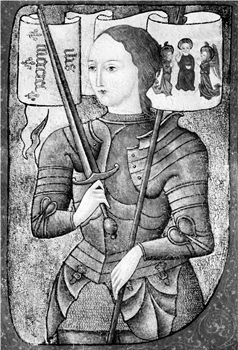
Joan of Arc in her time.
At last the judges reached their decision. On July 7, 1456, at nine o’clock in the morning, they convened in the great hall of the palace of the archbishop of Rouen. To emphasize the import of their findings to the kingdom at large, they were attended by the archbishop of Reims and the bishop of Paris among other dignitaries. The archbishop of Reims, as the most senior Church member present, read the verdict aloud to the expectant crowd that had assembled to witness the ceremony:
“In consideration of the request of the d’Arc family against the Bishop of Beauvais, the promoter of criminal proceedings, and the inquisitor of Rouen . . . in consideration of the information . . . and juridical consultations . . . we, in session of our court and having God only before our eyes, say, pronounce, decree and declare that the said trial and sentence [of condemnation] being tainted with fraud, calumny, iniquity, contradiction and manifest errors of fact and of law, including the abjuration, execution and all their consequences, to have been and to be null, invalid, worthless, without effect and annihilated. . . . We break and annul them and declare that they must be destroyed. . . .
“In consideration of Joan’s appeal to the Holy See . . . we proclaim that Joan did not contract any taint of infamy and that she shall be and is washed clean of such and, if need be, we wash her clean of such absolutely.”
As these words were delivered, a copy of the original transcript of the Trial of Condemnation was dramatically held aloft and torn to pieces as a literal expression of the act of nullification.
The next day, in front of an even larger crowd, and to loud prayers and general rejoicing, the verdict of absolution was repeated at the Old Market, site of the Maid’s terrible execution, and a cross erected in her memory.
“And thereafter my voices say to me: ‘Take it all in good part, do not whine over thy martyrdom; by it thou shalt come at last to the kingdom of Paradise,” Joan had once passionately declared to her inquisitors in response to their skepticism and attempts to undermine her commitment to her voices and state of grace. “[And] I firmly believe what my voices have told me, to wit that I shall be saved, as firmly as if I was there already.”