
CHAPTER 3

HISTORY IS COMMONLY depicted as a tangled skein of cause and effect, design and fate, so interwoven as to make it impossible to isolate any one factor as key to the progression of human affairs. But this was not the case in France during the first two decades of the fifteenth century, where almost every disturbance in the political arena can be traced back to one fundamental determinant: the insanity of Charles VI. Here was a madness so pervasive, so destabilizing, that it afflicted not only a king but a kingdom.
Possibly the most poignant aspect of the whole predicament was the potential Charles VI exhibited at the start of his reign. He inherited his throne in 1380 when he was just eleven and his younger brother, Louis, later duke of Orléans, eight. The old king, Charles V, had managed to recover most of the territory lost to England during the first half of the Hundred Years War and so was able to leave his eldest son a relatively strong and peaceful kingdom. The specter of conquest by England, which had haunted France in the middle of the century, faded, and in the boy king’s youthful energy there was every hope for the future.
Charles VI was a charming scamp, high-spirited, fun-loving, and sociable. Christine de Pizan, who knew him, described Charles as a tall, well-built young man, attractive even with his prominent nose. (Both Charles and his younger brother Louis, duke of Orléans, inherited their father’s distinctive proboscis.) Unlike Charles V, who had been sickly, preferring books and scholars to physical activity, Charles VI was an athlete who loved nothing better than a good joust, a trait that augured well for his ability to protect his kingdom in times of strife. His personality too differed markedly from Charles V’s in a manner that, in hindsight, betrayed his later affliction: the son was quixotic and impetuous where the father had been coldly calculating.
Because the new king was still so young, until he came of age France was ruled by his uncles, the dukes of Berry and Burgundy, acting as regents. Unfortunately, they used this transitional phase to seize as much money, power, and territory as was possible. During this period, for example, the duke of Berry stole the castle of Lusignan.
But while the duke of Berry was certainly avaricious, he was also timid. As a result, he was no match for his brother the duke of Burgundy, who displayed no such weakness. “The Duke of Burgundy,” declared the chronicler Jean Froissart, “was the greatest personage in France next to the King.” Known as Philip the Bold for his predatory policies, the duke of Burgundy busied himself during Charles VI’s minority with extending his influence to the north and east of France. He had earlier married the countess of Flanders, heir to one of the richest provinces in Europe, and so gained an interest not only in her domain but in Belgium and the Netherlands as well. Nearer to his home demesne of Burgundy in eastern France, he sought an alliance with his neighbor, the duke of Bavaria, with the intention of encircling France along its outer boundaries. As his power grew, he could then by degrees close in on his nephew’s territories.
Initially, Charles VI’s youth and inexperience allowed Philip the Bold to manipulate him easily. When in 1382 the citizens of Flanders rebelled, Philip advised Charles to lead an army to Ghent to put down the rebellion. Fourteen-year-old Charles thought this an excellent idea. His first introduction to warfare! A real battle! He and his uncles and a large force of men-at-arms all trooped north to Flanders, where the royal knights, with their chain mail, maces, and iron-tipped spears, made short work of the rebel force, made up as it was of ordinary townspeople whose only protection was iron hats. “The clattering on the helmets by the axes and leaden maces was so loud that nothing could be heard for the noise of them,” the chronicler Froissart noted. In the wake of this resounding victory most of the neighboring towns surrendered or paid Charles an exorbitant sum to go away.
Having reasserted his authority to the north, Philip the Bold then looked to use his nephew to help augment his power to the east. Here he was aided by the former king’s last request. As he lay dying, Charles V had called the dukes of Berry and Burgundy to him. “I feel I have not long to live. Seek out in Germany an alliance for my dear son, Charles, that our connection with that country may be strengthened hereby.” Again, fortune smiled upon Philip the Bold: the duke of Bavaria happened to have a daughter, Isabeau, two years younger than Charles VI and reputed to be quite pretty.

The only problem was that Isabeau’s father was against the marriage on the grounds that there was too great a difference in rank between his daughter and the king of France. The court of Bavaria, where Isabeau had been raised, was a quiet little backwater, comfortable but not ostentatious. The girl was unprepared to take on the responsibilities of a royal retinue, let alone navigate the complex political milieu associated with the most powerful kingdom in Europe. The duke preferred Isabeau to marry one of his own nobles and stay closer to home—a less brilliant alliance, certainly, but on the whole a more sensible one.
Her father’s reluctance did not at all deter the duke of Burgundy from pursuing the union, although it did force him to engage in a bit of subterfuge. He was aided by the duchess of Brabant, a relative of the duke of Bavaria, who recognized in Philip the Bold a possible military ally. The duchess prevailed upon Isabeau’s father to send the girl to her for a short visit, and then to another highly respectable relation, the duchess of Hainaut. As a treat for Isabeau, the two women intended to escort her to the fair at Amiens, and from there, on a more somber note, to make a pilgrimage to the nearby shrine of Saint Jean. Faced with so meritorious a request, the duke of Bavaria acceded to his cousin’s wishes. He even agreed to allow Isabeau’s portrait to be painted for the duchess.
Isabeau traveled to Brussels in the early summer of 1385. She was fourteen years old. She visited for three days with the duchess of Brabant before going on to see the duchess of Hainaut, with whom she stayed for three weeks. During this period, the duchess of Hainaut, an extremely worldly woman, took it upon herself to transform Isabeau, at least on the outside, from an awkward country girl into a vision of medieval beauty, elegance, and sophistication. Out went all of Isabeau’s dowdy Bavarian clothes and in came chic Parisian gowns, headdresses, and jewels worthy of a princess. For three weeks the girl was drilled in manners and comportment, including how to sit, stand, eat, walk, dance, and curtsy. Isabeau’s complete ignorance of the French language meant that the duchess of Hainaut did not have to work on her accent or on witty repartee; she simply instructed her not to speak.
In the meantime, Charles VI, now sixteen and very interested in girls, was shown Isabeau’s portrait, along with those of the duchesses of Lorraine (another territory the duke of Burgundy was interested in) and of Austria, and asked whom he preferred to marry. Apparently her rivals for the king’s affection did not represent much competition in the looks department, as Charles immediately chose Isabeau. Upon being told that she and her relatives would attend the fair at Amiens, he arranged to be present at the same time and then sent two of his closest knights to the duchesses of Hainaut and Brabant to arrange an interview.
The rendezvous was held on a Friday in the presence of a large audience. It took the duchesses of Brabant and Hainaut most of the day to get Isabeau ready, but finally she arrived at the king’s apartments dressed and accessorized as splendidly as art and money could achieve. Charles, who had spent a long, fraught, teenaged male night thinking about her portrait, was in that state of anticipation that lent itself mightily to the success of the enterprise. Isabeau made her way gracefully through the crowd of courtiers before coming to stand (silently) before the king. Charles was completely smitten. Later that evening, as he was preparing for bed, he instructed his emissaries, “Tell my uncle, the Duke of Burgundy, to make haste and conclude the affair.” So eager was Charles for the wedding night that he refused to wait to be married at Arras, as his uncle desired, and instead had a beautiful gold crown delivered to Isabeau on the spot. The two were married three days later at the local cathedral in Amiens without benefit of a nuptial contract or a dowry, an unheard-of omission for a royal alliance.
And so a provincial girl of fourteen, who likely could not read or write, and who had never been exposed to the workings of a large government, let alone the intrigues and shifting political currents of possibly the most sophisticated and cosmopolitan court in Europe, became queen of France. Nor did Isabeau have the benefit, as had Yolande of Aragon, of an experienced older woman who could act as a mentor or guide through the labyrinth of customs and relationships that constituted her new realm’s entrenched power structure. Charles’s mother was dead, and soon after the wedding the duchesses of Brabant and Hainaut abandoned her for their own courts, well satisfied with their efforts. At least some of the blame for the trouble to come may be laid at the feet of these two cynical women, who taught the new queen of France how to arrange her hair but not to rule.
In the beginning, though, as Isabeau was not called on to do much more than buy expensive clothes, look regal, and have fun, her inexperience did not work against her. The marriage was a happy one. Isabeau’s temperament suited that of her new husband; both loved banquets, dancing, and late nights filled with company and wine; they were also united in their love of fine clothes and elaborate, opulent, and frequently raucous entertainments. For her coronation, Charles arranged a three-day extravaganza in Saint-Denis, complete with fountains that spouted honeyed spiced wine, a large choir of children dressed as angels, and a highly theatrical street performance that boasted costumed actors reenacting the battle of the crusaders against King Saladin.
Charles too reacted well to the marriage, and matured greatly in the years immediately following his wedding. By 1388, when he was still only nineteen, he was able to dismiss the regency government administered by his uncles. This was a very popular move, as there had been a disastrous (and expensive) military campaign against England subsequent to the initial victory in Flanders for which his uncles the dukes of Berry and Burgundy were universally blamed. At the urging of Charles’s younger brother, Louis, a very precocious sixteen-year-old, the king sent his disgruntled uncles graciously but firmly back to their own provinces “with many thanks for the trouble and toil they had had with him and the realm.” Charles immediately surrounded himself with his father’s former counselors, all experienced and prudent men who governed, if not wisely, at least with moderation, and for the next four years there was peace in France.
And then came the summer of 1392.
IRONICALLY, the year had begun advantageously for Charles; in retrospect, it may well have marked the high point of his reign. He was in full control of his government, he was beloved by his people, and on February 6 he had fulfilled perhaps the most important task of a monarchy when the queen finally gave birth to a son who survived infancy. “The bells were ringing and in order to announce to all of France the new and joyous event that had taken place in the city, couriers were dispatched in all directions, charged in the name of the king to spread the happy news of the birth of the prince throughout the kingdom,” the Monk of Saint-Denis recorded in the official chronicle.
By this time Charles was twenty-three and monitored the administration of his government “with much diligence.” Diligence often required traveling long distances under unsanitary conditions, and in March when he went to Amiens on a diplomatic mission, he and several other members of his retinue fell ill with what seems to have been typhoid fever. Charles was so sick that he had to be taken by litter south to Beauvais, where it took him nearly two months to recuperate. He was not back in Paris until the very end of May.
Soon after his return, while he was still in a weakened state, a disquieting episode occurred in the capital. His chamberlain, Pierre de Craon, had recently been removed from his post, which Pierre attributed to a heated exchange with the constable of France, a man very high in the king’s favor. Nursing his grudge, Pierre and several of his men ambushed the constable on his way home from dinner with the king on the evening of June 13. They tried to kill him but succeeded only in wounding him. Charles was in the act of undressing for bed when he was informed (mistakenly) that his constable had been murdered; so upset was he that he did not bother to change but threw on only a cloak and went himself to investigate. He discovered the injured man in a nearby baker’s shop, where he had been carried after the attack. The constable had sustained many wounds and was covered in blood. Charles had known this man since childhood; the constable had watched over him faithfully since he first ascended to the throne. The sight of his longtime protector and father figure in so pitiable a state upset the king deeply.
“The first words the King said were, ‘Constable, how fares it with you?’ ‘Dear sire,’ he replied, ‘but so so, and very weak.’ ‘And who has put you in this state?’ ‘Pierre de Craon and his accomplices have traitorously, and without the smallest suspicion, attacked me.’ ‘Constable,’ said the King, ‘nothing shall ever be more severely punished than this crime. . . . They shall pay for it as if it were done to myself.’”
Charles ordered the assailant pursued, but Pierre had already fled the city. Eventually it was determined that he had sought refuge with the duke of Brittany, although the duke denied this. A furious Charles summoned an army and made preparations to attack Brittany and retrieve the criminal. He personally led his force out of Paris but made it only as far as Le Mans. There he became so ill that he was unable to sit upon his horse. “He had been the whole summer feeble in mind and body, scarcely eating or drinking anything, and almost daily attacked with fever, to which he was naturally inclined, and which was increased by any contradiction or fatigue,” observed Froissart. Even more worrying, the Monk of Saint-Denis reported that while at Le Mans, the king would sometimes talk nonsense and behave in a manner “unbecoming to royalty.” Despite his obvious weakness, at the end of three weeks, over the objections of his physicians, Charles insisted upon persevering, and once more mounted his horse to lead his forces to Brittany.
By this time it was August and very hot. Charles was in full armor. As the army left Le Mans, they passed a local leper colony where they picked up a deranged vagrant who shadowed the king for half an hour, shouting, “Go no further, great king, for you are to be quickly betrayed!” before being run off by the royal guard. The army continued on its way through first a forest and then out onto a dry stretch of flat land, at which point there was quite a bit of dust kicked up by all the horses, so the king and two pages rode a little ahead of the procession to escape the dirt. The pages were young, and one of them, struggling to keep awake in the heat, let fall the lance he was carrying. It clattered against the armor of the other page, startling the king.
At once, Charles brandished his sword and turned on the boys. “Advance, advance on these traitors!” he cried. The pages, terrified, spurred their horses to get away, but the king, hallucinating and believing himself to be under attack, continued to strike out at those around him, including his brother, the duke of Orléans, who somehow managed to elude him. Others were not so lucky, however. Charles killed five of his own men before his sword broke and he was wrestled from his horse by one of his knights.
The company immediately turned around and took him back to Le Mans, where he lay completely unresponsive for two days, staring blankly at his uncles and unable to speak when they came to visit. Only on the third day did Charles recover his senses and realize what he had done. He was sent south to recuperate. He did not return to Paris until October.
THIS WAS THE BEGINNING of Charles VI’s thirty-year struggle with what today doctors would likely diagnose as schizophrenia. During its most acute stages, which occurred annually and sometimes persisted for months at a time, Charles lost all sense of reality. He did not know who he was and denied being king. When he saw his own coat of arms, or those of the queen, he performed a bizarre little jig and then tried to efface them. He insisted that his name was George and that he had a different coat of arms altogether. During these episodes he was often uncontrollable, and would dash wildly through the castle, trying to find a way out, shrieking that his enemies were all around him. Eventually, his household had to block all the outside doorways so he did not run out into the street in this condition. During his most extreme bouts of madness Charles would refuse to bathe or change his apparel, often for as long as five months. He had to be tricked or frightened into removing his clothes, and when he did, his servants found his body covered in sores and smeared with his own excrement. Sometimes he threw his clothes into the fire. Sometimes he urinated on them. Often he made obscene gestures or babbled incoherently.
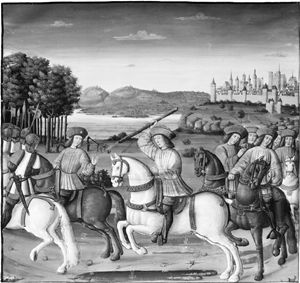
Charles VI suffers his first psychotic episode, attacking his own men.
Although frequently he would recognize his household servants, he almost never knew his wife and children. The sight of Isabeau, in particular, upset him; he couldn’t bear to have her around him. According to the Monk of Saint-Denis, “when . . . she [Isabeau] approached to lavish attention on him, the king repulsed her, whispering to his people: ‘Who is this woman obstructing my view? Find out what she wants, and stop her from annoying and bothering me, if you can.’” Instead, to calm him, he was provided with a mistress who lived with him at his favorite Parisian domicile, the Hôtel Saint-Pol, and by whom he eventually had a child.
But then, sometimes after days, but more often after weeks or even months of raving, the hallucinations would disappear as abruptly as they had come. Charles would remember who and what he was and return to his wife and children. He would also once again resume rule. This was the great undoing of France. For although he appeared sane during these periods, the king was likely never really free of the disease, and his confusion and uncertainty, particularly about what had occurred in the kingdom during the intervals of his lunacy, made him highly susceptible to suggestion and the slightest persuasion. He became like one of those characters in a fairy tale who, stricken by Cupid’s arrow, or sprinkled with magic powder, or placed under a wizard’s spell, falls in love with the first person he sees upon waking. Eventually it became widely known among his relatives that whosoever succeeded at gaining entry into the king’s presence immediately upon his emergence from one of his cycles of madness could obtain pretty much anything he or she wanted out of him.
AS SOON AS IT BECAME CLEAR that Charles was mentally incapacitated, his uncles, especially the duke of Burgundy, moved quickly to once again take control of the kingdom. Unlike the period of the king’s minority, however, they were not openly named as regents. Because Charles was sometimes sane enough to govern, he was never removed from power, and his subjects continued to consider him to be the only legitimate ruler of France. Consequently, every policy that was implemented by his uncles or anyone else had to be done in the king’s name, whether the king was aware of the action or not. It could also be reversed by the king whenever he was rational enough to do so. Additionally, any commandment issued by the king, even if it conflicted openly with a prior commandment, was automatically accepted as law.
This confusing state of affairs was further exacerbated by the introduction of a new and powerful rival to the duke of Burgundy. The king’s younger brother, Louis, duke of Orléans, married and with a family of his own to protect, was now old enough to jealously guard his prerogative. Louis was ambitious not only for power but for wealth, and was determined that his holdings should be on a par with—or preferably exceed—those of his uncles. In 1401, he took advantage of the duke of Burgundy’s absence from Paris to cajole his brother the king into ceding to him two important properties that Philip the Bold coveted. Furious, the duke of Burgundy responded by raising an army and marching on Paris. Civil war was only averted at the last minute through arbitration undertaken by the queen, the king being at the time locked up, raving, in the Hôtel Saint-Pol.
This was Isabeau’s first real foray into politics, and from the result she evidently decided it was better to wield power than to be at the mercy of someone else’s army, because the next year, when the king emerged from his annual period of madness, she made sure that she was the first person he saw. Consequently, in 1402, Charles ruled that if there was ever a disagreement in the future between two of the royal peers and he himself wasn’t available, the queen was authorized to settle the dispute as she saw fit. She was also empowered, in the king’s absence, to conduct or intervene in any business associated with governing the realm. To help her with these new responsibilities, Isabeau was allowed to consult as many or as few of the royal princes or the members of the council as she felt she needed. By these edicts, then, was the queen essentially made ruler of France.
But Isabeau’s avarice clouded her judgment and made her an easy target for her enemies. She took or wheedled as much treasure as she could from her husband. She was very fond of her brother and promoted his interests openly, much to the dismay of her subjects, who did not wish to see their hard-earned taxes lavished on a Bavarian. She has also been painted throughout history as having extremely lax sexual mores and as openly conducting an affair with her brother-in-law, the duke of Orléans, during the periods of her husband’s madness. Although recent scholarship suggests that these allegations came later as part of a deliberate effort by the English to undermine the legitimacy of the dauphin, there is no question that Isabeau cast about for allies and settled on her husband’s brother as a man she could trust. The pair worked together to forward their own interests, often to the detriment of their subjects’ pocketbooks. “They [Isabeau and the duke of Orléans] could be reproached also with insulting the people’s misery by spending heavily from the payments of others. Indifferent to the defense of the kingdom, they put all their vanity in riches, all their joy in the pleasures of the flesh. In a word, they so forgot the rules and duties of royalty that they became an object of scandal for France,” complained the Monk of Saint-Denis.
Naturally, the king’s uncles were not particularly happy that the queen (and by implication the duke of Orléans) was in control of the government. Evidently, Isabeau wasn’t quick enough the next time, because in 1403, after a private meeting with the dukes of Berry and Burgundy, the king amended his earlier ruling to state that in the event of his absence from court, the queen and his uncles were responsible for the administration of the realm, and that in the event of a disagreement, a decision would be taken by the majority and “sounder part” of the royal council—in other words, the duke of Burgundy.
And so it went, back and forth, back and forth. Sometimes the duke of Burgundy had the upper hand, sometimes the queen, sometimes the duke of Orléans. One ordinance cancelled out another. For example, again in 1403, by virtue of yet a later royal declaration, which stated very clearly that it could not be invalidated, the duke of Orléans was named regent in the event that Charles died while his heir was too young to rule. Four days later, in the presence of the duke of Burgundy, the king invalidated this edict.
Then, on April 27, 1404, Philip the Bold died and the balance of power shifted decisively in the duke of Orléans’s favor. Within six weeks, Charles had agreed to betroth his widowed daughter Isabelle (whose husband, Richard II, had been deposed and most likely murdered by his successor, Henry IV of England) and her immense dowry of 500,000 francs to Louis’s eldest son. Louis was also named lord of Pisa, a title that carried with it a special award of 40,000 francs, and received a number of French cities, gifts that Philip the Bold would no doubt have challenged vigorously had he been alive to do so. And the next year the duke of Orléans did even better, adding nearly 400,000 francs to his estate as a result of grants from the royal treasury, including a 20,000-franc bequest that the duke put entirely to the purchase of a particularly fine gemstone that had caught his eye.
This level of ostentation and affluence did not go unnoticed by the rest of the kingdom. A vehement protest was raised when the duke of Orléans’s obviously improved financial circumstances necessitated an increase in taxes to replenish the treasury. Some of the populace’s anger directed against the king’s brother spilled off onto Isabeau as well, especially when it was revealed that she had secreted a fortune in gold in a convoy subsequently dispatched to Bavaria. The rampant public dissatisfaction with the queen and the duke of Orléans allowed a newcomer to rise to power: Philip the Bold’s son, John the Fearless, the new duke of Burgundy.
John the Fearless was thirty-three years old, as energetic, competent, and assured as his father had been, but also more direct and prone to impatience. He assumed that he held a degree of power and influence that he had not yet quite achieved, and this caused him to overreach politically. He was like an understudy who, from long years of observation in the wings, knew all the lines but whose performance once on stage lacked the nuance of the more seasoned principal actor.
John began, much to the approval of the general populace, with a call for an audit and overhaul of the realm’s finances. To counter the threat, Isabeau and Louis banded together against him and largely prevailed. For the next two years, John the Fearless struggled with a notable lack of success to displace the duke of Orléans from his position of authority in France. John tried to reform the treasury; Louis thwarted him by deftly replacing those members of the royal council loyal to John with his own supporters. John received authority from the king to negotiate a general peace with England; Louis undermined his efforts by ordering the admiral of the French fleet to launch an assault against English ships in the Channel. Even more unsettling, funds that the king had promised would be paid to the account of the duke of Burgundy never arrived, an administrative omission that John attributed, not unreasonably, to the duke of Orléans’s influence.
It is unclear at what point exactly the duke of Burgundy decided to take a shortcut to power, but certainly by the fall of 1407 he had given up on the conventional avenues by which influence is acquired in favor of a more direct approach. On November 23, 1407, the duke of Orléans had dinner and spent the early evening alone with the queen at her private residence at the Hôtel Barbette in Paris. Isabeau had two weeks earlier given birth to a son who had died almost immediately, and was so affected by this death that she had taken to her bed. Louis was there to try to console the queen for her loss. After dinner, they were interrupted by a messenger purporting to come from the king, who claimed that the duke of Orléans was needed. Louis said good night to Isabeau and left her apartments in the company of a nominal retinue, with six valets bearing torches to light the way, a German page, and two young knights-in-training, who shared a horse and rode ahead of the duke. As this little procession turned a dark corner, after his sword-bearers had passed, a group of seventeen armed men rushed out of the shadows to attack Louis. Thinking his identity unknown to his assailants, to save himself he cried out, “I am the Duc d’Orléans!” but “It is you we want,” came the cold reply, and a scuffle ensued. The apprentice knights were too far ahead to be of use; by the time they had turned the horse around it was over. It had taken only moments for a prince of the royal blood and his German page to be stabbed to death and their corpses left to lie on the streets of Paris. To distract pursuers, the assassins set fire to a nearby building and then escaped furtively into the blackness of the winter night.