
CHAPTER 5

YOLANDE WAS IN ANGERS with the children when she received the news of the annihilation of the French army at Agincourt. Although she must have been relieved to hear that her husband was safe, the number of knights who perished or were taken prisoner that day was stunning. Almost no family of noble French origin was unaffected by this tragedy. The Armagnac ruling faction, in particular, was decimated. The constable had died in the fray, as had the count of Alençon, one of the founding members of the anti-Burgundian league. The dukes of Orléans and Bourbon had survived the fight only to be captured and held for ransom. Yolande herself had two uncles killed in the battle, one of whom was the duke of Bar. Even the duke of Burgundy sacrificed two brothers to the English longbows at Agincourt.
In the aftermath of the defeat, Charles VI and his eldest son, uncertain of Henry’s next move, stayed at Rouen, and Louis II remained with them. It soon became clear that the English king intended to continue on to Calais as he had originally planned, and from there to England. Despite his great victory, his men were too tired and sick to press on toward Paris. On November 16, 1415, Henry V and his army sailed from Calais for home, taking with them hundreds of captive French noblemen, including their most important prisoner, the twenty-year-old duke of Orléans.
Those who remained at Rouen understood that the respite from their English aggressors was only temporary. In the spring, Henry would return, probably with an even larger army, to claim his rights to France. The French crown would have to make deep concessions to prevent the loss of the kingdom altogether. Charles VI, once again on the verge of a psychotic episode, returned to Paris at the end of November, as did the duke of Guyenne, to confer with the surviving members of the royal council. Louis II, still suffering from illness, accompanied them. But before they arrived, a more immediate danger threatened. Messengers reported that the duke of Burgundy was marching toward Paris at the head of a large contingent of men-at-arms.
John the Fearless’s reaction to the French slaughter at Agincourt was mixed. While he grieved for his lost brothers, he could not help but notice that the English had conveniently relieved him of his most obstinate adversaries in the opposing political party. The discomfiture of his rivals and the resulting confusion at the royal court presented the duke of Burgundy with an opportunity to seize power that was too tempting to let slip by. The duke of Guyenne had bade him stay away from the battle, and to his great advantage John the Fearless had acquiesced to that request; now, in a position of strength, he came to take Paris.
Despite falling ill with dysentery on December 6, the eighteen-year-old duke of Guyenne took charge of the government. The count of Armagnac, the only leading member of the anti-Burgundian faction not to have participated at Agincourt, was hastily nominated as the new constable of France, and an embassy sent to his estates in the south urgently summoning him, with as many troops as he could muster, to Paris. The duke of Guyenne also sent emissaries to intercept John the Fearless armed with royal orders commanding the duke of Burgundy to break off his campaign and disband his forces, but the duke of Burgundy simply ignored these edicts and continued his march on the capital. On hearing this news, Louis II, strongly suspecting that John had not yet gotten over that unfortunate Catherine business, and that accordingly he stood a good chance of being singled out as a target of the duke’s ire, felt a pressing need to leave Paris. The king of Sicily slipped out of his hôtel at dawn on December 10 and made a dignified escape to his wife and children at Angers.
The duke of Burgundy and his troops arrived at the outskirts of the city on December 15; the count of Armagnac was reported to be on the road with his forces at about the same time; and three days later, on December 18, just as it seemed that it was impossible for French affairs to become more chaotic, the duke of Guyenne died of his dysentery.
The sudden death of the heir to the throne, followed by the necessary funeral ceremonies, created a temporary hiatus in the political and military frenzy. The duke of Burgundy could not very well march into Paris with an army while the whole kingdom was mourning the loss of the crown prince. Moreover, he had to worry about the position of his daughter, the former duchess of Guyenne, now an unwanted appendage without obvious means of financial support. It wouldn’t do to try to bully the royal family at the same time that he was trying to obtain a substantial widow’s portion for her.
While the duke of Burgundy hesitated, the count of Armagnac arrived and as the lawfully named constable of France ensconced himself in Paris, then used his troops to sever the supply lines servicing John the Fearless’s army. Charles VI’s second son, John, who had married the count of Hainaut’s daughter and was living with his in-laws in Belgium, was recalled to Paris to take his dead brother’s place as heir to the throne. The duke of Burgundy, faced with the problem of an increasingly hungry contingent of men-at-arms and a Parisian population hopefully anticipating the arrival of a new dauphin, was forced to withdraw, leaving the government of the kingdom once again in the hands of his rivals. With the departure of his powerful enemy, the king of Sicily judged the capital once again safe enough to hazard his return. By the middle of January 1416, Louis II was back in Paris, and this time he brought his wife with him.
FOR YOLANDE TO LEAVE the children behind in Angers—she was almost never separated from them—is a measure of how critical was the political situation in which she and her husband found themselves. Louis’s recent illness had weakened him considerably, and he was forced to rely more and more upon his wife’s diplomatic skills. Yolande was especially useful as a conduit to Isabeau of Bavaria, with whom she had established a personal and political relationship. Like Louis II, Queen Isabeau attended the meetings of the royal council. Over the next few months, with his wife’s help, the king of Sicily became the principal power in the government, appointing members of his retinue, including his longtime councillor, Tanneguy du Chastel, as prévôt of the city.
The political alliance between Yolande, Louis II, and the queen of France infuriated the duke of Burgundy. Taking advantage of a short absence by the count of Armagnac from the capital, John the Fearless sent spies into Paris to set in motion a plot to murder Queen Isabeau, Yolande, Louis II, the duke of Berry, Tanneguy du Chastel, and a number of others. The plan was for a group of Parisian middle-class burghers, goaded on by the Burgundian gentlemen who had infiltrated the capital, to steal the keys of the city from the local officials. They were then to arrest and execute the targeted victims, making sure to first humiliate them by making them ride through the streets of Paris on the backs of mules to the derision of the local population. Unfortunately for the duke, this plot was discovered by the royal guard on the evening of April 19, 1416. The captain denounced the conspirators to the royal council; an extraordinary commission was immediately established to investigate; the details of the scheme, including the compromising role played by the duke of Burgundy himself, came to light; and the unhappy intriguers, rather than ruling the city, found themselves hunted down and beheaded.
Ironically, the effect of this treachery was to secure Louis II’s hold on the government, a grasp that became even more pronounced upon the death two months later of the old duke of Berry, who had taken the news of the conspiracy very hard. With the king of Sicily’s steadily increasing authority, he and Yolande must have felt much more confident of their ability to protect themselves, because they brought thirteen-year-old Charles to Paris to stay with them while they awaited the arrival of his elder brother John, the new dauphin.
But the duke of Burgundy also had his eye on the new dauphin. In October, John the Fearless met secretly with Henry V as a first step toward arranging an alliance with the English that separated and protected Burgundian interests from those of the rest of France. To gain leverage over the dauphin, John the Fearless then threatened to have the count of Hainaut overthrown or murdered by these powerful new allies. This gambit yielded the desired result. In November, the count of Hainaut came to an understanding with the duke of Burgundy. The dauphin John would enter into an agreement with the duke to defend and protect the duke’s interests against all who opposed him. John the Fearless further instructed the count of Hainaut to approach the royal council on his behalf and insist that they agree to abide by the terms of this treaty.
Only after this agreement was finalized did the count of Hainaut and the dauphin John finally begin their journey to Paris. The negotiations had taken so long that it was by this time winter, and very cold. In January they reached Compiègne, where they settled to await preparations for the dauphin’s grand entry into the capital. During this stopover, the dauphin came down with an ear infection, so in March the count of Hainaut went to Paris alone to confront the royal council with John the Fearless’s demands. As might be expected, the Armagnac government did not appreciate the ultimatum, and by the end of March the count had returned empty-handed to Compiègne. Only then did he discover that his son-in-law had fallen seriously ill in his absence. There being no effective treatment against the more aggressive strains of bacteria in the fifteenth century, the infection that had begun in John’s ear had spread to his skull.
One week later, on April 5, 1417, to the utter disbelief of the kingdom, the dauphin John died. And just like that, Yolande of Aragon’s future son-in-law Charles, the fourteen-year-old boy who worshipped her, was the new dauphin and heir to the throne of France.
YOLANDE WAS NOT WITH CHARLES when the news of John’s death reached Paris. Louis II’s health had deteriorated significantly with the onset of winter. He had never really recovered from the infection that had prevented him from participating in the battle of Agincourt. By the previous January, he had become so weak that Yolande decided he was better off living quietly at home than in the turmoil of the capital. In fact, the king of Sicily, too, was dying.
Before they had left Paris, Yolande and her husband had made every effort to ensure Charles’s safety and political future. Yolande charged the most capable members of her household, including Tanneguy du Chastel, provost of Paris; Robert Le Maçon, Charles’s chancellor; and Gérard Machet, his confessor, with the care and protection of Charles in her absence. These were Angevin counselors of long standing whose political experience would prove invaluable. Still, this was a painful leave-taking for Yolande and her husband, as well as for Charles. Louis II must have known that his condition was fatal, because a chronicler reported that “he clasped [Charles] many times in his arms, and recommended that he never trust the duke of Burgundy, but to endeavor nevertheless by all means possible to be on good terms with him.” Then Yolande escorted Louis II slowly home to Angers.
He lasted until April 29, 1417, just long enough to learn that the dauphin John had succumbed to illness and that consequently his daughter Marie was now engaged to the heir to the throne of France. Louis II died in bed, surrounded by his wife and children, at the age of forty. In his will, he specifically enjoined his children to obey their mother in all things, and to revere her all their lives, and he added a special clause recommending that the dauphin Charles do the same. Although his eldest son, Louis III, inherited the majority of his estates and titles, Yolande was made executor of his will and regent over all of his fiefs until his son should reach his majority, and she also retained the property associated with her dower, which included the beautiful castle of Saumur and other lands and revenues in Provence.
There is no good time to die, of course, but Louis II picked a particularly unhelpful moment to make his exit. Coming so soon upon the death of the second dauphin, the demise of the king of Sicily provoked a power struggle in Paris between the count of Armagnac and Queen Isabeau, in which Charles, as the new heir to the throne, once again played the pawn. Charles had by chance been visiting his mother and his sister Catherine in Senlis when the news arrived that his older brother had died. Isabeau, taking advantage of Charles’s presence in her castle, was determined to keep him with her as a way of safeguarding her own interests. By exerting influence over Charles, her last remaining son, she could take control of the royal council and keep the reins of government in her own hands. So intent was Isabeau upon capitalizing on this opportunity that she called up a large contingent of soldiers to Senlis, ostensibly to help guard her prize, but really as a preliminary step toward advancing on Paris.
The summoning of this force—a clumsy and obvious contrivance—betrayed her intentions and instigated a showdown with the count of Armagnac, who naturally saw himself as the head of the political faction bearing his name, and who had no intention of ceding authority. He and Tanneguy du Chastel struck back. The king had just emerged from a bout of madness and was once again easily influenced by those who approached him first. Through a representative, the count of Armagnac leveled some scandalous accusations against Queen Isabeau’s court and suggested that the king reprimand his wife. Following the familiar pattern, the king accepted these allegations without investigation, took the count of Armagnac’s advice, and sent an army headed by Tanneguy du Chastel in his guise as provost of Paris (a sort of chief of police) to Senlis to take Charles away from Isabeau and bring him back to his father at the Hôtel Saint-Pol. Also by the king’s order, “the Queen was deprived of everything; she was no longer to be one of the Council and her establishment was reduced,” reported a chronicler and eyewitness. A seething Isabeau, stripped of all her royal powers, was exiled to Tours, there to contemplate her uncertain future in the company of a court by no means as glittering or opulent as that to which she had become accustomed.
None of this would ever have happened if the king and queen of Sicily had been in Paris; they were the glue that had held together the shaky alliance between the count of Armagnac and the queen of France. But Louis II was dead, and Yolande, as executor of his will, was in no position to leave the duchy of Anjou to try to sort out the mess in Paris. Instead, she did the next best thing: she got Charles out of the capital and back to his adopted family by insisting that the boy, in his capacity as dauphin and representative of the crown, preside over an official state meeting in Saumur. Charles, who by this time was afraid of both his father and his mother, leapt at the chance to return to Yolande. Yolande met him with an impressive retinue calculated to underscore his position as heir to the throne, and brought him back with her to the quiet of her castle at Saumur.
Yolande kept Charles with her that summer for as long as possible. He accompanied her and the rest of the family when she arranged to have her eldest son, Louis III, now duke of Anjou, count of Provence, and king of Sicily, engaged to the daughter of the count of Brittany, another major diplomatic coup. Louis II had wanted this alliance for many years but the duke of Brittany had always hesitated. However, now that Yolande’s daughter, Marie, was engaged to the dauphin of France, the duke of Brittany’s objections vanished, and he himself came to Angers to negotiate the terms of the nuptial agreement (which included a highly satisfactory dowry of 100,000 francs). Yolande made sure to bring Charles into the proceedings, and the engagement received “the consent of our very dear lord, son and brother, the Dauphin,” as a further reassurance to the duke of Brittany of the family’s now lofty royal connections.
But eventually Charles had to go back; with his new station in life came official responsibilities. Toward the end of July, an outbreak of civil disorder demanded that the dauphin, who had been accorded the position of lieutenant general of the kingdom by his father, led a military force to Rouen to put down the disturbance. On July 29, 1417, Charles and a small troop of men-at-arms successfully negotiated a peaceful settlement to the uprising, and the dauphin was able to enter the city and was accorded all of the dignities associated with his rank. Unfortunately, at the same moment, Henry V, accompanied by a seriously intimidating army of some twelve thousand soldiers, was midway across the English Channel at the head of a fleet of fifteen hundred ships heading for France.
THE ARRIVAL of this second invasion from England set off the final, calamitous series of events that would result in the French capitulation. No sooner had Henry V’s army landed than the duke of Burgundy, in accordance with the secret agreement he had made with the English the previous October, raised a force of his own. While Henry and his men methodically worked their way south down the coast and inward toward Alençon in an effort to secure Normandy, John the Fearless led his army out of the northern stronghold of Arras to march on Paris.
In the midst of the turmoil, Isabeau suddenly reemerged. Still smarting in Tours over her humiliation at the hands of the count of Armagnac, the queen of France, so long a friend to the party associated with the duke of Orléans, abruptly changed sides. She sent a covert messenger to John the Fearless, pledging to join forces with him against the Armagnacs if he would only use his army to rescue her from her exile. As a symbol of her goodwill, she took the valuable gold signet ring off her finger and had it delivered to John, to seal her part of the bargain.
The duke of Burgundy was only too pleased to accommodate the queen. Having the participation of so high a member of the royal family greatly increased the legitimacy of his military action. On November 2, 1417, he conducted a force of eight hundred men-at-arms to Tours to relieve Isabeau of her confinement. Isabeau then accompanied John as he made his way to Paris. While on the road, she wrote letters and issued edicts claiming that the king and the dauphin were being held against their will by evil counselors and “persons of low rank,” and called on her subjects to join with the duke of Burgundy to liberate her husband and son from their oppressors. This, of course, was a complete fabrication, but he’d gotten her out and she had to say something.
Working together, the queen and the duke tried to breach Paris at the end of November by secretly contriving to have one of the gates to the city left open. But the plot was discovered and thwarted at the last minute by Tanneguy du Chastel, who arranged for crossbowmen to guard the compromised gate. Frustrated, the duke of Burgundy and the queen of France were forced to withdraw and bide their time while they waited for another opportunity to present itself.
In the interim, the dauphin Charles had returned to Paris and was doing his best to govern. To counteract his mother’s propaganda, he too penned letters and edicts in which he informed his subjects that the duke of Burgundy was an accomplice to the king of England and warned them not to believe his words or follow his commands. Still, Charles was not equipped to handle so profound a crisis. He could control neither his father nor the count of Armagnac. The result was chaos. At the beginning of February 1418, just before the dauphin’s fifteenth birthday, Charles VI suddenly took it into his head to attack the English, and with the count of Armagnac took an army to Senlis. There weren’t any English in Senlis, only Burgundians, but this didn’t matter to the king, and the count of Armagnac was of course only too thrilled to besiege the rival political faction. Unfortunately, this partnership between king and count was particularly inept, and two months later they were forced to retreat, having accomplished nothing besides wasting a great deal of money and losing most of their military equipment to the duke of Burgundy. Their incompetence was manifest to the citizens of Paris, who paid for this fiasco with both higher prices and taxes.
The English army, on the other hand, was operating with a devastating effectiveness. By February 1418, Henry V had taken Caen, Bayeux, Alençon, Mortagne, Bellême, and Falaise, and by so doing had securely established the English presence in western Normandy. A chronicler who lived in Paris, who was openly sympathetic to the Burgundians, summed up the situation succinctly: “Indeed, it is perfectly true that some people who had come to Paris from Normandy, having escaped from the English . . . solemnly affirmed on oath that the English had been kinder to them than the Burgundians had, and the Burgundians a hundred times kinder than the troops from Paris, as regards food, ransom, physical suffering, and imprisonment.”
Yolande, still in Angers, watched the progress of the English army with alarm. To have Henry V in Alençon, so near Le Mans and the border of her fiefs of Anjou and Maine, was disquieting; if he wasn’t stopped he would soon be in a position to launch a full-scale assault on her property. She sent an ambassador to Paris to ask for reinforcements, but Charles VI was busy besieging Senlis and had no men-at-arms to spare.
So Yolande made one last great effort to reconcile the Burgundians and the Armagnacs, to prepare the way for a united front against the English. Working together with the duke of Brittany—they were the two whose territories stood closest to Henry V’s army—she called for a parley and actually succeeded in gathering representatives from each faction for a conference near Montereau-Fault-Yonne, about forty miles southeast of Paris. These talks began in March and lasted through the month of May, and at the end of that time, against all odds, an agreement was actually hammered out and a treaty drawn up.
But in fact no one wanted it. After all this time, the divisions ran too deep, and even the reality of an English invasion could not prompt the two sides to compromise. The count of Armagnac rejected the terms outright when the document was brought to Paris in May, and by his subsequent actions it was clear that the duke of Burgundy also had no intention of complying with the conditions of this truce.
For on May 29, 1418, after so many failed attempts on Paris, John the Fearless finally succeeded in breaching the city’s defenses. In the early hours just after midnight, Burgundian partisans unlocked the Saint-Germain gate with a stolen key and an army of eight hundred heavily armed warriors swarmed into Paris. Almost immediately, the streets were filled with a rampaging mob, as all the pent-up fury against the incompetence of the Armagnacs’ rule burst out of the citizenry. “Then Paris was in an uproar; the people took up their arms much faster than the soldiers did,” wrote an eyewitness. “And now Fate joined the Burgundians with the people of Paris and with every kind of weapon; she made them break down their doors and pour out their treasures and plunder; she twisted her wheel malevolently round, avenging herself on their ingratitude, because they did not care about peace. They were very glad to hide in cellars or basements or any corner, those that could.”
As soon as the extent of the danger became clear, Tanneguy du Chastel slipped into the dauphin’s bedroom at the Hôtel Saint-Pol and awakened him. It was just after two o’clock in the morning. For Charles, this nocturnal rousing must have elicited the old fearsome emotions associated with the nightmare journeys from his childhood, only this time he was old enough to understand the ferocity of the passions unleashed by the attack. In the blackness, from the streets below, came the terrifying sounds of violence and murder. Even more ominously, the shouts of the mob could now be heard plainly from within the palace itself: “Vive le duc de Bourgogne! Long live the duke of Burgundy!” and “Death! Death! The town is ours! Kill them all, kill them all!”
Hastily wrapping the dauphin in a robe—there was no time to dress—Tanneguy led Charles quickly through a back door of the hôtel, which opened onto the rue Saint-Antoine. From there, the pair fled to the fortified safety of the Bastille, the most secure structure in Paris, where they were soon joined by Robert Le Maçon, Charles’s chancellor. Although the massive walls of the Bastille had protected the sovereigns of France for centuries, both counselors feared that in this instance they would be insufficient to shield Charles from the reach of his Burgundian pursuers. After a brief consultation, a fateful decision was made to take advantage of the chaos in the streets to risk a desperate flight out of the city before the mob detected the absence of their prey. Robert Le Maçon valiantly gave up his own horse to Charles, who, in borrowed clothes and in the company of Tanneguy, stole out into the streets under cover of darkness. The intrigue worked; no one recognized the dauphin; and “to the great annoyance of the town of Paris,” as a Burgundian chronicler complained later, both men galloped to safety in Melun, outside the reach of the mob.
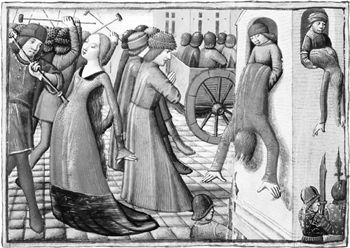
The Burgundians massacre the Armagnacs in Paris.
THE WISDOM of Tanneguy du Chastel’s initiative was to prove only too evident in the days ahead. “The people, bitterly inflamed against the confederates [Armagnacs], went through all the houses in Paris, hunting for them,” reported an eyewitness. “All that they found, of whatever rank, whether they had been taken prisoner by the soldiers or not, they hauled out into the streets and killed them at once without mercy, with heavy axes and other weapons. . . . There was not one of the principal streets of Paris that had not had a killing in it. . . . They were heaped up in piles in the mud like sides of bacon—a dreadful thing, it was. Five hundred and twenty-two men died by the sword or other weapons that day in Paris out in the streets, not counting the ones who were killed inside the houses.” In fact, in the course of that terrible night and over the next few weeks, some sixteen hundred members of the Armagnac party who had remained in Paris, including the count of Armagnac himself, who was discovered hiding in a cellar, would be arrested and eventually massacred by the Burgundians.
By July 13, Queen Isabeau and John the Fearless had sufficiently consolidated their hold on Paris to be able to enter the capital in state. Charles VI, ever erratic, welcomed them warmly, believed everything they said, and gave them everything they wanted; he even reinstated all of Isabeau’s powers retroactively, as though she had never been in exile. Perhaps he did not notice the carnage around him—two days before, the citizens of Paris had murdered the last of their Armagnac prisoners, including the count—or, if he did, felt it was a natural extension of his own paranoia. Whatever the reason, from this point on, Isabeau and John the Fearless controlled the Parisian government and the royal council.
And yet the continued absence of the dauphin, the legitimate heir to the throne, threatened to undermine their authority. To have Charles at large was too dangerous; those members of the Armagnac faction who had escaped or who lived outside the capital might use him as a rallying point. To prevent this, Isabeau issued a formal summons ordering Charles to appear in Paris. This was not a friendly invitation. To obey meant risking imprisonment or worse; to refuse gave the queen and the duke of Burgundy the justification they needed to raise an army and so force the dauphin to submit to their rule.
But by this time Charles was safely in Bourges, south of the Loire, under Yolande’s protection. With the death of the count of Armagnac and so many others, it was left to the queen of Sicily to undertake the leadership of the opposition to Burgundian rule. Her influence with Charles was so strong during this period that he seems to have been hesitant to act in any capacity without first securing her approval. In a long letter dated June 29, 1418, exactly one month after he had escaped Paris, he wrote to the citizens of Lyon that he would not set a date to visit their city “until we have had the advice of our mother the Queen of Sicily.”
As the political leader of the former Armagnac faction it was left to Yolande to answer the summons by Isabeau. Her reply, since lost, was reputed to have been recorded by the chronicler Jehan de Bourdigné:
“We have not nurtured and cherished this one for you to make him die like his brothers or to go mad like his father, or to become English like you. I keep him for my own. Come and take him away if you dare.”
DESPITE THIS CONTENTIOUS RESPONSE, Yolande was not in fact interested in promoting further warfare with Isabeau and the duke of Burgundy. Throughout her life, the queen of Sicily consistently demonstrated a preference for diplomacy over military action as a means of resolution. Also, she recognized the English as the primary enemy. However, she had first to get Isabeau and John the Fearless’s attention, to make them understand that they could not ignore the dauphin’s rights as heir to the throne. Both she and Charles understood that the king would be of no help—“I know very well that they [Isabeau and John the Fearless] will do to my lord [the king] everything they wish,” the dauphin remarked to one of his officials—so it became necessary to use the threat of military action to intimidate their adversaries. Accordingly, with Yolande’s approval, Charles summoned his vassals and men-at-arms. Some four thousand soldiers answered his call, insufficient, perhaps, to defeat the English, but certainly enough to demonstrate to his mother and the duke of Burgundy that they had to take him seriously. “Those who get power should be careful how they rule, because one day we’ll come back against them,” the dauphin warned.11
Having strengthened Charles’s bargaining position, Yolande once again insisted on a peace conference, and in August 1418 she succeeded in bringing together representatives from the two warring factions at Saint-Maur-des-Fossés, just outside of Paris. Here, her ambassadors put forward the novel suggestion that the two sides reconcile and join forces in repelling their common enemy, Henry V, who had by this time taken Rouen, and was demanding to marry Charles VI’s daughter Catherine and to be officially recognized as the future king of France. The duke of Brittany, who was again the queen of Sicily’s ally, managed to obtain a private interview with John the Fearless, and out of this a treaty emerged, which was signed by the duke of Burgundy and sanctioned by the king on September 16.
And then came a surprise: Yolande could not get Charles to sign it. He was beginning to listen to the more militant members of his entourage, like Tanneguy du Chastel, who had been targeted more than once by the duke of Burgundy. Tanneguy, it turned out, preferred not to come to terms with a man who routinely murdered, or tried to murder, his opponents whenever their interests conflicted with his own. But Yolande was in charge and she worked on Charles until finally, the next year, her efforts were rewarded. Over the course of three days, between July 8 and July 11, 1419, the dauphin met the duke of Burgundy face-to-face on a bridge near Melun, and after a series of talks they shook hands and signed a treaty of friendship. The two even exchanged “the kiss of peace.” At this time, they also made arrangements to meet later in the year, in order to continue the diplomatic dialogue. All of France breathed a sigh of relief.
Having maneuvered Charles into what she believed to be a position of security, Yolande felt comfortable enough to leave the dauphin in the hands of his advisers and make a journey that she had already been putting off for far too long. It had been two years since her husband’s death, and she still had not brought her eldest son, Louis III, to Provence so that he could be formally installed as count in his father’s place. Provence was an integral component of Louis III’s inheritance; he could not hope to renew the family quest to conquer the kingdom of Naples without the county’s support. She needed to secure the homage of the principal Provençal barons by going from town to town with her son, just as her mother-in-law, Marie of Blois, had done so many years before with Louis II. And so as soon as she knew that the treaty with John the Fearless had been signed, Yolande left Saumur and began the long journey south, taking Louis III and her two youngest children with her.
When Yolande quitted the dauphin’s court, she took the voice of moderation with her, and this would be France’s undoing. For in August, Henry V’s forces easily took the city of Pontoise and an Armagnac spy informed the dauphin that the duke of Burgundy had treacherously aided the English in this conquest. Although it is impossible to determine if this source was reliable, John the Fearless’s past behavior did not recommend him to the good opinion of those in the opposition party. The advisers surrounding Charles, particularly Tanneguy du Chastel, did not hesitate to believe the accusation. In a moment, all Yolande’s careful diplomatic groundwork was undone and a desperate plan conceived and put into effect.
As it happened, Charles had already arranged to meet John the Fearless for another diplomatic talk on the bridge of Montereau-Fault-Yonne on September 10, 1419. (Bridges were so often used as venues in these cases because it was generally assumed that it would be more difficult to conduct an ambush out in the open in such a confined space; in the event, this piece of conventional dogma turned out to be of dubious value.) On the appointed day, the two sides met as planned. The duke of Burgundy and the dauphin each stepped out onto the bridge accompanied by ten members of their respective entourages. As dictated by chivalry, John the Fearless went down on one knee before Charles and swept off his large black velvet chapeau in the required gesture of homage, at which point Charles, also following protocol, politely took him by the hand, raised him to his feet, and indicated that he could return his hat to his head. The niceties having been satisfied, Tanneguy du Chastel then shoved the duke of Burgundy from behind, so that another of Charles’s entourage could slash at his face more easily with his sword, and then Tanneguy du Chastel finished him off with his axe. In less than two minutes the once feared duke of Burgundy was on the ground with his internal organs spilling out all over the bridge. The whole operation was conducted with such ruthless efficiency that John the Fearless’s men did not have time to move before their leader was dead and they themselves surrounded.
This violent act, meant both to improve the position of the dauphin relative to his powerful cousin, and as the long-sought retribution for the murder of the duke of Orléans, did not achieve the desired result; rather it sent Charles hurtling along a downward spiral. As a result of the assassination, Isabeau, mistrustful of her son and fearing reprisals from the English, convinced the king to come to terms with Henry V. In a series of letters issued in May 1420, which became known as the Treaty of Troyes, Henry V was married to the princess Catherine, and then Henry was officially adopted by Charles VI in place of the dauphin as regent and heir to the French throne. The English army moved into Paris and held the capital as well as Normandy, Gascony, and Maine, while the dauphin Charles, distraught and disinherited, was exiled to the provincial court at Bourges.
But to Yolande of Aragon, who would be confronted with the aftermath of this fiasco (and the responsibility for cleaning it up), the parallels to the story line of The Romance of Melusine were stunningly obvious. For just like Raymondin, the fictional male protagonist in Jean of Arras’s tale, the dauphin, having participated in the murder of his cousin, the duke of Burgundy, was wandering lost and despondent in the forest of southern France. According to this narrative, Raymondin—that is to say, Charles—would eventually inherit all of the duke’s estates, establish a royal lineage, and become an even greater lord than his murdered cousin. There was just one element missing to turn this fiction into reality.
Upon her return from Provence, the evidence suggests that the queen of Sicily actively sought a Melusine as part of her strategy for reinstating the dauphin as the legitimate heir to the French throne. It is difficult to trace her movements completely, as for political reasons Yolande exercised discretion, but of one fact there can be no doubt.
She knew her when she saw her.