
CHAPTER 8

When I arrived at the town of Sainte-Catherinede-Fierbois, I sent [a letter] to my king; then I went to the town of Chinon, where my king was; I arrived there about the hour of noon and found lodging at a hostelry.
—Joan of Arc, in response to an inquisitor at her Trial of Condemnation, 1431
THE JOURNEY FROM VAUCOULEURS lasted eleven days. To get to Chinon, Joan and her companions were forced to cross territory controlled by the English and the Burgundians. If they betrayed their political affiliation in the slightest way, or were challenged for traveling without a safe conduct, they would be taken captive or perhaps killed. Although Colet de Vienne knew from past expeditions which roads and towns to avoid, they were a large enough party to attract attention, and so to reduce the risk of exposure they often traveled by night. Darkness carried its own perils; in the nocturnal hours they were vulnerable to roving gangs of bandits or mercenaries who preyed on travelers too poor or lost to find shelter. Long afterward, members of Joan’s party vividly remembered the need for secrecy and the fear that haunted them “because of the Burgundian and English soldiers who were masters of the roads.”
Perhaps because they were afraid, in the beginning there was resentment against Joan. Despite the admonition from Robert de Baudricourt to lead her “truly and surely,” at least a few of the men felt they were risking their lives on a fool’s errand and sought to punish her. “Afterwards I heard those who took her to the King speak of it and heard them say that, to begin with, they thought her presumptuous and their intention was to put her to the proof. . . . They wanted to require her to lie with them carnally,” recalled Marguerite la Touroulde, a witness. “But when the moment came to speak to her of this they were so much ashamed that they dared not speak of it to her nor say a word of it.” Bertrand de Poulengy, one of Joan’s original sponsors from Vaucouleurs, recalled that “every night she lay down with Jean de Metz and me, keeping upon her her surcoat and hose, tied and tight. I was young then and yet I had neither desire nor carnal movement to touch [her] . . . because of the abundance of goodness which I saw in her.” The precaution Joan had taken of donning male attire was thus immediately justified. The clothing helped the other members of her group to separate Joan’s femininity from her spirituality, and her modesty and piety were soon noted. By the end of the trip, her exemplary courage and irreproachable behavior had completely won over every member of her entourage. “She never swore, and I myself was much stimulated by her voices, for it seemed to me that she was sent by God, and I never saw in her any evil, but always was she so virtuous a girl that she seemed a saint,” Bertrand testified. Jean de Novellompont agreed. “The Maid always told us to have no fear and that she had a mandate to do this thing. . . . I believe that she was sent by God. . . . She liked to hear mass and she crossed herself with the sign of the Cross,” he said. “And thus we took her to the King, to the place of Chinon, as secretly as we could.”
They arrived at around noon on February 23, 1429, and found lodging at a local inn. “I sent letters to my King in which it was contained that I sent them to know if I could enter the town where my King was, and that I had made my way one hundred and fifty leagues to come to him and bring him succour, and that I knew many things [to the] good touching him, and I believe that in the same letters it was contained that I should know the King well [from] all others,” said Joan.
But merely surviving this frightening journey and announcing her arrival was not enough to ensure the success of Joan’s mission. She still faced the burden of convincing Charles to admit her into his presence, an event that Joan serenely believed would occur, but of which the other members of her escort were by no means as confident. They were right to worry, for the royal court was bitterly divided over whether Charles ought to receive her. In particular, Georges de la Trémoïlle was strongly opposed to the idea of allowing Joan access to the king, and argued strenuously against it. When Joan’s letter was delivered announcing her arrival, La Trémoïlle was at the head of the faction that convinced Charles to send emissaries not to receive her but to interrogate her. According to Simon Charles, a member of the king’s administration, “I know that, when Joan arrived in Chinon, there was deliberation in counsel to decide whether the King should hear her or not. To start with they sent to ask her why she was come and what she was asking for. . . . She said that she had two [reasons] for which she had a mandate from the King of Heaven; one, to raise the siege of Orleans, the other to lead the King to Rheims for his sacring [coronation]. Which being heard, some of the King’s counselors said that the King should on no account have faith in Joan [believe her], and the others that since she said that she was sent by God, and that she had something to say to the King, the King should at least hear her.”
These “others” were those members of the council allied with Yolande of Aragon. “There is no evidence of opposition to Joan’s ‘mission’ from any member of the house of Anjou,” observed medievalist M. G. A. Vale. This is an understatement; in fact, it is clear that Yolande and her supporters within the council were the advisers urging Charles to see Joan for himself and to listen to what she had to say. “Orliac [a noted French historian] assigns a major role to the Angevins, and especially to Yolande of Aragon, in fostering the career of the Maid,” wrote medievalist Margaret Kekewich. “She was sheltered, supplied and encouraged by a number of Angevin servants as she made her way to Chinon and whilst she remained in the Loire Valley.”
Charles, ever the equivocator, took all day to make up his mind, but at last his craving for spiritual reassurance prevailed and Joan was invited to the castle. She arrived late in the evening. The opposition, recognizing this peasant girl’s visit for what it was—a play by Yolande of Aragon and her faction for political supremacy at court—fought desperately against Charles’s meeting her until the very last moment. La Trémoïlle used every persuasion he could think of to unsettle the king and make him reverse his decision, a stratagem that he had employed to keep himself in power with notable success for many months. But Yolande and her family understood Charles, and especially his superstitions and fears, better than any of their rivals; and they employed those arguments to which they knew he would be most susceptible. “When she [ Joan] entered the castle of Chinon to come into his presence, the King, on the advice of the principal courtiers, hesitated to speak to her until the moment when it was reported that Robert de Baudricourt had written to him that he was sending him a woman and that she had been conducted through the territory of the King’s enemies; and that, in a manner quasi-miraculous, she had crossed many rivers by their fords, to reach the King,” reported Simon Charles. “Because of this the King was pressed to hear her and Joan was granted an audience.” Since Robert de Baudricourt, being still in Vaucouleurs, had no way of knowing what had occurred on Joan’s journey, or even whether at this point she had arrived safely, it must be presumed that this letter was an invention by the members of Yolande’s faction who knew to stress the mystical aspects of the case.14 Georges de la Trémoïlle was overruled, and Joan was invited to enter the great hall.
This was Joan’s first experience of a royal court, and although the surroundings were far less magnificent than those of Paris, the splendor of Charles’s retinue was more than enough to dazzle her: “There were more than three hundred knights and fifty torches,” Joan later recounted in awe. She must have looked as foreign to that great company as they did to her: a slim young woman, obviously provincial, attired in the clothes of a man; by this time she had cut her hair as male pages did in the shape of a bowl, which only enhanced the quaint, otherworldly nature of her appearance. Even now, so close to achieving her goal, she faced one last obstacle: Charles’s fear of meeting her caused him to try to camouflage himself by retreating behind his courtiers. Much has been made of Joan’s ability to recognize Charles, whom she had never seen before, despite this subterfuge; it added greatly to the miraculous nature of her visit. “When the King knew that she was coming, he withdrew apart from the others,” Simon Charles reported. “Joan,however, knew him at once and made him a reverence and spoke to him for some time.” Joan herself confirmed this observation. “When I entered my King’s room, I knew him among the others by the counsel of my voice which revealed him to me,” she said simply.
This episode has naturally been attributed to divine revelation; however, there was perhaps another explanation for Joan’s perspicacity. She did not in fact discover Charles by wandering alone into the main hall and through a body of three hundred knights as is implied; rather, she was escorted into Charles’s presence by the count of Vendôme. The count of Vendôme was among those who had conspicuously accompanied Yolande of Aragon when she returned to the royal court the previous September, and was one of the lords who formed the nucleus of her political party. He understood precisely what was at stake and how important it was that this young woman see Charles and convince him to stay in France and fight the English. The count of Vendôme, not finding the king precisely where he had left him, would naturally have looked around for him, and the count of Vendôme knew what Charles looked like. Since her escort both wanted and needed Joan to detect the king, it is hardly surprising that she did so. It also helped that Charles was distinctive-looking. He had inherited his father’s and uncle’s extremely large nose, and this would have been known even in Domrémy.
However Joan managed to recognize him, from the moment she approached Charles, she demonstrated the same piety, passion, and strength of purpose that had so impressed all who had met her previously. With a deep reverence that must have put the timorous king immediately at his ease, she curtsied before him. “I was myself present at the castle and the city of Chinon when the Maid arrived, and I saw her when she presented herself to his royal majesty,” said Raoul de Gaucourt, a member of Charles’s entourage. “She showed great humility and simplicity of manner, this poor little shepherdess. . . . I heard her say the following words to the king: ‘Very noble lord dauphin, I have come and I have been sent from God to bring aid to you and to the kingdom.’ ” The duke of Alençon, who was out hunting quail, was called back to Chinon in a hurry “when a messenger came to tell me that a maiden had arrived at the king’s court who declared herself to have been sent by God to chase out the English and raise the siege the English had set around Orléans.” Joan later described her meeting with Charles to Friar Jean Pasquerel, her confessor, in greater detail: “When [the king] saw her, he asked Joan her name and she answered: ‘Gentle dauphin, I am Joan the Maid, and the King of Heaven commands that through me you be anointed and crowned in the city of Reims as a lieutenant of the King of Heaven, who is king of France. . . . I say to you, on behalf of the Lord, that you are the true heir of France, and a king’s son, and He has sent me to you to lead you to Reims, so that you can receive your coronation and consecration if you wish it.’ This being understood, the king said to his courtiers that Joan had told him a certain secret that no one knew or could know except God; and that is why he had great confidence in her. All of that I learned from the mouth of Joan, because I was not present,” reported Friar Pasquerel.
The mystery of what secret Joan told Charles in order to win his confidence has remained a matter of speculation for six centuries. Some people believe she passed the king a ring verifying his royal birth; others aver that Joan revealed herself at this time to have been Charles’s half sister, the product of a liaison between Isabeau of Bavaria and the duke of Orléans, who had been spirited away from the Hôtel Saint-Pol at birth to be raised by peasants in Domrémy. Both of these hypotheses, and many others like them, were long ago refuted by the historical evidence and have been rejected as a matter of record; they persist only in fiction.
The truth was there was no “sign” as such. Joan herself expressed frustration when later questioned about this by Charles’s advisers. “In God’s name, I am not come to Poitiers to make signs; but take me to Orléans, I will show you the signs for which I have been sent!” What Joan did was speak in her convincingly passionate manner directly to Charles’s innermost fears and especially to his obsession with his possible illegitimacy. At the very end of his life, in confession—not a place where people ordinarily prevaricate—Charles confirmed that he had believed in Joan because she had known “the secret prayer” he had made to God. This prayer consisted of three “requests,” the principal entreaty being that Charles’s questions concerning his own parentage be answered by God, and he himself established, both within his own mind and that of the kingdom at large, as the legitimate son of Charles VI, king of France, and thus the true heir to the throne.15
A three-part heartfelt supplication to God to give him some sign that he was who he was supposed to be, to silence the doubts that had been raised by the opposition and that nagged at his soul and tormented his reason, to give him aid and succor in his struggle with the English, to protect him from harm by showing him which path was best to take—and then, suddenly, Joan, an obviously devout peasant girl reputed to be a holy woman, materializes out of the farthest reaches of the kingdom promising to lift the siege of Orléans and drive out the English in words that echo in the strongest possible tones the terms of that prayer: “I say to you, on behalf of the Lord, that you are the true heir of France, and a king’s son, and He has sent me to lead you to Reims.” In his darkest hour, Charles had cried out to God for a sign of divine favor, and God had answered his prayer and sent a messenger to reassure him of the truth. History and literature were full of accounts of similarly miraculous events; why should this not be one of them? What other explanation could there be for Joan’s presence at court? How else could she, a poor ignorant peasant girl from so far away, possibly have known what was in a king’s heart? What else but a divine command could have compelled her to attempt such a dangerous journey, one that had so little prospect of success? Charles had asked for a talisman, and God had sent one. Joan did not have to produce a sign, she was herself the sign.
After their conversation, “the king seemed radiant,” reported Simon Charles. No longer unsure, Charles began to act with energy, and to believe once more in himself and his cause. It was a turning point in his career and the war, and it all came from this meeting. “To introduce a prophetess to the impressionable Charles could have been a stroke of something approaching political genius,” admitted his biographer M. G. A. Vale.
CHARLES ORDERED that Joan be treated as a guest of the court for a week while he made up his mind exactly what to do with her. She was given rooms in the tower of one of his castles and assigned a page to accompany her during the day and a small household of women to stay with her at night. According to the duke of Alençon, the next day, “Joan came to the king’s mass, and when she saw the king, she bowed deeply; and he led Joan into a chamber,” recalled the duke. “The king kept the lord of La Trémoïlle and myself with him, saying to everyone else that they could retire. And then Joan made several requests of the king. . . . Many other things that I do not remember were said until it was time for dinner.” After the meal, they took Joan into a nearby field where she demonstrated her martial abilities. “Joan ran about charging with a lance, and I, seeing Joan behave like this, carrying and running with the lance, gave her the gift of a horse,” the duke of Alençon continued.
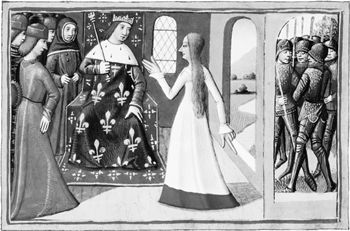
Joan addresses Charles at the royal court.
The presence of Georges de la Trémoïlle at these meetings ensured that Joan’s influence on Charles would not go uncontested. For all of her passion and piety, which had in the past won her so many followers, Joan never succeeded in convincing this particular councillor that she had come from God and not the opposition. La Trémoïlle, shrewd and practiced, knew better than to attack Joan openly while the king was so obviously taken with her. Instead, he merely planted doubts, and the upshot of these was that Charles decided that Joan should be examined by members of the Church to verify that she was genuinely an agent of God and not a trick played by the devil.
A small group of regional clerics, led by a couple of bishops in company with some lesser local Church officials, were accordingly rounded up and commanded to investigate Joan and render an opinion on her authenticity. The reluctance of this group to take responsibility for a definitive verdict is not difficult to imagine. After questioning Joan and deliberating for a week, they prudently recommended that she be interrogated by more learned authorities, and Charles arranged for her go to Poitiers, where she could be scrutinized by established specialists in scripture and theology.
The subsequent investigation of Joan at Poitiers, by a tribunal that boasted a number of masters from the University of Paris who had been exiled from the school for maintaining their political allegiance to Charles, was an extremely odd affair. Hurriedly conducting the inquiry in three weeks, this group made no attempt to appeal to the pope for guidance, as similar panels had done in the past with other holy women such as Elizabeth of Hungary, Catherine of Siena, or Bridget of Sweden. Nor was any real effort made to challenge Joan’s view of herself or her mission. Her interrogators did not even mind when she answered rudely or evasively. For example, Friar Pierre Seguin reported, “I asked her what language her voice spoke. She answered, ‘Better than yours.’ Me, I spoke the dialect of Limoges; and then I asked her if she believed in God; she answered ‘Yes, better than you.’ And I then said to her that God wouldn’t want us to believe in her unless something made us think that we should do so. I could not advise the king simply on her assertion that he should entrust men-at-arms to her so that she might lead them into peril, unless she could at least tell him something further. And she answered, ‘In God’s name, I did not come to Poitiers to produce signs. . . . But lead me to Orléans, and I will show you the sign for which I was sent.’ ” Rarely in history have members of the Church shown such patience and forbearance in their investigation of a young woman purporting to know the will of God better than they did.
An account of the proceedings hints at the explanation for this uncharacteristic deference, which clearly had far more to do with politics than theology. “Finally, it was concluded by the clerks after their interrogations . . . that given the great need in which both the king and the kingdom found themselves—since the king and his subjects were at that moment in despair and had no other hope of aid if it came not from God—the king should make use of her assistance.” The wording of their final decision—“In her, Joan, we find no evil but only good, humility, virginity, devotion, honesty, and simplicity”—was a masterful display of the art of appearing to authenticate Joan and her mission without actually saying so, a necessary precaution in case she should turn out to be under the influence of an evil spirit or a heretic after all.
The tribunal’s reference to Joan’s virginity provides the final clue to the motivating force behind this verdict. According to the prophecies, the woman destined to save France would be a virgin, and although Joan claimed to be such, it was necessary to offer more substantive proof. As this evidence obviously could not be obtained through scriptural questioning, a physical examination was required. It was not appropriate that she be inspected by men, so two noblewomen were instead enlisted in the effort. “I heard it said that Joan, when she came to the king’s court, was examined by women to know what was in her, if she was a man or a woman, and if she was a virgin or corrupted,” recalled Joan’s confessor, Jean Pasquerel. “Those who visited her for this purpose were, from what I heard, the lady of Gaucourt and the lady of Trèves.”
It should come as no surprise that the lady of Gaucourt and the lady of Trèves were both devoted and long-standing members of Yolande of Aragon’s household. The lady of Trèves was in fact the wife of Robert Le Maçon, who had been Charles’s counselor since he was fourteen, and who had helped him to escape Paris by giving up his own horse to the boy when the Burgundians overran the city in 1418. To add the authority and prestige of rank to these proceedings, Yolande herself oversaw the manner of Joan’s physical examination and presented the findings to Charles. “The Master’s report having been made to the King, this Maid was put into the hands of the Queen of Sicily, mother of the Queen our sovereign lady, and to certain ladies being with her, by whom this maid was seen, visited and secretly regarded and examined in the secret parts of her body,” reported Jean d’Aulon, Joan’s steward. “But after they had seen and looked at all there was to look at in this case, the lady [Yolande] said and related to the King that she and her ladies found with certainty that she [Joan] was a true and entire maid in whom appeared no corruption or violence. I was present when the lady made her report.
“After having heard these things, the King, considering the great goodness which was in this maid and what she had said to him, that by God was she sent to him, concluded in his Council that, henceforth, he would use her aid for the war,” Jean concluded.
Joan was going to Orléans.
BUT FIRST she had to be outfitted as befit her new position as a knight in the king’s army. She was sent to Tours for her equipment. Charles paid 100 livres tournois to have a suit of armor and a banner made especially for her; she chose her own standard, “on which was painted the image of Our Savior seated in judgment in the clouds of the sky, and there was an angel painted holding in his hand a fleur-de-lys which the image was blessing,” noted her confessor. To round out her military entourage she was given, in addition to her squire, two pages and two heralds. Two of her brothers, sent by the family to search for her, apparently also joined her at this time as part of her retinue. Although Robert de Baudricourt had already given her a sword, Joan wanted one with a religious provenance and wrote to the clerics of the church of Sainte-Catherine-de-Fierbois, a town she had stopped in on her way to Chinon, asking them to unearth a blade that had been brought back from a crusade and buried as a relic behind the altar. Word that a young woman purporting to be an emissary from God had promised to lift the siege of Orléans had already spread throughout the vicinity. The officials of Sainte-Catherine-de-Fierbois, sensible of the miraculous nature of the undertaking, hurriedly exhumed the sword and had it cleaned. “An arms merchant of Tours went to seek it, and the prelates of that place gave me a sheath, and those of Tours also, with them, had two sheaths made for me: one of red velvet and the other of cloth-of-gold, and I myself had another made of right strong leather,” Joan noted.
Finally all was in place, and Joan left Tours for nearby Blois, where Charles’s army was massing and a convoy was being readied with food and other provisions to relieve the siege of Orléans. This was the force that Yolande of Aragon had fought and pushed and schemed for, the goal to which she had devoted all her diplomatic and political energies. To ensure that this critical military effort was given the optimum chance for success she had assumed the responsibility for financing the operation herself. So committed was she to this mission that she donated her own tableware to the expedition. By April, she had accumulated a great store of foodstuffs: “Laden in the town of Blois [were] many carts and small carts of wheat and were taken great plenty of beeves, sheep, cows, swine and other victuals,” wrote the chronicler Jean Chartier. But even more important than the provisions was the number of skilled and experienced captains—including Étienne de Vignolles, known as “La Hire,” a seasoned commander of great renown, who brought with him a company of war-hardened mercenaries—whom Yolande had convinced to participate in this last, desperate attempt against the English.
Like La Hire, it would seem that Joan too was in a strange way recruited by Yolande for this mission. The prophecies had had the desired effect and Joan was by no means the only visionary to heed the call. A French historian reported that in the year 1428 alone, some twenty people, most of them women, publicly claimed to have been chosen by God to deliver a message to the king, and this was just the number of recorded instances. None of these other would-be seers were able to gain an audience with Charles, however, mostly because what they had to say did not conform to what Yolande wanted to hear. Later, Joan would meet one of these competing clairvoyants, a prophetess named Catherine de la Rochelle. Catherine had visions of a woman “dressed in cloth-of-gold, telling her to go to the loyal towns, and that the king would give her heralds and trumpets to make proclamations.” Catherine had gone so far as to write to the king promising to unearth a golden treasure with which Charles could pay his soldiers. As Charles was desperately in need of money, this was a large point in Catherine’s favor. Like Joan, Catherine had also convinced the people of her town, including a local priest, Brother Richard, of the authenticity of her visions. Catherine’s rival prognostications were sufficiently disquieting that Joan made a point of warning Charles against her. “I answered this Catherine that she return to her husband and do her housework and feed her children. . . . And I wrote to my King telling him . . . that it was folly and nullity, this matter of Catherine,” said Joan. “They were very ill content with me, Brother Richard and this Catherine,” she admitted.
At the same time, despite her role in bringing Joan to Charles’s attention, the queen of Sicily, because of her own upbringing, most likely also genuinely believed the girl to be a messenger from God. After all, Yolande’s own prayers had been answered as much as Charles’s by the discovery of the prophetess—for the king had at last given the order to send the army to the relief of Orléans.
Now, in the final week of April 1429, Yolande witnessed the fruits of her efforts as the convoy of supplies she had assembled, accompanied by a strong contingent of men-at-arms, rolled slowly out of Blois and took the road to Orléans. With Joan’s participation, the religious nature of this enterprise was highly visible, giving the procession the ardent air of a crusade. “When Joan left Blois to go to Orléans,” reported her confessor, “she had all the priests gather around the standard, and the priests went before the army. They marched out on the side of the Sologne assembled in that fashion; they sang Veni creator spiritus along with many antiphons, and they camped in the fields that night and the following day as well.” Joan forbade swearing and pillaging, and she drove away the prostitutes who inevitably followed in the wake of the soldiers; further, she insisted that the soldiers attend Mass and confess themselves in order to participate. Those who marched out of Blois beside her to do battle against the English felt keenly the difference between this army and those in which they had previously fought, and with this recognition there arose a hope that perhaps, this time, God would be on their side.