
SEVEN
Two Last Recorded Wishes
My concluding thought is that by an extraordinary series of events modern science was born, and swept across the world like a forest fire. All nations are now using it, and in some measure contributing to its development. We can only pray that those who control its use will develop it for the good not only of mankind but of the whole planet.
—JOSEPH NEEDHAM, 1993—HIS FINAL WORDS IN THE ESSAY “GENERAL CONCLUSIONS AND REFLECTIONS”
From Science and Civilisation in China, Volume VII, Part 2
Joseph: I had at one time hoped to be with you when the last volume was published, but I promised that even if I was not on the bridge the ship would sail safely into port…. I am sure that day will come.
—KENNETH ROBINSON: FROM AN IMAGINED CONVERSATION WITH THE LATE JOSEPH NEEDHAM, CAMBRIDGE REVIEW, 1995
Reprinted in Science and Civilisation in China, Volume VII, Part 2
Publication day of the first volume of what everyone was now referring to simply as the book was August 14, 1954, and Joseph and Dorothy Needham celebrated the event in a quietly deliberate style—and at a place he chose quite specifically, and for a raft of complicated reasons, some good, some less so.
He had already been working hard on the proofs of the second volume when, late in July, he and Dorothy left Cambridge for Paris, taking the Dover packet. They were bound for Budapest, where both were due to speak at the International Physiological Conference of 1954. They stopped along the way—first in Paris, to meet Gwei-djen, who was still working with UNESCO (it would be another three years before she returned to Cambridge to become involved with the book full-time). The trio retired to a restaurant to open a bottle of celebratory champagne, three weeks in advance of the happy event. Joseph and Dorothy then boarded the Orient Express for a journey that Needham, railway mad, later pronounced a nearly total delight, despite atrocious weather and a broken heating system in their wagon-lit. The dining car served splendid food, and the steam engines that pulled the train were liveried and magnificent, with drivers who liked Needham’s adolescent enthusiasm for their craft.
They stopped for a while in Mainz—Joseph making a point of visiting the “local Orientalists” to remind them courteously that their hero Johannes Gutenberg was (thanks to the discoveries at Dunhuang) not quite what they had long liked to suppose. Then the travelers stopped in Vienna for a weekend holiday, before pressing on to Hungary. Both gave well-received papers at the conference, though Joseph seemed rather distracted: his diary records that he had discovered a small steam railway in the forested hills above Buda, which was operated for children and only for fun, and he spent hours questioning the locomotive driver about the intricacies of its miniature workings.
Once done with the congress, the other scientists from western Europe then left for their various homes or their next destinations in convoys of cars—but the Needhams did not go home. They had their driver take them back through Austria and Liechtenstein and via Basel on the Franco-Swiss border to Tours, in the Loire valley. They made their own way from this point to where Joseph planned to spend publication day: the small medieval town of Amboise, fifteen miles upriver.
The couple chose the place for a number of reasons. The happiest of all was that Amboise was the town where Leonardo da Vinci had spent the final three years of his life—and Joseph Needham had said, only partly in jest, that he wanted to spend this most memorable day beside the house and the tomb of the most remembered Renaissance man who had ever lived.
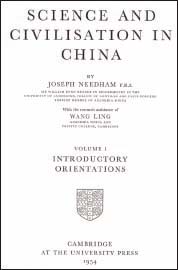
The title page of the first volume of Needham’s monumental project. The title is a mild pun, suggesting that the reader starts his inquiry by turning his mind eastward.
He wrote all this to Gwei-djen in Paris, also saying how much he missed her. In one letter he told her that when he had arrived the day before, Thursday, he had ventured into the château of Amboise, as he had done with her some years before—only this time he had gone to see what the two of them, in their rapture, had evidently missed: the flamboyant gothic chapel of Saint-Hubert, where Leonardo’s bones had been interred in the early sixteenth century.
He wished she could be there to see it now, he wrote—not least because she would have been amused by an elderly Englishman whom Needham had met outside the church and who said he had overspent his holiday funds. To raise money to buy himself lunch, he had sold Needham one of his ties.
Joseph and Dorothy marked the publishing event with dinner and a bottle of good local white wine, a 1947 Vouvray. On an impulse they then decided to visit the château at night. As he wrote to Gwei-djen the next morning,
one ascends the illuminated spiral ramp to the strains of sixteenth century music from loudspeakers, and on the top level the buildings are all floodlit, especially the beautiful chapel on the wall where Leonardo da Vinci is buried. His statue among the trees, standing where the collegiate church once stood, is also finely illuminated. He is there now in solitary possession. There are no statues of the kings, queens and nobles who were so much more self-important when he was living!
The public remembrance of great scientists, he concluded, could endure well beyond that of people whom mere accident of birth had made famous in their lifetimes. This had been the case with Leonardo. Perhaps, he suggested, it might one day be the same for him.
But there was more to his choosing Amboise than merely rubbing shoulders with the memory of Leonardo. He was also burying himself in the depths of rural France because, in a sense, he was hiding. He was keeping out of sight because of all that had happened to him in the eight years since he’d returned from China.
It had been a difficult time, largely because of his agreement to investigate the allegations concerning the Korean War. His reputation had been savaged. The security of his academic position had started to seem tenuous. His judgment had been called into question. He had been subjected, for the first time in his life, to an earthquake of criticism and insulting commentary. Some people called him a dupe, others a traitor, a few simply a crank. The gelling of his political convictions—not least his admiration for Mao—and his now unswerving support of the revolutionary left had also isolated him socially and intellectually from much of the British mainstream. He was in consequence lonely and unusually joyless.
In Cambridge the senior members of his college were no longer as collegial as they might have been, nor as supportive. The glacial mood had started early. Needham had been elected a fellow in 1924, but because of his youth, callow manner, and evident eccentricity he had been less than entirely welcomed then. He was seen by some of the Edwardian throwbacks at the high table as unsound, however bright. So he spent most of his early time squirrelled away in the laboratories, or at home with his wife and in time his paramours, and then he was wont to go away for long sojourns in the East—making himself scarce, keeping out of the way of the grand, stiff-necked fellows who formed the college establishment.
When he first returned from China in 1946 he found that the situation had changed a little; the mood had lightened somewhat. After his stay in Paris had ended in 1948, and when he had returned home flushed with the success of helping to create UNESCO, the atmosphere got even better, and his reception in the college had become almost congenial. But then five years later came his decision to lend his name and reputation to the International Scientific Commission in Beijing—which, as far as his standing in Cambridge was concerned, was a total disaster. Everything came tumbling down. He was excoriated in the press, denounced in Parliament, and shunned by many, and almost all sympathy that had survived in his college rapidly and steadily drained away.
By this time few of the senior Cambridge figures on whose support he could usually count were still around. His greatest onetime champion, the biologist Sir William Bate Hardy, had died in 1931, as had Stanley Cook, the Semitist who had taught Needham much about the Jews of antiquity. The zoologist Munro Fox had retired early (having been run over by a horse-drawn bus) to pursue his private passion for the study of ostracods. Reginald Punnett,46 an expert on heredity in chickens, had retired to Somerset and seldom returned to Caius, other than to come up by train to inspect the exceptional clarets he kept in his private cellar there. Only Frederick “Chubby” Stratton, the memorably amusing astronomer and bachelor fixture of the senior combination room, remained a firm supporter. So aside from his settled family friendships—and with Wang Ling beside him, and Gwei-djen across the Channel in Paris—Needham spent much of the early 1950s in the college largely alone, and often shunned.
He also did barely any teaching now, and though he had been officially excused from these duties, the exception rankled among some of his colleagues. Much of the uneasiness was motivated by envy that his life was so seemingly easy, in Cambridge terms. Much was also made of the casual way he had apparently invaded the turf of two other disciplines for which he had not the slightest qualification. He had no standing in the department of Chinese—and yet he pontificated on China at every opportunity. He had taken not one hour of formal training in history—and yet he had persuaded the university’s august and ancient press to let him write a great history of science. This deliberate straying into fields not his own was seen by some as merely impertinent, by others as positively threatening.
So a lot was resting on the initial publications of Science and Civilisation in China. If the books were well received, then their reception alone might restore his good name and ensure his return to acceptance and academic respectability. But he could hardly be sure that the reviews would be good. He was only too aware that he was writing for an audience already highly prejudiced against China and the East, a group of skeptics among whom even the cleverest were bound by an almost unconscious certitude of the West’s cultural and intellectual supremacy. The very reason he had begun the project was to try to change people’s minds. But now he was not so certain that he could. The task had grown very substantially since he began his work—not least because popular antipathy toward China was, in the 1950s, founded on not one but now on two quite separate arguments, one of which had been added, with cruel irony, since he first had his basic idea for writing the book.
In 1942—when he jotted down “Sci. in China—why not develop?”—the West was prejudiced against China for all the old, well-known reasons. China was thought to be backward, cruel, rigid, a place cut off from what Hegel had termed the world spirit. The prejudice was really quite simple, based essentially on racial dislike, fear, and cultural arrogance. Political ideology played little or no part in the antipathy: the Chinese were disdained because they were Chinese.
But now, twelve years later, and to the shock and general dismay of westerners, Mao Zedong’s Chinese Communist Party had settled itself firmly into power in Beijing. This new China—Red China—was to many in the West a fully certified public enemy, and was held in disdain, particularly by Washington, just as the Bolsheviks who ran the Soviet Union were disdained.
There was thus a second reason for loathing China. Old-fashioned prejudice had now been joined by vehement anticommunism, a strident antipathy to Mao, to Zhou Enlai, and to their revolutionary cadres. Anyone supporting Red China was now seen as innately hostile to America. Supporting China had long seemed merely eccentric and wrongheaded. Supporting Communist China was, on the other hand, downright treachery.
Needham’s left-wing sympathies were well-known; the anti-American conclusions of the report by his commission were still widely reviled; and even on normally liberal American university campuses the attitude toward him had now changed. He was now being quite widely criticized—not for his science, not for his history, and not for his intelligence, but for his politics, for his sympathies, and for his friends. And all that before a single word of his thesis—his essentially dispassionate, nonpolitical, and purely academic thesis—had been published.
So for him to have written a book—a series of books, no less—that trenchantly challenged the traditionally prejudiced view of China, and that roundly supported China’s claim to a proper place in the story of the making of the world—was suddenly, from Needham’s point of view, fraught with risk. The reviews could be savage, and personally devastating.
Moreover, the first volumes, as he had planned them, did little more than set out the thesis for the series. People might be tempted to wait, to see if the subsequent volumes—Volume III and the rest—would merit their full attention. There might be no reviews at all, perhaps none for some years yet, no final verdict, no vindication. And in that case the waiting would perhaps be an even greater agony.
He was consumed by nerves, and understandably so. As the first volume was about to emerge, a part of him wanted desperately to hide—and for that purpose he chose Amboise. He had no idea how the world would react to his work, and judging by what had gone before, he feared the worst.
But as it turned out, he need hardly have worried. Such reviews as did appear—and he was right; many reviewers decided to wait for future volumes before committing themselves—were truly extraordinary, all of them entirely positive. Despite his fears the world’s intellectual community, it seemed, actually cared very little about his politics. If he chose to support Mao and Zhou, and if that had gotten him into hot water with the Americans—well, this was still a superb work of scholarship. Ideological differences were set aside: a chorus of the most extravagant praise was sounded.
Arnold Toynbee praised it in The Observer; Sir Cyril Hinshelwood in the New Scientist; Richard Boston in the New York Times; and Arthur Hummel, the dean of scholars studying the Qing dynasty, in the American Historical Review. Old Laurence Picken, the embittered ethnomusicologist who had ample cause to give the foulest of commentaries, wrote in the Manchester Guardian that Needham’s achievement was “prodigious…perhaps the greatest single act of historical synthesis and intercultural communication ever attempted by one man.” And the Russians said that Needham’s work showed “a deep respect for the Chinese people, their creative genius, and their great contribution to Chinese civilisation.”
It was a triumph, evidently a complete vindication. The entire printing of 5,000 copies of Volume I sold out, and Cambridge had to go back to press at regular intervals in the following years. The book remains a classic, an essential work, and it has never yet been out of print.
In the short term, however, this critical success did surprisingly little for Needham’s standing in Cambridge, where, as in many academic communities, venom can take decades to dissipate. When he returned to Caius after his weeks of hiding away in France, he had few opportunities to escape the atmosphere of opprobrium. There was little comfort for him anywhere. He was frequently excoriated in the college. He could no longer seek solace in the biochemical laboratories. Christianity seems to have offered him less spiritual sanctuary than it might. Gwei-djen remained in Paris. Dorothy was deeply immersed in her own academic work. There was still scoffing in the press, perpetually reminding him of his much diminished status.
All he had left for comfort was China. It is impossible to overstate the role that China played in securing Needham’s foundations during this trying and uncertain period of his life. China—its people, their language, his own memories—provided Needham with the spiritual sheet anchor he needed, and with the necessary intellectual comfort.
Not that these were the most propitious years for him to be nailing his flag to the polities of Peking. Peking—Beijing today47—was in decidedly bad odor in the West during the 1950s, particularly in America. Since the founding of the People’s Republic in 1949 and since China’s involvement in the Korean War, the U.S. government’s official position was a firm and unyielding hostility toward Communist China, combined with a firm and unyielding support for the Nationalist regime on the island of Taiwan. A treaty to that effect was signed in 1954, giving American presidents the formal authority to use arms to defend Formosa, as Taiwan was then widely known, in the event of an attack from the mainland. Following the principle that the enemy of my friend is my enemy, Communist China was seen, at least by America, as a foe.
So Communist China was consistently ostracized by Washington throughout the 1950s and 1960s. There was no official American diplomatic recognition; Americans were by and large forbidden to go to China; there was a total trade embargo; there could be no financial dealings; and America did its best to keep the Communist Chinese from occupying China’s seat at the United Nations.48 “The United States holds the view that Communism’s rule in China is not permanent and that one day it will pass,” stated the official American doctrine of the day. “By withholding diplomatic recognition from [Beijing] it seeks to hasten that passing.”
Yet Needham—who had openly wept with joy when Mao announced the formation of the People’s Republic—remained an unabashed supporter of the Beijing government. He stated as often and as publicly as he could that the communist system was the best possible social and political framework to govern a country as immense as China. He consistently denounced American policy at every opportunity—and by extension he also denounced what he considered anti-Chinese British policies, though they were fewer and less stridently expressed.49 And he fully accepted that by doing this he kept himself stubbornly out of step with much of the rest of the world.
In 1955 he underlined his support for Mao and Mao’s regime in a small but practical way, by helping to found and becoming the first president of a briefly powerful and always controversial group, the Britain-China Friendship Association. He did this with Derek and Hongying Bryan, the couple whose marriage Needham had helped to inaugurate in China ten years before. All three of them were prominent in this unashamedly left-wing ginger group—and its eventual 2,000 members spent a furiously active decade engaged in what they saw as an essential bridge-building exercise: criticizing Britain’s lukewarm policy toward the People’s Republic, lobbying for an increase in trade between Britain and China, and arguing the case for China’s membership in the UN.
When challenged on his belief that China was now a free nation—a view that was patently absurd to anyone who knew anything of Mao Zedong’s policies—Needham would retort that “the first freedom is to eat—and now the Chinese people are being fed.” It might have been the best he could do, but it was reckoned generally—and certainly by the members of Caius—an exceedingly lame response. Few could understand Needham’s firm adherence to the Maoist line—even when he attempted to explain that if Mao’s policies were seen in the context of the sweep of Chinese history, they would win wide outside sympathy. There was no doubt that his stubbornly held and trenchantly expressed views—his trenchancy always tempered, however, by his gently courteous manner—contributed significantly to his unpopularity during the 1950s.
During this decade and the 1960s he intensified his support for almost every cause that was dear to the left. He joined, or spoke to, the Progressive League, the New Left Review Club, the Tawney Society, and the British Peace Society; he contributed to the Scientists Protest Fund; he cofounded Science for Peace. He marched to air bases and bomb plants with the Campaign for Nuclear Disarmament. He wrote letters to the Times attacking, variously, America’s development of advanced nuclear weapons, the suggestion that Latin be dropped as an entrance requirement for Cambridge, and the proposal that representatives of the Viet Cong be forbidden to visit London.
He held a public inquiry into an assault on a number of young Britons who went to a left-wing jamboree in East Berlin: American border guards had beaten them, Needham said, and yet the British government took no interest. He campaigned in vain to save Julius and Ethel Rosenberg from execution; he was also unsuccessful in demanding that a visiting American academic, a communist named J. H. Cort, be allowed to stay in Britain.50 He campaigned vigorously in favor of reforming laws against homosexual acts, protested the United States’ seizure of the scientist Linus Pauling’s passport, and took part in demonstrations against the military rulers in Greece.
And he traveled, frantically. He spoke to or attended conferences in Warsaw, Jerusalem, Budapest, Beirut, Rome, Milan, Brussels, Prague, Munich, Florence, Salzburg, Madrid, and the town of Stralsund in East Germany. He was also invited to conferences in New Hampshire, San Francisco, Chicago, and New York, but the American embassy in Grosvenor Square in London persistently declined to issue him the necessary visa—without saying why—and so he was obliged to withdraw. And though he was also invited to India to travel around the country and give a series of talks—his left-wing writings had made him enormously popular with Indian intellectuals—there was a sudden outbreak of border fighting with the Chinese, and Needham, who tended to favor the Chinese position in almost every dispute, decided it would be imprudent to go, and accepted a last-minute invitation to lecture in Romania instead.
For years, then, the now late-middle-aged Joseph Needham was all over the map—wandering, campaigning, marching, working. And though his travels did not cease, his urgent need to get away did suddenly subside, and at a specific moment, in the late autumn of 1957. That was when a series of coinciding events occurred to change Needham’s life again, improving it and setting him on the path he was to follow for the rest of his days.
Lu Gwei-djen returned from Paris that autumn, and this very much helped his mood. She settled back into her modest terrace house just 100 yards down the street from the Needhams. The three saw each other almost every day, an arrangement that appeared to suit everyone.
The second volume of his book appeared in 1956, and the third was grinding its way toward design and the start of production two years after that. The reviews of even the two first “throat-clearing” volumes had now, nearly universally, become quite lyrical: “a supreme achievement of European scholarship,” wrote the reviewer for a journal in Calcutta; “a book which is bound to modify all subsequent histories of Chinese thought, and indeed the histories of thought the world around,” said the critic at the Far Eastern Survey in New York; “a masterpiece of modern scientific study” was the description given by a journal in Beijing; and the Times Literary Supplement noted, “The important fact about this work…is that it is very exciting.” Needham’s temper improved with every newspaper he read.
Then came the most important and most surprising change: the slow unbending of attitudes within Needham’s ancient college, Gonville and Caius, suddenly started to accelerate. In the combination room a group of activists was slowly forming; eventually its members would stage a rebellion at the high table that would precipitate the most profoundly beneficial alteration in Joseph Needham’s standing.
College historians will insist that this revolution started as a direct result of the war. The gerontocracy of dons that had so vehemently doubted Needham in his early years was now being thinned out by natural attrition, and a new group, made up of men who were younger, more widely traveled, and more worldly, was slowly infiltrating the cloistered halls. In October 1957 one of them, the Hungarian-born Peter Bauer—later to become Lord Bauer, one of Margaret Thatcher’s favorite economists—staged what has since become known (supposedly because of the English translation of his name) as the “peasants’ revolt.” He was joined in the endeavor by the biologist Michael Swann, who would also later become a peer, and chairman of the BBC. These two men were exasperated by their lack of power in making college decisions and, to mutterings that suggested a scandal of the first water, they stood up and said so at that year’s famous and long remembered Michaelmas term general meeting.
And despite the mutterings and the opposition from the older members of Caius the rebels won a healthy measure of support—Needham’s included. A vote was taken. For the first time in decades a modest change in the college rules was brought about, sufficient to ensure that the College Council, for which elections had never before been contested, would now be open to the candidacy of all fellows, and not limited merely, as had been the case for centuries, to the chosen favorites of the old guard. The placemen who had hitherto held power, most of them administrators rather than university teachers and researchers, were immediately weeded from office. Democracy, never in the fullest flower in either the Oxford or the Cambridge colleges of the times, took a tentative and eventually a firm hold: and the ruling oligarchs’ grip on college matters was slowly, but very steadily, released.
This was to have enormous consequences for Needham. In 1959, thanks to the adroit maneuvering of his new allies, he was elected to no less than the presidency of the fellows—an unprecedented elevation for someone who just a decade before had been perhaps the most ill-favored figure in the senior combination room.
The election came at a particularly propitious time. The third volume of Science and Civilisation in China had now just been published, and although critical reaction to the first two books had been good, with the appearance of the first “real” book, which dealt with mathematics and astronomy, there could no longer be any doubt: Needham’s much-vaunted project was going to be a vastly important monument of scholarship, an undertaking which, when completed, would rival James Murray’s Oxford English Dictionary and Leslie Stephen’s Dictionary of National Biography51 as among the great intellectual accomplishments of all time.
The changed reaction to Needham in the college also reflected a new attitude toward him outside it. All of a sudden he seemed to have been transmuted from a revolutionary villain into a figure who was being met with growing respect for what was clearly shaping up to be a formidable achievement. He was creating something for which he, his college, his university, his country, and a steadily enlightened West could be illimitably proud. And the new respect he was winning thereby helped to make his new job at the college a great deal easier—not, it has to be said, that this was among the most challenging of positions.
The presidency of Caius College, at least in the 1950s, required only largely ceremonial duties—in the absence of the master, Needham would preside over dinner in Hall and over dessert in the combination room, and that was about it. But during his years as president, new duties would be added to his portfolio, to the point where by the middle of the turbulent next decade he held the post of college vice-master—giving him a set of responsibilities that proved ideal training for his next advance, which Needham, a dark horse, won by a majority vote of forty-five of the seventy-five fellows who were present at a formal meeting in early December 1965. This was when he became no less—and even at this remove the simple fact of his election beggars belief—than the master of the college.
In academic terms Needham had made, in a little over forty years, an ascent from back-courtyard rags to high-table riches. He had achieved a stunning climb to power that rendered him now not merely a force to be reckoned with in the academic and literary worlds, but a figure of stature and power in one of the greatest universities in the world—and so a force in the realm as well. All of a sudden Joseph Needham was a man who, at work in the corridors of power of British life, very much mattered.
He remained master for ten years, directing the ancient college through a time of almost unprecedented disturbance in the student world. Almost from the moment he undertook his duties, and had moved himself and thousands of his books into the master’s elegant lodging house beside the chapel and the Hall, the outside planet’s politics went badly awry, and the zeitgeist became relentlessly mutinous.
The causes of the upset were many. With the disaster of the Tet offensive in 1968, the Vietnam War had entered a peculiarly violent phase, and Lyndon Johnson had announced his withdrawal from politics. In China the Cultural Revolution was at its height. The “Prague spring” had set Czech students in full opposition to their communist masters. Riots at universities had spread from Nanterre to engulf all of France, and the army had to be called out to suppress them. Students had been shot dead in Mexico. Martin Luther King and Robert Kennedy had been assassinated. Columbia University in New York had been shut by protests. There were riots outside the London School of Economics.
And in the spring of that year the students in Cambridge also rebelled in solidarity. For a brief while this most genteel and affable of cities became the scene of sit-ins and marches, bottle throwings and arrests, littering and shouting and scuffles. This was no Kent State; but the cascade of events was serious enough to prompt an official inquiry, and to some degree it tested Needham’s mastership.
It did so only to some degree because, we should remember, the master was very much a committed Socialist—even a communist, though still never a formal party member—and so was in general ideological agreement with the political aims of the students around the world, including those who were camped outside the back door at Caius. One student recalled that during a peaceful sit-down a window in the master’s lodgings was briefly opened a crack, and a weathered hand emerged holding a folded piece of paper. The student took it and the hand withdrew.
“I wish you to know,” said a note written in ink in an impeccable hand, “that I support entirely all the reforms for which you are demonstrating today.” It was signed: Joseph Needham. His had been the window, his the hand.
His leftist views were in no way dimmed by his prestigious position—though in many ways he was a great traditionalist, and he restored all manner of ceremonials and feasts to the Caius calendar. He wrote an elegant essay for the college chaplains on the numerous figures who, through the seven centuries of its existence, had given money or help to keep the institution going: he directed that the anniversary of each chaplain’s death (when it was known; he guessed the date when it was not) be memorialized in the chapel and celebrated by an oration followed by a black-tie dinner in Hall. Needham liked to eat, to dress up, to drink, to give cocktail parties, and to smoke cigars;52 a Cambridge college is the perfect place to indulge such habits, and the death of an ancient benefactor the perfect excuse for doing so: even the most restrained of fellows thought it would be churlish to complain.
He was not able, however, to persuade the college governing body to admit women, either as fellows or as undergraduate students, during the ten years he held office.
His traditionalism occasionally spilled over into areas where one might have supposed he would be a flaming liberal. For example, he forbade the installation of a condom-dispensing machine in one of the Caius bathrooms. Considering his own fondness for erotic amusement, this might seem to verge on hypocrisy; he justified it by explaining that while he favored the free association of the young, he thought that having condom dispensers installed in college would encourage “instant sex,” and of that he was not in favor. Far better that students who wanted sex take time to walk to the drugstore in town to buy their supplies, and think about the implications while they did so. This was a curious lapse in his understanding of human behavior—perhaps a willful one.
He was by no means a killjoy, however. He was an exuberant man, given to partying, to spontaneous public singing—he would have adored karaoke, a friend remarked—and he danced wildly, if not well. The cultural anthropologist Francesca Bray, who would later write, more or less entirely, the volume on agriculture, has already been quoted: “You’d better watch your toes if/You dance with Joseph.”
Since 1963 he had also been giving regular sermons from the pulpit of his favorite old church, in Thaxted. The memorably turbulent priest Conrad Noel had long gone, though Noel’s son-in-law Jack Putterill remained vicar until his death in 1973, and the radical, tolerant approach to Christianity which had so attracted Needham after his undergraduate years was still very much in evidence. He spoke on some forty occasions—ringing declarations, all well attended, on such topics as “Political Prisoners and Torture,” “Christianity and Marxism,” “Jealousy,” and “Robots and Unemployment.” He became embroiled in a brief controversy in 1976 when the Reverend Peter Elers, who was then the vicar, declared himself gay, and had to endure a torrent of criticism. Needham came swiftly to his side:
I have felt for many years that there is a great necessity today for a thorough reformation and modernization of the traditional theology of human sexuality. We are no longer living in patristic times, or the Middle Ages, and the new knowledge of itself which mankind has acquired since the Renaissance is something which the church must absorb in order to be able to exert the full force of its eternal message.
The present movement for tolerance and acceptance of wide variations in human relationships is only another part of the same general struggle for socialism and against oppression, in which Thaxted has been in the forefront for half a century.
Soon thereafter, and to hammer the point home, he made certain that he gave a rousing sermon at the memorial service for a celebrated homosexual member of Parliament, Tom Driberg, so that there should be no doubt as to his very public tolerance. He gave his last sermon a little more than a decade later, on the fourth Sunday after Trinity, in the summer of 1987: his theme then was “Greed and Capitalism.” Politically, nothing had changed.
He still traveled, though his joints were beginning to creak. After a pause following the Korean War—in the mid-1950s he had felt that further trips to China would make his situation at home intolerable—he started going to China again. He was now one of the founding leaders of the Society for Anglo-Chinese Understanding (SACU), which he, the Bryans, and others had formed after their Britain-China Friendship Association collapsed in a welter of Stalinist recrimination. In the late 1960s, a visa obtained through SACU was just about the only way for a Briton to gain access to China; the young filmmaker David Attenborough was one of the first to do so. Needham remained its president for thirty-five years, and was able to get visas to China with ease—so long, his later critics pointed out, as he remained staunchly uncritical of the regime’s excesses.
He flew back to China first in 1964, and found to his delight that he was to be greeted officially by the government, and by no less than Zhou Enlai, who treated him like an old friend. The economic privations of the time were very obvious to Needham—the aftereffects of the Great Leap Forward were painfully evident, though he assumed they were little more than the teething troubles of the new regime, and he returned to Cambridge with his faith unshaken.
But in 1972 he went back again—and this time to a raw and very deeply altered China, just emerging from the incredible suffering of the Cultural Revolution. This time he was not so sure. He found himself deeply depressed because so few of his old friends were available for him; he was puzzled that some seemed to have disappeared altogether, often in unexplained and occasionally sinister-seeming circumstances. His guides in China that year were neither so helpful nor so friendly as before, and his freedom to travel was quite severely restricted. He was puzzled, almost hurt.
His abiding love for the essence of China and its people remained intact, as it would for the rest of his life. But in the aftermath of what had so evidently altered the face and feeling of China now, he began for the first time to question the wisdom of the policies. He wondered, at first in silence and then in a series of essays, if Mao’s kind of socialism really was the answer—and he speculated in print as to whether some of the errors, if errors there were, might not have done terrible damage to the science for which China had so long been famous. One article in Naturein 1978, in which he called Mao’s policies toward science “disastrous,” attracted considerable attention: he seemed almost to be on the verge of breaking ranks—except that Mao had died two years before, making such criticism easier to express. Needham also issued a scathing public denunciation of the Gang of Four—the architects of the Cultural Revolution—but only after their fall, and after the new leadership in Beijing had condemned them. Criticism in Britain made him reply, weakly, that he was no China watcher, merely a historian of Chinese science.
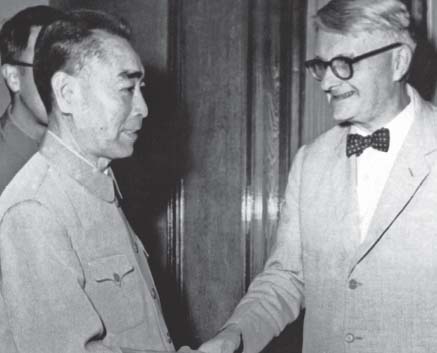
Both Needham, at sixty-four; and Zhou Enlai at sixty-six, were well on in middle age when they met again in Beijing in 1964, shortly before the outbreak of China’s Cultural Revolution, of which Needham was a moderately enthusiastic supporter.
Mao and his acolytes had done their best to keep such a formidable ally on their side. During the journey he made to China in 1972 the leaders were entirely unaware of his seeming unease, and they behaved in an exceptionally good-natured way to the man they regarded as one of their most vocal British supporters. It was Mao’s last opportunity to be so friendly. One story from that visit (a story one would prefer not to think apocryphal, though it cannot be confirmed) perhaps sums up the relationship which had grown up between Needham and Mao in the quarter century since they had first become aware of each other in Chongqing.
Needham was apparently invited, at very short notice, to come to Mao’s office on an “urgent matter of state business.” He dressed quickly, in a suit, and hurried along Chang’an Avenue to Zhongnanhai, the complex of lakeside palaces beside the Forbidden City where the Chinese leaders have their headquarters. Guards escorted him to Mao’s offices, where he found the chairman sitting in a relaxed mood, drinking tea.
They exchanged pleasantries for a few moments. Then Mao got down to business. He spoke in slow and heavily accented Chinese, which Needham could barely understand. He was aware, said Mao, that Yuese, in his early years at Cambridge—Mao used Needham’s Chinese name, Li Yuese—had driven a fast car, a sports car called, Mao astonishingly remembered being told, an Armstrong-Siddeley. The perplexed Needham nodded his head. Yes, he had. He had loved cars, and still did.53
“I thought so,” said Mao. “You are the only westerner I know well enough, and who knows about motor cars. So I have come to you, Yuese, to ask for a small piece of advice on an important matter of state business.”
Needham straightened his back, waiting.
“I am aware of developments in the outside world. I have to decide whether to permit my people”—Mao gestured expansively—“whether to allow my people to drive motor cars, or whether the bicycle is better for them. What, my dear Li Yuese, do you think?”
Needham, amazed, paused. He thought for a moment—of the thousands of bicycles moving along Chang’an Avenue like a ceaseless sea, just a few yards away. He thought of the uncomplaining discipline of the riders, of the near-silence of the onrush of people, of the occasional flash of elegance as a beautiful young woman would glide past on her Flying Pigeon, swanlike and lovely. He was transported. He was in a reverie.
Mao coughed. His visitor snapped back into reality. He was in the office of the chairman of the Communist Party of China, the guiding light, the Great Helmsman of the mightiest nation on earth. He had been asked a question. A reply was needed.
“Well, Mr. Chairman,” responded Needham, stuttering slightly. “To be honest with you, I find that back in Cambridge where I live, my very old bicycle is perfectly satisfactory for almost all of my needs.”
He was going to say more, to add that perhaps in a major industrial nation it might indeed be better to use cars, and it might be beneficial to allow private citizens to drive. But Mao was grinning. He had heard what he wanted to hear. A decision was in the making.
“So, Yuese, you who like China so much find the bicycle perfectly satisfactory?” He rubbed his hands together, then spread them apart. He had made up his mind.
“Right, then. Bicycles it is!”
And with that Needham was invited to leave, and he emerged blinking into the sunset onto an avenue that was jammed solid with the two-wheeled conveyances of the evening traffic jam. He suddenly felt he had made some contribution, in some strange way, to the future of all of these people—at least for the next few years.
No record of the conversation in Zhongnanhai exists. Maybe it never took place. But two things are certain. Joseph Needham did occasionally ride a bicycle. And China is now well on the way to becoming the world’s greatest producer—and soon the world’s greatest consumer—of automobiles.
Whatever Mao said or did not say to Joseph Needham on that summer’s day in 1972, he was dead four years later, and his successor, Deng Xiaoping, was to be bent single-mindedly on bringing China into the forefront of the modern world. And if that meant, as far as transportation was concerned, the wholesale scrapping of millions of Flying Pigeons and a nation shackled to a lifetime of pollution and traffic jams and countless miles of new roads to be built, then so be it.
Throughout this time there was a cascade of honors. In 1971 Needham was elected to a fellowship of the British Academy, so that now, in common only with the philosopher Karl Popper and the historian Margaret Gowing, he was a fellow of both the Academy and the Royal Society. Honorary degrees, academe’s device for publicly declaring the gratitude of the intellectual community, began to be offered: Cambridge got in early, and then Brussels, Norwich, Uppsala, Toronto, Salford, the two main universities in Hong Kong, Newcastle, Chicago (the U.S. government finally giving him a visa to permit him to receive it), Hull, Wilmington (North Carolina), Surrey, and Peradeniya University (outside Kandy, in the central tea-estate hills of Sri Lanka). (The last reflected his keen interest in what was then Ceylon, when he chaired the country’s University Policy Commission in 1958).
There was an oddly chilling coda to Needham’s brief visit to Chicago in the spring of 1978. He had been invited to give three public lectures at Northwestern University. For his second talk he decided on the topic “Gunpowder: Its Origins and Uses.” One of those who came to hear his lecture was a wild-haired loner of a mathematician, a tragic, brilliant man named Ted Kaczynski.
A short while earlier, professors at a Chicago branch of the University of Illinois had summarily rejected a brief essay Kaczynski had written on the evils of modern society, and one mathematician there had heard him mutter, bitterly, that he would eventually “get even” with those who had spurned him. On May 24, six weeks after sitting through Needham’s lecture, Kaczynski fashioned a wooden-cased explosive device made of gunpowder and match heads, and mailed it to one of the professors who had rejected him. It was intercepted, exploded, and injured a campus security guard.
There were no clues as to who was the perpetrator of the crime, and the incident marked the beginning of an extraordinary, bizarre, and frightening period in modern American history. Over the next two decades Ted Kaczynski, who lived alone in a remote shack in the mountains of Montana, went on to send waves of carefully made and ever more lethal bombs to academics, killing three people and injuring more than twenty. The press and the FBI called him the Unabomber. He remained at large until his arrest in April 1996.
Few knew at the time that he may have initially been schooled in his deadly craft, though entirely unwittingly, by Joseph Needham. One can only wonder what would have happened—or might not have happened—had the State Department’s ban on Needham remained in place, denying the Unabomber the opportunity to hear him and to learn about early Chinese techniques for the manufacture of explosives.
In addition to Needham’s collection of degrees there were medals galore, to join his Order of China’s Brilliant Star—which the British government still prohibited him from wearing at official functions. There were memberships and fellowships in bodies and institutes and academies from India to Denmark and China and then finally, once the State Department had relaxed its ban on his entry in 1978, from the great American organizations: the National Academy of Sciences, the American Historical Association, and the Yale Chapter of Sigma Xi.
His roving eye remained undimmed, even as he aged. There was much alarm in the mid-1970s when he became captivated by a distinguished Canadian Chinese woman, H. Y. Shih, who was a former director of the National Gallery of Canada. There was even talk of a divorce, and a marriage. Under great pressure from all his friends—including a joint attack from both Dorothy and Gwei-djen, who acted in what old Chinese families would recognize as the “concert of the concubinage”—the affair eventually fizzled, to widespread relief.
And through it all, the book. During the ten years of his mastership four more volumes were published—one on mechanical engineering; two on chemistry; and in 1975 the mighty 400,000-word tome that is generally reckoned the finest and most comprehensive, the famous Volume IV, Part 3, Civil Engineering and Nautics. Seven volumes were now out on the shelves; ten more were in the process of being written, edited, and proofread; another ten were still in Needham’s overfurnished but impeccably organized mind.
And the chorus of admiration for the works was becoming ever more enthusiastic. George Steiner, the critic and public intellectual whose imprimatur was at the time perhaps more sought after than any other, remarked that in Science and Civilisation in ChinaNeedham had re-created a world of extraordinary density and presence:
He is literally recreating, recomposing an ancient China, a China forgotten in some degree by Chinese scholars themselves and all but ignored by the west. The alchemists and metal-workers, the surveyors and court astronomers, the mystics and military engineers of a lost world come to life, through an intensity of recapture, of empathic insight which is the attribute of a great historian, but even more of a great artist.
The books could be favorably compared, wrote Steiner in a review in 1973, with À la recherche du temps perdu—for both “Proust and Needham have made of remembrance both an act of moral justice and of high art.”
An artist was commissioned to capture Needham’s image, for a painted portrait in the Hall at Caius. Needham decided to wear his long blue Chinese gown, the color blue having been regarded in imperial days in China as recognition of a high level of achievement, matching the high level of achievement in Britain that was suggested by the portrait itself. The older portraits under which members of the college dine are of ruffled, velvet-clad divines; Needham is among the more recent, and above him in his eastern getup are stained-glass windows depicting, not people, but the actual achievements made by other Caians—a colored-glass Venn diagram, and a delicately rendered double helix of DNA, conceptualized by Rosalind Franklin, James Watson, and Caius College’s Francis Crick.
Needham’s retirement from the mastership came in 1976, and with it came the beginnings of a slow and steady downward spiral. For the first time Needham was beginning to realize—and, moreover, to admit—that he might not manage to cover the entirety of Chinese science within the limits of his lifetime. Perhaps, he wondered out loud, he might have bitten off more than he could chew. It was clear that he needed help—and not simply the kind of assistance that Wang Ling and Gwei-djen had been able to offer. He needed someone who could perhaps write an entire volume, could look after an entire topic of Chinese scientific history on his or her own.
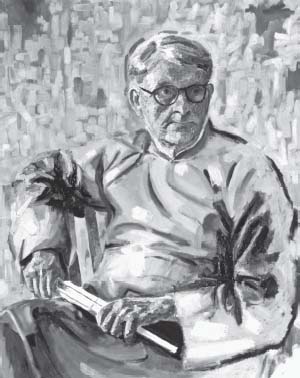
Needham was sufficiently distinguished in 1963 to have his portrait painted in oils for the Caius College Hall three years before he was elected Master. The combination of slide rule and scholar’s robe suggests his dual fascination with East and West.
Though he gritted his teeth about having to delegate, he eventually did: Francesca Bray was the first to be handed one entire subject (agriculture, eventually becoming Volume VI, Part 2). But T. H. Tsien’s Volume V, Part 1, about paper and printing, actually came out first, in 1985, and with a note from Needham publicly admitting that in freeing himself from the burden of sole authorship, he had now reached a turning point. The project was still his—he was its architect and the builder of the first courses of brickwork. But the upperworks, parapets, dome—these would be the work of others. Life was too short for it to be otherwise.
Moreover, he had now reached a venerable stage of life. He was seventy-six when he left the Caius mastership; eighty-five, frail, and bowed when Tsien’s volume on printing came out; then two years short of his ninetieth birthday, and ailing, when Francesca Bray’s volume on agriculture emerged. The wisdom of years was prompting him to envisage just how the series would progress when he was no longer competent to write it, and also how it could progress when he was no longer around even to direct it.
According to a tradition at Gonville and Caius, those who are most intimately associated with the college will in their lifetime make use of two ancient gates built in the college walls. They would enter as undergraduates through what had been known for 700 years as the Gate of Humility; and at death, if their life had brought distinction, fame, or both, they would leave through another, more ornate and topped by a sundial. Called the Gate of Honour, it was seldom opened, and then only for momentous occasions. Joseph Needham’s appointment with this second gate would now be not too long in coming, he suspected.
And yet he was content: those whom he had gathered around him in these closing years would be sure to finish everything, come what may. Cambridge University Press was in full agreement: Science and Civilisation in China was too bright a jewel in the publisher’s crown—in Cambridge’s crown, in the nation’s crown—for anyone ever to entertain any thought of abandoning it.
Needham and Gwei-djen moved adroitly to ensure the lasting physical security of the vast collection of books and manuscripts they had accumulated. Needham had long before persuaded the college that two rooms were necessary to house the project, and after a battle royal in the mid-1950s (for rooms in Oxford and Cambridge colleges are the scarcest of commodities, and one has to be of the greatest distinction to be permitted more than one), he was given the right to use both his old room, K-1, and K-2 next door. He installed Gwei-djen in the latter, their books in both. The crush of bookcases became unmanageable: it was still necessary for research assistants to be very small, the better to squeeze along the tiny corridors between these shelves.
Soon after Needham stepped down as master—being permitted as a courtesy to retain the rooms for a while—the pair amalgamated their book collections. They then formed a trust that had two aims: to keep the project going and to find a permanent home for it. The trust then underwent mitosis, remaining in existence, but joined by two sister organizations, one based in Hong Kong to raise funds for the project’s home, the other in New York to seek money for the book’s continued publication.
Needham and Gwei-djen began a rigorous program of shuttling to Asia, making speeches, attending dinners, jumping the hurdles and ducking through the various hoops that were the necessary rituals in persuading rich men and foundations to part with their money. Almost every time the couple went to China, they had to endure the gastronomic purgatories of banquets, often laced with awards. But Needham remained courteous and in puckish good form throughout: at one moment after he was awarded yet another plaque or medal or brooch or scroll of calligraphy, he turned to the camera crew recording the event: “All this,” he asked “—all this for little me?”
The couple’s greatest success was with a former bicycle repairer in Cambridge, David Robinson, who had made a small fortune in the 1950s renting televisions to Britons too broke to buy them, and had then invested the resulting cash in horse racing and turned it into a very large fortune indeed. In the late 1970s he was endowing a new college at Cambridge near the University Library (and across the road from one of Britain’s few Real Tennis courts), and after a meeting at dinner and a series of long conversations, he offered to give Joseph Needham’s East Asian History of Science Trust a plot within the college site. He offered land—something that in the city of Cambridge was rare and precious.
On this piece of land, Robinson imagined, there would rise a building to house all of Needham’s books on China, serve as headquarters for publishing the remaining twenty-odd volumes of Science and Civilisation in China, and allow research to be conducted on various aspects of Chinese history. And in time all this came to pass: Robinson College opened its doors in 1980, and the Needham Research Institute in 1987, just as David Robinson was coming to the end of his long and remarkable life.
The queen opened the college; her husband laid the foundation stone of the institute; and the university vice-chancellor and the Chinese ambassador were both on hand to declare the Needham Research Institute open for business.
But it was a project that had taken its toll. The financial crises attendant on its opening were profound, complicated as so often is the case by politics and competing egos. At one especially low point an anonymous donor gave sufficient money to keep the project tottering along—this turned out to be Lu Gwei-djen herself, who handed over part of her estate in Nanjing. Both she and Needham gave the titles to their houses on Owlstone Road—his at number 1, hers at 28—for the benefit of the trust. And from his personal funds (which were not inconsiderable: he was as judicious in financial matters as in his scholarly work) he paid Francesca Bray during her research for agriculture, much as he had paid Wang Ling for his help with the early volumes.
But more poignantly, the work was taking its toll on the health of the three now very elderly and increasingly frail protagonists of the story. Everybody noticed. Some observers were aghast. In the winter of 1986 Needham showed up in Hong Kong, walking slowly and painfully with the help of a stick, to ask for yet further funds from people with unimaginable fortunes. As he stood up after giving a talk, and hobbled off, one his oldest friends in the room, Mary Lam, cried out: “Those people in Cambridge are so cruel, sending such an old man to go around asking for money. Give Dr. Needham what he wants!” (This they did, to the tune of $250,000.)
Dorothy Needham was the first to die, three days before Christmas in 1987. The affection she and Joseph had displayed for each other never dimmed. The loving tone that marked their early correspondence—seen in hundreds of postcards and letters from Switzerland, Albania, Babbacombe, the Isle of Mull, O’Donnell’s Sea Grill in Washington, D.C., and everywhere imaginable in China—remained intact for all of their lives.
Dorothy—Li Dafei, “graceful plum blossom”—had begun to suffer the symptoms of Alzheimer’s disease soon after Needham retired. Thereafter she could travel very little, and was unable to take part in any discussions about the science to which she had once devoted her life. While still able to comprehend, in 1979, she had been elected an honorary fellow of Caius—one of the first women to be admitted, three years after her husband’s mastership had ended. Very occasionally the couple would dine in the college. When confused, she had to be led to her table by a steward, while Needham, now being wheeled through the college in a chair pushed by colleagues, would be hauled up to the hall in the dumbwaiter from the kitchen, along with the vegetables.
Dorothy Needham’s last academic testament and magnum opus, written in 1972, was a book, Machina Carnis, on how muscles work: antiquarian booksellers still stock it, charging as much as $250, and it remains a classic. It had been a puzzle to her that despite her distinction and what her husband had once called her “complete freedom from worldliness,” she remained officially unrecognized by her university, and existed only on research grants, which were the basis for a hand-to-mouth existence and for which she applied and reapplied year after year through the decades of her active life.
She died peacefully at home on December 22, 1987, at age ninety-two, having lived just long enough to be told that her husband’s institute had opened its doors—though it is doubtful that she ever truly understood. A flotilla of nurses were her final companions. The sadness of those close to her at her death was mixed with very evident relief that the ten long years when she was non compos mentis were finally at an end.
Gwei-djen was not well, either. Though she—unlike Needham—had stopped smoking, she had had serious bronchial complaints for years, probably brought on by the chain-smoking of her youth. As far back as 1982, when she and Joseph had traveled to the mountains of Sichuan to investigate a cave painting that illustrated the first Chinese gun, she had just had part of one lung removed, and she had to be carried up to the caves on a litter. Some time soon after that, she was found staggering around the college in the dark—Joseph and Dorothy were at the movies—and was rushed to a hospital with a perforated appendix. In 1984 she collapsed in a hotel in Shanghai and had to be removed to Hong Kong, where she was treated. She recovered well enough to accompany Needham to Taiwan, where they had what both agreed was a wonderful time. But her collapse seemed ominous, and from then on she had a frail look about her, seeming very different from the tough little spitfire she had been in her youth.
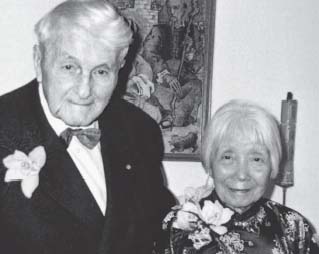
In 1989, more than half a century after they first met, Needham and Lu Gwei-djen were married in Cambridge. She died two years later, whereupon Needham invited three other women to marry him. All politely declined.
There was an unanticipated coda to this story. In the early autumn of 1989, Joseph Needham and Lu Gwei-djen married.
The woman from Nanjing, who had been named for the sweet-smelling osmanthus tree and as a thing of great value, had first met Joseph Needham in 1937 and had fallen under his spell in 1938. He had been thirty-seven years old, she thirty-three. They had become lovers, and ever since had been inseparable boon companions. Now, after fully fifty-one years of waiting in the wings, during which her essential presence in Joseph’s life was wholly accepted by Dorothy, Gwei-djen was at last to marry the man with whom she had shared this undying passion.
For more than half a century he had given her his unwavering affection. She, by way of return, had given him a great deal more: she had committed herself to him entirely, but she had also given him one further and incalculably valuable gift: China. “Joseph has built a bridge between our civilizations,” she had remarked in the 1960s. “I am the arch which sustains the bridge.”
The couple married in the Caius College chapel on the morning of September 15, 1989, a Friday. The wedding photographs show the two ancient lovers as they emerge through a sandstone archway, both stooped and with pure white hair, Joseph—the frailer of the pair—supporting himself with a tricycle walker and his chestnut stick, Gwei-djen leaning on a silver-tipped malacca cane. She is wearing a blue cheongsam with a bold peony print, he a crumpled double-breasted blue suit that had seen better days, and a blue bow tie. A lapel button shows his Chinese Order of the Brilliant Star. Both wear sprays of lilies, and are smiling broadly. “It may seem rather astonishing,” said Joseph at the celebration lunch in Hall, “for two octogenarians to be standing here together, but my motto is: Better late than never.”
It was to be a very brief marriage, lasting just a little more than 800 days. Late in the autumn of 1991 she slipped and fell in a dark Cambridge restaurant, breaking her hip. A few days later, lying immobile on her back in Addenbrooke’s hospital, she found it increasingly difficult to breathe, her cough worsened, and antibiotics offered to treat the very obvious infection in her already badly damaged remaining lung became ineffective. Early in November the doctors decided to send her home, where she died, peacefully, on November 28. The official cause was bronchial pneumonia. She was eighty-seven.
She had been inspired throughout her life in the West by one simple truth, something her father—Lu Shih-kuo, the “Merchant-Apothecary in the City of Nanking” to whom Needham dedicated the first volume—had said before she left China in 1937: “However strange the doings of the old Chinese might be in the eyes of modern people in the West, they always knew what they were doing, and some day the world would recognize this.”
There was some untidiness following her death. A number of hitherto unknown relatives wrote urgently to Needham, having heard that she had left a small fortune in carefully managed stocks and shares, and demanding ample portions of it. She died intestate, and though Needham tried to make certain that his late wife’s wish—that the bulk of her estate go to the charitable trust—was fully honored, he had his lawyers fire off a barrage of letters to the various aunts and uncles and in-laws who had written so importunately from China, Canada, and New York state, rejecting most of their requests. Some claims, however, were still unsettled nearly two decades later, in 2007, and were being painstakingly handled by Lu’s executors. The outstanding cases have been of a complexity and a duration to rival Jarndyce vs. Jarndyce. It is grimly supposed by many that the lawyers, working at a glacial rate, will consume an all too large portion of the remaining proceeds.
Yet there was a curious reason Lu did not make a will. In the late 1970s and early 1980s, work on the book was proceeding in a way that some critics found puzzling. Needham, now well on in age, seemed somehow to lose his early grasp on the need for a coherent plan for completing the project—managing to write no fewer than four separate (but magnificently irrelevant) volumes on alchemy, for example, and to shoehorn them uncomfortably into the series. This caused some ructions: not a few people in Cambridge began to fret that if Needham became subject to increasingly eccentric editorial whims like this, the series might never be finished.
The worry became so intense that it prompted one unalloyed supporter of the book and its founder to fly to New York to reassure the principal American financial champion of the project—the futurist and computer guru John Diebold—that all was in fact well, and that Science and Civilisation in China would be completed (and he was quite direct in saying so) by 1990. It was the most foolhardy of predictions—and when it became clear to Diebold that the target date would actually be missed by decades, he became understandably furious.
This led to much argument and recrimination between Cambridge and New York, with the conviction growing in the minds of the aging and stubborn Needham and Gwei-djen that some kind of plot was now being hatched in New York, and led by John Diebold, to shut down the project completely. In consequence, and by the time she married Joseph, Gweidjen determined that she should not in fact make a new will—as she should have done—until she had engineered a financial structure that, whatever the villains in New York might do, would guarantee the future of the books, or as she and Joseph then insisted on calling them, “our children.” But she died before completing her plan.
Needham was devastated by her death—much more so than he had been by the passing of his wife four years before. Moreover, he was now very much alone, for the first time since he had married Dorothy seven decades before. The sudden and unanticipated lack of female companionship evidently unhinged him, and he swiftly and impetuously (but serially rather than simultaneously) wrote proposals of marriage to three women—all of them East Asian, one the Miss Shih of Toronto with whom he had enjoyed a brief but intense relationship twenty years before. All three women turned him down.
His loneliness was exacerbated by the fact that all his academic contemporaries were now gone, and the people at his institute were young men and women who—though they waited on him hand and foot, treating him like an emperor and behaving with all the deference of courtiers in the Forbidden City—had little in common with him, and were much more absorbed in their own fields of study.
Physically, too, he was weakening. He was bowed over with scoliosis and had developed Parkinson’s disease and a variety of other ailments. But his mind remained sharp—waspishly so, said those who got on his wrong side—and he continued working through the early 1990s at the Sisyphean task he had set himself nearly half a century earlier.
To make his life a little easier, he had sometime before been moved into a house that stood in the grounds of Robinson College just next to the institute, no more than a two-minute wheelchair ride to the sun-drenched office where he liked to work. The house, built in the minimalist style of the 1930s, had been designed for one of the university’s most celebrated couples: the economist Michael Postan and his historian wife, Eileen Power. Needham would have been amused to learn of one unexpected connection: in 1930 Eileen Power, traveling in China, became engaged to Reginald Johnston, who was the immensely handsome tutor54 of the last emperor of China, Pu Yi. The engagement was called off in 1932.
In 1992 Needham was awarded the Companionship of Honour, and was brought to Buckingham Palace to receive this most exclusive of British awards from the queen. One of his caregivers—since Gwei-djen’s death he had a full-time helper, Stanley Bish—dressed him in a black silk Chinese robe for the ceremony. Needham was supposed to have said—but outside Her Majesty’s hearing—“About time!” There were many who thought that he should have received an honor rather earlier in his life, beyond the purely academic recognition he had amassed. But he was content with his lot, and cherished the uniqueness that this particular honor conferred: “Joseph Needham, CH, FRS, FBA,” said a notice published by the Royal Society: “one can count the number of living holders of these three titles on one finger of one hand.”
He worked until the very end, faithfully taking a ginseng pill each morning—just one; Gwei-djen had long before told him that his previously customary two were excessive—in the belief that it would lengthen his life. He loved his office: he loved being surrounded, almost encased, entombed, enwrapped, and swaddled by the accumulated thousands of books and stacks of papers and scrolls, and by walls that were hung with pictures and charts and maps and lined with the file cabinets, supremely well-organized, that helped him in his work. And there were innumerable objects, too, attesting in aggregate to the extraordinary range of his travels and fascinations.
There were clay models of masks from the Beijing opera. Chinese chess pieces brought back by Dorothy’s aunt Ethel. A small abacus. A bag from a sake brewery in Kyoto. A piece of the Berlin Wall. A model of a nineteenth-century beam engine. A baby’s urinal “collected by Rewi Alley in Xinjiang.” Seeds from a Chinese tea plant from Meijiawu. A Han dynasty bronze whistling arrowhead. An ivory box for keeping fighting crickets. A crossbow trigger, probably a Ming copy. A set of Chinese scales and a single slipper. A cigar holder engraved with Chinese characters written by Needham himself. Scores of seal ink containers, including one described as “very nice,” from the Qianlong era, made when Lord Macartney was visiting China in the late eighteenth century. A plaque stating that October 28, 1984, was officially Joseph Needham Day in the state of Illinois. Two pairs of slippers for bound feet. A rice pounder. A Sichuan spinning top. A toy railway train and one piece of track. Two of Dorothy’s earrings. Railway timetables and tickets galore. Photographs of churches from around the world. Pictures of himself morris dancing, while playing the accordion and smoking. A Chinese wooden puzzle. A sample of gypsum. A model of a spoon once used as a lodestone.
These props helped, as did the ginseng, for Needham was still managing to work—though dozing for much of the working day, it must be said—during the following three years, writing, filing, napping, writing. He would be wheeled over to the institute at noon, and return at five. When he came back he would eat ice cream and watch Chinese television, and sometimes he would sing—once singing “The Red Flag” so loudly he was asked to pipe down. He did not miss a day in the office, keeping to his routine of five hours at his desk laboring on the book, then going home to domestic letter writing, ice cream, and bed.
On Thursday, March 23, it was clear to all that the end was coming. His colleagues at the institute noticed that he was failing, and the next morning it was suggested that, for the first time in memory, he take the day off. It was a Friday, after all: he could make it a long weekend. He could charge his batteries for the week ahead. “All right,” he said. “I’ll stay at home.”
He got up for a while and sat at his breakfast table, classical music playing in the background. At noon his nurses put him back to bed. The dean of Caius came by, unannounced, and said a brief prayer with him, saying he would return the next morning to give Joseph Holy Communion. The old man slept through the early evening, wrapped in a sheepskin rug.
Then his caregiver asked if he was frightened. “Oh no,” he replied, weakly. Christopher Cullen, his successor as director of the institute, asked him if he was in pain. “No, no pain,” he returned, quietly. Stanley Bish later wrote that a friend and neighbor, the distinguished historian of literature and science, Elinor Shaffer, came by, though she had wondered if she should, since she had a bad cold. She brought a daffodil, a sign that the brisk March weather was nonetheless the start of another spring, the ninety-fifth through which Joseph Needham had lived.
She sat close to him, said Bish, telling him of her recent lecture tour, and believing that he understood the gist of what she was saying. At eight forty-five two nurses arrived, and someone told Joseph how lucky he was to have two beautiful young girls looking after him. He grinned wickedly, impishly, happily. A few moments later Elinor Shaffer got up to leave, having been invited to have a cup of tea in the living room next door to Joseph’s bedroom before venturing out into the cold.
She stood up, and according to his caregiver grasped Joseph’s hand, squeezed it, and said happily: “Good-bye, Joseph—I’ll be in to see you soon.” And with that Noël Joseph Terence Montgomery Needham, CH, FRS, FBA, sighed once, very slightly—there was no pain, no gasping, no more than a weary acceptance of the inevitable—and died.
It was eight fifty-five p.m. He had lived for ninety-four years and a little over three months. It had been a very full life indeed. It was a life during which, and all in consequence of his love for a Chinese woman, he had worked single-handedly to change the way the people of the West looked on the people of the East. In doing so he had succeeded, as few others are ever privileged to do, in making a significant and positive change to mankind’s mutual understanding.
And now that was done, and his appointment at the Gate of Honour had finally come due.
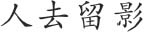
Written in elegant calligraphy beside the fireplace in Needham’s old college room is the famous four-character Chinese aphorism:
The Man departs—there remains his Shadow.
Such is the reverence for history in Cambridge it is likely that this singular memorial to Joseph Needham will remain in place for decades, and maybe for centuries.