
CHAPTER 10
By the time Lafayette reached his mid-twenties, he had come out of his shell and fully embraced the extravagant lifestyle of a typical Parisian aristocrat. He was tremendously wealthy, and yet his expenditures grew so lavish that they outpaced his sizable income—a common predicament for men and women of his class, who routinely leveraged their assets to the hilt in order to maintain an appearance of limitless riches. Despite their devil-may-care demeanors, many Parisian nobles subsisted on a system ofcredit that was as complicated as it was shaky.
Lafayette’s financial problems developed gradually, over a period of years. In 1782, his receipts still covered his outlays quite tidily. He was obliged to pay down substantial debt incurred during his American voyages, but his lands, investments, and inheritance brought in 224,743 livres, while his total expenses amounted to only 200,889 livres, leaving him a healthy surplus of 23,854 livres. By 1785, however, Lafayette was essentially breaking even, taking in just 845 livres more than he spent. And by June 1788, his finances were in a state of disarray; his annual income had shrunk to 115,381 livres, while his expenses remained nearly constant at 190,462, leaving a staggering deficit of 75,081 livres.
In a memo of June 30, 1788, Jacques-Philippe Grattepain-Morizot, the attorney who oversaw Lafayette’s accounts, expressed alarm. Grattepain-Morizot acknowledged that some unnecessary expenses on the part of the household staff could be reined in, but he impressed upon Lafayette that even “the greatest surveillance” would never yield enough savings to balance such a lopsided budget. Instead, he insisted that the discipline required to reach “that happy state of affairs, in which one spends only what one takes in and transmits to one’s children the property of their late father, can come only from you.” Underscoring his point, Grattepain-Morizot produced a table featuring eight columns of flowing cursive script and carefully inked numerals that categorized Lafayette’s expenses—salaries and pensions, merchants, household, children, and so on. Of the totals at the bottom of each column, the largest by far represented Lafayette’s discretionary spending. Amounting to 52,284 livres, Lafayette’s personal costs included such miscellany as a box at the opera (450 livres), subscriptions to publications (416 livres), and tailoring (3,215 livres). Taken together, these outlays exceeded the combined total of 49,208 livres that went to household expenses (domestic servants, linens, lighting, etc.), the children (their governess, clothing, smallpox inoculations, etc.), and Adrienne’s personal needs. Lafayette’s leisure activities necessitated ever greater expenditures on horses and carriages, including large sums, as Grattepain-Morizot observed, for maintenance due to Lafayette’s frequent voyages and fondness for carriage races. The memo concluded by directing Lafayette’s attention to a proposed austerity budget Grattepain-Morizot had drawn up, adamant that it “must commence tomorrow.”
Lafayette’s financial turmoil began, as is so often the case, with a real estate investment. On September 6, 1782, Lafayette reached the age of majority, finally enjoying unfettered access to his copious assets, and two months later he purchased the Left Bank town house on the Rue de Bourbon (the modern-day Rue de Lille) that he would make over entirely as his own. According to the sales contract, Lafayette paid 150,000 livres for the house and land, which stretched the length of a block, plus 50,000 livres for the furnishings, carved wood paneling, and decorations already in place. He then plowed 100,000 livres into renovations, bringing the total cost basis of the property to some 300,000 livres—an amount he raised by selling several income-producing properties, thus causing his revenues to plunge even as his expenses were growing.
Then, as now, location was all in matters of residential real estate, and Lafayette opted for a fashionable milieu quite distinct from the staid grandeur preferred by his in-laws. Whereas the Hôtel de Noailles stood on the Rue Saint-Honoré near the Tuileries Palace, Lafayette’s house was located on the other side of the Seine in the stylish Faubourg Saint-Germain. Compared with the home he left behind, Lafayette’s Rue de Bourbon house was rather modest. Not only was the Hôtel de Noailles several times larger than Lafayette’s town house, but the grandeur of its design both reflected and facilitated the family’s high social aspirations. The Duc de Noailles had created a stir when he’d erected a barrier outside his front door; previously, such structures had marked only the entrances to the homes of princes of the blood. Indoors, too, the Duc de Noailles had mimicked the royal family by creating a formal bedroom for receiving guests. There, in a canopied bed divided from the rest of the room by an ornate railing, the host could recline in luxurious comfort while visitors were obliged to stand—although guests of sufficiently high rank might sit on stools placed on the other side of the balustrade.
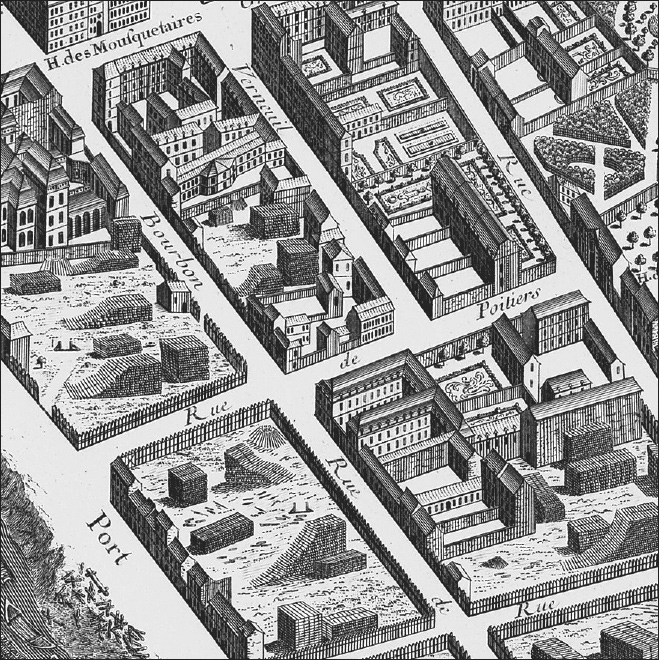
The Noailles complex had grown up around a core that dated to 1453, but Lafayette’s home had not even been built yet when the Turgot map of Paris—an enormous and remarkably detailed map published in atlas form—was created, between 1734 and 1739. Development in this part of the city was of such recent vintage that the Turgot map depicts construction sites and vacant lots on the blocks that would become Lafayette’s neighborhood. The two areas also boasted very different political characters. The Noailleses, a family of courtiers, were situated a stone’s throw from the Parisian center of royal power, but Lafayette’s house was next door to the final home of the disgraced finance minister Anne-Robert-Jacques Turgot, who had purchased the building in 1779 after being exiled from Versailles and resided there until his death in 1781.
As Lafayette described it in a 1784 letter, his was “a house which, if not the most beautiful, is at least infinitely gracious.” Like Turgot’s, Lafayette’s was one of eight built on the Rue de Bourbon by a single speculator, Pierre Salles, who used variations on a limited number of plans for all of the buildings he erected and sold in the 1730s and 1740s. Since its completion in 1744, Lafayette’s house, like others funded by Salles’s partnership, had functioned as a high-end rental. Three tenants in succession—all members of the nobility—had let the home from two different proprietors before Lafayette became its first owner-occupant. Although Lafayette’s home was torn down in the early twentieth century, the Hôtel Turgot (as it is known) still stands between the Boulevard Saint-Germain and the Assemblée Nationale. It offers a sense of what Lafayette’s home looked like, as both were built in a “horseshoe” arrangement framing a common entry court and were laid out in a very similar style. (The Hôtel Turgot, which was purchased by the renowned Dutch art historian Frits Lugt in the twentieth century, is now the location of the Fondation Custodia—one of the world’s foremost collections of Old Master prints and drawings, assembled mostly by Lugt himself.)
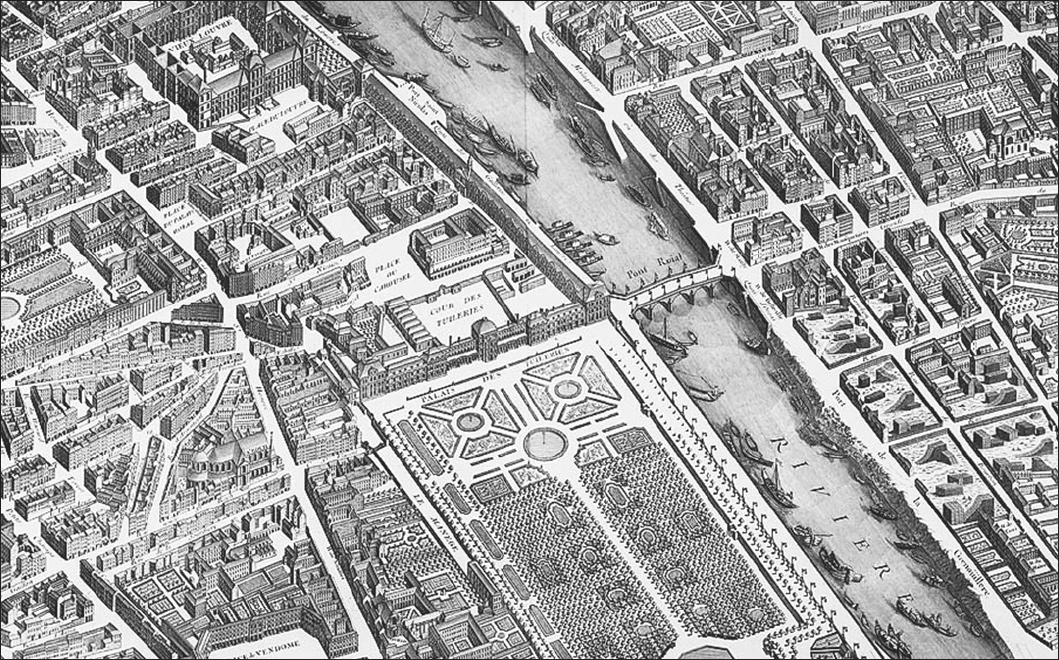
Detail of the Turgot map of Paris, 1739. The Hôtel de Noailles is at the left, and the location of Lafayette’s house is at the right. (illustration credit 10.3)
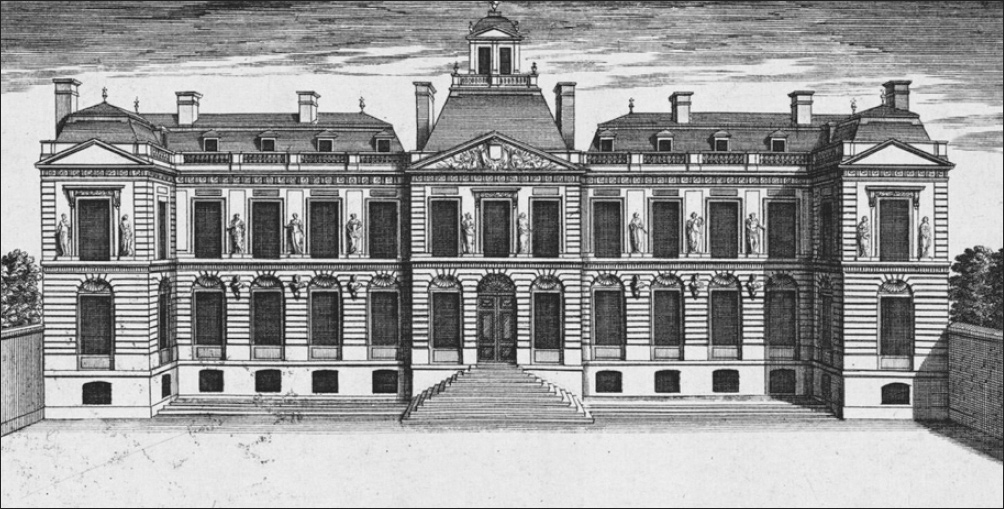
Detail of the Turgot map of Paris showing the empty lots where Lafayette’s town house would be built. (illustration credit 10.2)
The Hôtel de Noailles, located near the Tuileries and Louvre palaces on the Right Bank. (illustration credit 10.1)
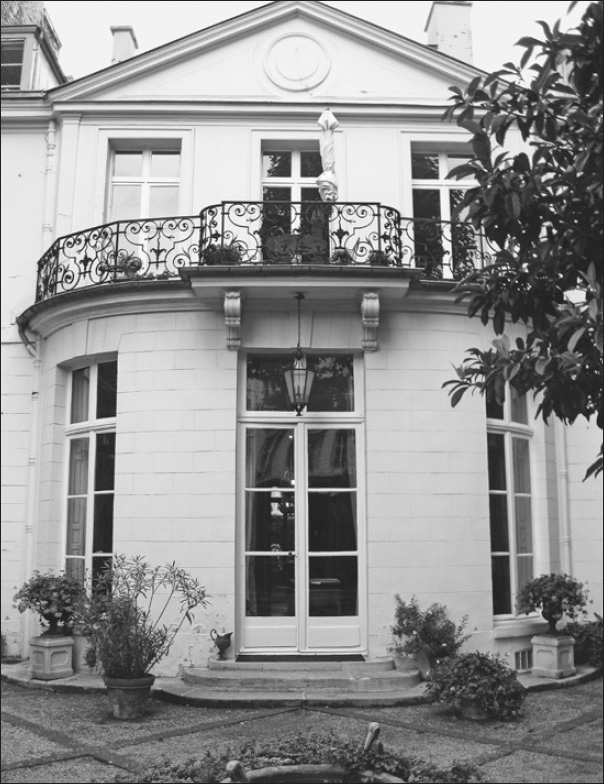
The Hôtel Turgot, built on the same plan as Lafayette’s town house and still standing, on the Left Bank, adjacent to the site of Lafayette’s home. (illustration credit 10.4)
The building was large enough to accommodate Lafayette’s family and household servants in a manner befitting their station, but compared with other homes in the area it was not out of the ordinary. The house’s primary living quarters were distributed across two floors, with six rooms per floor, augmented by an entresol (partial balcony level), a sous-sol (basement), and an attic. Household servants had quarters in the attic, and additional servants were lodged in an outbuilding. The stables, too, were ample, but while it was certainly a luxury to maintain the fifteen horses and four carriages they could hold, nearby homes erected by the same developer accommodated as many as twenty horses and five carriages.
Conceived as just one building among many in the developer’s plan, Lafayette’s town house grew increasingly distinct in the 1780s as it came to embody its owner’s character and ideals. From the architect who renovated the building to the furnishings that filled it, the home enhanced Lafayette’s reputation as America’s foremost French ally. Lafayette may well have been introduced to his architect, Adrien Mouton, through a Noailles relative, but the choice had symbolic resonance. As a student at the French Royal Academy of Architecture in the 1760s, Mouton had become a voice for religious freedom. Having won the Rome Prize, which enabled budding architects to study the great monuments of the Eternal City as guests of the French state, Mouton saw his sojourn inItaly cut short in 1767 when, at Eastertime, he refused to submit proof that his confession had been heard by a Catholic priest. Back in France, Mouton filed a lawsuit against the director of the French Academy in Rome, the painter Charles-Joseph Natoire, who responded that “it is necessary to smother in its cradle the progress of this cabal … which desires nothing but independence in every respect.” When Mouton received a settlement of 20,000 livres, he struck a blow against religious persecution.
By the time Lafayette selected his architect, the cause of religious tolerance had grown increasingly dear to his heart. Lafayette had made many Protestant friends during his time in America and had come to abhor the intolerance that France’s nominally Catholic government exhibited toward other Christian denominations. In 1785, he made his own small contribution to the cause when he returned to Paris in the company of John Edwards Caldwell, a fourteen-year-old boy from Elizabeth, New Jersey, whose father, the Reverend James Caldwell, had died during the war—“barbarously murdered by the British,” as John Quincy Adams put it. Lafayette placed Caldwell in a French boarding school, where he obtained a special dispensation releasing the Protestant student from the requirement of attending Catholic services. And in 1787, when Lafayette was selected by the French crown to authorize a set of government reforms—an event that became a precursor to revolution—Protestant rights became one of the first causes he championed.
American values were most fully on display in the rooms that Lafayette considered truly his own—the grand cabinet and its adjoining library. Here, Lafayette spent time alone, reading and writing, or welcomed visitors to discuss matters of state and other sober concerns. In keeping with its intimate function, the cabinet was relatively modest in size, but two windows leading out to a small balcony must have created an appearance of spaciousness, which would have been enhanced by three large mirrors: one mounted above the fireplace, a second directly opposite, and a third between the windows.
These spaces were filled with opulent French furniture that hinted at republican idealism. Throughout the 1780s, one of Lafayette’s favorite furniture makers was the Luxembourg-born Bernard Molitor, a technically skilled and aesthetically forward-looking craftsman at the top of his profession. With his home and workshop on the Rue de Bourbon, Molitor was Lafayette’s neighbor and worked for many families in Lafayette’s courtly and military circles. Molitor’s neoclassical style—all straight lines, with ornamentation limited to a decorative grammar borrowed from ancient Greece and Rome—was widely associated with the virtues of the ancient republics and was all the rage in the fashionable circles of Paris and Versailles.
For Lafayette’s home, Molitor and other craftsmen created tables, shelves, and boxes made from the most expensive materials and constructed with the greatest care. When Lafayette’s possessions were seized and sold by government order amid the tumult of theFrench Revolution in the 1790s, one of the items removed from the town house was a “mahogany bookcase,” presumably from the library, deemed to be of such merit that it was selected for the national collection. The appraisers also noted a “mahoganyguéridon” (a small, round table supported by a pedestal in a form inspired by antiquity) “with a white marble top,” which sold for 130 livres in 1795, and a two-piece set—a “secrétaire surmounted by a file cabinet” and an “armoire in mahogany and decorated with gilded leather”—that together sold for 810 livres.
Lafayette clearly devoted thought to the furnishings of his cabinet and its surroundings, which he described in several letters as showcases for all things American. Writing from Mount Vernon in August 1784, he told Adrienne that “the true Cincinnatus” had inspired him to consider how the room should be furnished. Two months later, he reported to Adrienne from Church’s Tavern, near Hartford, Connecticut, that “I have discovered here a climbing plant, always green, that will yield a marvelous effect on the two walls of our terrace. When it reaches you, I ask you to please seed it and to plant a large quantity.”
Decorating the room with American mementos had been on Lafayette’s mind even before he set off on his 1784 journey. On November 19, 1783, he had jotted a quick note to William Temple Franklin, the grandson and secretary of France’s favorite American, expressing a desire to own a copy of the new nation’s founding document. As Lafayette explained, “The object of my having a declaration of independence is to have it engraved in golden letters as the most conspicuous part of my cabinet, and when I wish to put myself in spirits, I will look at it, and most voluptuously read it over.” He hoped that Temple would be able to “procure it for me, printed if you can, in order that a French workman may be less apt to make blunders.” Lafayette admired the declaration as an inspiring document that embodied essential principles of liberty, equality, and fundamental human rights, but in his cabinet, paradoxically, visitors would encounter it in the deluxe form of a gold-plated curiosity. The display was a heartfelt ode to America that could have been conceived only by a Parisian nobleman.
The social hub of the Lafayette household was an airy, oval salon on the ground floor featuring three curved French doors that opened onto a garden. Light streaming through the doors’ clear glass panes would have bounced among four large mirrors, each measuring more than seven and a half feet in height. During evening gatherings, when the only illumination came from candles and a fireplace, these broad expanses of silvered glass would have animated the room with flickering reflections, allowing everyone present to keep an eye on the whole assembly by casting discreet glances at the nearest mirror.
Lafayette and Adrienne spent many hours in this well-appointed salon hosting the American dignitaries who became regular visitors to the Rue de Bourbon. Accounts of afternoons and evenings spent in the company of the Lafayette family recur throughout the correspondence of the Adamses, the Jeffersons, the Jays, and others sent to Paris by the United States government in the 1780s. English was the language of choice at these gatherings, where Lafayette’s two older children—Anastasie and George Washington Lafayette—were always introduced to the guests and sometimes entertained them with songs in the foreign tongue. So established did these “American dinners” become that Lafayette ordered invitations preprinted in English: “The Marquis de la Fayette has the Honor to present his Compliments to [blank] and begs the favor of his Company at Dinner on Monday next [date].” Dozens of these small cards are scattered among the copious papers Benjamin Franklin left behind at his death.
So un-French was mealtime chez Lafayette that even Abigail Adams, whose strict New England sensibilities inclined her to disdain the Parisian “life of ceremony and parade,” felt at home there. Colonel William Stephens Smith, the husband of Abigail Adams Smith, similarly approved. After dining with Lafayette on April 29, 1787, he wrote to his wife that the “dinner was so perfectly to my taste that I must give you a small sketch of it.” “There were only us two,” he continued. “The table was laid with great neatness. By the side of each was fixed, (I’ll call it) a dumb waiter. On which was placed half a dozen clean plates, knives and forks, and a small bell in the one near the Marquis, and the servants retired. The first course being over, he rung the bell and it was removed for the second. Thus we spent an hour and a half with great ease and friendship; not incommoding the servants, nor being subject to their inspection.”
Just as Colonel Smith was taken by Lafayette’s unprepossessing nature, the Adams women repeatedly commented on the virtues they saw in Adrienne. Abigail remarked, “I should always take pleasure in her company. She is a good and amiable Lady, exceedingly fond of her Children and attentive to their education, passionately attached to her Husband!!!” So startling was this last trait that Abigail thought it worth repeating—“A French Lady and fond of her Husband!!!” The Adamses’ daughter, also named Abigail, was similarly touched by Adrienne’s maternal qualities. After one dinner with the Lafayette family, she observed that “the fondness that Madame la Marquise discovers for her children, is very amiable; and the more remarkable in a country where the least trait of such a disposition is scarce known. She seems to adore them, and to live but in them.” Although the Adams women counted Adrienne’s company among the few features of Paris they would regret leaving behind, each hinted that there may have been something excessive in the family’s Americanization. The younger Abigail mused on the all-American dinners held chez Lafayette. “It was intended as a compliment,” she recognized, “but I had rather it had been thought so to introduce us to French company.” As the Adamses readied for their journey to England, her incisive mother noted, “I shall lose part, and the greatest part of American intelligence by quitting France; for no person is so well informed from all the States as the Marquis de la Fayette.”
In one case, unfortunately, Lafayette’s enthusiasm for filling his house with American memories seems to have come at considerable cost to another person’s well-being. The person in question was Peter Otsiquette, the son of a French father and an Oneida mother, who went to live with Lafayette “as a favourite Servant” at the age of nineteen, in 1786. Lafayette’s first allusion to Otsiquette (whom he generally called “Otchikeita”) came in a 1784 letter to Adrienne. Writing from Oneida territory, Lafayette confided, “I might well bring back a young Iroquois sauvage: but this negotiation is not yet complete.” Lafayette and his companions saw nothing unusual in the request—since the seventeenth century, missionaries had been sending Native American boys to France to be educated—and were surprised to discover that all of Otsiquette’s family had to be consulted before any arrangements could be made. Barbé-Marbois noted “the difficulty that M. le M[arqu]is de La Fayette had in procuring a sauvage companion. Even though the Oneidas have the greatest affection for him, they had infinite difficulty obtaining permission for him to take one of their young people to France.” The matter must have been resolved by April 1785, when Lafayette wrote to the Connecticut merchant Jeremiah Wadsworth that “the whole family who are Oneidas, consented to his coming with me—and I would be much obliged to you … to forward the Young Indian’s departure by the October packet.”
Otsiquette was half French, but in France, he was defined by his Oneida heritage. Among the thousands of pieces of paper discovered by Lafayette’s descendant René de Chambrun in the Château de La Grange in 1956 are a handful of small receipts listing an array of fabric and clothing purchased from the Paris boutique of Godin, l’Aîné. Godin’s shop regularly provided clothing for the Lafayette children and, occasionally, for the marquis himself, but on October 9, 1786, the merchant charged Lafayette’s account for two black taffeta cravats intended, according to the receipt, to be worn by “le sauvage.” On November 4, a black silk cravat and four blue handkerchiefs with red borders were added to the tab, and identified in the same way. These purchases were for European-style clothing, but a German officer who visited Lafayette in January 1787 described the man who served as Lafayette’s page as “a sauvage from America, dressed according to his custom.” John Ledyard, a Connecticut-born explorer who was a frequent guest at Lafayette’s house, and a frequent beneficiary of his largesse, observed that summer that “the Marquis, at much expense, equipped [Otsiquette] in rich Indian dresses.”
An especially colorful description of Otsiquette’s traditional dress comes from the memoirs of the Comte de Neuilly, who was a child in the 1780s. Neuilly remembered attending a ball honoring Lafayette at the home of Adrienne’s aunt the Comtesse de Tessé, which Lafayette arrived at in the company of “a sauvage whom he had brought from America: a real tamed animal [“une vraie bête apprivoisée”] with a ring in his nose, a feathered headdress on his head, a bone placed so as to hang from the ear; legs and arms tattooed: his entire costume consisted of a belt of feathers over a flesh-colored tunic.” Neuilly recalled being terrified at first by the “scalp dance” performed by the visitor, who kept time with a song by slicing the air with a tomahawk. Caraman entered into the spirit and joined in the dance, as did Neuilly, who, with a bit of encouragement from Lafayette, eventually found his nerve.
Command performances by natives of the New World had a long history in Europe, where travelers to distant lands sometimes brought back indigenous people—usually young men—to stay with them for a few weeks or a few years. In London, the 1710 visit of “Four Iroquois Kings,” as they were called, occasioned endless festivities as locals followed the exotic guests through the streets and marveled at their every move. The most famous visitor in Lafayette’s memory was undoubtedly the man known as Mai, who traveled to London from the South Sea Islands with the explorer Captain James Cook and lived in the home of the naturalist Joseph Banks from 1774 to 1776. For two years, Mai visited with the English elite and became the subject of paintings, prints, and newspaper articles, as well as the catalyst for debates on matters ranging from imperial policy to the relative merits of “civilization.” To Lafayette’s credit, he seems not to have allowed Otsiquette to become a public spectacle; we have no images of the youth, who apparently attracted little notice in Paris outside of Lafayette’s family circle.
Upon his return to America, however, Otsiquette’s connection to Lafayette earned him wide acclaim. His arrival on the Cato in late July 1788 was reported in American papers from Maine to Pennsylvania, and those who met him that summer were impressed with the social skills and physical dexterity he had acquired in France. Sometimes, however, the precise circumstance of his journey became distorted in the telling, as at least two newspapers reported that “this young aboriginal was sent for to Paris by that benevolent nobleman the Marquis de la Fayette, for the purpose of receiving the first principles of an European education.” Before going to France, readers were told, Otsiquette was “wholly in a rude and uncultivated state,” but he returned with “his manners elegant and refined, and his genius quick and penetrating.” One young woman who had the good fortune to dance with Otsiquette at a soirée in Providence wrote in her journal that Otsiquette had been dressed in the height of French style, wearing “a scarlet coat trimmed with gold lace,” and that his skill at dancing a cotillion was “by far the best of any person I ever saw attempt it.” Evidently, Otsiquette had also obliged his audience by performing a “war dance” for the assembled Rhode Islanders—creating a spectacle that they, like the young Neuilly, deemed “terrible.”
The Oneidas, too, apparently held Otsiquette in high regard. In March 1792, he was among the Iroquois leaders who traveled to Philadelphia for an audience with President Adams. Tragically, he died during that visit; he was buried with military honors. Once again, Otsiquette’s name spread throughout the American press. Some reported that Otsiquette had died of pleurisy, but others believed that the still young man had drunk himself to death. Francis Adrian Van der Kemp, a Dutch patriot who had immigrated to upstate New York, suggested in a letter to a friend that Otsiquette had returned from Paris “highly cultivated and master of the French language and politeness, although it was doubted if his heart was as improved as his head.” Otsiquette’s death prompted Van der Kemp, a deeply religious man, to ponder the ethics of European involvement with Native American peoples. Taking a bold stance for his time, Van der Kemp wrote, “It may be justly questioned if the vicinity of their white neighbors is to them not rather a curse than a blessing. How contrary is this with the genuine spirit of Christianity.”
For all of his Americanization, Lafayette remained a Frenchman through and through in one realm of his life: although he and Adrienne shared a deep bond of affection—one that grew even stronger in times of trial—Lafayette was known to enjoy the favors of women other than his wife, and to do so quite openly. The subject has traditionally been a sensitive one for Lafayette’s biographers, some of whom may have seen marital infidelity as an unwelcome blemish on the man’s otherwise admirable character. As the lateLouis Gottschalk recounted, his discovery of a love letter to a mysterious “Aglaé” ignited a “friendly controversy” among Lafayette scholars in the 1930s. Gottschalk’s insistence that Aglaé was not, in fact, a pet name for the marquise met with opposition from a group of devotees, who would “entertain no doubt of Gilbert’s constant fidelity to his Adrienne.” But in the arranged marriages of the eighteenth-century French nobility, blissful monogamy was almost unheard of, and Lafayette was a man of his time.
Lafayette recalled his early dalliances as mere peccadilloes. So unexceptional did they seem to him that he mentioned them in the third paragraph of the memoirs he sent to the American historian Jared Sparks in 1828:
I shall spare you also the confession of an unedifying youth, and even of the story of two romances dedicated to beauties who were then very celebrated, in which my head had a larger part than my heart. The first, scarcely begun, broke against the obstacles of jealousy with which I collided head-on. The other—in which I wanted at first to triumph less over the object herself than over a rival—I pursued, despite long interruptions, on every possible occasion. Our relationship went from esteem all the way to the contrary sentiment, and was finally terminated by a catastrophe unconnected with me. It is more pleasant for me to speak of the tender and stable affection that I never cease to feel for the woman whom I had the good fortune to marry.
Gottschalk’s Aglaé, Aglaé de Barbantane, Comtesse d’Hunolstein, seems to have been the first of the two women mentioned by Lafayette. Aglaé, a young woman of about Lafayette’s age, served as a lady-in-waiting to the Duchesse de Chartres in the 1770s and socialized in the circles of the Vicomte de Noailles. It was in this milieu that she and Lafayette met in 1776, before Lafayette joined the American army. At the time, she was reputed to be the mistress of the rakish Duc de Chartres—her employer’s husband—although Lafayette seems to have believed that his friend Ségur was his rival for Aglaé’s affections. She is presumed to be the unnamed lady over whom Lafayette challenged Ségur to a duel.
Lafayette failed to make an impression on Aglaé before he went to America, but his heroic exploits turned her head. By the time he’d returned as one of the heroes of Yorktown, his name and Aglaé’s were frequently being whispered in the same breath. They were enmeshed in a full-fledged lovers’ quarrel when Lafayette wrote Gottschalk’s telltale letter on March 27, 1783. “You are too cruel, my dear Aglaé,” it begins. “You know the torments of my heart, you know that it is torn between love and duty, and you demand that it take a stand on this unhappy matter.” Heated though it is, this rhetoric must not have been new: “It has been more than a year since you tried to break this tie,” Lafayette complained. “Every day you redoubled your efforts.… Now you take one last approach; it’s the cruelest one for me, but the only one that may succeed. The only question is whether I am an honest man.”
In the end, it’s not clear whether Aglaé broke the tie or whether it was broken for her. We know that she was dismissed from the Chartres household and entered a convent in the city of Nancy, in eastern France, where she remained until the French Revolution abolished religious orders. The author Stéphanie Félicité, Comtesse de Genlis, who served as tutor to the children of the Duc de Chartres and succeeded Aglaé as his mistress, had no personal fondness for her banished predecessor, yet she reported that Aglaé underwent a true conversion, embracing her Catholic faith and living an exemplary life marked by austerity and charity.
By the time Lafayette parted ways with Aglaé, his attention had drifted to the second woman referenced in his letter to Sparks—Diane-Adélaïde de Damas d’Antiguy, Comtesse de Simiane, a lady-in-waiting to the Comtesse de Provence. Gottschalk observed that Lafayette was already praising Madame de Simiane as “pretty” and “amiable” in a letter to his friend the Prince de Poix on January 13, 1783. And the celebrated painter Élisabeth Vigée-LeBrun, writing in her memoirs in the early nineteenth century, recalled Lafayette visiting her studio in 1783 “just to see the portrait that I was making of the pretty Madame de Simiane, to whom, it was said, he was paying court.” With a mixture of admiration and surprise, Vigée-LeBrun, a staunch monarchist who had been a favorite portraitist to Marie Antoinette, added that Lafayette’s “tone, his manners, had a great deal of nobility, and did not in the least suggest revolutionary tastes.” Coming from Vigée-LeBrun, this was meant as high praise.
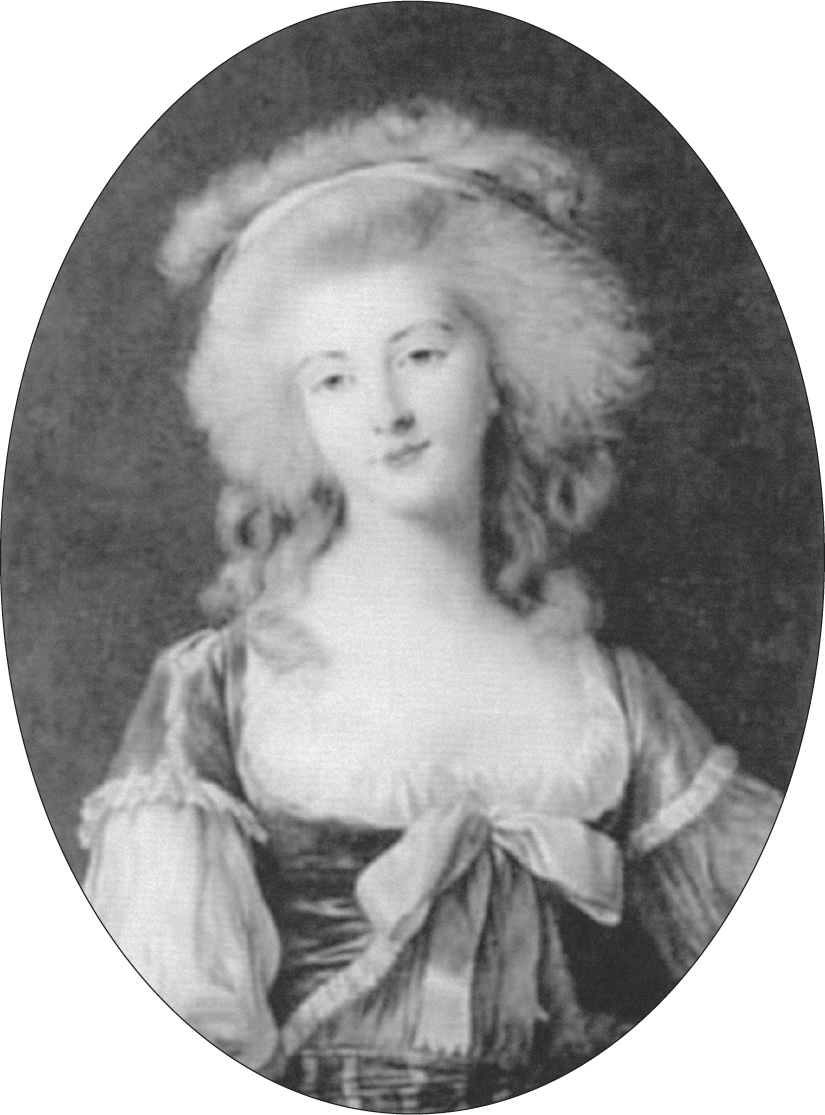
Élisabeth Vigée-LeBrun, portraitist to Marie Antoinette, was working on the Portrait of Diane-Adélaïde de Damas d’Antiguy, Comtesse de Simiane, in 1783, while Lafayette was courting the comtesse. (illustration credit 10.5)
In telling Sparks that this second affair had terminated in “a catastrophe unconnected with me,” Lafayette was not being entirely truthful. On March 14, 1787, the Mémoires secrets reported, “Rumor has it that Monsieur the Comte de Simiane, husband of the renowned beauty Madame de Simiane … killed himself a few days ago in a fit of jealousy over the Marquis de Lafayette.” Despite the gossip, the tragedy did not put an end to the relationship. By all accounts Madame de Simiane remained, at the very least, one of his closest confidantes for many decades to come.