
CHAPTER 17
Cannon fire jolted Paris to attention at nine-thirty on the morning of June 21, 1791. Soon, warning bells were ringing from every church and cries of alarm filled the streets. The king had vanished. Despite the heavy guard that surrounded the Tuileries Palace at all times, Louis XVI, Marie Antoinette, their children, and a handful of others had somehow disappeared overnight. No one knew where or why the royals had gone. It was equally unclear whether they had fled or been abducted. These questions went unanswered throughout the morning and early afternoon as rumors swirled through Paris and fingers were pointed in many directions—especially at Lafayette, the man who was supposed to protect the Tuileries.
In the chamber of the National Assembly, stunned silence gave way to cacophony. Alexandre de Beauharnais was presiding over the assembly and struggling to control the mounting confusion when Jean-Louis Romeuf, one of Lafayette’s aides-de-camp, made his way to the bar. Romeuf had not planned to visit the assembly, but he was glad enough to be there. Glad enough to be alive. He was one of several couriers dispatched by Lafayette early that morning to “warn all good citizens that the king has just been carried off by enemies of the public good, and to order them to attempt to block this departure by all available means, and to bring him back if possible,” according to the published proceedings of the assembly. But Romeuf had barely made it out of the Hôtel de Ville when a group of workmen forced him from his horse. As they saw it, Lafayette was to blame for allowing, if not abetting, the king’s departure; not having Lafayette on hand, they seemed happy to take out their fury on his messenger. While blows and kicks rained down upon Romeuf, a second group of Parisians, in a less bellicose frame of mind, pulled him from the fray and conducted him to the assembly. Plucking Lafayette’s orders from Romeuf’s hand, Beauharnais read them aloud.
Soon, Lafayette himself was in the chamber, having made his own escape from an angry crowd gathered on the Place de Grève. Speaking from the tribune, he proclaimed that “an attack” on the king had been carried out by “enemies of the public good” who hoped to strike a blow at “French liberty.” It was wishful thinking. Had the king been a victim, the nation would have faced a discrete enemy, a malignant force that could be identified and excised without harm to the body politic.
Unfortunately, the arrival of Arnaud II de La Porte, intendant of the King’s Civil List, made it clear that Lafayette’s optimism was sorely misplaced. De La Porte came to the assembly bearing a document entitled “Declaration of the King, Addressed to All the French, upon his Departure from Paris.” Once the king’s text was read into the record, there could be no mistake: Louis XVI had not fallen prey to an anti-revolutionary conspiracy; he had been chief among the plotters. The king explained that he could no longer stand idly by to “see all my powers unrecognized, prerogatives violated, personal safety endangered everywhere, crimes going unpunished, and complete anarchy established above the law.” The new constitution, he complained, left the monarch with nothing more than “the appearance of authority,” without sufficient power “to cure a single one of the ills that afflict the realm.” And he was just getting started.
The royal declaration was so long that it filled ten columns of print in the Archives parlementaires, its criticisms running the gamut from philosophical misgivings about the premises of the new order to grievances stemming from a sense of personal pique. The former are more substantial, but the latter are more telling, as the king’s grumblings about creature comforts and interior decoration reveal just how severely he underestimated the gravity of his situation. Recounting the ordeal of the royal family’s arrival at the Tuileries on October 6, 1789, Louis wrote, “Nothing had been prepared to receive the King.” Moreover, even after he had settled in, “the disposition of the apartments” did not “afford the comforts to which His Majesty had been accustomed in the other royal properties, and which every individual of means is able to enjoy.” Vexing, too, was his treatment during the Festival of Federation. At first, the assembly had placed him at the helm of the festivities “by special decree,” but they had subsequently “named another”—Lafayette—to the same post. Making matters worse, the seating arrangements were substandard: despite the king’s request, the royal family had been directed to a box separate from his own, “a thing hitherto unprecedented.” Louis was equally galled by the budgetary limits imposed on his household expenses; these restrictions, he complained, dared to presume “that services rendered to the person of the king are not also rendered to the State.” He concluded with a plea to the people: “Come back to your king; he will always be your father, your best friend.” The man seemed not to understand that the time for sentiment had passed.
The royal missive heaped such scorn on the various reforms that had accumulated since the Assembly of Notables convened in 1787 that it managed to alienate nearly all but the monarchy’s most ardent supporters. The Révolutions de Paris termed it “a satire of the Revolution.” Even the royalist Marquis de Ferrières had had enough. He summed up the situation in a letter to his wife, writing, “The Declaration written in the hand of the king completes his downfall.” By denouncing “all the Assembly’s decrees,” explained Ferrières, Louis had “declared himself … an enemy of the Constitution.” One of the several papers that claimed the title L’ami du roi (“The Friend of the King”) went so far as to remove the reference to the monarch from its masthead: on June 22, the paper was sold as L’ami des français (“The Friend of the French”).
Given the carelessness of the monarchs’ preparations for escape, it seems incredible that the royal scheme was not discovered. According to Madame Campan, plans had been in the works at least since March, when Marie Antoinette began sending Campan on shopping sprees. Buying just a few items from each boutique to elude detection, Campan assembled complete wardrobes for the queen and her children, shipping all purchases to Brussels to await the royal family’s arrival. Marie Antoinette had also decided that she could not live in exile without her custom-made nécessaire de voyage—an ebony box, some eight inches deep and twenty-two inches long, trimmed with copper and gilt silver, and designed to contain everything that might be desired on a journey, from a complete tea service to a compass to a makeup brush—and so an order was placed with the ébéniste Jean-Pierre Charpenat for an exact duplicate to be made and shipped to the Netherlands.
While Madame Campan was working her way through the shops of Paris, General de Bouillé was amassing twelve battalions and twenty-three squadrons, composed primarily of foreign troops, on the French side of the Belgian border. Bouillé, who pointedly did not share his plans with his cousin Lafayette, stationed most of his men in and around the fortress at Montmédy, the king’s intended destination, and dispatched others along the route the monarchs were to travel, in order to guarantee safe passage. As the historianTimothy Tackett has observed, if the suspicions of local citizens had not been aroused by the sudden influx of German-speaking soldiers, Bouillé’s order for eighteen thousand rations of bread must surely have signaled that something was afoot. Yet Bouillé reported that, “happily,” all of his arrangements generated “no suspicion among the people of the surrounding towns and countryside.”
When June 20—the planned departure date—finally arrived, events unfolded like a comedy with a tragic dénouement. In the royal apartments at the Tuileries, details of the voyage were still being sorted out as the day went on. Monsieur Léonard, the queen’s hairdresser, was added to the passenger list shortly before three in the afternoon and summarily packed into a carriage without being told where he was going, while the royal governess, Madame de Tourzel, was said to have objected to arrangements that had her traveling in a carriage separate from her charges. Meanwhile, horses and carriages of all variety— a hackney cab, a fiacre, a cabriolet, a berlin—were being deposited at locations in and around the city of Paris, where they would be picked up, driven, and exchanged throughout the day. Overseen by Marie Antoinette’s rumored paramour, the Swedish count Axel von Fersen, these and other maneuvers were designed to whisk the royal family safely out of the most closely guarded site in Paris and, from there, far beyond the city walls.
Much of the entourage was already on the move by the time the principal players donned the clothing of servants, couriers, and other commoners to camouflage themselves as they began making their way out of the Tuileries. They started to leave around ten o’clock at night, the end of the working day for many of the palace staff. One by one, they stepped into the courtyard at intervals that sometimes stretched to forty-five minutes, doing their best to blend into the flow of men and women walking toward the street. The process was just beginning when Lafayette and Bailly wandered into the scene. By chance, Lafayette had stopped by Bailly’s home before turning in for the night. There, he heard news that, both men agreed, should be shared with the king. So off they went to the Tuileries, where Lafayette’s carriage nearly ran directly into Marie Antoinette, and where Madame de Tourzel, waiting in the fiacre with the children, spotted him. The queen was shaken, but Lafayette did not notice her. Inside, Lafayette and Bailly found the king, who, having dismissed his servants for the night, was about to follow behind his wife. The three men conversed for what must have seemed like days to Louis XVI. Finally, sometime after eleven o’clock, the unwelcome visitors took their leave, and the king slipped out the door near midnight. Despite the delays and near misses, the first hurdle of the royal flight had been cleared.
With 160 miles still to cover between Paris and Montmédy, the danger of discovery remained high. The monarchs had chosen a well-traveled route requiring at least nineteen stops to exchange horses along the way, and the choice of yellow as the color of their vehicles did nothing to render them less conspicuous. Nonetheless, with Paris receding farther and farther into the distance, spirits inside the carriages began to lift. As the governess remembered it, Louis XVI passed the time reading aloud the declaration soon to be heard in the National Assembly; “then looking at his watch, which marked eight o’clock, he said, ‘La Fayette just now does not know what to do with himself.’ ” Apparently, the very thought of Lafayette’s awkward situation brought the travelers a degree of joy.
Their mirth was to be short-lived. They were more than halfway to their destination when they rode into Sainte-Menehould on June 22. By the time they reached the city gates, local officials were already suspicious, their interest piqued by the curious arrival and departure of first one, then another detachment of mounted soldiers. In both cases, their officers carried orders signed by the despised Bouillé containing a cover story involving “a treasure,” due to arrive shortly, that would require an escort to the border. When two carriages, accompanied by couriers in chamois-colored livery, reached the relay post, they aroused the interest of the postmaster, Jean-Baptiste Drouet. As Drouet told the story, the horses were being changed when, out of idle curiosity, he peered into the waiting carriage; there he noticed the queen, whose face he thought he recognized. Looking at the man seated to her left, Drouet “was struck by the resemblance between his physiognomy and the effigy of the king printed on an assignat [paper currency introduced in 1790] that I was carrying.” This was not an entirely unexpected development. In fact, Louis had been so fearful of recognition that, against the advice of Bouillé, he had charted a route circumventing Reims, the site of his coronation, where he believed that his countenance would be too familiar. Evidently, he had not considered that the assignats bore his profile, encircled by the words “Louis XVI King of the French,” so that any man he passed on the road might have his portrait in his purse. As the story goes, at least one man did, and his tale was repeated by journalists and printmakers seeking to insert a moment of levity into an episode that was, in all other respects, deadly serious.

Assignat worth 100 livres featuring the profile of Louis XVI at the upper center. (illustration credit 17.1)

The King Eating Pigs’ Feet at Sainte-Menehould, the Postmaster Comes Across an Assignat and Recognizes the King. Engraving. 1791. (illustration credit 17.2)
Once the carriages had vanished from sight, Drouet and a comrade leapt to their horses and raced to the town of Varennes. There, they hoped to stop the royal caravan. Reaching Varennes at eleven-thirty in the dark of night, the men dispatched a local innkeeper to spread word of the king’s arrival before blocking the bridge leading out of the town with an array of vehicles, including a nearby cart filled with old furniture. In less than five minutes, Drouet and a colleague, the mayor and the National Guard commander of Varennes, greeted the approaching carriages—now accompanied by some 150 mounted troops—at the bridge with eight other armed men. Passports were demanded. While the assembled citizens debated the validity of the documents and the identity of their owners, Louis XVI revealed himself, saying, “Here is my wife, here are my children, we beseech you to accord us that regard which the French have always accorded to their king.” By this time, one hundred citizens, many of them armed, had gathered in the street. Soon, the National Guard would have two cannons trained on the hussars. The king was lost.
Until word of the arrest reached Paris, Lafayette faced his own set of dangers. On the night of June 21, representatives from the various factions on the left temporarily set aside their differences to meet at the Jacobin headquarters. There, Georges Danton, the editor of Révolutions de Paris, denounced Lafayette. As his newspaper reported it, Danton boomed that, since “Monsieur the Commander General swore on his life that the king would not leave, we must have either the person of the king or the head of Monsieur the Commander General.” He had long suspected that Lafayette was an enemy of the revolution, and the events of “June 21 removed all doubt.” Danton was addressing Lafayette directly when he declared “the most astonishing” fact of the day to be that “people, on first hearing of the escape of Louis XVI, did not set upon your person.” Harking back to the murders of July 14, 1789, he added that “Flesselle and Delaunay paid with their heads for treason less criminal than yours.” The loyalty of the troops, the loyalty of their officers, and the loyalty of the Paris sections (the city’s neighborhood governments) all had to be confirmed, but the loyalty of Lafayette was particularly suspect. “The general of an army of thirty thousand men, who permits the escape of an entire family,” declared the paper, “is criminal or imbecile.… Soldiers of the nation, he has lost the right to command you.”
Fortunately for Lafayette, a messenger arrived from Varennes with news of the king’s discovery on June 22, before anyone had acted on Danton’s call. In a show of unity, three deputies, representing the political left, center, and right, were dispatched to meet the monarchs, who had already started on the return trip to Paris. So crowded was the road with onlookers that the somber caravan required several days to deliver its passengers to the Tuileries, where Lafayette promptly presented himself. As he recalled, he attempted to assume a deferential stance. “Does Your Majesty have any order to give me?” Lafayette asked. Through bitter laughter, the king replied, “It seems to me that I am subject to your orders more than you are to mine.”
Lafayette’s position was growing increasingly untenable. While those on the left held him responsible for the king’s escape, partisans on the right blamed him for the ignominious spectacle of the royal family’s return. The Comte d’Espinchal observed with disgust that Lafayette had “issued orders that no honors should be accorded to the king, and forbade even the doffing of hats. This worthy commander of a troupe of rebels and troublemakers [factieux] is, at this moment, the jailer of his sovereign and of the entire royal family.” A letter, written by Bouillé from the safety of Luxembourg and read into the record of the National Assembly on June 30, accused Lafayette of standing “at the head” of the party that hoped to replace the monarchy with a republic. Lafayette’s “secret ambition,” wrote Bouillé, drives “him toward the only goal he has”: establishing a government that would be “monstrous for us.”
This double accusation—of ambition and republicanism—was more than Lafayette could bear. Two days later, he appeared before the assembly to refute what he termed Bouillé’s “calumny.” “I am denounced as an enemy of the form of government that you have established,” he stormed to vigorous applause. “Messieurs, I will not renew my oath, but I am prepared to shed my blood to uphold it.” Lafayette’s discomfort with his role in the king’s return did not decrease with the passing of years. Writing in his memoirs decades later, Lafayette sought to absolve himself of responsibility by reminding readers that, “happily for him (after the atrocities suffered by these august victims), it was not to his orders, but to the accident of being recognized by a postmaster … that their arrest was due.”
When the sun rose over a sharply divided Paris at nine minutes past four on Sunday, July 17, discontent had been roiling the city for weeks. The flight to Varennes was just one of the contributing factors. As the historian David Andress has shown, tens of thousands of men had been tossed into the ranks of the unemployed thanks to the closure of a work relief project in mid-June, and these workers, having passed through two years of impromptu schooling in political action, continued to report to work at jobs that were no longer available as they began petitioning the authorities and protesting in the streets. Struggling to maintain order, Bailly and Lafayette deployed the National Guard to break up the workers’ gatherings—a move that only compounded the animosity felt by those protesters, who saw the National Guard in general, and Lafayette in particular, as complicit in the king’s flight. Mutual distrust continued to mount, with more and more Parisians from nearly every level of society being arrested for insulting, threatening, or assaulting the members of the guard. Andress reports that one man was brought in for opining “in a loud voice” that “it was astonishing that [Lafayette’s] head was not on the end of a pike,” while another was arrested for averring that Lafayette and Bailly deserved to be hanged.
It was against this turbulent background that the National Assembly stunned a sizable portion of the populace on July 15 by passing legislation clearing Louis XVI of criminal wrongdoing in his attempted escape and leaving the king at the head of the very government he had so recently disdained. Whatever misgivings individual deputies may have felt, their decision was nearly unanimous. The vast majority, apparently, deemed it unwise to disband the monarchy in such unsettled times. As a group, they took cover behind Bouillé’s letter, which, aside from castigating Lafayette, indicated that the blame for the king’s flight rested entirely on Bouillé’s shoulders.
Reactions were swift and loud. Calls for the creation of a French republic went up at the Palais-Royal and at Danton’s headquarters, and crowds marched to the Jacobins’ meeting room, hoping to unite the left under the republican standard. The Marquis de Ferrières told his wife that “all the firebrands of the capital were unleashed that very evening in the clubs, in the cafés, shouting horrors against Louis XVI and against the Assembly.” One group, he reported, tried to close down the Comédie Française and the Opéra but was repelled by the National Guard. The next day, Gouverneur Morris wrote to his fellow American patriot Robert Morris (no relation) that “much Heat” had been generated against the deputies. Observing that “the People are now assembling … and the Militia (many of them opposed to the King) are out,” he deemed it “far from improbable that I shall have a Battle under my Windows.” The National Assembly shared his fear. On July 16, Bailly was summoned before the chamber and instructed, among other things, to produce an address to the people of Paris explaining “the principles that dictated yesterday’s decree” and to ensure “public tranquility.”
Some of the “heat” Bailly was asked to cool had generated spontaneously, but political factions were busily fanning the flames. Danton’s followers were apparently behind the march to the Jacobins, and many believed that the Duc d’Orléans had had a hand in the tumult as well. As Lafayette related the tale in his memoirs, Choderlos de Laclos, acting on behalf of Orléans, had drafted one of several petitions that began to circulate on July 16 demanding that the question of Louis XVI’s culpability be sent out to the departments to be decided by the nation at large. The plan was for those supporting the motion to gather at the site of the Bastille at daybreak, then to procede en masse to the Champ de Mars, where they would sign the petition on the altar of the nation—the same altar that had been consecrated one year and three days earlier by Lafayette. Throughout the night and into the morning, members of the National Guard skirmished with would-be signers, who nonetheless made their way to the Champ de Mars early on July 17.
The violence began before noon. Two men, having inexplicably concealed themselves beneath the altar, along with assorted woodworking equipment and a bottle of wine, were spotted and seized by a group of protesters. Convinced that the pair were planting explosives to disrupt the proceedings, the crowd hanged the men from a lamppost, hacked off their heads, and mounted these bloody trophies on pikes. Another man made an attempt on Lafayette’s life only to have his pistol misfire at close range. Eventually, the main event got under way. As the afternoon wore on, some six thousand men and women managed to sign their names or, in many cases, leave their marks on the petition. For a few hours, it seemed that order had been restored.
But news of the newfound calm did not reach the National Assembly until the deputies had already renewed their demand that the municipal authorities keep the peace. In the heat of the late-morning debate, Michel-Louis-Étienne Regnaud de Saint-Jean d’Angély went so far as to insist that “were I to be a victim, like those citizens who have just perished, I would demand the proclamation of martial law!” Ignoring murmurs on the extreme left, the assembly supported Regnaud. During the late afternoon, Bailly ordered red flags to be raised, and with that martial law was declared in Paris. Around seven in the evening, Bailly set off from the Hôtel de Ville accompanied by a battalion of grenadiers of the National Guard to rendezvous with Lafayette at the entrance to the Champ de Mars, where Bailly intended to order the crowd to disperse.
According to Lafayette, their arrival was “greeted by a hailstorm of rocks,” and soon thereafter, a pistol shot barely missed the mayor as he attempted “to make his proclamation.” In the midst of this attack, the National Guard fired into the air. These were warning shots, Lafayette insisted, “meant to avoid injuring anyone.” But the assailants were “emboldened by this moderation” and “redoubled their attack against the municipal offers and the National Guard.” Two volunteer chasseurs were killed, whereupon “the National Guard fired in earnest [tout de bon].” Lafayette’s account is vague on the numbers of casualties, maintaining that “the losses on the side of the assailants have been insanely exaggerated; the crowd was dispersed by the cavalry, which injured no one.”
Lafayette’s was just one of the many accounts of that day, and it was not destined to become the dominant one. In 1910, the French historian Albert Mathiez—a staunch supporter of Robespierre, a committed socialist, and the founder of the influential journalAnnales de la révolution française, which dominated academic French studies of the revolution for much of the twentieth century—painted quite a different picture by compiling and analyzing the testimonies of scores of participants and eyewitnesses. Mathiez had numerous axes to grind and gleaned much of his evidence from investigations launched by Lafayette’s nemeses. Nonetheless, his findings, which have had a tremendous influence on the study of the event, indicate the diversity of reports that circulated during the summer of 1791, with nearly every point of Lafayette’s story being contradicted by someone in Mathiez’s compendium.
Several people, including Bailly himself, maintained that the mayor never even began to read aloud the proclamation declaring martial law. Moreover, although the legislation required that Bailly enter the stadium ahead of the soldiers, presumably to permit the crowd to disperse of its own free will, Bailly instead trailed the cavalry, which entered the stadium at full charge. Others testified that the National Guard began firing when a shot rang out from the crowd gathered on the embankment—a shot, some said, that was merely a misfire. According to other accounts, rocks were thrown only after the fusillade began. And although one witness claimed that Lafayette ordered the National Guard to hold their fire, neither Lafayette nor his officers were able to control their men. In some versions, the crowd started fleeing after the first round of shots, only to be hunted down by chasseurs who broke ranks, swinging their sabers wildly. Perhaps the most hotly contested part of the story involves the number of casualties: one author, apparently in Lafayette’s camp, noted ten deaths and twenty injuries; another man avowed that he had returned to the field after midnight and counted fifty-four bodies strewn about the streets; and Marat wrote that four hundred corpses had been thrown into the river overnight, on Bailly’s orders. To this day, we have no solid grasp on the death toll.
If the battle fought with rocks and guns was more or less over by midnight, the war of rhetoric was just getting started. At the July 25 meeting of Danton’s Cordeliers club, the membership invoked the specter of a bloody episode in the sixteenth-century wars of religion by terming July 17 the “Patriot’s Saint Bartholomew’s day.” The Révolutions de Paris commenced its vivid retelling on the title page of issue 106. It began: “Blood flowed in the field of the federation; the altar of the nation is dyed with it; men, women had their throats slit; citizens are in a state of consternation.”
Images, too, reinforced the helplessness of the victims and the brutality of the National Guard. The article in Révolutions de Paris was accompanied by a print depicting the Champ de Mars with half a dozen bodies lying on the field. At the right, infantrymen break ranks to fire at close range on a crowd of unarmed people who are trying to run away, while, in the background, a guardsman on horseback chases down a man on foot. Casting the scene as a moment of sacrilege, the caption reads “Men, Women, and Children were massacred on the altar of the nation on the Field of the Federation.” Other prints attacked Lafayette explicitly. One image, for instance, shows a microcephalic Lafayette seated atop his enormous white steed with a gang of turkeys leashed to its tail. Referring to the people gathered around the altar in the distance, Lafayette asks his feathered army whether “it will take courage to kill them.”
In the two months that followed, Lafayette reached a rapprochement with the only political faction that was still willing to support him: the Feuillants, a group that contained about seventy of the National Assembly’s last remaining moderates. In the wake of the Champ de Mars debacle, these men, with the Triumvirate at their center, broke with the Jacobins to form the short-lived club that retained a commitment to constitutional monarchy. Having worked at cross-purposes for more than a year, Lafayette understood that his only hope of political survival lay in collaborating with Alexandre and Théodore de Lameth, Duport, and Barnave toward remodeling the constitution in light of recent developments. In the end, the revised constitution accepted by Louis XVI on September 13, 1791, carried some of the group’s marks, but the constitutional monarchy was already in its death throes; debating its details amounted to little more than selecting a coffin.
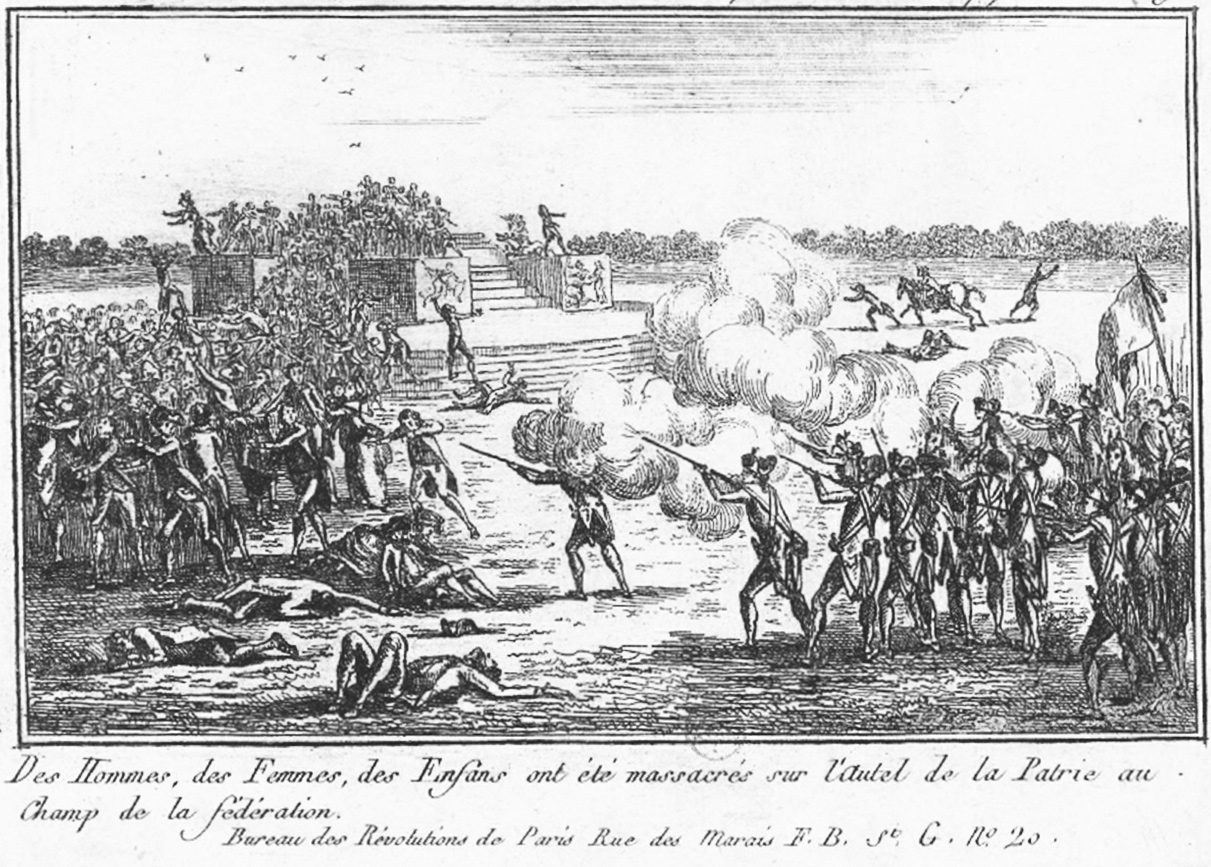
Unfortunate Day of July 17, 1791. (illustration credit 17.3)
Bouillé’s memoirs describe a mass exodus in the second half of 1791, in which “the roads of France were covered with men, women and children, afraid of being buried under the ruins of the crumbling monarchy.” Bouillé had in mind especially the aristocratic émigrés—well-heeled supporters of the monarchy who started trickling out of France in 1789 and began pouring across the borders after the flight to Varennes. Austria, Germany, Belgium, Italy, England, and the United States were popular destinations for these men and women, who counted among their number more than half of all the officers in the French army, some six thousand men, mostly from the nobility. But another group was also taking to the highways that autumn: the newly unencumbered deputies to theNational Assembly, who had voted to dissolve their body as of September 30, 1791, giving way to a new crop of representatives that would be known collectively as the Legislative Assembly. Having thus relinquished the reins of power, hundreds of former deputies spent the month of October making their way out of the capital to resume their private lives abroad or in distant provinces.

The Day of July 17, 1791. (illustration credit 17.4)
Lafayette, too, was on the road. On Saturday, October 8, he wrote a formal letter of good-bye to the National Guard, tendered his resignation to the municipality, and began the long journey back to Chavaniac. His appointment as commander of the National Guard had come to an end with the conclusion of the outgoing assembly, and he suggested in his farewell letter that his work had been accomplished. As Lafayette put it, “The constitution has been completed … and, after having been sworn to by all the citizens, in every corner of the empire, it has just been legally adopted by the entire people and solemnly recognized by the first legislative assembly of its representatives.” Yet he understood that the nation’s hard-won freedoms still rested on a precarious base, and he warned the National Guard against believing “that every sort of despotism has been destroyed, and that liberty … has been sufficiently established.” Echoing a rallying cry he had heard on the other side of the ocean, he implored his men to “live free or die.” The men of the National Guard demonstrated their gratitude by voting to present their departing commander with an épée forged from the iron bars of the Bastille.
Although Lafayette was writing to the men who served under him, his letter also addressed generations yet to come. The revolution-weary marquis was painfully aware that his reputation had been damaged: in the minds of a broad swath of the Parisian population, the massacre at the Champ de Mars had destroyed his credibility as the people’s protector and the nation’s liberator. Seeing no way to redeem his authority in Paris, he was returning to the Auvergne, but hoping to salvage his name for posterity, he summarized his conduct and motives. Lafayette reminded readers that even amid “hostile plots, ambitious intrigues, and licentious unrest,” the National Guard had remained firm in its devotion to liberty and love of the nation. And while he lamented that “without doubt, we ourselves made mistakes needing repair,” he alluded to his reputation as a hero of two worlds, writing that “liberty and equality, once established in both hemispheres, will never turn back.”
Heading south from Paris, Lafayette traveled more than four hundred miles in eleven days. As he neared his ancestral lands, local guardsmen and other citizens expressed their appreciation by serving as escorts as he passed through their towns. At last he reached Chavaniac on October 19—the anniversary, he noted in a letter, of the American day of triumph at Yorktown.
For the first time in his adult life, Lafayette intended to settle in the Auvergne. Declining a post in the departmental administration, he stated that he wished to return to “private life” and to devote himself “to the work of a simple citizen.” The American press drew out the connotation that Lafayette surely intended: that in turning to his land, he was emulating Washington. According to the February 1792 issue of the American Museum; or, Universal Magazine, published in Philadelphia, Lafayette was “taking the Cincinnatus of America for his model” by retiring to the Auvergne,
where he means, by his own example, to promote a higher cultivation of the soil, and to teach the people a more comfortable scheme of rural life.… Here he proposes to sit under his own vine, in the freedom which he has so largely contributed to establish, and from which he will not depart, unless to defend it from the violence of hostile attack.
As the American author suggested, Lafayette was not interested in farming for its own sake. Instead, like Arthur Young and other English reformers of the era, he saw agricultural improvement as a vehicle for the amelioration of rural poverty and, consequently, a guarantor of civil tranquility. Looking back on the period a decade later, Lafayette mused in a memo, probably written in 1801, that “this manner of serving my neighbors would have been very useful in the interest of peace.” To transform Chavaniac into a model farm that might “give the region an example of the best agriculture, and to raise there the most necessary types of animals,” he invited an English farmer, John Dyson of Suffolk, to join the household at Chavaniac. Dyson lived with Lafayette’s family for about a year, surveying the lands and making recommendations for the selection and care of crops and livestock that would be best suited to the climate and soil. No longer able to advance the cause of humanity through politics, Lafayette hoped that agriculture might give him a second chance.
The architect Antoine-Laurent-Thomas Vaudoyer also joined the family at Chavaniac that season; he left his Paris home for the Auvergne on October 12 and did not return for 380 days. Vaudoyer, a fellow Freemason and a winner of the prestigious Rome Prize, had been in Lafayette’s employ for some time, making sketches of Lafayette’s many houses scattered about the provinces, assessing their conditions, and reviewing their titles as the marquis attempted to take stock of his assets. Now, seeing few new buildings going up in the tumultuous capital and being increasingly dismayed by the choices made by the revolutionary government, Vaudoyer was content to spend some time in the Auvergne. Vaudoyer served as Lafayette’s architect, foreman, bookkeeper, and interior designer, responsible for everything from refurbishing doors, floors, and paneling to replacing staircases and creating a new mezzanine in one of the towers. Vaudoyer was also tasked with keeping tabs on the progress of the painted decorations that Lafayette commissioned for the château. As he had in his Paris town house, Lafayette wished to fill his domestic rooms with visual reminders of his political achievements. By July 4, 1792, nine works by the topographic painter Jean-Pierre Houël had arrived, including interior and exterior views of the taking of the Bastille, two scenes of the king’s entrance into Paris (one showing the events of July 17, 1789, the other of October 6, 1789), and other significant episodes that Lafayette wished to remember.

Jean-Pierre-Louis-Laurent Houël, The Storming of the Bastille, 1789, watercolor. Lafayette owned a version of this painting. (illustration credit 17.5)
Like many a modern-day renovation, the work at Chavaniac generated complaints from the neighbors. Evidently, some villagers were displeased by Lafayette’s decision to take down his weather vanes, which they had grown accustomed to consulting as they planned their fieldwork. Perhaps, Vaudoyer suggested, a new weather vane could be erected atop the curate’s house or on the church steeple? Or else, to avoid any interference with the cross, maybe a weather vane could be perched on a “liberty tree” planted nearby as a sign of the revolution’s regenerating effect on the French nation.
In singling out the cross and the liberty tree, Vaudoyer had—intentionally or not—touched on a problem that vexed Lafayette. At Chavaniac, Lafayette was distressed to encounter a local perception that the revolution was fundamentally anti-Catholic. Writing on December 14, 1791, Lafayette suggested that “all would be well here without the ecclesiastical and aristocratic maneuvers to put the people off the revolution under the pretext that it will send them to hell.” Lafayette still saw himself as a proud son of the Auvergne, but his years in the wider world had changed him so fully that he had difficulty understanding why the peasants and villagers might be skeptical about the new order. A particular sticking point was the Civil Constitution of the Clergy— a controversial law approved by the National Assembly on July 12, 1790, and denounced by the pope on March 10, 1791. In essence, the law subordinated the Catholic Church to the state in France. Wary of interference from Rome—a favorite destination for royalist exiles—the assembly required all priests to swear an oath to the national constitution; insisted that priests, curates, and bishops be elected by their flocks rather than appointed by church hierarchy; abolished a host of religious titles and privileges; and set new regulations governing the salaries, duties, and residency requirements of members of the clergy.
Many devout Catholics—especially those in the provinces—saw the Civil Constitution of the Clergy as a usurpation of church authority, but Lafayette thought it best not to address their concerns. Offering advice to a departmental administrator charged with explaining the benefits of the new regime to the peasantry, Lafayette recommended avoiding the matter altogether; “you will never convert a fanatic by tackling him head-on,” he explained. The newly established freedom of religion, Lafayette suggested, should be the only religious topic discussed with the local populace. In this way, “the advantages of liberty and equality, the happy consequences resulting from the rights of man in general, and of the French citizen in particular, must stir their hearts, elevate their spirits, and inspire in them horror for the former order of things, and hope for the revolution.”
Committed though he was to winning hearts and minds in the Auvergne, Lafayette had not entirely given up on a future in the capital. In November, he stood for election to replace Bailly, who had stepped down as mayor of Paris. But as the Marquis de Ferrières explained to his wife, Lafayette was still viewed with suspicion by both the Left and the Right. “Here,” wrote Ferrières on November 1, “all the parties agitate. They say that M. de La Fayette is plotting in the Midi, that he fans the flames of insurrection in Paris, that he wants to make himself necessary, and force the people to call him back.” Lafayette made a poor showing against the winner, Jérôme Pétion de Villeneuve, who was installed as mayor on November 13.
Lafayette’s retirement would, nonetheless, be a brief one. Thousands of French army officers who had made their way out of the country were regrouping along the nation’s borders in the fall of 1791. Led by the brothers of Louis XVI, and supported by neighboring governments, they were determined to restore the absolute monarchy by force. Calls for war sounded throughout France as partisans on various sides seemed to believe that a military conflict would redound to their benefit. Some believed that the war against the royalists in exile would finally unite the nation against a common enemy, while Louis XVI hoped that the émigrés would make quick work of whatever remained of France’s armed forces and restore his depleted powers. And yet on December 14, 1791, a beleaguered Louis XVI felt obliged to appear before the Legislative Assembly and announce that he had issued a stern warning to the elector of Trier—a principality under the jurisdiction of the Austrian Leopold II, Marie Antoinette’s brother, who had succeeded to the imperial throne of the Holy Roman emperor in 1790. As Louis told the deputies, he had demanded that the elector of Trier put an end to the “amassing of armed French troops” in his territory or face an armed response. The assembly applauded heartily.
Before the day was out, the Comte de Narbonne, the newly appointed minister of war, had established three armies of 50,000 troops each. Narbonne had been named to his post on November 6 after considerable political wrangling; he was not especially favored either by the king or by the assembly, but he was seen as a pawn of neither, which apparently made him acceptable to both. Rumored to be an illegitimate son of Louis XV—Gouverneur Morris had even heard whispers that Narbonne was the product of an incestuous liaison between Louis XV and his devoted daughter Madame Adélaïde—Narbonne was an ally of the Feuillants and a firm believer in constitutional monarchy. Two of the generals he selected to lead the new armies were unsullied heroes: Rochambeau, champion of the Battle of Yorktown, and Nicolas Luckner, who had made his name in the Seven Years’ War and to whom the “Song of the Army of the Rhine”—known today as “La Marseillaise,” the French national anthem—was dedicated when it was written, in 1792. The third was Lafayette—a choice that pleased almost no one. Lafayette set out to join his troops at Metz on Christmas Day 1791.
By April 20, 1792, when France declared war on the Austrian states, Lafayette had been drilling his men in northeastern France for several months, in a vain attempt to instill discipline in an army that was riddled with conflict and weakened by desertion. But for Lafayette’s enemies in Paris, out of sight was not out of mind: even from a distance of two hundred miles, a man with 50,000 troops at his disposal was a force to be reckoned with. That spring, the Jacobin party had been abuzz with false rumors that Lafayette was planning to march his troops into Paris to prevent the city from glorifying the forty surviving soldiers of the Châteauvieux Regiment. These men had been sentenced to a lifetime of hard labor after their mutiny at Nancy had been forcefully put down, with Lafayette’s full approval. Having been released from the galleys at Brest after serving just two years, the soldiers became popular heroes, welcomed in the Legislative Assembly’s meeting hall and scheduled to be honored by a grand celebration. Jacques-Louis David was charged with choreographing a “Festival of Liberty”—the first of many revolutionary festivals he would organize—to be held on April 15. On that date, the soldiers joined with the people of Paris in a triumphal procession through the streets. The Declaration of the Rights of Man, painted on stone tablets, was borne by marchers at the head of the procession. A train of young girls carried the broken chains that had once bound the soldiers. And a detachment of the National Guard brought up the rear, walking behind a carriage, modeled after ancient Roman precedents, bearing a seated statue of the goddess of liberty.
The Festival of Liberty surely celebrated the Châteauvieux Regiment, but it was also a rebuke to Lafayette—a response in kind to the procession he’d led on September 22, 1790, honoring the soldiers who fell suppressing the mutiny. Lafayette abhorred the event, but he seemed relieved that it was carried out peacefully. In an April 18 letter to Adrienne, who remained at Chavaniac, Lafayette wrote that “the national guard of Paris acquitted itself perfectly in the Châteauvieux affair which, in the end, became nothing more than a disgusting farce” that, in his opinion, reflected badly on the Jacobins. Yet Lafayette’s enemies remained convinced that he was plotting against the city. Jacobin newspapers condemned him as a double-dealer, and on April 18 and 19, shouting filled the Hôtel de Ville, as Lafayette’s supporters tried to prevent his detractors from removing the city’s busts of Lafayette and Bailly from public view.

April 15, 1792: Festival of Liberty honoring the release of forty Châteauvieux soldiers from the galleys of Brest, published in Révolutions de Paris, no. 145 (April 14–21, 1792). The depiction of the National Guard, which brought up the rear, as a lone man riding a scrawny donkey suggests the editors’ low opinion of Lafayette’s supporters.(illustration credit 17.6)
Lafayette remained characteristically undaunted. On May 1, he issued a rousing proclamation to the Army of the Center, as his troops were known, urging his men to ignore the partisanship that was roiling national politics. Terming them, variously, soldiers of the nation, soldiers of liberty, and soldiers of the constitution, he implored them to be brave, patient, and indefatigable, to keep their focus on the deadly battles that lay ahead. Let the factions fight among themselves if they would, he counseled. “As to us, armed with weapons blessed by liberty and by the declaration of rights, let us march on the enemy!”
It was sound advice, but Lafayette was unable to heed it himself. Throughout the months of May and June, he struggled to maintain discipline in a poorly equipped and increasingly disorderly army that was engaged in sporadic combat; meanwhile, he fielded frequent updates on the political situation in Paris. He recalled in his memoirs that he was troubled by what he learned: “The clubs usurped all powers, insulted the tribunals and the constitutional authorities, dominated the administration, the legislative body, directed politics and the war.” Lafayette was particularly concerned about the “excesses of Jacobinism.” So powerful did the Jacobins appear “that no one dared” stand up to them, Lafayette averred. And with so much authority concentrated in the hands of extragovernmental groups, he feared for “the liberty of the nation, its means of defense, the safety and property of its citizens.”
On June 16, Lafayette wrote a lengthy letter to the Legislative Assembly denouncing political clubs as antithetical to the constitution and a danger to French freedom. Although he railed against factionalism of all varieties, the Jacobins were his primary target. “Organized like a separate empire … blindly controlled by a few ambitious leaders,” the Jacobins were, as he put it, a “sect,” a “distinct corporation in the middle of the French people, whose powers they usurp by subjugating their representatives.” Read into the record two days later and republished in newspapers of every political stripe, the letter generated heated debate. While Lafayette’s supporters insisted that he was protecting the constitution as he had always done, his detractors saw something much more dangerous: a thinly veiled threat issued by a general with an army at his disposal. At the Jacobin Club on June 18, Robespierre opened the discussion with a simple directive: “Strike down Lafayette and the nation is saved.”
When thousands of armed men stormed the Tuileries Palace on June 20, cornering Louis XVI but leaving peaceably after the monarch donned a red “liberty cap” and raised a glass with the insurgents, Lafayette could not resist the siren call. Informing no one of his departure, he set out for Paris, where he hoped to rescue the king, the nation, and the constitution. Unbidden and unwanted, Lafayette appeared at the bar of the Legislative Assembly on June 28. Against a background of disapproving murmurs, he read a prepared statement declaring that the violence of June 20 had “excited indignation and alarm among all good citizens and especially among the army.” Many of his troops, he announced, were “asking themselves whether it is truly the cause of liberty that they are defending.” In their name, and in the name of “all the French who love their country, their liberty, their peace,” he insisted that “it is time to protect the Constitution from attacks, … to assure the liberty of the National Assembly,” and to guarantee the protection of the king. He demanded “that the instigators of the violence committed on 20 June at the Tuileries be pursued and punished as traitors [criminels de lèse-nation].” Finally, he took direct aim at the Jacobins. Insisting that he was speaking for “all the honest men of the realm,” he declared it imperative “to destroy a sect that smothers sovereignty, tyrannizes the citizenry, and whose public debates leave no doubt of the atrocity of its leaders’ plots.”
It was Lafayette’s last stand. His speech enraged the Jacobins, hardening their belief that he was threatening to turn his soldiers against them. In fact, his mere presence gave rise to accusations of dereliction of duty. A general cannot abandon his post at whim, and Lafayette had neither sought nor received permission to leave his army. But so firmly was he convinced of the righteousness of his cause that he seemed not to imagine how his actions might be perceived. If he wished to find out, all he had to do was read a fifteen-page pamphlet published shortly after his proclamation. It bore the title Crimes of Lafayette in France. Unable to accept the truth that his dream for a constitutional monarchy had turned into a national nightmare, he had grown blind to the circumstances around him.
Although he never enacted it, Lafayette did harbor one more plan that he believed might at last rescue the country. He would accompany Louis XVI to the Legislative Assembly, where the king would announce his intention to pass some time at the Château de Compiègne. The Paris Guard would serve as an escort along the route. Once arrived, the king would be protected by the National Guard of Compiègne and by two regiments of chasseurs. Protected in this way, Louis might then “issue a proclamation forbidding his brothers and the other émigrés to advance any farther, while declaring himself prepared to march personally against foreign enemies … and pronouncing his support of the constitution in terms that will leave no doubt as to his true sentiments.” If only the king had followed his advice, Lafayette mused years later, “it is likely that Louis XVI could have reentered Paris to the acclamations of all the people.” However, the king politely declined the offer, with the queen reportedly explaining that “we would be better off locking ourselves away in a tower.” As Lafayette archly noted in his memoirs, a tower—the keep of the Temple fortress in Paris’s Marais district—became her next and last home.
What was to be done about Lafayette? The question lingered through July and into August as the Legislative Assembly repeatedly circled back to the matter. Among other pieces of evidence, letters between Lafayette and General Luckner, the German-born marshal of France, who was serving as commander of the French Army of the Rhine, were read into the record, their words and phrases parsed and their meanings debated. Were the generals conspiring to enact Lafayette’s plan to save the king? Had Lafayette hoped to persuade Luckner to join him in a march on Paris, where, together, their armies might oust the “factions” that, in Lafayette’s view, were exerting an extraconstitutional “tyranny over the National Assembly and the king?” Or, in broaching political matters with Luckner, was Lafayette merely expressing personal views to which he, like any citizen, was entitled? After weeks of debate, Marc David Lasource, a Protestant minister who described himself as a former “partisan and admirer” of Lafayette’s, proposed on July 21 that the assembly formally accuse Lafayette of conspiracy. Speeches for and against Lafayette were heard throughout the day, with the abolitionist Brissot providing one of the loudest voices against his erstwhile friend, but the session adjourned without a vote. On August 8, the assembly took up the question once more; again debate raged for hours. Finally, just before adjourning at five o’clock that evening, the deputies rejected the accusation against Lafayette by a roll call vote of 406 to 224. According to the Archives parlementaires, the news was greeted by “boos from the spectators’ galleries, brisk applause from the right and center.”
On the morning of August 10, an unstoppable force stormed the Tuileries Palace. Describing the episode, the historian David P. Jordan wrote that “this was not another demonstration, not another spontaneous mass movement. It was a major military operation.” Tens of thousands of fédérés—National Guardsmen from the provinces—had been gathering in Paris for weeks; many had arrived for the annual celebration of July 14, and more were streaming through the capital with plans to join the army at the northern fronts. With an attack from Austria and its allies expected at any moment, the people of Paris were growing increasingly alarmed, and the Legislative Assembly’s quagmire of indecision did nothing to assuage their fears. Over the course of the summer, the city’s sectional governments stepped in, filling the leadership void. As the sections produced petition after petition declaring the monarchy overthrown, they also forged closer and closer bonds with the well-armed fédérés. The ringing of the tocsin in the early hours of August 10 announced their union: the sections had formed an insurrectionary commune and seized control of Paris while the fédérés readied for an offensive against the royal palace. By midmorning, the king and queen had taken refuge in the assembly and a bloody battle was raging at the palace. By midafternoon, some nine hundred bodies littered the Tuileries Palace, its courtyard, and the surrounding streets; two-thirds belonged to the Swiss Guards, whose orders to retreat arrived too late.
By nightfall, everything had changed. Although France was not declared a republic until September, the monarchy had definitively fallen. Declared prisoners of the insurrectionary commune, Louis XVI and Marie Antoinette were transferred to the Temple prison on August 13. Both would be tried and executed for crimes against the nation. Citizen Louis Capet, as the former king was officially known under the new order, climbed the steps of the guillotine on January 21, 1793; his widow followed on October 16. The Legislative Assembly, too, lived only a short time longer; its moderates and monarchists frightened away, the assembly effectively ceded power to the commune and to a hastily assembled Provisional Executive Council, which ruled jointly until a newly elected body—the National Convention—could be seated the following month.
Lafayette’s fate was left in the hands of an unforgiving coalition consisting of the Jacobin remnants of the National Assembly, the people of Paris who, Gouverneur Morris believed, would have “torn [Lafayette] to pieces,” given the chance, and a newcomer to national politics named Georges Danton, the editor of Révolutions de Paris and a longtime foe of Lafayette’s. Danton, a lion of a man whose booming rhetoric and renowned lust for life made him a perfect foil to the supremely controlled and calculating Robespierre, was a hero of the Paris sections, and his popularity among the people had led to his appointment as minister of justice. On August 17, the Provisional Executive Council issued an order relieving Lafayette of his command and demanding that he return to Paris to answer for his actions. On August 19, the full assembly passed a decree officially accusing Lafayette of “plotting against liberty and of treason against the nation.” On August 21, that accusation ranked thirteenth in the list of fourteen decrees Danton presented to the assembly as those he had certified with the seal of the nation since taking office. By signing off on a denunciation of Lafayette, Danton pleased both the sections and the Jacobins. It had been one of his first orders of business.
Lafayette was at camp in Sedan, in northern France when he learned the news. Emboldened by the knowledge that his motives had always been pure, he was at first inclined to hasten to Paris and confront his accusers. But after a few moments of sober reflection, he understood that entering Paris alone would mean facing certain death. Believing that he still had the support of the army, Lafayette ordered his troops to swear their allegiance to “the nation, the law, and the king.” The men remained silent. It was over.