
PART ONE
CHAPTER 1
Lafayette was born on September 6, 1757, at the Château de Chavaniac—an eighteen-room fortress of a home located some three hundred miles south of Paris. Built of dark, rough-hewn stones and capped with terra-cotta roof tiles, Chavaniac projects like a rocky outcropping from the volcanic hills and jagged gorges that cut through the landscape of the Auvergne. Although the château had been ravaged by fire in 1701 and reconstructed in the decades before Lafayette’s birth, the rebuilding made no concessions to the classical elegance that had begun altering the face of Paris in the 1500s. Instead, Chavaniac retained the squat, utilitarian character of the house erected on the site in the Middle Ages. In architecture, as in most things, change came slowly to this part of France.
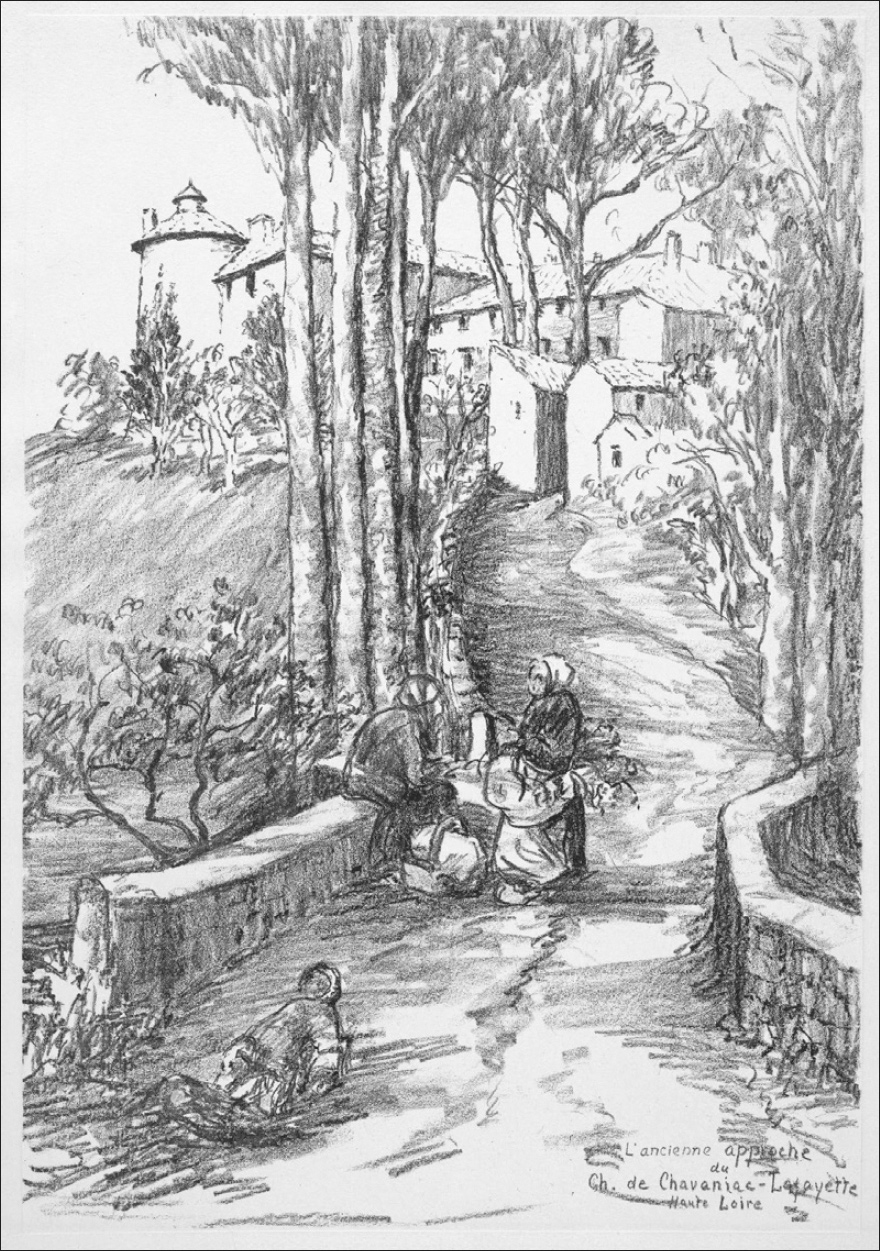
Lafayette’s birthplace. Château de Chavaniac in the Auvergne region of France, as depicted by Clara Greenleaf Perry, c. 1920. Lithograph. Collection of the Boston Athenaeum. (illustration credit 1.1)
Today, the Auvergne beckons travelers seeking unspoiled nature and hearty fare. Visitors lodge in centuries-old stone shelters, hike craggy terrain, and dine on pungent cheeses, rich sausages, and green lentils deemed among the best in the world. But in Lafayette’s time, few outsiders appreciated the region’s untamed charm. Passing through the area in 1789, the English agronomist Arthur Young (who found little to admire in France as a whole) reserved special disdain for the town of Clermont-Ferrand, the capital of the Auvergne. As Young described it,
Clermont … forms one of the worst built, dirtiest, and most stinking places I have met with. There are many streets that can, for blackness, dirt and ill scents, only be represented by narrow channels cut in a night dunghill. The contention of nauseous savours, with which the air is impregnated, when brisk mountain gales do not ventilate these excrementitious lanes, made me envy the nerves of the good people, who, for what I know, may be happy in them.
Dearly though Lafayette may have loved the Auvergne, it was not a fashionable place to call home.
By the standards of the high nobility, Lafayette’s ancestry was equally disserviceable. Although the senior branch of the family could trace its roots to the turn of the millennium and had produced dignitaries including Madame de La Fayette, the acclaimed author of the classic early novel La Princesse de Clèves (1678), Lafayette himself descended from the junior branch—a less distinguished lot. As Lafayette put it, his direct ancestors had “left the province only to make war and played no role at all at court.” Making matters worse, several generations of his forefathers had been on the losing end of primogeniture—the custom of passing all of a man’s resources to his eldest son. The capital that had trickled down through Lafayette’s father’s family was relatively slight, and a large portion of it had been amassed through a tradition of marrying well. Although Lafayette exaggerated his misfortune by writing in his memoirs that he had been “born poor,” he had certainly been born far less rich than he would eventually become. If not for a series of almost freakishly premature deaths, he might have inherited nothing at all.
Jacques-Roch du Motier—the older brother of Lafayette’s father, Roch-Gilbert—was the first of his generation to die, expiring at the age of eighteen in 1734 when he was shot in the back at close range by an Austrian prisoner in Italy during the War of the Polish Succession. Perhaps the nearly preternatural credulity that marked Lafayette’s character was a trait common to the family as a whole: Jacques-Roch had placed the Austrian behind him on a saddle without confiscating the captive’s pistol. Just a few years later, Jacques-Roch’s father, Édouard, met his end through hapless misadventure after a brief career at the Château de Versailles. According to the diaries of the Duc de Luynes, a consummate courtier and an invaluable recorder of palace life under King Louis XV, Édouard was a newly titled marquis working his way up the ranks in the King’s Bodyguard—and, evidently, making a poor impression; Luynes describes him as “a man of high birth, or so they say.” On October 8, 1736, Édouard was granted the honor of riding on horseback beside the monarch’s carriage during the return from the hunt, a ritualized ceremony that occurred several times a week and usually went off without a hitch. But after bagging their quarry at the hunting grounds of Les Alluets-le-Roi, some ten miles northwest of Versailles, the royal party was nearing the ironwork gate near the Trianon pavilion, on the edge of the palace gardens, when Édouard’s mount took a spill that brought down horse and rider. As Luynes put it, Édouard “broke his head” and was carried, unconscious, to the château, where, upon awakening, he lingered in agony to await the inevitable; about a year after the fall, Louis XV still felt obliged to ask a surgeon if the poor man’s suffering could be eased, but it was to no avail.
Édouard’s death, in 1740, left his infant son and two daughters in the hands of his wife, Marie-Catherine de Chavaniac-Lafayette, a formidable woman who, many years later, would be Lafayette’s grandmother, godmother, and primary caretaker. Abandoning her husband’s château at Vissac, the widowed Marquise de Lafayette moved the household some ten miles northeast to the newer and larger Château de Chavaniac, inherited through her father. There, as Lafayette remembered it, his grandmother grew into something of a local legend; she was held in such high regard that people took onerous journeys from the farthest reaches of the province to seek her advice.
Roch-Gilbert became the first of his line to marry into the prestigious nobility of the court—the men and women who lived in the circles of the royal family. Thanks to the intervention of Jean Bretagne Charles de La Trémoïlle, whose grandmother belonged to the influential senior branch of the Lafayette family, Roch-Gilbert wed Marie-Julie de La Rivière on May 22, 1754. Like the Motiers, the Rivières had been ennobled for centuries, but Julie’s family was more distinguished, better connected, and far wealthier than her husband’s. Julie’s paternal grandfather, the Comte de La Rivière, had performed brilliantly in his military career and in 1756 would be awarded the Grand Cross—the highest class of membership in the chivalric Order of Saint Louis— in recognition of his service. Julie’s mother, who died a year before the marriage, had served as a lady-in-waiting to Madame Adélaïde, the powerful maiden daughter of King Louis XV, while her father, the Marquis de La Rivière, devoted himself to his lucrative Breton estates and amassed a fortune in the process. Whenever they were in Paris, the Rivière men resided in grand apartments at the Luxembourg Palace granted by the king. At the time of the betrothal, Julie too was living in Paris, in the convent where she had been educated.
Despite her family’s wealth, Julie brought only modest resources to the union. She had an older brother whose interests took precedence over hers, and her father—renowned for his parsimonious habits—was willing to part with no more than a small dowry that would generate about 1,000 livres a year. It was not a lot by the standards of high society, but the Marquis de La Rivière was willing to send his daughter to live in the Auvergne, an idea to which Julie herself obligingly raised no objection. This was no small sacrifice. By permitting Julie to trade Paris for Chavaniac, the Rivières effectively abandoned hope that she might advance their dynastic ambition at court, and their benevolent attitude toward the newly married couple didn’t end there. Thanks to Rivière influence, Roch-Gilbert received a commission as colonel in the elite grenadiers. It was a higher rank than any Motier had previously attained but, alas, Roch-Gilbert did not enjoy it for long. On August 1, 1759, he was fighting in the conflict known today as the Seven Years’ War when he was killed by an English cannonball at Minden, in northern Germany. With that fatal injury, Roch-Gilbert’s two-year-old son—Gilbert, our Lafayette—became a full-fledged marquis.
For the second time in two decades, Lafayette’s grandmother found herself at the head of a household, responsible for the well-being of a boy who had lost his father. Concerned about her grandson’s precarious finances, she wrote to Louis XV in October, requesting a pension for the child. As she explained to the king, Roch-Gilbert’s four campaigns had drained the family resources. Most of the income from their estates and investments had gone to feeding, clothing, and arming the men under Roch-Gilbert’s command—obligations that traditionally fell to commanding officers. Making matters worse, Roch-Gilbert had failed to draft a will. As a result of this oversight, most of Julie’s dowry would revert to the Rivière family. Without the benefit of royal generosity, she suggested, no funds would be available to educate the young Marquis de Lafayette.
A modest pension was awarded, but Lafayette did not have to rely on such largesse for long: in 1761, the early death of Lafayette’s uncle—his mother’s brother—promised a lifetime of financial security as Lafayette, suddenly and unexpectedly, became the heir to the substantial Rivière fortune. At that point, it was his mother’s turn to act. The widowed Julie de La Rivière returned to Paris to live with her family, and on February 28, 1762, she was presented at court, where she began building a network of connections that would pave her son’s path to Versailles.
Over the next five years, Lafayette saw his mother for only a scant few months at a time, when she returned to the Auvergne for visits. To modern sensibilities, such separation might seem heart-wrenching, but members of the French nobility routinely handed infants over to wet nurses and placed older children under the control of governesses and tutors. Raised by a devoted grandmother, Lafayette was luckier than most. “Although my mother loved me a great deal,” he later wrote, “the thought of taking me away from my grandmother La Fayette never crossed her mind.” A honeyed sense of nostalgia infuses his descriptions of his childhood, which he spent in the close-knit company of his grandmother, her two grown daughters (one was widowed, the other never married), and a female cousin just a year older than he. His grandmother made considerable efforts to further his social and financial interests and did everything in her power to fill the boy with family pride. Lafayette remembered thrilling to tales of his father’s, grandfather’s, and uncles’ heroic battlefield exploits; if he ever learned that the stories were embellished for his benefit, he never let on.
These grand stories were, no doubt, in the back of his mind when, at the age of eight, Lafayette began to hope that he might attain glory for himself in the very near future. The fearsome and mysterious Beast of the Gévaudan was roaming the hills of south-central France, devouring livestock and murdering women and children in the vicinity of Lafayette’s home—or so people said. Between 1764 and 1767, scores of human deaths were attributed to this chimerical predator, whose rampages quickly became the stuff of tall tales and folklore. Living at the epicenter of the putative carnage, Lafayette might well have been frightened—he was still a child, after all—but instead he saw the creature as an opportunity for him to leave a mark on the world. Drafting his memoirs a dozen years later, he recalled that “my heart Beat” for the beast, “and the hope of Encountering it Enlivened my walks.”
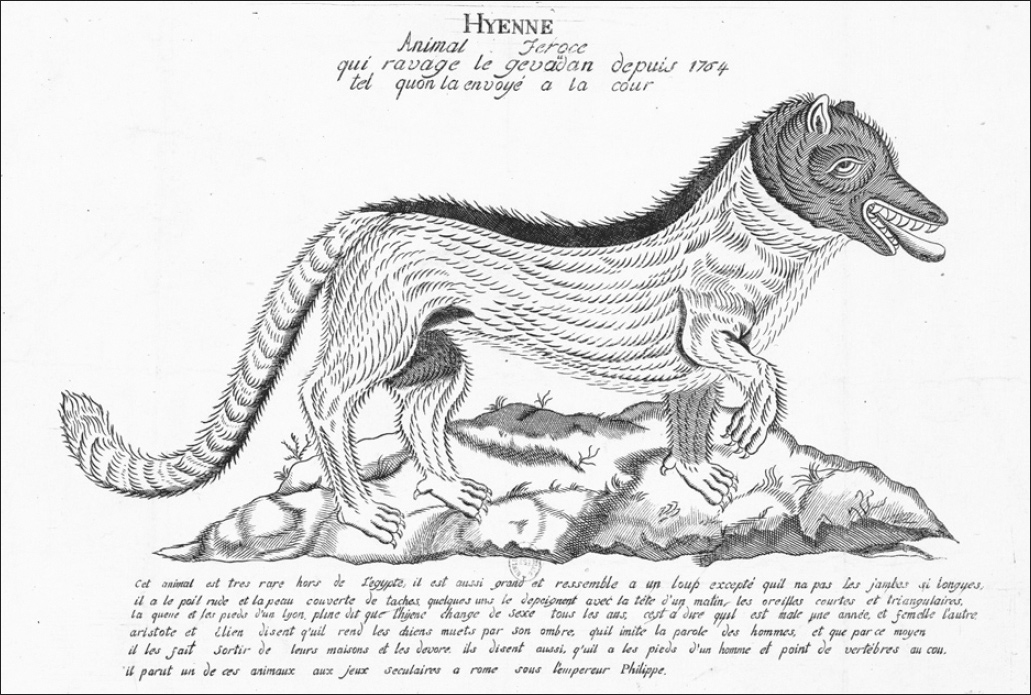
The Beast of the Gévaudan as pictured in a 1765 broadside. (illustration credit 1.2)
What, exactly, was this beast? Lafayette called it a hyena; others said it was a wolf; one particularly inventive account described a monstrous hybrid the size of a bull with talons “the length of a finger” and a mouth “measuring at least a foot” wide. Some insisted the creature had been sent by the devil. Though two centuries have passed, conflicting theories still abound. The “real” Beast of the Gévaudan has been variously described as an exceptionally large lynx, a cross between a wolf and a dog, or a villain of the human variety. Maybe its exploits were the inventions of a greedy landlord intent on extracting protection from his tenants. Or perhaps, as some have maliciously suggested, the fable was an ingenious cover story concocted by a bloodthirsty Protestant exacting a gruesome revenge for decades of Catholic oppression. In all likelihood, more than one creature was responsible for the carnage; an overabundant population of wolves seems a plausible culprit. Then again, the beast may have been nothing more than a figment of masshysteria. One thing, however, is clear: Lafayette never encountered the fabled creature.
Whatever else it may have been, the Beast of the Gévaudan was the talk of France. Chilling stories of its lethal exploits spread from the villages of the Massif Central to the salons of Paris and the court of Versailles. Government officials were implored to capture it, while earnest journalists, high-handed moralists, and hack writers alike exploited its potential to sell newspapers, pamphlets, and broadsides. No less a figure than King Louis XV took a keen interest in the uproar, sending hunters and bloodhounds to the countryside with instructions to capture and kill the beast. Members of the local nobility assembled their own hunting parties, and over the course of three years, several wolves and other creatures were slain, dissected, and documented, with their measurements widely reported and their images disseminated through engravings. The culprit may well have been slaughtered, or it may have died a natural death, although popular legends contend that the beast continues to wander the fields and mountains, possessed of a supernatural spirit.
When Lafayette first wrote down his recollections of the beast, during a hiatus from General Washington’s army, the tale was still a cause célèbre ripped from the headlines. So familiar was the terrifying creature that a reference needed no explanation. In his winningly self-deprecating manner, Lafayette played down the horror that had gripped the land, describing the beast as having “caused some damage, and even more commotion.” Only in later drafts of the much-revised memoirs did he go on to elaborate the crimes laid at the creature’s feet. But in 1780, the mere mention of his yearning for the beast stood as sufficient proof of Lafayette’s central claim: “I recall nothing in my life that preceded my enthusiasm for glorious tales or my plans to travel the world in search of renown.”
Although Lafayette dreamed of world travel, he was wary when the time came for him to accompany his mother on a two-week journey to Paris, in December 1767. The ten-year-old Lafayette had never imagined that his life might be different from that of his father or grandfather, and he “separated with the utmost chagrin from a grandmother, two aunts, and a cousin whom I adored.” Shortly after the carriage bearing mother and child started its northward journey, Lafayette sensed that everything was about to change. At home, local adults had treated him with the respect required by the rank of marquis, and village children had been too daunted by his station to approach him. On the road to Paris, he noticed something unusual: the men he passed did not tip their hats in deference to his position. For most of us, the process of growing up entails discovering the limits of our own, individual significance. But few people can pinpoint with precision the exact moment of that humbling realization. For Lafayette, it was seared into his memory.

Lafayette’s first home in Paris, the Luxembourg Palace. (illustration credit 1.3)
When Lafayette descended from the carriage in the courtyard of the Luxembourg Palace, in Paris, he stood before a building that had no equal in the Auvergne. One of the greatest architectural achievements of seventeenth-century France, the palace was located in the university quarter, on the Left Bank of the Seine. In a 1765 essay on Paris, Louis, Chevalier de Jaucourt ranked the Luxembourg on par with the Tuileries and the still-unfinished Louvre as one of the city’s “three superb palaces, distinguished above all the others.” Designed in 1615 for Marie de’ Medici, wife of King Henri IV, it had been loosely inspired by the Medicis’ Pitti Palace, in Florence; it catered to Marie’s Italianate taste and incorporated the classicizing tendencies of its primary architect, Salomon de Brosse. Extensive gardens added to the grandeur of the place, with a broad parterre branching into wide allées bordered with carefully trimmed rows of yew and boxwood. The garden’s intricate symmetries suggested the power of culture to bend nature to its will. Once Lafayette settled into the apartments where his grandfather and great-grandfather lived at the discretion of the king, he too would have to be shaped in conformity with the refined ways of the capital.
Paris in the mid-1700s was a thriving metropolis of 700,000 people and the second most populous city in Europe, surpassed only by London. Both capitals had seen their populations double since the first wave of mass urbanization began sweeping across the continent and the British Isles at the turn of the century. An incomparable center of cultural excellence, Paris boasted three theatrical companies, five public libraries, six Royal Academies, scores of churches, monasteries, and convents, and one world-renowned university, with thirty-six subordinate colleges. For the rich and well-connected, the city was an opulent playground where renowned artists, writers, and thinkers mingled with political leaders, ecclesiastical dignitaries, and financial titans in chic cafés and stylish salons. Shop windows displayed merchandise from the four corners of the globe, and luxury goods fabricated in the city—fashions, tapestries, mirrors, and more—were coveted throughout Europe and beyond. In short, the taste of the Western world was formed in Paris. For a provincial youth who had spent his first decade at the top of the only society he knew, this was a brave new world indeed.
The ways of Paris were equally foreign to the Abbé Fayon, Lafayette’s longtime tutor, who accompanied his young charge to Paris. In the Auvergne, Fayon had supplied Lafayette with an education entirely in keeping with tradition among the Nobility of the Sword—families like Lafayette’s whose inherited privileges derived from generations of military service. Boys of Lafayette’s station were schooled in the history of their lineages, and their intellects were stretched just enough to equip them with a smattering of Greek and Latin. Destined to become army officers and feudal landholders, noble boys from the provinces seldom needed much in the way of book learning. But Lafayette was no longer such a boy, and although Fayon remained in Lafayette’s employ for the rest of his life, the good abbé’s lessons were no longer sufficient.
In Paris, a new era was dawning in education and in most areas of life as rational principles of Enlightenment philosophy ushered in sweeping reassessments of society’s most fundamental assumptions and cherished institutions. By the time Lafayette began daydreaming about the Beast of the Gévaudan, seventeen volumes of the magisterial Encylopédie, edited by two of the era’s most influential philosophers—the author and art critic Denis Diderot and the mathematician and physicist Jean Le Rond d’Alembert—had already been published. This vast and formidable undertaking was intended to be nothing less than a compendium of all human knowledge. The Encyclopédie represented the pinnacle of Enlightenment-era erudition, offering lengthy entries on ideas and practices from reason and faith to wigmaking and apiculture.
When it came to education, the Encyclopédie authors and other reformist philosophers insisted that instilling virtue should be the primary goal of a noble’s course of study. As Charles Rollin, former rector of the University of Paris, put it in his influential Treatise on Education (1726), “virtue alone puts men in a position to fill public offices.… It is virtue that gives [a man] the taste for true and solid glory, which inspires in him love of the patrie and the desire to serve it well, which teaches him always to prefer the public good to private good.” For Rollin, such a solid moral footing could be attained only by studying the classics of Greek and Roman antiquity. Noble boys, he argued, should emulate the selfless actions of ancient heroes rather than fanciful tales passed down through family lore.
On a practical level, studying philosophy, rhetoric, and the other classical disciplines was becoming a necessity for scions of the sword nobility, who, for the first time in anyone’s memory, had to consider careers outside the army. France’s humiliation in the Seven Years’ War had generated loud calls for changes in the way the army selected and promoted its personnel. As critics pointed out, a sterling genealogy was no guarantee of strong leadership, yet lineage and wealth had been the only prerequisites for advancement to influential positions. Reformers insisted that merit alone should determine who rose through the ranks. As high posts gradually opened up to qualified commoners, young noblemen from military families could no longer count on living military lives.
All of this left Lafayette in a bind: when it came to seeking an occupation, his options were quite limited. Noblemen were prohibited by longstanding tradition from engaging in commercial professions; to become a tradesman or a financier would be to sufferdérogeance—the loss of the rights and privileges that accompanied noble status. Nor could Lafayette have entered the clergy. That he lacked any religious calling was not the problem. French ecclesiastical rosters were filled with second sons who, expecting no inheritance, were unable to marry, yet lived fully carnal lives despite their vows; faith and devotion were afterthoughts in such circumstances. But as his family’s sole heir, Lafayette had to marry, procreate, and continue the line. Of course, a provincial nobleman could always stay close to home and tend to his lands and dependencies, but to widen his family’s circle of influence Lafayette would need to find a place at court or in public service, perhaps undertaking a diplomatic career. Whatever route he followed, he would almost certainly require a more rigorous formal education than his father had received.
In 1768, Lafayette’s family enrolled him in the Collège du Plessis, one of the competitive secondary schools under the jurisdiction of the University of Paris. Located on the Rue Saint-Jacques, the Collège du Plessis was just a short walk away from the lodgings of Lafayette’s family. The school dated back to 1322, but its building was much newer, having been reconstructed in the seventeenth century, thanks to a bequest from Louis XIII’s powerful chief minister, Armand Jean du Plessis—the famed Cardinal Richelieu—a descendant of the founder.
As a member of the sword nobility, Lafayette was unusual among the school’s student body. Most of his classmates hailed from the less prestigious Nobility of the Robe, whose families owed their rank to judicial or governmental service. There were even a handful of outstanding scholarship students from bourgeois backgrounds, like Antoine-Joseph Gorsas, the son of a shoemaker from Limoges. Having lived in near isolation until now, Lafayette discovered that he enjoyed the camaraderie and respect he found among his fellow students. They liked him, and Lafayette felt like a rising star among devoted friends who gave him his first taste of leadership. Although he traveled in a circle of older boys, he recalled that the other students acted like “disciples” who “would have defended me fiercely if there was ever a need.” The boys’ dedication did not, however, necessarily extend to the causes Lafayette championed, as he learned on the day he “wanted to mount a revolt to prevent the unjust punishment of one of my comrades.” To Lafayette’s surprise, he found that “I was not as well-supported as I might have hoped.” This was to become a lifelong theme, as Lafayette’s unbounded zeal frequently generated both admiration and bewilderment.
Lafayette later recalled in his memoirs that he learned to enjoy the playful pomp that his newfound wealth allowed. His boys’ nights out must have been a sight to behold. It was his habit to dine in the city with classmates, whom he described as “children sporting épées … which went quite well with their embroidered suits, their bourses [taffeta sacs that collected long hair at the back of the neck], and their curls garnished with powder and pomade.”
This is not to say that Lafayette gave up his dreams of military distinction. He remembered “burning with the desire to have a uniform,” and when he was thirteen years old, he finally received one, thanks to his great-grandfather the Comte de La Rivière, who secured him a place in a unit that had welcomed many earlier members of the family: the Black Musketeers, soldiers of the king’s guard. Lafayette was delighted with this turn of events at the time, but in retrospect he recognized that the appointment was ceremonial. The troops of the Maison du Roi had disgraced themselves in the War of Austrian Succession, during the 1740s, when they’d bolted from combat, and thereafter they were relied upon to be little more than mannequins in smart uniforms. Still, Lafayette took an adolescent pride in his membership and was pleased to discover that participating in a picturesque review before the king counted as an excused absence from class—a bonus that any schoolboy would have appreciated. Writing about this in his memoirs, he adopted the self-deprecating tone that so endeared him to the American public, noting that he had been thrilled “to ride to Versailles in full uniform to hear the king tell me … that he had nothing to order, and to report back to the commander of the musketeers the same news that was repeated to him three hundred and sixty-five days a year.”
Nonetheless, four years at the Collège du Plessis helped Lafayette grow into the serious man who would leave his mark on history. The yearning for achievement that had inspired him to pursue the Beast of the Gévaudan motivated him to prove his mettle in the academic arena, and he succeeded admirably—albeit not admirably enough to satisfy his desires. Lafayette recalled with pride that he won the prize for Latin rhetoric given out by his collège, but he remained disappointed that he had not triumphed in the university-wide stage of competition. Implying a miscarriage of justice, his memoirs lament that boys who had taken the same Latin class several times over were permitted to compete in the contest, while he had completed the course only once. Lafayette believed that he would have carried the day despite the handicap if only he had been a better copyist, as his paper had been graded harshly by a judge who took off one point for each missing word of an inadvertently omitted sentence.
Although the study of Latin did not immediately yield the laurels that Lafayette craved, it may well have been the single most important undertaking of his young life. Latin gave the excitable lad a potent means of focusing his youthful enthusiasms—through the language, history, and philosophy of the ancient Roman republic and the classical world. Through his coursework, he imbibed the moral and ethical principles put forth in such texts as Cicero’s “On Moral Duties,” Virgil’s pastorals and Georgics, and the odes and satires of Horace—all standard reading in the colleges of Paris. History, represented in the curriculum by the Grecian progenitor of the discipline, Herodotus, and biography, where Plutarch loomed large, both became lifelong passions. Books by these authors, their contemporaries, and their followers lined the shelves of his libraries, and the lessons they taught shaped the outlines of his life.
Lafayette was hardly alone in his fascination with republican Rome, whose citizens shunned despotism to govern themselves according to principles of virtue and honor. Louis-Sébastien Mercier, an incisive chronicler of eighteenth-century Paris, wrote in 1781 that “Rome was the first name that reached my ears … the names of Brutus, of Cato and Scipio followed me in my sleep.” So fully did the Decades of the Roman historian Livy fill his mind that Mercier reported it took him “a good deal of time to return to being a citizen of my own country” after he put down his schoolbooks. Mercier did not miss the irony that France’s absolute monarchy employed teachers to “explain solemnly all the eloquent declarations advanced against the power of kings” by the ancient Romans. “One comes away from the study of the Latin language with a taste for republics,” he observed. But he warned that young men emerging from the collèges “must lose and forget” such political lessons quickly “for their safety, for their advancement and for their happiness.” As Mercier suggested, any student who found “himself at Versailles” dreaming, “despite himself, of Tarquin, of Brutus, of all the proud enemies of royalty” was in a highly awkward situation.
On April 3, 1770, Lafayette was still immersed in tales of Roman virtue when his mother died in the family’s rooms at the Luxembourg Palace. A few weeks later his grandfather, too, was lost—perhaps, as Lafayette wrote, due to grief. At twelve years old, Lafayette was an orphan—an extraordinarily wealthy orphan. Lafayette’s inheritance from his grandfather dwarfed the income from the lands in the Auvergne. From those southern properties, Lafayette received approximately 18,000 livres annually, while his grandfather’s estates in Brittany and Touraine yielded more than 60,000 livres per year. And upon the death of his great-grandfather in 1781, another 17,000 livres would be expected every twelve months. Altogether, with investments in the East India Company and rent from properties in Paris, Lafayette’s annual revenues routinely topped 100,000 livres. In some years, he brought in nearly 130,000 livres—all of it returns on investments. By way of comparison, a skilled laborer with steady employment seldom earned more than 1,000 livres per year at this time. Incomes as large as Lafayette’s were rarely found outside of the highest levels of nobility, and they were almost never seen in the hands of a young boy from the provinces.
Lafayette was too young, too naïve, and too lost in mourning to manage such sums. Even in the best of times, money interested him very little; for much of his life he relied on friends, family members, and advisers to help him watch over his wealth. In the early years, relatives in Paris managed Lafayette’s day-to-day finances while his grandmother kept tabs on developments from Chavaniac, and the entire clan began to look for a suitable bride to marry the suddenly rich young heir. Arranging a marriage among noble families naturally involved an intricate social and financial calculus. That the bride and groom might be personally compatible was always to be desired, but the preferences of two individuals carried less weight than the benefits a proposed alliance might bring the families. Given Lafayette’s stunning fortune, his guardians were not obliged to find a bride who would bring a large dowry, but they were eager to find a match that would give the young man a ready-made network of influence. To avoid a lifetime of obscurity at Chavaniac, Lafayette needed an advantageous marriage that would provide entrée to court.
Lafayette could not have hoped for a wife better suited to this purpose than the young woman selected for him, Adrienne de Noailles, who was descended from one of France’s most distinguished and influential families. Her father, the Duc d’Ayen, was renowned as both a chemist and a courtier; other close kin ranked among Louis XV’s most trusted advisers. Adrienne’s great-uncle the Duc de Mouchy had been inducted into several prestigious chivalric orders—the Order of the Golden Fleece, the Order of the Holy Spirit, the Order of Saint Louis—and in 1775 he would be named maréchal de France, the nation’s highest military honor. Élisabeth Vigée-LeBrun, the most sought-after portraitist in Paris and a favorite of Marie Antoinette’s, dined frequently at the home of the maréchal, where she shared the table with a select roster of guests who, she wrote in her Souvenirs, were chosen from among “the literary celebrities and the most distinguished figures of the city and the court.” The maréchal’s wife, the Comtesse de Noailles, had been appointed dame d’honneur to Marie Antoinette upon the dauphine’s arrival in France and charged with the daunting task of introducing the notoriously informal Austrian princess to the intricate social protocol required of the wife of the French heir apparent. So renowned was the comtesse for her stern demeanor and unyielding insistence on propriety that Marie Antoinette bestowed upon her the affectionately mocking nickname “Madame l’Étiquette.” Aside from princes and princesses of royal blood, few families wielded as much power as the Noailleses.
Why would such a family marry their daughter to an unknown youth from a distant outpost? The Duc d’Ayen had his reasons. As the father of five girls, d’Ayen faced the unenviable task of assembling five dowries hefty enough for five sons-in-law to accept. Lafayette, with his solid finances but comparatively undistinguished social status, was the rare marital prospect who would care little about Adrienne’s fortune.
Adrienne’s mother, Henriette Anne Louise d’Aguesseau, the Du- chesse d’Ayen, was less sanguine. She had just arranged an ideal union for her eldest daughter, who was set to marry the well-bred Vicomte de Noailles, a cousin of the Duc d’Ayen’s. Perhaps she shared the prejudice articulated by the Comte de Ségur, a friend of Lafayette’s, who nonetheless thought ill of noblemen from the provinces in general. In his memoirs, Ségur blithely pronounced that “one almost always recognized a man of the court by his politeness, and it was among the young country gentlemen that one most frequently encountered arrogance and a tendency to be easily offended.” In the duchesse’s view, Adrienne, who was just twelve years old, still had plenty of time. Lafayette’s would surely not be the last offer, and the duchesse sincerely hoped that it would not be the best. So vehemently did duc and duchesse disagree that they could not bear to live under the same roof for several months. He stayed at the family home in Versailles while she remained in Paris until a compromise was struck: the marriage contract would be signed but kept secret—above all, from Adrienne—and the wedding would be put off for two years. If Lafayette were to embarrass himself in the interval, his prospective in-laws could break off the engagement and be spared the taint. Long before news of the planned union became public, the young man moved into a wing of the Noailles town house in Versailles in the capacity of a privileged lodger. He paid a rent of 8,000 livres a year, supplied his ownservants, paid for his own food and fuel, and—most important from the perspective of the duchesse—remained under the constant surveillance of his future in-laws. Transforming the provincial marquis into a suitable husband was not a matter to be taken lightly.
Lafayette was therefore uprooted once more and would have to adjust to a new home, a new family, and a new school, not to mention a new set of expectations from his prospective in-laws. The transition was rocky. He abandoned the Collège du Plessis and its classical curriculum for the Académie de Versailles, which offered instruction in the finer points of comportment to children of the court nobility. There, Lafayette was expected to learn to ride like a gentleman officer, to dance with grace, and to wield an épée with aplomb. These skills could make or break a man at court, where impeccable manners were demanded at all times and a single miscue could mark a man for life. As the historian David A. Bell points out, a courtier’s emphasis on bodily performances was not purely arbitrary, since “the same qualities that made him a graceful and well-mannered noble … would also, he believed, make him an able warrior.” As a result, esoteric rules of behavior governed every moment at Versailles, and most of Lafayette’s new classmates had already absorbed this unwritten code of conduct as if by osmosis. Since early childhood, they had watched their elders perform rarefied rituals. By the time these boys reached adolescence, even outlandishly contrived postures and poses seemed like the most natural movements on earth. But all of this was foreign to Lafayette, who in truth was never able to master the finer points of a courtly existence.
The Académie also taught Lafayette harsh new lessons in social rank. For the first time in his life, he was immersed in a society of young men whose lineages surpassed his own in every respect. Their families were more ancient, better educated, and more successful in every way than any Lafayette had ever known. They wielded enormous power, enjoyed unchallenged esteem, and possessed truly breathtaking wealth. His most notable classmate was the Comte d’Artois, a brother of the future King Louis XVI. Lafayette had been transported into the most elevated of all possible realms, one where the battlefield deaths of his progenitors, the provincial fame of his grandmother, and his appointment to the Black Musketeers counted for much less than the dreamy boy from the Auvergne had once believed.