

Emma Goldman, an eighteen-year-old Russian Jew living in Rochester, New York, had followed the Haymarket trial of 1886 with fascination. A comely teenager with blue eyes, fine blond hair, full lips, and what one referred to as a “saucy” upturned nose, she formed a sympathetic bond with the eight defendants, later writing of “their heroic stand while on trial and their marvelous defense.” In this she might have been no different from the legions of impressionable young girls smitten with the rebels of Chicago. But hers was more than simple infatuation. She saw, she later wrote, “a new world opening” before her as she learned more of the defendants’ exploits.1
Execution day—November 11, 1887—left Goldman on edge as she tried to pass time in her father’s house. Goldman found herself in a “stupor” and feeling numb. It was “something too horrible even for tears.” When the topic of the executions inevitably came up that evening—the whole country was talking about it—Goldman could not believe her ears when one shrilled-voiced woman visiting the house expressed approval of the punishment. With a sudden leap, Goldman lunged at the women’s throat. “The child has gone crazy,” someone shrieked in the background. Family members quickly succeeded in separating the two, but unable to control her rage, Goldman grabbed a pitcher of water from a table and heaved it with all her might at the woman’s face. “Out, out!” she cried. “Or I will kill you.”
The next morning the fiery young woman awoke feeling that “something new and wonderful had been born in my soul. A great ideal, a burning faith, a determination to dedicate myself to the memory of my martyred comrades, to make their cause my own, to make known to the world their beautiful lives and heroic deaths.”2
Goldman was born on June 27, 1869, in the Russian province of Kovno, in what is today Lithuania, to “a petit bourgeois Orthodox Jewish family of declining fortunes.”3 Hers was an unhappy childhood full of complex issues. Her father’s failed professional dreams, due in Goldman’s mind to anti-Semitism, had turned him into a gloomy, hotheaded, abusive tyrant. Her mother, the widow of a physician with two daughters from her first marriage, was a powerful woman. Goldman would say that “no statesman or diplomat excelled her in wit, shrewdness or force of character.”4 Yet prone to imperiousness (she was nicknamed “the duchess”), the woman played the role of mother badly and left Goldman feeling uncared for.
As Goldman grew, she and her father, Abraham, fell into a bitter cycle of disobedience and punishment. According to her memoirs, Abraham once hit her for so long and so hard that he grew dizzy and passed out. On other occasions, she was forced to stand in the corner for hours or to pace back and forth with a glass of water in her hands, threatened with a beating if she spilled.5 She wrote of her father, “I loved him even while I was afraid of him. I wanted him to love me, but I never knew how to reach his heart. His hardness served only to make me more contrary.”6
By the time she was a teenager, Goldman seemed destined to spend her life in the menial pursuits that women of her age and means performed to get by. Moving to St. Petersburg, where her father was unsuccessfully attempting to manage a dry-goods shop, she stayed at home knitting shawls, a job she detested. She later worked in a glove factory and a corset shop in the Hermitage Arcade. All the while she wanted “to study, to know life, to travel.” They were ambitions that only heightened tensions with her father, who saw no reason for Goldman to learn anything more than basic household duties. “All a Jewish daughter needs to know is how to prepare gefüllte fish, cut noodles fine, and give the man plenty of children,” he said.7
When her sister Helene, twenty-five, decided to join another sister, Lena, in Rochester, New York, Goldman leaped at the chance to restart a life in the New World. With customary drama she secured her father’s grudging permission by threatening to throw herself in the Neva River if forced to stay. In December 1885, she set off.
Goldman was quickly disabused of any romantic dreams about life in the United States. Rochester had been a popular destination for German Jews in the 1870s but now offered a cool reception to fresh immigrants. Working hours were long, the pay was minuscule, and opportunities for advancement were even smaller. Goldman’s first job, sewing overcoats, kept her at work for ten and a half hours a day.
Lacking any other form of excitement and probably hoping to be rescued from her miserable state, Goldman married one of the first men she met, a fellow immigrant named Jacob Kershner, a young man from an aristocratic Russian Jewish family. The union, however, was doomed from the start. Goldman quickly discovered that neither his intellect, nor his abilities in the bedroom, measured up to her expectations. The marriage quickly ended in divorce. Compounding her error, she remarried him, only to sue for a second divorce. Bored, rebellious, and resentful of the society of her adopted home, Goldman searched for an emotional and intellectual outlet for her pent-up feelings. She found it in radical political theory. Like the experience of many of her generation, it was not a fascination born of the great thinkers such as Godwin, but something she simply felt in her gut. “Just mere theories do not move me,” she would say. “It is not enough to grasp our ideas. It is necessary to feel them in every fiber like a flame, a consuming fever, an elemental passion.”8

Like so many before her and so many since, Goldman sought a new life in the big city. In August 1889, she packed up her sewing machine, five dollars, a few belongings, and a couple of addresses—including that of Johann Most—and caught the train for New York. There, she said, she would “do what I like, live as I like, without asking anyone’s advice, without feeling the need of it.”9
Finding the company of those who shared her radical political views became her major mission in New York. That very night, she headed directly for one of Most’s favorite haunts, Sachs café on Suffolk Street on the Lower East Side. Suffering under the humidity of a New York evening, she sat at her table and listened to the animated conversations of those around her. One, more than the others, caught her attention. Above the chatter of the dining room, she heard a voice call out “Extra-large steak! Extra cup of coffee.” Wondering, she later confessed, who the glutton was, she turned to confront Alexander Berkman, the man who would change the direction of her life.10
A pleasant-looking young man with a strong jaw, high forehead, thick lips, and eyes that looked intelligent behind steel-rim glasses, Berkman had arrived in the United States from Russia in 1888 and immediately threw himself into New York’s tightly knit anarchist community. Like Goldman, Berkman seemed to have been born to the role. As a boy he had shocked his teachers when he announced to his class “There is no God,” a transgression for which he was punished by being demoted one grade. Orphaned at age eighteen, Berkman eventually made his way to New York, where he found various jobs including working as a cigar maker, a cloak maker, and a printer.
When he had time, Berkman also helped out at the Freiheit’s offices on William Street, and it was here that he once took Goldman, climbing “two dark and creaking flights” to introduce her to Most. Struck by a fawning young woman with a nice figure, Most immediately agreed to a second meeting to discuss anarchism and, no doubt, whatever else she wished. Goldman, displaying an incredible amount of naïveté or self-deception, could not understand his interest. She asked herself: “What could I give this man—I, a factory girl, uneducated, and he, the famous Johann Most, the leader of the masses, the man of the magic tongue and powerful pen?” One can only imagine the blood rising in Berkman’s face as he realized the folly of his plan to introduce the two. In so doing, he had presented Goldman to a promising rival and thrust himself into a fiery love triangle in which he seemed to hold the weakest hand. Goldman would soon write, “Most became my idol. I worshiped him.”
Predictably, Berkman and Most soon grew to detest each other. The German, Berkman felt, put his own ambitions above the cause of anarchy, spending money on himself that could have been put to better use promoting his political views. That Most was generous in pursuit of Goldman surely did not help. Once, seeing flowers that Most had given Goldman, Berkman roared, “Violets at the height of winter, with thousands out of work and hungry!” Most, for his part, held little sympathy for Berkman and no doubt enjoyed using his position to provide the young Goldman with opportunities that Berkman could not, such as organizing a speaking tour for her.
Still, Most found the competition daunting. For all his eloquence in front of enthusiastic crowds, he displayed a real talent for placing his foot squarely in his mouth. During one argument with Goldman, Most called love nothing more than “sentimental nonsense,” arguing “There is only sex!”—an ill-advised way to impress any woman. On another occasion, when Goldman rebuffed his amorous advances, he launched into a tirade against Berkman, calling him “that Russian Jew.” Goldman recoiled bitterly, reminding Most that she, too, was a Russian Jew. Cursing his ineptitude, Most fell to the ground, clenching his fists and “lay like a child before me, crying,” Goldman wrote in her memoirs. “Was he, Most, the anarchist, an anti-Semite? And how dare he say that he wanted me all to himself? Was I an object, to be taken and owned?”11
Despite the distractions and dramas of her love life, Goldman found time to develop her own interpretation of anarchy. She read widely and quickly displayed a fine intellect, despite her limited education. The pursuit of personal liberty, in all its forms, would become a passion and govern everything about her vision of anarchism. Rebellion became a favored theme as she avidly studied Max Stirner’s The Ego and His Own, which attacked every form of social convention, including religion and obedience to family and state. She dallied with the labor movement, helping to organize a strike as early as 1890, but ultimately found such work to be an unwelcome infringement upon her pursuit of individual freedom because of the need to make deals and compromises. “I bow to nothing except my idea of right,” she once said.
Goldman’s vision of anarchy and personal liberty inevitably led her to espouse greater women’s rights, though she recoiled at being labeled a feminist. Women, Goldman argued, had been enslaved by the institution of marriage. “The woman, instead of being the household queen, told about in storybooks, is the servant, the mistress and the slave of both husband and children. She loses her own individuality entirely, even her name she is not allowed to keep.” Anarchism, which included principles such as free love—or the right of two people who loved each other to remain partners only as long as they wanted or to have multiple lovers—promised to liberate women from the chains of the family. Anarchism “holds everything for women—freedom, equality—everything that woman has not now,” she told one journalist.12
She found the life of a professional agitator—in which she would be free to say what she wanted no matter the consequences—most appealing.13 All she needed was a public identity that would convince people to pay attention.
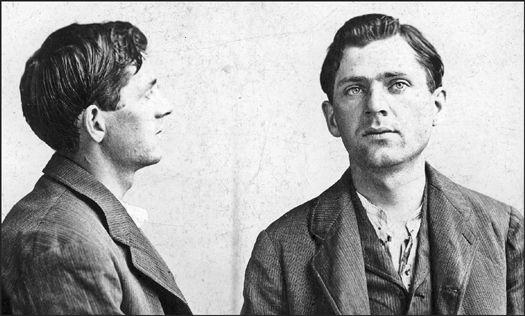
Leon Czolgosz
Buffalo and Erie County Historical Society, used by permission
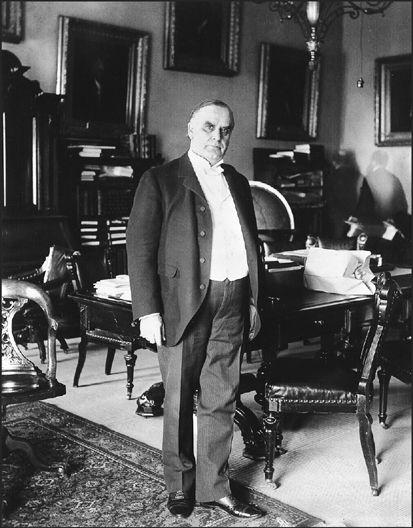
President McKinley standing at the cabinet table
Library of Congress
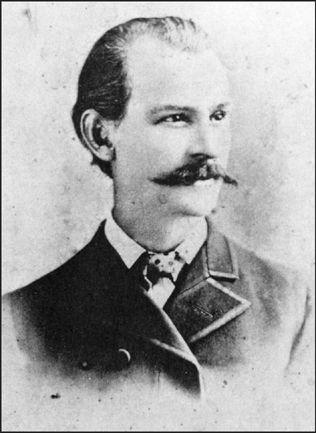
Albert Parsons
Chicago History Museum
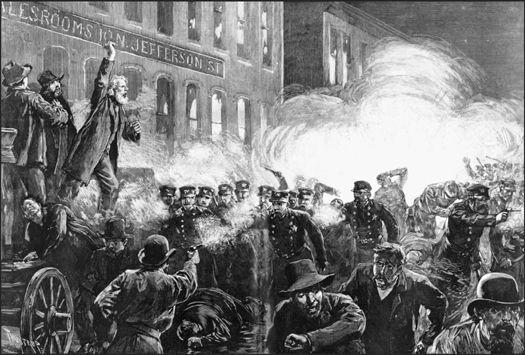
The Haymarket bombing
Library of Congress
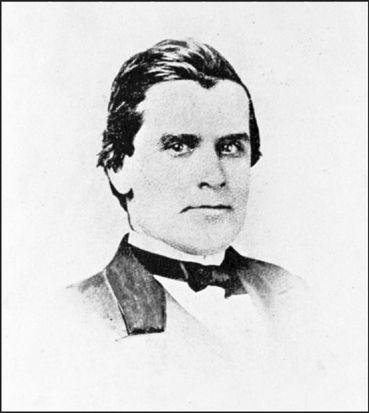
McKinley at age nineteen
Library of Congress
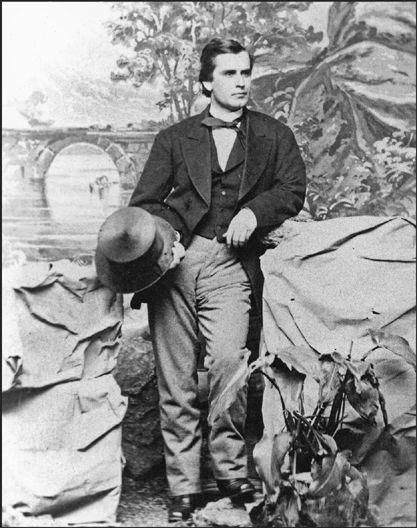
McKinley home from the Civil War
Used by permission from the McKinley Presidential Library and Museum, Canton, Ohio
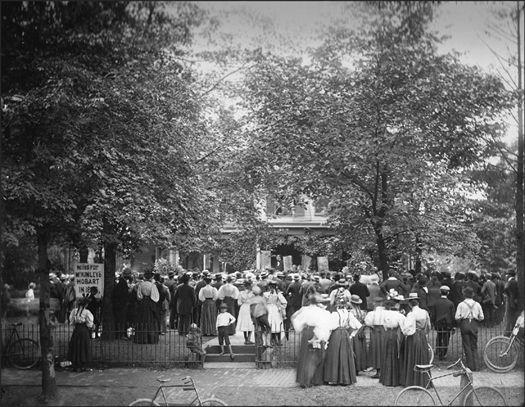
The “Front Porch Campaign” at the McKinley home, 1896
Used by permission from the McKinley Presidential Library and Museum, Canton, Ohio

A sickly but still youthful-looking First Lady
Used by permission from the McKinley Presidential Library and Museum, Canton, Ohio
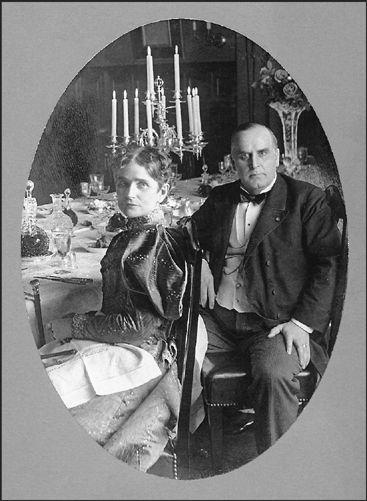
The McKinleys pose at a dinner party.
Used by permission from the McKinley Presidential Library and Museum, Canton, Ohio
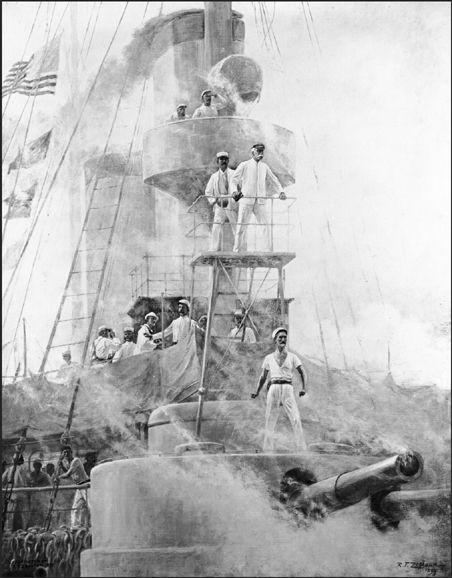
Dewey aboard the Olympia in Manila Bay
Library of Congress
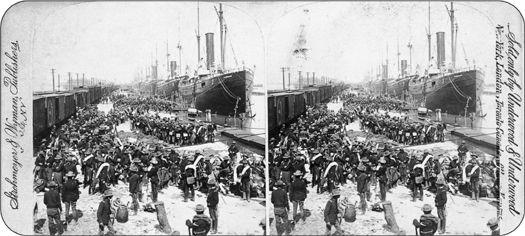
Troops departing for Cuba from Tampa
Library of Congress
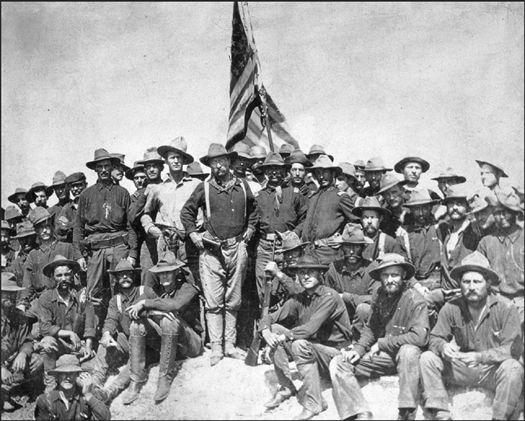
Roosevelt and Rough Riders on the San Juan Heights
Library of Congress
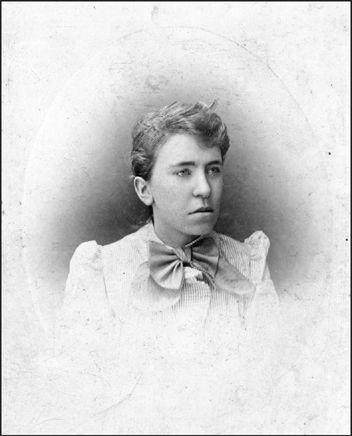
A young Emma Goldman
Collection International Institute of Social History, Amsterdam
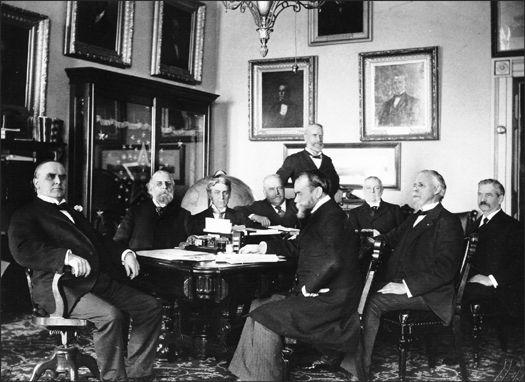
McKinley and cabinet, with Hay opposite McKinley
Library of Congress
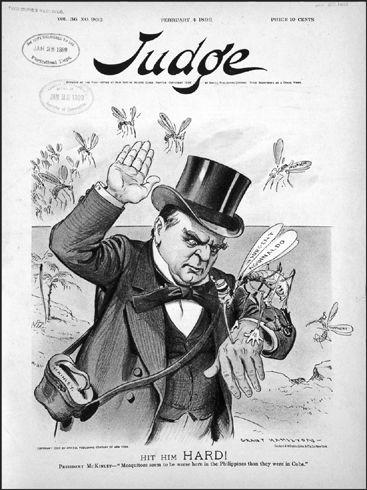
“Mosquitoes seem to be worse here in the Philippines than they were in Cuba.”
Library of Congress
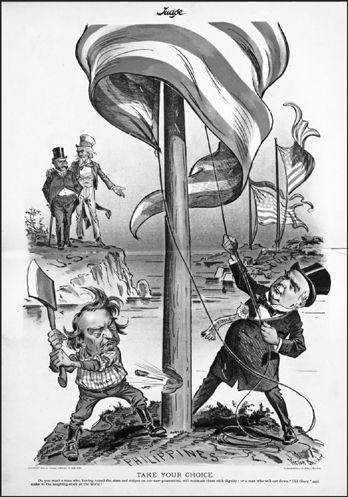
The 1900 McKinley campaign asks if voters want a man who will “cut down Old Glory.”
Library of Congress
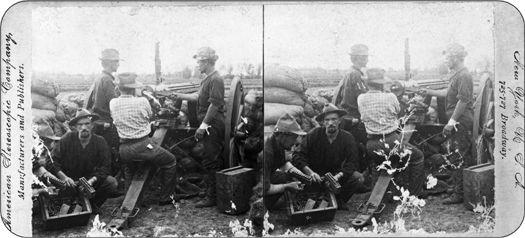
A Gatling gun crew sights Filipino positions near Manila.
Library of Congress

American troops head to Peking.
Library of Congress
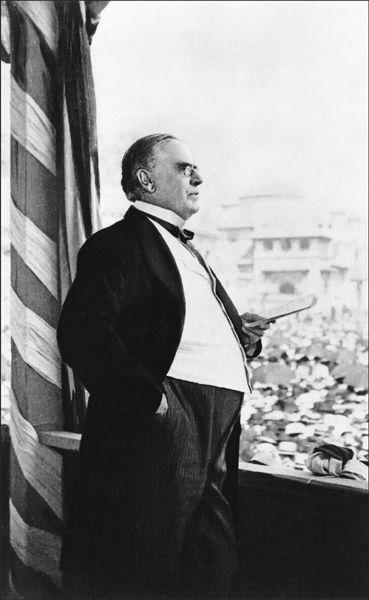
McKinley’s last speech, September 5, 1901
Library of Congress
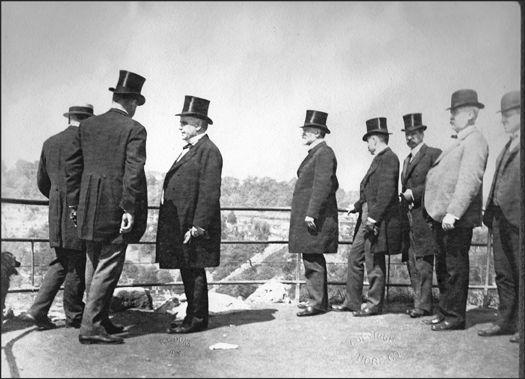
McKinley at Niagara Falls hours before the shooting
Used by permission from the McKinley Presidential Library and Museum, Canton, Ohio
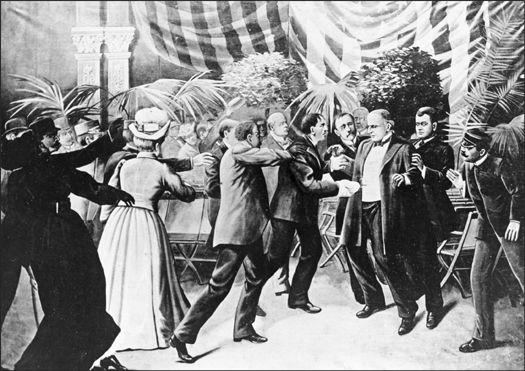
The shooting
Library of Congress
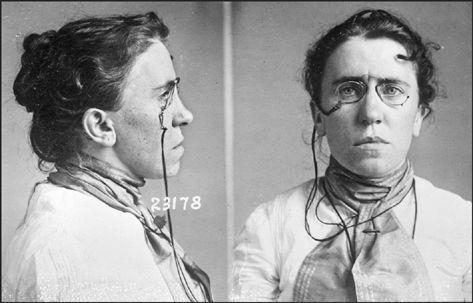
Emma Goldman, 1901
Library of Congress
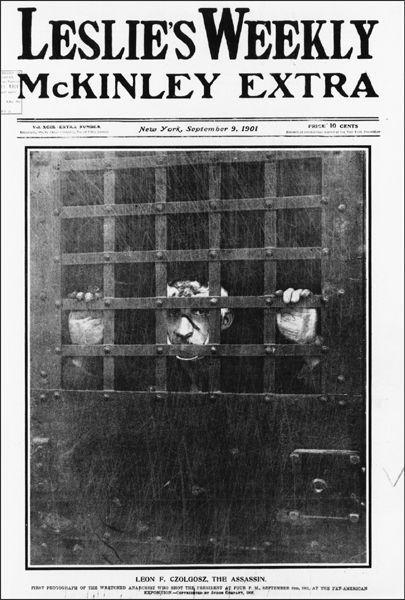
A photo purported to be of Czolgosz behind bars
Library of Congress
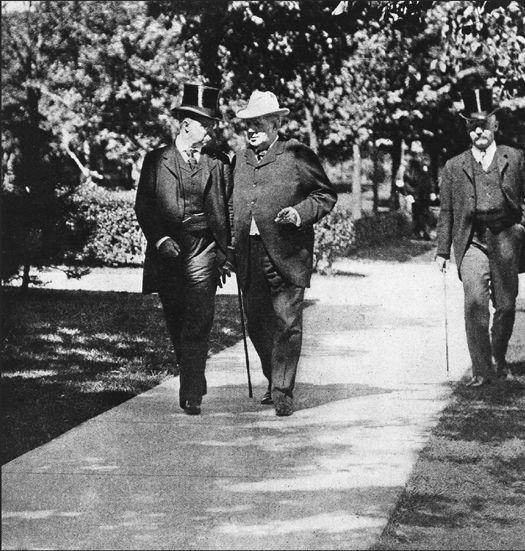
Hanna and Roosevelt near the Milburn House, September 1901
Library of Congress