
The last ten days of rehearsals in Los Angeles had been shifted to the Staples Center because even the Forum didn’t have enough ceiling height to accommodate the production’s gargantuan scale. According to Kenny Ortega, Michael Jackson responded to the move with a determined effort to demonstrate that he could still, as the show director had put it, “rise to the occasion.”
Just three nights after an exasperated Ortega had sent him home, Michael arrived at the Staples Center for the first full dress rehearsal of the O2 show, on the evening of June 22, “in this new kind of place,” the director recalled, and his enthusiasm was infectious. Suddenly “everyone was just kind of believing,” Ortega said. “I think there was this feeling in the room, in the air, we all could feel it, like we were on a plane. ‘We’re packed, we’re going.’ You could see London, we could smell it, we were ready.”
They had all seen the mercury in Michael’s personality during the past few weeks, moments when he was illuminated by a flash of insight and expected that his dancers and musicians get it without a great deal of explanation. He might coax them at first, but turned insistent within moments, flashing his temper when one of the performers frustrated his demand for an adjustment in tempo, or pouting and stalking off when another answered his instructions with a look of incomprehension. But now, a little more than a week before they were scheduled to leave for London, Michael seemed suddenly to love everything he saw and heard. “Beautiful, beautiful,” he kept telling people.
Watching it all through the lens of her camera, Sandrine Orabona was entranced by the sense of communion that enveloped Michael, his musicians, and the dancers as they worked out their performance of “Human Nature.” A strange but beautiful intimacy appeared to have developed among all the performers, the videographer remembered. Everything onstage started moving at lightning speed and people began to speak in what Orabona described as “creative shorthand,” so focused that they could understand each other completely with only a couple of words and a gesture. When Michael told the musicians, “Make it sound like you’re dragging yourself out of bed,” they all seemed to know exactly what he meant and “were spot on,” the videographer recalled. The atmosphere on the stage that evening, Kenny Ortega would say later, became a kind of shared breath in which the entire production team understood exactly what would be possible when they took the stage in London. “Everyone in a Michael Jackson show is an extension of Michael Jackson,” Ortega had shouted at the dancers any number of times during rehearsals, and now it was as if they had known all along precisely what he meant.
On the following evening, June 23, Tohme Tohme showed up at the Staples Center to make his first-ever visit to rehearsals for the London shows. Ten days earlier, Tohme and Katherine Jackson had met at the Coffee Bean on San Vicente Boulevard in Brentwood. Tohme’s claim was that Mrs. Jackson wanted the meeting to tell him that Michael was deteriorating physically and to beg him to intervene. Mrs. Jackson’s story was that Tohme was asking her to help him get his job back. She had never liked the man, Michael’s mother said, ever since he had insisted that her grandchildren who were living in the Lindley Avenue condo should pay rent on the place. Whoever was telling the truth about the Coffee Bean meeting, what was certain was that Tohme hadn’t seen his erstwhile client face-to-face in five weeks. And was horrified, Tohme said, when Michael ran forward to wrap him in an embrace: “I felt his bones. I was shocked to see the weight he had lost. I asked him, ‘Michael, what’s happening with you?’” Michael just laughed off the question about his weight, and went back to rehearsals. Only minutes later, though, he pulled Tohme aside to complain tearfully that, “They’re torturing me.” He asked what was wrong, Tohme recalled, “and all Michael told me is that they’re asking him to put things in his ears. He hates things in his ears—the microphone, you know, he doesn’t like that.” It felt like someone sticking a fist in his ear, Michael said, but they wouldn’t let him take it out. “I said, ‘Michael, just don’t wear it if you don’t want to. You are the star.’ But he said, ‘They’re making me.’” Within moments, though, Michael was back onstage performing, and looked as if there was nothing at all bothering him. “It was confusing,” Tohme recalled.
Tohme would say later that whatever doubts he harbored about his own status were soothed by that visit to the Staples Center. Randy Phillips introduced him to everyone as “Dr. Tohme, Michael’s manager,” and placed a bracelet around his wrist that would allow Tohme access to the Staples Center rehearsals any time he wanted to show up. At one point, Michael waved to Frank Dileo and said, “Come here and give your boss a hug.” Dileo responded by walking away, and Tohme asked Randy Phillips, “What’s that guy doing here?” They kept Dileo around, Phillips answered, according to Tohme, “because he makes Michael laugh.”
When Michael returned to the Carolwood chateau that evening, there was already an IV drip set up in his bedroom. Dr. Conrad Murray would claim later that he had grown concerned about fostering a propofol addiction in Jackson, and was especially bothered by hearing Michael refer to the white liquid Diprivan solution as “my milk.” He had decided that Jackson should be “weaned” from his reliance on propofol, Murray said, and sometime after midnight, gave Jackson a Diprivan dosage of 25 milligrams—just half of what Michael had been taking—then supplemented it with two of the prescription sedatives that had come in a package delivered from Las Vegas. It was enough, Murray claimed, to let the performer sleep until after the sun rose the next morning.
On June 24, 2009, Michael arrived at the Staples Center at about 6:30 p.m. for a meeting with Randy Phillips, Tim Leiweke, and Grammy Awards show producer Ken Ehrlich. Frank Dileo sat in, listening with Phillips and Leiweke as Jackson and Ehrlich discussed their ideas for a Halloween television special that would incorporate clips from Michael’s live performance of “Thriller” at the O2 Arena into the network premiere of his film Ghosts. Phillips’s promise of support for Michael’s attempt to create a career in movies, the AEG executives knew, had been a major motivator in winning his agreement to the O2 concerts; the airing of Ghosts would satisfy that promise in a big way.
The understanding that a success in London was going to reinvigorate Michael Jackson’s career across the board—as a live performer, as a recording artist, as a filmmaker, and as a cultural phenomenon—seemed at last to be sinking in, Phillips thought. Michael was humming with excitement as he left his meeting with Ehrlich to spend the next hour reviewing the 3-D effects for the “This Is It” shows. What the production team had done with the music videos of the Dome Project had him giddy with excitement. Michael’s idealism and his vainglory each would be on full display in this series of “short films.” But what the fans would wildly love was certain to invite an equal measure of derision from his critics.
Those who mocked him could be counted on to sneer at a montage that placed Michael among a parade of his icons: Princess Diana, Mother Teresa—and now the face of Barack Obama. Anyone with an even slight sense of perspective could only squirm while imagining what the likes of Jarvis Cocker might say about the eleven hundred CGI soldiers who would march down the Champs-Élysées to the tune of “They Don’t Care About Us” before arriving at an Arc de Triomphe that had been bent into an M shape. Jackson-lovers and Jacko-haters were certain to be polarized by the effects that would accompany Michael’s performance of “Earth Song,” the spiritual centerpiece of the “This Is It” show. The song would end with a recapitulation of that famous man-versus-tank scene from Tiananmen Square, only at the O2 it would be a dewy young native girl facing down a bulldozer in the Amazon rain forest—soon to be replaced by Saint Michael standing up for her against the villains of corporate pillage. On the other hand, the 3-D effects that would be incorporated into “Thriller” were going to flood the arena with adrenaline, and the sight of Michael in his white pinstriped suit dashing through the reworked video for “Smooth Criminal”—dodging a come-hither look from Rita Hayworth’s Gilda in one frame and ducking a Humphrey Bogart scowl in another—was both electrifying and hilarious.
“I want people to scream for miles!” he had told Ed Alonzo, the magician-comedian that had been hired to help him stage the two big set-piece illusions of the London shows. Jackson was delighted by what he and Alonzo had come up with for the introduction to the concert’s opening number, “Wanna Be Startin’ Somethin’.” As Michael stood on the darkened stage, a luminous glass globe would hover in the air, then float all around his spacesuit-encased body before flying out above the audience, growing steadily brighter as it zoomed over the heads of the fans then spun back toward the stage, skimming across the floor before it climbed again and landed in Michael’s open palm, exploding into incandescence as it disappeared from sight. The other piece of stagecraft Alonzo had created was a prelude to Michael’s performance of “Dirty Diana.” The stunt was to take place on and around a flaming mattress. Michael would be pursued about the bed by a pole-dancing aerialist “fire woman” who would raise a burst of “flames” (fluttering strips of scarlet and crimson fabric) each time she touched the stage. She would catch her prey eventually, of course, and then, leering, use her golden ropes to lash Michael like an unwilling partner to the tall posts of the bed. A semisheer sheet of billowing red fabric would fall over the scene, allowing the audience to see only Michael’s struggling silhouette until finally the red sheet fell—revealing the fire woman as the one tied to the bed, just as Michael materialized in the center of the stage, standing alone.
A planned practice session for the magic acts would be postponed until the next evening, but Alonzo was still waiting and watching when Jackson finished his chicken and broccoli dinner and took the stage at just about nine p.m. on the evening of the twenty-fourth. Michael complained that he had laryngitis, Alonzo remembered, and people glanced at one another, wondering if he was joking. There was no sign that he was ill when Michael began what turned into a run-through of the numbers he would perform at the O2. “He looked great and had great energy,” Alonzo recalled. “He wasn’t singing at full level, but it was as beautiful as ever.”
To what degree sweet emotions or wishful thinking—or even self-interest—might have colored the memories of those who were present in the Staples Center that night is impossible to gauge. Still, there was a persuasive unanimity in the recollections of witnesses.
“Bioluminescent,” was the word Kenny Ortega used to describe the Michael Jackson he saw on the stage at Staples.
“He came onstage and was electric,” agreed the show’s lighting designer Patrick Woodroffe.
“It was fantastic, he was so great,” said Randy Phillips.
“I watched in awe,” said Michael’s personal photographer Kevin Mazur. “Every track he sang sounded terrific. Michael was back and in real style.”
“The hair on the back of my neck stood up,” Ken Ehrlich said. “I wasn’t watching Justin Timberlake or Chris Brown or Usher or any of the hundreds of acts that have taken from Michael, the modern inheritors of his art. It was him.”
During Michael’s performance of “Billie Jean,” Sandrine Orabona would recall, “I turn the camera around and it’s like fifteen crew and dancers on the floor [standing and] watching, and they can’t believe what they are seeing.”
“We all looked at each other and there was something that said he really had it,” Woodroffe remembered. “It was like he had been holding back, and suddenly he was performing as one had remembered him in the past.”
“I honestly could not wait to see the show,” Mazur chimed in.
Ehrlich alone leavened his recollections of Michael’s performance with something that resembled objective reporting: “What I saw that night was a person who was still in the process of learning the show. I watched Kenny Ortega walk him through some stage directions. I know his method and there’s a certain reticence when he’s not in full makeup and wardrobe . . . I’ve seen him in rehearsal mode several times over the years. Michael is extremely methodical. He’s not going to give it all until he knows he’s got it all. But sometimes he’d jump into it, and it was really exciting. As he got more comfortable with the props and where the dancers were, he got more animated . . . He wasn’t giving it full out, but vocally he had started to really project.”
For several others, the most impressive thing about Michael’s passage through the songs he would perform in London, from the opening salvo of “Wanna Be Startin’ Somethin’” right on through the show’s closer, “Man in the Mirror,” was that he never hesitated. “He didn’t even take a moment to grab a bottle of water or take a rest,” remembered Ed Alonzo. “He went from one number to another.” According to Ken Ehrlich, Michael “performed virtually nonstop for two hours and ran through about a dozen greatest hits. He stopped just a couple of times to tweak arrangements and work on moves with dancers.”
Michael did pause once for a few minutes to inspect the props that would be employed during his performance of “Thriller” at the O2, and was especially taken with the giant spiders Bernt Capra had created for him. Then he went right on to the next number.
The most transcendent moment of the evening, those who were there would say, was Michael’s rendition of “Earth Song.” He had placed his own composition at the very heart of the program he planned for London, and intended it to be the climax of the concert. His performance of “Earth Song” was the climax of that last rehearsal, according to the people present in the Staples Center, the one moment of the evening when Michael truly cut loose and gave full voice. The homiletic lyrics of “Earth Song” might easily have been dismissed (and were, by any number of critics) as cloying clichés, targeted to the sort of emotional manipulation that is the essence of sentimentality. Yet as he finished the song amid the sounds of crying whales and images of a ravaged rain forest, “We all had goose bumps,” Randy Phillips said. “I had never seen such exultation in the cast and crew.”
Everyone stood stunned for a while, Kenny Ortega remembered. Moments later, it seemed, the rehearsal was over, but no one wanted to break the spell by leaving: “When he finished, we all stayed there, just pressing around.” Finally, as the other performers started to move offstage, he and his star stood out front, Ortega recalled, and “Michael said, ‘This is the dream. We did it good, Kenny. We did it. Very good.’”
“There was this anticipation of tomorrow, this anticipation of London and this great feeling about what we’d accomplished over the past couple of nights,” Ortega remembered. “He told me he was happy. He had nothing creatively or critically to say to anyone other than, ‘I love you, thank you, everyone’s doing a great job and I’ll see you tomorrow.’”
It was after 12:30 a.m. when Michael began to make his way out of the arena. One of the producers stopped him to say thanks for all the work he’d done to finish the videos. A moment later, the man came running over to tell Ortega, “You won’t believe what Michael just said to me: ‘Make sure those ghosts come through the screen.’”
Randy Phillips walked Michael outside to his car. According to Phillips, “He put his arm around me and said to me in that kinda soft, lilting voice of his, he said, ‘Thank you for getting me here. I got it now. I know I can do this. I’ll take it from here.’”
Michael Jackson had left the Staples Center in Travis Payne’s words “ecstatic and excited.” The sensations he carried with him out of the rehearsal were still charging Michael’s nervous system at 1:30 a.m., when he began trying to settle down in his bedroom at the Carolwood chateau. Sleep would not come easily.
Dr. Conrad Murray, though, at least by his account, was determined to continue weaning Michael from his reliance on Diprivan. As he had the night before, Murray said, he decided to attempt a gradual induction of sleep in Michael without using any anesthesia at all. He began, the doctor said, with a tablet of diazepam, a benzodiazepine drug most commonly marketed as Valium. Diazepam is principally an antianxiety drug, though it is also used to treat insomnia and epileptic seizures, as well as muscle spasms, restless leg syndrome, and alcohol withdrawal. Valium is frequently administered to hospital patients who are about to undergo such relatively minor procedures as a colonoscopy, and is sometimes used before more major surgeries, not only to relax patients, but also because its hypnotic effects tend to induce a specific state of amnesia that permits people to forget what it was like to be cut open. It’s a valuable drug, but also a highly addictive one. Symptoms of withdrawal from long-term use can include convulsions, tremors, and hallucinations.
Michael Jackson had been taking Valium regularly for almost a quartercentury, and the 10-milligram dose Dr. Murray claimed to have given him during the early morning hours of June 25 was not going to put this patient to sleep, at least not all by itself. In fact, according to Murray, the Valium had very little effect at all. At around 2 a.m., as he recalled, using the IV that was hooked up to his patient nightly, Dr. Murray gave Michael a slow injection of lorazepam, a stronger, fast-acting benzo that is most often marketed as Ativan. Like diazepam, lorazepam acts on the central nervous system and is employed mainly to treat anxiety but can also be used to ease insomnia or epileptic seizures. In hospitals, Ativan is regularly administered to patients doctors deem “aggressive.” Its principal properties are classified as “sedative-hypnotic” and “anterograde amnesia,” a medical description of the loss of the ability to form a new memory without affecting long-term recall. Ativan is even more effective than Valium at helping people forget unpleasant experiences. It’s also even more addictive, and withdrawal from lorazepam can bring on not only insomnia and seizures, but also a full-blown (albeit temporary) psychosis. Kicking an Ativan addiction is a lot like withdrawing from long-term alcohol abuse, drug treatment specialists say. Also, using lorazepam over a lengthy period of time can actually increase anxiety in a person, not to mention inducing confusion, depression, dizziness (losing balance and falling are quite common), hyperactivity, hostility, agoraphobia, and suicidal thoughts. The 2 milligrams Dr. Murray said he shot into Michael Jackson’s veins that morning was actually the minimum recommended dose for treating insomnia, though of course that didn’t take into account the diazepam already in his system. “Polypharmacy” is the pejorative term that doctors use to describe such mixing of drugs.
At 3 a.m., Dr. Murray remembered, he administered another “slow push” through the IV, this time sending the benzodiazepine drug midazolam (the specific brand name was Versed) into Jackson’s veins. Midazolam is stronger than lorazepam and considerably more potent than diazepam. The hypnotic and amnesic effects are each more powerful. Rectal administration of midazolam has become a preferred treatment for children suffering seizures because it is so fast-acting and so effective at erasing all memory of a disturbing event. Midazolam is also more dangerous than either diazepam or lorazepam, however, and has caused both respiratory and cardiac failures that have resulted in patient deaths, as well as cases of hypoxic encephalopathy, an interruption in the supply of oxygen to the brain that can result in permanent damage. Manufacturers as well as medical associations strongly urge that midazolam not be used outside a hospital setting where resuscitative drugs are readily available, and that patients who have received it by injection be constantly monitored by their doctors. The recommended initial dose of midazolam is 1 or 2 milligrams. According to Dr. Murray, he gave Michael Jackson 2 milligrams.
“Four o’clock came and four o’clock went, and he was still awake,” Conrad Murray would explain to a police investigator later. “And he complained, ‘I got to sleep, Dr. Conrad. I have these rehearsals to perform. I must be ready for the show in England.’”
By 5 a.m. Michael was tossing and moaning, insisting again and again he had to get some sleep. “He said, ‘Please, please give [me] some milk so that I can sleep, because I know that this is all that really works for me,’” Dr. Murray recalled. Again he refused to give his patient propofol, the doctor said, and instead administered another 2 milligrams of Ativan in a slow push through the IV. Michael still couldn’t sleep.
The sun had already been up for more than an hour at 7:30 a.m. Michael was by then in an agony of sleeplessness, according to Dr. Murray, who claimed to have given him one more IV injection, this time pushing another 2 milligrams of Versed into his patient’s veins. He remained at Jackson’s bedside after this, Murray would claim, constantly monitoring his patient’s condition with a device called a pulse oximeter connected to Michael’s index finger that provided a steady readout of his pulse rate and oxygen levels.
Even by Dr. Murray’s account, his patient by then had a combination of drugs in his system that would have put even those with the hardiest drug tolerances to sleep for hours—perhaps forever. Michael Jackson, though, was still wide awake and begging for his “milk.” At 10:40 a.m., Murray said, he told Michael that he would need to wake up around noon. Michael again demanded propofol. “He said, ‘Just make me sleep, doesn’t matter what time I get up,’” Murray recalled. He finally gave in, the doctor said, feeding 25 milligrams of Diprivan into Jackson’s IV. Michael closed his eyes, his breathing slowed, and he went to sleep—technically he was unconscious—just moments after the propofol entered his bloodstream.
Conrad Murray was already in trouble with the law at that moment. The Clark County district attorney’s office in Las Vegas had filed a case against the doctor for his failure to pay back child support two weeks earlier on June 10. His legal jeopardy would magnify exponentially during the next few hours.
He waited at Michael Jackson’s bedside, reading the pulse oximeter, for about ten more minutes, Dr. Murray later told the police, before deciding at about 10:50 a.m. that he could permit himself a brief bathroom break. A public record that includes the recollections of other witnesses calls into question nearly every one of Murray’s claims about what happened from this point forward, but the doctor’s story (according to police) was that he returned to the master bedroom of the Carolwood chateau after an absence of only about two minutes and discovered Michael Jackson was no longer breathing. That claim would leave Murray trying to explain how nearly another ninety minutes passed before a 911 call was made. His attorney Ed Chernoff would later insist that the police misunderstood, that Dr. Murray did not discover that Michael Jackson had stopped breathing until nearly an hour after he returned to the master bedroom.
What can be known for certain is that Conrad Murray made three cell phone calls between 11:18 a.m. and 11:51 a.m. on the morning of June 25, 2009. The first was to his medical clinic in Las Vegas and lasted thirty-two minutes. The second was to leave a recorded message in a very calm, somewhat exhausted-sounding voice for a patient named Bob Russell: “Just wanted to talk to you about your results of the EECP. You did quite well on the study. We would love to continue to see you as a patient, even though I may have to be absent from my practice for—uh . . . because of an overseas sabbatical.” The final call was to a Houston cocktail waitress named Sade Anding. Dr. Murray asked her how she was doing and she spoke for “a few minutes” in reply, Anding recalled, before realizing the doctor was no longer on the phone, even though he hadn’t disconnected. “I just remember saying, ‘Hello, hello, hello! Are you there?’” said Anding. She realized that Conrad had dropped the phone, Anding said, when she began to hear the sounds of a “commotion,” then coughing and “the mumbling of voices.”
According to Chernoff, the doctor, realizing that his patient had stopped breathing, “rushed over to [Jackson], felt his body to see if he was warm. He was looking for a pulse, found a weak pulse, and started performing CPR.” Assuming all of that was true, Michael Jackson probably could have been revived in a hospital setting. Heart and blood pressure monitors would have alerted doctors the moment the patient’s breathing ceased and a defibrillator would have been available to restart his heart. Conrad Murray, though, had no heart and blood pressure monitors on hand, and no defibrillator either. It did not help matters, according to medical experts, that Dr. Murray resorted to “nonstandard” CPR. Rather than pulling Michael Jackson’s body off the bed to the hard surface of the floor and performing chest compressions with two hands, what Murray did was place one hand under Michael’s body between the shoulder blades and use his other hand to compress the chest. Approximately twenty-five minutes passed between the time Murray broke off his cell phone conversation to begin administering CPR and the time a 911 call to emergency services was made at four seconds past 12:21 p.m.
According to Chernoff, Murray spent between five and ten minutes simultaneously trying to perform CPR and call 911. The doctor was “hindered,” his attorney explained, because there was no landline in the Carolwood chateau and Murray didn’t believe he could call 911 on a cell phone. Dr. Murray did phone Michael’s security trailer, Cheroff said, but there was no answer. He also placed a call to Michael Amir Williams’s downtown LA apartment, and left a voice mail message: “Call me right away, please, call me right away. Thank you.” Finally, the doctor ran downstairs shouting for help.
Kai Chase was in the kitchen preparing lunch for the Jackson children and wondering why the Tuscan white bean soup she had prepared for Mr. Jackson’s dinner sat untouched in the refrigerator, she recalled, when, sometime between 12:05 p.m. and 12:10 p.m., “Dr. Murray runs down the steps and screams, ‘Go get Prince!’” Prince ran toward the sound of the shouting and was in the den’s doorway when Dr. Murray told him in a panicked voice, “Something may be wrong with your dad!”
“From that point on,” the chef remembered, “you could feel the energy in the house change.”
Chernoff would say that his client told Chase to “get security” up to Mr. Jackson’s bedroom, but the chef did not recall that. Sometime after 12:10, Michael Amir Williams returned Dr. Murray’s call. Michael Jackson was having “a bad reaction” to some medication, said the doctor, who told Brother Michael to get to the Carolwood house. Dr. Murray sounded frantic, Brother Michael remembered: “I knew it was serious.”
Michael Jackson’s “logistics director” Alberto Alvarez was in the security trailer outside Mr. Jackson’s home when his phone rang at 12:17 p.m. Brother Michael was calling to say that Mr. Jackson was in trouble, recalled Alvarez, who immediately sprinted into the house, up the stairs, and through the open door to the master bedroom. What he saw left him “frozen and stunned,” Alvarez said. Michael Jackson was lying on his back in the middle of his bed with an IV tube attached to his leg, arms outstretched, eyes and mouth wide open, as Dr. Murray performed one-handed chest compressions, his other hand under Michael’s body. “Alberto, Alberto, come quickly,” Murray called, according to Alvarez. “He had a reaction. He had a bad reaction.”
The doctor became increasingly frantic and at one point attempted mouth-to-mouth resuscitation while Alvarez took over the job of performing chest compressions. Another security guard, Faheem Muhammad, was in the room by then, and saw Dr. Murray on his knees by the side of the bed, looking wild-eyed as he pushed again and again on Michael Jackson’s chest. “Does anyone in the room know CPR?” Muhammad remembered the doctor shouting.

“I wanted to save him. I felt that I could do it”: Michael clung to Lisa Marie Presley for support in the wake of the Chandler allegations, and the two were married in May 1994. They divorced in 1996.
(Pool ARNAL/PAT/Gamma-Rapho via Getty Images)
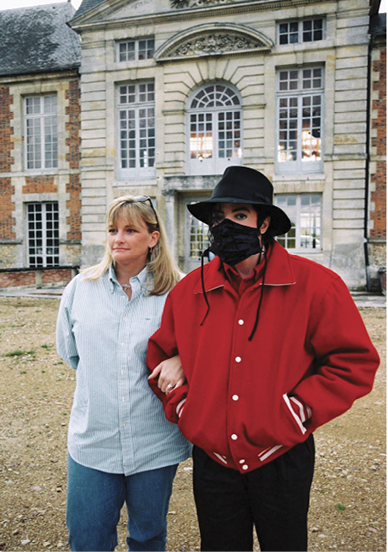
From surrogate mother to wife: Michael with Debbie Rowe in 1997 during a visit to France. Prince (Michael Joseph Jackson, Jr.) had recently been born and Rowe would become pregnant with Paris later that year. (AAR/SIPA)

Michael (here, with Prince and Paris circa 2001) was a proud father—and by all accounts, a devoted and responsible one. (©www.splashnews.com)
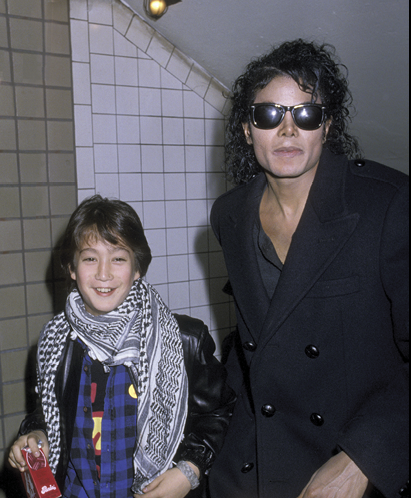
Michael with Sean Lennon on the set of the “Bad” video, 1987. Lennon appeared in the accompanying movie, Moonwalker. (Ron Galella/WireImage)
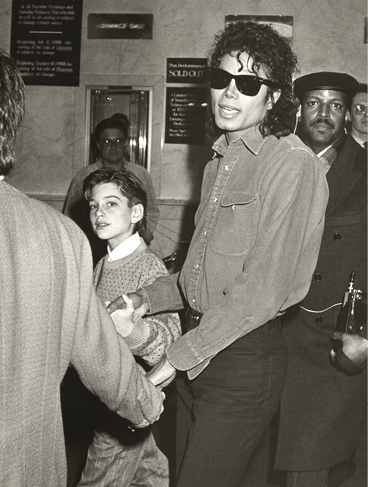
Jimmy Safechuck was Michael’s young friend in 1988, four years before Jordan Chandler. At the time, it was considered odd but harmless. Later every one of Michael’s friendships with young boys would be examined. (Ron Galella/WireImage)

Michael with Jordan and Lily Chandler in Monaco for the World Music Awards, May 1993. Jordie stayed in the same hotel suite as Michael, while Lily and their mother, June, stayed in another. (Nikos Vinieratos/Rex USA)

Michael in Times Square, November 2001, at his first ever in-store appearance, at the Virgin Megastore for Invincible. Jackson seemed to be wearing the nose of his idol Peter Pan.
(©SUZANNE PLUNKETT/AP/Corbis)

Jackson dangling Blanket, face obscured, from the balcony of Berlin’s Hotel Adlon in 2002, where he was accepting a Bambi Award. The incident would provoke an international outcry. (©Tobias Schwarz/Reuters)

Something in common: Michael and Elizabeth Taylor, with whom he shared a painful childhood as a child star and breadwinner, with Arnold Klein, the dermatologist who was friend and doctor to both, at an amFAR event.
(Gregg DeGuire/WireImage)

Michael with Al Malnik’s hands on his shoulders. Malnik was one of several financial advisors who attempted to turn around Jackson’s spending and debt. At left is Brett Ratner, the film director who introduced Jackson and Malnik. In the center is producer Robert Evans. (Ray Mickshaw/WireImage)
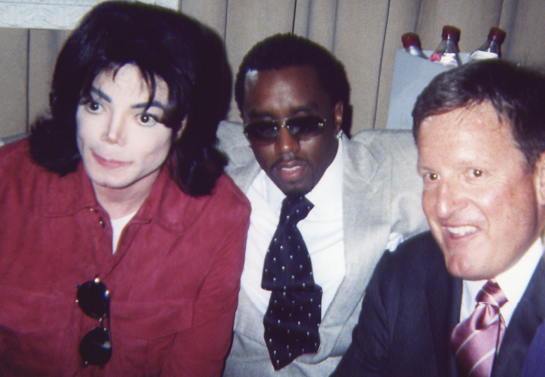
Ron Burkle, the supermarket billionaire and investor, was one of Michael’s financial rescuers. Here, they attended an MTV Movie Awards afterparty in 2003, along with Sean “Diddy” Combs. (Celebrityvibe.com)

Dieter Wiesner was Michael’s manager in the early 2000s, until the criminal trial when the Nation of Islam forced him out. Behind him in the doorway is Leonard Muhammad. (AP Photo/Kevork Djansezian)

Do you want fries with that? Marc Schaffel, one of Michael’s business partners, delivered cash to him in paper bags, which Jackson would call “Supersizing it.” Lack of a paper trail on these payments cost Schaffel some of what he’d hoped to recover in his suit against Michael.
(AP Photo/Nick Ut)
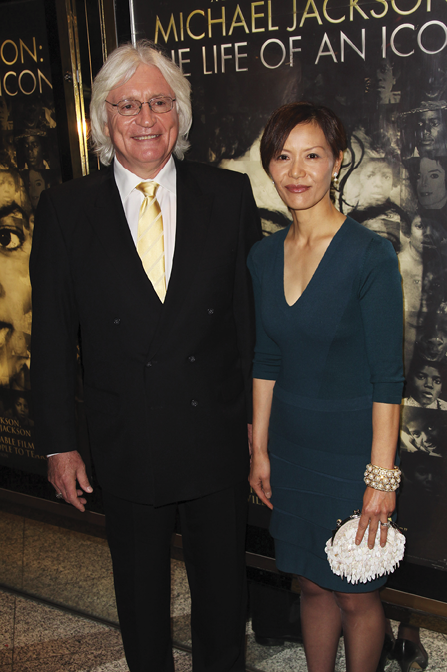
Tom Mesereau and Susan Yu, the legal team who represented Jackson in the Gavin Arvizo case. Mesereau to this day is a staunch defender of Jackson’s reputation.
(Dave Hogan/Getty Images).
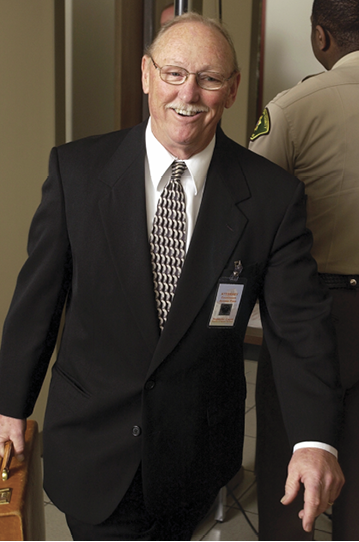
Tom Sneddon, District Attorney of Santa Barbara County, in the middle of Jackson’s criminal trial. Sneddon continued to refer to the Jordan Chandler case as “open but inactive” years after the grand jury refused to indict Jackson in 1994.
(Aaron Lambert-Pool/Getty Images)


Michael had made his own private world at Neverland Ranch in Santa Ynez, California. At top, the main house (John Roca/NY Daily News Archive/Getty Images); from here, visitors could catch a train to the Neverland amusement park (below), with its own carousel and fairground rides, cinema with a working candy counter, and sound system embedded in the landscaping.
(Jason Kirk/Getty Images)
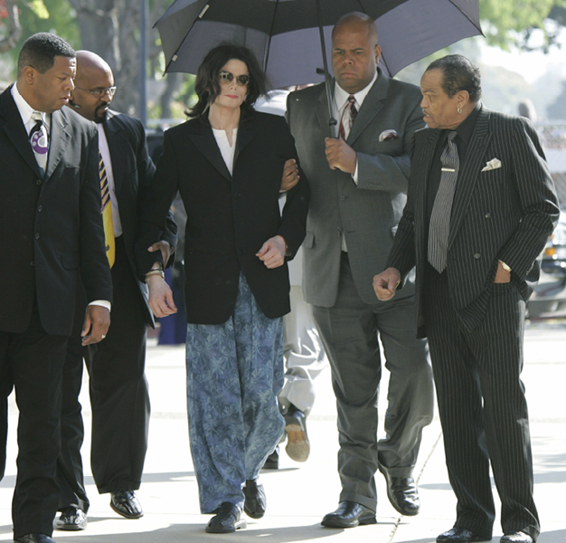
During Gavin Arvizo’s testimony at his criminal trial, Jackson was hospitalized, and nearly had his bail revoked for failing to show up the following morning. Here he is shown entering the courtroom, wearing a blazer thrown over his pajamas and walking aided by bodyguards.
(Kimberly White/WireImage)

By the end of the trial “he was strained beyond description,” according to Tom Mesereau, who is shown here with his client and Susan Yu leaving the courthouse after Michael was acquitted on all charges. Jackson, far from celebrating, was barely eating or sleeping and was hospitalized that night.
(Kevork Djansezian/WireImage)

With Neverland raided and ruined for him, Jackson left it behind. Sheikh Abdullah bin Hamad al-Khalifa, prince of Bahrain, offered him a place to crash. Here, he and Sheikh Abdullah (left) traveled to Dubai and posed with Emirates motor rally driver Mohammed Ben Sulayem. (©epa/Corbis)
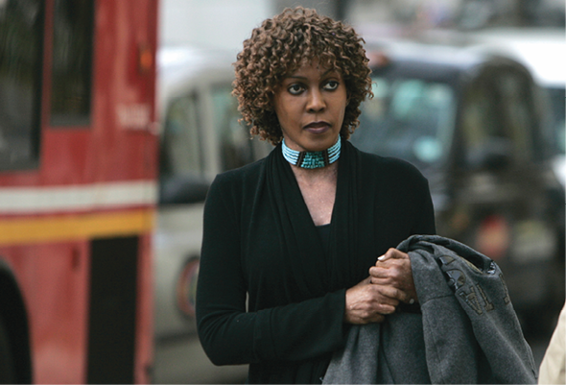
Grace Rwaramba reporting to the High Court in London in November 2008, to testify in Sheikh Abdullah’s suit against Michael for failing to deliver on the album and other projects for which, the Sheikh said, he had paid him advance money.
(©ALASTAIR GRANT/AP/Corbis)

Tohme Tohme became Michael’s manager in 2008 and set up the O2 shows.
(courtesy of Tohme Tohme)

Michael visits with Japanese children from an orphanage, invited specially for a Tokyo fan event.
(Eric Talmadge/AP/Corbis)

Michael walks in Beverly Hills with Paris, Prince, and Blanket, 2009. The kids hated wearing masks, but said after his death that they understood he’d done it to protect them.
(Ciao Hollywood/Splash News)

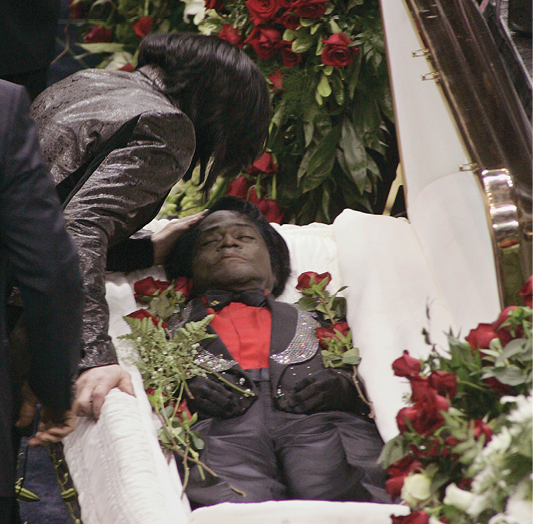
James Brown’s funeral in Atlanta was Michael’s first public appearance after returning to America from Ireland, and a chance to say goodbye to a “chitlin’ circuit” friend whose moves had inspired him, and who had spoken out on his behalf in 2003. Here, Michael is sandwiched between Al Sharpton and Jesse Jackson (Brett Flashnick/WpN); below, he approaches the coffin. His goodbye kiss on the Godfather of Soul’s lips would be a minor scandal. Michael would himself be laid to rest in the same model casket as Brown.
(TAMI CHAPPELL/Reuters/Corbis)

In 2011, Prince, Blanket and Paris (wearing a distinctive “Thriller” video jacket just like her dad’s) joined Jermaine and La Toya onstage in Cardiff, Wales, for a Michael Forever tribute concert. (Samir Hussein/WireImage)

After Michael’s death, fans flocked to his residences in Los Angeles and childhood home in Gary, and to scores of impromptu memorials all over the world. Here, fans mark the year anniversary of his passing at his star on the Hollywood Walk of Fame.
(Frazer Harrison/Getty Images)

Jackson’s children Prince, Blanket, and Paris (L-R) with Katherine Jackson and Justin Bieber at a 2012 Grauman’s Chinese Theatre Hand & Footprint Ceremony. The kids would use their father’s sequined glove and dance shoes to “immortalize” him in the forecourt of the theater.
(Lester Cohen/WireImage)

This memorial, erected by fans in Prague’s Old Town Square a few days after Jackson died, demonstrates that grief for him stretched across the globe.
(STRINGER/AFP/Getty Images)

Moonwalker: Michael Jackson doing his signature move onstage at Wembley during the Bad tour in 1988.
(©Harrison Funk/ZUMApress.com)
Prince and Paris Jackson stepped into the bedroom moments later. Both of them began to cry as they watched Murray and Alvarez struggling to revive their father. Paris fell down on her hands and knees; she began to sob and scream, “Daddy!” over and over again, Muhammad remembered. “Get them out! Get them out!” Murray shouted at the security guards. “Don’t let them see their father like this!” Alvarez called for the nanny, who quickly ushered the two children out of the room and back down the stairs.
It was 12:20 by then and still no call to 911 had been made. Somehow, though, Murray managed to send text messages at 12:03 and 12:04, and data packages—possibly photos or other media—at 12:15 and 12:18. According to Alvarez, Dr. Murray delayed making the call to emergency services so that he could disconnect the IV line (in which “a milklike substance” showed through the tubing) from Mr. Jackson’s leg, then gather up the drug vials strewn about the bedroom. Dr. Murray handed the vials and the IV line to him, Alvarez recalled, then said to load the whole lot of it into medical bags and place the bags in the closet.
It was Alvarez himself who finally made the 911 call at 12:21 p.m. and engaged in the following one-minute-and-fifty-six-second conversation:
911 operator: Paramedic 33, what is the nature of your emergency?
Alvarez: Yes, sir, I need an ambulance as soon as possible.
911 operator: Okay, sir, what’s your address?
Alvarez: Carolwood Drive, Los Angeles, California, 90077.
911 operator: Is it Carolwood?
Alvarez: Carolwood Drive, yes (inaudible).
911 operator: Okay, sir, what’s the phone number you’re calling from and (inaudible) and what exactly happened?
Alvarez: Sir, we have a gentleman here that needs help and he’s not breathing, he’s not breathing and we need to—we’re trying to pump him but he’s not . . .
911 operator: Okay, how old is he?
Alvarez: He’s fifty years old, sir.
911 operator: Okay, he’s unconscious and he’s not breathing?
Alvarez: Yes, he’s not breathing, sir.
911 operator: Okay, and he’s not conscious, either?
Alvarez: No, he’s not conscious, sir.
911 operator: Okay, all right, is he on the floor, where is he at right now?
Alvarez: He’s on the bed, sir. He’s on the bed.
911 operator: Okay, let’s get him on the floor. Let’s get him down to the floor. I’m gonna help you with CPR right now, okay?
Alvarez: (inaudible), we need to . . .
911 operator: We’re on our way there. We’re on our way. I’m gonna do as much as I can to help you over the phone. We’re already on our way. (inaudible) did anybody see him?
Alvarez: Yes, we have a personal doctor here with him, sir.
911 operator: Oh! You have a doctor there?
Alvarez: Yes, but he’s not responding to anything. He’s not responding to CPR or anything.
911 operator: Okay, okay, we’re on our way there. If you guys are doing CPR instructed by a doctor you have a higher authority than me. Did anybody witness what happened?
Alvarez: Just the doctor, sir. The doctor’s been the only one here.
911 operator: Okay, did the doctor see what happened, sir?
[Alvarez can be heard beginning to ask the question before he’s cut off by someone speaking angrily in an uncommon foreign language (many residents of Conrad Murray’s home country speak “Patois Trinidad,” which was first identified as a language by Christopher Columbus in 1498.]
Alvarez: Sir, you just—if you can please . . .
911 operator: We’re on our way. I’m just passing these questions on to my paramedics while they’re on their way there.
Alvarez: Okay. He’s pumping his chest but he’s not responding to anything, sir. Please . . .
911 operator: Okay, we’re on our way. We’re less than a mile away. We’ll be there shortly.
Three minutes and seventeen seconds later, the paramedics came in through the front door of the Carolwood chateau and ran toward the stairs leading to the master bedroom.
“I walked into the hall, and I saw the children there crying,” Kai Chase recalled. “The daughter was crying. I saw paramedics running up the stairs.”
At 12:26 p.m. the paramedics arrived at the bedside of Michael Jackson, where they found him unconscious, not breathing, and in full cardiac arrest. He thought at first that the man on the bed was much older than fifty, recalled paramedic Richard Senneff. The fellow looked like a hospice patient, almost skeletal and with feet that were a disturbing shade of blackish blue. He was startled, Senneff said, when someone told him this was Michael Jackson. Senneff and his partner, Martin Blount, quickly pulled Jackson’s body to the floor and began performing the standard form of CPR the way it should have been done from the beginning.
Kai Chase, along with the children’s nanny and one of the housekeepers, held hands and formed a circle with Prince, Paris, and Blanket in the hallway at the foot of the stairs. “We were all praying,” Chase remembered. “‘Help Mr. Jackson be okay.’ Then everyone was quiet.”
It was obvious to the paramedics within moments that they had arrived too late, Senneff and Blount recalled. Senneff had asked as he came into the bedroom how long the man on the bed had been “down” and was told by the doctor that, “It just happened.” He and Blount, though, agreed that based on Mr. Jackson’s dilated pupils, dry eyes, and cold skin, the man had gone into arrest quite some time ago. Dr. Murray, who was sopping wet with sweat, insisted to the two paramedics that he had phoned 911 one minute after noticing that Michael was no longer breathing.
At 12:57 p.m., the paramedics received permission over the telephone from Dr. Richelle Cooper at the Ronald Reagan UCLA Medical Center to pronounce the patient dead. Dr. Murray responded by kneeling over the body and laying two fingers on the inside of one elbow. He could feel a pulse, Murray told Senneff and Blount, and was refusing to accept a pronouncement of death. Urged on by Murray, the paramedics attempted to restart Michael Jackson’s heart with a defibrillator and deployed an air pump to inflate his lungs. When that failed, Murray got on the phone with Dr. Cooper and her colleague Dr. Than Nguyen, who instructed the paramedics to inject adrenalin directly into Michael’s heart. It had no discernible effect.
At 1:07 p.m., nearly forty-two minutes after their arrival at the Carolwood address, the paramedics loaded Michael Jackson’s body onto a stretcher and carried him to the ambulance, followed by Conrad Murray, who would ride with his patient to UCLA. According to Dr. Murray, Michael still had a faint pulse.
It was about 1:30, Kai Chase said, when security guards ordered her and the rest of the staff to leave the property because “Mr. Jackson was being taken to the hospital.”
Frank Dileo had been eating lunch at the Beverly Hilton Hotel when he received a cell phone call from a Michael Jackson fan who said there was an ambulance in front of the Carolwood house. Dileo immediately phoned Michael Amir Williams to ask if that was true. It was, said Brother Michael, who added that he was on his way to Carolwood right now. After taking the elevator upstairs to change from shorts into long pants, Dileo returned to the hotel lobby, then went out front to retrieve his car from valet parking. He was already driving toward Holmby Hills, Dileo said, when he phoned Randy Phillips, who lived very close to Carolwood Drive. Phillips was at the dry cleaners when he answered the call. He headed quickly outside to his car and started driving to Holmby Hills.
Tohme Tohme was at home in Brentwood when he took a cell phone call from an Internet reporter who asked if it was true that Michael Jackson had had a heart attack. “I said, ‘You gotta be out of your mind,’” Tohme remembered. “And then I got a call from NBC asking the same thing. Then I got a call from ABC. So I told my son to turn the TV on.” The first image that came onscreen was of an ambulance parked in front of the Carolwood house.
Dileo got lost on his way to Carolwood Drive and found the gates to Michael’s house flung wide open with a group of security guards standing out front when he finally arrived. The ambulance had already left with Michael, the guards said. Figuring that the ambulance was headed to Cedars-Sinai Medical Center, Dileo began driving in that direction. While on the road, he again phoned Randy Phillips, who said he was following the ambulance to the hospital. No—it was UCLA, not Cedars, Phillips told Dileo. Moments later, Dileo got a call on his cell phone from the Hayvenhurst estate. It was Katherine Jackson. “I heard they took my son to the hospital,” she said. “I don’t know what’s going on,” Dileo told her. “Give me a minute to find out and I’ll call back.” He was still headed toward UCLA three minutes later, Dileo said, when Mrs. Jackson’s driver called to ask what he should do. “Bring her to UCLA Medical Center,” Dileo told the driver.
The seven-minute ride to the hospital’s emergency room was “unbelievable . . . like the Rose Parade,” Richard Senneff remembered. “People running down the street, taking pictures, random cars passing the ambulance. It was insane.”
By the time Dileo arrived at the UCLA Medical Center, the main lobby was filled with security guards and nobody could get through. He made his way through a crowd to the emergency room, Dileo recalled, and found Randy Phillips waiting. Randy said he wasn’t sure what was going on. The staff in emergency knew who he and Randy were, Dileo said, and permitted the two men through the security door that led back to the room where a team of doctors surrounded the gurney on which Michael Jackson lay. “Outside the room, we heard them working on him,” Dileo recalled. “We thought he was alive. Then—no.”
Dr. Cooper and Dr. Nguyen agreed that Michael Jackson was officially dead an hour and twelve minutes after his body’s arrival at the hospital. Frank Dileo and Randy Phillips walked back out to the emergency room lobby, where they arranged for the wheelchair, the cardiologist, and the social worker who would be waiting when Katherine Jackson arrived at the hospital a short time later.
“It was madness at the hospital when I got there,” Tohme Tohme remembered. “Police, fans, media. The police are keeping everybody back, but they knew me and let me in. I walked in by myself and then I saw Randy Phillips. He told me, ‘We lost him.’ I said, ‘I wanna see him.’ So they took me in a room, he was in a small room, a viewing room. I saw him and it broke my heart. Then I saw Katherine and the kids come in. Everybody was crying. I just couldn’t stand it. I didn’t know what to think or do. I just hugged the kids and started to leave. But Randy Phillips came to me and said, ‘Doc, we need you.’ He and someone else from AEG, I don’t even remember who they were, said we need to go to the conference room to sign some document. I didn’t even know what it was. I was in a daze. I just signed it. Randy said we needed more security at the house, so I called for that. Then Randy said we had to go talk to some administrator at the hospital. As we were walking by he introduced me to Dr. Murray. I said, ‘Who the hell is Dr. Murray?’ And Randy said, ‘This was Michael’s personal doctor.’ The first time I heard they hired a doctor for Michael was the first and only time I saw Dr. Murray. Dr. Murray came in the conference room with us and there was a conversation I can’t talk about. Murray left, and then they said we had to make an announcement to the media.”
The group remaining in the conference room decided that Tohme would introduce Jermaine Jackson, and that Jermaine would address the media.
Michael Jackson had been dead for nearly four hours when his older brother Jermaine, wearing a crisp white shirt and a remarkably calm expression, stood before the cameras and microphones to read a prepared statement that someone else had written.
“This is hard,” he began: “My brother, the legendary King of Pop, Michael Jackson, passed away on Thursday, June 25, 2009, at 2:26 p.m. It is believed he suffered cardiac arrest in his home. However, the cause of death is unknown until the results of the autopsy are known.
“His personal physician, who was with him at the time, attempted to resuscitate my brother—as did the paramedics who transported him to Ronald Reagan UCLA Medical Center. Upon arriving at the hospital at approximately 1:14 p.m., a team of doctors, including emergency physicians and cardiologists, attempted to resuscitate him for a period of more than one hour. They were unsuccessful.
“Our family requests that the media please respect our privacy during this tough time,” Jermaine went on, then added his own addendum: “May Allah be with you, Michael, always. Love you.”
As respectful of Michael’s “personal physician” as the prepared statement had been, a number of those at the hospital already harbored suspicions about Conrad Murray. The doctor was “spinning . . . moving around, nervous, sweating, multitasking,” remembered Richard Senneff, who told the emergency room doctors that Murray had initially told him Mr. Jackson was “dehydrated,” then admitted to giving Michael some Ativan to sleep, but made no mention of any other drug.
Murray would say later that he was upset because Paris Jackson had wept to him that she was now “an orphan.” He told Michael’s daughter that “I tried my best,” Murray said, and the girl answered, “I know you tried your best.”
Even before the public announcement of Michael Jackson’s death, Murray asked at least two people for rides back to the Carolwood chateau. Brother Michael, who had followed the ambulance to the hospital, recalled that shortly after Michael Jackson was pronounced dead Dr. Murray said he needed to return to the Carolwood chateau, “so that he could pick up some cream that Mr. Jackson has so that the world wouldn’t find out about it.” (Dozens of tubes of skin-whitening creams were later found, along with a large quantity of Diprivan, in a medical bag that had been stashed in a cupboard of a closet in Michael Jackson’s bedroom.) Faheem Muhammad, also at the hospital, remembered that Dr. Murray told him he was hungry and wanted to leave. He suggested the doctor eat at the hospital, Muhammad recalled, but watched as Murray walked out of the building anyway.
Travis Payne was driving on Sunset Boulevard, headed to the Carolwood chateau for his 2 p.m. private rehearsal with Michael Jackson, when his cell phone rang. It was a cousin from Atlanta, calling to say he had heard that Michael Jackson had been rushed to the hospital and might be dead. He thought it was just “another big story,” Payne recalled, but when Payne’s mother phoned a few minutes later and said she had heard something similar, “I started to worry,” he admitted. He still figured the whole thing was another hoax, the choreographer said, but decided to drive to the Staples Center to see what was happening there.
“We were getting a lot of rumor calls,” remembered Kenny Ortega, who was already at Staples when Payne arrived. “My phone was just ringing constantly.” He was waiting for Randy Phillips to call from the hospital and tell him “what was really happening,” Ortega said: “Of course, what I wanted to believe was that this was another of those days in the life of Michael where rumor and exaggeration take over.”
He and Kenny agreed that they should just begin getting ready for rehearsal like they always did, Travis Payne recalled. First, though, Ortega gathered the entire production team around him—musicians, dancers, the musical director, the vocal coach, the dance coach, the production and lighting designers, even the technicians—and led them in a prayer that Michael would “return to us in a strong state of health,” as the show director recalled it.
Only a few more minutes passed, though, before Ortega got that call from the hospital. “I just saw Kenny’s face drop,” Payne remembered. They all knew what had happened before Ortega said a word, the choreographer recalled: “Everyone went silent.”
People were slow to react, Travis Payne remembered: “No one wanted to believe it. Finally, we all realized it must be true.” The entire group gathered again, dimmed the lights, lit a candle, and watched the flame flicker in the dark.