
Appendix 2
From 1927 to 1960, with short intermissions, Patricia Highsmith and her parents kept apartments in New York City. Pat was schooled in New York, she started her cahiers and diaries there, and she began both her “secret” career as a scriptwriter for comic books and her public career as a writer of fiction in Manhattan.
Wherever she lived in the world, Pat continued to set many of her novels and stories in New York or in small, imaginary suburban towns—in Massachusetts, Pennsylvania, Connecticut, and New York State—just a railway ride away from the city. New York was a kind of terminal for these fictions, and her imagination went out from it and returned to it again and again.
This map shows some of the “real” addresses in Pat Highsmith’s city life and some of the “fictional” addresses that feature in her work. Often enough the two coincide, especially when Pat had murder on her mind.
FACT
1. Manhattan: The Highsmiths’ first Manhattan apartment on West 103rd Street.
2. Astoria, Queens: The Highsmith apartments on Twenty-first Road and Twenty-eighth Street.
3. Hell Gate Railway Bridge; Wards Island: the largest mental hospital in the United States; Rikers Island: the largest prison in New York State. These two landmarks are in the waters just beyond Pat’s first childhood apartments in Astoria.
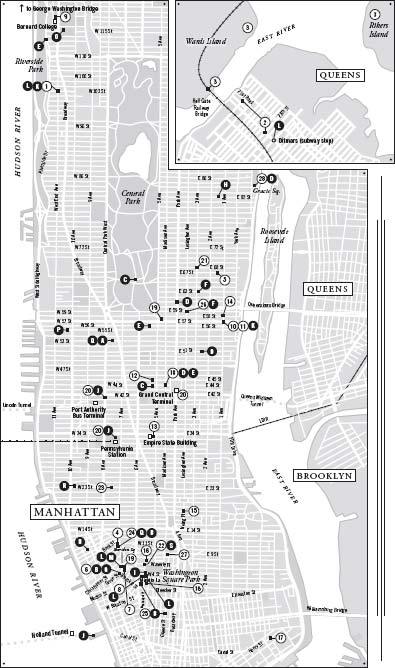
4. The Highsmith apartment at One Bank Street in Greenwich Village (on the site of an apartment building formerly occupied by Willa Cather).
5. Julia Richman High School at 327 East Sixty-seventh Street.
6. The Highsmith apartment at 48 Grove Street. The radical political philosopher Sidney Hook was a neighbor here; John Wilkes Booth is said to have plotted the assassination of Abraham Lincoln in the Federal mansion across the street.
7. Marie’s Crisis Café: The piano bar on Grove Street at whose site Tom Paine died, it is a block from the Highsmith apartment at 48 Grove and next to the building where the murder that inspired the film On the Waterfront took place. Pat loved piano bars and musical comedy; she followed the Revuers—Judy Holliday, Betty Comden, and Adolph Green—in all their Greenwich Village venues.
8. Pat’s summer sublet on Morton Street in 1940. “I consider my experience in Morton Street, my contact with various people there, quite invaluable.”
9. Barnard College, Pat’s “ivory tower,” 1938–42.
10. Mary and Stanley Highsmith’s apartment on East Fifty-seventh Street.
11. Pat’s apartment at 353 East Fifty-sixth Street.
12. Sangor-Pines Comics Shop, 10 West Forty-fifth Street.
13. Timely comics (later Marvel Comics), Empire State Building.
14. Café Nicholson on East Fifty-eighth Street.
15. Pat’s apartment at 75 Irving Place.
16. Village hangouts: The Jumble Shop, the Prohibition era tearoom at 176 MacDougal Street, and the lesbian bar L’s (or El’s) at 116 MacDougal Street.
17. Henry Street Settlement House: Where Pat took piano lessons from Judy [Tuvim] Holliday’s mother.
18. Brooks Brothers, Madison Avenue at Forty-fourth Street, Pat’s preferred place to buy shirts and vests.
19. Art galleries: Christopher Fourth: the Village art gallery belonging to Pat’s friends in Manhattan and New Hope, Peggy and Michael Lewis. The Midtown Galleries where Betty Parsons worked; the Betty Parsons Gallery opened in 1946.
20. Train and bus stations: Pennsylvania Station: The old Penn Station, modelled on the Baths of Caraculla; Grand Central Terminal; Port Authority Bus Terminal.
21. Caso’s Drugstore: Corner of Third Avenue and Sixty-eighth Street, “where I used to go at sixteen and fifteen, when I went to high school a block from here…. And the crises I have known here, the faces I looked for, and saw, or missed, the afternoons metamorphosed by some overwhelming event that happened in school that day, days that twisted one’s life around completely and permanently, I remember them.”
22. The Hotel Earle: corner of Waverly Place and Washington Square (now the Washington Square Hotel); Pat stayed here and so did Mary Highsmith.
23. The Chelsea Hotel: Pat stayed here several times in the 1960s when she was taking notes on her old Greenwich Village haunts.
24. Kingsley Skattebol, Pat’s friend from Barnard, had an apartment on West Eleventh Street.
25. Buffie Johnson, Pat’s old friend, owned a loft building at 102 Greene Street.
26. Bloomingdale’s department store: Pat, in real life, met Kathleen Senn here while she was working in the toy department and living on East Fifty-sixth Street.
27. The East Village and East Ninth Street: Respectively, the artistic domain and home of writer and performance artist Lil Picard, Pat’s longtime friend.
28. Gracie Square: The Upper East Side address where Pat visited the painter Fanny Myers [Brennan], who, like Cleo in The Talented Mr. Ripley, painted miniscule landscapes.
FICTION
A. Strangers on a Train: Guy Haines’s apartment on West Fifty-third Street which Charles Bruno, his Alter Ego, haunts.
B. Found in the Street: Ralph Linderman’s apartment on Bleecker Street Pat makes two geographical errors in Found in the Street: she gives Ralph a job at an arcade on Eighth Avenue in the West Eighties. Eighth Avenue becomes Central Park West at Fifty-ninth Street, and the arcades themselves would have been in the West Forties.
Found in the Street: Natalia and Jack Sutherland’s apartment on Grove Street.
Found in the Street: Elsie Tyler shares an apartment on Minetta Lane and works in a coffee shop on Seventh Avenue South. She is photographed at the Chelsea Hotel.
Found in the Street: The Armstrongs’ apartment on West Eleventh Street. (Kingsley Skattebol had an apartment at West Eleventh Street.)
Found in the Street: Elsie Tyler’s apartment on Greene Street, where she is murdered. (Buffie Johnson owned a loft building at 102 Greene Street.)
C. The Blunderer: West Forty-fourth Street: Walter Stackhouse’s law office, around the corner from the Sangor-Pines office.
The Blunderer: Central Park, where Walter Stackhouse mistakes a stranger for Melchior Kimmel, kills him, and is himself murdered by Kimmel.
D. The Talented Mr. Ripley: East Fifty-first Street between Second and Third avenues is where Tom Ripley shares a dingy brownstone apartment with Bob, “a window dresser.” He receives extorted checks there under the name George McAlpin. Previously Ripley lived in a brownstone on East Forty-fifth Street with a man who likes to shelter young men.
The Talented Mr. Ripley: Park Avenue: home of Dickie Greenleaf’s parents, Herbert and Emily.
The Talented Mr. Ripley: Gracie Square: Ripley’s friend, Cleo Dobelle, who paints pictures so small they can be viewed only through a magnifying glass, lives at this Upper East Side address.
The Talented Mr. Ripley: Brooks Brothers: Tom Ripley buys clothes for Dickie Greenleaf and himself here.
E. This Sweet Sickness: Romeo Salta’s Restaurant on West Fifty-sixth Street where David Kelsey, in the character of his Alter Ego, William Neumeister, appears with his imaginary girlfriend Annabelle and insists on “Two orders of everything, please.” The owner of Salta’s later sent Pat a case of wine in New Hope to thank her.
This Sweet Sickness: 410 Riverside Drive, the apartment from which David Kelsey/William Neumeister jumps to his death (near Barnard College in Morningside Heights).
This Sweet Sickness: Brooks Brothers: Kelsey/Neumeister wants to shop here, but can’t.
F. The Price of Salt: Frankenberg’s department store (Bloomingdale’s in real life) at Fifty-ninth Street and Lexington Avenue, where Therese meets Carole, while working in the toy department.
The Price of Salt: East Sixty-third Street is where Therese lives; it is also where Pat rented her first room after graduating from Barnard College.
The Price of Salt: Frankenburg’s department store (Bloomingdale’s in real life). Pat has a salesgirl steal Therese’s steak from the cloakroom—“Wolves, she had thought, wolves, stealing a bloody bag of meat”—just as someone stole her own steak while she was working at Bloomingdale’s in December of 1948.
G. Edith’s Diary: Edith Howland’s apartment on Grove Street, where Cliffie tries to suffocate the family cat.
H. The Cry of the Owl: The apartment on East Eighty-second Street where Nickie Jurgen, Robert Forester’s pathological ex-wife, lives with her new husband. She hides Robert’s opponent, Greg Wyncoop, in a shabby hotel “off Fourth Avenue.” Fourth Avenue is also where Carol, at the end of The Price of Salt, gets a job in a furniture store.
I. The Tremor of Forgery: Howard Ingham’s apartment on “Fourth Street near Washington Square” where John Castlewood, the director of the film Howard is writing, kills himself.
J. Strangers on a Train, The Price of Salt, The Cry of the Owl, This Sweet Sickness, etc.: all novels in which the Holland Tunnel, the George Washington Bridge, the Port Authority Bus Station, and New York’s two train stations are featured.
K. “The Terrapin”: Victor, who murders his artist mother (and is given Pat’s childhood preferences in books), lives with his mother on Riverside Drive (on the Upper West Side, where the Highsmiths first lived in Manhattan), then on Third Avenue, in the vicinity of Mary and Stanley Highsmith’s last New York apartment.
L. A Dog’s Ransom: Riverside Park, where Tina the poodle is kidnapped and killed. The dog’s owners, Greta and Ed, live nearby on West 106th Street.
A Dog’s Ransom: 103rd Street and West End Avenue, where Kenneth Rowajinski, the poison-pen writer and dog killer, lives. It is the site of the Highsmiths’ first apartment in New York. York Avenue in the East Sixties: the ransom dropoff for the dog is near Pat’s first rented room in the East Sixties, and near the Julia Richman High School on East Sixty-seventh Street.
A Dog’s Ransom: Astoria: Clarence Duhamel, the good cop, is brought up in Astoria, reading the authors Pat read: Krafft-Ebing, Freud, Dostoyevsky, and Proust. He also has Pat’s home subway stop, Ditmars—which she misspells in the novel. MacDougal Street in Greenwich Village is where he stays with his girlfriend.
A Dog’s Ransom: Morton Street: the location of the apartment to which the dognapper Kenneth Rowajinski is released from Bellevue Hospital. He is killed there.
M. The Click of the Shutting: Gregory Bullick lives in a Greenwich Village loft with his father. His subway stop is Pat’s home stop when she was his age and living on Grove Street: the Christopher Street station at Sheridan Square.
N. “Blow It” (from The Black House): Jane Street, Harry Rowe’s apartment in Greenwich Village where he separately entertains the two women he can’t decide to marry.
O. “The Baby Spoon” (from Slowly, Slowly in the Wind): Faculty housing near Columbia University (Pat’s alma mater) where Claude Lamm, the pompous professor, is murdered by his former student, Winston, who steals his wife’s baby spoon. “Claude suspected that Winston had a vaguely homosexual attachment to him, and Claude had heard that homosexuals were apt to take something from someone they cared for.” Winston lives in a “genuine garret at the top of a brownstone in the West Seventies.”
P. “The Romantic” (from Mermaids on the Golf Course): West Fifty-fifth Street: location of the apartment where Isabel Crane takes care of her invalid mother.
Q. “The Network” (from Slowly, Slowly in the Wind): “Seventh Avenue and 53rd Street” along with “West 11th Street, Gramercy Park, even Yorkville”—all of them considered “hearts of the city” by a network of friends in Manhattan portrayed by Pat as part of the great scamming racket that is New York. The “East Village” is a place where blacks “cut your fingers off if they can’t get the rings off” easily.
R. “The Still Point of the Turning World”: Mrs. Robinson lives in the London Terrace Apartments on West Twenty-third Street. Philip and Dickie have their encounter in the little park on the West Side Highway.
S. “Notes from a Respectable Cockroach”: The Hotel Earle (Pat calls it the Hotel Duke) inspired this cockroach story.